Executive Summary
The world of financial advisor conferences has evolved tremendously over the past 15 years. Yet while conferences were punctuated by a great pause due to COVID, the underlying shifts are driven more by how the growth of the internet is still reshaping both the ways that advisors get their education and professional development, and also how sponsors – the historical lifeblood of conferences – choose to reach advisors.
In the past, the primary conveners of advisor conferences were the membership associations, who with thousands (or tens of thousands!) of members were the largest aggregations of advisors, especially amongst independent advisors. As such membership associations were the best positioned to invite their members to a conference, charge sponsors for visibility and access to the advisors at the conference, use the dollars to host the conference and invite speakers that would drive turnover, and use the net proceeds left over to grow and advance the mission of the membership association.
More recently, though, this has substantively shifted. This is in part because conferences are no longer quite the driver of continuing education that they once were, as more and more high-quality CE providers become available online. But additionally, this is because the internet steadily undermined the print and then eventually online advertising models of industry media companies… leading them to instead go into the conference business and compete against membership associations for the sponsor dollars. While at the same time, the vendors that once paid membership associations their sponsorship dollars grew and scaled themselves to the point that many now run their own "user" conferences that rival or exceed the size of membership association events!
All of which means now there are more conferences than ever before, from more event organizers than ever before… and it's become increasingly difficult and even overwhelming for advisors to choose what to attend!
As someone who has been speaking at 50–70 in-person and virtual conferences every year for nearly 20 years myself, I've seen the good and bad of our wide range of industry events, from the industry associations to the broker-dealers and insurance companies and RIA custodians, the rise of vendor conferences and media-driven events, private company events, and more. As a result, I am often asked for my own suggestions of what, really, are the industry's 'best' conferences to attend, and back in 2012, I started to craft my own annual list of 'best-in-class' top conferences for financial advisors.
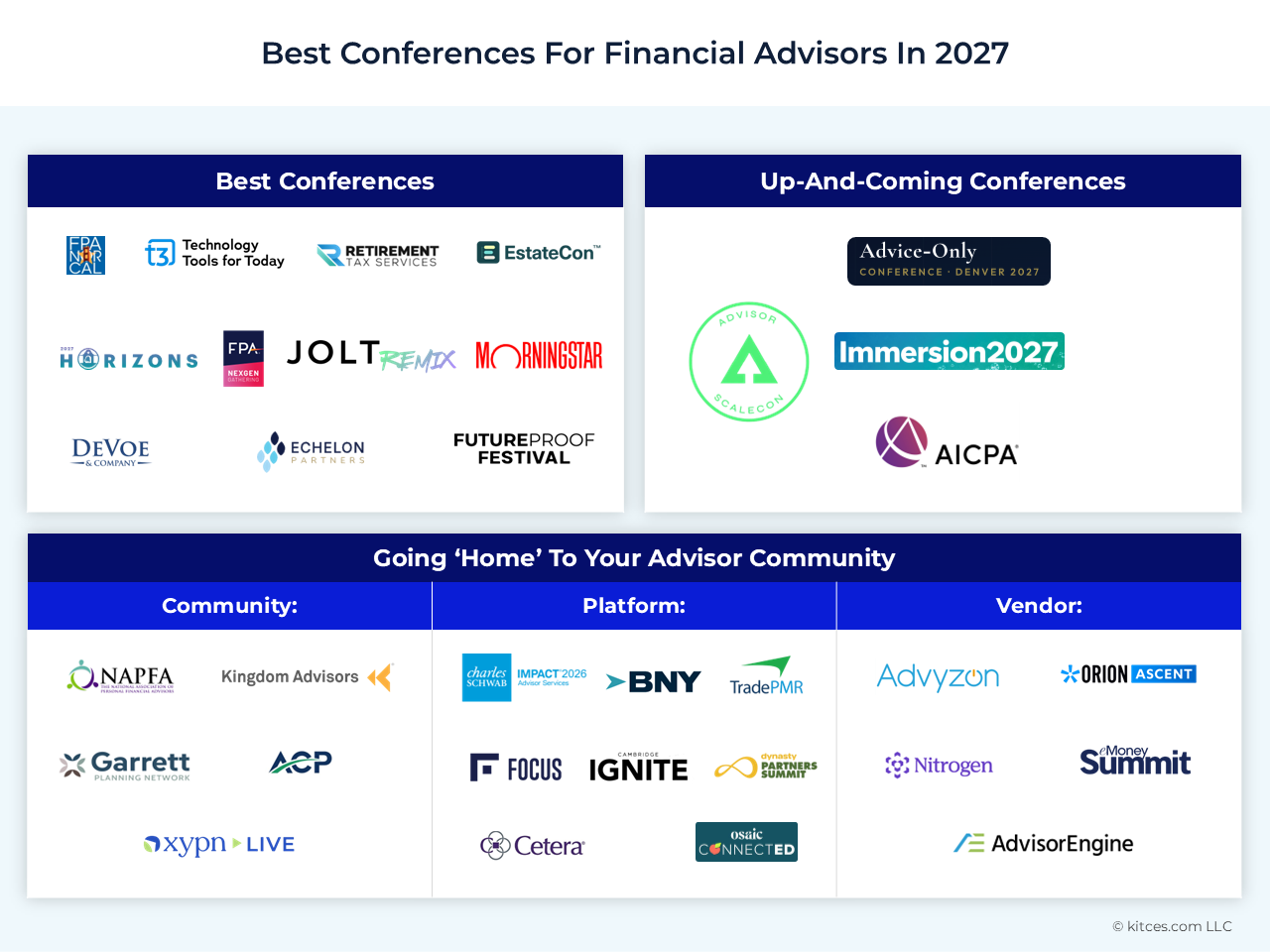
Having updated our annual conference list every year since, I'm excited now to present my newest list of "Top Financial Advisor Conferences" for the upcoming 2027 year, from events on advisor technology to marketing, practice management scaling to succession or developing next-generation talent, to the top events for those who still use conferences to up their technical game in areas like tax planning, estate planning, and retirement planning. Plus a few events that are simply great, well-rounded experiences for those who want to enjoy the conference, the destination, the sessions they attend, and their fellow attendees.
In addition, we've also updated our popular "Master Conference List" for all financial advisor conferences we could find for 2027, both for advisors looking for a wider range of events to attend (if you want to delve deeper into a particular topical area) and for vendors looking for more conferences to exhibit at! (And as more 2027 conferences are announced in the coming months, we'll continue to update the Master Conference List well into the coming year!).
So I hope you'll find this year's 2027 top conferences list (and our updated Master Conference List) to be helpful as a guide in planning your own conference budget and schedule for next year, and be certain to take advantage of the special discount codes that several conferences have offered to all of you as Nerd's Eye View readers!

Where available, Nerd's Eye View reader discounts are highlighted in red.
Best Conference For/In: Best Overall | Best Technology | Best Tax Planning | Best Estate Planning | Best Retirement Planning | Best For New Advisors | Best Marketing | Best Investments | Best M&A And Succession | Best Experience | Up-And-Coming Conferences
Prior Years' Best Conferences List: 2026 | 2025 | 2024 | 2023 | 2022 | 2021 | 2020 | 2019 | 2018 | 2017 | 2016 | 2015 | 2014 | 2013 | 2012 | Master Conference List
For Conference Organizers: For the embed code to post a "Top Advisor Conference in 2027" badge to your own conference website, or scroll to the bottom of this page.
For Vendors/Exhibitors Considering Sponsorships: Hopefully, this list will be helpful to you in deciding which conferences to potentially attend and exhibit at. For further ideas, please see our comprehensive master list of all financial advisor conferences, along with the earlier years' Best Advisor Conference lists (noted above). There are also many opportunities to exhibit at various FPA chapters, some of which have a sizable (150+) attendance at annual chapter symposia. For those seeking further assistance, we have limited availability to consult directly with companies on distribution and go-to-market strategies to reach financial advisors as well.
15 Years Of Evolution And Innovation In Advisor Conferences
It was back in 2012, a whopping 15 years ago, that the Nerd's Eye View published its first "best conferences" list. At the time, I was doing an increasing volume of speaking at the various membership associations that hosted events – from the FPA to NAPFA, IMCA (now Investments & Wealth Institute) to SFSP – and because most associations did multiple conferences each year (it was common for most of the associations to do 3–5 different annual events of various sizes), the number of choices were becoming overwhelming. So advisors began to ask me which conferences were the "best" to attend because I was seeing them all first-hand, and I published an article to share my own experiences.
At the time, the conference business was very much on the rise, driven indirectly by the rise of the independent advisor (both RIAs and the ongoing evolution of independent broker-dealers). As up until that point, if asset managers and their wholesalers wanted to reach advisors, the easiest way to do it was simply to go to a local physical branch location of the brokerage firm or insurance company, buy everyone lunch, and share the company's latest products.
But the rise of advisor independence changed this in two ways. First and foremost, it contributed to the relative fracturing of advisors by channel and location; suddenly it was no longer 30 advisors in one branch location, it was 30 advisors with 30 independent offices, which substantially undermined the ROI for wholesalers who didn't want to incur the time and cost to visit each one individually. At the same time, the expansion of independent advisors also expanded the ecosystem of technology and service providers for independent advisors (a moot point historically when working for a large firm where the mothership provides all!), which meant there was a growing crop of software vendors and industry consultants also seeking to gain access to advisors. And the membership associations were the easiest way to get in front of a large number of advisors at once, especially independents (who were more likely to join membership associations because they, too, often struggled with the lack of camaraderie by no longer being in a sizable multi-advisor branch office).
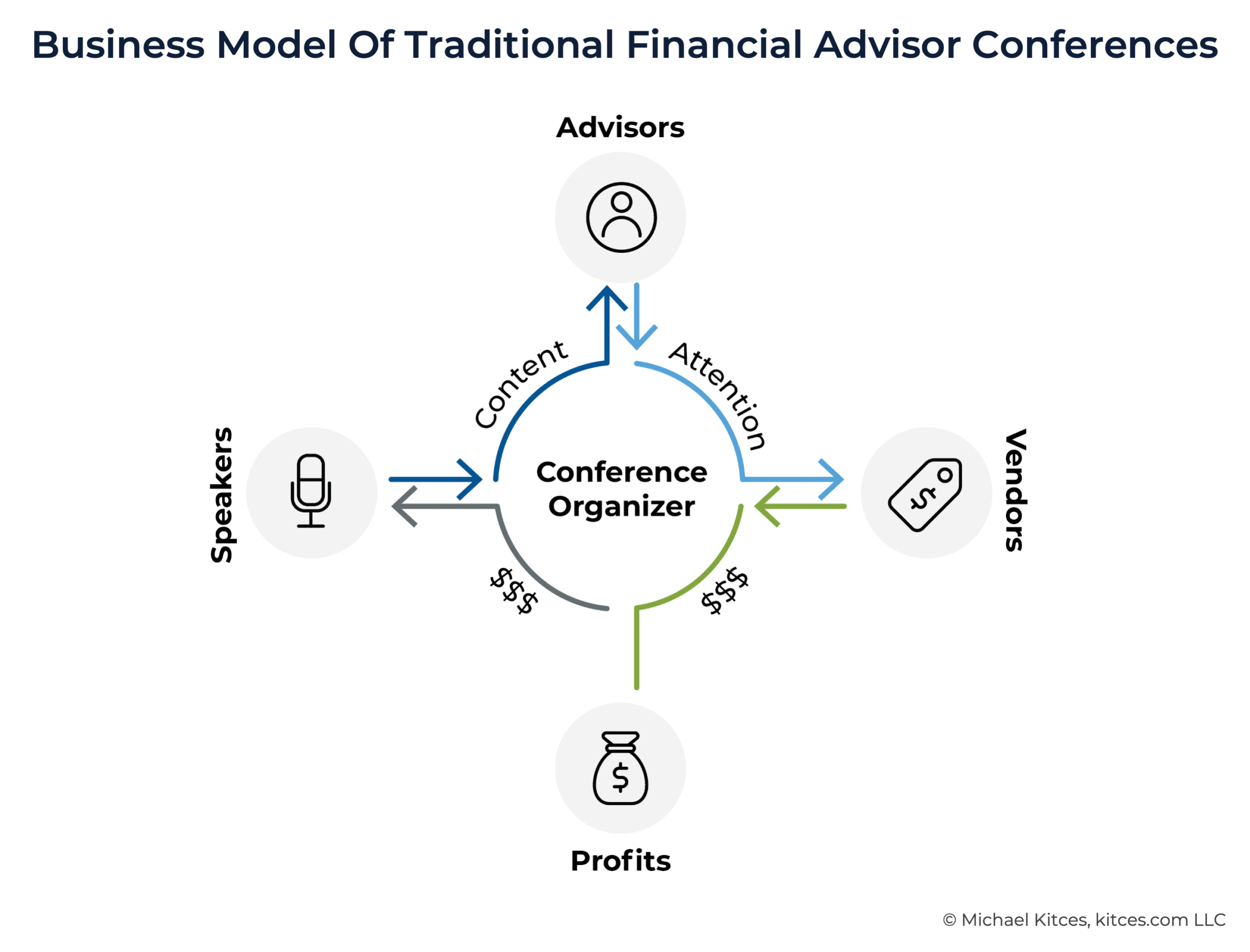
And the model worked because ultimately, sponsors wanted to get in front of advisors, membership associations had connections to advisors and an ability to bring them out to events, and the association was thus able to earn a profit by convening advisors, receiving dollars from the sponsors who wanted to reach them, using those dollars to hire speakers and run the event, and keeping the difference to earn a profit and ultimately advance their own association mission.
How The Internet Reshaped The Conference Business: The Rise of Media And Vendor Events
The dominance of membership associations in conferences in the 2000s and early 2010s was driven in part by a clear channel delineation: the media worked with vendors for media (first print, then online) advertising, while the associations worked with vendors for sponsorships of in-person events. Asset managers and insurance companies, and then increasingly advisor platforms and technology providers, allocated a portion of their marketing budgets to each.
But then as advertising competition intensified with the explosion of online media and then the relative competition of social media and search platforms (e.g., Facebook and Google) for those same advertising dollars, media companies were forced to begin pivoting from advertising to sponsorships. As most media companies realized that because they already had a sizable mailing list and readership, they could also convene and host their own conferences, especially as they already had relationships with prospective sponsors. They could simply cross-sell sponsorship opportunities to their existing advertisers.
Accordingly, nearly all the major media publications, from Financial Planning to Financial Advisor, Investment News to Barron's, began to run various sponsor-driven media-hosted events, from standalone conferences to awards events that assemble "top" advisors (typically to recognize the largest and fastest-growing, which not coincidentally are the ones sponsors are most excited to be in front of!). And suddenly the membership associations were facing real competition for the limited pool of available sponsorship dollars, and the limited bandwidth of financial advisors who may only attend one conference per year.
At the same time, the internet spawned a massive rise in independent technology vendors serving an increasingly sizeable independent advisor community. As in decades past (e.g., the 1990s and 2000s), the largest technology providers were major platforms (i.e., wirehouses and insurance companies) that had enough advisors to amortize the sizable costs of building software from scratch; technology for independent advisors was a tiny segment of micro-businesses, most of which were simply financial advisors who, in frustration of being unable to find any good technology solutions to solve their problems, built their own software and then started selling it to their peers (the creation journey for a wide number of today's household AdvisorTech providers, from Junxure-now-AdvisorEngine to Redtail, Orion to Tamarac, iRebal to eMoney, and more).
But starting in 2000s and accelerating in 2010s, independent technology providers grew, exemplified by eMoney and MoneyGuide deals for hundreds of millions, which had grown by then to already be serving tens of thousands of advisors (which gave each a larger user base than all the wirehouses combined!). And as the technology vendors grew, they realized that they didn't have to only pay to sponsor other (association or media) conferences, they had enough of a user base to build their own events! A trend that only accelerated in COVID, as in-person conferences were shut down for nearly two years, and vendors had to reallocate their budgets to engage speakers directly for their own (virtual webinar) events... and discovered that it worked so well that they'd continue to run their own in-person events as post-COVID travel rebounded.
Thus the rise of a number of industry vendor conferences that also surpass the turnouts of traditional association events, including Envestnet's Elevate, Orion's Ascent, and Nitrogen's Fearless Investing Summit.
Modern Conference Innovation: Communities And For-Profits
The modern reach of the internet and social media platforms hasn't just transformed the advisor conference landscape by shifting more events to be run by media companies and the industry vendors themselves. It's also made it easier than ever for anyone to start their own advisor conference, get the word out, and find a community of like-minded advisors who might want to participate alongside.
As a result, recent years have seen a rapid expansion of new conferences for often hyper-niche focused communities of advisors, from Sway for advisors building a personal brand to AdviseAI as the artificial intelligence moment has taken hold to the RTS Summit for advisors who want to go deep on applied tax planning.
In fact, because overhead costs can be fairly low and most of the expenses of hosting a conference are variable (e.g., food and beverage on-site at the event), more new conferences than ever launched in just the past few years. Most aren't very big (though some have quickly grown to be sizable), but most don't need to be very big in order to successfully serve the communities and topics they're aiming to convene around.
At the same time, there is clearly an ever-present and even growing hunger to get out and connect with others, as social media and now AI seem paradoxically to be making us feel lonelier and more isolated than ever.
Which helps to explain the phenomenon that is FutureProof, which now pulls nearly 10,000 attendees split between their two east (Citywide) and west (Festival) conferences annually… each of which is larger than any membership association conference ever was! Because even high-quality CE is now increasingly available online, so advisors really tend to turn out in-person for one of three things: a community to connect to; specialized knowledge focus; or an experience. Which are the three types of conferences we see thriving now.
But over a 15-year span, it means a best-conferences list that historically was dominated almost entirely by membership associations now has just two membership association events, surpassed by a half-dozen vendor-driven conferences, and several more "for-profit" conferences operated by standalone conference organizers who simply saw an opportunity to serve a particular segment of advisors who had a need that wasn't being met in the prior conference landscape.
Finding The 'Best' Advisor Conference (For Your ROI)
The good news of this ongoing trend of expansion in advisor conferences (and the range of organizations convening such conferences) is that it provides a richer tapestry of conferences choices than ever before. The bad news is that it becomes harder than ever to figure out which one to attend as choice overwhelm and decision fatigue sets in! Especially since the reality is that different conference organizers really do have a different focus in the type of content they're putting on the agenda and the type of advisor they aim to serve. Which, alas, isn't always clear from the conference name itself, making it difficult sometimes to figure out which conferences will really be 'best' in any particular domain.
However, as noted earlier, this is the exact challenge we've set out to help the advisor community solve since 2012 when we published that first annual list of the Best Financial Advisor Conferences! Which seems to be more relevant than ever today, as the Kitces team of speakers continues to present at dozens of conferences every year, both to serve the advisor community… and indirectly continue to gain first-hand perspective on which events are particularly good and worth recommending (or not)…
To that end, our "Best Conferences" list this year spans a wide range of conference organizers, topic domains, knowledge specializations, and advisor sub-communities, to help all of our readers find that conference most relevant to their individual advisor needs and circumstances. As ultimately, the 'best' conference is only determined relative to the advisor themselves and whatever their own needs and goals are, to get the ROI that makes it – in terms of both the financial cost, and the cost of time – worthwhile to attend.
 Best Overall Financial Planning Conference: FPA NorCal 2027

The FPA NorCal conference is hosted annually by a coalition of about half a dozen Financial Planning Association (FPA) chapters in the Northern California/greater San Francisco area, that first came together more than 50(!) years ago in 1972 with the realization that they could create a much stronger regional conference together than any individual chapter could on its own. Yet despite being a "regional" conference, NorCal's finely tuned systems and processes for planning and executing the event – down to nearly 20 years at the same beautiful Palace Hotel venue – ensure that the conference is consistently, year after year, a national-caliber financial planning event.
 The typical NorCal conference agenda anchors around nationally recognized keynote speakers, from investment experts like Schwab's Liz Ann Sonders, JP Morgan's David Kelly, and Ariel Investments' Mellody Hobson, to business experts and pioneers like Greg McKeown of Essentialism and Salman Khan of Khan Academy, plus inspiring success stories like soccer hall-of-famer and Olympian Brandi Chastain and Olympic-figure-skater-turned-philanthropist Kristi Yamaguchi, paired with a series of five parallel breakout tracks of financial planning content. (Which typically includes yours-truly, and often 1-2 other Kitces team speakers as well!)
The content features a mixture of practice management sessions along with more technical CE, many of which run 75-100 minutes (not just the 'usual' 50-minute CE session) to allow room for the speakers to delve deeper into their topics. Which is welcomed, because the FPA NorCal conference has a rigorous speaker selection and vetting process and does not permit any 'pay-to-play' sponsored sessions… which makes it a lineup of speakers that advisors actually would want to listen to longer!
In fact, often, the biggest challenge at NorCal is that you'll want to see multiple sessions that conflict with each other in the same time slot – and thus NorCal was also one of the first industry conferences to pioneer the effort of recording every session (general and all breakout sessions), making all recordings of all sessions included as part of the registration fee for all attendees. (So even if you can't attend every session in person, you'll get every bit of content as a registered attendee!)
An added benefit of the NorCal conference is that because it always falls on the Tuesday and Wednesday after Memorial Day (which, notably, is late in 2027 on May 31st, so the conference itself is the first two days of June!), it's a great 'destination' conference to claim a deductible business expense for the flight but starting the trip with a long Memorial Day weekend in San Francisco (or if you prefer, perhaps visiting the wineries of Napa and Sonoma Valleys). And for those who like to use their hotel/travel/credit-card points, the Palace Hotel is now a Marriott property!
The one important caveat, though, is that because NorCal started out as a regional conference and has morphed into a national event, it does have a capacity limitation (the main ballroom of the Palace Hotel caps out at approximately 600 attendees), so those who are interested should register early because the event does get completely sold out in many years!
Who Should Attend: Experienced financial advisors who really want to attend high-quality conference sessions and are looking for a well-run event (or those who simply want a nice destination conference to travel to with a significant other!?).
Details: June 1–2, 2027, at The Palace Hotel in San Francisco, CA.
Cost: $1,300 for FPA members and $1,725 for non-members. Early bird pricing of $1,050 for FPA members and $1,500 for non-members is available through January 31.
Conference Website: FPA NorCal 2027
Best Technology Conference: Technology Tools For Today (T3) Advisor Conference 2027
 While historically, independent financial advisors had very few choices of technology to use in their advisory firms – since the 'best' technology was built by the biggest enterprises (wirehouses and insurance companies) as proprietary software for their own advisors – in recent years, the technology landscape has blossomed, to the point that today the Kitces AdvisorTech Map tracks nearly 600 different technology solutions for financial advisors.
Yet, with more choices than ever comes more due diligence responsibility to vet and compare more vendors than ever, such that many advisory firms find it's more challenging to pick the 'right' technology solution today than it was a decade or two ago, when advisors were compelled to pick from often no more than two to three homegrown solutions in each major category. And ironically, the explosion of AI only seems to be exacerbating the problem, as AI makes it easier than ever to develop a prototype and launch an initial software product, such that the AdvisorTech Map is now adding an average of more than 10 new companies per month aiming to serve financial advisors.
As a result, what was once a difficulty in just finding solutions (given that most advisor technology companies simply haven't been able to afford the exhibitor booths at traditional advisor conferences, where vendors selling $49/month software are often expected to pay the same exhibitor fees as trillion-dollar asset managers) has now turned into a difficulty in comparing an increasingly overwhelming number of solutions (where few advisors want to spend hours going through sales calls and demos with each of half a dozen vendors or more).
Yet the good news is that helping advisors navigate this landscape, since the beginning, is what advisor-technology consultants Joel Bruckenstein and David Drucker set out to do in originating their newsletter-turned-conference, which they dubbed "Technology Tools for Today" (T3).
And nearly 25 years later, the T3 Advisor Technology conference is still the leading conference for advisor technology… though to be accurate, it is arguably less of a 'conference' (where advisors attend sessions for educational content) and more of a 'trade show' where advisors come to see the latest wares in the exhibit hall, and attend sessions that are almost exclusively presented by the vendors/sponsors. Which, at most advisor conferences, would be a bad thing – vendors selling their wares from the stage instead of providing advisor education. In the case of T3, this is exactly what advisors want: an opportunity to see one vendor after another, from showcases of their recent releases (what they've spent the past year building) to their roadmap (what they're working on in the coming years). Because that's the whole point of a trade show for advisor technology – to function as a comparison-shopping trip!
A notable addition for T3 in 2027 is their "AI University", a full-day pre-conference workshop with advisors showing real-world use cases for AI in their firms and technology experts highlight best practices and how advisors can implement more AI for themselves. Offered previously as a separately-priced pre-con session, this year AI University is included as a part of the standard registration fee, or those who want to attend only the AI University workshop can register separately for the one day at a lower rate.
For tech vendors deciding whether to participate, it's notable that even by 'trade show' standards, the T3 conference is still not a 'huge' buying audience for AdvisorTech companies looking for new users (historically, as much as half of the ~1,000 attendees are fellow software vendors, media representatives, and industry consultants). Though the conference does typically attract not only individual advisors but also technology decision-makers at larger advisor enterprises (e.g., mega-RIAs and independent broker-dealers) who present more of a seat-count opportunity than 'just' the raw attendee headcount of T3.
Still, in practice, the primary 'ROI' for software vendors that exhibit at T3 is typically measured not by the number of new users, but by the chance to gain better visibility amongst industry 'influencers' (as T3 has historically been very well covered by industry media and independent consultants who make enterprise recommendations), and the potential to establish relationships with other tech vendors that might be future integration partners (or even future strategic acquirers!).
Who Should Attend: Advisory firm owners (or their technology decision-makers in larger advisor enterprises) who are either independent or making the transition to independence and want an efficient way to see the full breadth of advisor technology solutions all in one place.
Details: March 22–25, 2027, in Las Vegas, NV. (AI University pre-con on Monday March 22nd.)
Cost: $1,199. Early-bird pricing of $999 is available through November 30th. $499 for those who only want to register for AI University as a standalone. Nerd's Eye View readers can receive $200 off the prevailing conference rate with the T3KITCES200 discount code.
Conference Website: T3 Advisor Technology Conference 2027
Best Tax Planning Conference: RTS Tax Summit 2027
 For nearly 15 years since the first emergence of the robo-advisor, industry commentators have been warning of fee compression as a result of the competitive forces of technology. Yet as it's turned out, the median advisor fee has remained quite stubbornly fixed at 1% on $1M of AUM, and instead of cutting fees as technology provides ongoing efficiencies, advisors have been reinvesting into their value proposition to expand services and do more for their clients (and continue to validate their existing 1% AUM fees).
The pressure to do more and show more value, writ large across the industry, helps to explain everything from record numbers of CFP exam takers (just arising now, more than 50 years after the first CFP class!), to the explosive interest in tax-aware long-short strategies and more generally a growing interest in providing more tax planning (and even outright tax preparation) for clients. Especially given that one of the fundamental challenges of financial planning is that much of its value is very long term, and while it is truly valuable, it's difficult to tell clients, "You're going to pay me these fees for the next 30 years, but trust me you're totally going to appreciate it in the long run." (Even if it really is true!) Whereas the benefits of tax planning are often much more concrete… ("Mr. and Mrs. Client, I saved you $4,216 in taxes last year!"), leading more and more financial advisors to engage in proactive tax planning with clients.
Yet doing in-depth annual tax planning – or outright bringing tax preparation in-house – is a substantive shift for most advisory firms. It raises challenging (albeit navigable) questions of how far advisors can go in tax planning before delving into the domain of Tax Advice that requires separate licenses. It can shift the cadence of planning meetings to align with the tax planning cycle (e.g., a client service calendar that targets end-of-year tax planning across the entire client base in the fourth quarter). And it often requires new tax planning software and client deliverables.
To fill this void, the RTS Tax Summit emerged in 2023 to help advisors engage more deeply in tax planning. Unlike other 'tax planning' conferences over the years – such as the AICPA ENGAGE conference – the RTS Tax Summit is unique in its focus not just on 'advanced tax planning' strategies, but the practical realities of trying to embed tax planning within an advisory firm (as opposed to AICPA's focus on tax planning for those who are already CPAs with an existing tax practice).
The Tax Summit is led by Steven Jarvis, a CPA who also runs Retirement Tax Services (RTS, which initially developed an outsourced tax preparation service for financial advisors and now has developed a membership community for financial advisors that want to delve deeper into annual tax planning with clients), in conjunction with Matthew Jarvis and Micah Shilanski of The Perfect RIA podcast. Which brings the event a very practitioner-oriented approach on how to actually 'do' tax planning for clients… including tax planning checklists, how to explain and position various popular tax strategies with clients, and panels with advisors who have expanded their tax planning, sharing how they hired and staffed for it.
Ultimately, the RTS Tax Summit isn't necessarily the most 'advanced' tax planning conference for those looking to nerd out on the deepest cutting-edge strategies for ultra-high-net-worth clientele (where AICPA ENGAGE or the new AICPA PFP Symposium may be a better fit), but it is the most practical for the typical advisory firm that's really proactively trying to figure out how to 'go deeper' and 'do more' when it comes to incorporating tax planning (which may or may not include full tax preparation) as part of their services to clients.
Who Should Attend: Financial advisors looking to go deeper in offering and systematizing tax planning as a part of their services to clients.
Details: September 26–29, 2027, at the Kimpton Miralina Resort in Scottsdale, AZ.
Cost: Super Early Bird pricing of $1,592 is available for a limited time.
Conference Website: RTS Tax Summit 2027
Best Estate Planning Conference: EstateCon 2027
 The ongoing rise of the estate tax exemption since the early 2000s has caused a precipitous 95%+ decline in the number of households exposed to Federal estate taxes, exacerbated by the doubling of the estate tax exemption under the Tax Cuts and Jobs Act of 2017 that was made permanent at $15M+ (per person, $30M for couples) in 2026 and beyond under OBBBA… to the point that 'Federal estate tax planning' itself is now an increasingly specialized niche.
Nonetheless, for advisors who do work with truly ultra-high-net-worth clients, Federal estate tax planning for clients who might face 7-, 8-, or even 9-figure estate tax liabilities remains as relevant as ever. Yet at the same time, the dearth of estate tax planning opportunities is leading to a shift in the entire nature and focus of estate planning itself amongst financial advisors. Which for any client but the most ultra-high-net-worth, is less and less about reducing estate tax exposure, and more and more about either the income tax planning opportunities in estate planning (i.e., how to maximize step-up in basis at death and the use of non-grantor trusts for income tax planning strategies), the asset protection strategies that can be implemented as part of an estate plan, or simply ensuring that they have some kind of estate planning documents in place at all (and that there's at least some plan in place!).
Which has led in recent years to a number of technology-enabled service providers, from Trust & Will to Wealth.com and EncorEstate, offering financial advisors the ability to focus more on estate planning with their clients by helping to ensure those documents get drafted at all… and at a reasonable price, as the fewer remaining estates-and-trusts attorneys are now themselves often focusing more on ultra-HNW clients (for increasingly expensive document preparation fees).
In recognition of this shift, Wealth.com launched their "EstateCon" event in 2026, a conference for financial advisors focused on estate planning (and to a lesser extent, tax). As contrasted with long-standing estate planning conferences like the Heckerling Institute (which remains the conference for advanced estate planning strategies, but is very attorney-centric), EstateCon aims to explore estate planning for financial advisors. Where we're not the lawyers drafting the documents… but we do need to be fluent in estate planning techniques and issues, and be able to communicate and engage with clients on the topic.
To that end, anticipate at EstateCon a mixture of some more technical sessions on the tools and techniques of estate planning itself, along with sessions that explore how advisors can better integrate estate planning as both a topic and even an implementation service (through providers such as conference-organizer Wealth.com!) provided to clients, as advisory firms look to provide more and more holistic services to substantiate their own value proposition.
Who Should Attend: Financial advisors looking to expand their services and value proposition to do more to support their clients with estate documents, or those who want to go deeper into estate planning tools and techniques.
Details: February 1-3, 2027, at the Omni Montelucia Resort in Scottsdale, AZ.
Cost: $699. Nerd's Eye View readers can receive 15% off with the KITCES2027 discount code!
Conference Website: EstateCon 2027
Best Retirement Planning Conference: American College Horizons 2027
 Retirement planning has been a staple of financial planning since the very first CFP certification curriculum more than 50 years ago. But the reality is that for most of those decades, retirement planning was truly about planning for a retirement in the future. Which meant the real focus was how much would eventually be needed, allowing the advisor to calculate how much needed to be saved now… so the advisor could help the client to implement those savings into the investment, insurance, annuity, or other accumulation-oriented products the advisor had for sale. Which was buoyed by the fact that this coincided with the rise of, and lifecycle of, the baby boomer generation, as they moved into their career and then peak earnings years and focused on saving for retirement.
One of the most dominant shifts of the financial advisory industry over the past 20 years, though, has been the evolution from transactional business models with customers (demonstrating their gaps to sell financial services products to fill those gaps) to relationship models with advisory clients, epitomized by the broad industry transition from product commissions to AUM fees and the concomitant rise of independent and corporate RIAs along with dual-registrants at broker-dealers.
Coupled with the aging of baby boomers themselves, who now are no longer saving for retirement but trying to enjoy the retirements they'd been saving for, these shifts mean the whole nature of retirement planning is shifting, from accumulation and planning for retirement savings, to instead focus on decumulation and planning for retirement income. Such that there has been a growing demand for advanced education on retirement planning (particularly on the decumulation stage of retirement), and the emergence of two new retirement-centric designations (the RICP and the RMA) over the past 15 years.
And in 2025, the American College (which offers the RICP designation) launched its own decumulation-stage retirement-income-centric conference, dubbed "Horizons".
Given the reality that 'retirement' is a ubiquitous topic at nearly any financial planning conference, Horizons has sought to differentiate itself by the depth and quality of its speaker lineup. The 2025 and 2026 agendas have been a veritable 'who's who' of retirement planning experts, including Wade Pfau, Michael Finke, and David Blanchett, along with Ed Slott, Denise Appleby, Jamie Hopkins, Sharon Carson, and more (including yours-truly and Jeff Levine from our team of Kitces speakers!), and the American College seems committed to maintaining this differentiated positioning of top-end speaker quality.
Drawing a page from the FutureProof experience focus, the Horizons conference also aims to make the conference more engaging than 'just' a series of top retirement planning speakers in a hotel ballroom; while the event is not outside (a la FutureProof Festival), the middle day of the conference is, by design, an offsite day providing organized excursions with fellow attendees to build community while enjoying some local experiences (and last year, the opening morning of the first conference day included a Scholarship Golf Classic event).
Who Should Attend: Experienced financial planners who want to go deeper into retirement planning – particularly the decumulation stage of working with retirees to generate retirement income – and are looking for a conference that offers not only thought leaders sharing the latest research and retirement planning strategies but also meaningful opportunities to network with other retirement-planning-centric advisors.
Details: May 3-5, 2027, at the Hyatt Regency Hill Country in San Antonio, TX.
Cost: Early bird pricing of $849 is available until January 15. Nerd's Eye View readers can receive extended early bird pricing through May 3 with the KITCES discount code!
Conference Website: American College Horizons 2027
Best Conference For New Financial Planners: FPA Gather 2027
 As financial advisor career tracks slowly but steadily continue to shift from 'eat what you kill' business development roles from day one (where, if you survive long enough, you can go back to get your CFP education and become a more comprehensive financial planner), to roles where advisors join existing advisory firms or teams as paraplanners or associate advisors to support the financial planning process from day one, the industry's ability to attract and retain young talent has never been better. The bad news, however, is that starting out as an employee advisor often means far less flexibility and control of your time, and a loss of access to the broader financial advisor community as more time is simply spent within the firm's own four walls and not out at various networking meetings.
To fill this void of lost community and networking opportunities for young advisors, NexGen was first born 22 years ago. Now part of the Financial Planning Association (FPA), the FPA NexGen community includes more than 2,000 financial planners who are still in the first decade of their careers, who share their experiences and provide support to each other through a combination of a private message forum and an annual conference historically called the FPA NexGen Gathering, which last year was rebranded to simply be FPA Gather.
Notably, though, the FPA Gather conference is not like traditional financial advisor conferences that are focused on technical sessions for earning CE credits (there are only a handful on the agenda) or practice management (since more and more NexGen advisors are employees, not independent practitioners or business owners at the early stage of their careers managing their own practices).
Instead, the content of Gather is focused on what actually matters to NexGen advisors – which is primarily about personal and career development: effectively growing yourself and your career, learning how to better engage with clients, and navigating the dynamics of trying to climb the ladder and 'make partner' as an employee at an independent advisory firm. The conference is built around "cohort" groups that come together to discuss whatever they most want to talk about that's relevant to what they're dealing with in their own jobs, in a very organic 'build the agenda you want to see' conference experience.
FPA Gather is a must-attend event for all those new financial planners trying to survive and thrive in their early years, and who want to find a community of like-minded peers all looking to build long-term successful financial planning careers. In fact, the bonds formed in NexGen are so tight that many members stay connected to their NexGen peers years later by forming study/mastermind groups (once they 'graduate' out of the community's early-career requirements).
Who Should Attend: FPA Gather is best suited for financial advisors in their 20s and early 30s. While the conference itself does not have an age limit, the reality is that NexGen membership is predominantly 20-something advisors who are still starting their careers, though the event does attract some career-changers in their 30s, 40s, or 50s, who are also navigating their early-career first-decade-of-work experience.
Details: August 24–26, 2027, in Portland, OR.
Cost: $515 for FPA members and $715 for nonmembers through May 21, 2027. Nerd's Eye View readers can receive $20 off with the 27GAT20NEV discount code!
Conference Website: FPA Gather 2027
Best Advisor Marketing Conference: Jolt Remix 2027
 The conventional view of organic growth is that marketing's job is to make the phone ring, and sales' is what you do when you answer it. In the context of financial advisors, though, the idea of the phone ringing with prospects who call you is akin to taking a boat out onto the lake and just waiting for the fish to jump in. If you want to actually catch some fish, you have to cast the rod and try to reel them in, just as financial advisors have historically had to get out there and cold-call, cold-knock, network, or engage in some similar prospecting approach to bring the business in.
However, at least some advisory firms are increasingly discovering that it really is possible to engage in marketing that builds a brand and draws prospects in, without needing to go out to find them one by one. From Ken Fisher, who is legendary within the industry for building his $275B of AUM almost entirely through direct mail marketing (to a recent valuation of nearly $13B of enterprise value), to Josh Brown and the Ritholtz Wealth team, who have grown to nearly $9B of AUM primarily through their social media, blogging, and traditional media efforts, and more recent up-and-comers like Root Financial's James Conole adding $250M-per-quarter to his firm through YouTube, more and more success stories are emerging of advisors who build marketing funnels that attract their ideal prospects to them and make the phone ring (or at least make the email inbox notify with a new message).
The added appeal of this approach for many advisory firms as they grow is that it allows the advisory firm to separate 'sales' from 'service'… alleviating the need to find financial advisors who are good enough at business development to grow the firm (but praying they're not so good that they'd go create their own firm!?), and instead allowing the firm to hire advisors who will focus on simply providing good service to existing clients, and a separate marketing team whose job is to get those clients in the door in the first place.
However, up until just the past few years, there really were no conferences for financial advisors focused on marketing (actual marketing, as distinct from just engaging in more outbound prospecting/sales strategies). But in 2022, Robert Sofia (formerly of marketing consulting firm Platinum Advisor Strategies, and now CEO of marketing technology solution Snappy Kraken) launched the Jolt conference, specifically focused not on advisor prospecting and sales, but truly on Advisor Marketing, with an agenda that covers a wide range of marketing topics from creating content that engages with prospects, to the ways to leverage various emails and social channels to get it out there, to the data that advisors should track to measure results and iterate improvement. And after taking a year off in 2026, the Jolt conference is back for 2027!
Notably, the Jolt agenda does have a fairly heavy focus on digital marketing in particular – which isn't entirely surprising, given that Sofia's Snappy Kraken is a digital marketing solution for advisors. Still, though, the agenda historically has featured a wide range of advisors with experience and expertise in advisor marketing – it's not just the Snappy Kraken team selling their wares and includes a number of advisors sharing their own "How I Did It"-style marketing success stories – and, in the end, addresses how scalable marketing necessitates building systems and leveraging technology to implement it. For which Snappy Kraken is already one of the more popular solutions on the Kitces AdvisorTech Map. So if advisors are going to look for advisor marketing content, why not get it from an event that has the solutions to actually help implement those ideas, and is seeing real-time in practice what's actually working (or not)?
Who Should Attend: Financial advisors who are trying to figure out "how to make the phone ring" with a marketing system that attracts prospects to them (rather than going out to prospect) and are ready to try something different from traditional referral-based and networking tactics for business development.
Details: May 12–14, 2027, in Phoenix, AZ.
Cost: 2027 pricing not yet announced. (2025 pricing was $1,207, with Early bird pricing of $957 available through January 31.) Nerd's Eye View readers can receive 20% off with the KITCES discount code!
Conference Website: Jolt Conference 2027
Best Investment Conference: Morningstar 2027
 Notwithstanding the ongoing evolution of alternative fee-for-service business models beyond Assets Under Management (AUM), and the expansion of financial planning services beyond investment management, Kitces Research on Advisor Productivity still shows that 90%+ of financial advisors are built around an AUM model that includes investment management as a key component of their services. Which means as much as we are delving deeper into tax, retirement, estate, and other financial planning topics… it's still crucial to have a competency in investment management to be a good steward of clients' life savings.
Yet despite the near-ubiquity of investment management as a key aspect of what financial advisors do, it's remarkably difficult to find a "good" investment conference for advisors. On the one hand, organizations like the CFA Institute conduct a world-class event on investing, but it tends to be focused more to the core CFA audience – who are hands-on managers, often of individual stocks and bonds – and not necessary for the typical financial advisor who picks funds (or ETFs) and asset allocates them into a diversified multi-asset-class portfolio. Or the event covers advisor-oriented investments but only as a track within a larger conference (e.g., the Investments & Wealth Institute's Annual Conference). Or the events are more "niche"-oriented, such as the SRI Conference or US SIF for those focused on Socially Responsible Investing, or ETF Exchange for those building primarily/solely ETF portfolios. At the other end of the spectrum are "investment" events that are really just a parade of wholesalers delivering their pay-to-play investment product pitches.
By contrast, the Morningstar Investment Conference has a history of finding the "right" balance between the two. Speakers at the Morningstar conference are often from asset management and product firms… but the speakers are typically the knowledge fund managers themselves, not just a wholesaler making a product pitch. And over the years, the sheer size and clout of Morningstar itself has allowed them to bring out the true investment management thought leaders as well, from Rob Arnott and Cathie Wood and Cliff Asness, to Bill Gross and Jeff Gundlach, Mellody Hobson, Michael Hasenstab, David Booth, and more.
Furthermore, the Morningstar conference typically has a number of panels that include Morningstar's own research analysts, who – again because of Morningstar's size and scope – have valuable and unique perspective on the broad trends underway in the world of investment management.
Notwithstanding the investment-star-studded nature of Morningstar's lineup, though, their pricing has been quite favorable to financial advisors in recent years (only $499 for the full conference in 2026, or $399 early bird!), making it one of the more affordable events to fill up your investment cup as well!
Who Should Attend: Financial advisors who are responsible for selecting investment funds or strategies, or design investment portfolios for clients, along with those who are members of their advisory firm's Investment Committee and are looking for new ideas to bring back (from Morningstar's huge exhibit hall of all things investment management!).
Details: June 16-17, 2027 in Chicago, IL.
Cost: 2027 pricing not yet announced, but 2026 was $499 for advisor registration ($399 early bird).
Conference Website: Morningstar Investment Conference 2027
Best M&A And Succession Conferences: DeVoe Succession Summit And Echelon Deals & Dealmakers Summit 2027
 The traditional advisory firm was a cash flow machine but not much of an asset. Upfront commissions allowed advisors to survive even with just a handful of clients in the early years, and get paid very well for their time if they had business development and financial advice acumen to build a client base over the years. However, the commission-based model is fundamentally transactional, which means as soon as the transactions stop, so does the revenue. As a result, as strong as the income might be, commission-based practices rarely sold for more than 1X trailing 12-month revenue for what was effectively just buying a book of warm leads someone might cross-sell to in the future. And in reality, most senior advisors monetized their book by simply offering younger/newer advisors the opportunity to call on the clients they no longer met with themselves, in exchange for a case-split on any new business that resulted (the equivalent of a pure-earnout-based sale).
However, the shift to recurring-revenue models (AUM fees and, more  recently, subscription/retainer models) has fundamentally changed this equation. Now the founder-advisor can build a base of clients who pay ongoing fees, and eventually wake up on January 1st with hundreds of thousands (or millions!) of dollars of revenue, and "all they have to do" is deliver great service to retain those clients. Which means hiring service advisors to deliver that great service. And a sustaining business, with sustaining enterprise value, emerges.
Which means it's not entirely surprising that as advisory firms have taken on increasingly substantial enterprise value – especially when coupled with a wave of baby boomer advisors entering their 60s and even their 70s – there's a growing focus on how to harvest that value in either the form of succession planning, or through acquiring enterprise value in the form of mergers and acquisitions (M&A). Leading to the emergence of several conferences that focus specifically on how to facilitate such transactions whether external (via M&A) or internal (via succession), as the buyer or the seller.
The Echelon Deals and Dealmakers Summit, and the DeVoe M&A+ Succession Summit, both engage with advisors in this domain. Echelon and DeVoe themselves provide investment banking services to advisory firms, which both makes them a "vendor" conference in that they're hosting an event around services they provide, and leading experts on the topics because they truly sit right on the frontlines of what's really happening across both domains in the advisor landscape.
In practice, both events have some mixture of external-oriented M&A conversations and internally-oriented successions, but as the event-names imply, the agendas do tilt in different directions, allowing advisors to better align with which event may be of interest depending on their own preference of internal-or-external path.
The Echelon Deals & Dealmakers Summit tends to have a heavy focus on the actual deal-making process: valuation and pricing, entity and legal structuring, managing your "cap" (capitalization) table of owners, and how to execute through the dealmaking process. In addition, while both buyers and sellers do attend, the event tends to attract more buyers who are, quite literally, looking to learn how to better make deals and be dealmakers.
Whereas the DeVoe Succession Summit, as the name implies, has a more internal focus aligned to succession. Valuation discussions at the least take on a more internal-vs-external (internal succession vs external sale) dynamic, how to facilitate capital conversations may be towards funding external growth or internal succession, and the concomitant look at how to structure the terms and legal issues that crop up with internal succession, as well as how to manage the internal handoff when it's time.
Who Should Attend: Firm owners and founders looking to growth more proactively through (serial) acquisitions to Echelon, or those looking to facilitate an internal succession or at least better evaluate an internal versus external sale to DeVoe.
Details: The DeVoe M&A+ Succession Summit is September 27-29, 2027, in Washington, D.C. The Echelon Deals & Dealmakers Summit has not yet been announced, but it will likely be sometime in late fall.
Cost: 2027 pricing not yet announced. (2026 pricing was $799 for <$10B AUM and $1,999 for >$10B AUM for DeVoe, not publicly available for Echelon.)
Conference Website: DeVoe Succession Summit 2027 and Echelon Deals and Dealmakers Summit 2027
Best Conference Experience: FutureProof Festival and FutureProof Citywide 2027
 While the nature of the content, the focus of the speakers, and the composition of the advisor attendees will vary from one advisor conference to the next, the experience of most conferences is quite similar – hosted in a large hotel ballroom or perhaps the wing of a convention center, with rows (and rows and rows) of seating that face the speakers on stage, coffee breaks in the hallway, a buffet in a cavernous exhibit hall encircled by sponsors, and nary a jot of sunlight unless you choose to take a break away from the conference activities and walk outside for a few minutes.
And then there's FutureProof. Which doesn't even represent itself as a financial advisor conference, but instead launched as a 'wealth festival' hosted not just in Huntington Beach, California, but on Huntington Beach… literally, outdoors, just a few dozen feet from the rolling waves of the Pacific Ocean. (Technically, the event activities are draped on top of the beach parking lot, so advisors don't have to walk in the sand to get around. 😊) Where sessions are all presented under the warm (but typically not overly hot in September) California sun from five different outdoor content stages, lunch is delivered via local food trucks, and advisors only ever have to walk back across the street to go indoors to the hotel when it's time to go to sleep.
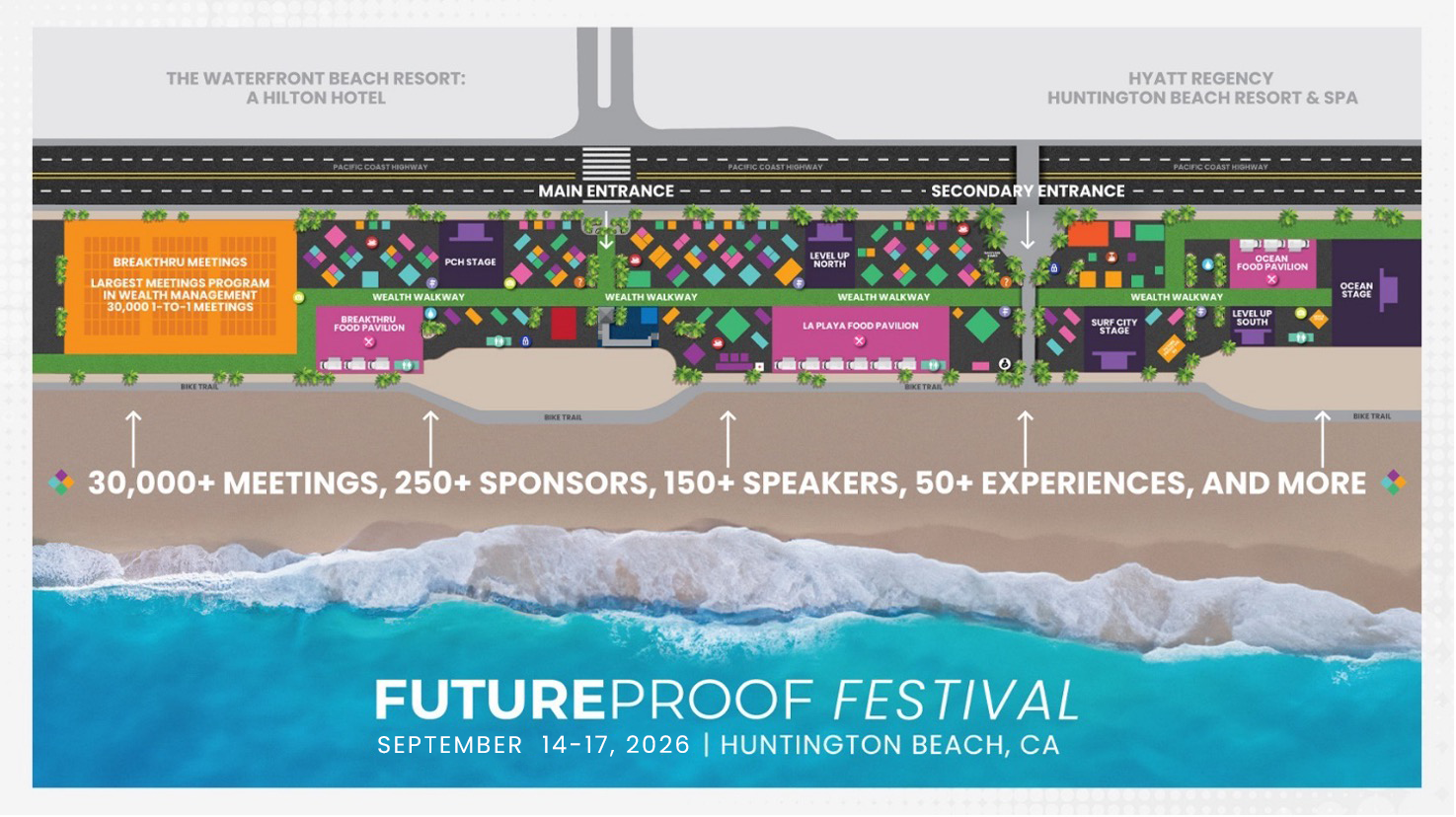
The success of FutureProof Festival in Huntington Beach in its first two years led to an expansion of FutureProof events, and now there are two: "Festival" in Huntington Beach in September, and "Citywide" in Miami Beach in March. Both have a similar outdoors-conference experience (with the exact same kind of beach setup). Thematically the content is a bit different – Festival has more of a tilt towards wealth management and RIAs, while Citywide has more of a tilt towards investment management, pulls more from the 'traditional' east coast brokerage of New York City, and has developed a strong AI-for-advisors theme. However, given the sheer size of the events – each now pulls upwards of 5,000 attendees in total – most advisors won't notice a huge difference between them, as each features a lineup of industry-oriented speakers intended to stir conversations and explore future-oriented themes, and will simply choose based on their preferred timing (March vs September) and geographic location (southern California vs south Florida).
Notably, though, FutureProof isn't just a 'traditional advisor conference held outdoors'. It is by design a substantively more networking-oriented conference. Sessions are relatively short (most are 30 minutes), with futurist-oriented topics (apropos of the name, to help you "future proof" your practice) and designed to spark conversation more so than bring answers. (And with shortened sessions, there is little-to-no CE at all.) Interspersed throughout the day are interviews with interesting talking heads of the industry (from Jeff Gundlach debating the bond market to Peter Mallouk sharing the evolution of his firm, to yours-truly sharing some of our latest Kitces Research data), along with other forms of music and entertainment in what is intended to be much more of a 'festival' than a conference in the first place.
Also unique at FutureProof are "Breakthru" meetings, where advisors, in advance of the conference, can provide an indication of the kinds of other advisors they'd like to meet while they're there and 'match' with others who are looking for someone similar. If both people mutually agree, they are set up to meet at a series of meetup tables for a 15-minute connection (all facilitated by a Breakthru app designed by the conference organizers to make it easier to match and meet and offering suggestions for those who aren't sure who to meet up with). Because all meetings are by mutual agreement (both parties have to say they're interested in connecting), are only 15 minutes long (relatively low stakes; if it's not a good connection, just move on quickly), and are 1:1 (not overwhelming for the introverts who don't like big social crowds!), advisors who attended have been incredibly upbeat about making better peer connections at FutureProof than through the 'traditional' approach of just talking to people during meals or in hallways and hoping to meet someone with whom they could connect.
In addition to using Breakthru to meet with other advisors, FutureProof also provides the option to use the app for vendor meetups (an alternative to walking the rows of exhibitor booths that also make an appearance at FutureProof). And advisors who want to meet with exhibitors can agree to a set number of meetings to get their conference registration fees reduced (or, for leaders at large firms who represent significant buying opportunities for the vendors, waived entirely) in exchange for the facilitated introductions.
Ultimately, though, FutureProof is such an 'un-conference' conference for financial advisors that it's remarkably hard to describe beyond that it's simply a great experience. Attending is less about the session content (though there are some sessions advisors will probably drift in and out of) and more about the social dynamic of interacting with a wide range of fellow advisors in a comfortable, sunny (and lovely outdoor not-conference-room-stuffy) environment, with a conference environment (and Breakthru app) that facilitates good connections even for those of us who don't like big social settings.
Come to FutureProof expecting to have interesting conversations with other advisors, enjoy the feeling of the warm California or Florida sun, and leave feeling refreshed after having spent a few days getting fresh air to go with the fresh conversations and fresh ideas. It's an experience unto itself.
Who Should Attend: Financial advisors who want to get away from the 'traditional' conference and feel it would be refreshing to connect with others in a warm outdoor environment, where the primary focus is on networking and conversation with other advisors who are similarly energized.
Details: Citywide is March 14–17, 2027, in Miami, FL, and Festival dates are not yet announced by likely similar mid-September timing (e.g., September 12-15) in Huntington Beach, CA.
Cost: Current pricing is $795 for advisors at firms with >$50M of AUM, $495 for those from firms with <$50M of AUM for Citywide. Free passes (and travel stipend) available to advisors who are firm owners/decision-makers and willing to take 8 Breakthru meetings that are 15-minutes each with other (typically sponsor) participants. Nerd's Eye View readers can receive 20% off financial advisor passes and 10% off industry passes to Citywide by going through this link!
Conference Website: FutureProof 2027
Up-And-Coming Conferences Of Note
Notwithstanding the fact that there are a lot of advisor conferences out there – so many that we need to make an annual Best Conferences list to sort through them all, and a Master Conference List to organize them – there are still more new conferences emerging. In the current environment, though, this isn't entirely surprising – the more that advisors and their teams and firms continue to specialize in their roles and offerings and business offerings and target clientele, the more opportunity there will be for new conferences to emerge to provide a specialized event for the needs of that particular group.
To that end, we highlight a few emerging up-and-coming conferences, most of which are too new to give a formal 'review' as an ongoing event (especially as some will debut for the first time in 2027!), but nonetheless, given their clear focus, may still be of interest for particular advisors who are a fit for their specialized content.
AICPA PFP Symposium For (Advanced) Tax-Centric Financial Advisors
 While financial advisors have been increasingly migrating toward a deeper level of estate and tax planning advice, the CPA world has also been migrating increasingly toward financial planning. Which isn't entirely new – in practice, many of the largest RIAs today were formed by former CPAs who broke out of the High-Net-Worth (HNW) planning divisions of Big-8 accounting firms back in the 1980s and 1990s to form their own wealth management firms.
In fact, the growth of this 'other world' of CPA financial planners long ago spawned their own membership association – the Personal Financial Planning (PFP) section of the AICPA. Which, for many years, ran its own "Advanced Financial Planning" conference known as the AICPA PFP conference, before it was folded in 2017 into the broader AICPA ENGAGE conference.
But last year in 2026, the old Advanced PFP Conference was revived as the "PFP Symposium" event.
Because it is created and operated by CPA financial planners (under the AICPA's PFP [Personal Financial Planning] section), attendees can expect an agenda with a deep technical focus, filled with more advanced income and estate tax planning topics (as the base knowledge required just to become a CPA forms a high bar for a continuing education conference to build upon!), along with practice management and growth-oriented sessions that delve especially into what it takes to scale a jointly-tax-and-financial-planning practice.
Notably, there is no requirement that advisors be CPAs to attend; however, anticipate that all the content will come from a very tax-centric approach to financial planning (as most AICPA PFP members are practicing CPAs who have expanded from tax into the wealth management business).
Details: January 25–27, 2027, in Nashville, TN.
Cost: $2,200. Early bird pricing of $2,050 is available until December 11th, and further discounts apply for AICPA members. Nerd's Eye View readers can receive $150 off with the 2027PFP discount code!
Conference Website: AICPA PFP Symposium 2027
Advisor ScaleCon And Elite Advisor Network To Scale Your Advisory Firm in 2027
 It was nearly 40 years ago that Michael Gerber first published The E-Myth, showing how most small businesses build around their founders as the technician who does the work of the business – from baking cupcakes to providing legal services to being their financial advisor – and ultimately struggle when they need to grow beyond the capabilities and capacity of the owner. As that transition requires the advisor-owner to approach the business in a fundamentally different way: where outcomes are no longer dictated by the quality and depth of the work they do in the business, and instead are driven by how effectively they can work on the business to be a sustaining enterprise without them doing the work.
 The story resonates well within the financial advisor domain, where the unhappiest advisors are often those approaching $2M of revenue, as the business reaches a stage of complexity where they hit a wall that can only be overcome but completely changing how they approach the business (to be less an advisor, and more the CEO of an advisory business). Which is challenging, because at the least it requires learning an entirely new set of skills, and at worst is difficult because it alters the advisor's entire identity and role within the business itself.
Fortunately, though, the path of how to scale an advisory firm has been navigated enough times, that a growing number of advisors are now building systems and training platforms to share their learnings with others, creating a number of advisor communities and conferences for those who want to learn from those who have already tread the path before them.
Two recent additions are the emergence of Advisor ScaleCon from Eric Negron of Forefront Advisor Network, and Elite Advisor Network from Sten Morgan of Legacy Investment Planning. Both are built around joining a membership community, coupled with 1-2 live events per year that bring advisors together for in-person training and development in how to be more effective and successful as an advisory firm business owner trying to grow and scale the business itself.
Notably, borrowing from the growth and evolution paths of their founders themselves, the two networks do have a slightly different focus. Elite Advisor Network has a heavier component of growth and business development, with a particular focus on charging for financial planning (and learning how to communicate the value of financial planning to prospects to be worth charging for!), while Advisor ScaleCon tilts more directly towards scaling yourself and your advisory firm (e.g., how to build systems, utilize technology, develop team, and create leverage for and beyond yourself).
Details: Membership year-round, 2027 event dates to be announced.
Cost: AdvisorScale allows advisors to join the community for free, but events start at $1,600 to attend in-person ($1,000 virtual). Elite Advisor Network has a free membership tier mostly around their resources, but charges $550/month ($6,600/year) to engage in bi-weekly group training calls, forums with community members, and the full training library, with a separate charge of up to $3,000 per in-person event (discounted 30% for members).
Conference Website: Advisor ScaleCon and Elite Advisor Network 2027
The Advice-Only Conference And Immersion 2027
 Financial advisor business models change remarkably slowly, as evidenced by the dominant rise of the assets-under-management model over the past 20 years, and the dominance of the commission-based model for the decades that preceded it. Eventually, the model can and does change to reflect industry, advisor, and especially end-client preferences, but because there are only a small single-digit percentage of consumers who are looking to change advisors or start with one for the first time in any particular year, the change is very slow.
One indirect effect of the industry's slow pace of change is that amongst those pioneers and early adopters who do begin to test out a new business model and way of serving clients, it's often a very lonely experience being different than the other 99%+ of the financial advisors. Thus the formation of organizations like NAPFA, Garrett Planning Network, and the Alliance of Comprehensive Advisors (originally the Alliance of Cambridge Advisors) as early leaders in fee-only, hourly, and retainer-based models in particular; they create a space for pioneers to come together, commiserate on the challenges, and share emerging best practices.
In recent years, Kitces Research on Advisor Productivity finds new business models emerging in two domains: those who charge a single flat fee that bundles together investments and financial planning (akin to retainer-based models, but often with a particular emphasis on how flat-fee pricing may better reflect the actual work being done to manage a portfolio), and "advice-only" advisors who explicitly charge only for financial planning advice and do not (and cannot) manage the client's portfolio at all (so it's clear to the end consumer that the financial planning isn't a loss leader to gather assets, it is the value proposition).
And now, both emerging communities are developing their own conferences to convene their early pioneers. The Advice-Only Conference, an extension of the Advice-Only Network (which provides a Find-An-Advisor website to help consumers find an advice-only advisor in particular), launched their inaugural event in 2026 to bring together advisors within their network (and more broadly those engaging in the advice-only movement). And Immersion aims to similarly serve the flat-fee advisor community, and is organized by Sara Grillo's Transparent Advisor Movement.
Notably, both conferences are priced very favorably to their communities (each has registration or early-bird fees of only $400 for the entire two-day event), and content is not particularly CE-oriented and instead is designed primarily to focus on the very real practice management challenges and best practices emerging (from marketing and pricing to compliance and execution) from those pioneering the respective business models, with a heavy peer-to-peer sharing element to each.
Details: Advice-Only Conference is May 11-12, 2027, in Denver, CO. Immersion is March 9-11, 2027, in Dallas, TX.
Cost: $399 early-bird for Advice-Only Conference (full registration price not yet announced). Nerd's Eye View readers can receive $50 off with the KITCES50 discount code! $400 for Immersion.
Conference Website: Advice-Only Conference and Immersion 2027
Going 'Home' To Your Advisor Community
While many financial advisors decide to go to a conference to solve a particular problem – whether it's an educational gap or a practice management/business need – sometimes the reality is that the reason to attend is little more than spending time with 'your people': the community of advisors that you belong to and wish to (re-)connect with, or at least those who are similar in what they do and share similar challenges and best practices. Which makes the conference less of a conference, per se, and more about 'going home' to spend time with your community/peers.
For most advisors, their 'home' conference is the annual conference of their RIA custodian or broker-dealer platform (which is why events like Schwab IMPACT and LPL Focus are some of the largest conferences in the industry), or the advisor platform they work with (e.g., Dynasty Partners Summit). With the added benefit that not only is it an opportunity to talk to and network (and perhaps commiserate) with fellow advisors using the same platform, but it's also an opportunity for the advisors on those respective platforms to see the latest services and capabilities their platforms are rolling out, hear what senior leadership are focused on (or have a chance to ask questions and express concerns), and meet home office staff as well. Not to mention that because advisors with a shared platform tend to have a similar business model and often a similar 'profile' (which makes them a fit for that platform), the other advisors in attendance tend to be reasonably similar and good to network with.
In turn, the rise of vendor conferences is also creating a new kind of 'home' community conference from some of the industry's largest vendors, especially where the technology platform forms a major hub around which the advisor's practice is built. Examples include the Envestnet Advisor Summit, Orion Ascent,Nitrogen's Fearless Investing Summit, and eMoney's Advisor Summit, with recent new additions from Advyzon and AdvisorEngine's Drive. Which again offer opportunities for good networking (advisors using similar systems tend to share other commonalities that give them good chances to share best practices), as well as for hearing the latest and greatest from their vendors and key leadership.
For other advisors, their 'home' community conference are the peers with whom they share a planning or business philosophy or other (e.g., religious) affinity, including many of the long-standing membership associations and networks such as XYPN, NAPFA, Garrett Planning Network, the Alliance of Comprehensive Planners, and Kingdom Advisors.
And so, for advisors who otherwise aren't certain what conference to attend in 2027, consider "there's no place like home" as the conference of choice. Or alternatively, multi-advisor firms may wish to divide and conquer, with one advisor going to their home conference and another going to something new for 2027!?
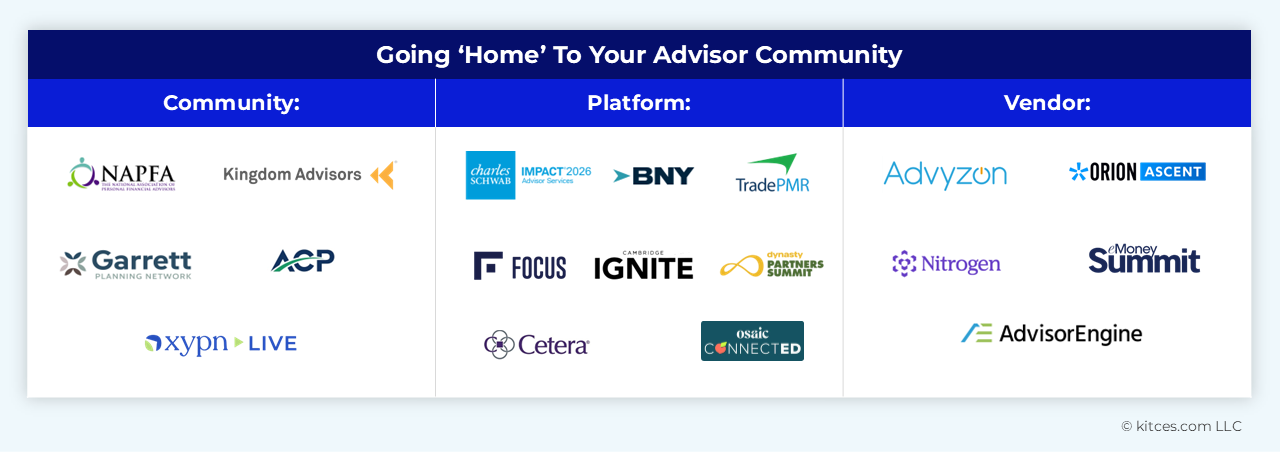
Community: XYPN, NAPFA, Garrett Planning Network, ACP, and Kingdom Advisors
Platform: Schwab IMPACT, Pershing INSITE, Tradepmr SYNERGY, LPL Focus, Cambridge Ignite, Dynasty Partners Summit, Cetera Connect, Osaic ConnectED
Vendor: Advyzon, Orion, Nitrogen, Envestnet, eMoney, AdvisorEngine
So what do you plan to attend? Do you have any conference favorites that I didn't include in the list? Please share in the comments section below!
Top Advisor Conference Badge
Display this badge on your website!
Copy the embed code below:
Click inside the box, select the code, and copy.
Display this badge on your website!
Copy the embed code below:
Click inside the box, select the code, and copy.