Executive Summary
Tax-loss harvesting can be an effective way to reduce investment income in a taxable portfolio, by selling positions at a loss and reinvesting the proceeds in similar securities (but not identical ones, to avoid wash sale rules negating the loss) – which creates a loss for tax purposes that can offset gains from elsewhere in the portfolio, while keeping the portfolio funds still invested and able to participate in any further market upside. The caveat, however, is that unless new funds are constantly added to the portfolio to buy new positions, there becomes fewer and fewer losses available to harvest over time. Because on average, the market tends to rise, and so in a diversified portfolio most positions will eventually rise far enough above their cost basis that even subsequent downturns don't result in taxable losses, while for positions that do continue to decline there's only a finite amount of losses they can actually generate (because their market value – and cost basis – can only go down to zero).
But recent years have seen the growth in popularity of a type of investment strategy that aims to generate more tax losses over time than standard portfolios, while still performing at or above the overall market return. At its core, "Tax-Aware Long-Short" (TALS) investing involves adding leverage (i.e., borrowing) to an existing portfolio to buy more positions and thus increase the number of potential losses to harvest. The leverage is used for both long (i.e., borrowing cash to buy equities in hopes that they'll increase in value) and short (i.e., borrowing equities to sell and repurchase later in hopes that they'll decline) positions – which means in theory, TALS portfolios can generate losses in both bear markets (where the long positions decline in value) and bull markets (when the short positions decline), while largely remaining economically neutral since a decline in the short positions will be mostly offset by an increase in the long positions and vice versa. And because short positions can theoretically generate an infinite amount of losses (since they decline when markets rise), TALS portfolios are less likely to run out of losses to harvest over time than standard long-only portfolios.
The higher tax-loss harvesting potential of TALS portfolios can make them useful in situations where an investor expects to incur a large amount of capital gains income, e.g., if they want to sell a highly-appreciated security and reinvest in a more diversified portfolio. However, for advisors who are considering TALS (e.g., managed by a subadvisor in a Separately Managed Account [SMA] portfolio), it's also important to consider the underlying investment strategy beyond just the tax ramifications. Because tax rules prevent TALS from being entirely economically neutral, i.e., the long and short positions can't exactly offset each other such that a loss on one side will be fully offset by a gain on the other side. Instead, they must have "economic substance", meaning there needs to be a reasonable expectation of profitability before considering the tax benefits of the strategy. In other words, TALS managers can't just aim to exactly replicate the performance of a market index while generating no additional pre-tax return from the added leverage – they need to actively try to outperform the market in order to substantiate the tax losses that they incur along the way.
Furthermore, the "carrying costs" of TALS investing – which include both fees to the TALS manager for managing the portfolio as well as fees to the custodian as compensation for their role in lending funds on margin (for the long side) and intermediating securities lending (for the short side) – create a significant baseline hurdle which TALS managers must overcome "just" to achieve market performance, let alone outperformance. And the higher the leverage in the portfolio (with higher potential losses to harvest), the greater the carrying costs – ranging from around 100bps (i.e., 1%) of the original portfolio value on the low end to 400bps (i.e., 4%) or more on the high end. And with that additional leverage comes more risk that any underperformance of the TALS portfolio will be more severe than in a more lightly-leveraged portfolio. Or put differently, increasing leverage in a TALS strategy increases the potential tax benefits it can generate, but also increases the risk that it may underperform enough that the investor would have been better off simply selling their concentrated security and paying tax on it!
The key point is that TALS portfolios' potential for asymmetric tax losses also comes with a potential for asymmetric economic losses. And as the popularity of TALS investing continues to increase, it's difficult to know what the repercussions of events like short squeezes will be in a world where TALS has ramped up the demand for short positions (as custodians like Schwab and Fidelity have begun to acknowledge by raising borrowing costs and imposing various restrictions on TALS accounts to manage their own counterparty risks as the primary lender in the strategy). And so advisors can provide value by analyzing not only the tax impact of a potential TALS strategy, but also how the costs and risk of the strategy aligns with the client's goals and their own investment philosophy – because it's one thing to generate 'just' losses for tax purposes, but it's another thing when those paper losses translate into real economic losses instead!

How Time Erodes Tax-Loss Harvesting Value
Tax-loss harvesting has long been used as a strategy to offset income from a taxable investment portfolio. The overall concept is fairly straightforward: Selling securities for less than their cost basis (i.e., the amount that the investor originally paid for them) results in capital losses, which are netted against any capital gains realized in the same year to reduce the overall amount of capital gains income for that year. If there are no capital gains to recognize in the current tax year, capital losses can also be used to offset up to $3,000 of ordinary income, with the remaining losses being carried over for use in subsequent tax years.
And once an individual has sold an investment for a (tax) loss, they can immediately reinvest the proceeds of the sale to keep their funds invested and participate in future market growth. While investors generally can't turn around and reinvest into the same security that they just sold for a loss (since the wash sale rules disallow losses when the same security is repurchased within a 30-day window before or after the sale), they can invest in similar securities – e.g., selling one large cap equity ETF at a loss and buying a different large cap equity ETF to replace it. This makes tax-loss harvesting a popular way to leverage the perennial short-term fluctuations of the financial markets to offset taxable income from portfolio rebalancing or sales of other assets like real estate or businesses.
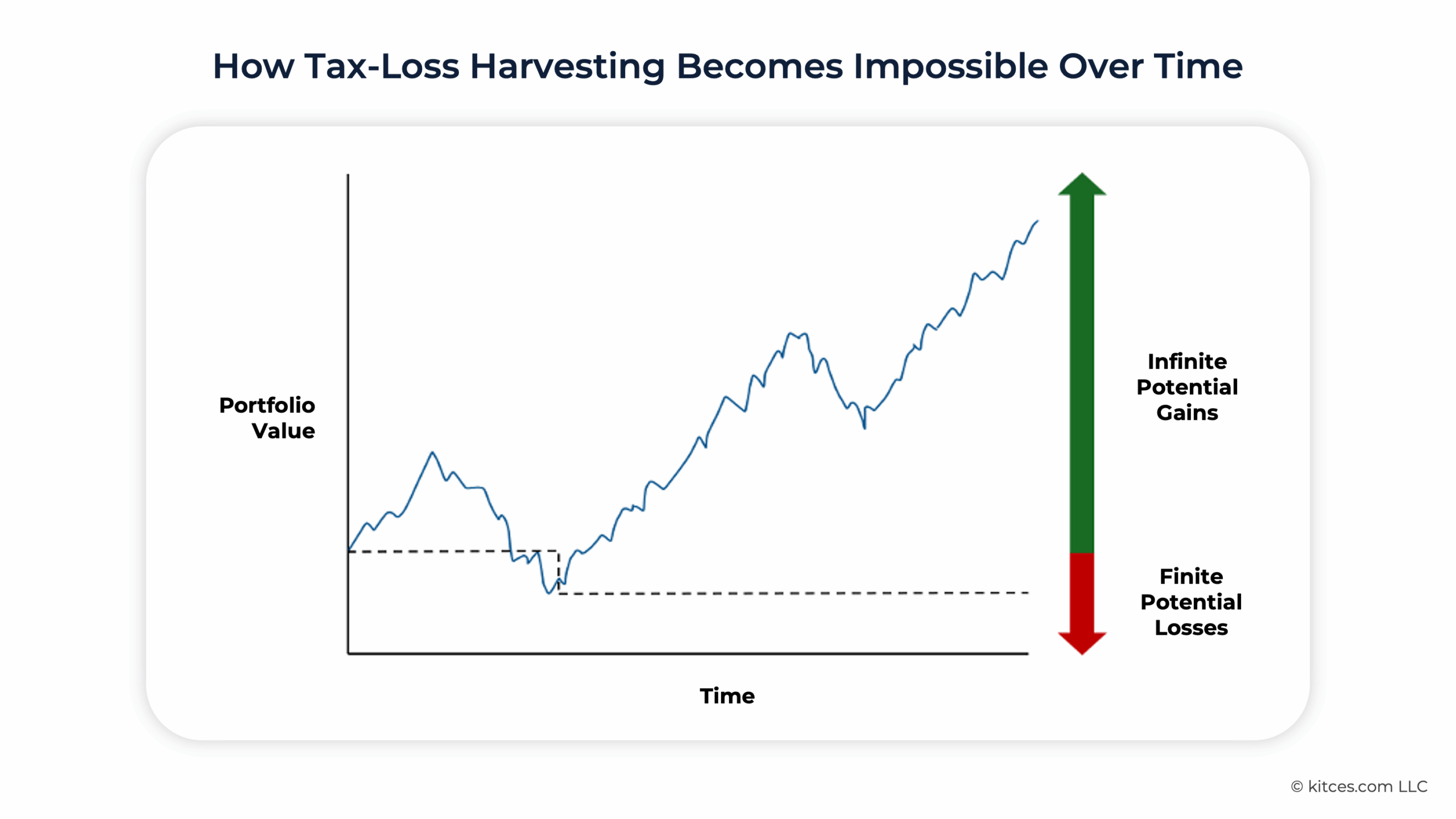
The issue, though, is that it's only possible to do tax-loss harvesting when there are capital losses to harvest. Which is often the case with relatively high-basis securities, where the day-to-day volatility of the markets can cause the security's value to occasionally dip below its cost basis. Over the long term, however, the market as a whole tends to move up and cause most of the portfolio's positions to drift higher and higher compared to their cost basis, leaving few positions available to sell at a loss. Often, positions will increase in value so much over time that it would take an unlikely (and catastrophic) bout of market volatility to bring them back down to a loss.
Furthermore, any losses that are harvested make it more difficult to harvest further losses, since selling one position for an amount lower than its cost basis and purchasing a new position resets the new position's cost basis at the lower value. Less commonly, positions will decline and continue to decline – but the most that they can decline is down to zero, which puts a cap on the amount of losses that can be harvested for any one position.
As a result, given a theoretically infinite amount of potential gains and a finite amount of potential losses, and with the market generally moving up on average, it's mathematically inevitable that at some point tax-loss harvesting will become impossible. Eventually, through a combination of holding the portfolio for a long enough time for most positions to grow significantly higher than their original cost basis, and harvesting all of the losses that have already come available which systematically steps down those positions' cost basis, there will come a point when there is no more tax-loss harvesting that can be done, and the sale of any positions from that point on will trigger a (potentially sizable) taxable capital gain.
More Positions Create More Tax-Loss Harvesting Value
But how long it takes for tax-loss harvesting to become impossible depends on how many positions are in the portfolio. A portfolio made up of a handful of broad-based index funds won't generate that many losses, because even though each fund might be comprised of hundreds of individual stocks that variously increase or decrease, the entire fund is treated as a single holding from the investor's tax perspective. And again, at some point that one fund is either up so far from its original cost that no more harvesting is possible, or its cost basis has been stepped down by previous tax-loss harvesting to the point that no more losses can be claimed (even if individual holdings within the fund may still have losses).
A portfolio made up of many individual securities, on the other hand, has many more potential loss opportunities that can be individually harvested (even though the performance of the individual-securities portfolio might be the same in aggregate as the broad-index ETF portfolio) because each holding with a loss can directly be harvested - allowing that one position to be tax-loss harvested even if the portfolio and index as a whole are up.
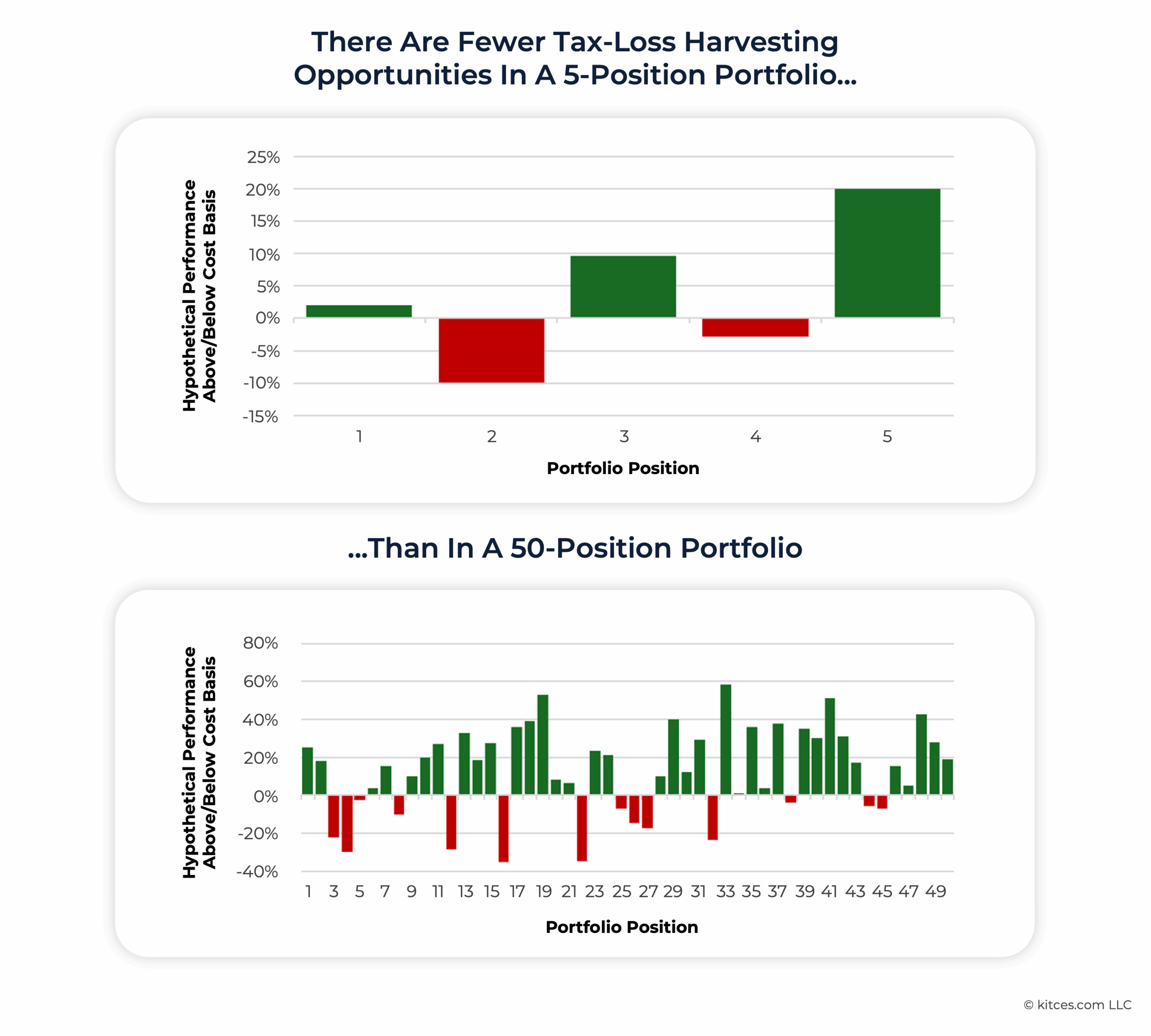
Hence, for example, direct indexing technology can make it possible to harvest more losses using a portfolio of individual securities (designed to track a broad market index like the S&P 500) than can be harvested when investing in a single index fund. This can make direct indexing one possible option for advisors who want to create more tax-loss harvesting opportunities, since with potentially hundreds of individual positions there will be more chances to harvest losses in the near term and those opportunities will take longer to exhaust themselves in the long term.
The caveat, however, is that even a direct-indexed portfolio will still eventually run out of losses to harvest. Because the same rule of infinite potential gains and finite losses still applies – even when there's a bigger number of portfolio positions to harvest losses from.
Adding Leverage To Create New (Long And Short) Positions For Tax-Loss Harvesting
The one way to create the potential for more tax-loss harvesting in a portfolio that's already exhausted its taxable losses is to add more high-basis positions to the portfolio. The simplest way to do this is simply by contributing cash and buying more securities – but that's only possible if the investor has cash available to contribute to the portfolio.
But the other way to create more positions – and therefore more tax-loss harvesting opportunities – is by borrowing funds to invest.
There are two ways to invest with borrowed funds: Long (i.e., borrowing cash and using it to invest in new positions) and short (i.e., borrowing someone else's existing positions and selling them, then buying them back and returning them to their original owner at a future date). Long investing creates a gain if the investments rise in value and a loss if the investments decline, while short investing does the opposite – the position gains if the investment declines in value (since it will be worth less than what the investor sold it for), and loses if the investment increases. At a broad market level, then, where markets tend to rise over time, long investing tends to generate more gains and fewer losses over the long run, while short investing generates more losses and fewer gains.
When these two borrowing strategies – long and short – are combined, two things happen. From an economic perspective, the long and short investments offset each other: The longs tend to increase in value in bull markets and decrease in bear markets, while the shorts decrease during bull markets and increase during bear markets. In other words, the net portfolio value doesn't change in value much on the aggregate, other than from skill or luck in picking more long positions that go up and more short positions that go down. But from a tax perspective, the portfolio has the potential to generate taxable losses from either side: From the long side when markets go down, and from the short side when markets go up.
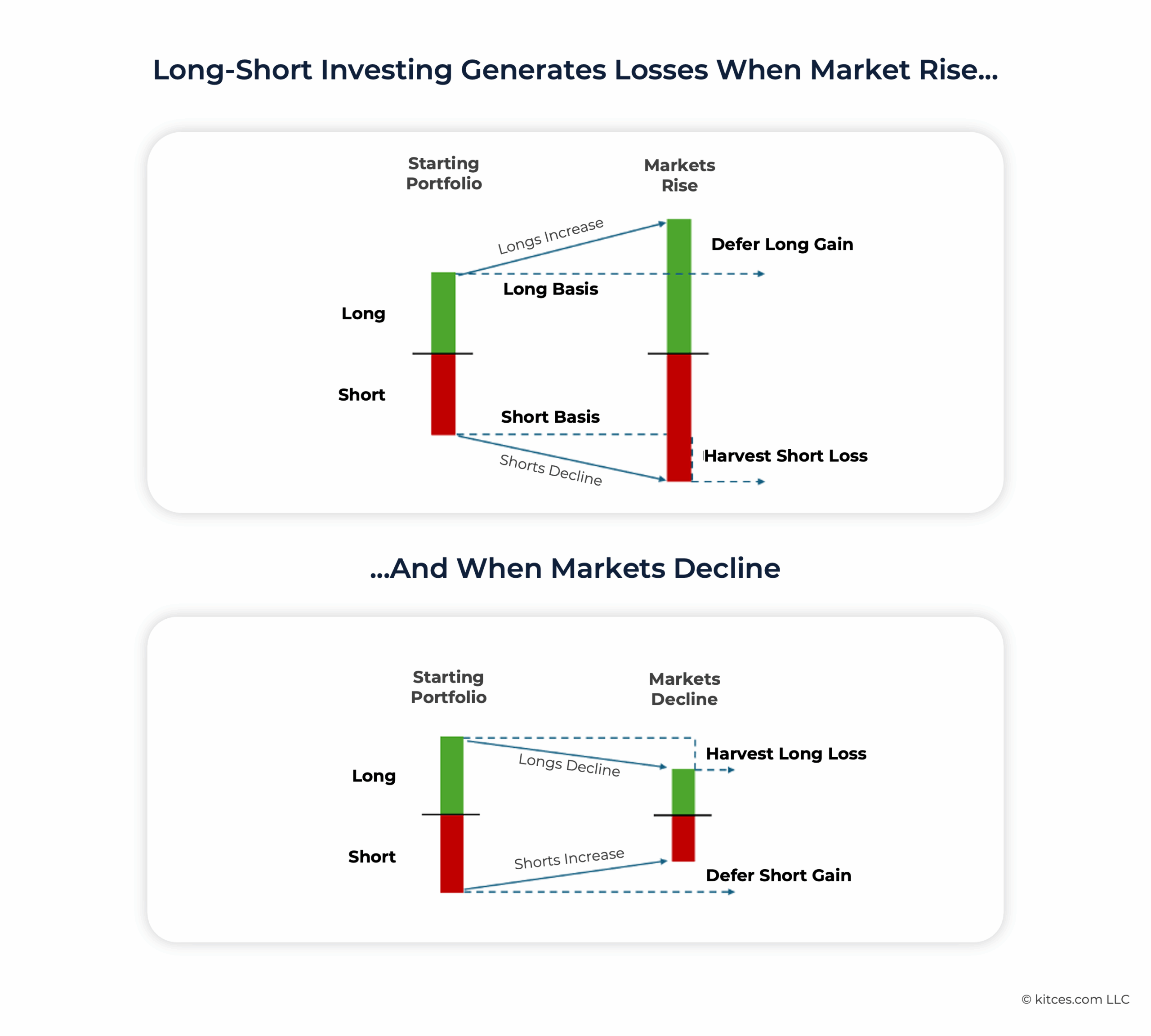
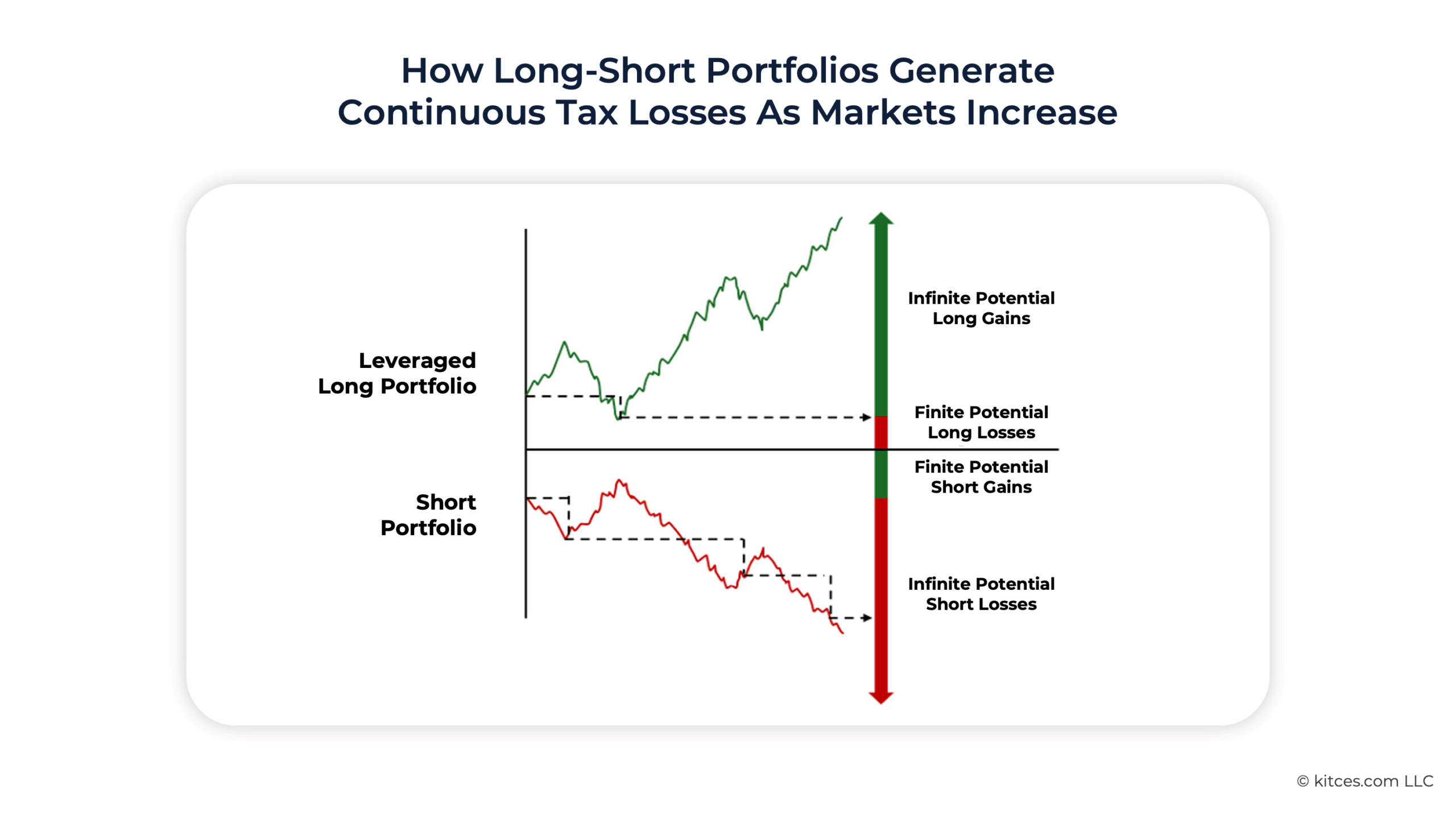
Because markets tend to go up over time on the whole, the losses in the combined long/short portfolio would primarily come from the short side as time goes by. But unlike long investments, short positions can generate hypothetically unlimited losses: While investments can only decrease to zero, there's no limit to the amount they can increase. Which gives a long/short portfolio a theoretically inexhaustible supply of tax losses over time as the short positions decline in inverse to the increase in markets – even though the combined value of the leveraged long and short positions doesn't change much from an economic perspective because the long positions are rising at the same time the short positions decline.
In other words, unlike a long-only portfolio which inevitably exhausts its losses over time and gets "locked up", a long-short portfolio can avoid that outcome – even when markets rise over time – with the continuous losses generated from the short leg of the portfolio.
The Rise Of Tax-Aware Long/Short (TALS) Investing To Offset Gains In Concentrated Positions
The fact that losses for tax purposes can be ‘unlimited' with short positions, while overall investment risk is limited by having offsetting long positions, is broadly the concept behind tax-aware long/short (TALS) investing.
An investor starts with an existing portfolio of assets, onto which a portfolio manager adds "extensions" of long and short positions (technically purchased on margin, which in turn requires a margin-eligible account). The long and short positions mostly offset each other from an economic perspective, but generate losses for tax purposes (either on market pullbacks for losses on the long positions, or on market growth that generates losses on the short positions), increasing the tax-loss harvesting potential of the portfolio well beyond what would have been possible with the original portfolio alone.
The extensions generally range from 30% of the original portfolio's value in long investments and 30% in short (usually referred to in shorthand as ‘130/30', since 130% of the total portfolio assets are long and 30% are short) to 100% in long and 100% in short (200/100), to as high as 200% in long and 200% in short (300/200), although some managers create even bigger extensions. The bigger the long/short extensions, the greater the tax-loss harvesting potential of the portfolio – although as will be discussed more below, bigger long/short extensions also come with higher carrying costs and higher risk of underperformance, so it isn't necessarily always a good idea to simply go with the biggest possible extension to maximize the tax-loss harvesting potential.
The upshot of the TALS strategy is that the capital losses generated by the long and short extensions can offset capital gains generated elsewhere. Which can make it useful for when an investor has assets that they want to sell which would recognize a large capital gain.
Hence, TALS has in recent years been increasingly pitched as a solution for investors (including clients of financial advisors) holding highly appreciated shares of concentrated stock – e.g., equity-compensated employees or early investors in startup companies whose shares have greatly increased in value after originally acquiring them for little or nothing.
The biggest provider, AQR, reports managing nearly $70 billion in TALS strategies as of Q3 2026, but numerous other managers including Brooklyn Investment Group, Neuberger Berman, DGS, Burney Advisor Services, Cache, and others create a lot of options for investors exploring TALS.
Economic Substance, Carrying Costs, And Risk Management: Why TALS Can't Be A "Passive" Strategy
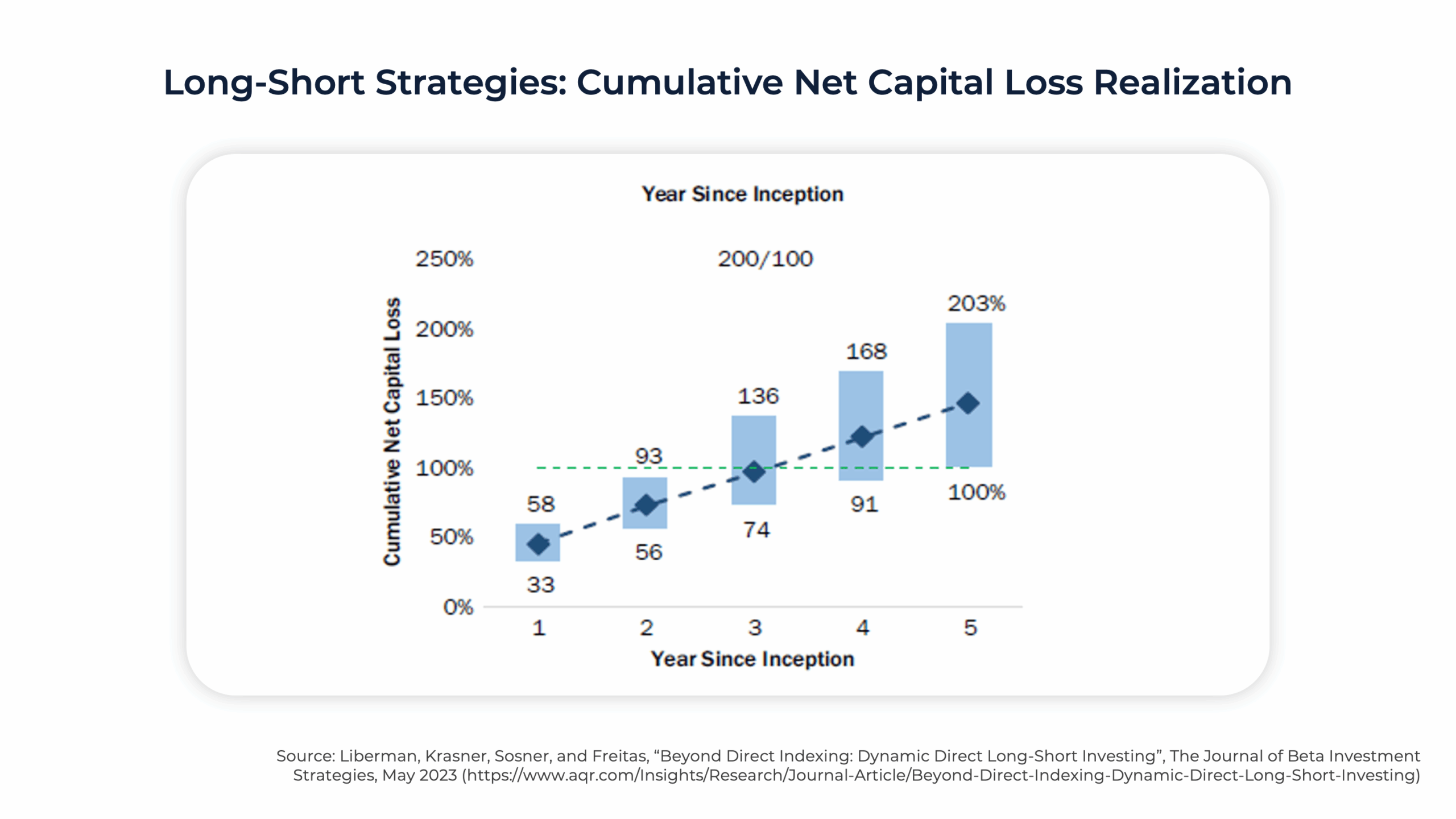
The pitch for Tax-Aware Long-Short (TALS) as a strategy to generate tax losses to offset gains from the sale of an appreciated asset is a compelling one on its surface. AQR, in its paper "Beyond Direct Indexing: Dynamic Direct Long-Short Investing", published research showing how a 200/100 TALS strategy (that is, one with an extension of 100% long investments and 100% short investments) can generate cumulative net capital losses that on average add up to nearly 100% of the original portfolio within three years of inception. So for example, an investor with $1 million in appreciated company stock, who adds $1 million in levered long positions and $1 million in short positions, could (per AQR's conclusions) accumulate $1 million of capital losses within three years, which they could use to completely liquidate the appreciated holding over that 3-year period and reinvest in a more diversified portfolio without incurring any net capital gain – even if the basis of the original security was zero.
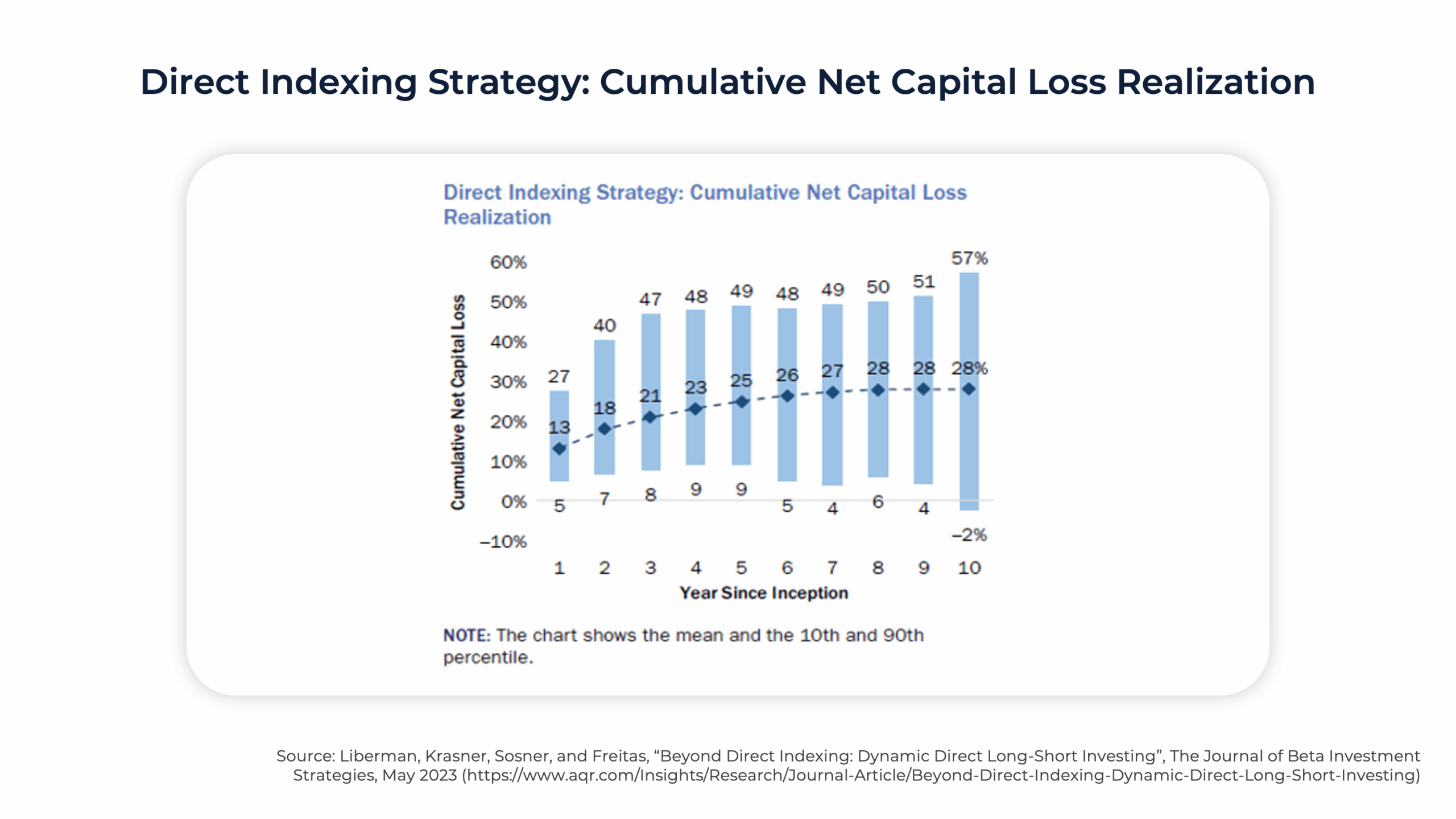
By comparison, that same research showed that cumulative losses in a standard direct indexing portfolio add up to "only" 21% of the original portfolio value after three years, and top out at around 28% after 7 years before flattening out as the portfolio exhausts its tax-loss harvesting opportunities as ongoing market growth eventually leaves the original cost basis behind. Borrowing to create long and short positions on top of the original portfolio simply creates much more opportunity to generate losses for harvesting, as again the loss-harvesting potential for the short side of the position is effectively "unlimited" and continues to be available even (and especially) as markets continue to rise over time.
However, this is where we have to move away from the simple, conceptualized version of TALS investing and talk about the nitty-gritty specifics. Because it isn't a strategy that's especially compatible with a low-fee, asset-allocation-based investment philosophy. In reality, TALS is actually an active, risk-managed investment strategy, not an overlay that can be added onto a portfolio to passively generate tax losses. Even though "Tax-Aware" comes first in the name, the "Long-Short" part is really the core of the strategy – the tax characteristics are more of an incidental benefit – and so that is what must be considered first when deciding whether or not TALS makes sense for a particular client. Because TALS is only appropriate for investors who understand and accept the risks and costs involved with it.
Economic Substance Requirements
The simplified way of explaining TALS is that the long and short extensions of the core portfolio offset each other: In up markets the longs rise and the shorts fall, and in down markets the shorts rise and the longs fall. But it isn't necessarily as clear-cut as that. In practice, the longs and the shorts don't completely offset each other because they don't have the same underlying investment; e.g., the portfolio wouldn't have a long position in Apple in the long extension and an equal short position in Apple in the short extension.
This is for two reasons: First, under IRC Section 1259, establishing a short position on an appreciated security that an investor already owns results in a "constructive sale" of the security, where the investor is considered to have sold the security and any unrealized gain will be recognized and taxed as a capital gain. Owning positions on the same companies at the same time in both the long and the short extensions would potentially cause gains to be recognized any time a new short position is established, which defeats the purpose of holding onto the gains while ‘only' generating taxable losses (given that this is a tax-loss-harvesting tactic).
The second reason to avoid completely offsetting positions is that, aside from the outright constructive sale provisions of IRC Section 1259, the IRS doesn't tend to like it when taxpayers make transactions that produce tax benefits (like harvesting capital losses) when there is no corresponding change to the taxpayer's actual financial position – generally known as the "Economic Substance Doctrine". If, as described above, the short and long extensions in a TALS portfolio completely offset each other – so that every increase on the long side was offset by an equal and matching decline in the short side, and vice versa – resulting in zero net gain or loss in either direction, the IRS would be likely to scrutinize and potentially disallow any capital losses that were claimed.
Or put differently, in order to be permitted to claim a tax loss, there needs to be some reasonable expectation of pre-tax profit from the strategy in the first place – the ability to realize and deduct capital losses can't be the only benefit that the strategy aims for. Hence, for example, TALS managers like AQR emphasize their aim to provide "credible pre-tax alpha" in their tax-aware strategies, with credible being the key word: There needs to be at least a plausible attempt to come out ahead compared to a purely passive index-fund approach in order for the losses generated in a TALS strategy to be viable. Which means in the end, a TALS strategy literally can't be designed to perfectly neutralize the economic impact of having shorts with losses offset by long positions with gains without losing the tax benefits; it has to pursue pre-tax (i.e., not-just-tax-motivated) alpha by some means.
So while the high-level model of TALS remains true – the short extension tends to accumulate tax losses during bull markets (but economically the losses are offset by gains in the long position) and the long extension generates tax losses during bear markets (but economically the losses are offset by gains in the short position) –in order to try to generate pre-tax alpha, TALS managers need to take a more active approach, e.g., picking stocks that they believe will go up to invest in for the long extension, and stocks that they believe will go down for the short extension.
In practice, TALS managers may target a certain level of beta (i.e., risk) compared to the market, or they may take a market-neutral approach of hedging against overall market movements so that their performance is purely dependent on whether their stock picks over- or under-performed the market. Which means a TALS manager may act much more like a hedge fund (which was where the long-short investing strategy originated in the first place before the "tax-aware" overlay was added on) than a traditional asset-allocated portfolio of broad market funds. Not just because that happens to be the manager's investment philosophy (though it often is, as many TALS managers are also in the hedge fund business), but because it needs to have an active approach in order to create the necessary economic substance to validate the tax losses it generates.
Carrying Costs Of TALS
There's another reason besides the Economic Substance Doctrine that TALS managers must try to generate alpha from the long and short portfolio extensions, which is that there are substantial "carrying costs" of investing in a long-short strategy. The strategy needs to perform at least well enough to exceed these costs, otherwise an investor with concentrated securities might be better off in the long run by simply selling their holdings, paying tax on the capital gains, and reinvesting the rest in an index portfolio.
TALS investing involves multiple layers of cost. First there's the fee that goes to the TALS manager itself for running the strategy, which varies from manager to manager but generally runs to 100bps (1%) or more of the extension size. The extension size is typically measured as the amount of the long extension – so for a 130/30 TALS portfolio, for example, the fee would come to 100bps × 30% = 30bps of the investor's existing portfolio, while for a 200/100 TALS portfolio the fee would be 100bps × 100% = 100bps and for a 300/200 portfolio the fee would be 100bps × 200% = 200bps.
The second layer of TALS costs goes to the custodian where the TALS account is held in the form of a net borrowing cost. Custodians charge investors for borrowing funds on margin, which is technically how the extension long position beyond the original portfolio is created. The borrowing rate is usually structured as a base rate (e.g., the Federal Funds Rate (FFR) or Overnight Bank Funding Rate (OBFR)) as a pure cost of borrowing funds, plus a spread that goes to the custodian to facilitate the margin account borrowing (which is set by the custodian and can vary based on factors like the size of the account or the total amount of on-platform assets). So if FFR is 3.65% and the spread is 40bps, then the borrowing cost for the long extension is 3.65% + 0.4% = 4.05%.
However, investors don't actually pay the full margin borrowing cost because that amount is partially offset by the short interest rebate. When an investor makes a short sale, the proceeds of the sale are held in a collateral account for when the shorted securities need to be bought back, and those funds earn interest. That interest is generally structured as the same base rate (e.g., FFR or OBFR) as the margin rate, minus a spread that is the custodian's cut as the intermediary to the strategy (which is also set by the custodian and may vary from one investor to another).
And so the net borrowing cost for TALS investors amounts to the margin borrowing rate that they pay to the custodian minus the short interest rebate that the custodian pays them. Or in mathematical terms:
Net borrowing cost = margin rate − short interest rebate = (base rate + margin spread) − (base rate − short interest spread) = margin spread + short interest spread
In other words, the math works out that the net borrowing cost equals the margin spread plus the short interest spread, as the underlying cost of funds for the long and short positions offset each other, but the custodial platform that facilitates the borrowing transactions in the margin account still needs to earn its spreads (as all custodians do for offering margin accounts with borrowing through the custodian). As noted earlier, since the custodian's spreads are individually set by custodians, the actual cost can vary from one custodian to the next and even between different advisors and clients using the same custodian. A "typical" net borrowing spread may be in the vicinity of 100bps, but advisors might pay more or less than that amount depending on factors like the size and number of clients with TALS portfolios (and as noted below, some custodians like Fidelity have recently been raising their net borrowing costs to manage risk amid the sharp rise in popularity of TALS investing).
Like the management fee, the net borrowing cost as a percentage of the investor's original portfolio is based on the size of the extension – e.g., if the net borrowing cost is 100bps, then the total cost for a 130/30 TALS portfolio would be 100bps × 30% = 30bps; for a 200/100 portfolio it would be 100bps × 100% = 100bps; and for a 300/200 portfolio it would be 100bps × 200 = 200bps.
Example 1: Autumn is considering implementing a 200/100 TALS strategy for one of her clients and asks her custodian for a quote on the net borrowing cost. Her custodian's margin rate equals FFR plus 50bps, and the short rebate equals FFR minus 70bps. The net borrowing cost equals the sum of the two spreads times the size of the extension, which comes to (50bps + 70bps) × 100bps = 120bps.
All-In Costs Of TALS Require Manager Alpha 'Just' To Match Market Performance
Putting it all together, then, the carrying costs of a Tax-Aware Long/Short (TALS) portfolio are comprised of the portfolio management fee (which may be 1% or 100bps), plus the net borrowing cost (which itself is comprised of the margin spread and short interest spreads charged by the custodian facilitating the margin account, and can often be another 80-120bps or more). Both of these costs scale up or down with the amount of leverage in the portfolio; e.g., while the carrying costs of a relatively lightly leveraged 130/30 TALS portfolio might be ~200bps × 30% equals "only" around 60bps of the original portfolio size, a more highly leveraged 300/200 portfolio could easily cost on the order of 350-400bps. Hence, TALS portfolio managers need to pursue an active management strategy to generate pretax alpha – not just as a way to legitimate the tax losses created by the strategy, but to overcome the substantial carrying costs (which increase in proportion to the size of the long/short extensions added to the portfolio).
The key point is that the success of a TALS strategy hinges on the manager's ability to reliably outperform the market, with bigger extensions (which by definition involve greater leverage) increasing the volume of tax losses to harvest but also amplifying the portfolio's sensitivity to outperformance or underperformance. If a TALS portfolio underperforms the market, the investor may still be able to realize tax losses (because as noted earlier, the strategy is designed to generate tax losses in all market conditions, and the economic substance rules only require a reasonable expectation of pretax alpha, not for that alpha to actually exist). But any significant period of underperformance eats into the tax benefit of the strategy. An investor might save money on taxes by generating losses to offset the capital gains income from selling an appreciated security, but with an underperforming TALS portfolio an investor might find that they would have been better off simply selling their appreciated securities and paying the tax on the capital gains, which would leave them free to invest in an index portfolio to achieve the actual market return. And even with market-matching performance, the ongoing all-in annual costs of a TALS strategy can erode the benefits of tax loss harvesting over time (especially for versions with higher leverage that increase the carrying costs).
How Fidelity And Schwab's Recent Restrictions On Tax-Aware Long-Short Portfolios Affect The Strategy Going Forward
Tax-aware long-short investing has experienced massive growth in recent years as the technology for managing risk and alpha models has improved, providers have increasingly pitched TALS as a solution for clients who want to smooth out the tax impact of diversifying their concentrated portfolios, and tax-related planning strategies have become more popular amongst financial advisors themselves (as also evidenced by the rise of the tax planning software category, and the emergence of advisory firms even bringing tax preparation in-house). As the hunger for demonstrating concrete dollars of tax savings has risen, by some estimates the cumulative amount of net assets in TALS strategies has grown to exceed $150 billion.
The upshot of the massive growth of TALS is that it also represents a massive growth in borrowing of assets to deploy for the long and short legs of the TALS strategy. And all that borrowing goes on the balance sheet of the custodians where the TALS portfolios are held, who are typically the parties that lend the margin cash and securities for short sales that TALS runs on. The good news for custodians is that they charge a spread on the margin and short interest positions, which supports their own revenue and profitability by making TALS strategies available on their platforms. But it also opens the custodians up to the risk that investors who borrow funds or securities for TALS strategies won't be able to give them back if the TALS manager doesn't properly manage their own risks, creating a form of counterparty exposure risk for the custodians that allows TALS strategies to be implemented via their platforms.
Overall, TALS represents a relative blip on the balance sheet of a major custodian – e.g., Charles Schwab reported over $11.9 trillion in client assets at the end of 2025, so even if it custodied the entire $150 billion of TALS portfolios in existence, that would only make up a little over 1% of its balance sheet. But custodians are in the business of lending and managing the risks of lending, and do have capital requirements that are impacted by their lending and balance sheet leverage, and so the ramp-up in TALS over the last few years has caused them to reevaluate how to deal with the risk involved with that all the new TALS-related leverage.
First, in December 2025, Fidelity announced that it would be instituting a pause on new client dollars going into TALS strategies on its platform, which became an indefinite pause in February 2026. Then, in March 2026, Fidelity began telling RIAs that it would be raising the net borrowing cost of TALS accounts – i.e., the margin interest minus short interest rebate – by substantially reducing the short interest rebate it was paying to effectively charge a much higher spread to compensate for its risk, such that some borrowing costs went from on the order of 60bps to over 150bps. Then Charles Schwab began to institute its own restrictions to TALS in April 2026 by (1) setting a 30% cap on the amount of assets in TALS strategies that any RIA can keep on the Schwab platform, (2) limiting the maximum extension size to 200/100 (i.e., a 100% long extension and a 100% short extension), and (3) setting minimum portfolio sizes for TALS accounts at $3 million for accounts where Reg T margin rules apply and $1 million for accounts with portfolio margin (with Reg T margin being a traditional margin account with static maintenance margin requirements while portfolio margin uses more dynamic margin requirements calculated based on the actual riskiness of the portfolio and is more often used for options trading).
The custodians haven't been specific about their reasons for imposing these changes, but it's clear by their timing and nature that both Schwab and Fidelity see the unrestricted growth of TALS accounts on their platforms as a material risk, which they're acting now to manage – Fidelity by outright throttling the creation of new accounts and requiring more financial compensation from already-existing accounts, and Schwab by setting guardrails on the concentration of TALS-managed portfolio assets on its platform and the degree of leverage that the strategies can employ.
All of which brings up two main considerations for financial advisors using or considering TALS strategies for their clients. First, for advisors on the Fidelity platform specifically, the increase in net borrowing costs by nearly 100bps further increases the amount of pre-tax alpha that the TALS manager must generate with its strategy to overcome the higher carrying costs (and/or represents a greater cost drag that offsets more of the benefits from pursuing the loss harvesting strategy in the first place, relegating it only perhaps to clients with very large concentrated gains to harvest). Recall that underperforming the market over a years-long time horizon will leave an investor better off having sold their appreciated asset and paid the tax on it rather than investing in the TALS portfolio, and the ratcheting up in carrying costs increases the risk of this happening unless the portfolio is transferred over to a different custodian with lower net borrowing costs. To that end, it's worth remembering that in addition to Schwab and Fidelity, Interactive Brokers also provides custody for TALS strategies (and has not as of now announced any changes to its pricing or account requirements), while Goldman Sachs and Pershing are also reportedly building out their own TALS custody offerings to be available soon.
The second consideration is that, with custodians gradually waking up to the potential borrowing-related risks in TALS accounts and adjusting their risk management strategies accordingly, advisors might also want to give a second look to the risks involved in TALS. As highlighted most recently with the "short squeeze" in shares of the Avis Budget Group rental car company, TALS strategies with their sizeable short investments are subject to asymmetrical risks – in other words, even though the tax-loss potential of the short side of the TALS strategy is theoretically unlimited, you don't actually want to generate unlimited losses, especially in the period of a few weeks or days when there's no time for the long side of the portfolio to catch up (because, again, the long and short sides can't be perfectly matched, or the whole strategy fails the Economic Substance doctrine and the losses would be disallowed). A portfolio that's well diversified in its long and short extensions may avoid incurring too much in losses on a one-off situation like Avis, but it's a reminder of how quickly things can go sideways when (leveraged) short sales are involved.
The key point is that while it can be easy to be tempted by the potential to generate on-paper tax losses to offset real-life income, those paper losses can subsequently translate into actual economic losses without a solid understanding of the risks involved. It's hard not to be reminded of the limited partnership tax shelters that proliferated in the 1970s and 80s up until they were effectively banned by the Tax Reform Act of 1986, which generated enormous tax losses in their early years via accelerated depreciation, interest, and investment tax credits (which made them extremely popular in an era where the top marginal tax rate was 70%)… but many of which also resulted in enormous economic losses when the partnerships' underlying investments proved nearly worthless once the tax benefits were exhausted and the strategies had to be economically unwound. That isn't to say that tax-aware long-short is the equivalent of the tax shelters of the past, but just to point out how easy it is to overlook potential risks and red flags in an investment strategy when it promises substantial tax benefits.
The main thing for advisors to remember, then, is that while it's easy to think of tax-aware long-short as a tax-loss-generating extension to the client's existing core portfolio, it's really an entire investment strategy unto itself – one that happens to generate tax losses, but also comes with its own risk/reward profile. A full consideration of the strategy involves not just analysis of the tax impact on the client, but also due diligence of the manager's method for creating pre-tax alpha and managing risk, as well as of the custodial costs and operating restrictions – because in the end, it might be better for the client to simply pay tax on their investment gains if they risk losing even more wealth to borrowing costs, management fees, and leverage-driven volatility!
For additional coverage of the evolving tax-aware long-short landscape (and other taxable investment products and strategies), I highly recommend subscribing to Brent Sullivan's Tax Alpha Insider newsletter!