Executive Summary
For most of their history, advisory firms were incredibly illiquid small businesses, and founders had to spend years or even a full decade training a successor in the hopes of having someone, anyone, to pay for the value of the equity that had been built. But over the past 15 years, a combination of low interest rates and an expansion of private markets and their access to capital has led to an explosion of mergers and acquisitions (M&A) amongst advisory firms, turning practices into remarkably liquid businesses, transacting at ever-higher multiples as a plethora of buyers bid up the prices for sellers. Yet as the media has increasingly reported on sometimes-eye-popping multiples, the reality is that because of how deals are actually negotiated and terms are written, the "headline" multiple is often not actually a fair reflection of what sellers are receiving in the end!
In this guest post, Rich Chen, founder of Brightstar Law Group, explores how real-world M&A deals are negotiated for advisory firms, and what, exactly, can lead to material divergences between the valuation multiple externally reported in a deal, and what the seller actually gets for the business, with the aim of helping sellers better prepare how to negotiate with buyers.
The starting point is to recognize that when a buyer offers a seller a multiple of revenue or profits (EBITDA), the buyer and seller still have to agree on how to actually calculate revenue or profits. And as it turns out, determining exactly what the revenue base or EBITDA base will be – against which the multiple is then applied – is not as straightforward as simply looking at the firm's profit-and-loss statement for the trailing-12-month period.
When it comes to determining a revenue base, trailing-12-month revenue may be a common starting point, but buyers generally only want to pay for revenue they will receive after the purchase is closed – i.e., recurring revenue that will perpetuate in the future. As a result, any one-time receipts are often discounted or removed entirely from the valuation process. Similarly, any other revenue streams that come "off the top" of the advisory firm – revenue-sharing arrangements to referral sources, fees paid to a sub-advisor, etc. – are also commonly removed, as buyers want to pay for net revenue, not the gross that they won't get to keep anyway. And to the extent that revenue is set, buyers will often apply a haircut to the revenue calculation for any clients who don't actually consent to the acquirer's advisory agreement (often with a 1-percent-not-retained-equals-2-percent-reduction-in-value penalty).
For firms that are valued as a multiple of EBITDA, the adjustments can be even more complex. If the advisory firm doesn't pay its own founder a "fair market rate", acquirers will typically impute a salary into the business to pay the founder and reduce earnings accordingly… which can materially curtail the valuation of the firm as a whole. (And ironically, in this context, acquirers often want to impute a very high salary for the founder, as they more than make it back in a reduced purchase price when the higher salary reduces earnings being multiplied.) On the plus side, any personal expenses routed through the business are often adjusted out (increasing EBITDA and the business valuation). The most controversial adjustments are expenses that are nominally "one-time" in the business, but that buyers may claim represent a recurring need for reinvestment – from paying for technology consultants, to office transitions, to non-cash compensation for key employees (that the acquirer fears will turn into cash compensation obligations in the future).
The end result of these adjustments is that the final dollars a seller receives on their adjusted EBITDA or revenue base could be substantially lower than what a headline number implies; a firm that thought it was getting 4X revenue that really gets 4X adjusted revenue might only get 3.1X its original revenue, and a firm that anticipated getting 10X EBITDA may only receive 8X after adjustments are done.
The key point is to recognize that buyers don't simply buy an advisory firm blindly; with experienced buyers in particular, it is a meticulous exercise of scrutinizing the financial details of the firm, to ensure what they're paying for will really drive a favorable outcome for their business as the acquirer. So beware putting too much weight into media headlines that showcase seemingly high multiples… as often the reality is that those multiples were calculated after adjustments specific to the business, and are not necessarily representative of the going rate for unadjusted top-line revenue or profits!

The "Terms Traps" That Underlie Headline Valuations In Advisor M&A
Publicity about RIA Merger and Acquisition (M&A) transactions is dominated by the headline valuation number – usually a multiple of revenue or earnings – that is to be received by the seller.
However, every year, RIA sellers leave significant money on the table, not because they negotiated poorly, but because they never understood what the headline multiple actually meant. A buyer presents a number (e.g., 10x EBITDA). That number immediately dominates the conversation. It becomes the reference point for subsequent discussions, shorthand for whether the deal is good or not good enough, and the figure most likely to be repeated when the seller calls their accountant or spouse that evening. Yet by the time the seller fully understands the structure behind that number, they have often already conceded the terms that actually matter most… and could have changed what the true multiple paid turns out to be in the end.
The key issue is to recognize that a headline multiple, standing alone, tells a seller very little about what they will actually receive, when they will receive it, and under what conditions. Which matters, because strategic acquirers, private equity-backed consolidators, and independent wealth platforms have each developed highly sophisticated deal structures that have embedded substantial economic complexity below the surface.
Complexity in the terms of an M&A deal is not necessarily nefarious. Much of it reflects legitimate risk allocation between buyers and sellers. However, that complexity is consistently and systematically disadvantageous to sellers who do not understand the intricate details, and tends to produce outcomes that diverge sharply from what the headline valuation multiple implied – resulting in lower sales proceeds than sellers expect.
The biggest "terms traps" fall into three categories. First, the multiple is applied to an earnings base which the buyer (not the seller) controls when it comes to defining what constitutes 'earnings' for that calculation. Adjustments made during due diligence can materially erode that base before the multiple is ever applied. Second, a significant portion of most RIA purchase prices is deferred through retention payments, earnouts, or seller notes, each of which carries risks that are invisible in the headline number; simply put, most big headline valuations in M&A deals are not 'walk-away cash' at closing. Third, equity offered in the acquiring entity (e.g., rolling some or all of the seller's equity into the buyer's equity) carries a subjective valuation and features that can significantly diminish its value to the seller receiving it.
In this article, we'll focus on the first of those three 'traps,' unpacking how headline multiples are often not reflective of what sellers really receive in the end, with concrete examples of how various adjustments can affect the value ultimately realized. Sellers who understand these concepts are better armed to maximize value and meet their goals when negotiating purchase price terms with buyers.
How Do Buyers Define The Revenue Or Earnings Base On Which The Purchase Price Multiple Is Based?
The revenue or net income (framed as EBITDA) definition is one of the most important concepts to understand, because it serves as the foundation on which the multiplier and other key purchase price terms are based. A buyer who presents a 4x revenue or 10x EBITDA multiple in a letter of intent is making an implicit promise: take your revenue or EBITDA, multiply by 4 or 10 respectively, and that is what your firm is worth.
However, the revenue or EBITDA figure in that equation is not your revenue or EBITDA as reported on your P&L. Rather, it is the buyer's version of your revenue or EBITDA (calculated through a quality of earnings analysis), defined in their agreement, calculated according to their methodology, and adjusted during due diligence in ways that sellers rarely anticipate in full.
By the time a purchase agreement is being negotiated, sellers frequently discover that the revenue or EBITDA base to which the headline multiple will be applied is materially lower than where they started, and the headline multiple, unchanged, now produces a substantially lower purchase price.
Three mechanisms can drive this erosion depending on the deal structure: revenue haircuts applied before the multiple is set; EBITDA add-back disputes in transactions priced on net income; and post-signing purchase price adjustments that reduce net closing proceeds without touching the headline at all.
Calculating The Revenue Base For A Multiple-Of-Revenue Valuation
When a buyer says they are paying "4X revenue," the first question sellers rarely ask (but should) is, "4X whose revenue?". In the vast majority of deals, the answer is that the buyer defines revenue according to their own framework, which typically starts with the seller's reported gross fees, and works backward through a series of 'adjustments'. Each adjustment is defensible in isolation. Collectively, though, they can reduce the revenue base by a meaningful percentage before a single dollar of the multiple is applied.
The most common adjustments fall into three categories.
The first is the exclusion of non-recurring items. Buyers will typically strip out any revenue they consider one-time or unlikely to persist post-closing, such as a large single financial planning fee, an insurance commission that reflected unusual activity in one year, or revenue tied to a client relationship the buyer believes will not survive the transition. These exclusions are presented as normalization, and in concept they are reasonable. No buyer wants to pay a multiple on revenue that will not recur. The problem for sellers is that the determination of what counts as recurring is made by the buyer, it can be made late in the process, and it is not always applied consistently or with adequate credit for the seller's documentation that a given revenue stream might actually be sustainable.
The second category of revenue adjustment is the exclusion of revenue tied to clients who fail to consent to the advisory contract assignment. Federal and state laws require advisory firms to include provisions in their advisory contracts requiring clients to consent to any assignment of their agreements. Buyers accordingly require a client consent process, in which existing clients are notified of the transaction and asked to affirmatively agree to continue with the new firm; in fact, even if there is a potential path for negative consent letters (depending on how existing advisory agreements were structured), the buyer may still require clients to affirmatively consent in order to mitigate regulatory risk or for other reasons. Which matters because revenue associated with clients who do not consent is excluded from the purchase price calculation entirely.
In actual practice, these exclusions can be substantial. In many transactions, buyers will effectively penalize sellers for non-retention by reducing the overall purchase price by two percent for each percent reduction in the clients who consent to the transaction, applied against the revenue base to which the purchase price multiple is applied. A seller who entered that process assuming their entire book would be included in the multiple calculation could easily discover that 5% of their clients decide not to sign, such that the effective purchase price is reduced by 10%, coming in materially lower than what the headline implied.
The third category of revenue adjustments involves the definition of 'net' versus 'gross' revenue. RIA transactions increasingly use net revenue — gross advisory fees less third-party pass-through costs — as the revenue base to which the multiple is applied. The rationale is that the buyer will inherit the obligation to pay those third-party costs, so paying a full multiple on gross revenue would overstate the economics.
This is a legitimate structural argument, but the practical effect depends entirely on what the buyer treats as a pass-through cost. These costs can include, depending on the circumstances, revenue-sharing fees paid to referral sources, sub-advisory fees, and other costs of third-party service providers providing services to the RIA. A seller who models their revenue at the gross fee level and then receives an offer expressed as a multiple of 'net revenue' using the buyer's definition may find that the effective multiple on their reported gross fees is materially lower than what was initially presented.
Example 1. Harold is looking to sell Jones Financial Planning, the advisory firm he has spent the past two decades building, that currently generates $2,200,000 of revenue across a combination of AUM and financial planning fees for his 287 clients.
Harold receives an acquisition offer of 4X his revenue, suggesting an exit sale price of $8.8M for his advisory firm.
However, in the due diligence process, the buyer notes that Harold's fee structure includes a $5,000 upfront planning fee to cover the depth of the financial planning process in the first year, in addition to ongoing AUM fees. Given Harold's growth in adding 14 new clients in the past year, the buyer subtracts 14 x $5,000 = $70,000 from the firm's revenue as non-recurring. The buyer also notes that Harold implemented 7 long-term care insurance policies last year that generated $17,000 in one-time commissions. As a result, Harold's revenue base is reduced to $2,200,000 - $70,000 - $17,000 = $2,113,000 instead.
The buyer also notes that a significant portion of Harold's growth came from referrals from two local CPAs, with whom Harold had a 25%-of-revenue-sharing agreement on clients that they had referred over the years, amounting to $200,000 of annual payments on $800,000 of referred revenue. Given the buyer's 'net revenue' definition, this further reduces Harold's revenue base to $2,113,000 - $200,000 = $1,913,000.
As Harold then goes out to his clients to get them on board with the transition, he ultimately finds that 16 of his 287 clients are not willing to sign onto the transition for various reasons; a few Harold had only tenuous relationships with anyway (clients from long ago that he hadn't seen for years), a handful that preferred being with a small firm and don't like Harold's new 'big-firm' acquirer, and several that just failed to get back the consent paperwork in the required time window. Given that this represents about 5.5% of Harold's book, and the buyer had a 2-for-1 reduction clause, Harold's revenue base is further reduced by another 11% to $1,702,570.
The end result is that Harold's purchase price turns out to be 4X his $1,702,570 adjusted revenue, or $6,810,280. While this is still a sizeable sum for the sale of his business, the actual proceeds are not 4X, and instead only amount to about 3.1X Harold's trailing-12-month revenue of $2.2M.
The lesson for sellers is this: before accepting any offer framed as a multiple of revenue, they must obtain and carefully analyze the buyer's specific revenue definition, model the revenue base under that definition using their own client data, and understand the gap between what they believe their revenue to be and what the buyer will recognize for purchase price purposes.
In many cases, thorough preparation (including proactive documentation of recurring revenue streams, advance analysis of which clients are likely to consent, and a clear understanding of which fee types will be netted out) will not change the buyer's definition, but will allow the seller to negotiate from a position of full information and to compare competing offers on a truly apples-to-apples basis – especially if other prospective buyers are using different formulas, such as a multiple of EBITDA, to frame their offers.
Defining EBITDA For The Purchase Price Multiple
In deals where the purchase price multiple is pegged to EBITDA as opposed to revenue, the EBITDA calculation begins with reported net income of what the business owner was actually able to distribute and take home, and then works backward: interest, taxes, depreciation, and amortization are added back, producing a raw EBITDA figure. But that's not typically the only change; from there, buyers may then make further adjustments to 'normalize' what they believe a sustainable ongoing EBITDA will be going forward.
This adjustment step – the transformation of raw EBITDA into "adjusted" EBITDA – is where sellers most frequently encounter friction.
First and foremost, buyers will almost universally insist on imposing a market-rate compensation expense for the selling owner, regardless of what the owner has actually been paying themselves. In some cases this is because the owner intends to retire and the buyer will outright need to actually hire a replacement advisor to service their clients; in other cases, it's because the acquirer needs to convert the selling owner from an owner/partner into an employee and more concretely divide the salary they earn for their work in the business, from the profits they may (or may not) still be eligible for as an ongoing equity partner in the business.
Example 2. Leslie is an RIA owner with $5 million in annual revenue, has been paying herself a salary of $200,000 per year, producing a reported EBITDA of $1.8 million – an apparent 36% profit margin.
However, the buyer determines that a market-rate compensation figure for an owner-operator managing a firm of that size and complexity is $500,000 per year. The buyer's normalized EBITDA calculation therefore deducts an additional $300,000 in owner compensation to true up Leslie's compensation to $500,000, reducing adjusted EBITDA from $1.8 million to $1.5 million.
At a 10X EBITDA multiple, that single adjustment reduces the purchase price by $3 million, from $18 million to $15 million. The seller who entered the process anchored to a 10X current $1.8M EBITDA = $18 million headline valuation (calculated against their own reported income) leaves the negotiation having absorbed a 16.7% reduction, before any other adjustment is applied. Or viewed another way, the final valuation of $15M on Leslie's adjusted EBITDA was only 8.3X her original $1.8M of EBITDA.
Buyers will also scrutinize personal expenses that the owner has run through the firm, such as vehicle expenses, personal travel, meals, and similar items, that reduce taxable income but are not genuine recurring business costs. These are typically added back to EBITDA, which is favorable to the seller.
The risk here is not the add-back itself, but the process by which it is identified and quantified. Sellers who have not conducted a thorough pre-process review of their financials often find that buyers identify add-backs the seller did not anticipate, which can either create awkward disclosure conversations, or result in add-backs being applied in ways the seller did not model.
Common examples of disputed add-backs include: costs associated with one-time technology migrations (e.g., a $15,000 consultant who supported a CRM migration which curtails the purchase price by 10X x $15,000 = $150,000) or office transitions that the seller argues are non-recurring, but the buyer treats as indicative of ongoing infrastructure investment requirements; below-market rent paid to a related-party landlord (such as an entity owned by the seller or a family member) that has the effect of inflating reported EBITDA, which the buyer normalizes by imputing a market-rate rent expense, thus reducing adjusted EBITDA by the difference between what was actually paid and what an arm's-length tenant would pay; recruiting and onboarding costs for a key hire that the seller treats as a one-time event but the buyer views as a recurring cost of maintaining a quality team; litigation settlement payments or legal fees associated with a discrete dispute that the seller argues will not recur but the buyer discounts as reflecting ongoing operational or regulatory exposure; and non-cash compensation expenses (including phantom equity or deferred compensation accruals for key employees) that the seller treats as add-backs on the grounds that no cash changed hands, but that the buyer argues represent real economic obligations that will require future cash outflows (e.g., salary will have to be adjusted in the future once those payouts have occurred) and therefore should remain in the EBITDA calculation.
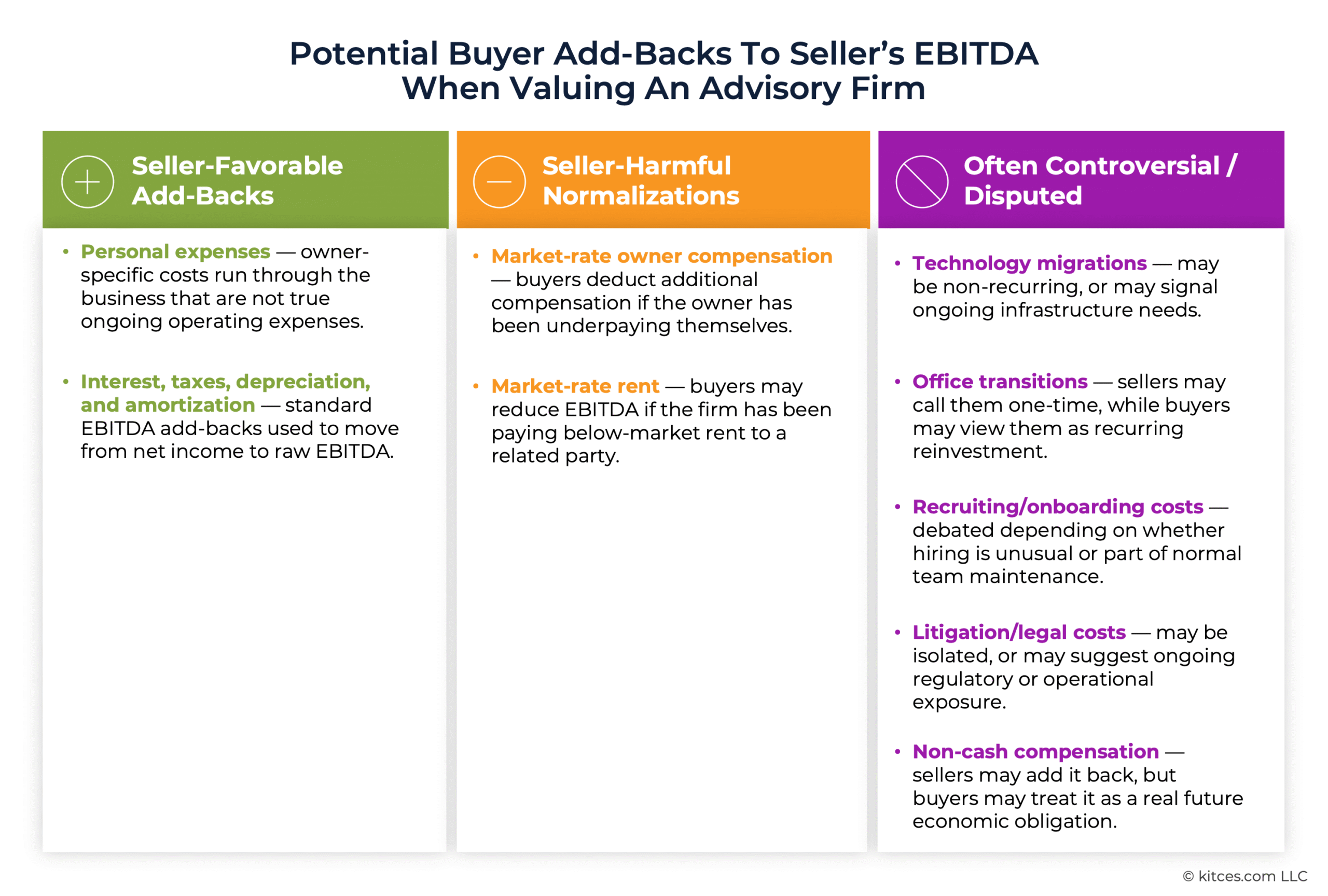
The most important practical step for sellers is to run their own adjusted EBITDA calculation — using the same methodology the buyer is likely to apply, before entering any negotiations. This means imposing a market-rate compensation adjustment for the owner, identifying and quantifying all potential personal expense add-backs, and stress-testing the EBITDA base against the buyer's likely adjustments.
Sellers who arrive at the negotiating table with a fully-reconciled, documented, and adjusted EBITDA figure are far better positioned to defend their earnings base than those who simply present their tax returns and rely on the buyer's version of the numbers. The EBITDA add-back conversation will happen. The key is whether the seller controls the narrative going into the negotiations.
Other Purchase Price Adjustments
The headline multiple reflects an enterprise value, but what a seller actually receives at closing can be a different and materially lower number than the multiple applied even to an adjusted revenue or EBITDA base, once a further series of other closing adjustments are applied… none of which are typically visible at all in the 'headline multiple' that may be reported.
Buyers routinely deduct debt from the purchase price, such as loans outstanding for an office building the business purchased, or the remaining loan balance for another advisory firm the selling firm previously acquired.
However, other debt-like items can also show up as adjustments here, as the category is far broader than most sellers anticipate. Deferred revenue, unfunded compensation obligations, lease liabilities, client prepayments, and accrued but unpaid expenses are all commonly treated as debt-like and deducted dollar-for-dollar from closing proceeds. This is particularly relevant for advisory firms, which frequently bill AUM fees quarterly in advance and may charge upfront financial planning or retainer fees. To the extent a client has prepaid for services that have not yet been rendered as of closing, the buyer inherits the obligation to perform that work without receiving the corresponding fee, so buyers accordingly treat that unearned portion as a debt-like item and deduct it from the purchase price. A seller who bills a full quarter of fees shortly before closing may be surprised to find that the unearned portion of those fees is netted straight out of their proceeds.
Where the deal includes a net working capital adjustment, the purchase price is further trued up against an agreed target (or 'peg') level of normalized working capital — with the seller receiving a credit to the extent delivered working capital exceeds the peg, and absorbing a reduction to the extent it falls short. Because RIAs are typically asset-light businesses with limited working capital, a full working-capital true-up is less universal here than in other industries, and many advisory-firm deals instead rely on a cash-free/debt-free construct with the specific debt-like deductions described above. But where a working capital mechanism is used, the traps mirror the earlier adjustments: the buyer often sets the peg using a trailing average that the seller has little visibility into, and disputes over what belongs in the working capital definition (for instance, whether particular accruals or prepaids are included) can move real dollars at closing and in any post-closing true-up.
In addition, buyers typically fund an indemnification escrow or holdback (commonly ranging from 5% to 15% of the purchase price) that is withheld at closing and released only after a survival period. During that time the buyer may assert post-closing claims (for instance, to recover the value of any additional seller debts or liabilities that weren't discovered or disclosed prior to closing) that ultimately could offset deferred components of the purchase price payable to sellers, including retention and earnout payments.
Sellers who evaluate competing offers based solely on enterprise value multiples, without modeling the net cash at closing after all deductions, adjustments, and holdbacks, may find that the actual check received at closing is significantly smaller than the headline implied.
Conclusion
The headline multiple is where most RIA deal conversations begin, but it is rarely where the economics are actually determined. The decisions that determine what an RIA seller is actually due to receive occurs almost entirely downstream of the headline: how the earnings or revenue base is defined before the multiple is applied, and how the purchase price is adjusted at closing. Sellers who understand only the headline are negotiating blind, especially given that such adjustments are present in virtually every sophisticated transaction involving today's serial acquirers of advisory firms.
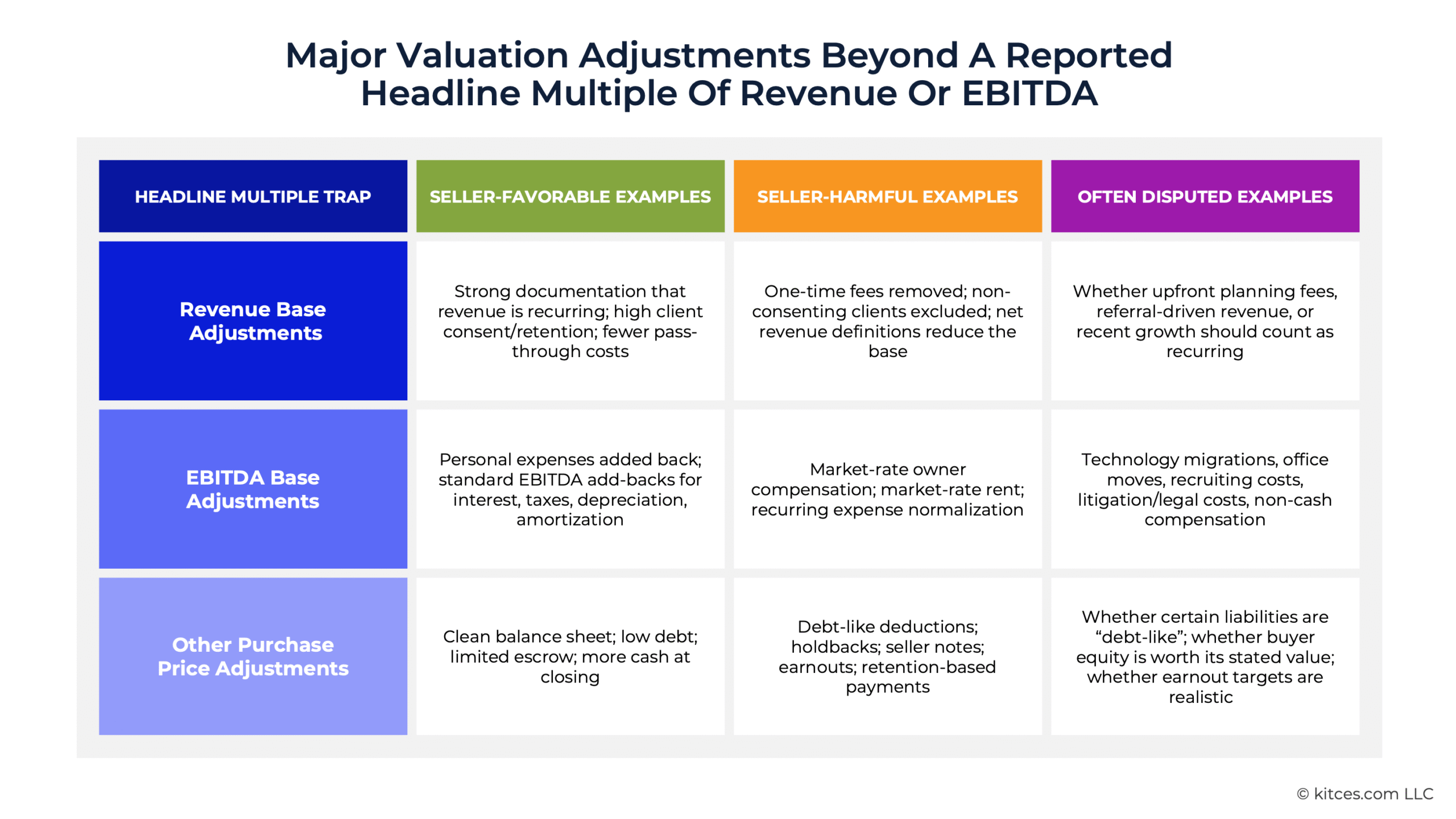
For sellers who are approaching a transaction or evaluating whether to begin a process, the practical takeaway is that before engaging with any offer, prepare your own fully documented earnings model. This means understanding your business KPIs and how a seller will economically break down your revenue and expenses, and being able to calculate your revenue under the buyer's likely definition, not your own.
With a detailed look at your books, you can identify the potential revenue haircuts, and/or produce an adjusted EBITDA figure that accounts for owner compensation normalization, the removal of personal expenses, and takes a hard look at what expenses are really one-time or recurring.
Buyers will do this analysis. Sellers who do it first, and document it rigorously, will be in a far stronger negotiating position.