




The world of financial advisor conferences has evolved tremendously over the past 15 years. Yet while conferences were punctuated by a great pause due to COVID, the underlying shifts are driven more by how the growth of the internet is still reshaping both the ways that advisors get their education and professional development, and also how sponsors – the historical lifeblood of conferences – choose to reach advisors.
In the past, the primary conveners of advisor conferences were the membership associations, who with thousands (or tens of thousands!) of members were the largest aggregations of advisors, especially amongst independent advisors. As such membership associations were the best positioned to invite their members to a conference, charge sponsors for visibility and access to the advisors at the conference, use the dollars to host the conference and invite speakers that would drive turnover, and use the net proceeds left over to grow and advance the mission of the membership association.
More recently, though, this has substantively shifted. This is in part because conferences are no longer quite the driver of continuing education that they once were, as more and more high-quality CE providers become available online. But additionally, this is because the internet steadily undermined the print and then eventually online advertising models of industry media companies… leading them to instead go into the conference business and compete against membership associations for the sponsor dollars. While at the same time, the vendors that once paid membership associations their sponsorship dollars grew and scaled themselves to the point that many now run their own "user" conferences that rival or exceed the size of membership association events!
All of which means now there are more conferences than ever before, from more event organizers than ever before… and it's become increasingly difficult and even overwhelming for advisors to choose what to attend!
As someone who has been speaking at 50–70 in-person and virtual conferences every year for nearly 20 years myself, I've seen the good and bad of our wide range of industry events, from the industry associations to the broker-dealers and insurance companies and RIA custodians, the rise of vendor conferences and media-driven events, private company events, and more. As a result, I am often asked for my own suggestions of what, really, are the industry's 'best' conferences to attend, and back in 2012, I started to craft my own annual list of 'best-in-class' top conferences for financial advisors.
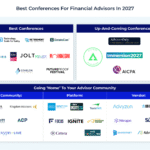
Having updated our annual conference list every year since, I'm excited now to present my newest list of "Top Financial Advisor Conferences" for the upcoming 2027 year, from events on advisor technology to marketing, practice management scaling to succession or developing next-generation talent, to the top events for those who still use conferences to up their technical game in areas like tax planning, estate planning, and retirement planning. Plus a few events that are simply great, well-rounded experiences for those who want to enjoy the conference, the destination, the sessions they attend, and their fellow attendees.
In addition, we've also updated our popular "Master Conference List" for all financial advisor conferences we could find for 2027, both for advisors looking for a wider range of events to attend (if you want to delve deeper into a particular topical area) and for vendors looking for more conferences to exhibit at! (And as more 2027 conferences are announced in the coming months, we'll continue to update the Master Conference List well into the coming year!).
So I hope you'll find this year's 2027 top conferences list (and our updated Master Conference List) to be helpful as a guide in planning your own conference budget and schedule for next year, and be certain to take advantage of the special discount codes that several conferences have offered to all of you as Nerd's Eye View readers!