Executive Summary
There's a long-standing aphorism amongst financial planners about the difficulty in doing retirement planning: if the client could just tell me the precise date they will die, I'd make them the perfect retirement plan. Yet the reality is that no one knows when they are going to pass away; while life insurance companies may be remarkably effective at estimating life expectancies for whole populations based on the law of large numbers, any individual client is a sample size of one. Which means most advisors simply plug in a "reasonably conservative" assumption to their retirement planning software, and plan from there.
In this guest post, Dr. K. Jeremy Ko of ShoreUp Retirement Solutions explores the dynamics of how advisors typically estimate a retiring client's lifespan, and the potential impact of developing more customized estimates of life expectancy, to better estimate how much clients need to save for retirement, can safely spend in retirement, or time the onset of their Social Security benefits.
The starting point is to recognize how common it is for most advisors to simply use a standardized conservative life expectancy assumption, with one recent analysis finding that nearly 90% of advisors simply use the default age-90 or age-95 assumption already built into their financial planning software. Even though the reality is that different demographics – from income to education to race – have materially different life expectancies, varying in many cases by 10-15+ years. Which means at the least, advisors would benefit by looking to more client-demographics-specific actuarial tables than just the standard population average.
At the same time, while many advisors may prefer to ask clients what their own preference is for a life expectancy assumption, research finds that consumers also systematically misjudge their own life expectancy, with a so-called "flatness bias" that younger individuals tend to underestimate life expectancy (i.e., they don't realize how long they may really live in retirement), while older individuals tend to overestimate life expectancy (i.e., they don't realize how short their remaining years may be). Which is especially problematic because these client misperceptions will systematically tilt planning recommendations towards more aggressive, rather than more conservative, assumptions early in retirement.
So what's the alternative? Using an emerging set of technology tools – from the Society of Actuaries calculator, to the University of Connecticut's Goldenson Center of Actuarial Science, or the public version of Northwestern Mutual's Lifespan Calculator – to craft more client-specific recommendations that take into account their individual income, educational, and health factors. Two otherwise similar clients can vary by as many as 20 years in life expectancy just on the basis of a select number of key health and other demographic factors, enough to very materially impact planning recommendations that might otherwise be overlooked if not discussed.
Another benefit of the emerging crop of technology tools is that it can make the conversations with clients easier, as advisors can either walk through the questionnaire with clients together, or offer them the opportunity to do it on their own (if the clients are otherwise uncomfortable to talk about specific family or health factors that may impact their longevity) and simply use the results from the software output itself. Recognizing that because advisors still have a conservative tilt – no one wants to see a client run out of money by underestimating life expectancy – advisors may still default to more conservative longevity estimates (such as a 90th percentile lifespan instead of using the 50th percentile median).
Ultimately, though, the key point is simply to recognize that lifespan in retirement can vary, quite significantly, based on individual health, demographic, and other factors. Merely using a broad-based conservative assumption about clients' life expectancy – such as assuming all clients may live to age 90 or 95 – can still result in undue conservatism for clients who really aren't in good health, and with recent medical advances may actually underestimate the life expectancy of the healthiest clients. In the end, no life expectancy tool can perfectly predict how long a client will live, but the more life expectancy assumptions are adapted to the individual client and their retirement recommendations, the more accurate the recommendations can be, even if they will never be perfect.
 |
And if you want to go deeper on this topic, hear directly from the author on the Financial Advisor Technician podcast . |

Listen To The Financial Advisor Technician Podcast On This Topic




Episode Shownotes And Transcript
Click to expand transcript and show notes↓↓
Shownotes:
- Jeremy Ko: LinkedIn
- ShoreUp Retirement Solutions
- "How to Estimate "The End" Of Retirement", by David Blanchett
- American Academy of Actuaries Longevity Illustrator
- Northwestern Mutual Lifespan Calculator
- University of Connecticut Healthy Life Expectancy Calculator
- Navigating Sensitive Topics With Clients: 3 Tools To Get Them To Open Up About Planning Hurdles, by Meghaan Lurtz
Transcript:
Adam: Hello, and welcome back to the Financial Advisor Technician Podcast. I'm your host, Adam Van Deusen. On today's episode, we're going to discuss one of the major challenges when it comes to retirement planning, which is that clients have unknown lifespans. Because if an advisor could know exactly when a client was going to pass away, they could fine-tune the financial plan to precisely meet the client's goals.
However, in the real world where longevity is uncertain, it can make sense to take a conservative approach when it comes to estimating a particular client's lifespan, as clients and advisors alike are likely to consider the consequences of underestimating a client's lifespan, which could result in the premature exhaustion of their assets, to be more severe than those from overestimating the lifespan, which could result in less lifetime spending than the client might have enjoyed otherwise. Which is why many financial planning software programs use a default age at death for clients that is beyond what actuarial tables might suggest.
That said, given the many planning applications of lifespan assumptions from determining how much a client might need to save for retirement to optimal Social Security claiming strategies, having a better estimate of a particular client's lifespan could lead to better planning outcomes.
So to help us dig deeper into how advisors might approach the challenging issue of estimating a particular client's lifespan, I'm joined today by Jeremy Ko, an economist and the founder of Shore Up Retirement Solutions, to discuss different ways to estimate a particular client's lifespan, how generating personalized lifespan assumptions might be easier and less expensive than many advisors might expect, and how advisors can tactfully raise this sensitive issue with clients.
So welcome, Jeremy, and thanks for joining us on the Financial Advisor Technician Podcast.
Jeremy: Thanks so much, Adam. Really appreciate the opportunity to talk to your audience today.
Standard Approaches To Estimating Clients' Lifespans [2:03]
Adam: To start, perhaps you could provide a rundown of some of the perhaps, you might say, less-personalized approaches to lifespan assumptions, and where they might fall short for advisors and their clients.
Jeremy: Yeah. So, I think that there's three common practices that each present their own problems. And I want to start out by saying we're not trying to castigate, condemn the whole profession. The client intake process is really long and complicated as it is, and I think the last thing that an advisor or planner wants to do is to grab more stuff from the client, as it relates to actuarial lifespan. But the three main approaches that exist, I'd say, are first of all, a one-size-fits-all or a monolithic approach, where the planner or the advisor will assume that the client is going to live to some age, like 90, 95, 100, just to be conservative, without any consideration as to that client's particular characteristics on a personal level. So, things like health attributes, their gender, etc. There was a study done by David Blanchette which found that, at least in Canadian financial plans, and I believe the practice is pretty much equally common here in the U.S., that about 70% of them took a assumed lifespan of 90, and about 20% of them took an assumed lifespan of about 95, with very little variation, even by gender. So, that's one approach. And as you pointed out, Adam, that can present its own problems, even if you're trying to be conservative on the upper end.
And then there's a fairly common approach where planners, advisors will ask their client, "Well, how long do you think you're going to live?" that, on its surface, seems like a reasonable approach. But the problem with that is that there's systematic biases in reporting these lifespan estimates that people exhibit in data. So, to be specific about this, there's something called flatness bias, where people on the younger end of the retiree scale, so, these are people in their 60s and 70s, will typically underestimate the length of time that they're going to live. Whereas people in their 80s and 90s, on the older end of the retiree scale, that they will overestimate the amount of time that they're going to live. So, people kind of fudge for the same number, whether they're really young or really old in on the retiree scale. And so that can present its own problems. And then finally, with the use of technology primarily, people can fall back on standardized lifespan tables that come from Social Security or the Society of Actuaries, and that can give a pretty good read on people's lifespan when it comes to the average person. But when it comes to an individual's own health or demographic characteristics, individual lifespans can vary by something like 10 to 20 years, and it doesn't account for that.
And as you pointed out, if you're overestimating lifespan, then the client, the retiree, is not going to be able to consume as much as they otherwise would, and to be able to enjoy their retirement. If you are underestimating lifespan, then you're increasing the chance that this person's going to run out of money in old age and retirement, the longstanding problem, also known as longevity risk.
Adam: Yeah, I think that makes a lot of sense, and I think the point you made in the beginning is a good one, that you're meeting with a new client, you're not necessarily going to lead with a very sensitive topic of, "Well, how long do you expect to live?" or even trying to dig in further to their health history. So, I do think it makes a lot of sense to perhaps lean on some of these actuarial tables or a more generalized approach.
Factors That Have Been Shown To Influence Lifespan [5:40]
Adam: Now, I know that you've done research yourself on some of the factors that can help determine how long a particular client might live. What were some of those that you found to be useful in that regard?
Jeremy: So, I should say that we're doing ongoing research on this issue, as we speak. I've got a co-author who's working on incorporating more variables into the model that we ran in our analysis from 2024 to 2025. And there, the variables we looked at were really basic health variables. So, people generally have a good read over whether they're healthy, whether they're not, whether they've got some chronic condition or some kind of genetic trait, or some kind of adverse health behavior. And saying that you're in fair or poor health, believe it or not, subtracts about eight to ten years of lifespan for the typical retiree. So, it has a big impact. And the other thing that we threw in there was smoking behavior. So, whether or not people currently smoke. And that has an impact, when controlling for other factors, of about five to seven years on lifespan. And then we've got demographic characteristics in there as well. Gender is a very obvious one, which will increase or decrease lifespan by about two to three years. Obviously, women generally live longer than men do. And you've also got things like college education, which has an impact, a smaller impact, of about anywhere from one to two years on projected lifespan. So, all told, these factors can have an impact of about 10 to 20 years, collectively, on projected lifespan. And again, we're currently doing research to incorporate things like chronic conditions, parental lifespan, and we're going to be releasing that hopefully within the next few months.
Adam: That's interesting. And getting back to the first point, about asking them their subjective health, that's a slight twist on the question of, "Well, how long do you expect to live," right? They might not know actuarial tables or how long they're expected to, but they probably do have a good experience in terms of what their own sort of day-to-day health looks like, which, for the planning process, is also potentially useful when it comes to estimating future medical expenses, I would think. So, it's an interesting twist. And we'll talk later on in the conversation about how advisors might sort of bring up this conversation over the course of meeting with a new or existing client.
Adam: So, Jeremy, we've talked about some of the factors that you found, that you found were quite, that really contributed to more accurate lifespan estimates. Were there any sort of characteristics of individuals that were…you might have thought would have been impactful, but turns out might not have been?
Jeremy: Yeah. So, we were actually quite surprised that the demographic variable of race really didn't have a whole lot of impact on projected lifespan, when you control for other factors. So, specifically, the way that we characterize race in our data is we included whether or not the person identified as being Black, and whether or not they identified as being of other race, other than Caucasian in the U.S. And what we found is that these variables really didn't have statistically significant impact on projected lifespan, when controlling for other variables. So, I'm certainly not denying that race, in sort of a coarse way, is related to lifespan. So, if you look at 2019 data, for example, male Native Americans have a projected lifespan of about 69 years, whereas Asian females have a projected lifespan in this country about 87 years. So you're talking about a 20-year difference based on race and gender. But what we find is that when we control for these other variables, like smoking and health and education, that those racial differences go away. So, the good news for advisors and planners is that they don't need to heavily take race into consideration when they project the lifespan of a client.
Adam: Oh, that's interesting. Yeah, I was wondering about the interaction about some of these data points. So, it sounds like, though, in isolation, things like the subjective self-described health, smoking history, those, by themselves, contribute to better estimates, and when put together, create a more accurate estimate. Is that correct?
Jeremy: Yeah, absolutely. So, the best thing that you can do is to incorporate all those simultaneously. If you incorporate them in isolation, you're getting part of the picture, but you're not getting the full picture, because it could conceivably be…I think we all know anecdotes of people who smoke, but they do great. And we know the opposite situation as well. We know that people who die of lung cancer, but they never smoked a cigarette in their life. So, it's important to put these variables together, in a single model. Now, that doesn't mean that you need to have 100 variables there to be able to capture lifespan accurately. In fact, that's one of the core questions that we're attempted to answer in the research that we're doing right now, is, if we were to choose a parsimonious model of lifespan prediction, based on, let's say, five to ten variables, what would those variables be? So, that's the research that we're currently doing. But it's important to have enough in there.
Adam: Yeah, I think that's a good point that you make, that using multiple variables could be helpful in these client conversations. I'm sure a lot of advisors out there listening have had the experience of a client who says, "Well, my mother or father either smoked every day, or engaged in other habits and lived to age 95 or 100, so I expect that I'm going to live to 95 or 100," as it were, too. Or even vice versa, for some reason, they might expect to have a shorter lifespan, but when you put multiple factors together, actually, their lifespan estimate could be more optimistic. So, I think not leaning on one particular data point, but combining together sounds like a pretty powerful tool for the advisors to use in these client conversations.
Jeremy: Yeah, I totally agree. And when we're including just one variable or two variables, again, we're sort of taking a small step away from a non-personalized approach. But the thing, again, that I would endorse is taking a larger step away. And I don't think this necessitates, again, taking in 100 intake variables to predict lifespan, but just a small enough number to be able to predict it accurately, I think is sufficient to formulating a really robust financial plan for somebody.
Free Online Tools That Allow Advisors To Better Estimate Client Lifespans [11:59]
Adam: So, if I'm an advisor, I say, okay, well... I might be able to ask a couple of these questions, if they've ever smoked their subjective health, but now, what do I do with that? Can you maybe talk about some of the resources that are available for advisors to help them sort of apply these and other factors, that might be useful in making personalized lifespan assumptions.
Jeremy: Yeah, so, there's plenty of calculators out there, that will help advisors use this intake information to project future lifespan. So, we've got a blog post that I think is out, or coming out very soon, which discusses these in good detail. And there's three that I highlight, although there's a panoply of others as well. And I just want to highlight these because they're particularly good, they've got particularly good data sources, and they provide different kinds of looks and feels in terms of client intake. So, first and foremost, the Society of Actuaries, of course, one of the lead authorities on actuarial science, they've got a calculator up that's called the Longevity Illustrator, which is pretty parsimonious. It's got a pretty minimal set of highly predictive inputs. The ones that I just outlined, smoking, health status, gender, birth year. And one of the nice things about their calculator is that they don't just project expected lifespan, but different percentiles of lifespan. So, in other words, if you want to be optimistic for a particular individual, and take their 90th percentile lifespan, that's the lifespan at which they're going to die, at or before, with 90% chance. If you want to be conservative and really optimistic about their future lifespan, it will report things like that. And then, if you want more intake variables, you've got a calculator from the University of Connecticut's Goldenson Actuarial Science Center. And there, they've got a bunch of other input variables, things on chronic conditions, exercise, diet, sleep, alcohol use, education, income. And this calculator not only projects lifespan, but it also projects healthy years as well. And health span is a very important input to lots of things, lots of aspects of financial planning, like, for example, the potential need for long-term care in the future.
And then finally, I wanted to highlight the calculator that's provided by Northwestern Mutual, which takes in insurance data as input data, that it estimates a model on. And this is a really, really long kind of intake survey, which includes all the items, pretty much, from the University of Connecticut calculator that I just mentioned, but then also includes certain types of high-risk behaviors, like seatbelt use, driving, drug use, and so on. This is insurance data, so they've got all sorts of invasive data that goes into their model. And then last but not least, I wanted to mention my own company's calculator, ShoreUp Retirement Solutions. We've got a lifespan calculator that's also a Social Security optimizer, which estimates lifespan, and gives higher percentile lifespans if the planner or the advisor wants to be conservative, and then concurrently optimizes Social Security for that particular person. And that's also related to some of the research that I did with my co-authors on the benefit of incorporating these personalized lifespan projections into retirement planning, in the context of Social Security.
Adam: Yeah, that's great. And are all of these calculators free, or is it a subscription?
Jeremy: Yeah, all the ones that I mentioned are free.
Adam: Oh, okay. Terrific. So, yeah, for advisors out there, if you'd like to try out these different calculators, when I saw them, of course, I had to immediately do it for myself. But if you'd like to check them out, you can go to kitces.com/FAT2, that will take you to Jeremy's terrific article on this topic, which has links to all of these calculators.
Incorporating Lifespan Assumptions Into Social Security Claiming Decisions [15:43]
Adam: So, now, I think that's a really good point, that it's not so difficult to sort of run these numbers, and, again, free tools to help you do that. Now, in terms of practical purposes, in terms of being able to leverage these sort of more accurate assumptions, perhaps one example I know that you discussed in your article is about Social Security. How might having this more accurate approach help with the Social Security claiming decision?
Jeremy: Yeah. So, Social Security is a very obvious place that one can plug these kinds of personalized lifespan estimates into. And I think that it's widely known among planners, advisors, about how basic Social Security retirement benefits work. So, first of all, people are generally eligible from age 62 to age 70, so there is some variation around that, for spouses with dependent children, and disabled spouses and so on. But generally speaking, people are eligible for Social Security retirement benefits between 62 and 70. And the later they claim in that age range, the higher their monthly benefit is in real terms, in other words, in terms of buying power, spending power. So, what this implies is that if you've got a shorter expected lifespan, you're better off claiming earlier, because you don't want to miss out on those early benefits from age 62 to 70. Whereas if you've got a very long expected lifespan, you're generally better off claiming later, because, when you've got a lot of monthly payments that are going to accrue to you as a result of your longer lifespan, then you want to make the most of those payments. You want to increase those payments as much as possible, by claiming later.
So, it's just a general sort of fact pattern that the shorter your lifespan, the earlier you want to claim, the longer your lifespan, the later you want to claim. So, personalized lifespan estimation is something that plugs in very naturally to the Social Security estimation, I'm sorry, the Social Security claiming decision. And so the research that I did with my co-authors, Qi Sun, of Pacific Life Insurance and Sean Zhang, of John Carroll University, studies the personalized lifespan estimation issue within this very quantifiable context, because the rules of Social Security are really well-defined. And what we found, somewhat to our surprise, actually, is that personalized lifespan estimation really does make a difference in the amount of around $10,000 on average, across individuals. And this finding's really robust, regardless of how you cut the sample. If you just look at high wealth people, that would be typical financial planning and advising clients, this result still holds, that people, on average, are going to do better, on the order of $10,000 or more, per person, if they incorporate personalized lifespan projections into their Social Security claiming decision.
And this finding kind of extrapolates beyond Social Security benefits. I mean, if it just had to do with that, then, I don't know, it'd be kind of limited importance, I would say. I mean, Social Security is an important benefit to the vast majority of Americans, but with higher-wealth people, it becomes less and less important. But it also matters for things like retirement savings thresholds and withdrawal rates. So, in the blog, we kind of did this analysis, to show that if you look at someone with a quite short expected lifespan at the age of 65, so, someone who smokes, who's in poor health, female, that that person is going to have a median expected lifespan of around 80 years. And someone who's got sort of the opposite attributes, are in excellent health, they don't smoke, they're going to have an expected lifespan of around 96 years, that there's really marked, striking, striking differences between the amount that the former person would need in order to retire comfortably, versus the latter person would need. So, the former person would need an amount that's on the order around $450,000 to $600,000, if you take some variation in the rate of return that they're going to get on the portfolio, whereas the latter person's going to need strictly more. They're going to need something on the order of $620,000 to $1 million in order to retire comfortably. So, this is a really important input variable that planners should take seriously when they construct a plan when it comes to retirement.
Adam: Yeah, and I think throughout the discussion, another theme is that the advisor doesn't necessarily have to take the output of maybe one of the calculators that we discussed earlier, and that's sort of the end-all, be-all. There's room for adjustment, based on a client's risk preferences, for example. So, if, you mentioned sort of the 90% threshold earlier, or perhaps taking the median output and adding a few years on to that, but as I understand, it seems as though, even if you did that, you use the output and then add years on, that's still likely to be more accurate than using sort of a generic number.
Jeremy: Yeah, and then that's kind of the ethic that we're trying to espouse in this research and in the blog piece, is that I think it's very sensible, this is a very, very sensible practice that planners and advisors pursue, and that is to add some kind of cushion, to be conservative about lifespan, to hedge against longevity risk. That makes total sense. But what makes a little bit less sense is doing that in a monolithic way, to assume that even, in spite of the fact that I smoke, that I've got poor parental longevity, I don't take care of myself, I've got multiple chronic conditions, that my optimistic lifespan is going to be the same as yours, Adam, if you don't smoke, you exercise, you take good care of yourself, your parents and your grandparents lived till 100, that my optimistic lifespan and your optimistic lifespan would be the same, it's not really well-rationalized. So it'd be better to take one of these calculators, and add a cushion, as you pointed out, depending on how conservative you want to be, and maybe take the 90th, the 70th percent of lifestyle, or the 90th percentile lifespan, in order to hedge against longevity risk, to the degree that the planner and the client want to.
Adam: Yeah, and I should note as well, if anyone wants to get nerdy, as we often do here at Kitces, within the article, we have a lot of great graphics showing Jeremy's research, some of the outputs on Social Security and these other findings. So, again, if you go to kitces.com/FAT2, you can check that out.
Strategies To Tactfully Raise Lifespan Discussions With Clients [21:58]
Adam: So, let's say I'm one of our advisor listeners. And so, they say, "Great. I really want to...I'm interested in doing these more personalized lifespan assumptions," but, as we alluded to earlier, one of the potential hang ups is, that some of these questions could be a little uncomfortable, especially if you're meeting with a relatively newer client. What are some approaches that advisors might take to sort of get this conversation started in a tactful manner?
Jeremy: Yeah. So, first and foremost, this is a fantastic question, and a really big barrier to having these kinds of conversations is just the level of discomfort that can potentially be on both sides. So, it's an issue, it's an elephant in the room that we absolutely need to address. First and foremost, I think that the discomfort in broaching these topics oftentimes comes primarily on the advisor side, more so than on the client side. So, an advisor will find, if they broach this in a delicate way, that clients can be surprisingly open to discussing these issues, because an advisor is a trusted person, who's supposed to take this information in confidence. And I think the majority of clients see that person that way, that this is a relationship of trust.
Now, in order to make that conversation more comfortable on both sides, there's standard approaches that people can use. And I'm going to borrow some material from a well-known financial planning researcher in mind out there. Her name's Meghaan Lurtz. And she's done some content for Kitces. She's got her own Substack. I think it's called "(Less) Lonely Money." And she endorses an approach where the planner takes this therapy-based, conversational approach, and they don't start with hard questions first. So, they do a lot of rapport-building. They do a lot of listening. They do a lot of empathizing and asking about vision, asking about getting to know this person in a general way, before the advisor starts getting into hard numbers and questions on, that could be uncomfortable. And then, another practice which she endorses, which makes utter sense to me is asking permission to broach these topics, to say, "Look, I wanted to ask you about these sort of health-related issues. Is it okay that I do so?" And I think that advisors would find, if they were to try to adopt this practice, that clients are surprisingly open to discussing these things.
Now, there's other kinds of approaches that advisors can use as well, which I think are really well-rationalized, so, for example, one is to use an intake that's sort of direct to the client, and the client sort of inputs these things in a private way, and they've got optionality with it. And it's also, of course, these days, really important to have security assurances with this data as well. And finally, my background is in behavioral economics, so I'm going to refer to stuff from behavioral science, which is near and dear to my heart. There's ways to frame shorter expected lifespan, that make it more palatable for clients. One is to benchmark or anchor your estimates to lower ranges of lifespan, like 80, and then let's say your estimate pops up that it's 85, 90, 95. Well, that looks a lot better to a client than if you start with, "Hey, the average lifespan at your age going forward is 90," and then they find that theirs is 80. That might not make them feel very good.
So, there's that. And then there's also ways, believe it or not, of framing short lifespan in a favorable way. So, although it's, all else equal, a good thing to live a long time, provided you're going to have healthy years going into the future, but the drawback of that, from a financial standpoint, is that you need more money to retire, that you can withdraw less from your retirement assets over time, and that you may need to have a longer working life. So, there are some distinct, at least financial, advantages to having shorter expected lifespan. You can retire earlier, you don't have to work as late, and you can potentially enjoy the early years of retirement more. So, that's another behavioral approach that one could use, in order to take some of the anxiety away from short expected lifespan.
Adam: Yeah, and getting back to the point earlier about the inputs that are needed to have these assumptions, the advisor's not asking for a blood test or anything like that. It's personal, but still just asking questions here. And also, to the point, it's interesting that you note that we're looking at sort of ranges here. It's not I put your information in a calculator and the crystal ball says "you're going to die when you turn 80," or 75, or whatever it says. It's ranges and percentiles, because this is sort of inherently unknowable.
Jeremy: Correct.
Adam: And I'd imagine part of this conversation, too, is just getting the client to think ahead into the future, in terms of what their life is going to be like at that age, where they think they're going to be. Perhaps that can serve as a bridge, as it were, to sort of the deeper conversation about, well, what does your financial life look like here? What does your health look like there, amongst the other factors?
Jeremy: Mm-hmm. Yeah. Yeah, totally agree.
One Key Takeaway For Advisors [27:12]
Adam: So, before we finish up, one question we always like to ask our guests here on "Financial Advisor Technician" is, for our advisor listeners, given that we've talked about so much today, from the different ways to estimate lifespan, why having a personal lifespan is important, and how to broach this conversation with clients, what's sort of the one key takeaway you'd like our advisor listeners to have from this conversation?
Jeremy: I think the one key takeaway is that advisors spend a lot of time with intake of lots of different financial variables and goals-related inputs, when it comes to client intake, in order to personalize a financial plan for a client, and put comparatively less time in a very critical input, which is the length of retirement, the length of the retirement plan, which is linked to lifespan. And that that particular input is really critical to a financial plan when it comes to savings thresholds, withdrawal rates, Social Security claiming decisions, if the person has a defined benefit pension, what they ought to do with that, annuitization decisions, insurance, etc., etc. And so, because it's got such wide-ranging implications for retirement planning, it makes sense for the planner to put thought and time and energy into that critical input, and personalizing and tailoring it for the particular client's situation, and that it's not that hard to do so, not just in a behavioral sense, to be able to broach the topic with the client, but to find free resources out there that help them pinpoint that number a lot better for a particular client.
Adam: Yeah. That makes a lot of sense. Well, thank you so much, Jeremy, for joining us today on the "Financial Advisor Technician" podcast.
Jeremy: Thanks so much, Adam. Really appreciate the time, and I enjoyed talking to you and your audience.
Adam: And for our listeners, if you'd like to dig deeper into personalized lifespan estimates, including links to all the calculators discussed during the episode, you can go to kitces.com/FAT2, to read the full-length article on this topic. We'll also include a link to that in the episode description in your podcast player.
And as a reminder, Kitces Premier members can earn CE credit for taking quizzes on our technical content, and also have access to our regular CE-eligible webinars, recordings of which can be found in the Members section. If you're interested in becoming a Premier member, we'll put a link in the episode description as well.
Also, if you're enjoying the "Financial Advisor Technician" podcast, please leave us a rating or review on your favorite podcast platform, to help others discover the show. Thanks again for listening, and we'll see you next week on the "Financial Advisor Technician" podcast.
Standard Approaches To Lifespan Assumptions For Retirement Planning
Financial advisors often use standardized lifespan assumptions in retirement planning, such as "run all projections assuming clients pass away at age 95", typically only modified in situations where clients express their own self-assessed views about their lifespan (e.g., "My health is terrible, I'll be lucky to make it to age 75, let's use that as a baseline").
This type of simplified approach to lifespan assumptions is done for a variety of reasons. The most common is simply because client onboarding is already a complex and time-consuming process for financial advisors. As such, engaging in an involved intake conversation related to actuarial lifespan can be challenging. Not only can such a conversation be time-consuming, but it can evoke discomfort, shame, and anxiety for both advisors and their clients.
The downside of avoiding these conversations is the potential for inaccurate lifespan estimation, resulting in suboptimal decisions about the timing of Social Security benefits, and the potential for taking too much, or perhaps too little, in retirement withdrawals for retirement lifestyle consumption.
Near-Universal Default Lifespan Assumptions
In a 2021 issue of the Journal of Financial Planning, retirement researcher David Blanchett found that, in a sample of 32,711 financial plans, approximately 70% utilized a standard survival age of 90, while 20% set it at 95, with little to no customization—even across genders. Not coincidentally, these survival age assumptions are the most common assumptions typically pre-populated into financial planning software platforms in the first place. Which implies that ultimately, most advisors are simply using the default longevity assumptions already programmed into their software, without making any further changes.
To be fair, these are naturally conservative assumptions; according to government data at the Centers for Disease Control, the population life expectancy is age 76.5 for men, and 81.4 for women (or an overall population average of age 79). Even amongst those in the top 1% of income, life expectancy is age 87.3 for men and 88.9 for women. Which means advisors using longevity assumptions of age 90 or 95 are reducing the risk that clients outlive their money by planning for a longer-than-is-likely time horizon as a baseline. Not surprising, given that for most clients, as well as financial advisors on their behalf, the greatest fear of retirees is running out of money before the end of their retirement.
The caveat, however, is that when all clients receive conservative (i.e., age 90-95+) life expectancy assumptions, the method can exacerbate errors in financial planning for "normal" clients. For example, an advisor would generally recommend a lower withdrawal rate to a client with a conservative age-95 lifespan, than one with a typical lifespan closer to age 80; as a result, this client would enjoy less consumption than they could otherwise afford over their lifespan.
Customizing Using Actuarial Or Subjective Lifespan Estimates
While the whole point of life expectancy averages is the acknowledgement that not everyone will live to the same age – and thus advisors' "conservative" approach of picking a much-higher-than-average lifespan age by default – the reality is that different segments of the population do have distinct life expectancies as well. Which means using population- or demographic-specific actuarial lifetables can help advisors pinpoint lifespans more accurately.
For instance, as noted earlier, life expectancy for the top 1% of households by income is about 10 years longer for women than the bottom 1% by income (88.9 versus 78.8 years, respectively), and is 15 years longer for men (87.3 versus 72.7, respectively). Public health research has also found differences in life expectancy by racial demographics, and also by educational level (e.g., whether the individual went to college or not). Broader improvements in public health services over time also mean that life expectancy by varies by birth year, with those born more recently having longer life expectancies than those born earlier in the 1900s. To the extent the advisor can use a more specific-to-the-client actuarial table than a generic population average, the more accurate the life expectancy.
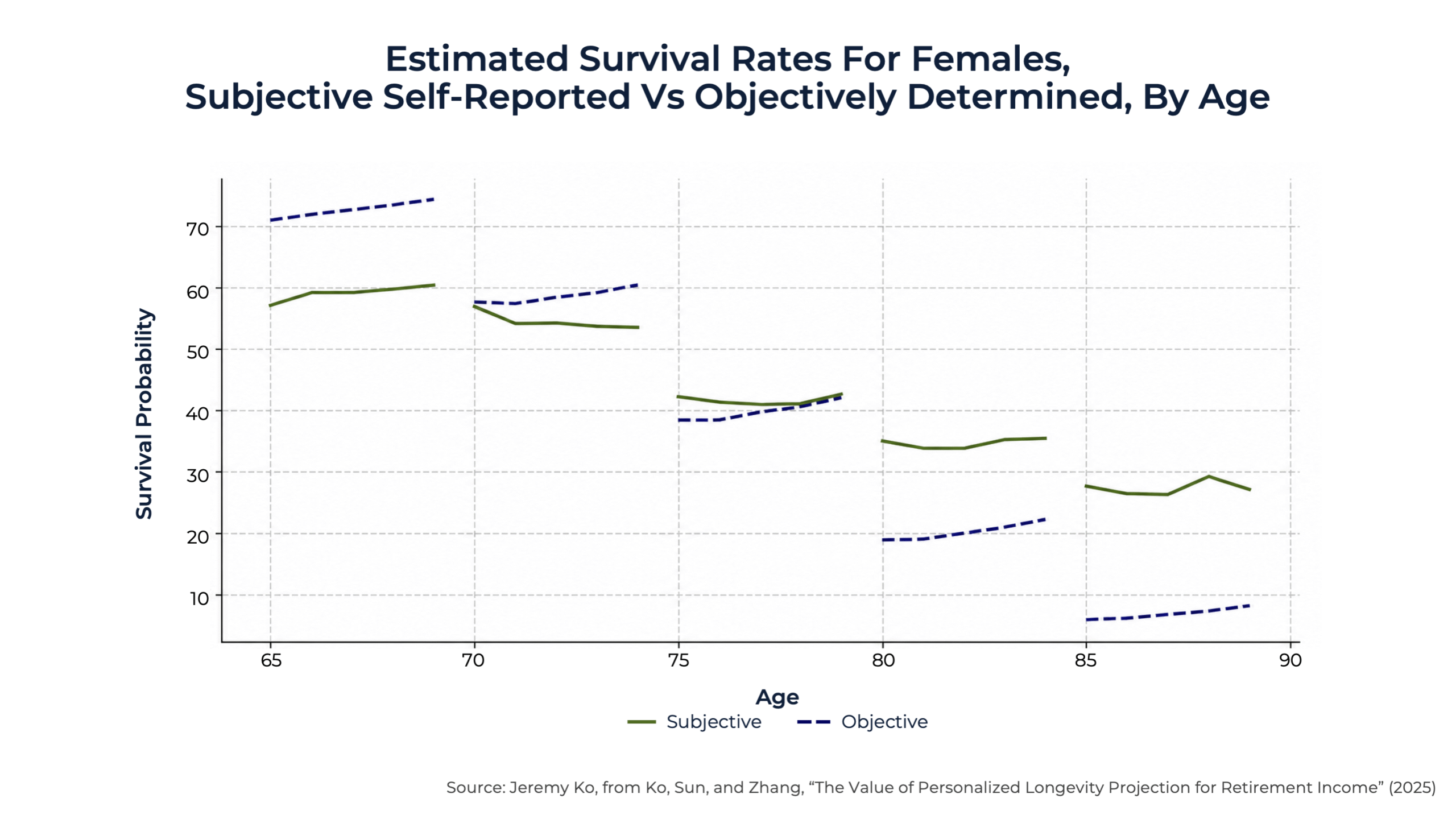
Alternatively, financial advisors can use the clients' own estimate of their life expectancy (or at least adjust based on their views of how healthy they are). However, research suggests that individuals' subjective perceptions of their own longevity often diverge from objective actuarial estimates, exhibiting "flatness bias". In particular, prior survey-based empirical studies find that younger individuals tend to underestimate their survival probabilities, while older individuals tend to overestimate them; in other words, young people tend to underestimate how old they really might live, while older individuals underestimate how soon they might really pass away.
Figure 1 below shows average subjective (self-reported) survival probabilities and objective survival probabilities by age from 65 to 89 for females in the sample used in Ko, Sun, and Zhang (2025). These data come from the Michigan Health and Retirement Study (HRS) of U.S. individuals aged 50 and over. The HRS includes a question on a respondent's self-assessed survival rate until a certain age, roughly 10-15 years from the age at the time of the survey. Respondents aged 65 to 69 are asked to project their survival rate until age 80, 70 to 74 until age 85, 75 to 79 until age 90, 80 to 84 until age 95, and 85 to 90 until age 100. The objective survival probabilities below are provided in the HRS and based on lifetables by gender and birth year from the CDC.
The figure shows a visual representation of flatness bias in this figure. In particular, females below the age of 75 tend to underestimate their survival probability (the subjective line is below the objective), while females above of age 80 and above tend to overestimate their survival probability (the subjective line is far above the objectively calculated survival probability).
The Value Of Personalized Lifespan Estimates
While using actuarial tables as a baseline is an improvement over having clients estimate their own subjective longevity, or just using population-wide averages, it's not a panacea, because individuals may have multiple relevant demographic characteristics – so which actuarial table should the advisor use? Moreover, selecting which actuarial table(s) to use based on demographics does not capture granular variation in lifespan across individuals. For instance, differences in health status and behaviors alone (e.g., whether the person smokes or not, exercises actively or not), can cause variations in lifespan of 10-20 years. A planner could, therefore, conceivably underestimate the lifespan of someone with strong health attributes and family history, or overestimate life expectancy for those with significant adverse health factors.
Personalized Lifespan Models Are More Accurate
To that end, research finds that lifespan can be predicted more accurately when incorporating basic demographic and health variables, than when using standard actuarial tables alone. A study by Ko, Sun, and Zhang analyzes the impact by using a survival model incorporates the following factors: 1.) race (Black, White, other); 2.) ethnicity (Hispanic or non-Hispanic); 3.) education (less than high school, high school degree or equivalent only, college degree or more); 4.) self-rated health status (excellent, very good, good, fair, poor); 5.) current and former smoker status.
The analysis adopts what's known as a Cox proportional hazards (Cox PH) model (which is a standard method for modeling heterogeneous survival rates across a population). For simplicity, it assumes that the mortality rate (i.e., the probability of death at each age) for each individual is a fixed multiplier (known as the hazard ratio) times the population-average mortality rate for all ages. Individuals with a higher than average mortality rate have a hazard ratio greater than one. Those with a lower than average mortality rate have a hazard ratio less than one.
The table below shows the impact of each variable on mortality rate for both males and females in from the Michigan Health and Retirement Study (HRS) data. First, the p-value below relates to the "statistical significance" of each variable on the mortality rate of a particular gender. Generally, p-values below 0.05 (or 5%) are considered to be statistically significant – i.e., a relationship of this magnitude has a 5% chance or less of being observed by random chance. The hazard ratio in this table is again the multiplier applied to mortality rate corresponding to each factor. For example, a hazard ratio of 2.28 corresponding to poor or fair health means that males reporting this health status have an estimated mortality rate that is 2.28 times (or 128% higher) than the average male. A hazard ratio of 0.85 corresponding to a college degree means that college-educated males have an estimated mortality rate that is 0.85 times (or 15% lower) than the average male.
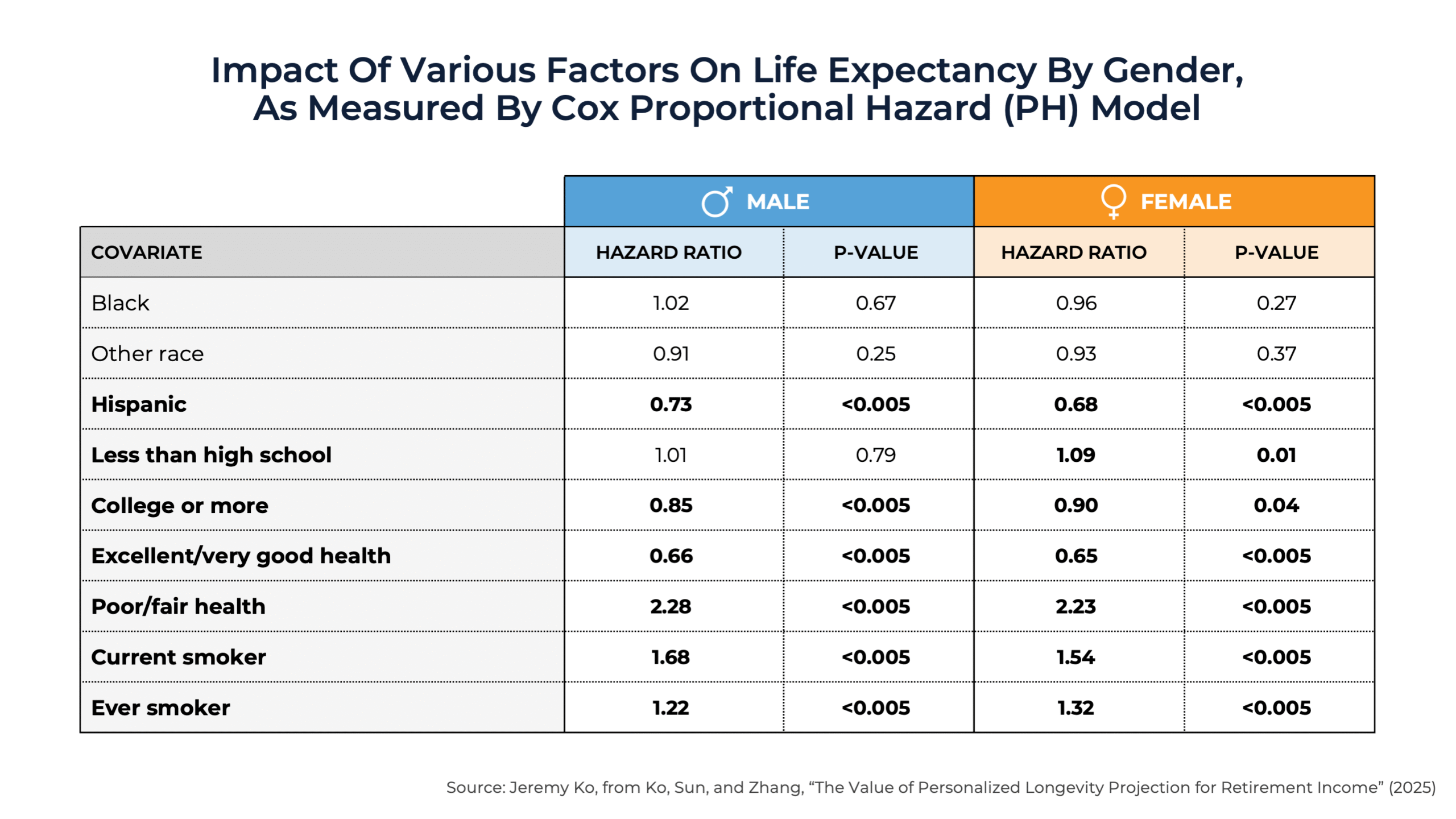
What kind of impact do these hazard ratio variables have on projected lifespans? Retirees who report poor or fair health have a projected median lifespan that is 8-10 years lower than people who report excellent or very good health. Retirees who report currently smoking have a median lifespan that is 5-7 years lower than those who report not smoking.
Which is important, as it means in general, demographic variables have a lower impact on projected lifespan than these health-related variables. People who report having a college degree have a median lifespan up to two years longer than those who report not having a college degree. Women also have a median lifespan approximately 2-3 years greater than that of men.
Taken together, though, these health and demographic factors can cause variation in projected lifespan of about 10-20 years, which is enough to very materially impact an advisor's recommendations on everything from when to start Social Security for one or both members of a couple, or how much can be "safely" spend in retirement with varying time horizons.
Increased Value From Social Security Benefits
Expected lifespan matters a great deal in the context of Social Security retirement benefits. Claiming benefits earlier (e.g., at age 62) results in monthly payments which are lower but start sooner. Claiming benefits later (e.g., at age 70) results in payments which are higher but start later. Consequently, people with higher expected lifespan should generally claim their benefits later, especially in situations where delayed benefits impact both the recipient and the survivor benefits that might be paid out to a widow in the future.
Ko, Sun, and Zhang (2025) attempt to quantify the dollar value of personalized lifespan estimates in the context of individual Social Security claiming by using data from the HRS. They choose an optimal claiming age (which maximizes the expected value of lifetime benefits) for each respondent in their sample using their personalized lifespan estimate based on their demographic and health characteristics at age 62. They then observe the death age of each respondent and compute the realized value of benefits over their lifespan assuming an annualized primary insurance amount (benefit if claimed at full-retirement age) of $40,000. They then compare this value from their personalized optimal claiming age to the benchmark claiming ages of 62, 67, and 70.
The table below summarizes the results of this simulation. The analysis suggests that incorporating personalized lifespan estimates into Social Security claiming decisions can generate meaningful gains in lifetime benefits relative to commonly used claim ages. Among the thousands of respondents in the sample, the personalized claiming strategy produced the highest realized present value of benefits on average. Compared to claiming at age 70—a strategy frequently recommended by financial advisors and researchers to take advantage of delayed retirement credits—men realized an average increase of approximately $18,800 in lifetime benefits, while women gained roughly $9,300. Relative to claiming at age 62, which remains the most common claiming age, the gains were approximately $12,300 for men and $26,500 for women.
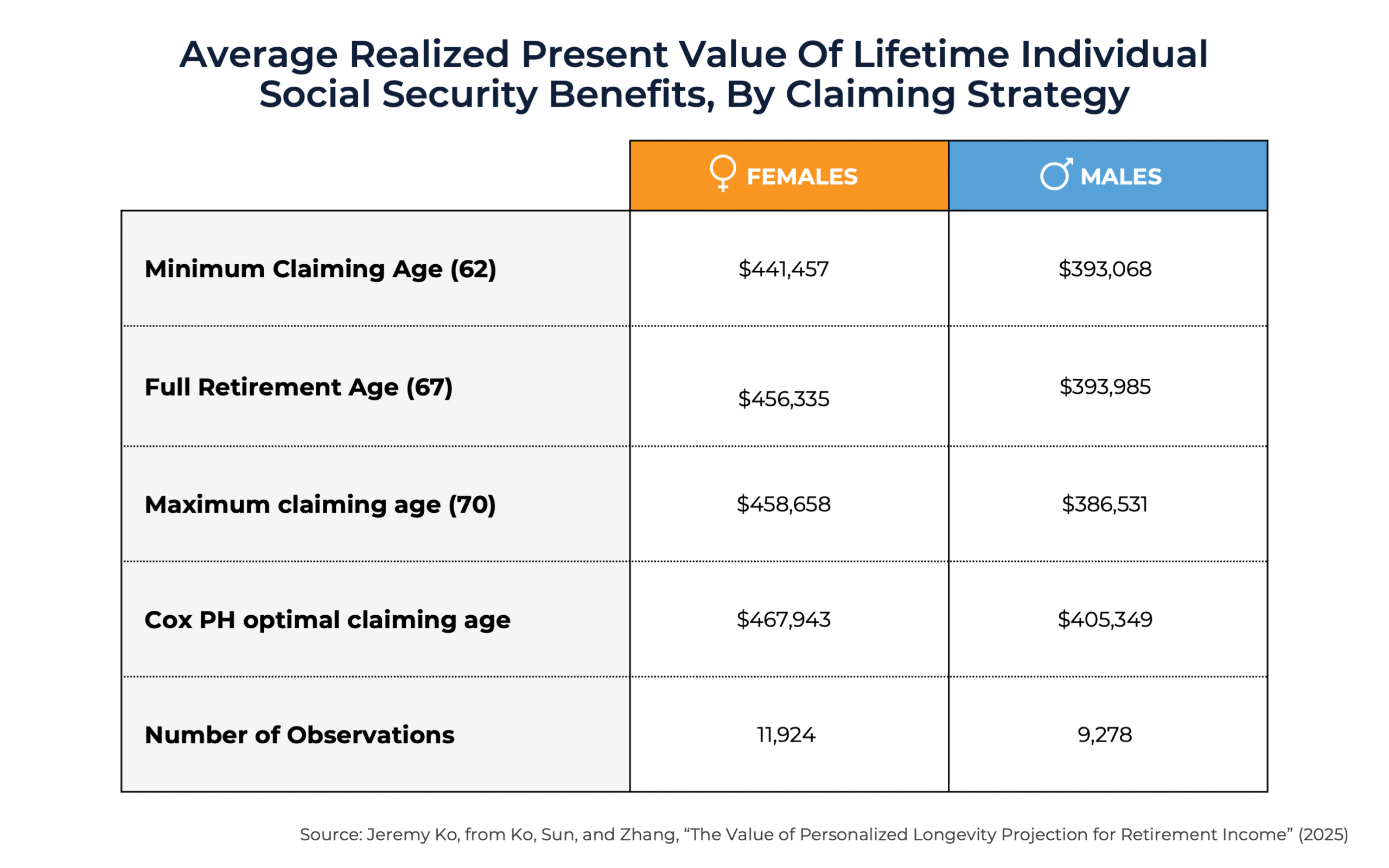 Viewed another way, the personalized claiming strategy increased the realized value of lifetime benefits by about 2.9% for men and 2.5% for women relative to claiming at full retirement age, and overall the lifts from a personalized claiming strategy were more impactful than any standard rule of uniformity claiming at age 62 (early) or age 70 (maximum delay). In other words, personalized lifespan information appears capable of capturing a substantial portion of the value available from Social Security claiming optimization.
Personalized Retirement Savings Thresholds
These findings can be applied to optimize other retirement planning decisions such as savings thresholds, systematic withdrawal rates, and annuitization. As an example, we analyze how savings thresholds can vary with different expected lifespans based on variation in demographic and health variables.
Consider two different single women as prospective clients – one with a short expected lifespan, and the other with a long expected lifespan – who are aged 65 in 2026. The long-lived client is college educated, in excellent health, and has no history of history smoking. The short-lived client does not have a college degree, is in poor health, and currently smokes.
The table below shows the median (50th percentile) and 90th lifespans for both individuals as computed using the Cox PH model from Ko, Sun, and Zhang (2025). (The 50th percentile lifespan is the age by which 50% of people with similar projected lifespan (based on their demographic and health characteristics) would die. The 90th percentile lifespan is the age by which 90% of people with similar projected lifespan would die.) The long-lived client lives until 96 and 108 at her 50th and 90th percentile lifespans, respectively. The short-lived client lives until 80 and 90 at her 50th and 90th percentile lifespans, respectively. Therefore, there is a 15-to-20-year difference in projected lifespan based on demographic and health attributes. An advisor would plan to the 50th percentile lifespan if the client cares about optimizing retirement outcomes over her average or expected lifespan. The advisor would plan to the 90th percentile lifespan if the client cares more about running out of money in the event she lives into old age.
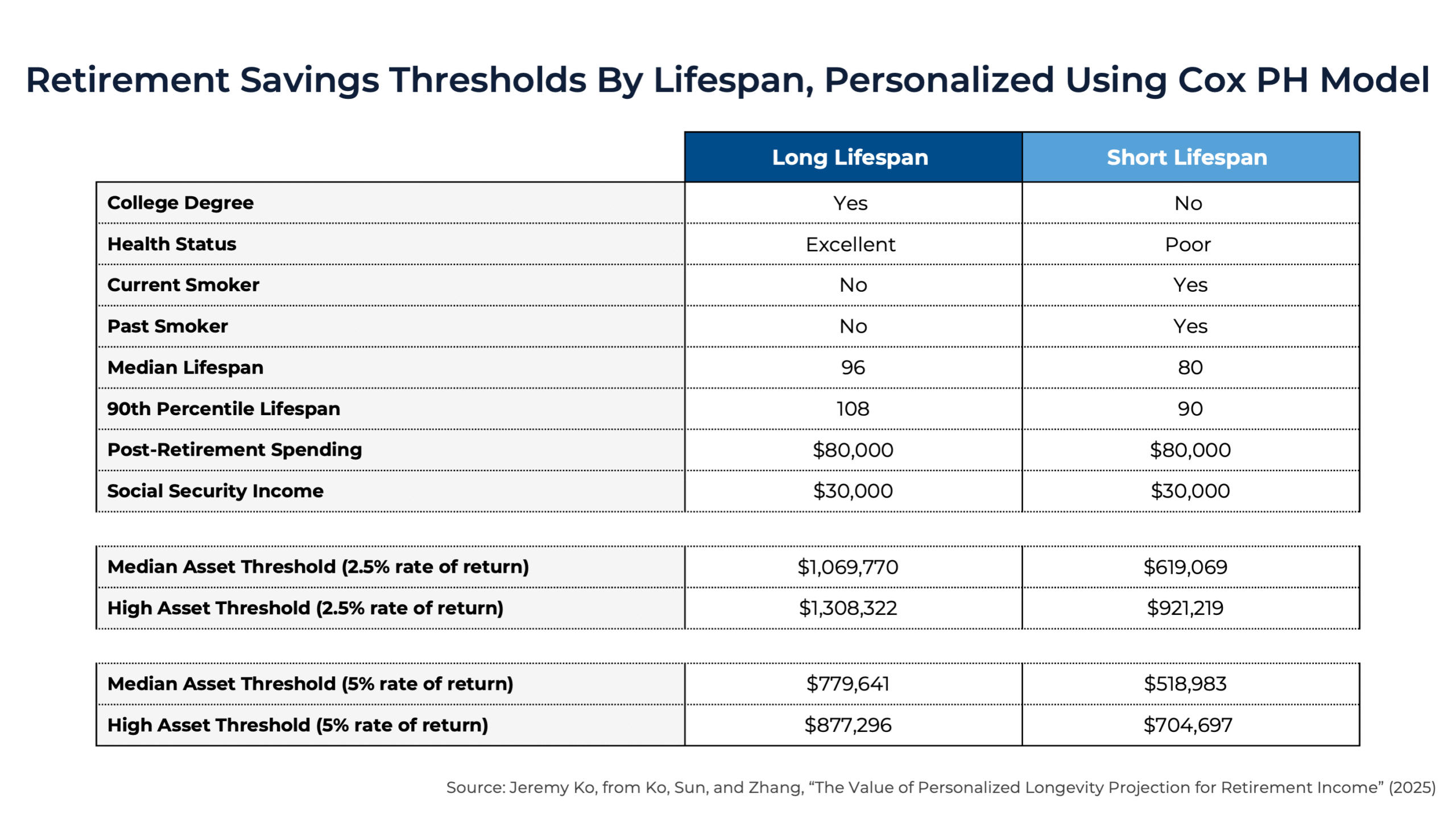 What do these differences in lifespan imply for retirement savings thresholds? We assume that both individuals have a pre-retirement income of $100,000, and require an 80% replacement rate in retirement, which means their post-retirement spending goal is $80,000/year. We also assume that each individual has an average amount of Social Security income in the amount of $30,000 per year. Therefore, they each need to generate $50,000 per year throughout their retirement period from savings.
The preceding table shows the amount of assets that the long and short-lived clients would need at age 65 to fund retirement through their 50th and 90th percentile lifespans. The short-lived client needs substantially less than her long-lived counterpart. She needs only $619K invested at a 2.5% annual real rate of return to fund retirement through her 50th percentile lifespan of 80 years old. Now let's suppose that the client worries about running out of money in retirement so that the advisor opts to plan through her 90th percentile lifespan of 90 years old. In this case, she needs $921K to fund her retirement. In contrast, the long-lived client needs even more than this amount to fund retirement until even her 50th percentile lifespan of 96 years old. She needs over $1M to ensure her consumption even until this average or expected lifespan.
Now let's suppose that these clients have a high risk tolerance and opt for portfolios with a more aggressive equity allocation. In this case, a reasonable real rate of return might be 5% per year. Both clients would now need less to retire. The short-lived client needs only $519K and $705K to fund retirement through her 50th and 90th percentile lifespans, respectively. Hence, advising a client with a short lifespan that she needs $1M to retire vastly overstates her needs at reasonable assumed rates of return.
How To Incorporate Personalized Lifespan Estimates
Online Calculators
While historically most financial advisors have not adapted very personalized life expectancy estimates for clients because of the time it takes to have the conversation, in today's environment advisors can incorporate personalized lifespan estimates into retirement plans with relative ease using available technology. There are many free lifespan calculators available online, from those with parsimonious inputs (e.g., less than five) to get an expedited (but still more accurate than default assumptions) estimate, to those with an extensive battery of intake questions.
First, the Society of Actuaries (https://www.longevityillustrator.org/) offers a calculator with a small number of intake variables (which overlap with inputs from the model discussed earlier in this article). The SoA Longevity Illustrator specifically uses self-rated health status (excellent, average, poor), current and former smoker status, gender, and birth year. This calculator outputs the user's median lifespan, plus breakpoints of projected lifespan from the 10th to 90th percentiles. This calculator can be used when an advisor wants a quick intake with a minimal number of predictive variables.
The University of Connecticut's Goldenson Center of Actuarial Science also hosts a lifespan calculator (https://apps.goldensoncenter.uconn.edu/HLEC/) with a larger array of inputs. Its health-related input variables include information about exercise habits, chronic conditions, diet, sleep, and alcohol consumption. This calculator also includes the additional demographic variables of education and income. This calculator projects not only lifespan but also the number of anticipated healthy years. These outputs can be useful for more detailed retirement planning including projected changes in spending such as long-term care funding.
The Northwestern Mutual Lifespan Calculator (https://media.nmfn.com/tnetwork/lifespan/index.html#0) takes in a more extensive set of input variables than these other two applications. Its inputs include dozens of items spanning chronic conditions, family history, drinking, etc. This calculator also includes high-risk behaviors such as seat-belt use (or rather, the lack thereof!), driving behavior, and recreational drug use. Financial advisors can use this calculator if a deep-dive into lifespan and an expansive set of predictors is preferred.
Other tools that provide more detailed analysis of a client's life expectancy as part of a broader planning tool include Waterlily, which applies client-specific health factors to help customize long-term care recommendations, as well as ShoreUp Retirement Solutions, which provides both expected and 90th percentile personalized lifespan estimates as part of their free online Social Security optimizer for individuals.
Notably, many of the calculators above also offer the advantage of presenting higher percentile lifespan estimates, if the advisor wants to consider more conservative long-life scenarios. This is akin to how advisors already typically use conservative life expectancy assumptions to manage the risk of clients outliving their assets. However, a superior practice would be to manage this risk in a more personalized way. For example, planners can use personalized lifespan estimates for their financial plans, but rely on the 90th percentile rather than the 50th (median). Still, the key is that a conservative lifespan for one individual is not necessarily the same as a conservative lifespan for another, which can imply substantial differences in savings thresholds, withdrawal rates, etc.
An advisor should consider updating lifespan estimates whenever a client's financial plan is updated – e.g., on a yearly basis. This practice is especially important when predictors (such as health status and chronic conditions) can change over time.
How To Engage Clients About Lifespan
Shifting planning practices toward personalized lifespan estimation is not necessarily an easy, straightforward thing to do. Conversations about longevity can evoke discomfort and other negative emotions. Eliciting client attributes such as chronic conditions, family health and longevity history, smoking, drinking, exercise, and other health behaviors can potentially evoke feelings of anxiety and shame. Hence, advisors and their clients can suffer from the "ostrich effect" of avoiding these topics.
Fortunately, there are approaches which derive from therapy and behavioral science which can help planners broach topics around health and longevity. The starting point, as highlighted in prior articles by Dr. Meghaan Lurtz, is to be certain to build rapport through listening and empathy before asking for numerical inputs and sensitive information. Advisors can also simply ask for the permission of the client before asking for sensitive information. If clients don't want to discuss, they can voice their concerns or decline, but notably advisors often anticipate that clients will be more resistant to these conversations than they actually are.
With that in mind, Lurtz offers the following scripts to further help advisors overcome possible hesitancy in broaching these topics:
Approach 1: The Legacy & Identity Bridge
Best for: clients who are motivated by purpose, relationships, or legacy. This opener connects longevity planning to daily life and identity (not illness or data).
STEP 1 — Open with identity
"When you picture yourself at 80 — what do you hope you're still doing? Not financially, just... in your daily life."
Let them answer fully. Don't rush to the planning piece. Ask follow up questions to get a vivid picture.
STEP 2 — Bridge to the plan
"Thank you for all of that detail. Your picture matters more than most people realize when it comes to building your plan. Because how we fund your retirement, when you claim Social Security, how much you need saved — all of it is shaped by how long you're likely to live and how you live during that time."
STEP 3 — Ask permission
"There are some tools that help us personalize that timeline for you specifically. A few of the questions touch on health and family history; would you be willing to explore this conversation together?"
The above approach works well for clients who otherwise have a longer-term orientation and like to visualize their purpose and future. For those who may be more skeptical – about the future, or their own health and longevity – it may be more helpful to reframe the conversation from the start.
Approach 2: The Permission & Reframe
Best for: analytical clients, skeptical clients, or anyone who may feel uncomfortable with health conversations and benefit from knowing there's an upside to a shorter timeline. This approach leads with agency and reframes the conversation before it begins.
STEP 1 — Name the purpose and ask permission
"One of the most valuable things we can do in your plan is get your retirement timeline right — not just use a generic 'plan to 90' that gets applied to everyone. There are actually tools now that can give us a much more personalized estimate based on a handful of factors. Some of those questions are pretty routine, but a few of them touch on health and family history, which can feel more personal. Would it be okay if we walked through them together? You can skip anything that doesn't feel right, and we can always revisit."
STEP 2 — Reframe before diving in
"I also want to say upfront — the point of this isn't to predict anything scary. In fact, a lot of the time, clients are surprised that a shorter planning horizon actually means more flexibility: earlier retirement, a higher withdrawal rate, less pressure to save. So wherever the numbers land, there's something useful in it for you either way."
The key principle with these scripts, borrowed from trauma-informed interviewing research, is that sequencing matters: story first, meaning second, practical questions last. Advisors who are new to these conversations often find it helpful to write out the opener they plan to use before a client meeting and, if possible, say it aloud beforehand. Preparation isn't just about the words. It's about arriving relaxed enough, open enough, and prepared enough to then be able to fully listen to the answer.
Financial advisors can also use insights from behavioral science to make shorter projected lifespans more palatable to clients – consistent with the script from approach 2 above. One possible approach involves anchoring lifespan estimates to short benchmarks below the median (e.g., age 80) so that the great majority of personalized estimates are greater than this number. In addition, advisors can discuss and emphasize the advantages of shorter relative to longer lifespans – which came mainly in the financial domain. These advantages include earlier retirement, lower savings thresholds, and higher withdrawal rates as we saw with our analysis of long vs. short-lived personas.
Finally, technology offers a means of providing privacy and security in the intake of sensitive client information. Another appeal of standalone longevity estimation tools that can be given to clients directly, or financial planning software which allows clients to directly input intake data without intermediation by their advisor, is that it reduces potential awkwardness for clients to have to talk out loud about aspects of their health that they aren't yet comfortable to discuss; instead, their responses are simply recorded securely in the software itself, and the advisor only receives the final "answer" about a personalized life expectancy assumption, and can subsequently discuss as much (or as little) as clients wish to discuss.
Conclusion
Longevity is one of the most important variables in retirement planning, yet it is often estimated using broad assumptions that fail to reflect meaningful differences across individuals. Health, education, smoking history, and other factors can translate into differences in projected lifespan of 10 to 20 years or more, with significant implications for Social Security claiming, savings targets, withdrawal rates, and retirement income security.
The good news is that advisors no longer need to rely on one-size-fits-all longevity assumptions. A growing number of calculators and planning tools make it possible to generate personalized lifespan estimates using a relatively small set of demographic and health inputs. While no model can predict exactly how long someone will live, personalized estimates can provide a more informed foundation for retirement decisions than generic planning ages or subjective guesses.
The bottom line is that as personalized longevity tools become more accessible, advisors have an opportunity to make retirement plans more individualized, more accurate, and ultimately more valuable for the clients they serve.