
Executive Summary
When it comes to learning about a client, some topics can be easier for financial advisors to raise than others. For instance, while a client might be willing to open up about how they plan to spend their time in retirement, they might be more reluctant to answer questions about their health or legacy. Which can create a challenge for advisors, who may need to understand these issues to build a plan that truly reflects the client's values and circumstances.
In this guest post, Meghaan Lurtz, a leading expert on the psychology of financial planning and Professor of Practice at Kansas State University, explains why sensitive conversations matter in financial planning, how trauma-informed interviewing techniques can help advisors approach these discussions, and how advisors can use three practical tools to navigate these 'hard questions'.
When a client tenses up or talks around a sensitive question – such as, "Do you have any health concerns I should know about?" – an advisor might assume the topic is out of bounds and avoid it in the future. However, research suggests that when someone is reluctant to discuss a particular topic, it's often because they expect the conversation to be more uncomfortable than it is likely to be in reality.
With this in mind, advisors can draw on trauma-informed interviewing techniques –even when a client hasn't experienced trauma themselves – to facilitate these discussions more effectively. Key practices include being mindful of the order and pacing of questions asked (e.g., not going directly to the hardest questions), preparing for the conversation beforehand, and asking open-ended questions where possible.
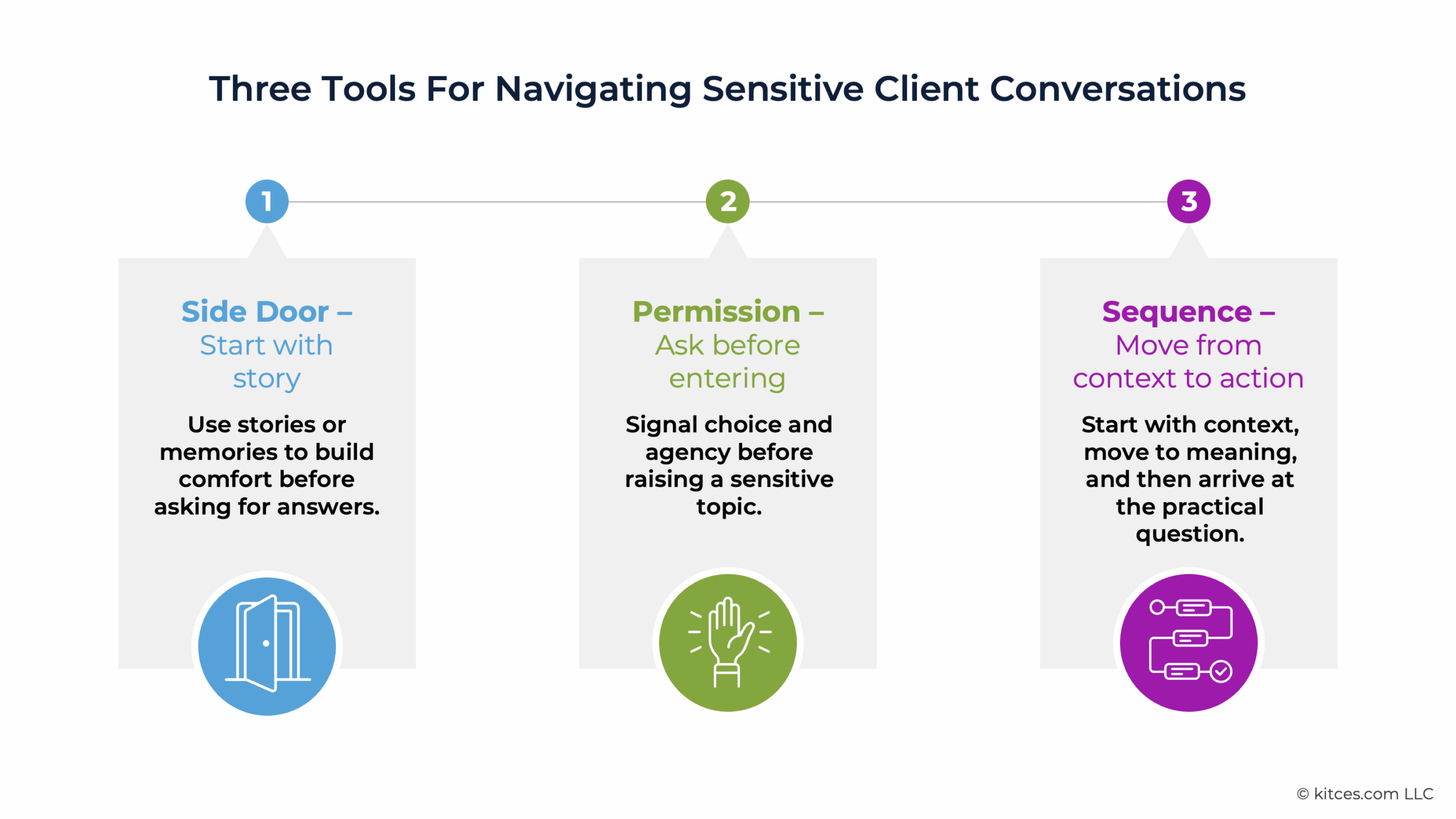
One related tool for navigating hard questions is to use a "side door" approach. By starting more gently with a potentially thorny topic, advisors can ease clients into the conversation. For example, instead of asking, "How much do you want to save for your children's college education?" an advisor might ask, "When you imagine your child getting their acceptance letter, what do you picture happening next?" This can help get the client talking while surfacing unspoken assumptions about the topic. Advisors can also ask clients for permission before broaching a potentially sensitive subject, which can give clients a greater sense of control over how the conversation unfolds. (And, paradoxically, clients who are given permission to say no are far more likely to say yes!) A third approach is to sequence questions, starting with low-pressure context to understand the client's story, moving to the emotions or deeper meaning behind the topic, and only then arriving at practical decisions.
Ultimately, the key point is that advisors don't need to avoid sensitive questions in financial planning. Rather, by preparing clients, pacing conversations, asking permission, and sequencing questions from story to meaning to action, advisors can reduce defensiveness and uncover insights that lead to better plans!

Why Sensitive Conversations Matter In Financial Planning
Financial planning conversations routinely touch on topics that can feel deeply uncomfortable to discuss: health, family conflict, legacy, past financial mistakes, caregiving, grief… the list goes on. And these are not peripheral concerns – they are central to the work. A client's assumptions about longevity shape their withdrawal strategy. A couple's unspoken disagreement about college savings can derail an otherwise sound plan. A widow's fear of dependence may keep her from spending in ways that align with her stated goals. The emotional and relational context surrounding financial decisions matters.
Yet, it can be hard to 'go there'. Advisors may worry that asking about health will feel invasive, that raising family dynamics will spark an argument, or that probing a past financial mistake will make the client feel judged. The instinct is understandable. No one wants to be the person who leaves a client feeling ashamed or uncomfortable in a conference room. And so, instead of asking real questions, advisors often settle for safer, smaller, often technical ones: What's your savings rate? instead of What are you working so hard for? Or Do you have long-term care insurance? instead of What scares you most about getting older?
The problem with safer questions is not that they are wrong. It's that they rarely surface the information – including the emotional and story driven context – that advisors need to build plans that can hold up over decades of real, unpredictable, deeply human life.
Clients Avoid Hard Topics – But Not For The Reasons Advisors Think
When clients shut down a line of questioning, it's tempting to conclude that the topic itself is off-limits. An advisor brings up health, and the client changes the subject. A question about inheritance triggers a clipped, "I'd rather not get into that." The advisor makes a mental note: Don't go there again.
 But research suggests that what clients fear is rarely the topic itself. It's how it will feel to discuss it. In her 2024 book "Talk: The Science of Conversation and the Art of Being Yourself", Alison Wood Brooks describes a study she conducted with Mike Yeomans in which participants were asked to rate how uncomfortable different conversation topics would be. Unsurprisingly, money, politics, religion, and crying ranked among the lowest in predicted enjoyment. But when participants actually had those conversations, many found them deeply satisfying. As Brooks explains, just because a topic seems difficult does not mean the conversation itself will feel as uncomfortable as people expect; sometimes it ends up feeling really good.
Hart, VanEpps, and Schweitzer (2021) found something similar across five studies and over 1,400 participants in their research paper, "The (better than expected) consequences of asking sensitive questions". People regularly avoid sensitive questions – like "How much is your salary?" – because they anticipate discomfort, judgment, or awkwardness. But those fears were consistently exaggerated. Asking sensitive questions, even about money, didn't lead to worse impressions. In fact, it often led to richer, more meaningful conversations. The researchers call this mismatch a 'conversational forecasting error': people tend to overestimate how uncomfortable it will feel to raise a sensitive topic, and they underestimate how rewarding it can feel to be seen.
Most advisors know this intuitively. Ask any planner who has ever gently pushed a couple to talk about how they really feel about funding college. One parent might see education as a duty to their child. The other sees it as a privilege to be earned. They are not just negotiating a 529 – they are negotiating their values, their childhoods, and their fears. And with all of that floating in the background, questions like "How much do you want to save for college?" can land like a trap. But that does not mean the conversation has to end there. Many fantastic advisors that I have had the luck to interact with often share stories about clients expressing gratitude on their way out the door, saying things like, "I can't believe I shared all of that" or "I'm so glad we had this talk." Clients may not jump at the chance to discuss hard things. But when they feel ready, it often goes far better than they imagined.
Conversations Go Wrong Without Preparation
If clients are more open than advisors expect, why do some of these conversations still stall? Often, it's because the advisor goes in without a plan. Direct, data-driven questions – "What's your college savings number?" or "Do you have a will?" – can feel like sitting under a money-interrogation spotlight before clients are ready. It's normal to see clients tense up and go quiet in those moments.
Importantly, this is not a failure of the advisor's intention. It's a matter of approach and how the conversation is introduced. Without context, permission, or emotional pacing, even a well-meaning question can feel like an extraction rather than an invitation. And when a client feels interrogated rather than listened to, they do what any reasonable person would do: they shut down.
The good news is that there are well-researched strategies for asking difficult questions in a way that is more likely to keep people open, engaged, and willing to share. These strategies come from what might feel like an unlikely source – clinical and investigative work with trauma survivors – but they are directly applicable to the kinds of sensitive conversations financial advisors have every day.
What Trauma-Informed Interviewing Is – And Why It Matters For Advisors
Before going further, it's worth clarifying that the phrase 'trauma-informed' can sound more clinical or emotionally heavy than intended here. It may bring to mind therapy couches or clinical assessments. But the principles behind trauma-informed interviewing are not limited to trauma itself. They also apply whenever a topic is sensitive, when people might feel vulnerable, and when the structure of a conversation can determine whether that person opens up or shuts down. That description fits many financial planning conversations.
 In "The Body Keeps the Score", Bessel van der Kolk (2014) explores how difficult experiences can be carried in the body, and how healing often begins not with direct questions but with careful ones. Van der Kolk doesn't explicitly teach interviewing in the book, but his work underscores the importance of slowing down, listening beyond the words, and asking what someone saw, felt, or heard not just "What happened?" or an open-ended, "What do you remember?". The details matter because people don't always process difficult experiences in neat, fully coherent narratives. Experience lives in the senses, even when the mind may struggle to put it all together in a coherent story. He also emphasizes that the structure of a conversation – pacing, tone, permission, and sequence – shapes not only what people say, but whether they are able to say it at all.
Why A Gentler Opening Matters
The key practical insight is that not every good question is a good opening question. Advisors do need to discuss issues like health, caregiving, family histories, and money beliefs. But leading with the hardest questions can close the door before the conversation has a chance to begin. Which means a gentler starting point is worth considering; questions need to be shaped not only for the topic, but also for the person being asked.
Two real-life advisor situations help illustrate the point:
Situation 1: A male advisor in his early 50s was working with a widowed female client in her late 60s. He knew that cervical cancer ran in the client's family, but he had never directly raised the subject with her. He didn't know if she was worried about it, whether she was being regularly screened, or whether it was something she wanted to address in her planning. Understandably, he felt nervous and a bit awkward asking a female client about such a personal women's health concern. He wanted to be kind and respectful, but also recognized that the subject carried a lot of emotional weight and family history.
Situation 2: A younger male advisor was working with an older male client whose family history included dementia and Alzheimer's disease. Each time the advisor tried to raise the topic, the client found a way to avoid the conversation. The advisor did not want to push, but also understood that the issue could have major implications for long-term care planning. The question wasn't whether the topic mattered, but how to approach it in a way the client could engage with.
These scenarios differ in their details, but they share an important common thread. In both cases, the advisors were trying to do the right thing. They were not overlooking relevant family history, nor were they indifferent to the planning implications. Rather they were running into the harder part of the work: how to talk about emotionally loaded issues in a way that invites reflection rather than resistance. Financial planning is full of opportunities for this kind of deeper conversation. And the more thoughtfully advisors prepare for it, the better equipped they will be to navigate it well.
Why Preparation Shapes Better Sensitive Conversations
Over the years, researchers have confirmed how much the manner of questioning matters in sensitive interviews. Two themes stand out. The first is preparation: studies on police training for interviewing trauma victims emphasize the importance of planning ahead and, in many cases, rehearsing the interview before meeting with the person involved (Abbe and Brandon 2013; Smith and Milne 2011; Langballe and Schultz 2017). The second is question style. Research consistently supports using open-ended, non-leading questions that invite context – how something felt, what it sounded like, and what the person noticed or saw (Milne and Bull 1999; Risan, Milne, and Binder 2010).
What distinguishes trauma-informed interviewing from ordinary questioning is attunement. Instead of asking, "What happened to you?", an interviewer might begin with, "Would it be okay if we talked about what's going on?" The same principle applies to financial planning. Instead of immediately asking for a number or diagnosis, an advisor might first ask permission to discuss a particular experience, memory, or physical response – such as the knot in a client's stomach when thinking about spending or about someone they know who has not aged well. In doing so, the advisor creates room for control, permission, and pacing. Because when a conversation moves too quickly, shame, fear, or ambivalence can prevent the underlying issues from surfacing.
How Permission And Pacing Change The Conversation
Consider parents discussing something as seemingly straightforward as college savings for their children. They may be looking at the same spreadsheet but have very different feelings about what it means. One sees sacrifice as love. The other sees freedom as love. One thinks college should be paid for in full. The other worries about enabling entitlement. Neither may define 'enough' in quite the same way.
An advisor could ask, "How much do you want to save for your kids' college?" It is a perfectly valid question. But it can also feel like a high-pressure one. It assumes a clear number, a shared value system, and certainty about the future. In reality, those assumptions rarely hold. Any answer either partner gives can create tension or shut the conversation down.
A trauma-informed approach might instead ask:
- "When you imagine your child getting their acceptance letter… what do you picture happening next?"
- "What was college like for you, financially? How did it shape the way you think about this now?"
- "Have there been times when the two of you saw money decisions differently? How did you handle that?"
The same challenge often arises in conversations about health. Even a thoughtful, well-intentioned question such as, "I know talking about health and aging can feel uncomfortable, but how much do you think you will need to save for long-term care?" may still feel intrusive if the client isn't ready for it. The topic carries too many emotions, assumptions, fears, and uncertainties to move directly to the practical questions. From that perspective, it isn't surprising that a client may want to shut the conversation down. Here, too, a trauma-informed approach can help.
- "Who in your life has aged well or has health you admire?"
- "Tell me a bit more about health in your family – parents, siblings, cousins. How have their experiences shaped how you think about your own health and planning?"
- "We have worked together for a while, and I am curious whether there have been other times when the planning felt difficult or emotional. Was there anything about how we handled those conversations that might help us now?"
These are not questions designed to pin down a number. They are invitations to share the emotional context that shapes the decision. They acknowledge that money decisions are rarely just about money, and that the goal is not immediate precision – it is a fuller understanding of what's driving the decision. And yes, these approaches can take longer at first. They may feel indirect. But what they often reveal is something people didn't realize they needed to say – something an advisor would never hear by simply asking, "What's your college savings rate?" or "Let's talk about long-term care."
Three Practical Tools For Navigating Hard Questions With Clients
Understanding why trauma-informed interviewing works is only the beginning. Its value comes from applying those principles intentionally in client meetings. Fortunately, the core tools are straightforward and highly adaptable. They can be used in conversations about health, legacy, family conflict, spending, caregiving, and virtually any topic where a client might feel exposed or uncertain.
Tool 1: Use The "Side Door" Approach
Most people, often without realizing it, go through the front door by starting with direct questions:
- "What's your savings rate?"
- "Do you want to fully fund college?"
- "Do you have long-term care insurance?"
These are valid and important questions. But they can still cause clients to shut down – not because the answers don't matter, but because the path into the conversation may not feel safe, curious, or personal. A side-door approach uses a simple three-step structure: 1) start with a story, 2) move to meaning, and then 3) arrive at the practical question.
Step 1: Ask for a story or memory.
Stories can lower defenses and invite clients to share rather than justify. They also give clients space to bring up what's already on their mind – a birthday, a favorite car, a memory about illness or a family pattern – without the pressure of having to produce a 'right answer'.
Example prompts:
- "What do you remember about how your family handled big expenses?"
- "When you were little, what did you think being 'rich' meant?"
- "Do you have people in your life who've aged in a way you admire – or maybe want to avoid?"
Step 2: Move to emotion, meaning, or hope.
This is the feeling layer, but it doesn't mean simply asking, "How do you feel?" Instead, the advisor continues through the side door. The goal is to surface fears, hopes, and values while avoiding shame or causing a client to withdraw.
Example prompts:
- "How did that experience shape what you believe about saving?"
- "What felt fair or unfair about that?"
- "When you imagine being 80 or 90, what do you hope you're still able to do, day to day?"
Step 3: Only then, ask the practical question.
This is where action lives – but it's far more effective when it grows out of connection.
Example prompts:
- "What would feel like 'enough' saved for college?"
- "We can approach this in a few ways – some people like to talk through family history, others prefer a tool that estimates lifespan ranges. We don't need to decide anything today. Would you be willing to have the conversation?"
Why the side door matters: This approach works because it gives clients time to acclimate. Rather than leading wit ha direct data question that may trigger a fight-or-flight response, the advisor builds trust incrementally. By the time the practical question arrives, the client has already had time to think about the issue, reflect on it, and connect with the advisor – which makes a candid, honest answer more likely.
Advisor tip: This approach is especially powerful for topics like health. A question like "Do you have any health concerns I should know about?" can feel clinical and unsettling. But asking, "What's something you want your future self to thank you for – physically, mentally, or emotionally?" invites a very different kind of response. It surfaces areas where the client wants to grow without focusing on what is broken or wrong. Similarly, "Who are you trying to stay healthy for?" can reveal the relationships that motivate self-care and shape health decisions –without asking directly about illness or aging.
Tool 2: Ask Permission For Sensitive Topics
One of the simplest and most powerful shifts in trauma-informed interviewing is asking permission before entering sensitive territory. This does not mean the advisor needs to ask permission to do their job. It means signaling to the client that they have agency in the conversation, that their comfort matters, and that they won't be pushed beyond what they're ready to discuss.
The phrasing is straightforward: "Would it be okay if we talked about…?" or "Would you be comfortable if we discussed…?" or "Would you be willing to talk about…?" These are small sentences with outsized impact. When a client hears a permission-based opener, their nervous system registers something important: I have a choice here. I am not being cornered. That sense of control makes it far more likely they will actually say yes.
Here's an example of the difference in practice:
Without permission: "So, let's talk about your health. Are there any conditions I should know about?"
With permission: "Health is something that can shape a financial plan in important ways. Would it be okay if we spent a few minutes exploring that? There's no pressure to share more than you're comfortable with."
Both approaches ask about health. But the second gives the client more control over how the conversation unfolds. And paradoxically, clients who are given permission to say no are far more likely to say yes.
Why permission matters: Permission-based openers reduce resistance because they address the client's unspoken fear: Am I going to be put on the spot? When the answer is clearly no, defenses lower. This is particularly important for topics that carry shame – debt, spending habits, health concerns, or family conflict. Clients are more willing to be honest when they feel they are choosing to share rather than being put on the spot.
Advisor tip: Permission can also be built into the meeting structure itself. Sending an agenda before the meeting that notes, "We may touch on some personal topics, like health or family dynamics, that help us plan more effectively – but only if you're comfortable," gives clients time to prepare mentally. Some clients need a meeting or two before they are ready, and that is both normal and okay. Getting there eventually is better than never getting there at all.
Tool 3: Ask Sequenced Questions To Build Safety
The third tool brings the first two together into a deliberate conversational structure. The idea is simple: the order in which questions are asked shapes how comfortable a client feels engaging with the conversation. Trauma-informed interviewing research is clear on this point – sequencing matters (Milne & Bull, 1999; Risan et al., 2020). Starting with the hardest question first is like asking someone to sprint before they've had a chance to stretch. It might work occasionally, but more often it creates unnecessary resistance – the conversational equivalent of pulling a muscle – before trust and context have had time to develop.
The recommended sequence is:
Phase 1: Context (low pressure).
Begin with questions that feel easy and open. These are story-based, memory-based, or future-oriented questions that invite the client to talk without feeling evaluated. The goal is to build comfort and establish a conversational rhythm.
Example: "Tell me a little about how you and your partner first started talking about money together. Was it easy, awkward, somewhere in between?"
Phase 2: Emotion and meaning.
Once the client is talking and the conversation has a natural flow, the advisor can gently move toward the emotional layer. This is where values, fears, and hopes can surface. Questions here are still open-ended, but they begin to uncover deeper material.
Example: "It sounds like that experience really shaped how you think about financial security. What does security mean to you now, at this stage of life?"
Phase 3: Practical decisions.
Only after the context and emotional layers have been explored does the conversation move to the practical question the advisor ultimately needs to address. By this point, the client has already had time to reflect, connect with the advisor, and build trust. The practical question feels like a natural extension of the conversation rather than a cold request for data.
Example: "Based on everything we've been talking about, what would feel like the right amount to set aside for this? Or would you prefer that I run a few scenarios for us to look at together?"
Why sequencing matters: This sequencing works because it mirrors how people naturally process difficult topics. We don't typically move straight to decisions. We tell stories to create context, find meaning next, and then consider action. When advisors follow that arc, clients are more likely to feel understood rather than interrogated. And when clients feel understood, they tend to share more openly, engage more fully, and make better decisions.
Advisor tip: Sensitive conversations can be easier to navigate if advisors write down the questions they plan to ask – and the order in which they plan to ask them – before the meeting. Researchers who study investigative interviewing consistently emphasize the value of rehearsing before an interview (Smith & Milne, 2011). The same principle applies here. Knowing what – and when – to ask makes it easier to stay present in the conversation rather than scrambling to find the right words while also trying to listen.
What Changes When Advisors Ask Better Questions
When advisors adopt these tools – the side door, permission, and sequencing – the conversation becomes more relational and less transactional. The pacing slows down. People can breathe more deeply. Defensiveness softens into curiosity. And the advisor begins to understand what someone values before trying to optimize it.
A parent doesn't just decide how much to save for a child's college education – they share a story remembering how they felt ashamed to apply for loans themselves at 17. A client doesn't just review their estate plan – they talk about fearing that their children won't remember who they were. A partner doesn't just agree to a budget – they admit how deeply they worry about being financially dependent on someone else.
These moments of clarity and connection are the real gift of this style of questioning: not just better answers, but more honest ones. Not just reaching agreement, but gaining insight into the memories, fears,and longings that matter most to the client and ultimately shape their decisions.
Consider advisors who reached out to me and prompted this article, frustrated because clients would shut down every time they raised the topic of health. "No matter how I bring it up," the male advisor with the male client said, "they change the subject." When we talked through his approach, it became clear that he was going through the front door every time: "Are there any health concerns I should factor into your plan?" The question was reasonable and important. But for clients who associate health conversations with bad news, vulnerability, or loss of control, it was too uncomfortable.
We redesigned his approach using the three tools. Instead of leading with a clinical question, he now starts with: "If you had a month with full energy and no obligations, what would you do with it?" This question is a side door. It surfaces the client's current sense of vitality, physical possibility, and aspiration without asking directly about illness or aging. From there, he can ask permission: "Would it be comfortable if we talked about how health might factor into your plan down the road?" And from there, the practical planning questions feel natural rather than intrusive.
The clients did not change. The approach did. And that made all the difference.
From Interviewing To Understanding
Advisors don't need to avoid sensitive questions in financial planning. What often matters most is how they're introduced and explored. By preparing clients, pacing conversations, asking permission, and sequencing questions from story to meaning to action, advisors can reduce defensiveness and uncover insights that lead to better plans.
French philosopher Simone Weil once wrote that attention is the rarest and purest form of generosity. In the context of financial planning, attention often takes the form of numbers and forecasts. But in the best moments, it becomes something more: a way of listening that tells someone, "You do not have to carry this alone."
The practical application is straightforward: before the next client meeting that involves a sensitive topic, advisors can take time to prepare. Write out the questions. Consider the sequence. Decide where permission may help and where a side-door question may open the conversation more gently. Practice the phrasing, even if only briefly, while in the car on the way to the office. Because preparation can make it easier to stay present, listen carefully, and respond with care.
Ultimately, the key point is that asking sensitive questions more thoughtfully does more than improve the conversation – it helps advisors build meaningful plans that are grounded in the client's actual fears, values, and goals!





Leave a Reply