Executive Summary
Sec. 530A accounts a.k.a. Trump Accounts (TAs), the 'starter' retirement accounts for children under 18 that were created under the One Big Beautiful Bill Act (OBBBA), have been available to open and fund since July 4, 2026. And during that time, they've gained modest traction: according to Treasury Department estimates, around 7–8 million children have had accounts opened on their behalf. This early 'success' is due in large part to the Federal government's $1,000 'pilot' contribution made to children born from 2025–2028, as well as to 'qualified general contributions' from charitable organizations such as the Dell Foundation's contribution of $250 for children under 10 years old in ZIP codes with median household incomes under $150,000. However, there are approximately 70 million U.S. children under 18, meaning that until recently even with these incentives only around 10% of the children eligible to have had a Trump Account opened on their behalf actually had one.
Under new regulations issued by the Treasury Department in late September, however, every U.S. child who is eligible for a TA (i.e., who has a Social Security Number and has not yet reached the year that they turn 18) has now had one automatically opened on their behalf. This means that all eligible children will now be able to receive general contributions from charitable organizations for which they are qualified, which they wouldn't have gotten if they didn't have a TA open in their name (although those contributions generally have age and geographical restrictions, so not everyone with a TA will actually receive them).
Interestingly, though, even children who haven't received any type of contribution will also have accounts opened on their behalf – even if their parents or guardians had already decided not to open one – and there's no ability to opt out or close the account if it isn't needed or wanted! However, parents and guardians will need to go through a process of 'claiming' their children's auto-enrolled account and verifying their identity in order to assume control over it and make additional contributions. Accounts that go unclaimed will either be closed in the year their beneficiary turns 18 (if there are no funds in it) or will stay open and be rolled into an IRA when claimed (if it does have funds). Which means that it's a good idea for parents or guardians of children with auto-enrolled accounts to claim the account on their children's behalf – even if they don't plan on ever funding it – to avoid it being improperly claimed by someone else in cases of identity theft (or simply lost with potential funds inside that the beneficiary could eventually use).
In addition to the auto-enrollment rules, the new Treasury regulations also create the ability for donors of qualified general contributions to do so in the form of individual stocks, which would then be held in recipients' TAs for a minimum of five years – despite the text of the law that restricts TAs to holding only 'eligible investments' of low-fee U.S. equity index mutual funds or ETFs. In other words, TAs are not only now allowed to own individual stocks, they're required to hold them (with no ability to decline the contribution or sell the stock for five years) if they happen to be included in a group of accounts that a donor decides to make a qualified general contribution to.
Although this new rule might incentivize more donors to make large-scale in-kind contributions to TAs (since the net worth of many wealthy founders and shareholders consists mainly of company stock, which they may be restricted from selling in large blocks), it also introduces new risks for TA owners who will be subject to the greater volatility of single stocks (and who will have no ability to choose the stocks they invest in, or to sell those they don't want!). Notably, however, accounts that receive individual or employer contributions, as well as the $1,000 Federal pilot contribution, will still be required to invest those contributions into eligible investments, so the effects of single-stock qualified general contributions will be smaller for those who receive other types of contributions to TAs.
The key point is that, with the rules and processes around Trump Accounts continuing to evolve, financial advisors can provide value by communicating the impact of the new rules to clients with minor children – particularly about the need to claim their child's auto-enrolled TA. Parents may not have much choice now about whether to open an account or accept a single-stock qualified general contribution, but advisors can provide valuable guidance on how to protect and manage the account going forward!
 |
And if you want to go deeper on this topic, hear directly from the author on the Financial Advisor Technician podcast. |

Listen To The Financial Advisor Technician Podcast On This Topic




Episode Shownotes And Transcript
Click to expand transcript and show notes↓↓
Title: What Treasury’s New Trump Account Regulations Mean For Clients
Shownotes:
- Ben Henry-Moreland: LinkedIn | Speaking
- An Advisor’s Guide To Opening 530A “Trump Accounts”
- How Sec. 530A “Trump Accounts” Impact Intergenerational Giving Decisions
Full Transcript:
Adam: Hello, and welcome back to the "Financial Advisor Technician" podcast. I'm your host, Adam Van Deusen. On today's episode, we're going to discuss developments regarding Section 530A “Trump accounts”, including the Treasury Department's decision to auto-enroll eligible children in these accounts and the decision to allow philanthropic donors to contribute individual securities to recipients' accounts. This has created a potential impetus for parents to take action, even if they hadn't been planning to open these accounts for their children, and therefore, a potential planning opportunity for financial advisors.
To help us dig deeper into this topic, I'm joined today by my colleague Ben Henry-Moreland, a senior financial planning nerd here at Kitces.com, to discuss the ins and outs of these new rules, why parents might want to now claim Trump accounts for their children, even if they hadn't planned on opening one, and how philanthropic contributions of individual stock might impact the balances in and taxation of these accounts. So welcome, Ben, and thanks for joining us again here on the "Financial Advisor Technician" podcast.
Ben: Hi, Adam. It's great to be back.
How Trump accounts Were Originally Designed [1:18]
Adam: Great. So, to start, perhaps you could give our listeners a brief refresher on what Trump accounts are and how they work.
Ben: Sure. So these are the sort of starter retirement accounts that were created under the One Big Beautiful Bill Act in 2025. They launched on July 4th, 2026. Essentially, in a nutshell, what these are are a special type of IRA that has specific rules that kick in prior to whenever the owner or sort of the beneficiary of the account hits the year that they turn age 18. So, prior to that sort of defining line, people can contribute to the accounts. There's up to a $5,000 individual contribution limit. Up to $2,500 of that can be from an employer contribution. And there are no withdrawals allowed from these Trump accounts up until that age 18 year.
There's another specific type of contribution that is allowed to these accounts during that sort of early period that's called a qualified general contribution. And that is a specific type that can be made by charitable organizations or government entities that has no specific limits on the amount that can be contributed, but it has to go to a specific class of beneficiaries, a specific group that I think has to be, at minimum, 5,000 Trump account owners. So these are sort of big, broad-based contributions that charitable organizations, government organizations can make to children who either are of a certain age, who are born in a specific year, or who live in a specific geographical area in a zip code or state.
It has to be more than 5,000 beneficiaries. So it can't be one specific block in a neighborhood or something, but it has to be geographical or age-based or a combination of the two. And so these are those three types of contributions that could be made. And then once that age 18 year rolls around for the beneficiary, the account essentially converts into an IRA. They can roll it over. They can convert it to Roth. It's effectively a retirement account after that. Those are the big picture rules.
There's another type of specific restriction on the type of investments that these accounts can invest in during that early period up until the beneficiary's age 18 year. And it has to only be invested in, specifically, ETFs and mutual funds that track a U.S. equity index that don't have any leverage and have fees and expenses of under 0.1%, 10 basis points. So, effectively, low-fee index U.S. equity mutual funds or ETFs are the only investments that are allowed. And actually, right now, the only single one investment that anyone in a Trump account can invest in is an S&P 500 fund, SPYM, is the only one that is actually available right now.
So, essentially, these investment restrictions, contribution limits, and no withdrawals are the special rules that kick in prior to that age 18 year. And then after that, it's effectively just a retirement account, an IRA.
The Treasury Department’s Decision To Auto-Enroll Children In Trump Accounts [4:33]
Adam: Terrific. Thanks so much for setting the table because we're going to get into a couple of these areas with the new Treasury rules. So the first is going to have to do with enrollment. So perhaps, first, you could talk about, how did enrollment in the Trump accounts look originally?
Ben: So the law, as it was passed back in 2025 and then the subsequent steps and regulations that came after that, set up this process for opening Trump accounts that involved kind of multiple steps. First, someone had to fill out this tax form, Form 4547, that just stated that they were eligible to open a Trump account on behalf of their minor child. It's, of course, usually parents and guardians who are actually opening these accounts on their kids' behalf. They had to make this election to open the account on this tax form. Also, if they wanted to receive the federal government's $1,000 pilot program contribution, I didn't mention this earlier, but an additional $1,000 contribution made by the federal government for children born from 2025 to '28. Parents who wanted to receive this contribution also had to check a box on Form 4547 to elect that and receive that contribution.
So then, once they submitted the form, they waited a couple of days and were able to...once the government had processed that form and verified their information, then they would actually establish the account. They would sort of get the link to the website, the portal, the app, whichever method they wanted to open it with, where they would actually open this account up. So it was a little bit of a clunky process of, first, filling out this form and then going and opening the account itself. And it was not very different from how you'd open a standard IRA or brokerage account, where you'd go to a broker-dealer, custodian, etc., just to fill out an application and get this account opened and be able to fund it right away. There were multiple steps in the process.
And so for this reason, as well as the fact that there are some of these restrictions on the account, like the fact that it rolls over into an IRA and you might be able to convert it to Roth, but you still have this restriction on being able to actually use any of those funds up until the beneficiary hits their 59.5 birthday. And so these are accounts that are really meant to be sort of locked up for decades, which is not how a lot of parents treat the money that they give to their children. They either save for college or give them funds with a little bit more flexibility. And so these Trump accounts have had a little bit of traction, particularly among people who might be eligible for that $1,000 pilot contribution. People who sign up for that can get $1,000 and be able to invest that, even if they don't contribute anything else to it.
There have also been a couple of announced qualified general contributions, the most famous being the Dell family. The Michael and Susan Dell Foundation announced that they would be contributing $250 to Trump accounts for everyone born between, I believe, 2016 and 2024. There have been some matching contributions to that for children specifically in Connecticut and Indiana, I believe. So there's been some money that has been flowing into these accounts that hasn't been from individual contributions. And so some families open these just to get those dollars and don't contribute anything else to that. But a lot of families just haven't been opening them.
And I think last month, in September, the Treasury said that about 7 million to 8 million people had opened these accounts, but there are actually around 70 million children who would actually be eligible for a Trump account. So about maybe 10% of the people who could actually open these accounts actually had opened them. So it meant that maybe some children were missing out on these dollars that they would be able to receive otherwise. But a lot of families just decided that even if there was some benefit, they maybe just didn't want to have this account with these sort of restrictions on it that would be potentially following them around for decades. And I think some families just never really knew about it or didn't get around to opening them. So whatever the case, it had relatively low pickup on these Trump accounts.
So what happened in late September was that the Treasury Department issued new regulations that announced it was effectively opening Trump accounts for everyone who had not yet already had one opened on their behalf. So all 70 million or so children who are under the age or haven't reached yet the year of their 18th birthday now have Trump accounts open on their behalf, whether or not their family actually wanted them to open it or not, which was a little bit surprising, I thought.
Adam: Yeah. That's a really good segue into sort of this next topic here. And I do want to make sure for our listeners, if you are interested in the process of opening Trump accounts, Ben wrote a terrific article on actually doing it himself for his children. So if you'd like to check that out, you can go to kitces.com/FAT1 to read that article or listen to our "Financial Advisor Technician" episode on that topic.
Why Parents Might Want To Claim Their Child’s Trump account (Even If They Don’t Plan On Contributing To It Themselves) [10:07]
Adam: Terrific, Ben. So, yeah. So now, as you said, the Treasury Department says, "We're going to auto-enroll all of the children who are eligible for them." But my understanding is that that's not sort of the final step for everyone, that parents would actually still need to take action to create or to sort of open the accounts for their children. Is that right?
Ben: That's right. So, technically, all of these accounts are open right now, but there's still a step that parents or guardians of the children in whose name these accounts are open need to take to actually claim them. They need to go to either the website, trumpaccount.com, or via the Trump accounts online or their mobile app. They need to go to one of these websites and effectively claim the account, which is a process not all that different from what parents had to do to establish the accounts before all these rules kicked in. They have to go, and they have to verify their identity. They have to verify that they are actually the person who is legally responsible for their child. And so they have to go through these verification steps to actually claim the account.
It's not actually that different or less onerous than the process as it was before. The difference here, I think, is that...so these accounts that are sort of open but not claimed yet, they can receive qualified general contributions. They can receive these contributions like the Dell Foundation, any ones that get announced in the future that they may be eligible for. They'll be able to receive these contributions, have them effectively invested, and be able to have any subsequent investment growth, or you hope not lost, but any sort of market growth beyond that. They'll be able to effectively invest these as soon as possible rather than if someone waits a few years to actually open the account. They would potentially miss out on those funds.
So it's a way to get the potential benefits of investing the funds as early as possible from these qualified general contributions. And so, once that account is actually claimed, it will have some dollars in it already invested. And at that point, then it can receive normal individual contributions. These accounts can't receive any other types of contributions before they're actually claimed. So you won't get any individual contributions and the employer contributions. Can't even get the $1,000 pilot program contributions. That still needs to be sort of affirmatively elected by the parents. It won't receive that contribution as well. It's only for essentially pulling in these qualified general contributions and investing them as early as possible.
Adam: Very good. So it sounds like the key here is it's really a two-step process. So it was opening the account and then claiming it. So the government is taking care of the opening part, but it still needs to be claimed in order to take these additional actions. Is that correct?
Ben: Yeah, that about sums it up.
Adam: All right, great. So let's say there are probably some parents out there who heard of the Trump accounts originally. They didn't think they would...maybe their kids are a little bit older, so they weren't going to qualify for the government's contribution. They weren't geographically located or otherwise to get the general contributions that are being made by philanthropic groups. And they say, "I just don't want to deal with another account. I'm not going to open it." At this point, with the accounts sort of auto-enrolled, does it make sense for parents to claim the accounts, even if they have no intent, at least for the moment, of funding them themselves?
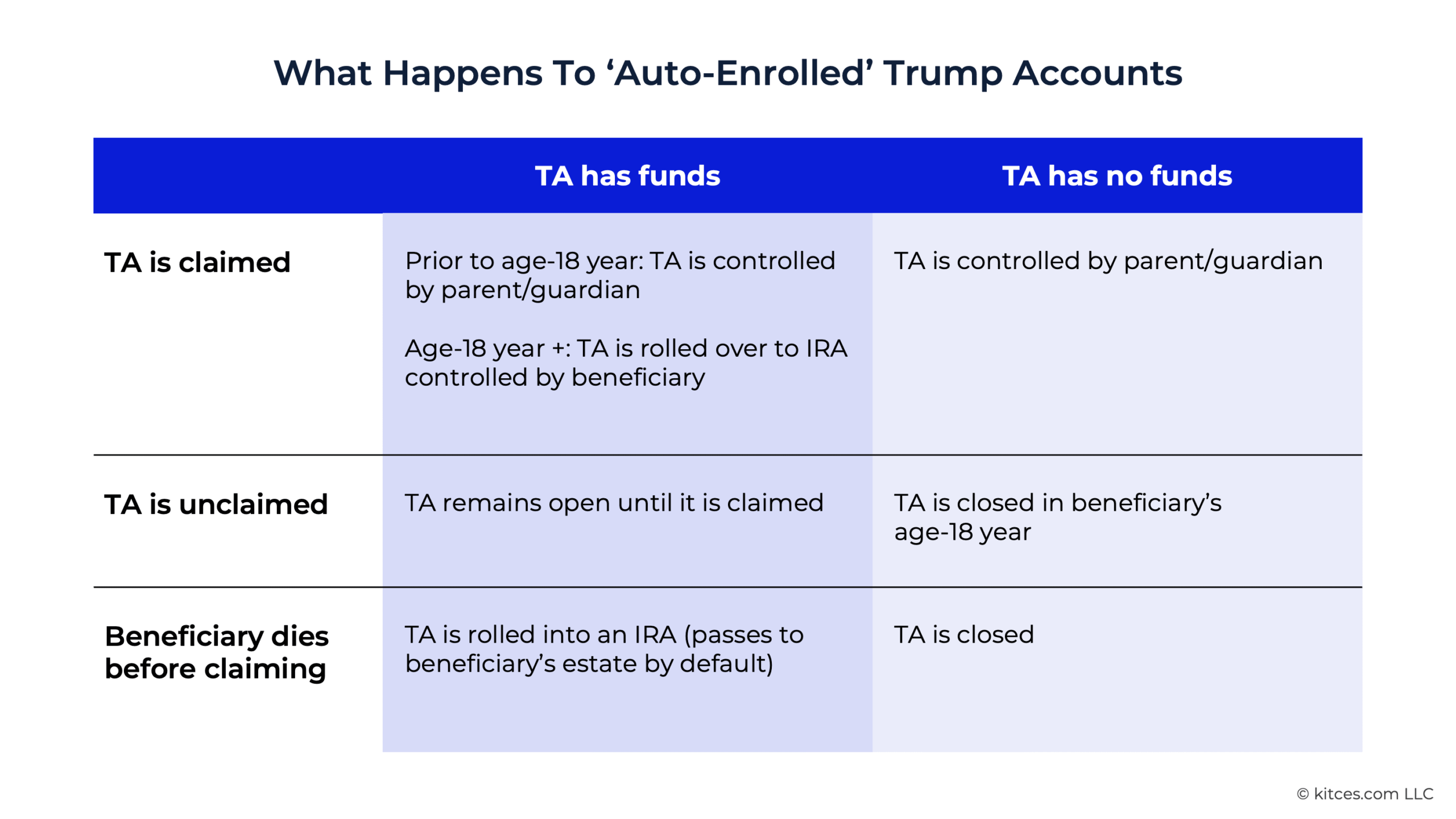
Ben: Right. So if these accounts go sort of unclaimed, there's a few things that can happen. So if the account has no dollars in it and the beneficiary hits that age 18 year, the account just gets closed. It goes away. If it does have some dollars in it, if it does get some qualified general contribution money, it stays open until it's actually claimed. And so if it's before the age 18 year, it then becomes an actual Trump account in that beneficiary's name. If it's after, if it's in the age 18 year or later, then it becomes an IRA. It basically rolls over into an IRA in that beneficiary's name. And so these accounts, they'll stay open if there's actually money in them. So there's no risk, essentially, in losing the dollars that might be contributed to it, because if there are any actual qualified general contribution dollars, the account stays open.
The risk, though, of just leaving the accounts sort of unclaimed, it's just out there, is that in situations where there might be sort of identity thieves, people who get information, some personal information about people who might be parents or guardians of these beneficiaries, people could be able to steal this information and use it to then essentially claim the account for themselves, be able to take control of it, eventually, maybe be able to have access to these dollars. And so I think it is a good idea, even if it's a parent, someone who's decided, "I'm not going to open a Trump account for my kid. I'm not planning on contributing to it. I don't think they're going to get any money from it otherwise." They now have a Trump account out there with their child's name on it. They should claim it just so that they have access to it.
There's other situations, like maybe parents who are divorced or separated. If there's maybe one custodial parent or one parent who really has more of the management over their kids' affairs, either parent can claim the account. They can legally do so. And so the parent who has the custodial power, I should say, the control of the account goes to whoever actually claims it first. So situations where there is maybe separated parents and one parent with more of the control over the financial affairs of the child, they'll want to get control over that. They'll want to claim that account as early as possible to be able to have that under their control again, even if they're not actually planning on contributing to it. Just claiming it means that they have the ability to have control over the account.
Adam: Very good. So I think from an advisor's perspective, maybe some advisors have had the conversation with their clients about the Trump accounts previously, maybe some decided to open, some decided not to. But it sounds like, at least for those clients who have children, perhaps another conversation is in order because, as you said, folks are...even if they're not getting in the contributions, you said the chance of fraud probably would be worthwhile to pay attention to. So that could be a good point for advisors out there.
The Implications Of Individual Securities Being Allowed In Trump Accounts In Certain Cases [17:14]
Adam: Okay. Let's look at the other side, the other big change that came in. And this had to do with the types of contributions that can be made into individuals' accounts from those philanthropic outside sources. So, can you talk a little bit about the big change that happened there?
Ben: Yes. So, yes, the auto-enrollment side of these new regulations was sort of only half of the big announcement. The other half of this was establishing in a way that qualified general contributions, those contributions from charitable organizations, government organizations, etc., they can now start to make those contributions to Trump accounts, not only in the form of cash, but also in the form of stock and individual stock. And this is a big change because, like I mentioned earlier, eligible investments in Trump accounts very clearly does not include individual stock. It has to be mutual fund or ETF, have these sort of low-fee index funds. And so holding individual stock in these accounts seemingly was not something that could be done.
So it was presumed that if someone wanted to actually make a contribution, make a qualified general contribution, and they owned a lot of stock, they would need to sell the stock first, either in their charitable organization or before donating it, and then just contribute cash. So the Treasury Department said, "Actually, we are going to start allowing contributions in the form of… what they call qualified stock", which is essentially just any U.S. publicly traded stock that's not under any sort of trading or transfer restriction. And so the big deal here is that not only is this qualified stock going to be able to go into Trump accounts, but the Trump accounts are actually going to be required to hold them for a minimum holding period. And that minimum holding period is either the lesser of five years or up until the account beneficiary hits their age 18 year.
So anyone 13 and younger, essentially, they're going to have to hold that stock for five years. So not only are individual stock holdings now allowed in Trump accounts when people make these contributions, but they are then required to hold that individual stock for a minimum of five years. Completely different from, I think, our understanding of how these accounts were originally intended to work by only holding low-fee mutual funds in sort of agreement with being able to hold sort of diversified investments and low-fee funds and avoid sort of speculation on individual stocks that was the reason for these eligible investment rules to begin with.
Adam: Yeah. And so I think a key point here is that this is only these outside contributions from the philanthropist, let's say. So if you're a parent contributing, you're still only contributing in cash and then can only invest it in the broad-based index fund. Similarly, for the government's pilot contribution that's coming in in cash, can only be invested in the index fund. So we're only talking about this third category of contributions. Is that right?
Ben: Yes, that's right. And it should be clear, as of right now, when I'm speaking into this microphone, no one has made one of these contributions yet. But presumably, the timing of these regulations is such that someone is planning to do it. I think people have been pushing for allowing individual stock contributions in some way or another. If you think of someone who is maybe a founder or a big shareholder, executive of one of these publicly traded companies, has a lot of stock and maybe less cash liquidity, so they maybe don't want to sell their stock and incur a bunch of capital gains. Or even if they have this stock in a charitable fund where that wouldn't be paying taxes on gains anyway, they may have restrictions on what they can do, on whether they can sell it or maybe just don't want to sell a big chunk of stock and have that potentially affect the share price before contributing it all into Trump accounts.
So I think this is a way to entice some of those bigger donors who would prefer to donate in kind rather than donating cash. So I would assume we will see some sort of announcement of this type of contribution coming in the near future.
Adam: Well, yeah, that's an interesting element. You mentioned before that if the child is receiving this individual stock into their account that they're required to hold it for at least five years, I think you said. So if someone is worried about selling shares of the company where they're a major shareholder, that's one nice way to be able to donate it without having to worry about a large-scale liquidation or sale that could affect the share price, I'd imagine.
Ben: Yes, exactly. And likewise, if the Trump accounts were then required to sell the stock immediately to reinvest it, you would just have the same problem there. So I think this is a way to, again, entice those individual contributions without it potentially affecting the share prices of the stocks that are being contributed.
Adam: And so, I guess, now, from an account holder's perspective, let's say you have the government's pilot contribution or similar in there. But now let's say someone in the future donates shares. That could be quite interesting from an asset allocation perspective, I'd imagine, perhaps something that the advisor might want to pay attention to or the parents might be paying attention to in terms of the potential future growth of the account.
Ben: Sure, absolutely. And I will say I don't necessarily want to overstate some of the impact of these qualified general contributions. So far, they've been relatively small compared to the amounts that individuals can contribute into the accounts. The Dell Foundation contribution that has been the biggest one so far has been $250 per account. But any individual can contribute $5,000 per account per year. So these are relatively small so far compared to the overall scope of the Trump account contributions. And again, individual contributions still have to be invested in these low-fee index funds. So, for someone who's already making contributions to the accounts, these stock contributions might not make up a huge portion of the accounts.
But still, the interesting thing, particularly when it's someone who is not contributing otherwise, is that you had these original eligible investment rules, again, specifically to make sure that these accounts were not being used for short-term speculation, really just requiring low-fee index funds, which I think is a relatively good evidence-based way of making sure that the accounts were being invested with a long-term perspective. All of a sudden, adding then individual stocks from whoever decides to donate them makes it a much different type of account, where you've got a lot more risk of what happens with an individual company versus the broad market. When you look at some of the research that's been done on diversification, the vast majority of stocks, individual stocks, over the long-term end up actually underperforming the index that they're a part of.
And so introducing this risk to Trump accounts, yes, it is a net benefit. Account holders aren't going to lose money from these stocks. The worst that can happen is the stock goes to zero. But still, it is a bit of a diversion from what I think the original intent of what Congress created these accounts for and why they put these rules in place to begin with. So, yes, it's potentially a positive if it encourages more people to make these contributions to the Trump account program. But as we've seen so far, the contributions haven't been necessarily a big part of the total amount that people can actually contribute.
And now, if you think about it, we've got instead of 7 million Trump accounts available, now we have 70 million. So that's, all of a sudden, the denominator. You have many, many more different accounts that these donations are going to be spread out amongst. And so it makes it even potentially a lower sort of relative amount that these stock contributions will represent compared to the overall value. So, two sides of this coin. Yes, it makes sense to encourage people to make these contributions, but from an individual Trump account holder standpoint, it's a bit of a difference from what these accounts were originally intended to do.
One Key Takeaway For Advisors [26:21]
Adam: Very interesting. So we've covered a lot of ground today on these new rules. So, with that in mind, what would be your one key takeaway for advisors on these developments with Trump accounts?
Ben: Well, I think, for advisors, it's really a matter of making sure that clients know that if they have children who are eligible for these accounts and they haven't opened them, that they now need to go and claim them. You may have had conversations with clients already where the decision has been made not to open them, and now it's time to kind of go and revisit that conversation and say, "Well, actually, whether you like it or not, there is an actual account out there." And so, again, it's just a good idea, I think, for those parents to claim those accounts just so they know that they have control over them, even if they're still not planning on actually contributing to them.
Adam: Well, all right. Well, thank you so much again for joining us here today on the "Financial Advisor Technician" podcast, Ben.
Ben: Yes, thank you so much for having me.
Trump Accounts And The 'Opt-In' Rule
Sec. 530A accounts, a.k.a. “Trump” accounts (TAs), were created by the One Big Beautiful Bill Act (OBBBA) of 2025 and officially launched in July of 2026. The purpose of TAs is to serve as 'starter' retirement accounts for children: The accounts can be opened and contributed to on behalf of child beneficiaries up to the year of their 18th birthday, after which they convert into standard traditional IRAs.
Contributions to TAs can come from various sources, including 'direct' contributions from individuals (e.g., parents or grandparents of the account beneficiary), employer contributions from the employer of either the beneficiary or their parents, 'qualified general contributions' from charitable or state or local government organizations, or the Federal government 'pilot program' contribution of $1,000 for children born from 2025-2028.
Additionally, TAs are subject to restrictions on the types of assets their funds can be invested in during the period up to the year of the beneficiary's 18th birthday (officially known as the account's 'growth period'). Generally, 'eligible investments' must be U.S. equity index-tracking ETFs or mutual funds that don't use leverage and charge a total expense ratio of no more than 0.1%, and as of this writing the only investment option available for any TA is the State Street SPDR S&P 500 ETF (SPYM). This means that, under the law as written, funds in a TA cannot be invested in non-eligible investments like actively managed mutual funds, foreign equities, or individual stocks or bonds.
Originally, TAs were designed to be an 'opt-in' account. Parents or legal guardians of eligible children needed to establish the account on their child's behalf, either via a multi-step process of filing IRS Form 4547 to elect to open the account and then 'establishing' the account on the dedicated trumpaccount.com website, or as a single combined step of electing and establishing the account via the Trump Accounts mobile app. For parents of children born between 2025 and 2028 who are eligible for the $1,000 Federal pilot program contribution, electing to receive the contribution comprised yet another step in the process, requiring the parent to check a box on Form 4547 or on the Trump Accounts app to affirmatively opt into the pilot program.
The opt-in nature of TAs (and the separate pilot program election) meant that TAs haven't been opened by families who weren't aware of the accounts or the process for establishing them – or who simply didn't want to open them for whatever reason. But for a TA to receive any contributions, it must be open and active. These contributions include not only direct contributions but also the $1,000 Federal pilot program contribution, any 'qualified general contributions' that the beneficiary would be eligible to receive (discussed further below), and any employer contributions (to the extent the beneficiary or parent's employer offers them). Even if a child is eligible for any or all of these types of contributions, they won't actually receive them if a TA has not been opened on their behalf. And with the Treasury Department estimating as recently as September 2026 that around 7 to 8 million TAs have been established since the program was opened this summer (representing only around 10% of the total TA-eligible children), until recently, many children were at risk of missing out on the 'free money' being distributed via these contributions.
New Treasury 'Auto-Enrollment' Regulations Make Trump Account Ownership Mandatory
On September 29, after just under three months of Trump Accounts being available under the original 'opt-in' rules, the Treasury Department issued new regulations that fundamentally change the planning decisions for TA beneficiaries and their parents and guardians. Using name and birthdate data from the Social Security Administration, Treasury has automatically created TAs for every child who is currently eligible and within their 'growth period' (i.e., who hasn't yet reached the year in which they turn 18), and who hasn't yet had an account established on their behalf. That means that over 60 million new TAs have just been established for children who didn't yet have them – regardless of the reason that their parents or guardians had not yet opened a TA on their behalf.
The new system is being described as 'auto-enrollment', but unlike many other forms of auto-enrollment (e.g., 401(k) plans that automatically enroll new employees once they become eligible), there's no way to opt out of TA auto-enrollment for eligible children or their parents or guardians. And once the auto-enrolled accounts have been established, there's no way to close them until after they've been converted to an IRA in the beneficiary's age-18 year. In other words, TAs are now effectively mandatory for all children under their age-18 year – regardless of whether they or their parents or guardians actually want to own them. And the Treasury Department states in the new regulations that it will be “periodically” auto-enrolling newly eligible children going forward. So at least for the foreseeable future, every soon-to-be-born U.S. citizen will have a TA opened in their name.
Parents Still Need To Claim Their Child's Trump Account To Make Most Contributions
The other issue with the Treasury Department opting to auto-enroll children into Trump Accounts is that it doesn't have contact information for all 60+ million eligible children, or their parents or guardians. So those parents and guardians will still need to proactively 'claim' their child's auto-enrolled TA in order to actually take control of it. According to the Treasury Department's Q&A, this claiming process can be done via the Trump Accounts mobile app or the trumpaccount.com website, and includes steps to verify the user's identity and their eligibility to claim an account on a child's behalf.
Notably, until an auto-enrolled TA is claimed, it can only receive certain types of contributions. Individual direct contributions are not allowed, and neither are employer contributions (since there's no actual mechanism to fund the TA until the adult responsible for the account can claim it and link a bank account to it). Technically, unclaimed accounts can receive the $1,000 Federal pilot contribution; however, the election to receive the pilot contribution is still made on an 'opt-in' basis, meaning that most unclaimed auto-enrolled TAs won't receive the pilot contribution even if their beneficiary is eligible for it (since if the beneficiary's parent or guardian hasn't claimed the account, it's likely that they haven't made the election for the pilot contribution either).
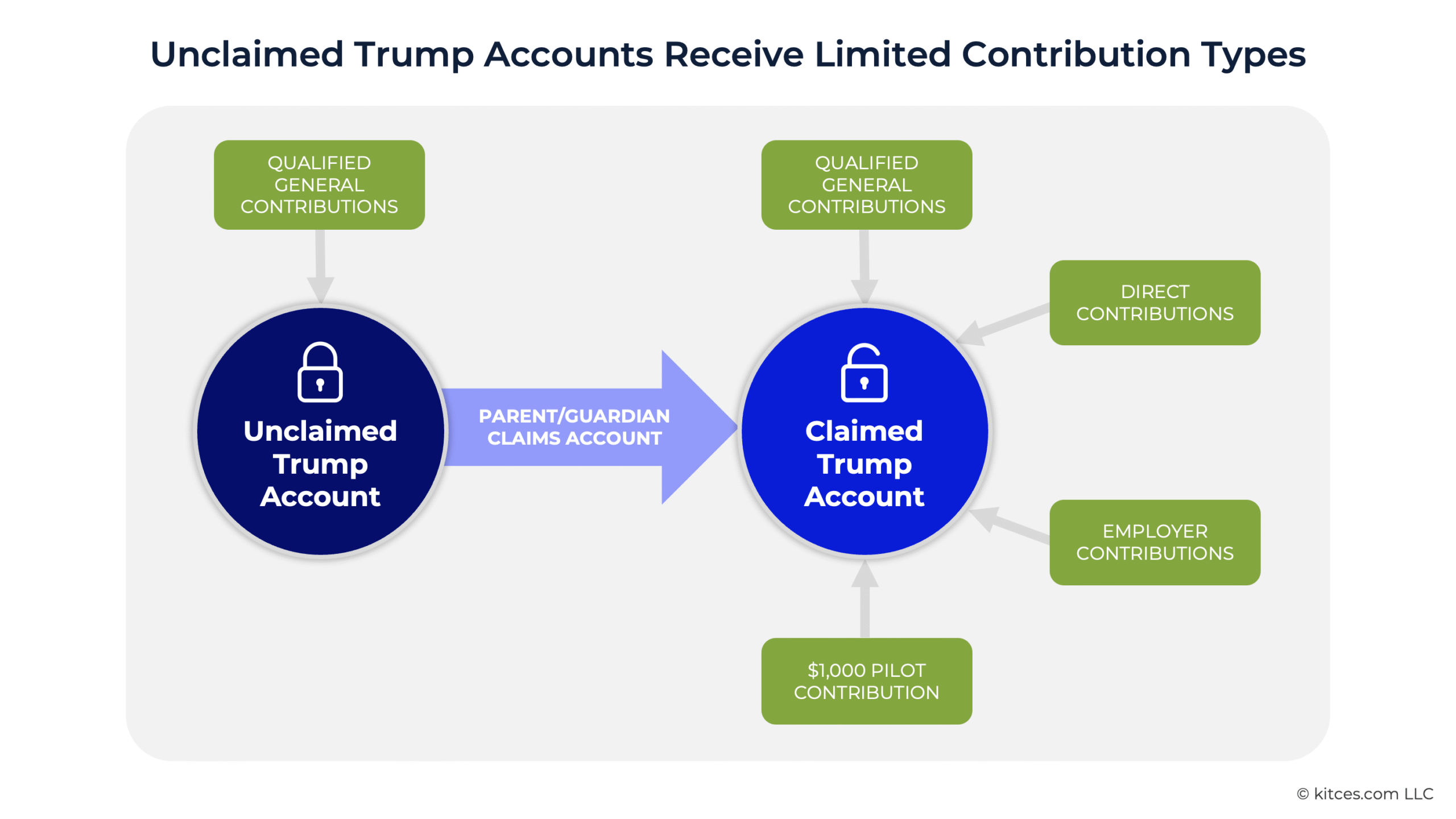
In most cases, then, the only contributions that will be received by (unclaimed) auto-enrolled TAs are qualified general contributions, i.e., contributions that can be made to large blocks of TA beneficiaries by state or local government agencies or nonprofit organizations. Qualified general contributions must follow several specific rules: Along with only being allowed to come from certain government or charitable organizations (and not individuals or for-profit businesses), they must be given to all eligible TA beneficiaries who are of a certain age and/or who reside in a certain area chosen by the donating organization. The criteria that donors choose must include at least 5,000 eligible children – i.e., qualified general contributions must be relatively large in scale, and can't be used, for instance, to narrowly target a handful of TA beneficiaries who live on a single block.
The best-known example of a qualified general contribution so far is the donation by Michael and Susan Dell – via their nonprofit Dell Foundation – of $250 for each eligible child born between 2016 and 2024 who lives in a ZIP code where the median income is $150,000 or less. (They couldn't limit the donation solely to children of families with no more than $150,000 of income, because income isn't one of the eligible criteria on which donors can base qualified general contributions – hence the ZIP code median income workaround.) These contributions have begun to be deposited into already-established TAs, and will presumably also appear in auto-enrolled accounts of children who meet the donation criteria. Similar donations have been announced by Ray and Barbara Dalio (for children who live in Connecticut) and Brad Gerstner (for children in Indiana).
In a technical sense, an auto-enrolled TA that hasn't been claimed doesn't actually hold any assets directly. Instead, it holds a proportionate interest in a pooled trust containing the qualified general contributions of all eligible (unclaimed) TAs, which is invested in the same way as the TAs themselves (i.e., in low-fee U.S. index funds as well as “qualified stock” as described in more detail below). Once the TA has been claimed, its share of the pooled trust (including any investment gains or losses since the date of the original contribution) is transferred into the account. But the net effect of auto-enrollment is to treat any qualified general contributions that the TA beneficiary was eligible for as if they were invested from the date of the contribution itself, not the date the TA was claimed (i.e., to start the investment, and potential for compounding growth, as soon as possible).
Why To Claim An Auto-Enrolled Trump Account (Even If It Has $0)
The benefit of Treasury's auto-enrollment announcement is that children who hadn't previously had accounts opened on their behalf are now able to receive qualified general contributions such as the Dell contribution – even if the contributed amount is effectively held 'in limbo' until the account is claimed by its owner or their parent or guardian. Although the size of the contributions so far has been relatively small at the individual level – $250 each for children who meet the Dell contribution criteria, plus another $250 for children in Connecticut and Indiana – it still represents 'free money' that the child wouldn't have been able to receive by any other means.
Claiming a child's auto-enrolled TA gives them eventual access to these dollars: They won't be able to withdraw funds until (at least) the year that they turn 18, but at that point they'll have full control over both the initially contributed dollars, plus any growth that has since accumulated in the account. They'll be able to either convert the funds to Roth, roll them into another IRA, or simply liquidate the funds and pay ordinary income tax on the proceeds (plus a 10% additional early distribution tax if the distribution doesn't qualify for a specific exception).
There are a number of outcomes that can happen if an auto-enrolled TA is never claimed. If the unclaimed account has no balance (i.e., it didn't receive any qualified general contributions), the account is simply closed at the start of the year of the beneficiary's 18th birthday. If the unclaimed account does have funds, it will remain open until it is claimed. Prior to the year of the beneficiary's 18th birthday, the account must be claimed by the beneficiary's parent or guardian (as a 'standard' TA that can receive all types of contributions). Starting at the beneficiary's age-18 year, the beneficiary themselves must claim the account, at which point it will be rolled into a traditional IRA in the beneficiary's own name. If the beneficiary dies before the account is claimed – no matter the beneficiary's age at the time – the auto-enrolled account rolls into an IRA in the beneficiary's name, where it is treated as an inherited IRA (which will presumably pass to the beneficiary's estate, since they would have never designated a successor beneficiary).
But even if an auto-enrolled TA isn't eligible to receive any qualified general contributions and has a zero balance, it's still best for a parent or guardian to claim the account in order to protect it from being misused in any way. For instance, it could be possible for an unrelated person to 'hijack' a child's auto-enrolled TA – e.g., to use stolen identity information to claim that they are the adult who can control and manage the account going forward, which could give them eventual access to any funds that do end up in the account. The real parent may or may not have any interest in personally contributing to the account, but claiming it is preferable to leaving it dangling, unclaimed, for identity thieves to potentially make use of.
Other potential issues can occur with unclaimed TAs even in cases where identity theft isn't involved. For instance, either of a child's parents can open or claim a TA on a child's behalf, which can create problems in cases of divorce or separation. A parent doesn't need to be the child's 'primary' or custodial parent in order to claim a TA: If both parents claim the account, the one who did so first is given the authority to manage the account going forward, regardless of which parent is better suited to manage the child's financial affairs. And because each child can only have one TA open on their behalf at a time, there's no way for the other parent to open another account on the child's behalf. If there is animosity or disputed custody between separated or divorced parents, the question of which parent controls the child's TA becomes critical.
The key point is that even though many parents may not have wanted to open TAs on their children's behalf – e.g., because they'd rather contribute towards the child's education or other goals, and there's no 'free money' to be had from employer contributions or the $1,000 pilot contribution – they can't change the fact that they now have a TA with their child's name on it, somewhere, needing to be claimed. Parents can claim their child's account on either the Trump Accounts mobile app or the trumpaccount.com online portal, and although advisors can't open TAs on behalf of clients or their kids, they can be proactive in their outreach to their clients who are parents of children under age 18 (or who are expecting to have children in the near future) to make sure that they know to claim their child's account if they haven't already.
Individual Securities Now Allowed (Required?) In Trump Accounts
Aside from the new auto-enrollment policy, the September 29 Treasury regulations contained another significant change to how Trump Accounts will be structured and managed going forward, by allowing donors to make qualified general contributions in the form of in-kind stock donations rather than cash.
This is in spite of the seemingly clear text of Sec. 530A that “No part of the [TA] funds will be invested in any asset other than an eligible investment during any period before the first day of the calendar year in which the account beneficiary attains age 18”, with “eligible investments” later defined as U.S. equity index-tracking mutual funds or ETFs that have annual fees of less than 0.1% and do not use leverage. The law seems to make it plain that no individual securities (or any other ineligible investments) are allowed in TAs, which makes sense as the accounts are primarily meant for long-term retirement saving, for which diversified portfolios have time and again been shown to be superior to individual stocks.
However, the Treasury's regulations use a linguistic loophole to get around this requirement. According to the regulations, “Holding qualified stock received pursuant to a qualified stock contribution does not violate this restriction because no funds in the account are used to acquire the contributed stock. Rather, the stock is contributed directly into the individual Trump Accounts for the beneficiaries in the designated qualified class.” In other words, according to the Treasury Department, the law's “eligible investment” rules only apply to investments that are purchased with existing funds within the TA, not to investments that are directly contributed to the TA!
What this means is that, unlike the Dell, Dalio, and Gerstner qualified general contributions, which were made in cash and were subsequently invested in the default SPYM fund when received in eligible TA beneficiaries' accounts, future donors can make qualified general contributions in-kind in the form of “qualified stock” (that is, publicly traded stock of a domestic corporation that isn't subject to any transfer restrictions on the donor).
Furthermore, once the stock donation is received in an eligible beneficiary's TA, it becomes subject to a minimum holding period of the lesser of five years or up until the beginning of the year of the beneficiary's age-18 birthday, during which time the stock cannot be sold, distributed, or otherwise disposed of in any way (although any dividends distributed by the shares will be required to be received in cash, or the proceeds sold and reinvested in “eligible investments”, i.e., mutual funds or ETFs).
In other words, in spite of the seeming plain-text meaning of Sec. 530A that individual stock holdings are not allowed in TAs, the new Treasury regulations not only allow TAs to hold stocks that are donated via qualified general contributions, but they require those stocks to be held for up to five years after the donation!
Individual Stock Incentivizes More Donations, But Adds New Risks For TA Owners
These rules have reportedly been a goal of several wealthy founders and shareholders of publicly traded companies, as they give them the ability to make qualified general contributions without forcing the sale of their company stock in order to create liquidity for the gift. Meaning, for instance, that they can avoid paying capital gains taxes on those shares, avoid any restrictions on selling shares that they may be subject to as executives or board members of their companies (which may also apply to any charitable foundations that the donor controls and through which the qualified charitable contributions would typically be made), and avoid any disruption to the stock's share price that might be caused if all TAs were forced to sell the shares upon receipt. To that end, the new rules are a positive in that they may incentivize more individuals or charitable organizations to donate to TAs when doing so in cash would have been unreasonably burdensome.
But it isn't as obvious that individual stock ownership would have as great of a benefit to Trump account owners as to the donors of the stock. Although individual stocks like Tesla, NVIDIA, and Amazon have enjoyed strong runs over the last few years, the historical evidence strongly suggests that nearly all individual stocks will underperform the broad market over the long term. Requiring TAs to own individual stocks – especially when the accounts might hold little else if the beneficiary or their parents don't make any additional contributions that can be invested elsewhere – puts the risk of owning an undiversified portfolio (with no ability to sell the shares) on the individual account owner, with no option to opt-out of that risk before the end of the required minimum holding period.
Furthermore, although the donors of individual stock can avoid tax on any unrealized gains in the securities donated in-kind as a qualified general contribution, the owners of the TAs that receive the stock will eventually have to pay taxes on the full value of the funds within the account. Because qualified general contributions are exempted from income when they are received in the beneficiary's account, that means they are treated as pre-tax dollars in the TA. Which means that when the account owner eventually distributes those funds (in their age-18 year or later) – either as a direct distribution from the account or in the form of a Roth conversion – the funds from the stock contribution, plus any growth attributable to them, will be included in their taxable income. And unlike the capital gains and NIIT tax rates that the original donor would have paid to sell their shares, which max out at 23.8%, the recipient of that stock will eventually pay ordinary income tax rates, ranging from 10%–37%, upon distribution. In other words, while some lower-income recipients of in-kind stock donations might pay a lower tax rate than the wealthy donor who originally contributed the stock, many might actually pay more, if they're in the 24% tax bracket or higher when they eventually distribute the donation. (Ironically, it might be more tax-efficient for major shareholders to just give stock in-kind directly to kids outside of a TA, because then the recipients would be able to retain the donor's original basis in the stock and would pay capital gains tax rates on the remainder!)
Other unintended consequences might come about as a result of TAs being allowed (and required) to hold individual stock. For instance, some government agencies might bar their employees and their families from holding individual stocks of certain companies that represent a conflict of interest (e.g., Federal Reserve employees and their spouses and dependent children being prohibited from owning bank stocks), which could present a problem if those employees' (or their kids') TAs are forced to accept stock they're forbidden from owning. Or more cynically, it's also conceivable that, rather than being a purely altruistic donation, some major shareholders of large corporations could use individual stock donations as leverage when faced with adverse legislation, regulations, or judicial decisions – e.g., if a proposed regulation has the potential to negatively impact a company's profitability and cause its stock price to decline, the company might have a more powerful argument against the regulation if they can cite its effects on the millions of children's TA balances that hold its stock.
To be fair, any receipt of a qualified general contribution – even in the form of individual in-kind stock – is a net gain to the recipient: The worst that can happen is the stock going to zero, so there's no possibility that the contribution will cost them money. Additionally, for parents who contribute to their children's TAs in other ways (i.e., individual or employer contributions), individual stocks might not make up a significant part of the account's balance, given that the $5,000 annual limit on individual contributions (which must still be invested in eligible ETFs and mutual funds) is much more than the $250 one-time contribution that has become the 'norm' so far with qualified general contributions (and because there are now 70 million established TAs instead of 7 million under the new auto-enrollment system, those contributions might get even smaller per account).
But considering both the spirit of the law (which specifically mandated certain types of assets that TAs can invest in) and the principles of disciplined long-term investing that many financial advisors aim to espouse (that a diversified portfolio beats speculation in individual stocks), it's somewhat baffling to see these new rules giving TA beneficiaries no choice but to accept (and eventually pay tax on) shares of company stock that neither they, nor their parents, nor any financial professional working for them in a fiduciary capacity had any hand in selecting.
For Trump account beneficiaries and their parents or guardians, the immediate result of the new Treasury regulations is to remove much of the choice that those parties originally had around Trump Accounts: whether or not to open a TA to begin with, and how to invest qualified general contributions that come into the account. Which on the one hand makes things slightly simpler from a planning perspective – there's no decision to be made, since the Treasury Department has already made it – but also potentially re-opens planning conversations that may have already been had, and at worst forces parents who had already decided not to open a TA to now decide how they're going to manage it.
This creates a good opportunity for financial advisors to reach out to clients with minor children to let them know to claim their auto-enrolled TA if they haven't established one already. They'll also need to know how to keep track of the account over time, including maintaining login credentials for the Trump Accounts app and online portal – and to watch out for the Form 5498-TA that the TA custodian will send each year with information about any contributions made during the year, the end-of-year account balance, and the account basis (i.e., the amount of after-tax dollars that can eventually be withdrawn tax-free). Ultimately, they'll need to pass that information on to their kids when they reach their age-18 year – at which point the beneficiary will be afforded all the choices (e.g., whether to keep, roll over, or distribute and close the account, and how to invest the funds inside it) that their parents or guardians don't have within the account today!