Executive Summary
We often tend to think of giving from one generation to the next in terms of inheritance, with a parent passing on their assets after death. However, some parents (who are confident that they have more than enough funds to last their own lifetime) want to be more proactive in giving to the next generation. Which in some cases is because of a desire to witness their children enjoying the gifts they've been given, but is more commonly done in order to set the child up for future security, happiness, and fulfillment – e.g., by funding their college education or gifting funds for a down payment on a home.
In practice, this type of intentional giving tends to fall into one or more 'eras' according to when the funds are intended to be spent by the child. Many parents focus on higher education savings or supporting their children's lifestyle expenses during young adulthood. A smaller number of higher-net-worth families are focused on dynasty creation, i.e., setting aside funds to be used by multiple future generations. And nearly all parents do some amount of small-dollar giving to their young children, from allowances to birthday gifts to visits from the Tooth Fairy.
However, few parents tend to focus on saving for their children's retirement – often because the parents themselves won't necessarily be around by the time their children reach retirement age. This is notable given the recent launch of Sec. 530A "Trump Accounts" (TAs), which are explicitly designed for retirement savings on behalf of young children (given their rules that closely mirror those of IRAs, other than the ability to contribute regardless of whether the child has any earned income). Government promotional efforts have emphasized how much can be accumulated in TAs over decades of saving and compounding, and planners have noted the option for Roth conversions after the child's age 18, allowing for many decades of tax-free growth – raising the question of whether parents should think about saving for their children's retirement, in order to take advantage of the tax benefits of TAs.
However, the reality is that despite the potential for significant asset accumulation by the child's eventual retirement age, TAs remain just one of a variety of account types available for intergenerational giving. And because each account type has its own set of tax characteristics and incentives for specific types of savings, the 'best' account for giving depends more on what type of giving best aligns with the parent's philosophy of how to invest in their child's future happiness and wellbeing, rather than which one will result in the highest after-tax dollar figure.
For example, some parents may be convinced that a college and/or postgraduate education is the best way to set their children up for a career that will be financially rewarding and personally fulfilling (at which point they'll be able to adequately fund their own retirement savings) – suggesting that a 529 plan and its tax-free withdrawals for higher educational expenses may be the most tax-efficient way to fund that goal. But other parents might see more value in 'pre-funding' their children's retirement, which gives them the ability to take risks and/or pursue more personally fulfilling (though perhaps less lucrative) careers without having to worry as much about financial security – in which case TAs might really be the 'best' option available.
The key point is that there really is no single 'best' account for intergenerational giving, as different accounts – from 529 plans and TAs to UTMA/UGMA taxable custodial accounts to child-owned Roth IRAs to irrevocable trusts – are each tax-advantaged for certain goals, but may be tax-disadvantaged for others. And so the decision to use one (or more) account type is ultimately more about what the parent hopes the child will eventually do with it, rather than which one could (theoretically) accumulate the highest balance in the end!
 |
And if you want to go deeper on this topic, hear directly from the author on the Financial Advisor Technician podcast . |

Listen To The Financial Advisor Technician Podcast On This Topic




Episode Shownotes And Transcript
Click to expand transcript and show notes↓↓
Shownotes:
- Ben Henry-Moreland: LinkedIn | Website
- An Advisor’s Guide To Opening 530A “Trump Accounts”
- Maximizing Health Savings Accounts (HSA) Tax Benefits With Adult Children Under Age 26
- Using A Family Dynasty 529 Plan For Multigenerational College Planning
Full Transcript:
Adam: Hello, and welcome back to the "Financial Advisor Technician" podcast. I'm your host, Adam Van Deusen. On today's episode, we're going to discuss intergenerational giving strategies and how advisors and their clients can identify the appropriate account to use given the client's goals for the assets that they are giving. Because while tax efficiency is an important part of these conversations, how the client is trying to actually support their child during their lifetimes can play an even larger role in how they decide to gift.
So to help us dig deeper into this topic, I'm joined today by my colleague Ben Henry-Moreland, a senior financial planning nerd here at Kitces.com, to discuss the different types of intergenerational giving parents might consider, how the new Section 530A Trump Accounts fit in with this taxonomy, and how advisors can support their clients in identifying the appropriate account that not only offers the most tax efficiency, but also matches their goals for the money as well. So welcome, Ben, and thanks for joining us again here on the "Financial Advisor Technician" podcast.
Ben: Hi, Adam. It's great to be back.
The Different Goals Parents Might Have For Lifetime Gifting To Their Children [1:33]
Adam: Terrific. So to start, before we dig into the Trump accounts and other accounts parents might use for giving, perhaps you could set the stage by discussing the different types of goals parents might have for giving to their children.
Ben: Sure, absolutely. So just to come at it from a little bit of a high level to start out with, I think we often think of how money goes from one generation to another in terms of a parent has assets, they reach the end of their life, whatever assets they have leftover go to their children, and then they become the property of the children. And that goes on to the next generation, etc., etc. But in cases where a parent is confident that they have enough funds for themselves to last the rest of their lifetime, they often don't want to necessarily wait until the end of their own lives to give to their children. Sometimes they might think that it's better to make an early investment in their child and towards their child's well-being, whether that's to help them with an education, help them during more in the middle of their life. And sometimes it's just because the parent just wants to be able to see their child enjoy their inheritance rather than waiting until after the parent is, by definition, already going to be gone, after the end of their own lives, and the child inherits that asset.
And so there's often, I think, more of a desire to be a little bit more intentional about how and why a parent is giving to their children. And so when I look at the different types of gifts and the different types of reasons for giving that parents have for giving to their children, I see a number of different sort of buckets, as I like to describe it, of different types of giving that parents do.
And so if you think of kind of a timeline from the beginning of the child's life and going forward, you start with gifts that happen literally during childhood, when the child is still in school, living at home. And these tend to be sort of smaller dollar gifts. These are allowance money, their tooth fairy money, birthday gifts, etc. Often this is just helping with short-term needs, maybe giving the child a little bit of a sense of responsibility and knowing how to manage money for themselves. But oftentimes it's relatively low in intentionality and relatively low in dollar amounts. So we don't think about that too much in terms of planned giving, but it does exist.
But when we start to think about what needs to actually get planned for a little more, the next bucket of giving is a really big one. It's the educational gifts. It is, "Let's start saving for college education," for maybe post-grad education, if that's a goal as well, sometimes even for pre-college, if there's private school or preparatory school, etc. So being able to set up a child with a good education is a very, very common and very important goal for a lot of parents to be able to...I think the view is be able to set their child up for a happy, sort of productive, more successful life by investing early on in an education to get them the experience, the connections, the knowledge to then take into their own careers and hopefully be happy and fulfilled and successful in what they do.
So beyond education, though, there are other types of giving that parents do for their kids. There's sort of some more flexible giving that some parents do. A lot of the times, when their children are off and adults and on their own, they may be giving their kids money for using it for a down payment on a house, or maybe the child wants some seed money for starting a business, or maybe they need some help with childcare costs. There are a lot of different reasons why parents might give to their children just during their adult lives, oftentimes just because they want the child to have the lifestyle that the parent thinks that the child deserves, that they are happy in what they're doing. Again, just being happy and fulfilled. And so these I kind of see as the sort of midlife lifestyle bucket, as it were, of giving. These funds are generally a little bit more flexible in how they're used and more for helping the child live the lifestyle that they want to have.
So beyond that, then, you get to some of the later buckets of giving. One of these is going to be retirement, and this is one where I think we've generally seen the least amount of focus because it's often going to come after the parent has already passed on or at least when they're getting pretty late into their lives. And so oftentimes this is the sort of giving that happens literally when the parent dies. It might happen close to when the child hits retirement or maybe even allows the child to retire. But it's often not necessarily a big area of planned giving for parents because so often they would rather fund educational expenses. They would rather see their child use those funds during their lifetime.
And then that leads me to the final bucket of gifts, which I call kind of the dynasty gifts. And those are the ones that you know that there is enough to last not only for the parents' own generation, but also beyond their children's generation. They want to be able to fund multiple generations of gifts. And so this is situations where you've got oftentimes more higher-net-worth families setting up maybe trust-based plans, etc., that really are meant to look forward for multiple generations beyond even their immediate child's lifestyle.
So those are kind of the different buckets that I see. You've got those childhood expenses, education, home, business, lifestyle, the retirement expenses, and then finally dynasty for those families who really want to fund future generations. And then you're going to see...I think that is going to dictate then what type of accounts you're going to want to use for actually funding those and how you have those planning conversations to give funds to future generations.
Adam: Thanks so much for that breakdown. I think that's really instructive from an advisor's perspective in terms of a client comes to you and says, "Hey, I'm feeling confident about retirement. I want to give to my kids." I think this is a really good conversation starter in terms of, "Well, hey, what's the exact purpose that you're trying to achieve here? Are you very focused on education goals, or is it a house goal?" As you mentioned, there's a lot of different things that they could be considering. And I will note as well, Ben has written a terrific article on this topic with some really nice graphics that show these concepts, including sort of this timeline of the different types of goals that parents might have. So if you're interested in taking a look at that, you can go to kitces.com/FAT7 to see it.
How “Trump Accounts” Fit In To Intergenerational Giving Plans [8:48]
Adam: So now, with that in mind, something that's gotten a lot of attention lately are the new Section 530A Trump accounts. And for anyone who hasn't listened, Ben was actually the first guest here on the "Financial Advisor Technician" podcast when he was talking about his own experience of opening Trump accounts for his children. So if you're interested in that, please go back and listen to that first episode or go to kitces.com/FAT1 to check that out. So with that in mind, though, the Trump accounts have added sort of a new wrinkle into the field of accounts that are available for parents to give to their children. So perhaps you could start off by, again, explaining the dynamics of Trump accounts and what they might offer those who contribute to them.
Ben: Sure, absolutely. So you know how I mentioned earlier that retirement gifts were one of the, I think, more neglected or least used or least planned for types of giving for parents to give to their children. Well, these 530A accounts really are a retirement account for parents or grandparents, etc., to give to children. So it is filling in sort of an area that often I think is not really considered a whole lot in intergenerational giving. So how they essentially work is they are a type of individual retirement account, IRA, that has special rules that allow anyone to contribute to the accounts prior to the year where the account beneficiary, the child whose account it is, prior to the year that they turn 18.
So any time between when they're born and that year that they turn 18, any individual can give to this account. There is no earned income requirement like there is with a standard IRA, so the child doesn't have to have any income to be able to contribute, which allows people to start making contributions very early to these accounts. They can contribute up to $5,000 a year. There are other types of contributions available. Employer contributions…employers can contribute to their employees or their employees' kids up to $2,500 a year. There's a pilot program that the federal government is doing, doing $1,000 contribution for children born between 2025 and 2028. There are some charitable contributions that are also being made to it as well.
The bottom line is, essentially, these are accounts that can be contributed to for children to set them up very early on to start having some of these tax-deferred savings. And I mentioned that these are essentially a type of IRA. Well, when the child hits their age 18 year, these accounts effectively just convert into an IRA, specifically a traditional IRA, a lot of the funds in the account will be pre-tax and are tax-deferred. So when those come out, eventually, they will be taxed. And so this account has all the same rules, then, starting at the age 18 year that IRAs have. They will be subject to early withdrawal penalties before age 59.5, unless there's an exception, things like first-time homebuyer expenses up to $10,000, educational expenses, childbirth, and adoption expenses.
Some of this list of exceptions that apply to IRAs also apply to these TAs [Trump Accounts] as well. So they're really retirement accounts. They are meant to be there to start saving for children when they are very young in age and then to be able to grow for decades and decades up until the child hits near retirement age, age 59.5-plus. So this is really meant for people to contribute to their kids for specifically a head start on their retirement savings.
Adam: Okay. Yeah. Thank you. That's really helpful because I think that really puts it in when you were discussing the sort of five different giving buckets before. This one sounds pretty firmly in terms of the retirement bucket, in terms of intention. And although one of the things that strikes me about these accounts, and you had mentioned this, is that when the child does turn 18, I understand they get full control over the account. So unlike a 529 plan, for example, where a child might be the beneficiary, but as the owner of the account, the parent really is in control…the child gets control at that age.
So despite the tax penalties for taking an early withdrawal, the penalties in taxes, as you mentioned. They could decide to buy a car. They can do whatever with it, much more similarly to the UTMA or UGMA account, just with more penalties. So there's kind of two sides to this. One is the parent wants the child to use this account for retirement, but the child is actually going to have to follow through on using it for retirement. Is that correct?
Ben: Yeah, and that's an important nuance. One thing I didn't mention before is there are no withdrawals or distributions allowed prior to that age 18 year, and so no one can take money out of the account. But from that point, it is really effectively a custodial account. So it becomes, like you said, the property of the child once they hit that age 18 year, and they can, like you said, do anything that they want to with it. They will incur an extra tax penalty, an extra 10% penalty, if they withdraw the funds, but they will have the full ability to do so.
Matching Gifting Goals With The Most Appropriate Account Option [14:19]
Adam: So now let's put both sides of this conversation together. So we've talked about these five stages of giving or five stages of a child's life where a parent might want to give. And on the other hand, we have these accounts that come with different tax advantages, different levels of control in terms of the money for the parents. So, why don't we put them together and see where different accounts might match up at different points in a child's life or a different type of giving?
So you mentioned the first type of giving was sort of the childhood. Again, you mentioned this is sort of small scale. So I'm assuming, here, we're thinking about things like a custodial checking account, custodial savings account, just given the relatively small amount of money that we're dealing with.
Ben: Yeah. And it could just literally be a piggy bank or some envelopes on the kid's desk, if you really want to have the money just be there and tangible and in cash. But yeah, sometimes you want to have an actual bank account. Maybe you get them a credit card when they're a little bit later in childhood so they can start building credit…but yes, these are going to be pretty standard checking savings. Maybe you're going to start to build some investments, but that is, I think, by definition, going to start being a factor for sort of later in life giving. So it is going to be pretty simple at this point.
Adam: Great. So going into the next level, and we're thinking about education. So now we're really, I think, broadening the types of accounts we might use and the sort of tax and control implications that we have here. So I think common things here, you're thinking about 529 plans, Roth IRAs. How do you think through this education-focused giving?
Ben: Yeah. I think, for education, in terms of tax characteristics, certainly the 529 plan tends to beat most of the other options just because of the way it allows for tax-free or, I should say, at least tax-deferred compounding of funds over at least close to a couple of decades and then being able to take that money out tax-free for educational expenses. It isn't necessarily going to be 100% of every parent's college funding plan, often because you don't want a lot of assets to be left in the plan after the child goes to college, or if they don't go to college at all, then you have money in the 529 plan. And then there's tax penalties in taking that out. So it does represent a little bit of a risk of sort of overfunding that plan if those funds don't actually get used.
And so you get into other types of accounts. Maybe I think one interesting option is some parents use their own Roth IRA funds for contributing to their child's education. You do get a couple of advantages there. You get the ability to withdraw funds up to the basis in the Roth IRA tax-free before you start taking any taxable distributions there. Anything that's beyond the basis then, if it's used for educational expenses, becomes taxed. But it does get...it is exempt from the early withdrawal penalty from the IRA if the parent is still under age 59.5. So it is an option that I see. Otherwise, you just often see parents using some of their own funds that are maybe in taxable accounts. They're just a little bit more flexible, maybe incur some capital gains there.
So it's often not funds that are given to the child directly because they're...specifically in situations where there are financial aid concerns, etc., involved, you don't necessarily want the child to have a lot of their own assets there. So you don't necessarily see a lot of child-owned taxable accounts or custodial accounts there. Likewise, child-owned Roth IRAs, you generally want those to be able to grow and accumulate much longer in the future. And I would also say that the new Trump accounts are not necessarily a great option here for educational giving. So they're probably not going to be counted towards the child's assets for financial aid purposes because they are technically a retirement account and those assets are generally disregarded.
But at the same time, and I should also say, that the funds in these accounts, the IRA rules allow for an exception from the 10% early withdrawal penalty if they are used for educational expenses. However, these dollars are going to be taxed when they come out of the accounts and taxed to the child. They will be income to the child. Again, if there are financial aid considerations, then the child's own income is going to affect those financial aid calculations, even if the assets in the account do not. So I think, generally, the TAs are not going to be a great education funding plan. You would probably want to focus more on 529s and then some combination of taxable funds or even funds from the parents' own Roth IRA.
Adam: Great. So now moving on to sort of the lifestyle bucket. So here, we're thinking of supporting a child with starting a new business, buying a first home, something like that. So in some cases, I would imagine parents are just giving directly from their own accounts…savings or a taxable brokerage account. But in terms of actual accounts that are either owned by the child or related to the child, what are some of the options there that might be best?
Ben: Sure. So in these cases, it's often flexibility. That is the key. So you're often not using...you're not necessarily using retirement accounts in this case because a lot of the things that parents are going to be giving to their kids for are not going to qualify for those exceptions. And so you want to be able to use something that's a little bit more flexible. So sometimes this is where parents, if they want to start giving for these purposes at an early age, they might start putting money into an UTMA, UGMA sort of taxable custodial account. The downside here is that the child can use this for any purpose once they hit the age of 18.
So it can be something where, if the parent wants to have a little bit more control over how the child ultimately uses these funds, they may want to keep the funds under their control. They may want to keep them in their own taxable account, maybe have a separate taxable account under their own name that's segregated for the kids. So the kid might be able to ask someday their parents, "Hey, can I have some money for this X,Y expense, for down payment for a house?" And so the funds are available that the parent can give to their child, but they're still under the parents' control.
In, I think, a little bit more complex or particularly higher net worth situations, sometimes parents or grandparents even will use irrevocable trusts for these sorts of purposes, say, put some money into an account and put conditions on it where it literally cannot be withdrawn unless it fits certain conditions. So maybe the funds can't be withdrawn until the child hits age 30, or they can only be used for certain types of expenses or need to be approved by the trustee, etc. So you can put a little bit more stricter control on these accounts. However, you need to usually have a higher sort of asset value. You're going to see likely more than maybe $100,000-plus if that is the size of the gift. Not everyone, not every parent is going to be giving that sort of gift to their child.
So I think these lifestyle expenses, it ultimately comes down to how much control the parent wants to have, if they just want to give their child a pot of funds and say, "You can use this on whatever you want to. But once you use them, they're gone," they might do a taxable custodial account in the kid's name. If they want a little bit more control over approving expenses, they might use their own taxable account. And if they really want to be strict about it and have the funds where it actually makes sense to do it, then irrevocable trust is often what comes into play there.
Adam: All right. So now moving on to sort of the retirement-specific savings, which has been a lot of the focus of our conversation here. So we've talked about Trump accounts in this bucket. Are there any other options that an advisor and a client might compare against the Trump account contributions?
Ben: Sure. And like I mentioned, this was often less of a focus of planning with a lot of parents, but there are still some options even before the TAs came around that the parents could use for this. Often, parents would contribute to an IRA owned by their child. The problem was the child needs to actually have earned income to have their own IRA to contribute to. So you had to wait until the child was able to work and earn income for that. A lot of parents who are business owners can end up ultimately employing their child, giving them some pay that creates earned income that allows them to contribute to an IRA. There are still...you can still use the taxable custodial account approach for this, again, with the caveat that the child can use it for whatever they want to. They don't have to necessarily keep those funds there until retirement. But you can also have it where the parent decides they don't want to actually give anything during their lifetime, and whatever the parent leaves at the end of their life is what the child has to fund their own retirement.
Or finally, the last account I want to talk about here, I wouldn't want to sleep on necessarily, the health savings account, the HSA. And this really comes into play specifically when you've got parents of children who are on their own, who are not dependents anymore, but are still on the parents' health insurance account. They can do this up through age 26. And when that's the case, when the child is on the parents' health insurance and it is a high-deductible health insurance plan, it's one that's eligible for HSA contributions, then the child can make their own HSA contribution. That's up to the family limit, which is over $8,000 this year. While the parents can make their own contribution separately as well to their own account.
So it's a way that a lot of parents can start to give towards HSAs, which have this triple tax benefit of you get a tax deduction when contributing to it, the funds grow tax-deferred, and then they are able to be withdrawn tax-free for medical expenses. And so HSAs can be a great retirement savings account because you can use them, you can keep those funds and invest them, and they can grow. And you can use them on health care costs in retirement and take those funds out tax-free. So really great tax advantages to these accounts. And there's at least a few-year window where parents can really be advantaged to give to their kids HSA accounts if they're still on their health insurance plan. So kind of a new strategy, but I think something that parents should consider if they're able to.
Adam: All right. And then sort of winding up, finally, we had sort of dynasty goals. And I'd imagine, in this case, sort of control is probably at the top of mind for a lot of clients and thinking in this way. So we're thinking irrevocable trusts. Anything else that they might be considering?
Ben: Yeah. And the other option here, yes, irrevocable trusts are going to be generally going to be the biggest thing that you see here. There are some even more complicated things with sort of business structures, with family LLCs and the like that you see with bigger sort of ultra-high net worth families as well. One thing that is an option as well, I know a colleague, Jeff Levine, wrote an article about this a few years ago for Kitces, but it is a 529 plan that's...because of the rules of 529s, the owner of the account can change beneficiaries. They have the ability to assign whoever they want to as beneficiary. And so if you essentially have a family super funding a 529 plan, when the first owner of that passes on, assuming that's the first generation of kids, you can overfund it so that the first generation of kids who uses it doesn't actually use all the assets in the account.
The original owner passes on, they pass it on to the next generation, and that person who becomes the new owner can assign a new generation of kids as the beneficiary who can go on to use those funds, etc. And so it can be a really good way to fund multiple generations of children's college educations or education plans using...and take advantage of the tax benefits of the 529 plan. So a bit of a more complicated strategy, specifically around parents or grandparents who really want to focus on educational giving, but is out there, particularly as an alternative to some of these irrevocable trust-based plans, but really specifically for education.
One Key Takeaway For Advisors [27:13]
Adam: Great. And we'll definitely link to that article on the Dynasty 529 plans in the show notes. So, Ben, given that we've covered a lot of ground today, what would be your one key takeaway for advisors on intergenerational giving strategies and the potential role of Trump accounts within them?
Ben: So I think it is a situation where it's easy to get wrapped up in the tax benefits of one account versus another and get stuck into a conversation of, which one of these is the best from a tax perspective? But as we've just covered here, there are a lot of different reasons parents are going to give to their kids. And there are so many of these different types of accounts that have their different tax characteristics or tax incentives for specific purposes. And so the best tax treatment of a gift and, I think, ultimately, the best type of account for a gift is really going to depend on what that parent wants to actually fund for their kids, what philosophy they're going to have about how to make their gift to their kids, have the biggest impact on their lives, have the biggest impact on their happiness. And it's not just about what is going to have the most after-tax dollars five or six decades down the line. It is really going to be about how do we make our kids the happiest they can be using these dollars that we've earned during our lifetimes.
Adam: All right. I think that's a really great way to sum things up. So thank you so much for joining us again today here on the "Financial Advisor Technician" podcast, Ben.
Ben: Thanks, Adam. I enjoyed it.
Adam: And for our listeners, if you'd like to dig deeper into matching available account types with intergenerational giving strategies, you can go to kitces.com/FAT7 to read our full-length article on this topic. And as a reminder, Kitces Premier members can earn CE credit for taking quizzes on our technical content and also have access to our regular CE-eligible webinars, recordings of which can be found in the Members section. If you're interested in becoming a premier member, we'll put a link in the episode description as well. Also, if you're enjoying the "Financial Advisor Technician" podcast, please leave us a rating or review on your favorite podcast platform to help others discover the show. So thanks again for listening, and we'll see you next week on the "Financial Advisor Technician" podcast.
The Five 'Eras' Of Intergenerational Giving
Every parent knows that raising a child is a continual act of giving – of time, attention, and wisdom. And while much of a parent's job is about meeting immediate needs (e.g., a toddler who just scraped her knee needs a hug right now), in the bigger picture the purpose of these 'gifts' is to help the child grow into a happy, fulfilled, and socially productive person.
Often, when they have the means to do so, parents give to their children financially as well. And just as with the less tangible gifts of time, attention, and wisdom, financial gifts are more often than not about setting the child up to be happy and fulfilled well after they've passed into adulthood. Because while there's more to happiness than having money, it's much easier to feel contentment in a comfortable financial situation than under the stress of financial strain.
For example, a study of middle-income parents in Canada and the United States on their motivations for investing so much time, money, and attention in their children sums up this perspective. While financial success was often a factor – most often framed in terms of needing a college education to achieve upward mobility – many parents also "justified their high allocation of resources to their children by hoping for a happy life for their children, for the fulfillment of their dreams, and as a means to enable the child's personal growth."
Which is why many parents (and grandparents) with the means to give to their children are mindful about how they give. When parents are confident that they have plenty of funds for themselves, they may not want to make their kids wait until their passing to receive their inheritance – either because those dollars can have a greater impact earlier in the child's life, or simply because the parent wants to be around to see their children benefit from the gift. Giving during the child's lifetime also gives the parent more say in how the money is ultimately spent. Because when the parent's goal is to help their child live a happy and productive life, they may not want to just shower their children with cash from the moment they're old enough to spend it – instead, they want to target their giving in a way that propagates their own values to live on through their children.
When parents give money to their children to use for a specific purpose, that purpose tends to fall into one of five different 'eras' depending on when during the child's lifetime it's intended to be used: Childhood, Education, Lifestyle, Retirement, or Dynasty Creation.
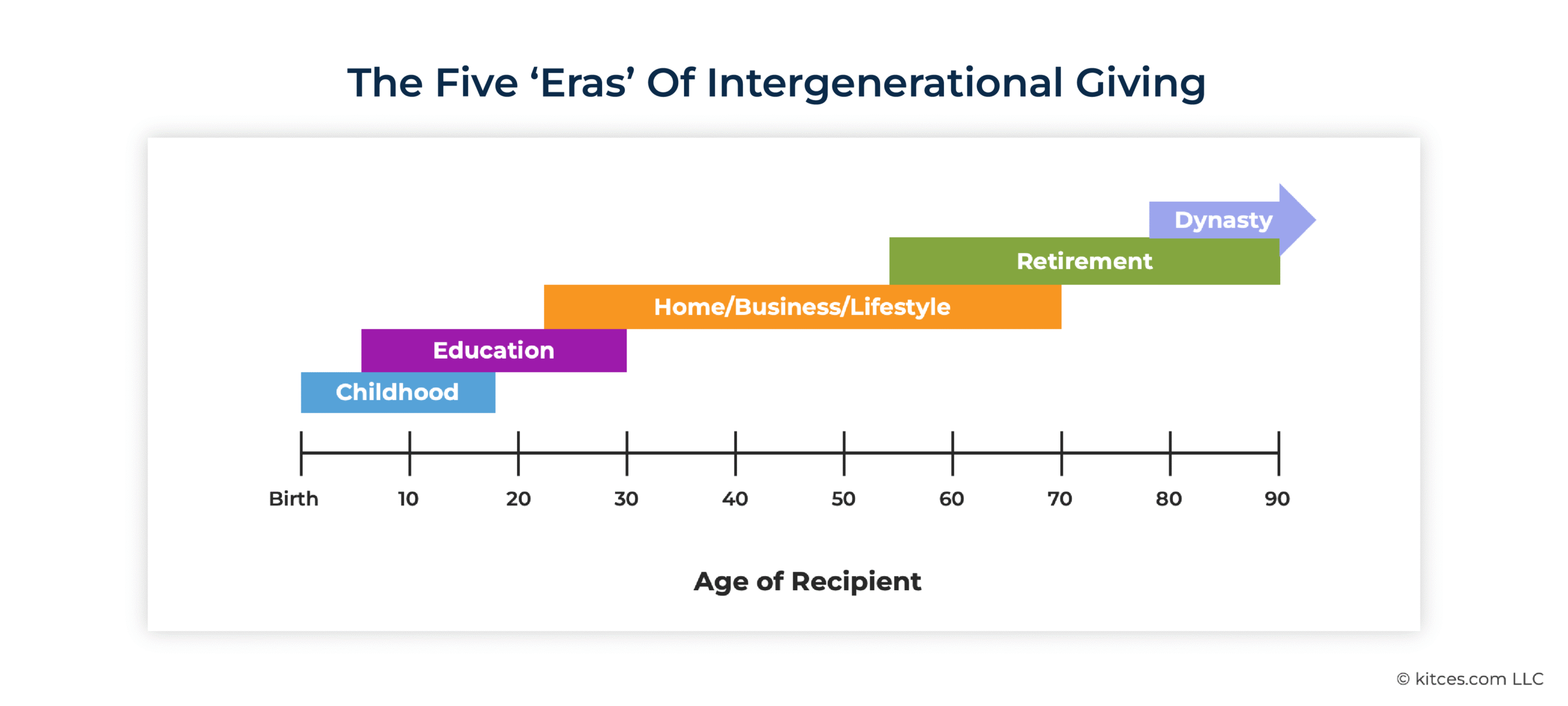
The era into which a parent's gift to their child falls will have a number of planning implications, e.g., how large the size of the gift will be, what type of account serves as the vehicle, and how much (or little) control the parent has over how the gift proceeds are actually used.
Childhood (age 0–18)
The first era is gifts given to children when they are still truly children, ranging from allowance money to birthday gifts to visits from the Tooth Fairy. These tend to be the smallest-dollar gifts, and have the least amount of purpose attached to them: Parents may start giving their young children money as a way to teach them early lessons in financial literacy and responsibility (e.g., opening a bank account, budgeting, and managing an account balance), but just as often these gifts are simply meant as a treat. Although this type of giving can be an important step towards building the foundation of a child's understanding of the world of money, it also requires the least amount of planning, both because of the small dollar amounts involved and the reality that most of these gifts will be spent relatively quickly.
Notably, as the child gets older and nearer to young adulthood, the size and purpose of childhood gifts might change: For instance, a parent might give their teenage child a car after their 16th birthday, or a cash gift on graduating from high school – both of which could be intended to help support the child's transition into independence. These milestones can commonly mark the shift from childhood giving into 'lifestyle' gifts, as described farther below.
Education (age 5–30)
Education tends to be the biggest focus in intergenerational giving. With a college degree nearly universally recognized as a key requirement for a fulfilling career with a middle-class or higher lifestyle, many parents prioritize educational giving above all other forms because they perceive it as the area with the highest positive impact on their kids' quality of life going forward.
There is also great need for parental support with education: For most college attendees, it will be one of the biggest expenses of their lives, at a time when they probably have few (if any) resources of their own to pay for it. And that's before considering the additional possibility of either private K-12 school or postgraduate studies, each of which could cost as much as or more than college itself.
In recognition of that need, the government facilitates a variety of tax-efficient ways for families to contribute towards their children's education. The existence of state-sponsored 529 plans, which allow parents and grandparents to save and invest funds on their children's behalf and withdraw them tax-free for qualified educational expenses, makes educational giving one of the places where the parent's dollars can have the greatest financial impact. Direct payments to educational institutions are also one of the few carve-outs that are not considered taxable gifts under the gift/estate tax regime, so gift tax filing is not required even when the amount surpasses the donor's annual gift exclusion limit. And higher education expenses can qualify for an exception to the 10% early distribution tax from IRAs, making traditional and Roth IRAs potential vehicles for education savings as well.
In other words, the importance of education as a stepping stone to long-term happiness and comfort, plus the need for someone to pay for it (compared to the alternative of many years of student loan payments) and the powerful tax advantages of 529 plans and other giving vehicles, results in a disproportionate focus on education-related giving in the child's childhood and young adult years compared to the rest of their life. And because of the high cost of college and the multitude of options to save and pay for it (from 529 plans offered by all 50 states to Roth IRAs to taxable accounts to trusts – each with its own tax benefits and tradeoffs along with implications for need-based financial aid), education planning is a significant area of focus for financial advisors and their clients.
Lifestyle (Age 20–70)
Although educational giving tends to be the biggest focus, for some parents intergenerational giving continues as their children move into adulthood – often as a means for the parent to help the child achieve the type of lifestyle that the parent wants for them.
For example, some parents might choose to help their adult children with housing costs – e.g., supporting their rent payments on their first apartment (or allowing them to live at home at free or reduced rent), or lending (or gifting) them cash for a down payment on a home. Or parents may help with other milestones of adulthood, like helping to pay for a wedding or for the costs of child care when the children have young kids of their own. Others might provide seed money for their children to start a business.
Whatever the specific purpose, the overarching goal when parents give to their adult children is often to help them maintain a certain level of material comfort so they can more confidently do things that bring them fulfillment, whether that's commencing or changing careers, starting a family, or launching a business. This type of giving can be trickier to plan for given how the goals, timelines, and dollar amounts can vary, so the amount that parents give is often based around what they can actually afford to give at the time the child needs/asks for it – although some parents are more proactive in setting up UTMA/UGMA custodial accounts (which the child can usually access starting at age 21) or irrevocable trusts (which may delay access to funds until the child reaches a certain age or only allow funds to be tapped for specific purposes) to create a source of funds for when the child needs it. These tools can also be helpful in facilitating 'equalization' of gifts among siblings who may have divergent financial needs, by allowing parents to gift more 'fairly' into a uniform savings vehicle.
Retirement (age 70+)
It's comparatively rare for parents to give money to their kids specifically for retirement. This could be for a number of reasons: As noted earlier, some parents would like to be able to see their kids use and enjoy the gifts they give, and that's much less likely when the child themselves may not retire until age 70 or older. And oftentimes the very purpose of parent-child gifts is to help the child achieve a career that will allow them to comfortably save for their own retirement. So while some parents might, for example, help their kids start a Roth IRA when they get their first job (or even give the child a job when they're old enough to be on payroll to generate the earned income necessary to contribute to an IRA), not as many parents actively continue to contribute to their kids' retirement savings after they've gone off on their own. It's simply too far off – in terms of both years away and the goals that parents typically have in gifting to their kids – to be a higher priority than education- or lifestyle-related gifts earlier in the child's lifetime.
Dynasty Creation (Multigenerational)
Finally, some parents and grandparents may opt to make gifts that are intended to last beyond the child's own lifetime and benefit future generations of family. This is usually limited to higher-net-worth families, who are fully confident that both theirs and their children's needs will be met, and who take proactive steps in planning for how their money will be used after they're gone (whether to keep it within the family, or distribute it to charity or others).
This is the most complex area of intergenerational gift planning, often including irrevocable trusts and other vehicles like family limited partnerships and LLCs, both to ensure that the wishes of the progenitor of those funds are carried out as well as to minimize the impact of gift and estate taxes. Given the expense associated with drafting complex estate documents and administering trusts over potentially decades long time horizons, this kind of gifting is usually not undertaken unless the dollar figures are fairly large (at least $100,000 in many cases).
How 530A "Trump Accounts" Fit Into Intergenerational Giving
In the context of how intergenerational giving has traditionally been treated – with a foundation of small-dollar gifts in childhood, a heavy emphasis on education and lifestyle-supporting gifts in young adulthood, a layer of multigenerational dynasty planning for families that can afford it, and gifts of retirement savings for the younger generation as at most an afterthought – there's been a surprising amount of interest in the new Sec. 530A "Trump Accounts" (TAs) created by the One Big Beautiful Bill Act (OBBBA) and officially launched on July 4, 2026.
TAs are structured effectively as a 'starter' retirement account for kids. Contributions (up to $5,000 per year) are allowed from birth until December 31 of the year before the child beneficiary turns 18, with additional contributions allowed from government or charitable organizations (including a $1,000 "pilot program" contribution from the Federal government for children born between 2025 and 2028). Starting in the child's age-18 year, the account effectively becomes a traditional IRA: Funds can be withdrawn, but are subject to a 10% penalty tax up until age 59 ½ unless they meet one of a number of specific exceptions (e.g., educational expenses, first-time homebuyer expenses up to $10,000, or birth or adoption expenses up to $5,000). Investment income in TAs is tax-deferred, but is taxable at ordinary income tax rates when withdrawn (along with the amount of any contributions to the TA that were excluded from income, including employer contributions and government/charitable contributions).
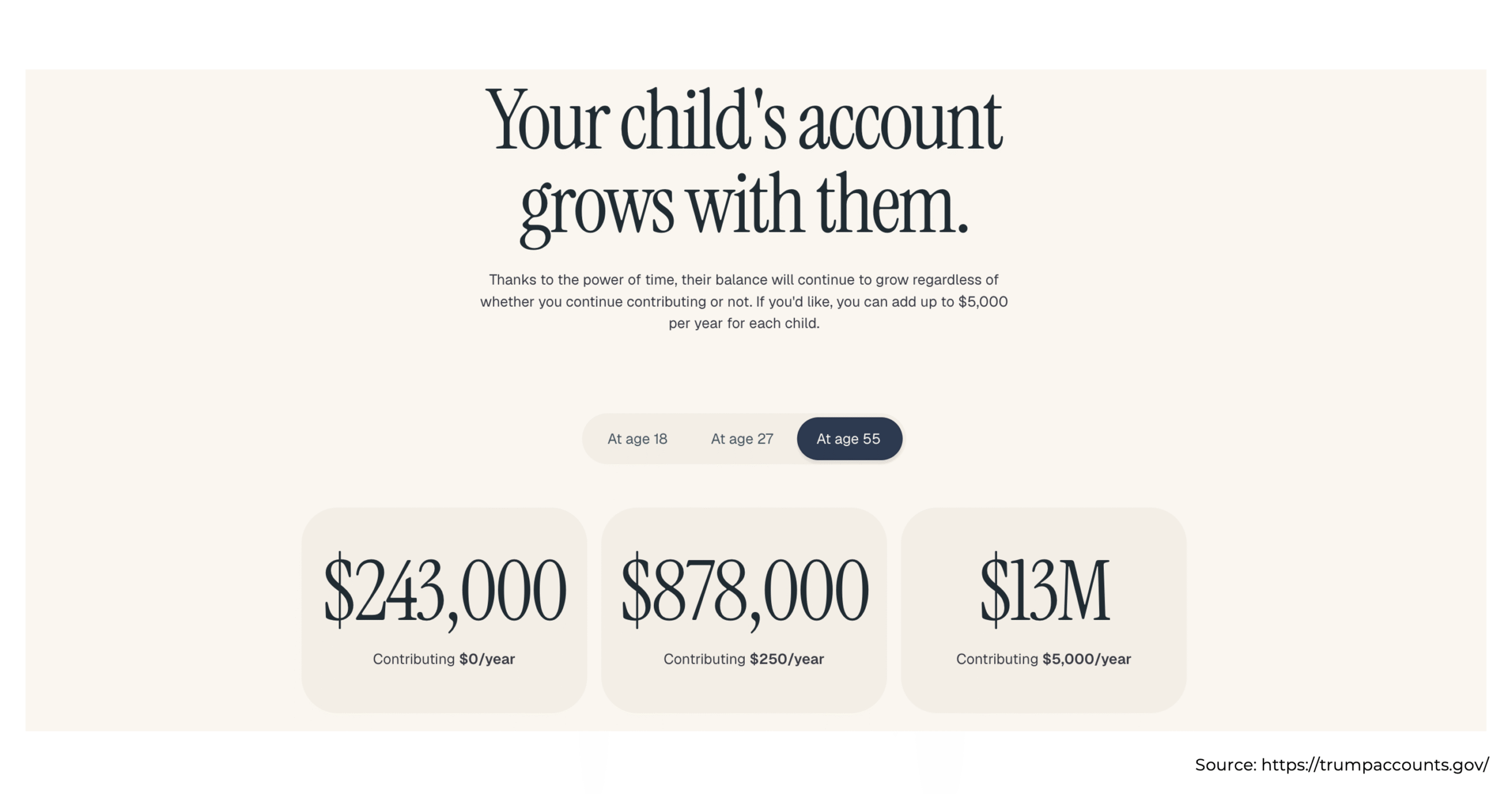
The Federal government has been promoting TAs as a way for parents to get their kids started on building "tax-advantaged" savings, by showing how, with the power of time and tax-deferred growth, contributions of 'only' a few thousand dollars today can grow to eye-popping sums over the course of a few decades – as shown below with the government's illustration of a $1,000 initial deposit at birth growing to $243,000 by age 55, and $5,000 annual contributions up until the child's age-17 year growing to $13 million.
Many planners have also pointed out that, once a TA transitions into a traditional IRA in the beneficiary's age-18 year, it can be converted to a Roth IRA. Although it may make more sense for most TA beneficiaries to wait to convert their accounts until they're no longer dependents of their parents for tax purposes (due to the Kiddie Tax rules that would tax most of the conversion at the parent's marginal tax rate rather than the child's), there's still a possibility for a young adult to turn a pre-tax TA into a sizeable Roth IRA while paying a relatively low tax rate on the conversion if they can do so early in their careers while their income is perhaps at its lowest – giving that chunk of funds the opportunity to grow for decades until it can be withdrawn fully tax-free upon retirement.
Example: Arianne's parents contribute the maximum amount ($5,000 per year, growing with inflation after 2027) to a TA on her behalf each year from the year of her birth to age 17. Assuming growth of 8% per year and inflation of 3% per year, the TA's balance at the end of her age-17 year is $246,073.
Arianne goes to college where she is still a dependent of her parents for tax purposes, so she leaves the TA untouched until age 23, when it reaches a value of $390,486. At that point, she converts the entire account to Roth while in the 22% tax bracket, paying $60,321 in tax. The remaining $390,486 − $60,321 = $330,165 in the Roth IRA grows over time to $5,693,909 by the time Arianne is 60 years old – at which point it can be withdrawn 100% tax-free.
From a numbers perspective, there's no doubt that TAs can be a powerful tool for turning relatively modest contributions today into large sums of tax-free wealth in the future. That's mainly a function of the ability to start contributions at a very early age and to convert the account into a Roth at a slightly less early age (but still early enough to permit decades of tax-free compounding). But it's also in large part because the TA can't be fully used for many decades – by design. By putting the account on an IRA 'chassis', Congress ensured that it can't actually be used (at least without sacrificing a significant chunk of its benefits due to the 10% early distribution tax) until after age 59 ½. While parents can use TAs to seed future wealth for their kids, that wealth doesn't become truly accessible until an age when those 'kids' are nearing retirement.
But as discussed earlier, retirement is one of the eras where parents have traditionally done the least amount of gifting to their kids. Rather than putting funds aside with the goal of fully funding their kids' retirement savings at the end of their career, parents have usually preferred to focus on the beginning part of the lifecycle – i.e., college and early adulthood – to set their kids on a path towards a fulfilling and productive life that allows them to fund their own retirement savings.
And so now that TAs have come along, with a heavy promotional blitz and the tantalizing promise of a Roth conversion-based strategy for achieving generational wealth after retirement, it's worth asking whether the calculus has changed at all – whether the TA's benefits are enough that parents should be considering putting more funding towards their children's retirement savings, or even rethinking their intergenerational gifting plans to redirect funds towards TAs that would have otherwise gone into, say, 529 plans, irrevocable trusts, or UTMA/UGMA accounts. In other words, assuming that most parents' goal in gifting to their kids is to help them achieve a happier and more fulfilling life, will they get a better 'return' on their dollar by saving towards their kids' retirement (via a TA) than other types of accounts?
What's The 'Return' On Intergenerational Gifts?
There is no single correct answer for what is the 'best' form of intergenerational giving. Regardless of the tax-efficiency of one type of giving versus another, the answer truly depends on what the parents want for their children, their philosophy on the purpose of wealth, and how much the child is expected to be (and is capable of being) responsible for deciding how to use the funds they're allotted. Tolstoy may have written that "all happy families are alike", but even happy families have widely diverging goals, which means that planning for intergenerational giving is not a one-size-fits-all exercise.
For example, some parents feel strongly that investing in their children's education will give them the best chance of a lucrative and satisfying career, while also incentivizing them to develop qualities like work ethic, perseverance, and cooperation that will serve them both personally and professionally. Because while it's certainly a privilege to be gifted a loan-free college and/or postgraduate education, it's still up to the recipient to take advantage of the opportunity and turn it into a career.
A family with this philosophy might decide that pre-funding their child's retirement via TA could leave the child with less of an incentive to apply themselves and develop the qualities that will advance their career – that is, since they won't 'need' to earn enough to save for retirement on top of their current living expenses, they won't be compelled to work harder and earn more income to be able to do so. In that case, funding a college education would have the highest 'return' on dollars given, because even though the gifting is done earlier in the child's life, it will result in higher earning potential (boosting the recipient's human capital over their lifetime) and the ability for the child to save more over the course of their career.
By contrast, other families might have the opposite philosophy: That funding a child's retirement from the start will enable them to pursue a career path that's fulfilling to them, even if it means straying from the standard higher education path. A young adult with a fully-funded retirement account could forego college to start a business, join a trade that doesn't require a bachelor's degree, pursue a career in a less-lucrative but potentially more meaningful (to them) field like the performing arts, or take more extended periods of time off to spend with family, without the fear of jeopardizing their ability to retire at a reasonable age. Under this philosophy, the gift of retirement savings would have the greatest 'return', as a relatively modest upfront contribution can turn into a large sum via decades of compound growth – and in the meantime give the recipient the freedom to choose the career and life path that maximizes their happiness rather than the one that maximizes their income.
A third philosophy might be that the child should get to choose when and where to use the funds that their parents want to give them: That instead of being locked behind doors labeled "college" or "retirement", those dollars should be in a place that's equally accessible throughout adulthood. In this scenario, rather than responding to specific incentives, it's ultimately up to the child to decide what use of their gift would have the most positive impact and to balance their current wants and needs against their future expectations accordingly.
The key point is that any of these philosophies of intergenerational giving could be seen as an investment with a high potential 'return'. Both in the financial sense – either through many decades of compounding returns for parents who want to contribute toward their kids' retirements, or by unlocking higher potential career earnings for those who would rather fund education – and in terms of the happiness and personal development of their kids, who are responsible for taking the actions that will maximize the future value of their parents' gifts.
TAs Won't Change Giving Philosophies (But Will Enhance The Available Savings Options)
The existence of TAs isn't likely to change many parents' beliefs about when in their children's lives an intergenerational gift would have the most positive impact. Those come from the parents' own deep-seated values and attitudes towards money and privilege, and a parent who is already hard-set on the value of a college education isn't likely to reconsider their plans based on a new type of tax-deferred retirement account (especially when 529 plans already feature tax-free withdrawals for education expenses).
But what TAs do accomplish is giving parents with the opposite philosophy (where 'pre-funding' long-term retirement savings gives the child the freedom to choose an unconventional career path) a new and potentially more viable option to meet their planning goals. Prior to TAs, parents who wanted to give their kids funds earmarked for non-education expenses had little say in how those funds were actually used (especially if they didn't want to deal with the expense or complexity of an irrevocable trust). For example, taxable UTMA/UGMA accounts become the property of the child when they reach age 21 (in most states), giving them full use of the funds, and there's no difference from a tax perspective between funds withdrawn at age 21 or age 60. TAs, on the other hand, offer withdrawals starting at age 18 but come with an additional 10% tax on distributions prior to age 59 ½ - adding at least a bit of friction for a TA beneficiary tempted to withdraw funds for nonessential purposes and an incentive to keep the funds growing within the account.
In other words, while TAs' tax features probably won't make them a better option than 529 plans for parents focused on college savings, nor a great alternative to UTMA/UGMA taxable accounts for parents who would rather give their kids more spending flexibility, they do potentially make sense compared to other options for parents who are specifically focused on their kids' retirement savings. Which means the important part in deciding whether to open and fund a TA is knowing whether or not the parent wants to put money towards their children's retirement in the first place. Or put differently, each type of goal has one or more account types available to build tax-advantaged savings, and so the question isn't what is the 'best' type of account for intergenerational giving; it's what is the best type for that parent's particular savings goal.
Choosing An Account For Intergenerational Giving
The recent launch of Trump accounts (TAs) does create an opportunity for financial advisors to have a conversation with their clients with young kids about their intergenerational giving goals. Doing so can help advisors confirm – or rethink – whether the form of gifting that the parents are currently doing (or planning to do) fits with their gifting philosophy.
The Best Accounts For Each Type Of Giving
When it comes to choosing an actual account type to contribute to, it's helpful to know which intergenerational giving 'eras' the parents' giving plans fall into – Childhood, Education, Lifestyle, Retirement, and/or Dynasty. This can help with mapping the account type(s) that fit best for each era onto the client's actual giving goals.
As noted earlier, Childhood giving tends to be smaller in scale and cash-based – the biggest decision might be whether or not to open a custodial checking account.
For Education goals, 529 plans are the most popular option because of the ability to make tax-free distributions for qualified education expenses. However, parents can also supplement 529 plans with their own taxable or retirement savings – with Roth IRAs being a popular option because of the ability to make tax-free distributions up to the account's basis, with additional taxable (but penalty-free) distributions for educational expenses prior to age 59 ½. Direct payments to educational institutions are also a popular choice, often facilitated by agency accounts (where a grandparent remains the asset owner but the parent is an authorized checkbook signer).
For more flexible Lifestyle savings, taxable brokerage accounts are the norm – but parents can choose whether to title those accounts in the child's name (i.e., a custodial UTMA/UGMA account) or in their own name. An UTMA/UGMA account might be more tax efficient since the first $2,750 of income from the account is generally tax-free under the Kiddie Tax rules, but children will have full control over their UTMA/UGMA assets starting at age 18 (creating some concerns for parents who don't know if their children will be ready for the responsibility of handling their own money at that age). Additionally, those accounts are treated as the child's property on the FAFSA, resulting in a potential negative impact on any need-based college financial aid they may be eligible for. Parents who intend to make larger gifts but want stricter control over the timing and purpose of fund disbursement may consider setting up an irrevocable trust outlining the specific conditions under which funds can be distributed.
Prior to TAs, the only options for Retirement-specific savings for children were UTMA/UGMA taxable accounts (which have all the issues mentioned in the preceding paragraph) or saving to the child's own (typically Roth) IRA, which requires them to have earned income and thus isn't generally an option until middle or high school when they can start working. TAs, which can be opened and funded immediately after birth, add a new option for this category – and once the child becomes eligible to contribute to an IRA as well, they can contribute to both accounts simultaneously (with the current $5,000 contribution limit for TAs and the $7,000 limit for IRAs being treated separately, allowing for a total combined contribution of $12,000).
And for parents who have high-deductible health insurance coverage that includes non-dependent children (up to their age 26), another option is contributing to a Health Savings Account (HSA) on their child's behalf – a savings vehicle that can be used for qualified healthcare costs either in the short term or later in life (including during retirement).
Finally, most Dynasty planning is limited to irrevocable trusts. However, 529 plans, which generally do not require forced distributions after the original owner's death, can be used to potentially fund multiple generations of education expenses.
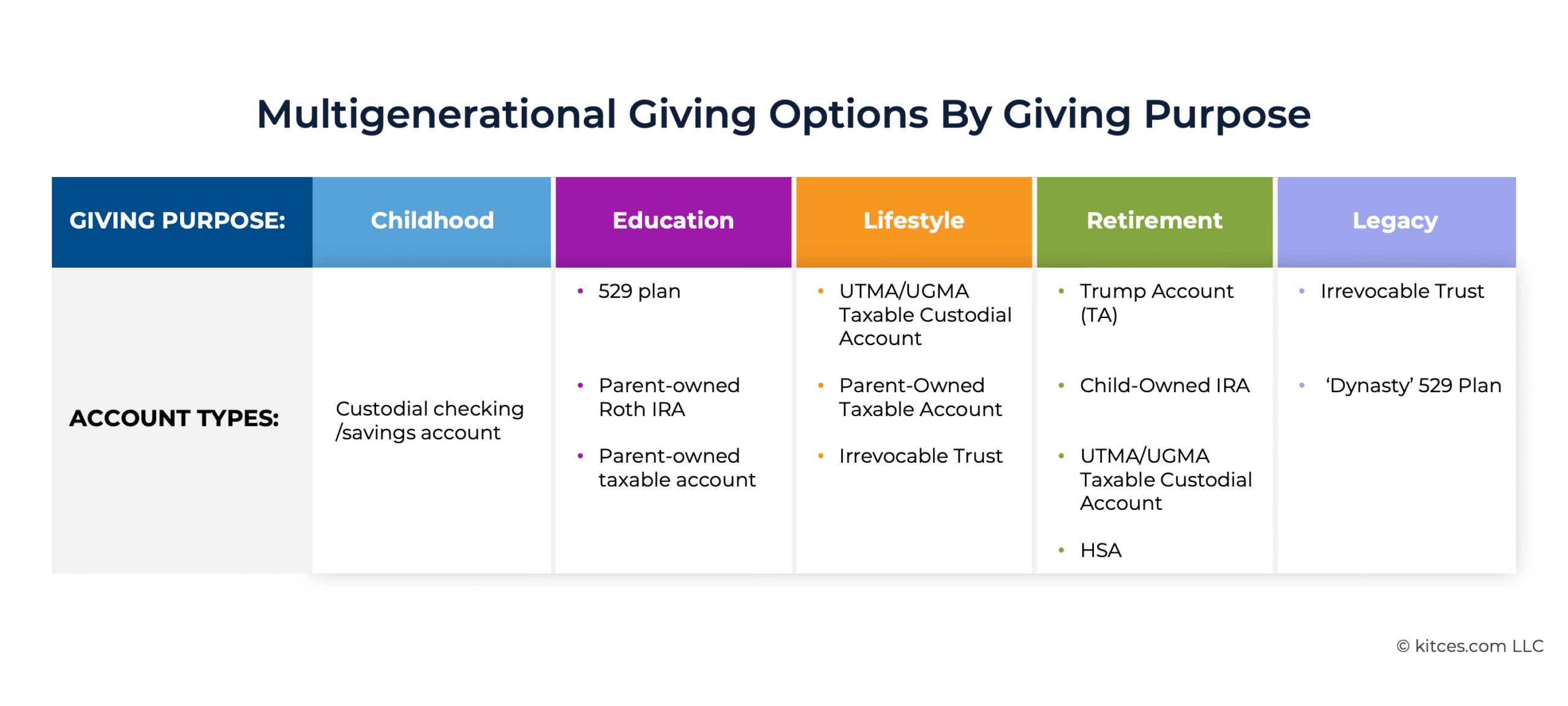
Ultimately, as the sheer number of gifting options shown above demonstrates, the arrival of TAs doesn't represent a revolutionary new way to transfer wealth to kids so much as it adds a slightly different flavor of giving to the (many) options already available. So while TAs might be worthwhile for some parents based on their own philosophy of intergenerational giving (and many more parents may want to open accounts on their kids' behalf just to take advantage of the 'free money' of the $1,000 Federal pilot program contribution), it will ultimately depend on whether Retirement is really the area of their kids' lives they want to subsidize – because if not, there are plenty of other options that have existed long before TAs that can get the job done.