

Executive Summary
Welcome to the March 2026 issue of the Latest News in Financial #AdvisorTech – where we look at the big news, announcements, and underlying trends and developments that are emerging in the world of technology solutions for financial advisors!
This month's edition kicks off with the news of Altruist's launch of a new AI-powered tax planning add-on to its Hazel AI notetaker, which triggered a big selloff in the stocks of established RIA custodians like Schwab, LPL, and Raymond James – but despite the media narrative that the volatility was a result of the threat of AI-driven disruption to the advisory industry as a whole, the real story (given that Altruist's tool was itself made for financial advisors) is about the threat that Altruist and its rapid technology innovation poses to other custodians, and how they might now see Altruist as a true competitor (even though they've been gaining momentum and market share on the back of their technology for years)
From there, the latest highlights also feature a number of other interesting advisor technology announcements, including:
- Jump and Zocks, the respective #1 and #2 market leaders in the advisor AI notetaker category, each announced Series B fundraising rounds, widening the gap in scale and capital between themselves and the remaining standalone notetakers – and suggesting that rather than being threatened by CRMs rolling out their own internal notetakers, the AI notetakers could instead be a threat to the CRMs themselves as they build out their CRM-like capabilities faster than the CRMs can respond
- FMG Suite has acquired Testimonial iQ, a tool that aimed to streamline the process of collecting and promoting client testimonials on Google Reviews – which in part highlights how advisor use of testimonial marketing has lagged in the years since the SEC revised its Marketing Rule to allow the solicitation and promotion of testimonials, making it hard for Testimonial iQ to persist as a standalone tool; but is also a story about how FMG Suite is aiming to cover virtually every part of the website-centered digital marketing funnel for advisors via its PE-funded acquisitions
- After a number of years where Holistiplan was the dominant tax planning software on the market, a slew of new competitors have recently arisen from both existing platforms (like Wealth.com, Nitrogen, and Altruist) and new startups (like Hive AI Tax and april) featuring AI-powered document extraction and AI-generated recommendations – which on the one hand could be troublesome for Holistiplan's incumbent stature if AI has erased the technology advantage it once had, but on the other hand could turn out to reinforce why Holistiplan became so popular to begin with (because it allowed for advisors to build the tax planning strategies they want to build, rather than feeding them recommendations they may or may not be comfortable giving to clients)
Read the analysis about these announcements in this month's column, and a discussion of more trends in advisor technology, including:
- The AI meeting support startup Contio (founded by Riskalyze founder Aaron Klein) has launched its new MeetingOS software, a three-part tool that generates meeting agendas, provides real-time talking points and client information during the meeting itself, and logs meeting notes and follow-up tasks after the meeting, all with the goal of improving client meetings themselves rather than just the work before and after – however, since the problem with client meetings is often too much (rather than too little) information and agenda topics, it's possible that a tool like MeetingOS could create an information overload that prevents the advisor from staying present in the client conversation (which undermines much of the purpose of meeting with the client to begin with)
- Max (formerly MaxMyInterest) has launched a new private banking service for RIAs with ultra-high-net-worth clients, giving independent RIAs an option to offer access to the kinds of services provided in-house by private bank advisors (without the need to refer to a private bank who might subsequently pitch the client on their own wealth management services)
And be certain to read to the end, where we have provided an update to our popular "Financial AdvisorTech Solutions Map" (and also added the changes to our AdvisorTech Directory) as well!
*To submit a request for inclusion or updates on the Financial Advisor FinTech Solutions Map and AdvisorTech Directory, please share information on the solution at the AdvisorTech Map submission form.
Authors:


Altruist's Hazel AI Tax Planning Tool Sparks Market Selloff In RIA Custodians As Altruist Emerges As A Bona Fide Custodial Competitor
For many years, the RIA custodial space has been dominated by three big firms: Charles Schwab, Fidelity, and BNY Pershing (plus a fourth, TDAmeritrade, until it was absorbed by Schwab in 2020). But there are many other custodians out there: For instance, large broker-dealers like LPL and Raymond James offer RIA custody to their dual-registered representatives and to independent RIAs; SEI and Interactive Brokers grew custodial branches out of their respective core businesses of private fund administration and market making in options and futures markets; and a few including TradePMR, SSG, and Altruist started out as RIA custody providers overlaying other existing custody/clearing platforms like First Clearing, Pershing, and Apex, respectively (although that list has shrunk down to solely Altruist after SSG was acquired by Altruist in 2023 and TradePMR was acquired by Robinhood in 2024).
There's been little movement in this custodial picture over the years, as the Big 3 have maintained their market position through their sheer scale and name-brand power. Even though LPL and Raymond James are themselves attached to sizeable, publicly traded companies, their RIA custody arms have limited brand recognition outside of the representatives affiliated with their broker-dealers or OSJs (or the relative handful who have dropped their broker-dealer affiliation but kept the RIA custody relationship to avoid the hassle of transitioning and repapering all of their clients). And the high cost of switching custodians has meant that Altruist has had to build its business mainly by targeting newer, smaller firms without an existing (and typically deeply entrenched) custody relationship.
Altruist's relative newcomer status makes for a long road to catch up with the more established players. But the advantage that Altruist does have over its competition is that it is built on newer infrastructure that has enabled it to rapidly innovate and compete on the strength of its technology. The splashiest feature early on was Altruist's portfolio management and performance reporting system which, for advisors who custodied at Altruist, eliminated the need to spend upwards of $10,000 per year per advisor on a third party solution. But Altruist's technology also just made for a better core custodial experience as well (scoring strongly across all its core categories in our Kitces AdvisorTech Research), e.g., allowing for rapid electronic processing of new account applications at a time when many other custodians required wet signatures, faxes, and multiple day time periods to open client accounts. And while Altruist didn't have the size and scale of Schwab or Fidelity, or even LPL or Raymond James, it has been able to raise massive amounts of venture capital from investors who saw the opportunity to disrupt the custodial space through technological superiority.
We seem to have reached a turning point in Altruist's journey when the news hit in mid-February that Altruist was launching a new tax planning add-on to its Hazel AI notetaking tool – and the markets reacted with a massive selloff in the shares of publicly traded RIA custodians. From the morning of February 10 (when the launch was announced) until the time of this writing, Raymond James's shares are down over 10%, Schwab's are down over 12%, and LPL's are down over 22%.
The news and its aftermath generated a fair bit of confusion about what connected the launch of an AI tax planning tool to the decline in RIA custody stocks. And the picture got even muddier after a media narrative emerged that the selloff was caused by investors' concerns that AI-powered tax planning software would somehow disrupt the financial advice model that those companies rely on for their custodial business – even though the Hazel AI tool is made for financial advisors, by a company whose revenue is almost entirely dependent on RIA custody. Clearly Altruist wasn't putting out a tool that threatened to disrupt its own source of revenue!?
But while there's perhaps some truth to the AI disruption narrative from a market behavior perspective (as there are no doubt legions of traders ready to push the sell button whenever the words "AI" and "disruption" appear together), the fundamental story – and the real threat to the established RIA custodians – is more simply about Altruist's emergence as a major player in the custody space. Altruist has been steadily gaining momentum and market share over the years as it has built out its tech capabilities and rolled out features such as automated tax-loss harvesting, cash management, and the Hazel AI notetaker, but it seemingly hasn't really been seen as a legitimate competitor among its own peers (as evidenced by the fact that the other custodians haven't felt pressured to innovate back and boost their own technology). And while it's still a bit of a mystery as to why this particular product launch served as the tipping point – Altruist itself didn't even seem to view its tax planning add-on as an industry-disrupting killer app until after the media narrative took hold – what's certain now is that the likes of Schwab, LPL, and Raymond James (whose executives' stock option compensation has surely taken a big hit in the last month) aren't likely to ignore Altruist as a competitor any more.
The question going forward, then, is how the established custodians will react now that it's clear that Altruist's pace of innovation and emerging technology advantage is costing them their market share (with markets implicitly projecting that Altruist will capture more market share in the years to come, thus triggering a sell-off in the stock price of the incumbents). Existing custodians could increase their own investments into technology to compete against the Altruist threat, although it's a risky proposition to pour time and money into technology when they're already behind in many areas due to legacy technology debt – by the time they've caught up to where Altruist is now, Altruist might have already taken another leap forward, leaving the competition playing perpetual catch-up.
Alternatively, an established custodian could opt to try and buy Altruist along with its technology and existing base of RIA users and clients. It's worth pointing out that LPL, with its relatively clean custody channel that isn't entangled with other parts of their business (as Schwab's and Fidelity's architecture are with their massive retail arms, Raymond James' custody and clearing serves multiple parts of their financial services businesses), could more or less plug in Altruist to replace its existing ClientWorks platform, with the resulting combination of Altruist's technology and LPL's scale and distribution capability through its network of broker-dealer affiliates increasingly pivoting to advisory, having the potential to compete with the likes of Schwab and Fidelity at the top of the custodial market.
The key point is that the connection between Altruist, Hazel, and the custodial stock selloff isn't about one new industry-disrupting AI breakthrough, and certainly not the threat of $50/month AI-driven SaaS software competing directly with RIA custodian economics. It's about the market catching up to what many advisors and observers who closely follow the industry have already known for a while, which is that Altruist's technological capability and rapid innovation (in their core custodial functions as well as the other features bundled in or added on to custody) are genuinely making them a true threat to join and compete with the "Big 3" custodians. And now that the market has realized it, we can expect to see a new round of innovation, consolidation, and overall disruption in the custodial space at large.
Jump And Zocks Raise Dueling Series B Funding Rounds As AI Meeting Notes Becomes A Race Towards An 'Advisor Operating System'
Advisor-specific AI meeting note tools have existed for about three years now, and over that time one of the biggest questions has been their viability as a standalone solution. While the value of AI notetakers is clear-cut given the material time savings of eliminating the manual work involved in logging meeting notes and managing follow-up tasks, what's questionable is whether those capabilities should exist in one standalone tool or as a feature within an existing platform. In the early days of AI notetakers, the answer seemed obvious: They make the most sense living within CRM software (since that's the repository of all the client data that the AI notetaker deals with). Which meant that once CRMs started to roll out their own integrated AI notetaking tools, it would be hard for any of the standalone notetakers to survive on their own.
But over the last year, an interesting thing has happened. CRMs took a very long time to roll out their own notetakers – for example, Wealthbox just launched its own internal notetaker in the fall of 2025, while Redtail still has yet to introduce a notetaker of its own – which cost the CRMs a lot of the initiative in the race to gain market share. Instead, two standalone providers, Jump and Zocks, became the clear-cut #1 and #2 market leaders in the advisor-specific notetaker category, which allowed them to raise capital and build out features like meeting prep summaries, natural language search capabilities, and document extraction. And so by the time Wealthbox finally unveiled its own AI notetaker, its features were already outpaced by Jump and Zocks, making advisors less likely to drop the standalone solutions even though it meant paying for another software license on top of the CRM.
The result is that, with AI notetakers building out their capabilities and integrating to other parts of advisors' tech stacks, it's ironically the CRMs now that are being threatened by the existence of the standalone AI notetakers rather than the other way around.
If the CRM's main roles are as (1) a repository for data on clients and their historical interactions with the advisor and (2) a hub for client-related tasks and workflows, then AI notetakers are already close to taking over the first role: Every meeting or email the advisor has with the client while using the notetaker already in the system, and it would be a relatively simple matter to pull in the remaining historical client data from the CRM (given that most notetakers are accessing that data via integration already). And with the AI notetakers now building connections to other software tools, their users arguably have access to a richer depth of client data they can get from their CRM, since an advisor can effectively search their entire tech ecosystem to answer a question (e.g., whether the client has taken an RMD yet this year) using the AI notetaker's interface. Where the AI notetakers haven't yet caught up is in supporting the creation and management of advisor workflows (since that arguably isn't a function that needs to – or should – be done using AI), but given the fairly dim view advisors have of their CRMs' existing workflow capabilities, even a fairly basic (non-AI) workflow management function could be an upgrade over what advisors experience with their current CRMs.
In that context, it's notable that this month Jump and Zocks, the two leading standalone AI notetakers (at least according to the most recent Kitces Research on Advisor Technology), have each announced their own Series B fundraising rounds, with Zocks raising $45 million and Jump raising a whopping $80 million – suggesting that far from being threatened by disruption from CRMs and other platforms launching their own bundled notetakers, their investors see them as the most likely disruptors that could eventually usurp the CRM's roles in the advisor tech stack.
It's worth noting that neither Jump nor Zocks has explicitly stated that they're planning to compete head to head with the CRMs. But given the increasing size of their funding rounds, it's getting hard to imagine that isn't the case. For example, Jump claims to already be used by around 27,000 advisors, which equates to nearly 10% of everyone in the U.S. who can currently call themselves a financial advisor. If their investors hope to 10x their growth at their current pricing and service model, then Jump alone would need to be used by nearly every single advisor in the country (without even accounting for Zocks or any other competing notetaker). That's plainly unrealistic as no matter how popular AI notetakers become, they likely won't reach 100% adoption (not even CRMs are at that point now), and not everyone who uses an AI notetaker will use Jump.
So rather than aiming to increase the notetakers' user bases to an implausible number, there must be a plan to increase revenue per user to achieve their investors' growth goals. Which means expanding the AI notetakers' capabilities (and add pricing tiers accordingly) so that rather than generating around $1,000 of revenue per user per year, they can generate closer to $2,000 or more. And as to how they'll expand their capabilities, it doesn't take much of a stretch of the imagination to predict that they'll keep building in the direction of CRM-like features with their fresh capital.
But while the funding rounds are obviously good news for Jump and Zocks as the market leaders in the AI notetaking category, they're a much worse sign for the other standalone AI notetakers. Jump's and Zocks's Investors alone have essentially funded 100% (or more) of the addressable market for AI notetakers, which leaves zero room in their view for any remaining competitors. Making matters worse, those competitors are also now farther behind in capital and scale, which makes it even harder for them to innovate and catch up to Jump and Zocks. We've already seen some tools either be acquired (as Thyme did, being acquired by Altruist and rebranded as Hazel) or pivot to different use cases (as Warmer did by jumping to advisor lead generation), and such moves will likely only increase from here as the writing on the wall gets clearer.
Ironically enough, the prediction may still hold that standalone AI notetakers won't exist in the future as they do today. But if that's true, it's because, rather than being absorbed or undercut by competition from CRMs, the leading AI notetakers eventually build towards being CRMs themselves – or towards a whole new category of "advisor operating systems" that encompass both the traditional CRM functions as well as agentic AI and data orchestration between multiple tech systems – while the remaining notetakers may be forced to pivot away to other use cases to remain viable. And with Jump and Zocks building their CRM-like capabilities faster than CRMs have built their own AI capabilities, they now have the momentum – over not just the standalone notetakers, but also the CRMs that they (explicitly or not) are rushing to compete with.
FMG Acquires Testimonial iQ To Add Another Piece To Its (Website-Based) Marketing Funnel
An advisory firm's website is an important piece of its marketing plan, but it isn't the only piece. For one thing, potential clients need to be able to find their way to the website to begin with (e.g., through a blog, social media campaign, or SEO strategy). Then, once they're there, the website needs to be compelling enough to get the prospective client to click around, and it needs to build up enough trust so they'll to decide to reach out – and there needs to be an actual way for the prospect to reach out, whether that's by booking a meeting, filling out a contact form, or signing up for an email list. The website is just one segment of the marketing funnel, one that hopefully gets prospective clients from the "curious" stage to the "ready to book a meeting" stage.
There are tech solutions for advisors up and down this marketing funnel. Tools like Yext work to enhance online visibility for advisors, driving prospective clients to the advisor's website by getting them to show up in more search results. Solutions like Finsites, Paladin Advantage, and Advisor Websites can provide the website itself, while content solutions like Clearnomics (for charts and visualizations), Catalyst Writing and AdvisorStream (for written content) and Pageport and VidVisor (for embedded videos) can engage clients on the site itself. Calendar tools like Calendly, OnceHub, and Acuity Scheduling can help with meeting booking, and then tools like Mailchimp and Snappy Kraken can help advisors manage email lists and drip marketing campaigns.
But one provider that's grown to encompass nearly the entire website-based marketing funnel is FMG. Starting as a provider of compliance-friendly website templates for broker-dealer firms, FMG has gradually expanded its 'suite' over time, mainly via acquiring other providers, to include SEO and content tools, email and social media marketing automation, client event promotion and management, and client texting (following FMG's acquisition of MyRepChat). So while websites may still be at the center of what FMG provides, its strategy over time has been to fill in all the other gaps around website-based marketing to give advisors an end-to-end solution.
And this month FMG announced its latest acquisition, the client testimonial platform Testimonial iQ, which adds yet another piece of website-related marketing technology to its collection. The tool is being rebranded as FMG Testimonials, and will continue to be offered as a standalone product along with being bundled into FMG's broader suite of marketing tools.
Testimonial iQ launched in 2023, a year after the SEC's updated Marketing Rule allowing (with numerous caveats) advisors to solicit and promote reviews and testimonials from their clients went into effect. The idea was to create a single interface where advisors could send clients to write a review, which when submitted by the client would post to the advisor's Google Reviews and would also be made available for the advisor to display on their own website.
But in spite of the potential for testimonials to boost advisors' online presence and drive traffic to their websites – and despite the fact that leveraging online reviews and testimonials has become a standard marketing practice in other industries – testimonials haven't gained all that much traction among advisors in the years since the Marketing Rule took effect. In the most recent Kitces Research on Advisor Marketing (which was conducted in 2024, four years after the new rule was announced and two years after it went into effect), only 7% of advisors were actively using testimonials in their marketing materials – and while many advisors indicated that they planned to start using testimonials in the near future, it isn't at all apparent that testimonial use has picked up significant steam since then. This is likely at least in part because of the need to create documented processes to comply with the Marketing Rule, including creating a standardized (and documented) way to ask clients for testimonials and providing disclosures when required, but it ultimately spells bad news for providers like Testimonial iQ (and related tools like Amplify Reviews), since when the vast majority of advisors are too intimidated by the existing regulations to dabble in testimonials to begin with, there's a very narrow market for a standalone tool to help garner and promote those reviews.
At the same time, though, a tool like Testimonial iQ could make more sense as a part of FMG's broader suite of digital marketing solutions. Advisors who are already using FMG for their website, social media, SEO, and email marketing might find it easier to incorporate testimonials when they're integrated together with the platform they're already using than they would have as standalone software. And for FMG, which had fresh capital after its own acquisition by private equity firm GTCR last fall, client testimonials represented one of the few sections of the digital marketing funnel that it didn't offer on its platform, making Testimonial iQ a natural target for what is effectively the advisor digital marketing version of a PE rollup firm.
The big question going forward is still whether testimonial marketing will see any meaningful increase in adoption as advisory firms get used to the rules and put the needed processes into place. It's possible that Testimonial iQ was just a little ahead of its time, and launched when testimonial marketing was too new and unfamiliar of a proposition for many firms to handle – which would make it potentially a great acquisition for FMG if the use of testimonials ramps up as advisors get more comfortable with the regulations and put the needed compliance processes into place. But on the other hand, if testimonial adoption continues to stagnate, FMG's acquisition won't be as valuable – but it still has all of its other digital marketing tools to fall back on. Which goes to show that when one company owns the entire digital marketing funnel, it's not that big of a deal if advisors use some parts of the funnel less than others. But when one provider builds around just a single area of the funnel, then it's risking a lot on advisors showing up in that area – and if those advisors don't show up, then there's only so long that it's possible to remain viable as a standalone company.
New Tax Planning Tools From Wealth.com, Nitrogen, And Others Show The Popularity (And Coming Commoditization?) Of Tax Planning
There's a cycle that's occurred several times over the life of the financial planning profession that goes something like this: First, a small number of financial advisors find an innovative new way to better serve their clients. That then becomes a way for those planners to differentiate themselves from the existing status quo, giving them an advantage in marketing and highlighting the value of their advice. Other advisors begin to catch on to the opportunity and adopt it, simultaneously doing better work for their clients and more rapidly growing their own businesses. Eventually technology solutions pop up in response to growing interest in the new advice model and innovate new ways to deliver it better and more efficiently. Around this time, larger enterprise firms begin to adopt the new model, enabled by the technology providers' promise to make the model scalable and handle the heightened compliance concerns of the bigger firms. Ultimately, the 'new' advice model becomes part of the status quo going forward: It's no longer a differentiator between firms, but is simply the baseline expectation, and the solutions become largely commoditized.
For example, advisors once predominantly sold individual stocks and other products to their clients from their wirehouse broker-dealers' inventories, until some advisors started to differentiate themselves as 'independent' broker-dealer representatives who would choose the 'best' diversified mutual funds to sell. And then that became more or less the status quo, until some advisors began to differentiate themselves by managing entire diversified portfolios for their clients for a fee instead of selling various third-party mutual funds on commission. And then that became the status quo, until some advisors began to differentiate themselves by offering more comprehensive financial planning beyond portfolio management alone. And by sometime during the 2010s, offering comprehensive financial planning was itself the status quo: It had grown so commonplace, facilitated by the rise of planning software like Naviplan, MoneyGuide Pro, eMoney, and RightCapital, that it was no longer an effective differentiator between one advisor and the next.
After comprehensive financial planning, the next frontier for financial advisors has become tax planning. Which isn't exactly new (it has long had a place in the CFP educational curriculum), but has become a much bigger focus over the last 10 years or so as advisors have started going deeper into different areas of tax planning focus like asset location, equity compensation, concentrated holdings, and business tax strategies.
The movement toward tax planning was supercharged with the introduction of Holistiplan in 2019, which allowed advisors to expedite their reviews of client tax returns by creating a simple tax summary based on the client's uploaded tax return (from which Holistiplan automatically extracted data to populate the tax analysis). Advisors can also create short-term (usually 1-3 years) tax projections based on their current return's baseline, allowing them to model different planning scenarios and strategies they might recommend, and show the resulting impact on the client's taxes – but many advisors don't even get into the projection functionality, instead focusing solely on the current-year summary to help the client visualize their current tax situation.
The upshot was that with Holistiplan, all of a sudden almost any advisor could do at least a basic amount of tax planning, even if that just amounted to going through what was in the client's tax return summary, and many advisors did exactly that: As of the latest 2024 Kitces Research on Advisor Productivity, 92% of advisors stated that they do some level of tax planning for clients, and the 2025 Kitces Research on Advisor Technology showed that over 50% of advisors use Holistiplan to do that tax planning.
But the fact that so many advisors now advertise tax planning as a component of their services, and that so many of them use the same software to do it, strongly suggests that tax planning (like many differentiators before it) is itself becoming commoditized. It might no longer be enough for an advisor to merely say that they offer tax planning: If a client can get the same thing from an advisor down the street using the same software, it's just the status quo now.
Which makes it interesting that, after many years where Holistiplan has dominated the market for tax planning software (albeit with some competition from FP Alpha in more recent years), several technology providers have recently launched their own tax planning tools, including Wealth.com, Nitrogen, and Altruist's Hazel (as add-on tools to their existing platforms), as well as standalone planning tools from Hive Tax AI and april.
It's likely no coincidence that the slew of new planning tools to compete with Holistiplan are emerging just as AI is making it easier to extract and organize data from client documents (and more generally, to stand up new software solutions). The functions that originally required Holistiplan to program pre-AI Optical Character Recognition (OCR) technology to scan dozens of different tax forms and then digest the data and output it into a standardized report can likely be handled by AI tools with a fraction of the time and resources. And AI has also allowed the new generation of technology to do something that Holistiplan (so far) does not do: Allow advisors to enter client information freeform via a chatbot interface, and generate answers and even ideate tax planning recommendations based on the client's information in real time. In other words, these tools go beyond 'just' calculating the client's current and future tax situation and allowing the advisor to model their own tax planning strategies as a projection tool, but instead play a direct role in coming up with the strategies themselves. Which in theory can support deeper tax planning by at the very least affirming strategies that the advisor might have in mind and potentially even surface new strategies that the advisor hadn't thought of.
The caveat, though, is that one thing that's become apparent in recent years in the ecosystem of specialized financial planning tools is that many advisors are hesitant to start conversations and bring recommendations to clients where they aren't prepared to answer follow-up questions that the client might have. If a tax planning tool suggests a strategy that the advisor isn't familiar with, is the advisor then going want to bring it into a client meeting where the client might ask, for instance, what the impact of this strategy will be on their taxes in three years, and then be embarrassed that they can't competently answer the client's question? Conversely, for advisors who are already comfortable with going deep into tax conversations, will they see the value in a tool that suggests strategies that they likely already know?
By contrast, Holistiplan's core features of a streamlined tax summary report and a tax projection calculator allows it to meet advisors where they're most comfortable. Whatever recommendation the advisor brings to the client meeting, they can relatively easily change the projected scenarios and demonstrate the strategy's impact. This is arguably one thing that has helped Holistiplan succeed over the years: That regardless of the depth of tax planning that the advisor wants to go into, Holistiplan can most likely support it, and show the value of the recommendations that the advisor already was knowledgeable about and wanted to recommend. And though it can be argued that technology can and should be used to nudge advisors towards doing more in-depth tax planning, it's an open question as to whether advisors in reality will be receptive to a tool that nudges them towards strategies they'd have trouble explaining to a client themselves (for which a brief in-tool "summary of how this tax strategy works" may not be enough real-time education to drive adoption).
In the end, though, there likely is going to be an incentive nudging advisors towards more in-depth tax planning, and that's the commoditization of basic tax planning that already seems to be occurring (which, as always, pushes advisors to add more value on top of the commoditized layer that everyone else does). Much as offering generalized "comprehensive" financial planning ceased to become a differentiator once everyone else became comprehensive financial planners, performing basic tax return reviews and high-level planning conversations doesn't help a planner stand out as much when everybody else can do the same thing in Holistiplan. Which is ultimately both good and bad news for Holistiplan: As the fairly entrenched incumbent in the space, it has a very comfortable lead in market share – but on the flip side, it also has a lot of potential market share to lose, and the near-ubiquity of tax planning today means that there's an incentive for other platforms to spin up a lower-cost competitor. In the end, though, the question will be whether those solutions will be good enough – and whether they'll enable the kinds of tax conversations that advisors actually want to have – to peel enough users away from Holistiplan to threaten its dominance?
Contio Unveils Its MeetingOS To 'Fix' Broken Meetings For Advisors, But Are Client Meetings Really Broken?
Advisors spend a lot of time in client meetings, and for good reason: Meetings are where the vast majority of an advisor's interactions with clients (and prospects) take place, and they represent perhaps the best chance for the advisor to build trust and rapport with the client. In short, they're the times when the advisor really gets to demonstrate their value, and deepen the human-to-human relationship. In fact, according to the most recent Kitces Research on Advisor Productivity, one of the biggest differences between highly productive advisors (defined as those generating $1 million or more of revenue per year) and the rest is the amount of time they spend in client meetings: Higher-earning advisors spent 24% of their time in client meetings on average, while others spent 17% (equivalent to a difference of 2.8 hours, or an additional 1-2 client meetings per 40-hour week).
So no advisor necessarily wants to spend less time in meetings, and ultimately there's only so much more time that can be spent in client meetings before it's just exhausting as well. However, many advisors, when asked, would likely say that rather than having more or fewer client meetings, they could stand to hold better meetings. With most advisors only meeting with their clients one or two times per year, there's often so much to get to that it's hard to cover it all even in a two-hour meeting – and if the discussion ends up veering off-topic, or the client has questions or new issues that they bring in, the meeting can easily run beyond two hours (and past the point where it's possible to really absorb new information or make clear decisions). And for ongoing clients, most advisors try to anchor to their review meetings to 'only' a one-hour (not two-hour) time slot in the first place.
The reason for this struggle to get it all done in the time allocated to a typical review meeting isn't necessarily because of a lack of planning or preparation on the advisor's part. Many advisors spend a long time doing meeting preparation (on average, almost 30 minutes for every 1 hour of meetings, according to our own Kitces Research on Advisor Productivity) going through the client's file and crafting an agenda covering a host of meeting items: e.g., recapping old talking points, addressing open action items, refreshing the client's financial plan, and providing an update on their investment performance, while also trying to leave time for updates or questions from the client. If anything, advisors try to pack too much into their agendas, leaving little time for organic conversations that often can help the advisor get to the bottom of what the client really wants to talk about.
That's why it's notable to see the launch this month of MeetingOS, a software tool from the startup Contio (founded by Riskalyze/Nitrogen founder Aaron Klein) that, unlike AI notetaking tools that center their value proposition around eliminating preparation and follow-up tasks before and after the meeting, focuses on improving the meeting itself (via AI).
At a high level, MeetingOS does three things. First, it creates client meeting agendas: The high-level meeting topics are set via templates created by the advisor, but the specific talking points are pulled from the advisor's CRM and other tools (harnessing the strong capability of AI to synthesize CRM and prior meeting notes). For example, if a past meeting note mentioned that the client was taking an international vacation, MeetingOS might add "How was the vacation to Europe?" under the Client Updates section. Second, MeetingOS serves as a kind of behind-the-scenes meeting manager, feeding the advisor talking points and key information in real time based on what's said during the conversation (it calls this the advisor's "superhuman memory", to give an idea of the effect it's meant to convey). And third, MeetingOS generates meeting notes and follow-up action items, similar to what's done by most standard AI meeting note tools.
But while the functionality of MeetingOS is generally impressive, there's an open question about whether it really solves the pain points that advisors have around meetings. While it's certainly a good thing to have a meeting agenda (and Contio's agenda creator truly is impressive in how it can populate a meeting agenda template with talking points and research notes from the client's file in a fraction of the time it would take an advisor to do themselves), the process of creating an agenda isn't necessarily a big pain point for advisors – it's selecting what to cover (or not) in the agenda itself, namely not trying to pack too much information into a limited meeting time slot.
Furthermore, in watching MeetingOS's demo (which it must be said is refreshingly thorough in how it lays out the product and its key features), the feeling one gets is of information overload: Onscreen during the meeting is not only a fully populated agenda, but also lists of "private" talking points viewable only by the advisor (particularly helpful in the context of Zoom/virtual meetings where there's a screen that only the advisor can see), plus a running list of meeting themes and action items going down the other side of the screen. It's hard to imagine trying to actually follow all of this on one screen while also staying present in the conversation in a Zoom window (to say nothing about an in-person meeting). After all, the human brain is still not really capable of multi-tasking, especially when it's a real-time effort to read (a screen) and talk or listen (to a client) simultaneously.
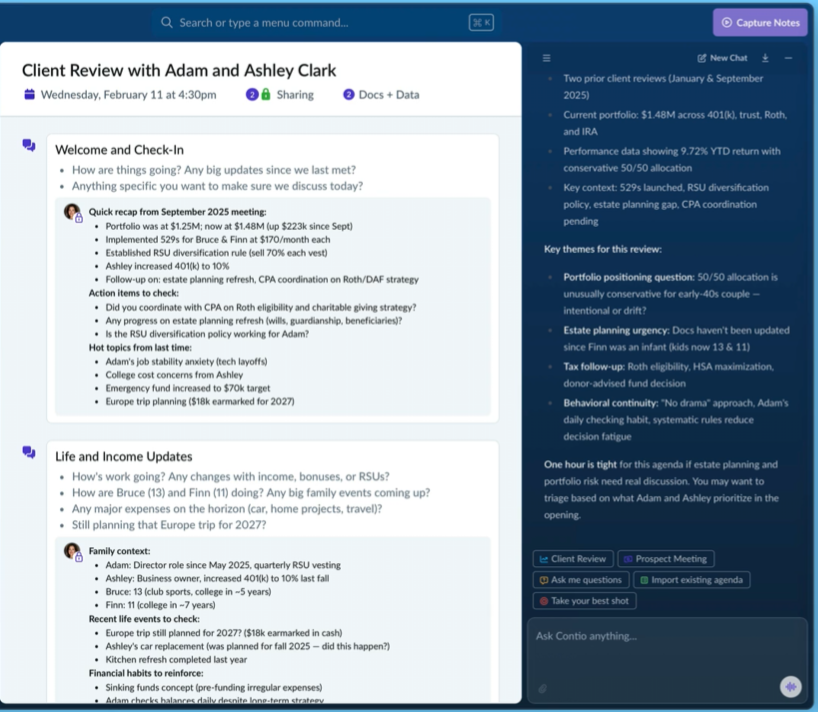
Screenshot from Contio's MeetingOS 'Guided Tour'
Still, it's fair to recognize that client meetings require the advisor to strike a difficult balance: Advisors want to be open and receptive to whatever it is that the client wants to talk about, but at the same time there are often specific conversations that need to be had and decisions to be made. Client meetings are about building relationships, but they're also about getting things done while all of the parties are in the same room. For advisors, that often requires careful calibration of their service model, so that things that are essential for in-person discussion can happen during the meeting, and there are other processes for handling the things that can be done asynchronously. But MeetingOS seems to instead go all-in on compiling everything that could possibly be discussed in the meeting, rather than sorting and prioritizing the things that are best discussed in the meeting. Though in theory that is a balance from MeetingOS that could shift as the software inevitably iterates its features after it gets wider use from early-adopter advisors.
Ultimately, it will be interesting to see where Contio and MeetingOS go from here. Because on the one hand, it's nice to have a trove of client information at your fingertips to answer any question you (or they) might have in the moment. But on the other hand, every minute that the advisor is looking at the screen to pull up a specific data point, or read a conversation prompt, is a moment where they aren't fully present in the conversation itself – which is arguably much more of the purpose of having the meeting in the first place. (And as many advisors might reluctantly admit, it really isn't the end of the world to say "I don't know" or "I'll follow up with you" in a client meeting – advisors, just like their clients, are human too.) While advisors might have a number of pain points in how they experience client meetings, not having enough information in front of them is not usually one of them, meaning MeetingOS may need to find a better way to show advisors the information they need when they need it… but otherwise not distract them so they can stay present with their clients for the rest of the conversation.
Max Introduces Private Banking Solutions, Showing That Access, Not Just Service, Matters For UHNW Clients
For financial advisors, there's often a natural incentive to go "upmarket" with their services to higher-net-worth clients: The higher clients go up on the spectrum, the more complex planning issues around things like taxes and estate that they encounter, and the more they're willing to pay someone who can help them solve those problems. Hence, advisors who seek to work in the HNW or UHNW space build deep expertise in topics like executive compensation, complex trust planning, and charitable giving strategies to help them stand out.
But there's a different thing besides planning expertise that financial advisors can provide to clients as they go up the income and net worth scale: Access to products and services that aren't available (or practical) to 'mere' HNW or mass affluent clients. Hence, for example, many of the financial advisors that UHNW clients work with are at private banks, where the advisors can not only help them solve their complex planning issues, but also get the client access to a universe of banking services like bespoke loan products and cash accounts with higher yields than can be found on the retail market.
This can be a problem for independent RIAs who aren't affiliated with a private bank. They can't offer those products themselves because they aren't banks themselves. And while advisors could try to develop referral relationships with private bankers to send their clients when the need arises, there's no guarantee that the bank won't turn around and pitch the client on their own wealth management services.
It's notable, then, that Max (formerly MaxMyInterest) has introduced a new private banking solution specifically for UHNW clients of RIAs. At its core, the new product offers cash management and borrowing solutions tailored to UHNW clients, but also includes advisor-specific features like an advisor-branded client portal, flexibility to choose which products to make available to clients, and integrations with advisor-specific CRMs, portfolio management platforms, and financial planning software.
Max already has a history of creating innovative solutions for HNW advisory clients. Their flagship product, the original MaxMyInterest, was all about spreading cash around to different (retail) banks in order to maximize the client's cash yield while maintaining full FDIC coverage – which caps out at $250,000 per customer per bank, meaning that was only really relevant to clients who planned to keep more than $250,000 in cash, which is already a fairly upper tier of net worth. The new private banking solution seems to aim even more upstream into UHNW territory (explicitly including "yacht loans" as a feature of its product, to give a sense of the tier of clientele it's targeting). In other words, Max is aiming for a fairly narrow slice of the RIA market – but even just a handful of RIAs signing up their $100 million+ clients for private banking services would likely make the venture worthwhile.
At one level, this is a continuation of the story of RIAs moving upstream into ever-higher-net-worth territory, and evolving their product and service offerings to adapt to those clients' needs. If advisors expect UHNW clients to choose them over a wirehouse broker-dealer or private bank advisor, they need to have product and services that are competitive with what those advisors would be able to provide. Akin to the handful of advisor-friendly corporate trustees in the marketplace, providers like Max recognize the opportunity that exists to outsource the things like lending that independent advisors can't do on their own (and won't try to steal the advisor's clients while doing so).
But on the opposite side of the coin, the demand for products like Max's private banking suggests that UHNW clients really are starting to go to independent RIAs, even though they don't have direct access to the kinds of proprietary products and services that private bankers do. Which in turn implies that at the end of the day, for many clients (even UHNW ones), planning expertise is the primary factor in choosing an advisor, and access to products and services (while still having some importance) is a secondary concern. But as the upstream movement of advisors continues, there's likely going to be opportunities to have the best of both worlds: The in-depth planning expertise at the core, plus a growing number of banking and trust products that the advisor can offer (without being a banker or corporate trustee themselves).
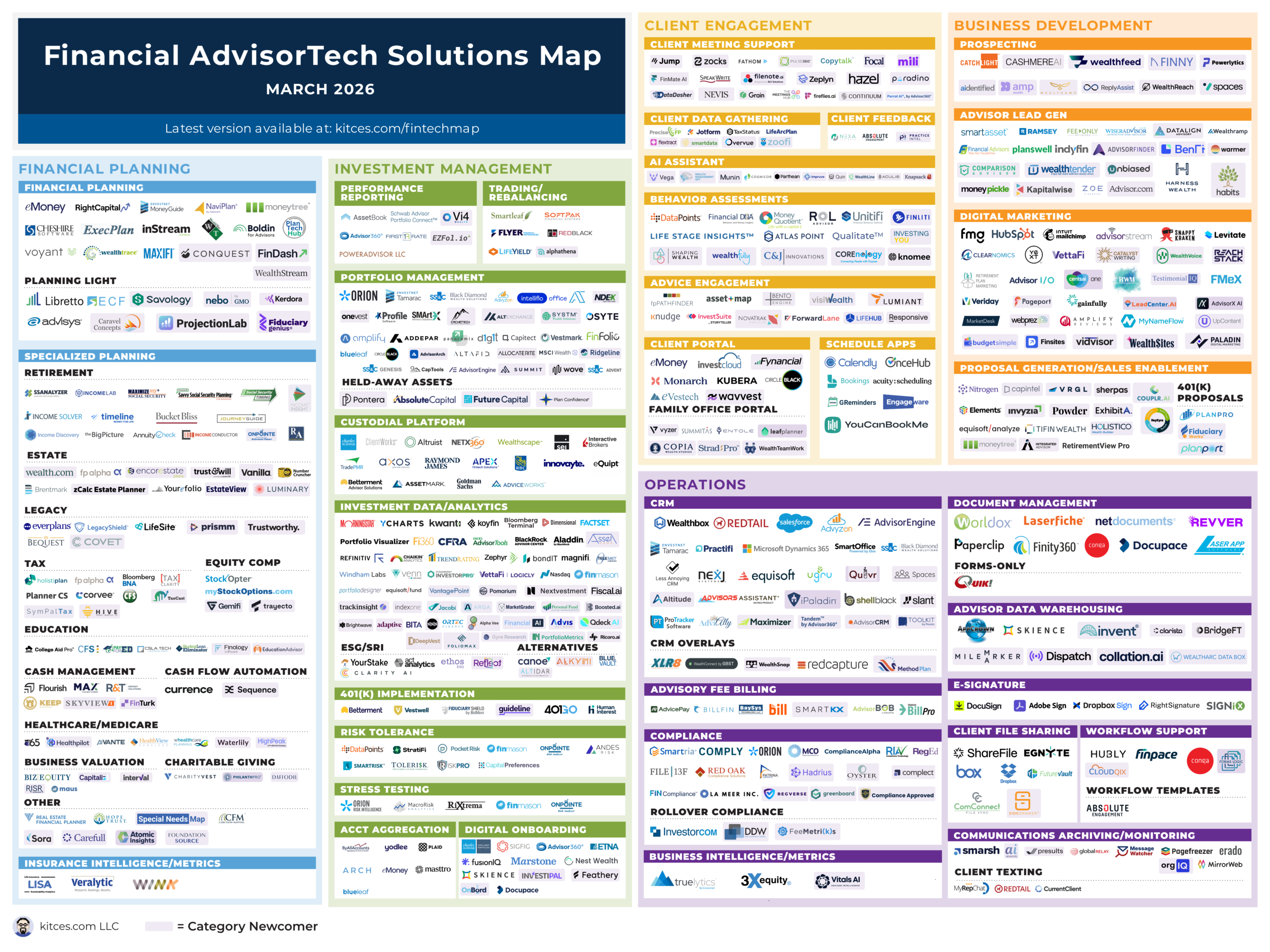
In the meantime, we've rolled out a beta version of our new AdvisorTech Directory, along with making updates to the latest version of our Financial AdvisorTech Solutions Map (produced in collaboration with Craig Iskowitz of Ezra Group)!
So what do you think? Does Altruist provide a legitimate threat to the market share of bigger custodians like Schwab and LPL? Would you rather use a tax planning tool that lets you model your own recommendations, or one that generates the recommendations itself? Is the problem with client meetings that there is too little client information available, or too much? Let us know your thoughts by sharing in the comments below!





Leave a Reply