Executive Summary
Given some of the frictions and costs involved with implementation, many sophisticated tax planning strategies have historically been the purview of only the wealthiest investors. However, thanks to technological and other advances, in recent years certain tax-aware investment strategies have become available to a wider range of investors. At the same time, innovation in investment strategies and products can sometimes push the boundaries of what the IRS finds acceptable, potentially exposing investors who use them to greater scrutiny.
Amidst this backdrop, the IRS has issued formal guidance regarding certain tax-aware investment strategies that have been growing in popularity. Its more definitive statement, Revenue Ruling 2026-20, addresses a variation of the Section 351 ETF conversion (which investors can use to diversify concentrated positions while deferring capital gains) in which securities that don't fit the ETF's investment thesis are exchanged with an Authorized Participant, as part of the same plan, for securities that do. In this case, the IRS concluded that the ETF should not be respected as an independent intermediary, and that the investor should be treated as having made a taxable exchange. The agency did not, however, restrict Section 351 ETF conversions more broadly, leaving a good deal of gray area between what is clearly permitted and what is not.
The IRS also recently issued Notice 2026-62, which identifies transactions that concern the agency. The Notice describes additional guidance or enforcement actions the government may consider pending a public comment period (including guidance that could apply retroactively), making it less definitive than the Revenue Ruling, though still helpful to understand the types of transactions and products that are on the IRS' radar. Strategies identified in the notice include a partnership/exchange-fund variation of the Section 351 transaction, box-spread ETFs (which generate interest-like income that turns into a deferred capital gain), ETFs that defer income by rotating between underlying ETFs with different dividend record dates, ETFs that seek to skirt the registered investment company qualifying-income rules, and certain strategies designed to exploit differences in the character of economically offsetting gains and losses.
With these (and other) IRS statements in mind, financial advisors considering a particular tax-aware investment strategy for one or more clients might first determine whether there would still be a legitimate investment reason for the client to own the strategy if the projected tax benefit were materially smaller than expected (i.e., it has an attractive risk/return profile even in the absence of advertised tax benefits).
From there, the process looks much like the one advisors already use for investment risk: estimating the net benefit if the strategy works (after fees, financing, and professional costs, and recognizing that some of the 'savings' may simply be deferral), the total cost if it doesn't (including interest, penalties, and professional fees), and the strength of the tax position itself (including input from an independent tax professional and whether any outside legal opinion has been updated for the new guidance).
Further, an advisor might work with a client to assess their personal "tax risk tolerance" (i.e., their willingness to pursue a tax-aware investment strategy that might later bring them under IRS scrutiny), alongside their capacity for that risk (e.g., whether they have sufficient liquidity if the strategy is deemed impermissible and they are faced with a large tax bill and, potentially, penalties). While some clients might see the upside potential of a strategy as being worth a potential audit or even a case in Tax Court (including the accounting and legal fees they could face), others might not be willing to take that risk.
Ultimately, the key point is that while the IRS isn't 'declaring war' on tax-aware investment strategies, financial advisors and their clients can likely expect more guidance, and more scrutiny, on certain strategies that appear to push the limits on permissibility. Which suggests that financial advisors can support their clients by helping them understand their personal tax risk tolerance – and recommending particular tax-aware investment strategies (or not) accordingly!
 |
And if you want to go deeper on this topic, hear directly from the author on the Financial Advisor Technician podcast. |

Listen To The Financial Advisor Technician Podcast On This Topic




Episode Shownotes And Transcript
Click to expand transcript and show notes↓↓
Title: The Value Of Assessing Clients’ “Tax Risk Tolerance” Following Recent IRS Pronouncements
Shownotes:
- Jeff Levine: LinkedIn | Website | Speaking
- Adopting A Two-Dimensional Risk Tolerance Assessment Process
Full Transcript:
Adam: Hello, and welcome back to the "Financial Advisor Technician" podcast. I'm your host, Adam Van Deusen. On today's episode, we're going to discuss a recent IRS revenue ruling and a separate IRS notice that scrutinized certain tax-aware investment strategies and how these documents fit within the broader category of tax risk for clients. Because in today's environment, technology and other advances have made many tax-aware investment strategies that might once have been the domain of ultra-high net worth individuals feasible for clients with a wider range of wealth. However, while certain strategies have been officially blessed by the IRS, others exist in a much more gray area, which suggests that a client's interest in pursuing them could be determined by what might be called their tax risk tolerance or their capacity and tolerance for using tax strategies that could save them significant money, but also could put them in hot water with the IRS.
So to help us dig deeper into this topic, I'm joined today by Jeff Levine, the lead financial planning nerd here at Kitces.com and the chief planning officer for Focus Financial Partners, to discuss the ins and outs of the recent IRS revenue ruling and notice, what they mean for particular tax-aware investment strategies, and how advisors can help clients determine their personal tax risk tolerance and put it into action when considering tax planning strategies. So welcome, Jeff, to the "Financial Advisor Technician" podcast.
Jeff: Thanks so much, Adam. It's great to be with you today.
IRS Scrutiny Of Certain 351 Exchange Transactions [1:54]
Adam: Terrific. So to start, maybe we could give our listeners a concrete example of what we're talking about in terms of tax-aware investment strategies and potential IRS scrutiny. So with that in mind, maybe you could begin by going into the recent IRS revenue ruling and what it had to say about certain Section 351 ETF conversions.
Jeff: Yeah. We've seen this rise of tax-efficient investing strategies largely for, I don't even want to say, middle-market-type households, because it's still more affluent households, but it's not the ultra, ultra-wealthy. Ultra, ultra-wealthy have long had access to strategies that others simply haven't had, and largely because it took too much effort and time and cost in order to deliver them to those without $100 million, let's say, of net worth. But today, technology and awareness have driven more of these strategies further down market. And so there's a rise, really, of approaches out there trying to figure out, how do we combine investments with taxes and minimize the ultimate tax liability to create better after-tax returns for clients?
And one of the ways in which this has been done recently, or at least in some ways tried to be done recently if you think about the IRS's position on what we're about to talk about, is through a 351 exchange. Now, at a high level, a 351 exchange here is just utilizing the various elements of the tax code, but in the sense of the financial advisor and how it's being used for clients, it's clients contributing appreciated securities into a newly formed ETF. Now, there are some rules around this. Those securities that are being contributed have to be "diversified" in order to meet IRS rules, which means no one position represents more than 25% of the portfolio being contributed by a client and no fewer than 5 positions represent 50% of the portfolio.
So the IRS considers that, by regulation, already diversified. And so if a client contributes those positions in kind to a newly formed ETF, the idea here is that, well, maybe a whole bunch of other people also have diversified positions that they are also going to contribute to that newly formed ETF. And much like an exchange fund or a swap fund that advisors may be more familiar with, the idea here then is that a client owns a little bit of this newly formed ETF that now is diversified because everybody has brought their own investments to the portfolio.
Adam: Very good. So investors have been using this for a little while now. Now, what aspects of this rose it to the level of the IRS? Why were they concerned about what's going on, at least certain practices, when it comes to the 351 exchanges?
Jeff: Well, it's kind of like my kids, Adam. You give an inch. People take a mile, right? And so there's definitely been some cases out there, some situations, where people have sought to utilize the rules in a way that the IRS sort of believes is inconsistent with the way Congress intended. And honestly, you have to sort of agree with it when you think about it very much objectively.
So, look, one of the really interesting things about ETFs in general, let's go away for a second from abuse, but in general, ETFs are able to be very tax efficient because you can have tax-free exchanges between the ETF and the AP. The AP there being the authorized participant.
ETF can exchange its shares for individual securities with the AP that allows for in-kind redemptions, etc., and all tax-free, or at least tax-deferred. So it's very, very efficient. In general, look, that's why ETFs as a whole have risen in use so much in recent years. Everybody used to be in mutual funds for diversification. Now, while mutual funds are still a very viable product and there's still reasons to choose sometimes mutual funds over an ETF, ETFs have risen dramatically over the last few decades. And it's largely because of that built-in, real, genuine, valuable tax efficiency that they offer. But now people start to get creative, and they say, "Well, what can we do here that would be interesting and novel and maybe combine all these rules in a unique way?"
And so what some people have done is basically looked at the newly formed ETF as a way to take in these investments immediately, or at least very close to that, have exchanges with the authorized participant in a tax-free nature, and now you have sort of immediate diversification of a previously maybe diversified but not really diversified position.
I'll give you an example. The most egregious situations here involve people who are trying to artificially meet the diversification requirements and then use that and the redemption features and cost basis tracking, all to achieve, in their view, basically, a really strong benefit. So an example here, I think, is very helpful. Because, obviously, we're talking about a lot of different moving parts here.
So let's all imagine, right, that we've got a client who's got $200 million of highly appreciated securities, right? Let's just make it all gain for whatever purpose. I know that's a little bit unrealistic, but it makes our example easy. So we've got a client with $200 million of securities in one investment. Now, we already know, Adam, that you can't use a 351 exchange for that one position. It's $200 million, and that's going to violate the diversification requirements. No position can be more than 25% of the portfolio. You have to have at least 50% represented by more than 5 positions. So we now end up in a situation where we go to the client, and we say, "Okay, you can't just contribute this $200 million. Let's find a way to be diversified. Let's buy $800 million of an ETF that is an S&P 500 index fund for argument's sake."
Now, at first, you might say, "Well, now that's two positions." But it's not the way the IRS looks at it. The IRS is very clear that when you have an ETF, you kind of look through the ETF to the underlying positions. And so, by buying $800 million, in this example, of the S&P 500 index ETF, you now, combined with your $200 million of existing highly appreciated securities, have, in this example, I guess, $1 billion of diversified assets. So now you take your billion dollars of diversified assets, and you create an ETF. Maybe it's your own ETF. And you contribute all the billion dollars of diversified assets into this billion-dollar ETF. Now, what does the ETF do? Right away, the ETF says, "Okay, we don't want to hold $200 million of this other security. We're going to exchange it with our authorized participant for other securities."
And immediately you end up with a completely diversified, in whatever you want to have type of arrangement, billion-dollar portfolio. And then we go even further, and we say, "Hey, you know the $800 million of index ETF that we just bought and we just contributed? Well, the basis of that is $800 million." So we're going to trace the basis, and we're going to take out or we're going to sell $800 million of our newly formed ETF. We're going to take it back. We're going to pay no tax because it's all basis. And what we're left with is, instead of the $200 million of very concentrated single-security stock risk, we're left with a diversified portfolio of $200 million. We've paid no tax, and the IRS is very unhappy about this. That's really...and you could see it's a little bit egregious, but that's sort of the extreme of what some people are doing and what the notice, or rather what the revenue ruling that was released by IRS this past month really indicates, that that sort of exceptional, egregious activity is no longer allowed.
The Difference Between An IRS Revenue Ruling And Other Documents [10:57]
Adam: Very good. Thank you for that example. And I think you make a good point there, is I think some of the media coverage around this was painted with a little bit of a broad brush, that it wasn't Section 351 exchanges writ large. I think, as you mentioned, it's sort of these particularly egregious examples of some of the activities that were going on there. And I guess relatedly for our listeners, could you just briefly explain what a revenue ruling like this actually means and how that's different from an IRS notice or a private letter ruling or sort of other IRS actions that they might have heard of?
Jeff: Yeah. A revenue ruling is basically a private letter ruling that everyone can rely on. So in effect, it largely has the effect of law. It can be challenged more easily in court if someone believes that it's inconsistent with what Congress passed by statute. But basically, until that happens, it largely has the effect of law. So a private letter ruling is where you go to the IRS and you say, "Hey, this is the facts of my particular situation, and I'm not sure, or I want to guarantee, as to how you are going to view this, IRS." And so people can go, and you can pay a lot of high-priced attorneys or CPAs, or in some cases both a good amount of money to pay to prepare one of these rulings, and then you can also pay a usually very significant IRS fee. There's different fees for different types of rulings. But the IRS will kind of rule on it. And it's almost like a mini court case that's done via correspondence with the IRS, where they will look at the facts of your situation and say, "Here's what our opinion is. Here's how we would treat this."
Well, in some cases, the IRS gets the question so many times, or in other cases, they just want to pronounce something on their own that they want to be applicable to everyone based on the facts and circumstances of a particular situation. And they will issue a revenue ruling. And unlike a private letter ruling where it's just for you, your individual taxpayer who sought it, and no one else can even...you can't cite other private letter rulings in court or anything like that, a revenue ruling is applicable to all taxpayers. And so this was the IRS saying, "Hey, anybody who's doing this, this is now how we are going to view your transaction. And we are going to..." And effectively, what the IRS said is, "We're going to view the authorized participant as largely a straw man, and anything that's exchanged with that authorized participant is effectively going to go back and be taxable to the individual who contributed those securities." So you can't use this to just wash away the gains.
But the challenge here, Adam, is that the IRS told us what is definitively wrong. It told us, the example I just gave you, I have zero doubt in my mind that if that was put before the IRS, the IRS would collapse that transaction and treat that exchange with the authorized participant as taxable, even though, technically, if you follow step by step by step of the law, someone could argue, "Well, it's not." But there's lots of legal doctrine there, whether it's the step transaction doctrine, the substance over form doctrine, etc., where the IRS can look at the bigger picture and sort of collapse it. And I have zero doubt they would be able to do that. The question though is, how close to the sun can you fly without your wings catching fire? So, how quickly after some securities are contributed can an ETF manager make some changes to the portfolio?
And look, ETF managers have a fiduciary duty to their shareholders to do certain things. How does that balance against what is contributed? And we can go further, and we can say, "Okay, well, if they can make changes and maybe they can make some even a small amount sooner, then what is a small amount? Is it 5% of the portfolio is okay to turn over relatively quickly? Is it 10%?" We don't have any bright-line tests from the IRS. All we know is the most egregious examples are bad, but we don't really know what's good. And that's the big challenge for clients and advisors coming out of this revenue ruling.
Adam: Very good. And I should note for our listeners, Jeff has written a wonderful article digging very deep into the revenue ruling and the IRS notice, which we're going to talk about next. So if you're interested in learning more about that, please go to kitces.com/FAT15, to check out that article.
Potentially Concerning Transactions Flagged By IRS Notice 2026-62 [15:47]
Adam: Now, Jeff, this is actually, I think, a really good segue into the second document the IRS issued, which was a notice. And so perhaps you could talk briefly about what having a notice means sort of on this sort of spectrum of IRS pronouncements, but also briefly maybe a few of the examples of the types of transactions that were sort of flagged in this notice.
Jeff: Yeah. So an IRS notice, let's talk about that as a high level. IRS notice is really an alert for people, right? It is really what it sounds like. We're going to put you on notice. And sometimes those notices can just kind of share initial thoughts that the IRS has, but it would say, "We'd like to have some commentary first." Sometimes it's, "We intend to issue guidance along these lines, but we're not there yet. So we've got to have some more formal stuff created, but this is how we're planning to treat it. So be aware, folks, that if you're doing these things, this is going to be an issue."
And so, in this particular case, the IRS issued a notice. This was Notice 2026-62. And for those wondering, I don't think we mentioned earlier that revenue ruling we're talking about. Obviously, you can go online and check out the article or to the website you just mentioned. But that revenue ruling was 2026-20. So as we think about this notice, the notice was largely there to say, "Hey, we are concerned about a variety of other transactions going on in this tax-aware investing space, but we don't yet feel we have a handle on how all of these work to the extent we need to prepare guidance. So we are going to open up a commentary period and allow people to submit their thoughts to the IRS." And this is very common when the IRS wants to engage in rulemaking in a particular area, but they feel like they need some further guidance from the marketplace, etc.
And so what the notice really does is, I would say, it creates two broad categories of additional types of transactions that the IRS is concerned with. One of them is other uses of this in-kind redemption via the authorized participant. This is what the IRS referred to, I think, as "atypical usage of Section 852(b)(6)," which is the section that talks about the ability of an authorized participant to have these in-kind redemptions, in-kind without the tax. So they flagged a couple of additional transaction there. One of them is a variant here where a partnership...people contribute first securities to a partnership, and then the partnership itself does an exchange fund contribution. And the idea here is that the partnership is used as the vehicle to create diversification where one is not available before.
So maybe, Adam, you have your $200 million stock. You don't go and buy $800 million of S&P 500 index fund because you don't have another $800 million. But you got your $200 million of your highly appreciated stock. And I take that, and I also say, "You know what, hey, I've got my own $200 million of stock." It's a completely different stock. And we go, and we find a bunch of people. And effectively, almost like an exchange fund, we pull together an exchange fund first, and then maybe in this coordinated manner, we then go with our exchange fund, which is now diversified through step one. And then we put it into a 351 exchange via...we now all end up with an ETF that's all diversified. It's low cost. It's able to be traded with relative ease. So that's one thing that the IRS looked at.
Another one is box spread ETFs, where, effectively, through a variety of option positions that get rolled over and changed, we can create interest-like income in an ETF, or supposedly interest-like income in an ETF, but that has a deferred and a capital gain component as opposed to current and ordinary income tax rules.
And then, finally, there are ETFs that seek to kind of avoid creating dividends by rotating through underlying ETFs of a similar type. So imagine we've got five different S&P 500. I'm making this very bland here. We've got five different S&P 500 index funds out there from different providers. One has a dividend date of the first of the month on the first month of every quarter. One has it on the first of the month of the second month of every quarter. One has it on the first of the month of the third month of every quarter. What some of these ETFs will do is they kind of use the authorized participant to rotate through these so that they never hold one of the ETFs on its dividend payable date. And supposedly this then avoids the dividends for the underlying investors. So that's one category. Again, all using the authorized participant and the very valid, reasonable tax treatment that ETFs have, that IRS has not challenged the ability to have these tax-free exchanges, but potentially in ways that Congress did not mean.
The other category that they're really concerned about and that they've expressed some concern about, really starting over the summer via a conference that was where a couple of IRS officials just happened to share some thoughts, was on investment strategies that seek to create ordinary income losses in exchange for potentially capital gain. So there's a natural advantage here for capital gains in the tax code because of their favorable treatment as opposed to ordinary income, especially long-term capital gains. There are a variety of different ways in which managers can potentially try to create situations like that. One of them would be something called the mixed character straddle. Another one is by using same-day foreign currency trades. And a third one is through the selective termination of notional principal contracts.
Instead of getting into each one of those in the weeds, because that could be a lot, I would just encourage readers to take a look at the article if they want to have a little bit more of an idea here. But effectively, all of those have the ability, the promoters or the sponsors of these investments would tell you, to generate ordinary income losses and sort of swap them with capital gains based on the way each of those types of structures is being implemented by the manager. And they all have their root in true IRS rules. The question is, again, is this a substance over form issue? And if there's an issue, how close to the sun can someone fly before their wings catch fire? It's the same sort of situation on these, though the IRS doesn't feel like they have enough information yet to actually rule-make. And so they'd like more information from folks about this, and that commentary period is now going to be open. And I would expect the IRS to opine on this at some point in the near future.
Adam: Thanks for that rundown. And again, the link if you want to check out Jeff's article that really digs into the IRS measures is kitces.com/FAT15 if you want to check that out.
The Value Of Assessing A Client’s “Tax Risk Tolerance” [23:42]
Jeff: Well, so, Jeff, now let's zoom out a little bit. You've mentioned a couple of times the idea of flying too close to the sun. And my impression is that different clients have different definitions of flying too close to the sun. So we think about this in investment planning all the time, how much in terms of client risk tolerance. And breaking that down, I know we've had a previous article in the Nerd's Eye View blog about this, that risk tolerance is not just a matter of risk tolerance. Can I handle a 5%, 10% drawdown, whatever it is? But also risk capacity, the idea of, if there was a 30% drawdown, what would that mean for my retirement, for example. And so now, in your article, I think you've done a wonderful job sort of translating this into the tax context. So I'm an advisor out there. I have a client. Let's call them Icarus, for example. And how am I going to work…what can I do with this client to sort of assess their tax risk tolerance and then sort of determine whether a certain strategy is flying too close to the sun?
Jeff: Well, I think that's the first step, right, is understanding that we are, as advisors, extraordinarily comfortable and familiar with this concept of, "My client might be conservative. My client might be aggressive." And when we think about that, we always think about it in terms of the portfolio, right? How much should they have in stocks versus how much should they have in bonds? They're a moderate investor, so they're 60-40, etc. We're super familiar with this, and we have no qualms about two people coming into our office with basically largely the same fact pattern, but in some cases, just even different emotional feelings about something and deciding that they should end up in two different portfolios. Which is sort of interesting when you take a step back, that two people can have identical income, identical assets, identical everything, and yet the "right" thing for them might still be very different when we factor in their personal feelings and emotional sentiments towards investing.
Well, that same thing is also true when it comes to tax planning. There are certain things where we don't really have to worry about it. A Roth conversion is not something that falls on this spectrum. A Roth conversion is not a gray area of the law, something that's ill-defined or something where there could be differences of opinion. If you have an IRA, you can convert it to a Roth IRA, period, end of story, settled area of the law. This is not what we're talking about. What we're talking about is gray areas of the law or things that are subject to interpretation. And what's interesting is the higher up the net worth and the higher up the income ladder you go with clients, the more you are likely to be exposed to this sort of thing.
So, for two reasons. One, higher income, higher net worth individuals tend to be more tax averse. They pay a lot more in taxes. So they're willing, in many cases, to look at things that may be a little bit less settled. Now, I want to be very careful here. When I say less settled, I don't mean wrong, right, or I don't mean things we know. There is fraud. There are things that are clearly not allowed. For instance, someone trying to do a 351 exchange in that egregious manner I discussed earlier. That is clearly wrong. We now know that from the IRS that their view is this is wrong. But there's a lot of things that are unsettled. That's why we have armies of CPAs and attorneys who write tax opinion letters for various things, and you see this a lot in the corporate world. But again, as you get higher income, higher net worth clients, this sort of idea of, "Yes, I'm willing to engage in this structure."
A lot of times you see things with partnerships. The partnership rules are probably the single most complex area of the tax code. And candidly, there's lots of areas where the IRS would tell you in a private conversation that they're not even sure how some of this should be treated. So the idea here simply being when there's a gray area, how much does your client stand to gain from this? Is this going to really move their needle? Are they going to see a lot of taxes? Or is there not enough juice from the squeeze, so to speak? Or maybe this is a situation where it is a significant amount that your client could stand to benefit, but your client is just...they want simplicity. They've just worked for the last 40 years. They're looking to wind down and sell their business and kind of ride off into the sunset in retirement and not worry about anything. And they don't want to be dealing with correspondence from the IRS. If they get a notice from the IRS, they see the IRS letter in the mail, they are going to freak out. There are others who won't even open the letter. They'll just bring it to their CPA and go, "My CPA will handle it."
Understanding that, know your client, is a really big component of this. And, Adam, you did a really great service for our listeners here, bringing in the fact that it's not just tolerance but also capacity. Well, there's also the issue of, if things go wrong in this, how bad is the downside? What are we looking at, just likely back taxes? Is it more likely that if the IRS looks at something, it's going to be prospective only? If they do something retroactively, could it also trigger interest? Could it trigger penalties? And what would that do to the client's situation and their overall plan? And obviously, if it would derail their plan by a numbers perspective, you've got to kind of share with the client, "I know you may be comfortable with this, but maybe we shouldn't do this because the risk is too much."
So it is this combination of tolerance and capacity and willingness to engage in these transactions. And again, I just want to emphasize, we're not talking about things that are right versus wrong. We're talking about areas of the law where there is at least some disagreement amongst genuine, educated professionals as to how things should be treated. And just as there's a huge difference when we go from black to white, there's not just right and wrong in the tax area. There's, "Well, this seems a little risky. This seems a lot more like we're getting a lot closer." The wings are really heating up here, right? Icarus's wings are really hot. Just how hot can they get before we spark the flame? And then that, unfortunately, no one knows in a lot of these situations.
Adam: And I think you've made some really good points in there. One, that you're considering the financial implications of this, how much is the tax planning upside versus the potential downside of penalties, but also things like lawyer fees, accounting fees as well. But also the hassle factor here. If you do something that gets you audited, maybe you come out of the audit clean, but that's some annoyance that you're having to deal with. Or that extreme example, ending up in tax court, that's a lot of time and energy in your mind where, again, some clients might be up for that, and others say, as you mentioned, "Maybe I just want to go off in my retirement, even if it means potentially not being able to take advantage of a certain strategy."
Jeff: Yeah. People do things all the time where it is not necessarily the best financial move. The best example of this would be with houses, right? People do all things all the time with their homes that make absolutely no financial sense whatsoever, but it brings them enjoyment, and that's how they want to spend their money. Well, you can translate that to the same...you can do things that don't necessarily have the highest expected financial outcome if it makes you comfortable, it makes you happy, brings you peace of mind, etc. And so there's nothing wrong with that.
One Key Takeaway For Advisors [31:35]
Adam: Yeah. I think that's a great way to wrap things up. So given that we've covered a lot of ground today, Jeff, what would be your sort of one key takeaway for advisors when thinking about these recent IRS documents, but client tax risk tolerance more broadly?
Jeff: Well, I think the biggest thing is we are going to see more and more and more of this. Technology is enabling more strategies that are new and innovative to be driven "downmarket" more to the client with $25 million, to the client with $10 million, to the client with $5 million of investable assets. So advisors really need to create a game plan of how they're going to address these things. If you want to serve those sorts of individuals, there's business risk by not looking at these things because someone else is going to, but there's also risk to the client of taking that step that is too risky, etc.
So you've got to figure out how you're going to do due diligence on these sorts of products and investments going forward, and some of that should be done by the advisor, but candidly, some of that needs to be done by a tax professional as well…making sure your clients' CPAs and tax attorneys are on board with any sort of strategy you may be looking at. I would really start to now talk to these individuals and say, "Hey, we're starting to explore some of these approaches. How can we engage you? How would you like to be a part of this process, etc.?" Because at the end of the day, it's the attorneys who may end up arguing this in litigation if it goes that far. It is the CPAs who have to sign the return, with the client taking a particular position as to how they're going to treat something.
So I would say the biggest thing right now is for advisors to figure out how they are going to go about doing the due diligence that is necessary to determine what sort of investments they're going to look at, what sort of products and sponsors they're going to use, make sure that they have a process in place to help protect their clients and themselves. And again, I expect to see this sort of structure increase over the coming years, not decrease. So if it's not something you're doing now, it is probably something you're going to want to start to do in the near future if, again, you want to serve that market.
Adam: Great. Well, Jeff, thank you so much for joining us here on the "Financial Advisor Technician" podcast.
Jeff: Really appreciate it, Adam. Thanks so much for everything you're doing to help keep advisors educated and informed of all that's out there. I've really enjoyed listening to the first 14 or so episodes myself, and I can't wait to hear the future ones as well.
Adam: Well, thank you so much. And for our listeners, if you'd like to dig deeper into client tax risk tolerance and the recent IRS documents, again, you can go to kitces.com/FAT15 to read Jeff's full-length article on this topic. Also, Jeff is available to speak both in person and virtually on a wide range of tax planning topics. So if you'd like to have him join your next event, please visit kitces.com/speaking or click the link in the episode show notes. And as a reminder, Kitces premier members can earn CE credit for taking quizzes on our technical content and also have access to our regular CE-eligible webinars, recordings of which can be found in the Members section. If you're interested in becoming a premier member, we'll put a link in the episode description as well. Also, if you're enjoying the "Financial Advisor Technician" podcast, please leave us a rating or review on your favorite podcast platform to help others discover the show. So thanks again for listening, and we'll see you next week on the "Financial Advisor Technician" podcast.
The Summer Of Discontent: IRS Sharpens Scrutiny Of Certain Tax-Aware Investing Strategies
Taxes have always mattered to investors. But for much of investing history, access to the most sophisticated tax-management strategies was largely reserved for the wealthiest households. Creating customized portfolios was expensive. Advanced derivatives strategies required expertise and scale. Many tax-management techniques involved operational complexity that simply couldn't be justified for smaller accounts. And, of course, the wealthiest investors generally had both the strongest incentive to seek out such strategies and the greatest resources to implement them.
Over time, however, technology and other advances have steadily pushed increasingly sophisticated tax-management strategies down-market. Direct indexing is one obvious example. While once largely limited to institutional and ultra-high-net-worth investors, direct indexing is now readily available to a much broader group of mass-affluent and high-net-worth households. More recently, leveraged long/short Separately Managed Accounts (SMAs) have pushed the concept further.
And still more novel strategies have sought to combine different provisions of the Internal Revenue Code and regulations to create taxpayer-friendly results. Some have sought to allow investors with large, embedded gains to transform an existing portfolio into an ETF without immediately recognizing those gains. Others have attempted to generate ordinary losses alongside capital gains, potentially allowing taxpayers to use more valuable ordinary deductions while recognizing corresponding gains at preferential capital-gains rates.
As awareness of these approaches has increased and reached a broader cross-section of investors, so too has the attention they have attracted from advisors, clients, investment managers – and, increasingly, the federal government.
Treasury First Signals Concerns With Some Tax-Aware Investment Strategies
On July 21, 2026, the Wall Street Tax Association held a panel discussion entitled Developments in Tax Aware Financial Product Strategies. During the session, several Treasury officials made comments that made it clear that the IRS was interested in exploring whether some increasingly popular investment strategies were operating outside the confines of the current law, or were using tax rules in ways that were inconsistent with their underlying purpose.
Those comments led to several high-profile, largely cynical articles in major publications, such as Bloomberg's The Latest Tax Dodge for the Ultra-Rich Is a Customized ETF and A Tax Strategy for the Rich Built the World's Largest Hedge Fund, the Wall Street Journal's The Tax Strategy for People Suffering From Stock-Market Success, Reuters' US Treasury won't tolerate 'abusive' Wall Street tax strategies, Bessent says, and the Financial Times' US Treasury sends warning to hedge funds over 'tax alpha' strategies.
Although some advisors likely took notice of the Treasury's commentary, it didn't rise to the level of formal IRS guidance, which meant that little was likely to change on the part of product sponsors, advisors, and ultimately, the investors pursuing these strategies. However, it did serve as an initial indication that such guidance might be forthcoming.
IRS Issues Formal Guidance Addressing Certain Tax-Aware Investing Strategies
In what came as a surprise to many, that formal guidance (or at least the first bit of it) arrived via IRS Revenue Ruling 2026-20 and IRS Notice 2026-62 on September 28, 2026, just a little more than two months after the Wall Street Tax Association seminar.
Notably, while the documents were released together and overlap in certain respects, they should be viewed as two separate publications with two distinct purposes.
Revenue Ruling 2026-20 reaches an actual conclusion about a particular Section 351 ETF conversion fact pattern, as described in more depth below. Notice 2026-62, on the other hand, is much less definitive. It identifies a number of specific tax-focused investment strategies, but instead of stating the IRS's stance towards those strategies, the Notice states instead that the IRS believes the strategies may produce results inconsistent with the purpose and proper application of existing tax rules, and signals that more guidance or enforcement action may be coming. The Notice also states that future guidance could, where Treasury has the authority to do so, apply retroactively.

Nerd Note:
Notably, a revenue ruling is an official IRS interpretation explaining how the Internal Revenue Code, regulations, and other tax authorities apply to a specified set of facts. Unlike a private letter ruling (PLR) that applies only to the taxpayer requesting it, a Revenue Ruling applies to all taxpayers.
A notice is "a public pronouncement that may contain guidance that involves substantive interpretations of the Internal Revenue Code or other provisions of the law" – but it is only an interpretation, and isn't necessarily the definitive guidance on how the IRS will treat a certain set of facts.
Conceptually, then, Revenue Ruling 2026-20 functions much like a red light for transactions matching its specific fact pattern, and a yellow light for transactions that differ somewhat from that fact pattern, but also share some common ground. Notice 2026-62 is more like a collection of yellow lights for a variety of different transactions. Understanding the difference between the two is critical for financial advisors trying to evaluate where today's tax-aware investment opportunities sit on the spectrum from well-established planning to potentially aggressive tax strategy.
Revenue Ruling 2026-20 Draws A Line Around Certain Section 351 ETF Conversions
Revenue Ruling 2026-20 addresses a particular variation of the increasingly popular Section 351 ETF conversion. IRC Section 351 generally allows property to be transferred to a corporation in exchange for that corporation's stock without immediate recognition of gain or loss as long as the transferor subsequently owns at least 80% of the shares and voting power in the corporation immediately after the exchange.
For a client with appreciated assets, such a transfer can be extremely valuable because it defers (though does not eliminate) the embedded gain on the property.
An important limitation, however, applies when property is transferred to an investment company, such as an ETF. Section 351(e) generally prevents Sec. 351 exchanges from being used as a simple mechanism for achieving tax-free diversification. For example, if five different investors each contributed a single large stock position in a different company to a newly formed ETF in exchange for ETF shares (such that the ETF subsequently contained five companies' stock, effectively 'diversifying' each investor's holdings from a single company to a five-company portfolio), each investor would be required to recognize embedded gain or loss in their contributed positions.
Treasury regulations, however, provide that where a contributed portfolio is already "diversified," the tax-deferred contribution of stock to an investment company is still allowed. To determine whether a contributed portfolio is diversified, the regulations prescribe a "25/50 test". The 25/50 test generally requires that no more than 25% of the contributed portfolio's value be invested in the stock of any single issuer, and that no more than 50% of the portfolio's value be invested in the stock of five or fewer companies.
Thus, an investor whose existing portfolio satisfies the applicable diversification requirements may potentially contribute appreciated securities to a newly established ETF in exchange for ETF shares without immediately recognizing their embedded gain.
Example 1: An investor owns approximately $1M of NVDA shares, which have appreciated in value significantly in recent years above the investor's low tax basis. They also own an additional $1M (in aggregate) of AAPL, DELL, SNDK, and TSLA stock positions. The investor opts to combine these five stocks (NVDA, AAPL, DELL, SNDK, and TSLA – a total value of $2M) together with $3M of another multi- (many) stock portfolio into an investment company, receiving ETF shares in exchange for the combined $5M in stock. Since the $1M of NVDA (the largest position) makes up no more than 25% of the total portfolio (25% × $5M = $1.25M), and $2M invested in the largest five positions make up no more than 50% of the portfolio (50% × $5M = $2.5M), this portfolio passes the 25/50 test and is eligible for a Section 351 exchange. The investor incurs no tax upon completing the initial exchange and will only recognize capital gains tax upon the eventual sale of the ETF shares.
ETFs' In-Kind Redemption Mechanism Creates Additional Opportunity for Tax-Deferred Securities Swaps
But Section 351 is only the first ingredient in the strategy addressed by Revenue Ruling 2026-20.
One of the primary reasons that ETFs, in general, can be extraordinarily tax efficient is their ability to conduct transactions in kind. Authorized Participants (APs), which are generally large financial institutions, can transact directly with ETFs in large blocks of ETF shares known as creation units. An AP can contribute cash or securities to an ETF in exchange for ETF shares. Conversely, the AP can present ETF shares for redemption and receive securities from the ETF.
Section 852(b)(6) provides special treatment to certain distributions made from regulated investment companies (RIC), such as an ETF, in redemption of the RIC's stock. As a result, when an ETF distributes appreciated securities in a qualifying in-kind redemption, the ETF generally does not recognize the gain embedded in those securities.
That ability is enormously valuable in the ordinary course of ETF management, and is just one of the reasons why more and more managers have adopted ETFs as their structure of choice (as opposed to the mutual fund structure) in recent years. Instead of selling an appreciated position and generating taxable gain inside the fund, an ETF may be able to transfer appreciated securities out through an in-kind redemption. By contrast, a similar transaction by a mutual fund manager would generally create a taxable gain that must be passed along to the fund's investors.
Nerd Note:
While mutual funds are generally not eligible for contribution as part of a 351 exchange, ETFs do qualify and, in fact, can be particularly useful as part of the process because the diversification analysis generally looks through the ETF to its underlying assets rather than treating the ETF, itself, as a single issuer. For example, if an investor contributes shares of a S&P 500 ETF into another ETF as part of a 351 exchange, the contributed portfolio is considered to contain 500+ positions, not just the single ETF position, for purposes of the diversification test.
Critically, Notice 2026-62 (more on that Notice in a bit) makes clear the IRS is not concerned about the practice of in-kind redemptions in the general sense. The Notice specifically acknowledges that ETFs routinely engage in creations and redemptions and says it is not expressing a view on those transactions, except as otherwise discussed in the Notice. Rather, the IRS's concern stems from when Section 351 exchanges and Section 852(b)(6) in-kind redemptions are used together, as part of a coordinated plan, to engage in tax-deferred diversification that the IRS believes neither provision was designed to allow.
The ETF "Middle Man" And Substance Over Form Arguments
Revenue Ruling 2026-20's facts involve an investor contributing appreciated securities to a newly formed ETF in an intended Section 351 transaction. Importantly, the contributed portfolio satisfies the applicable diversification requirement.
Some or all of the securities contributed by the investor, however, either don't fit the ETF's contemplated investment thesis, or are overrepresented relative to the portfolio the ETF is intended to hold after the planned transactions. As part of the same plan (this phrase may prove to be critical in future analyses of such transactions), an AP then transfers to the ETF securities that do fit the ETF's investment thesis, or cash that the ETF will use to purchase them. Shortly thereafter, the ETF redeems the AP's shares by transferring to the AP securities that had originally been contributed by the investor.
If all of that sounds complicated, all you really need to understand is that supposedly, once these steps are complete, the ETF owns a portfolio consistent with its investment thesis that is materially different from the portfolio originally contributed by the investor (or investors). And that it has done so without generating any taxable income (e.g., capital gains).
The IRS believes that in situations like this, the ETF should not be respected as an independent intermediary. Essentially, it is serving merely as a conduit through which an investor exchanges one group of securities for another. Accordingly, applying substance-over-form and step-transaction principles, Revenue Ruling 2026-20 stipulates that such an investor should be treated as though they have made a taxable Section 1001 exchange with the Authorized Participant, with respect to the investor's securities that the ETF uses to redeem the AP.
In short, inserting an ETF in the middle doesn't transform what is substantively an exchange of appreciated property for materially different property into a tax-free transaction.
A $100M Concentrated Position Illustrates What Clearly Doesn't Work
Consider an intentionally extreme example.
Example 2. Suppose an investor owns $100M of a single highly appreciated stock, PublicCo, with a tax basis of only $5M. By itself, the position clearly could not satisfy the diversification requirements necessary for the contemplated Section 351 ETF transaction.
So, what does the investor do? Well, one idea would be to go out and buy $300M of a broadly diversified S&P 500 ETF shortly before the transaction. Because the S&P 500 ETF is analyzed on a look-through basis for the diversification test, the combined $400M contribution – $100M of PublicCo and $300M of diversified ETF shares – now satisfies the applicable 25/50 requirements.
Next, the investor contributes the entire $400M portfolio to a newly created ETF – maybe even one that they've created themselves – in exchange for $400M of the new ETF's shares. But the new ETF never really intends to hold the $100M PublicCo position. Its actual investment thesis calls for a much more broadly diversified portfolio.
So, what does the ETF do? Well, it goes to an AP, of course, and that AP contributes $100M of securities that fit the ETF's strategy (or cash that the ETF can use to buy such securities). Shortly thereafter, the ETF transfers the $100M PublicCo position to the AP in redemption of the AP's newly created ETF shares.
The end result? The investor has gone from owning $100M of extremely low-basis PublicCo plus $300M of recently purchased diversified assets, to owning $400M of an ETF whose underlying holdings are materially different and even more diversified.
But why stop there? If the ETF shares received in the Section 351 transaction preserve the contributed portfolio's tax-lot characteristics in a manner allowing the investor to identify and sell the ETF shares associated with the $300M high-basis S&P index ETF, the intended next step might be to liquidate approximately $300M of relatively high-basis ETF shares, leaving the investor with roughly $100M of diversified ETF exposure carrying the legacy PublicCo low basis, and $300M of cash.
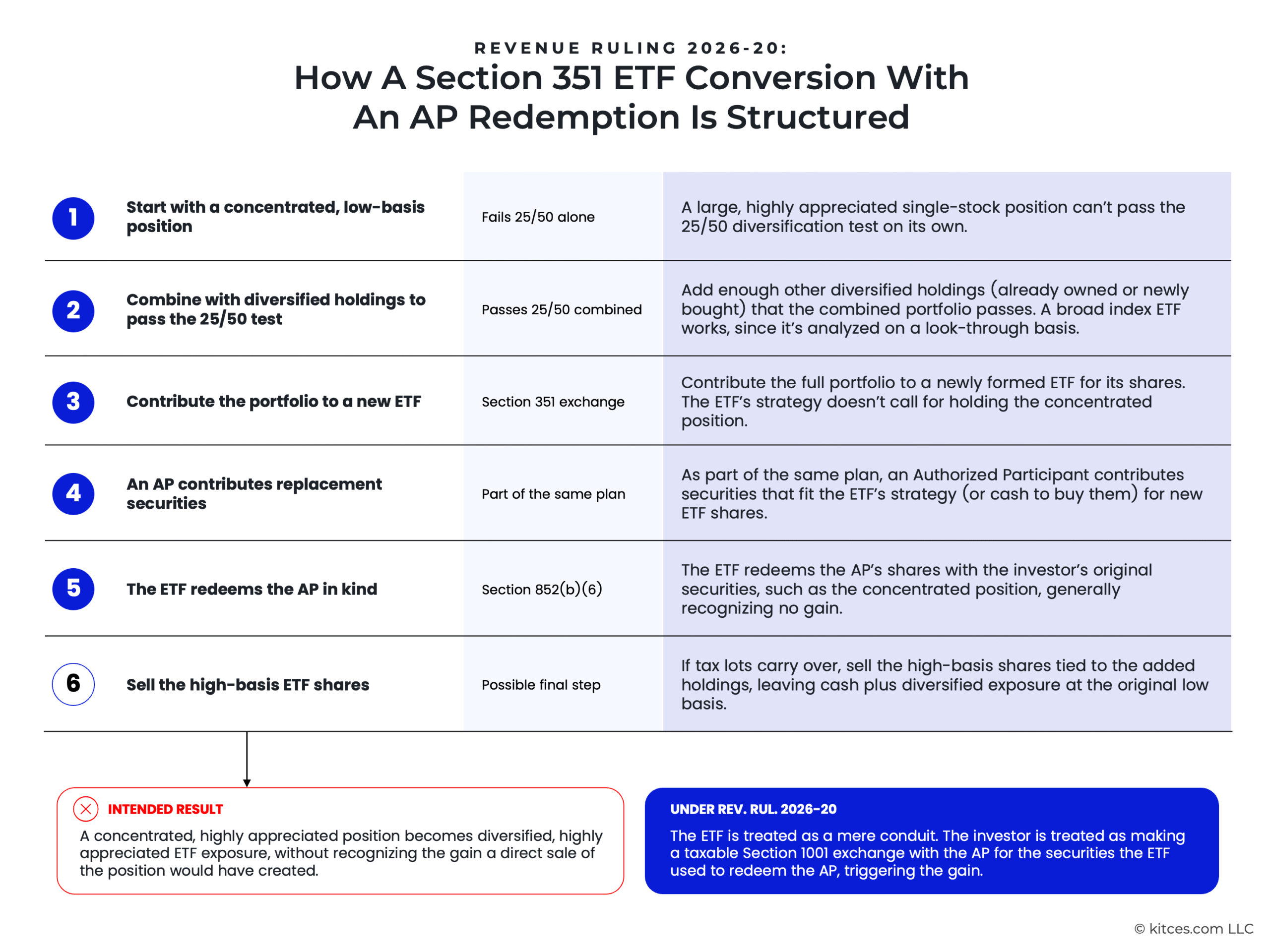
Economically, the strategy has attempted to transform $100M of concentrated, highly appreciated PublicCo into $100M of diversified, highly appreciated ETF exposure without recognizing the approximately $95M gain (assuming a $5M original cost basis) that a direct sale of PublicCo would have created.
Revenue Ruling 2026-20 says that the planned use of the ETF contribution and AP redemption cannot produce that result.
Instead, the investor is treated as exchanging the $100M PublicCo position directly for the replacement property provided through the AP, triggering the $95M of capital gains that they had sought to avoid through the planned sequence of transactions.
Importantly, it is the prearranged exchange of the PublicCo securities – not merely the fact that securities were contributed to an ETF under Section 351 – that drives the ruling.
And that's where the guidance becomes simultaneously useful… and frustrating.
Revenue Ruling 2026-20 Tells Advisors What Is Clearly Bad – But Not Exactly Where 'Bad' Begins
As noted above, the Treasury department is not disputing the permissibility of 351 exchanges into ETFs or in-kind AP redemptions, or even the combination of the two under certain circumstances. So, there is a spectrum of scenarios involving these transactions that ranges from definitely allowable to definitely disallowed.
Revenue Ruling 2026-20 is highly useful at establishing one end of this spectrum.
If an investor contributes appreciated assets pursuant to a plan under which assets inconsistent with the ETF's intended portfolio are quickly pushed out to an Authorized Participant and replaced with materially different assets, the IRS has made its position clear: The two transactions are effectively collapsed into a single (taxable) exchange between the original investor and the Authorized Participant.
But neither Revenue Ruling 2026-20, nor Notice 2026-62, says that all Section 351 ETF conversions are abusive. In fact, Notice 2026-62 specifically states that it:
"…expresses no view regarding, transactions in which a § 351 transaction is used to seed a newly established ETF with assets that are consistent with the ETF's investment thesis and that are intended and expected to be retained by the ETF absent a substantial change in circumstances…"
So, there is fairly decent clarity regarding two opposing extremes.
At one end of the spectrum, the contributed assets totally conform to the ETF's investment thesis, and there is a genuine expectation that those assets will remain in the ETF absent unexpected changes in market or business decisions. In other words, there is little to no turnover of the underlying investments within the ETF for some meaningful period of time.
Meanwhile, at the other end of the spectrum is the scenario where assets are contributed with an understanding from the beginning that they don't really belong in the ETF and will quickly be exchanged through an AP for the portfolio everyone intended the ETF to own all along.
The problem now in front of advisors is everything between those endpoints.
Suppose 95% of the incoming portfolio fits the ETF's contemplated portfolio (as defined in its prospectus/registration documents) extremely well, but 5% does not.
Or suppose every security is technically permitted by the ETF's prospectus, but the portfolio manager opts not to keep every single one that was contributed.
What if a security fits the ETF's strategy when contributed but the manager sells it three months later? Six months later? A year later?
What if the ETF is meant to follow a specific trend or trading philosophy and expects to have 30% annual turnover on a regular basis?
What if an ETF accepts an S&P 500 index ETF as part of the contributed assets, but uses an AP to exchange the ETF for the ETF's underlying securities in an effort to reduce expenses and fulfill its fiduciary duty?
And how much difference between the contributed basket and the portfolio eventually held by the ETF is enough to make the portfolios "materially different" anyway?
Neither the Revenue Ruling 2026-20, nor Notice 2026-62, provides meaningful guidance or safe harbors to address these questions.
And while the more time between the various parts of this transaction, the stronger a taxpayer's case will be that the entire thing wasn't part of some coordinated plan (as is often pointed out in other situations where the 'step transaction' doctrine comes into play), advisors shouldn't assume that the simple passage of time eliminates all risk. Waiting an arbitrary number of days or months doesn't necessarily change the substance of a transaction if the entire series of steps was part of the original plan.
Effective 351 Exchange Due Diligence
When evaluating potential 351 exchanges in the future, advisor due diligence may need to go considerably beyond checking whether the investor's contributed assets pass the 25/50 test.
Advisors should also understand how those assets compare with the ETF's actual investment thesis, not merely the broadest reading of its prospectus. Perhaps just as important is how (or even whether) the ETF will limit the securities it accepts from other investors, as those, too, will generally need to comply with the ETF's stated investment strategy.
Furthermore, while fund managers may be reluctant to share certain details or commit to certain levels of turnover, reasonable advisor due diligence questions in the face of Revenue Ruling 2026-20 include, "How much turnover is generally expected, and over what period of time?", "How will you document and record that changes were made due to unexpected changes in market or business conditions?", and "How will you ensure that contributed securities are in line with your investment thesis to begin with?"
Those questions matter because the Revenue Ruling's analysis turns heavily on what the parties planned and what economic transformation the series of transactions was designed to achieve.
IRS Notice 2026-62 Casts A Wider Net Over Additional Tax-Aware Investment Strategies
While Revenue Ruling 2026-20 states the IRS's position on 351 exchanges that follow a particular fact pattern, Notice 2026-62 covers a much broader array of tax-aware strategies that are currently being used, in varying amounts, by some investors and asset managers.
Notably, while IRS Notices are official public pronouncements and may contain substantive interpretations of tax law, this particular Notice primarily identifies transactions that concern Treasury and the IRS, requests comments about them, and describes additional guidance or enforcement actions the government may consider. The Notice is, therefore, less definitive than Revenue Ruling 2026-20 about the IRS's stance on the strategies it describes. But that does not make the Notice unimportant.
The Notice specifically warns that the IRS may challenge one or more of the strategies described therein based on existing statutes, regulations, anti-abuse provisions, and judicial doctrines. It further notes that future guidance may be prospective or, of potentially greater concern to advisors and their clients, retroactive.
For advisors, then, Notice 2026-62 serves as a 'yellow light' with regards to the strategies that it describes – meaning that while clients who are currently or planning to use the strategies aren't necessarily engaging in problematic transactions, it's safe to assume that the IRS is going to be viewing those transactions with a higher level of scrutiny – and that they could be identified as problematic by the IRS in the future.
Additional ETF And Fund Strategies Flagged By Notice 2026-62
Notice 2026-62 identifies several strategies involving "novel investment fund strategies that purport to produce tax results that may be inconsistent with the purpose and proper application of the relevant federal tax rules."
The following is a brief synopsis of the strategies involving "atypical usage of IRC Section 852(b)(6)" – the tax-free in-kind redemption via an AP (in addition to the ETF strategy described in Revenue Ruling 2026-20) – and why the IRS is concerned about them.
- Partnership/exchange-fund variation of the Section 351 transaction – In short, investors whose appreciated portfolios aren't sufficiently diversified to qualify for the desired Section 351 transaction (i.e., fail the 25/50 test) first contribute assets to a partnership intended to avoid investment-company treatment, such as an exchange fund, and then, as part of a coordinated plan, the now-diversified-partnership engages in a Section 351 conversion. The IRS is concerned that this is a potential abuse/workaround of the 25/50 test and allows investors to convert a concentrated holding into a diversified portfolio inside an ETF wrapper (effectively deferring taxes on the portfolio and its embedded gains indefinitely).
- Box-spread ETFs – Funds that use option positions that economically resemble a financing or interest return are placed in an ETF structure and appreciated positions may ultimately leave the ETF through in-kind redemptions. The IRS is concerned that what is economically interest-like income turns into a deferred capital gain, rather than annual taxation of returns at ordinary income tax rates
- ETFs that Defer Income By Rotating Between Underlying ETF Funds with Different Dividend Record Dates – An ETF holding shares of another ETF may sell or redeem those shares immediately before a dividend record date and replace the position with a substantially similar ETF, preserving essentially the same economic exposure while avoiding receipt of the dividend that otherwise would have generated taxable income. The IRS is concerned that what should be taxable income is deferred using this approach.
- ETFs that Seek to Skirt the RIC Qualifying-Income Rules – Assets capable of generating income that does not qualify toward a RIC's 90% gross-income test, such as certain commodity or digital-asset exposures, are removed through in-kind redemptions before the associated income or gain is recognized. The IRS is concerned that these ETFs are circumventing the RIC requirement that at least 90% of the company's income arise from dividends, interest, payments with respect to securities loans, gains from the sale of securities or foreign currencies, or specified income.
In addition to the 852(b)(6) strategies described above, Notice 2026-62 identifies three strategies designed to exploit differences in the character of economically offsetting gains and losses. More specifically, these strategies generate roughly equivalent amounts of ordinary losses and capital gains, producing no economic gain or loss but nevertheless creating risk-free tax 'alpha' by letting the taxpayer deduct the losses against higher-taxed ordinary income while the gains receive capital treatment, which means lower rates if they are long-term and, regardless of holding period, more opportunities to reduce or eliminate them (e.g., through leveraged long/short SMAs or opportunity zone funds). The specific strategies identified were:
- Mixed-Character Identified Straddles – A fund pairs economically offsetting positions with different tax treatment, such as a foreign-currency forward generating ordinary gain or loss under IRC Section 988, and a regulated futures contract generating 60/40 capital gain or loss under IRC Section 1256.
The fund closes the futures position first. If it has a $1M gain while the forward has a $1M loss, the result may be $1M of capital gain and $1M of ordinary loss despite roughly zero economic gain. If the futures position loses, the fund may instead add that capital loss to the basis of the forward, potentially converting the later result into less ordinary income or even an ordinary loss.
Treasury's concern is that straddle rules intended primarily to govern timing are being used to manipulate the character of the taxable gain or loss.
- Same-Day Foreign-Currency Trades – IRC Section 988 generally makes foreign-currency gains and losses ordinary, but taxpayers may elect capital treatment for certain qualifying transactions by the end of the day they are entered into.
A fund can therefore open and close numerous currency forwards on the same day, identify the winners and losers before the election deadline, elect capital treatment only for the winners, and leave the losers ordinary.
Thus, $2M of gains and $2M of losses could produce $2M of capital gain and $2M of ordinary loss from a tax perspective despite no net economic gain.
Treasury's concern is hindsight: the taxpayer selects character after already knowing which trades succeeded.
- Selective Termination Of Notional Principal Contracts (NPCs) – Periodic swap payments generally produce ordinary income or expense, while certain payments received upon terminating a swap may potentially qualify for capital treatment.
Accordingly, a fund might terminate a winning swap shortly before a scheduled payment and claim capital gain, while allowing an offsetting losing swap to continue and claiming the resulting payment as an ordinary expense. The intended tax result is again capital gain paired with ordinary loss despite little or no net economic gain.
Treasury's concern is that economically similar payments are receiving different tax treatment largely because the winner is deliberately terminated while the loser is allowed to mature.
Ultimately, these are tax positions being claimed by funds and taxpayers – but not necessarily outcomes that the IRS has accepted as correct. In fact, to the contrary, Notice 2026-62 signals that the IRS is actively questioning whether these approaches are permissible under the current law.
Managing The "Tax Risk" Of Strategies The IRS May (Or May Not) Scrutinize
The issuance of Revenue Ruling 2026-20 and Notice 2026-62 need not cause advisors (or their clients) who have engaged in these strategies to panic. The Ruling and Notice should, however, inform advisor practices going forward – including a reconsideration of which clients these strategies are truly appropriate for.
For clients already participating in affected strategies, that doesn't automatically mean that positions should be exited. It does mean the risk assessment should be revisited.
The Investment Case Should Come Before The Tax Case
One of the best initial screens for a sophisticated tax-aware investment may also be one of the simplest: Would there still be a legitimate investment reason for the client to own this strategy if the projected tax benefit were materially smaller than expected?
The answer need not be yes under every conceivable circumstance. Taxes are real costs, and reducing unnecessary taxes can itself create substantial economic value. But there's an important difference between choosing among otherwise reasonable investments partly because one offers superior after-tax results, and entering a transaction whose economics become unattractive without a particular tax outcome. (The oil and gas and real estate tax shelters of the 1980s offer a cautionary example: when the Tax Reform Act of 1986 curtailed their tax benefits, many investors were left holding partnerships with little underlying value.)
Advisors should therefore begin with the underlying investment case. Why does the strategy belong in the client's portfolio? What return is it expected to generate before taxes? What risks does it introduce? What role does it play relative to the client's other investments?
Only after those questions produce satisfactory answers should the incremental tax benefit become the deciding factor. The closer an investment comes to having 'generate a tax result' as its principal economic purpose, the more careful the advisor's diligence should become.
Financial Advisors Need To Begin Assessing A Client's "Tax Risk Tolerance"
Financial advisors are intimately familiar with the concept of investment risk tolerance. Clients understand, at least conceptually, that pursuing higher expected returns generally requires accepting additional uncertainty. Advisors, therefore, spend significant time determining how much investment risk a client is willing to take, how much risk the client has the financial capacity to bear, and whether taking that risk is actually necessary to accomplish the client's objectives.
But increasingly sophisticated tax-aware investments that operate within gray areas of the law create another type of risk that deserves a similarly explicit planning process: Tax Risk Tolerance.
Notably, tax positions don't all exist at the same level of certainty. At one end of the spectrum are strategies supported by clear statutory language, regulations, and longstanding practice. At the other end of the spectrum are positions whose expected benefits depend on an interpretation of multiple Code provisions, favorable characterization of complex financial instruments, unsettled proposed regulations, anti-abuse doctrines not applying, and a conclusion that the IRS or a court will ultimately agree with the taxpayer's analysis.
Unfortunately, between those extremes is an enormous amount of gray.
The fact that a strategy hasn't been prohibited doesn't make it risk-free. Likewise, the fact that a strategy carries tax risk doesn't necessarily mean it is inappropriate. Instead, the question should be whether the amount and type of tax risk are appropriate for the particular client. That requires an analysis surprisingly similar to the process advisors already use when discussing investment risk.
Start With The Size Of The Potential Reward
The first question is straightforward: If things go as planned, how much is this strategy actually expected to save on a net basis? Critically, the answer isn't simply the size of the loss generated, or even the amount of tax deferred in the current year. Rather, advisors should consider the value of the tax benefit after accounting for the strategy's management fees (above and beyond the fees that would otherwise apply to the client's portfolio), transaction costs, financing costs, incremental CPA and legal fees, investment drag, and the possibility that some of the 'savings' represent tax deferral rather than permanent tax avoidance.
Even a strategy expected to reduce current year's taxes by $300,000 may be considerably less compelling if it costs $75,000 per year to implement, introduces additional investment risk, and simply shifts much of the $300,000 into future years.
Attempt To Quantify The Downside If The Tax Position Fails
The next question is: What happens if the IRS disagrees?
Suppose a strategy is expected to save $500,000 of Federal and state income tax. If the position is ultimately unsuccessful, is the client simply back where they started, paying the $500,000 they otherwise would have owed? Or could the result include interest, accuracy-related or other penalties, additional state liabilities, professional fees, amended returns, and tax consequences spilling into later years?
A useful tax-risk conversation shouldn't stop at the taxes alone. The relevant downside is the total economic cost of being wrong, which could include CPA fees to amend returns, legal fees incurred in defending a position, etc. – to say nothing of the psychological/emotional toll that such an outcome could incur.
Evaluate The Strength Of The Tax Position
Next comes perhaps the most difficult question: How strong is the legal support?
It's at this point – if not before – that most advisors will need to lean on the support of additional professionals, such as CPAs or tax attorneys. Deciphering gray areas of the law should be left to tax professionals, who should be engaged and 'on board' before a client commits any capital.
That said, advisors should understand the need for the analysis, and should have a cursory understanding of what might go into such an evaluation so that they can have informed conversations with the relevant parties.
It's worth noting that this part of the due diligence process should involve independent specialists. An ETF sponsor or SMA manager that employs an aggressive tax strategy might say, "Our lawyers are comfortable with this," – but that tells an advisor very little and does very little to protect a client (or their tax preparer) if things go sideways. Engaging an independent tax pro who is familiar with the client's specific circumstances to weigh in on the proposed strategy also presents a natural opportunity to educate the client on the tax/legal ambiguity associated with it (and to diligently document such communication so there are no misunderstandings later about what the advisor represented).
What actual authorities support the position? Is there statutory or regulatory language directly on point? Are there revenue rulings, court decisions, or other meaningful authorities? Does the strategy depend on proposed rather than final regulations? Does it rely on form prevailing despite an economically different substance?
Has the IRS recently identified the exact transaction – or something substantially similar – as an area of concern?
Revenue Ruling 2026-20 and Notice 2026-62 make the last question particularly important. A transaction may not have changed mechanically from one month to the next, but a formal IRS announcement that the government believes that type of transaction may produce an inappropriate tax result can significantly change the risk profile associated with taking the position. The investor is practically assured that the IRS will view the strategy with higher scrutiny, and even if the result ends up being in the taxpayer's favor, it's possible that they will need to spend time and resources defending their position under audit.
Obtaining Outside Legal Opinion
For more aggressive strategies, a client's tax professionals should also determine whether the investment sponsor has obtained one or more written tax opinions from outside, independent counsel. But the diligence shouldn't end with checking a box marked "Tax Opinion: Yes."
Who wrote the opinion? Is the law firm genuinely experienced in the relevant area of tax law? Is the opinion addressed to, or otherwise capable of being relied upon by, the client? What level of confidence does the opinion express – for example, does counsel conclude that the position "should" prevail or merely that it is "more likely than not" to prevail?
Does the opinion meaningfully grapple with contrary authorities and anti-abuse doctrines, or primarily develop the strongest possible argument for the desired result?
And perhaps most importantly in the current environment: When was the opinion written, and has it been updated to address Revenue Ruling 2026-20, Notice 2026-62, or other subsequent guidance?
A strong opinion from highly qualified independent counsel does not eliminate tax risk, but it can go a long way towards minimizing the possibility of future penalties and is quite a bit more meaningful from a due diligence perspective than reliance on a manager's marketing materials.
Assess The Client's Willingness To Deal With IRS Scrutiny
Just as determining the appropriate level of investment risk requires analyzing both quantitative and qualitative factors, so too does analyzing a client's Tax Risk Tolerance. For instance, some clients may be perfectly comfortable receiving an IRS examination notice, gathering documentation, paying professionals to respond, and waiting months or years for the matter to be resolved. Others may lose sleep the night an IRS envelope arrives.
Neither reaction is inherently right or wrong. But they are different. Advisors should be cautious when recommending investments that incorporate highly aggressive tax strategies to clients who will immediately abandon the position at the first sign of IRS scrutiny.
To that end, another useful data point to assess is how far the client is willing to go if they disagree with an IRS position. Would the client pay specialized tax counsel to pursue the matter through IRS Appeals? Would the client be willing to litigate? Could the client emotionally and financially tolerate years of uncertainty if a material issue reached Tax Court?
Or is the client likely to settle quickly regardless of the strength of the underlying position simply because the cost and aggravation of fighting aren't worth it? Two taxpayers presented with exactly the same investment and exactly the same tax opinion can rationally reach opposite decisions based on their answers.
That's Tax Risk Tolerance.
Tax Risk Tolerance And Tax Risk Capacity Aren't The Same Thing
There is another lesson advisors can borrow directly from the investment-planning world: A client's willingness to take risk isn't necessarily the same as the client's ability to take risk. The same distinction applies to taxes.
A client may have very high Tax Risk Tolerance psychologically. They may be willing to defend an aggressive position to the end and be completely unbothered by the prospect of an audit. But what happens if they lose?
If an adverse determination could produce a multimillion-dollar assessment and the client lacks sufficient liquidity to pay it without selling an illiquid business, disposing of real estate at an unattractive time, or borrowing on unfavorable terms, then the client may have substantial Tax Risk Tolerance but inadequate Tax Risk Capacity.
Conversely, another client may have more than enough liquidity to absorb the worst possible tax outcome but may find even routine correspondence from the IRS intolerably stressful. That client has substantial Tax Risk Capacity but low Tax Risk Tolerance. Good planning should consider both.
The IRS Is Not Declaring War On Tax-Aware Investing
With such an extensive list of transactions under scrutiny, it would be easy for advisors or clients reading headlines to reach an overly broad conclusion: "Tax-aware investing is now under attack."
That isn't what Notice 2026-62 says.
In fact, the Notice is remarkably deliberate about distinguishing the strategies under examination from conventional tax-efficient investing. Treasury and the IRS acknowledge that taxpayers routinely engage in longstanding planning intended to reduce Federal income tax and that such planning may be fully consistent with Congressional intent.
The Notice specifically contrasts the strategies at issue with conventional tax planning and states that future guidance is intended to target abusive transactions, while respecting established market practices (though it remains to be seen how the IRS will thread that needle).
The distinction that the IRS appears to be drawing, therefore, isn't between investments that consider taxes and those that don't. Rather, it's more along the lines of distinguishing between legitimate investments that seek to manage taxes efficiently and transactions in which the tax outcome begins to look like the principal investment product. For financial advisors, that distinction should become an increasingly important part of product due diligence.
Advisors Can Expect More Guidance – And More Scrutiny
Revenue Ruling 2026-20 and Notice 2026-62 are almost certainly not the end of this story. Notice 2026-62 asks market participants for extensive feedback about whether the IRS has accurately described the transactions, which economically similar transactions deserve different treatment, and what future guidance could address perceived abuse without interfering with legitimate longstanding market practices.
Meanwhile, Notice 2026-62 specifically identifies a wide range of actions that the IRS may consider, including regulations, additional revenue rulings and notices, and potentially designating certain transactions as listed transactions or transactions of interest. Such designations could dramatically increase the disclosure, compliance, and enforcement consequences associated with the affected strategies.
Perhaps most importantly, advisors shouldn't assume that taxpayers are necessarily safe simply because they acted before future guidance is published. The Notice explicitly says the IRS may challenge abusive strategies under existing law during examinations. It also leaves open the possibility that future guidance may apply retroactively when Treasury has authority to do so.
A strategy entered into when IRS scrutiny appeared relatively remote may look different after the IRS has publicly identified its mechanics as problematic. A tax opinion prepared before the guidance may need to be revisited. And a client who was willing to accept yesterday's tax risk may rationally decide that today's risk is different.
Tax-Aware Investing Isn't Going Away – But Tax-Risk-Aware Advice Will Matter More
Nothing in Revenue Ruling 2026-20 or Notice 2026-62 changes the basic fact that taxes matter. For high-income and high-net-worth households in particular, thoughtfully managing taxes can create enormous long-term value. Tax-loss harvesting, direct indexing, thoughtful asset location, charitable giving, appropriate exchange funds, and many other tax-aware approaches can all remain important parts of a financial plan.
Innovation shouldn't be considered abusive merely because it creates a tax benefit. Indeed, Notice 2026-62 itself takes pains not to reach that conclusion. But financial engineering, technology, and increasingly sophisticated tax expertise are allowing investment managers to create strategies that push ever closer to the boundaries of existing tax law.
Revenue Ruling 2026-20 has now drawn one of those boundaries with significantly greater clarity. When an investor contributes appreciated securities to an ETF as part of a plan in which those securities are quickly transferred to an AP in exchange for materially different assets, the IRS believes the steps should be integrated and the investor treated as having completed a taxable exchange. Notice 2026-62 tells us that Treasury is examining where several other boundaries should be drawn.
For financial advisors, the answer shouldn't be to reflexively reject every strategy the IRS identifies. Nor should the answer be to proceed simply because the government hasn't yet definitively prohibited a particular transaction.
Instead, advisors will increasingly need to help clients answer two different questions for relevant strategies: "Is the investment risk associated with this strategy appropriate for me?" and "Is the tax risk associated with this strategy appropriate for me?"
Because ultimately, sophisticated tax planning isn't just about identifying what might work. It's about understanding the benefit if it does, the consequences if it doesn't, the strength of the position in between – and whether the client is both willing and able to live with the answer.