Executive Summary
A client whose portfolio is highly concentrated in a single large holding with sizable embedded capital gains presents a multilevel challenge for a financial advisor. On the one hand, continuing to hold the security exposes much of the client's portfolio to the risks inherent in investing in a single company. On the other hand, selling the security in order to diversify may trigger significant capital gains and incur a sizable tax bill, leaving less for the client to reinvest. And while some investors can diversify gradually over time to at least dampen the tax consequences of selling, that might not be an option for someone who is already in a high tax bracket, or whose concentrated position is so sizable that it would take several years or more to diversify their portfolio to an acceptable level.
One option that has gained prominence in recent years to solve for this challenge is the exchange fund, which combines multiple areas of the tax code to allow investors to achieve some level of diversification while deferring the recognition of capital gains. In a nutshell, an exchange fund operates as a partnership to which multiple investors contribute individual highly appreciated securities and, after a seven-year holding period, each investor can withdraw a pro rata share of the entire 'basket' of securities within the fund without recognizing capital gains. And over the past several years, as the runup in technology stocks has created concentrated stock wealth for numerous investors – such as employees of technology companies who are compensated in company stock – exchange funds have been marketed as a solution to provide instant diversification with full deferral of capital gains.
However, there are caveats relevant for advisors when evaluating whether an exchange fund might help their clients achieve their goals. For example, the seven-year holding period –which is a requirement for the exchange fund to achieve tax deferral for all its participants – creates a significant restriction for clients who may need liquidity during that time frame. Additionally, the requirement for the exchange fund to hold at least 20% of its assets in illiquid investments, typically non-traded real estate funded by debt incurred by the fund in order to avoid selling any of the contributed securities, raises questions about the risks involved in adding such a high allocation to illiquid alternative assets – especially given the cost of borrowing to invest in those assets.
Also, because the concentrated securities that many investors are trying to diversify away from are disproportionately made up of technology stocks (since those have been the top overperformers in recent years), many exchange funds are consequently concentrated in technology and other high-growth sectors. Meaning that, while the fund might be diversified enough to eliminate investors' single-company risk, investors may still be subject to a significant amount of 'single-sector' risk. That is, if they can find a fund that will take their securities, as investors who are concentrated in certain popular holdings like Apple and Amazon might face long waiting lists for exchange funds with room for them.
The key point is that strategies like exchange funds don't eliminate tax on diversifying out of concentrated holdings – they merely defer it. Unless the investor doesn't plan to use the portfolio funds during their lifetime, they'll need to pay the tax at some point. Which means that when evaluating an exchange fund, advisors can ask whether it's worth taking on the additional risk – both in terms of illiquidity and the risks of the investments within the exchange fund itself –just to delay a tax bill that will eventually come anyway, or whether it's better to sell and take the tax hit now rather than risk even greater losses if the portfolio is misaligned with the client's needs?

One of the toughest problems for financial advisors to solve is what to do when a client's portfolio is dominated by a single large holding with sizable embedded capital gains. Perhaps the client was an employee of a startup and received much of their compensation in the form of stock options. Maybe they were gifted shares of stock where the original owner already had large unrealized gains, causing those gains to transfer over to the new owner. Or maybe they were just lucky enough to get in early on a 'winner' that they bought at a low price and held onto as it appreciated over time.
But whatever the reason, a large concentrated holding with high embedded gains presents a multilayered challenge for the owner. Having too much of a portfolio tied up in a single company leaves the investor's overall wealth extremely susceptible to fluctuations in that company's stock price. From a risk standpoint, this might make it appealing to liquidate the single large holding and reinvest the proceeds into a diversified portfolio that's less vulnerable to single-company risk; however, doing so would require realizing the previously unrealized capital gains embedded in the client's holding. Depending on the size of the holding and the amount of embedded gains, selling the position could result in a sizable tax bill, especially if the income from the realized gains would be enough to bump the client up into a higher capital gains tax bracket.
The Cost Of Holding Vs Selling Concentrated Securities
The two simplest options for dealing with concentrated securities are 1) to do nothing (i.e., continue holding the security indefinitely), or 2) to liquidate the whole position, pay the tax on any realized gains, and reinvest the proceeds. Accordingly, it makes sense to start by comparing those baseline options.
The Risk Of Holding Concentrated Positions
In any planning conversation, 'doing nothing' is always an option. But when it comes to holding very concentrated portfolio positions, the risk of standing pat is often too high to be in the client's best interest.
Single concentrated stocks can create significant wealth for those who are lucky enough to hold one of the relatively few outperformers, but they can just as easily destroy wealth when held for too long. Most individual stocks tend to actually underperform the market as a whole, with overall market performance being driven by a small number of outliers. And even for someone fortunate enough to have held a 'winner' that has outperformed in recent years, there's no guarantee that that luck will continue in the future: In fact, historically the median stock in the top 20% of performance over the previous five years has gone on to underperform the market as a whole by 17.8% over the subsequent 10-year period.
In other words, the odds are not good that any single stock will do better than a diversified portfolio, with the stocks that have significantly outperformed in the recent past having an even worse outlook.
The Tax Impact Of Selling Appreciated Securities
Assuming that diversifying the concentrated position is the way to go, the least complicated way to do so is to sell it, pay tax on the realized gains, and reinvest the proceeds into a more diversified portfolio.
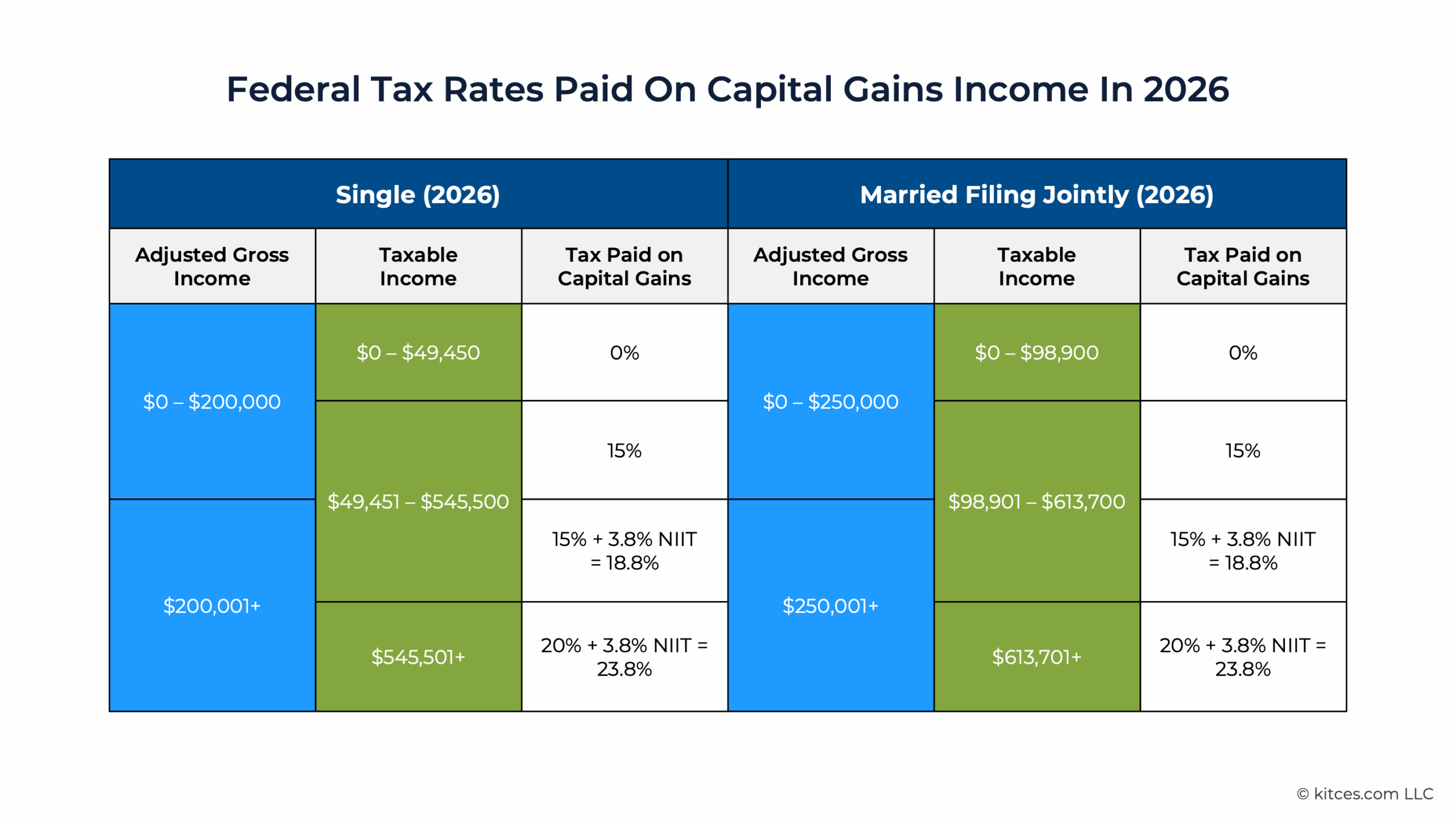
Selling the holding today has the guaranteed result that some part of the proceeds from the sale will need to go toward paying the subsequent tax bill, which leaves less to reinvest. The severity of this tax hit depends on the investor's Federal and state tax bracket: As shown below, single filers with over $545,500 and joint filers with over $613,700 of taxable income in 2026 will pay the top Federal capital gains rate of 20% plus the 3.8% Net Investment Income Tax (NIIT) for a total of 23.8% on any additional capital gains, but households with less income could pay 18.8%, 15%, or even 0% on any realized capital gains.
Investors may also pay state and/or local income tax on any capital gains income. A taxpayer paying the top marginal California tax rate, for instance (kicking in at $698,271 of taxable income for single filers and $1,396,542 for married filing jointly), would pay 12.3% in California state tax in addition to the likely 23.8% in Federal tax, for a combined 36.1% marginal tax rate. But for others with less taxable income or who live in lower-tax states, the state income tax impact won't be as large – and it will be nonexistent for those in the states that have no income tax (Alaska, Florida, Nevada, New Hampshire, South Dakota, Tennessee, Texas, Washington, and Wyoming).
So the impact of selling and reinvesting the concentrated holding will depend greatly on the investor's existing income situation (e.g., if their income from working already puts them in a higher tax bracket), the amount of embedded capital gains in the concentrated position (and whether the income from selling it itself will cause the investor to move up to a higher tax bracket), and finally the location of the investor (and what state and/or local income tax they may be subject to).
Some clients might be fine with simply selling and paying the tax, especially if they're in a lower tax bracket and/or a lower-tax state. Or they may agree to sell their shares gradually over a period of several years to spread out the tax impact of diversification. For example, if a married couple has $150,000 of income, they could realize approximately $100,000 of gains in the 15% capital gain tax bracket before the 3.8% Net Investment Income Tax (NIIT) kicks in and increases the effective capital gains tax rate to 18.8% on any additional realized gains.
For investors with moderate levels of income and moderate-sized single-stock holdings (and for whom state tax rates are relatively low or nonexistent), setting an annual capital gains budget and liquidating just enough of the concentrated stock to fill up that budget each year could conceivably diversify the whole portfolio in a year or two. But that strategy might not work as well for clients who are already in a high tax bracket or whose embedded gains are high enough that it could take several years or more to become fully diversified (continuing to leave them exposed to single-stock risk in the meantime).
For other clients, the potential tax impact will be enough to deter them from selling out of their concentrated holdings, even when doing so puts them at risk of losing even more wealth due to the volatility of their single-stock holding than the guaranteed tax impact if they had simply sold the stock and paid tax on the gain. Which creates a need for a strategy that will reduce the client's exposure to single-company risk while also minimizing the tax impact of diversifying out of a single appreciated holding.
While there are few ways to completely eliminate the impact of capital gains tax on diversifying a portfolio (other than a few specific exceptions like the exclusion of up to $15 million of gains on the sale of Qualified Small Business Stock), there are some ways to defer taxes while moving to a more diversified portfolio and keeping the embedded gains unrealized. This is easier said than done, however, because the tax code in general prohibits investors from exchanging one investment for another without realizing capital gains on the exchange. Which means that any (legal) way to diversify while deferring capital gains introduces additional factors of complexity, cost, and risk to the equation. Advisors can help clients navigate these strategies, along with the requirements, benefits, and tradeoffs of each, to determine if they can feasibly help the client achieve their goals – or if the client would be better off simply selling their concentrated holding and paying the tax.
The Benefits And Risks Of Using Exchange Funds To Diversify Concentrated Holdings
Exchange funds have existed for decades, but they've gained more prominence in recent years, particularly among technology workers with high amounts of equity-based compensation and, therefore, highly concentrated holdings with a low basis. The theory behind them is grounded mainly in IRC Section 721 (allowing taxpayers to contribute appreciated property to a partnership in exchange for an interest in that partnership without recognizing gain on the appreciated property) and Section 731 (allowing property distributed from a partnership to a partner to also avoid gain recognition if certain requirements are met).
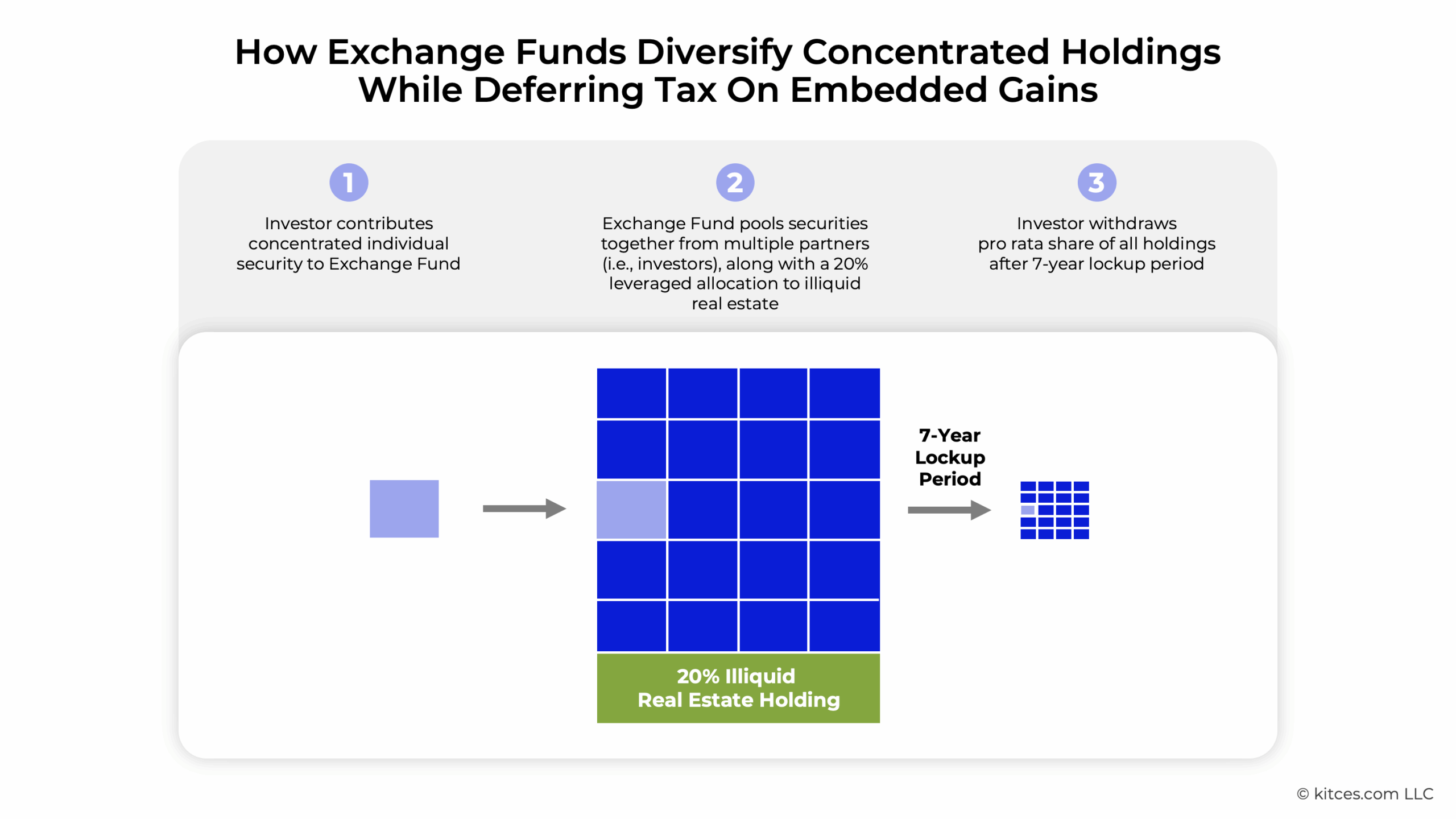
Exchange funds work by combining these two sections of the Internal Revenue Code together: Investors contribute their individual securities to the exchange fund, which is structured as a partnership, with each individual investor becoming a limited partner in the fund. The contributed securities are pooled together and, after a seven-year holding period, each investor can withdraw a pro rata share of the combined pool of securities. If the partnership and transactions are structured properly, investors don't recognize any gain on either the contribution of individual securities into the fund or the withdrawal of their share of the combined securities out of the fund.
In simpler terms, exchange funds aim to transform an investor's single concentrated holding into a more diversified 'basket' of securities, all while deferring tax on any embedded gains.
Example 1: Aimee owns $1 million of Apple stock that she bought 20 years ago for $10,000. If she liquidated those shares today to diversify into a broader range of investments, she would realize a taxable gain of $1,000,000 − $10,000 = $990,000.
However, if Aimee contributes to an exchange fund into which 19 other investors have each contributed $1 million of different securities of their own, then, after seven years, she would be able to withdraw a portfolio consisting of not just her original 100% Apple stock but instead 1 ÷ 20 = 5% of each of the individual stocks that were contributed by the 20 investors in the exchange fund.
Aimee doesn't recognize any gain on either the contribution or the withdrawal, and her original cost basis of $10,000 transfers from the Apple stock to her share of the partnership and finally to the diversified portfolio she withdraws after seven years.
The 20% Illiquid Assets Requirement
One quirk of exchange funds is that they also typically hold at least 20% of their assets in real estate (either directly owned or via investments in pooled limited partnerships, but not through exchange-traded REITs). This is because Section 721 stipulates that capital gain can not be deferred on partnership contributions if the partnership is considered an “investment company”, which is defined as a business where more than 80% of its assets are made up of securities like stocks, bonds, mutual funds or ETFs, or publicly traded REITs.
Thus, at least 20% of the exchange fund's assets must be made up of other, generally illiquid, investments. In theory, an exchange fund could invest in various types of illiquid assets, from private equity and debt to oil and gas production, and even niche investments like private jets. But real estate tends to be the most popular for a number of reasons, including its relatively low correlation to equities (which usually make up most of the rest of the exchange fund's assets) and its ability to generate income which can pay for some of the fund's expenses without needing to liquidate any of the contributed securities.
In practice, exchange funds generally borrow against their other assets to purchase their real estate allocations so they don't need to sell their partners' contributed assets (which would generate capital gains that would be passed through to those partners), meaning that most exchange funds must borrow at least 25% of the value of their contributed securities. In other words, if 100% of the fund's net asset value is made up of securities contributed by its partners and 20% of its total assets must be in real estate, then its total assets must be 100% ÷ (1 – 20%) = 125% of net asset value, with debt financing the 'extra' 25%.
Historically, exchange funds were bespoke products that were put together by wealth managers of ultra-high-net-worth clients, primarily at investment banks and wirehouses where there were enough clients with concentrated, highly appreciated securities to 'fill up' an exchange fund. But in more recent years, tech-forward providers like Cache have emerged that handle the operational details of exchange funds either directly to clients or through an advisor intermediary. By marketing primarily to the tech industry – where the runup in technology companies' stock prices over the past decade-plus has left many employees with millionaire-level net worth concentrated in employers' equity – exchange fund providers have been able to bring in a steady stream of new investors, allowing them to subscribe and launch new exchange funds on an ongoing basis with fairly low minimums for new investors. For instance, Cache launches new exchange funds on a twice-monthly basis with a minimum investment of $100,000.
But the fact that exchange funds are relatively accessible today, even for non-UHNW clients, doesn't make them the right fit for anyone with appreciated securities. There are some significant caveats inherent to exchange funds that can end up eroding the tax advantages that they offer.
The Liquidity Constraints Of Exchange Funds
One important liquidity constraint of exchange funds is the seven-year holding period. This requirement is needed to comply with IRC Section 704(c)(1)(b), which stipulates that if property contributed to a partnership is distributed within seven years to any partner other than the original contributor, the original contributor recognizes a taxable event.
For example, if Beth contributes $1 million of Stock X to an exchange fund and Charles contributes $1 million of Stock Y, then Beth is taxed on any embedded capital gains on shares of Stock X distributed to Charles within seven years.
Thus, while some exchange funds allow distributions to be made within seven years of the investor's original contribution, in such cases the investor is only allowed to take distributions of the original appreciated security that they contributed themselves, to avoid triggering capital gains for any of the other investors. And individual funds might impose additional restrictions: For instance, in Cache's case, if a distribution is made during the seven-year holding period, the distribution amount is limited to the lesser of the current market value of the securities the investor contributed or their pro rata share of the partnership's total net assets, in order to prevent investors from pulling out their original shares in the event they outperform the other investments in the exchange fund.
The bottom line is that investors are effectively committed to the exchange fund for a seven-year period. If they need liquidity for their funds sooner than that (e.g., if the appreciated securities they own make up a significant portion of their total liquid net worth), the exchange fund might not be able to deliver it.
Example 2: Donna owns $3 million in Stock X that she acquired through her employer's stock option plan, with her only other significant assets being $20,000 in a savings account and $100,000 in her 401(k) plan. Donna would like to put aside $1 million for a down payment on a home in the next five years.
In this case, the $1 million needed for the down payment should certainly not be considered for an exchange fund, since it's needed before the end of the seven-year holding period. But even setting aside that amount, the remaining $2 million still represents over 94% of Donna's total net worth, and 99% of her liquid net worth (since the 401(k) plan assets would be subject to early distribution penalties if she withdrew them before age 59 ½).
An exchange fund might be able to help diversify her concentrated holding in a tax-efficient way, but it would also severely impact her liquidity – replacing one risk (having most of her net worth in shares of a single stock) with another (having most of her net worth entirely inaccessible for a seven-year period).
Investment Risk: From Single-Stock To Single-Sector?
While exchange fund proponents often tout the 'instant diversification' that they provide, the actual diversification benefits of exchange funds can often be overstated. Exchange funds are usually designed to have very low turnover: Because the securities they hold nearly always have very low basis, any sales of those holdings to reallocate or even rebalance the portfolio will usually realize capital gains that are passed through as taxable income to each of the partners. Which means that the investment portfolio of an exchange fund is effectively a 'buy-and-hold' portfolio starting on the date its investors contribute their appreciated securities: whatever those securities are, that's the portfolio for the duration of the exchange fund (plus the 20+% leveraged real estate allocation, as noted above).
The biggest portfolio management decision for the exchange fund, then, is which investors – and which securities – to let into the fund in the first place, since those initial contributions will dictate what the portfolio looks like for the fund's duration. This would be fine if exchange fund investors were as broad and diverse as the financial markets themselves, allowing fund managers to build each fund from contributions representing a cross section of all major asset classes – e.g., US and international equities of large and small cap varieties, emerging markets, and government and corporate bonds. But because exchange funds primarily attract (and market to) investors whose securities have appreciated the most, and because the technology sector of the economy has experienced the most appreciation in recent years, exchange funds tend to resemble high-growth technology funds that are particularly susceptible to swings in that sector of the economy.
For example, the NASDAQ-100 index, which is the benchmark for Cache's main exchange fund, is currently weighted over 60% toward technology stocks. That's nearly twice as much as the S&P 500, which is weighted 33% toward Information Technology. To be sure, going from being primarily invested in a single stock to 'just' being overweight in the technology sector is an improvement from a risk perspective. But it still might be riskier than a client realizes, especially if the client is also employed in the technology industry and thus has much of their financial and human capital tied up in one industry.

Nerd Note:
Notably, exchange fund providers are developing ways to work around the single-sector concentration problem. For instance, Cache has developed a strategy for creating more tax-deferred diversification within the exchange fund by using a portion of the fund's contributed securities to 'seed' an ETF via a Section 351 exchange. The securities within the ETF can then be swapped out for others that represent the 'missing' components of the benchmark index that the exchange fund aims to track.
But this strategy is currently only available for “qualified purchasers” with at least $5 million in investable assets. For investors with fewer assets, the reality is that if they hold certain securities like Apple or Amazon that are already oversubscribed in most exchange funds, they may need to wait months or even years to find a fund that is willing to take their securities.
Meanwhile, the real estate portion of the exchange fund portfolio presents its own issues. Exchange fund providers like Cache are fairly frank about how the primary purpose of real estate in their portfolios is to help funds avoid being considered an “investment company” under Section 721, while any actual investment value is of secondary importance. This causes them to focus on real estate partnerships that keep costs relatively low and produce steady, modest returns (primarily from rental income generated by the sub-portfolio of real estate properties held by the fund).
On the plus side, the income generated by the exchange fund's real estate investment can help pay for costs incurred by the exchange fund, such as the fund's management fees and the borrowing costs for the real estate section of the portfolio, without having to liquidate any of the securities contributed by the fund's partners (which would generate capital gains to be passed through to each partner). But the downside is that after accounting for those costs, there might not be much, if any, return left to be earned from the real estate allocation. As shown below, the income yield of private real estate has been in the range of 4%–5% annually for the last 10 years, with the price appreciation component of the return being considerably more volatile:
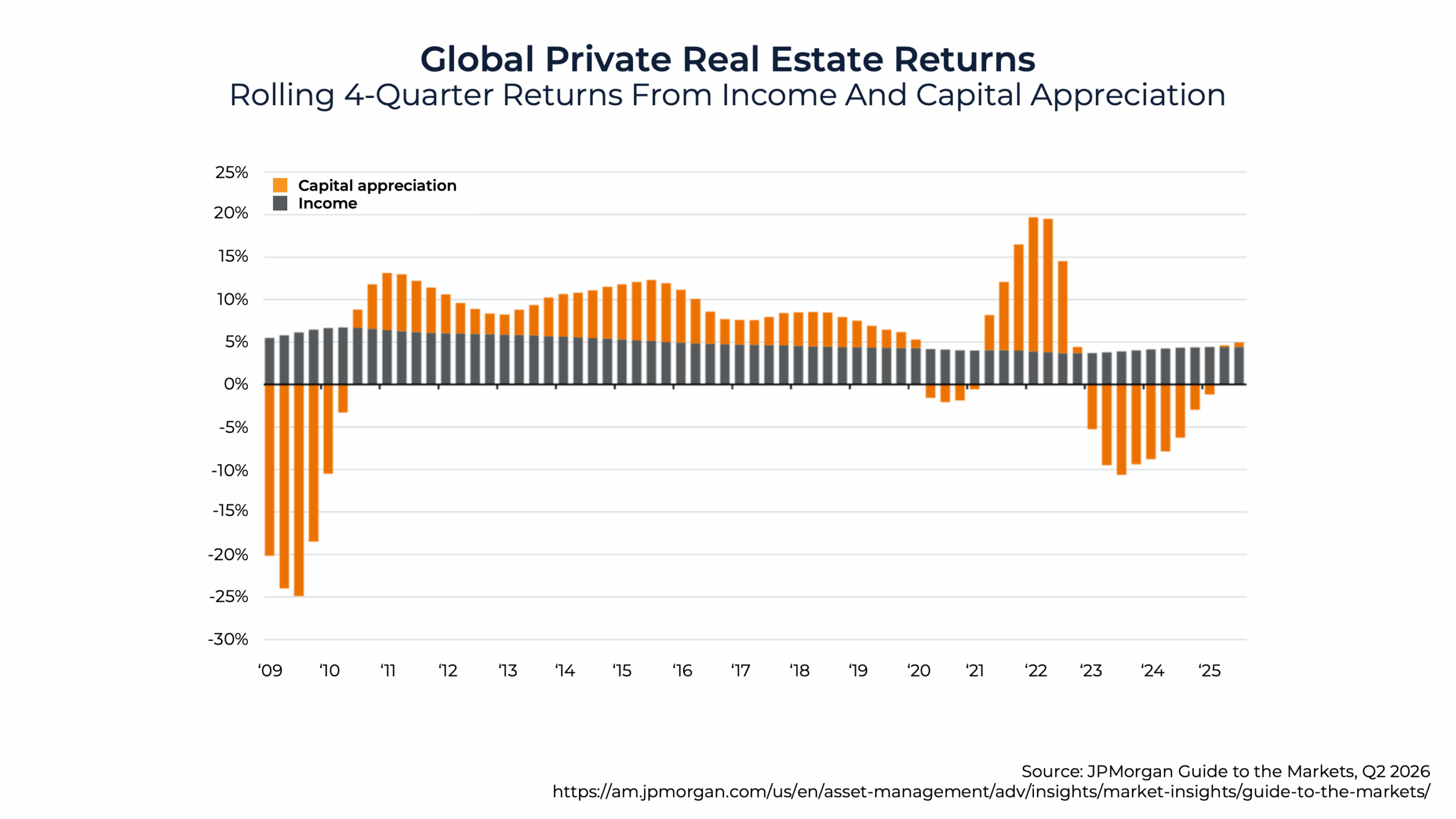
In an environment where private real estate funds yield about 4% per year in income, an exchange fund that pays more than 4% to borrow money to invest in private real estate will generate a negative net income yield on that real estate sleeve. Meaning that the fund must rely on price appreciation in the underlying real estate portfolio to realize a positive total return. But, unlike the pension and endowment funds that make up much of the investor base in private real estate funds and that often have decades-long investment horizons, exchange funds effectively have only a seven-year horizon, over which real estate values can swing precipitously, as the above graph demonstrates.
On the positive side, there is some potential benefit to holding real estate as a diversifier whose returns are less correlated with the rest of the exchange fund's equity-heavy portfolio. But much of that diversification comes from the steady income generated by real estate investments year after year. When that income is eroded by borrowing costs and fees, leaving only the more volatile price component of real estate returns, there's a real risk that the real estate portion of the exchange fund portfolio won't justify the tax benefit that is the whole purpose for its inclusion to begin with.
Zooming back out, one of the key questions to ask about an exchange fund is how similar its proposed investment portfolio is to what the advisor might recommend if the client were to simply sell their appreciated securities and reinvest the proceeds, ignoring the tax consequences. How alike would that hypothetical portfolio be, in terms of its risk and return characteristics, to a high-growth, tech-heavy equity portfolio with an additional 20% levered institutional real estate allocation? Even setting aside the seven-year waiting period, if the portfolio required to achieve tax-deferred treatment of 'diversifying' out of an appreciated security is out of whack with the client's risk or return needs, it's worth asking whether the benefits of tax deferral really justify it.
Calculating When It's Worth It To Use An Exchange Fund Vs Selling And Paying Tax
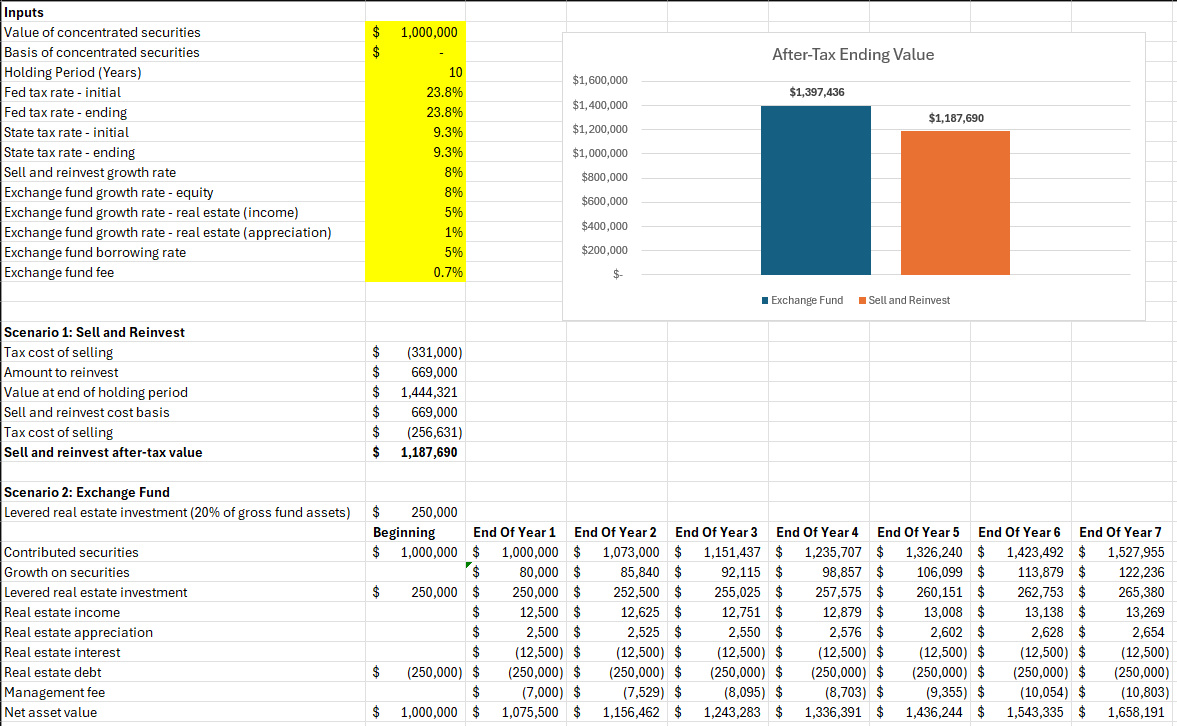
It's one thing to talk conceptually about how different factors like investment risk and borrowing rates affect whether it makes sense to use an exchange fund to diversify a concentrated holding, but it's also helpful to have a model to quantify what the impact of those factors actually is. That's why we've put together an Excel-based calculator to model the outcomes of either selling and paying the tax on a concentrated holding and then reinvesting it in a diversified portfolio, or using an exchange fund to diversify the portfolio while deferring tax.
Click to download the Exchange Fund Modeling Calculator
The calculator uses the following key inputs to model the outcomes of both scenarios:
- The value and cost basis of the concentrated securities to be diversified
- The length of the holding period
- The beginning and ending Federal and state tax rates
- The anticipated growth rates of the 'sell and reinvest' portfolio, the exchange fund's equity allocation, and the exchange fund's real estate allocation (broken into its income and price appreciation components)
- The borrowing costs of the exchange fund's real estate allocation
- The exchange fund's management fee
For the sell-and-reinvest scenario, the calculator subtracts the tax cost of selling the concentrated holding and assumes the remainder is reinvested in the diversified portfolio (with that amount equaling the new portfolio's cost basis). It calculates the growth of that reinvested amount over the course of the holding period, and determines the final after-tax value by calculating the tax cost of selling the portfolio (again) at the end of the holding period.
For the exchange fund scenario, the calculator assumes that the investor remains in the exchange fund for the entire seven-year lockup period. During that time, the fund's value increases based on appreciation of the securities contributed by its partners as well as the income and growth of its real estate allocation, and decreases based on the interest expense on the real estate allocation and the fund's management fee. After the seven-year lockup period, the investor withdraws their share of the fund's portfolio (excluding the real estate allocation) and holds that portfolio for the remainder of the calculator's modeled holding period, with growth based on the exchange fund's equity growth rate. At the end of the modeled holding period, the calculator figures the tax cost of selling (using the investor's initial cost basis, which carries over from the original concentrated security) to come to the exchange fund's after-tax value.
By comparing the final after-tax values of the sell-and-reinvest and exchange fund scenarios, we can see when it's economically better to sell and reinvest the concentrated security and pay the resulting capital gains tax, or to defer tax by using the exchange fund.
As an example of how the calculator applies these inputs, consider an initial analysis of a $1 million concentrated holding with a $0 cost basis and the following assumptions:
- Beginning and ending tax rates of 23.8% for Federal and 12.3% for California state tax;
- 10-year holding period;
- 8% growth rate for the sell-and-reinvest and equity portion of the exchange fund;
- 6% growth rate for the real estate portion of the exchange fund (made up of 5% income yield and 1% price appreciation);
- 5% cost of borrowing; and
- 7% management fee.
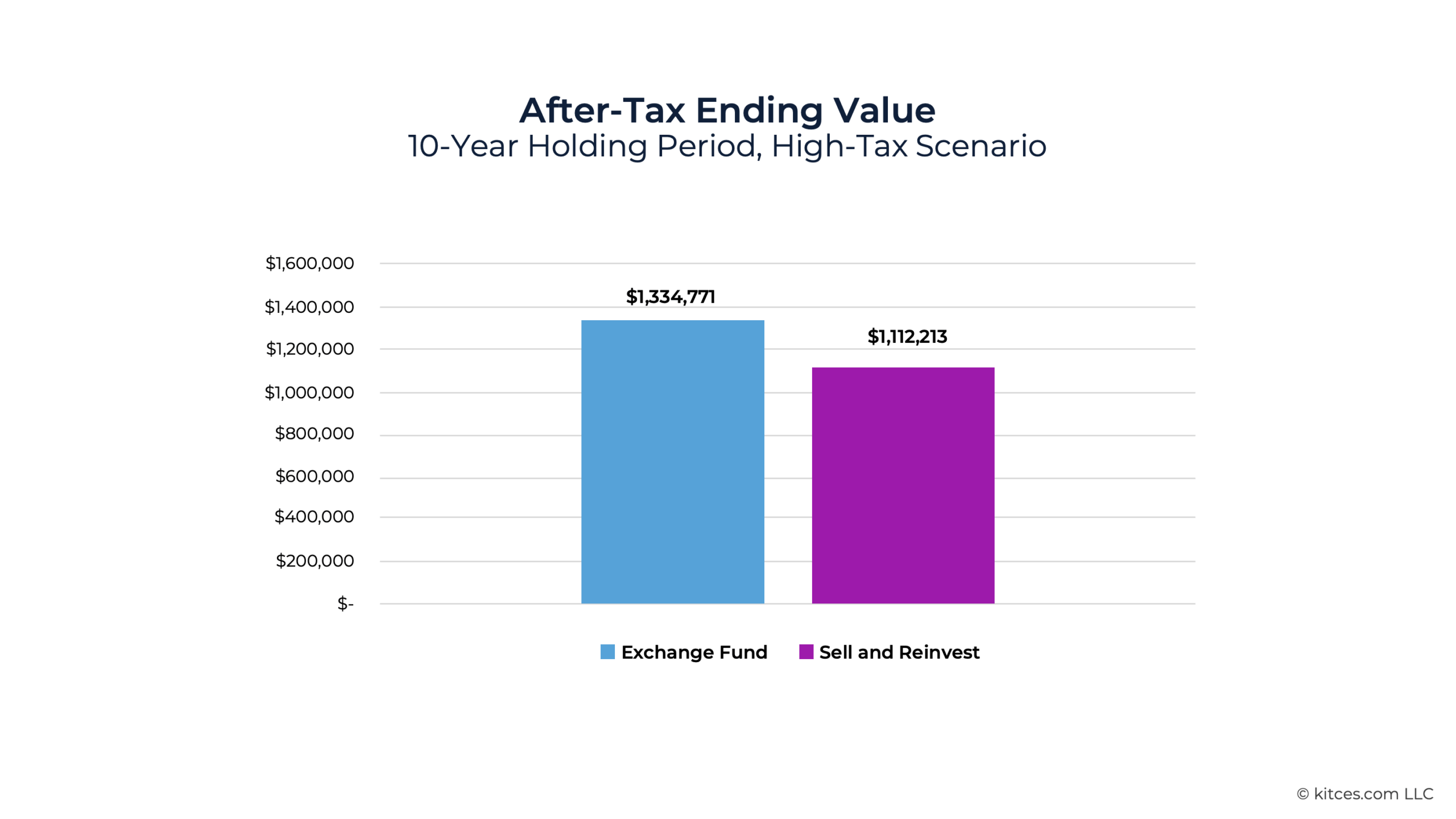
As shown below, the exchange fund scenario comes out ahead, with a final after-tax value of $1,334,771 versus $1,112,213 for the sell-and-reinvest scenario:
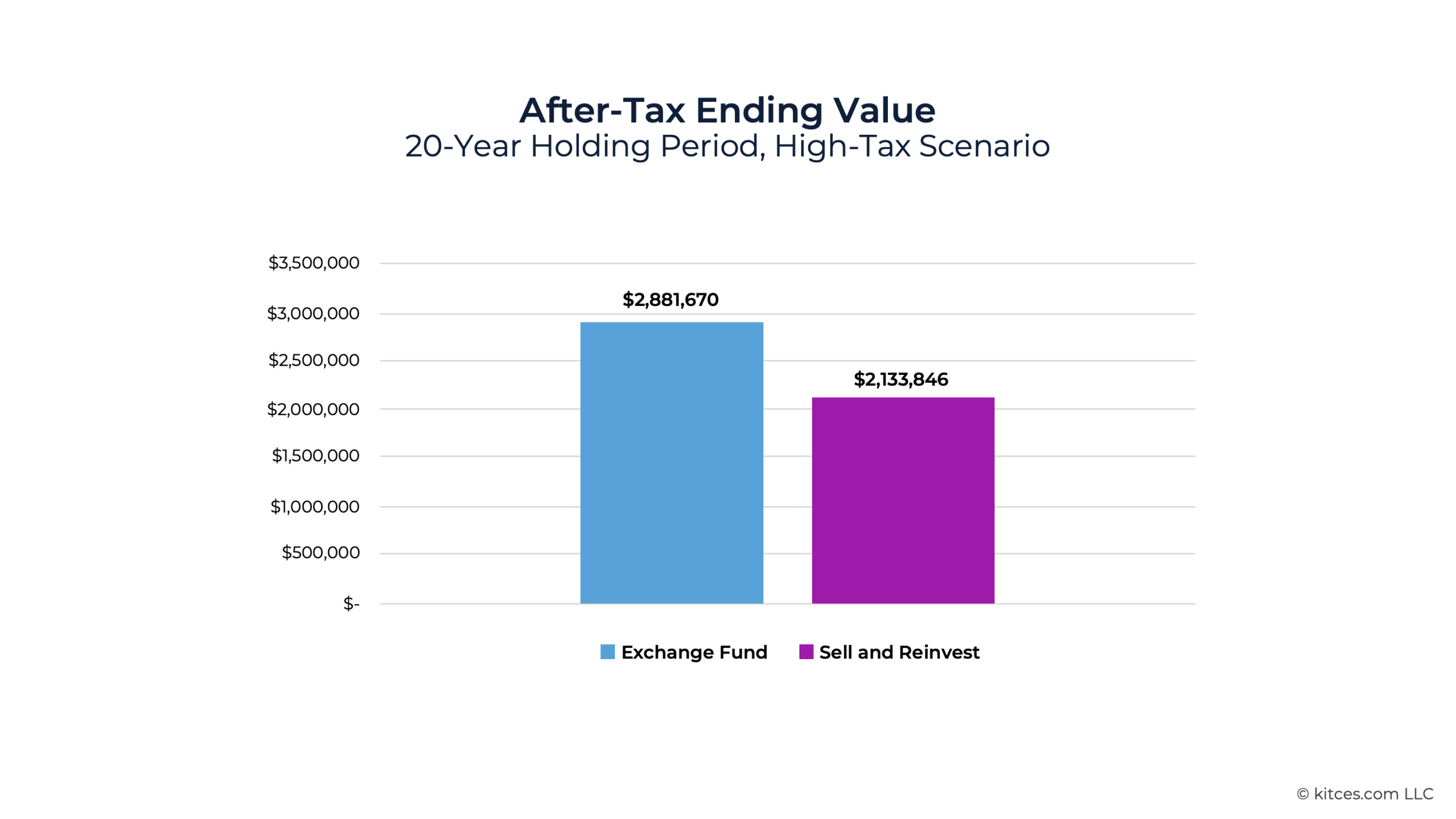
The gap gets wider over longer holding periods. For instance, when the holding period increases to 20 years, with all else equal, the ending values are $2,881,670 for the exchange fund and $2,113,846 for the sell-and-reinvest scenario:
However, this is a scenario that's likely to be highly favorable to the exchange fund, given the high tax rates of the investor and zero cost basis of the contributed security (both of which increase the tax impact of selling the initial concentrated holding and, consequently, enhance the benefits of deferring tax on the sale). With all else being equal, we can expect the exchange fund to come out ahead.
But the other key assumption in the initial scenario is that the portfolio of contributed securities to the exchange fund performs exactly the same as the reinvested portfolio in the sell-and-reinvest scenario. Which won't necessarily be the case, because the 'diversified' portfolio of the exchange fund (consisting of other high-growth stocks, likely concentrated within the tech sector) will likely look very different from the portfolio that one would invest in with the proceeds from selling the concentrated holding.
More specifically, the exchange fund portfolio is likely to be more volatile than the sell-and-reinvest portfolio because it's still at least partially concentrated. Which means that while it could match or significantly outperform the diversified sell-and-reinvest portfolio, it also has a higher chance of underperforming. And even a modest underperformance could quickly offset the tax deferral benefits of the exchange funds.
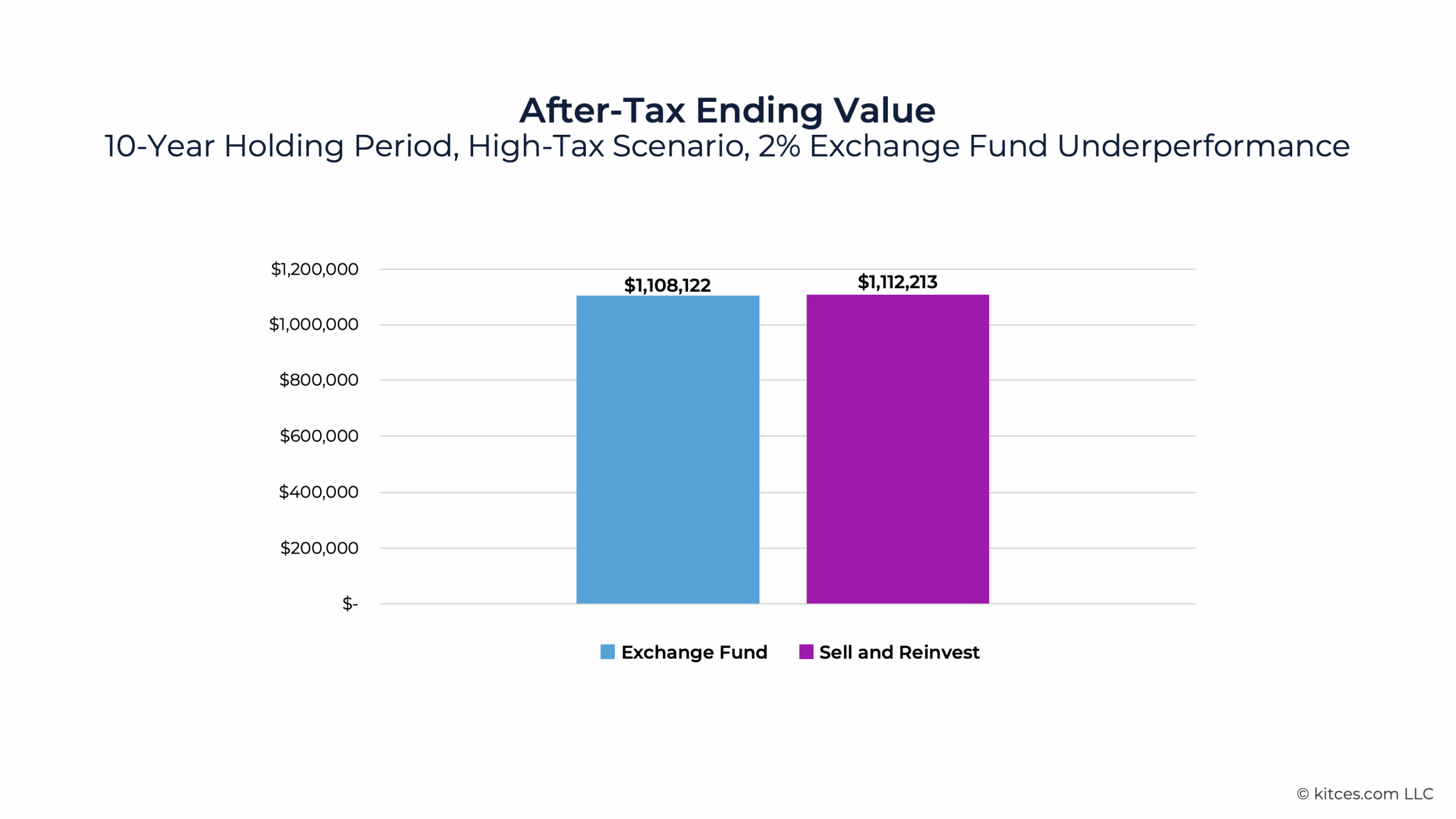
For example, using the same assumptions as the initial scenario above, but with the equity portion of the exchange fund growing at 6% instead of 8% over a 10-year period (i.e., underperforming the sell-and-reinvest portfolio by 2% per year), the ending value of the exchange fund is actually slightly below the sell-and-reinvest portfolio:
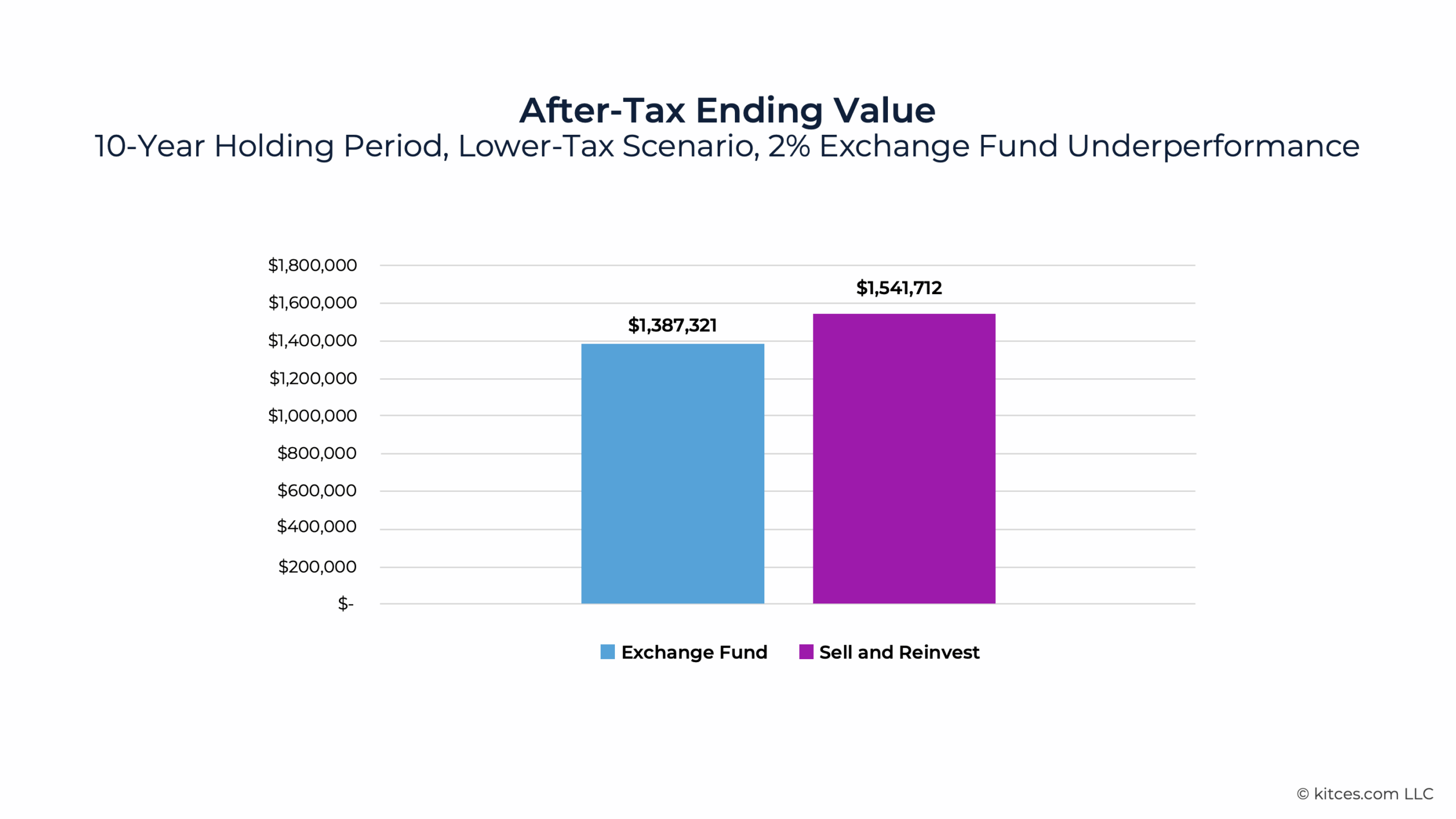
And that's in a situation where all the other factors strongly favor the exchange fund. In a scenario where the investor is in a lower tax bracket (15% Federal and 5% state), the outcome favors the sell-and-reinvest strategy even more, with an after-tax ending value of $1,541,712 versus $1,387,321 for the exchange fund:
While the exchange fund may come out ahead if the fund's performance equals or exceeds the market performance, the investment mix in most exchange funds (with their overweight to technology stocks and leveraged real estate allocation) makes it unlikely that they'll simply track the market return – they could over- or under-perform the market, and as the calculator shows, a moderate underperformance of 2% per year, compounded over the life of the exchange fund, could significantly reduce or completely wipe out the value of any tax savings over simply selling the concentrated securities, paying tax on the capital gains, and reinvesting in a market-tracking portfolio.
The key takeaway is that while the tax deferral features of exchange funds might make them look like a slam dunk in comparison to selling and reinvesting when all things are equal, the reality is that all else is not equal due to the specific requirements of the exchange fund. Once an investor contributes securities to an exchange fund, they have little control over the risk and return characteristics of the portfolio since the contributed holdings must remain effectively frozen in order to avoid generating capital gains. By contrast, upon selling and reinvesting – and paying the resulting capital gains tax – the proceeds can be invested in a portfolio that's better aligned with the investor's specific needs.
In the end, then, the question of whether to use an exchange fund is similar to that of holding the original appreciated security: Is it worth taking additional portfolio risk to avoid the tax consequences of selling? Or is it better to sell, take the tax hit, and reinvest in a portfolio mix that's better suited to the client's needs, rather than risk additional losses to the volatility of a more concentrated portfolio?