Executive Summary
When selling a business, it's only natural to want to negotiate for the highest price you can. In the context of the advisory business, this has led to a growing focus on the "going rate" valuation multiples of revenue or earnings (EBITDA), with advisors asking what they can do to maximize the overall sale price for their firm. Yet the caveat is that when it comes to the sale of advisory businesses, deals are almost never structured with the total purchase price paid at closing. Instead, deals are commonly structured with a significant component of the purchase price to be paid out years after the closing, and only if the seller meets certain milestones, which can be challenging to achieve. Sellers who gloss over or misunderstand these nuanced deal terms can receive less than they originally envisioned when negotiating the deal, such that what sellers "expect" to receive as a valuation multiple when the deal is struck may be substantively different than what they actually receive in the end.
In this guest post, Rich Chen, founder of Brightstar Law Group, explores how today's serial acquirers of advisory firms commonly include retention, earnout, and other post-closing contingencies that can materially shape what sellers will actually receive for the sale of their firm.
The first key to recognize in evaluating the offer letter for an advisory firm acquisition is that in today's environment, deals are rarely ever paid out fully in cash at closing. At best, only 80% of the deal may be paid when the transaction closes, and in many cases as little as 50% or even just 25% of the deal occur in cash. Which at the very least, means advisors must adjust for the time value of money, at a reasonable discount rate (that reflects the risk of being an implicit creditor of the acquirer!), for the fact that much of the proceeds may take as many as three to five years to be paid out.
However, scrutinizing deferred payments is not just about the fact that they are delayed, it's that depending on the terms, they may never be paid, as they are commonly subject to contingencies of how the deal itself proceeds after closing.
For instance, acquirers often defer payments based on retention requirements, that a certain number of clients (or more commonly, a certain percentage of revenue) must be retained after closing, for at least 1 year and sometimes as long as 2-3 years after closing. Which not only creates an outright hurdle for sellers to navigate – in staying onboard and engaged enough to ensure clients stick with the transition – but an additional challenge in that sellers don't necessarily control the environment that they operate in after the deal closes! Clients may have outflows due to taxes, or a divorce, or terminate due to dissatisfaction with the new acquirer, and the seller is at risk. A market decline could cause clients to leave, or simply depress revenue (calculated on assets under management), and while some firms do offer a "market-neutral" revenue retention clause (where changes in market returns are backed out), that adjustment can turn out to sting if the markets went up and might have otherwise preserved the retention payment against other client outflows!
An even greater challenge in many acquisition situations are earnouts, which require not just retention but a certain "threshold" rate of growth (typically calculated as a Compound Annual Growth Rate, or CAGR) for several years after the closing. Which is difficult both because of the challenges of compounding – a 20% CAGR amounts to a requirement that the seller must 2.5X the business in 'just' five years to meet the earnout (and if they could 2.5X the business that quickly, should they have even sold it!?) – and also because the seller must achieve growth goals in a firm that they no longer control (which could change its investment strategy, or its pricing, or its staff support… and the advisor simply has to do their best with the situation). And many acquirers also retain the right to terminate the advisor, with or without cause… potentially curtailing their ability to achieve the earnout targets at all.
The good news is that at least some retention, earnout, and post-deal employment terms (with restrictions on terminations without cause) can be negotiated with buyers. And awareness of the importance of the terms, and how they work, makes it easier to compare and contrast different Offer letters that may have different structures. Still, though, the key point is that it's not enough to 'just' focus on the valuation multiple the business is receiving in the first place, because what matters is not what the deal is worth "on paper" when it closes, but what the seller actually receives in their pocket in the end!

Advisory firm owners who are looking to sell have become increasingly focused in recent years on how to improve their valuation multiples. Because in some cases, it's easier to take the steps to make the business more stable and salable – and receive a better multiple on its revenue or earnings – than it is to materially grow the revenue or EBITDA base itself. And ideally, a firm that is still growing can boost its enterprise value further by lifting its size and the multiple at the same time, and avoid the so-called "earnings definition" trap in their valuation.
Yet it's not enough to just focus on increasing enterprise value by lifting the revenue or earnings base and the multiple that applies to it. The next layer of structural complexity involves when and how the resulting purchase price will actually be paid.
This is where many RIA sellers encounter the most significant and least-anticipated disappointment, because in the current market, a very large portion of the typical RIA purchase price is not paid at closing. It is deferred through retention payments tied to client retention metrics, earnout payments tied to post-closing revenue performance, or some combination of both. That deferral introduces two categories of risk that the headline multiple obscures entirely: performance risk (the risk that the seller will not meet the conditions required to receive the deferred amount) and credit risk (the risk that the buyer's financial condition will deteriorate during the deferral period).
The scale of that deferral has grown materially as the RIA M&A market has matured. In the current deal environment, it is not uncommon for a seller to receive as little as 25% of the total stated purchase price upfront at closing, with 75% or more structured as deferred compensation payable over multi-year periods through some combination of promissory notes, retention payments, or as equity in the buyer that won't be monetized until the buyer's own subsequent liquidity event.
These structures are often presented as maximizing total sale proceeds, especially to the extent that the buyer's equity continues to grow (organically and/or through other additional acquisitions after the seller's). In a best-case outcome, these delayed-payment terms can result in more total dollars. But they also mean that the seller is bearing a substantial portion of the post-closing performance risk that would otherwise sit with the buyer. Which is especially notable when earnout payments are often conditioned on hitting aggressive growth targets (typically expressed as a compound annual growth rate (CAGR) measured over several years), and the seller must achieve these retention and earnout targets in a firm they no longer control – pricing, staffing, and service decisions all pass to the buyer at closing. Not to mention the risk that buyers usually retain the right to terminate the seller, with or without cause, which can undercut the seller's ability to earn the contingent payments at all!
Fortunately, though, some of these terms can be negotiated, and understanding how they work also makes it far easier to compare competing offers on an apples-to-apples basis. To that end, this article examines: (1) why deferred payments must be discounted for both the time value of money and the buyer's credit risk; (2) how retention payments are structured, measured, and defined, including market-neutral calculations, measurement periods, and buyer-driven attrition; (3) how earnouts and compounding CAGR targets work and why they are so hard to achieve; and (4) how the seller's loss of post-closing control and the buyer's termination rights threaten deferred payments, and what protections sellers should negotiate.
How M&A Deferred Payments Are Structured And Impact Purchase Price Multiples For Advisory Firms
The architecture of deferred compensation in RIA deals has become increasingly sophisticated. Buyers have developed tiered structures with multiple measurement dates, complex formula-based calculation methodologies, and elaborate dispute resolution processes.
Each of these elements has legitimate structural rationale. Retention payments, for example, align the seller's post-closing behavior with the buyer's economic interest in keeping clients.
However, together they create a framework that is systematically more favorable to buyers than sellers, and sellers who have not experienced it before are rarely equipped to fully evaluate at signing.
Upfront Vs Deferred Payments For Purchase
The most intuitive problem with deferred compensation is also one of the most consistently underweighted by sellers: a dollar received in five years is not worth a dollar today. This is not a novel financial insight for financial planners who are taught about the "time value of money" in their CFP classes, but in the context of RIA transactions it is surprisingly underappreciated in practice. Sellers who receive competing offers with the same headline purchase price but different payment timing will often evaluate them as economically equivalent when they are not, in some cases by a very substantial margin.
Example 1. Jeremy receives two offers for the RIA firm he owns, one with a stated purchase price of $10 million and the other for $10.5 million.
Offer A pays $10 million in cash at closing. Offer B pays $5 million at closing, $3 million at the one-year anniversary, and $2.5 million at the three-year anniversary (subject to the buyer remaining solvent, and the seller continuing in an advisory capacity).
If the seller applies even a modest discount rate of 10% (representing the return they might be able to earn on the capital if received today and investing into a similar "small-cap stock") the present value of Offer B is approximately $9.6 million, not $10.5 million. At a 25% discount rate (given not only the time value of money, but the risk of being a creditor of, and willing to stay employed by, the acquirer), it falls to roughly $8.7 million.
The seller who accepts Offer B thinking it is $500,000 superior to Offer A has implicitly agreed to a risk-adjusted discount that was never made explicit in the headline.
In the RIA M&A market, the deferral periods and amounts can be substantial. In practice as an attorney that routinely sees transactions firsthand, it is common to witness post-closing payments paid in multiple tranches over multi-year periods after closing. The longer the payout period, the more years of compounding performance risk the seller is absorbing, and the more opportunities the buyer has to make operational decisions that affect outcomes the seller cannot control.
This is especially important when recognizing that deferred payments aren't always 'just' a matter of timing and when the dollars are paid. Often there are additional contingencies from retention requirements (where dollars are not paid if clients and their revenue don't actually retain in the subsequent years) to earnout conditions (with tightly defined growth targets that must be met for the dollars to be earned) – that don't just determine when the sales proceeds are received, but may limit whether the later payments are received, in full, partially, or not at all.
What Are Retention Payments And How Do They Impact Purchase Price?
Retention payments, which are contingent payments tied to whether the seller's clients (and their associated revenue) remain with the combined firm after closing, are one of the most common features of the current RIA M&A market, and one of the areas where sellers most consistently underestimate their risk exposure.
The concept is intuitive: buyers want assurance that the clients they are paying for will actually stay, and they are willing to pay more for assuredness that the clients remain (in exchange for being able to pay less if they do not). What sellers frequently fail to appreciate is the degree to which the retention metric is constructed in ways that hold the seller responsible for outcomes that sometimes are partly or entirely outside the seller's control.
The first and most fundamental issue is how "retained" revenue or assets is defined in the first place. In most retention payment structures, the seller is measured not against whether their clients themselves stay with the firm, but against a specific revenue or AUM figure associated with those clients, as of a reference measurement date.
The problem is that client AUM balances change for reasons entirely unrelated to the seller's performance or client relationships, such as inheritance, divorce, business liquidation, retirement spending, tax obligations, or simply portfolio rebalancing. The problem can be compounded where sellers are not allowed to factor in new revenues from clients acquired post-closing in calculating the retained revenue target.
In addition, if a market correction occurs between closing and the retention measurement date, the revenue associated with a fully "retained" client book may be materially lower than the baseline simply because client portfolios declined in value, causing AUM fees to decline as well. Whether that reduction is the seller's problem or the buyer's depends entirely on how the retention metric is negotiated and defined.

Nerd Note:
Buyers have developed a partial solution to the problem of post-closing market volatility, through a "market-neutral revenue calculation" – measuring client revenue as if market values had not changed from the closing date. This can be meaningfully important for sellers wishing to remove an important exogenous variable from the retention payment calculation. Notably, though, it can also work against the seller, if market performance increases asset values after the closing (which might have otherwise offset revenue lost from some departing clients). In addition, the specific mechanics of how market impact is isolated and calculated can be complex and subject to dispute.
Retention payment structures can vary significantly in their generosity and their risk allocation. In some agreements, shortfalls in revenue retention can lead to outsized declines in the retention payment to be paid. For example, a one percent reduction in revenues retained could result in a two percent reduction in the overall retention payment. Some formulas dictate that if revenue retention falls below a defined amount or percentage, the entire revenue retention payment is forfeited (e.g., "at least" 95% of clients must be retained, or no retention payments will be made).
Equally important (and frequently overlooked by sellers focused on the retention percentage thresholds) is the duration over which retention is measured. In the current market, retention measurement periods of up to three years post-closing have become increasingly common (although it's still more common to see one-year and two-year retention measurement periods).
A three-year retention window is categorically more difficult for a seller to satisfy than a one-year window. Over a three-year period, clients experience life events, market cycles, staffing changes at the buyer, and integration disruptions that would never arise in a shorter measurement window. Every additional year of the measurement period adds cumulative attrition risk, and the seller bears that risk even when the attrition is driven by the buyer's own decisions. A seller who would comfortably meet a one-year retention threshold at 97% might find that sustaining that level across 36 months – across two or three market cycles and an integration period – is a materially different proposition.
Sellers must also be attentive to whether the retention measurement accounts for client attrition attributable to the buyer's own integration missteps. If a buyer re-papers clients aggressively, changes investment strategies, relocates relationship managers, or otherwise disrupts the client experience in ways that cause departures, those departures are nevertheless typically counted against the seller under a formulaic retention calculation. That's why it's imperative for sellers to carefully negotiate in transaction documents limits on actions buyers can take post-closing that could negatively impact client retention by the seller.
Example 2a. Megan sold her $1.7M revenue advisory firm with $210M of AUM for a $5M purchase price, which included $2M paid upfront, and $1M per year retention payments for each of the subsequent three years. In order to earn each retention payment in full, the firm must retain 100% of its original $1.7M of revenue, measured on the actual advisory fees generated as of each anniversary – with no adjustment to neutralize the effect of market movements on AUM-based fees. For every 1% of revenue that falls short of the 100% target, the retention payment is reduced by 2% (a 2X penalty), and Megan is not permitted to count revenue from any new clients acquired after closing toward the retention target.
In the first year, Megan is proactive in reaching out to her 126 clients and introducing each to the new firm and the successor advisor who will eventually take over when Megan retires in 3 years. A few relationships do not survive the transition – a handful of clients decline to sign the new paperwork, and one larger client leaves because he preferred being the "big fish in a small pond" at Megan's firm – bringing client attrition to about 3%. Markets are roughly flat on the year, so attrition is the only real drag, and Megan finishes having retained about $1.649M of the original $1.7M of revenue, or 97.0%. Because the target is 100% and every point of shortfall is penalized at 2X, her 3.0% shortfall translates into a 6.0% reduction of the first retention payment at the end of year one, so Megan receives roughly $940,000 rather than the full $1M.
In the second year, the drivers of Megan's shortfall come from both directions in roughly equal measure. A bear market sets in and the broad markets decline about 6%, and because her retention target is measured on actual advisory fees with no market-neutral adjustment, that decline flows straight through to her AUM-based revenue. At the same time, integration friction accelerates client departures – including one client lost to a trade error the acquiring firm "makes good" on but cannot save – lifting cumulative client attrition to about 6%. Between the two, Megan's measured revenue falls to roughly $1.50M, or about 88.4% of the original $1.7M. With an 11.6% shortfall against the 100% target penalized at 2X, the second-year payment is docked 23.3%, and Megan collects only about $768,000.
In the third year, both pressures deepen. The market weakness persists, leaving the broad indices down roughly 10% from the closing baseline, and once again the entire decline is charged against Megan because her deal contains no market-neutral calculation. Client attrition also continues to build – as integration changes to service teams and pricing take their toll – reaching about 10% on a cumulative basis. Together, the roughly 10% market decline and the roughly 10% client attrition drag her measured revenue down to about $1.38M, or 81.0% of the original $1.7M. Her 19.0% shortfall against the 100% target, penalized at 2X, docks the final payment by 38.0%, leaving Megan with only about $620,000 of the third $1M retention payment.
The end result is that Megan's total proceeds are $2M upfront plus approximately $940,000, $768,000, and $620,000 across the three retention years – about $2.33M in retention payments, or roughly $4.33M in total, instead of the $5M she anticipated when she originally negotiated the deal.
What makes the shortfall so frustrating in the preceding example is that it splits across two very different causes: of the roughly $670,000 she gave up, roughly $380,000 traces to genuine client attrition (which reached about 10% over three years) and roughly $290,000 to a market downturn that reduced her AUM-based fees – a market risk her deal forced her to bear entirely because it contained no market-neutral adjustment.
Of course, if markets had gone up instead of down, Megan's decision to have revenue retention include market adjustments could have helped as well. In fact, Megan had taken the arrangement because she anticipated that a few clients might not stay, but hoped that market growth over time would be more than enough to offset a handful of client departures. However, because markets moved against her instead, the impact of markets didn't ameliorate client losses, they were amplified instead!
On the other hand, because several of these terms are negotiable, modest changes could have been made that would have dramatically improved Megan's outcome.
Example 2b. To reduce the risk that a market decline could exacerbate Megan's retention problems, assume instead that she negotiated a "market-neutral" retention calculation, measuring revenue as if market values had not moved from the closing date (for example, by backing out the return of a 60/40 benchmark comprised of the S&P 500 Index and the Bloomberg Aggregate Bond Index).
That change alone would have removed the roughly 10-point market decline from the calculation, leaving Megan measured only on her actual client attrition of about 3%, 6%, and 10% – lifting her to roughly 97%, 94%, and 90% of baseline and, even under the harsh 100% target and 2x penalty, raising her payments to about $940,000, $880,000, and $800,000 (roughly $2.62M in retention, or $4.62M in total) rather than $4.33M.
In turn, rather than hoping for market growth to offset the slight client attrition Megan anticipated, she instead could try to negotiate for three further changes to narrow the remaining gap tied to genuine client losses: (1) a retention "cushion" under which no payment is docked so long as she retains at least 95% of revenue; (2) a reduction of the penalty rate from 2X to 1X below that threshold; and (3) credit for revenue from new clients acquired after closing, so that organic growth or subsequent referrals (leveraging the new firm's brand and resources) can offset departures.
With the cushion and 1X penalty layered on top of the market-neutral measure, Megan's 97% first year would pay in full and, because only the shortfall below the 95% threshold is penalized (at 1X), her 94% and 90% years would be docked just 1% and 5% (about $990,000 and $950,000), and once new-client revenue is credited toward the target her measured retention would climb back toward – and in the stronger years above – the 95% threshold, restoring most or all of the $3M in retention payments, bringing her back to the original $5M negotiated payment if Megan is able to successfully negotiate for all these adjustments to the retention calculation.
A final protection worth negotiating is a catch-up (or "true-up") mechanism, which measures retention cumulatively rather than treating each year as a separate, permanent pass/fail. Under a catch-up, a shortfall in one year is not lost forever: if the seller's retained (and newly added) revenue recovers in a later year, the previously withheld portion of the earlier payment is restored. This matters because year-by-year measurement penalizes a temporary dip even when the book ultimately recovers. For example, suppose that under the market-neutral, cushioned, 1X structure Megan's measured revenue dips to 94% in year 2 (a 1% shortfall below the 95% threshold, docking that payment by $10,000 to $990,000) but then, with new-client growth credited, recovers to 96% by year 3. Without a catch-up, the $10,000 docked in year 2 is gone permanently; with a catch-up, year 3's return above the threshold trues up the earlier shortfall, restoring the full $10,000 and delivering the entire $3M in retention payments (and the full $5M headline price). In short, the catch-up converts a series of unforgiving annual snapshots into a cumulative test that rewards Megan for ultimately recovering and being able to deliver the retention the buyer paid for.
The dispute resolution mechanism for retention payment calculations is also important. Most agreements provide that the buyer calculates the retention metrics and delivers a statement to the seller, who then has a limited window to object. If the parties cannot resolve a dispute through negotiation, the matter goes to a designated accounting firm for binding resolution. Sellers should review this process carefully, paying particular attention to how disputes are initiated, what information the seller has the right to receive and review in order to verify the buyer's calculation, and what standards the accounting firm applies in resolving disputed items.
How Do Earnout Payments Work When Selling An Advisory Firm?
Earnouts, which represent contingent payments tied to post-closing revenue growth, net new asset accumulation, or profitability targets, represent the highest-risk component of most RIA purchase price structures. They are often presented by buyers as an opportunity for sellers to participate in the future value they help create for the combined platform, and in an optimistic scenario that framing is accurate.
In the typical scenario, however, earnouts introduce a set of risks that sellers only fully appreciate after closing, when the conditions required to realize the earnout are no longer within the seller's control.
Meeting Post-Closing CAGR Growth Requirements
The structural architecture of RIA earnouts has become increasingly elaborate in recent years, similar to retention payment arrangements. In the current RIA M&A market, earnout periods of three to four years after closing are not uncommon, and earnout measurement periods of up to five years are not out of the question in larger transactions and/or when faster-growing platforms are involved. Furthermore, the required growth rates embedded in those earnout formulas have escalated materially. Compound annual growth rate (CAGR) targets of 10%–15% are now standard in many deals; targets as high as 20% to 25% appear in transactions where buyers have built aggressive growth assumptions into the headline valuation and are using the earnout structure to share, or more accurately, to transfer, the risk of achieving those assumptions onto the seller.
The compounding mathematics of CAGR-based earnout targets deserve particular attention, because they are systematically more difficult to achieve than sellers initially appreciate. A 20% CAGR target does not simply mean growing revenue by 20% over the earnout period. It means growing at 20% per year, compounding on an expanding base, for every year of the measurement window.
Moreover, because most CAGR-based earnout formulas measure on a compound basis from the closing revenue baseline, a single year of underperformance cannot simply be recovered the following year by hitting that year's target: the compound baseline shifts upward regardless of actual performance, meaning one difficult year can mathematically foreclose on the ability to hit the final-year target even if the business rebounds strongly.
Example 3. Alice and Robert were co-founders of a sizable $1.2B AUM RIA that had $10M of revenue, where the two decided that they would rather be a part of and grow underneath a larger RIA platform going forward (that would handle more of the internal operations and infrastructure building, so Alice and Robert could focus more on growth). They agreed to a 20% CAGR target over the next five years, recognizing that each had historically been able to bring in as much as $50M of AUM per year already (which was almost 10% organic growth for the firm), and coupled with market returns felt that 20% growth was quite achievable.
In the first two years, growth went relatively well. Alice and Robert brought in almost $130M between the two of them in the first year and $150M more in the second year, amounting to almost $2.3M of new revenue, and the portfolios themselves were up almost 9% the first year and 14% in the second year, bringing total revenue to $14.8M by the end of year 2. This exceeded their year 2 CAGR goals of $10M × 1.20 = $12M at the end of year 1 which had risen to $12M × 1.20 = $14.4M of revenue in year 2.
However, in the third year a bear market emerged. As a result, new client activity slowed to only $90M in new assets (as a few clients departed and new client activity was slower), and even diversified client portfolios declined by 11%. This brought revenue down to $13.9M, while the CAGR target rose to $14.4M × 1.20 = $17.3M, and suddenly Alice and Robert needed to bring in nearly $400M of AUM to generate enough revenue to bridge the gap.
In the fourth year, the market still wobbled, resulting in a modest decline of 2%. Alice and Robert were able to have a record year of growth in trying to attract new clients in the face of the prior year's market volatility (and how well their investment strategies had weathered the storm with "only" an 11% decline), attracting more than $100M of AUM each (a total of $215M of new assets) and $1.7M of new revenue. Still, this only recovered revenue to $15.3M, while the compounding CAGR target rose to $17.3M × 1.20 = $20.7M of revenue, causing them to fall further behind.
In looking out to the fifth year, Alice and Robert realized the CAGR target would adjust again, to $20.7M × 1.20 = $24.9M, and that there was no feasible way for them to add nearly $10M of revenue in the last year (after closing the fourth year at $15.3M). Even though they were up by more than 50% after 4 years from their original $10M of revenue, the compounding nature of the CAGR targets left them feeling like it would be impossible to achieve the 5-year target, especially after the year-3 bear market. As in the end, a 20% CAGR actually meant Alice and Robert had to grow revenue by 2.5X in five years (from $10M to $24.9M) to achieve their compounding growth targets, daunting when they historically had 'just' brought in about $800k/year in new revenue (on $100M of annual new assets between the two of them).
By contrast, consider how differently this example would have unfolded had Alice and Robert negotiated a 5% CAGR target instead of 20%. On the same $10M revenue baseline, a 5% CAGR would have required revenue of only about $10.5M after year 1, $11.03M after year 2, $11.58M after year 3, $12.16M after year 4, and roughly $12.76M by the end of year 5 – a cumulative increase of just over 27% across the full period, rather than the 2.5x (150%) increase demanded by the 20% target. Measured against the firm's actual results - $12M in year 1, $14.8M in year 2, $13.9M in the year-3 bear market, $15.3M in year 4, and continued growth thereafter – Alice and Robert would have cleared every milestone with substantial room to spare, and would have done so even in the down-market third year, when their $13.9M of revenue still comfortably exceeded the $11.58M year-3 threshold. The compounding that made the 20% target mathematically unreachable after a single weak year works entirely in the seller's favor at 5%: because the base rises so much more slowly, ordinary organic growth plus market returns keeps the firm ahead of the target rather than falling progressively further behind. This contrast underscores the central point: the achievability of an earnout is extraordinarily sensitive to the CAGR rate, and a seller should model the required revenue at each measurement date against realistic growth before agreeing to any headline growth rate.
Sellers evaluating any earnout with a CAGR component should model the actual revenue levels required at each measurement date under the formula, compare those figures to the firm's historical organic growth rate, and assess the probability of achievement with cold-eyed realism.
EBITDA- Vs Revenue-Based Earnouts
Where earnout targets are based on the seller's EBITDA instead of revenues, sellers should also carefully analyze the interaction between the earnout formula and the buyer's cost structure, because the choice of metric fundamentally changes who bears the cost of running the business post-closing. While most RIA earnouts are measured on a revenue or recurring-revenue basis, some are structured around EBITDA or another profit-based metric – and it is in these profit-based earnouts that the buyer's cost decisions can quietly erode the seller's payout.
Because an EBITDA target is net of expenses, any cost the buyer adds to support the practice is effectively charged against the seller's earnout, even though the seller does not control the spending decision.
For instance, consider a solo advisor with $800k of revenue and, say, $400k of EBITDA, acquired under an earnout that requires growing EBITDA to $600k. If the buyer hires a $150k/year service advisor to take over the book (because the seller plans to retire at the end of the earnout period), that salary reduces EBITDA dollar-for-dollar – so the seller must now generate not just the $200k of EBITDA growth the target appears to require, but $200k of growth plus $150k to absorb the new hire's cost, or $350k of incremental earnings, simply to reach the same $600k target.
The result is that the seller is, in substance, funding the cost of their own succession out of their contingent earnout consideration. This dynamic is precisely why a seller who agrees to an EBITDA-based earnout should insist on a defined add-back schedule and clear limits on which post-closing costs the buyer may charge against the target – and, all else equal, should prefer a revenue-based metric, which does not expose the seller to the buyer's discretionary spending in the same way.
How Buyer Actions Can Negatively Impact Retention And Earnout Achievability
One of the central risks of retention and earnout structures, consistently underappreciated at signing, is that once the transaction closes, the seller typically loses meaningful control over the decisions that drive outcomes. Pricing decisions (whether to raise, lower, or restructure advisory fees) are made by the buyer. Staffing decisions, including who serves the seller's former clients, are made by the buyer. Technology, service models, marketing, and client communication strategies all belong to the buyer post-closing. If any of these decisions causes client attrition or depresses revenue growth, the retention or earnout can suffer, and the seller bears the financial consequences.
Buyers sometimes offer sellers influence over post-closing operations through employment agreements, advisory roles, or governance rights. However, these arrangements provide limited protection in practice, particularly since they often allow the buyer to terminate such arrangements at will. An employment agreement that pays the seller a market-rate salary does not give the seller veto power over integration decisions that, if they don't go well, may drive client attrition and depress the retained revenue on which retention and earnout payments depend. A seat on an advisory committee does not create binding operational authority. And a covenant requiring the buyer to operate the business in the "ordinary course" post-closing is sufficiently vague that it typically does not provide a viable claim for retention or earnout interference except in egregious cases.
This loss of control is especially acute for retention payments, which are frequently the earliest deferred amounts at stake and the most immediately sensitive to buyer conduct. Because retention is typically measured against the seller's existing client book over the first one to three years after closing, precisely the window in which integration is most disruptive, buyer decisions such as re-papering clients, changing fee schedules, reassigning relationship managers, or migrating clients onto a new service model can trigger the very attrition that reduces the retention payment, even where the seller has done everything possible to keep clients in place. In that sense, the seller can satisfy every retention obligation within its own control and still fall short of the retention threshold purely because of choices the buyer made.
That's why it's important for sellers to negotiate clear post-closing conditions that can reduce the likelihood of client attrition and protect both retention and earnout achievability, such as requiring no fee increases, and limits on re-papering or service-model changes, during the period when the deferred compensation is being measured.
It's Hard To Earn The Earnout If You're Terminated First
A distinct but related risk, one that sellers consistently underweight, is the risk of termination. In virtually every RIA transaction that involves a post-closing employment or services arrangement, the buyer retains the contractual right to terminate the seller's engagement, with or without cause, at any point during the deferral period. This right is typically embedded in the employment agreement or transition services agreement, and is rarely subject to meaningful restriction.
The practical consequence is that the seller's ability to satisfy the conditions required to receive deferred retention payments or earnout payments depends, in part, on remaining in a role that the buyer can eliminate in its sole discretion. The longer the measurement period, and the greater the proportion of total purchase price that is deferred, the more significant this termination risk becomes. A seller whose employment is terminated without cause two years into a five-year earnout period may find that a substantial portion of the headline purchase price is either forfeited outright, or subject to a dispute over whether the termination itself constituted an interference with the seller's ability to earn the contingent payments.
In some circumstances, buyers will agree to accommodations to address these concerns. For instance, some buyers will agree to compensate the seller if their employment is terminated without cause in the form of an agreed-upon severance payment in lieu of receiving the entire deferred compensation. Another possibility, albeit even rarer, is that a buyer may release the seller from the restrictive covenants (such as non-compete and non-solicitation obligations) that would otherwise bind the seller through the end of the retention or earnout measurement period in exchange for forfeiture of any unpaid deferred compensation. Sellers should not assume either will be offered, but both are worth raising in negotiation, particularly because being terminated by the buyer can have a significant impact on the seller's ability to earn the full amount of deferred compensation. Sellers should treat the termination risk embedded in any deferred compensation structure as a direct discount to the stated value of that component: the longer the deferral period, the larger the deferred amount, and the broader the buyer's termination rights, the larger that discount should be.
Ultimately, this means that sellers who are relying on deferred payments to achieve their financial objectives should attempt to negotiate specifically for: (1) full or substantially full acceleration of unvested retention payments upon termination without cause; (2) a deemed-achievement provision that treats earnout targets as met upon either a termination without cause, or a material diminution of the seller's role; (3) a narrowly and specifically defined "cause" standard that limits the buyer's ability to characterize a termination as for-cause in order to avoid earnout obligations; and (4) a prohibition on any reduction of the seller's compensation, authority, or responsibilities below a defined threshold without the seller's consent, because a constructive termination achieved through a gradual erosion of the seller's role is functionally equivalent to a direct termination, but far harder to remedy.
Buyers, even when well-meaning, understandably are often reluctant to provide such accommodations, reasoning that they are purchasing assets and should have freedom in how they use them after the closing. Which makes negotiating termination provisions associated with earnouts very challenging.
The practical prescription for sellers is to approach earnout provisions with disciplined skepticism. Any earnout component that represents more than 10% of the total headline purchase price warrants careful scrutiny of: (1) whether the targets are realistic based on the firm's historical growth trajectory, modeled on a compound annual basis at each measurement date (so it can be partially earned over time) rather than in the aggregate; (2) what operational authority the seller will retain post-closing that is necessary to achieve the earnout; (3) whether there are buyer interference protections that create accountability for the buyer's decisions; and (4) whether the earnout calculation methodology is sufficiently transparent and auditable that disputes can be meaningfully contested.
Sellers should also insist on robust dispute resolution procedures with specific timelines, information access rights, and accounting firm review standards because the earnout dispute, if it arises, will be the final test of whether the deal documents truly protected the seller's interests.
Conclusion
As the saying goes, "a bird in the hand is worth two in the bush", and sellers of advisory firms must be highly cognizant that deferred payments from acquirers entail not only "time value of money" delays that can reduce the value received, but often have significant contingencies that can materially alter the remuneration ultimately received for the sale of the business. Especially if the retention payments and earnout payments tie significant portions of the purchase price to conditions the seller may not be able to meet, or that the buyer's decisions may actively undermine.
As a result, it's crucial to model the net present value of every offer, not just the sum of the components. Apply a discount rate of at least 10-15% to all deferred payments (recognizing both the time value of money, and what is effectively the creditor default risk of the acquirer), and higher discount rates (20%-30%+) to payments that have greater contingencies for retention or growth. Further stress-testing of the retention or growth assumptions against realistic client attrition or growth scenarios (considering what the firm can realistically accomplish given its historical track record) may provide further illumination about what can likely be achieved (or not). And be certain to subtract from the closing proceeds every deduction, adjustment, and escrow holdback that applies. The resulting number (i.e., the risk-adjusted NPV of net proceeds) is the only figure that meaningfully allows competing offers to be compared. Otherwise, as the example shows below, the "true" valuation based on cash actually received at the end can be very different than what the seller anticipated!
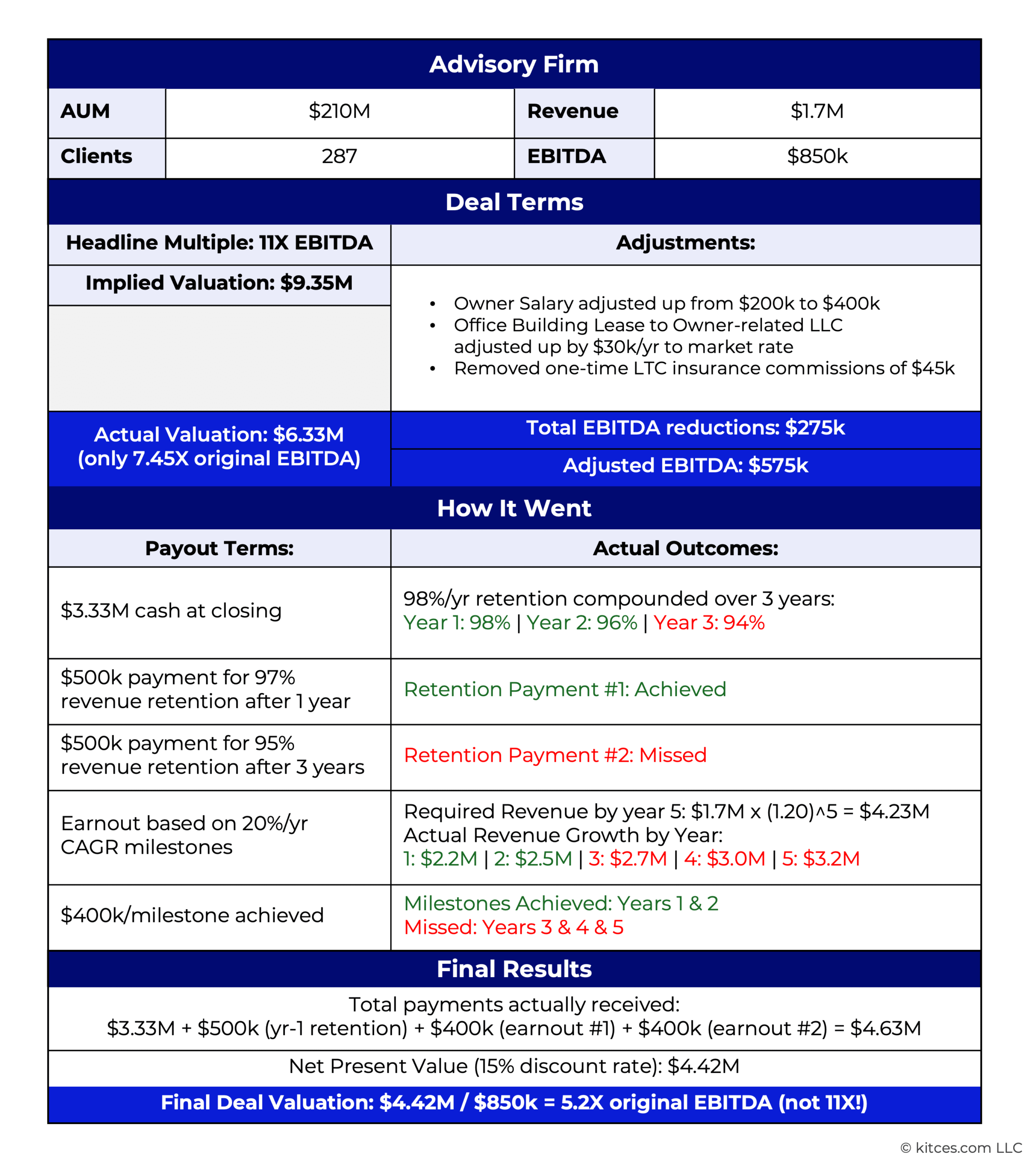
The RIA M&A market is robust, valuations remain compelling for well-positioned firms, and many transactions do deliver on the financial outcomes sellers are seeking. The goal of this analysis is not to discourage sellers from transacting, but to equip them with the analytical framework to ensure that when the deal closes and the proceeds arrive, the number matches the headline, and if it does not, they understood precisely why before they signed.