Executive Summary
Welcome to the February 2026 issue of the Latest News in Financial #AdvisorTech – where we look at the big news, announcements, and underlying trends and developments that are emerging in the world of technology solutions for financial advisors!
This month's edition kicks off with the news that Pershing has become the latest RIA custodian to announce the launch a client referral program, following closely behind other custodians like Goldman Sachs, Robinhood/TradePMR (who in turn followed Schwab and Fidelity in light of the high demand for their referral programs), which exemplifies the recent trend towards custodial platforms seeking to differentiate themselves with client referrals to the PE-backed mega-RIAs who are willing to pay their substantial cost – even though one notable to exception, Altruist, has managed to achieve significant growth without any client referral program by leaning into its technology capabilities to attract small- and medium-sized RIAs for whom custodial referral programs aren't usually an option anyway.
From there, the latest highlights also feature a number of other interesting advisor technology announcements, including:
- BridgeFT, the provider of data connections between RIA custodial platforms and advisor technology tools, has been acquired by iAlta, a startup company co-founded by a co-founder of Envestnet that's aiming to build a unified alternative investment data infrastructure layer – which will help iAlta's alternatives analytics and administration tools plug into the custodians and technology solutions that advisors already use (and could foreshadow more acquisitions to come as iAlta builds an end-to-end alternatives investment management tool)
- The tax data startup TaxStatus has introduced a new Tax Return History report that allows advisors to easily compare clients' prior-year tax returns side-by-side, further building out its capabilities for advisors to deepen their understanding of clients' current tax situations – and raising questions about whether TaxStatus will at some point build out more forward-looking planning tools like Holistiplan or FP Alpha, or if it sees enough of uses for clients' prior-year tax data to focus solely on that side of the timeline?
- Aquilance and Atomic Insights, two providers of billpay solutions for advisors of UHNW clients, have each announced separate venture capital investments, highlighting how technology could conceivably help bring concierge-style billpay services downmarket as RIAs are increasingly seeking to go upmarket – expanding the overall market for providers serving those firms (though it's debatable exactly how much that market will expand if 'mere' HNW clients simply don't get the value from billpay that UHNW clients do)
Read the analysis about these announcements in this month's column, and a discussion of more trends in advisor technology, including:
- The advisor workflow automation tool Hubly has announced new integration capabilities with AI tools including Jump, GReminders, and Pulse360, which serves as a reminder that as much is made of AI tools' ability to automate tasks, they aren't necessarily reliable for the kind of highly structured and repeatable workflows that are needed for an advisory firm, and require tools like Hubly to provide that structure for them
- Although AI notetaking tools are mostly used for their ability to save time in meeting prep and follow-up, advisors may not want to overlook the tools' ability to gather and report on meta-level meeting data like talk time and sentiment analysis, which can help advisors build their own meeting skills to develop deeper connections with clients (or help advisory firms identify the advisors with those skills so they can aid in training others!)
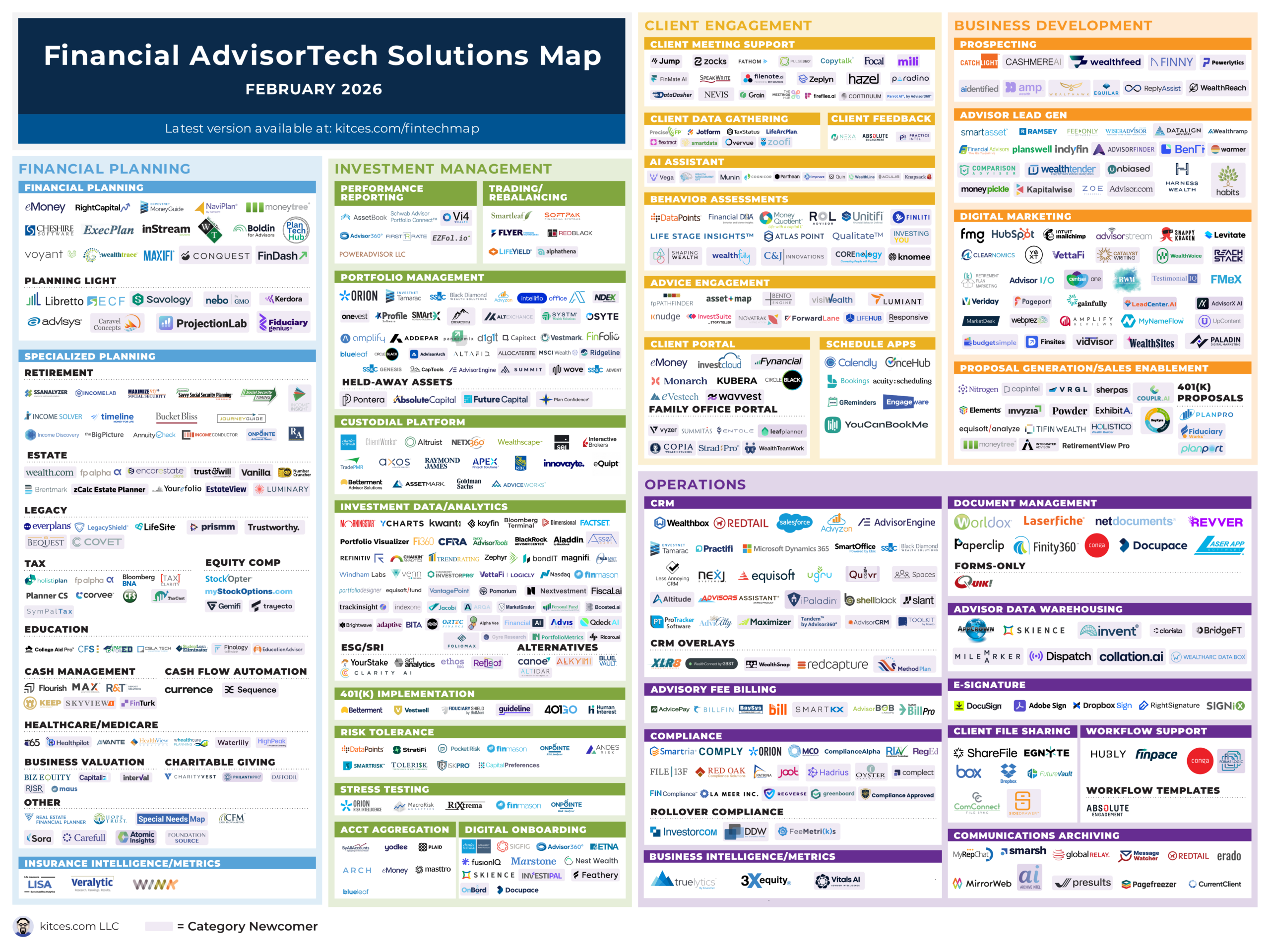
And be certain to read to the end, where we have provided an update to our popular "Financial AdvisorTech Solutions Map" (and also added the changes to our AdvisorTech Directory) as well!
*To submit a request for inclusion or updates on the Financial Advisor FinTech Solutions Map and AdvisorTech Directory, please share information on the solution at the AdvisorTech Map submission form.
Authors:


Pershing Announces (Yet Another) Referral Program As Helping Growth Of Mega-RIAs Overshadows Technology As A Custodial Differentiator
At its core, the function of an RIA custodial platform is fairly straightforward. The custodian needs to hold client assets safely, act as a broker-dealer to facilitate trades, and execute inflows and outflows from client accounts such as money movement requests and advisory fee deductions. Every major custodian can reliably handle these baseline tasks, and there's very little differentiation between them on costs (at least based on the few fees that advisors can see and evaluate). Which means that custodians need other some way to differentiate themselves.
Fortunately, there are a number of different levers that custodians can pull to differentiate themselves from the rest. They could aim to offer the most responsive and hands-on customer service (as Shareholder Services Group [SSG] was long known for). They could build the best technology to overlay their custodial platform so advisors don't have to spend money for third party software to do the same thing (e.g., how Schwab includes the popular iRebal rebalancing technology as a "free" add-on for advisors on its platform, and how Altruist bundles much of the portfolio management software that advisors pay tens of thousands of dollars for elsewhere for "free" on its own platform). Or custodians could offer to solve advisors' business growth needs by referring prospective clients via their retail arms.
The needle has swung back and forth between these methods of differentiation over time. At one point, service took precedence: Which custodian could provide the best trade execution or be the most likely to have someone knowledgeable pick up the phone? However, as investment management became increasingly digital in the 1990s and 2000s (drastically reducing the need to call the custodial broker-dealer to execute trades in the first place), there became more of an emphasis on the technology that each custodian had to offer. Over the years, Fidelity launched its Wealthscape platform, TDAmeritrade introduced Veo One, and Schwab rolled out Schwab Advisor Center, with the intention of either providing an all-in-one technology suite in addition to baseline custodial capabilities (as with Wealthscape) or an open architecture platform that makes it easy for an advisor's own third party technology to plug into (as with Veo and now Schwab's Advisor Services).
But in more recent years, the emphasis has shifted away from technology and towards offering RIAs growth through client referrals to attract their custodial business. The success of the Schwab Advisor Network (which has generated so much demand that Schwab has repeatedly had to filter down the number of participants, and last year increased its program fees for RIAs on its network and raised the minimum asset requirement for clients referred through the program) and Fidelity's Wealth Advisor Solutions has spawned other custodians to roll out their own referral programs, from Robinhood announcing a new referral program shortly after its acquisition of TradePMR to Goldman Sachs launching a referral program in late 2025 to Betterment reportedly planning to debut its own referral program sometime in 2026.
And now this month's news that BNY Mellon's Pershing will be debuting its own client referral program for RIAs as yet another example of how the biggest RIA custodians are going all-in on offering business growth – rather than technology or services and support – to differentiate their offerings and attract new RIA business.
At a time where benchmarking studies show that RIAs only manage around 5% client growth per year, it makes sense that custodians would offer up referrals to entice RIAs to their platforms. And there are plenty of growth-hungry firms with the capital to pay the custodians' sizeable referral program fees, particularly in the form of PE-funded mega-RIAs like Mercer, Creative Planning, WEG, and numerous others – indeed, buying leads through custodial referrals is a core part of many of these firms' continued growth strategy.
For context, here are the program fees of some of the major custodial referral programs as of their most recent ADV filings:
- Schwab Advisor Network: 26.25bps on the first $2 million of referred assets, 21bps on the next $3 million, 15.75bps on the next $5 million, and 10.5bps on assets over $10 million with a minimum annual fee of $25,000
- Fidelity Wealth Advisor Solutions: $50,000 annual fee plus 10bps on all referred fixed income and cash assets and 25bps on all other assets
- BNY Pershing: $50,000 annual fee plus 30bps on all referred assets
In that sense, then, custodians are just following the demands of the market – particularly the PE-funded mega-RIAs that now reportedly serve nearly 25% of all RIA assets under management, who are scaled-up and capitalized enough to absorb the above fees and still serve clients profitably. Though at the same time, because there are only so many referrals to make – and referrers generally only want to refer to firms that have strong business development teams to ensure that the referrals actually close – in practice custodial referrals only help a narrow subset of typically-very-large RIAs; accordingly, the latest Kitces Research on Advisor Marketing found that custodial referrals were only a lead source for about 1% of advisors overall.
But it's also worth noting that even though client referrals are all the rage among custodians today, they still aren't the only differentiator. One case point is Altruist (now the only one of the top four custodial platforms without a referral program), which has leaned farther into its technological capabilities than its competitors by offering digital onboarding, automated rebalancing, performance reporting, and billing tools included for free for advisors who custody on the platform, and has perhaps not coincidentally become the fastest growing custodian in the market as measured by new firms joining. And in contrast to the custodians that target (only) the biggest mega-RIAs through their referral programs, much of Altruist's growth has come from small- and mid-size RIAs.
Which suggests that outside of the relative handful of giant PE-funded firms for whom custodial referrals are king, many RIA firms really do still see technology as a key differentiator between custodial platforms, and will pick the custodian investing the most aggressively into their technology, regardless of any referral programs it does or doesn't offer (because most RIAs aren't going to get a spot in those referral programs anyway, while all of Altruist's users benefit from their stellar ratings on performance reporting and portfolio management as shown in the latest Kitces Research on Advisor Technology).
To be fair, in addition to its new referral program, Pershing has also revamped its technology side with its Wove platform, which combines multi-custodial portfolio management tools with native versions of Salesforce's CRM and Conquest's financial planning software. However, Pershing's traditional association with BNY's banking and UHNW wealth management services don't make it as much of a natural fit for the types of small- and mid-sized RIAs that have flocked to Altruist – which could be part of the reason why it's now joining the rush to serve the mega-RIAs already lining up for Schwab's and Fidelity's referral programs.
The key point is that when all of the custodians have the basics of asset custody and trade execution covered, and when very few custodians charge an explicit fee or trade commissions for advisors to compare (since they typically make their revenue through back-end sources like cash sweeps and payment for order flow), there really isn't that much to differentiate them from one another. And so the choice then comes down to which platform can provide the most value beyond custody. As the last few years of trends in the custodial business have shown, for the majority of small- and mid-sized firms looking to start up or change custodians, technological capability can still serve as the main differentiator. But for the handful of big fish in the RIA pond who are willing to buy growth at all costs, it's apparently client referrals that matter most – and hence Schwab and Fidelity, and all the others now following in their wake, are now rushing in to fill the demand.
iAlta Acquires BridgeFT To Make Custodial Connections For Its 'Envestnet For Alternatives'?
The asset management world is forever evolving, with new investment products and solutions being constantly introduced and existing ones being innovated on to fit to new markets and use cases. Financial advisors can serve as a sizeable distribution channel for those solutions, since a single advisor might work with 100 or more clients at $1 million or more of AUM each for whom they might implement a given investment product. Which is why it makes sense, for instance, for providers of investment solutions to spend tens of thousands of dollars on sponsorships and booths at national conferences, because getting even one advisor to sign up and implement the solution across their $100+ million of AUM can make up for the expense several times over.
But the challenge that new investment solutions often have is that in addition to needing to build visibility and credibility among advisors, they also need a way to plug into advisors' existing tech ecosystems. Advisors use one of a handful of custodians, plus any number of individual or all-in-one tools for portfolio analysis, proposal generation, rebalancing, performance reporting, and billing. If a particular investment solution isn't compatible with some or any of those tools, it becomes very difficult to implement it at scale because the hassle of doing so outweighs the potential benefits. And so advisors might decide to steer clear of certain investment solutions – even if they think they could otherwise be beneficial for their clients – if they don't see a way to implement them with the tools the advisor is already using.
In the early 2000s, Envestnet became successful at solving this problem for investment solutions like TAMPs and SMAs (and later a host of others from model portfolios to direct indexing and tax overlays to annuities). By providing a marketplace of investment solutions plus the technology to implement them, Envestnet solved both the advisors' problem of needing a way to connect their investment solutions to their custodians and other tech infrastructure, and the investment solutions providers' problem of needing a way to distribute to advisors and their clients. For which Envestnet made money from asset managers and investment solutions providers who paid to be on their platform and from advisors who paid SaaS fees for the technology.
But whereas in the late 1990s and early 2000s TAMPs and SMAs were the hot new product type that needed a solution for integrating with advisor technology in order to gain traction among clients of RIAs, today that distinction in many ways belongs to alternative investments like private equity and credit. And like TAMPs and SMAs back then, alternatives today have many data gaps between themselves and other parts of the advisor ecosystem, e.g., for doing due diligence and comparing alternatives managers, trading and administering alternative investments with their bespoke liquidity requirements and capital call schedules, and reporting performance in conjunction with the client's other assets. Although solutions exist at various points along this spectrum (e.g., Altidar, Blue Vault, and Alkymi for alternatives research and analytics; iCapital and CAIS for alternatives marketplaces; Bridge, Arch, and Canoe for back office administration; and Addepar and Masttro for reporting), a true end-to-end solution for alternatives hasn't emerged yet that can solve for both the specific challenges involved with alternatives as well as the "last mile" issue of integrating alternatives into advisors' existing technology infrastructure.
Which makes it notable that this month iAlta, an emerging provider aiming to unify the data infrastructure of alternatives investing, has announced the acquisition of the data management technology provider BridgeFT (not to be confused with the different Bridge that provides alternatives back office management technology).
iAlta was launched in 2025 by a group that notably includes Envestnet co-founder Bill Crager, and their goal appears to be to do for alternatives what Envestnet did for TAMPs and SMAs back in the early 2000s: To provide technology to make them easier for advisors to implement, and (presumably) make money from asset managers who are included their platform. Also like Envestnet, iAlta is taking the approach of buying rather than building the solutions it's aiming to provide across its platform, having already acquired two alternative investment data and administration providers in Verivend and Betterfront.
With the BridgeFT acquisition, iAlta will have a way to plug its prior acquisitions (which are specific to the alternatives universe) into the broader advisor technology ecosystem. BridgeFT's main specialty is building API connections to custodial platforms and normalizing the incoming client custodial data, allowing advisory firms and technology providers to integrate with multiple custodians using a single, standardized API. This capability could translate well to alternative investments, which also feature highly fragmented and nonstandardized data, but perhaps even more importantly it creates a connection – a bridge, if you will – to the existing custodial and technology ecosystem that advisors live in. Which helps to solve for the "last mile" problem that many alternatives solutions have of plugging into the tools that advisors already use so they can manage them as an integrated part of their clients' portfolios rather than as a separate sleeve with its own data and reporting tools.
It will be worth watching to see what iAlta does from here. While Crager has said that iAlta doesn't intend to build or buy a alternatives marketplace to compete with iCapital or CAIS or a reporting tool to compete with Addepar or Masttro, it's fair to wonder given his Envestnet roots whether the company will be able to resist trying to put together a complete end-to-end tool for alternatives instead of focusing solely on the data infrastructure alone. Although Envestnet's experience with trying to build an everything-for-everyone conglomerate by acquiring solutions and fitting them together into one puzzle, which ultimately became a liability to the company and led to its acquisition by Bain Capital, may serve as enough of a cautionary tale to keep iAlta focused on building a comparatively narrow data-only solution.
But the bottom line is that with the acquisition of BridgeFT, iAlta now has an important leg up with its ability to plug into a wide range of custodial platforms and advisor technology. Because ultimately, while tools like alternatives marketplaces and administration and reporting platforms may make alternatives investing easier in a vacuum, in the real world if you want to support alternatives investing for financial advisors you need to meet them where they are, with the custodians and technology that they already use. With the BridgeFT acquisition, it's clear that iAlta understands this concept – even if it isn't quite certain yet what they'll do with it.
TaxStatus Introduces New Tax History Report, But Will It Eventually Compete Head-On With Holistiplan In Forward-Looking Planning?
There are two sides to tax planning for clients. One is understanding their current tax situation, e.g., their income sources, the types of assets and liabilities they hold, the deductions or credits that they might be eligible for, and other taxpayer-specific nuances like the structure of businesses that they own or the types of stock option grants that they've received. Much of this information can be found on clients' most recently filed tax returns, and while being backward-looking by definition – since they're only accurate as of the end of the year prior to when they're filed – the client's tax considerations in the recent past can at least offer a starting point for conversations about what's most likely to also be relevant in the future.
The second piece of tax planning is forward-looking: Taking the client's current tax situation and projecting it into future years to evaluate and compare different planning strategies. These projections can be either short-term and specific (e.g., creating projections for the current tax year and for at most 2-3 years out to give advice on specific strategies to reduce tax in the near term) or long-term and more generalized (e.g., projecting out a client's future tax rate in retirement to decide whether or not it's worth it to do a Roth conversion this year). But in either case, in order to do a forward-looking projection it's usually necessary to have some kind of tax planning software that can project the clients' current tax situation forward and simulate different strategies while applying the correct tax rules for the present and reasonable assumptions for the rules in the future. This is especially true as tax laws such as the Tax Cut & Jobs Act, SECURE and SECURE 2.0 Acts, and most recently the One Big Beautiful Bill Act have introduced ever more complexity into the tax code, which in turn has made it much harder to create any kind of reliable tax projection without software that can correctly account for all the moving parts involved.
The tricky part is marrying these two sides of the tax planning equation – understanding the current situation and projecting future scenarios – together into a coherent whole. You need a way to (efficiently and comprehensively) capture the relevant data from the client's current tax situation, and you need a calculation engine to project those details forward, model changes, and show the results. For a long time, Holistiplan has dominated the market for technology serving these functions. By scanning the client's most recent tax return and extracting the relevant numbers, Holistiplan (and more recently competitors like FP Alpha) can create a picture of the client's current tax situation. That current picture then serves as the baseline for future projections, which the advisor can adjust to model different planning scenarios.
The approaches of Holistiplan and FP Alpha have proven popular among advisors, but they aren't without limitations. First, their functionality relies on the advisor uploading their clients' tax returns, which requires the client to actually give the advisor a PDF of their return (and remove any password protection that their tax preparer might have embedded into the document) and for the advisor to then upload it. This may or may not be a significant blocking point, but for clients who are less organized, have only paper copies of their return, or who have stringent security settings on the return files they do have, the return upload requirement can cause some meaningful snags in the process.
The other issue is that software like Holistiplan uses only the single most recent tax return as the input, when the reality is that multiple years' worth of returns are needed to construct an accurate picture of the client's current tax situation – many advisors ask for up to three prior years' worth of returns from their clients to gain the context necessary to understand, e.g., whether the client has inconsistent or smoothly rising income. Which again isn't something that would necessarily dissuade people from using tools like Holistiplan… but it does create an opening where if a competing product did offer more capabilities to incorporate multiple returns into planning assumptions, advisors might find to be at least worth considering as an alternative.
In this context, it's notable that TaxStatus, the tax portal that allows advisors to access client tax information directly from the IRS, has recently released a new Tax Return History report which shows a line-by-line comparison of up to four years' worth of a client's tax returns. The new report is something of a companion to TaxStatus's existing Financial Baseline Report, which provides a high-level breakdown of just the client's most recent return.
When TaxStatus first introduced the Financial Baseline Report, the big question at the time was whether it was planning to ultimately build a Holistiplan competitor. While TaxStatus had originally served primarily as just a data layer between the IRS and other software, the Financial Baseline Report represented a step towards building out planning capabilities within TaxStatus itself. And because TaxStatus had direct connections to the IRS's systems and the capability for clients to provide one-click approval for the advisor to access their tax data, it was in a position to deliver Holistiplan-like planning functions fed directly by IRS data, without the need to upload an actual client tax return.
But the thing that TaxStatus notably lacks in comparison to Holistiplan and FP Alpha is the forward-looking planning component. While its tools can help advisors assess clients' current and historical tax situations, it hasn't (yet) built anything to project those numbers forward or make planning adjustments. And in rolling out more features like the Tax Return History report, TaxStatus continues to focus more on historical tax data than proactive tax planning, which calls into question whether TaxStatus sees itself as a potential Holistiplan competitor at all (i.e., a tool for evaluating both a client's current tax situation and their future planning), or if it intends to remain firmly on the past/current side of the timeline.
On the one hand, TaxStatus's current offerings highlight the fact that there are a lot of potential uses for "just" the client's past and current tax data in financial planning, from understanding the client's income volatility or charitable giving habits to assessing their propensity to sell assets during a market downturn (e.g., if they have a large amount of capital losses in a year in which the markets declined and have a high allocation to cash today) to gaining visibility into any held-away assets – and so it's possible that TaxStatus doesn't need to directly compete with Holistiplan at all to have value in its own right.
But on the other hand, it's hard to ignore how much the respective capabilities of TaxStatus and Holistiplan seem to complement each other: TaxStatus with its ability to pull in tax data from the IRS without uploading documents and to assess multiple years' worth of returns at once; and Holistiplan with its ability to project the current numbers forward and build scenarios out of them. One could see one of those providers starting to build the other's capabilities into its own tools or vice versa, and thereby providing competitive pressure as the more "comprehensive" tax planning platform. Or alternatively, it's reasonable to imagine one of those providers simply buying the other and combining their capabilities together into a single front-to-back, IRS-connected tax tool.
The key point is that it's rare for planning tools – even ones that specialize in a single planning area like tax, estate, or retirement planning – to hone in on only one part of the planning process. If a tool is capable of doing end-to-end planning, then it will typically try to do that, rather than require advisors to buy more technology to complete the process. And so when one provider specializes in the backwards-looking data coming straight from the IRS, and other providers specialize in the future planning that that data feeds into, it's only natural to wonder when they'll start to converge towards each other (or merge together entirely).
Billpay Providers For UHNW Clients Raise Capital As 'Concierge' Services Come Downmarket
One thing that many financial advisors learn when they work with a variety of client types is that the planning challenges don't necessarily get more or less complex as clients go up and down the income and net worth spectrum, they just become different kinds of complex. A client with $50,000 of assets and one with $50 million of assets both have planning challenges and problems to solve, and though the scale of the problems might be different between the two – e.g., the $50,000 client is much more likely to be worried about running out of money in retirement than the $50 million client – they're problems all the same, and both types of clients may be equally willing to pay advisors who can solve them.
One of the common complexities for clients on the higher end of the net worth spectrum has to do with paying for things. UHNW clients might have their assets spread out across dozens of different accounts – multiple types of personal and business bank accounts, revocable and irrevocable trusts, retirement and taxable investment accounts, etc. Different accounts might be designated for different types of expenses: One account might be used to pay a large tax bill, another to meet a capital call for a private fund, one to invest in real estate, and yet another for big personal purchases like cars or jewelry. And rather than take the time to keep everything straight themselves, UHNW families might be happy to delegate the job of managing payments to someone else who can be trusted to know the rules and effectively handle the client's cash management needs.
Hence, advisory firms that serve UHNW clients sometimes offer "billpay" (i.e., payment management) as a value-added service. But there are many moving parts involved – the rules for which accounts can be used for what, vendor and invoice management processes, approval workflows, cash flow reporting, etc. – which has historically made payment management a fairly time- and staff-intensive service to offer. As a result, billpay has been mostly offered as a kind of concierge service by firms that serve an ultra-ultra-high-net-worth segment of clients (e.g., $100 million of assets and up) who are willing to pay enough to make it cost-effective.
However, two different providers that have each announced capital raises this month provide examples of how advisors can offer billpay and other cash management services with less overhead cost.
The first is Aquilance, which has operated for nearly 40 years as an outsourced bookkeeper and billpay service for UHNW families, which recently announced a $16 million investment and strategic partnership with Ten Coves Capital. Aquilance approaches payment management as more of an outsourced service enabled by technology, with its own staff of accountants and bookkeepers who can work in conjunction with an advisor's team to provide the service without needing an internal staff to support it. Although notably, Ten Coves Capital is generally known as a technology investor (including an investment in the business financial operations platform Bill.com). Which could either mean that Aquilance is looking to further streamline its outsourced services through technology (while still retaining its fundamental nature as an outsourced, human-staffed service), or it could be aiming to launch a 'pure' technology offering that advisors' teams can use themselves to facilitate billpay for clients.
Representing the other approach to billpay is Atomic Insights, a newer startup that is already in the 'pure' technology category and has announced its own $10 million seed funding round led by Aquiline, with participation from Northwestern Mutual Future Ventures. As a tech-only offering, Atomic Insights connects to the advisor's custodians, CRM, and portfolio management software and facilitates workflows by which advisory teams initiate money movements, manage vendors and invoices, log approvals, and send wire or ACH transfer instructions to the custodian. Meaning that the advisory firm needs to have its own staff to manage the process, but it can now be handled in a continuous workflow on a single platform rather than needing to switch between systems and make various manual handoffs between staff members.
With both of these providers, the end goal is to reduce the amount of overhead cost needed to offer billpay and payment management as a service for clients, which could have the add-on effect of making it more viable to provide those services to a wider range of clients. And the fact that both are now backed by eight-figure venture capital investments suggests that investors also believe that the future of billpay might not be just for a tiny segment of UHNW clients anymore, but that there's instead potential to bring it downmarket to a bigger range of 'mere' HNW clients – and that the natural magnetism pulling advisory firms towards offering more value-added services to go upmarket will entice more advisors to offer billpay going forward.
But what's yet to be seen is how far downmarket billpay services can conceivably go. At some point on the net worth scale, the complexity of a client's balance sheet and cash flow needs decreases enough that managing payments ceases to be a pain point that they're willing to pay someone else to solve for them (or at least as much as an advisor would need to charge to make it worth offering). If technology or tech-streamlined services can reduce that breakpoint from, say, $100 million in assets down to $10 million, that could open up a meaningful new market for advisors to offer billpay as a service. But if it 'only' reduces the threshold down to $50 million, will there be that many more advisors willing to offer billpay to be worth the investment?
Ultimately, what's clear is that there's some attention from technology providers and their investors in the kinds of services that advisors are offering to UHNW clients and the possibility of bringing that downmarket to a bigger segment of the industry. As advisory firms – particularly PE-funded acquirers – increasingly seek to go upmarket, it's conceivable that they'll be enticed by the ability to offer concierge-style payment services as a differentiator. Or to put it differently, when the technology seeks to bring billpay downmarket, and when RIAs look to go upmarket, they'll eventually both meet somewhere in the middle.
Hubly's Integrations With AI Tools Are A Reminder That AI Can Work With Workflows, But Won't Replace Them
As AI tools have proliferated across the AdvisorTech landscape over the last few years, it's become more clear what are and aren't good use cases for AI within the context of an advisory firm. AI so far does well with sifting through large amounts of information and doing something with it: e.g., creating a summary of key takeaways (as with the many AI notetaker tools on the market), matching client financial information with potential planning strategies (as tools like Conquest Planning and FP Alpha have experimented with), and serving as a single interface for advisors to interact with client data from across all of their different technology tools (as Dispatch and Milemarker have been building out). What those uses all have in common is that they start with unstructured or inconsistently-structured data (meeting transcripts, raw financial data, differently-formatted client data across multiple systems, etc.) and put it into a more structured, readable format.
Except it's worth remembering that the AI itself doesn't create the structures that shape its outputs. The Large Language Models (LLMs) behind the AI tools can't decide for themselves what the best format is for a client meeting note summary or a list of proposed recommendations or a client data interface. The human developers who create those tools need to build that structure in order to create a user experience where the person using the tool gets the most out of it. To use a musical analogy, if AI can create the melody, a human still needs to give it a structure and arrangement to turn it into something that we can recognize as a song.
This is all to say that while AI technology can make it much easier for advisors to look up, summarize, or analyze information, it still takes substantial human involvement to overlay a structure onto the LLM's output so that it's consistent, readable, and ultimately useful for the advisor using it. And in an advisory firm context, that structure is really important: Advisors must often follow very specific processes in order to remain in compliance with their firms' policies and procedures and ensure that their clients get consistent service. If an advisor asked an AI agent to open a new IRA for a client and roll their 401(k) account over into it, they wouldn't want the AI alone to decide how to complete that task: They'd want to be very sure that the technology adheres to the specific processes put in place by their firm for opening accounts, getting client signatures, moving money, investing funds, etc.
Which is why even though AI tools have taken over all manner of individual tasks for advisors, they haven't yet consumed entire workflows and processes, at least on the operational sides of firms where those processes need to be specific and consistent to stay in compliance. They can generate individual tasks (e.g., a follow-up email after a client meeting) or even be used to kick off workflows, but the workflows themselves don't need (and likely shouldn't use) AI in order to be done the same each way.
And so it's notable this month that Hubly, the provider of workflow and task management tools for financial advisors, has announced that it has built integrations with several notable AI tools including the AI notetaker Jump, the meeting management tool GReminders, and the client engagement tool Pulse360.
Hubly's role since it was founded has been to provide an Asana- or Trello-like workflow and task management tool specifically for financial advisors. To that end, it has integrated primarily with advisor-specific CRMs like Wealthbox and Redtail, to enhance the built-in workflow tools that those platforms have (but which many advisors have found lacking). It makes sense to expand that integration list to AI notetakers and other tools that pull from disparate data sources: From Hubly's perspective, because it creates another source from which workflows can be triggered other than CRMs (especially if advisors are starting to spend more time in their AI notetakers than their CRMs); while from the AI tools' perspective, Hubly provides the workflow structure that their tools can feed into without having to build the workflows into their own tools.
The other interesting implication here is that when workflow tools like Hubly can integrate with AI tools like Jump while bypassing the CRM entirely, it diminishes the role of the traditional advisor CRM even further. Hubly came about because advisors rely on the data in their CRM, but were frustrated with their CRMs' workflow tools. AI notetakers came about initially because they can save the advisor time in taking and transcribing meeting notes and doing meeting follow-up tasks, but have increasingly pushed towards a role as an interface for client information across multiple systems (CRMs, email, financial planning software, etc.) so the advisor doesn't need to navigate through their CRM to find it. If Hubly can handle workflows better than CRMs, and AI notetakers can serve as a better client data hub than CRMs, then where does that leave the CRMs themselves? And what happens if AI tools do start to build in their own workflow tools (a version of which the AI-native Slant CRM is already working on)? If advisors can manage client data and workflows while bypassing their CRM entirely, then what is the CRM even for?
Ultimately, without placing too much importance on a single integration announcement, the Hubly news is at the very least an indication of the direction where the tides are moving in the industry. AI tools are eating up the use cases that advisors used to use CRMs for, and advisors never liked their CRMs' workflow capabilities all that much to begin with. Without either of these legs to lean on, traditional CRMs stand in real danger of becoming obsolete unless they can build out capabilities that can compete with the AI notetakers'.
But the news is also a reminder of the limitations of AI technology today: While much is made of AI's ability to automate ad hoc tasks, that feature can become a liability when the tasks need to be done the same way every time. And so in the end, if AI notetakers really are aiming to become the new CRM, they'll need to build workflows that can provide the structure that the AI itself lacks – or, as in the case of Jump, GReminders, and Pulse360, they'll need to tie into other tools like Hubly that can deliver those workflows for them.
Technology Feature Spotlight: AI Notetakers' Sentiment Analysis Tools Could Help Advisors Improve Client Meeting Skills (And Train Other Advisors To Do Better)
The baseline value proposition for an AI notetaker is pretty clear. The tool logs into a meeting between the client and advisor, transcribes the dialogue that takes place, and runs that text through a Large Language Model (LLM) that summarizes the meeting, identifies relevant takeaways, and notes action items that need to be followed up on. Which means that (1) the advisor themselves is not burdened with taking notes during a meeting (and they don't necessarily need to bring a second person in the meeting as a notetaker); (2) the meeting notes will be more likely to capture all of the relevant points than if the advisor had (often distractedly while talking to the client themselves) taken notes themselves or "brain-dumped" into a Word document after the meeting; and (3) much of the manual work necessary for drafting a meeting follow-up email to send to the client is eliminated, since the advisor can simply paste in the bullet-pointed meeting summary and add their own personalized messaging around it before sending it to the client.
Just from that functionality alone, it's fairly easy to see why AI notetakers have taken off (e.g., the most recent Kitces Research on Advisor Technology found that around 40% of independent advisors have adopted meeting support tools in one form or another, barely two years after their widespread release). The time spent on preparing and following up for meetings can take a significant amount of time – often one hour of before/after time per one hour of meeting time itself, according to the latest Kitces Research on Advisor Productivity – and that time savings can open up more hours for deeper planning or more client-facing time.
But once an AI notetaker has listened to and transcribed a client meeting, there are other things that it can do with that transcript besides creating a meeting summary and identifying follow-up tasks. A meeting transcript is a rich trove of data that can be analyzed in various different ways, including not just for the concrete details about what went on in the meeting, but also for a more qualitative evaluation of how the meeting went. Which can at least in theory make an AI notetaker useful both for managing their various meeting-related tasks and for providing insights that can help advisors hold better meetings.
Which is important, because client meeting skills are crucial but sometimes underappreciated for advisors looking to improve their craft. It's simple enough to say that advisors should do things like make eye contact, listen actively, avoid talking too much, and keep the conversation moving so it doesn't go past its end time, but in practice most people are better at some of those skills than others, particularly in a client meeting situation when the advisor is more focused on keeping up with the conversation than on managing the meeting structure. But meeting skills can be improved through repetition – as the meeting cadence gets more comfortable for the advisor, they can think a little more each time about which areas they're trying to improve on, and actively work to build those skills until they've become second nature and the advisor can move on to the next skill. And that improvement can come much faster, and be much more effective, when there's some kind of feedback mechanism by which the advisor can see specifically which parts of each meeting they did well with, and which areas they need to focus on to improve. As Ericsson, Prietula, and Cokely's classic 2007 Harvard Business Review paper "The Making Of An Expert" put it, "experts are always made, not born" – and the true key towards becoming an expert in anything is through "deliberate practice" with feedback and coaching on how to better do the things that stretch one's current capabilities.
But few advisors get a chance to receive this feedback. If they're lucky, they might start their career in a paraplanner or associate advisor role where they can sit in on meetings, observe the more experienced lead advisor and how they manage the meeting, and eventually take over portions of the client meetings themselves before going fully solo in meetings with their own clients. But even then, there might not be a chance for the lead advisor to give meaningful feedback in the hectic period between doing post-meeting follow up and starting preparation for the next meeting. And many advisors may not even get a chance to sit in on meetings before being thrown into client meetings on their own, giving them no avenue for feedback at all other than their own gut feeling after the meeting is over (which might give a good sense of whether or not the meeting went well overall, but doesn't provide much in the way of useful specifics beyond that).
Which is why it's at least interesting that AI meeting note tools like Jump and Zocks have built meta-level meeting analytics tools that can help advisors assess certain key aspects of their meeting performance – and which have been arguably underutilized as training tools for advisors looking to improve their meeting skills.
One of the simplest of these meeting metrics is talk time: How much on average, or during a particular meeting, did the advisor spend talking during meetings versus the client? The ideal number for this might vary from meeting to meeting and client to client, but in general if the advisor's meeting conversations all tend to be one-sided with the advisor delivering information, they might need to remind themselves to step back and listen on occasion. And for deeper analysis, Jump and Zocks (as well as some general-purpose AI notetakers like Fireflies) also include sentiment analysis tools, which analyze the meeting transcription for words or phrases with positive or negative connotations to give an impression of the overall tenor of the meeting. As shown in the sample screenshot from Zocks below, AI notetakers can track client sentiment in real-time throughout the meeting, allowing advisors after the fact to pinpoint the times when their clients' sentiment rose or dipped during the meeting.
And as Jump's recent Financial Advisor Insight Report found after analyzing thousands of anonymized meetings and their sentiment data, the client's sentiment at the beginning of a meeting can vary widely based on market conditions, global news, or events in their own lives – but as the chart from the report below shows, that sentiment tends to meaningfully improve by the end of the meeting.
The report also found that certain advisors were more able to consistently improve client sentiment throughout their meetings by showing awareness of and validating clients' emotions, limiting the advisor's own speaking time so clients can express their concerns and feel heard, and emphasizing the client's own goals and relationships rather than investments and the markets. With these findings, Jump developed an "Advisor Emotional Intelligence Index" based on key factors like talk time, the number of open-ended questions asked by the advisors, the level of empathy expressed in their statements, and the amount of emotional awareness demonstrated by the advisor, all of which are correlated with a greater intra-meeting lift in client sentiment.
All of these tools could be valuable for advisory firms for at least one of two different purposes. At the individual advisor level, these metrics can provide something of a running scorecard for the advisor's meeting skills. In the spirit of "what can be measured can be improved", advisors who want to focus on key metrics like talk time or sentiment improvement during a meeting can use these tools to keep score and provide continuous feedback that they can use to improve. Jump and Zocks each have their own literal meeting score metrics that can help gamify the experience (e.g., encouraging the advisor to top their best score from one meeting to the next).
And at a firm level, these tools can help managers see which of their advisors may be more skilled at emotional intelligence than others. This can have all kinds of implications, from salary and bonus decisions to assigning incoming clients to identifying which advisors would be the best choice to train or share best practices with other advisors at the firm.
It's worth noting that not every skill related to success in client meetings can be quantified and analyzed by AI notetakers today. Meeting note tools only analyze the transcript of the meeting, meaning they focus solely on the words said out loud. But there's a whole vocabulary of unspoken language that goes back and forth between advisors and clients during a meeting, from posture and body language to eye contact to tone and inflection to allowing for moments of silence and reflection – none of which gets captured in an AI notetaker. The technology is therefore only one part of what can be a more holistic effort by advisors to self-assess their meeting skills.
But the key point is that, for advisors who are using notetaking tools like Jump or Zocks, these tools exist in the technology that they're already using – there's no need to buy an extra piece of technology when it's already a part of the AI notetaker. Although many advisors may see them as add-on features outside the tools' core notetaking function, or may only use them sporadically to check on individual meetings, it could be worth a closer look at how they can be used more systematically to help the advisor improve their client meeting skills. In a world where communication is being rapidly taken over by AI, the most successful advisors will be the ones who can develop deep and lasting human connections with their clients – and while AI can't build those connections itself, it can perhaps ironically be a useful aid in giving feedback so advisors can learn how to do it themselves.
In the meantime, we've rolled out a beta version of our new AdvisorTech Directory, along with making updates to the latest version of our Financial AdvisorTech Solutions Map (produced in collaboration with Craig Iskowitz of Ezra Group)!
So what do you think? Do you use service, technology, or client referrals (or something else) to differentiate between custodians? Would you offer billpay as a service if it could be streamlined with technology? Are you using your AI notetakers' meeting analytics tools to improve your client meeting skills? Let us know your thoughts by sharing in the comments below!