Executive Summary
Many financial advisory firms start out with a single founder – in part because, early on, the founder might also be the only employee. Over time, as the firm grows in terms of clients, revenue, and team members, the founder may consider opening up ownership opportunities to employees, whether to reward key team members, foster a greater sense of ownership among staff, or support a long-term succession plan. However, taking that step can come with challenges, from determining the appropriate buy-in structure to overcoming the mental hurdle of no longer being the firm's sole owner.
In this guest post, Tim Goodwin, founder and CEO of Goodwin Investment Advisory, discusses the strategic thinking behind offering equity ownership opportunities to employees in his firm, the framework he used to expand ownership, and how other founders can prepare to share ownership in their own firms.
At a fundamental level, Tim wanted to offer equity to his employees to foster a greater sense of ownership. Being an owner – and receiving distributions based on the firm's profitability – can heighten employees' focus on the firm's efficiency, client experience, and long-term enterprise value. For instance, his employee-owners are incentivized to identify potential cost-saving opportunities, such as whether certain subscriptions are truly necessary.
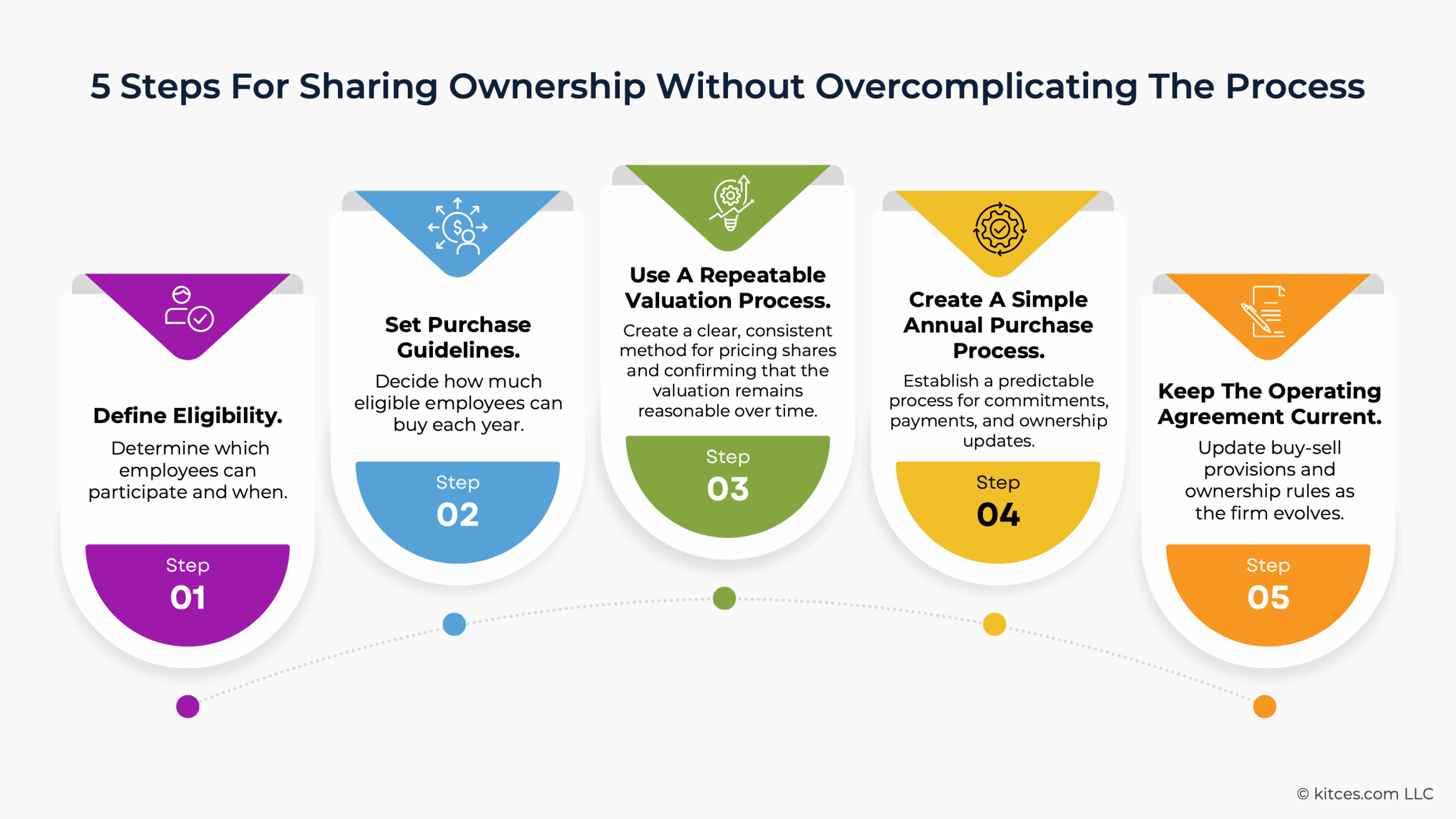
Tim found that preparation was crucial before sharing equity, as having clean books, a current operating agreement, clear buy-sell language, a reasonable valuation process, and enough financial transparency to educate employee-owners can smooth the transition and help avoid conflicts down the line. Once the business is prepared to bring on additional owners, the next steps include defining which employees can participate and when, setting guidelines for how much eligible employees can buy each year, using a repeatable valuation process to price shares, creating a simple annual process for commitments, payments, and ownership updates, and keeping the operating agreement current as the firm evolves.
In Tim's case, equity buy-in opportunities are offered to all employees who have been with the firm for at least one year, which creates greater alignment across the staff and recognizes the contributions non-advisory staff make to the firm's profitability. He allows employees to buy additional shares once per year at a revenue- and profitability-based valuation, and he also allows employees to sell their shares if, for example, they need liquidity for a major purchase. Employee-owners are required to liquidate their shares when they leave the company unless they retire, in which case they can retain ownership for no more than 10% for 10 years This helps keep ownership centered on current firm staff.
Ultimately, the key point is that allowing employees to buy equity ownership interests in the firm is not just a way to reward key personnel. It can foster a psychological sense of ownership across the team, support stronger alignment around growth and profitability, and potentially create stronger long-term outcomes for both the founder and employees!

I first remember being struck by the idea of employee ownership in a very unglamorous place: sitting on the throne, reading a magazine.
At the time, Goodwin Investment Advisory was still young, small, and fragile. I was nowhere near having a sophisticated ownership structure. But as I flipped through that magazine, I came across an advertisement for a mutual fund company that proudly described itself as employee-owned. For whatever reason, that phrase lodged itself in my brain.
Someday, I thought, I would love to be able to say that about my firm.
Not because employee ownership sounded trendy. Not because I was trying to solve a specific retention problem. And not because I had some perfectly designed succession plan. It struck me because it represented the kind of firm I hoped to build: one that was not just about me, but where the people helping create the value could also share in the value, and where employees would eventually think less like hired hands and more like stewards.
Today, employees at our firm collectively own approximately 16% of Goodwin Investment Advisory. We currently have 13 shareholders, although one of those is technically the self-directed IRA of an employee who also owns shares personally. Only a minority of our employee-owners are advisors. Many are in operations, compliance, client service, marketing, or other non-revenue-producing roles.
That is intentional.
Many founder-led RIAs say they want their teams to 'think like owners'. But in many firms, actual ownership is reserved for the founder, maybe one or two next-generation advisors, and possibly a senior rainmaker or two. Meanwhile, the operations team, client service team, compliance team, marketing team, and other non-advisor contributors are asked to care deeply about firm growth, profitability, efficiency, client experience, and long-term enterprise value without participating meaningfully in the upside of the enterprise they are helping build.
That mismatch can become a quiet source of friction. Founders want employees to care about revenue, expenses, profitability, vendor costs, process efficiency, and firm value. Employees naturally care about doing good work and being paid fairly for that work. But if their compensation is primarily salary, bonus, or production-based compensation, then the incentive structure does not always encourage enterprise-level thinking.
Charlie Munger is often credited with saying, "Show me the incentive and I will show you the outcome." Whether that line is repeated a little too often in business circles, the concept is hard to ignore.
For advisory firms that want employees to act like owners, it may be worth considering whether employees should have the opportunity to become owners.
For a small RIA, that does not necessarily mean creating an ESOP, designing a complex phantom equity plan, or waiting until the firm reaches billions of dollars in AUM. In our case, we have tried to keep the model relatively simple: eligible employees can purchase real equity, we use a formulaic internal valuation process, we distribute profits quarterly, and our operating agreement includes clear buy-sell provisions for what happens when someone leaves, retires, or wants to sell.
It is not perfect. It is not effortless. And it is not right for every firm. But for founder-led advisory firms that want to create broader buy-in, reward non-advisory contributors, begin internal succession planning, and build something that can outlive the founder, sharing real equity may be more practical than many owners assume.
Why 'Thinking Like An Owner' Usually Requires More Than A Pep Talk
When I first started Goodwin Investment Advisory, I did not begin with a clean, elegant ownership structure. I started the firm with debt to get the company started, and some of that debt was eventually converted to equity. As the firm became profitable, I began buying that equity back from the friends and family members who had helped me get the business off the ground.
Eventually, after years of building, borrowing, buying back, and cleaning things up, I finally owned 100% of GIA.
And then, somewhat counterintuitively, I decided to start sharing it.
The first time we opened ownership to employees, I did something I told them I would not do again: I gifted equity. I looked at each employee's compensation from their first day of employment through the end of that year and effectively gave them the amount of equity they would have purchased if they had set aside 10% of their gross pay to buy shares.
It was my way of jump-starting the ownership culture I wanted to build. But I was clear with the team: this was a onetime gift. Going forward, I encouraged them to consider setting aside up to 10% of their income each year if they wanted to purchase equity at the annual valuation.
At that point, the company was still small enough that it did not make sense to overcomplicate the valuation process. We did some research, looked at industry benchmarks, discussed what seemed reasonable, and agreed on a valuation formula. Purchases generally happened at the end of the year, with the equity transfer effective at the beginning of the following year.
In the beginning, I was not solving a problem as much as I was building toward a vision.
I wanted GIA to be a firm where employees cared about more than their own compensation and more than revenue alone. I wanted them to care about expenses, profitability, distributable cash flow, growth, culture, client experience, and long-term enterprise value.
Of course, employees can care deeply without owning equity. Many do. But ownership changes the nature of the conversation.
Before employees became owners, they cared about their roles, their clients, their teammates, and their compensation. But expenses and profitability naturally felt more like leadership concerns. After employees became owners, the questions started to change:
"Why do we still have this subscription?"
"Are we using all of these licenses?"
"Do we really need the premium version?"
"Is there a less expensive option that would accomplish the same thing?"
Those may not sound like profound questions, but to a founder, they are music.
That is what ownership often looks like in the real world. It's not always a dramatic speech about stewardship. Sometimes it's someone noticing that the firm is paying for unused software licenses and deciding that it matters.
One simple practice that helped reinforce this mindset was creating what we call an "owner's spreadsheet". The name is a little funny because it is not about owning the company. It is about 'owning' a vendor relationship or recurring subscription. Each quarter, our CFO sends the spreadsheet to the team and asks each assigned person to review their area: Are we still using this? Do we still need the same number of licenses? Are there upcoming changes? Is this expense still creating value?
That process would probably be useful even without employee ownership. But ownership gives it more weight. When employees understand that unnecessary expenses reduce profit, and that profit affects distributions, cost discipline becomes less of a lecture from the founder and more of a shared business responsibility.
Quarterly distributions have also made ownership feel more real.
Our firm bills most clients quarterly in advance, so each quarter has its own miniature business cycle: revenue comes in, expenses are managed, profit is calculated, and distributions are made. That cadence helps employees connect daily decisions to actual business results.
If ownership only feels like a theoretical future liquidity event, it can be hard for employees to connect their actions today to enterprise value tomorrow. But when employees receive quarterly distributions and understand how revenue, expenses, EBITDA, and profit margins affect those distributions, ownership becomes much less abstract.
It also creates better questions:
"Do we distribute all the profit?"
"How much should I set aside for taxes?"
"What happens if markets are down and revenue declines?"
Those are the kinds of questions I want employee-owners to ask. When employees become owners, I want them to understand what they own. That requires transparency.
At GIA, we are transparent with employee-owners about the P&L, EBITDA, expenses, valuation, and distributions. We talk about K-1s, tax estimates, valuation, and the risks of ownership. We hold an annual ownership meeting for current and potential future owners.
The one area where we draw a clear boundary is individual compensation. An employee's personal compensation remains private. We do not share an employee's exact pay with other team members, and we do not expect employees to share it either. That said, we do have career paths and compensation ranges, so employees can generally understand how compensation is calculated and what opportunities exist as they grow.
In other words, we are transparent about the business without making every personal compensation detail public.
Broad Ownership Can Create Alignment That Loyalty Alone Usually Cannot
For many advisory firms, ownership is treated primarily as a reward for senior advisors or rainmakers. That is understandable. Advisors often bring in revenue, manage important client relationships, and eventually become natural successors.
But if ownership is only available to advisors, I think firms may miss an opportunity to align more of the team around the long-term value they are helping create.
An advisory firm is built not only by the people who bring in clients but also by the people who keep the business running. They create the client experience, protect the firm from compliance risk, manage technology, improve operations, execute marketing, solve service issues, and make sure the business runs smoothly enough for advisors to advise.
In our firm, advisors may eventually buy larger chunks of equity. They may also be more likely to become future executive leaders or senior partners. I understand that. But I do not see why that means ownership should be unavailable to the rest of the team.
Operations, compliance, marketing, and client service team members can devote a significant portion of their careers to a firm. They can also have substantial influence over expenses, efficiency, reputation, scalability, and client experience. In some ways, those team members may be closer to the levers that affect profitability than advisors are.
Advisors often focus heavily on revenue, which makes sense. But operations and client service teams often see waste, inefficiency, friction, and recurring costs before anyone else. Giving them an opportunity to participate in ownership can turn those observations into action.
It can also help avoid a cultural divide between 'the people who own the business' and 'the people who support the people who own the business'. I do not want the ownership culture at GIA to feel like an exclusive club for advisors. I want it to reinforce that the firm is an enterprise built by many types of contributors.
That does not mean every employee must buy equity. Not everyone does every year. Some employees buy less than others. Some are not yet eligible. Some may not be in a financial position to buy. Ownership works best when it's an opportunity, not an obligation.
But making that option available matters.
In an environment where talented employees have many choices, I believe the best people increasingly want a path toward ownership. If someone is going to give a firm not just their time and effort, but their creativity, loyalty, judgment, and long-term career energy, it is reasonable for them to ask whether they can participate in the value they are helping create.
This is also consistent with what Kitces Research has recently highlighted around advisor wellbeing and retention. The 2025 Kitces Report on Advisor Wellbeing found that advisor wellbeing improved from 2023 to 2025. Separately, the report identified several workplace factors associated with higher satisfaction, including autonomy, team support, alignment between stated firm values and actual practices, and ownership stakes. The point is not that equity alone creates wellbeing. It is that ownership can reinforce an environment where high-performing people see a future for themselves.
That matters to me personally.
One of my personal mottos is to create careers people love. Over time, that vision has matured. I still want to create careers people love, but I also want to create income and ownership opportunities that help employees build better lives.
It has been incredibly meaningful to see employees buy their first homes, move into better homes that support their families, invest in land or rental properties, and create memories with their children or grandchildren. I have seen families move from dual-income households to a single-income household because one spouse's income at our firm was enough to support the family. Seeing that kind of financial flexibility translate into real opportunities for employees and their families has been deeply satisfying.
At some point, the satisfaction of building the firm became about more than my own balance sheet. It became about seeing other people build wealth, stability, and options alongside me.
That is part of why I am willing to sell internally at a lower multiple than I might receive from an outside buyer.
I understand that if I sold GIA to a large external buyer, aggregator, or roll-up firm, I might receive a higher multiple. I am not criticizing owners who choose to sell externally. That may be the right decision for them, their families, their employees, and their clients.
But my current vision is different. I want to build a firm that can outlive me. I want Goodwin Investment Advisory to continue leading people to financial peace, independence, and generosity long after I am no longer the person carrying the vision every day. If that is the goal, then it makes sense to begin transferring ownership internally, even if that means accepting a lower internal valuation than an outside buyer might pay.
That is also how I would answer the founder who says, "I built this. Why should I share it?"
You do not have to.
If owning 100% of your firm is satisfying enough for you, and if your long-term plan is to sell externally or wind down the firm, then broad employee ownership may not be worth the complexity.
But I do not look at GIA as something I built entirely on my own. As a person of faith, I believe God owns everything and that I am a steward of what has been entrusted to me. I am stewarding my clients' wealth. I am stewarding the careers of employees who have committed years, and potentially decades, of their working lives to the firm. I am stewarding a mission that I hope continues beyond me.
My employees took a risk, too. They joined a small company. They trusted me. They helped build the firm. If the firm becomes significantly more valuable, I want them to participate in that outcome.
I also believe that founders are often wrong to assume that sharing equity automatically reduces their future wealth.
Yes, if I sell 1% of the company, I own 1% less. That part is mathematically true. But if broader ownership helps create a more engaged, efficient, scalable, profitable, and durable firm, the remaining piece may become worth more than the whole would have been otherwise.
A founder may end up owning a smaller slice of a much larger pie. But perhaps the bigger point is that more people are helping bake the pie, protect the pie, grow the pie, and make sure nobody leaves the pie sitting out in the rain.
That is the real bet.
A Practical Framework For Opening Up Ownership Without Overcomplicating It
The hardest part of opening up ownership was not deciding that I wanted to do it. As a founder who tends to think in terms of big-picture vision, that part was easy. I wanted to share equity. I wanted GIA to become an employee-owned company. I wanted the team to have more buy-in.
The harder part was turning that desire into a structure.
Who is eligible? How much can they buy? How do we value the company? How do we document the purchase? What happens if someone quits, is terminated, retires, or wants to sell shares for liquidity? How do we protect the company, the founder, and the employee-owner?
Those details are not as fun as the vision. But they are the cost of doing this intentionally.
For us, the structure has evolved into a relatively simple process.
First, define who is eligible. At GIA, W-2 employees are generally eligible to purchase equity after approximately one full year of employment. We may allow a little wiggle room if someone was hired very early in the year and is close to the one-year mark when the annual purchase window opens, but the basic rule is simple: after about one year, an employee can participate. We intentionally do not limit ownership to advisors.
Second, decide how much employees can buy. As a broad guideline, I have typically encouraged employees to consider purchasing up to approximately 10% of their gross pay each year. Not every employee does that. Not every eligible employee buys every year. And as the value of the company has increased, those purchases generally represent a relatively small percentage of my ownership each year.
Historically, the annual purchases across multiple employees might only amount to 1% to 2% of my equity. More recently, we have begun discussing larger purchases with certain employees, particularly advisors or employees who have had a liquidity event and want to buy more. The important point is that we did not start by trying to transfer a huge percentage of the company at once. We started small.
Third, establish a repeatable valuation formula. For our current internal valuation, we look at trailing 12-month EBITDA and trailing 12-month revenue. Specifically, we currently calculate value using 8.5x EBITDA and 2.5x revenue, then average those two figures. We may round slightly because the numbers are large, but that is the basic approach.
I recognize that not every advisor or valuation professional would agree with those multiples or that methodology. That is okay. I am not suggesting that our formula is the right formula for every firm.
The more important lesson is that the valuation method should be clear, understandable, and repeatable. Employees should not feel as though the founder is inventing a new price every year based on emotion or convenience. A formula helps reduce negotiation, confusion, and suspicion.
That does not mean the formula can never be reviewed. Some years, we may hire an outside valuation firm and agree as owners to incur that expense. In other years, we rely on industry benchmarking, M&A data, offers we are seeing in the marketplace, and conversations among the larger shareholders to confirm whether the formula and its assumptions still produce a reasonable internal valuation.
Internal valuation is different from an external sale valuation. If I sold the entire company to a large external buyer, the valuation might be higher. Internal ownership is a different type of transaction. The goal is not simply to maximize the founder's exit price. The goal is to preserve culture, maintain continuity, reward contributors, create alignment, and build a path for future internal ownership.
Fourth, use a simple annual purchase process. Our process generally begins in the fourth quarter after we bill clients on October 1. We determine the valuation, share it with the team, and ask interested employees to sign a simple commitment document, similar to a letter of intent or memorandum of understanding, stating how much they intend to purchase at that price.
Once money changes hands, the operating agreement is updated to reflect the new ownership percentages. Everyone signs the updated operating agreement. At this point, employees are generally buying directly from me personally. They write me a check or send a wire, and my ownership decreases while their ownership increases. We are not issuing new shares and diluting all existing owners. We also do not currently offer seller financing or payroll deduction. Employees purchase with cash. That keeps the structure simpler, at least for now.
Fifth, keep the operating agreement fresh. Before opening ownership, a founder should work with counsel to update the operating agreement and make sure it includes clear buy-sell provisions. A well-written agreement will answer several basic but critical questions: Who can own equity? How is equity valued? What happens when someone leaves voluntarily? What happens when someone is terminated? What happens when someone retires? Can former employees continue to hold equity? How are shares repurchased? Who has decision-making authority? What rights come with ownership?
In our case, employees generally cannot continue owning shares if they are no longer employed by the company, unless they retire under our retirement exception. If an employee quits or is terminated, they must sell their equity back at the most recent valuation. That expectation is included in the operating agreement and reinforced in the annual purchase commitment.
The only exception we currently make is retirement. If an employee retires from GIA, we allow that retiree to keep equity for up to 10 years. However, the retiree must sell their ownership down to no more than 10%.
That rule is designed to balance two goals. First, we want to reward long-term contributors who helped build the company and may want to continue receiving distributions in retirement. Second, we do not want a small group of retirees holding large blocks of equity indefinitely, leaving too little available for the next generation of employees and leaders.
The process is not limited to purchases; employees can also sell. If an employee-owner needs liquidity – for example, to help with a home down payment – we allow that employee to sell shares at the same annual valuation. If another employee wants to buy that year, the selling employee can move ahead of me in line. In other words, the buyer purchases from the employee who wants liquidity before buying from me.
However, this is one area where I expect our system will need to evolve. As ownership stakes become larger, it may no longer be practical for me personally or another employee to absorb every repurchase. Over the next couple of years, we expect to explore a more formal internal mechanism, possibly a trust, that could buy and sell shares from employees so that liquidity does not flow primarily through me.
That is one of the future bridges we know we will need to cross.
What To Have In Place Before Sharing Equity
Sharing equity is not something I would recommend every firm do tomorrow.
At a minimum, a founder needs clean books, a current operating agreement, clear buy-sell language, a reasonable valuation method, and enough financial transparency to educate employee-owners. The firm should also have enough profitability that ownership has real economic meaning.
Clean books matter more than some founders may initially realize.
When you own 100% of a company, you may run certain expenses through the business that start to feel less appropriate once you have partners. Meals, entertainment, travel, personal-adjacent expenses, and other discretionary spending may need to be examined more carefully. Once the company has other owners, expenses need to clearly make business sense.
There is also a valuation implication. If a founder is trying to minimize taxable profit through business expenses, that may reduce taxes in the short term, but it also reduces reported profitability and, therefore, may reduce the company's internal valuation and distributions. Once employees become owners, the founder has to think differently about what belongs on the company's P&L.
Profitability also matters because ownership without distributions or a credible path to appreciation may not feel very meaningful. Employees need to understand that distributions are variable and not guaranteed. In our industry, revenue is often closely tied to public market values. If markets decline sharply, revenue may fall. If expenses are too high or profit margins are too thin, distributions may decline or disappear.
That is why employee-owner education is so important. Employees need to understand that private company equity is illiquid, distributions can vary, valuations can change, and ownership involves risk.
A firm also needs a healthy enough culture to support ownership. Employee ownership can improve a culture, but I would be cautious about using equity to fix a broken one. If the firm is unprofitable, the financials are messy, the founder is unwilling to share information, the team does not trust leadership, or employees are not interested in buying in, then the firm may not be ready.
Likewise, if the founder is planning to sell externally in the near future, broad internal ownership may not be worth the complexity. There may be other ways to reward employees in connection with a sale.
In my view, sharing equity is likely the best fit for a founder-led firm with a healthy culture, growing revenue, real profitability, clean financials, a credible long-term vision, and a founder who is willing to share both information and upside.
It also requires a founder who is open to employee input.
One misconception founders may have is that bringing in employee-owners will suddenly create a room full of outside investors with competing agendas. That has not been my experience. These are not random external investors. These are people already working inside the business. They already know the clients, the culture, the systems, and the mission. If I trust them with our clients, our financial systems, and a company debit card, it is not a giant leap to trust them as fractional owners.
And if they have different opinions, those opinions may be worth hearing.
That does not mean minority owners make every decision. Governance still matters. Decision rights still matter. The founder or leadership team may still retain control. But employee-owners can bring valuable perspectives precisely because they are close to the work.
Culturally, I would consider it a leadership failure if I were constantly making major decisions that were out of sync with the other owners. The goal is not to run everything by formal vote. The goal is to build a leadership culture where we are aligned, where ownership creates buy-in, and where important decisions are made with broad consensus whenever possible.
Real Buy-In Versus Golden Handcuffs
One caution I would offer is that equity should not be treated merely as a retention trap.
The phrase "golden handcuffs" usually refers to compensation or benefits that are valuable enough to make someone feel financially stuck, even if they no longer want to be there. That is not the kind of ownership culture I want to build.
Golden handcuffs say, "It would be too expensive for you to leave."
Real buy-in says, "We are building something valuable together, and you have a real stake in the outcome."
That distinction matters. Equity should deepen commitment, not create captivity. Ideally, employees stay because they believe in the mission, trust the leadership, enjoy the culture, see a future for themselves, and understand how ownership can help them build wealth over time.
Equity can reinforce a healthy culture, but it cannot substitute for one. If employees are underpaid, poorly led, burned out, or disconnected from the mission, access to equity may not solve the underlying problem.
But when the baseline culture is healthy, equity can become a powerful accelerant. It gives employees a reason to think about the whole enterprise, not just their individual roles. It helps them connect firm growth to personal wealth creation. It can reduce the odds that talented people leave simply because they do not see a long-term path.
Start Simple, But Start Intentionally
For founders who are interested in sharing equity, my advice is simple: do not overcomplicate it, but do not wing it, either.
Start with the documents. Update the operating agreement. Add or refine buy-sell provisions. Define who can own equity and what happens when they leave. Decide how valuation will work. Determine whether employees can sell shares, who can buy them, and how repurchases will be funded.
Then build a simple annual process. Choose a valuation date. Communicate the value. Give eligible employees an opportunity to indicate interest. Use a simple commitment document. Collect payment. Update the operating agreement. Educate owners about distributions, taxes, risk, and illiquidity. Repeat the process each year.
You do not have to start with a complex institutional structure. You do not necessarily need an external valuation every year, although there may be times when one is useful. You do not have to sell large percentages at once. You do not have to give up control.
You can start small.
Employee ownership does not have to begin as a grand, perfectly engineered succession plan. It can begin as a founder deciding that the people helping build the firm should have the opportunity to own a small piece of it.
Over time, those small pieces can matter. They can matter financially, as employees build wealth through distributions and appreciation. They can matter culturally, as employees begin paying closer attention to expenses, profitability, and enterprise value. They can matter strategically, as the firm builds a path for internal succession. And they can matter personally, as the founder experiences the satisfaction of helping others participate in the wealth the business creates.
For me, sharing equity has not felt like losing something. It has felt like making the firm more of what I always hoped it would become. I do plan to continue selling equity slowly and intentionally over time, ideally only to members of my team. I started this firm over 20 years ago, and in many ways, I have created my dream job. I still want to preserve that dream job into the future, and maintaining majority control is part of what makes that possible for me. That said, I also recognize that my thinking may evolve over the next 20 years. Health, succession, the strength of the next generation of leaders, or other life circumstances could change the picture.
I still own a majority of GIA, and my current expectation is to remain the majority owner through my primary working years. But as I get into my 60s and 70s, especially if I have confidence in the second- and third-generation leadership of the firm, I can see myself becoming more open to a broader partnership structure.
The Emotional Side Of Ownership
My wife, Maureen, is the second-largest shareholder in GIA and has been with me through the entire entrepreneurial journey. I consider her my partner in the truest sense. For years, she has listened to me talk through the business, helped me process decisions, encouraged me, challenged me, and served as a sounding board. At our 20-year company celebration, I even gave her the "GOAT Award" – the Greatest (Couch Consultant) Of All Time.
I gave her shares as a Christmas gift one year because I wanted to recognize that contribution in a tangible way. There was no strategic tax reason for giving her shares. In fact, I remember my CPA raising an eyebrow at the time and asking why I was doing it, since it did not really change our household net worth or tax return. The honest answer is that I did it as an expression of gratitude.
Yes, she receives a K-1, but the most meaningful part to me is that when we make quarterly distributions, she receives a distribution in her own name. It is her money, and each distribution is a small, recurring way of saying thank you and recognizing her as a true partner in the journey.
It also creates good conversations for us as a couple. When distributions are made, she knows I received one too, and we talk about what we want to give, what we need to set aside for taxes, and whether there are any upcoming projects or priorities. So the decision wasn't technical or tax-driven. It was much more personal than that.
That may not be the kind of detail that shows up in a textbook on succession planning. But ownership is not just technical. It is emotional, relational, and cultural.
It is about who helped build the firm. It is about who will help carry it forward. And it is about whether the founder wants to be the only person pushing the boulder uphill, or whether the founder is willing to let others put their shoulders into it, too.
Ultimately, for small RIA owners who want their firms to outlive them, want employees to think like stewards, and want to create a practical path for broader participation in enterprise value, real equity may be one of the clearest ways to create genuine buy-in.
Do not overcomplicate it. Make it fair. Document it carefully. Start small. And then let ownership do what ownership does best: turn employees who care into partners who carry.