
Executive Summary
Welcome to the October 2026 issue of the Latest News in Financial #AdvisorTech – where we look at the big news, announcements, and underlying trends and developments that are emerging in the world of technology solutions for financial advisors!
This month's edition kicks off with the news that Anthropic has announced the launch of Claude for Financial Advisors, an industry-specific plugin for its popular AI chatbot, which connects to a number of different existing advisor technology tools and moves data in and out to execute functions like creating a pre-meeting summary
From there, the latest highlights also feature a number of other interesting advisor technology announcements, including:
- Two new announcements in the financial planning space – the launch of Hazel's new AI Financial Planning Agent and Conquest's AI planning platform being released to individual (non-enterprise) advisors – show how AI-enabled financial planning startups are aiming to disrupt the incumbent "Big 3" of eMoney, RightCapital, and MoneyGuidePro – but with the slow pace at which advisors adopt new financial planning software, it could take years to know whether that 'disruption' is actually happening
- Savvy has announced the launch of a new custody platform – open to all advisors regardless of whether they're affiliated with Savvy's RIA – suggesting a potential shift in strategy towards technology and custody (and possible competition with Altruist in both categories) which could better allow for the tech-style growth and valuation that Savvy is seeking?
- The estate planning software Luminary has announced a recent $22M fundraising round, showing how despite a hard year for specialized planning tools – which have been pressured both by the potential of having their features co-opted by comprehensive planning software and by the ability for advisors to build their own low-cost tools using AI – there is still a path for success for software that can get into deeper and more complex planning than generalized financial planning software or homebuilt options are able to go
Read the analysis about these announcements in this month's column, and a discussion of more trends in advisor technology, including:
- The M&A and transition consulting firm FP Transitions has released a new valuation benchmarking tool, which is part of a new crop of business benchmarking software that can help advisory firm leaders go into greater detail and specificity than traditional benchmarking studies allow when comparing the details of their business operations (and overall firm value) with their peers
- The SEC is reportedly probing into how advisory firms train and supervise their employees on their use of AI tools, which has implications for firms whose employees build tools or automations using personal (i.e., non-enterprise) versions of tools like ChatGPT or Claude (that could inadvertently expose client data to parties outside the firm) and underscores the importance of having an AI policy in place – because just as the SEC fined numerous firms for off-channel communications by their employees, RIAs could soon find themselves disciplined for unsanctioned AI use by their 'amateur developer' employees!
And be certain to read to the end, where we have provided an update to our popular "Financial AdvisorTech Solutions Map" (and also added the changes to our AdvisorTech Directory) as well!
*To submit a request for inclusion or updates on the Financial Advisor FinTech Solutions Map and AdvisorTech Directory, please share information on the solution at the AdvisorTech Map submission form.
Authors:


Anthropic Debuts Claude For Advisors To Augment – Not Supplant – The Existing Advisor Tech Stack (At Least For Now)
AI has exploded in usage and prominence over the past four years, and most of that usage has revolved around two main competing companies: OpenAI (with its ChatGPT product) and Anthropic (with Claude). And although ChatGPT and Claude are perhaps best known for their general-purpose chatbot interfaces, they're arguably equally important for the foundational Large Language Models (LLMs) they provide, which serve as the back-end of a host of other AI-powered software tools – including much of the AI-enhanced software that's used by financial advisors. In other words, tools that we think of as 'AI software for advisors' like Hazel, Slant, and Jump don't literally build out their own in-house LLMs: They connect to OpenAI's and/or Anthropic's LLMs and sit on top of those models to perform advisor-specific use cases. Which makes AI advisor technology effectively an advisor-friendly layer on top of an underlying general-purpose AI model, e.g., adding user interface, pre-developed prompts, and storage of or integrations to existing data sources, as features to run specific functions or workflows rather than relying on an open-ended chatbox window as both ChatGPT and Claude use, and often integrating 'deterministic' layers like calculators to do math that the 'probabilistic' AI model can't be fully trusted with.
But the difference between a general-purpose tool like ChatGPT or Claude and an advisor-specific solution isn't just the advisor-friendly interface and pre-built workflow capabilities; it's also the pricing model. The business-level tiers of ChatGPT and Claude that don't feed user data into the LLMs for training purposes (which already makes them a virtual requirement to purchase for protecting the privacy of client data) tend to be priced based not just on flat monthly fees per user but on the actual amount of 'tokens' used. As a result, using AI for complex reasoning tasks and multilevel agentic functions rather than relatively simple queries results in much higher billing rates as advisors exceed the pre-allocated amount of session or weekly tokens those tiers get by default and must pay for additional tokens. Advisor-specific AI software, on the other hand, still tends to bill solely on a flat SaaS fee model, even though the providers themselves are paying the LLM providers based on usage. Which works for the technology providers because they can set their pricing to account for the reality that some users will use the technology less than others (leaving the lighter users effectively subsidizing the heavier users who account for most of the token consumption), and is popular for advisory firms who can more easily predict their ongoing technology costs and don't have to worry about higher usage and "surprise" token bills cutting into their bottom line.
In that light, it's interesting to see Anthropic's announcement at September 2026's FutureProof Festival that it is launching a new Claude for Financial Advisors 'plugin' – essentially a set of pre-built skills and connections to the data from other advisor technology platforms that runs directly from the Claude chatbox – which seemingly aims to not only do away with the advisor-specific interfaces of third party software, but also the flat per-user pricing in favor of usage-based fees as Anthropic clearly hopes that advisors using Claude as their main interface to agentically execute all their multi-system workflows will use far more tokens than the standard business-tier allotments.
Notably, the intention of Claude for Advisors (at least for the time being?) seems not to be to replace any one or more existing advisor technology tools, but to move data in and out of the tools that an advisor already uses and run various workflows (e.g., creating a pre-meeting brief and agenda, checking marketing materials against SEC requirements under the Marketing Rule, or reviewing a client's portfolio drift against its target allocations). The initial feature set consists of eight different pre-built 'skills' (essentially workflows for the AI to run) and 11 different 'connectors' (data feeds to and from existing advisor technology tools) including Addepar, BlackRock, Black Diamond, Envestnet Tamarac, iCapital, MoneyGuidePro, Orion, Vanguard, Wealthbox, Wealth.com, and Zocks. Additionally, Claude for Advisors has announced that it will eventually be able to pull in custodial data from Schwab, although that connection isn't yet live as of this writing.
The idea, then, is to eliminate the need for advisors to jump back and forth between different software platforms to perform tasks that require data from multiple sources (i.e., the so-called 'swivel chair' problem). Instead of, for example, logging into Tamarac for investment performance data, MoneyGuide for the latest planning projections, Zocks for notes from the last annual review meeting, and then formatting all that information together in a Word document for the upcoming client meeting agenda, Claude can do the whole thing based on a prompt of "run /pre-meeting" for the client, with agents connecting to each system to prepare each component of the meeting agenda. On the plus side, this means that, for advisors who use the tools that Claude for Advisors connects to, they won't need to adopt a whole new set of tools to have an AI-connected tech stack, which might make Claude attractive for firms that don't want to endure the hassle of switching all their client data over to an internally-integrated tool like Hazel or Jump. But on the downside, Claude's functionality is limited to the number of technology providers that agree to share data with it, and the list of providers that is not on Claude's list of 'connectors' is as notable as those who are: Per the most recent Kitces Research on Advisor Technology, neither the two highest-adopted financial planning providers (eMoney and RightCapital), nor the most popular tax planning provider (Holistiplan), nor any of the top advisor marketing providers (FMG Suite, AdvisorStream, and Snappy Kraken), nor other popular tools like Advyzon, Nitrogen, or Jump are currently connected to Claude for Advisors. Additionally, while Schwab is the largest custodian on the market, advisors won't be able to pull in data from other custodians like Fidelity, Pershing, TradePMR/Robinhood, Interactive Brokers, or Altruist (although many Altruist users were ostensibly more likely to use Hazel than Claude to begin with). While some of these providers might eventually agree to connect with Claude, others might understandably be hesitant to do so if they see Claude as a potential competitor (since sharing client and advisor usage data might give Claude ample training material to build its own replacement products for the tech providers that agree to connect to it!).
From the advisor perspective, one of the big questions going forward will be whether advisors will be willing to buy a tool that, in addition to their existing software costs, will cost at minimum an extra $400 per month (since Anthropic requires Claude for Advisors users to be on an Enterprise pricing tier with a minimum of 20 seats at $20 per month), plus token usage costs which per Anthropic's informational webinar can run from $70–$120 per user per month. In other words, a solo advisor could expect to spend in the range of $5,500–$6,500 per year, while a 20-employee firm could expect to spend $20,000–$35,000 per year on Claude, all in addition to their existing software licenses. Which they may ultimately decide is worth it: If Claude can create enough extra efficiency to serve just one additional client per advisor, it will have more than paid for itself. But it does represent a significant upfront cost that advisory firms would need to incur, with no guarantee of whether Claude for Financial Advisors will be able to deliver on the time savings or extra revenue it promises. (Notably, Claude is offering a one-time $4,800 credit against token usage costs for firms that sign up by September 30, which reduces the initial commitment especially for smaller RIAs that would still need to sign up for a 20-seat enterprise license – but it doesn't change the ongoing cost of using Claude.)
However, aside from the question of whether/where the time savings or extra revenue will manifest, what's also still unknown is how effectively Claude can really pull together data from multiple tools into useful outputs for advisors without any speed bumps (e.g., advisors having to manually upload data from a source that isn't accessible to Claude) or hallucinations. After all, one of the popular selling points of advisor-specific AI tools is precisely that those tools have developed everything from the housing or cleaning of data to the guardrails and pre-built human-in-the-loop workflows to ensure nothing goes awry, which advisors just typing directly into Claude would have to figure out or monitor for themselves. Further, off-the-shelf tools have professional developers who can refine their workflows and agents to minimize the number of tokens used (relative to what non-developer advisors might execute by just typing their individual prompts into Claude). In addition, we've already seen in the last decade how the promises of seamless data integration (originally via API) can crash into the reality of unstable connections, providers' reluctance to share data with potential competitors, and advisory firms' data itself too scattered and unstandardized to be distributed cleanly throughout different ecosystems. While Claude for Advisors' debut can no doubt be viewed more as an MVP and a starting point than a finished product (i.e., it will likely iterate further and perhaps build more refinements from expanded integrations to establishing hallucination guardrails), that status leaves plenty of questions about what shape it will eventually take – and whether it can really come from the outside to supplant the tools that were built for advisors' use to begin with.
Altruist Launches AI Financial Planning Agent, Conquest Opens To Individual Advisors As Competition Heats Up In Financial Planning Software
Historically, innovation and disruption cycles in financial planning software have tended to have long timelines – often stretching a decade or more. In the 1990s, the market leaders were detailed cash-flow based tools like NaviPlan and MoneyTree. Those became supplanted in the next decade starting with the release of MoneyGuidePro in 2000 (which gained popularity with its simplified goals-based planning approach) and eMoney Advisor in 2001 (which would take off later in the decade with the success of its client portal and personal financial management dashboard). MoneyGuidePro and eMoney would see their market share rise, and the incumbent Naviplan's and MoneyTree's share fall, up through the mid-2010s when the newcomer RightCapital came onto the scene and found traction with its dynamic interface that allowed for more collaborative in-meeting planning (as well as its lower price point without sacrificing much in the way of planning breadth and depth). Since then, according to Kitces Research on Advisor Technology, RightCapital's market adoption has grown while the incumbent MoneyGuide's has fallen (while eMoney has stayed relatively steady atop the market) so that up until now there has been a fairly stable 'Big 3' of eMoney, RightCapital, and MoneyGuidePro – albeit with MoneyGuidePro in danger of slipping farther down and out of that group and going the way of the incumbent providers that it once displaced.
At this point, with two of the three market leaders having been around for at least 25 years and the relative newcomer being over 10 years old, it's fair to wonder where the next disruption in financial planning software will come from, and the emergence of AI technology over the last few years has provided a very plausible vehicle for that disruption (just as streamlined, goal-based planning was the vehicle for MoneyGuidePro's success and data aggregation and cloud-based software were the vehicles for eMoney's).
The tricky question, however, has been how to actually integrate AI into financial planning while keeping it both reliable in its output and compliant with SEC and state requirements? Since its early days AI has been notoriously opaque in how it generates its outputs (essentially a 'black box' into which text goes in and out but little is known about the calculations that go on inside) and prone to 'hallucinating' its responses – neither of which are desirable characteristics for software on which recommendations are based that need to be verifiably in the client's best interest. And so while other categories of advisor technology like client meeting support, outbound prospecting, and (perhaps ironically) compliance have quickly embraced AI use cases, the current incumbent financial planning software platforms have been slow to integrate AI, with RightCapital only recently debuting its Iris 'AI planning agent' in June 2026 and neither eMoney nor MoneyGuidePro having yet launched any publicly announced AI tools.
Which makes it notable that this month saw two major announcements from AI-powered startups seeking to gain a foothold among the long-entrenched incumbents in the financial planning software category. First, Hazel, the increasingly comprehensive AI tool made by Altruist, announced the launch of its new 'financial planning agent', which is packaged along with its existing AI notetaker and tax planning agent. And then, Conquest, the Canadian financial planning software (notably created by the founder of NaviPlan) that has been available in the U.S. since 2022 but primarily focused on enterprise firms, has announced that it will now be available to smaller firms on a 'self-serve' (i.e., able to sign up online without a sales call) basis.
Notably, the two providers take different approaches to financial planning, with Conquest looking more like a 'traditional' financial planning platform (with standardized planning modules, data entry fields, and sliders to adjust scenarios, and probability-of-success calculations) and Hazel's output being more customized to the individual client. But despite the surface differences, their approaches to the AI side are quite similar: Both use AI for streamlining data entry, analyzing client data, and suggesting recommended planning strategies, while the actual planning calculations are handled by deterministic (i.e., non-AI) calculators. Which increasingly seems to be the way that AI-enabled planning software (including other tools like FP Alpha and Hive Tax for tax, Advice.ai and Wealthstream for financial planning support, and Wealth.com and Luminary for estate planning) is threading the needle between efficiency and reliability/compliance: Allowing AI to do the things it's good at like parsing documents, entering data, and analyzing the results, while hard-coding the calculations that underlie the planning recommendations (and creating space for the human advisor to review for accuracy and tailor their recommendation to the specific client).
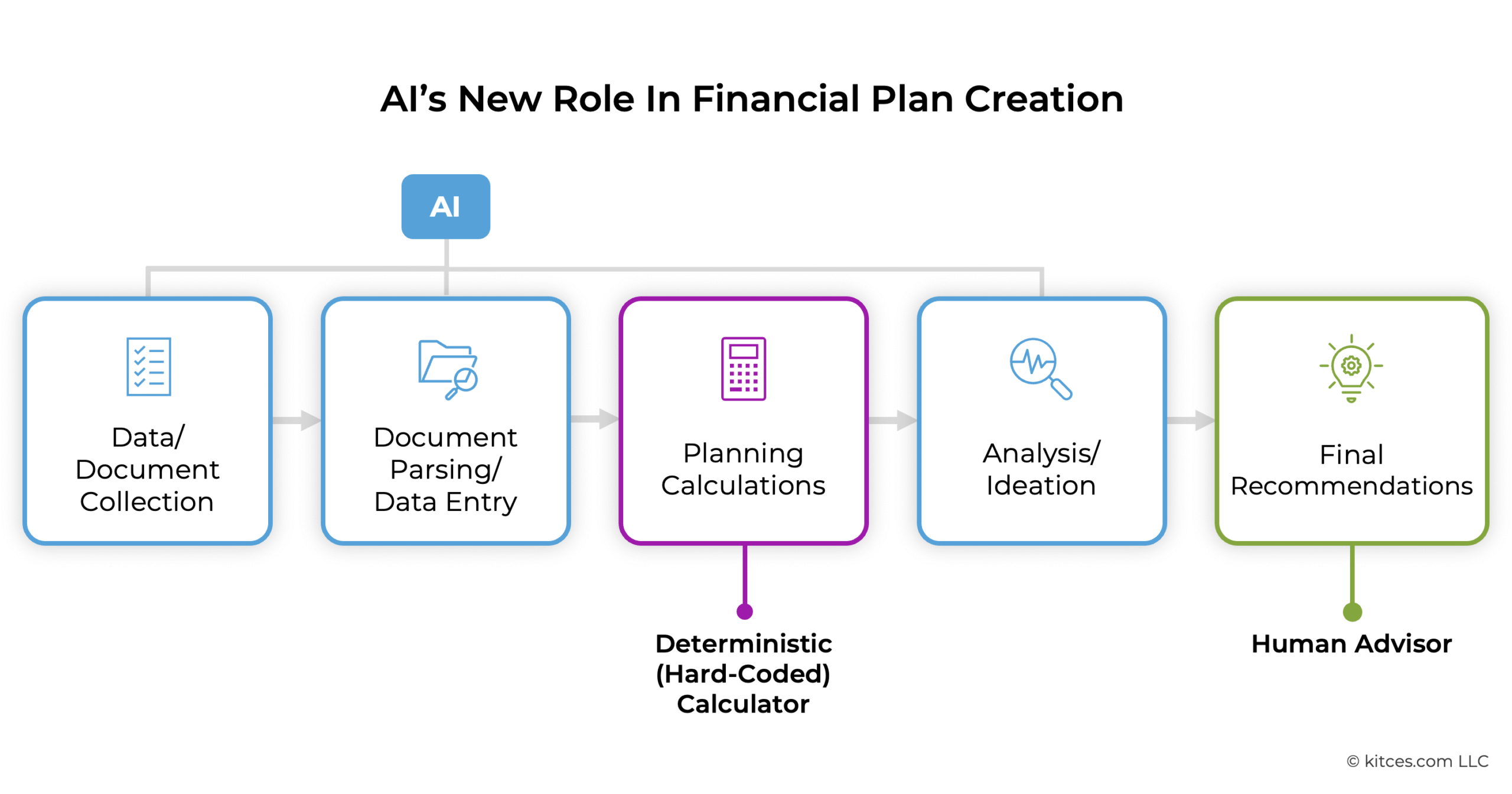
What remains to be seen, however, is whether or not advisors will warm to this AI-enabled approach to financial planning. There's no doubt that AI could cut significant time from the time needed to build a comprehensive financial plan: According to the most recent Kitces Research on Advisor Productivity, a new financial plan can take from 15–25 hours of team time to create, with the bulk of that time coming in the laborious data collection, data entry, and analysis stages that AI now promises to expedite. Except for many advisors, the amount of time it takes to build a whole financial plan is an indication of how much importance they place on the plan's accuracy and depth for producing reliable recommendations. Historically, advisors have been largely unwilling to sacrifice plan depth for time savings, as evidenced by the number of 'Planning Light' options on the AdvisorTech Map that have failed to gain much traction, and even MoneyGuidePro which is arguably the 'lightest' of the Big 3 planning software providers with its more focused goals-based approach. The most popular financial planning software platforms today, eMoney and RightCapital, are among the most in-depth and time-intensive to create plans in, not because they're needlessly inefficient but because they produce plans in extensive depth and breadth. Although AI may be able to cut down significantly on the time it takes to create a plan, that won't matter if advisors don't feel like the plan they create captures the full scope of the client's financial situation or the planning scenarios that are possible.
Ultimately, given how slowly shifts in the financial planning software landscape tend to occur (because even with new innovations in the space, advisors just really don't like to change their software or deal with the hassle of moving hundreds of client plans onto a new platform), it will likely be several years before we see how the effects of AI are playing out. Notably, new generations of AI-native software can have a disruptive effect on incumbent platforms, even in the slower-moving realm of advisor technology: See, for instance, the CRM space where incumbents like Wealthbox and Redtail that were relatively slow to adopt AI are seeing pressure now from startups like Slant. But switching CRM platforms is a different beast than switching from one financial planning software to the other, because the latter gets much closer to the heart of the advisor's value proposition for their clients. But if AI really can deliver on its promise to streamline plan creation without sacrificing depth or accuracy, then over time we might see the makeup of the "Big 3" shift once again, as today's AI-native startups (eventually) become the established incumbents going into the next innovation cycle.
Savvy Raises $100M And Launches White-Label 'Custody' Platform, But How Many Advisors Want To Pay A Revenue Share For A Technology Platform?
When a client pays a financial advisor an advisory fee, a significant portion of that fee goes to pay for the support services and technology that the advisor needs to be able to serve their clients (compliance, trading and reporting, marketing, client service, and so forth), with the rest going to the advisor as compensation and to the advisory firm as profit. Although every advisory fee involves this allocation of dollars, the way that those dollars are allocated and paid out depends on how the advisory business is structured. If the advisor owns their own practice, they pay all of their own expenses out of their fee revenue and keep the remainder as profit. But if the advisor instead affiliates with a larger entity such as a corporate RIA or broker-dealer that covers at least a portion of their overhead costs (like compliance, technology, or centralized trading), then what the advisor receives as income represents a percentage of their gross fee revenue (e.g., an 85% payout) – or when flipped around, the portion that the advisor doesn't receive represents their 'payment' to the affiliate platform for the support services that platform provides.
There is a wide range of different types of affiliate platforms with an equally wide range of payout rates. Some offer little more than SEC registration (and associated compliance support) and E&O insurance while others go further to provide back-office and portfolio management, technology, marketing and branding, office space – covering virtually everything the advisor would need except the actual client meetings that the advisor does themselves. But in general, the more support and services an affiliate platform offers, the higher percentage of their advisors' fee revenue the platform keeps for itself, to cover its own costs in providing those services (as well as to generate profit for the platform's owners).
There's certainly a value proposition in supporting financial advisors in the functions that they need to serve their clients (and that the advisor isn't necessarily best suited to do themselves), especially since most advisors got into the business to service their clients (not to pick technology, handle compliance, and manage staff), which makes many advisors willing to pay a percentage of revenue to affiliate platforms who can provide that support staff infrastructure.
The issue, however, is that many of the expenses that the platforms cover represent fixed overhead costs: Other than investment management (which is typically paid on basis points since it's directly tied to an AUM-based advisor's revenue stream), most advisory firm costs don't expand directly with the size of the client base or the amount of revenue the advisor generates. At the least, this means affiliated platforms often have a graduated fee structure where advisors pay a smaller percentage of their revenue as the firm itself gets larger. Still, as advisors grow their book of business, the amount that they pay their affiliate platform can grow beyond what it would cost for the advisor to find and pay for those services themselves as an independent RIA. At which point the only thing keeping them affiliated with the platform is either their simple unwillingness to launch their own firm and take on the responsibility of building and managing it all, or the difficulty in replacing the services and/or technology the platform is offering. Which means from the platform's perspective, the more reliant the advisor is on the platform's support and the more difficult it would be for them to switch to new tech and service providers, the harder it is for them to break free.
In this light, it's notable that Savvy Wealth, an RIA platform that's distinguished itself by building out in-house (AI-centric) technology for its affiliated advisors, has announced September 2026 the launch of a new custodial platform available to both Savvy and non-Savvy advisors, which comes on the heels of a $100 million capital raise – both of which appear to signal a shift in focus for the company from being an RIA with a proprietary tech platform to being a technology company that happens to have an affiliated RIA (as ultimately, tech firms can add tech users and grow faster than RIA service providers that have to add one advisor and hire one service team member at a time).
Savvy's custody platform is not self-clearing, but instead serves as an introducing broker-dealer on top of Fidelity's National Financial Services (NFS) – in effect, Savvy is a technology layer for directing account openings, money movements, and trading while NFS handles the actual custody and clearing. This is notably similar to how Altruist worked in its early days as an introducing broker-dealer on top of Apex Clearing before it became its own self-clearing custodian in 2023, and how TradePMR is layered on top of First Clearing, and raises the question of whether Savvy sees itself as being a potential competitor to Altruist – except whereas Altruist offered its core trading and reporting technology for 'free' to advisors who custodied on its platform (since it could make enough money on the custody itself to give away the technology), Savvy's non-custody technology is still only available to advisors who affiliate with and pay a portion of their revenue to Savvy's RIA.
Which raises an interesting question about how Savvy's offering differs from what advisors could buy directly with third-party software to help with custodian onboarding (e.g., Docupace, OnBord, or Skience), or find on an existing custodial platform like Altruist. With Altruist's technology expanding beyond custody and portfolio management and into AI-enabled meeting support, tax, and financial planning via its Hazel AI platform (and most likely a CRM offering to follow?), there's less to differentiate a company like Savvy based on technology alone – but when technology is one of its main selling points for advisors to affiliate with it, there seems to be less of a reason to pay a percentage of revenue to Savvy when an advisor could get a similar level of technology from Altruist for the $300/month that the highest-tier Hazel offering costs (or more generally paying a monthly SaaS fee to any number of third-party providers that help with custodian onboarding). Which isn't to say that Savvy can't or doesn't offer value beyond its technology platform, but as the competition from platforms like Altruist ramps up, the pressure will be on Savvy to demonstrate that it provides real support in areas like compliance and marketing – not just self-serve technology that advisors can find elsewhere for a SaaS fee – to justify its revenue-based platform fees.
And so this is the Catch-22 that Savvy is ultimately facing. The more that it continues to plow its funds into technology investments and automate what historically were support-staff services, the less differentiated it becomes from a 'pure' technology company – at which point it faces a pricing challenge to have a percentage-of-revenue model when advisors are more accustomed to paying flat SaaS software fees to get something similar elsewhere. Whereas if it invests more into the support services it provides for advisors who affiliate it, it starts to look more like a 'normal' corporate RIA, which will have a harder time attaining hyper-scaling growth speed and the tech-company valuations and eventual IPO that it's seeking – but it will have a better chance of retaining the advisors on its platform who will have a harder time replacing those services on their own.
The key point is that while some advisors will always prefer to be affiliated with an advisor platform because they simply don't want to bother with owning and managing their own RIA, the technology that's available to independents is rapidly catching up, and the lines that have been drawn are that technology is a flat SaaS fee for software, while service-providers providing overhead staff support get a percentage of revenue to fund the growing volume of staff it takes to provide those services to more and more advisors – which means that even as RIA platforms implement tech to be more efficient service providers, they will arguably still need to offer services beyond just technology to retain advisors with a percentage-of-revenue-based platform fee.
Luminary Raises $22M As Deeper Specialized Planning Tools Remain Safe From Feature Expansion (For Now)
In the early days of financial planning, much of advisors' focus was on analyzing a client's future savings needs, e.g., for retirement or for living expenses if a working spouse passed away, with the ultimate aim of recommending financial products to fulfill those needs (for which at the time the advisor was usually paid a commission on the sale). And so the earliest financial planning technology, from the HP-12C calculator to early software like Financial Profiles and PLANMAN, was about projecting those future needs against what assets the client had available to quantify the gap between the two. Subsequent generations of financial planning software have expanded on that formula, from detailed cash flow-based tools like NaviPlan and MoneyTree to goals-based software like MoneyGuidePro to Monte Carlo analyzers like eMoney and RightCapital, but at their core they haven't veered far from the original purpose of projecting the client's current situation into future scenarios.
But over time, as the industry shifted largely from commission-based to fee-based business models and from investment-centric to comprehensive financial advice, the financial software grew to become more comprehensive as well. Software that was once mainly focused on retirement savings now had separate modules for things like budgeting, education planning, Social Security optimization, tax planning, and estate planning. However, the farther away those modules got from the software's core function of cash flow projection, the less depth it tended to provide. For instance, a tax planning module might be able to break down the client's Federal tax situation in detail, but it couldn't provide many state-specific tax considerations. Or an estate planning module might be able to give an overview of a basic will or revocable trust-based plan, but it might not be able to handle more complex irrevocable trust-based situations. Which created an opening for more specialized software tools to fill those gaps for advisors who wanted to go deeper into certain planning areas, from providers like Income Lab for detailed retirement projections to FP Alpha and Luminary for estate planning to Holistiplan for tax to StockOpter (now Grantd), Trayecto, and Gemifi for equity compensation (among many other specialized planning providers on the Kitces AdvisorTech Map).
From an advisor perspective, it's good to have specialized planning software available to fill the gaps that a 'comprehensive' platform doesn't cover. But from the software providers' perspective, it's a hard road to make specialized planning software work as a business model. They need to be popular enough to generate sufficient revenue to keep the business profitable, but at the same time, if they become too popular, the comprehensive planning platforms might take notice of their success and decide to replicate their functions inside the comprehensive software – effectively running the risk of becoming a victim of their own success. And at the same time, as the cost of building new software has gone down with the rise of AI coding tools, it's also become easier for individuals to make their own specialized tools to handle what their comprehensive software doesn't already do, which puts further pressure on standalone planning tools to offer more than what an advisor can now conceivably build themselves.
However, as shown by the estate planning software provider Luminary's announcement of a new $22 million capital raise this month, it's still possible to find success as a specialized planning software provider that can truly go deeper than either comprehensive planning platforms or advisors' homebuilt solutions are able to.
Luminary came about among the newer generation of estate planning software that includes Wealth.com, Vanilla, and FP Alpha, which use AI to scan and analyze a client's estate planning documents and pull in data from other platforms to quickly visualize the client's estate picture. Advisors can then model specific future scenarios and compare the potential outcomes between different strategies. All of which up until fairly recently involved a laborious process of reading estate documents, pulling numbers from account statements or portfolio software, calculating different scenarios in Excel, and formatting the results in a PowerPoint deck, which represents a lot of time savings for advisors who frequently do estate planning work.
The caveat is that there's a limited number of advisors who do the kind of in-depth estate analysis that Luminary enables. With the Federal gift and estate tax threshold now exceeding $15 million per person ($30 million for couples), very few clients need to rely on complex trust-based plans to avoid Federal estate taxation (and while a number of states have their own estate or inheritance taxes that kick in at lower levels, state tax rates are typically much lower than the 40% top Federal rate, creating a higher breakeven for when it's worth it to set up a trust-based plan). And for those clients who do need that level of estate planning analysis, it isn't something that they need every single year – in most cases, they'll only need to revisit the plan every 5–10 years at most. Which is why most other providers of estate planning software, like Vanilla and Wealth.com, also offer some form of estate document preparation, to cover clients whose main estate planning need is just to have some documentation in place at all (or, like Valur, offer trust administration to be able to earn money on the implementation of the plan rather than just the plan itself). So it makes sense why Luminary's outside funding (which now totals $31.5 million) seems relatively modest compared to estate-planning-plus-documents providers like Vanilla (which has raised $81.4 million in total), Trust & Will ($82.2 million) and Wealth.com ($111 million).
That said, however, the reality that the depth of planning that Luminary enables is relatively rare among financial advisors ironically means that it isn't as likely to be co-opted by comprehensive planning software as other tools are. It wouldn't likely be worth it for a tool like RightCapital to introduce an estate planning module that goes as deep as Luminary, so as long as Luminary stays in its lane of deep-level estate analysis, it should remain protected from being undermined. Further, in opening itself to estate attorneys, CPAs, and trust administrators as well as financial advisors, Luminary isn't as vulnerable to disruption as a tool that sells solely to the RIA channel.
Ultimately, Luminary's fundraise stands out as a silver lining amid a specialized planning landscape that has been through some turmoil lately amid competition from comprehensive planning platforms and self-built options. But as Luminary shows, providers that go in-depth into niche areas that the comprehensive planning platforms won't go into, and where the complexity (and stakes of getting things wrong) is too high for a home-built solution, have an argument that the future of advisor technology will continue to have a place for them.
FP Transitions Introduces A Valuation Benchmarking Tool For RIA Leaders To Dive Deeper Into Their Business Data
Many financial advisory firm founders, when they first start their businesses, don't think much about what their firm will be worth as an asset someday. They're understandably more worried about whether the business is generating enough income for them to just put food on their table and survive in the short term, and to meet their lifestyle goals in the intermediate term once they get past the startup phase. But as the firm matures, and the founders get older and closer to retirement, their thinking often does start to shift towards the value of the firm as a whole. Because while not all firm owners go into founding their firms with the intention of selling them someday, the hard reality is that eventually the founder will need to retire, and the two options at that point will be to either (1) hand it over to new (internal or external) ownership, or (2) wind it down and redirect the clients elsewhere. Option (2) isn't ideal for either the advisor (who gets no equity value for the client relationships they built over the years) or the clients (who have to start over again finding a new advisory firm to work with), so it's generally better when thinking about retirement to think about it in terms of a sale – and that means thinking about what a 'fair' price would even be.
In a relatively small and illiquid market like RIAs, it's hard to know what one firm is worth unless you know what other, similar firms have recently sold for. Which raises two additional questions: What firms are substantively similar to each other, and how much are they selling for? This conundrum goes back to the early days of the independent RIA movement, and for nearly 30 years third-party firms have been conducting research to provide benchmarking data so RIA owners can compare and contrast their own revenue, expenses, and profits (and a host of other data) against similar firms to understand which will be more or less valuable – starting with the consulting firm Moss Adams in the late 1990s, continuing with InvestmentNews which inherited the Moss Adams study, branching out into custodians and asset managers like Schwab and DFA who began to release their own benchmarking studies, and expanding further with The Ensemble Practice (led by Moss Adams alumni Philip Palaveev) launching their own annual benchmarking study in 2025.
But while benchmarking studies can be very useful for understanding broadly how a firm compares to its peers, the caveat is that benchmarking studies are static, and the usefulness of the data is heavily contingent on how it's presented in the report. For example, a report might break their benchmarking data down by revenue level, comparing firms with <$1M, $1M–$2M, $2M–$3M, etc. But in reality, a firm with just over $1M in revenue (which might still only have one full-time advisor) might be in a very different situation than one with close to $2M in revenue (which might be approaching three full-time advisors). If an advisor wants to get more granular in the firms they compare themselves to, or go deeper than the higher-level data the study provides, there's a cap to how valuable a published benchmarking study with static categories of "comparable" advisors will be to them in the long run. And because most benchmarking studies are focused on the data of firm operations – not sales or mergers – there's little in them to directly tie firm financial data to a specific valuation.
Which is why it's notable that the M&A and succession consultant FP Transitions has launched a new valuation benchmarking tool, the FPInsights Portal, to help advisors compare their own business performance metrics, and more importantly their overall enterprise value, against similar firms, as well as a new metric that it calls 'Estimated Value Index' that estimates (on a scale of 1 to 100) how well the firm is maximizing its value compared to similar firms.
FPInsights is just one of several business benchmarking tools that have cropped up in the last year-plus to help improve advisory firm owners' visibility into their own business metrics and how they compare with their peers, each of which has used this data for a slightly different purpose. For example, Vitals AI sought to help advisors organize (and often to clean) their business CRM data to be able to understand the health of the business and the profitability of its advisors (but alas ultimately decided to shut down), while AdvisorEconomics (which was co-founded by Michael Kitces) is meant specifically for firms in 'growth' mode, pulling data from the advisor's accounting software and calculating a set of Key Performance Indicators (KPIs) based on the number of clients, advisors, and firm owners to help drive firm growth decisions such as when to hire the next employee or if they have an opportunity to cut overhead costs. In contrast, FPInsights is more specifically geared towards business valuation, whether that's for an external sale or outside investment, internal succession transactions, or loan underwriting for the firm to finance its own acquisitions.
The key point is that while it's one thing to have raw financial and business data on hand – whether that's one's own advisory firm data, or data from a published benchmarking study – it's hard to put that data to use (e.g., to make better business operating decisions to drive firm growth or to improve business valuation for an eventual sale) without cleaning data and being able to contextualize it into what is "normal" (i.e., proper insight into what similar firms are doing). And although many of the firm owner's decisions might be the same regardless of whether they are trying to grow their revenue and profitability or the valuation of the business itself (because at the end of the day a growing and profitable business is likely to be one that someone is willing to pay more for), it's helpful to have multiple solutions available so firm owners can see what they're doing in the context of where they want to be, be it a growing firm that they are continuing to operate and scale up, or a successful sale that allows them to ride off into the sunset.
SEC Examination Requests Reveal A Focus On Technology And Training (And A Future Crackdown On Unsupervised AI Use?)
Like any piece of technology, AI has a learning curve. Although anyone can type a prompt into a ChatGPT or Claude chatbox, it often takes repeated rounds of prompts (and sometimes extensive back-and-forth) to actually get what you want out of it. As a result, there are some people who try it out, play around for a little while, and eventually lose interest, while others will keep at it to learn the art of prompting and eventually move on to more complicated uses like analyzing documents or creating agents to perform routine, multi-step tasks. But even though there's a degree of skill involved in prompting, it's still done in plain English: Building something with AI doesn't require learning a whole other language (as it does if you want to learn how to build things in, for instance, Python or Java). Which means that it doesn't take much more than a weekend of work to get pretty good at getting AI to do at least moderately complex tasks, including pulling data from other sources (such as off the Internet or from files on the user's computer) to perform tasks with.
On the one hand, this might seem like a positive for advisory firms, since with a little creativity and a relatively minimal amount of one-time effort an employee can revamp a manual process to be automated by AI, saving them time and allowing them to be more productive elsewhere. But on the other hand, there are fairly significant downsides to advisory firm employees having the ability to build AI tools from scratch, most prominently when it comes to client data (which advisory firms are required to protect under SEC Regulation S-P). If the employee is using a 'free' version of ChatGPT or Claude, any information (including client data) that they put into the AI will generally, by default, be used by the AI model for training purposes, effectively feeding the client's personal information into the AI model. And even if an employee takes care not to directly enter client information into the AI (or uses a paid version that doesn't train on information entered by the user), an AI agent that they create to perform a certain task could still find its way around whatever safeguards the RIA has in place to protect client data. Having a handful of (amateur) software developers on staff creates risk for advisory firms that often take great pains to evaluate third-party vendors precisely to manage the risk of client data being inadvertently exposed.
It's notable, then, that the SEC is reportedly taking an interest in how advisors train and supervise their employees regarding their use of technology, including AI. Which reflects the inclusion of "training and security controls that firms are employing to identify and mitigate new risks associated with [AI]" on the SEC's list of 2026 exam priorities, and their particular focus on compliance with Regulation S-P (which took full effect in June of 2026).
Notably, the SEC hasn't announced whether it has fined or otherwise warned or disciplined any advisory firms regarding their employees' AI use. On one level, it would seem to be similar situation in recent years when the SEC levied fines on multiple firms for failing to supervise employees' use of off-channel communications (such as sending messages about client work to colleagues via text or messaging app rather than going through company-approved and monitored channels). Every company that has employees who act as 'citizen developers' using unapproved AI tools to ask client-related questions or build automations for client work could hypothetically find itself at risk of a similar fine – however, it's unclear as of yet whether the Trump-era SEC will be as willing to levy such fines on RIAs as it was under the Biden administration. It's possible that, rather than starting with outright fines, the SEC takes what it learns from this round of examinations and issues new guidance to help RIAs clarify their own policies around managing and supervising AI at their firms.
In the meantime, though, it's important for RIAs to be aware of the risks that AI tools – both authorized and unauthorized – present, and account for both in their policies and procedures. An RIA might decide to simply ban all use of Claude or other general-use AI apps, but that won't always mean that employees will abide by those restrictions – it may simply push their use to where the RIA can't see it. It may be better instead for RIA leaders to first take stock of how their employees want to (or do) use AI, which tools they use, and whether there's a way to use them within the firm's client data protection policies. That way, they can vet the tools through the firm's standard approval process (possibly signing up for an enterprise license where the data is auditable and not used to train the LLM), and supervise how employees use them (including archiving the prompts that the employees use, which may be fair game for the SEC to request).
The bottom line is that, while it may be a stretch to say that AI use by employees is an inevitability, there's at least a strong likelihood that advisory teams will have at least one or two people who are interested enough in the widely-available AI tools to make some use of them for work purposes. Firms that don't yet have a policy on their employees' AI use, or who have a policy (or even an outright ban on AI tools) that employees aren't following, might find themselves needing to make adjustments sooner than later if the SEC continues to probe the topic in its examinations – even if it isn't yet handing out outright fines or disciplinary measures.
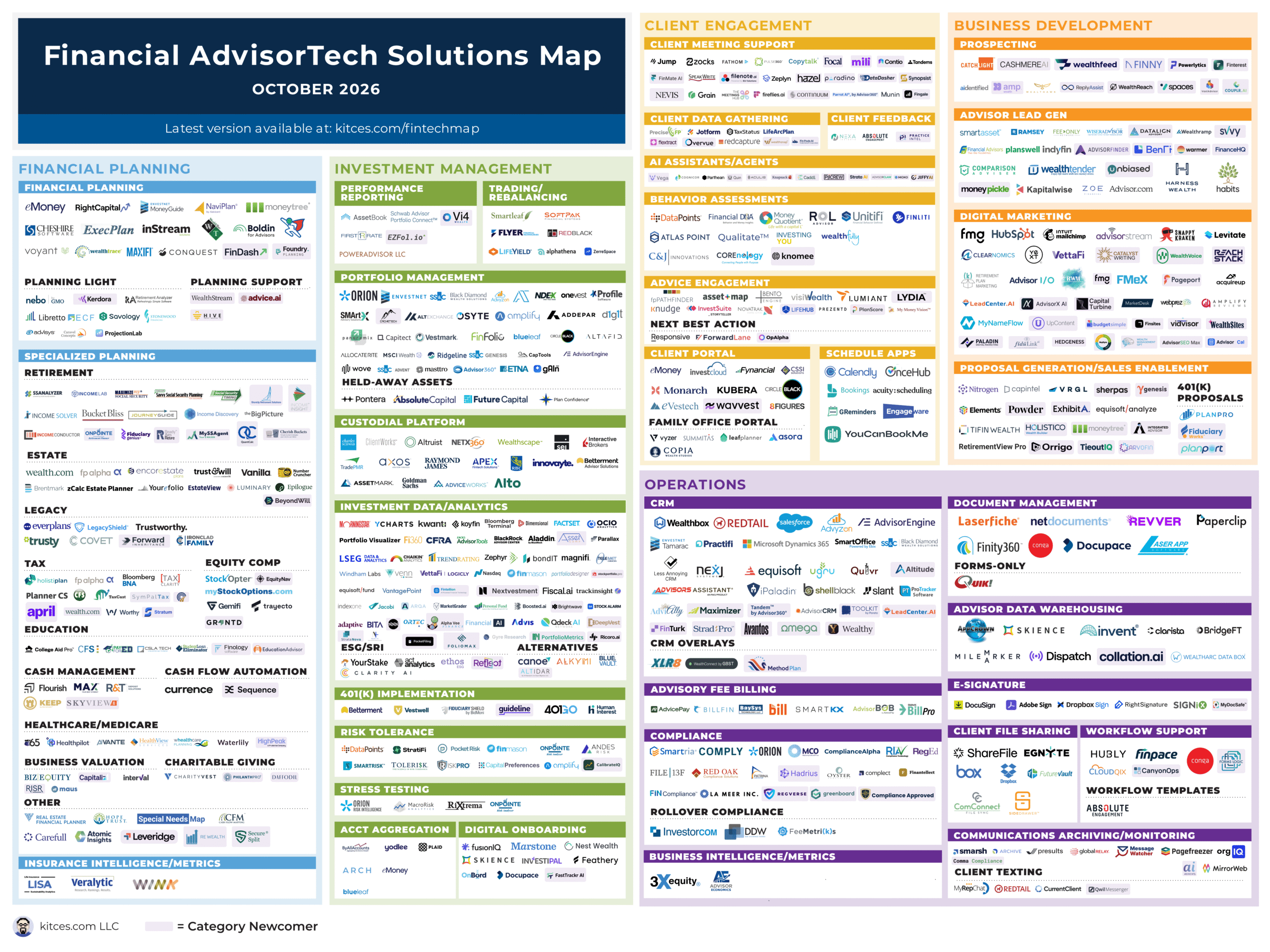
In the meantime, we've rolled out a beta version of our new AdvisorTech Directory, along with making updates to the latest version of our Financial AdvisorTech Solutions Map (produced in collaboration with Craig Iskowitz of Ezra Group)!
So what do you think? Does Claude For Financial Advisors offer enough capability to make it worth the enterprise-tier subscription and token fees (on top of the technology that the advisor already uses)? Do AI-enabled financial planning tools like Hazel and Conquest threaten to disrupt the incumbent platforms (or at least gradually supplant them, given the historically slow pace of change in that category)? Does Savvy's technology-forward RIA platform offer substantive support beyond what advisors could get from a different tech provider at a flat subscription rate instead of a percentage of revenue? Let us know your thoughts by sharing in the comments below!





Leave a Reply