
Executive Summary
Welcome to the July 2026 issue of the Latest News in Financial #AdvisorTech – where we look at the big news, announcements, and underlying trends and developments that are emerging in the world of technology solutions for financial advisors!
This month's edition kicks off with the news that Salesforce, RightCapital, and YCharts have all launched their own new AI capabilities, from internal notetakers to capture meeting notes, to analyzers that help to craft better planning recommendations and automatically solve for desired client goals, to document extraction tools that expedite the process of analyzing a prospect's existing portfolio and developing a proposal. Which marks a rising trend of "The Incumbents Strike Back" as standalone AI providers have threatened industry disruption, but the fact that advisors are slow to switch software means that now existing leaders in the major AdvisorTech categories are developing their own versions of the same AI capabilities to retain their advisor users and preempt their disruptors!
From there, the latest highlights also feature a number of other interesting advisor technology announcements, including:
- AI Notetakers like Jump and Zocks are developing their own expanding capabilities, from Jump's new account onboarding automations (that can kick off directly from the client information and action items collected in a new-client meeting) to Zocks' rollout of Client Queries (that allow advisors to ask questions about their aggregate client base to spot new business opportunities)… capabilities that unto themselves represent useful incremental improvements, but in the long term appear to put the AI notetakers on a slow but steady collision course with traditional CRM systems (eventually forcing advisors to choose which they will stick with in the long run).
- New roll-up Arca emerges from "stealth" mode with a $48M capital raise, while Farther raises another $150M to fuel its own growth, as the new generation of tech-enabled RIA platforms make the case that engineering talent can build internal proprietary all-in-one tech platforms good enough to materially improve their advisor productivity and margins (even as the past 20 years of AdvisorTech improvements have failed to produce any reduction in the typically-40% overhead expense ratio of large advisory firms!?).
- WealthReach raises a $1M seed round to support the development of their "Living Sites" platform that leverages AI to create more dynamic SEO- and AEO-friendly websites, with content that can more continuously update to make the sites appear fresh and attractive to search engines, as the ongoing drive for organic growth shifts more advisory firms to finally pivot their websites from 'digital marketing brochures' to become differentiated websites that are actually findable by new prospects (at least for advisory firms that are differentiated enough in their own value proposition to support a differentiated website in the first place!?).
Read the analysis about these announcements in this month's column, and a discussion of more trends in advisor technology, including:
- Edward Jones takes a minority stake in Quicken, as the firm seeks to delve deeper into financial planning and enable its advisors with more tools that support good financial planning conversations with clients… but raising the question of why Edward Jones felt the need to invest into Quicken rather than just leverage its existing MoneyGuide contract, or pursue more "modern" personal financial management solutions like Monarch Money (or simply purchase Mint.com before it was shut down)?
- As advisory firms continue to invest into data warehousing solutions to create new AI orchestration layers, a deeper look at what they're actually building reveals solutions that are remarkably non-AI in their nature, from automating address updates across multiple systems to facilitating billing and advisor payouts and improving onboarding processes… raising the question of whether firms really need to be investing so much into centralized data to facilitate their AI initiatives, or whether their AI initiatives are simply becoming the impetus to finally establish more systematic processes and begin to better use the APIs of their existing providers to implement the deterministic non-AI workflows they needed all along?
And be certain to read to the end, where we have provided an update to our popular "Financial AdvisorTech Solutions Map" (and also added the changes to our AdvisorTech Directory) as well!
*To submit a request for inclusion or updates on the Financial Advisor FinTech Solutions Map and AdvisorTech Directory, please share information on the solution at the AdvisorTech Map submission form.

Incumbents Strike Back Against Standalone AI Tools As Salesforce, RightCapital, And YCharts All Launch Their Own AI-Enabled New Capabilities
At the end of November in 2022, ChatGPT went into public release and took the world by storm. Within three years, it had reached 1 billion active monthly users (the fastest pace any tech company had ever reached that level of adoption), and predictions were rampant that the world was on the cusp of mass unemployment as ever-more-capable AI models threatened to displace a growing amount of white-collar workers, or at least to displace a wide range of existing software platforms as an incredible amount of capital was raised to build "AI for ____" across most major software categories and industry verticals.
Amongst financial advisors, the industry found relatively quickly that ChatGPT didn't actually seem to be a direct threat to what are still very human-based advisory relationships of trust. But that didn't slow the interest in creating AI software for advisors, especially as the emergence of AI notetakers quickly became the fastest-growing software category in the history of financial advisors. In turn, the success (in growth and capital-raising) of solutions like Jump and Zocks spurred an advisor-specific wave of new AI-driven startups, from investment research tools like DeepVest and Brightwave, to specialized planning tools from FinDash and WavVest, to Wealth.com, to document extraction like VRGL and Flextract, and prospecting tools like WealthFeed and Finny. The overarching thesis was "disruption" – that new AI-driven solutions would rapidly surpass existing incumbents, leading to rapid disruption across the AdvisorTech Map (and rapid growth to justify often-lofty valuations).
Except the reality is that financial advisors change software very slowly; as Kitces Research on Advisor Technology shows, only about 3% to 5% of advisors report an intent to change software in any particular category in any particular year (driven in part by the fact that clients only tend to leave advisors at 3% to 5% per year, and advisors usually only change platforms at a 2% to 3% switch rate). Which means there's actually remarkably little impetus for any kind of disruption to occur in AdvisorTech, simply because most advisors aren't changing their software platforms fast enough for disruption to happen!
Consequently, at best, a change in software leadership in any AdvisorTech category takes a lot of time. (In point of fact, there were still software platforms in the mid-to-late 2010s "finally" switching from desktop to cloud-based solutions, a future-of-technology trend that had started nearly 15 years earlier!) And at worst, the slow pace of advisor tech changes actually creates risk that the disruptors will themselves be disrupted, as it gives time for incumbents to see what the newcomers are building, and start building their own version of the same features. Which incumbents can potentially gain rapid adoption, because they already have the existing user base and/or enterprises to cross-sell new capabilities to.
Accordingly, it is not surprising that this month there was a slew of announcements from long-standing industry incumbents about their new AI capabilities (to compete against various 'disruptors'). For instance, Salesforce built into its Agentforce for Financial Services a series of new AI tools, including a "Meeting Concierge" (draft summaries of meetings, queue up follow-up tasks, prep briefing for next meeting), "Run My Day" (to help prioritize tasks and highlight at-risk client signals to act upon), and Enhanced Client Details Page (that gives a more AI-commentary style summary of a client integrating all their info together), warding off the competitive capabilities of AI notetakers like Jump and Zocks. RightCapital's new "Iris" AI helps to scan for gaps in client data or spot inconsistencies, identify key planning issues in their projections, and make it easier to "solve" for certain planning scenarios. YCharts' launch of "Y" not only provides AI-driven support for investment analyses (analyze a portfolio to spot key risks, facilitate portfolio comparisons), but can also provide real-time written commentary on what's happening in markets (to brief the advisor, or prepare as a newsletter or communication to clients), and facilitate document extraction (e.g., pulling numbers from statements or spreadsheets to plug into the portfolio analysis or proposal generation tools) akin to VRGL and Flextract.
For advisors, new capabilities like this are appealing, if only because it reduces the number of components in the advisor's tech stack, which both saves money (fewer tools that each often require another $99+/month to buy, as recent AdvisorEconomics data shows technology-per-employee spending has been on the rise in recent years), and reduces the pressure to figure out what integrates with what (native AI capabilities "automatically" integrate with the core incumbent platforms they're built within). To some extent, such expanding AI capabilities from incumbents even reduces the pressure to try new emerging AI tools, when advisors can be reasonably confident "knowing" that their existing platforms will eventually roll out their own versions "soon enough".
For the broader industry, this highlights the reality that AdvisorTech success, and "disruption", is less an engineering conversation (figure out how to make great software that can disrupt the industry), than a distribution/go-to-market conversation (how do you actually get to critical-mass adoption in an environment where relatively few advisors change software in any year?). Simply put, AdvisorTech is a tough market to break into, and incumbents often do have time to replicate features of newcomers, and prevent or at least slow their competitive growth. Accordingly, it's notable that the biggest category of AI growth was the one that largely created its own category – AI notetakers – and didn't have any incumbents to compete against. Yet even there, the CRMs are now starting to strike back as Wealthbox and now Salesforce build their own AI notetaking capabilities… which may not fully stop the momentum of Jump and Zocks, but at the least doesn't bode well for the other 10-20+ providers trying to compete in that category as well?
Ultimately, though, the real question will be whether the incumbents can actually build AI capabilities as good as (or at least "good enough" to compete with) the standalone AI solutions? In practice, it may depend on the category, as some are easier for incumbents to replicate than others. Yet at the same time, startups that do get enough momentum have the opportunity to compete against the incumbents on their own ground (e.g., will Jump/Zocks build their own CRMs to try to take market share from Wealthbox and Redtail?). And in some cases, it may simply be that an incumbent-competing feature set that also has AI capabilities becomes the competitor (e.g., Slant as the "AI-native CRM"). But the bottom line is that AdvisorTech is really not so disruption-prone, it's much more evolutionary than revolutionary. As the saying goes, we overestimate the amount of change that will come in two years… yet beware complacency indefinitely, as the saying also notes that we tend to underestimate the amount of change that can still occur in 10 years?
AI Notetakers Roll Out New Capabilities To Defend Through Expansion, As Jump Builds Account Opening And Zocks Develops Client Queries
Because "disruption" in AdvisorTech is rare (due to the slow pace at which advisors change their technology at all!), it's notable when newcomers really do experience rapid growth and adoption. For which AI notetakers is arguably the fastest-growing new AdvisorTech category ever, with providers like Jump and Zocks reaching upwards of 40,000 advisor users in barely two years. In part because they lived at the nexus of a significant need and opportunity (when advisors already spend nearly 1 hour of prep and follow-up time for every 1 hour of client meetings, there is a lot of time saving potential on the table!), and didn't have to displace existing tools because they represented an entirely new set of capabilities that simply didn't exist until Large Language Models (LLMs) came forth to make it possible.
The rapid growth of the category creates a huge slew of imitators, in part because the approach of AI notetaking became so popular, across so many verticals, that platforms like Recall.ai were built to easily plug into the common meetings platforms, and further expedited the launch of new industry-specific versions of notetakers. At that point, the differentiator wasn't simply whether an AI notetaker could be engineered; it was the use cases specific to that vertical, its regulatory/compliance needs, and industry-specific integrations, that began to distinguish the leaders from the rest.
In the context of AI notetakers for financial advisors, this meant deep integrations to CRM systems, as in the advisor context CRMs are both the system of record (for recording documentation for compliance purposes), the task management system (where workflows occur), and the source of truth for intelligence about the client relationship (from capturing meeting notes for future reference, to prepping on client information for the next meeting). The more tightly integrated the two were (notetaker and CRM to record those notes), the more appealing the industry-specific provider was over a 'generic' competitor, and the less the risk of being displaced.
Except the other challenge with the rise of solutions like Recall.ai facilitating the easy stand-up of AI notetaking capabilities is that CRM systems themselves could also quickly build their own versions, leading to rollouts from platforms like Wealthbox, and Advyzon, and PractiFi (and more recently Salesforce), and the rise of new "AI-Native CRM" providers like Slant. Which started to raise questions of how the AI Notetakers would avoid the CRM providers (re-)capturing adoption over time with an on-platform solution, and whether they would eventually have to become CRM systems to prevent being displaced by them.
In this vein, it's notable that this month several of the leading AI notetakers announced new expanded capabilities that are going beyond their original "notetaking" feature set, from Jump building out account opening and onboarding capabilities (allowing new client onboarding to begin directly from the new-client meeting that Jump already captured), and Zocks launching Client Queries that help financial advisors scan their existing book of clients for new opportunities or places to focus (e.g., "which of my clients have at least $500,000 of held-away assets and are due for a review this quarter" or "which clients have had a significant age milestone in the past few months but haven't been contacted recently").
As standalone features, both developments make sense unto themselves, as each represents capabilities adjacent to what the notetakers already do… Jump already captures client meetings from which new accounts may be initiated so better queuing up those workflows makes sense, and Zocks is already capturing rich data on clients for which a deeper ability to query to find opportunities also makes sense. For advisors already deep in the respective platforms, the capabilities are another touchpoint to expand what happens within the AI notetaking tools they're already doing.
Yet at the same time, it's notable that "looking up information about clients to take action upon" (akin to Zocks' Client Queries) is a long-standing CRM function, as are the "manage the new account-opening workflows" that Jump is now building. And developing these features requires a further deepening of the underlying capabilities – the breadth to which the tool can serve as (or access other) source(s) of truth on client data, and initiate and execute workflows. Which implies that the platforms are building the underlying components to be CRM systems in the future – potentially inching ever closer towards their own CRM offerings? – even if thus far they're only offering narrower features to solve for immediately-adjacent needs.
Ultimately, though, the reality is that advisors will still only want to drive the actual CRM functions from a single place; the more that AI notetakers replicate components of what CRMs typically do as a system of record and a system of action, the more conflict advisors themselves will feel about "which software do I log into for which function", creating the proverbial "swivel chair of software" that has already created growing angst amongst advisors in recent years. Which means in the long run, AI notetakers still can't 'just' solve for an expanding series of use cases and workflows adjacent to notetaking… the further they tread into the territory of what historically has been done within CRM, the more they will risk being displaced as the 'redundant overlap' by the CRM providers build their own AI notetaking and workflow capabilities from the other direction… or be compelled to truly become competing CRM systems themselves?
Arca Emerges From Stealth With $48M Capital Raise While Farther Raises $150M In The Hopes That (AI-Driven) Proprietary Tech Can Drive Higher Productivity Advisor Roll-ups?
The financial advisor business has long used various formulas to allocate and split up the revenue associated with a (new) client. In the "old" days, the rough rule of thumb was a 25/25/25/25 split between whoever was able to Find them (i.e., sourced the prospect), Bind them (i.e., get the prospect to sign and become a client), Mind them (i.e., provide the service), and Grind them (i.e., do the administrative paperwork grind).
For an advisory firm that otherwise ran a 20% profit margin – which meant the Find/Bind/Mind/Grind was carving up the other 80% of the revenue – this effectively resulted in the advisory business spending 40% of revenue on the advisors who brought in the clients (Find and Bind them), and 40% on overhead (Mind the clients and Grind the work). Which early practice management consultants like Mark Tibergien dubbed the 40/40/20 rule (40% direct expenses to advisors, 40% overhead, and 20% profit margins), as highlighted in his seminal book, "How to Value, Buy, or Sell a Financial Advisory Practice".
Notably, though, these "rules of thumb" (though in reality, they weren't just rules of thumb, they were very much substantiated as reality by the benchmarking studies that Mark Tibergien and Moss Adams were running in the 1990s and 2000s), were built in an era where a "large" advisory firm had $100M of assets, and a "mega" firm was trying to grow to $1B of AUM. As advisory firms have grown far larger over the past several decades, where large firms may now have billions of AUM and mega firms have 10s and are growing towards $100+ billion in assets, the race has been on to leverage ever-larger firm sizes to create economies of scale that would allow advisory firm margins to expand.
In the decade of the 2010s, this thesis largely played out through the efforts of various "aggregators" that sought to bring together multiple advisory firms with duplicative overhead, obtain cost synergies by reducing the redundancies, and taking advantage of their size to make the fixed overhead expenses it takes to run an advisory firm a smaller percentage of overall revenue… in essence, aiming to shrink those overhead expenses as a percentage of revenue down from 40% to 35% or 30% of revenue, in a path to margin improvement through scaling.
More recently, though, the focus has shifted from pursuing economies of scale by allocating fixed overhead staff and expenses across a larger base of advisors, and instead by developing more internal or proprietary technology that aims to just eliminate a portion of overhead staff altogether. Which has only amplified further in the emerging age of AI, which both reduces the barriers to entry for firms to develop their own technology to improve operational efficiencies, and the hopes that agentic AI will be able to handle more complex operational tasks that can truly result in a replacement of human staff members with fixed-cost software instead.
And so it's notable that this month, a new advisor startup named Arca emerged from "stealth mode" with a fresh $48.5M capital raise, while existing tech-enabled advisor roll-up Farther announced a new $150M capital round to further its own serial acquisitions of advisory firms, as both firms aim to capitalize on the potential of building their own (AI-driven) proprietary software to lift their productivity and operate at better margins than "traditional" advisory firms.
From the advisor perspective, the potential for any technology to make advisors more efficient is appealing; advisors are the most expensive cost in an advisory firm so any productivity improvements can quickly drop to the bottom line, and our own Kitces Research on Advisor Wellbeing reflects how strongly most advisors dislike having lots of administrative and compliance tasks or being stuck with ineffective technology, which means building better proprietary technology can also improve advisor retention. And when the average advisor rates the components of their technology stack higher than their advisor tech stack as a whole (due to the challenges of integration across so many technology components), there is clearly room for improvement.
Yet from the broader industry perspective, one of the most perplexing challenges of the scaling advisory business is the sheer lack of any economies of scale to appear in the overhead costs of running the business. As a result, while the median overhead expense ratio of advisory firm was 40% more than 20 years ago, the latest Investment News industry benchmarking study found that amongst "large" firms with an average of $26M of revenue (more than 10X the firms of old), the median overhead expenses were… 42% of revenue! Which means that two decades of the emergence of the internet, the shift to cloud-based software, the rise of "robo" and business process automation, and now the past several years of AI-enabled technology, have resulted in absolutely no improvement in overhead efficiency! In fact, the irony is that the only profitability improvements in advisory firms appear to have come from a reduction in the percentage of revenue going to advisor compensation… which is more likely a function of proprietary technology making it harder for advisors to leave and take clients, and aggregators deploying dollars for acquisitions that are tied to restrictive employment agreements (which also makes it harder for advisors to leave and take clients), than actual improvements in productivity?
Ultimately, it's possible that the robustness of the 40% overhead costs of running an advisory business are simply because we haven't invested enough yet into proprietary technology, such that the rising level of engineering talent coming into advisory firms, coupled with record flows of investor capital (with deals like Arca and Farther, and similar tech-enabled-roll-up competitors like Savvy and Compound), will eventually find a way to break the trend. Yet even then, additional questions arise: if independent AdvisorTech vendors can amortize tech development costs across thousands or even tens of thousands of advisors (the user counts at leading vendors in the major AdvisorTech categories), can any proprietary platform really develop superior software and effectively compete in most or all of the major AdvisorTech categories at once? For the time being, investors are still betting that a breakthrough is looming, where AI will either create new capabilities (that independent tech vendors can't replicate across a disparate tech stack), or enable faster and lower cost development (to allow proprietary platforms to remain competitive)… but time will tell whether the latest crop of tech-enabled advisor roll-ups can really drive better margins through operational efficiencies, or if in the end the primary beneficiaries of industry technology improvements are the consumers who benefit from better quality advice but not necessarily reflected in the margins of advisory firms that must continuously reinvest to stay competitive?
WealthReach Raises $1M In Seed Funding To Make Advisor Websites Findable And Drive Actual Organic Growth
For most of our history as financial advisors, "marketing" your practice meant "prospecting", the process of going out and sourcing new people who might someday do business with you… usually via either cold outreach (e.g., cold-calling or cold-knocking), or creating opportunities to connect and meet people (e.g., going to networking meetings, or hosting a seminar). Success was defined by how effective people were at a high-volume-rejection activity (the more "no's" you get, the closer you are to the next "yes"!?), where the end goal was to find some connection to strike up a conversion, build rapport and trust, and try to engage the prospect to become a client.
Then the internet arrived in the late 1990s, and consumers began to go online, surfing websites to find products to buy or service-providers to hire. Which meant financial advisors, too, needed to get their own websites to give consumers an opportunity to hire them. Except because the typical financial advisor had no other marketing process to get prospects to their website, the typical advisor website itself was often little more than a digital version of the marketing brochure they might have handed out at an in-person seminar (that they could digitally redirect prospects to after a seminar or networking meeting). Accordingly, most advisor website designers created "build-once, deploy-many" platforms with extremely standardized templates that allowed advisors to drop in their firm-specific marketing details, get compliance approval, and then "have a website" that prospects (or perhaps referrals) could be directed to.
Yet the reality is that websites can do so much more than just be a place to direct a prospect that the advisor has already met or been introduced to. In an era of search engines (and now AI), consumers often do their research online first, before reaching out to or engaging with a potential service-provider, and the most successful service-providers – from plumbers and electricians to doctors and financial advisors – may be identified by a future client online, researched, and by the first contact the prospect has already decided who they intend to work with.
However, this approach – where a website isn't just a digital marketing brochure for existing prospects, it's a way to be found online in the first place – doesn't work if the search engines don't surface it as a search result in the first place. Which in reality is usually the case, because so many financial advisor websites are not built adhering to the technical specifications it takes to have "good" Search Engine Optimization (SEO), don't have dynamic content (to keep the website freshly indexed), and don't have clear messaging that helps guide LLMs about when to surface this particular advisor and their website in an AI-driven search query (to support Answer Engine Optimization, or AEO). Such that in practice, most advisor websites generate few search results beyond those who were already looking up the firm by name (which unfortunately means that prospect, by definition, already knew about the advisor, and weren't actually using the search or AI engine to discover the advisor).
And so in that vein it's notable that website and advisor marketing startup WealthReach is raising $1M of seed capital to build and iterate on this, with their "Living Sites" offering that specifically aims to build and maintain websites that are engineered for good SEO and AEO, and leverages AI to create fresh and more dynamic content for the advisor's target audience (and to keep the site more favored in SEO, even developing new content pages on the kinds of topics the firm's prospects are searching for). Coupled with a tool called Convert that uses cookies to identify ~40% of visitors and tie them to an actual person (that the advisor can then monitor or outright reach out to).
For advisors, the rising industry focus on driving organic growth makes it appealing to have the potential for prospects to proactively find your website without already knowing it and searching for it by name, as a pathway to get introduced to new prospects. Yet the caveat is that even with Living Sites' dynamic content and better SEO/AEO structure, it doesn't help if the firm isn't clear about what differentiated target market it's pursuing in the first place. Firms that do have a clear target market, whether it's focused on retirees, or doctors, or business owners, or even just being the leading fee-only fiduciary in their town (i.e., 'local SEO'), have more straightforward paths to differentiate their websites and become findable (with WealthReach's help). But Living Sites still can't make a differentiated website for an undifferentiated advisor.
In the broader industry context, though, WealthReach's launch is a good example of leveraging AI where it's good, but not doing so more than it needs to be used. For instance, AI can help draft marketing content, and keep fresh content flowing (while still having a compliance approval process). When Convert spots prospects, and pulls in data from existing marketing databases and public profiles to learn about them, AI can help craft an initial outreach email or LinkedIn message to them. Yet WealthReach is still built on a more 'traditional' chassis of deploying a well-constructed website, with the right markup and schema to be SEO and AEO friendly, using 'traditional' cookies and marketing technology to identify prospects (rather than being entirely AI-driven).
Ultimately, the real driver – as with any organic growth tool – will be whether advisors actually get new clients through their new "living" website from WealthReach. Which, again, will still be difficult to many, because it's hard for any platform to optimize and differentiate the website of an undifferentiated advisor. And advisors who are more clearly differentiated are often more willing to invest further into their own custom website anyway. Nonetheless, WealthReach seems to have a more compelling price point than a 'custom' website, and more capability than a traditional template-based advisor website provider (albeit at a slightly higher price point for website, though cost-effective given its dynamic content updates relative to hiring a custom content writer), which makes WealthReach an interesting entrant to the advisor websites space. Even if many will simply use it to capitalize on how to be the best/most differentiated firm in their local market… which is a remarkably viable marketing tactic unto itself as Local SEO continues to rise in popularity!?
Edward Jones Takes Minority Stake In Quicken To Expand Its Technology Capabilities For Advisor-Led Financial Planning?
One of the longest-standing constraints to doing financial planning for clients is that it's difficult to look across all the domains of their financial household to provide advice, if their financial household isn't in good order in the first place. In other words, if (prospective) clients don't even understand and can't explain where all their dollars currently are, and how they're being spent, it's difficult to provide any financial planning advice to improve their outcomes!
In the early days, going through the process of collecting all of a new clients' various financial statements and documents, and combining them together into a single comprehensive financial plan, was itself part of the value proposition, as it might be the first time clients ever actually saw all their financial assets in one place. Which means the process of helping clients to Get Organized was often as much a part of the value proposition as the advice that came afterwards!
Fortunately, the rise of technology has made this easier over the years, though. From the emergence of Quicken on the personal computer nearly 40 years ago, to the rise of Mint.com just under 20 years ago, technology tools have increasingly sought to expedite the financial-organizing-and-tracking process, first by providing an electronic way to track it all, and then increasingly by leveraging solutions like account aggregation to automatically draw in current balances, transactions, and cash flows, to provide more and more continuous real-time flow of data, with less and less time commitment for the consumer themselves.
For technology firms providing the software, this is a value proposition unto itself, but for financial advisors, it also greatly helps to solve the original problem that "it's hard to give advice on the finances of a client who doesn't know the status of their finances in the first place". As a result, account aggregation and financial dashboards like Mint.com or more recently Monarch Money were not only a direct-to-consumer solution, the advisor industry has also built solutions, from eMoney's pioneering personal financial management dashboard that emerged more than 15 years ago, to Envestnet's acquisition of account aggregator Yodlee alongside MoneyGuide financial planning software, and RightCapital's development of its own financial dashboard and budgeting tools.
In this vein, it's notable that this month, Edward Jones announced that they have taken a minority stake in the personal finance app Quicken, with an explicit intention that the investment is a step towards integrating Quicken's personal financial management capabilities more directly into Edward Jones as a way to support their value proposition and advisor conversations with clients.
From the advisor perspective, the Edward Jones investment continues to reinforce the ever-growing focus on how technology can support deeper conversations with clients when software helps to ensure their finances are better organized, automatically, year-round. Because advisors no longer have the bottleneck of struggling to deliver planning advice in the absence of clear data about the client's financial situation, and clients themselves can be more proactively and productively engaged in the advice process when they have a better understanding of their own financial situation. Though Edward Jones itself notes that they are still determining the actual deployment strategy, to decide where or how Quicken will be offered to their clients and integrated into their internal advisor software platforms.
At the same time, though, it's notable that Edward Jones' decision to invest in Quicken comes just a few years after they shut down their long-standing internal Financial Foundation solution and chose to adopt MoneyGuide instead… the software long known to be the least cash-flow-based of the financial planning tools. And now Edward Jones is procuring access to its own cash-flow-based personal financial management tool for clients, raising the question of whether the firm regrets (or at the least, sees a significant capability gap) in MoneyGuide, compared to competitors like eMoney and RightCapital that have more deeply built such features themselves (while MoneyGuide parent Envestnet just spun off its Yodlee account aggregation division!).
In turn, it's also striking that Edward Jones chose Quicken… a PFM software that originated in the DOS era more than 40 years ago, still runs an active desktop version for consumers (how exactly will that integrate to… anything?), and only fully rolled out a cloud-based subscription service (Simplifi) in 2020. If Edward Jones was going to focus on "modernizing" their planning software and tech stack with personal financial management capabilities, why not buy out Mint.com from Intuit just a few years ago before it was just outright shuttered (and ostensibly could have been had, in full, for far less than a partial stake in Quicken)? Or invest into a more modern platform solving the same "personal financial management" problem with modern tech, like Monarch Money (which has already been developing a For-Advisor-Professionals version?).
Ultimately, though, Edward Jones' deal with Quicken is still likely to make waves, if only for the sheer size of Edward Jones itself… with 20,000 advisors and nearly 10 million clients they serve (compared to the only-2-million existing customers using Quicken itself), if Quicken is now building for financial advisors, it may soon become a broader offering for more advisory firms than just Edward Jones (and/or spur competitors like Monarch Money to expand their offering alongside). At the same time, the Quicken deal seems yet another negative harbinger for MoneyGuide, which by Kitces Research on Advisor Technology has already faced declining satisfaction ratings and market share amongst independent advisors, and seems to have gotten a vote-of-no-confidence from Edward Jones that it can provide the full breadth of what it takes to deliver a comprehensive financial planning value proposition in the modern era?
How Much Do Advisory Firms Really Need To Warehouse All Of Their Own Data To Build Better (Agentic AI) Workflows?
The typical financial advicer lives with three core components to their advisor technology stack: CRM, portfolio management, and financial planning software. (In addition to the firm's internal document management system, such as Sharepoint/OneDrive, Google Drive, Dropbox, Box, etc.) The data that powers each of these core components lives within those respective software platforms, because it originates from different systems of record in the first place… CRM captures a wide range of client interactions and workflow data, portfolio management is typically fed by custodian or broker-dealer that holds the securities, and financial planning software houses its own unique set of goals and financial projections. While internal file systems capture the "paper" (or digital paper) that still formulates the rest of the client file.
These disparate data systems evolved into separate silos simply because they originated from different functions to begin with. CRM grew from contact management and what was originally the rolodex. Portfolio management grew from portfolio accounting data (that first powered performance reporting, then billing, and then trading). Financial planning software grew from its own specialized planning function to understand a client's needs and offer recommendations. While electronic document management emerged from the conversion of paper files to digital files over the past 25 years.
From the advisor perspective, the good news of this approach is that each system is well developed to fulfill its core function. The bad news, though, is that to the extent the client or business data overlaps or is redundant across multiple systems, the advisor must maintain and update it across multiple systems. Which in turn means servicing clients requires accessing data in multiple places to prepare for a client meeting or fulfill a client request, and as workflows expand, eventually the firm needs to fully integrate processes (and the underlying data they rely on) across multiple systems. Which is difficult when there are so many different software providers to integrate together.
But now the rise of AI seems to be putting the stress and frustration of having data spread across multiple systems to a new breaking point. Because for AI to fulfill its full potential, from building knowledge bases to especially the orchestration "take actions on your behalf" agentic layer of AI, the AI systems must be able to access all of the data. Which is difficult unless it's all organized cleanly in one place. And so the extent that advisory firms believe "the future is AI-enabled" (not to replace advisors, but to support them [and perhaps to replace some back- and mid-office staff]), it creates an imperative for advisory firms to centralize and warehouse all of their data in one place.
Over the past few years, this has led to a rising wave of providers offering various versions of "centralized data warehousing solutions" (often coupled with the advisor orchestration layers on top), from early providers like AppCrown and Skience building on top of the Salesforce environment, to Invent.us, Milemarker, Collation, and the latest newcomer (from Envestnet co-founder Bill Crager) dubbed Field. Along with a wave of larger independent advisory firms standing up their own data warehouses entirely from scratch. All mean to provide increasingly deep layers of data ingestion, cleaning, warehousing, and then surfacing the data back to the firm, so that it can begin to build the agentic AI layers on top.
The interesting dynamic of this shift to "own your data, build the AI orchestration layer on top" transition, though, is what's actually being built by the providers offering those value-added layers. Better business intelligence with more centralized data. Expedited processing of advisor payouts. Most automated client onboarding execution across multiple systems. Synchronizing data updates (e.g., address changes) in one place to propagate across all systems. Compliance monitoring of everything from client and internal communications to whether client portfolios are staying on model (and generating alerts or review actions when something is amiss).
What's significant about these is not how useful they are (these are all common multiple-data-systems pain points in advisory firms), but the fact that ultimately, they're all linear deterministic workflows… the kind that don't actually require an artificial intelligence orchestration layer to execute autonomously, they "just" need a workflow system that can facilitate a workflow that interacts with the existing APIs of multiple systems. Almost all of which a single advisor workflow solution like Hubly can accomplish for less than $150/month. Assuming the advisory firm actually has a consistent process that can be turned into an automated workflow in the first place.
Which raises the question… to what extent do advisory firms really need to warehouse their data to solve their most proximal workflow and execution efficiency problems, or is the reality that most firms simply don't have the technology know-how or support to pick the right software or customize their existing software, or lack enough standardized processes to systematize into efficient workflows in the first place. Such that the benefits coming from their "AI initiatives" may be less a function of what AI or data warehousing is actually accomplishing, versus the fact that their AI initiative may simply be the forcing function causing them to finally make the necessary (or more-than-necessary) tech investments and willingness to rebuild and systematize processes that makes it possible to develop workflows in the first place?
To be fair, there is potential for what a centralized data warehouse and AI orchestration layer may do for mega advisory firms at scale, especially for enterprises that proactively seek to displace their humans with fully-tech-automated solutions. But firms have to be very large to really have enough "Big Data" problems to need big-data solutions, while most advisory firms really just have "small data" problems (like how to use an API to synchronize data between two applications) and often pride themselves on the human touch that they use to differentiate from the mega firms pushing towards full self-service tech automation for their customers.
Which means for the typical advisory firm, the question remains: will there really be benefits for all these centralized-data-warehousing efforts that outweigh the costs (especially if and when AI solutions re-price to the levels they need to charge to be long-term viable), or in the end are advisory firms over-spending on data warehousing to make up for years of under-spending on simpler API integrations that could have facilitated better workflows with just a little more investment years earlier?
In the meantime, we've rolled out a beta version of our new AdvisorTech Directory, along with making updates to the latest version of our Financial AdvisorTech Solutions Map (produced in collaboration with Craig Iskowitz of Ezra Group)!
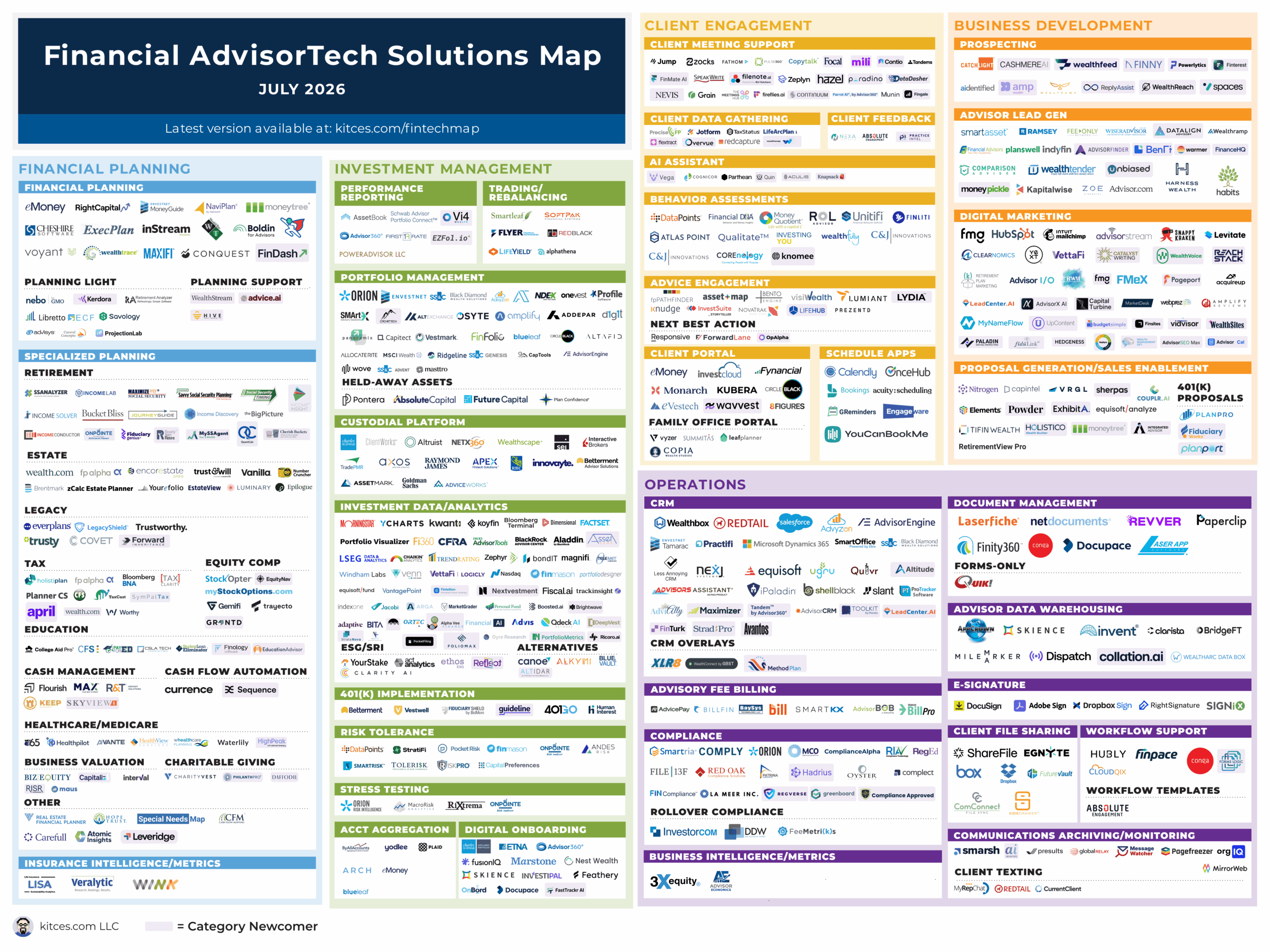
So what do you think? Will standalone AI software solutions continue to gain momentum, or will advisors prefer to remain with their existing platforms if more AI capabilities are rolled out over time? Will the AI notetakers eventually become CRM systems themselves? Can advisory firms really get the ROI from spending what can sometimes be millions of dollars to centralize and warehouse their own data? Let us know your thoughts by sharing in the comments below!





Leave a Reply