Executive Summary
Welcome to the August 2026 issue of the Latest News in Financial #AdvisorTech – where we look at the big news, announcements, and underlying trends and developments that are emerging in the world of technology solutions for financial advisors!
This month's edition kicks off with the news that the all-in-one platform Advyzon has rolled out a suite of new AI features within its platform, exemplifying how AI tools for advisors are approaching mainstream adoption by being incorporated by big incumbent platforms (who have been able to pick and choose which features and use cases to include based on what's proven popular among the early standalone tools in the marketplace)
From there, the latest highlights also feature a number of other interesting advisor technology announcements, including:
- YCharts has acquired Zephyr, which owns one of the industry's largest sources of separately managed account (SMA) data – allowing YCharts to capitalize on the growing popularity of SMA strategies (both by incorporating it into its own analytics and proposal generation tools and by owning the data itself, which could be highly in demand if the use of SMAs continues to rise)
- The digital onboarding and workflow automation tool Feathery has announced a $30 million Series A fundraising round – but although slow and manual account opening processes are still a problem for some advisors (particularly in the insurance and broker-dealer channels), the history of similar digital onboarding tools suggests that most advisors aren't willing to pay for a third party tool to fix it (rather than expecting their custodian or CRM to provide a better onboarding experience for them)
- The AI-powered RIA compliance solutions Hadrius and Greenboard each closed Series A funding rounds, showing how even though other AI use cases such as meeting notes saw quicker adoption among advisors, there are signs that AI compliance tools are gaining traction as well (particularly since RIA regulators will likely have access to similar AI tools to do their own examinations!)
Read the analysis about these announcements in this month's column, and a discussion of more trends in advisor technology, including:
- Despite proclamations that AI meeting notetakers would be the death of CRMs, a new crop of AI-native CRMs in FinTurk, OmegaFP, and Cadix, following in the steps of the popular startup CRM Slant, suggests that there's still a future for the CRM category
- In an environment where technology providers are churning out a copious amount of AI "agents" to automate specific tasks for advisors, the technology consultancy (and Kitces AdvisorTech Map collaborator) Ezra Group has launched a new directory of "AI Agents for Advisors" which aims to help advisors evaluate and compare the capabilities of different agents (and should also reflect the shape of the AI agent landscape over time as agents play an increasing role in AdvisorTech offerings)
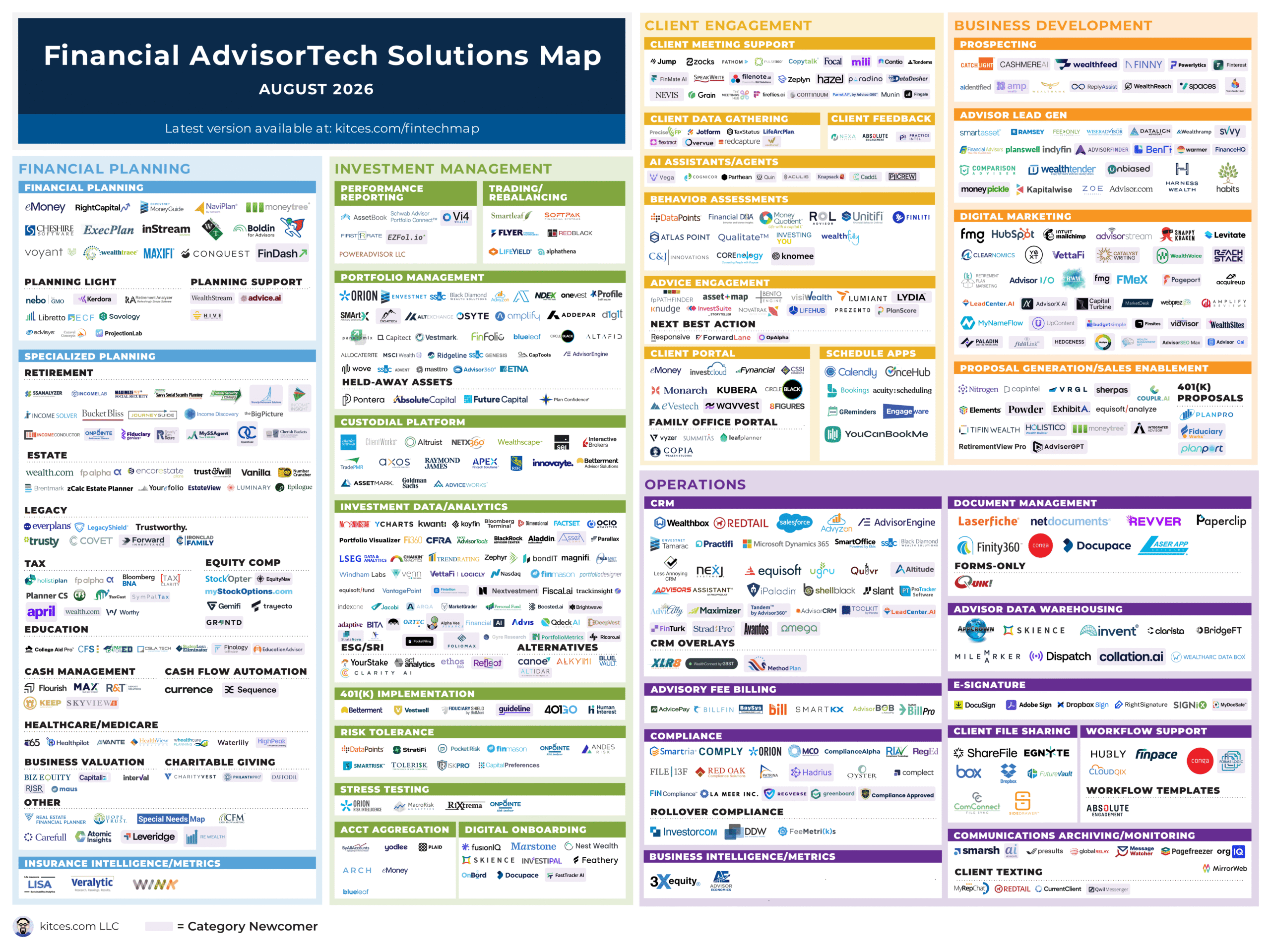
And be certain to read to the end, where we have provided an update to our popular "Financial AdvisorTech Solutions Map" (and also added the changes to our AdvisorTech Directory) as well!
*To submit a request for inclusion or updates on the Financial Advisor FinTech Solutions Map and AdvisorTech Directory, please share information on the solution at the AdvisorTech Map submission form.
Authors:


Advyzon Rolls Out AI Features As AI Goes From "Early Adopter" To "Mainstream" Status
Every piece of technology was new at one point, and even the most widespread technology today was once only used by a small group of early adopters who saw its potential and were willing to try it out, live with the initial bugs as the software got improved, and take the risk that it might not last for the long term. Some technology never quite makes it out of this early adopter phase, but if it does, it has to transition from a small and relatively homogenous user group – risk-taking, relatively nerdy, and often fond of using new technology just for the fun of trying new things – to a wide and diverse group of mainstream users who tend to be far less tolerant of problems and just want confidence that the software will work the way it's supposed to without making them have to figure it all out themselves (a leap that Geoffrey Moore famously dubbed as "crossing the chasm").
General-purpose generative AI took little time to burst into the mainstream, with ChatGPT becoming one of the fastest-adopted consumer products in history a few months after its launch in late 2022. But advisory firms on average tend to take more time to adopt new technology than the population as a whole: According to research by Schwab, fewer than one-third of advisors were using any AI tools by mid-2023, and while by the end of 2025 that number had crept up to nearly two-thirds, much of that adoption appears to have been via experimentation by individual advisors and employees, not RIAs broadly adopting their own firmwide systems.
One reason that many advisory firms tend to take a conservative approach towards new technology is that in a client-facing, fiduciary business, it's often too great a risk to put client data or firm operations in the hands of new and unproven products: Many providers don't survive long enough to see significant adoption, and given how disruptive it can be for firms to change technology, most of them would prefer not to be forced to do so on short notice. Not to mention the very real client data and privacy fears that arise in the context of AI in particular, which can be solved but have taken time for the industry to build proper protocols to address.
But the other reason for slow adoption amongst advisors in particular is that when new technology comes along, it doesn't tend to come from the existing 'incumbent' providers that advisors already use; instead, it usually arises from newer startups that offer it on a standalone basis. For example, when AI notetakers first came on the scene, they all came from new companies that existed solely to do AI notetaking (plus other related functions that they built in over time, like email follow-ups and task management). It wasn't until a year-plus into the AI notetaking boom that highly-used incumbent providers like Wealthbox and Nitrogen began to incorporate their own AI notetakers. And it's simply harder to get advisors to adopt a new technology when doing so requires buying yet another piece of standalone software, rather than having it available within the tools they already have. In an environment where most advisors use two or three core pieces of software (and two or three providers make up most of the market share within each of those core areas), and the rest of the landscape is a huge swath of scattered, mostly niche tools, a new type of tech going mainstream often requires getting into one of the tools that advisors already use and trust.
Which is why it's notable to see that Advyzon, the all-in-one portfolio management and CRM platform, has announced this month the rollout of "Advyzon AI", a suite of new AI tools incorporated throughout its platform. Built on the client and portfolio data that already lives within the Advyzon system, Advyzon AI includes features like AI meeting notes, client meeting prep summaries, analysis and summarization of uploaded client documents, and next action recommendations.
As an incumbent software provider (and particularly a multipurpose platform like Advyzon), there's a balancing act to strike when it comes to incorporating new technology into your platform. On the one hand, if the new technology proves popular and effective and you wait too long to incorporate it, you risk being disrupted by early movers (as may be the case in the CRM category, as incumbents like Wealthbox and Redtail which were slow to incorporate AI are now being challenged by AI-native startups like Slant). But on the other hand, waiting gives you time to see how things shake out in the marketplace (e.g., which features or use cases prove popular, and which ones fail to live up to the hype), so that by the time you do roll out the technology you can incorporate that information by building exactly what advisors are known to want, and make your product better by offering exactly what they will actually use.
Advyzon's new AI feature set suggests that it has spent time surveying the landscape of what has and hasn't worked with regards to advisor AI, and built versions of what has already become popular elsewhere to incorporate in its platform: Advyzon users who were using standalone tools like Jump, Zocks, VRGL, or Altruist's Hazel can now find most of those tools' features bundled into Advyzon's platform (and advisors who weren't using those tools already can now get their first exposure to AI through Advyzon). Meanwhile, AI use cases that have so far fallen relatively flat – like AI prospecting and the idea of a unified AI 'operating system' – are absent (in the latter case, likely because Advyzon has always aimed to be the 'operating system' – even pre-AI – by building portfolio management, CRM, and eventually financial planning software onto a single platform and codebase).
Which ultimately shows how for technology, going from 'early adopter' to 'mainstream' can be a self-reinforcing cycle: The technology is picked up first by early adopters, incumbents stay on the sidelines and wait to see what features become popular among the early adopters, the incumbent finally releases their version that focuses on what the early adopters like, and then the incumbent's mainstream users 'discover' the technology and become users themselves. From the competitive landscape perspective, this is the great hazard in building new tech in a heavily saturated industry like financial services… even if the new capabilities are meaningful and valuable, the challenge is still getting enough distribution to gain traction with advisor users, before incumbents copy the feature set and do it themselves. When it comes to individual advisors, though, this means that the way AI will likely be adopted by the firms who haven't already picked it up yet will not be through purchasing one of the new innovators in the AI category, but instead by being incorporated into an established platform that they already use (like Advyzon) that has cherry-picked the most user-friendly and popular AI features to add in.
YCharts Acquires Zephyr To Incorporate SMA Data In Its Portfolio Analysis And Proposals As SMA Popularity Booms
Most financial advisors' service models include managing their clients' investments (and charging a percentage of those assets under management). But most advisors don't really manage investments at a granular, single stock- or bond-level; instead, they allocate their clients' portfolios to third-party asset managers who do the actual day-to-day research and trading. Historically, throughout much of the 1980s and 1990s, advisors mainly allocated to active mutual fund managers, because in those days advisors were primarily paid on commission, and mutual funds were structured to pay sales loads or 12-1b distribution fees on top of the management fees paid to the fund company, which made mutual funds lucrative both to the fund companies that created them and to the commission-compensated advisors who sold them.
But over the last 30 years, as advisors have been increasingly paid for advice rather than product sales, and have largely incorporated the principles of Modern Portfolio Theory into their investment philosophy, the dominant model of investment management has shifted from picking active mutual funds and plugging them into a client's portfolio to constructing diversified asset-allocated portfolios designed around the client's risk tolerance. Which in turn led to a shift first from mostly active to mostly passive mutual funds (which could serve as low-cost 'building blocks' from which advisors could build their portfolio models), and then from passive mutual funds to ETFs (which could do the same job as a passive mutual fund but with generally lower cost and more tax efficiency).
In the last decade or so, however, there have been signs of yet another large-scale shift in how advisors allocate their clients' portfolios. As robo-advisors like Betterment have made it possible for consumers to get a diversified, asset-allocated ETF portfolio at a fraction of the cost of a human advisor, advisors have increasingly sought to differentiate themselves by using separately managed accounts (SMAs), which allow for more personalization and tax management of clients' portfolios than the ETF building block model. For example, a direct-indexing portfolio held within an SMA can be designed to broadly replicate the performance of an index like the S&P 500 while adjusting the holdings to account for the client's preferences around specific ESG factors. And a Tax-Aware Long-Short SMA can add 'extensions' of short and leveraged long positions to an existing portfolio that will generate tax losses regardless of whether markets broadly go up or down. And improvements in technology over the years has brought down the costs of SMA portfolios to the point where many of them can be managed for less than 1% per year (which is less than what most of the actively-managed mutual funds charged in their heyday, despite being a 'customized' portfolio being managed directly for the client rather than being pooled together with the funds of thousands of different investors to manage at scale).
But one of the challenges of employing SMAs for portfolio management is that, like all third-party investment managers, advisors must do due diligence on SMA managers to ensure their products and strategies work as advertised and would serve in their clients' best interests. And unlike mutual funds and ETFs, which as registered investment companies must publicly report their prices and performance and therefore can be analyzed based off of public data gathered by platforms like Morningstar, FactSet, and YCharts, SMA managers are not required to publish their results, meaning there's no public dataset for advisors to analyze the performance of a particular strategy – or perhaps more importantly, to benchmark the performance of one SMA manager against others that implement a similar strategy.
Which makes it notable that this month the news came out that YCharts is acquiring the investment data and analytics software provider Zephyr, which owns one of the industry's largest proprietary data sets on SMA managers.
The centerpiece of the deal appears to be Zephyr's Plan Sponsor Network (PSN) database, which compiles portfolio and performance data for over 21,000 different SMA products going back 40+ years (which SMA managers voluntarily report to PSN on a quarterly basis). The addition of PSN data will presumably allow YCharts to include it in their investment analytics and proposal generation tools, giving them a better value proposition for advisors incorporating SMAs into their clients' portfolios. That allows YCharts to not only tap into the surging popularity of SMAs overall, but also to expand more 'upmarket' in their reach towards enterprise-level firms, given that SMAs, with typical account minimums of $1 million or more, tend to be used primarily by higher net-worth clients, and those clients are more likely to be served by bigger RIAs.
At a broader industry level, Zephyr's (and PSN's) acquisition shows how providers in the business of data analytics perceive the value of the data that underlays their tools. The fact that YCharts opted to acquire Zephyr outright rather than simply licensing PSN data to incorporate it into its software indicates that they see additional value in owning the data itself – either through exclusivity (e.g., by walling the data off from competing investment analytics tools to differentiate its own offering) or through monetization (e.g., by licensing the data to competitors, more of whom will want access to SMA data as overall interest in SMAs increase). Whatever the strategy, YCharts is now in a position to control the 'pipes' of the industry's biggest SMA dataset, at a time when SMAs are exploding in growth – which is good for YCharts and its users, but less so for users of competing analytics platforms who may need to pay more for PSN data or possibly be blocked from it altogether.
The big question going forward, then, will be whether or not the current popularity of SMAs really represents a large-scale shift in how advisors manage portfolios (akin to the earlier shifts from active mutual funds to passive mutual funds to ETFs). With higher account minimums, less liquidity, and generally higher fees than ETF-based portfolios, SMAs aren't likely to achieve the level of broad-market popularity enjoyed by ETFs, barring significant structural changes. But if technology continues to drive down the cost of SMA investing and it carves out a prominent niche among HNW investors, then the need for SMA data will at the very least not decline going forward, and could very well increase further in the years ahead – which positions YCharts well to capitalize with its new ownership of the primary source of that data.
Feathery Raises $30M For Its AI Workflow Automation And Account Opening Tools, But Do RIAs Need Another "Digital Onboarding" Solution?
Running an RIA often requires striking a balance between providing personalized service to meet each client's unique needs and using standardized processes to be able to operate at a scale that's large enough for the business to sustain itself. When advisory firms are still on the smaller end of the scale, they often err towards customization: Specialized client service is typically what drives new business and revenue, which has a bigger impact on the bottom line than any efficiency gains that can be achieved through more standardized processes. But as firms get larger, standardization gets more important, as there are more people covering individual (non-revenue-generating) roles like client service, paraplanning, and trading, whose coordination is essential to keep the firm running smoothly.
The problem, however, is that not all processes are in the hands of the advisory firm. An RIA might be able to control its own data gathering or annual review meeting workflows, but for opening client accounts at a custodian, the steps are dictated by the custodian: They decide which forms need to be filled out, what client information is needed, whether the form is 'In Good Order' or not, and how many layers of verification need to be involved.
For many years, this meant that advisory firm clients literally needed to fill out paper forms with 'wet' signatures, and mail or fax them to the custodian to open their accounts. In more recent years as custodians have adopted digital account opening and allowed API access to third party providers, it's become possible to streamline the process at least somewhat: Digital onboarding tools like Skience, Docupace, and Marstone can take client information from sources like the advisor's CRM and populate it into the custodian's digital account opening interface to save the advisory team from having to populate each form manually. But the custodian still ultimately controls what the process looks like and which tools have access to it, which makes even digital account opening tools have limited value because they really just serve to patch over what is actually an issue at the custodian level. Which means ultimately, it can be hard for advisors to stomach the idea of paying separately for a tool that 'fixes' an inconvenient account opening process that really should be the custodian's – and not the advisor's – problem to deal with and improve upon in the first place.
This became clear nearly a decade ago when, after the 'robo advisor for advisors' movement fizzled (as their promises of profitably serving mass-market clients directly collapsed under the reality of high client acquisition costs), many of the original B2B robos pivoted to providing digital account opening and onboarding tools for advisors with their clients instead. But those tools continued to struggle to find adoption after the pivot, even though they solved for a real advisor pain point (especially since at that point most custodians still required paper forms and wet signatures), because advisors didn't want to buy a standalone tool to facilitate a digital onboarding process they felt the custodian should be digitizing itself.
Fast forward to today, and even though most custodians have switched to a paperless account opening process, there are still issues like manual data entry and insufficient field validation to prevent NIGOs that make the process slower than it should be. And so it's notable to see the news this month that the digital onboarding and workflow management provider Feathery has announced the completion of a $30 million Series A funding round from a consortium of venture capital firms led by Portage Ventures.
Feathery is one of a newer generation of digital onboarding solutions that now incorporates AI into features that surround a core function of opening custodial accounts via API connection. Most notably, Feathery features an AI-powered workflow builder (solving for the problem that while advisors often rely on workflows to get things done at scale, many have not actually documented those workflows and/or struggle build them out in software so they can be automated), while also including client data gathering features such as a form builder and AI document extraction to export to the advisor's CRM, portfolio management, and planning tools (as well as populate its account opening and transfer paperwork with the custodian).
But while Feathery's AI-augmented digital onboarding tools might count as an improvement in the insurance and broker-dealer channels that they first launched and built with (which remain markedly more old-fashioned in their processes and still often run on paper forms), as Feathery shifts into wealth management it's hard to see, from an RIA perspective, how what Feathery is doing at its core is much different than the generation of digital onboarding tools that preceded it. Because while on the plus side Feathery may be able to pull some users away from tools like Skience or PreciseFP with its more modern interface, it's questionable whether Feathery will convince more advisors to sign up for a new digital onboarding tool when there were already a number of such tools to choose from – none of which had particularly high adoption among advisors, because advisors continue to pressure their custodians directly to make better digital onboarding processes.
To be fair, much of the rationale for the $30 million fundraise probably had to do with the aforementioned broker-dealer and insurance channels, where Feathery's solution really does look innovative compared to the existing tools available, and there may be select opportunities in the enterprise RIA market (with existing users including Sequoia Financial Group and RFG Advisory) where the sheer size of the teams and client base make it worthwhile to have a tool to centrally manage account opening and workflows (especially as enterprise RIAs want to own more of their own data layer, and may want an onboarding tool that can integrate to custodians and their own proprietary data warehouse). But if Feathery seeks to expand further into the independent RIA market with its fresh funding, the big question will be whether it can convince advisors that features like AI-powered account opening workflows and data gathering tools add enough value to make it worth paying for a standalone account opening tool when they expect their custodians to provide it to them (and some custodians, like Altruist and Betterment, can now actually give it to them for free)?
Hadrius And Greenboard Raise Series A Funds As AI-Powered Compliance Tools Start To Gain Traction
In November 2022, when the release of ChatGPT kicked off the rapid proliferation of AI tools throughout the marketplace, one of the immediate follow-up responses was something like, "OK, this is cool… but what is it really useful for?". Because it's one thing to have a chatbot that can trawl the entire Internet and body of written literature to answer questions like, "What should I have for dinner tonight?", but it's another thing to turn those capabilities into something that will have a real day-to-day impact.
In the advisory space, the first truly useful AI tools were the first wave of AI notetakers like Jump, Zocks, and Finmate AI. With recording and scanning meeting notes, composing summary emails to clients, assigning follow-up tasks, and pulling previous meeting notes to prep for the next meeting taking up (per recent Kitces Research on Advisor Productivity) around one hour of time for every two-hour client meeting, the time savings of a tool that could expedite those tasks down to 15 minutes or so meant that advisors could reinvest that time into more meetings, deeper planning for clients, marketing and business development to bring in more clients, or simply feeling less harried from the onslaught of administrative tasks between each meeting. Advisors rapidly adopted meeting note tools, such that by 2025 our Kitces Research on Advisor Technology showed that around 30% of advisors used some kind of client meeting note tool – an impressive growth rate for technology that had barely existed two years prior, and a number that has surely increased further in the year-plus since that report was released.
But while AI meeting notetakers clicked with advisors almost immediately, other use cases for AI have been slower to catch on. Despite the addition of many new AI prospecting tools to the Kitces AdvisorTech Map, including FINNY, Wealthfeed, Wealthreach, and Aidentified, advisors haven't been as quick to adopt them (since few advisors actually engage in cold prospecting for business growth in the first place, and those who don't aren't likely to be convinced by technology to start doing so). The Investment Data/Analytics category of the Kitces AdvisorTech Map has similarly been flooded with new providers that use AI for everything from scanning for market signals to flagging and summarizing changes to SEC filings, but in reality most independent, retail-serving financial advisors don't engage in the kind of single-stock analysis that makes these tools useful. And while many providers are seeking to be the agentic AI "operating system" that connects the advisor's tech stack together and employs a swarm of AI agents to automate most daily workflows, it's been harder for those providers to articulate what makes them actually useful in an advisory firm context, where productivity tends to be impacted more by bringing in new clients and serving existing clients better than becoming more efficiently run on the back end.
In that vein, compliance has similarly been an area where advisors have been relatively slow to adopt a new generation of AI-driven tools. Which is curious because compliance would seem to be an area where Large Language Model (LLM) AI tools would be particularly useful: Rather than relying on the 'old' system of pulling random samples of client communications or trade records to look for suspicious activity, or even the relatively 'new' method of searching for specific keywords or text strings that could indicate malfeasance, LLM tools have the capability to sift through virtually all of a firm's data and analyze it in context, resulting in a much bigger likelihood of catching actual instances of bad behavior (and requiring much less sorting through false positives to get to the cases that really need attention).
But in contrast to AI notetakers, which had an immediate payoff for advisors in the time savings they allowed (that could then be reinvested into more productive activities), the benefits of better compliance technology are less tangible for advisors: It isn't likely to cause them to spend much less time on compliance, it just allows them to do compliance better. Which in the best case means that there's only marginal time savings to be achieved (which is what mainly matters in a world where most advisors view compliance as a "check-the-box" requirement instead of a productive, revenue-generating activity) – and at worst could actively dissuade some advisors from adopting it, since a more comprehensive scan of their firm's trades and communications might result in digging up issues that it will then become the firm's problem to deal with!
In that context, it's notable that the AI-powered compliance technology provider Hadrius announced this month a $22 million Series A funding round, shortly after its competitor Greenboard announced its own $15.5 million Series A round in May 2026 – suggesting that despite the relative slowness of advisors to take to AI compliance, there are signs that it could be one of the next categories of advisor AI technology to start gaining traction and adoption.
As Hadrius notes in its announcement of the funding round, the case for involving AI in compliance has grown as the volume of communication between advisors and their clients or the public has exploded. In the days when most communication was done via physical mail or faxes, it was relatively easy to perform a human review of what the advisor was saying to clients. As email and social media started to take hold, the amount of communications increased exponentially, yet it was still possible to review a representative sample of an advisor's output to infer that what they were saying was legitimate on the whole. But as we've entered an age of AI communication, where words, images, and even video can be generated cheaply at scale, the amount of potential output is virtually limitless – and given the wildly varying reliability of different AI tools to generate accurate (to say nothing of compliant) text, there's a strong case for a newer generation of more powerful tools to capture it all – or in other words, as Hadrius put it, "in a world of AI slop, everything is compliance".
But the question going forward is whether the prospect of doing 'better' compliance will move the needle with enough advisory firms to drive significant adoption beyond the relative handful of larger RIAs for whom compliance is enough of a cost center and liability risk that it's worth investing in tools to do it thoroughly and efficiently. The answer will probably lie in whether there end up being bigger consequences for firms that don't adopt AI for compliance. After all, since the tools for scanning advisory firm communications and flagging issues already exist at the B2B software level, it's almost certain that they're available for regulators doing the examinations as well. As an advisory firm owner, it's logical that you would want tools that are at least as powerful at flagging compliance issues as the ones used by the regulators, otherwise, it's virtually guaranteed that you'll end up losing time and resources addressing deficiencies flagged by the examiner's more powerful tools. So while firms may have been slow to adopt AI compliance tools because they don't feel like it serves an immediate need for them (or at least as immediate as expediting meeting notes and follow-up), they may nevertheless be driven to adopt them by the increasing risk that they won't be able to keep up with regulators using the same types of tools for enforcement.
Which ultimately goes to show how there are multiple avenues for gaining adoption as an AdvisorTech provider. You can provide an easy solution to a common problem, such that many advisors will be willing to pay $80-$100 per month for software to do it (although as has been the case in the AI notetaker space, that can quickly lead to an overcrowded category and leave the startup standalone providers vulnerable to being undercut by incumbents who add meeting notetakers to their existing tools). Or else you can provide something that will eventually be a virtual requirement for advisory firms, with the risk hanging over their heads of financial or reputational liability if they don't stay up to speed. Although the former might create more opportunities for rapid adoption, the latter also seems likely to pay off in the end – once advisors realize what's needed to keep up with their regulators.
"AI-Native" CRMs Are Proliferating As The Rumors Of CRMs' Demise May Have Been Greatly Exaggerated
The CRM has been a core part of the advisory firm tech stack for many decades: first as a digital Rolodex of client contact information, then as a repository of client meeting notes and supplemental information, and eventually as a hub for workflows and task management built off of the data stored within the CRM system. CRMs thus became the "system of record" for RIAs that contained the definitive data for each client, and many other technology tools build their integration capabilities primarily around CRMs like Wealthbox, Redtail, and Salesforce because they need client data to run off of, and the CRM is where that data lives.
But despite the importance of CRMs to advisory firms, they aren't the best-loved piece of software. CRMs are as close to a universally adopted tool as exists in the advisor technology market, with the most recent Kitces Research on Advisor Technology showing 92.5% of advisors using some type of dedicated CRM. But advisors' satisfaction with their CRMs was below average relative to the software's importance, rating only as a 7.5 out of 10 on average (compared to an average satisfaction of 8.0 for financial planning software, the only major tool to exceed CRM's adoption rate in the survey). Which suggests that the CRM market is ripe for some disruption, with the incumbent providers' (dominated by the top 3 of Wealthbox, Redtail, and Salesforce) failure to fully live up to the expectations of the advisors relying on them making them vulnerable to a newcomer who could do a better job.
What is it, exactly, that the incumbent CRMs are failing to do for advisors? It isn't the function of being a repository for client data; instead, it's making it easier for the advisor to do something with that data. If there's no easy way to search through data (which might stretch back years or even decades for some clients) or identify specific actions that need to be taken or issues to be addressed, then the CRM doesn't serve much more of a role than as an archiving tool for compliance purposes.
And so when AI meeting notetakers started to come onto the scene beginning in 2023, and quickly expanded their capabilities beyond 'just' transcribing meeting notes and drafting follow-up emails to assigning tasks, pulling out key information from email and CRM notes for future action items, and sending out information to financial planning and other tools, it inevitably raised speculation that CRMs were in danger of being 'eaten' by the new generation of AI tools. In other words, with notetakers building out the functionalities that allow advisors to make more and better use of their data, CRMs risked having their roles being whittled back down to their original function as a digital Rolodex, with AI notetakers taking over the job of doing all the high-value tasks built on top of that data.
But despite many proclamations about the demise of the CRM, there are two reasons that they could prove unfounded. One is that, as history has shown, it's difficult to get advisors to buy an additional standalone software tool to improve the way their existing tools work. We've seen this in areas like digital onboarding (which has failed to take off as a standalone category because, despite the inefficiency of opening new client accounts at many custodians, most advisors don't want to buy a separate tool to make it better) and workflows (where tools like Hubly, despite offering clear improvements over the workflow capabilities of the CRMs they overlay, have gained only limited adoption because they cost as much or more as the CRM software itself). Advisors quickly adopted standalone AI notetakers early on simply because there were no alternatives at the time, but now that seemingly every tool has an AI notetaker built into it we can expect the adoption of standalone providers to begin to plateau going forward.
The second reason is that, after so many decades as a core component of the tech stack, it's hard to detach advisors from the notion of the CRM as the system of record and hub of daily client-related activity. It might make sense conceptually to move to a system where data synchronizes automatically from one system to another, using an "orchestration" solution like Dispatch or MileMarker Navigator, with the notetaker as the advisor interface, which would eliminate the need to even have a CRM to serve as the data repository. But it's another thing to convince advisors to abandon a system that they've used for 40+ years, even despite its flaws.
Against this backdrop, Slant emerged about one year ago as a new 'AI-native' CRM, which serves as a traditional CRM in the sense that it houses all of the client information in one repository, but also builds in numerous AI features built on that data (from notetaking to a chatbot interface for querying client data to researching and answering client questions) as well as deep workflow functionality. All of which has made Slant a popular choice for newer advisory firms entering the industry, while convincing others to switch from incumbents like Wealthbox and Redtail.
And now, amidst the early successes of Slant, a new wave of other AI-native CRMs have begun to pop up seeking to combine the traditional CRM role with modern AI functionality, including FinTurk, OmegaFP, and Cadix, all of which have two primary aims: (1) To improve upon the experience of traditional CRM functions (e.g., to feature deeper workflow capabilities and AI-enhanced search functions), and (2) to build in AI capabilities that enhance how advisors use the CRM's data, from automated emails to agentic workflows to automatically flagging important issues for the advisor to deal with.
So it's possible to see now why early debates around whether or not AI notetakers would disintermediate traditional CRMs might have missed the point. As the popularity of Slant shows, advisors are happy to keep using CRMs as they always have if those CRMs help the advisor make better use of the data that they hold. And given the reluctance of many advisors to buy multiple separate tools to manage the same function, the emergence of several new CRMs that combine both traditional CRM and AI notetaking functions might be bad news for both the incumbent CRMs (which have been relatively slow to add their own AI features) and standalone AI notetakers (which would be redundant for advisors who have all the same functions built into their CRM).
In other words, it may have been premature to declare the rise of AI notetakers as the demise of traditional CRMs. Because ultimately, it isn't the concept of CRMs that is broken – advisors still would rather have a centralized store of information, and productivity functions like workflows and communications tools built on top of that data (that preferably don't require buying another piece of software to do well). Instead, advisors' dissatisfaction was with the actual CRM tools they had to work with – which, now that a new crop of AI-native CRMs is starting to emerge, could still eventually find themselves disrupted, even if it's from within the CRM category itself rather than from the AI notetakers as everyone expected.
Ezra Group Launches A New AI Agents Directory To Help Answer The Question: "What Does This Agent Actually Do?"
The rise of AI within advisor technology has come along with a lot of new jargon for users and evaluators of new technology to learn. Words like 'context', 'instance', and 'intelligence', which are all common words outside of AI, have completely different meanings when used in regard to AI. But one of the most confusing AI-related words right now is 'agent'. So many different technology providers today have some version of an AI agent doing things within their software, and yet few take the time to explain to (usually non-expert) users what an agent does or why it's important.
Broadly speaking, an AI agent is a system that's trained to perform a narrow, specialized task – in other words, a robot that does a job. For example, an AI agent might be trained to perform an advisor's pre-client meeting workflow: Scheduling the meeting, sending a follow-up reminder and data gathering questionnaire, preparing an agenda and client snapshot for the advisor, etc. (Somewhat confusingly, AI agents are different from what's generally referred to as 'agentic AI' – the agents are akin to workers performing specific tasks, while agentic AI is a system that's made to coordinate higher-level, multistep workflows that often involves managing multiple individual agents.) While agents can be custom-built using an AI tool like Claude, in the financial advisor world – where few advisors are interested in building their own agents – most AI agents are made to be used out-of-the-box within a software platform. Some software might be built around a single agent (e.g., to open client custodial accounts), while others might make and use multiple agents for different functions. Some agents are made to run autonomously in the background with little input from the user, while others only function when given an order from a human.
But the bottom line is that an AI agent is a robot that does stuff, which makes it distinct from other forms of AI like generative AI 'word calculators' (e.g., chatbots and meeting note tools). And with the proliferation of all things AI on the AdvisorTech Map, it's hard to distinguish the 'word calculator' tools from the agents that actually do things, and at a micro level, to distinguish one AI agent from another. If there are seven different tools that say they automate advisory firm workflows, how do you find out which one actually solves for the workflows you need done?
That's why it's notable that the technology consultancy (and Kitces AdvisorTech Map collaborator) Ezra Group has introduced this month a new directory of "AI Agents for Advisors". Currently listing 51 different financial advisor-specific AI agents (but likely to expand in size as more providers add their own agents), the directory is broken down by category (e.g., Workflow Support, Financial Planning, Tax, Client Meeting Support, etc.), and includes data points for the type of firms they serve and pricing structure (e.g., seat-based or usage-based), and will eventually include an 'Autonomy Score' on a 0-5 scale of how much human input is needed for the agent to do its job.
On an individual RIA level a resource like Ezra Group's AI Agents directory can help advisory firms get a grasp on what's out there in a rapidly growing and evolving technology landscape, while cutting past the marketing language that dominates most technology websites to focus on whatever it is that the technology actually does – which is a version of what we've tried to do with the Kitces AdvisorTech Map and Directory, but at an even more granular level since many of the agents in Ezra Group's directory are effectively sub-components of software providers listed on the Map. This gives advisors yet another resource to evaluate and compare software in a standardized way to determine which one really best meets the advisory firm's needs.
But on a broader industry level, it will be fascinating to track how the AI Agents directory grows and evolves over time, as it reflects how technology providers are packaging agents and incorporating them into their offerings. In theory, it's possible for a provider to sell a single pre-built agent for an advisor to run on their own, or a collection of agents that solve multiple tasks on an a la carte basis, or one or more agents that run under the umbrella of a broader technology platform, which will make it interesting to see which ones advisory firms actually buy and incorporate – or conversely, which get co-opted by bigger incumbent firms who release their own versions to their users? Will some software providers ultimately become more of a marketplace for different AI agents for firms to pick and choose from, while others focus more on building the infrastructure for agents to work in to maximize their functionality?
Ultimately, as some of the froth around the AI notetakers and other generative tools seems to have settled, the focus appears to be shifting to AI that can actually do things, which is still very much up in the air in terms of which use cases will prove useful and popular and which of today's startups will become the market-leading incumbents in the future. Much as the AdvisorTech Map provides a snapshot of the shifting trends in the AdvisorTech space, Ezra Group's AI Agents Directory will be worth following to trace the outlines of the AI agents movement in the months and years ahead.
In the meantime, we've rolled out a beta version of our new AdvisorTech Directory, along with making updates to the latest version of our Financial AdvisorTech Solutions Map (produced in collaboration with Craig Iskowitz of Ezra Group)!
So what do you think? Is performance and benchmarking data for SMA providers a must-have for advisors who use SMAs in their client portfolios? Is a standalone digital onboarding and workflow tool a necessity for RIAs when most custodians have their own digital account opening process? Is the CRM category likely to be disrupted – and if so, will it come from AI notetakers or from new AI-native CRMs? Let us know your thoughts by sharing in the comments below!