Executive Summary
Welcome to the May 2026 issue of the Latest News in Financial #AdvisorTech – where we look at the big news, announcements, and underlying trends and developments that are emerging in the world of technology solutions for financial advisors!
This month's edition kicks off with the news that Morningstar is selling the client account aggregation data provider ByAllAccounts, becoming the latest AdvisorTech platform to offload a data aggregator that it acquired in the mid-2010s (following Envestnet's sale of Yodlee last year) – which yet again highlights the frustrating inability of data aggregation technology to live up to its promise of seamless real-time visibility into clients' financial lives (or to provide "big-data" business insights that justified the massive price that AdvisorTech platforms paid for them)
From there, the latest highlights also feature a number of other interesting advisor technology announcements, including:
- The AI prospecting technology provider FINNY has launched a new AI tool, dubbed "Hunter", that aims to automate outreach and campaigns for both inbound prospecting and outbound marketing – marking an expansion from FINNY's original focus on just the outbound prospecting side of business growth (which was arguably necessary to expand its market beyond the relative handful of advisors who use outbound prospecting as a primary growth channel)
- All-in-one platform Advisor360 has announced that it is partnering with the financial planning software provider Conquest Planning to embed Conquest's software directly within its platform for one bundled subscription fee, which on the one hand gives Advisor360 users one more tool to use within Advisor360's all-in-one ecosystem, and on the other hand gives Advisor360 another rich data source to feed into its "Unified Data Fabric" for AI Agents to run on
- Wealth.com has announced a new $65 million Series B fundraising round in the wake of its recent expansion beyond "only" estate planning into tax, raising questions about whether it plans to expand further into other specialized planning categories like equity compensation or retirement income planning – or even into a full-blown financial planning (plus CRM?) platform
Read the analysis about these announcements in this month's column, and a discussion of more trends in advisor technology, including:
- The startup advisor phone and texting system provider CurrentClient has announced a $1.25 million seed funding round, showing that there is an appetite among advisors (and investors) for a unified business phone and (compliant) texting solution, whereas most previous solutions focused on either one or the other
- Several RIAs have recently announced large investments into data infrastructure and AI agents to streamline their operations and reduce overhead costs, which raises questions about how much additional efficiency can actually be achieved through AI and whether it's enough to justify the investment – especially when off-the-shelf solutions from third-party providers may be able to do the job nearly as well at a fraction of the cost?
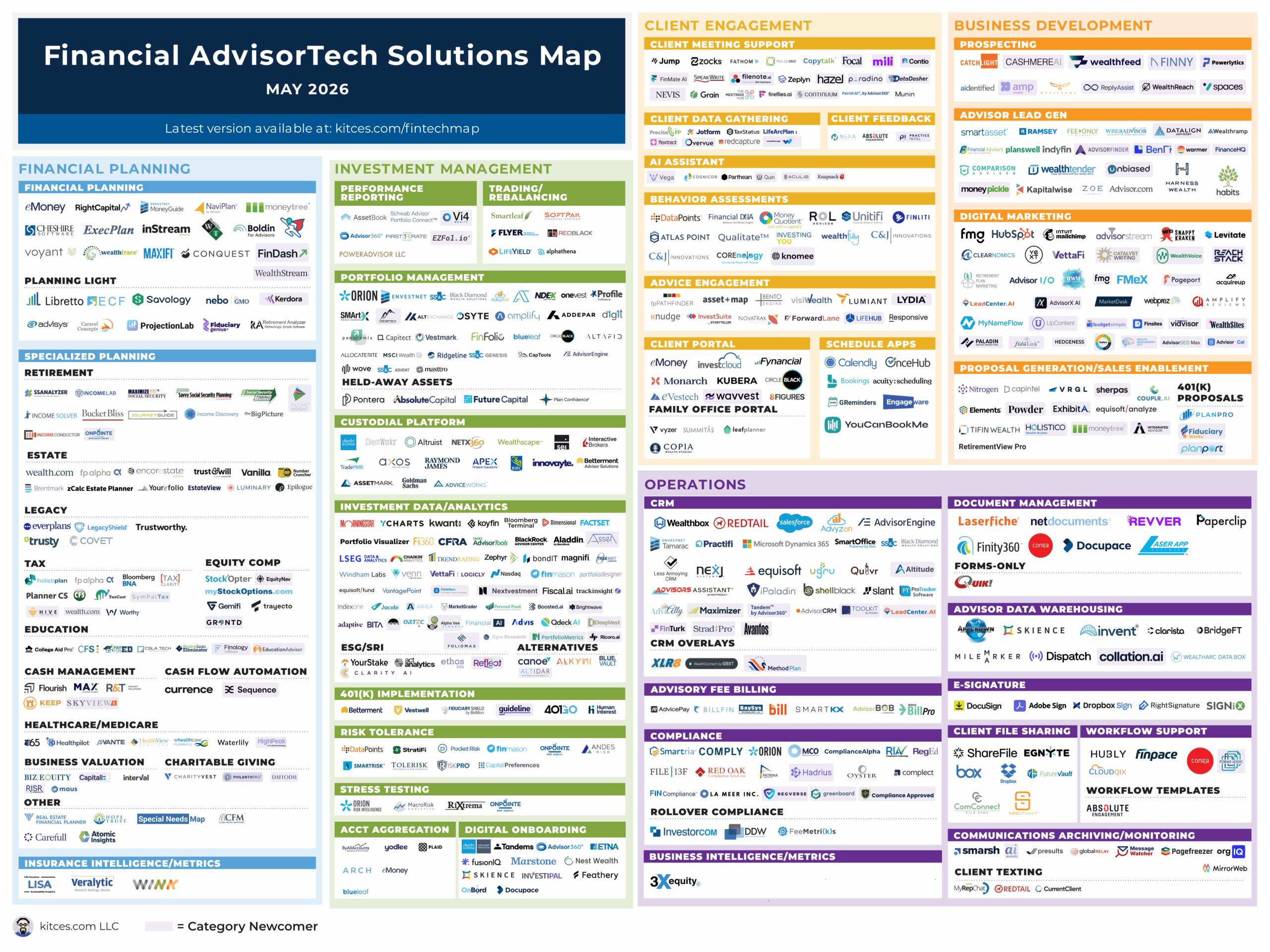
And be certain to read to the end, where we have provided an update to our popular "Financial AdvisorTech Solutions Map" (and also added the changes to our AdvisorTech Directory) as well!
*To submit a request for inclusion or updates on the Financial Advisor FinTech Solutions Map and AdvisorTech Directory, please share information on the solution at the AdvisorTech Map submission form.
Authors:


Morningstar Sells ByAllAccounts As The "Big Data" Dreams Of Account Aggregation Fail To Materialize (Again)
In the pre-internet era, it was hard for financial advisors to have much insight into their clients' financial lives other than what the client was willing to give them. Helping clients to "get organized" was often part of the value proposition of doing a financial plan in the first place, where often the first time clients ever saw a consolidated balance sheet of all their assets was in their first financial plan. With the caveat that advisors would only know what was in the accounts that they managed for the client, and information on any "held-away" assets like bank accounts, 401(k) plans, and other non-managed assets came piecemeal in the form of paper statements collected during client meetings or mailed ahead of time (and sometimes clients simply neglected or refused to provide any information on these accounts, making them effectively invisible for planning purposes).
But as peoples' financial lives moved increasingly online in the 21st century, it became more possible for financial advisors to gain visibility into the clients' outside accounts by electronic means. In the late 1990s and through the 2000s, solutions like Yodlee, ByAllAccounts, and CashEdge (along with eMoney's popular client portal) all arose, and suddenly advisors had ongoing, automatically-updated views into clients' aggregated account- and transaction-level data across their entire households. Which allowed advisors to provide new features like consolidated investment performance reporting on managed and non-managed accounts, "personal financial management" (PFM) portals for real-time net worth and expense tracking, and eventually even management of 401(k) and other held-away assets through platforms like Pontera.
Amidst the rising popularity of these account aggregation capabilities, a number of platforms made big investments into aggregation providers in the early 2010s. CashEdge was purchased by FiServ for $465 million in 2011, followed by ByAllAccounts being acquired by Morningstar for $28 million in 2014, and eMoney being acquired by Fidelity for $250 million and Yodlee being acquired by Envestnet for $590 million in 2015. The massive price tags for these acquisitions were in most cases far beyond what could be supported by 'just' the revenue and profits of the aggregation providers. Neither were they justified by the added value that each of these platforms could achieve from deeper data integrations within and outside of their platforms (which they could have mostly achieved by simply licensing the data from the providers rather than buying the providers themselves). Instead, the main driver of these acquisitions seemed to be the notion that by owning the pipes through which all the data flowed, the platforms could gain considerable insight into the behaviors of advisors and their clients – which in turn would in theory create immense value by the Big-Data-driven decision making and product strategy it allowed.
In reality, however, the platforms that invested heavily into Big Data initiatives through account aggregation providers struggled to realize significant returns on those investments, and have in many cases scaled back their initial ambitions. Fidelity's acquisition of eMoney was significant initially for the client portal aspect that differentiated it from all other financial planning software, but as other software like RightCapital came along offering its own data aggregation capabilities (at a lower cost), eMoney focused more on improving the financial planning side of its platform than on continuing to emphasize data aggregation as a differentiator (to the point that eMoney doesn't even charge extra for its account aggregation capabilities anymore). Envestnet sold Yodlee in 2025 at likely a fraction of its original $590 million purchase price after Envestnet found that the promise of "big data" insights improving strategic decisions proved difficult to achieve in the reality of a multifaceted (at the time) public company.
And now we have the news this month that Morningstar has become the latest platform to offload its 2010s-era account aggregation acquisition, having sold ByAllAccounts for an undisclosed amount to a tech startup incubator called Pello Companies.
Notably for financial advisors and fintechs who are still using ByAllAccounts for data aggregation, there's no indication that any major changes will immediately come to the platform. But as has been noted elsewhere, it's striking the firm that acquired ByAllAccounts is an investor called Pello Companies that aims to "unlock the full potential of open finance", while the incoming CEO whom they've hired to run ByAllAccounts is talking about delivering "an expanded set of capabilities that extend beyond pure data aggregation". So at the very least it seems like Pello is looking to revamp the ByAllAccounts platform, and potentially expand on it – e.g., to leverage its existing data movement infrastructure to provide a unified data layer for advisory firms to run AI agents on top of in the mold of providers like Dispatch and MileMarker Navigator, so they can finally (maybe?) fulfill the promise of Big Data in the AI era?
For Morningstar, the sale of ByAllAccounts continues a trend of shedding lines of business outside of its core investment data and research functions, having also sold its TAMP to AssetMark in 2024 and wound down its Morningstar Office portfolio management platform (sending most of its users to Black Diamond) in 2025. After divesting from those solutions – both of which drew clear benefits from the ability to weave in outside account data through ByAllAccounts – there may have simply been little strategic value for Morningstar in continuing to own an account aggregation solution.
From an industry perspective, though, what's notable is how, after nearly 30 years of promises of how data aggregation would reshape how advisors give advice and manage their businesses, the reality has fallen frustratingly short. Both for advisors – who in the most recent Kitces AdvisorTech Research gave account aggregation tools the lowest satisfaction score among all other commonly used categories – as well as for the owners of the technology itself, who have suffered massive writedowns in the account aggregation investments they made during the last decade. To be fair, not all of these struggles could have been predicted – for instance, rather than financial institutions becoming more comfortable sharing client data with third-party aggregation providers as those providers have matured over time, they've instead increasingly gone in the opposite direction and gotten more reluctant to share their data (e.g., Fidelity's crackdown on "screen-scraping" aggregation providers and held-away account management tools like Pontera). And the current Trump administration has sought to roll back the CFPB's long-awaited Open Banking Rule, which would have forced many institutions to make client data more readily available to clients (and the advisors and AdvisorTech they may have wanted to share their data with). All of which are at odds with what seemed like growing momentum for "open finance" and fewer restrictions on consumer data movement a decade-plus ago.
But what's really ironic is that the wave of divestment from account aggregation providers is occurring just as AI has brought back a renewed wave of promises about the possibilities of Big-Data-driven insights. As tech providers envision a future where AI agents pulling data from multiple sources 24/7 can automate workflows from marketing to client outreach to financial plan creation, it's worth remembering the lesson of ByAllAccounts, Yodlee, and other providers: That client data from third-party institutions is often going to be quite messy, nonstandard, and highly dependent on how much data (if at all) those institutions are willing to share. The only question is whether RIAs and AdvisorTech platforms will remember this lesson the next time they're tempted to make a sizeable investment in a "big data" solution without a clear plan for how exactly they'll derive value from it?
FINNY Unveils Its New "AI Chief Growth Officer" To Expand Beyond Outbound Prospecting
Financial advice is a trust-based business, and that trust is neither easily nor instantly earned. Not many clients will decide to hire an advisor who is a complete stranger to them: They need to become confident that the advisor (1) knows what they're talking about and (2) will give advice with the client's best interests in mind. And so in the advice business, the "sales" process isn't always about the product or services that the advisor is selling: It's about the advisor themselves, and whether the client can trust them to give guidance on their most important financial decisions.
There are two broad approaches to building this level of trust with prospective clients. One is on an "inbound" basis, where the advisor works to get marketing materials out into the world that demonstrate their expertise and trustworthiness (e.g., through blogs, podcasts, videos, reviews, etc.) in the hopes that they will be seen by potential good-fit clients who will go on to book a meeting with the advisor. And the other method is "outbound", where the advisor proactively reaches out to individual prospects to pitch their services one-on-one. Both approaches have their ups and downs: Inbound marketing tends to have a higher conversion rate of prospects to clients since the prospect generally only calls when they're ready to hire an advisor, and it usually scales better because it doesn't require much investment beyond the initial time needed to create the content – but it's also highly dependent on whether or not the marketing content is actually viewed by good-fit potential clients, and even if it is, there's no guarantee that those prospects will actually decide to pick up the phone to book a meeting.
Outbound prospecting, by contrast, has the advantage of creating a one-on-one connection between the advisor and prospect right off the bat (rather than relying on the prospect to seek out the advisor's content and decide to move forward with a meeting), which jumpstarts the process of relationship building and, with enough persistence and a big enough list of prospects to reach out to, can take less time than inbound marketing to meaningfully increase growth. But the downside of outbound prospecting is that the close rate tends to be miniscule (since there's no reason necessarily to expect that a prospect whom the advisor cold-calls is actually willing or ready to hire a financial advisor), while the time investment is significantly greater than inbound marketing. Because in reality, most outbound prospecting doesn't tend to be a "one-call close" situation but instead requires a process of following up to establish and build trust and bring the prospect along to the point where they're ready to sign on as a client.
In recent years, a number of AI tools have arisen to address the pain points of outbound prospecting, including FINNY, WealthHawk, WealthFeed, Wealthreach, and Cashmere. These tools may work from a technology perspective, as AI's ability to sift through and connect data points from multiple data sources allows them to create detailed profiles of prospective clients based on publicly available information, so users can narrow down their outreach to prospects who seem to be the best fit. And their generative AI capabilities can create "personalized" (AI-generated) outreach via email, LinkedIn, or other channels, allowing users to scale their outreach efforts much more efficiently. The caveat, however, is that very few advisors actually use outbound prospecting as a primary marketing channel – according to data from the upcoming Kitces Research on Advisor Marketing (to be released in July of 2026), only about 7% of advisors report using "digital cold outreach" tools such as AI prospecting technology. Which makes the market for AI prospecting tools relatively tiny compared to the overall advisor market – and far too small for the 10+ providers now competing for their business.
And so it's notable that FINNY has announced the launch of a new feature, appropriately called "Hunter" (as in hunting for prospects), that expands FINNY's capabilities beyond outbound prospecting and into inbound marketing. Dubbed by FINNY as "your AI Chief Growth Officer", Hunter's AI trains on firm materials to learn the advisor's "voice" and other details like their client niches and value proposition to create content for both inbound marketing (e.g., blog or LinkedIn posts) and outbound prospecting. It then plans and executes those campaigns automatically, with the advisor needing to do little more than provide input on their firm and individual style.
For FINNY, the release of Hunter marks a potential pivot – or at the very least, an expansion – from 'just' handling AI-powered outbound prospecting to being a full-blown digital marketing platform. Which makes sense for them since it allows them to target more advisors than the relative few who do outbound prospecting – which FINNY arguably needed to do after raising $17 million of venture capital funding in December 2025 at a $150 million valuation that only made reasonable sense if a significantly higher number of advisors adopted it than the 7% or so who actually do outbound prospecting. Rather than settle for convincing more advisors to adopt outbound prospecting, FINNY expanded into a digital marketing category which, according to the most recent Kitces Research on Advisor Technology, is used by around 5x as many advisors (35%) as AI prospecting.
The question going forward will be, in an environment where advisors tend to use inbound marketing or outbound prospecting but rarely both at the same time, how many advisors will see value in a tool that handles both inbound and outbound? FINNY has competition in the digital marketing automation space from well established competition like FMG Suite, Snappy Kraken, and Hubspot, in addition to all the providers in the overcrowded Prospecting category. By opening themselves up to competition on both sides from specialized competitors, FINNY risks being caught in the middle as a multifunction tool in an area where advisors may only want something that does one thing and does it well.
In the end, the evolution of FINNY illustrates how there's a limit to how much technology alone can convince advisors to adopt new techniques outside of their existing processes. Even when given the technology designed to smooth out the pain points of outbound prospecting, advisors who prefer inbound marketing will still overwhelmingly stick with that strategy. Which means the advisors who get the most value out of AI prospecting tools will be those who already have an effective follow-up and relationship building process that goes beyond the initial outreach. So tools like FINNY that want to grow beyond that relative handful of firms doing outbound prospecting need to grow their value proposition accordingly.
Advisor360 Embeds Financial Planning From Conquest Planning In A Bet On AI-Connected Workflows, But Are The Benefits Real Enough To Change Platforms?
If you ask a financial advisor what frustrates them most about their technology, the odds are that their reply will be something about the lack of effective data integration between different software tools. With multiple systems relying on the same client data – from custodial platforms, CRM, and portfolio management to a core financial planning and perhaps multiple specialized planning tools – the ideal scenario would be that data that gets entered or updated in one piece of software would automatically trigger updates across all the rest of them. And yet, despite decades of development of APIs to build data connections between software tools, the integration capabilities of advisor technology remains at best maddeningly inconsistent and all too often failing to live up to the promises of frictionless data movement between platforms – to the point where the most recent Kitces Research on Advisor Technology found that advisors on average were much less satisfied with the integration capabilities of their tech stack than with the technology tools themselves.
For some technology providers, the solution to the ongoing integration challenge has been to combine multiple software components within a single platform, with an open flow of data between each component, to theoretically provide for one seamlessly integrated workflow. These "all-in-one" platforms – like Orion, Envestnet, Advyzon, Black Diamond, Advisor360, and many others – have gained significant adoption over the years, with the latest Kitces AdvisorTech Research showing that a majority of advisors (61%) use at least some type of all-in-one software. And yet they've never exactly dominated the market, at least as much as one would expect given the prevalence of software integration as a pain point for advisors. If 61% of advisors are using all-in-ones, then 39% would presumably rather pick and choose the individual components of their tech stack that work best for them, even despite the integration pain (and likely higher cost of individual non-bundled solutions) of doing so. And from an advisor productivity standpoint, Kitces AdvisorTech Research found little difference in revenue per team employee between advisors who use individual "best-in-class" components and those who use all-in-ones – and actually found higher revenue per advisor for those who took a best-in-class approach. So despite the longstanding complaints about integration challenges for advisors, there's little evidence that it makes a substantive impact on the bottom line.
In that context, it's notable that the all-in-one platform Advisor360 has announced this month that it will be adding financial planning technology to its platform (which currently includes CRM, portfolio management, performance reporting, account opening, billing, and other functions). It isn't building or buying its own financial planning software, but instead is embedding Conquest Planning's software directly in the platform – without requiring users to buy an additional Conquest Planning license, which effectively bundles Conquest and Advisor360 into a single platform.
For Advisor360, there are two big implications to the move to introduce embedded financial planning. One is that it adds yet another feature to Advisor360's all-in-one platform as part of its goal of "unifying the advisor's thread of work across planning, execution, and client management" – i.e., to become the one software platform that the advisor uses for every job task throughout their workday. But the second implication is that Advisor360 is continuing to consolidate advisors' data sources into its "Unified Data Fabric", a process that started with its purchase of the Parrot AI notetaker in early 2025, continued with the release of its Tandem CRM and data hub in 2025 and went even further earlier this year with the announcement of what it calls an "AI-native wealth operating system" to bridge together its multiple capabilities and build AI agents to run workflows across them.
Which is itself a slightly new angle to the argument for all-in-one software: In order for tools like AI agents to achieve their full capabilities, they need full access to the data from the systems that they use (in the same way that a human employee needs a login to all of the different software systems that they need to do their job). Bringing new tools like financial planning software in-house isn't just about gaining more efficiency by reducing the need to click back and forth between software platforms, then: It's also about making sure there is an uninterrupted flow of data to feed into Advisor360's unified data layer so its planned AI agents can work as advertised.
Which is perhaps the biggest reason why Advisor360 (as well as Advyzon, which has announced the pending launch of its own financial planning tool) is venturing into financial planning software despite the well-publicized struggles of other all-in-one platforms to successfully integrate financial planning into their otherwise portfolio management-dominant platforms – see, for instance, Orion, which has struggled to gain meaningful adoption of its financial planning tool since it acquired Advizr and converted it to Orion Planning; and MoneyGuide, which has seen steady declines in advisor adoption and satisfaction since its acquisition by Envestnet. Advisor360 already had API integrations with multiple financial planning tools like eMoney, MoneyGuide, and RightCapital going back to its roots as an in-house technology platform for Commonwealth Financial Network advisors. But API integration just provides a small window into the data living on a platform, not necessarily the full picture – and the full picture is what's needed to have a fully functioning AI agents running on top of that data.
The question going forward, though, is whether the promised benefits of AI agents running over a unified data layer will be enough to convince advisors to go through the pain of switching financial planning platforms. Especially given that Conquest, despite having significant adoption in its homeland of Canada, is still a relative up-and-comer in the US amidst the dominant "big 3" of eMoney, RightCapital, and MoneyGuide, so there are few US Conquest users for whom switching to Advisor360's embedded option would be a comparatively smooth transition. And the reality is that it's really not certain that AI agents will actually yield the kinds of efficiency gains that AI adherents in the tech industry are promising. Advisor360 in its own press release refers only to "future enhancements that will surface planning-driven opportunities through built-in AI assistants", meaning that those agents haven't even been built yet and advisors who sign up for the bundled platform will need to wait to see whether or not they'll actually materialize.
So while it's possible that some advisors will look at Advisor360's embedded Conquest Planning tool and decide to adopt it based on the merits of the tool itself – which already has some of the most advanced internal AI capabilities of any of the major financial planning software providers – it's debatable whether the ability to use Conquest embedded within Advisor360 is itself worth making the significant investment in time and resources of switching planning software. Because while there have been many arguments by all-in-one proponents over the decades about why it's better to have everything in one place, it's easier to make promises of significant efficiency gains than it is to deliver those tangible gains in reality. And as the continued healthy market for individual planning solutions shows, there's a material number of advisors who will be reluctant to jump to an all-in-one until there's compelling evidence that it will really make a difference to their bottom line.
Wealth.Com Raises $65M To Become The All-In-One AI Software For Specialized Planning?
Advisory firms all need certain core technology systems to run their businesses. The standard three core systems tend to be portfolio management, financial planning software, and CRM, since most advisory firms offer portfolio management requiring a layer of rebalancing, performance reporting, and billing; do financial planning that requires a projection engine and planning deliverables; and need a system of record to house data on clients and their relationship history with the advisor. But beyond those three core categories, which tend to see near-universal adoption among advisors, the market gets much more fragmented as advisory firms diverge from one another once you start to drill down past their basic functions. Different firms have different planning niches, client service models, investment philosophies, business development strategies, and operational workflows, and the technology that they use for each of those functions varies in kind. Hence, while general comprehensive planning software like RightCapital, eMoney, and MoneyGuide has a cumulative 95% adoption rate per our most recent Kitces Research on Advisor Technology, more specialized planning tools tend to see significantly lower adoption: From tax planning, retirement, and cash flow monitoring on the high end with adoption rates from roughly 50%–75% down to legacy planning, healthcare/Medicare planning, student loan planning, and business valuation tools on the low end with adoption rates below 20%.
This is why most specialized financial planning tools tend to exist on a standalone basis, even as much of the rest of the AdvisorTech landscape tends to consolidate towards all-in-one tools. The high amount of subject matter expertise needed to program the software to accurately perform complex planning calculation, plus the attention to user experience that's needed to clearly illustrate complex planning concepts to clients, makes it difficult to build a specialized planning tool that works well in one planning category, let alone one that spans multiple categories. And the fragmentation of specialized planning approaches among advisors can make it difficult to scale distribution by bundling or cross-selling tools (e.g., the advisor who specializes in estate planning isn't necessarily going to also need a student loan planning tool). With a few rare exceptions – e.g., Holistiplan and FP Alpha both offering modules for tax, estate, and property and casualty insurance review – it's made better business sense for most specialized planning tools to stick to one niche and put their development resources towards going deeper rather than broader in their planning capabilities.
And so it's notable this month that the specialized planning technology platform Wealth.com has announced a whopping $65 million Series B funding round led by Charles Schwab, which per its press release will be used both to accelerate the development of its Ester AI engine and to fund strategic acquisitions. In other words, Wealth.com is planning to double down on AI to facilitate specialized planning, and to potentially expand via acquisition into other planning areas where it can leverage its AI capabilities.
Wealth.com's roots, of course, were as a standalone estate planning solution (primarily for estate planning document creation with an added planning layer) which leaned heavily into AI for estate document extraction and analysis. Earlier this year, Wealth.com added a new planning domain with its tax planning tool (which is offered either as a separate standalone tool or bundled with estate planning) – which made a certain amount of sense, as there is potentially a bigger market among advisors for tax planning tools than for estate planning given that tax planning opportunities can often crop up every single year whereas a client may only need a new set of estate documents once every 10-15 years. The caveat, though, is that the market for tax planning is already dominated by a popular incumbent in Holistiplan – but with some advisors potentially in the mood to explore new options following Holistiplan's price restructuring in the last year (and others who are either new firms or existing ones that didn't already have a tax planning solution), now could be a rare opportunity for Wealth.com to chip away at some of Holistiplan's entrenched market share.
But the question going forward is, if Wealth.com plans to use its fresh Series B funding to make acquisitions to expand the breadth of its technology, which direction will it go in? It could follow the example of Holistiplan and FP Alpha and add a property and casualty insurance module – but although that may make some sense from a technology standpoint (as it can leverage the same document extraction technology that has proven effective for scanning estate and tax documents to automatically read and analyze insurance declarations), the unfortunate reality is that few advisors really consider property and casualty insurance to be a high-value client conversation (other than in the UHNW space where the needs get exponentially more complex for insuring various types of personal, business, and trust assets).
If Wealth.com wanted to expand into an area with deeper and higher-value planning needs, it could consider tackling equity compensation, where an increase in advisors drawn into the equity compensation niche and its combination of high-income clients and complex planning needs has led to a small pop of new competition with firms like Trayecto, Gemifi, and Grantd, and EquityNav. Or it could aim for the Social Security and retirement income planning space, which has a relatively high overall adoption rate among advisors but unlike the tax planning space has no one dominant Holistiplan-like incumbent. Wealth.com could even expand outside of specialized planning entirely build out its own comprehensive planning tool to compete with eMoney, RightCapital, or MoneyGuide, or acquire a startup CRM like Slant to add an operational dimension for advisors giving advice through the Wealth.com platform and integrate that advice more smoothly into the client relationship.
For now, though, what's clear is that Wealth.com has aspirations of taking over a much bigger chunk of financial planning beyond its estate planning roots, with the expansion into tax being just the beginning. And so going forward, the challenge for the platform will be how to overcome the difficulties of building, scaling, and distributing specialized planning software which will be used in different ways by different segments of advisors for different client types – i.e., the reason that most specialized planning tools have remained as standalone offerings up until now. Whatever the likelihood of succeeding, Wealth.com's leaders have the ambition – and now the funding – to try.
CurrentClient Raises $1.25M In Seed Capital For Its Unified Phone And Compliant Texting Solution
For many decades, communicating with clients via phone didn't require much in the way of technology other than the phone itself. An advisor would have a business line connected to their office, and if they needed to get ahold of a client (or vice versa) all they had to do was pick up the phone and dial. An advisor might (if they were very close with their clients) give out their home phone number in case the client needed to get ahold of them in the evening, but that was about as complicated as it got: As long as the advisor had a Rolodex of their clients' phone numbers, and business cards with their own number to give to clients, there were no other systems to create friction in making telephone calls to and from clients.
Things started to change after the advent of cellular phones, however. Now advisors could be reachable to clients at all times on a single phone number, whether they were in the office or at home or anywhere in between. On its own, that wasn't necessarily a problem – some advisors might not have been comfortable giving out their personal cell number, but others embraced the newfound potential to be more intimately connected with their clients. But concurrent with the rise of cellphones was the rise of text messaging, and that raised a host of new issues. Because unlike voice-only phone communication, texting is a form of written communication – which per SEC and state regulations, must be archived for compliance purposes. At first, a lot of firms to simply forbade their advisors from texting with clients to avoid the headache of archiving and reviewing client text messages from each advisor's phone (especially since those phones also likely contained personal messages that would need to be filtered out from the client ones). But over time, as texting gradually became one of the predominant channels for people to communicate with each other, there was increasing pressure for advisors to be able to text with clients in order to communicate on a more personal and less formal level than the "official" business communications channel (which by and large has remained email). Which is important in a personal relationship-based business where one element of building that relationship is connecting with clients on the level that they prefer.
The issue, however, was that because the compliance considerations for voice calling and text messaging were so different, the technology for each evolved along different lines. Advisors who wanted to use a separate business phone number on their cellphone for client purposes rather than giving out their personal number could use a VoIP solution like Google Voice, RingCentral, or Zoom Phone – with the caveat that as general-purpose solutions, they generally don't connect to advisor-specific software like CRM or compliance archiving tools, making them hard to use compliantly for texting. And while advisor-specific texting solutions like MyRepChat emerged to make it easier to archive text messages specifically, they tended not to integrate well into the broader phone ecosystem (e.g., requiring a separate phone number for texts versus phone calls) and had clunky apps which ultimately undermined the utility of having an easy, informal communications channel for clients.
Into this environment came CurrentClient in 2022, which aimed to create a more modern and unified phone and texting solution for financial advisors. Advisors connect a dedicated business phone number to CurrentClient – either by porting in an existing phone number or by setting up a new one created by CurrentClient – and conduct all their client calls and texting through the single dedicated app. The app connects to CRMs like Wealthbox, Redtail, Salesforce, and Slant to log individual client communications. It also stores text messages and sends them to compliance review tools like Hadrius, Greenboard, and Archive Intel, and allows for scheduled messages like automated post-meeting follow-ups or birthday greetings. All of which represented a significant step up over the existing options in its user-friendliness, connections with advisor-specific tools, and additional client engagement features (as evidenced by CurrentClient winning the "Best In Show" award in the AdviceTech Competition at the 2024 XYPN Live conference).
And now CurrentClient has raised $1.25 million in seed funding in a capital raise led by Thicket Ventures, which CurrentClient will use to put resources towards sales to scale up its growth (having already hired away the head of sales from the AI prospecting provider FINNY, which has gone through its own period of growth and scaling in the last two years). It also plans to build on the AI capabilities that are currently sold as add-ons to the core phone and texting solution, such as automated transcripts and summaries of client calls through the app, AI call screening and routing, and an AI "receptionist" to pick up calls when the advisor isn't available.
This latest fundraise provides some validity to the idea that CurrentClient is solving a real pain point for advisors by creating a unified phone and texting system that plugs into advisor-specific CRM and compliance tools. Which sounds simple enough, but sometimes innovation is just recognizing when a system that's grown over the years to become the status quo is different from what it would look like if it were built up from the ground up today… and then actually building it. It's a credit to CurrentClient that it saw the problem and built the solution to solve for it, without trying to do too much beyond that. The question from here will be whether the initial success of CurrentClient will spawn any competition, either from existing players like MyRepChat (which recently released its own update to modernize its interface, though it's still predominantly a texting tool) or from other startups who rise up in CurrentClient's wake.
RIAs Are Building And Investing In Data Warehouses And In-House AI Tools, But Will The Time Savings Make It Worth The Cost?
When an advisory firm needs a piece of technology for a certain function, the most common path is to buy a piece of software "off the shelf" from an outside software provider and plug it into the firm's existing tech stack. This usually makes sense because RIAs aren't software developers, and don't have the expertise or resources in-house to create their own bespoke technology, and off-the-shelf solutions are good enough to meet most (if not quite 100%) of most advisory firms' needs. Which makes it a better idea most of the time to license the software from a third party than investing in building it internally, since the incremental gains from building wouldn't be enough to justify the massive extra cost of doing so.
When a firm reaches a certain level of size and scale, though, it sometimes does start to make sense to build technology internally. Even if off-the-shelf software does 95% of what the advisory firm needs it to do, that extra 5% – multiplied by hundreds or thousands of employees across the firm – can start to add up to significant dollars and flip the cost-benefit comparison in favor of building. Thus why historically, the largest advisor enterprises – e.g., major wirehouses with 10,000+ advisors each – were often the builders of the best (proprietary) technology.
But that doesn't mean that just because an advisory firm has the resources to build in-house that it necessarily should do so: it's really about whether or not the in-house product would drive meaningfully better margins to justify the cost of building it, compared to going with the off-the-shelf solution that does "almost" everything for a fraction of the cost to build. Especially in a world where now, thanks to the rise of the internet and APIs, independent software platforms often have tens or even hundreds of thousands of advisor users, which means the technology firms often have more resources (and users to amortize their costs across) to build specialized solutions than even the largest advisory firms have resources to build for themselves.
But business owners – advisory firm owners included – can sometimes be a little dazzled by the possibilities for efficiency gains and cost savings that new technology brings, which can make it hard to see the economics clearly for what they are. One example is Carson Group's rollout last year of its AI assistant "Steve", which it claimed would save its employees 5 minutes per search or a cumulative 5,000 hours per year across its network. But with 287 investment adviser representatives per Carson's most recent ADV filing, those 5,000 hours equate to around 20 minutes per week per advisor, or about 0.8% of their working time (or alternatively, about 2.5 team members assuming 2,000 working hours per year). It isn't clear how much "Steve" cost to build, but it's fair to wonder if Carson could have achieved the same less-than-1% productivity gains that allows it to replace 2.5 team members with a third-party tool… that didn't require the more-than-2.5 staffers (between product and development) just to build an in-house solution from scratch in the first place?
Or more recently, there's Savant Wealth Management's announced plans to spend $15–20 million per year ($50M in total over the next 3 years) to build an AI operating infrastructure in order to replace a chunk of its human knowledge workers with "bionic agents" that it hopes will help it scale faster as it grows, while claiming that doing so could help Savant quadruple its revenue while "only" doubling its staff headcount. In other words, Savant expects its new AI agents to double each of its employees' productivity, even though there's no evidence so far of AI generating anywhere near that kind of a productivity boost. Even the recent McKinsey report highlighting a 100,000 advisor shortage noted that the industry has a talent shortage in part because of the limits in how much productivity can realistically be generated from AI, with their estimate that even in 10 years gen-AI-enabled tools will only deliver time savings of 6% to 12%. (Although Savant CEO Brent Brodeski's remarks that Savant's agents "don't take vacation" and "never speak back unless you ask them to" suggest that there are other motives behind the investment in AI agents beyond just process automation, perhaps to the chagrin of its existing human employees.)
The decision to invest so heavily into internal AI tools seems even stranger when comparing those investments to the cost of an off-the-shelf solution. Advisors can license AI tools like Vega Minds, CogniCor, or Zeplyn for somewhere between $500-$1200 per seat per year. Compare that to Savant's plans of spending $50 million, which with a reported 727 employees equates to $68,775 per employee – and doesn't include the very real costs the firm will face to maintain and keep iterating on the software after the initial build. Will the in-house version really be so much better that it's worth spending around 60 times the annual cost of the equivalent off-the-shelf product to build it themselves (plus more to keep it maintained and updated every year in a rapidly evolving AI environment)?
Or viewed another way, are even "mega-RIAs" like Savant still too small with too few advisors or team members to fully justify the cost of self-building their own technology (as compared to a wirehouse with 10,000+ advisors to amortize those costs across)? After all, even Commonwealth with its 2,000 advisors decided in 2019 to spin off Advisor360 because it found the ongoing costs to maintain and iterate on their own proprietary CRM and portfolio management system were just too high without having more advisors (as an independent software company) to spread the development costs across.
It's worth noting that there's also a third option for investing in technology besides buying an off-the-shelf solution or building an in-house version, which is to buy software from third party providers – but then also invest into the technology providers themselves (most of whom are startups still in active fundraising mode). This happened recently when RFG Advisory made a strategic investment into Zocks as part of Zocks' recent Series B fundraising round earlier this year. A strategic investment can serve as a sort of middle path between licensing off-the-shelf software and building the technology internally: It provides more visibility and perhaps input on the product strategy and roadmap (and sometimes even a board seat) to give more assurance that the technology company is building their product in the direction that the advisory firm wants it to, while at the same time requiring far fewer internal resources for planning and building the software than an internal build. And then if the software provider does well and grows in value, the advisory firm gets to participate in that upside, offsetting or even eliminating the cost of the investment to achieve the tech they wanted to see built in the first place.
Ultimately there can be good reasons to buy, invest in, or even build software internally. But the greater the investment, the more the advisory firm would need to realize in return – in terms of higher margins driven by efficiency or providing higher value services, or literally realizing a return on investing into a technology provider itself – in order to justify the cost compared to an admittedly-not-perfect but also far-less-expensive off-the-shelf option. In an age of so much talk about the future possibilities of AI, there's always a strong temptation for business leaders to be seen as being ahead of the curve – but it's hard to see where the math adds up for embarking on a massive internal AI build when the true long-term gains that proponents have been claiming to be just around the corner for several years now are still very much a question mark.
In the meantime, we've rolled out a beta version of our new AdvisorTech Directory, along with making updates to the latest version of our Financial AdvisorTech Solutions Map (produced in collaboration with Craig Iskowitz of Ezra Group)!
So what do you think? Is there still any hope for traditional client account aggregation in the age of AI? Will Advisor360's bundling of Conquest Planning into its platform make it worth switching from a different financial planning software? Will RIAs that embark on internal software builds realize any return on that investment? Let us know your thoughts by sharing in the comments below!