Executive Summary
Welcome to the June 2026 issue of the Latest News in Financial #AdvisorTech – where we look at the big news, announcements, and underlying trends and developments that are emerging in the world of technology solutions for financial advisors!
This month's edition kicks off with the news that Altruist is planning to launch a corporate RIA for advisors who want some level of compliance and technology support while remaining functionally independent – which is a first for a major RIA custodian that isn't in the business of actually being an RIA, but may make sense given that the economics of RIA custody are so favorable compared to technology and services that the corporate RIA doesn't actually have to be that profitable as long as it can draw a significant amount of advisors (and their client assets) onto Altruist's custody platform?
From there, the latest highlights also feature a number of other interesting advisor technology announcements, including:
- Flourish has debuted a platform where advisory clients can compare and obtain mortgages – and by eliminating some layers of costs, is actually able to offer better interest rates than can normally be found on the retail market, creating an opportunity for advisors to add tangible value for clients in a planning area they don't often focus on
- TaxStatus has announced a new embedded tax planning function, powered Advice.ai, which generates planning recommendations based on the client's tax data piped directly from the IRS – marking one of TaxStatus's first ventures into forward-looking planning (ironically at the same time as many similar features are rising up to compete with the longtime market leader Holistiplan)
- RISR, which makes software for advisors who work with business owner clients to help them grow and protect the value of their business, has released a new AI document analysis tool to expedite review of business tax forms and buy-sell agreements – showing how the use cases for AI document analysis are starting to trickle down from broad-based applications like review of personal tax returns and investment statements into more niche client types
Read the analysis about these announcements in this month's column, and a discussion of more trends in advisor technology, including:
- A new survey of high-net-worth investors suggests that although clients feel neutral to positive about whether or not their advisors use AI in general, they are more wary about specific use cases that get in the way of the client-advisor relationship (such as AI-generated recommendations and client communication), and strongly disapprove of advisors not disclosing their use of AI
- Despite many claims that expanded access to inexpensive 'vibe coding' tools will collapse the AdvisorTech landscape as advisors drop their software subscriptions in favor of custom homemade solutions, the reality is that the number of technology options is increasing even faster than before – because in reality, advisors don't want to build their own software, but the lower bar to building and developing technology means that a greater number of narrower-purpose point solutions are starting to emerge, solving problems for advisors that previously didn't have a large enough market to support a dedicated tech solution
And be certain to read to the end, where we have provided an update to our popular "Financial AdvisorTech Solutions Map" (and also added the changes to our AdvisorTech Directory) as well!
*To submit a request for inclusion or updates on the Financial Advisor FinTech Solutions Map and AdvisorTech Directory, please share information on the solution at the AdvisorTech Map submission form.
Authors:


Altruist Launches A Corporate RIA To Ease Breakaway Advisors' Path To Independence (And To Its Custody Platform)
There's a fundamental difference between the economics of technology or service providers that support RIAs, and those of an RIA custodian. For most tech and service businesses, the fee that the RIA pays is all of the revenue that the provider receives – there tend not to be additional ways to monetize the advisor (or their clients), and so the profitability and scale of the business is all about (1) how high of a fee they can charge, which mainly reflects the centrality of the tech or service to the advisor's own revenue center, and (2) how efficiently they can deliver their service or scale their technology product (so they can squeeze the most margin out of the fees they receive).
But custodians largely rose up under a different model, where they aren't paid directly by the advisors using them (i.e., it is not common for RIA custodians to charge an outright fee for custody), but instead find more indirect ways to monetize the advisors' (and ultimately, their clients') assets on their platforms: Most broadly through net interest on cash sweeps, but also through other channels like payment for order flow, mutual fund revenue sharing and distribution fees, fully paid securities lending, margin interest, and options trading fees.
All these layers of fees that can add up to 10-20bps or more (and frankly, the lack of transparency that makes it difficult for advisors and their clients to really know what they're paying or to compare one custodian to another) can make being a custodian much more lucrative than being 'just' a technology or service offering. Imagine an RIA with $100M of AUM and charging an average of 1% on those assets. With Kitces Research on Advisor Technology finding that most advisors spend 2%-5% of revenue on their technology, the $100M RIA's entire technology spend would equate to $20k-$50k per year. Whereas a custodian like Schwab that “just” generates 10bps of revenue from the advisory assets on their platform would earn $100k off of the client assets of a $100M RIA (and could earn $200k+ if the custodian's revenue yield gets as high as the 20bps they have earned historically).
This economic disparity between advisor custody and advisor technology/services is why it made sense for Altruist, when it launched as an RIA custodian in 2018, to create its own portfolio management technology and simply give it away to advisors on its platform. From the advisor perspective, being able to get rebalancing or performance reporting software for 'free' from their custodian represents meaningful cost savings compared to spending $10k-$20k per advisor to buy a third party 'all-in-one' portfolio management system like Orion or Black Diamond. While from Altruist's perspective, the revenue generated by client assets from advisors attracted to the platform by its 'free' technology makes up for the cost of offering it. The traditional economics of trying to get the most out of a single subscription payment for advisor technology are flipped on their head when the software can effectively operate as a loss leader to draw advisors into the more lucrative custodial relationship, such that the custodian can afford to offer most of the technology for free.
All of which is relevant when it comes to the news this month that Altruist plans to launch its own corporate RIA. As is the case in general for corporate RIAs, Altruist will provide the business structure of a centralized, SEC-registered RIA and some level of compliance and technology support (and presumably custody through Altruist's platform), while individual advisors who choose to affiliate with the corporate RIA entity as IARs will work as 1099 contractors. Each individual advisor's clients will engage with and be billed by Altruist as the corporate RIA, and Altruist will pay out a (as yet unannounced) percentage of that revenue back to the advisor.
The main difference between Altruist and most other corporate RIAs is that Altruist provides not just the technology and compliance support of a corporate RIA, but again operates first and foremost as the custodian for client assets. Which has two main implications: First, similar to its software offerings, Altruist doesn't necessarily need to generate a lot of (or any) profit from its corporate RIA business for it to make economic sense to the company. It only needs to bring enough client assets onto its platform to make up for the cost of the services it provides (namely the compliance support, since its technology is already built into its custodial offering) as a 'marketing expense' to drive revenue growth on custodial assets. Which means that Altruist will likely be able to offer higher payouts than similar corporate RIAs, whose sole source of revenue is the percentage of client fees that they keep after advisor payouts. Which means that, just like some advisors were likely attracted to Altruist because its 'free' software allowed them to avoid paying $10k-$20k for third party portfolio management technology, some other advisors could also be attracted if it allows them to earn a 5%-10% higher payout than a different corporate RIA offering the same level of service. (Notably, however, Altruist hasn't yet disclosed what its payout grid will look like, so it isn't certain yet that they actually will offer meaningfully higher payouts than other corporate RIAs, just that they could potentially do so while still profiting as a whole from the offering.)
The second takeaway is that Altruist could be uniquely appealing as a corporate RIA that doesn't push its advisors to stay with the corporate RIA… as ultimately, if the advisor converts to their own standalone RIA, then Altruist can continue to be financially successful in the relationship because the assets would ostensibly stay with Altruist Which will have made it worth the while for Altruist even if they don't see much or any profit from the corporate RIA relationship itself. This is distinct from a traditional corporate RIA, whose revenue is dependent on its affiliates and therefore has little incentive to make it easy for advisors to 'de-affiliate' (e.g., to move to a different corporate RIA or go fully independent). In other words, Altruist's ability to bundle its corporate RIA on top of custody, with a convenient pathway to de-affiliate, may make it a more attractive landing spot for breakaway broker-dealers who still want some centralized technology and compliance support as they make the switch to the RIA channel, but who aren't necessarily planning on staying affiliated to a corporate RIA forever… and Altruist gets the benefits of custodial asset growth either way.
Going forward, though, the question will be how well Altruist can make the shift from being a custodian and technology provider – which is primarily about sophisticated technology features and ease of use across its custodial and tech platforms – to the more service-oriented offering of a corporate RIA. Because even if Altruist's version of a corporate RIA is relatively “thin” to support a higher payout level – e.g., only offering the minimal required support and oversight on compliance, and allowing/requiring advisors to still self-service their own trades (using Altruist's portfolio management technology), while individual advisors come up with their own marketing, client service models, and operational processes – it will still need to be responsive enough to advisors' compliance and technology questions that the advisors actually feel supported. And if it turns out that the advisors who affiliate with Altruist also want support in other areas – from marketing to operations to other, non-portfolio-management areas of technology like financial planning or CRM software – Altruist may be faced with deciding how much it's worth expanding their corporate RIA service offerings (and the resource demands that entails) and potentially drifting away from their bread-and-butter focus on custody and technology.
With the complexity of compliance-related demands on RIAs continuing to grow (especially for RIAs who would otherwise be required to register at the state level), there's increasing appeal for the corporate RIA model, with a single, SEC-registered entity handling compliance while individual advisor affiliates are allowed to run their operations and client service models mostly autonomously. And while Altruist is the first major RIA custodian to launch a corporate RIA, it's ultimately an extension of the same approach Altruist took towards technology – namely, that in a world where the actual costs of custody are obscure enough that most RIAs aren't easily able to compare one custodian to another, but assets on platform are still lucrative and drive revenue growth, the custodian who offers the most tangible value outside of custody (e.g., with free or heavily discounted technology and/or services) will have an advantage in attracting new advisors' (and their clients') assets.
Flourish Launches A New Mortgage Lending Platform For Advisory Clients With Better-Than-Retail Rates
Financial advisors often like to be involved in planning for all of the major events in their clients' financial lives, from buying a house to having children to planning for retirement. But there may be areas where the advisor is less directly involved in implementing the advice than others. Many advisors are hired and paid to manage their clients' investments, so naturally most investment-related decisions are likely to be implemented by the advisor. In areas like tax, estate planning, and insurance, there is often enough overlap in knowledge between financial advisors and professionals in those fields for the advisor to take at least some hands-on involvement in analyzing options and making specific recommendations (though many advisors are also careful to avoid giving tax or legal advice, and refer the advice and implementation out to an appropriate specialist when needed).
But there are other areas where it's still rarer for advisors to get directly involved, and one of these is obtaining mortgages and other (non-portfolio-related) debt. This is partly for structural reasons, as mortgage brokers need to be licensed through NMLS and few advisors have enough clients needing a new mortgage at any given time to make it work obtaining and maintaining a mortgage broker license. Plus, with financial advisors more likely to come from a securities, tax, or insurance background than mortgage and banking, they may not be as comfortable getting in-depth into the ins and outs of one particular mortgage offer versus another, and so will prefer to refer out the whole analysis to a knowledgeable broker (who will ultimately be the one who gets paid for the conversation one way or another).
The one potential exception, though, is when the advisor is able to get the client access to a better interest rate on their mortgage than they would otherwise be able to find on the retail market. Because in a mostly commoditized mortgage market, the interest rate for a given mortgage term will in all likelihood be the deciding factor in choosing one mortgage over another. However, it's rare for an advisor to actually be able to connect a client with a better mortgage rate than they could find from a knowledgeable broker, because mortgage rates are for the most part set by forces outside of the broker's control – e.g., 10-year Treasury rates, plus the various spreads collected by those who originate the loan, service it, and package it into a mortgage-backed security for investors.
It's notable, then, that Flourish – a technology company that has specialized in building advisor-facing marketplaces for financial products, starting with cash management accounts and later adding annuities – has now launched Flourish Lending, a platform where advisors can help clients review potential mortgage options and then work with one of Flourish's in-house loan officers to originate the loan.
The new platform's launch is the culmination of Flourish's acquisition in April 2025 of the “liability management as a service” platform Sora Finance. While Sora also allowed advisors to help clients compare rates, monitor for refinancing opportunities, and apply for and close mortgages within the software, it struggled to gain traction with advisors because at the end of the day it was simply comparing market interest rates – which could also be accomplished by referring the client to a mortgage broker without the need for the advisor to get involved at all. And so the question was whether Flourish would be able to achieve better rates than what could be found on the retail market, which would actually drive advisors to use it as a tangible value-add.
This month's launch of Flourish Lending appears to answer that question in the affirmative, with one of the platform's key features being interest rates that average around 0.5% below the national average, giving advisors on the Flourish Lending platform (and their clients by extension) access to below-market interest rates. It appears that Flourish can achieve this by bypassing the “retail” layer of mortgage lending and working directly with the capital markets providers that are traditionally the secondary buyers of mortgages after they've been originated by the primary lender – effectively removing the layer of fees collected by originators from the retail interest rate.
What's interesting is that Flourish Lending's launch comes soon after the emergence of other 'synthetic' lending platforms like SyntheticFi and Vest Synthetic Borrow, which allow individuals to take out portfolio-backed loans via box spreads that have even lower effective interest rates than what's on the Flourish platform. Notably, these products might not compete with each other directly: box spread loans tend to have terms of five years or less compared to the traditional 15- or 30-year mortgage, and it might even possible to combine the two, e.g., by taking out a box spread loan to cover the down payment while taking out a traditional mortgage via Flourish lending to finance the remainder of the purchase price. But they do represent a growing trend of technology providers starting to recognize that it isn't always enough for technology to facilitate comparing or analyzing different products or strategies to help clients come up with the 'best' choice – particularly when the planning area in question isn't one that's central to the advisor's focus. Instead, the winning formula might just be what the technology can do to help the advisor get the client the best rates – either on cash management or annuities such as in Flourish's previous offerings, or on loan interest as in Flourish Lending or the growing number of synthetic loan options.
TaxStatus Introduces AI-Generated Planning Recommendations With Advice.ai Integration
Up until quite recently, many advisors were averse to doing extensive tax planning for their clients. This had to do in large part with advisory firms shielding themselves from the potential liability exposure that it gave them for their advisors to be (intentionally or unintentionally) giving tax advice – with few required operational safeguards in place for advisory firms to supervise their employees in tax matters, and often a lack of Errors & Omissions (E&O) insurance coverage to indemnify the firm if it were held liable for an advisor's recommendation that resulted in additional taxes and penalties for the client, many firms simply forbade their advisors from giving any tax-related advice whatsoever. But even for advisors who could decide whether or not to do tax planning, part of the challenge was that doing so requires knowledge about the context of the client's current tax situation – which in turn typically required digging through the client's historical tax returns for information on their income, deductions, and other tax information on which to base the analysis.
This all changed with the emergence of Holistiplan in the late 2010s, which allowed advisors to greatly expediate the process of tax planning and review by scanning the client's tax return and automatically generating a report on the client's tax situation, while also using the current numbers as the baseline for short- and medium-term tax planning projections. Advisors raced to adopt tax planning in the ensuing years, and with few competitors to Holistiplan in the early days, it grew to dominate the market for tax planning software.
In the early 2020s, a newer player called TaxStatus emerged as a complement – and potential competitor – to Holistiplan. Its key feature was that, rather than requiring the advisor to obtain and scan a PDF of their client's tax return, TaxStatus built a direct integration to the IRS – allowing the software to pull in multiple years' worth of tax data following a simple authorization process. At first, TaxStatus seemed like it might find a niche supplying IRS tax data to other technology providers, and for several years had an integration with Holistiplan to pull in tax data without the need to scan a tax return. But eventually the Holistiplan-TaxStatus integration ended, and TaxStatus seemed more intent on building out its own tax planning tools and reports and competing directly with Holistiplan itself. But in large part, the features that TaxStatus developed were more geared towards backward-looking tax history and monitoring the client's current situation – e.g., generating a list of the client's current accounts based on their form 1099 history and sending alerts in the event of audits or tax due notices. Which made sense on one level given that the tax data that TaxStatus pulls in is itself backwards-looking – but in practice, most financial advisors would rather focus on forward-looking tax planning rather than backwards-looking tax history in their client conversations, which left TaxStatus at a disadvantage to Holistiplan (as well as other competitors that emerged like FP Alpha, Hive Tax AI, and more recently others like Wealth.com's and Hazel's respective tax planning tools).
But now it seems as though TaxStatus has finally joined the tax planning fray with the recent announcement of TaxStatus's new partnership with Advice.ai. Under the new partnership, Advice.ai will supply a 'library' of preset tax strategies – ranging from business deductions to charitable contributions to estate planning – and evaluate the client's eligibility and compatibility for each strategy and calculate an estimate of the tax savings from implementing them, resulting in a ranked list of strategies as a starting point for discussion. And unlike the prior Holistiplan integration, the new Advice.ai feature is embedded within TaxStatus itself, not the external Advice.ai platform.
What's also notable, though, is that TaxStatus's CEO, Kevin Knull, also happens to be the co-founder of Advice.ai. Knull, who also served as president of MoneyGuide prior to its acquisition by Envestnet, was reportedly responsible for TaxStatus pivoting its focus from being 'just' a conduit for IRS data to flow into external tools like Holistiplan to being a tax planning tool in its own right. So it's interesting that, rather than build that functionality internally, TaxStatus instead partnered with a third party provider – founded by its own CEO – and licensed that provider's planning capabilities to run within TaxStatus's platform. For its part, Advice.ai appears to be setting its focus on tax and estate planning for UHNW clients, so it's possible that the two platforms will end up serving different clientele, e.g., more mass-affluent and 'regular' HNW for TaxStatus, and UHNW for Advice.ai, to avoid competing directly with one another.
The bottom line, though, is that after years of wondering when TaxStatus will pivot to a full-fledged planning tool, that time now seems to have arrived. The caveat is that while there were few competitors to Holistiplan in that space even just one year ago, the last 12 months have seen a flurry of new AI-powered tax planning tools that make it a much more crowded category to get a foothold in. Still, TaxStatus's direct electronic feed to verified IRS data is a legitimate differentiator between it and the other tax planning tools on the market. But the question will be whether the partnership with Advice.ai can help TaxStatus effectively turn pure tax data into better planning conversation.
RISR Introduces Business Document Analysis And Risk Module As AI Document Review Expands Into Niche Client Areas
One of the foundational elements of the financial planning process is understanding the context of the client's current financial situation. That information can come from numerous sources, from client interviews to questionnaires, but often the most complete and accurate data (especially for technical information the client is less likely to know on their own) comes from documents like tax returns, investment statements, estate plans, insurance policies, and business documents. Financial advisors therefore tend to spend a lot of their time reviewing documents, and often build significant expertise in not just the underlying concepts like tax rules and life insurance policy structures, but also the vast taxonomy of technical forms and terminology that must be understood in order to grasp the story that the data in the documents is trying to tell. For instance, learning how to review a tax return (e.g., knowing the various tax forms that clients are likely to file, the information contained on each, and what that information says about the client and their financial situation) is a skill unto itself even beyond knowing specific tax rules and planning strategies. Likewise with knowing how to efficiently skim through the large blocks of text in a client's trust documents or buy-sell agreement to get to the information that really matters for planning purposes.
But one of the bigger large-scale trends in advisor technology over the last few years has been the rise of tools meant to streamline or outright eliminate manual document reviews for financial advisors. The start of this trend can be dated to the 2019 launch of Holistiplan, which could automatically extract data from client tax returns using OCR due to the highly structured and standardized nature of tax returns, and it then expanded to more fragmented documents like investment statements (VRGL), property and casualty insurance policies (FP Alpha and Holistiplan), and estate planning documents (FP Alpha, Wealth.com) with the rise of LLM-based AI tools that can quickly scan through blocks of text and pull out the information that it's been trained to recognize as relevant.
What most of these tools have in common is that they're broad-based solutions for a wide range of advisors. Most clients will have tax returns, investment statements, insurance policies, and estate documents of some sort for the advisor to review, which made solutions to automatically 'read' these documents the low-hanging fruit of the industry. However, advisors who specialize in narrower client niches often have other documents that they need to spend time reviewing – for example, an advisor working with divorced women may spend a lot of time reading divorce decrees, equity compensation specialists might need to dig into clients' grant history and vesting schedules, and advisors of business owner clients might need to go through a lot of buy-sell agreements and related life insurance policies. However, with fewer advisors specializing in any one of these niches, it's taken longer for technology solutions to fill in the gaps – both because the technical concepts themselves might be harder to effectively train an AI model on to generate accurate output, and because it's harder to profitably scale a solution where the addressable market is only a small fraction of the overall advisor population, which gives fewer providers an incentive to build a niche planning AI tool.
Which is why it's notable that this month RISR, a technology platform for advisors working with business owner clients, has announced a new document extraction tool for business-specific documents including business tax returns, buy-sell agreements, and insurance policies, to help advisors more efficiently identify opportunities for tax planning and business growth as well as gaps in protection in the event of the death or disability of the owner.
Many advisors work with at least one or two business owner clients and help them with things like designing retirement plans to maximize the owner's tax-deductible benefits, deciding on a business structure (e.g., an S-corporation versus a C-corporation versus a partnership) to incur the least amount of tax on the business income, and structuring the sale of the business to minimize the tax impact (e.g., through installment sales treatment or transferring ownership to employees via an ESOP). However, a much smaller number of advisors truly specialize in small business owner clients or dig into the details of the business itself to do things like analyzing operations to maximize cash flow, take steps to increase the business valuation in anticipation of selling it down the line, or identifying and protecting the business from risks it could encounter. In handling those use cases, RISR serves only a rather small slice of advisors – but for those advisors who do that level of business analysis, it can be very helpful to have a tool that can keep them out of spreadsheets and document review.
But from an industry perspective, it's notable to see the evolution of document analysis and extraction tools from serving mainly broad-based applications to now narrowing down into more and more niche use cases. Which on the one hand reflects how niching as a business strategy for advisors has grown over the last few years – to the point where even a relatively small niche like advisors who work with small business owners to grow and protect their business can support a software tool made to handle their specific needs – and on the other hand demonstrates how the cost of building, training, and releasing AI tools has plummeted even in the last year. It might have been unthinkable not too long ago to go through the work of training an AI module on spotting business planning opportunities and protection gaps for a market share that is unlikely to succeed 5% of advisors, but now it's just one more niche AI tool out of many. Which ultimately goes to show again that, far from flattening the AdvisorTech landscape, the proliferation of cheap AI tools is more likely to speed up innovation even further and result in even more technology solutions (and AI-powered features in existing tools).
Survey Shows That Clients Don't Mind (Disclosed) Advisor AI Use, As Long As They Know They Can Still Talk To A Human
Every time there's a potentially transformative development in advisor technology, it seems to trigger a fresh round of debate over what the value of an advisor really is. When mass-market spreadsheet tools like VisiCalc and Lotus-1-2-3 and later Excel first came out, people wondered whether there was any need to pay a financial planner to run cash flow projections and time value of money calculations when consumer tools could do it themselves with software at a fraction of the price. Similarly, when more powerful advisor-specific comprehensive planning software like eMoney and MoneyGuide came along, people wondered whether a consumer-facing version of the same tools would eliminate the need to hire an advisor who could run them. Later, robo-advisor tools like Betterment and Wealthfront caused consternation over their ability to manage an asset-allocated portfolio at a fraction of the cost of a human advisor. And now as generative AI tools like ChatGPT, Claude, and Gemini have emerged over the last few years that can research and answer questions on-demand, more than a few people have wondered why you would hire an advisor to create a financial plan when ChatGPT can create something (almost?) as good instantaneously.
But as much anxiety as these tools may have caused among advisors, after the fact it turned out that each barely registered as a blip among clients who actually hired advisors. Because none of these tools got in the way of why most clients hire advisors, which is to have a human who will listen to them and make them feel heard, give them a recommendation that will best suit their needs by how well they're understood, and be helpful and responsive to any requests or questions the client asks them (not to mention saving them the time and cognitive load of needing to figure it all out for themselves in the first place). Clients continued to hire advisors who met this criteria for them, and to the extent that ostensibly-competitive technology altered the relationship at all, it was for the better – as advisors adopted spreadsheets, then financial planning software, robo portfolio management technology, and (increasingly today) AI, they were able to expedite or automate away many of the manual calculations, workflows, and analysis that had once taken up more of their time, allowing them to focus more on clients' needs and do deeper and more comprehensive planning, effectively increasing the value and quality of their services thanks to the technology. Clients rarely if ever noticed the changes in the technology itself, because the advisor's process for making rebalancing trades or running Monte Carlo simulations wasn't why they hired the advisor in the first place (and often occurred behind the scenes anyway).
However, there is likely at least theoretically a line at which technology could start to fundamentally alter the client-advisor relationship and undermine the value that the advisor provides. For example, if an advisor exposes sensitive client information to a software provider that sells or misuses the data, or has it stolen due to lack of security protocols, that might cause a breach in the trust that the client places in the advisor to safeguard their private information. But at a more fundamental level, if a piece of technology turns out to get in the way of the underlying reason that the client has hired them in the first place – again, to be a human who listens to the client, makes the best recommendation for their needs, and is responsive and helpful with requests and questions – clients might start to become wary of that technology and any advisors who use it. Or stated more simply, clients hire advisors to be their advisors, not to be the person who just enters their information into AI and get the output that the client could have typed in and read the responses from themselves.
In this context, it's notable to see the results of a new survey by the asset manager Janus Henderson of 1,000 affluent and high-net-worth investors on their attitudes towards the use of AI in finance and investing – both their own personal use and that of advisors. On a whole, the survey found that most clients feel fine about advisors using AI across a variety of uses – for example, 40% responded that they would feel good about their advisor using AI to create and share educational content or to handle administrative tasks, and only 12%-13% responded that they would be upset by it. But by contrast, only 24% of clients responded that they would feel good about their advisor using AI to provide investment recommendations, while 33% would be upset by it. And only 20% of clients would feel good about their advisor using AI to automatically respond to texts or emails, while 40% would be upset by it.
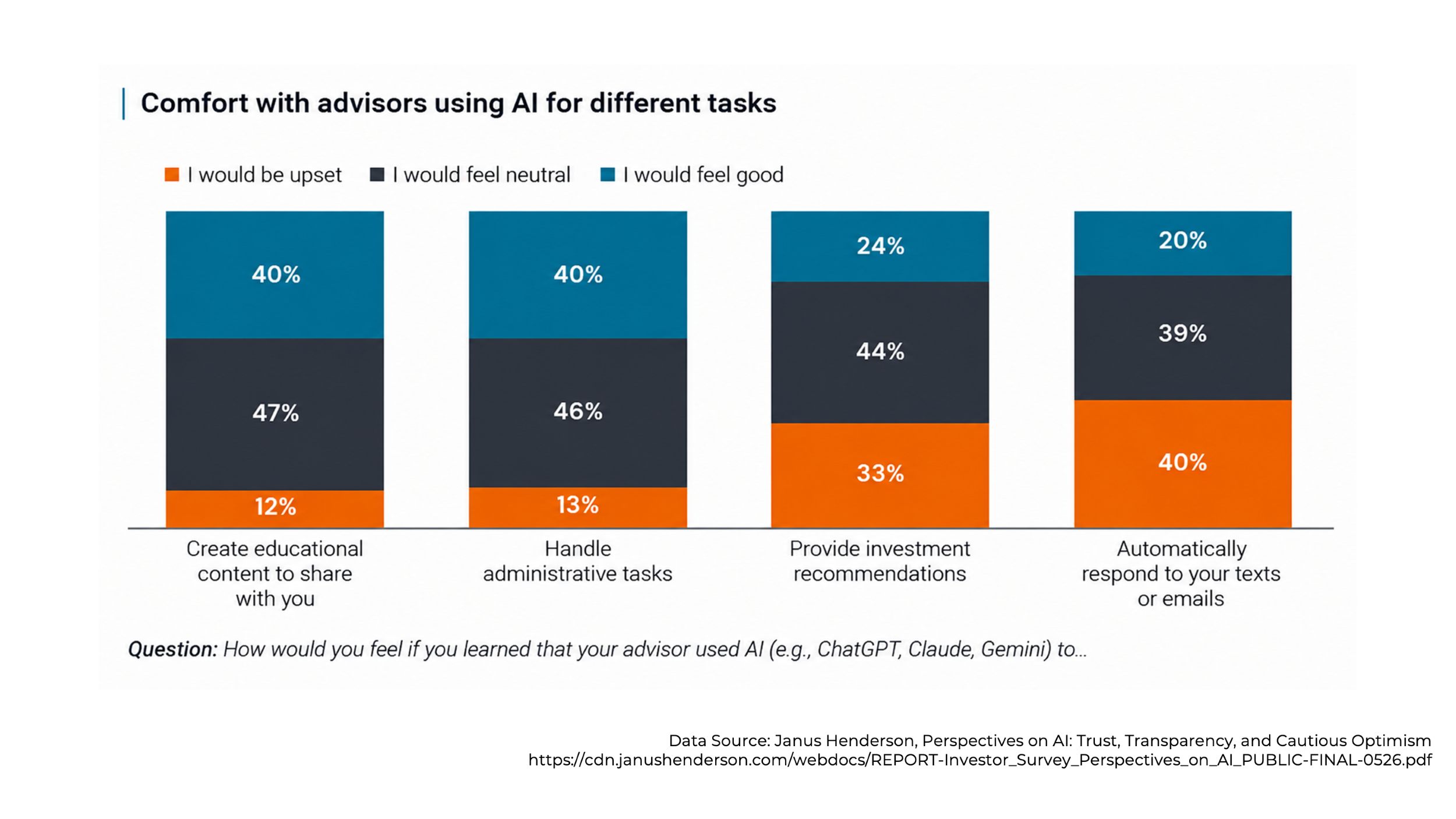
Furthermore, while most investors responded as feeling good to neutral about advisors' use of AI in most areas, a full 80% responded that they would be upset if they learned that their advisor had used AI without disclosing it to them.
So while clients appear to have no particular problem with their advisors using AI per se, there are two big caveats. One is that what the advisor uses AI for matters more than the use of AI alone: clients are much more likely to accept AI when it's used for generalized educational content than for specific recommendations, and are similarly much more favorable towards advisors using AI for behind-the-scenes administrative tasks than for actual interaction with the client, echoing the theme that clients expect human service and human expertise when hiring a human advisor. And second, no matter what the advisor actually uses AI for, clients want to know that the advisor is using it, even if they take no issue with the use of AI itself.
At a high level, these new findings reinforce the idea that, like many technological developments before it, AI is no particular threat to advisors – and despite the anxiety on the advisor side over whether or not to use AI, the reality is that apparently clients won't really register its use anyway, as long as it doesn't intrude on the fundamental client-advisor relationship. If an advisor uses AI to write a blog post or client newsletter or to automate some manual back-office tasks, it won't matter much to existing clients and may even be a net benefit if it allows the advisor to better educate and get deeper into their client relationships. And there's no reason for advisors to hide their use of AI in these areas – and it would seem that it's much better to be transparent and proactive in disclosing when and how the advisor uses AI for these purposes.
However, the survey does also begin to give a sense of where the line really might be where AI starts to encroach on the client-advisor relationship. While the survey asked specifically about AI-generated investment recommendations, the increased client wariness of using AI to provide recommendations presumably extends to financial planning recommendations as well. Which is notable given the recent emergence of tools that use AI to “surface” recommendations based on client data, from Conquest Planning to FP Alpha to Altruist's Hazel tax planning tool (among many others). If clients turn to financial advisors specifically because they're too wary of trusting AI to give them sound recommendations, how will they feel about their advisors using their own AI tools to do the same thing?
And the other big line in the sand is on using AI to communicate with clients. Again, clients hire advisors specifically to be a human who will listen to them, give them the best recommendation for their needs, and be helpful and responsive to questions and requests. While AI might help with the very last part – being responsive – it clearly matters more to clients that they're hearing from the advisor themselves than that they simply get a fast reply. Which has its own implications for AI-powered communications tools for clients and prospects, from AI “receptionists” and automated texting features such as offered by CurrentClient to AI-generated prospect outreach offered by FINNY. In a world where it's feeling increasingly difficult to interact with a human in any customer service context, how will clients react if they feel they can't be certain that the 'person' who is writing or texting them from the advisor's account is actually the advisor?
The bottom line is that just like spreadsheets, financial planning software, and robo-advisors before it, AI is just a tool – albeit a far more powerful one with a much broader range of potential uses. When used to expedite or automate tasks that get in the way of the client-advisor relationship, it can be a net positive if it allows the advisor to focus more on the relationship parts. But when it's used to expedite or automate away the very human-service parts of the client relationship itself, that's when clients may start to notice and become wary (and doubly so if the advisor tries to pass it off as themselves without disclosing that they're using AI). Which means while there's always a temptation to get more efficient and use AI to build 'personalization at scale', there's only so much that real personalization can scale before the client starts to wonder if they're really interacting with the human they hired.
AI 'Vibe Coding' Tools Are Making The AdvisorTech Map Bigger, Not Smaller
If a person wants to build and sell a piece of software, there's traditionally been a fairly significant upfront cost in doing so. Building software has required knowing how to code, and so the first step for someone who isn't able to write the code themselves is to hire a developer or engineer to come up with the initial prototype of the product, and then to test, iterate, and improve upon it until it's finally ready to sell to the public. And so when the software finally is ready to sell, there's a sizeable hurdle for making up the upfront cost (and if the founder took any venture capital funding to finance those startup costs, that adds another level of revenue and profits needed to meet the investors' return expectations).
This is one of the reasons that many of the solutions on the Kitces AdvisorTech Map are broad-based tools in commonly used categories like financial planning, portfolio management, investment data/analytics, CRM, and digital marketing. Not because there's so much inherent demand for yet another CRM or portfolio management system, but because the potential user base for these tools is so large – approaching 100% of advisors – that even getting just a small slice of the market can put a startup software provider on a sustainable footing. In a world where there's a high startup cost to getting a software product off the ground, it's just easier to make up that cost with a broad-based tool that can be used by almost any advisor than with a narrower point solution that will only conceivably be used by a smaller slice of advisors. (The same is true for new features in existing software: It takes resources to develop new features, so the highest priority on the product roadmap will go to the features with the most common use cases to recoup the costs.)
This doesn't meant that more narrowly focused tools haven't existed; clearly, the range of specialized planning and client engagement tools speaks to the fact that more niche tools can exist in the AdvisorTech ecosystem. But those tools often have a tough road to follow: Reach too few advisors, and they don't have resources to maintain and update the software to keep it viable; but if they prove popular enough they risk being undercut by bigger platforms co-opting their key features.
But despite the economics of the industry, smaller 'point' software solutions are still necessary because every advisory firm is built a little different. Firms have their own target clients, fee structures, investment philosophies, operational processes, and client deliverables. And so there will almost inevitably be gaps between the tools that an advisor needs and the software that's available on the market. Which in the past often meant either relying on spreadsheets to do the task, or hiring a developer to create a custom-built solution (at which point the advisor might decide to try selling that tool to other firms as well in order to at least recoup the cost of building it – which is how many tools from eMoney to Orion to iRebal were originally launched).
But just in the last year or so, however, the economics of building and developing software – especially smaller, niche-ier point solutions – have shifted significantly. The emergence of AI 'vibe-coding' tools like Replit, Bolt, and Canva Code, which write the code for a software tool based on natural language prompt, means that an advisor without coding or software development expertise can build a workable software prototype in an afternoon – and that an entrepreneur who wants to build an actual saleable product can do so with a fraction of the time and engineering resources needed for creating software in the traditional way.
The drastic reduction in the upfront cost needed to create viable software has led to many predictions that the AdvisorTech landscape will be upended in short order - that there's no reason to spend thousands of dollars each year on off-the-shelf software subscriptions when it's possible to build a decent replica in a few days' time, and so the major software providers will be wiped out when advisors flock to their own homebuilt solutions instead.
That's always seemed unlikely – the reality is that most advisors are fairly happy with the software they have already, have little interest in being software builders, and are fine with continuing to pay someone else to build and maintain the tools they use. But the more likely-seeming outcome – and the one we've seen more evidence of so far – is the opposite: That the lowering of barriers to building and releasing software will lead to even more providers on the AdvisorTech Map. Specifically, those with more niche point solutions that were less economically viable under the traditional software development cycle, but which AI vibe coding allows to be built much cheaper and therefore don't require as much user growth to make up for the initial cost.
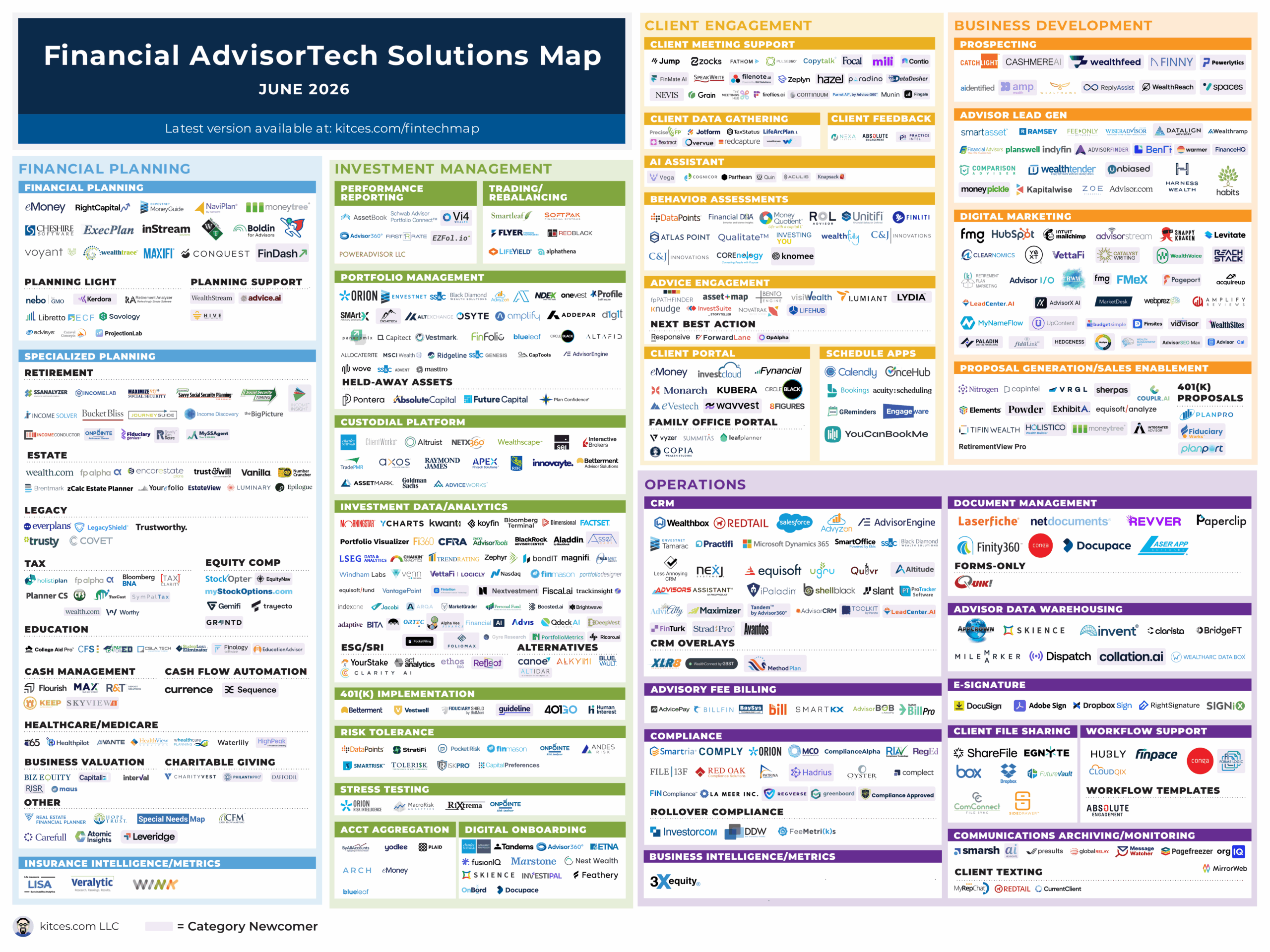
Just this month, five new solutions first appearing on the Kitces AdvisorTech Map fit that description. First there's Fingale, a post-meeting tool specifically made to make updates and trigger workflows in Wealthbox based on an uploaded meeting transcript or voice memo. Next is MySSAgent, a Social Security optimization tool using AI to analyze a client's situation and come up with the optimal claiming strategy. Then there's Leveridge, which aims to be the “Holistiplan of real estate” by pulling relevant data from Schedule E of a client's tax return and using it to create reports and projections that can be exported into planning software like eMoney or RightCapital. There's also PocketFiling, for investors or advisors who are following specific publicly traded stocks (e.g., for a client who has concentrated company stock holdings), which pulls updated 10-K filings each quarter and highlights the additions, deletions, and changes in reported risk factors. And finally there's OpAlpha, which sifts through data in the advisor's existing CRM to track client “relationship health”, noting which clients are more or less engaged and flagging which ones the advisor may need to check in with.
What's notable about these new solutions is that they're all designed to fill the gaps left by existing software tools. AI notetakers might suggest follow-up actions after a meeting, but not all of them actually trigger those actions in Wealthbox, so Fingale fills that gap. Comprehensive financial planning software might include some basic Social Security optimization tools, but they aren't all designed to cover more complex edge cases, and so MySSAgent fills that gap. Picking out Schedule E data on rental properties and turning it into useful reports or planning software inputs is a pain, and so Leveridge fills that gap. Comparing and contrasting subsequent 10-Ks is tedious and difficult, so PocketFiling fills that gap. And CRMs, despite containing most of the advisor's client relationship history, often lack tools for advisors to make use of that data to build and maintain those relationships, and so OpAlpha fills that gap.
And so even though these are all relatively narrow point solutions that may have relatively limited potential for widespread adoption, we're now entering an era where that isn't necessarily a hindrance to getting the software built and released to the public – and so it's looking likely that the AdvisorTech Map will continue to fill out with more and more new solutions designed to fill use cases and functions that are too narrow be viable for most existing software. Which on the plus side means there will be even more solutions for advisors to solve for niche problems that traditional software didn't cover – but on the downside means it will be that marketing and distribution will become that much harder for the increasing number of tools, especially ones that don't fit into neat categories. So for an advisor facing a gap or pain point in their existing software capabilities (and who doesn't want to vibe code their own solution), at this point it's worth looking around to see if someone else is selling a tool to solve it – because even if it seems like a very narrow niche problem, it's increasingly possible that it's still common enough to support a startup software provider!
In the meantime, we've rolled out a beta version of our new AdvisorTech Directory, along with making updates to the latest version of our Financial AdvisorTech Solutions Map (produced in collaboration with Craig Iskowitz of Ezra Group)!
So what do you think? Is Altruist's corporate RIA a more attractive solution for breakaway advisors than the existing options? Is it worth getting deeper into mortgage planning and implementation with clients if the advisor can give them access to a better rate through a platform like Flourish Lending? Where is the line where technology starts to intrude on the (human) relationship between the client and advisor? Let us know your thoughts by sharing in the comments below!