Executive Summary
Over time, wealth management has evolved from product sales, to investment management, to comprehensive planning – often including tax planning. In fact, the 2024 Kitces Research on Advisor Productivity found that 92% of advisors now report doing some level of tax planning for clients, which suggests that simply offering it may no longer be enough to stand out. Yet many clients still experience tax surprises – from under-withholding to missed estimated payments – that are often attributable to a lack of effective communication between the advisor and the client's tax professional. And among the minority of advisory firms that offer tax return preparation in-house, the objective is typically not additional revenue, but client retention, referrals from the 'one-stop shop' experience, and differentiation, which are benefits that smaller firms can capture as well.
In this guest post, Russell Kroeger, Founder and CEO of Trayecto, and Chris Stanley, Founder of Beach Street Legal, explore three ways that advisory firms can bring tax preparation closer to their planning process, from partnering with an independent tax professional to preparing returns in-house to acquiring a tax firm. They also explore the compliance, legal, and operational issues to consider with each option.
Partnering with an independent tax firm is the simplest path, as the advisor can offer a more integrated tax experience without taking on the operational and compliance burden of preparing returns, though the trade-off is less control over the client's experience (since the advisor is still subject to the tax professional's capacity and turnaround times). Due diligence on the tax professional's expertise, disciplinary history, and information security should be documented, and the arrangement itself should be put in writing (e.g., through an MOU), along with the appropriate Form ADV disclosures and – where the advisor covers client fees or receives referrals – language in the advisory agreement and compliance with applicable promoter/solicitor rules.
Preparing returns in-house offers advisory firms the most control, as the advisor can demonstrate a direct link between the tax projection and the filed return and credibly position the firm as a true one-stop shop. It also requires staffing (e.g., an Enrolled Agent or CPA), the implementation of systems to track return status, and the capacity to manage 100+ returns in a limited window. From a legal standpoint, the firm must decide whether to operate through its existing RIA entity (which is simpler, though tax-related liabilities and records then sit alongside the advisory business) or through a separate affiliate (which better contains liability and regulatory reach, though with additional administrative overhead).
And finally, acquiring a tax firm provides immediate access to talent and systems (and a pool of potential cross-sell clients), though cultural and workflow differences can be difficult to overcome. Tax firms typically sell at lower multiples than RIAs, and an acquisition can also change the value of the advisor's own firm depending on who the eventual buyer is. It could also trigger a change of control (requiring client consent to assign advisory agreements) at a time when the SEC has specifically named recently acquired advisers in its 2027 Exam Priorities.
Ultimately, the key point is that adding tax services is not an all-or-nothing decision, as a light-touch partnership, a gradual build toward in-house capabilities, and an outright acquisition all sit on the same spectrum of cost, control, and complexity. Firms can start at the point that matches their current resources and their clients' needs, and revisit it as both grow.
 |
And if you want to go deeper on this topic, hear directly from the author on the Financial Advisor Technician podcast. |
Authors:


Listen To The Financial Advisor Technician Podcast On This Topic




Episode Shownotes And Transcript
Click to expand transcript and show notes↓↓
Title: Three Paths To Building A Firm’s Tax Planning Capabilities
Shownotes:
- Chris Stanley: LinkedIn | Beach Street Legal
- Russell Kroeger: LinkedIn | Upstart Wealth Management | Trayecto
Full Transcript:
Adam: Hello, and welcome back to the "Financial Advisor Technician" podcast. I'm your host, Adam Van Deusen. On today's episode, we're going to discuss the different options advisory firms have in terms of offering tax planning services to clients.
While the vast majority of comprehensive financial planners offer some type of tax planning for clients, the types of services offered and the way they are provided can vary widely. For instance, one firm might run tax planning scenarios in-house, but leave tax return preparation to a trusted accounting firm, while another might decide to have tax return prep done in-house for a more one-stop shop experience.
While this gives firms the opportunity to decide which course is the best fit for their and their clients' needs, the implications of each of these decisions, from the time and monetary investment needed to follow through with them to the compliance considerations of choosing a particular path, can make this a challenging decision.
So to help us dig deeper into this topic, I'm joined today by Chris Stanley, an RIA compliance expert and the founder of Beach Street Legal, and Russell Kroeger, a partner at Upstart Wealth Management and the founder of financial and tax planning software Trayecto, to discuss what it means for advisors to offer tax planning services in the modern advisory environment, three different paths firms might choose to offer these tax planning services, as well as the upsides and trade-offs involved with each. So welcome, Chris and Russell, to the "Financial Advisor Technician" podcast.
Chris: Thank you. I appreciate the opportunity to be here.
The Spectrum Of Tax Planning Services Advisory Firms Offer [1:51]
Adam: Great. So to start, perhaps Russell, could you begin by maybe talking about the spectrum of tax planning services an advisory firm might offer its clients, whether they do so internally or with an external partner?
Russell: Sure. So maybe on one end of the spectrum would be more traditional tax planning, talking about the different opportunities that a client might have based on their fact pattern, to help optimize taxes or smooth their tax burden across their lifetime. And then maybe on the other end of the spectrum would be not just the tax planning, but connecting the tax planning to the execution of the return, and then tying the filing and completion of that return to the planning that had been done for the client, almost in a way where you can think about stringing pearls onto a necklace where one tax year connects to the following tax year, which ends up being incredibly valuable the more you go into that.
Because obviously there's a cash flow component to taxes, and last year's taxes get filed in April of the current year. And so just being able to connect cash flow expectations and the planning to the current year and then into the future year can be incredibly valuable. And there's obviously how much responsibility you want to have for those various components that go into those services is obviously completely up to the firm and how they want to structure their offering, but there's a lot of value to be had the more you lean into it.
Adam: Yeah, very good. Thanks for teeing that up. And I think you made some really good points in there. First off, that there's a range of options within tax planning. Tax planning isn't going to mean the same thing to every firm or to every client. As you said, from the one end, maybe we're using our standard financial planning software to maybe run a few tax projections there to all the way at the other end offering a fully integrated experience. But as we're going to discuss shortly, doing so comes with various investments and certifications and things like that that need to be made.
Engaging With An External Partner To Expand Tax Services [3:58]
Adam: So I think that was a great place to start. And so now what we'll do is we're going to talk about three different options advisory firms have in terms of offering tax planning services. And the way I think it would be great to structure this with both of you as our experts is we'll talk about each one, perhaps with Russell talking about what it actually entails about the services offered, what it means for the client experience. And then we'll kick it over to Chris, as a compliance expert, to talk about what it takes for firms to actually pull this off successfully and compliantly.
So the first option we'll talk about is something I think that a lot of firms do currently, which is partnering with external tax providers, an external accounting firm. So in this case, I'd imagine a firm is going to do some of the tax planning in-house, but not actually do the tax return preparation, and maybe some of the other services internally.
So Russell, perhaps you could kick us off and just give us a picture of, for a firm considering going down this path, what might that look like both for the firm and for its clients in terms of the experience?
Russell: Yeah, so I think this path is probably what most advisors are familiar with. Everybody has to file tax returns. So somebody is going to have a relationship with a CPA, and how connected is the work that the advisor does to the work that the CPA does is really the question here. And so if you want it to be more of an integrated experience, if you want to have it be more collaborative and connected, so the planning work that you're doing gets connected to the tax advice, where is that line? Who is the one that's actually giving the tax advice? And then ultimately, how are those actions getting executed and then put into the client's tax return and then filed in a timely way?
I think that there are firms that partner with RIAs to varying degrees. So you could have the not-close connection of my clients just have their CPA, and we may or may not coordinate to a fully integrated, almost white-labeled solution, which a lot of tax firms are leaning into now to be able to serve the clients of those RIAs.
So depending on what you're looking for, the closer the connection obviously between the proactive financial planning and then the tax work that gets done, the better. So thinking about what does the firm look like that you might partner with or trust, passing off a handful of your clients to that firm to help streamline the clients' taxpayer experience.
Adam: Yeah, and I imagine a couple other advantages that come to mind is a potential cross-referral opportunities with those firms. Everyone's looking out for the COIs or centers of influence. And the more regular interactions you're having with a firm, the more mutual trust I'd imagine that gets built as well.
So, Chris, from your point of view, what should firms be thinking about in terms of documenting these partnership relationships? Any compliance or regulatory implications of this structure for advisors and tax planning services?
Chris: I'd say the threshold consideration is to clearly define what actual tax services will be within scope. I can imagine that the term tax services or tax filing or tax prep, etc., etc., could mean different things to different people. So I think step number one is just getting on the same page with the independent tax professional to understand, okay, does this just encompass the preparation of a federal and one state income tax return? Will it include any tax advice or tax projections or other tax work over the course of the year? Will the tax prep and filing be inclusive of business returns or trust and estate returns, or what happens if the IRS wants to do an audit? Is that covered under the expectation of services?
So as you can see, there is some helpful upfront work just for the advisor and the tax professional to make sure that they're on the same page. And then once that's settled, I think it's also helpful to memorialize the mutual understanding in writing. I don't know that it has to necessarily be in an agreement per se, but some an MOU or memorandum of understanding might be helpful just to ensure there's no misunderstandings.
There's obviously the dollars and cents component of it as well, insofar as whether the tax professional will directly invoice the clients and then the advisor is reimbursing the clients, whether the tax professional will send his or her bill to the advisor for direct payment, what are the payment terms? What amounts are covered? What is beyond the scope that the client will pay directly? Etc., etc.
So once that's all settled with the tax professional, then it comes down to translating that into ADV disclosure for the advisor, and then also to ensure that there is some written agreement or an addendum to an existing agreement between the advisor and their clients to describe what actual tax services are going to be provided by the third-party tax professional and what the coverage, the financial coverage of the advisor will be.
So is it just a blank check arrangement, which I don't know that I would necessarily recommend, where whatever the third-party tax professional happens to charge, the advisor will cover that, or is it we'll cover a certain fixed dollar amount per return or per tax year, or we'll cover these services, but we'll exclude any audit-related work if the IRS wants to do an audit? And again, just memorializing that in a client agreement or an addendum, and then translating that into appropriate disclosure, primarily in your ADV Part 2A items 4 and 5.
And then the last footnote I'll add here is that if there is any compensation for referrals that is going one way or the other, either from the tax professional to the advisor or from the advisor to the tax professional, that has a host of other considerations from a disclosure perspective, and also just complying with the SEC's marketing role as it relates to solicitors and promoters.
Adam: Very good. Yeah, a couple of key points I get from that. One is this communication element that each of the parties involved, the client, the advisor, and the tax professional know what each one is responsible for. When it comes to taxes, there are so many balls that can potentially be dropped during the year, and that can be really costly. So having those clear lines of communication sounds very important.
And then you also mentioned the fee issue. Another consideration here is that, do firms want to offer it wrapped into their AUM fee? Is it a separate fee charge? Making sure that that's clear to the client and disclosed. So I really appreciate that point as well.
Considerations For Bringing Tax Prep In House [11:03]
Adam: Okay, so now let's move into a second type of option. So I think, as you both mentioned, that first cost structure is I think going to be very common to firms, but something we've seen more and more in recent years are firms that want to bring tax prep in-house, that maybe they're trying to move up market, maybe their clients are saying, "I just want a one-stop shop to handle all of these services." So some firms might decide, hey, we're not just going to offer the tax planning, we want to make this seamless by offering the tax prep in-house.
So Russell, perhaps you could start by talking about how does this potentially expand the tax planning services offered by the advisory firm itself? And what does it actually take in terms of personnel, investments, things like that to offer tax prep in-house?
Russell: Yeah, this is maybe a much longer conversation, but I think at a high level, a couple of things to think about, first and foremost being do you have the people on the team with the skill set and the certifications to do the work? The other component being, so if you do or don't, what is the risk to the business if those people leave? It can be really unfortunate to spin up an offering for clients and then for the only person that is capable of doing that work on the team to leave, and then you have a gap to fill in how you proposed the client experience was going to be. So that's definitely one thing to manage.
But the other component is also if you have not gone through tax seasons before as a financial planner, I think it's maybe hard to understand the gravity of what's required. There's a lot of data to go through, being very thoughtful, managing potentially volumes of tax returns in Q1 when there's other planning work to be done.
And so really just being honest with yourself about what that's going to take and not just again during tax season, but also throughout the year. If you are doing tax returns for your clients, throughout the planning process, you're probably going to want to have better, more granular data because you're going to need that when it comes time to do the client's tax return. Whereas if you're not doing that work, you can leave that data gather to the CPA, and that's their responsibility.
Obviously, if you're partnering, maybe that's a shared responsibility, but just thinking about how much more onus is on you as the advisor or as the firm owner to be able to deliver those services, not even considering the technology that goes into it. Really just thinking about what that means for the firm and how you operate and how you relate to clients and how you train them to give you the data that you need and all of that stuff is probably the first thing to think about. And if you are willing to take on that risk and lean into that complexity, then you can dive further into, okay, well, what technology do we need, and how do we then implement our systems for tax season?
Adam: Yeah, really good insights there. A couple of points…one, you mentioned the hiring front and the personnel is that you might not have an internal person who has the capacity or the qualifications to prepare tax returns. So now you're hiring someone who you might not...a type of employee you might not have hired before. So maybe you've hired a paraplanner or associate advisor or maybe even a lead advisor, but hiring a tax professional is going to be a different story there. So considering whether you have the understanding of what it takes to find someone's qualifications and who's going to be successful in the job, as well as bringing them into the firm and its culture is something to consider.
Then also you mentioned, I think it's a really well-taken point, that if you're considering doing this, the time to make the decision is probably not July or August, where things are a little bit relaxed. Maybe it's in January or February next year, as you're maybe putting together a client's tax letters, you're doing some different tax planning information-gathering services, and thinking about whether you want to add the actual tax preparation on top of it. So really well-taken points there.
So, Chris, from your perspective here, I think this is a real potential opportunity to give clients this one-stop shop experience, make things really seamless for them. But I'd imagine from a firm's point of view, some extra liability coming here that you're not just maybe collecting data, but you're actually preparing and filing returns, which can have significant financial implications for the client, especially if any errors are made. So from your perspective, from compliance and regulatory considerations, what should advisory firms think about before going down this path of offering in-house tax prep?
Chris: The initial fork in the road here is usually option A, do we operate a tax practice through our existing RIA entity? Let's assume, for the sake of argument, maybe it's an LLC or a corporation. And we don't necessarily have to spin up a new LLC or corporation, and we don't necessarily have to open up new bank accounts and credit cards, or get a new EIN number from the IRS, or file separate tax returns, or draft up a separate operating agreement or stockholders agreement.
That is definitely the more simplified approach, especially if you're looking to test the waters, so to speak, of offering tax services. And that can be all well and good, and maybe is a good way to start offering these services in-house with the goal of keeping things simple. The primary downside is that there's no segregation or sandboxing of liabilities.
So if, hypothetically, there is some tax return error that causes a client to experience a loss and they're seeking recovery, i.e., they sue to seek compensation, now they're effectively naming the combined RIA/tax entity, which ostensibly has more assets, more in the bank to serve as a basis for recovery.
So the RIA firm would have to be comfortable opening up its entire corporate infrastructure, if you will, setting aside, of course, limited liability protections that may exist, but having that serve as the basis for recovery, as opposed to if a new entity was spun up to offer tax services, a different LLC, a different corporation, then ostensibly it's just that separate entity that would be named in the lawsuit as the provider of tax services.
So the downside is, effectively, if you run a tax services business through a separate entity, now you're having to create a separate entity at the state level, filing articles of organization or articles of incorporation. Typically, there are fees associated with that, also paying annual renewal fees and registration fees at the state level. If you want to respect corporate formalities, you'll keep your books and records separate. You'll have separate bank accounts and credit cards, financial statements, etc., etc.
And so there's a bit of an additional administrative hurdle to operate a tax practice through an affiliate, for example. The upside of that, of course, could be maybe you have a different ownership structure through the affiliated entity that is not identical to the RIA entity. So just to maybe walk a step back, if you offer tax services in-house through your existing RIA entity, like an LLC, then the profits and the losses and everything from a dollars-and-cents perspective inures to the benefit of the owners of the RIA.
If you have a separate new tax entity that's set up, maybe you have different owners. Maybe the ownership structure is separate. Or again, if you want to keep things simple, maybe you have the CPA firm set up as a just 100% subsidiary of the RIA firm.
But the bottom line is having a separate entity does allow for some potential additional flexibility from an ownership, equity control, and financial perspective if that's important to the firm. So I'd say, again, the initial fork in the road is do we operate this in-house? Do we set up a separate LLC or corporation? Or do we maybe start in-house through the same entity and then evolve into a separate entity down the line if the provision of tax preparation services is successful and going according to plan?
Now, Chris, on a related note here, from a regulatory perspective, I'd imagine that disclosures are going to be important here, again, in terms of the exact services that our advisory firms are providing. But also, in your experience working with RIAs, going through examinations and things, what have you found the SEC is looking for, potential pitfalls that firms have faced when they do offer in-house tax prep?
Chris: Sure. And I would say the overarching message I try to convey is sunshine is the best disinfectant, meaning that whether you operate tax services through a partnership arrangement with an independent third-party tax professional, whether you operate it in-house through your own RIA entity, whether you set up a new affiliate or subsidiary that's a different company to offer tax services, those are all going to need to be disclosed transparently in your ADV, specifically as it relates to conflicts of interest.
So under an advisor's fiduciary duties, they're required to fully and accurately and transparently disclose their conflicts of interest, their economic incentives, and that will find its way into different parts of the Form ADV depending on the structure of the arrangement, in-house, partnership, same entity, different entity, etc., etc.
So you'll see in the article that there's a table that tries to identify where potential disclosures will reside, but I would say the primary things to think about is that if an advisor operates a separate affiliate to offer tax services and there's going to be a separate fee attached to that, well, now the advisor has a financial incentive to recommend that their advisory, their financial planning clients work with their affiliated tax firm because they're ultimately going to earn more compensation as a result. So that's a clear conflict of interest that should be disclosed.
Another example could be if there is a referral arrangement with an independent tax professional and the tax professional is going to compensate the advisor in consideration of the advisor introducing its financial planning clients to the tax firm, that's another financial incentive that will have to be transparently disclosed.
So I think ultimately the messaging here, or the takeaway here, is just to follow the money, look where you are financially incentivized to make decisions, transparently disclose those financial incentives, those conflicts in your ADV, and ensure that there's no hiding of the ball as to where your motivations may lie and take the role of a skeptical SEC examiner when viewing the relationship.
Considerations For Acquiring An Existing Tax Practice [22:10]
Adam: Great. All right. Well, thank you for that rundown. So now let's say I'm putting myself in an advisory firm's position. I'm saying, "Okay, this idea of offering in-house tax prep sounds good for me. I think the clients would really like it. It'll really help client loyalty and retention, but doing all this hiring, maybe starting a separate business from scratch, that seems like a lot to me." Maybe I want to take a shortcut and just acquire an existing tax practice to bring it in with my firm.
So, Russell, what would that look like, and how might an advisory firm integrate that within its current practice?
Russell: There are definitely a number of, obviously, business and economic decisions when thinking about that, right, like how are you funding the acquisition and all of those logistics. But I think, more practically speaking, being thoughtful about what does that tax firm look like, and who are their existing clients? How many clients do they have? How much overlap is there from your target archetype of a client, your existing client base, and the clients that they serve?
If you have clients with a given type of complexity, like equity compensation or real estate or something like that, do the professionals at that tax firm have similar expertise, or do they serve clients with a similar expertise? Maybe one that's a little bit more a tongue-in-cheek comment, but is the tax firm a paper firm? Are you going to have to do paper? Do their clients fully embrace the digital experience?
Thinking through all of those things can be really important as well because ultimately you're going to be responsible for that and integrating it into your firm from a worldview and culture perspective. And ultimately, the standards of how that firm operates is going to impact what your client experience is for some period of years until you can incrementally get it to be more aligned with your vision for the future of the firm.
So just being very thoughtful about what a combined company would look and feel like effectively and whether or not that matches your vision for the client experience that you want to offer because there could end up being a lot more complexity as you peel back the onion than just, do these economics make sense? And so I think that is probably the thing that needs to be explored the most, that you don't really know how to think about until you experience it.
Adam: Yeah, this cultural element, I think, really is key because, as you mentioned, you're not just hiring someone to prepare tax returns. This is someone who's going to be a partner with you.
A huge upside, I'd imagine here, is the potential for their current tax clients to potentially become wealth management clients from the advisory firms' end. So it would help if those individuals come, have a similar background, similar situation that the advisory firms' ideal target client fits that.
Now, Chris, I'd imagine from your end, we're talking a couple of things here. One is that most advisory firms probably have not engaged in acquisition before. There's a lot of M&A, but a lot of that's at the largest firms. So both, I would guess, the legal elements of doing a business acquisition like this, but also in terms of disclosures, I would think for current clients and what the combined business is going to look like. So perhaps you can talk about some of the best practices for thinking through an acquisition such as this.
Chris: Effecting a merger, acquisition, or some transaction where you're actually purchasing the assets or the equity of an independent company like a tax firm is a bit of a different ballgame than the first two paths that we explored with a partnership and/or bringing tax prep in-house or through an affiliate. So if you're actually growing inorganically through an acquisition, then you're looking at a much longer timeline to effect the acquisition.
I would say at least to do it well, you want to make sure that you are going through the process of appropriate due diligence from a legal perspective, a compliance perspective, a financial perspective, operational perspective. There's obviously the dollars and cents aspect of it, as Russell mentioned, to make sure that you either have the funds in-house to effect the acquisition or seeking out third-party financing, for example, to effect the transaction. So there's a bit of a longer runway to get this off the ground, and there's a bit more legal, financial spend, if you will, to make sure that it's done right.
The other thing, as you alluded to Adam, has to do with ultimately how the transaction may be structured because, depending on the structure, it may have different implications for how existing clients have to be approached with respect to the transaction. And primarily, what we're dealing with here is referred to as the change of control provisions under the Advisers Act, meaning that if as a result of the transaction with the third-party tax firm, if the ownership of the RIA changes by 25% or more, that will generally be deemed a change of control at the advisor and clients of the advisor are entitled to consent to a change of control because it's deemed to be an assignment of their advisory agreement.
And an assignment can either be handled via positive or affirmative consent, meaning the client actually has to sign something effectively approving the change of control, or via passive or negative consent where perhaps a notice can be sent to the client of the change of control, but they need not respond, and their silence is deemed to be their consent. So again, the takeaway here is that if the transaction or the acquisition of a third-party tax firm will result in a change of control for the advisor, you're now going down the path of ensuring client consent logistics are handled appropriately.
The other thing I'll just conclude with is that for the last few years, the SEC has a fairly explicit focus on advisory firms that have undergone some M&A activity, transaction with another advisory firm or another third party. It found its way into the 2026 SEC exam priorities. It appeared again in the 2027 SEC exam priorities, which were just released a few weeks ago. So suffice to say, the SEC is interested in advisors that are engaged in M&A activity to make sure that clients' interests are still protected, that they went through appropriate protocols from a client consent and disclosure and compliance infrastructure perspective. So it's important to bear that in mind as well.
One Key Takeaway For Advisors [28:58]
Adam: Very good. So I think it was a terrific rundown of these three different options that advisory firms have for adding tax planning services. But since we've covered a lot of ground today, for each of you, what would be your one key takeaway for advisors when thinking about these options for offering tax planning services? Russell, do you want to go first?
Russell: Sure. I would just say, almost...if you closed your eyes and imagined the perfect experience for your clients across financial planning and tax, what would that value proposition be? And then you can work backwards from there to decide how you're going to stitch that together. How much of that do you want to do, or do you want your firm to be responsible for? And then, to the extent that you are drawing lines in the sand of what you don't want to do, who do you need to connect with? And how do you want to structure that relationship such that your clients are getting the value prop that you imagine? And then just honoring that. Don't feel the pressure to do something that you don't want to do. Just, again, lean into the vision you have for your clients, and then just execute on that in a fiduciary way.
Adam: Terrific. How about Chris, from your side?
Chris: So I'd encourage advisors to be thoughtful about the details of whatever arrangement they end up pursuing, and to understand that the more thoughtful they can be in accounting for all these little details about the particular arrangement, the better it will help them disclose the arrangement to Form ADV, to clients, making sure they're on the same page with the tax professional if it's a third party, and to not treat the relationship in a casual fashion.
Because we have seen sometimes that if advisors rush into an opportunity, they end up doing a bit more cleanup work down the line, which is a little bit harder and potentially more expensive to do. So just to go about it the right way, find the right partner, find the right service model internally, and ensure that everything is transparently and fully disclosed in ADV's client agreements, and via an MOU with a third-party tax professional, if relevant.
Adam: Terrific. Well, thank you so much for joining us today on the "Financial Advisor Technician" podcast, Chris and Russell.
Chris: I appreciate it, Adam. Thank you.
Russell: Thanks for having us.
The Growing Importance Of Tax Planning
From A Problem Of Supply – To One Of Execution
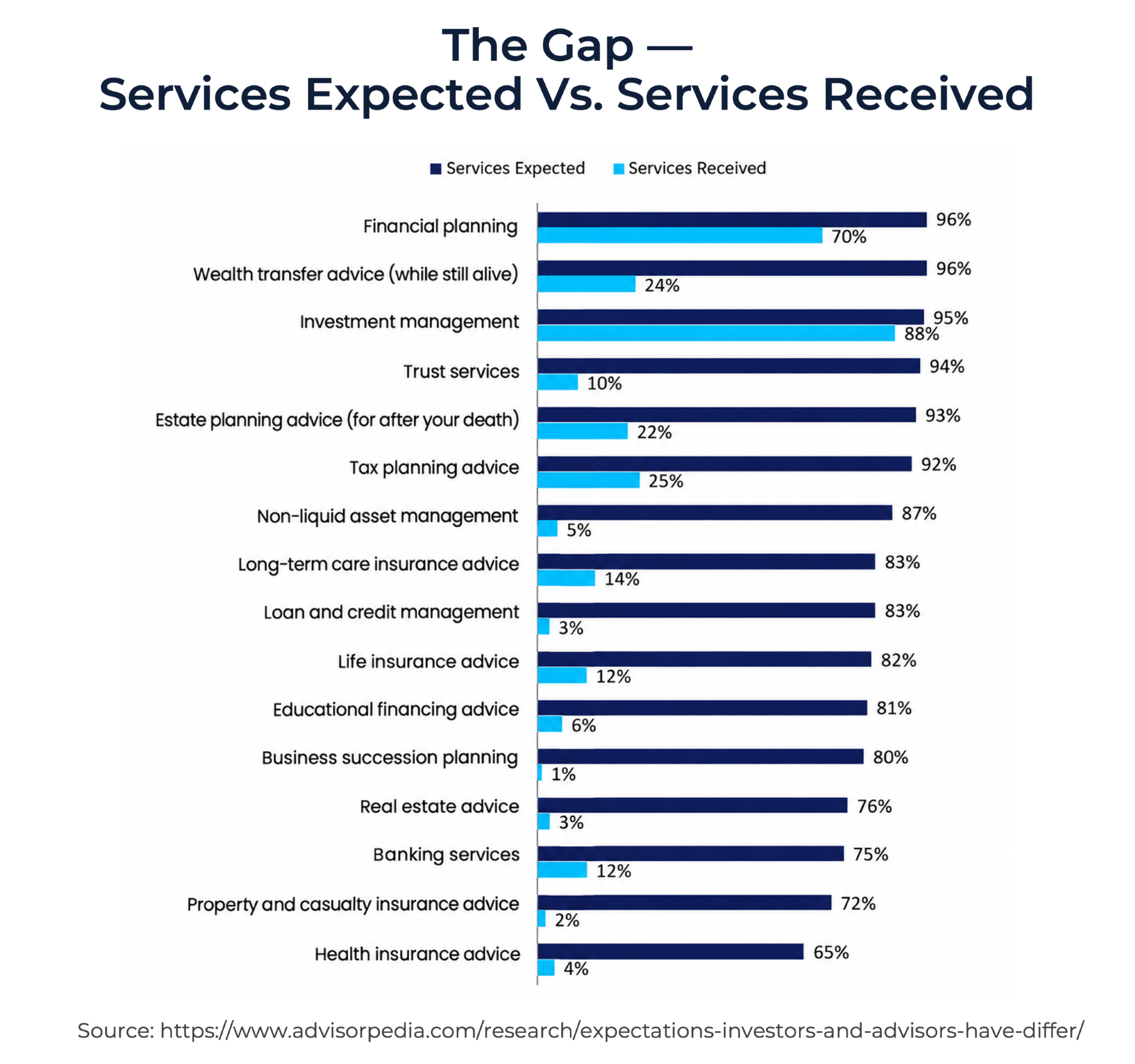
Wealth management started with a focus on the sale of products, evolved into the management of investments, and then, most recently, into comprehensive planning. Tax planning is the current frontier – and by the numbers, it has already arrived. According to 2024 Kitces Research on Advisor Productivity, 92% of advisors now report doing some level of tax planning for clients. That same report suggests that tax planning is becoming commoditized: It may no longer be enough to say you offer it, because the client can get the same thing from the advisor down the street (often using the same tool).
Which means the gap has moved. Five years ago, it was a supply problem: Nine in ten wealthy investors expected tax planning advice, but less than a third were receiving it:
Today, the 'supply' (tax planning offered by RIAs) increasingly exists, but effective execution remains less common: whether the tax projection matches the tax return, whether the financial advisor and the tax professional are working from the same facts, and whether any of the advice arrives when the client actually needs it. Tax planning has become table stakes – and yet the taxpayer experience still lags. For high-income earners and equity-compensated clients in particular, tax surprises are an acute source of pain: under-withholding, missed estimated payments (resulting in penalties and interest due), and insufficient cash flow planning all conspire to produce a subpar tax planning experience that can detract from the overall financial advisor/client relationship. Often underlying such issues is an information asymmetry between the financial advisor and tax professional, resulting in incomplete or inaccurate advice.
Providing a seamless taxpayer experience, on the other hand, is an incredible competitive advantage for attracting and retaining clients. After all, each prospective wealth management client is ultimately also a taxpayer. The integration of tax services and wealth management should thus not be thought of as exclusively reserved for family offices, ultra high net worth individuals, or institutional clientele. Any client that stands to reduce a tax bill or otherwise plan for their taxes more efficiently is a candidate for an integrated wealth management and tax experience.
In practical terms, any of the following common scenarios could suggest that a firm's current offering is insufficient to meet client tax planning demands:
- A client terminates the RIA to start working with another RIA that happens to offer tax services in-house as a one-stop shop.
- Clients ask if the RIA can handle tax prep and return filing (i.e., the demand exists before the supply exists).
- An RIA has a long-standing professional relationship with a CPA, and conversations start to evolve into a more formal business relationship, cross-referral agreement, or partnership.
- Clients seem more and more tax-sensitive and have increasingly complex tax needs that begin to overshadow the more commoditized investment management component of an RIA's practice.
Larger, multi-billion-dollar RIAs (like Ritholtz, Creative Planning, Focus Partners, and Mariner to name a few) are already embracing this future by offering tax return prep as part of their offering – if not for every client, at least for those who meet a certain managed-asset minimum threshold. In fact, the 2024 Kitces Research on Advisor Productivity found that approximately 17% of advisors were already doing preparation for at least some of their clients. Yet while most firms do charge at least a tax preparation fee, increased revenue is not the objective of this service offering. Instead, the objectives are client retention, referrals from existing clients due to the 'one-stop-shop' experience, and differentiation relative to firms that don't embrace tax/wealth management synergy.
This article will endeavor to convey that far from this being the exclusive domain of multi-billion-dollar RIAs, comparatively smaller firms (and their clients) can also benefit from offering integrated wealth management and tax services.
So What Do We Mean By "Tax Services"?
Tax services involve leading tax projections and delivering tax planning advice, as well as preparing and filing the client's tax return. The goal of providing tax services is to improve the client's after-tax outcomes while anchoring that value to their relationship with you, as their advisor, and your firm.
The value here is not just in the tax return preparation, which is a backward-looking compliance activity. Instead, the value lies in proactive tax planning that seamlessly flows into the filing of the client's tax return that is reported and executed in a manner consistent with the preceding tax planning recommendations, without any client surprises...and for that process and delivery of guidance to be timely and as dynamic as the client's life needs it to be.
Given the implications of rendering 'tax advice' versus 'tax planning', each advisory firm will need to decide where to draw the line – which influences the amount of value the advisory firm can deliver and shapes the client's taxpayer experience. The professionals who are most involved in the process of establishing the strategy, improving clarity, reducing friction, and making taxes less daunting are the ones that clients attribute value to.
Fortunately, there are ways to improve your client's taxpayer experience and position yourself as the core tax planning strategist. Doing so may require adopting new technologies and workflows, and exercising increased diligence about the detail and timeliness of client data, but the benefits can outweigh the costs if done correctly.
Three Paths To Incorporating Tax Preparation Into Your Tax Offering
Assuming a baseline risk appetite for offering tax preparation, a desire to influence and improve your client's taxpayer experience, and solidify your strategic role in the client's life by operationalizing a key and generally detested aspect of their finances (tax) – what do you do?
Financial advisors of any size or tax preparation appetite can pursue essentially three paths forward:
- Partner with an independent tax professional;
- Prepare and file your clients' tax returns in-house; or
- Acquire the business of a tax professional.
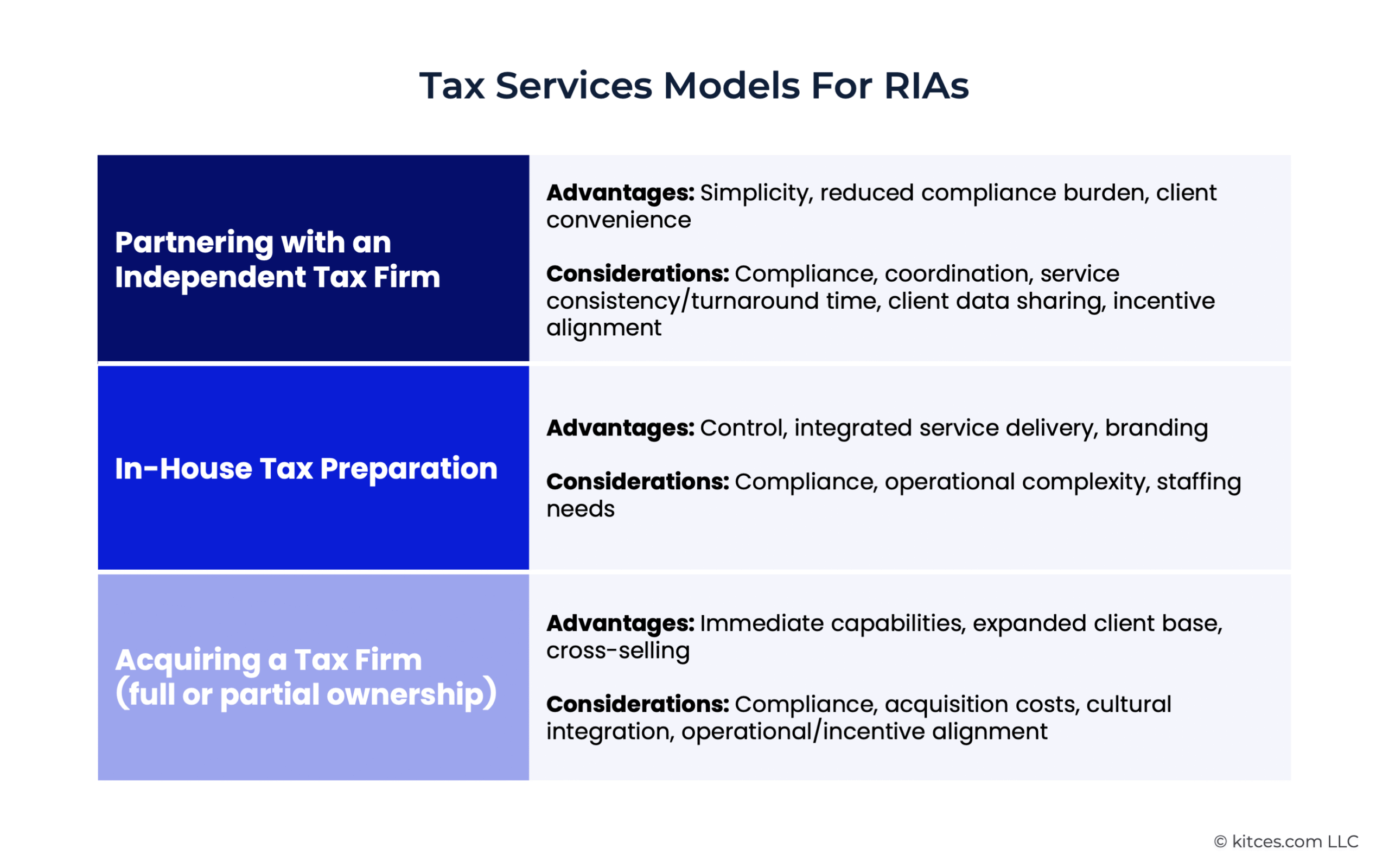
What follows is an exploration of the foregoing three options from a strategy, operations, and legal/compliance perspective to help you reason through which is best for you and your clients.
Partnering With An Independent Tax Firm
Why Advisory Firms Choose It – Pros And Cons
Partnering with an independent tax professional can work well when most of your clients are happy with their existing tax preparer, but you need someone you can trust to coordinate with on key clients – or when a client's relationship with their existing tax professional breaks down.
This 'partnership' path is the closest to coordinating with a client's existing tax pro in terms of operational complexity, cost, and compliance burden. However, because in this case the client's relationship with the tax pro will be mediated or facilitated by the advisor, the advisor may need to exert more effort related to gathering and transmitting accurate, granular data on an ongoing basis to ensure that both parties are working from the same facts.
For example, whereas in a traditional scenario the client is responsible for gathering and submitting Forms 1099 (including any corrections) to their tax preparer, or providing a mid-year estimate of taxable investment income, now the advisor might undertake those duties on the client's behalf.
Relative to other arrangements, the biggest advantage to partnerships is simplicity. The financial advisor enjoys the benefit of providing an integrated tax experience without the operational complexities and risks, avoids the need to professionalize an in-house tax offering staffed with a qualified tax professional, and lowers the associated compliance burden. Clients that don't want to vet a tax professional on their own can simply defer/delegate that process to you as the financial advisor, and you can partner with one or more tax professionals that have the right expertise. When a partnership is done right, it feels like an extension of your service offering.
But the trade-off is coordination and control over the client experience. You must inherently trust the independent tax professional to prioritize your client work appropriately, deliver quality work consistently, communicate well, and honor tight turnaround times. At the end of the day, you're subject to the independent tax professional's processes, capacity, capabilities, responsiveness, and delivery – all of which are beyond your direct control. Data-sharing and incentive alignment are also key considerations. If the tax professional partner is scaling rapidly, your client may go from feeling like a priority to just being one of the (many) returns that needs to be cranked out.
Vetting also matters in the domain where your clients' complexity lives. As an example: it's one thing for a tax professional to say that they 'do' equity comp; it's another to have mastery of it. Ask candidate tax professionals for case studies that reflect your clients' real issues, and ask how many comparable returns they actually complete each season. The answers separate marketing from real capability.
Advisor Considerations When Choosing A Tax Firm Partner
Before entering into any sort of partnership arrangement with an independent tax professional, a financial advisor should perform initial due diligence to assess, for example, whether the tax professional:
- Has the qualifications, experience, and expertise that are appropriately suited to your clients' tax needs;
- Has any material disciplinary history (e.g., with a state board of accountancy), ongoing litigation with a client or business partner, or other publicly-available 'negative news' that calls into question the tax professional's ethics or professionalism;
- Has appropriate information security policies, procedures, and controls to protect your clients' sensitive information from unauthorized access.
Such due diligence efforts should be memorialized in writing through some combination of meeting notes, responses to a due diligence questionnaire, and/or other documentation that is saved in the financial advisor's records. Questions could include:
- How big is the tax professional's firm? Number of CPAs vs total clients served?
- How much do they charge their existing clients – and to what extent do those clients resemble your own?
- What time and staff commitment can they make for the collaboration? What work will be performed by whom? What will be the communication cadence and workflow across firms?
- What is the nature of the client experience? How will service expectations be set and managed, and when can the client expect to receive communication touchpoints (and from whom)?
- Can you explicitly define the scope of the collaboration? For example, who will handle – and pay for – tax planning, including its various components (behind the scenes analysis, presentation to the client, etc.)? Additionally, how will the advisor facilitate tax return prep (such as Q4 data-sharing and tax season review)?
- Will it be possible for the tax preparer to appear as 'part of your extended team' from the client's perspective?
- How big is the cross-referral opportunity set?
Considerations Fom The Tax Firm's Perspective (That Advisors Should Be Aware Of)
This cuts both ways. Just as you're vetting the tax professional, any tax firm worth partnering with will want assurances from you before taking on your clients; clarity on who owns what, delivery timelines, and what they'll need from your clients and by when, so they can track return status and communicate proactively with you and your clients throughout the season. These are the considerations they'll typically want addressed up front:
-
- Scope & Role Clarity (in writing)
○ Who owns projections? Who owns the filing? Who signs the return?
○ When the plan changes, who drives the analysis and notifies the other party, by when, and with what document?
○ An unwritten understanding of the answers above is nearly impossible to enforce. Memorialize the answers in a written sub-agreement between the RIA and the tax firm regarding scope of services, fees, and how disputes get resolved. - Tax Doc Delivery Timelines
○ Agree to deliver tax documents by a specific date and timelines for return completion after documents have been received - Signature & Liability
○ If the tax preparer signs the returns, they carry malpractice risk. Your engagement letter and ADV/CRS must not imply you're the tax preparer unless you are. If you cover client fees, spell it out (cap, scope, and corner cases). Corner cases are where fee coverage goes sideways: the return goes on extension, the client gets audited, or an entity you didn't know about surfaces mid-engagement — and suddenly you're on the hook for an invoice you told the client you'd cover. Decide up front whether coverage is capped, fixed, or blank-check, and put it in writing. - Seasonality & Capacity
○ Agree on a capacity ceiling for March/April and a regular cadence (e.g., weekly) for status reporting that flags which returns are on track versus falling behind, so at-risk cases can be escalated and re-routed early. - Data Integrity
○ Tax professionals need more granular data than most financial advisors use, so data quality, timeliness, and coordination are critical for a cohesive experience. - Economics
○ Who pays and how to handle additional fees (like proactive tax projection beyond tax prep and filing)
- Scope & Role Clarity (in writing)
Partnership Legal And Compliance Considerations
Once due diligence has been satisfied, the financial advisor and the tax professional should consider entering into a written memorandum of understanding ("MOU") or agreement that memorializes the terms and conditions of the collaboration. An MOU or agreement ensures that the parties are on the same page insofar as their respective roles and responsibilities, client service standards, and financial arrangements (e.g., if the financial advisor agrees to cover all or a portion of the fees charged by the tax professional for services performed for the financial advisor's clients). The MOU or agreement should also set forth how disputes will be resolved, collaboration termination logistics, confidentiality obligations, client non-solicitation provisions, etc.
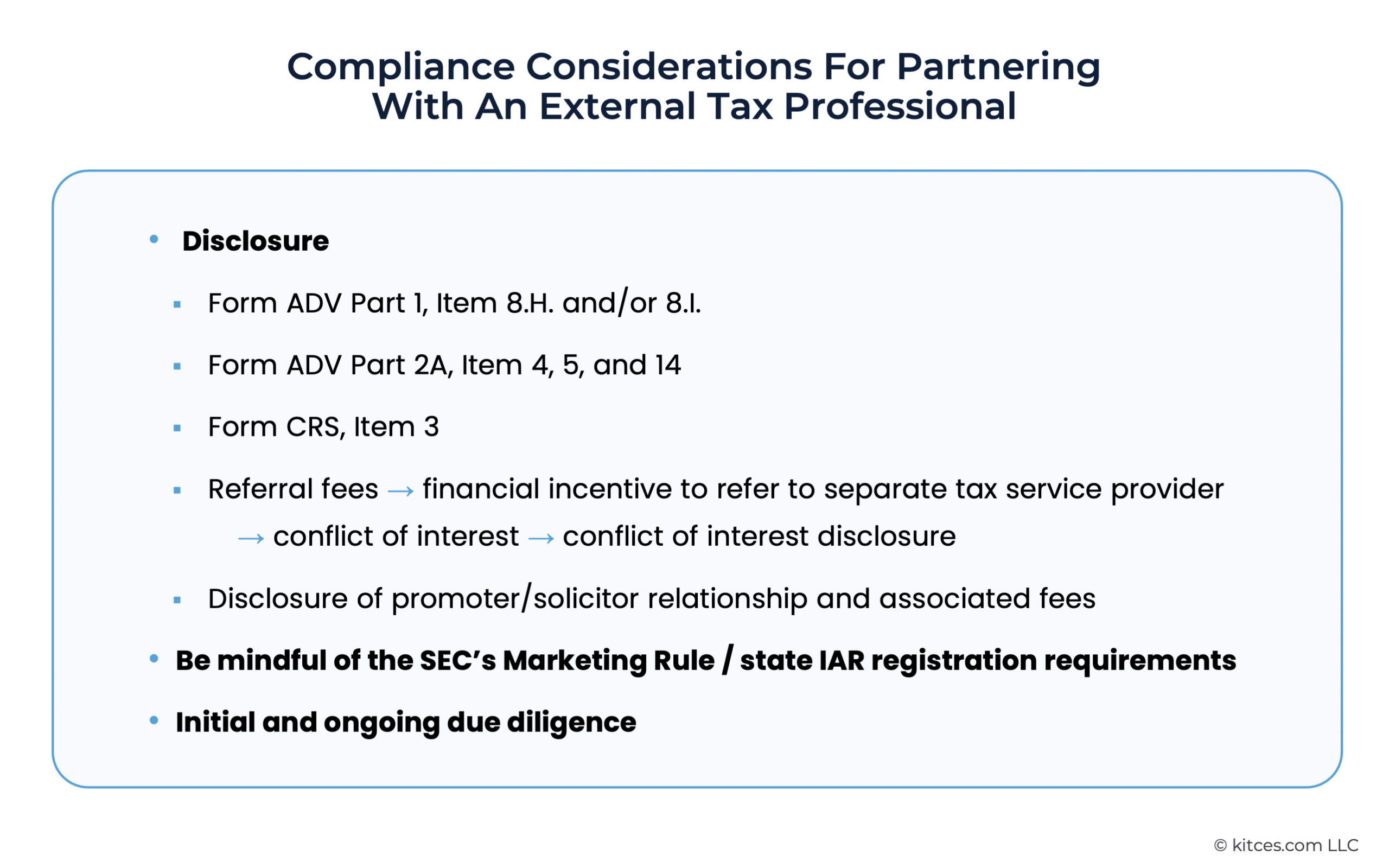
Once the tax services collaboration is ready to be offered to clients, the financial advisor should transparently describe the relationship at least in Form ADV Part 2A, Item 4. To the extent the financial advisor will directly pay the tax professional's fees and/or reimburse clients for fees they are charged by the tax professional, such financial arrangements (and any limitations) should be described in Form ADV Part 2A, Item 5. And similarly to the extent the tax professional pays a referral fee to the financial advisor, additional disclosure is warranted in Form ADV Part 2A, Item 14 and Form ADV Part 1, Item 8.I. SEC-registered financial advisors will need to assess corresponding disclosures in the Form CRS as well.
If the collaboration contemplates the financial advisor paying and/or reimbursing all or a part of the fees charged to clients by the tax professional in consideration of its services, the specifics of this arrangement should be set forth in the advisory agreement between the financial advisor and the client (or at least in an addendum thereto). The agreement/addendum should explain, for example:
- That tax preparation and filing services are provided by an independent and unaffiliated tax professional (and not the financial advisor);
- That the client must separately engage the tax professional pursuant to its own engagement letter (as applicable);
- What specific tax preparation and filing services will be paid for and/or reimbursed by the financial advisor (e.g., one individual state income tax return + one individual federal income tax return per tax year);
- The amount of fees that the financial advisor will pay for and/or reimburse (e.g., up to a certain dollar amount per tax year); and
- What services and fees are excluded (e.g., tax-related filings other than income tax returns, amended tax returns, preparation of financial statements, attestation/audit services, etc.).
If the collaboration also contemplates the tax professional referring its tax-only clients to the financial advisor for investment and/or financial planning services, the parties will also need to contend with the rules applicable to promoters/solicitors (such as entering into a written promoter/solicitor agreement, disclosing to referred clients the direct or indirect compensation paid by the financial advisor to the tax professional in consideration of client referrals – including the associated conflict of interest – and assessing whether the tax professional may need to register as an investment adviser representative or registered investment adviser under applicable state securities rules).
Due diligence is not a 'once-and-done' exercise, and the advisor should periodically 're-kick the tires' of the tax professional to confirm that the continued partnership is in the client's best interest. For example, the financial advisor could ask applicable clients for feedback regarding their experience with the tax professional, assess the responsiveness and quality of the tax professional's work product, and ask the tax professional to reconfirm that they are still duly licensed to prepare and file tax returns, have not experienced a cybersecurity breach, are appropriately staffed to continue rendering the agreed-upon services, etc.
In-House Tax Prep
Why Advisory Firms Choose It – Pros And Cons
In-house tax prep is a great option for smaller firms whose advisors already have a tax background (or are willing to acquire the skills and pursue the Enrolled Agent license) and the capacity to start preparing client returns directly, or for larger firms who can onboard staff (EAs and CPAs) to roll out the offering to a larger client base.
This path is a more intensive option than partnership because all the considerations for operations, cost, and compliance as a tax preparer are now the responsibility of the financial advisor – but you can manage the client's taxpayer experience in a way that you just can't if you're partnering with an independent tax professional. The primary advantages of in-house prep are control, integrated service delivery, and branding.
When you're doing it in-house, it's not just about filing the return. It's about integrating the expectations set through proactive planning into the results of the tax return – connecting the projection with the actual filing outcome: "Here's what we said you'd owe, and here's what your return shows. These are your key drivers for tax liability and tax savings. And this is why our projection was on target or off." Doing so raises the bar for delivering good advice, and it's also a materially better client experience. Clients see the implications of their decisions and can connect the dots across planning strategy, cash flows, taxes, and investments in a way that isn't possible without a tightly integrated offering. Delivered this way, the return itself becomes something closer to a retrospective — a summary of what happened in the prior year that matches what the client was told to expect, rather than a stressful annual reveal.
Another benefit is control over the timeline. We've all seen clients waiting around for their tax return – being told it would be a week, and then receiving nothing. In-house, you can prioritize specific returns, train clients to provide timely docs, and set better expectations for turnaround times to avoid the frustration of a fragmented offering.
Branding matters, too: being a one-stop solution is powerful. By highlighting the integration of financial planning and tax, financial advisors can more legitimately contend that they offer 'comprehensive' wealth management with demonstrable tax-specific outcomes through a unified experience.
On the flip side, the operational and staffing complexity of an in-house tax offering can't be overstated. Financial advisors – especially those who have never done it – often underestimate how much work it is to design, execute, and maintain a high-quality tax services offering. It's not that all tax prep is technically difficult per se, but managing 100+ tax returns in a limited window of time is stressful and can dominate a financial advisor's mental and temporal bandwidth (and potentially detract from the other, just-as-important aspects of the financial planning relationship). Financial advisors that integrate tax services in-house need a system to track the status of tax returns (such as Canopy or TaxDome), to implement structured touchpoints with the client along the way, and to develop and communicate an understanding of which returns need to be completed by the April 15 deadline – and which returns can go on extension.
Appropriately staffing an in-house tax offering is another challenge. If a financial advisor is not licensed to prepare and file returns, someone who is will naturally need to be hired to fill that role. Any financial advisor who's hired anyone (tax professional or not) knows that finding and hiring a candidate with the right combination of qualifications, experience, and fit is no small undertaking. At a minimum, the hiring advisor should assess a tax professional candidate's specific expertise given the common financial fact patterns across the existing client base, as well as the corresponding complexity of client returns. Clientele that receive equity compensation, hold real estate, own businesses, etc. demand a much different tax skill set compared to clientele that are simply W-2 employees or are fully retired and only need to report their portfolio income and IRA distributions.
Beyond staffing, the financial advisor will need to develop a system for how the tax professional partners with existing members of the team and engages existing clients to deliver tax services. This role will likely need to drive the tax prep process, including communicating with clients around the tax document request process and any follow-up questions. At the same time, there can be some flexibility in how involved they are in proactive tax projection planning as well as the 'tax advice' portion of the value proposition. Is the tax professional joining client meetings to address questions and run analyses, or is the tax professional just running projections behind the scenes and developing proposals for the lead financial advisor to share with clients?
Just because a financial advisor can prep and file returns, doesn't necessarily mean that the financial advisor should. The threshold question is whether the preparation and filing of returns yourself is the highest and best use of your time (especially if it detracts or distracts from actually building and growing the business overall). The financial advisor will thus need to think about staffing not in isolation, but how the team's skills, capabilities, and available time can be augmented and made more efficient with the appropriate tech stack. That includes the emerging class of AI-assisted tax prep tools (e.g. Aiwyn, Filed, and Black Ore) — evaluate them the way you would a staff hire: what work can they reliably take off your plate, and who is accountable when they get it wrong?
In-House Legal And Compliance Considerations
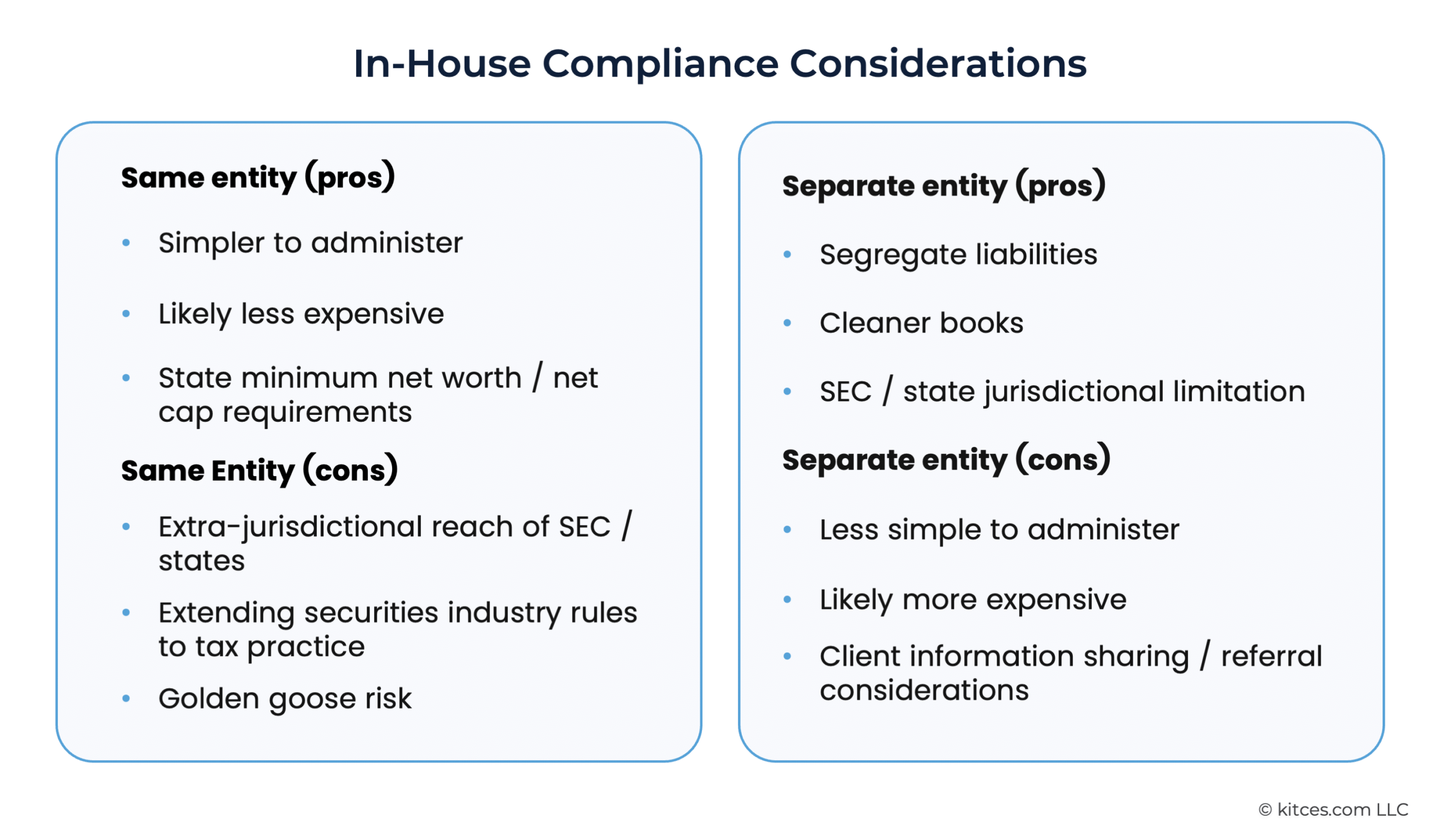
The initial legal fork in the road for an in-house tax practice is whether it is to be operated through the existing registered investment adviser entity or instead through a new, separate-but-affiliated entity. There is no right or wrong answer per se, as both options have their own pros and cons.
The primary benefit of delivering tax services through an existing RIA entity is simplicity: no new limited liability company or corporation to create and maintain with the state, no separate employer identification number and corresponding tax identity, no separate bank, credit card, and other financial accounts, etc. Financial planning and tax services are simply different business lines within the same legal entity. You need not even create a separate domain, email address, brand, or recordkeeping system if you don't want to. The foregoing benefits also correspond to fewer additional administrative expenses (no separate state organization filing and annual renewal fees, no separate financial account charges, fewer additional tech/brand costs, etc).
For state-registered advisers in particular, another potential benefit is that the assets and income of the tax services business line can count toward meeting a state's minimum net worth/minimum net capital requirements. Conversely, the balance sheet liabilities and expenses of the tax services business line will reduce the existing RIA entity's calculable minimum net worth/minimum net capital and potentially jeopardize its ability to remain compliant with such minimums.
The primary downside of delivering tax services through an existing RIA entity is the inability to clearly segregate and contain liabilities between the financial planning and tax services business lines. If a client or other third-party incurs a loss or is otherwise damaged by the provision of tax services, for example, the claimant can seek recovery from the assets of the combined financial planning and tax services entity – which ostensibly will have more assets to serve as the basis for recovery as compared to a standalone entity that is comprised of just the assets of the tax services entity. A missed tax election or filing deadline, a return that contains erroneous information, or a tax penalty caused by the tax professional now potentially becomes the RIA entity's financial responsibility. For a profitable financial planning business with even moderate assets, this structure introduces a highly undesirable tax liability risk to the RIA golden goose.
It is also harder to exclude the business operations and associated records of a tax services business line from the long arm of the SEC or state securities authority if operated through the RIA entity. While the jurisdictional reach of the SEC and state securities authorities should only extend to the securities-related operations and records of a registrant, the commingling of securities-related operations and records with tax-related operations and records blurs the jurisdictional line and may make it harder to rebuff an examiner with a penchant for extraterritorial lines of inquiry during an exam. At least for state-registered advisers in Texas, the Texas State Securities Board even explicitly states that "Inspection Staff may review and copy all commingled records" (i.e., records that RIAs are required to keep that are commingled with any records that RIAs are not required to keep – such as tax services records).
For state-registered advisers registered in states that still prohibit client testimonials, operating a tax services business through the RIA entity also eliminates the possibility of incorporating client testimonials solely related to tax services (since the testimonial would still technically be from a client of the RIA with respect to the RIA's services). A testimonial from the client of a separate, non-RIA affiliate that is purely related to the tax services of that separate entity, however, should fall outside the purview of the more restrictive anti-testimonial rules imposed on certain state-registered advisers.
While separate financial planning and tax entities may result in higher administrative costs and ongoing entity maintenance responsibilities, the legal segregation of businesses introduces the ability to separately sandbox liabilities, sources of recovery, and jurisdictional reach by securities regulators. Separating the tax services enterprise into its own legal entity also opens the door to a different ownership structure from the RIA entity; in other words, the equity owners of the tax services entity need not be identical to the equity owners of the RIA entity. If there is a desire for separate ownership, profit distribution, and/or control rights as between the financial planning business line and tax services business line, this cuts in favor of separate entities with bespoke ownership structures. This may be particularly useful for financial advisors that do not want to dilute the ownership or control of their existing RIA entity.
Whether in-house tax services are operated through the existing RIA entity or a separate-but-affiliated entity will impact how and where the provision of tax services are disclosed in Form ADV (and potentially Form U4) as follows:
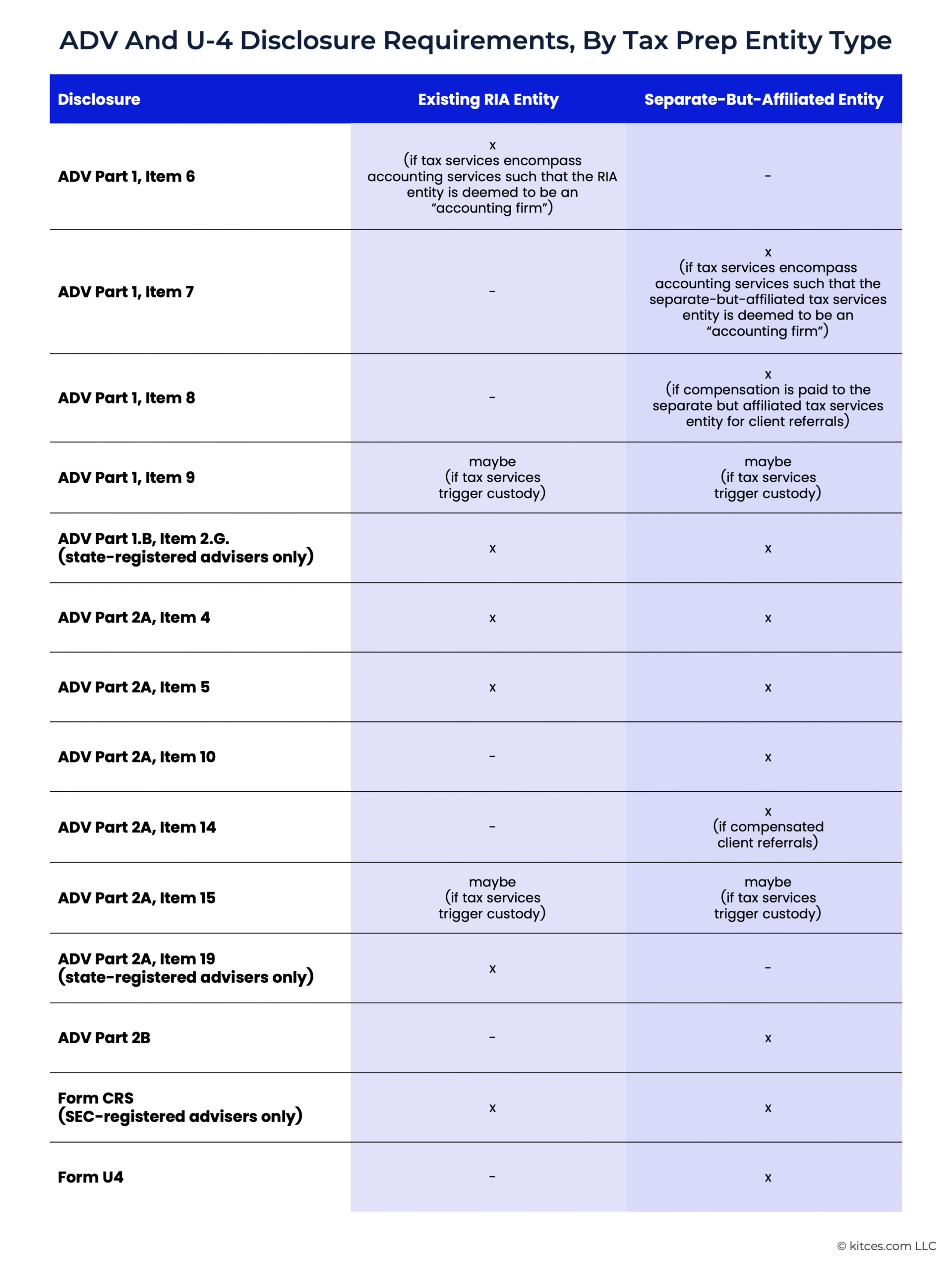
Beyond ADV disclosure, the in-house provision of tax services will also need to assess:
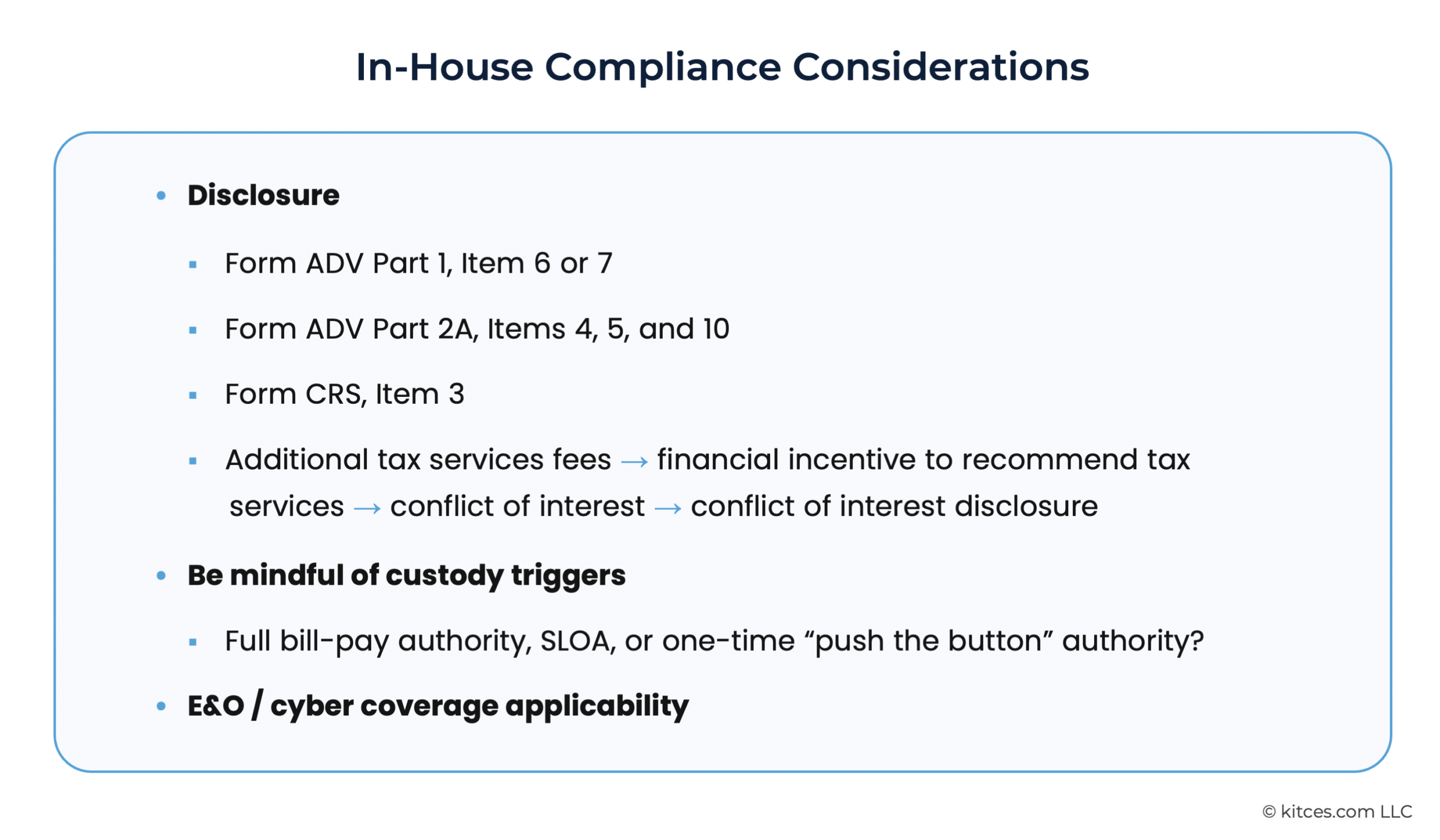
- Internal Revenue Code §7216 and the restrictions it imposes on tax return preparers relating to the disclosure or use of a client's tax-return information for purposes other than preparing or assisting in preparing a return absent client consent (this is particularly relevant if tax services are provided by a separate-but-affiliated entity from the RIA);
- Whether the provision of tax services is covered or excluded from existing insurance coverage (e.g., errors & omissions, cybersecurity, directors & officers, umbrella, commercial general liability, etc.), and whether additional riders or policies are warranted;
- Incorporating tax services and fees into an existing advisory agreement, an exhibit or addendum, or a separate engagement letter/agreement;
- Role-based access to financial planning client information and tax services client information, as well as the associated implications for who is deemed a "supervised person" and "access person" of the RIA entity pursuant to the Code of Ethics Rule under the Investment Advisers Act of 1940 (and thus subject to the reporting of beneficially-owned securities accounts and transactions to the CCO);
- State boards of accountancy ownership requirements as imposed on CPA firms (e.g., that a CPA firm must be majority-owned by a CPA);
- Potential application of solicitor/promoter rules if client referral compensation is paid to non-IAR tax personnel and/or a separate tax services affiliate;
- Custody implications if the provision of tax services encompasses bill pay authority, client username/password access, certain tax payment authorizations, etc.;
- Economic incentive and conflict of interest disclosure (e.g., that the RIA entity has an economic incentive to recommend that clients use its tax services affiliate and pay additional tax services fees); and
- Information sharing and affiliate disclosure in the RIA entity's privacy notice.
Each financial advisor will independently need to evaluate the legal/compliance pros and cons of the same vs. separate business structure as applied to its specific business practices, administrative overhead appetite, risk appetite, etc., and there is no cookie-cutter answer for each situation. Even if tax services are initially offered through the existing RIA entity, the financial advisor can always spin out the business line into its own separate entity down the line when it becomes more operationally and financially feasible to do so.
Acquiring A Tax Firm
Why Advisory Firms Choose It – Pros And Cons
Acquiring a tax firm – in part or in full – may be the right fit for large firms who can manage the complexity of doing so, have a lot of clients in need of return prep, and see cross selling wealth management services as an opportunity for growth. RIAs that take full ownership of a tax firm will need to decide if the tax firm will remain a separate entity or if it will get rolled into the existing RIA.
The advantage is immediate access to talent and systems, rather than needing to build them in-house from scratch. You also expand your client base and can cross-sell, bringing tax clients into wealth management and vice versa.
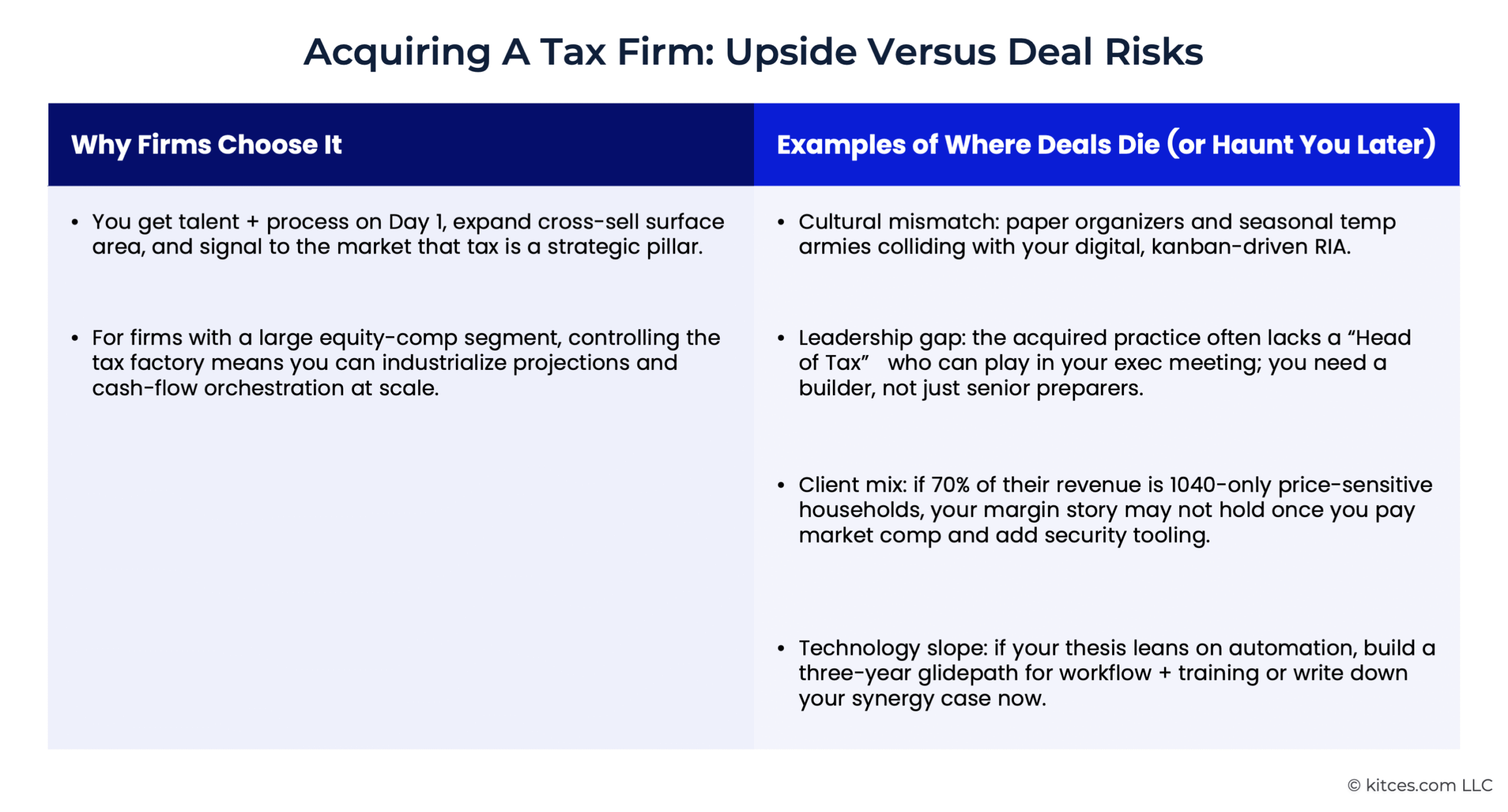
But acquisitions have costs beyond the valuation paid at closing. Multiples for tax prep firms are much lower than RIAs, and you'll still need to forecast the P&L while considering the impact of AI and automation on tax prep services. For context: smaller, owner-operated accounting and tax practices have sold at a median of roughly 1X gross revenue and 2X discretionary earnings over the past five years, while the median RIA deal in 2025 priced at 11.6X EBITDA – and even sub-$100M RIA books generally trade around 4.5X–7X discretionary earnings. Compared on the same basis, that's roughly a two-to-three-times spread, so retention and cultural integration are critical to making the math work.
Friction also likely exists where the tax firm runs differently from your advisory firm – whether that's paper vs. digital workflows, a lack of clarity around roles and functions, or a differing approach to service delivery and cadence (e.g. ongoing versus deadline-driven). Operations, incentives, and demographics of the client base all make a big difference in determining whether an acquisition makes sense.
AI deserves more than a passing clause in any valuation forecast. Automation is coming hardest for exactly the structured, repeatable work a tax practice sells – which cuts both ways: future revenues may compress, but the same tooling makes the work cheaper to deliver and easier to scale as the RIA grows its own client base. If AI-based prep software is part of the thesis, read the terms of service like a buyer: does the vendor stand behind the filing, and who pays to fix the amendment when it gets one wrong? And remember the reputational math: routing clients to a tool that errs is a golden-goose risk of its own, because the client experiences the mistake as yours.
Acquiring a tax practice also changes what your own firm is worth, and the direction depends on who your eventual buyer is. Large and PE-backed acquirers almost all run tax practices already, so an in-house tax offering reads to them as sticky, recurring revenue they know how to onboard. Smaller buyers can see the opposite – one of us (Chris) has watched deals stall because the buyer looked at the seller's tax book and said, in effect, "We don't know what to do with these tax clients." And the mix matters: a firm with 100 wealth management clients and 500 tax-only returns hasn't necessarily increased its valuation; it has bought itself a second business.
Acquisition Legal And Compliance Considerations
Whether the acquired tax practice is rolled into the existing RIA entity or into its own stand-alone affiliate, the core legal and compliance considerations ultimately become those that have already been described in the in-house section above. That said, the merger or acquisition of another company inherently introduces a new layer of legal and compliance implications that must be appreciated well in advance of signing on the dotted line.
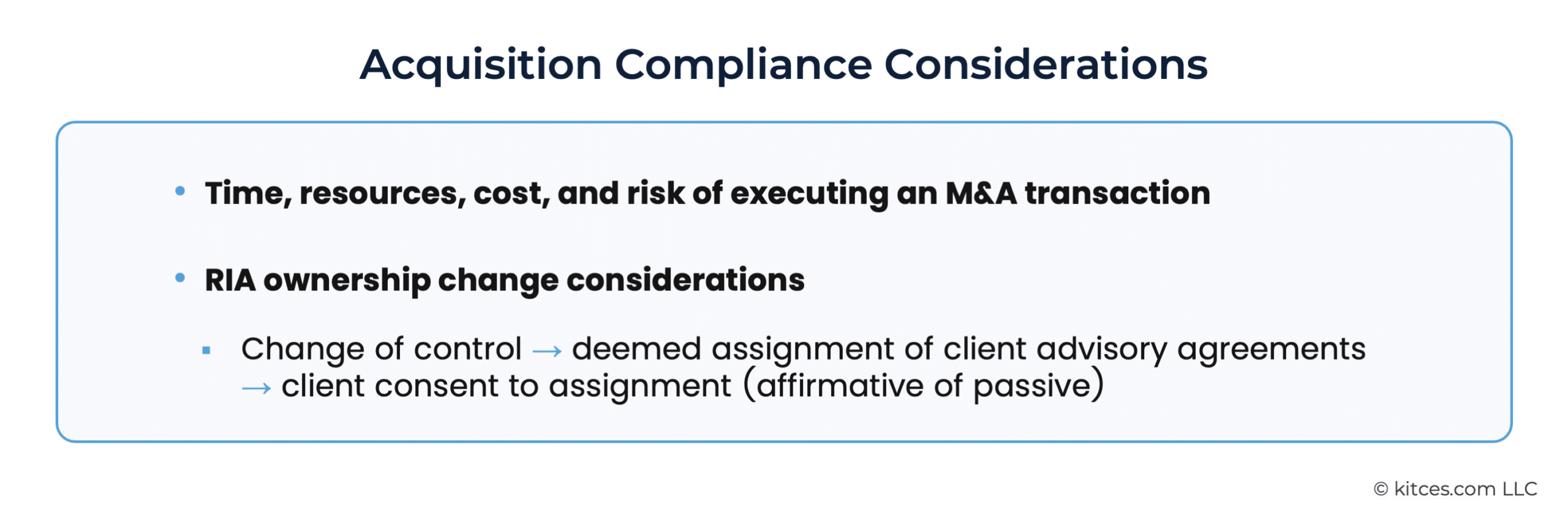
For example, if the merger or acquisition of a tax services entity results in the ownership or control of the RIA entity changing by 25% or more, it will generally result in a "change of control" that triggers the deemed "assignment" of existing advisory agreements. Each client must be afforded the opportunity to consent to the assignment of their respective advisory agreement, and consent mechanics will hinge on how the assignment clause in such advisory agreement is drafted. Some advisory agreements may permit an assignment to occur by 'passive'/'negative' consent (i.e., advance written notice to which the client need not respond), or 'affirmative'/'positive' consent (i.e., the client must sign a consent form or new advisory agreement).
Because RIA mergers and acquisitions necessitate a significant dedication of time and resources that may distract from a financial advisor's core responsibilities to its clients (and compliance program), the SEC specifically identified "advisers that have grown through mergers, acquisitions or other means," in its 2027 Exam Priorities. In line with the other thematic elements of its Exam Priorities, the SEC is most interested in whether an adviser "has adapted its compliance program in response to these changes and whether it has identified and made any necessary changes to address new conflicts of interest." Before going down the path of a merger or acquisition, a financial advisor should identify all the elements of its compliance infrastructure that may need to be updated at or by the time the transaction closes, and realistically assess whether it has the capacity to absorb an entirely new business line.
Tax services can be offered in a variety of forms using a variety of structures, and how much of that process your firm drives determines the value attributed to your offering. None of this requires an all-or-nothing leap: a light-touch partnership, a slower build toward in-house capability, and an outright acquisition sit on the same spectrum, at very different levels of cost, control, and complexity. Pick the point on that spectrum that matches your firm's resources and your clients' needs today, and revisit it as both grow.