Executive Summary
As part of a broader marketing strategy, RIAs might work with "solicitors" or "promoters" (e.g., accountants, online advisor matching platforms, and compensated bloggers) who refer prospective clients in exchange for compensation. While the SEC's Marketing Rule sets forth rules requiring RIAs to disclose their compensation arrangements with any paid promoters and the potential conflicts they entail, some firms might not realize that, depending on the relationship between the RIA and the promoter and the extent to which the promoter provides 'advice' to prospective clients, disclosure alone might not be enough for the RIA to be fully in compliance.
In this guest post, Isaac Mamaysky, Partner of Potomac Law Group and Cofounder and COO of QuantStreet Capital, explains the requirements for paid referrals under the SEC Marketing Rule, why paid promoters may need to register as RIAs (or IARs), and whether the registration burden lies in the hands of the promoter or the RIA that's compensating them.
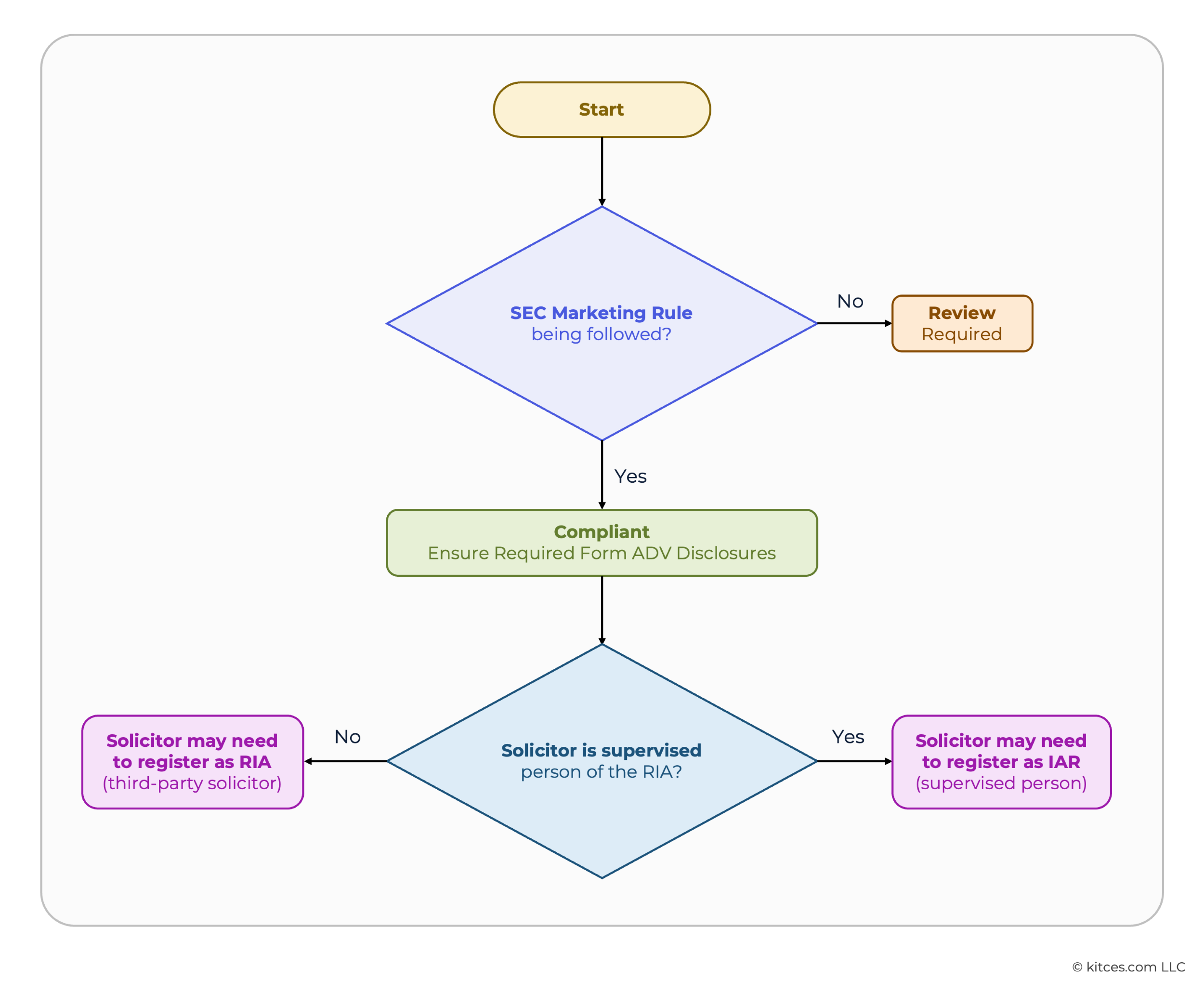
To start, an RIA engaging with a promoter will want to ensure compliance with the Marketing Rule (and provide the required Form ADV disclosures) for the testimonials and endorsements themselves. For example, the Marketing Rule requires that advisers disclose, among other items, whether cash or non-cash compensation was provided for the testimonial or endorsement and any material conflicts of interest arising from the adviser's relationship with the promoter.
Next, the RIA can determine whether the promoter is a supervised person of the firm, defined by the Investment Advisers Act as "any partner, officer, director (or other person occupying a similar status or performing similar functions), or employee of an investment adviser, or other person who provides investment advice on behalf of the investment adviser and is subject to the supervision and control of the investment adviser". If a promoter is determined to be a supervised person, the RIA must determine whether the promoter is required to register as an investment adviser representative (IAR) under applicable state law.
If, instead, a promoter is acting independently of the adviser (i.e., not as a supervised person), while there is no explicit requirement for advisory firms to confirm their unaffiliated promoters' registration status, prudent firms may choose to conduct due diligence into the promoter's compliance with their standalone registration obligations (if any).
Ultimately, the key point is that while the Marketing Rule made it easier to use both paid and unpaid promoters for business development, there are still compliance obligations regarding their use that could trip up advisors who don't have a full understanding of their requirements. Nevertheless, by determining whether they have made sufficient disclosures regarding the use of a solicitor, as well as whether a solicitor is a supervised person (and following the relevant Federal and state registration requirements depending on the solicitor's status), firms can ensure that they comply with not only the requirements of the Marketing Rule itself, but also those under the Advisers Act, SEC, and state regulations that make up the full compliance landscape for testimonials and endorsements.

Paid referral arrangements are common in the investment advisory space. RIAs often work with "solicitors" (an older, traditional term) or "promoters" (the newer term introduced in 2021 under the SEC's Adopting Release to its updated Marketing Rule), who refer prospective clients in exchange for compensation. These include client referral firms, individual wholesalers, accountants, online advisor matching platforms, compensated bloggers, and other Centers of Influence (COI) that direct prospective clients to advisers. The defining feature of these relationships is that the promoter refers a prospective client to an RIA, and the RIA firm pays a fee in exchange for the referral.
The SEC's Marketing Rule sets forth rules requiring RIAs to disclose their compensation arrangements with any paid promotors and the potential conflicts of interest they entail. Many advisors assume that providing these disclosures is sufficient to ensure compliance with the Marketing Rule. However, depending on the relationship between the RIA and the promoter and the extent to which the promoter provides 'advice' to prospective clients, disclosure alone might not be enough for the RIA to be fully in compliance. In practice, understanding an RIA's actual obligations with regards to paid referrals requires a deeper reading of both Federal (SEC) and state securities rules and regulations, both of which may come into play even if the RIA is registered solely at the SEC level.
Requirements Of The SEC Marketing Rule
Under the SEC Marketing Rule, paid referrals are treated as advertising. Both are regulated by the Marketing Rule, which sets forth the adviser's obligations when it uses a paid promoter. When a current client promotes an adviser, that is called a "testimonial”. When a non-client promotes an adviser, that is called an "endorsement”. Per SEC Rule 206(4)-1(b), any testimonial or endorsement must include the following disclosures, which may be provided by either the firm or the promoter.
- First, the testimonial or endorsement must disclose "clearly and prominently" ((i.e., at least as prominently as the testimonial itself):
- Whether the testimonial or endorsement was given by a current client or investor, or by a person other than a current client or investor;
- Whether cash or non-cash compensation was provided for the testimonial or endorsement; and
- A brief statement of any material conflicts of interest arising from the Firm's relationship with the promoter.
- Additionally, the testimonial or endorsement must disclose (though not necessarily "clearly and prominently"):
- The material terms of any compensation arrangement with the promoter, including a description of the compensation provided; and
- Any material conflicts of interest on the part of the person giving the testimonial or endorsement resulting from the investment adviser's relationship with such person and/or any compensation arrangement.
The firm must enter into a written agreement with any third-party promoter who receives more than $1,000 in a 12-month period that describes the promoter's scope of activities and compensation. Also, the firm may not compensate any promoter who is an ineligible person or bad actor and disqualified by SEC action at the time the testimonial or endorsement is disseminated.
An important exception to these obligations is when a testimonial or endorsement is provided by one of the firm's partners, officers, directors, employees, or any person that is controlled by the firm, provided that "the affiliation between the investment adviser and such person is readily apparent". In other words, certain of these requirements do not apply when a supervised person of the firm engages in promotional activity on behalf of the firm (since it would hardly seem misleading for a paid employee of an RIA to be promoting their firm's services).
Why Paid Promoters May Need To Register As RIAs (Or IARs)
On a surface level, it seems that RIAs and promoters that abide by the rules above will be in compliance with regards to any testimonials or endorsements used in their advertising. However, unaddressed in the text of the Marketing Rule itself (but noted in the rule's Adopting Release issued along with the final Marketing Rule in 2021) is a separate but equally important set of compliance considerations revolving around whether promoters themselves may be required to register as RIAs – or as Investment Adviser Representatives (IARs) of the RIA on whose behalf they are promoting.
In the Adopting Release to the Marketing Rule, the SEC makes a few key points about the registration obligations of promoters. First, a promoter may be obligated to register as an investment adviser if the promoter is not already a supervised person of an RIA. Second, a promoter that is a supervised person of an RIA may need to be registered as an IAR. More specifically, here is the language of the Adopting Release on these points:
- "A promoter may, depending on the facts and circumstances, be acting as an investment adviser within the meaning of section 202(a)(11) of the [Investment Advisers] Act. [That section defines an "investment adviser" broadly as a person who, for compensation, engages in the business of advising others about securities.] Investment adviser status and registration questions require analysis of the applicable facts and circumstances, including, for example, whether a person is 'advising' others. Commission staff previously stated that a person providing advice to a client as to the selection or retention of an investment manager . . . would be deemed to be 'advising' others . . ."
- "Any promoter must determine whether it is subject to statutory or regulatory requirements under Federal law, including the requirement to register as an investment adviser pursuant to the Act and/or as a broker-dealer pursuant to section 15(a) of the Exchange Act, respectively."
- "A promoter also must determine whether it is subject to certain state law and certain FINRA rules, including any applicable state licensing requirements applicable to individuals. To be clear, we are not making a presumption that a person providing an endorsement or testimonial meets the definition of investment adviser or broker dealer and must register...Nor are we making a presumption that such person may or may not be an associated person of a registered investment adviser. Indeed, we agree that some promoters may meet the definition of associated person of an investment adviser depending on the facts and circumstances. Others may not. Under the final marketing rule, if an adviser determines that a person providing an endorsement or testimonial is an associated person, the adviser should have requisite control of such person."
In other words, the SEC's position is that a solicitor who is not a "supervised person" of an RIA may have to register as an investment adviser if the solicitation activity entails advising clients about securities. By contrast, if the solicitor is a supervised person of the RIA, then they may – depending on applicable state law – be required to register as an IAR.
The Investment Advisers Act defines "supervised person" as "any partner, officer, director (or other person occupying a similar status or performing similar functions), or employee of an investment adviser, or other person who provides investment advice on behalf of the investment adviser and is subject to the supervision and control of the investment adviser". Any promoter who fits that description wouldn't need to register as an RIA on their own, and so the question becomes whether or not they'll need to register as an IAR in the state(s) in which they operate.
Knowing Whether A Paid Promoter Is A "Supervised Person"
Broadly stated, when a solicitor works with an RIA, they can do so in one of two capacities:
On one hand, they may work entirely outside the RIA as a sort of standalone business. For example, a Center of Influence, like an accounting practice, may refer clients to one or more RIAs. In that case, the accountant is likely not a supervised person of the RIA, since they are not (per the above definition) acting as a partner, officer, director, or employee of the investment adviser. However, the solicitor may have a standalone obligation to register as an RIA, depending on the extent to which they are "advising" others regarding securities. In the Marketing Rule Adopting Release, the SEC cites earlier guidance to explain its position that providing advice to a client about the selection of an investment adviser may itself amount to investment advisory activity that triggers registration. For promoters that don't meet the $100 million AUM threshold of SEC registration – and many promoters have no AUM because their business consists of referring clients to RIAs – some states have their own registration requirements for promoters operating in those states.
On the other hand, a solicitor may be a supervised person of an RIA for which the solicitor is soliciting clients. In this case, the Adopting Release makes clear that there would be no separate RIA registration obligation for the promoter – "If the promoter is a supervised person of the adviser for which it is providing a testimonial or endorsement, the promoter does not need to separately register with the Commission as an investment adviser solely as a result of his or her activities as a promoter" – but the promoter may nevertheless be subject to IAR registration as a matter of state law.
Investment Adviser Registration
The Investment Advisers Act defines an “investment adviser” as any person who, for compensation, engages in the business of advising others regarding securities. State securities laws, including the Uniform Securities Act, generally use similar definitions.
From a registration standpoint, the general framework is that larger advisers (those with $100 million or more in AUM, advisers that would otherwise be required to register in 15 or more states, and certain internet advisers) are eligible to register with the SEC. By contrast, smaller advisers with less than $100 million in AUM generally must register with one or more state securities regulators rather than with the SEC.
If a solicitor is “advising” others regarding securities and is not a supervised person of an RIA, then the solicitor may have an independent obligation under federal or state law to register as an investment adviser. In the Marketing Rule Adopting Release, the SEC cites earlier guidance to explain its position that providing advice to a client about the selection of an investment adviser may itself amount to investment advisory activity that triggers registration.
Taking all this together, a solicitor may need to register as an investment adviser under federal or state law. A pure solicitor often will not have its own AUM, so SEC registration usually will not be available on an AUM basis, but may still be possible if the solicitor meets the general framework cited above. Otherwise, the issue usually becomes one of state law. Many states use investment adviser definitions similar to the Advisers Act and focus on whether the solicitor is “advising” others about securities; if the solicitation amounts to giving investment advice, then the solicitor needs to register as an investment adviser under state law.
While this reflects the Uniform Securities Act framework, some states address solicitors explicitly. For example, New York’s investment adviser regulations define a “solicitor” as a person who, “as part of a regular business, engages in the business of providing investment advice to the limited extent that such person receives compensation for introducing a prospective investor or investors to an investment adviser,” and New York then subjects solicitors to the same registration and examination requirements as investment advisers.
By contrast, Pennsylvania provides an example of a state that expressly excludes certain solicitors from registration. The practical takeaway is that whether an unaffiliated promoter must register as an investment adviser is a state-by-state question, which is informed by both the general definition of the term “investment adviser” and any state-specific solicitor exemptions.
When Does A Promoter Need To Register As An IAR?
While firm-level RIA registration obligations are split between the states and the SEC (depending on whether or not the adviser meets the requirements for SEC registration), IAR registration is handled entirely at the state level. The North American Securities Administrators Association (NASAA) explains that individual IARs generally must be registered in the states where they have a place of business, and SEC Rule 203A-3 defines "place of business" to include an office where the IAR regularly provides advisory services, solicits, meets with, or otherwise communicates with clients, as well as any location held out to the public for those purposes.
The Investment Advisers Act does not create a standalone Federal IAR licensing regime. Instead, SEC Rule 203A-3 defines who counts as an IAR for purposes of allocating regulatory authority between the SEC and the states. Broadly, an IAR is generally defined under that rule as a supervised person of the adviser, but the rule also provides that a supervised person is not an IAR if the person "does not on a regular basis solicit, meet with, or otherwise communicate with clients of the investment adviser, or provides only impersonal investment advice."
Thus, under the Federal definition of Investment Adviser Representative, there is a recognition that soliciting clients is a hallmark of being an IAR: If an individual solicits clients for an RIA, they cannot be exempt from the definition of IAR. And if an individual is an IAR, then they may be subject to state IAR registration obligations depending on state law. The federal definition clearly suggests that solicitation activity is a strong indicator that an individual is an investment adviser representative, but whether the solicitor must actually register as an IAR depends on the law of the relevant states.
The 2002 Uniform Securities Act, the NASAA model legislation which many states have adopted in whole or in part, defines an "investment adviser representative" as an individual who "receives compensation to solicit, offer, or negotiate for the sale of or for selling investment advice..." The model act then makes it unlawful for an individual to transact business as an IAR without registration unless an exemption applies.
Accordingly, a NASAA FAQ presents the following questions and answers:
[Question:] I solicit clients for an investment adviser. Must I register?
[Answer:] The Uniform Securities Act includes anyone 'who solicits, offers, or negotiates for the sale of or sells investment advisory services' within the definition of investment adviser representative, though there may be special solicitor registration provisions. Solicitors should check with all jurisdictions in which they will be doing business.
[Question:] I will be getting basis points or referral fees for business I send to an investment adviser. Must I register?
[Answer:] As is the case with solicitors, state law often requires qualification and registration for individuals receiving referral fees or receiving a percentage of business from an investment adviser. Check with the applicable jurisdiction(s).
Under the model act, if an IAR has a place of business in a particular state and solicits clients for an RIA in the state, then the IAR may have a registration obligation in the state. Notably, Section 404(f) of the model act says that an RIA does not need to “employ or associate with” an IAR if the referral fee is paid by the RIA to another RIA or broker-dealer (which means the supervised person is already associated with a registered entity). In other words, a supervised person does not need to register with more than one RIA on the basis of the same activity. If the supervised person is registered as an IAR of an RIA, and their work for that RIA includes referring clients to a different RIA, then the IAR does not need to also register as an IAR of the second RIA.
State-Specific IAR Registration Requirements For Solicitors
While the above analysis is based on the model rule, we also see explicit requirements regarding solicitor registration in certain states. These states specifically address solicitors in detail, rather than including them on a list of individuals who fall within the definition of an IAR. For example, define a "solicitor" as a person who, as part of a regular business, provides investment advice to the limited extent of receiving compensation for introducing prospective investors to an investment adviser or Federally covered investment adviser. New York then states outright that solicitors are subject to the same registration and examination requirements as investment advisers, and that representatives of solicitors are subject to the same registration and examination requirements as investment adviser representatives.
Along the same lines, a California FAQ provides the following guidance:
[Question:] I solicit clients for a registered investment adviser and receive referral fees. Do I have a registration obligation?
[Answer:] Yes. Any California RIA that compensates an individual solicitor for client referrals is responsible for reporting such solicitor by filing a Form U4 on Web CRD. Note: The RIA must contact the Department to request restricted approval for solicitors.
However, if the solicitor is an entity other than an individual, the solicitor will meet the definition of an investment adviser and must first seek registration as an investment advisory firm prior to accepting any compensation from client referrals.
Interestingly, California waives the examination requirements for certain solicitors, giving them a slight pass on the typical qualification requirements for an IAR: "Any investment adviser representative employed by or engaged by an investment adviser only to offer or negotiate for the sale of investment advisory services of the investment adviser may be exempt from the qualification requirements of section 260.236 of title 10 of the California Code of Regulations."
To provide a contrasting approach to New York and California, Georgia law provides that certain compensated solicitors are excluded from IAR registration when specified conditions are met. As noted above, Pennsylvania law provides for something similar.
Whose Obligation Is It To Comply With Registration Requirements?
When embarking on a solicitor relationship, an RIA may wonder who bears the burden of determining whether the solicitor is properly registered: Is it the firm, the solicitor, or both? While specific SEC guidance squarely allocating responsibility for promoter registration does not appear readily available, the Adopting Release of the Marketing Rule and general regulatory principles point in a sensible direction.
The Adopting Release states that a promoter must determine whether it is subject to Federal registration requirements and applicable state licensing requirements. Thus, the obligation does not fall entirely on the RIA to ensure that, for example, a promoter that is required to register itself as an RIA actually does so. At the same time, however, the release makes clear that, if the promoter is a supervised person of the RIA, then the adviser should have control over the supervised person and thereby be responsible for ensuring that the promoter complies with its registration requirements. The Marketing Rule also requires the adviser to have a reasonable basis to believe that the compensated testimonial or endorsement complies with the rule itself.
Combining these considerations with general regulatory principles, it seems reasonable to conclude that an unaffiliated promoter bears the primary burden of assessing its own RIA registration obligations, while advisory firms bear the direct burden of assessing IAR registration for any promoters that are supervised persons. It's a good practice for advisors to document their decisions regarding the IAR registration status of supervised persons, which can be done in an internal memo that would then be subject to subsequent examination. And prudent advisors may consider conducting and documenting reasonable diligence on any unaffiliated promoter's claimed registration or exemption status (rather than simply taking the promoter's word for it).
Any compensated solicitor relationship falls squarely within the SEC Marketing Rule, which imposes straightforward requirements for disclosure of solicitor relationships. However, the rule itself does not address the separate question of when (and how) paid promoters are required to register at the Federal and/or state level.
For unaffiliated promoters, the question is whether the promoter's solicitation activities rise to the level of "advising" others regarding securities, in which case standalone RIA registration may be required under Federal or state law. For affiliated promoters, the question concerns state IAR registration: Do the states at issue require solicitors who are supervised persons to register as IARs?
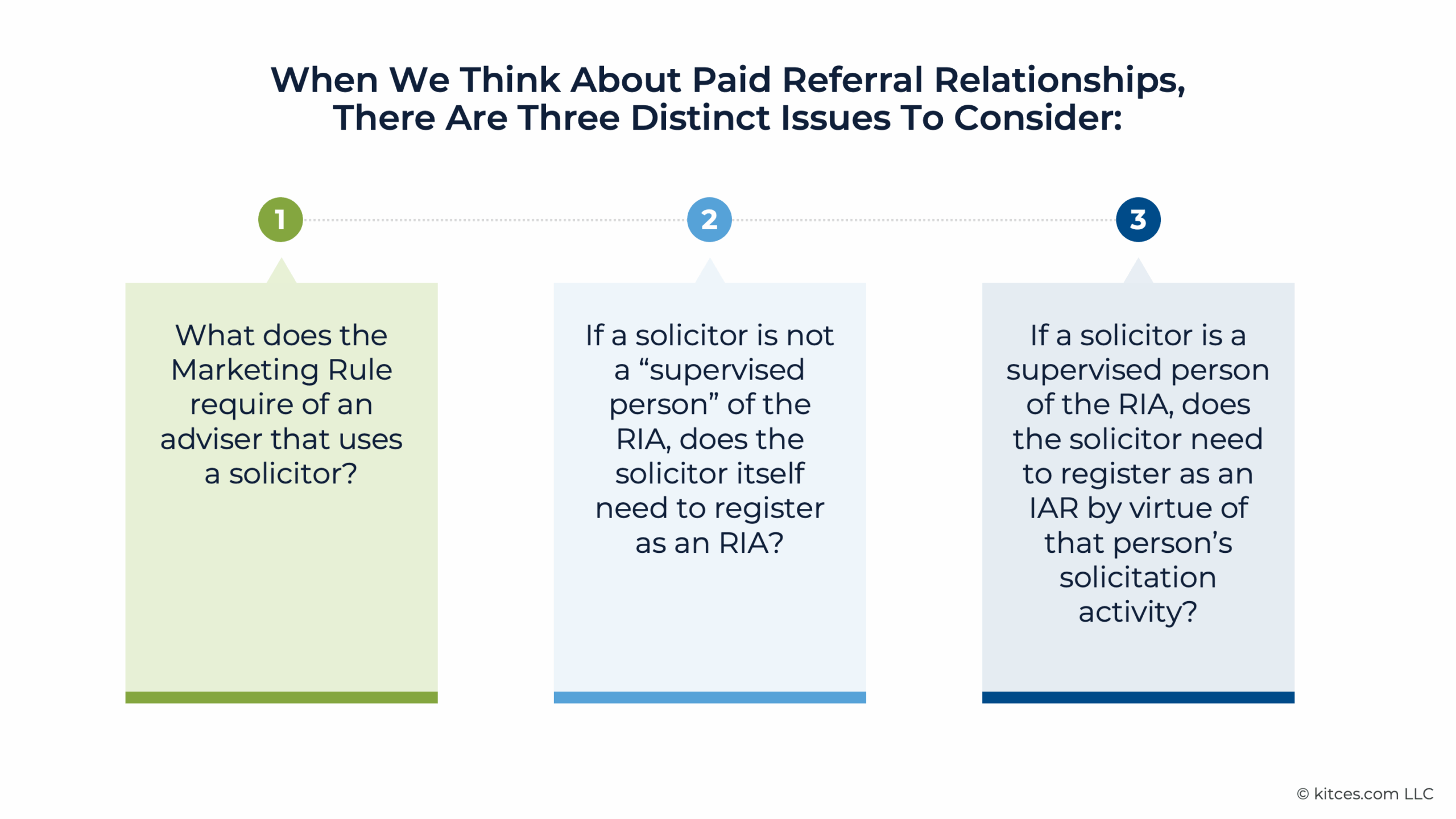
For advisors, then, the key takeaway is that every paid referral arrangement requires at minimum two, and often three, separate reviews. First, the advisor must ensure compliance with the Marketing Rule (and provide the required Form ADV disclosures) for the testimonials and endorsements themselves. Second, where the promoter is a supervised person of the advisor, the advisor must determine whether the promoter is required to register as an investment adviser representative under applicable state law. And third, where the promoter is acting independently of the advisor, while there is no explicit requirement for advisory firms to confirm their unaffiliated promoters' registration status, prudent firms may choose to conduct due diligence into the promoter's compliance with their standalone registration obligations (if any).
The bottom line is that although the updated SEC Marketing Rule made it easier to use both paid and unpaid promoters for business development, there are still compliance obligations regarding their use that could trip up advisors who don't have a full understanding of their requirements. By taking the steps above, advisors can ensure that they comply with not only the requirements of the Marketing Rule itself, but also those under the Advisers Act, SEC, and state regulations that make up the full compliance landscape for testimonials and endorsements.