Executive Summary
For many years, the U.S. tax code has incentivized individuals to give to charitable causes by allowing an itemized deduction for charitable contributions. Although the amount that an individual could deduct was limited to a certain percentage of their Adjusted Gross Income (AGI) based on the type of property contributed and the type of organization it was contributed to, any contribution made within those limits could be deducted dollar-for-dollar to reduce the taxpayer's taxable income.
However, under the One Big Beautiful Bill Act (OBBBA), passed in 2025, two new rules are set to come into effect for the 2026 tax year that will reduce the tax benefits that individuals receive from making charitable contributions. The first is a new 'floor' on charitable deductions that reduces a taxpayer's charitable deduction by 0.5% of their AGI (and if total contributions don't exceed 0.5% of AGI, the deduction is reduced to zero). And the second is a reduction of taxpayers' cumulative itemized deductions by a factor of 2/37ths, which takes effect only for taxpayers whose taxable income (before itemized deductions) exceeds the threshold for the top 37% Federal tax bracket.
The overall effect of the new limitations will be to slightly reduce the tax benefits of giving to charity – but only slightly, given how small the 0.5%-of-AGI floor and 2/37ths reductions are relative to the taxpayer's total income. However, the limitations will have a more noticeable effect on the ability to deduct charitable contributions for higher-income households, where the 0.5%-of-AGI floor creates a higher hurdle for deducting contributions – to the extent that for donations of smaller sizes, higher-income taxpayers might receive less of a hard-dollar tax benefit than lower-income taxpayers, despite being in a higher bracket! However, the tax benefits of charitable contributions steadily increase in favor of higher-income households for donations of bigger sizes. Which ultimately means that, rather than disincentivizing charitable contributions for higher-income households, OBBBA's new limitations actually incentivize taxpayers to contribute more as income level increases.
Although the relative impact of the new charitable contribution limitations isn't large enough to meaningfully change many individuals' giving plans, there are steps that can be taken to minimize their effect. One is to 'bunch' together several years' worth of charitable contributions into a single year to avoid being subjected to the 0.5%-of-AGI floor over multiple years, which can be aided by using a donor-advised fund (DAF) which decouples the timing of the taxpayer's contribution (and corresponding deduction) from that of the ultimate grant disbursement to another charity. Taxpayers who don't itemize their deductions every year can take advantage of a new charitable deduction for non-itemizers of up to $2,000 that was also created under OBBBA, and which isn't subject to the 0.5%-of-AGI floor or the 2/37ths reduction for itemized deductions. And IRA owners over age 70 1/2 can consider making Qualified Charitable Distributions (QCDs) instead of deductible charitable contributions, which for individuals taking RMDs can reduce the amount of RMD income the owner is required to recognize, and at the very least can reduce the amount of future RMDs the owner needs to take.
Ultimately, while charitable giving is often done with selfless intention, tax implications commonly play a role from a financial planning standpoint as well. And so while OBBBA's new rules may not require a complete overhaul of most individuals' charitable strategies, advisors who engage in careful planning can help their charitably inclined clients get the most out of their giving!
 |
And if you want to go deeper on this topic, hear directly from the author on the Financial Advisor Technician podcast. |

Listen To The Financial Advisor Technician Podcast On This Topic




Episode Shownotes And Transcript
Click to expand transcript and show notes↓↓
Show Notes:
- Ben Henry-Moreland: LinkedIn | Speaker Booking
Full Transcript:
Adam: Hello, and welcome back to the "Financial Advisor Technician" podcast. I'm your host, Adam Van Deusen. On today's episode, we're going to discuss specific measures within the 2025 One Big Beautiful Bill Act that relate to charitable giving and that go into effect in 2026.
Because while clients typically are philanthropically minded when making charitable contributions, advisors can be supportive by helping them take advantage of available tax planning opportunities as well, which could ultimately allow clients to donate more than they might have otherwise.
With this in mind, understanding the new rules, which include a 0.5% of AGI floor on deductible charitable contributions and a 2/37ths reduction in itemized deductions for those with particularly high incomes, these could help clients get the greatest tax benefit from their charitable contributions.
To help us dig deeper into this topic, I'm joined today by my colleague Ben Henry-Moreland, a senior financial planning nerd here at Kitces.com, to discuss the ins and outs of these new rules, how much impact they will have on different types of clients, and planning strategies financial advisors can consider for their clients based on these new rules. So, welcome, Ben. And thanks for joining us again here on the "Financial Advisor Technician" podcast.
Ben: Hi, Adam. It's great to be back.
The New 0.5% AGI Floor On Itemized Charitable Contributions [1:31]
Adam: All right. To start, perhaps, you could begin with the new 0.5% AGI floor on charitable contributions and what it means for individuals' itemized deductions.
Ben: Absolutely. So, this is a new rule that's coming into effect this year, in 2026, under the One Big Beautiful Bill Act, OBBBA, that passed last year. And how this works is we call it a floor on charitable contributions. How it really works is that when someone makes charitable contributions, typically when they're able to itemize their deductions, they take charitable contributions as an itemized deduction.
Traditionally, they've been able to deduct those all dollar for dollar against their taxable income. What this new rule does is it sets this 0.5% of AGI floor. It's kind of what I think of as a hurdle. The amount of charitable contributions that someone makes, which is typically deductible, they need to reduce that amount by 0.5% of their adjusted gross income. If someone's charitable contributions are less than 0.5% of their AGI, then they just don't get to deduct any at all. It reduces them down to zero if it's less than 0.5% of AGI or just reduces by that 0.5%.
Adam: Interesting. I should note, for our listeners out there, we're going to be going through a lot of numbers and things like that today. If you're interested in digging deeper into this, including some really great examples of different client situations, we definitely encourage you to check out Ben's full-length article on this topic, which you can access by going to kitces.com/FAT11.
The 2/37ths Itemized Deduction Reduction For Higher Earners [3:20]
Adam: Thank you for teeing that one up, Ben. Before we move into some of the implications, maybe we could move to one of the other key rules here, what you might call the two 37th reduction for higher earners.
Ben: Sure. This was a separate rule created under OBBBA that's also coming into effect this year in 2026. This actually has to do not just specifically with charitable contributions that are deductible on Schedule A, but for all of a taxpayer's itemized deductions, the total amount that they deduct on Schedule A. When this takes into effect is when someone has taxable income that exceeds the 37% federal ordinary income tax bracket.
So when they're in that 37% bracket, they are required to reduce their itemized deductions by a fraction of 2/37ths. It sounds like a random number, but what that effectively does is it means that they get what is effectively a 35% tax deduction or tax benefit, I should say, from their itemized deductions. Usually, when you have a deduction from taxable income, the actual tax savings that you realize is the percentage tax brackets that you're in times the amount of the deduction.
If it's a $100 deduction and you're in the 35% tax bracket, you get a 35% effective tax benefit from it. It means that for people in that 37% tax bracket, they only get a 35% tax benefit from the deductions that they take, even though any extra income that they get, they'll be taxed at 37% on it. It effectively just caps the benefit they get from those deductions at 35% of their income.
So it's a little bit more complex in practice because for someone whose itemized deductions actually take them out of the 37% bracket, they have to add those back in, and they're actually subject to that 2/37ths reduction on the excess amount of deductions that take them below the 37% bracket.
How that actually works is you add the full amount of itemized deductions back to taxable income, and the amounts of that taxable income that is over the 37% tax bracket is then subject to that 2/37ths reduction. It's basically any amount of deductions that reduce your income in the 37% tax bracket, that's where you have to have that 2/37ths reduction.
Slightly complicated formula here, but net really it's you have these two different reductions that people are subject to of their itemized deductions, both of which affect charitable contributions. One directly on the charitable contributions itself, that 0.5% of AGI floor, and one for the entire amount of itemized deductions, that 2/37th reduction for people in the 37% tax bracket.
Adam: Interesting. I think that's a really good point there, that when we talk about that 0.5% AGI floor, as you mentioned, that's applying to everyone who's planning to itemize deduction. So your full range of clients out there. When we're talking about that 2/37ths, that's a little more complicated that you mention. We're talking about the highest earners out there, basically. So it's sort of a little more limited pool there. So I think that's a very good point.
The Actual Dollar Impact Of The New 0.5% AGI Floor [6:53]
Now, let's dig in. Let's start with that 0.5% of AGI floor. So when I'm thinking of this, I'm thinking, okay, so the higher my income, that means the higher the floor and sort of the less I'll be able to deduct from my charitable contributions. Is that the right way of thinking about this?
Ben: That's basically it. So, yeah, it's an AGI-based floor. So the higher the AGI, the higher the adjusted gross income, the higher the floor. And it's important, I think, to put this 0.5% in context because it's not going to be necessarily a huge number. For every $100,000 of adjusted gross income, half percent of AGI is $500. So a family with $100,000 of income, if they make $500 or less of charitable contributions, they won't be able to deduct them. Then it goes on for someone with $500,000 of AGI, that's a $2,500 reduction. For someone with one million dollars of AGI, it's a $5,000 reduction.
So we're not talking about a big amount in relation to the amount of income that someone has. But for people on that higher end of income, obviously, they're going to have a bigger impact on the amount of charitable contributions that they can deduct, which, for households, the higher the income that they go, if they're making smaller amounts of charitable contributions, they're going to have a much bigger impact on whether those are actually going to be deductible, is kind of the ultimate case. The higher the income goes, the more charitable contributions someone needs to make to sort of minimize the impact of that half percent of AGI floor.
Adam: Interesting. I think another angle here, too, is we're talking about, let's say someone makes $100,000 of income, that means it's a $500 floor there. Let's say they make $1,000 of donations. So then, in that case, they're not able to deduct the first $500. But, of course, in this case, it's not as though they're losing $500. That is then just sort of the benefit or the loss, I guess, in this case, is multiplied by the tax rate they were going to be paid. So if it was $500 that was subject to the floor, and they were in the 22% tax bracket, that's actually, in dollar terms, about $100 loss or so. Is that correct? Is that sort of get at the scope of sort of the actual impact here?
Ben: Right. Yeah. So not only is the reduction in charitable contributions "only" half a percent of AGI, the actual amount in dollar terms of the loss of tax benefit there is just a fraction of that amount based on whichever tax bracket the household is in.
Adam: Yeah. Interesting though. I think as you had mentioned previously, that that impact is going to be much more the higher you go up the income scale. So now someone with a million dollars, for example, of income, then, that would represent the 0.5% floor would be $5,000. And if they're in the 37% tax bracket, now we're talking about a little bit more money here. So perhaps of interest to all itemizers out there. But I think as you mentioned, particularly the higher-income itemizers there.
Ben: Yeah. As income increases, yes, not only is the dollar amount of the floor increasing because AGI is increasing, but also, as they're going into higher tax brackets, the more deduction that they lose out of every dollar is greater. So, yeah, it's the double effect of both having that AGI floor in place and also it means you're losing a larger percentage of those dollars that get lost to the floor.
Adam: Interesting. And then I suppose, in some ways, it actually really encourages folks with higher incomes to donate more so that their contributions well exceed the floor and they're able to take the itemized deduction for a higher percentage of the charitable contributions that they make.
Ben: Yeah. And that's really one of the points I wanted to make in the article I wrote. And as I'm talking to folks about this new rule, is it's not... specifically, this AGI floor. It's not necessarily disincentivizing people to make charitable contributions at higher income, even though it reduces the deductible amount of the charitable contribution because it's based on income and not the size of the contribution itself, it's really...the actual impact of it is to incentivize people to contribute more when they are in higher tax brackets, have higher income, because that allows them to maximize the total effect of their charitable contributions. If you've got someone with a million dollars of AGI making a $10,000 charitable contribution, then they're losing $5,000 of that contribution.
They're losing half of that contribution to the half-percent AGI floor. If that same person with a million dollars of AGI is making a $100,000 charitable contribution, they're still losing the same $5,000. They still have $95,000 left to deduct. So the more someone contributes at those higher incomes, the less of an effect that half percent of AGI floor is going to have.
Planning Considerations Based On The New Charitable Contribution Rules [12:22]
Adam: Let's now move into some potential planning considerations for advisors when we're thinking about these rules. So I guess one that comes to mind, and I know you discussed in your article, is the idea of charitable bunching. Now, this became more popular after the Tax Cuts and Jobs Act was passed back in 2017, which because TCJA at the time dramatically raised the amount of the standard deduction to the point that many, many more people were taking the standard deduction as opposed to itemized deductions.
So with charitable bunching, the idea here is that you sort of bunch your charitable contributions into one particular year. So to put you sort of over the limit or over the standard deduction and be able to take itemized deductions and receive an additional benefit for your charitable contributions. So I think that's something a lot of advisors and clients are going to be aware of at this point. But how might that apply, or how can advisors think about that in the context of these new rules under OBBBA?
Ben: Sure. So the charitable bunching strategy, you're correct that it was...it's primarily relevant, has been primarily relevant to folks who would not otherwise be able to itemize their deductions every year. It basically takes advantage of the fact that you can time charitable contributions basically however you want to. You know, the other sort of itemized deductions, you can't time as precisely, generally.
You've got property tax and income taxes that need to be paid by a certain deadline. You've got medical expenses where you can't necessarily time when you have medical expenses. You've got mortgage interest that's on its own timeline, etc. So charitable contributions are the real lever you can use to say, I'm going to make three or four or five years' worth of charitable contributions in this one single year to boost myself over the standard deduction and be able to deduct all this at the same time.
And then for the next few years, your itemized deductions are well below the standard deduction. You just take the standard deduction for the next few years until you're ready to sort of reload again and do another bunching year. So the implication of these new rules under OBBBA is that it opens up this bunching strategy as something people would want to consider, even if they're already itemizing deductions. There was no reason for someone who is already itemizing to bunch their charitable contributions together just to be able to itemize because they're already doing it.
Now, though, for someone who is regularly contributing to charity, every year that they contribute, they will need to pay that half percent of AGI reduction from that contribution. If someone bunches their contributions into one year, they still have to pay that half percent of AGI, but they only have to do it once. They only have to do it in the one year that they're contributing.
So if someone makes five years' worth of charitable contributions in a single year, they pay the half percent of AGI reduction once, versus if they did it spread over five years, they would pay it five different years. So for people who are already itemizing their deductions and do give to charity every single year, it makes more sense now to bunch those charitable deductions together and only pay that half percent of AGI reduction once.
Adam: Very interesting. And related to another aspect of OBBBA, which was the increasing the limit of the deductibility of state and local taxes, the so-called SALT cap, you probably are going to have more itemizers now, especially those who might live in higher tax states, as you'll be able to deduct more of those, which could, again, put them above the standard deduction limit. So the conversation, this conversation in terms of making the bunching contributions, I think could be attractive to that group, as you mentioned, to avoid having to take that floor every year.
Ben: Absolutely. And I will note, though, that as we mentioned before, that the main...the biggest impact group of clients that will be affected by this are those at higher income levels. And that increased SALT deduction does phase down at $500,000 to $600,000 of income. So once you've got someone over $600,000 of income, they're still limited to just a $10,000 SALT deduction.
So it may come into effect for some clients in that middle to upper zone. There's this thing about OBBBA, is there's so many different moving levers going on here that you can't…it makes it hard to just do a little bit of sort of back-of-the-envelope calculation on who's going to have what deduction available to them.
The New Charitable Deduction For Non-Itemizers [16:53]
Adam: Very interesting. Now, I also understand that OBBBA included a separate rule, which we haven't talked about, which allows non-itemizers to take advantage of a charitable deduction. Could you sort of describe that and perhaps how it interacts with the other rules and some of the income conversations we've been having?
Ben: Sure. Ironically, this is this is probably going to have the biggest sort of broad impact for the bigger number of taxpayers, because only really a small amount of taxpayers actually itemized their deduction. I think it's less than 10%, if that, might be closer to one percent. And so anyone who doesn't itemize their deduction is not is not affected by this half percent of AGI floor because it only applies to itemized charitable contributions.
But there is this new rule allowing people who do not itemize their deductions, who take the standard deduction, to deduct up to...it's $1000 for single filers or $2000 for married filing joint filers. They're able to deduct those amounts even for charitable contributions, even if they don't itemize their deductions. It's specifically for people...if someone itemizes, they can't take this deduction. But if they're taking the standard deduction, they are allowed to deduct these amounts for charitable contribution.
The caveat is that the contributions have to be in cash. They can't contribute…a lot of people contribute not just cash, but they contribute maybe appreciated securities or funds that they are coming from their brokerage accounts. They may be contributing property. People donate maybe their cars to their public radio station, or they bring clothes or furniture to their local Goodwill or thrift store to donate. You can't donate that sort of property. It has to be a cash contribution. And it also cannot be used to fund a donor-advised fund.
So for those folks who use donor-advised funds, which we haven't gotten into yet, but this will also factor into, I think, some of these planning decisions, but it can't work for this non-itemized charitable contribution. So these donations have to be in cash. They have to be directly to a charity. But this charitable deduction is open to anyone who does not itemize their deductions, which is a much bigger number of taxpayers, even though I think a lot of clients of financial advisors are people who are itemizing their deductions.
The strategy here, I think, that is going to be relevant for a lot of clients of financial advisors, is for those people who have been doing this bunching strategy specifically so they can itemize their deductions, they make four or five years' worth of charitable contributions in a single year and then take the standard deduction all of the other years.
Well, they don't necessarily have to make all of their charitable contributions in that one year. They can spread them out now a little bit more and maybe bunch some contributions together in the years that they want to itemize. But then in the years they take the standard deduction, they can just take advantage of that non-itemizer deduction, which the advantage of it is that the non-itemizer deduction is not subject to the half-percent of AGI floor. So, potential wages, people can spread out those contributions a little bit more and still be able to take advantage of them, even if they're not itemizing in that specific year.
Adam: Thanks for that rundown. And you mentioned donor-advised funds in there. It seems like that they could be particularly useful here for people who are trying to do that bunching strategy, because if you're making two or three years' worth of contributions in one year, you might not know all the different charities you want to donate to or want to donate a certain amount to a particular charity.
So then donor-advised fund could sort of become the place to keep those funds and to hold those funds for when you are ready to make the contributions again in future years. Though, again, this is only for the itemizers, because as you mentioned, if you're using the standard deduction and using the new charitable deduction for non-itemizers, donor-advised fund contributions do not count, right?
Ben: Right, exactly. And I do want to emphasize how big a part of both of these strategies we've just been talking about, both charitable bunching for people who already itemize, as well as for people who are only occasionally itemizing.
It basically allows you to get a big lump-sum charitable deduction for the year you contributed to the DAF and then time out however you want to actually make the distributions to charity if you don't necessarily want to make one huge lump sum to a charity in one year. So it's really helpful in being able to get the best of both worlds, I think, have an upfront deduction and be able to bunch contributions together, but also have the flexibility to make distributions wherever and whenever you want to.
Why QCDs Could Be More Attractive Under The New Rules [21:51]
Adam: And one final strategy that you bring up in your article is the implications for QCDs, or qualified charitable distributions, based on the new rules for itemized deductions. Talk about the interaction between those two and how QCDs might be more attractive now for individuals who are eligible to make them.
Ben: Sure. Well, QCD is always kind of one of my favorite strategies, I think. It's a way to contribute dollars from a traditional IRA, and it's only available for individuals who are age 70.5 or older. So it used to be tied essentially to the age when someone starts RMDs. Now that RMDs don't start until age 73, there's a little bit of a disconnect because QCDs are still set to age 70.5. But once someone hits that age 70.5, they can make distributions from their IRA directly to a charitable organization. It has to be directly to the organization.
The IRA owner can't cut a check to themselves and then contribute to charity and have it count as a QCD. It has to go directly to the charity. But what it effectively does then, once that QCD is made, it is excluded from income. So it does not count as a normal IRA distribution would, does not get added to gross income or AGI or taxable income. It's just completely excluded from income.
So there are sort of two benefits to this. For someone who is already making RMDs, the QCD can count towards a person's RMD obligations. So if they don't need the dollars in their IRA and the money from the RMD that they're required to take to go towards their lifestyle expenses, if they have Social Security or pension or other funds that they can use to fund their lifestyle and they're taking money out of their IRA because they're required to because they are at RMD age, that QCD reduces dollar-for-dollar the amount of income that they recognize from their RMD.
So it effectively acts as a deduction or a reduction of that income for that charitable contribution. But because it's not a sort of standard itemized charitable contribution that would be subject to the half-percent of AGI floor, it is not subject to that limitation. You still get that full dollar-for-dollar reduction of income by making the QCD.
For someone who is not RMD age or who already uses the money from their RMD to pay for their living expenses, pay for their mortgage or their groceries or the expenses they have in retirement, it's not quite as much of a dollar-for-dollar reduction of income. But what it does do is it reduces future RMDs because when someone takes money out of their IRA for a QCD, it still comes out. It's excluded from income. It reduces the balance of the IRA, and it reduces the amount of future RMDs they're required to take.
And so that has some potential future tax benefits, particularly if it's someone who is paying a lower tax rate today than they will in the future. If their tax rates go up in the future, taking that QCD today means that they won't have to take those dollars out in the form of RMDs in the future, where they'll be taxed at a higher rate.
So it's a little bit trickier to quantify, but it's still beneficial to make charitable contributions in that way. And I think this new rule, the new half percent of AGI floor, particularly for folks in the highest tax bracket who also have to deal with the 2/37ths reduction, it tilts the math even more, I think, towards making a QCD in that situation.
One Key Takeaway For Advisors [25:42]
Adam: Very interesting. So we have covered a lot of ground today on this topic. So, from your point of view, Ben, what would be your one key takeaway for advisors regarding charitable giving under these new rules?
Ben: So, again, putting the numbers in context, a lot of these aren't going to necessarily radically change people's giving philosophies or giving strategies. Again, I would say that these rules don't necessarily disincentivize giving to charity, I don't think it's going to make anyone rethink their charitable intentions.
Obviously, I think, for a lot of people, they're giving with the idea of giving to causes they care about first and thinking about the tax benefits second. But at the same time, people see these sort of new rules come up, and they see the slight erosion of the tax benefit they used to get from donating to charity. And they appreciate when, I think, their financial advisor is able to help them avoid that.
I think just having the ability, when you've got different options like bunching charitable contributions, making a QCD, when those options are available on the table, clients really appreciate knowing that those strategies are there. And while some may not want to change their giving strategy too much, especially given the size of the actual effects of these, which is not super large, they're going to at least appreciate having these conversations, I think, particularly as you're going into maybe year-end tax planning for your clients, figuring out what sort of charitable giving they're going to do this year. Just knowing that there are a few different strategies that they can put out there and have on the table for avoiding this without dramatically upheaving their charitable giving strategy will make a big difference for the client.
Adam: Well, I think that's a great place to end. So, thank you so much, Ben, for joining us here again on the "Financial Advisor Technician" podcast.
Ben: Thank you so much for having me.
OBBBA's New Rules For Itemized Deductions
The One Big Beautiful Bill Act (OBBBA), which became law on July 4, 2025, contained a number of changes to the itemized deductions that individuals and couples can claim on their tax returns. These included an increase in the limit on state and local taxes that can be deducted from $10,000 to $40,000, and the permanent repeal of miscellaneous itemized deductions like tax preparation and investment advisory fees.
But two changes in particular, both taking effect in 2026, will impact a wide range of taxpayers who regularly make charitable contributions – and will affect end-of-year tax planning conversations between advisors and their clients around how to structure their charitable giving in 2026 and the years ahead.
The 0.5%-Of-AGI Floor On Charitable Contributions Reduces The Value Of Contributions Deducted On Schedule A
The first change is the creation of a new 'floor' on deductible charitable contributions taken as itemized deductions on Schedule A. The new 'floor' works by reducing the amount of charitable contributions the taxpayer makes during the year by 0.5% of their Adjusted Gross Income (AGI) – or, if their total charitable contributions didn't exceed 0.5% of their AGI to begin with, down to zero.
Example 1: Aaron and Bethany are a married couple who earn a combined $500,000 in Adjusted Gross Income (AGI). They made $1,000 of total charitable contributions in 2026, comprised of cash donations to their favorite charities.
In previous years, the $1,000 of charitable contributions would have been fully deductible on Schedule A of Aaron and Bethany's joint tax return (assuming that they were itemizing their deductions). However, starting in 2026, they must subtract 0.5% of their AGI, or 0.005 × $500,000 = $2,500, from their deductible charitable contributions. Since the $2,500 reduction exceeds the $1,000 of contributions that they actually made, Aaron and Bethany aren't allowed to deduct any of their charitable contributions for 2026.
The new 0.5%-of-AGI floor is in addition to the existing AGI-based 'ceiling' on deductible charitable contributions, which varies depending on whether the contribution is made in the form of cash or property (and whether the property is treated as Capital Gain property, as well as how it's valued), and whether the charitable organization is a public charity or a private foundation:
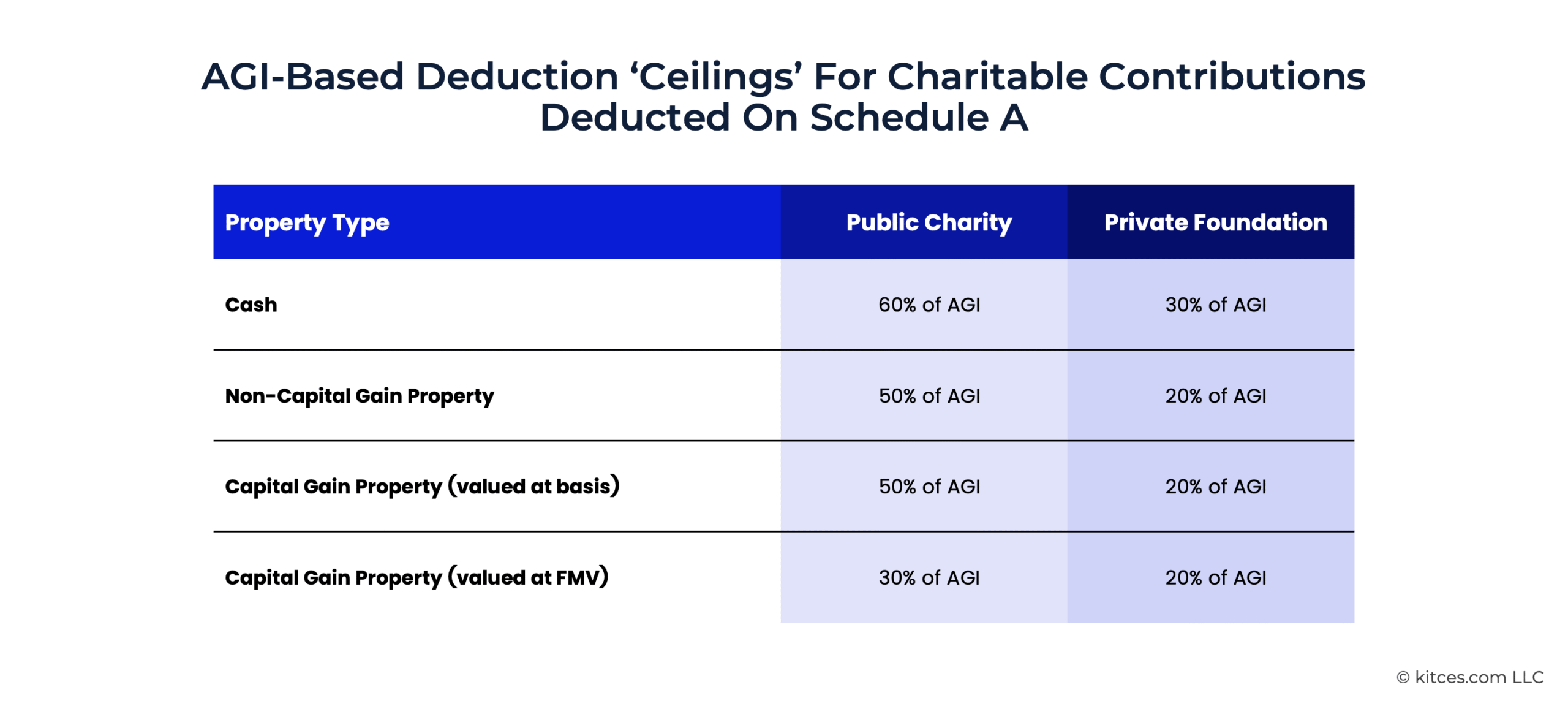
When a charitable contribution exceeds the AGI-based ceiling for that contribution type, the excess amount cannot be deducted in that year, but it can be carried over and deducted for up to 5 total years (subject to each year's AGI ceiling).
However, the 0.5%-of-AGI floor generally cannot be carried over to future years – once it's subtracted from the total amount of charitable contributions, it's just gone.

Nerd Note:
The 0.5%-of-AGI floor is applied to the total amount of charitable contributions before the AGI-based ceiling, meaning that, for example, for a contribution subject to the 30%-of-AGI ceiling, the full amount of the contribution would be reduced by 0.5% of AGI, and then the remaining amount would be limited to 30% of AGI. Or to put it another way, the 0.5%-of-AGI floor doesn't reduce the deductible amount of a contribution subject to the 30%-of-AGI ceiling to 29.5%.
In effect, then, the itemized deduction for charitable contributions is now limited both on the bottom end (by the 0.5%-of-AGI floor) and the top end (by the AGI-based ceiling for the type of contribution being made), further hemming in the tax benefits of contributing to charitable organizations.
The New 2/37ths Itemized Deduction Reduction Replaces The 'Pease' Limitation In The Highest Tax Bracket
On top of the new 0.5%-of-AGI floor on charitable contributions, there's another new rule created under OBBBA that will affect how contributions can be deducted. Starting in 2026, individuals with taxable incomes exceeding the threshold for the 37% ordinary income tax bracket – which is $640,600 (single/head of household) / $768,700 (MFJ) for 2026 – will have their itemized deductions reduced by 2/37ths of the lesser of a) their total itemized deductions, or b) the amount by which their taxable income plus itemized deductions exceeds the 37% bracket threshold.
In other words, if a household's taxable income exceeds the 37% ordinary bracket threshold, the 2/37ths reduction is applied to all of the taxpayer's itemized deductions. However, if taxable income is lower than the 37% threshold but is higher than the threshold once itemized deductions are added back to it (i.e., the itemized deductions cause taxable income to drop below the 37% threshold), the 2/37ths reduction is applied to the portion of itemized deductions that exceeds the threshold.
Example 2: Colson is a single tax filer with AGI of $650,000. He has itemized deductions including $10,000 of state and local taxes (SALT) and $30,000 of mortgage interest, reducing his taxable income (before the 2/37ths reduction) to $610,000.
Although Colson's taxable income is below the 37% ordinary income threshold of $640,600, adding back his $40,000 of itemized deductions raises his income above the threshold, so the 2/37ths reduction will be applied only to the $650,000 − $640,600 = $9,400 that exceeds the threshold. The reduction will equal 2/37 × $9,400 = $508.
The total deductible amount of Colson's itemized deductions, then, will be $40,000 – $508 = $39,492, making his taxable income $650,000 − $39,492 = $610,508.
When an individual subject to the 2/37ths reduction also makes charitable contributions subject to the 0.5%-of-AGI floor, the 0.5%-of-AGI floor is applied first, then the remaining amount of deductible charitable contributions is added to the rest of the taxpayer's itemized deductions, and then the 2/37ths reduction is applied to that combined total.
Example 3: Martha is a single tax filer with AGI of $750,000. She has itemized deductions including $10,000 of state and local taxes (SALT), $20,000 of mortgage interest, and $20,000 of total charitable contributions.
First, the charitable contributions are reduced by the 0.5%-of-AGI floor, or 0.005 × $750,000 = $3,750, leaving $20,000 − $3,750 = $16,250 of remaining deductible charitable contributions. That amount is added to Martha's remaining itemized deductions, summing up to $10,000 (SALT) + $20,000 (mortgage interest) + $16,250 (deductible charitable contributions) = $46,250.
Martha's taxable income before the 2/37ths reduction is $750,000 − $46,250 = $703,750, which exceeds the 37% single-filer tax bracket threshold of $640,600, so the 2/37ths reduction will apply to the full amount of itemized deductions. The reduction equals (2/37) × $46,250 = $2,500, reducing the total amount of itemized deductions to $46,250 − $2,500 = $43,750. Martha's taxable income after the reduction, then, is $750,000 − $43,750 = $706,250.
The new 2/37ths reduction replaces the 'Pease limitation' on itemized deductions that was suspended starting in 2017 under the Tax Cut and Jobs Act (TCJA) and permanently repealed by OBBBA. The point of the reduction is to cap the tax benefit of itemized deductions: Since the actual tax impact of a deduction is generally equal to the dollar amount of the deduction times the taxpayer's marginal tax bracket, deductions have a higher value for people with higher incomes who are subsequently in higher tax brackets. With the highest Federal tax bracket currently at 37%, a 2/37ths reduction on itemized deductions for households in that bracket therefore reduces the deductions' tax benefit to 35% – i.e., the value of the next-highest tax bracket below 37%.
Notably, however, the 2/37ths reduction applies regardless of whether the taxpayer's itemized deductions are offsetting ordinary income or long-term capital gains income (which is taxed at lower rates of 0%, 15%, and 20%). In other words, even though a taxpayer can only get a maximum benefit of 20% from itemized deductions that offset capital gains income, the 2/37ths reduction still applies even if 100% of their income comes from capital gains, giving deductions against long-term capital gains a maximum benefit of 20% × (35/37) = 18.9%.
Nerd Note:
The Federal tax calculation is ordered such that deductions first offset ordinary income before offsetting long-term capital gains, so itemized deductions would only offset capital gains income if ordinary income were already reduced to zero. For example, if a taxpayer had $1 million of capital gains income, $50,000 of ordinary income, and $75,000 of itemized deductions, the first $50,000 of itemized deductions would offset the entire $50,000 of ordinary income, and only the remaining $25,000 of itemized deductions would offset capital gains income.
How Much Impact Will The OBBBA Rules Have On Charitable Deductions?
The 0.5%-of-AGI floor on charitable contributions will impact all itemizers who donate to charity, and the 2/37ths reduction on all itemized deductions will add a further layer of tax effects for households in the 37% tax bracket. But how much of a tax impact will these new reductions really have on households who make charitable contributions?
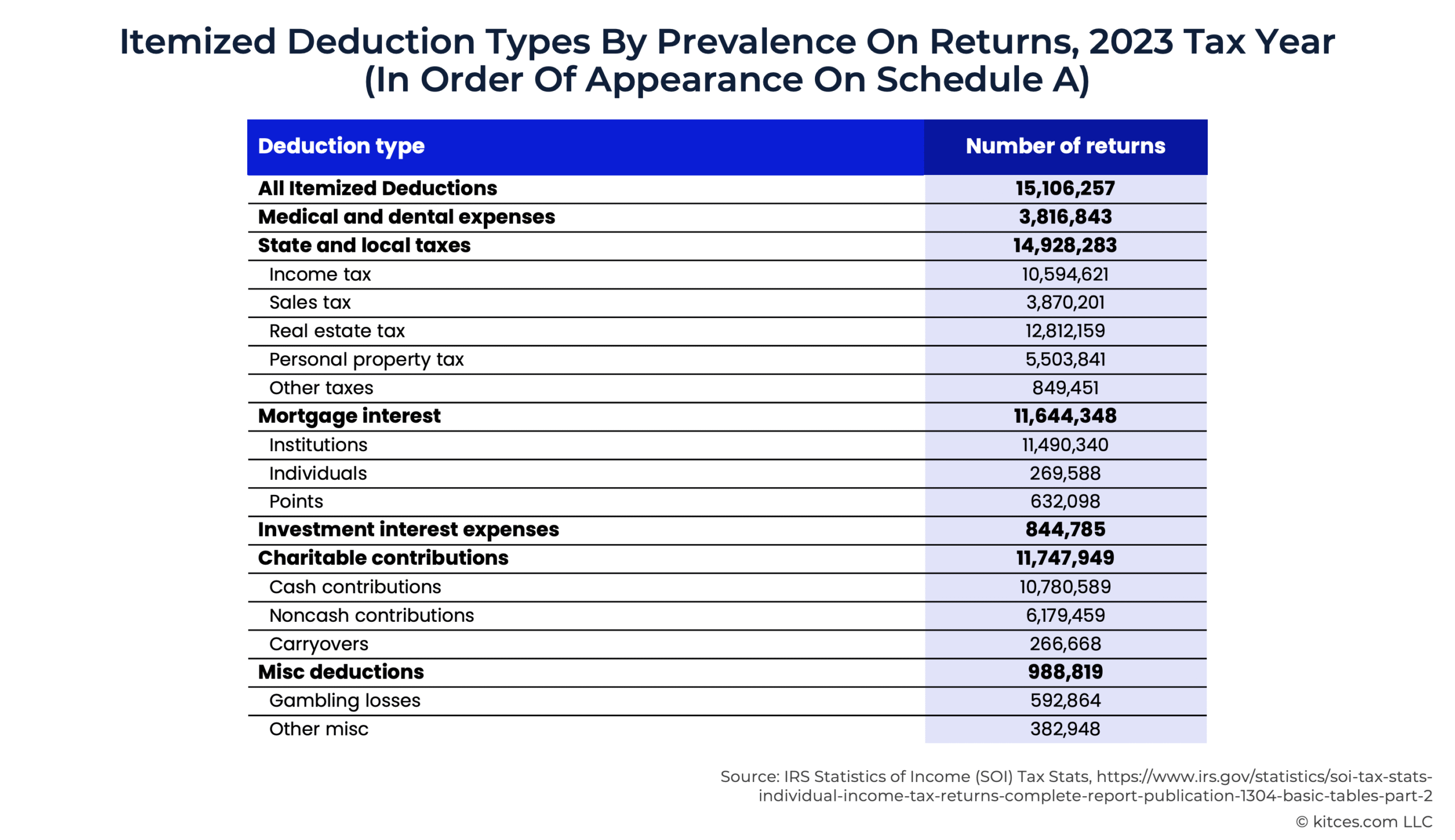
Charitable contributions are one of the most common itemized deductions, so the new charitable deduction floor will have a widespread impact among taxpayers who do itemize deductions. Even those who don't make charitable giving a central focus of their financial plan will often donate from time to time to causes that are important to them, or at the very least will donate household items that they no longer need to their local Goodwill or ReStore. As of data from the 2023 tax year, out of a total 15.1 million who itemized deductions, about 11.7 million taxpayers (or 77% of itemizers) deducted charitable contributions – making it the second-most common itemized deduction category, behind state and local taxes (which includes income tax, sales tax, or real estate and personal property tax).
But although the new charitable deduction floor will impact a wide swath of taxpayers, the magnitude of that impact on most individual taxpayers will be relatively small. By definition, a reduction in allowable charitable deductions of 0.5% of AGI is fairly miniscule in relation to total income: A household with $100,000 in AGI will have a $500 reduction in deductible charitable contributions, a household with $200,000 in AGI will have a $1,000 deduction, a household with $1 million in AGI will have a $5,000 reduction, and so on.
Additionally, the 0.5%-of-AGI deduction floor is not a dollar-for-dollar increase in tax owed, but instead functions as an increase in the amount of taxable income on which the tax is calculated – so the actual tax impact of the new rule in dollar terms amounts to 0.5% times the taxpayer's current tax bracket.
Example 4: Declan is a single filer with $200,000 of AGI who has made $5,000 of cash charitable contributions in 2026, in addition to $20,000 of other itemized deductions.
Declan's charitable contributions will be reduced by 0.005 × $200,000 = $1,000, meaning his total itemized deductions will equal $5,000 − $1,000 + $20,000 = $24,000, and his taxable income will equal $200,000 − $24,000 = $176,000, which puts him in the 24% tax bracket.
The impact of the deduction floor in actual tax terms, then, is $1,000 (the amount of the reduction in deductible charitable contributions) × 24% (Declan's marginal tax bracket) = $240.
With the relative effects of the new rule netting out to just a fraction of the 0.5% by which charitable deductions are reduced, the cumulative effect that the new 0.5%-of-AGI floor has on actual taxes paid will be negligible for many taxpayers with lower and moderate incomes (many of whom aren't likely to itemize deductions to begin with). But as income increases, the 0.5% floor creates a larger hurdle for deducting charitable contributions, and at higher tax brackets there is correspondingly a higher amount of 'lost' tax savings from that hurdle, which will make the new rule a bigger planning consideration for higher-income families with charitable inclinations.
The Charitable Contribution Floor Is A Surtax On Income For Charitable Givers, Not A Tax On Contributions
Because the size of the deduction floor is calculated based off of the taxpayer's AGI and not the amount of charitable contributions that they make, it is, in effect, a 'surtax' on any additional income earned by a household making deductible charitable contributions (much like the since-repealed Pease limitation was an effective 1% tax on income for anyone with itemized deductions). As shown below, this surtax ranges from 0.5% × 10% = 0.05% for those in the lowest (10%) Federal tax bracket, to 0.5% × 37% = 0.185% for those in the top (37%) bracket.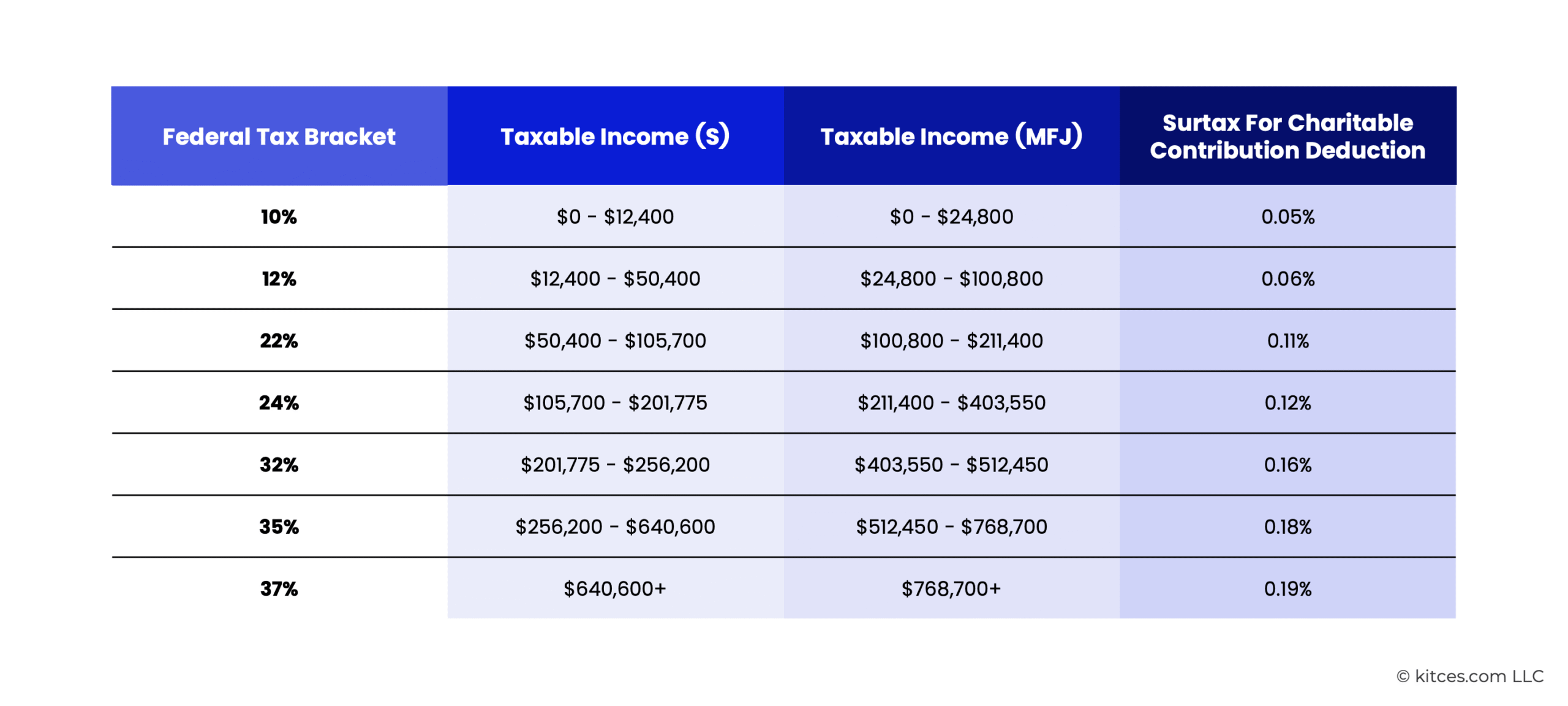
Broadly, this means that as long as charitable contributions exceed 0.5% of AGI, the total amount of contributions doesn't have any impact on the amount of the reduction: Only increasing or decreasing AGI will increase or decrease the amount by which charitable contributions are reduced. In other words, it's the income, not the charitable contributions themselves, that is the primary lever. The actual amount of the surtax, however, is so small that the actual tax impact of any planning decisions (e.g., accelerating income via Roth conversions, deferring income via traditional 401(k) contributions, improving tax efficiency through asset location, or shifting the timing of business income) will likely be negligible unless the dollar amounts are very large. So while it makes sense to account for the effects of increasing or decreasing AGI on the deductibility of charitable contributions when analyzing, e.g., the current versus future tax impacts of making a Roth conversion, the charitable contribution floor itself is unlikely to be the driving factor in many tax planning decisions.
The 2/37ths Reduction Creates A 2% Surtax On Itemized Deductions (Including Charitable Contributions)
The new 2/37ths reduction in itemized deductions, unlike the 0.5%-of-AGI floor on charitable contributions, is based on the amount of itemized deductions themselves rather than on income (once the taxpayer has reached the 37% tax bracket), and therefore increases as itemized deductions increase. For instance, an additional $1,000 of itemized deductions will be reduced by $1,000 × 2/37 = $54, meaning that the taxpayer can 'only' deduct $946, and that the effective marginal tax savings on their deduction will be 37% × $946 = $350, i.e., a 35% rate. Or to put it more simply, while households in the 37% tax bracket will pay a 37% tax rate on any additional income that they earn, they'll only save at a 35% rate on any itemized deductions that they receive!
The other way of looking at the 2/37ths reduction is as a 2% tax on itemized deductions: Because households subject to the reduction are by definition in the 37% tax bracket, they will see a tax increase of 37% × 2/37 = 2% per dollar of itemized deductions compared to if they had received a 100% deduction (as in 2025 and years prior).
Either way, the 2/37ths reduction creates a slight disincentive against taking itemized deductions, including charitable contributions, for households in the 37% tax bracket.
Smaller Charitable Contributions Lose Value At Higher Income Levels
Added together, the new rules under OBBBA create a small surtax for households that deduct charitable contributions that increases in step with income (i.e., the 0.5%-of-AGI floor on charitable contributions), and an additional 2% surtax on all itemized deductions – including charitable contributions – that increases with the amount of deductions themselves (i.e., the 2/37ths reduction on itemized deductions).
These changes may seem relatively minor at first blush, but they do give rise to some odd planning considerations. Namely, counter to the standard rule that a tax deduction is worth more in actual tax savings for taxpayers in higher income tax brackets than those in lower brackets, some charitable contributions under the new rule will actually generate more tax savings for taxpayers in lower brackets.
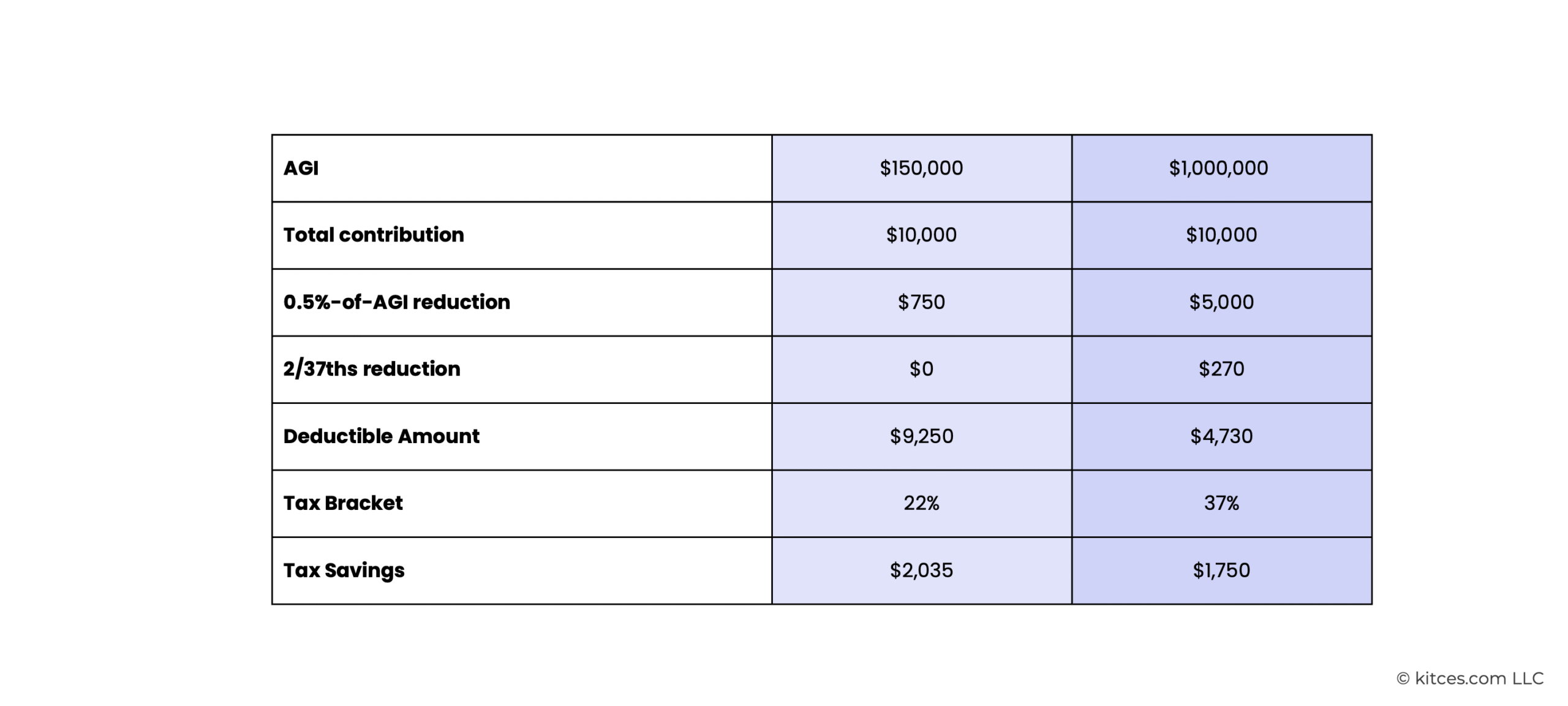
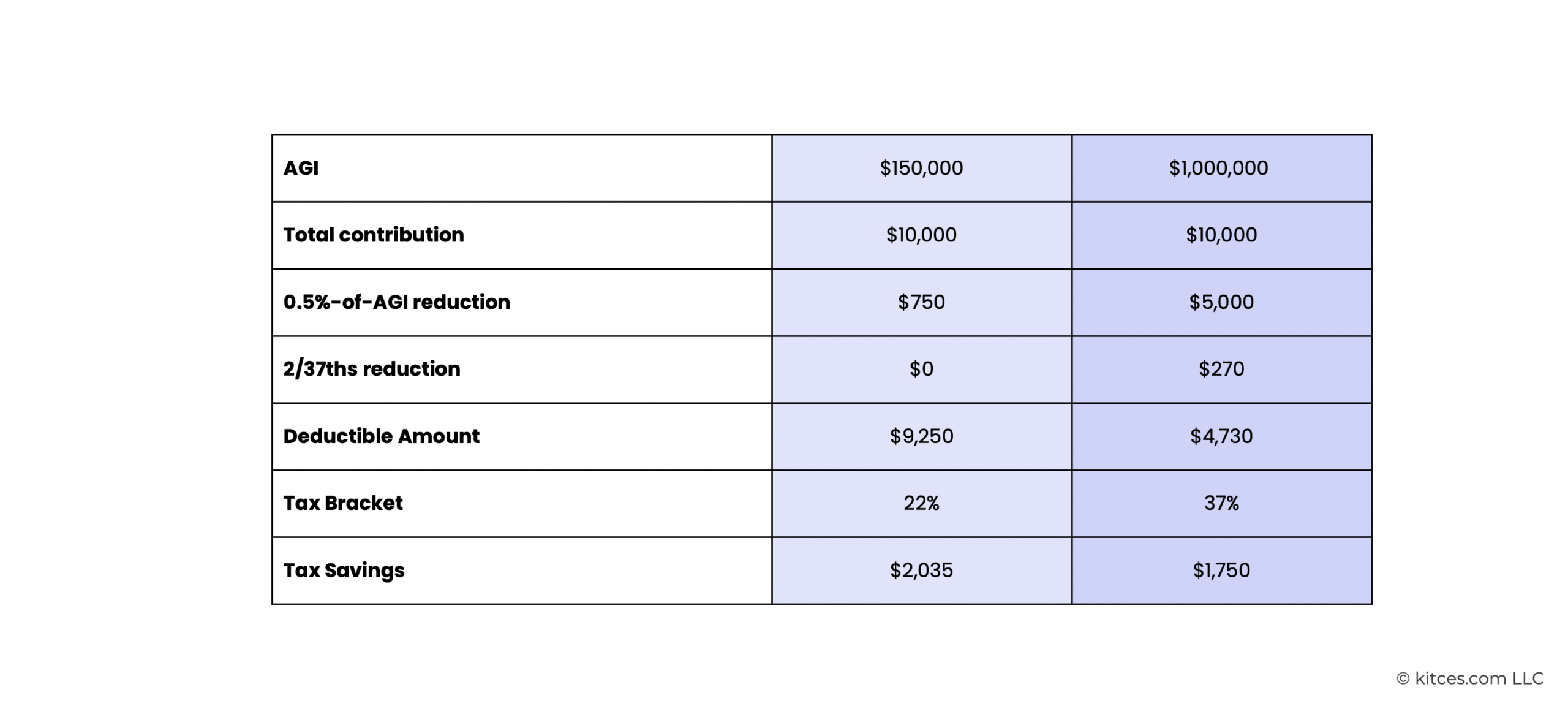
Consider a $10,000 charitable contribution made by a married couple with $150,000 in AGI (in the 22% Federal tax bracket) versus the same amount for a couple with $1 million of AGI (in the 37% bracket). The couple with $150,000 of AGI will have their contribution reduced by 0.005 × $150,000 = $750, and thus will have a net tax benefit from the contribution of 22% × ($10,000 − $750) = $2,035. In contrast, the family with $1 million of AGI will have their contribution reduced by 0.005 × $1 million = $5,000, plus a further reduction of 2/37 × ($5,000) = $270, so they'll receive a net tax benefit of 37% × ($10,000 − $5,000 − $270) = $1,750. In other words, the family with $150,000 of AGI will realize $2,035 − $1,750 = $285 more in tax savings than the family with $1 million in AGI from the same $10,000 charitable contribution, despite being in a lower tax bracket!
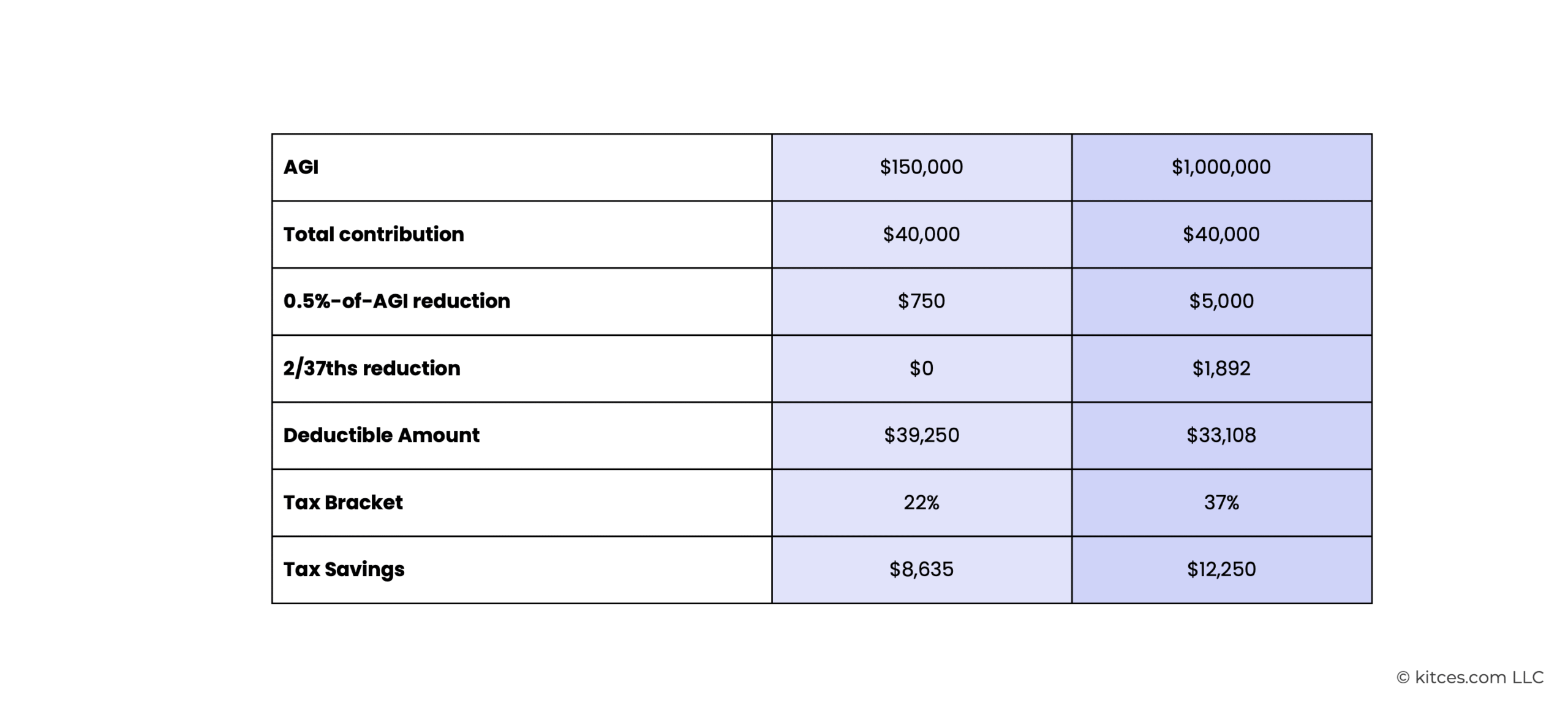
As the magnitude of the charitable contribution increases, however, the benefit to the high-bracket taxpayer increases. In the example above with the two households with $150,000 and $1 million of AGI, respectively, if the charitable contribution is increased to $40,000, then the $150,000 AGI couple will reduce their deduction by 0.005 × $150,000 = $750, and will have a net tax benefit of 22% × ($40,000 − $750) = $8,635. But the $1 million AGI couple, after reducing their contribution by 0.005 × $1 million = $5,000 to $35,000 and further reducing that amount by 2/37 × $35,000 = $1,892, will receive a net tax benefit of 37% × ($40,000 − $5,000 − $1,892) = $12,250.
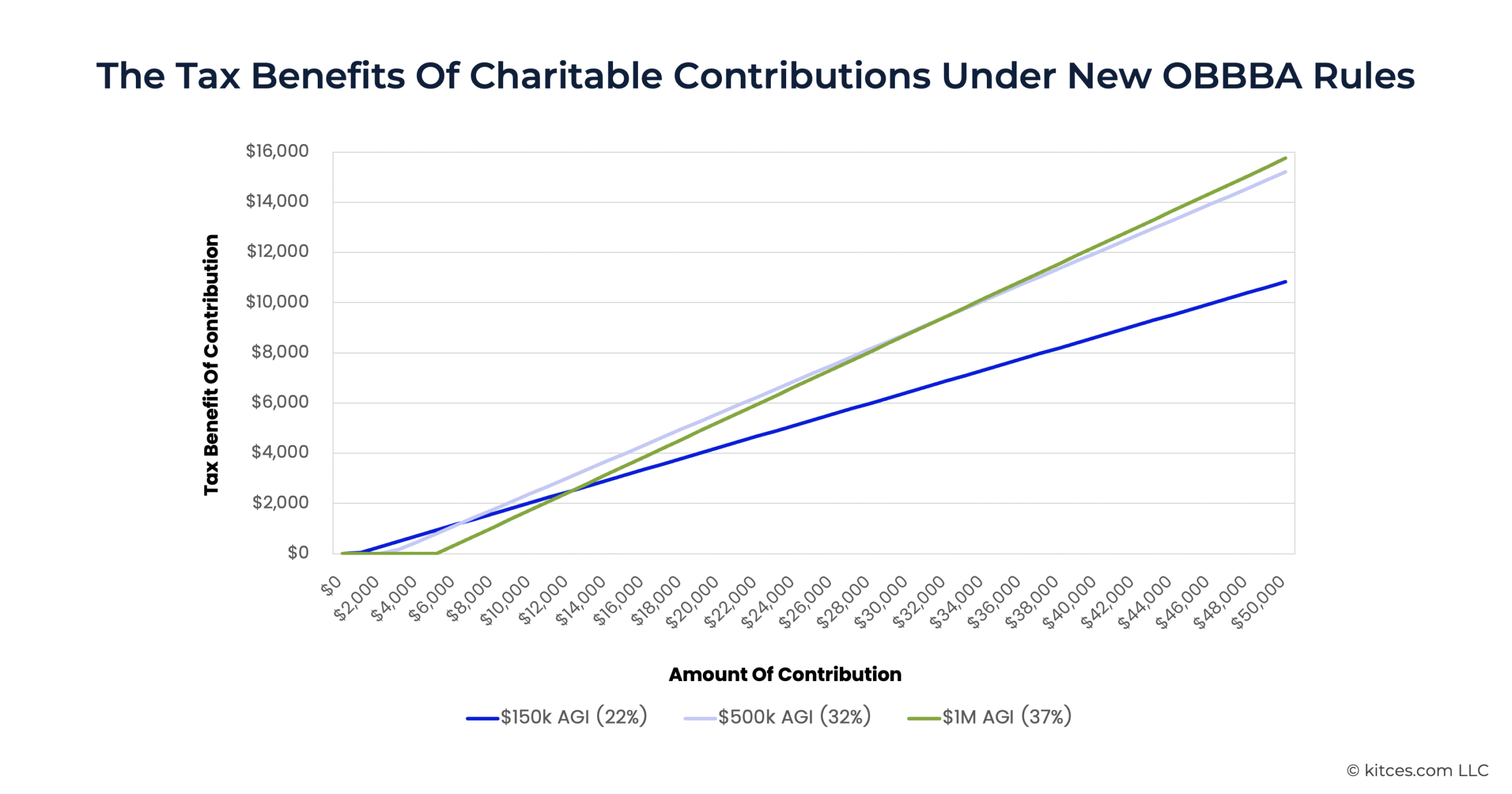
As shown below, the larger the contribution amount, the more that taxpayers in the highest brackets benefit from the deduction – but for smaller contributions, households in the lower brackets get the biggest bang for their charitable buck. For a household with $1M of AGI (in the 37% tax bracket), it would take about a $13,000 contribution to get a greater tax benefit than a household with $150,000 of AGI (in the 22% bracket), and a $32,000 contribution to get a bigger benefit than a household with $500,000 of AGI (in the 32% bracket).
Higher-Income Households Are Incentivized To Make More Charitable Contributions Under OBBBA's New Rules
From a planning perspective, the takeaway is that OBBBA's new limitations don't disincentivize charitable contributions at higher income levels, despite blunting the impact of deductions – in fact, there's actually an incentive to give more at higher income and tax bracket levels, because doing so will earn a higher 'yield' in tax savings per dollar contributed. As shown below, that yield will eventually approach the household's marginal tax bracket (except for those in the 37% bracket, where it won't exceed 35% because of the new 2/37ths limitation on itemized deductions).
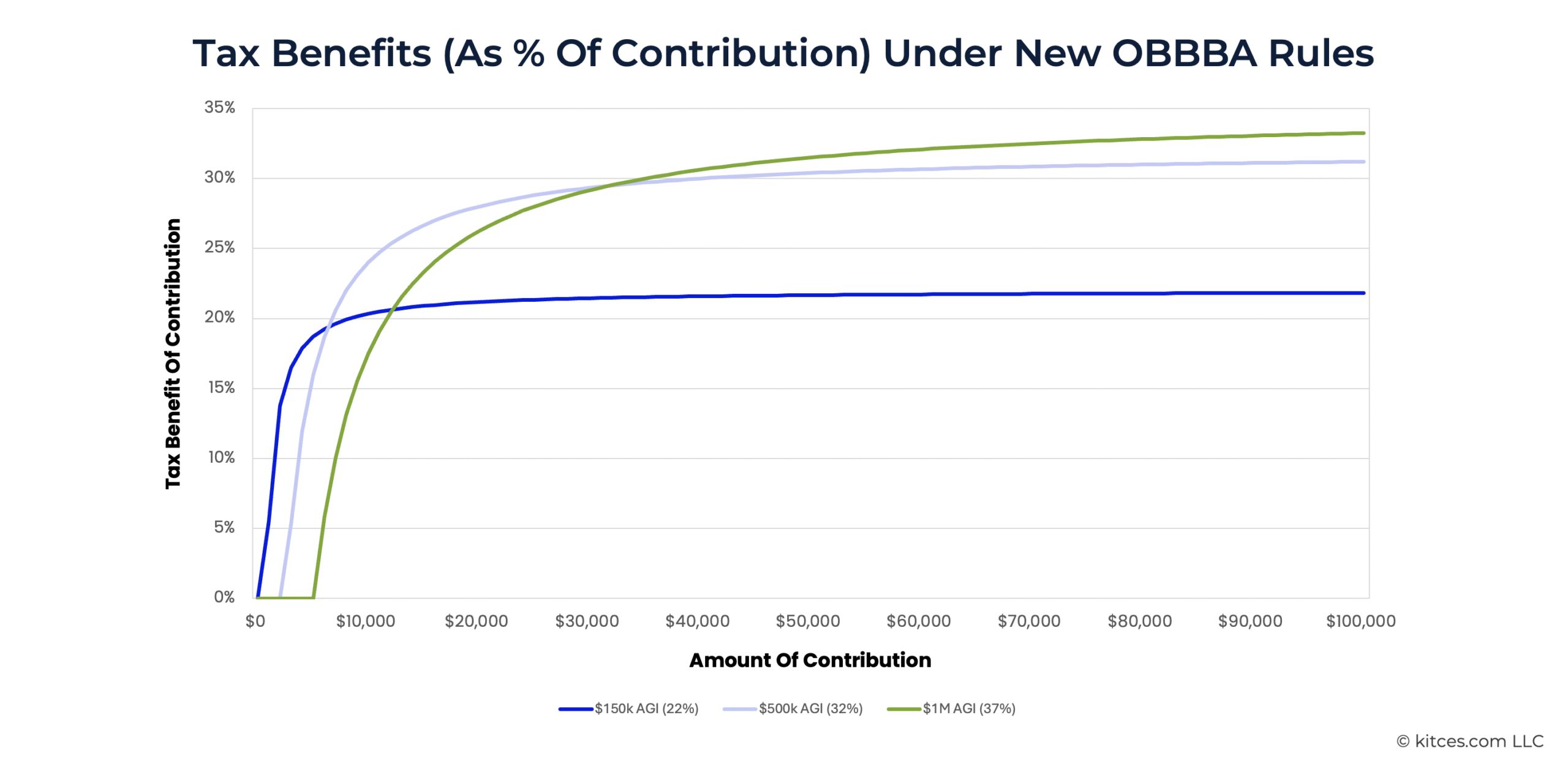
For households with lower and moderate incomes (who still itemize deductions), the new limitations won't have a significant impact other than for relatively small-dollar donations (e.g., in the hundreds or low thousands). But as income grows, the effects of the 0.5%-of-AGI floor, and eventually the 2/37ths reduction for households in the 37% tax bracket, add up so that contributions must exceed (at least) the low tens of thousands to avoid the diminution of tax benefits. Which means that the taxpayers who see the most benefit from charitable contributions going forward (or at least for as long as the new rules are in effect) will be those who are not only in the highest tax brackets, but who also make the biggest overall charitable contributions.
Strategies To Minimize The Impact Of OBBBA's Limitations On Charitable Contributions
The new limitations on the deductibility of charitable contributions likely aren't big enough to meaningfully change household charitable giving strategies on a fundamental level. The fact that the impact is the greatest on the smallest donation totals means that for those who have their contributions' deductibility reduced the most (or reduced all the way to zero, if their charitable contributions don't exceed the 0.5%-of-AGI floor), charitable giving probably wasn't a sizeable factor in their overall tax situation to begin with. For example, if a couple with $500,000 of AGI in 2026 (who are therefore in the 24% Federal tax bracket) contributes less than 0.005 × $500,000 = $2,500, the most they stand to 'lose' in tax benefits from the deduction is $2,500 × 24% = $600, which is just 0.12% of their income.
But the impact of the new limitations does add up, particularly as income rises; the 0.5%-of-AGI floor presents an increasingly higher hurdle to deductibility, and the 2/37ths reduction takes effect once the household reaches the 37% tax bracket. Planning for clients who stand to have their charitable deductions reduced by the new law can focus on either minimizing the effects of the 0.5%-of-AGI floor and 2/37ths reduction, or avoiding them altogether by shifting to other types of (fully deductible) charitable contributions.
Charitable Bunching For Clients Who Already Itemize
As the standard deduction has increased substantially over the years – more than doubling from $6,300 (S) / $12,600 (MFJ) a decade ago in 2016 to $16,100 (S) / $32,200 (MFJ) in 2026 – an increasingly popular tax strategy has been for households with itemized deductions that don't quite exceed the standard deduction to try to bunch as many deductions together into a single year as possible, allowing them to itemize their deductions once every few years while taking the standard deduction in the intervening years. Charitable contributions tend to be one of the most 'bunchable' deduction types, since taxpayers are free to give to charity at any time and in any amount (unlike other deductions like mortgage interest and property taxes that have stricter payment deadlines, and medical expenses where there usually isn't much freedom to decide when and how to incur them). Donor-advised funds (DAFs) give taxpayers even more flexibility as to the timing of their tax deduction for charitable contributions, since the deduction for the taxpayer (which occurs in the year of the initial gift to the DAF) is uncoupled from that of the receipt of funds by the end charity (at the time of grant recommendation out of the DAF, which could be much later – as is discussed later in this article), and so the popularity of DAFs has increased along with the rise of charitable 'bunching' strategies.
For households whose itemized deductions already exceed the standard deduction before factoring in charitable contributions, there hasn't historically been much benefit in bunching deductions because the deduction would be 'worth' just as much in one year versus the next. Such households might still have engaged in other types of planning around contributions, such as contributing more in a higher-income year to offset the additional taxable income that would have been taxed at a higher rate, but there wasn't any planning to do around the deductibility of the contribution itself (as long as the gift didn't exceed the AGI-based ceiling for that type of contribution, although even in those cases the excess contribution could be carried over and deducted in future years).
But with the new floor on charitable deductions under OBBBA, it makes more sense for higher earning households to bunch charitable deductions together into a single year, even if they would have itemized their deductions in both years anyway. That's because the 0.5%-of-AGI floor on charitable deductions is applied in each year that the taxpayer makes a charitable contribution – but it's applied only once per year. So by making two or more years' worth of charitable contributions in a single year, an individual can avoid incurring the 0.5%-of-AGI floor more than once.
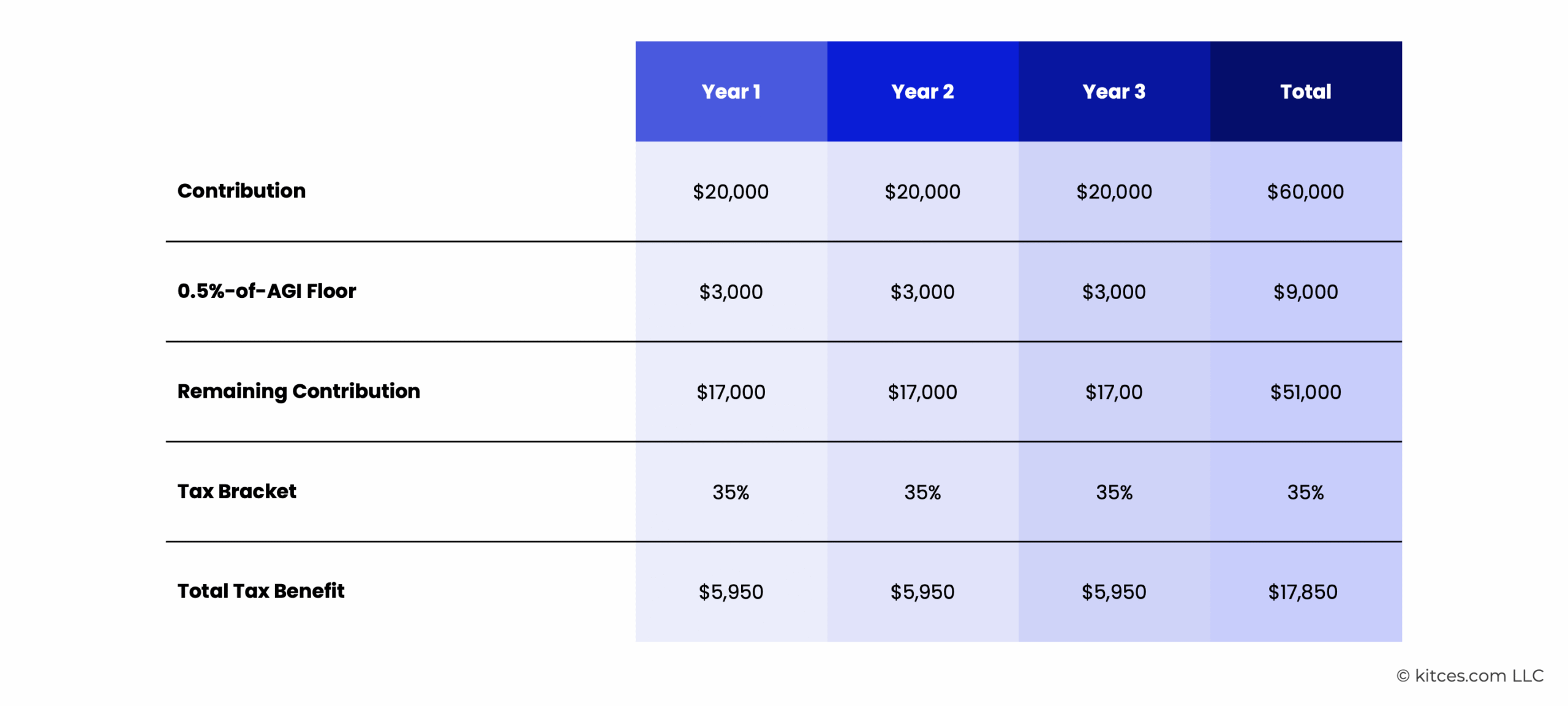
Example 5a: Graham is a single taxpayer with $600,000 per year of AGI. He normally makes a $20,000 charitable contribution to his alma mater each year. If he continues to make this contribution for each of the next three years, then (assuming his AGI remains the same) he'll need to reduce his charitable deduction by 0.005 × $600,000 = $3,000 each year, meaning that for the three total years he'll be able to deduct ($20,000 × 3) – ($3,000 × 3) = $51,000 in aggregate. Assuming Graham is in the 35% Federal tax bracket for each of those years, his total tax benefit from the contributions is 35% × $51,000 = $17,850.
Example 5b: If Graham bunches his next three years' worth of charitable contributions into one year, however – i.e., makes the entire $60,000 donation in 2026 instead of spreading it into three $20,000 chunks – the $2,500 reduction will only apply once, so he'll be able to deduct $57,000 of the contribution instead of $51,000. Which means he'll receive a total tax benefit of 35% × $57,000 = $19,950 by bunching the contributions, a $2,100 increase over the $17,850 benefit of making the contributions over three years.
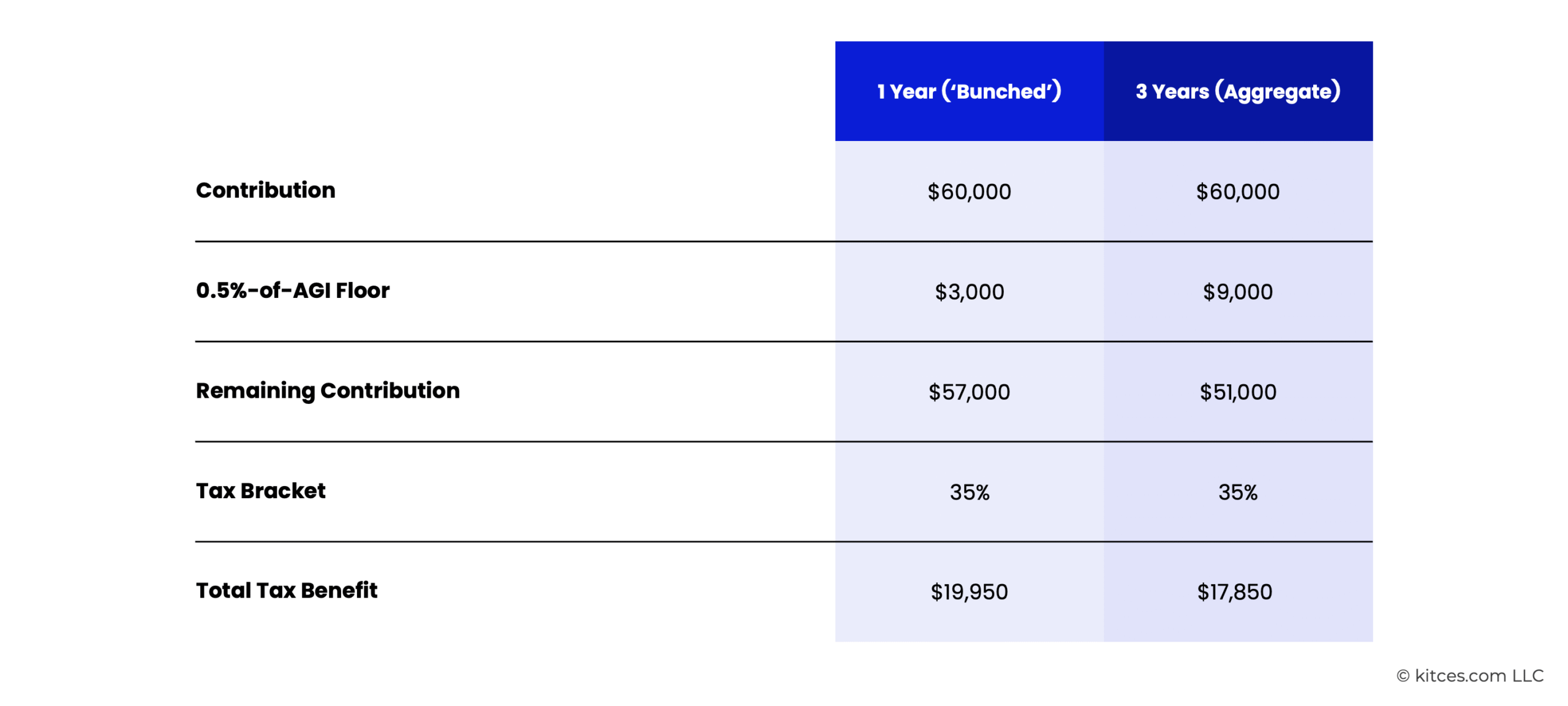
Since the 0.5%-of-AGI floor gets applied during every year in which the taxpayer makes a charitable contribution, the greater the number of years' worth of contributions they can consolidate into a single year, the more tax savings they'll realize (versus spreading the contributions out).
Example 5c: Graham in the example above decides to make 10 years' worth of contributions all at once rather than 'just' 3 years' worth. As a result, he'll receive a deduction of ($20,000 × 10) – $3,000 = $197,000, and a total tax benefit of 35% × $197,000 = $68,950. If he had spread the contributions over 10 years, he would have only been able to deduct ($20,000 × 10) – ($3,000 × 10) = $170,000, for a total tax benefit of 35% × $170,000 = $59,500. Meaning that bunching the contributions netted a total of $68,950 − $59,500 = $9,450 of tax savings.
In reality, though, not all clients will feel comfortable committing to 'pre-paying' many years' worth of donations into one large lump-sum contribution (e.g., because they donate to a variety of different causes instead of a single charity each year). In that case, charitable lumping is still possible by using a DAF, where an individual can make an up-front donation (and receive a tax deduction in the year of that contribution) and then 'direct' the DAF funds to be distributed to their preferred charities at any subsequent point. Funds inside the DAF can be invested tax-free, meaning there is little opportunity cost to making a lump-sum donation if the funds can be reinvested within the DAF similarly to how they had been positioned in the client's own portfolio.
But regardless of whether a household makes a lump-sum donation directly to a charitable organization or spreads out their giving via a DAF (while still receiving the tax deduction upfront), the bottom line is that bunching together charitable contributions is no longer only beneficial to households who wouldn't have otherwise been able to itemize their deductions – it can now play a role in helping higher-income households who do regularly itemize to minimize how much the tax benefits of their giving are eroded by the 0.5%-of-AGI floor.
OBBBA's New Charitable Deduction For Non-Itemizers
Historically, deducting charitable contributions has only been an option for taxpayers who itemize their deductions – except for in 2020 and 2021, when COVID relief legislation allowed non-itemizers who take the Standard Deduction to deduct charitable contributions up to a maximum of $300 for single filers and $600 for joint filers. However, OBBBA revived the non-itemizer charitable deduction and made it permanent, while also increasing the limits to $1,000 for single filers and $2,000 for joint filers. And unlike the itemized deduction for charitable contributions, the non-itemizer deduction is not subject to the 0.5%-of-AGI floor.
The caveat is that, in order to be eligible for the non-itemizer deduction, charitable contributions need to be made in cash and given directly to a charitable organization. In other words, they cannot be made in the form of property (including physical property as well as financial assets like appreciated stocks), and cannot be made to a donor-advised fund (DAF).
While this creates a new opportunity for households that rarely or never itemize deductions to begin deducting charitable contributions, it also creates a potential planning strategy for households that bunch together deductions in order to itemize in some years, and take the Standard Deduction in other years. Those households no longer need to bunch all of their charitable giving into a single year in order to get a tax deduction for it – they can now employ a strategy where they make most of their charitable gifts in the year that they itemize deductions, but continue to give in small amounts (up to the $1,000/$2,000 limits) in years they don't itemize in order to receive 'unreduced' charitable deductions in those years.
Qualified Charitable Distributions (QCDs)
Another way to contribute to charity that isn't subject to OBBBA's new limitations on itemized deductions is to make the contribution in the form of a Qualified Charitable Distribution (QCD). In a nutshell, QCDs can be made from a traditional IRA whose owner is over 70 1/2 years old, with the IRA cutting a check directly to any 501(c)(3) charitable organization. The QCD is fully excluded from income, meaning that it doesn't count toward Adjusted Gross Income (AGI), and is limited to $111,000 (2026) per individual each year.
QCDs are particularly valuable for individuals who are taking Required Minimum Distributions (RMDs) from a traditional IRA that don't actually need the RMD dollars to fund their lifestyle. In that case, the QCD is effectively a direct deduction from the income that the taxpayer would have otherwise been required to recognize – but as an 'above-the-line' deduction that reduces AGI rather than an itemized deduction, it is neither subject to the 0.5%-of-AGI floor on charitable contributions nor the 2/37ths reduction of itemized deductions. It also has other 'downstream' effects that come with reducing AGI, such as the potential for reducing Medicare Part B premiums or the taxation of Social Security benefits.
This 'direct deduction' math doesn't work for everyone, however: IRA owners between the ages of 70 1/2 and 73 are permitted to make QCDs, but aren't otherwise required to take an RMD. Similarly, to the extent that an individual relies on their RMD for living expenses, the QCD would eat into the amount available to spend, and may need to occur as an additional distribution on top of what they are already taking from the IRA for their own needs.
But there's still an indirect benefit of making QCDs in this case, which is that doing so will further reduce the balance of funds in the IRA and consequently lower future RMDs. This is harder to quantify than making a QCD that directly reduces current-year income from an RMD, but for households with larger IRAs it might be more valuable from a long-term tax planning perspective to chip away at the size of the IRA and future RMD obligations than it is to take a charitable deduction in the current year, particularly if future RMDs are expected to push the taxpayer up into a higher tax bracket (making the future reduced RMD income more valuable than the current-year charitable deduction). The new OBBBA limitations only further tilt the math in the QCD's favor by reducing the current-year value of itemized charitable deductions.
The key point is that although the impact of the 0.5%-of-AGI charitable contribution floor and 2/37ths reduction in itemized deductions may be small relative to household income, the impact in dollar terms grows substantial at higher income levels. And so while OBBBA's new rules may not require a complete overhaul of charitable strategy, the tax savings that can be realized by careful planning can help charitably inclined clients reap a greater benefit from their giving!