Executive Summary
Maintaining proper documentation is unlikely to be at the top of many advisors’ favorite activities. Nonetheless, accurate and thorough documentation not only can keep an advisor and their firm out of trouble with relevant regulators but also can help an advisor fulfill fiduciary responsibilities to their clients while providing evidence of their actions and recommendations in the case of a future client complaint. Which suggests that creating and maintaining relevant documents is not just a regulatory requirement but also could be a business imperative as well.
Broadly, documentation that is important to a financial advisory firm can be thought of in three tiers: documents that are required by the regulatory requirements of the practice (Tier 1), documents that describe actions taken and client communications (Tier 2), and documents that explain an advisor’s rationale for recommendations or actions (Tier 3).
Tier 1 documents that are required by regulators are likely to be those the advisor is most familiar with and can include a signed client agreement, Form ADV Part 2 delivery acknowledgment, conflict of interest disclosures, privacy notices, and other files as required by various governing bodies. The goal of this tier is to prove that the documentation required for legal and regulatory purposes was, in fact, delivered to the client, and these documents are often filed on a company intranet or in their CRM.
Next, Tier 2 documents catalogue interactions with a client and can include meeting notes, email communications, and copies of analyses delivered to the client. In this tier, a few of the important things to capture are what happened, when it happened, and who was involved. These details create a verifiable timeline of the client relationship that neither the advisor nor the client may be able to reconstruct with full accuracy from memory alone (which can be helpful evidence if a client [incorrectly] claims down the line that an advisor did or did not make a particular recommendation).
Finally, Tier 3 documents include the rationale for why an advisor recommended a specific action. While it is helpful to understand what recommendations were made (Tier 2 documents), describing the rationale behind them in writing can both provide the advisor with insight into their thinking if the recommendation is revisited down the line and also provide helpful background insights if another advisor or team member begins working with the client.
While financial advisory firms will likely already have Tier 1 documents established (though they might need to be updated from time to time), implementing a process across the firm for creating Tier 2 and Tier 3 documents can ensure these are produced consistently. For instance, building in time before client meetings (to record the thinking behind their recommendations) and after (to document decisions that were made and the reasons behind them) can ensure these tasks don’t slip through the cracks. Also, while some advisors might enjoy the writing process, firms might encourage those who are less adept at this task to take advantage of dictation tools (e.g., Windows Talk-to-Text and Pulse360) to organize their thoughts and avoid procrastinating this task.
Ultimately, the key point is that the benefit of maintaining proper documentation isn’t just a matter of staying in line with relevant regulations but also an opportunity to better serve clients and promote business continuity by maintaining accurate records of client communications and recommendations, as well as the reasons behind them!

Keeping proper documentation and records is a begrudgingly accepted aspect of financial advising. Nonetheless, it’s important because, in addition to satisfying compliance requirements, proper documentation of financial planning analysis and recommendations ensures that vital information is accessible to all who may need to refer back to it in the future: the advisor, their staff, regulators – and the clients themselves.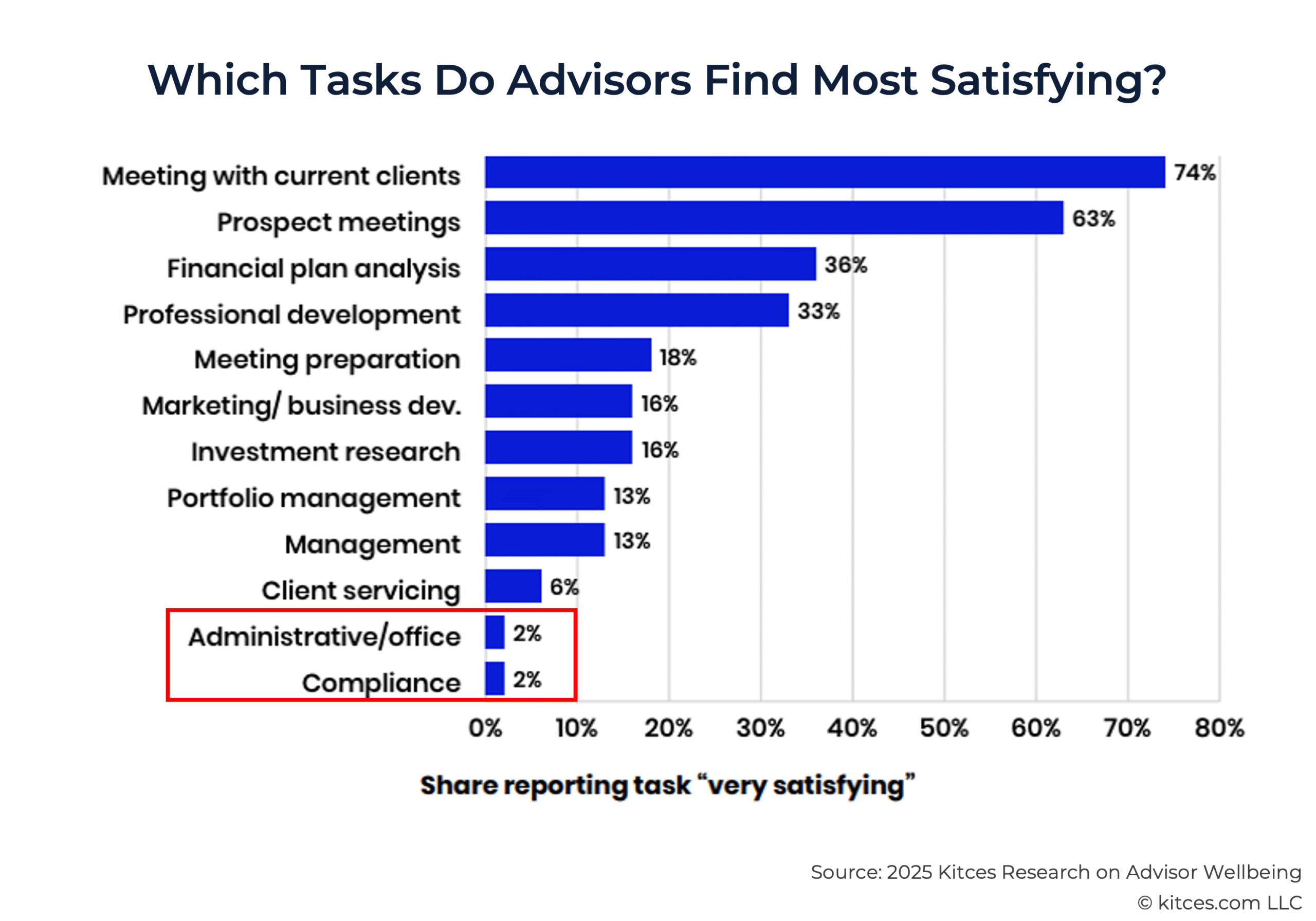
Despite the necessity and practicality of doing so, though, maintaining good records is one of financial advisors’ least favorite tasks. In the 2025 Kitces Research on Advisor Wellbeing, advisors reported administrative and compliance tasks as the least satisfying job responsibilities. Additionally, the Kitces research team found that increased time spent on administrative and compliance tasks was associated with lower wellbeing and a higher likelihood of leaving their employer.
However, with the right systems in place, documentation can help minimize the risk of litigation, reinforce an advisor’s fiduciary duty by stimulating critical thinking and provoking clearer recommendations, and also strengthen the advisor’s practice by reducing key-man risk and building a more collaborative culture.
To maximize the benefits of documentation, advisors need a clear idea of what in-depth documentation entails. This article outlines a tiered approach to advisor documentation: required documentation for compliance, documentation of client communications and actions taken, documentation of advisor reasoning and analyses. Finally, the article concludes with practical strategies for building a sustainable documentation process even for advisors for whom writing does not come naturally.
Meeting Minimum Regulatory Compliance Documentation Requirements
The level of documentation that most advisors are accustomed to is that required to meet their compliance obligations. Depending on an advisor’s designation and how their firm is registered, they may be subject to documentation requirements from multiple regulatory bodies, including the CFP Board, the North American Securities Administrators Association (NASAA), and the Securities and Exchange Commission (SEC).
Documentation Requirements For CFP Professionals
The CFP Board's Code of Ethics and Standards of Conduct defines documentation standards for information that CFP Professionals must provide to clients prior to or at the time of a client engagement based on the type of activity they are engaging in.
Section A.10a – Provide Information To A Client (When Providing Financial Advice)
- A description of the services and products to be provided;
- How the Client pays for the products and services, and a description of the additional types of costs that the Client may incur, including product management fees, surrender charges, and sales loads;
- How the CFP Professional, the CFP Professional’s firm, and any related party are compensated for providing the products and services;
- The existence of any public discipline or bankruptcy, and the location(s), if any, of the webpages of all relevant public websites of any governmental authority, self-regulatory organization, or professional organization that sets forth the CFP Professional’s public disciplinary history or any personal bankruptcy or business bankruptcy where the CFP Professional was a Control Person;
- Conflict of Interest Disclosure;
- Written Notice Regarding Non-Public Personal Information;
- Disclosure of Economic Benefit for Referral or Engagement of Additional Persons; and
- Any other information about the CFP Professional or the CFP Professional’s firm that is material to a client’s decision to engage or continue to engage the CFP Professional or the CFP Professional’s Firm.
Notably, these documentation requirements are more about recording that the disclosure occurred, not necessarily about retaining details of the information provided, or the specific language used in each required disclosure. When an engagement rises to the level of financial planning (as defined by the CFP Board), the documentation requirements expand.
Section A.10b – Provide Information To A Client (When Providing Financial Planning)
- The information required to be provided in Sections A.10.a.i.-iv. and vi.-viii.; and
- The terms of the engagement between the client and the CFP Professional or the CFP Professional’s Firm, including the scope of engagement and any limitations, the period(s) during which the services will be provided, and the Client’s responsibilities. A CFP Professional is responsible for implementing, monitoring, and updating the Financial Planning recommendation(s) unless specifically excluded from the Scope of Engagement.
In addition to information that CFP Professionals are required to provide at the beginning of an engagement, they are also required to update clients on material changes.
Section A.10c – Updating Information
A CFP Professional has an ongoing obligation to provide to the client any information that is a Material change or update to the information required to be provided to the client. Material changes and updates to public disciplinary history or bankruptcy information must be disclosed to the Client within ninety (90) days, together with the location(s) of the relevant webpages.
Additionally, throughout client engagements, CFP Professionals are expected to act prudently in documenting information based on the facts and circumstances of the client engagement, the significance of the information collected, the need to keep the information in writing, and the obligation to act in the client’s best interest. These standards highlight that documentation aligned with an advisor’s ethical obligations and fiduciary duty is not simply a checklist; it also requires an advisor’s judgment to determine what is significant based on the relationship with the client.
Documentation Requirements For State-Registered Investment Advisers
Documentation requirements from the North American Securities Administrators Association (NASAA, which develops model rules and guidance for state regulators) are broader and not contained in a single standard of conduct; rather, they comprise several rules that apply to registered investment advisers at the firm level.
The Model Rule 203(a)-2 outlines the mandatory recordkeeping requirements for state-registered investment advisers. Required records include:
- journals, ledgers, bank statements, and financial statements;
- client account records including written client agreements and documentation of any discretionary authority granted;
- originals of all written communications related to any recommendation made and any advice given;
- advertising and performance records; and
- written information about each investment advisory client that forms the basis for making any recommendation or providing any investment advice to that client.
Most records must be maintained for five years, and kept at the firm's principal office, and remain readily accessible for the first two years.
The Model Rule for Investment Adviser Written Policies and Procedures requires registered firms to provide clients with written privacy policies at the beginning of the client engagement and annually, a written code of ethics, transaction reporting, and written cybersecurity and business continuity policies.
Documentation Requirements For SEC-Registered Investment Advisers
SEC-Registered Investment Advisers are subject to federal recordkeeping requirements under SEC Rules 204-2 and 206(4)-7. Rule 204-2 under the Advisers Act also requires SEC-registered advisers to maintain a broad range of books and records, including journals, ledgers, client agreements, order memoranda, and all written communications related to recommendations made and advice given.

Nerd Note:
For a detailed checklist of books and records requirements for both investment management and financial planning services, read the related Kitces article A Recordkeeping Checklist For Financial Planning Services: Proactive Documentation Of Service Delivery To Reduce Regulatory Scrutiny.
Rule 206(4)–7 under the Advisers Act requires written compliance policies and procedures that are reasonably designed to prevent violations of the Investment Advisers Act.
In addition to these regulations, advisors working with retirement plan assets face an additional layer of documentation requirements under the Employee Retirement Income Security Act (ERISA), enforced by the Department of Labor, including investment policy statements and investment selection rationale.
As these regulations highlight, advisors must manage a variety of documentation requirements to meet compliance standards, both at the start of a client engagement and on an ongoing basis throughout the relationship. While the frameworks highlighted above are separate requirements, they do overlap. For example, an advisor delivering Form ADV Part 2, Form CRS, a privacy notice, and a signed engagement letter to a client at the outset of a relationship and filing that documentation would simultaneously satisfy CFP Board's Section A.10 disclosure requirements, NASAA's written agreement and disclosure document requirements, and SEC Rule 204-2's client agreement retention obligation. Comparing these frameworks also highlights that regulatory requirements can range from purely structural (i.e., keep these documents for this period of time) to judgment-based (i.e., document what you think is important about the client recommendations), requiring a thoughtfully designed approach to compliance.
Non-compliance with these standards could result in disciplinary action, such as designation-specific censures, fines, and legal prosecution depending on the severity of the violation. In 2019, a Florida-based advisor was found to have failed to comply with the Florida Administrative Code and Florida Statutes in multiple domains related to proper disclosures and documentation, including:
- Failure to maintain an accurate Form ADV
- Failure to maintain written information about each advisory client that was the basis for making recommendations or providing investment advice to those clients
- Failure to ensure that all contracts were dated, signed by all parties, and disclosed the appropriate advisory fee
These violations led to the advisor being required to pay a $12,000 fine to the Florida Office of Financial Regulation and receiving a one-year suspension of his right to use the CFP marks.
However, meeting the minimum regulatory documentation requirements is not the same as demonstrating how an advisor is considering their fiduciary duty throughout their practice.
Compliance Documentation As Evidence – And Expression – Of Fiduciary Duty
Risk Mitigation: Documentation As Evidence Of Fiduciary Practice
Financial advisors who practice as fiduciaries have an obligation to act in the best interests of their clients. As a fiduciary, it is typical to be required to disclose conflicts of interest, make reasonable recommendations that are suitable for the client’s situation and goals, and maintain client confidentiality. Although financial advisors are required to document various client interactions and disclosures to comply with these duties, the difference between documenting for compliance and documenting to fully demonstrate acting as a fiduciary becomes most visible when a client dispute arises.
Let’s look at the following example.
Example 1a. Paul is a long-time client of his financial advisor, Michelle. Michelle is a CFP Professional. Paul is a retired oil executive and holds a large stake in his former employer, ABC Oil. For years, Michelle has explained to Paul that carrying such a high concentration of oil stock carries significant risk and recommended reallocating some of the funds invested in the stock to more diversified assets. Paul has refused, as he still believes in the company and wanted to keep the stock holdings that he had earned throughout his career.
In the most recent client meeting, during a review of Paul's holdings, it was noted that the value of his ABC Oil stock had lost more than 50% of its value as the company was in financial trouble and is now facing bankruptcy. Paul was visibly agitated by the resulting decline in his net worth and asked Michelle, "Why didn't you tell me to trim these holdings earlier?"
Michelle's situation illustrates a situation where an advisor would benefit from having a record of the conversations with the client and the recommendations she provided. Michelle did in fact review Paul’s financial situation, and appropriately provided guidance on what to do with the ABC Oil stock holdings. But ultimately, as a CFP Professional and a fiduciary, she had a duty to follow his instructions and retain the concentrated position as Paul stated he wanted to do.
Yet without any other documentation, all Michelle can show after the fact is that Paul continued to hold an overly concentrated position that experienced significant financial losses… and a literal “he-said, she-said” debate about whether or how strenuously Michelle actually delivered this recommendation. Situations like this leave advisors vulnerable, because the reality is that sometimes clients forget what was recommended in the past, especially if the recommendation wasn’t acted upon. Other times, clients may blame their financial advisor for an adverse outcome driven by the client’s decision-making to avoid accepting responsibility for their own bad results – for which the best solution is documentation to substantiate what was really discussed.
There are several ways that Michelle could have documented her recommendations. She could have written out her specific recommendations, and kept copies of her previously provided financial plans as proof that she had addressed the client’s concentration risk at that time (notably, contemporaneous documentation when the original conversations occur is much more important than trying to create a record of what was discussed weeks, months, or years later). She could have sent a summary of the meeting notes to the clients after that original meeting to discuss the holdings and ensure the clients’ stock discussions (and Michelle’s recommendation to diversify) were accurately included in the summary, creating a further paper trail of what was said to the client back then (that Paul might not be recalling now). She also could have asked the client to sign off on his decision to maintain his concentration risk levels against his advisor's advice.
Software advancements, such as the adoption of CRM systems and AI notetakers, have made documenting and filing client information more frictionless. However, simply using tools to track signed documentation, disclosure deliveries, and client meeting notes, is not sufficient to demonstrate that an advisor is acting as a fiduciary throughout the planning process. Under the CFP Board code of ethics, documenting the recommendation itself is required, but documentation of the reasoning for why the advisor does not believe the requested action is in the client's best interest, and of how or when that information was communicated to the client, is not explicitly required. However, failing to document this information could put the advisor in a vulnerable position in the future, as they may be unable to demonstrate that they have indeed provided thoughtful guidance to the client based on their expertise.
Let’s return to Michelle’s scenario. What if she had not documented her recommendations to Paul, along with his response?
Example 1b. Although Michelle did act in a manner consistent with her fiduciary duty, Paul could still file a complaint with the CFP Board, alleging that she failed to meet her fiduciary duty of care by not adequately advising him of the risk he was taking. If Michelle works at a state-registered RIA, Paul could also file a complaint with the state securities regulator, citing unsuitable recommendations and failure to act in the client’s best interest.
Despite Michelle’s thoughtful practice, her lack of thorough documentation would leave the defense of her actions during the financial advising process to her word against Paul’s memory of the engagement, potentially opening her up to both regulatory discipline as well as client litigation.
The risk posed by the lack of documentation can also increase over time as memories fade and as clients work with different advisors at the firm. If Michelle were to retire while Paul was still a client, another advisor taking over the account may have even less information about what transpired between the original advisor and the client, leaving the incoming advisor with gaps in the client’s history and even less ability to respond or defend the firm if Paul subsequently filed a complaint about advice allegedly not given years prior. Thorough record-keeping provides continuity for staff or successor advisors who may work on the client relationship in the future, offering vital information if client disputes arise.
Documentation As A Means To Strengthen Fiduciary Practice
Documentation can be a major safeguard for financial advisors, providing evidence of their actions as fiduciaries throughout the financial planning process, but the benefits of thorough documentation also extend to the advisor’s practice itself.
Documentation also reinforces an advisor’s consideration of their actions throughout the financial planning process. Consider the example below.
Example 2. Miguel received an email from a client who has a newborn baby. Excited about their new family addition, they asked Miguel for his recommendations for a 529 Plan.
Miguel's initial thought was to suggest the Utah 529 plan, but as he was preparing to write his email back to the client, he realized he had not actually looked into 529 plan options in years and had fallen into the habit of just suggesting the same one to every client. He had done the research years before and felt it was a good plan, but he was not actually considering the client’s unique circumstances. This prompted him to do more research into current 529 plan rankings, and to think through his specific clients' needs and the benefits they would receive based on their state.
Miguel expanded his recommendation to include 3 other 529 plan options, highlighting the NY 529 plan for its tax benefits given the couple’s recent move to New York City.
When advisors take time to reflect on why they are making a recommendation and how they will explain it, they can refine their thinking and identify gaps in their logic or analysis to address before presenting their final recommendations to a client. This process strengthens an advisor's recommendations and reinforces consideration of appropriate alternatives for clients, supporting the advisor's fiduciary duty.
Notably, though, this may actually be more difficult for some advisors, given how the delivery of financial planning itself is evolving. The 2024 Kitces Research on Advisor Productivity found that just over half of financial advisors now use an interactive financial plan built during the client meeting, rather than a written document. Though this shift towards collaborative financial planning may facilitate increased client engagement and make plan adjustments easier, it also means there are fewer points in the planning process for advisors to step back and organize their thinking outside the client meeting, unless they have an intentional process of doing so.
Building intentional documentation time into the client meeting prep process helps ensure that initial notes on the rationale behind the recommendation are captured. This process can also help advisors prepare for a smoother presentation meeting by creating space to think through which information is crucial for the client to understand, to refine what they found, and to explain the alternatives considered and their recommendations. This deep consideration of these elements aligns with the fiduciary duty of care by conducting a thorough review of the reasonableness of the analysis. This process can be especially helpful for early-career advisors who are learning how to adequately prepare to deliver a financial plan or to prep for a client meeting.

In academia, it is commonly understood that writing is part of the thinking process, not just the result of thinking – as the practice can help a person refine, organize, and interrogate their ideas. In "The Psychology of Written Composition", authors Bereiter and Scardamalia suggest that there are two models of how one might approach writing: knowledge telling, and knowledge transforming. With knowledge telling, a writer simply writes down what they already know, without deep engagement. In the context of financial planning, this could be summarizing details about the client and their unique circumstances, which is an understanding central to the duty of care. By contrast, with knowledge transforming, they begin to problem-solve, synthesize viewpoints, and create new connections between ideas. This process, when completed via documentation, complements financial planning analysis by giving advisors space to carefully re-evaluate their own thinking. By documenting the rationale underlying their recommendations, an advisor increases their ability to think critically about the advice they are giving.
Additionally, when advisors encounter a new problem, strategy, or circumstance they have not yet encountered, writing can help them solidify their understanding and identify gaps in knowledge. Researchers Flower and Hayes argue that writing is the process through which writers actively construct meaning, forming new connections and discovering what they actually think. Financial advisors are always learning, and a commitment to continuing education is built into the requirements necessary to maintain various licenses and designations. Incorporating practices that help solidify learning also helps advisors to continuously build new skills and reinforce knowledge gained on the job.
Building A Sustainable Compliance Documentation Process
What To Document, And How To Make It A Regular Habit
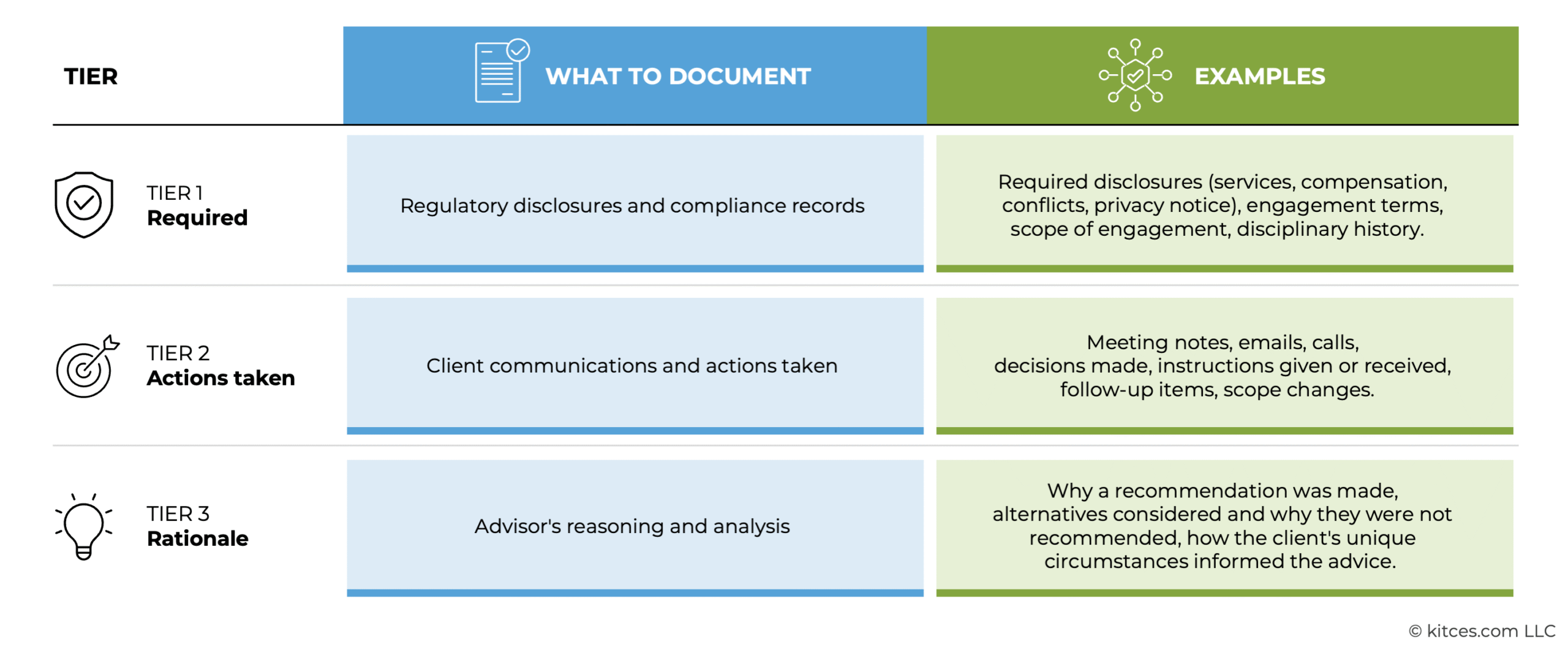
After identifying the importance and usefulness of documentation, the question becomes: what should advisors document? Documentation can be thought of in 3 tiers:
- Tier 1 is to document what is required by the regulatory requirements of the practice;
- Tier 2 is to document actions taken and client communications; and
- Tier 3 is to document the advisor’s rationale for recommendations or actions.
Tier 1 is by far the level of documentation that most advisors are most familiar with. This includes documents such as:
- signed client agreements
- Form ADV Part 2 delivery acknowledgments
- Form CRS
- conflict of interest disclosures
- privacy notices
…and other files as required by various governing bodies.
These are documents that most financial planners already have and likely keep filed on a company intranet or in their CRM. The goal of this tier is to prove that the documentation required for legal and regulatory purposes was, in fact, delivered to the client.
Tier 2 is about cataloging interactions with the client, and this is more often where advisors may begin to have gaps. Examples of documentation that would fall under this tier are:
- meeting notes
- email communications
- copies of analyses delivered to the client
In this tier, a few of the important things to capture are what happened, when it happened, and who was involved. These details create a verifiable timeline of the client relationship that neither the advisor nor the client may be able to reconstruct with full accuracy from memory alone.
Tier 3 is often the area with the least documentation in a company's client record-keeping system. This includes the rationale for why an advisor recommended a specific action.
For instance, consider example #2 earlier, with Miguel and his 529 recommendation. An advisor may have a record in their email inbox or client CRM of the 529 plan recommendation they provided to a client, but may not have the exact reason for that recommendation unless they specifically included a written rationale in the email to the client. Summaries of the alternatives considered are even rarer, as advisors tend to provide only the final recommendation to the client; the process by which that final recommendation was reached is less commonly retained.
These details, though, are important, especially for consequential client decisions such as whether to conduct a Roth conversion or structure their estate in a specific way. Additionally, keeping notes on recommendations provided to the client, especially when an advisor believes the client is taking an action against their own best interests, is vital. Documenting both the events that led to the client's decision and the client's final decision or direct instruction ensures there is a resource to refer to in the future.
Leveraging AI Notetakers And Other Technology To Make Compliance Documentation Easier
AI tools and notetakers are increasingly being integrated into financial planning practices, making it much easier to reach tier 1 and tier 2, but pure reliance on these tools may not fully capture an advisor’s decision process (including the ultimate recommendations, as well as the alternatives considered), which is a central aspect of an advisor’s fiduciary duty and the financial planning process. It is also worth noting that the cognitive benefits of the documentation process, specifically space to re-evaluate thinking and identify gaps in reasoning or knowledge, depend on advisors actively engaging in the writing process rather than delegating it entirely to AI tools.
A few good questions to ask oneself when going through the documentation process are:
- Does the information noted give another person (client, successor advisor, etc.) a strong idea of what has happened?
- Could another person understand the rationale behind the analysis and ultimate recommendation(s)?
- While writing my rationale, were there any areas I struggled to explain?
- Does the client file demonstrate actions and judgment aligned with my fiduciary duty?
For advisors who do find some level of enjoyment in the writing process or in client note-taking, simply building the habit of quickly jotting down their ideas or incorporating a writing session into their client meeting prep may be all the adjustment they need to integrate this process into their current routine. Blocking off 15 to 30 minutes directly after client meetings to write down additional thoughts while the conversation is still fresh can also increase documentation quality. This may also be a good time to review the summary from AI notetakers and ensure it has captured all the relevant details for both the client and the advisor’s records.
Advisors may also have distinctions between what they include in client-facing notes and internal notes. For example, where notetakers can accurately capture what was discussed and recommendations conveyed to clients, internal notes may include more sensitive contexts, such as observations about family dynamics, health considerations, or the client’s behavioral patterns.
By making documentation a commonplace task that is built into the financial planning process, the action as a whole becomes less of a project where an advisor is spending large amounts of time looking backward and trying to remember details of their interactions with clients, or when they provided a document to a client, or what their rationale was during a specific analysis.
Advisors who genuinely do not enjoy writing or struggle to maintain their notes may be able to use one of the strategies below to get started.
- Try creating a template. It can be intimidating to get words on an empty page or to just figure out where to start. Depending on the CRM, templates can be constructed to automatically populate standard questions for the advisor to answer after client meetings or phone calls, leaving the advisor to simply enter their responses. Then the CRM will automatically file the information under the client’s records.
- Try using dictation. Most advisors spend their time talking and explaining complex concepts to clients regularly, and talking through their thoughts becomes second nature with repetition. Dictation software, such as Windows talk-to-text and Pulse360 has improved significantly over the years and can be a useful way for advisors to think out loud rather than relying on writing as their primary method of thinking. Thinking out loud does not have the exact same benefits as writing, just as typing does not have the exact same benefits as handwriting. However, psychological research suggests that thinking out loud can help increase focus and lead to further information processing. Doing so can also help one prepare for client presentations and for more in-depth conversations with clients, who are increasingly informed by AI.
 Try a Shultz Hour. In the book "Happier Hour", UCLA professor Dr. Cassie Holmes describes the Shultz hour as a practice modeled after former U.S. Secretary of State George Shultz, who scheduled one hour a week for quiet reflection that he did not allow to be interrupted by anyone other than his wife or the President. Shultz used this time to step back and consider the larger questions in his life. In a similar way, an advisor could set aside an hour each week to reflect on how their practice aligned with their fiduciary duty and consider what documentation they may want to prepare or keep in support of that. In this way, documentation becomes less of an afterthought or compliance exercise.

Building A Culture Of Documentation
Documentation is most valuable when it can be easily located later. Therefore, it’s important that all staff members who work on client accounts are fully aware of which documents they need to keep and where and how they should be stored, including a clear, consistent file-naming structure.
By creating and disseminating a formal documentation policy across the firm, more seasoned advisors can explain its importance and hold junior advisors and staff accountable for upholding those standards. Thorough, well-organized documentation also reduces key-man risk. If an advisor is unexpectedly unavailable, having complete client records of both the advisor’s reasoning and observations, as well as a history of client interactions, means colleagues are better prepared to step in without significant disruption to the client relationship. Developing a process and culture of record-keeping is the best way to ensure that the effort put into documentation benefits the advisor, their practice, and their clients.
Reframing documentation as something that both provides evidence that an advisor's practices are in alignment with their fiduciary duty and also strengthens their ability to act as a fiduciary can transform it from purely a compliance task into a means through which an advisor strives to infuse deep thinking into how they serve clients.
By creating habits and processes that surround the documentation process, advisors can reap the benefits of ensuring that records provide a complete and thorough record of proper disclosure, client interactions, and analysis rationales. Leveraging those processes efficiently helps build an overall culture of strong documentation that can not only bolster an individual advisor's practice, but also benefit younger staff within a firm and support future business continuity.