Executive Summary
The traditional view of financial planning is that advisors are experts, who learn a specialized base of technical knowledge (e.g., CFP certification), and leverage that knowledge to collect information about clients' current situation and future goals and craft recommendations about what course of action clients can take to get from here to there. In this context, clients come with questions, financial advisors provide the answers, and then clients implement the recommendations (or subsequently delegate those steps to the financial advisor altogether). Yet in recent decades, this paradigm has begun to shift as the internet provides consumers near-unlimited access to information themselves… and now seems to be coming to a head with AI chatbot tools that allow a client to feed an advisor's entire financial plan and recommendations into the engine and come back with questions to challenge what their advisor said!
In this guest post, Dr. Meghaan Lurtz, a leading expert on the psychology of financial planning and Professor of Practice at Kansas State University, discusses how in reality clients coming back with AI-informed questions may not be a signal that technology is undermining financial advisors, and instead indicates that clients are more proactively engaging with their financial advisor in what could become a boon to advisor-client engagement!
When advisors have had years and decades of experience as being "the authority" on financial planning issues that their clients ask questions about, it's only natural to feel challenged when they begin to double-check what their advisors have said using AI. Yet the reality is that clients who don't understand their financial planning recommendations aren't going to implement… and in the past, clients who didn't understand had little way to learn more, and may not have even known what questions they should be asking to better engage in the process. Whereas now, when clients leverage AI for themselves in a planning engagement, it creates a form of 'hybrid' model that makes it easier for them to engage proactively with their advisor!
After all, if clients really want to circumvent an advisor's advice, they can already do so; they simply go open the trading account, or buy the crypto, or purchase the boat, and don't bring it up to the advisor they already knew would likely tell them not to. The mere fact that clients choose to bring questions back from their AI output and ask "What do you think about this?" means there is a desire to take the conversation with their advisor even deeper. In turn, this means that advisors who invite clients further into the (AI-prompted) conversation create more opportunity for clients to be heard, which further increases the likelihood they'll follow through!
Advisors who want to lean in further and turn client AI-prompted challenges into more constructive conversations can use a four-part framework: first thank the client (I'm really glad you brought this up. This is exactly the kind of conversation I want us to be having), then listen ("What was it about this idea that got you excited? What's the part that feels right to you?") before offering to share perspective ("I appreciate you sharing all of that. Can I offer some additional context that might be helpful as you think this through?"), which opens the door to better understand ("I can see why that strategy looks attractive. Here's the piece I'd want us to stress-test before making a move — what do you think?"), to finally co-create a new future with the client ("This was a great conversation. Keep bringing me what you're finding — this is how we make the plan better together.").
Ultimately, though, the key point is to recognize that clients who bring questions that seemingly are "challenging" their advisor are probably not doing so because they're unhappy or don't value their advisor; it's a pathway for clients to engage with their advisor more deeply, with greater confidence, because the AI may have helped them better get up to speed on what questions to ask, what conversations to have, and in the process may better surface the values and goals that are really most important to them. Which isn't unique to financial advisors; when a patient tells their doctor, "I looked up my symptoms on WebMD," a good doctor doesn't say, "Stop Googling things." A good doctor says, "Tell me what you found and what concerned you", and the patient leaves that appointment feeling heard. The same door of opportunity is now opening for financial advisors, too!

For the first time in history, the knowability of things is essentially endless. A person curious about asset allocation, Roth conversions, or the tax implications of selling a rental property no longer needs to schedule a meeting, wait for a callback and simply defer to expert's word. They can ask Google. They can fact check and personalize on ChatGPT or Claude. They can pull up a Reddit thread, watch a TikTok, or run a Monte Carlo simulation on a free platform. And many of them are doing exactly that — including the clients sitting across from financial advisors in meetings this week.
Let it be known, I do not think this means we are entering a crisis. I think what is being ushered in is a greater need for human advisors. I am excited by this behavior because, in many ways, this is exactly what financial educators and advocates have been working toward for decades — more people, more engaged, more interested in their own financial lives. The democratization of (financial) information is genuinely thrilling when we think about what it means for self-efficacy, for engagement, and for the kind of financial planning relationships that become possible when clients desire understanding of their plans, not just hoping they can follow them.
I truly believe, even with the not-so-great-or-perfectly-correct TikToks or AI Chat responses, that this is progress. Think about it: people, the same people who would have never had or wanted to have a financial conversation with a professional before out of fear, shame, or confusion on where to start, are emboldened by what they can Google or understand from a Reddit post and think for maybe the first time in their life…I think I want to talk to someone about how this might apply to me. I am honestly wowed and extremely enthusiastic regarding this shift and so before I continue on, on why and how important this is, let me address a common doubt.
Some advisors reading this may doubt that, when people are given some information, this information actually makes them want to talk to someone as compared to just doing it on their own. My evidence for this being the exact opposite, that when people feel a little more empowered, a little more educated or knowledgeable, that they do in fact want to talk to someone… is the fact that Robinhood, the pinnacle of do-it-yourself, bought RIA custodian TradePMR. And more than that, in March of 2026 announced a pilot launch for its Advisor Network, a new RIA referral program connecting advisors with eligible clients who have at least $250,000 in investable assets. Robinhood is courting 40 large RIAs for the referral program, and a survey Robinhood conducted with Boston Consulting Group and the World Economic Forum confirmed these young investors who have ostensibly been doing it on their own through Robinhood still want to talk to a professional!
When Information-Seeking Clients Begin To Use AI Chatbots As A Hybrid Engagement Model
Advisors tell me/ask me – my client is telling me that they put the plan I gave them through an AI and now they want to talk about what AI found or surfaced, what do I do? As with the shift of Robinhood investors to TradePMR-affiliated advisors, this doesn't necessarily mean that clients are trying to undermine their advisors. Instead, it signals that clients are embracing a new kind of hybrid advisor-plus-AI model.
Yet advisors, use to being recognized as the experts, are sometimes struggling with the shift when clients engage in a conversation that may "challenge" the advisor's advice after bringing it to an AI chatbot for feedback. The old (and perhaps somewhat paternalistic) playbook doesn't have a chapter on meeting "clients challenging you" with anything other than defensiveness (at best) and condescension (at worse).
Still, the fact remains that more clients are arriving at meetings armed with research from AI tools, social media, self-directed platforms, and a general sense that they can — and want — to be more involved in their financial decision-making. Of course, there are certainly situations where a client relationship has genuinely run its course, and clients who ask hard questions or are arriving with their own research deserves serious examination about whether the client is really still a good fit (or not). But in many of these cases, what looks like a challenge is an invitation for connection.
In other words, a client who brings questions, AI-generated analysis, or outside research to a meeting is not challenging their advisor's competence — they are choosing to engage with their advisor rather than going around them. Because the fact is that they could have simply opened Robinhood, bought the crypto, or executed the trade on their own; these tools exist. Yet, instead, they brought the idea to their advisor, and we can interpret that as an act of trust.
Which in turn gives advisors an opportunity to learn to receive these moments with curiosity rather than defensiveness. Clients analyzing an advisor's financial plan with AI and coming with questions are opportunities to deepen client relationships, improve planning outcomes, and differentiate in a hybrid world.
From Blind Trust To Informed Partnership: "Challenge" Will Be A New Normal
As stated, clients have more access to financial information, tools, and AI than at any point in history. And this isn't a threat to advisors. It does not mean expertise is less valuable. It means the way that expertise gets delivered to and received by clients has and will continue to evolve.
There have always been different types of advisory clients, and broadly speaking, most fall into one of three categories: Delegators, who hand over decisions entirely and prefer to be told what to do; Validators, who want to understand and approve before moving forward; and Reformed DIY-ers, who tried managing their finances on their own, learned some hard lessons, and now work with an advisor but bring a level of knowledge and autonomy to the relationship. (The fourth category of consumers, pure DIY-ers, simply do not engage with financial advisors at all.)
Historically, many advisors preferred Delegators. The relationship was relatively frictionless — the client said yes, handed off to the advisor to execute, and everyone moved on. But the democratized access to information and tools means more clients could or can shift toward becoming Validator and Reformed DIY-er behavior. And I believe, based on the sheer number of times that I have been asked by advisors lately about what to do and how to respond when a client tells them that the client ran the plan through Chat and now has some questions, this trend is accelerating.
So let me start with what hopefully will feel like some good news; this is not unique to finance, and it might be a sign of new and additional value. Doctors have been navigating this dynamic for years. "I Googled my symptoms" and "WebMD says it could be..." are such common meeting openers in healthcare that the medical profession has developed entirely new frameworks for engaging with informed patients—patient advocacy (where patients are encouraged to be more hands-on in the process) is in vogue and even used as marketing! The medical professional's value hasn't disappeared; the dynamic has simply shifted from blind trust to informed partnership. The same transition is happening in financial planning right now.
The real signal to worry about is silence, not questions. A client who goes behind their advisor's back, opens a Robinhood account, buys crypto without mentioning it, buys a house or a boat, or transfers assets — that's a client who has disengaged. That's a client who has decided, consciously or not, that their advisor isn't someone they want to involve in their financial decision-making process, let alone their broader financial life. Conversely, a client who brings their research to the meeting and says, "What do you think about this?" is doing the exact opposite. They are choosing to engage. They could have just acted on their own — the tools, again, are readily available — but instead, they brought the idea to their advisor. If the client didn't value the advisor, they wouldn't bother raising the topic. They'd just act.
The real signal to worry about is silence, not questions. A client who goes behind their advisor's back, opens a Robinhood account, buys crypto without mentioning it, buys a house or a boat, or transfers assets — that's a client who has disengaged… Conversely, a client who brings their research to the meeting and says, "What do you think about this?" is doing the exact opposite. They are choosing to engage.
The data tells a consistent story: retail trading platforms have surged in popularity, AI tools used by consumers for financial research have grown exponentially, and at the same time Cerulli finds that consumers' willingness to pay for advice is also on the rise. Yet as consumers are increasingly looking to engage, surveys on client expectations increasingly point toward transparency and collaboration as top priorities. The shift from "professional as sole authority" to "professional as trusted partner" is well-documented across healthcare, law, and now financial services. This is not a blip. This is the new landscape, and advisors who understand it will be better positioned to build the kinds of client relationships that last.
The Big Reframe: Using AI To "Challenge" Is A Call for Connection
When advisors reframe clients using AI to "challenge" the advisor's financial plan and recognize it as an attempt to connect, the entire dynamic of the meeting shifts. Instead of a power struggle, the conversation becomes collaborative. Instead of defending a recommendation, the advisor is coaching a client through their own decision-making process. This is a fundamentally different posture, and it changes everything about how the meeting feels for both parties.
The moment an advisor gets defensive, the dynamic flips from collaborative to adversarial. Defensiveness often shows up in predictable ways: dismissing the source ("You can't trust what ChatGPT tells you"), over-explaining credentials ("I'm a CFP professional with years of training and experience"), rushing to "correct" the client, or — perhaps most damaging — shutting down the conversation entirely.
The antidote to all of these responses is curiosity. "What was it about that idea that caught your attention?" is a fundamentally different response than "That's not how it works." The advisor's job in these moments is not to win the argument — it's to stay on the same side of the table as the client.
What is more, there's a practical benefit to this curious posture that goes well beyond relationship maintenance: a client who brings in AI output or outside research is handing the advisor a gift. They are offering a window into what they are thinking about, what they are worried about, and what matters to them right now. When a client or a prospect just walks in and says, "Claude suggested I should consider a Roth conversion," that's a fast track to understanding what's on their mind. This is information advisors normally must work hard to uncover through thoughtful discovery questions and careful listening.
And I truly believe that this fast track would have been far less possible pre-November of 2022 (ChatGPT's official launch), because money is a language. And we, all humans, learn language by conversing with other people who speak that language. Before November of 2022 if an individual didn't know anyone besides their advisor (if they even had one!) that knew how to speak the language of Roth conversions, where would they have learned to even be curious or ask or consider that strategy for themselves? Whether it is the right strategy or the wrong strategy is not what is up for debate here.
What is important is that the question can now be asked, and prospects and clients feel brave and informed enough to talk to their advisor about it. Instead of advisors needing to draw it out, clients and prospects are being very clear: I am thinking about taxes, about the future, about optimization. That's actionable information, delivered freely, and the only thing the advisor needs to do to receive it is not get defensive.
Where an AI tool's output differs from the advisor's recommendation, I don't see this as a problem to be managed either — it is an opportunity to get on the same side of the table as the client and walk through the logic together. To help the client understand why the plan was built the way it was and what contextual factors — their specific tax situation, their family dynamics, their risk tolerance, their goals — the AI tool may not have known about. That's deeper engagement, not dissent. And for the advisor, it's a chance to demonstrate exactly the kind of synthesizing, contextualizing, and personalizing that makes professional advice irreplaceable.
The healthcare analogy is powerful and instructive here. When a patient tells their doctor, "I looked up my symptoms on WebMD," a good doctor doesn't say, "Stop Googling things." A good doctor says, "Tell me what you found and what concerned you." The patient leaves that appointment feeling heard, feeling like they have an advocate, feeling like they are fighting their health issue side by side with their doctor rather than just following orders.
When a patient tells their doctor, "I looked up my symptoms on WebMD," a good doctor doesn't say, "Stop Googling things." A good doctor says, "Tell me what you found and what concerned you", and the patient leaves that appointment feeling heard…
Financial advisors can create the exact same dynamic. We want people to be interested in their financial health, to stand up for themselves, to bring their perspective to the table — because we know they are the only ones who truly know themselves, and that perspective matters. A client who comes in with ideas and plans and pushback is a client who is interested, who cares, who wants what's best for themselves — and who actually believes that getting what's best is possible. That's worlds apart from the client who shrugs and says, "I hope what's happening is in my best interest." I want to encourage advisors to celebrate this shift, not prepare to war against it.
What I Learned From My Own Classroom
I'll share something personal that took me a while to fully understand and become comfortable with, as I think it mirrors what many advisors might be feeling right now. As a professor, when AI tools started becoming more accessible to students, my first reaction was a mix of fear and disdain. There is no way this chatbot knows more than me? What happens to the value of my job, and to the value of universities, when knowledge is free and everywhere (and maybe sometimes even better)? What does it mean for the classroom when students can look up anything, generate analyses, and arrive with answers I didn't give them? What happens when a student genuinely knows more about a topic than I do?
Nothing catastrophic happened. None of my fears were realized. I still have a job. The classroom didn't collapse. And while I certainly have students who outsmart me on specific topics — that has always been true, by the way — I found that when it does happen, it only makes class more interesting. For them and for me. The students learn more when they bring knowledge to the table. They care more. They become more engaged. And what's perhaps most surprising is that my intelligence, my expertise, my value as a teacher — none of it is diminished.
The student's knowledge doesn't replace mine. It becomes another angle, another discussion point, another piece of information that everyone in the room grows from when we explore it together. My ability to synthesize, to strategize, to incorporate new information, to compare and contextualize — that's still valued. Perhaps more than ever, because now we're all working with richer material. I don't have to know everything. I don't have to always get it right and always know just a little bit more than everyone else. I still matter because I can help new information mean something in a wider context. And the act of wrestling with it in real time, alongside my students — that's not a sign that I am not good at my job. That's an act of open-mindedness, intelligence, and relationship development.
The same is true for financial advisors. A client who arrives with a well-researched idea from an AI tool is not diminishing the advisor's expertise. They're creating an opportunity for the advisor to demonstrate it in the most compelling way possible: in real time, in response to something the client actually cares about, in a way that shows the advisor can think on their feet and integrate new information into a broader context. The advisor doesn't have to know everything. They don't have to have considered every possible strategy before the client brings it up. They need to be the person who can take a piece of information — wherever it came from — and help the client understand what it means for their specific life. That's not a threat. That's the highest form of professional value.
Client Engagement Is Turning The Corner — And That's A Good Thing
Here's another way to think about this. As I mentioned earlier, financial educators, behavioral finance researchers, and planning advocates have spent years — decades — trying to get more people interested and involved in their own financial lives. Trying to combat apathy, avoidance, and the dangerous passivity that leads people to ignore their finances until something goes terribly wrong. The entire field of financial literacy exists because getting people to care about money is hard.
And now? Clients are coming to meetings having done their own research. They are asking questions. They are pushing back on recommendations and in the process better clarifying their true goals and values. They are using sophisticated tools to educate themselves and showing up with opinions about their own financial futures. Maybe — just maybe — we are turning the corner on the engagement problem that the profession has been trying to solve for generations. And if that is true, it is a really, really good thing.
But it also means the profession, advicers, needs new tools and new perspectives for working with these clients. The old model — where the advisor was the sole authority, where the "best" clients were the quiet ones, where the most desirable relationship was the one with the fewest questions — does not serve anyone well in a world where information is everywhere and clients have both the tools and the motivation to use it. We need to let go of the default thinking that a challenge means the client doesn't really want to work with us, that they don't trust us, that we should end the relationship as soon as possible. That instinct is understandable, but it's wrong more often than it's right.
Simply put, it should be exciting when clients come with ideas and plans and pushback. It means they are interested. It means they care. It means they want to know what's happening with their money and they want what's best for themselves — and they actually believe that getting what's best is possible and worth trying for, instead of just sitting back and hoping for the best. That kind of engagement is what the profession has been asking for. Now that it's here, the question is whether we have the frameworks and the mindset to receive it well.
The 4-Step Protocol For Turning Challenge Into Connection
What follows is a repeatable conversational framework advisors can use when a client arrives with outside research, AI-generated analysis, or a request that feels like it might be challenging the plan. The goal is not to have a rigid script — it is to have a map that keeps the advisor on the same side of the table as the client, every single time. Think of it as four moves that, practiced together, transform a potentially tense moment into a relationship-deepening one.
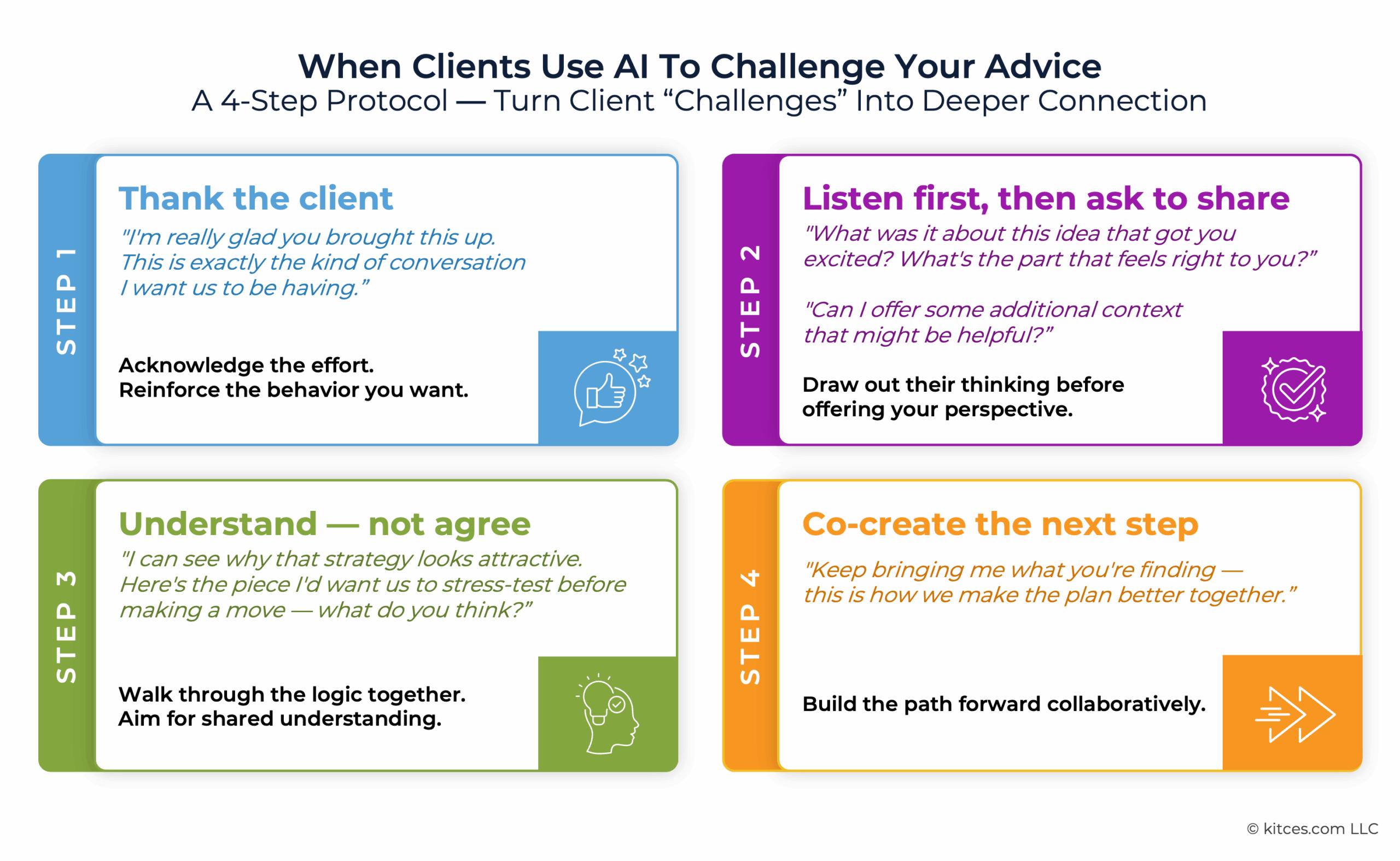
Step 1: Thank The Client
Before anything else, the advisor should genuinely acknowledge that the client brought this to the meeting. Not a perfunctory "thanks for sharing" — a real, warm acknowledgment that sets the emotional tone and signals that the advisor is not threatened.
This step also reinforces the behavior the advisor actually wants: clients who talk to their advisor rather than act without them. It also helps advisors in those moments if and when it does feel, at least at the start, like a threat to the advisor's authority. This is not easy. It does take practice. It is not always fun or flattering to hear that a client disagrees or has yet another opinion, but taking this small first step to give a genuine thank you really helps. It can help stop the advisors' fight or flight mode from turning on full force.
Moreover, this is a simple step. Yes. But it is also a remarkably easy to skip probably because it is so simple, but don't. Don't skip it. When an advisor feels caught off guard by a client's research, the instinct is often to jump straight into analysis or correction. Resist that instinct. The first ten seconds of the advisor's response shape whether the advisor and the client feel that the conversation is a collaborative one or an adversarial one.
Examples of language advisors can use:
"I'm really glad you brought this up. This is exactly the kind of conversation I want us to be having."
"Thank you for doing this research. It tells me you're thinking deeply about your plan, and that's a good thing."
"I am grateful that you're bringing me what you're finding. Share your thoughts!"
The specific words matter less than the warmth and openness behind them. The client needs to feel, in that first moment, that their advisor is glad they spoke up and this too can help an advisor calm and also feel more open to whatever comes next.
Step 2: Get The Client Talking First (Then Ask Permission To Offer Your Perspective)
Before sharing any opinion, the advisor will want to draw out the client's thinking. Understand why this matters to them. What prompted the research. What they are hoping for. Only after the client feels heard will the advisor ask permission to offer another perspective. This two-part move — listen first, then ask to share — keeps the advisor out of "lecture mode" and maintains the collaborative frame.
This step is where the real value of the client's research emerges. Questions that draw out the client's thinking might include:
"Walk me through what you found — what stood out to you?"
"What was it about this idea that got you excited? What's the part that feels right to you?"
"When you picture this change actually happening, what does that look like for you and your family?"
"Is there something about the current plan that's been on your mind, or is this more about a new opportunity you're seeing?"
Each of these questions does double duty — they make the client feel heard, and they give the advisor rich, specific information about what's driving the client's thinking.
The transition to offering a perspective is equally important and should feel like asking permission, not seizing the floor.
"I appreciate you sharing all of that. Can I offer some additional context that might be helpful as you think this through?"
"That's a really thoughtful take. Would it be helpful if I shared how I'm thinking about this from the planning side?"
These transitions signal respect and keep the client's defenses down and their ears open.
Step 3: Go For Understanding, Not Agreement
The goal of the conversation is not to "win" or to get the client to agree that the advisor was right all along. The goal is shared understanding. Sometimes the client's research reveals something the advisor hadn't considered — and a good advisor will say so. Sometimes the AI got it wrong, and this is a chance to walk through the reasoning together and help the client see why the plan was built the way it was. Either way, the advisor should be working toward mutual understanding, not compliance.
Questions that drive understanding might sound like:
"Let's look at this together — here's why we built the plan the way we did, and here's where what you found overlaps and where it diverges."
"That's an interesting point. What the AI may not have had context on is [specific personal factor — your tax bracket, your timeline, the trust structure we set up last year]. Does that change how you're thinking about it?"
"I can see why that strategy looks attractive. Here's the piece I'd want us to stress-test before making a move — what do you think?"
Notice the language throughout these examples. It is consistently collaborative. "Let's look at this together." "What do you think?" "Does that change how you're thinking?" The advisor is not issuing verdicts. They are thinking out loud with the client. And that act of thinking together — of treating the client as a partner in the process rather than a recipient of instructions — is what transforms a potentially contentious moment into a relationship-deepening one.
Step 4: Co-Create The Next Step
Finally, the advisor can close by building the next action together. Collaborative next steps leave the client feeling like they helped shape the path forward, not like they were overruled.
This might sound like:
"Based on everything we've talked through, here's what I'd like to offer as our next step. Does that feel right to you, or would you adjust anything?"
"This was a great conversation. Keep bringing me what you're finding — this is how we make the plan better together."
Consider memorizing that last line. I use it with students, consulting clients, my husband…it's a good one: "Keep bringing me what you're finding — this is how we make the plan better together." It is an explicit invitation for the client to continue doing exactly what they did: engaging, researching, questioning, and bringing their ideas to the relationship. It tells the client that their curiosity is not just tolerated but welcomed. And it positions the advisor as someone confident enough in their own expertise to embrace — rather than fear — a well-informed client.
The Beginning Of A Better Conversation
The shift in client behavior that many advisors are experiencing is not a temporary disruption. It is a structural change driven by technology, access, and a broader cultural shift toward transparency and participation in one's own life decisions. Clients who arrive with AI-generated analyses, a Robinhood tip, or something they read in the Wall Street Journal and that stoked some pointed questions, are not going away. They are going to become the norm. And the advisors who thrive in this landscape will be the ones who develop frameworks for receiving these moments with curiosity rather than defensiveness.
The protocol outlined here — thank, listen, understand, co-create — is not complicated. But it requires something that can be genuinely difficult: the willingness to let go of the idea that a good client is a delegating-and-then-totally-hands-off client. The willingness to see a question not as a challenge to one's competence but as an invitation to demonstrate it. The willingness to be the kind of professional who doesn't just tolerate informed clients but actively cultivates them.
Financial planning has always been about more than numbers. It is about the relationship between a person and their money, and between a client and the professional who helps them navigate that relationship. When clients bring more of themselves to the table — more knowledge, more questions, more opinions, more of their own research — they are not making the advisor's job harder. They are making the relationship richer. And a richer relationship, built on mutual respect and genuine collaboration, leads to better plans, deeper trust, and the kind of partnership that can weather whatever the markets, the economy, or life itself throws at it.
As the saying goes, in a world where information is everywhere, wisdom is what's scarce. And wisdom is not the same as knowledge. Wisdom is the ability to take information — from any source, whether it's a textbook, a client's gut feeling, or a response from an AI chatbot — and contextualize it, personalize it, stress-test it, and integrate it into a coherent plan that serves a specific person's life. That is what financial advisors do. That is what they have always done. And a client who shows up with knowledge from ChatGPT, Claude, Google, or anywhere else is not threatening that role. They are giving the advisor the richest possible material to work with.
The question is not whether clients will keep bringing their own research to meetings. They will. The question is whether advisors will see that as the beginning of a problem or the beginning of a better conversation. For those who choose the latter, the reward is not just a stronger practice. It's the kind of advisory relationship that both the advisor and the client will find genuinely fulfilling. And in a profession built on trust, that might be the most valuable outcome of all.