Executive Summary
Advisory firms often rely on long-standing Investment Management Agreement (IMA) templates that include liability waivers without revisiting whether those provisions remain consistent with current regulatory expectations. Yet language that regulators historically disfavored but somewhat tolerated has increasingly become a focus of regulatory scrutiny. Through recent guidance and enforcement actions, the SEC has made clear that so-called ‘hedge clauses' – provisions that limit an adviser's liability to gross negligence or willful misconduct, or that suggest clients waive certain legal rights – may mislead clients and conflict with an adviser's fiduciary duty. Which means advisers face growing compliance risk from familiar, long-used contractual language that may no longer be consistent with current regulatory expectations.
In this guest post, Isaac Mamaysky, Partner of Potomac Law Group and Cofounder and COO of QuantStreet Capital, explains how to identify hedge clauses, why hedge clauses have become such a significant regulatory concern, and how advisers can revise their IMAs without raising compliance red flags.
At their core, hedge clauses attempt to limit an adviser's liability by narrowing the circumstances under which a client can bring a claim. But under Sections 206(2) and 215(a) of the Investment Advisers Act, advisers cannot engage in misleading practices or require clients to waive compliance with Federal securities laws. The SEC's longstanding concern is that hedge clauses may run afoul of both provisions at once by suggesting that clients have surrendered non-waivable rights and discouraging them from pursuing valid claims. This concern is especially pronounced for retail clients, for whom the SEC has said such clauses are "rarely, if ever" appropriate. And even attempts to soften the language – such as adding ‘savings clauses' that preserve rights under Federal and state law – have not resolved the problem in enforcement actions.
Recent enforcement activity shows how firmly regulators have moved in this direction. Cases against advisory firms have found that common formulations – such as limiting liability to gross negligence, disclaiming responsibility for good-faith decisions, or requiring clients to indemnify the adviser – can violate antifraud provisions. Notably, this scrutiny has extended beyond retail relationships into some involving more sophisticated clients, along with a formal withdrawal of older guidance allowing a more case-by-case analysis. At the state level, many regulators have aligned with the SEC, with some jurisdictions explicitly prohibiting hedge clauses and others identifying them as common examination deficiencies. In practice, this creates a regulatory environment where the risk of retaining hedge-clause language may outweigh its intended legal benefit.
Removing hedge clauses does not leave advisers without ways to manage liability exposure. Instead, the regulatory framework points toward a more effective – and compliant – approach: clearly defining the scope of the advisory relationship. By specifying which services are and are not provided, allocating responsibilities between adviser and client, permitting reasonable reliance on client-provided information, and disclosing material investment risks, advisers can shape the contours of their fiduciary obligations without attempting to waive them. Because fiduciary duty applies to the services the adviser has agreed to undertake, narrowing the scope of the engagement can naturally limit liability exposure while remaining aligned with regulatory expectations.
Ultimately, the persistence of hedge clauses in many IMAs reflects inertia more than intent, but the regulatory landscape has shifted decisively. With examiners actively scrutinizing these provisions, the prudent path for most firms is to eliminate legacy waiver language and replace it with clear, well-structured agreements that accurately reflect the advisory relationship. In doing so, advisers can reduce compliance risk while also improving transparency around the services they provide – helping support stronger client understanding and a clearer fiduciary relationship!

Many Investment Management Agreements (IMAs) include some version of the following language: "The adviser shall not be liable unless it acted with gross negligence or engaged in willful misconduct." Or: "The client releases the adviser from liability for actions taken in good faith."
If this looks a little too familiar, then the IMA may contain what regulators call a "hedge clause" or "waiver". Those who still remember studying for the Series 65 may recall the familiar exam principle that the SEC has long frowned on hedge clauses. In light of recent enforcement actions, it may be fair to say that the frown has turned into something closer to a grimace. The SEC has increasingly made clear that hedge clauses can mislead clients and may be inconsistent with an adviser's fiduciary duty.
The good news is that this is a problem with a straightforward solution. Once advisers understand how to identify hedge clauses and why regulators object to them, they can replace legacy waiver language with clear provisions that define the scope of the advisory relationship, allocate responsibilities between the client and adviser, and disclose the risks inherent in investing.
Before we consider the modern regulatory posture toward hedge clauses, let's begin with the most basic question: What is a hedge clause?
Hedge Clause (noun). Also known as waiver, release of liability, liability disclaimer, or exculpatory clause.
- A contractual provision that limits the adviser's liability for negligence, often by restricting liability to gross negligence or willful misconduct.
- A contractual provision by which a client waives the right to bring certain claims against the adviser.
- A contractual provision that otherwise limits the circumstances under which a client may bring claims or the adviser may be held liable.
To be sure, we see this all the time outside the investment management context. Whether it's signing up for a gym membership, attending a children's birthday party, or buying lift tickets for a ski trip, the experience typically begins with signing a waiver.
Outside of the highly regulated investment advisory industry, these provisions are governed by state law. Some states take the position that waivers are legitimate tools for allocating risk among the parties to a contract. Other states apply strict scrutiny and only enforce waivers in limited circumstances. Yet others take the position that waivers are a violation of public policy.
Whether a court will enforce a waiver in litigation depends on state law, but RIAs need to navigate a more foundational question: Will the waiver survive an SEC compliance exam? If not, how should the language be revised to achieve similar objectives without creating regulatory risk? To contextualize the answers to these questions, we begin with understanding how regulators view hedge clauses.
The Regulatory Landscape
The Federal regulatory framework is rooted in Section 215(a) and Sections 206(2) of the Investment Advisers Act:
- Section 215(a): "Any condition, stipulation, or provision binding any person to waive compliance with any provision of this title or with any rule, regulation or order thereunder shall be void."
- Section 206(2): It is unlawful for an investment adviser to "engage in any transaction, practice, or course of business which operates as a fraud or deceit upon any client or prospective client."
Taken together, these provisions illuminate the regulatory issue. Section 215(a) says a client can't waive the firm's compliance with the Investment Advisers Act, and Section 206(2) prohibits an adviser from using contractual language that deceives a client. From the SEC's standpoint, a hedge clause simultaneously implicates both provisions: It purports to have clients waive rights that cannot legally be waived, and it misleads clients into believing that they cannot pursue those non-waivable rights.
Thus, consistent with long-standing regulatory guidance, the 2019 Commission Interpretation Regarding Standard of Conduct for Investment Advisers (the "fiduciary release") states:
[T]here are few (if any) circumstances in which a hedge clause in an agreement with a retail client would be consistent with [the] antifraud provisions, where the hedge clause purports to relieve the adviser from liability for conduct as to which the client has a non-waivable cause of action against the adviser provided by state or federal law. Such a hedge clause generally is likely to mislead those retail clients into not exercising their legal rights, in violation of the antifraud provisions…
This reflects a long line of SEC precedent. For example, in the 1974 Auchincloss & Lawrence No-Action Letter, the SEC cited an even older release for the position that: "[a] hedge clause or other provision which is likely to lead an investor to believe that he has in any way waived any right of action he may have either at common law or under the federal securities laws violates the antifraud provisions of the various securities laws."
"Non-Waivable" Causes Of Action
Notably, I haven't found a single piece of SEC guidance that explains exactly which non-waivable causes of action typical hedge clauses attempt to waive. The SEC often invokes the concept, but only at a high level. In the absence of concrete guidance, we are left to infer what waiver language, if any, may be acceptable based on enforcement actions, no-action letters, and general fiduciary principles. This is a far less certain exercise than relying on formal guidance, and the uncertainty weighs strongly in favor of simply deleting hedge clauses – which is the approach suggested here and, in practice, the one the SEC appears to favor.
The Connecticut Department of Banking has published one of the clearest and most comprehensive analyses I've seen regarding the regulatory issues posed by hedge clauses. Drawing heavily on long-standing SEC and Federal precedent, the Department explains that, as fiduciaries, investment advisers are bound by a duty of utmost good faith and full and fair disclosure. This means advisers may be liable despite acting "in good faith and without evil intent"; in fact, even simple negligence can be sufficient to establish a claim. Moreover, the Department explains that breach of fiduciary duty may, in and of itself, constitute fraud under the securities laws.
Against this backdrop, consider what a typical waiver clause attempts to do: One variation limits liability to gross negligence or willful misconduct (effectively releasing the adviser from liability for its own negligence). Another variation disclaims liability for actions taken in good faith or for errors in judgment. From a regulatory standpoint, both versions are problematic because they may mislead clients into believing that their rights are narrower than what the law actually provides.
For example, a negligent misrepresentation or a failure to disclose material facts (particularly in the context of a conflict of interest) can violate the antifraud provisions of the securities laws regardless of "specific intent, gross negligence, or malfeasance." In other words, a client may have a claim against their adviser for failing to disclose material facts, even if the adviser acted in good faith.
These are examples of non-waivable causes of action that are grounded in the adviser's fiduciary duty. A hedge clause that purports to eliminate the adviser's liability for acts or omissions undertaken in good faith or without bad intent may itself be misleading because it suggests that clients have surrendered legal rights that cannot be surrendered.
Increased Regulatory Scrutiny
In the 2019 fiduciary release – where the SEC reiterated its long-standing concerns about hedge clauses that purport to waive non-waivable client rights – the Commission formally withdrew the 2007 Heitman Capital Management, LLC, SEC Staff No-Action Letter (the "Heitman Letter"). In the Heitman Letter, the SEC took the position that hedge clauses were not automatically prohibited and instead should be evaluated based on the surrounding facts and circumstances, including the sophistication of the client. For years, practitioners relied on the Heitman Letter to support the idea that carefully drafted hedge clauses might be acceptable in certain contexts, particularly with sophisticated or institutional clients. But, with the fiduciary release, the Heitman Letter was formally withdrawn.
As to retail clients, the fiduciary release emphasizes that hedge clauses are "rarely, if ever" consistent with the Advisers Act antifraud provisions when they purport to relieve the adviser from liability for conduct giving rise to a non-waivable cause of action. Over the past few years, the SEC has identified hedge clauses as an examination priority and has also taken a number of enforcement actions against the same type of hedge language that the Heitman Letter had previously allowed.
To be sure, the fiduciary release does leave the door open for some hedge clauses to remain enforceable. It explicitly says: "[T]he question of whether a hedge clause violates the Advisers Act's antifraud provisions depends on all the surrounding facts and circumstances, including the particular circumstances of the client (e.g., sophistication)." Thus, advisers may have some latitude to continue using tightly drafted waivers.
Some attorneys will reasonably argue that it remains permissible to disclaim responsibility for client-directed decisions, actions based on client-provided information, or the actions of third parties that the adviser does not control (such as broker-dealers or custodians). When read in light of the fiduciary release, that position may be entirely defensible.
With that said, there's an old saying among practitioners that liability waivers aren't worth the paper they're written on. Whether that maxim always holds true is a topic for another day, but many advisers may conclude that the regulatory risk associated with most hedge language outweighs any marginal contractual benefits the language may have. Especially for advisers serving retail clients, the safest approach may be to remove most hedge clauses rather than test the limits of the SEC's tolerance for them.
State Considerations
For their part, many states have taken a similar approach to the SEC. Indeed, the larger context for the Connecticut Department of Banking analysis discussed above is the following issue:
In recent months, the [Connecticut Department of Banking] staff has observed an increase in the attempted use by investment adviser applicants of contractual language that seeks to limit or entirely avoid their civil liability for various types of conduct or omissions arising from the advisory relationship. [State] antifraud provisions may be violated if an advisory client is led to believe that the client has either waived a right of action he or she may have under state or federal securities law or common law, or is misled as to the nature of those rights.
Connecticut's analysis closely mirrors Federal law, and regulators in many other states take a similar view. To give just a few examples, Alaska warns that hedge clauses are "misleading to clients", Alabama says they are "null and void" for state-registered advisers, South Carolina states that advisory contracts "should not contain" them where they waive client rights under state or Federal securities laws, and Washington says outright that "hedge clauses are prohibited in investment advisory contracts". Indeed, NASAA has reported that improper hedge clauses are among the most common contract deficiencies identified in state investment adviser examinations.
Just note that state laws vary, and some states may take a more forgiving stance toward these provisions. Accordingly, state-regulated advisers should either eliminate hedge clauses from their IMAs or carefully review the law of their jurisdiction before relying on them.
Recent SEC Enforcement Actions
Following the 2019 fiduciary release and simultaneous withdrawal of the Heitman Letter, the SEC has taken a number of enforcement actions involving hedge clauses.
In each of the three cases below, the SEC found that the firm's use of waiver language violated Section 206(2) of the Investment Advisers Act. As noted earlier, this provision prohibits advisers from "engag[ing] in any transaction, practice, or course of business which operates as a fraud or deceit upon any client or prospective client."
In these enforcement actions, the SEC has leaned into its historical position that hedge clauses are misleading and deceitful because they lead clients to believe that they have waived certain non-waivable claims.
While reading the language that follows, advisers can consider whether similar language appears in their own IMAs.
2022 CCM Enforcement Action
In the Comprehensive Capital Management (CCM) enforcement action, the SEC took issue with the following hedge clauses. The first version predated the 2019 fiduciary release, and the second reflects CCM's effort – which didn't work – to revise the language in light of SEC guidance.
Version 1:
Client agrees to hold CCM, its officers, directors, employees, agents, independent contractors, and representatives forever harmless from all claims, liabilities, losses, damages, attorney's fees, costs and expenses which may arise from any act (on Client's behalf or for Client's account), omission, or insolvency of any broker/dealer, agency, professional, independent contractor or financial products salesperson. […]
Version 2:
CCM and its IARs will be liable only for their own acts of gross negligence or willful misconduct. CCM and its IARs will not be liable for any act or omission, or the failure or inability to perform any obligation, of any broker, dealer, investment adviser, sub-custodian or other agent, including affiliates, whom CCM selected with reasonable care. CCM will not be liable for any incidental, indirect, special, punitive or consequential damages.
Notably, the full text of each of these hedge clauses also included a ‘savings clause', saying that Federal or state securities laws may still impose liability or that nothing in the agreement waives rights under those laws.
Here's one of them:
The federal securities laws impose liabilities under certain circumstances on persons who act in good faith, and therefore nothing herein shall in any way constitute a waiver or limitation of any rights which the client or CCM may have under any federal securities laws.
The SEC found that the problematic hedge language was not cured simply because the agreement included a savings clause. The SEC concluded that CCM's language violated Section 206(2) of the Investment Advisers Act because it could lead a client to believe incorrectly that the client had waived a non-waivable cause of action against the adviser.
2024 ClearPath Enforcement Action
In the 2024 ClearPath Capital Partners (CCP) enforcement action, the SEC took issue with the following language:
Version 1:
Neither CCP nor any of its employees, officers, directors or any person acting on their behalf (each, and "Indemnitee") shall be liable to Client for any action or inaction that results in any cost, claim, liability, damage, loss or expense suffered in connection with the services covered herein, if the Indemnitee believed in good faith at the time of its action or inaction that its conduct was in the interests of Client, and such conduct did not constitute gross negligence, willful misconduct or a breach of applicable law. The indemnification provided for herein shall be available only as and to the extent that it is not prohibited by applicable law governing rights of indemnification.
Version 2:
Except for gross negligence or willful malfeasance, or violation of applicable law, neither CCP, nor any of it's [sic] respective directors, employees, shareholders, officers or affiliates shall be liable hereunder for any action performed or omitted to be performed or for any errors of judgment in managing the Account. Federal Securities Laws and certain state securities laws impose liabilities under certain circumstances on persons who act on good faith, and therefore nothing herein shall in any way constitute a waiver or limitation of any rights which Client may have under any federal or state securities laws (or ERISA, if Client has a qualified plan there under).
As in the CCM action, the SEC determined that ClearPath's provisions are misleading, notwithstanding the savings clause, because they may lead clients to believe that they have waived certain non-waivable legal rights. Based on this, the SEC concluded that the hedge clauses violate Section 206(2) of the Advisers Act.
In some ways, the ClearPath enforcement action put the nail in the coffin of the Heitman Letter. With ClearPath, the SEC had the same concerns about other hedge language (not included here) that was used for sophisticated clients in connection with private fund investments. While one principle of Heitman and the fiduciary release is that the SEC may have more tolerance for this type of language when used with sophisticated clients, that principle didn't salvage the relevant language in ClearPath.
2026 FamilyWealth Advisers Enforcement Action
In the recent FamilyWealth enforcement action, the SEC took issue with the following hedge clause language:
Limited Liability: [Respondents] shall not be liable to Client, its agents or representatives thereof, for any act, omission, or determination made in connection with this Agreement except for its willful misconduct or gross negligence…
Liability: [Respondents] shall not be subject to liability for any act or omission in the course of, or connected with, its performance of this Agreement, except in the case of willful misfeasance, bad faith or gross negligence on the part of [Respondents], or the reckless disregard by the [Respondents] of its obligations and duties under this Agreement, but nothing herein shall in any way constitute a waiver or limitation of any rights which Client may have under any federal or state securities law or the Employee Retirement Income Security Act of 1974 ("ERISA"), if applicable…
Indemnification: Notwithstanding any provision of this Agreement, Client shall defend, indemnify and hold harmless [Respondents]… against any and all losses, claims, damages, liabilities, actions, costs or expenses to which such indemnified party may become subject to the extent such losses, claims, damages, liabilities, actions, costs or expenses arise out of or are based upon… (b) any violation of federal or state securities, trust or insurance laws by [Respondents], its officers, its agents, or its employees arising out of the purchase, sale, offer to purchase or offer to sell any security; (c) any breach, default or violation of, under or with respect to any of [Respondents'] duties, obligations, representations, warranties or covenants contained in this Agreement; or (d) any negligence, gross negligence, recklessness or willful or intentional misconduct of, or violation of any law by [Respondents] or any FamilyWealth employee or agent.
The indemnification language may be seen as especially problematic because it attempts to waive liability for the adviser's unlawful conduct, which is uncommon even in waiver provisions.
The SEC once again concluded that each of these hedge clauses "is inconsistent with an adviser's fiduciary duty because it may mislead… retail clients into not exercising their non-waivable legal rights. Accordingly, the Respondents' use of these hedge clauses violated Section 206(2) of the Advisers Act." Note that, as in the preceding examples, the contract included a savings clause, which did not have its intended effect.
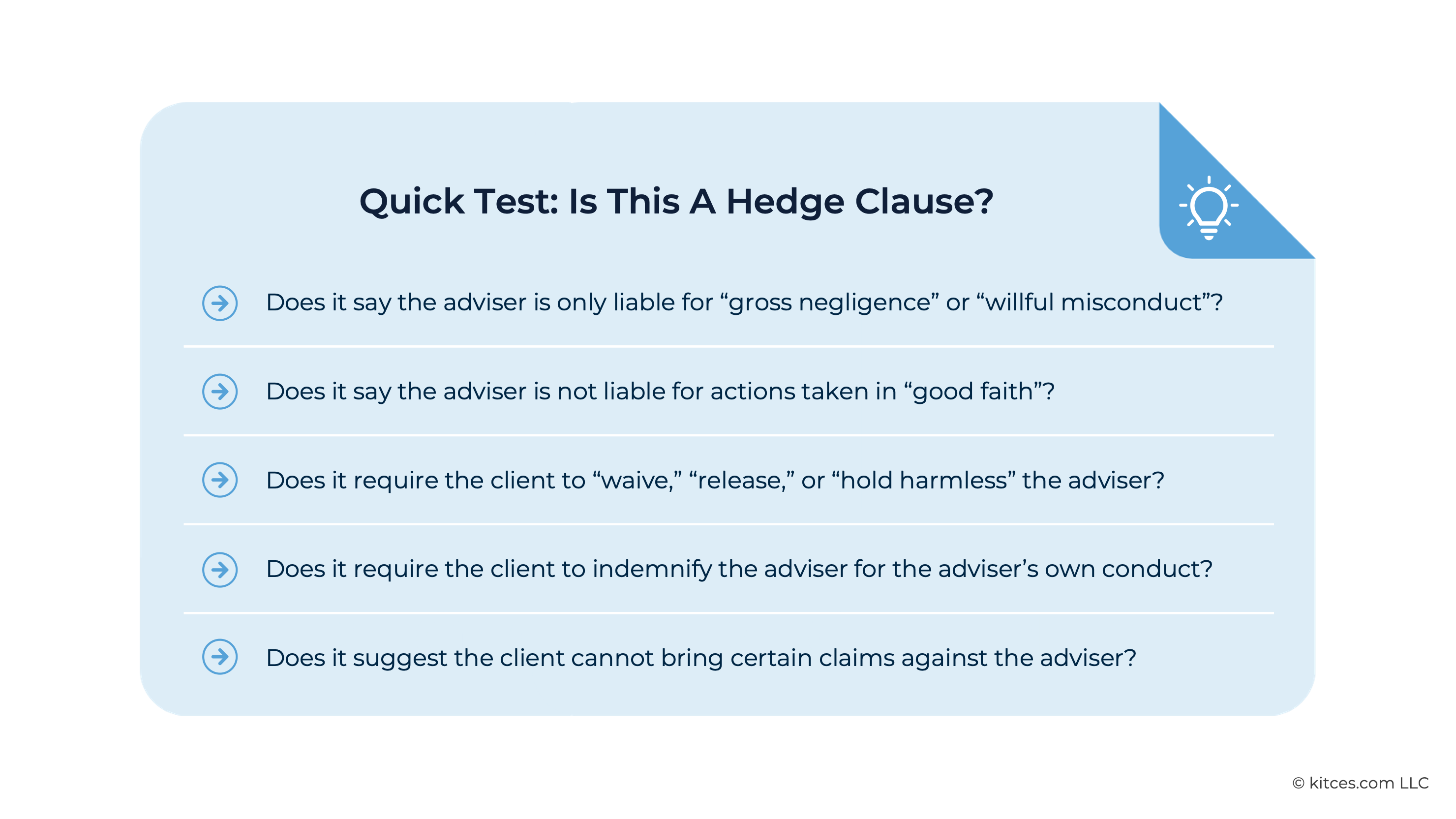
Identifying Hedge Clauses
In the context of everything discussed so far, advisers can pressure test their own IMAs: Do they include language saying that the adviser is not liable for decisions made in good faith? Do they say that advisers are only liable for gross negligence or willful misconduct? Do clients otherwise release the adviser, waive claims against them, indemnify them, or hold them harmless?
Here are some questions for advisers to consider when reviewing their own IMAs:
- Does the IMA have language along the lines of any of the statements below?
- "the firm is not liable for any losses except in the event of the adviser's gross negligence or willful misconduct;"
- "the adviser shall not be liable for any losses resulting from an act, omission, or error of judgment made in good faith;"
- "the client releases the adviser from liability and waives claims against the adviser, unless the adviser engaged in gross negligence or willful misconduct;"
- "the client waives claims against the adviser for simple negligence;"
- "the client agrees to hold harmless and indemnify the adviser for losses resulting from the adviser's negligence, provided the adviser did not engage in gross negligence or willful misconduct;" and
- any other language by which a client purports to waive or limit rights of action against the adviser.
- Does the IMA include any of the following trigger words, which often appear in hedge clauses?
- "gross negligence"
- "willful misconduct"
- "simple negligence"
- "negligence"
- "good faith"
- "hold harmless"
- "indemnify"
- "waive"
- "release"
- "not liable"
- "limits liability"
- "sole remedy"
- "exclusive remedy"
- "consequential damages"
- "Federal and state securities laws may nonetheless impose liability"
These terms are not necessarily problematic standing alone, but they frequently appear in hedge clauses and are included here to help identify potential hedge clause language.
- Are there any other documents, in addition to the IMA, where hedge clause language may appear?
- old IMAs signed by longtime clients;
- other legacy forms that may have been signed, filed, and forgotten;
- website terms of use;
- terms embedded in onboarding forms;
- wrap-fee agreements; and
- any other current or legacy documents that govern the adviser's relationship with clients.
Replacing Hedge Clauses
Before discussing how hedge clauses might be replaced, let's take a step back and consider a big picture question: Why do IMAs include hedge clauses at all?
The short answer is that these provisions are intended to limit the adviser's liability. Investment losses are an inherent risk of the advisory relationship; clients may suffer losses even where an adviser acted in good faith. When that happens, a client may still argue that the loss resulted from the adviser's negligence. A hedge clause is meant to reduce that risk by providing that the adviser will not be liable for ordinary negligence or good faith errors in judgment (but only for more serious misconduct, such as gross negligence or willful misconduct). The challenge, then, is how to achieve a similar objective without running afoul of regulatory concerns.
So, what should replace legacy waiver language? The answer lies in the same 2019 SEC fiduciary release that withdrew the 2007 Heitman Letter and kicked off the modern wave of enforcement actions targeting hedge clauses.
The fiduciary release makes clear that advisers cannot eliminate or disclaim their fiduciary duties to clients. At the same time, it recognizes that advisers may define the scope of the relationship by contract, which in turn shapes the nature of the adviser's fiduciary duties. In other words, an adviser may limit the scope of the services it agrees to provide, and fiduciary obligations will then be interpreted through the lens of that limited scope.
Citing past SEC precedent, the fiduciary release states that "an adviser is a fiduciary that owes each of its clients duties of care and loyalty with respect to all services undertaken on the client's behalf." (Emphasis added.)
It follows that, if an adviser and client have agreed the adviser won't provide certain services, then the adviser doesn't assume fiduciary obligations as to those services. For example, if the IMA says that the adviser doesn't vote or monitor proxies and the client retains this obligation, then the adviser generally has no fiduciary obligation with respect to proxy voting. The contract can't eliminate the adviser's fiduciary duty, but it can define the services to which that duty applies; fiduciary duty can thus be shaped (and narrowed) by contract.
With this context, let's consider some permitted functions of an IMA:
First, an IMA can clearly define the scope of services. A key principle explained in the fiduciary release is that fiduciary duty cannot be eliminated, but "the scope of an adviser's activity can be altered by contract" and "an adviser's fiduciary duty would be commensurate with the scope of the relationship."
In other words, the more limited the scope of the advisory relationship, the more limited the fiduciary obligations. Along the same lines, the IMA can clearly identify responsibilities retained by the client rather than the adviser. When the agreement assigns certain duties exclusively to the client, the adviser generally does not assume fiduciary responsibility for them.
Consider a few examples:
- As noted above, if the IMA states that the client, and not the adviser, will monitor and vote proxies, then the adviser has no fiduciary obligation to monitor and vote proxies.
- If an adviser agrees only to manage assets in a particular account under specified guidelines, then the adviser's fiduciary duties will not extend to the client's other accounts, which the adviser does not manage.
- If the IMA contemplates that the client, and not the adviser, will choose and monitor third-party managers, then the adviser's duties as to those choices are limited, if not eliminated.
While the details depend on the nature of each adviser's services, the principle is that advisers can limit the scope of their fiduciary obligations by properly allocating responsibilities between themselves and their clients.
Second, an IMA can permit reliance on client-provided information and require clients to provide accurate information. The fiduciary release specifically notes that an adviser may rely on information supplied by clients when forming investment advice and should not be treated as having breached a duty by giving investment advice based on client-provided information that turns out to be wrong.
Third, an IMA can define the monitoring obligations associated with the relationship. The fiduciary release explains that the adviser's duty to monitor depends on the nature and duration of the advisory relationship. An ongoing discretionary relationship typically entails ongoing monitoring, while a limited engagement (such as a one-time financial plan) may not. Explicitly stating the scope and frequency of monitoring helps frame fiduciary obligations.
Fourth, an IMA can disclose significant risks. Of course, the SEC does not object to clear disclosures explaining that investing involves risk, markets fluctuate, and losses are possible. This is explicitly required in the firm brochure, and disclosing the most significant risks may also be a good practice in the IMA. When an adviser discloses material risks that could lead to losses despite its good faith efforts, and one of those risks materializes, that disclosure strengthens the adviser's defensive posture. Courts are generally reluctant to impose liability for losses resulting from inherent risks that are outside the adviser's control.
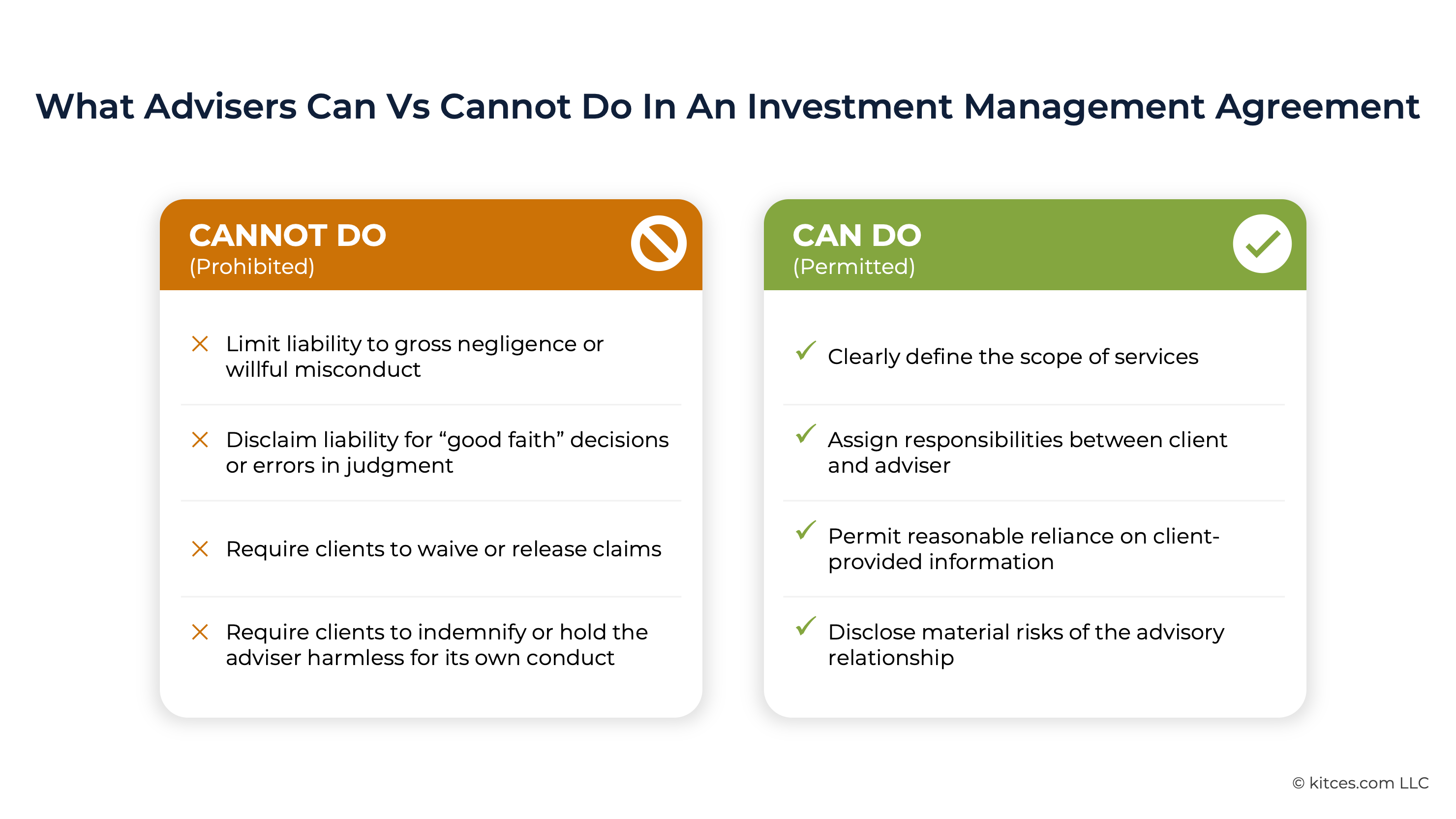
The Effect of This Language
Here we circle back to the intended purpose of hedge clauses. They are meant to reduce an adviser's exposure when a client suffers investment losses and later claims those losses resulted from the adviser's negligence. That same objective may be achieved by clearly defining the scope of the relationship, allocating responsibilities between the adviser and the client, permitting reasonable reliance on client-provided information, and disclosing the material risks inherent in the relationship.
If a service or monitoring obligation falls outside the scope of the engagement, the adviser generally does not assume fiduciary duties with respect to that service. When a client provides information, the adviser may reasonably rely on it. And if a disclosed, inherent risk of investing later materializes, a court may be reluctant to hold the adviser liable for a loss arising from an event outside its control. In this way, a well-drafted IMA can reduce litigation and regulatory risk without purporting to waive liability.
A Note on Implementation
Once hedge language is identified and revised, the final step is implementation: advisers need to actually roll out the updated agreements to clients. This may mean negative consent, affirmative consent, or implementing new agreements, depending on the terms of the existing IMA and applicable law.
Advisers should also plan for the operational side of the rollout. This entails tracking which clients have signed new agreements and which haven't, retiring legacy forms, and ensuring that the updated agreements are used consistently going forward. While this can be a time-consuming project, it's a finite one, and once completed, it removes a recurring compliance risk that examiners are actively focused on.
It is also worth taking the opportunity, while going through this process, to revisit the rest of the IMA to confirm that it reflects current regulatory expectations and aligns with best practices. For many firms, that kind of review is well worth doing. But even standing alone, removing legacy hedge clause language is a meaningful compliance improvement that brings the agreement closer to the SEC's current regulatory expectations and reduces the risk of a problem hiding in plain sight.
Many advisers are still using legacy templates that contain dated hedge clause language. These provisions often persist simply because they've always been there, but the regulatory landscape has evolved. In light of the SEC's recent examination priorities and enforcement actions, advisers should assume that liability waivers in IMAs will be closely scrutinized on compliance exams. For many firms, the sensible approach is not to refine hedge clauses, but to remove them and rely on other mechanisms to limit liability.