Executive Summary
Building an advisory firm from scratch is extremely difficult in the best of circumstances. While CFP educational programs teach the knowledge of financial planning, they don't teach the practice of it – and there's remarkably little established training or curriculum. From figuring out how to find or attract prospects in the first place, to establishing and operationalizing your planning process, investment approach, and overall value proposition, while still finding time to not just work in the business but also work on the business – these are all challenges commonly faced by advisor-owners. Fortunately, though, we can learn from other advisors who have generously shared their experiences.
In this guest post, Jeremy Eppley of Silverstone Financial shares some of the key milestones of his growth journey, as told through the lens of lessons he gleaned and then applied to his practice while listening to all 500 episodes of the Financial Advisor Success podcast. He highlights 20 episodes as a starting point for those who want to binge on the most salient practice management lessons (and another 30 'bonus' episodes for those who want to go deeper).
Jeremy begins by underscoring the importance of key structural decisions you make about how to build the firm in the first place. The channel you choose (e.g., RIA versus broker-dealer) impacts what tools you can use or solutions you can offer to clients in the first place (Episode 192). Having a fee structure that generates enough revenue per client (by AUM, planning, or subscription fees) is essential to be able to scale in the future (Episode 244). But you don't have to get paid for everything you do, just enough to make the business work; thus the appeal of giving away parts of the initial planning process for free… because clients who really want and need your help will just ask you to implement for/with them, anyway (Episode 20)! All of which only works if you're careful in managing your own spending and lifestyle creep as an advisor (so your personal upkeep doesn't undermine the stability of the business, especially in its early years, per Episode 1).
Operationally, choosing the right platforms also matters, from selecting a tech-forward custodian (Episode 350), to truly making your CRM system the hub of the advisory business (Episode 272) – as does establishing the right team structure to leverage the lead advisor's time while deepening (and diversifying) how many different people the client has a relationship with at the firm (Episode 248). Recognizing that not every client will be the right fit for the firm, it's okay (for your business, and your personal health and sanity) to refer out the clients whose incoming phone call you're already dreading anyway (Episode 233).
This creates the space to home in on how you want to serve your particular clientele – and the more clear you are about who your ideal client is, the easier it is to create a specialized offering (Episode 173). Which in the case of Silverstone Financial, means giving clients confidence by running their numbers in two different financial planning software platforms (Episode 285), raising at least 12 months of cash each year to give them more confidence in the midst of market volatility (Episode 391), and partnering with an external tax preparation firm to offer clients a "one-stop shop", but not actually bringing the tax preparation in-house with your own CPA or EA (Episode 421)!
Ultimately, the key point is simply to recognize that while every advisory firm is different, almost every problem experienced by one advisor/founder has probably been experienced by another in a manner that is similar enough that we can all learn something by hearing each other's journey. Podcasts like the Financial Advisor Success series provide an excellent library of lessons to absorb, whether you're walking the dog, mowing the lawn, cooking in the kitchen, commuting, or exercising. Or as Jeremy puts it, "an hour and a half of walking [with the Financial Advisor Success podcast] … is a great way to pay down some of your health debt and build up some educational assets at the same time".

I launched Silverstone Financial, a fee-only RIA, when I was 21 years old. I had limited prior advisory experience, no client base, and no roadmap for what building an advisory firm from scratch actually looked like in practice. What I did have was an obsession with learning and an incredible resource that would help shape almost every important decision I made: the Financial Advisor Success (FAS) podcast, hosted by Michael Kitces.
 Over the course of building my firm from zero to $30+ million in AUM, I have listened to all 500 episodes, many of them more than once. What started as curiosity evolved into something closer to a curriculum: an unofficial MBA for building an RIA, delivered through conversations with advisors, consultants, and innovators in our profession. As I listened, I saved the episodes that changed how I think or operate my RIA.
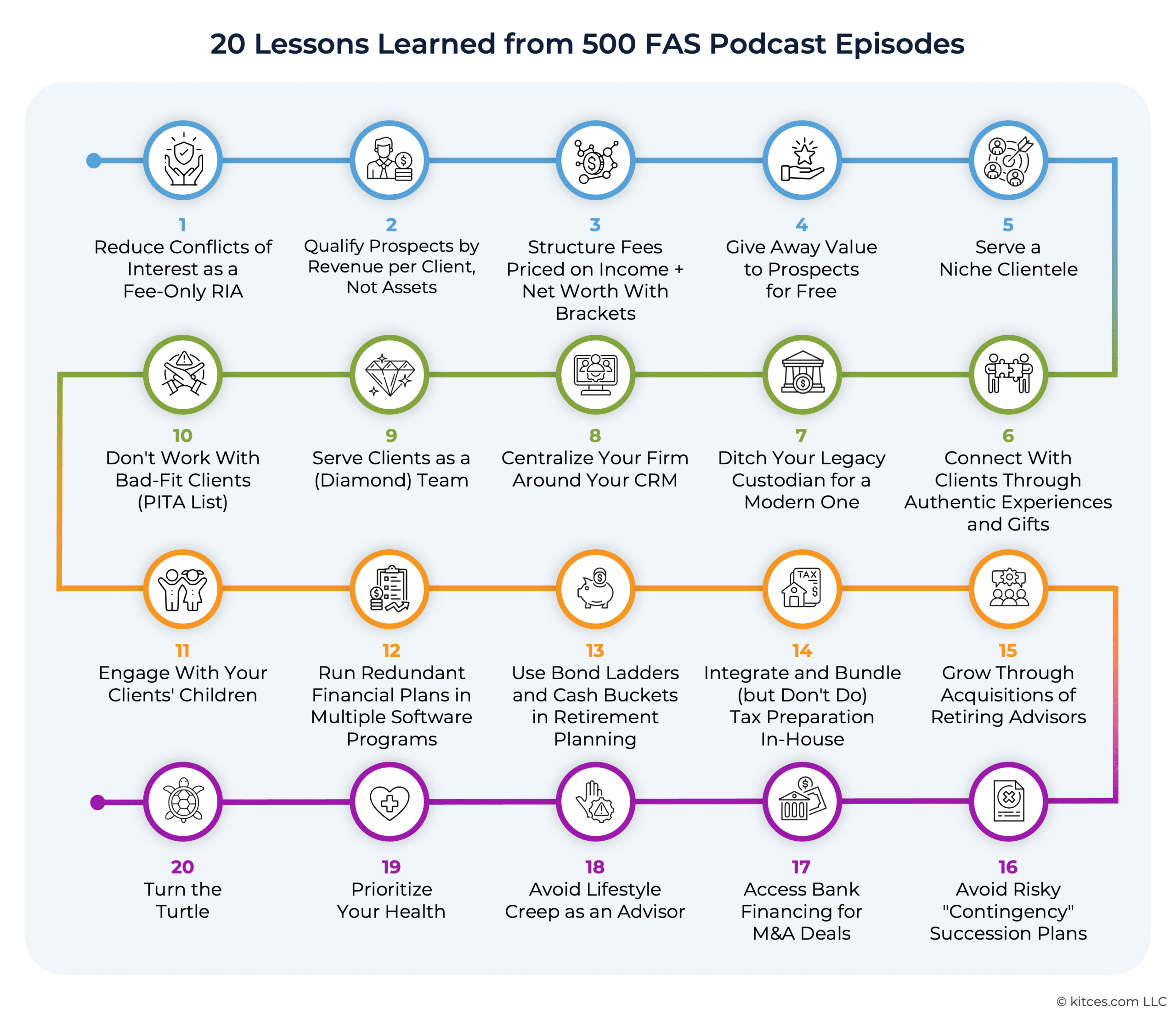
This article is my attempt to distill the most impactful lessons I extracted from those 500 episodes. Each lesson is rooted in a specific episode (or handful of episodes). These are not a ranking of the best episodes. They are the episodes that hit me hardest, resonated most deeply with my experience, shifted my thinking, changed a business practice, or gave me the language to describe something I had been doing instinctively but couldn't quite articulate. Some lessons are about pricing. Some are about client service. Some are about succession planning and M&A. And a few are simply about staying healthy and sane while building something that demands everything you have.
If you are an advisor who has been curious about the FAS podcast series but does not know where to start, consider this your guided tour of one of the most valuable (free!) resources available to you. I highlight 20 episodes that shaped my early career, and 30 more as additional great listens. If you have never listened before, I recommend that you start with these 50 episodes (then go back to episode 1 and listen to the remaining 90%+!)
And if you have already been listening for years yourself, I hope reading this feels like a trip down memory lane. Maybe some of these episodes deserve a re-listen.
Pricing And Prospecting
Lesson 1: Reduce Conflicts Of Interest As A Fee-Only RIA
 Paul Pagnato's story showed me that the fiduciary model is not just an ethical choice; it is a business strategy. Paul describes his journey of breaking away from a wirehouse to build a true fiduciary multi-family office. What Paul articulates in the episode is that there is a meaningful difference between wanting to act in a client's best interest, and actually being structurally free to do so.
Paul spent years at a major wirehouse convinced he was acting as a fiduciary for his clients. What he eventually realized is that when your product shelf is controlled by your employer, when your compensation is influenced by what you recommend, and when fee arrangements are opaque, you are constrained, no matter how good your intentions. What struck me most was his framing that he had been "doing the best he could with the toolkit he had" at Merrill Lynch. Many talented wirehouse advisors believe they are acting as fiduciaries because, within their constraints, they are. But the existence of those constraints, and the decision to remain operating within those constraints, matters.
I decided to structure my firm as an independent fee-only RIA to maintain control over the conflicts present in our industry. As an independent fee-only RIA, I can shop interest rates across dozens of lenders to find the best deal for a client ("sell-away"), evaluate any investment strategy on the market without an approval process, and charge a single transparent fee that covers all services without kickbacks or hidden compensation.
The episode also discusses various other topics, like how Paul bundles all of his services – investment management, planning, tax, legal, lifestyle services – into a single fee, with no referral arrangements or indirect compensation. That concierge one-stop-shop model intrigued me. He also discussed the healthy tension that comes from a merger, and how that friction actually made his firm better. I have experienced this directly in my own merger – which I'll discuss later in this piece.
Lesson 2: Qualify Prospects By Revenue Per Client, Not Assets
 Shannon McLay built The Financial Gym around a membership-based coaching model that serves clients who don't have the investable assets a traditional advisory firm would typically require. The episode is a fascinating case study on a nontraditional advisory business model.
The line from this episode that stuck with me was Shannon explaining that $2,500 per year in planning fees is effectively a "Merrill Lynch-level client" with $250,000 in assets at one percent AUM. This highlighted how screening out prospects solely by assets under management creates a systematic blind spot; it ignores revenue per client as the actual measure of business viability.
I decided to offer subscription-fee planning services without the requirement to manage assets, and have found great success in that business model. A 35-year-old attorney paying $6,000 per year in flat planning fees is a better business client than a retiree with $400,000 in assets paying one percent (and likely has a far longer planning relationship ahead of them).
Shannon's episode also clarified something important about knowing your own niche. She built her business around financial coaching and behavioral change work, areas that many advisors avoid. Hearing her describe her niche made me realize that serving financial coaching clients with a heavy emphasis on budgeting was not a fit for what I was looking to build. But now I know where to send clients who need that kind of guidance. Not every firm has to serve every client type, and knowing where to refer is as valuable as knowing what to offer.
The episode also discusses various other topics, like the challenges of raising outside capital, scaling budgeting services, designing in-house software, and hiring/training diverse advisors from outside the industry.
Lesson 3: Structure Fees Priced On Income + Net Worth With Brackets
 Jake Northrup's fee structure at Experience Your Wealth is the most elegant I have encountered. It was built around a practice serving younger professional clients. His firm charges a flat annual fee calculated as 1% of earned income plus 0.50% of net worth.
I had attempted a similar fee structure when I first launched my firm (I settled on 1.5% of income plus 0.25% of net worth). However, what makes his actually practical is that he implemented brackets into his fee schedule. The earned income and net worth inputs are placed into a formula, but the actual pricing falls into a few wide tiers so the fee does not need to be recalculated annually.
This allows advisors to not worry as much about perfectly capturing the difficult-to-value private business or minor income fluctuations. Instead it is an easy proxy for complexity that is objective and simple for clients to understand, while still allowing for clear fee increases as their income or net worth rises over many years. And because AUM fees are charged separately, clients see a clear distinction between what they are paying for planning services versus investment management.
The episode also discusses various other topics, such as implementing a service calendar with predictable meetings across months and set topics, and Jake's strategy of hiring advisors earlier than feels financially comfortable. He discusses how to evaluate whether early hiring makes economic sense, how to structure compensation for an early-stage associate advisor, and how having an additional advisor creates capacity that fuels marketing and business development efforts.
Lesson 4: Give Away Value To Prospects For Free
Two episodes featuring Michael Kitces as the guest, both interviewed by XYPN co-founder Alan Moore, shaped my thinking on business development in a fundamental way.
In Episode 20, Michael describes the philosophy behind his entire content operation: giving away 99% of his content for free in order to build the kind of trust and credibility with the 1% of his audience who actually wants to pay to do business with him.
Although it is not the same as connecting with thousands of people through blogging and social media, I learned the same lesson to give away as much free advice/value as I could in a one-on-one prospect intro meeting. Advisors sometimes fear that if they give away the advice before they are hired, that the client will just not pay them and simply implement it themselves. This is an unfounded fear. If a prospective client just wanted answers, they could Google it themselves. They come to an advisor because they need help with implementation or accountability.
The amount of credibility and trust that an advisor will gain in an intro meeting by explaining exactly what needs to be done for them, before any paperwork is signed or anyone is paid, is astronomical. There is always more value you can provide clients after they are onboarded. If an advisor is able to give the client 100% of the value they could provide in a single meeting, they probably were not a good fit client to begin with. Don't try to hide your secret sauce; give them a free sample!
The episode also discusses various other topics, such as Michael's origin story within the financial services industry, the importance of keeping your personal household spending lean to facilitate the cash needed for an entrepreneurial venture, and strategies to allow advisors to manage their limited time effectively, especially when involved in many business ventures.
Lesson 5: Serve A Niche Clientele
 Andrew Leonard of Geometric Wealth Advisors grew his firm to $250 million in five years, and then to $500 million by doubling down on his hyper-focused niche specialization: his firm serves partners and senior professionals at Bain, McKinsey, and BCG.
What Andrew's episodes crystallized for me is that going narrow into a niche does not limit growth; it accelerates it. When an advisor serves a specific type of client so deeply that you understand their compensation structures, career trajectories, tax situations, and peer dynamics better than any generalist could, you become the obvious choice for every new client who fits that profile. His firm provides unique value propositions to his niche clientele that other companies cannot offer, like benchmarking their client's income trajectory against dozens of comparable clients, and negotiating mortgage rates and favorable insurance terms (because his clients are a group of attractive homogeneous clients for mortgage brokers and insurance companies).
When I switched from being a generalist to a specialist focusing on inheritance and gift/estate planning strategies, I saw my growth rate materially increase. Prospective clients have extreme difficulties telling different advisors apart. When someone trying to make good decisions about an inheritance visits three advisors' websites – two generalists' and mine – there is no question which advisor they are going to hire.
The episode also discusses various other topics, such as bringing tax preparation in-house, referring out every prospect that isn't in his niche, the succession challenges of his father's practice sale, and his philosophy around the AUM model. He explains that only three things actually matter when deciding on a fee schedule. What is the total dollar amount? Is it simple and understandable? And is it relatively easy for the firm to administer? He even publishes a fee calculator on his firm's website, a transparency move that I love so much that I now have a fee calculator on my website as well.
Lesson 6: Connect With Clients Through Authentic Experiences And Gifts
 David Ortiz built his practice by using food to build trust quickly. As a former chef, he literally cooks for clients, sometimes in their own homes, as a relationship-building strategy. What resonated was the simplicity of the underlying idea. Sending a meaningful gift to a client or creating an intimate event that reflects your actual personality, signals something that a standard quarterly review isn't able to.
For me, I found that gifting books to clients was a way I could connect with them. I mail clients books that I have found genuinely meaningful, often tied to something specific they shared in our conversations. Die With Zero by Bill Perkins (for retirees), Built to Sell by John Warrillow (for business owners), Moving Forward on Your Own by Kathleen Rehl (for widows), or even a local guidebook for an upcoming vacation that they mentioned, are books that have all been received well by my clients in the past.
I also host small casual events around a fire pit that I built by hand with my father, rather than more traditional client appreciation events. Neither of these ways to connect with clients is about being flashy. They are about being authentic in a memorable way, like David does with his cooking.
The episode also discusses various other topics, such as how hosting an event that clients actually want to invite their friends to is a great way to meet new referrals/prospective clients, and how financial planning is fundamentally about task tracking and providing clients with accountability to get important tasks done.
Operational Optimizations
Lesson 7: Ditch Your Legacy Custodian For A Modern One
 Jason Wenk, founder and CEO of Altruist, discusses the RIA custodial landscape and how advisors should stop accepting the inefficiencies imposed by their legacy custodians. The incumbent RIA custodians built their technology decades ago, and have continued layering incremental updates on top of still-aging infrastructure. In Jason's view, instead of requiring advisors to pay for and bolt on separate billing tools, reporting systems, and trading platforms, a custodian can and should provide advisors with that software natively built into the platform.
What I found most illuminating was Jason's explanation of how legacy custodians make money through structural friction. For example, by not offering fractional shares, legacy custodians keep more client cash sitting uninvested, and/or push clients towards using their mutual funds (for which they receive proprietary or shelf space fees) to drive revenue for themselves, to the detriment of client outcomes.
I have used Altruist since I launched my RIA, and can personally attest to how operationally transformational their platform is over Schwab or Fidelity. Altruist has allowed me to automate the majority of my investment management tasks, and given me more time to build relationships with my clients. Advisors who have not explored custodying at Altruist (and also using their amazing Hazel AI assistant) are significantly behind the curve, in my opinion. The pace at which they innovate is unmatched in the industry.
The episode also discusses various other topics, such as Jason's journey building his two prior RIA companies, how custodial platforms make money (and how much), how securities lending is an underutilized win-win for clients and custodians (and how it works), and the benefits of a vertically integrated tech stack.
Lesson 8: Centralize Your Firm Around Your CRM
 Kate Guillen is an operations consultant who founded Simplicity Operations, and works with financial advisory firms to build more efficient, scalable back-office systems.
In the episode, Kate explains that the CRM should not just be an address book. It should be the operational nervous system of the entire firm. That means every workflow, every task, every service calendar touchpoint, every client communication log, and every follow-up item lives in the CRM. Having these items scattered across various spreadsheets, email inboxes, sticky notes, and individuals' memory is highly inefficient and should instead be systematized.
When every process is formalized into a CRM workflow, service delivery becomes consistent and repeatable regardless of which team member is handling a given task. Kate walks through how to eliminate the "dropped balls" that erode client trust over time, and how to build a CRM system that actually gets used day to day.
Since listening to this episode, I now keep my tasks, workflows, prospect pipeline, client notes, and all communications in my Wealthbox CRM system. This has been one of the most valuable operational changes I have made since launching my firm. I started building these systems back when I was still a solo-firm, knowing that having clean data and repeatable systems would be extremely valuable once I grew the firm beyond myself. Now that the firm has multiple members, everyone in the firm knows that they have a single point of truth and a single system to log into to know what is going on in the firm. Well worth the investment of my effort when I was still solo.
Lesson 9: Serve Clients As A (Diamond) Team
 J.D. Bruce's advisory firm (Abacus Wealth Partners, at the time) uses the "diamond team" model, a concept originally developed by Angie Herbers, in which multiple advisor roles are layered into a structured team that handles different client segments and service tiers.
The structure creates leverage for growth and makes advisor transitions far less disruptive, because the client has a relationship with the team rather than a single advisor. Thus, when an advisor eventually transitions out of a relationship, it is not a handoff to a stranger, because the client already knows the rest of the team. I have found that I both enjoy servicing clients more as a team, and feel that they are better served with multiple advisors' perspectives.
Another separate point that J.D. makes in the episode is how they structure their fee schedule. His firm charges a flat 0.50% AUM fee, plus a separate explicit financial planning subscription fee. The separation matters because people often value what they pay for.
Having tried a number of different fee schedules since I launched, I also have settled on an (optional) 0.50% AUM fee for investment management and a separate financial planning subscription fee based on complexity. It feels fair, easy to calculate/administer, and clients seem to really like this structure.
The episode also discusses various other topics, such as how it's the company's responsibility to bring in new clients (with the advisors just being responsible for servicing them well), and also addresses the value of hiring ahead of full capacity. Having advisors who are not yet at full client load creates room to absorb bumpy growth more easily. An acquisition or organic growth surge without a capacity buffer can scramble staff and cause operational bottlenecks. Building that buffer intentionally, as uncomfortable as it feels to give up profitability in the short term, is a structurally more resilient way to grow a team.
Lesson 10: Don't Work With Bad-fit Clients (Pita List)
 Patty Kreamer is a professional organizer and productivity expert rather than a financial advisor, and that outside perspective is exactly what makes this episode so useful. Her primary argument is that advisors who look to technology to solve their productivity problems are often treating the symptom rather than the disease. The real issue is usually a lack of intentional structure around how time and energy are managed.
The main insight that has stayed with me longest from this episode is the PITA list (Pain In The A__ list). Michael describes a practice where an advisory firm's support staff (not the advisors) gets to "vote off the island" the most difficult, draining, and/or low-value client relationships each year.
My firm has not grown large enough to have enough client relationships or staff where a PITA list is functional, however knowing about it has made me more conscious of what clients to bring "onto the island" as I grow in the first place. Now that my firm has grown to a point where the business is sustainable and provides me the level of income I require to pay my bills, I have increased my scrutiny on what clients I should and should not bring on. If I feel that they are not a good fit for my firm either due to their personality or their needs, I just refer them on to another better fit advisor. It's not worth the headache to have a client that you dread picking up the phone to talk to.
The episode also discusses various other topics, such as what to say when you are "firing" a client, setting expectations with your clients early on, cutting processes/deliverables that clients don't actually value, creating your "ideal week" schedule, how to delegate tasks to others, and how to "process" emails instead of just "checking" email.
Financial Planning And Client Service
Lesson 11: Engage With Your Clients' Children
 Carli Smith of Signal Wealth Advisors addresses what happens to your client relationships when the wealth transfers to the next generation.
Carli encourages advisors to engage with your clients' children before the wealth transfers, not after. She shares specific tactics for bringing clients' children into planning conversations, not as observers, but as active participants. This means discussing financial planning fundamentals with them directly, helping them understand the family's values around wealth, and giving them their own planning context rather than just a tour of their parents' balance sheet. The result is that when wealth eventually transfers, the next generation already has an established relationship with the advisor.
As an advisor who specializes in inheritance and gift/estate planning strategies, this episode spoke directly to what I do for clients. However, beyond advisors who specialize in this space, I feel that many advisors are lacking in their efforts to connect with the next generation of clients.
Besides the upcoming great wealth transfer and retaining revenue-generating assets, clients are better served when advisors plan multi-generationally. For example, if you are recommending Roth Conversions to your retiree clients but you don't know what tax rates their children are subject to, your projections are wrong! In my experience, clients highly value an advisor's efforts to connect with and serve their children.
Lesson 12: Run Redundant Financial Plans In Multiple Software Programs
 Ryan Townsley is a unique kind of career changer: a former nuclear engineer, who built a hyper-specific niche practice serving nuclear engineers within five years of retirement who have at least $1 million in investable assets. That is a precise client target – his homepage literally features an image of a nuclear power plant – and it is exactly as powerful as it sounds. By drilling into that specificity rather than stopping at "engineers" or "retirees," his firm became the most credible option for that exact profile of client.
The practice I adopted most directly from these episodes is running redundant financial plans across multiple software programs. Ryan's niche clientele of nuclear engineers demand that level of rigor in planning, as they have been trained that every gauge in a nuclear plant needs a redundant one to cross check to avoid a literal catastrophe. Ryan uses both Riskalyze and Tifin Risk for risk profiling, and both RightCapital and Income Lab for financial planning analysis. Rather than presenting clients with a single plan output and asking them to trust it, he shows them what multiple independent modeling tools say about their situation.
I loved this approach (despite the added work of duplicate software inputs) and it turns out that regular (non-nuclear engineer) clients love that added certainty too!
These episodes also discuss various other topics, such as bringing tax preparation in-house, the concept of a "down market playbook", a webinar-based mass-client communication strategy, the importance of building repeatable workflows before adding staff, and using bond ladders and cash buckets in guardrail-based retirement income planning.
Lesson 13: Use Bond Ladders And Cash Buckets In Retirement Planning
 Christopher Jones of Sparrow Wealth Management built a highly efficient solo practice by aggressively cutting anything that clients did not actually value, saving time not through being more efficient but simply doing less by eliminating what didn't really matter.
The operational efficiency lesson is helpful, but I found his cash management practices extremely influential. He discusses how a well-structured cash flow approach in retirement, specifically bond ladders and cash bucket strategies, can reduce client anxiety during market downturns far more effectively than a conventionally rebalanced equity portfolio.
His approach is to make one large single withdrawal per year to fund client spending needs rather than piecemeal draws throughout the year. He raises all of a client's anticipated cash needs for the next 12 months in a single transaction, moves that cash into a high-yield cash account (I use Altruist's cash management account for this) and lets the remainder of the portfolio stay fully invested without interruption. This approach reduces trading friction, simplifies the portfolio, and allows a more aggressive investment posture for the funds that remain invested. It is an elegant operational simplification (as all clients' trading for cash flow needs is done in a single block at the beginning of the year) that also has meaningful behavioral benefits.
We have implemented a similar strategy for our retiree clients. We set them up with a cash account with 12 months of spending, plus an emergency fund buffer. We refill that cash account from a 5-10 year bond ladder (we like BlackRock's iShares iBond ETFs) and usually put the rest into the stock market, depending on the client's risk tolerance. I have found it to be extremely efficient allowing for clients to see the security of their bond ladder during down markets and allowing us to only have to "raise cash" once per year.
Lesson 14: Integrate And Bundle (But Don't Do) Tax Preparation In-House
 Daniel Friedman of advisory firm WMGNA discusses how his firm added tax preparation to its service offering, without building a full in-house CPA department. The model relies on outsourced tax professionals, with his firm negotiating bulk discounts by delivering volume to get favorable pricing on behalf of clients. By adding tax planning and tax preparation, their client relationships are stickier, and can drive premium fees and even additional client referrals.
We have added this functionality as well (using former XY Tax Solution's Sam Nguyen's tax preparation firm) to be able to bundle tax preparation into our wealth management service for clients with more than $1 million AUM with our firm. We absorb the cost for our clients, and find that it effectively comes out to 5 bps to 15 bps on average, depending on level of assets and tax return complexity. At those levels, I compare it to being less expensive than a TAMP, but providing more of a differentiator for our firm and more value to our clients. In my experience, clients love the idea of having a one-stop-shop and having us do deep tax planning and tax preparation for them, even if we don't have to do the tax preparation ourselves by hiring our own staff.
These episodes also discuss various other topics, such as how communicating tax savings in concrete dollar terms (not percentages or abstractions) is what resonates with clients, how tax integration is a true differentiator for small business owner clients, and a really interesting concept of "character insurance" (writing a letter to your children on each of their birthdays to give to them when they are an adult).
Succession Planning And M&A
Lesson 15: Grow Through Acquisitions Of Retiring Advisors
 Jaime Benedetti grew his firm to $1.2 billion in AUM through a deliberate strategy of acquiring the practices of retiring advisors. Jaime notes that messier less-polished practices can be attractive acquisition targets for younger buyers because they are less expensive, and the process of cleaning up the operations and upgrading the client experience is where value is created.
He also describes a practice of affiliating with advisors who are not yet ready to retire but who want a succession relationship in place now. These arrangements give a younger acquirer a pipeline of future opportunities and allow the senior advisor to continue working while slowly having clients develop trust in the eventual successor.
This is what I have decided to pursue with my business partner, Gordon Achtermann. Gordon (age 62) and I (age 26) were both solo advisors with our own practices. He wasn't ready to retire, but he would often get questions from his clients and prospective clients about what he would do when he retired or if he got hit by "the bus". I conversely often got questions about my young age and lack of experience. We both missed out on some prospective clients that were uncomfortable with each of our "deficiencies".
Since we merged, we don't get those questions anymore. He points to me when asked about succession, and I point to him when asked about my lack of grey hairs. Our growth rates and close rates have increased since merging, and we both believe that our clients are better served as a team. He doesn't plan to retire for several years, which gives us lots of time to slowly build relationships that will stick with the firm when he does eventually retire.
As a young advisor, M&A with retiring advisors feels like a fantastic growth opportunity, and my experience so far with my partner Gordon has been incredible. We are in discussions with additional advisors nearing retirement interested in replicating Gordon's success. Feel free to reach out to me via LinkedIn (mention this Kitces article in your connection message) if you have questions about succession planning; I have learned a lot from having seen/gone through a few successful/unsuccessful M&A transactions.
Lesson 16: Avoid Risky "Contingency" Succession Plans
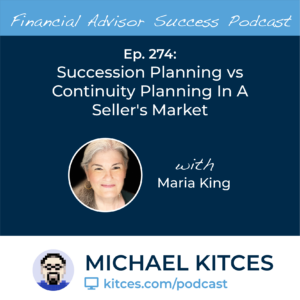 Maria King draws an important distinction – the difference between continuity planning and succession planning. Continuity planning is emergency preparedness to try to protect clients and staff if you die or become incapacitated tomorrow. Succession planning is a long-term, deliberate transition of relationships, ownership, and leadership.
The mistake most advisors make is treating a contingency continuity agreement as if it covers both. Advisors who have only a contingency arrangement in place as their succession plan are often sitting on a liability they do not fully understand until something actually happens. The horror stories shared in the episode around some continuity plans resonated with me directly.
In a typical contingency arrangement, a designated advisor agrees to absorb the practice if something happens to the primary advisor (and often the other advisor reciprocally agrees to do the same in return).
But in reality, that means if the phone call comes that something did happen, the advisor must drop everything to attempt to bring over potentially dozens of new client relationships, while simultaneously trying to purchase the business under urgent and non-ideal conditions. It is bad for the acquiring advisor, and bad for the clients. The acquiring advisor is essentially accepting a ticking timebomb that could blow up their plans, processes, and capacity if the contingency plan is ever triggered.
And even if the trigger occurs at a perfect time, where the acquiring advisor has capacity and is excited to bring on a ton of new clients all at once, the transitions are still with mostly cold relationships. If an advisor does not go through the (multi-year) effort of slowly introducing the successor advisor to their clients, neither the clients nor the new advisor will know almost anything about each other. Transitioning many cold relationships in a short period of time will not lead to high levels of client service or trust. Fewer clients will transition over, destroying the full value of the transitioning business, which could have been retained had a true succession plan been in place.
For these reasons, I personally do not participate in contingency-based succession arrangements. I focus instead on trying to find like-minded advisors interested in merging and slowly building long-term succession relationships now, while there is no urgency. My successful merger with my business partner, Gordon, is proof of how a deliberate succession plan is better for the retiring advisor, better for the successor advisor, and better for the clients.
The episode also discusses various other topics, such as the importance of determining how disability is defined in a contingency contract, how M&A loans are usually structured as 7 year terms because it lines up with the profitability / cash flow of the business, and how to find a good successor fit by looking for alignment in culture, client experience, and investment philosophy (I would also add planning philosophy, which can sometimes be surprisingly different).
Lesson 17: Access Bank Financing For M&A Deals
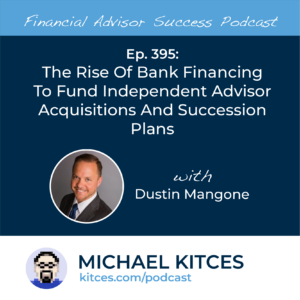 Dustin Mangone, director of investment advisor services at PPC LOAN, addresses how younger advisors can overcome the main structural barrier to RIA acquisitions by getting access to M&A financing capital. The typical model for financing an advisory firm acquisition historically has been seller financing, where the buyer pays over time out of the cash flow the acquired firm generates and the seller carries the note. However, this structure creates ongoing dependency on the selling advisor and often doesn't entice older owners to sell if they could just hold on to their shares and work a few more years to keep their cash flow profits anyway.
Bank financing, which has become increasingly available over the past decade, offers a meaningfully different structure, where buyers can get the majority of the cash from the sale upfront. The notes PPC Loan offers usually carry ten-year terms, fixed rates, and loan sizes ranging from $200,000 to $25 million. Underwriting is based on a combined buyer-plus-seller revenue figure (typically approximately two times combined revenue) and a debt service coverage ratio of roughly 1.3 times profit to debt payment. He also notes that in eleven years of lending to advisory firms, there have been zero defaults and zero missed payments so far, showing the attractiveness of this lending space. Yet ironically, most banks still refuse to lend to our industry because "you can't repossess goodwill".
The episode also discusses common contractual terms to closing an advisory firm acquisition, including attrition allowances and holdback/clawback provisions, along with challenges that can arise with SBA loans, and how selling an advisory firm in tranches is an effective and underutilized way to structure a succession plan.
I found this episode incredibly insightful. It covers how M&A deals are structured, what multiples advisory firms actually sell for, and gave me confidence that I will have access to capital to purchase retiring advisors' businesses when the right opportunity comes along.
Personal Life Lessons
Lesson 18: Avoid Lifestyle Creep
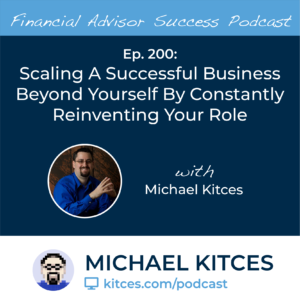 For a second time on this list, Michael Kitces's two guest appearances on the FAS podcast discuss the idea of living frugally early in your career, to be able to fund your entrepreneurial pursuits. Having successfully avoided lifestyle inflation in the earlier years, he describes how the discipline of living below his means (such as still driving a 15+ year old car) gave him the financial runway to make bold reinvestment decisions in his businesses. These opportunities would not have been possible if personal spending obligations had consumed his early savings.
A founder's personal financial spending can lead to an entrepreneurial venture failing, just like business expenses can. If you have a large monthly mortgage payment for a big house that you locked yourself into when you had high income, it is much more difficult to make ends meet when your salary goes to $0.
This lesson is intensely personal for me. I launched my firm at 21, right out of college, before I had to worry about a high salary locking me in golden handcuffs. Starting at $0 of salary when launching my business, I got used to living on ramen noodles while I watched my friends graduate college into their first high-paying jobs and being able to live it up with their disposable income.
When your personal burn rate is high, you have less time to let the business grow at its natural pace. You start making decisions based on short-term financial pressure rather than long-term strategic choices for the business. Establish the lifestyle you actually want to live, and be intentional about when and why you expand it.
It took me 2.5 years to break even on my business expenses and an additional year (3.5 years) to also get to a sustainable break even on my personal expenses. If I had a more expensive lifestyle in my early 20s, I would have run out of runway on the business before it became sustainable.
Lesson 19: Prioritize Your Health
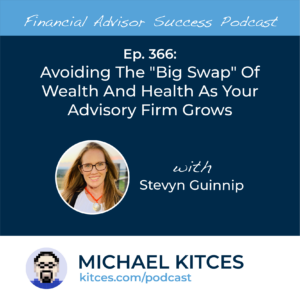 Stevyn Guinnip, a fitness professional who works specifically with financial advisors, introduces the concept of the "Big Swap" – the tendency for ambitious, high-achieving advisors to gradually trade physical health for professional and financial success.
It happens slowly, through accumulated sleep debt, sedentary work habits, skipped workouts, and stress that never fully dissipates. By the time the trade becomes visible, the compounding health debt is expensive and slow to repay. She recommends allocating approximately 10% of your daily waking hours (roughly 1.5 hours) to health-related activities.
As my business has grown and my time has become more constrained by serving my growing number of clients, I have had to make prioritizing my health more important. It is difficult to find the time and the motivation, but I do feel like I perform significantly better in my business when I am eating well, exercising, and well rested.
For advisors who want to both work on their health and listen to more FAS Podcast episodes, I recommend listening to FAS episodes on a hike or a walk around your neighborhood. I try to get out and walk for 1.5 hours every other day, and I pop in my earbuds and listen to these incredible episodes (that's how I got through all 500 of them!). An hour and a half of walking (or one hour if you listen to the podcast at 1.5x speed) is a great way to pay down some of your health debt and build up some educational assets at the same time.
The episode also discusses various other topics, such as how advisors tend to score two to three standard deviations above the general population on measures of goal orientation and self-efficacy, the importance of mental health as well as physical health, and how to integrate wellness habits into your daily routine without sacrificing productivity.
Lesson 20: Turn The Turtle 🐢
 I saved this lesson for last because it is the one I most want to linger on. Episode 81 is my favorite episode of the FAS Podcast series. The episode features Louis Barajas, a financial planner who has spent his career expanding access to financial advice in communities that have historically been underserved by the profession.
Louis makes a number of truly insightful observations in the episode. For example, he makes the point that sometimes advisors have to recommend unconventional approaches to solve problems. If a client only has $100/mo of disposable income and has the goal of having their child graduate from college, perhaps paying for a tutor, or self esteem courses, or even family therapy to resolve a dysfunctional household that is holding their child back in school, is a better investment than putting that money into a 529 plan if the child is otherwise unlikely to even graduate high school to begin with. Much of the traditional CFP® curriculum that advisors learn doesn't always apply to underserved parts of the population.
Louis also suggests the importance of always charging something, even and including when doing pro bono work, because when advice is given for free, it is perceived as an opinion rather than a professional service. Charging for advice, even in communities where pro bono work might seem like the generous thing to do, is what creates the relationship of professional accountability that actually changes financial behavior.
The episode discusses various other topics, such as focusing on "financial doing" rather than financial planning, protecting clients from unscrupulous insurance agents by helping them execute on your recommendations, how to serve Latino immigrants and clients who are unbanked, and cautionary tales from his two business separations due to company culture changing.
However, his firm's immutable law of "Turn The Turtle" stuck with me the most out of every lesson I learned from the FAS podcast series. I would like to quote Louis' explanation directly:
"If you're walking down the street and you see a turtle that's upside down, this turtle has no way to be able to turn itself over. Stop whatever you're doing, go to the turtle, and turn it over, please. So we have the same thing with our staff. If anybody calls our office in need, and they're one of these turtles that need to be turned, stop whatever you're doing and help this person in need, please. That's one of the values that we have in our firm. If somebody calls, they take the call, and if they can't help them, they can direct them to the right person."
I have tried to embody this in my firm. My calendar scheduling link is directly on my website. Anyone can schedule 30 minutes with me; I am not going to pre-screen them out. If they aren't the right fit for me, I can give them 30 minutes of my time and either give them some quick guidance or find another professional who can help them. Financial planning is a helping profession. Advisors should never forget why they became an advisor in the first place.
Conclusion
Five hundred episodes of the FAS podcast represent an extraordinary collective curriculum on what it actually looks like to build an advisory firm that serves clients well, operates efficiently, grows sustainably, and endures. The lessons above are the ones that shaped how I built my own RIA firm.
What I have found most valuable about the FAS podcast as a learning resource is not any single episode, but the cumulative effect of hearing hundreds of different advisors describe their specific approaches to pricing, hiring, technology, client service, succession, and business development. Patterns emerge. Best practices become visible. And perhaps most importantly, I discovered along the way that many of the instincts I had about how to build my firm were shared by other successful advisors who have come before me.
If I could offer one piece of advice to other advisors, it would be to listen to these 500 episodes with intentionality, write it down when something resonates, and act on it before the feeling fades. The ideas are already out there, shared generously by advisors who figured them out the hard way. The podcast exists precisely so that the next generation can avoid repeating the same mistakes.
Additional Listening – Honorable Mentions: 25 More Impactful Episodes
- Episode 53: How Compassionate Communication Makes Us "No Longer Awkward" With Grieving Clients, with Amy Florian
- Episode 63: Overcoming A Material U-4 Disclosure To Build A $125M AUM Advisory Firm, with Kevin Kroskey
- Episode 67: The Future Of The Broker-Dealer Model As Advisor Support Without FINRA Or Products, with Elliot Weissbluth
- Episode 91: Increasing The Value Of Advice By Focusing On Life-Centered Planning For Transitions Not Goals, with Mitch Anthony
- Episode 94: Crafting Your Optimal Solo Practice By Simply Charging What You're Worth, with James Osborne
- Episode 106: Empowering Widows Financially By Helping Them Navigate The 3 Stages of Widowhood, with Kathleen Rehl
- Episode 156: Establishing Next Generation Career Tracks And Business Development Training For Long-Term Sustainability, with DeLynn Zell
- Episode 176: Understanding The Landscape Of Employee Vs. Independent Advisor Broker-Dealer Platforms, with Mindy Diamond
- Episode 180: Getting A Year's Worth Of Growth Every Month By Going All-In On A Clear Target Market, with Ryan Inman
- Episode 184: Building A Premium Financial Planning Experience To Sustain A Premium Advisory Fee, with Reese Harper
- Episode 219: Serving Families Of Multi-Generational Wealth By Tackling The Personal Problems That Money Exacerbates, with Coventry Edwards-Pitt
- Episode 229: Navigating The Evolution Of Financial Planning Over 50 Years Of Building, with Alexandra Armstrong
- Episode 292: Syndicating Private Real Estate Opportunities To Differentiate With HNW Clients, with Matthew Topley
- Episode 303: Pivoting From 'Robo' Investment Management To Financial Planning In South Africa, with Louis van der Merwe
- Episode 327: Growing To $1B By Standing Out With Marketing The Competition Can't Mimic, with Marc Horner
- Episode 333: Scaling A Small-Business-Owner Boutique To A $31M Retainer-Based Valuation, with Jim Dew
- Episode 336: Showing Prospects An (Asset) Map To Generate More Advice Engagement, with H. Adam Holt
- Episode 338: Finding Your Why In Helping Clients Figure Out What To Retire Towards (Not From), with Tony Hixon
- Episode 342: Scaling To $1M Of Financial Planning Fee Revenue By Specializing In The Divorce Niche, with Nancy Hetrick
- Episode 343: The Evolution Of Super-OSJ Platforms To Support Independent Advisors, with Rita Robbins
- Episode 406: Exiting To A Perpetual Purpose Trust To Facilitate Internal Leadership Succession Without Indebting G2 Advisors, with Michael Kramer
- Episode 411: Getting Clients Comfortable With Market Risk Using A More (Options-Based) Measured Risk Approach, with Larry Kriesmer
- Episode 465: Making The Sell-Or-Keep Decision When You Hit A $260M AUM Wall, with Todd Pisarczyk
- Episode 481: Leveraging Technology To Rapidly Scale Growth Delivering Financial Planning To Next-Generation Clients, with Adam Dell
- Episode 495: Scaling To $3.5M Of (Flat-Fee) Revenue By Leaning Into A Unique Retirement Income Approach, with Bradley Clark