Download Dan Allison's, "Interactive Client Survey Outline" below, and check out "#FASuccess Ep 153: Generating More Productive Referrals By Closing The Gap Of Prospects Who Are Referred But Never Call" for more tools, tips, and strategies for generating more referrals from clients (in a non-salesy, genuine manner)!
Interactive Client Survey Outline
 Welcome back to the 153rd episode of Financial Advisor Success Podcast!
My guest on today's podcast is Dan Allison. Dan is the founder of Feedback Marketing Group, a marketing and sales consulting firm that helps financial advisors to increase their growth by teaching methods to actually generate more referrals from existing clients.
What's unique about Dan, though, is the way he approaches the challenge of referrals with a background in clinical and behavioral psychology, an approach that's focused specifically on how to reduce the client's own mental and other barriers to make it easier for them to provide effective referrals in the first place. Based on his discovery that, in the end, the problem for most advisors is not that their clients aren't referring them actively, but that there's a gap to be closed between how often clients refer and how often that referred person ever actually follows through to contact the financial advisor for help.
In this episode, we talk in-depth about Dan's approach to referrals and the five key points he focuses on helping to generate more and more productive referrals:
- Making sure that you are really offering the services your clients want and would be willing to refer, recognizing that, unfortunately, not all advisors actually provide services worth referring in the first place;
- Ensuring that clients are well educated about your firm and the full breadth of what you really do, given that clients will often only think of their advisor services based on what the advisor did for them personally and not actually the full range of the advisor services;
- Communicating that you're actually looking to help more people and have capacity, and the kind of people that clients should be trying to spot that would be a good fit for you;
- Working with the client to figure out if they do refer someone, what their introduction strategy will be to ensure that you'll actually be able to connect with and have a chance to help that referral; and
- Categorizing your own clients to figure out who the potential referral goldmines might be, and more importantly, who the referral landmines are that, once identified, you'll simply know not to ever have the referral conversation with anymore.
We also talk about the fundamental dynamic of client referrals themselves. Why the "I get paid in two ways" or "the greatest compliment you can give me is a referral" and similar approaches that try to guilt clients into feeling like they should be obligated to give their financial advisor referrals is mostly doomed to fail, the difference between transactional referrals versus relationship referrals and how the very nature of client referrals has changed as the financial advisor business model has changed, but why even in a relationship model, it's not enough to simply serve your clients well and wait, hope and pray that they'll start sending you referrals, because, as most advisors know, that often doesn't really happen in reality.
And be certain to listen to the end, where Dan shares some of his own journey as someone who built and sold an incredibly successful business while still in his 20s, the somewhat random way that he landed in the financial services industry, with a background in psychology and mental health, but how in the end, the career of being a successful financial advisor is all about that mental game of preparing yourself, not for the sprint of launching your firm but for the marathon of building a successful practice over the years and decades to come.

Welcome to the December 2019 issue of the Latest News in Financial Advisor #FinTech – where we look at the big news, announcements, and underlying trends and developments that are emerging in the world of technology solutions for financial advisors and wealth management!
This month's edition kicks off with the blockbuster news that Charles Schwab will be acquiring TD Ameritrade in 2020, which sets off not only a seismic shift in the competitive landscape for retail brokerage and RIA custodial platforms but also raises substantial questions about the future of advisor FinTech innovation in a world where the majority of such startups in recent years have built first to TDA’s VEO platform as an initial go-to-market strategy… which may or may not remain viable if Schwab folds VEO into its own (much-harder-to-get-onto-the-integration-roadmap) OpenView Gateway platform.
From there, the latest highlights also include a number of other interesting advisor technology announcements, including:
- Newly Proposed Regulations to update SEC advertising rules and permit advisors to steer clients towards third-party review sites could spawn a slew of new Advisor Ratings platforms
- Envestnet’s Tamarac integrates with FIX Flyer as more and more large RIAs look for trading efficiencies in a multi-custodial world
- MaxMyInterest launches a 1.00% APY high-yield checking account (to couple with their even-higher-yielding savings account) for advisory firms to offer their clients
- Goldman announces that it is gearing up a new pricing strategy for United Capital’s FinLife CX technology to support the distribution of Goldman proprietary solutions
Read the analysis about these announcements in this month's column and a discussion of more trends in advisor technology, including the launch of BidMoni’s FiduciaryShield platform to help advisors support (and prospect for) 401(k) plans, LoanBuddy's launch of a new advisor dashboard and enterprise pricing as student loan planning as demand begins to rise for student loan planning tools, the launch of a new “AdvisorEpisodes” platform by three former Riskalyzers to provide advisory firms ready-made short videos to share on their social media channels, and JourneyGuide's launch of a new retirement planning software platform with the novel approach of illustrating, in the planning software itself, whether a particular annuity product actually improves the client’s long-term financial plan (or not)!
And be certain to read to the end, where we have provided an update to our popular new “Financial Advisor FinTech Solutions Map” as well.
I hope you're continuing to find this column on financial advisor technology to be helpful. Please share your comments at the end and let me know what you think!
*And for #AdvisorTech companies who want to submit their tech announcements for consideration in future issues, please submit to [email protected]!

Enjoy the current installment of "weekend reading for financial planners" – this week's edition kicks off with the ongoing chatter about the fallout of the announced Schwab acquisition of TD Ameritrade, from Schwab relocating its headquarters to Dallas, the uncertain fate of TDA's VEO, how Schwab will handle smaller RIAs that, in the past, may have joined TDA specifically because they didn't meet Schwab minimums, and whether it will be necessary to repaper accounts as a part of the merger (which could put all the RIAs on TDA's platform 'in play' for competing custodians).
Also in the news this week is a newly proposed rule from the SEC that would potentially limit the use of leveraged and inverse exchange-traded products as regulators grow increasingly concerned about inappropriate uses of such vehicles and whether investors (whether clients of a broker-dealer or an RIA) truly understand the risks involved.
From there, we have several tax planning articles, including new Final Regulations from the Treasury clarifying that there will not be a 'clawback' of gift and estate taxes even if the Tax Cuts and Jobs Act lapses in 2025 and the current $11.4M estate tax exemption falls back to lower levels, a look at how states are becoming increasingly aggressive on "residency audits" to determine whether those claiming to have relocated (to avoid the state's high income tax rates) really changed their state of residence or not, and a reminder from IRA guru Ed Slott that with the beginning of a new year fast approaching the once-per-year 60-day rollover rule for IRAs does not reset and is still based on a rolling-365-day blackout period (but trustee-to-trustee transfers remain safe either way!).
We also have a few articles on advisory firm mergers and acquisitions, including a reminder of the key levers that drive the valuation of an advisory firm beyond just its revenue (as two firms with the same revenue may still have a drastically different valuation based on the stability and profitability of that revenue), the rise of bank funding options for RIAs that want to sell internally but not seller-finance the transaction, tips from successful acquirers of what it takes to close on a transaction (and get the seller to pick your firm as the chosen buyer), and some interesting research on the realities of today's M&A market for advisory firms that is increasingly driven by large firms that are paying ever-higher levels of upfront cash or in-kind stock exchanges as a part of the transaction.
We wrap up with three interesting articles, all around the theme of customer/client service and interacting with clients: the first explores the concept of "aesthetic intelligence", and that how an advisory firm and its services are aesthetically staged can have a significant impact on the client experience; the second explores how, amongst the affluent, human contact that eschews screens and computers is becoming a form of 'luxury good'; and the last is a powerful reminder that at some point spending money as a business on good customer service isn't just an overhead expense but a 'marketing' expense that drives word of mouth (and that it's important to be strategic in how you allocate resources to client service recognizing its potential marketing impact).
Enjoy the 'light' reading!
 Welcome back to the 152nd episode of Financial Advisor Success Podcast!
My guest on today's podcast is Beverly Flaxington. Bev is the founder of The Collaborative, which provides sales training and organizational development support to financial services firms.
What's unique about Bev, though, is the human behavioral coaching approach that she takes to teach sales and business development skills. Recognizing that, in the end, with financial advisors (as with our own clients) it's not just about knowing what to do, but figuring out how to change your behavior to actually do it.
In this episode, we talk in depth about Bev's approach to sales training and how to conduct a meeting with a prospective new client. Why it's so important to set upfront for the prospect an expected outcome for the meeting, the importance of figuring out whether someone is a qualified prospect by determining if they're suited for your firm services, willing to pay and really ready to make a decision, how to get permission to ask deeper questions to the prospect to get to know them further, and why it's ultimately a kindness to a prospect to ask for their business when that moment comes, instead of just waiting and praying for them to volunteer that they're ready to sign up with you.
We also talk about the challenge of differentiating in today's crowded advisor marketplace, the value of having a niche, at least for your outbound marketing efforts, why getting more specific about exactly who you serve makes it both easier to generate referrals from existing clients and reduces that awkwardness of talking about what you do in social settings, and the importance of defining clear triggers so those who might refer to you know exactly what situations to watch out for that might be a good opportunity to refer.
And be certain to listen to the end, where Bev talks about how advisors who find the sales process icky or uncomfortable can reframe it in their own minds to understand that in the end, settling is simply about letting people know what you do, how you can help them, that you genuinely want to work with them and do good work, and that your job is simply to help them make a decision they're confident about, which hopefully will end out being to hire you to do the work!

The past year has been one of major reinvestments back into the Kitces.com platform and the Nerd’s Eye View blog, with a significant expansion to “Team Kitces”, in our ongoing attempt to make this site an ever-more-valuable resource for the financial advisor community, and especially all of you, our readers. But to make sure that we’re staying on track with the right focus, we ask all of you, every year, for feedback about what you want to make this website even better for you!
Over the years, your reader feedback has shaped everything from the visual design of the blog (from its original dense small font!) the comment system we use, to the expansion of our Members section to offer CFP and IMCA/IWI CE credits, and now CPE credits for accountants as well for Nerd's Eye View blog posts, the launch of the Financial Advisor Success podcast, our popular Advisor #FinTech Map, and our newest “Master List” of all the major Financial Advisor conferences in the industry.
But we’re not done. There’s always more we can do. Which is why, every year, we conduct a reader feedback survey of all of you who read this blog, to get your thoughts and feedback about everything we currently offer, your perspective on some new ideas we're considering, and to take in whatever other input you're willing to share (good or bad!) about what we could do to make this a more valuable site (and a better user experience) for you.
So regardless of what kind of reader you are: an advisor, an individual consumer who reads this blog for your own benefit, a related professional that works with financial advisors, or associated with a vendor who serves advisors... I hope you'll participate in this year's survey. It's only 12 questions, should take no more than a few minutes, and will remain open until the end of next week.
Thanks in advance for taking a few minutes to access our Reader Survey below, and share your feedback! 🙂
Enjoy the current installment of "weekend reading for financial planners" – this week's edition kicks off with the mega-news that Charles Schwab is apparently in talks to acquire TD Ameritrade, in what would create an absolute juggernaut in the brokerage industry with nearly $5 trillion in assets and as much as a 70% market share of RIA custody... which in turn is already raising concerns about whether, at least when it comes to RIAs, creating "Schwabitrade" might actually go too far in reducing competition and industry innovation (not to mention the challenges of integration and managing advisor service at such scale).
Also in the news this week is an indication of the growing "turf war" emerging as everyone from private banks (e.g., Goldman Sachs) to robo-advisors converge on serving the mass affluent that historically were the bread-and-butter client of the independent RIA but are now increasingly hard to attract in a more competitive landscape, and an indication that the SEC may be preparing new Proposed Regulations on both the definition of an Accredited Investor and the RIA Custody Rule (both of which are badly in need of updating for the modern era).
From there, we have several articles on behavioral finance, from a look at the value of a financial advisor as one who helps to minimize potential regret of the few big irreversible financial decisions in life (where it's crucial to have the right advice to ensure the right decision is made in the moment), the emerging rise of "financial therapy" as a complementary value-add for financial advisors (or possibly even the future of the financial advisor's value proposition), and a look at how thus far Artificial Intelligence is still struggling with the sheer breadth and complexity of interpreting human emotions (and suggesting that AI may still be a very long ways off from really being able to replace human-to-human interactions on emotional topics and issues).
We also have several marketing-related articles this week, from exploring why RIAs often have difficulty getting clients to read their email newsletters (and what are realistic stats to expect for client open and click-through rates), the importance of storytelling to both convey a financial advisor's value proposition to prospects and their recommendations to clients through a financial plan (which arguably should be more of a 'storytelling aid' than an analytical document), and the key pages that prospects actually focus on (and therefore every financial advisor should have) on their financial advisor website.
We wrap up with three interesting articles, all around the theme of making good career decisions: the first looks at how most people seek out the wrong kind of career advice (asking people in similar roles or other 'successful' people who tend to give advice from their perspective, instead of asking people who know you well personally or are in the company/role in question already who can really validate whether you understand the role and how good of a fit it really is, or not); the second explores how to find the right community of peers to help get that professional sounding board and support; and the last looks at how, because the best firms end out being exponentially (1,000X) more successful, the key to career success is less about finding the right dream job and simply about finding the right company ("rocket ship") to get on board with... and figure out later how to get into the best role/seat on the rocket ship!
Enjoy the 'light' reading!
Enjoy the current installment of "weekend reading for financial planners" – this week's edition kicks off with the industry announcement that independent broker-dealer network Advisor Group is acquiring fellow IBD network Ladenburg Thalmann, which will create the 2nd largest independent broker-dealer (behind only LPL), with more than 11,500 advisors overseeing $450B in assets across 9 broker-dealer subsidiaries.
From there, we have several practice management articles this week, including a look at the ever-growing breadth of CFP programs for undergraduates (providing students more choices for their CFP education, but arguably making it harder for advisory firms that are hiring to figure out which are the 'best' programs with the best-prepared students), the emerging trend of large advisory firms hiring CTOs (Chief Technology Officers), the new business role of a "Chief Of Staff" that can be used to leverage the efficiency of a founder/CEO (and/or to groom talent for future leadership positions), and an idea on how to better unleash the creativity of your own employees.
We also have several marketing-related articles, from exploring the 'right' way to diversify your marketing (not by diversifying the types of clients you're trying to reach, but instead by diversifying the marketing channels you use to reach a narrower set of target clientele), to tips on figuring out if your niche just isn't working for you yet or if you've picked the wrong niche altogether, the benefits (or not) of hiring a publicist to help an advisory firm with PR (depending on the natural proclivities of the owner towards social media and blogging), and how to build your confidence in your own blogging writing or video abilities to get over the "Imposter Syndrome" of thinking you don't have enough expertise to be valuable (when in fact you do!).
We wrap up with three interesting articles, all around the theme of managing our time: the first looks at how the decade of the 2010s has become the decade we 'lost' control of our time (with the rise of the smartphone and becoming ever-reachable by anyone, anywhere); the second delves into why we seem to have such trouble protecting our time in the modern era; and the last provides some valuable tips on how to get better control of your time by saying "No" more often, and how to change your mindset to get more comfortable with saying "no" more often in the first place!
Enjoy the 'light' reading!
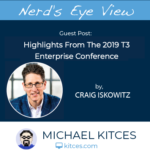
In the last week of October, executive leadership from numerous independent broker-dealers and large RIAs gathered in South Florida for the 2019 T3 Enterprise Conference (as differentiated from the T3 Advisor Conference that is predominantly attended by individual/independent advisors). Hosted by Joel Bruckenstein and his team from T3 Consulting Services, the two-day conference mixed networking, panel sessions, and vendor presentations, focused more on enterprise-level solutions.
In this guest post, Craig Iskowitz – CEO and founder of Ezra Group, a financial technology consulting firm – shares his signature Twitter-driven recap of the conference, which featured new enterprise-level AdvisorTech offerings, interviews with industry leaders around emerging financial planning trends, and discussions on the challenges (and opportunities) that firms face in a rapidly-changing landscape.
Craig kicks off his recap highlighting Shirl Penney’s observation that fear and inertia are preventing advisors from going independent, but notes that they're also limiting countless advisory firms who won’t let go of their legacy technology (thus keeping legacy vendors in business). Also casting a long shadow over the proceedings was the Black Friday Crash of (Trading) Commissions, which Penney predicts will lead custodians to start charging for their technology (although Craig points out that there are far more intriguing possibilities for new revenue streams… particularly for smaller RIAs).
Another major theme permeating discussions at this year’s T3 Enterprise conference was the ongoing difficulties with vendor integrations. David Ballard from Ladenburg Thalmann pointed out that firms looking to integrate technology stacks and databases experience too many headaches, and that vendors should take the lead on building those integrations amongst themselves before pushing them out to the end-user.
Other highlights included presentations from:
- InterGen Data, which combines government census data with other demographic data sets to deliver unique insights into future life events that could have a significant impact on clients and their families;
- Whealthcare Planning, whose platform gives advisors tools to help with challenges their aging clients are facing, including helping retirees letting go of their independence around decision-making, driving, and domicile;
- BidMoni, whose FiduciaryShield aims to create a marketplace to connect advisors with service providers when supporting company retirement plans (e.g., record keepers, custodians and TPAs);
- Morningstar, which introduced Goal Bridge, a financial planning add-on for Advisor Workstation aimed not at selling financial products, but at selling data and analytics instead; and;
- Mike Ragunas, CIO of Cetera Financial, who presented details around their implementation of AdvicePay for their new subscription-based direct billing platform.
Ultimately, the 2019 T3 Enterprise Conference brought together a wide range of vendors and firm leaders with the goal of exploring ways to bring real value to their clients through improving the onboarding process and overall experience, while finding opportunities to increase integrations in order to improve firm efficiency and client retention. And, with the trend towards consolidation and aggregation of data and accounts, it behooves fintech providers to focus on integrations and making sure that the user experience is fast, painless, and seamless… or they can be sure that someone else will.
Enjoy the current installment of "weekend reading for financial planners" – this week's edition kicks off with the big industry news that the SEC is looking at finally updating the advertising rules for RIAs after nearly 60 years, which would include allowing advisory firms the ability to use testimonials and endorsements from clients, and even highlight third-party ratings about their work with clients (while still limiting how firms tout their investment performance in particular).
Also in the news this week was an announcement by Schwab at their IMPACT conference that the firm is looking to expand its banking and lending services for advisors on their platform, the rollout of Morningstar's new Analyst Ratings for funds (that are resulting in a substantial number of downgrades for funds, especially in their higher-cost share classes), and an indication that the SEC is gearing up to crack down on hybrid broker-dealers using affiliated money market sweep programs without properly disclosing the conflict to their RIA clients.
We also have several retirement related articles this week, from the IRS' announcement that it is gearing up to roll out new life expectancy tables that will reduce RMD obligations beginning in 2021 (though the actual RMD factors may only be reduced by about 0.21%), a look at the "9 types of retirees" and their psychographic tendencies, how some firms are experimenting with virtual reality to literally help clients better visualize their future retirement (to help them change their behavior to save more), how to help clients have a more financially successful retirement not just by helping them plan for retiree health care costs but actually getting healthier to reduce those costs, and an interesting look at how the discussion of income inequality is raising questions about the nature of retirement and why "the rich" don't just retire once they have "enough" in the first place?
We wrap up with three interesting articles, all around the theme of how we work most productively and what it takes to incentivize us to do so: the first looks at a recent study that finds while we tend to believe financial incentives will motivate others, when we consider our own motivations we usually don't think it will have as much impact (raising questions of whether we overestimate the role financial incentives really play); the second explores the recent decision of Microsoft in Japan to test out a 4-day workweek (which at least temporarily resulted in a whopping 40% increase in productivity after a 5-week experiment); and the last looks at a company that is trying out (just) 5-hour work days for their knowledge workers, on the theory that if employees can really get concentrated deep work done from 8AM to 1PM, they'll accomplish as much as a full work day anyway... and be happier and better rested with all the time they have left over.
Enjoy the 'light' reading!