Executive Summary
When a client sadly passes away, financial advisors often leap into action. In part it’s simply to provide good service and support to a grieving family. In many cases, there’s also a business interest to engage with next generation heirs and establish or deepen a relationship, in the hopes of continuing to serve the family after the death of the original client. In either case, “proactivity” becomes the guiding principle of engagement. Except the reality is that when it comes to estate planning scenarios, there is actually such thing as being too proactive… because the actions of settling an estate and distributing assets can unwittingly negate the ability of beneficiaries to subsequently engage in disclaimer planning.
In this guest post, David Haughton, an attorney and VP of Engagement for Hargrove MSO, explores the benefits of disclaimer planning, and how the unique requirements for executing a qualified disclaimer, including and especially that the beneficiary not have “accepted” the inheritance, can run directly contrary to traditional proactive service for estate heirs.
The basic principle of executing a disclaimer is fairly straightforward: a beneficiary can choose to not accept an inheritance, and by doing so in a qualified manner, is simply deemed as never having inherited the asset in the first place, allowing it to flow instead to the next (i.e., contingent) beneficiary. For those facing estate tax exposure, this is much more appealing than simply receiving the inheritance and re-gifting it to another beneficiary (and using a portion of their own lifetime gift and estate tax exemption). And even for the wide swath of those without Federal estate tax exposure, disclaimer planning can still be relevant in scenarios from shifting a pre-tax IRA to someone with a more favorable tax rate to draw post-death Required Minimum Distributions, to shifting after-tax assets to someone who may receive better step-up in basis treatment in the future.
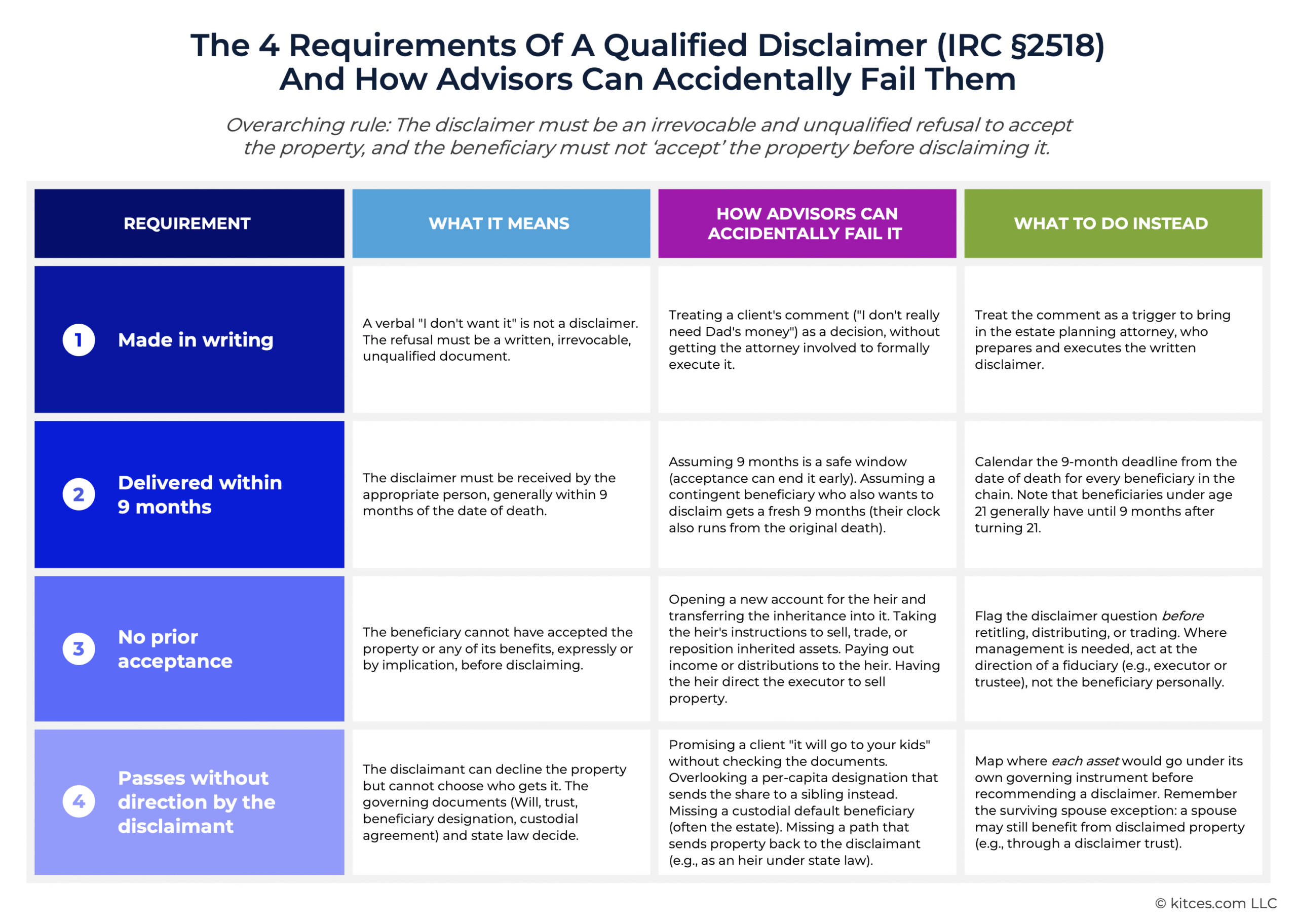
However, executing a qualified disclaimer has a series of four very concrete requirements: 1) made in writing; 2) completed within 9 months of the inheritance; 3) done before accepting the inheritance; and 4) results in property passing without direction by the disclaimant. The fourth requirement in particular is important to recognize, because it means the beneficiary cannot actually dictate where the property will go, only that they will not receive it… and the original governing documents (e.g., the Will, or trust, or account agreement, or beneficiary designation) instead determines who will receive instead.
The bigger caveat, though, is the 3rd requirement of a qualified disclaimer: that the property not be accepted. Which is important, because distributing assets to a beneficiary, paying income to them, or even the advisor taking action to sell, liquidate, or otherwise manage the assets at the direction of the beneficiary, can be deemed acceptance. Such that while the standard rules for disclaimers allow up to 9 months for completion, acceptance will immediately end the time window, which means advisors proactively trying to engage next-generation heirs can unwittingly terminate the planning opportunity.
As a result, a best practice for helping heirs to settle an estate is to understand and identify as early as possible whether disclaimer planning might possibly be relevant, if only to avoid eliminating its potential altogether with “early” settlement of the estate. Fortunately, this doesn’t mean no actions can be taken in the account – the advisor can still manage at direction of a fiduciary (e.g., a trustee) supervising the assets. And often advisors have the best holistic perspective to understand whether a disclaimer is a relevant planning opportunity (or not).
Ultimately, the key point is simply to recognize that because “acceptance” can terminate the window for executing a qualified disclaimer, advisors otherwise engaging in proactive service to help a grieving family or to establish a relationship with next generation heirs must be cautious not to accidentally end a disclaimer planning opportunity. Especially recognizing that disclaimers aren’t just a matter of Federal estate tax planning (for only a small subset of ultra-high-net-worth clients with estate tax exposure); income tax consequences, from IRA distributions to step-up in basis opportunities, mean disclaimer planning has potential for a wide range of client circumstances. As long as the window remains open long enough to determine whether it’s right for any particular heir!
 |
And if you want to go deeper on this topic, hear directly from the author on the Financial Advisor Technician podcast. |

Listen To The Financial Advisor Technician Podcast On This Topic




Episode Shownotes And Transcript
Click to expand transcript and show notes↓↓
Title: Qualified Disclaimers: An Advisor’s Role In Helping Clients Disclaim Assets Effectively
Episode Shownotes:
- David Haughton: LinkedIn
- Retaining The Next Gen In The “Great Wealth Transfer”: Planning Opportunities To Build Relationships With Clients’ Heirs
Full Transcript:
Adam: Hello, and welcome back to the "Financial Advisor Technician" podcast. I'm your host, Adam Van Deusen. On today's episode, we're going to discuss qualified inheritance disclaimers and the important role that financial advisors can play in ensuring that they are completed properly. Because while heirs often welcome an inheritance, sometimes disclaiming it will make sense, whether because of potential estate tax exposure, a desire to shift a pre-tax IRA to someone with a more favorable tax rate to draw post-death RMDs, or to shift after-tax assets to someone who may receive better step-up in basis treatment in the future. Importantly, though, executing a qualified disclaimer has a series of four very concrete requirements, including that it must be done before accepting the inheritance, which can sometimes conflict with an advisor's desire to fulfill the wishes of their recently deceased client expeditiously.
So to help us dig deeper into this topic, I'm joined today by David Haughton, vice president of advisor engagement at Hargrove MSO, to discuss why heirs might be interested in disclaiming an inheritance, the rules for doing so, and the role an advisor can play in making sure that any disclaimers are managed successfully. So welcome, David, back to the "Financial Advisor Technician" podcast.
David: Thanks for having me. Happy to be on.
What Disclaimers Are And When They Might Be Appropriate [1:28]
Adam: Yeah. So to start, perhaps you could give our listeners a quick rundown of what inheritance disclaimers are and when they might be appropriate.
David: Yeah. So essentially, what a disclaimer is, when you break it down to its most simple form, is when someone says, "I don't want to receive that. I know I am supposed to receive that. I know I'm supposed to inherit it by whatever means that is, by beneficiary designation through a trust or through a will, but I am going to decline to receive it, and I want it to pass to someone else." That is essentially what a disclaimer is. And it can be very basic, the reasons that you would want to do it, you flat-out don't want to receive the property, or there could be complex planning techniques behind it as far as why you want to disclaim property. And so it's a savvy technique in the industry, but there's a lot of rules according to the IRS Code that you’ve got to be really careful of to make sure you do it right.
Adam: Yeah, very interesting. Yeah. So on the first side of why you might want to disclaim, I get the idea of maybe it's a piece of tangible property that might be more challenging to handle than it's worth. I could imagine an old home or something like that. But then, on the other side, you mentioned there might be financial reasons for doing so. So I would guess one of these for particularly wealthy folks would be estate tax exposure. Would that be sort of a common area why people might do this?
David: Yeah, absolutely. There are circumstances where, first of all, people are well off. They have already accumulated a lot of assets on their own. They have their own estate planning concerns when it comes to maybe estate taxes or other areas that they just don't want to have additional assets lumped on top that are going to ultimately probably end up with their children or with their beneficiaries anyway. And so, when you refuse an inheritance through a disclaimer, by law, if you do it appropriately, you can actually bypass it passing through your estate. So it's as if you never owned it. And the good part of that is, right now, we have a gift tax.
Now, a lot of people don't have to pay a gift tax if you give a gift, but as you give gifts, if it's over a certain limit, over $19,000 per year, you start to eat into your $15 million estate tax exemption. And if you were to accept an inheritance and then turn around and give it to your children rather than disclaiming it, then you're going to be using up that gift tax balance, and you may not want to do that. So a disclaimer is a great way to totally bypass that process and have it act as if it never went through your estate at all.
Adam: Though, these days, with the now permanent approximately $15 million per person or $30 million per couple exemption, I'd imagine a lot of not-ultra-high-net-worth clients here are maybe thinking about that less. Now, that said, I understand that there are perhaps other reasons that maybe a broader swath of clients might be interested in doing a disclaimer. Could you go into some of those?
David: Yeah. In a lot of circumstances, when you're receiving assets, if they aren't ideal assets to receive, you may have liability concerns. You may yourself have creditor or divorce concerns. You may have concerns as to why you don't want to receive that property. Or it could be, like you mentioned in the opening, basis. It could be that you want to pass it to someone where, once they pass away, they're going to get an enhanced step-up in basis. And so there can be a lot of different reasons and a lot of different savvy planning techniques that you can take depending on what type of assets you're going to be receiving that you may want to consider, "How do I disclaim?"
Now, we're probably going to talk about all the decision points that come into that, but it's important that you're looking asset by asset. Like you said, if I am inheriting a dilapidated property that is a huge liability risk, I may just want to disclaim that because I don't want to have any part of that, and I never want anyone to say that I have owned it. And so that's on the one side of things. And then, on the other side of things, it can just be a more practical concern that I don't need this money, and I want the benefit somewhere else.
Four Specific Rules To Make A Qualified Disclaimer [5:52]
Adam: So let's say we have a situation…an advisor has a client who's set to inherit some property, and the disclaimer seems to be the right course of action for one reason or another. Now, I understand that there's some very specific requirements to actually make that disclaimer happen properly. So perhaps you could start with a couple of those key issues.
David: Yeah, absolutely. Yeah. Under the Internal Revenue Code, there are four specific rules that need to be followed in order for it to be a qualified disclaimer. And I use the word "qualified" very intentionally because anyone can disclaim any property, but it's not necessarily going to be a qualified disclaimer when we're talking, per the IRS rules, for it not to pass through your estate.
And so, number one, it needs to be in writing. So you need to actually affirmatively make a statement to your fiduciary that you intend to disclaim that property, whether it be the executor or the trustee. Wherever you are going to be receiving that property, you need to make an affirmative declaration to them in writing that you are disclaiming it.
Next, it needs to be timely. So it needs to be within the time limits set under the Internal Revenue Code, and that's 90 days. So it's 90 days from the death of the person who's making the transfer to the beneficiary. And that's a hard deadline, and it needs to be done within that time. Also, the beneficiary can't have already accepted the property. So, for instance, when we talk about a piece of real estate, if I received the property and I inherited it, and then I renovated it for a couple of months, I lived there, I had a couple of parties there, and then I realized there was black mold in the walls, I can't turn around and disclaim it. I need to have not accepted the property. And that's a moving target as far as what is considered acceptance, what isn't, and that's something that is going to be on a subjective basis that's going to be determined whether you accepted the property. But you can't have taken those steps to accept the property.
And then, finally, you need to make sure that it's passing without the direction of the disclaimant. So what that means is that the property is not passing per the wishes of the person who's receiving the property. And we're going to, I'm sure, talk about that quite a bit. But it needs to be that they are outright refusing it, and they are not playing a hand on where it's going to go after them.
Adam: Thank you for that rundown. And I should note for our listeners, David has written a terrific article on this issue with a lot of step-by-step questions and processes that advisors can use. So if you'd like to check that out, you can go to kitces.com/FAT16, to see that article.
So I guess taking these one by one and thinking of potential pitfalls that could occur with each one. So the first requirement you mentioned was that the disclaimer has to be made in writing. So I would imagine the pitfall here is the client tells you verbally, "I'd like to disclaim it," and then that isn't good enough. It has to be actually in a signed letter of some sort. Does it need to be notarized? How does that work?
David: Yeah, it's funny. I don't know that there are really substantial requirements when we're talking about in writing, because ultimately, that disclaimer needs to get delivered to the fiduciary, so to the trustee, or to the executor, or whoever is the custodian of the account, or whoever is going to be the one making the transfer. And it just needs to be unequivocal in writing and irrevocable. And so, typically, when you do that, you want to make sure that it can be proven it was done less than 90 days after the death and that, typically, having something like a notarization is further proof that you did it willingly, and it's a valid document. So I don't know that there are specific requirements that it'd be notarized or have witnesses, kind of like a will, but it would behoove people, if they want to make sure they're doing it right, that they have a provable way of showing that it was done within 90 days after death. It was actually delivered to the appropriate fiduciary custodian, what have you, and it's verifiable as a valid document.
Adam: So, moving on to the second requirement that you mentioned. So this disclaimer must be received by the appropriate person, the fiduciary, the executor, that you mentioned, generally within nine months after the date of death. So I'd imagine two potential problems here. One, that the individual waits too long to make the disclaimer. But I think on the other end, which might be interesting for advisors, is that the acceptance could be made too soon. So an advisor is trying to work out all of the...if they had a recently deceased client, making sure that beneficiaries receive assets that were meant for them. But if they move too quickly, it's possible that they could act before an individual has a chance to explain that they'd like to make a qualified disclaimer or to bring that conversation up. So, in this world, what are some sort of best practices for advisors to manage this requirement?
David: Yeah, it's exactly right. And I think, in most circumstances, if an advisor moves quickly and they're helping to usher those assets along through the inheritance line as quickly as possible, as quickly as legally permitted, or as quickly as operationally permitted, then they're providing good service. But in some circumstances, you can inadvertently blow this disclaimer planning opportunity. And so that's why it's really important, if someone passes away, to take inventory of what is being received, whether a disclaimer is possible, can they disclaim, determining where is it going to go if you do disclaim, and then figuring out, should they disclaim it, and figuring out all those items before the client goes through the process of accepting whatever that definition may be. Accepting the property and losing the ability to do a disclaimer is really, really important.
And I just want to add one nuance to the nine months because, like everything in the law, there's always these exceptions and these little nuances and quirks. One thing I should mention is that if it is a minor who is going to be inheriting the property, then they might have more of a runway, and they can actually wait until nine months after that beneficiary turns 21 to make the disclaimer election. So that's an important nuance to remember. But I think what's really important is to know that you should be coordinating with the estate attorney before you jump into action and transfer accounts and help to transfer that wealth over and just make sure you're not missing any disclaimer opportunities as far as the planning is concerned.
Adam: And so, from an advisor's perspective, you mentioned before the idea of we're having a party in a house that you inherited, then decide you don't want it anymore. That clearly feels like acceptance there. But in terms of financial assets, here, we're dealing with IRAs or other types of accounts or things like that. It sounds like it's not just a matter of I've now opened an inherited IRA, which feels like acceptance, but my understanding is that there are other actions an advisor could take that could be construed as acceptance that they might not have thought of. What are a few of those?
David: Yeah. If they're taking affirmative acts that are consistent with ownership, I think that's the way that the Treasury regulations typically talk about it. And that could be making a withdrawal and purchasing something with the account. It could be moving the account and then the actual beneficiary asking the advisor to change the investment allocation. There could be all kinds of actions that you take typically with an account that is yours, and accepting and depositing dividends, things of that nature, that could be construed as acceptance.
Now, it's important to understand that there are nuances to that because, in the course of their duty as a fiduciary, a lot of times, the child is also maybe the executor or the trustee. And there are certain actions that they need to take on behalf of the estate that's not necessarily, just because they happen to be a beneficiary, it's going to cause it to be acceptance. For example, if an RMD is taken in the year of death from an IRA, because if they don't take it, there's going to be substantial penalty, typically, it has been seen that that is not going to be something in itself that is going to constitute acceptance. But if you're taking all other kinds of actions with the account like you would if you own the account yourself and then thereafter saying, "Oh, you know what, I don't want this," or, "You know what, this isn't mine," then it's probably going to be determined as it's not an effective qualified disclaimer.
Adam: Oh, very interesting. Okay. So, so far, we have made in writing, delivered within nine months, no prior acceptance. So the last requirement that you mentioned, which I do think is very interesting, is that the assets must pass without direction by the disclaimant. So I guess this is the idea here. It says, well, let's say there's an adult, maybe a 50-year-old, something like that, who's set to inherit money from their parents. So they can't say, "Okay, I want to disclaim this, but I want to make sure the assets go to my child." That would seem to disqualify the disclaimer here. So, what are the rules? How would the assets pass if a disclaimer is made?
David: Yeah. So this is a common misconception…is a lot of times, when you're talking about disclaimer planning, people will say, "I don't want those assets to pass through my estate, so I would like them to instead go to my children," which is maybe the way it would go under a typical estate plan, let's say. But it's not always the case because those assets need to pass without the direction of the person receiving them. Otherwise, it's going to be determined to be a gift in most circumstances. So, for example, if I leave a brokerage account worth, let's say, $1 million to my spouse and my spouse were to disclaim it, my spouse is not going to have the option of saying, "This is where I want it to go." It's going to go as if my spouse had predeceased me.
So it's either going to go to my contingent beneficiaries that I named in the account documents, or potentially, depending on what the account documents say, the account agreement says, it could potentially go to my estate and go to whoever it flows through through there. So that's why it's really important to understand that you can decline, but you can't direct it. You can't direct where it's going to go. It's going to go through a matter, of course, how the estate documents say that. So if it's a trust, it's going to pass to whoever the contingent beneficiary, if that person wasn't living.
Now, one nuance to that, one exception to that, when it comes to spouses, you have a little bit more leeway to do estate tax planning when it comes to a spouse, because they could make a disclaimer from themselves individually or from a marital trust into what's called a credit shelter trust, that they are technically still a beneficiary of, but is outside of their estate. And that is a very important planning item. That is probably one of the most common uses of disclaimer planning, is for estate tax planning with spouses. And so that is one of the exceptions in the law, one of the nuances in the law, where typically, if you disclaim it, you can't thereafter benefit from it, and you can't control where it's going to go. But when it comes to disclaiming to a credit shelter trust, also known as a bypass trust, that is usually acceptable as long as you're doing it in the appropriate process.
Adam: So I think that speaks to the idea of, again, you have this nine-month period, but there's a lot of thought that needs to be taken here when you're making sort of this kind of potentially momentous and impactful decision.
Why A Disclaimer Isn’t Necessarily An All-Or-Nothing Decision [18:00]
Adam: I guess one related question that comes up is, when it comes to disclaimers, is this an all-or-nothing decision? If you're inheriting multiple accounts or whatever it is, can you disclaim a portion of it and keep another portion? How does that work?
David: You can. Yeah. You got to think about it functionally as to whether certain things are severable and whether you are able to disclaim a certain portion of something. But in most circumstances, it's not all or nothing. Because a person's estate is not just one big lump sum pot. It's usually broken up into a number of different assets. So you could say, "I don't want to receive this dilapidated property, and I don't want to receive this small IRA. However, I would like to inherit the baseball card collection and this brokerage account." You can decide what to disclaim and what not to disclaim. That can obviously make things somewhat complicated in certain circumstances, and that's why you need to be really specific when you're making the disclaimer. And the advisor needs to understand that it's not an all-or-nothing decision and what the implications of each asset are, right?
Because if my estate is comprised of, let's say, I have a lot of my assets in trust, and then I have life insurance as beneficiary designation, IRAs that have a beneficiary designation, those aren't necessarily all going to flow to the same beneficiaries after the declining beneficiary passes away. They could have, theoretically, different beneficiary designation situations. And so it's really important to understand asset by asset and determine whether it is an asset they want to disclaim, what's going to happen with that specific asset if they do disclaim it.
An Advisor’s Role With Disclaimers (Without Veering Into Legal Advice) [19:51]
Adam: And I suppose another question that comes up sometimes on advisors' minds is a concern about veering into legal advice here as a financial advisor. Any concerns you'd have for advisors in this matter? Or when is it the time to sort of consult an attorney versus guiding the client themselves?
David: Yeah, absolutely. I think the advisor stands in a really important, respected, trusted position by the client. And they're usually going to be the first phone call when someone passes away to determine what's owned and what is going to happen next. And they stand in a really important educational position for the advisor to help the client and their beneficiaries make sure that the assets are going to pass in the most tax-efficient way, the most wealth is transferred to the next generation. But they need to be careful that they're not making a legal analysis and not offering legal advice. And so helping them to draft a disclaimer document, obviously, that would probably be stepping over the line. And even making specific advice to say, "You should disclaim this asset or that asset," I think they can point out where assets could offer a benefit for a disclaimer. And this isn't necessarily the client passed away. This could be the client's parents passed away, which is probably a more often scenario to determine where the assets should now flow to.
And so, as long as they're bringing the attorney who can offer the legal guidance in as early as possible, they are certainly in a great position to be the quarterback of that situation, to identify educational opportunities about what a disclaimer is and when you may consider it, and maybe identify, in their estate, maybe using software for estate summaries and things of that nature. But they need to be really careful that they're not giving legal advice, and certainly they're not making the decision for the client or on behalf of the client.
A Decision Sequence For Advisors And Their Clients For Disclaimers [21:49]
Adam: Oh, excellent. Thank you for that background. Okay. So that is, I think, a terrific framework to think about it. So now we've discussed what disclaimers are, when clients might consider them, and these very restrictive rules in terms of making it successfully. So if I'm an advisor out there and I'm encountering this situation now or sometime in the future, I think in your article, you put a really nice sort of decision sequence for advisors to think about and work with their clients. So, what are the sort of steps that advisors might consider taking when encountering this situation?
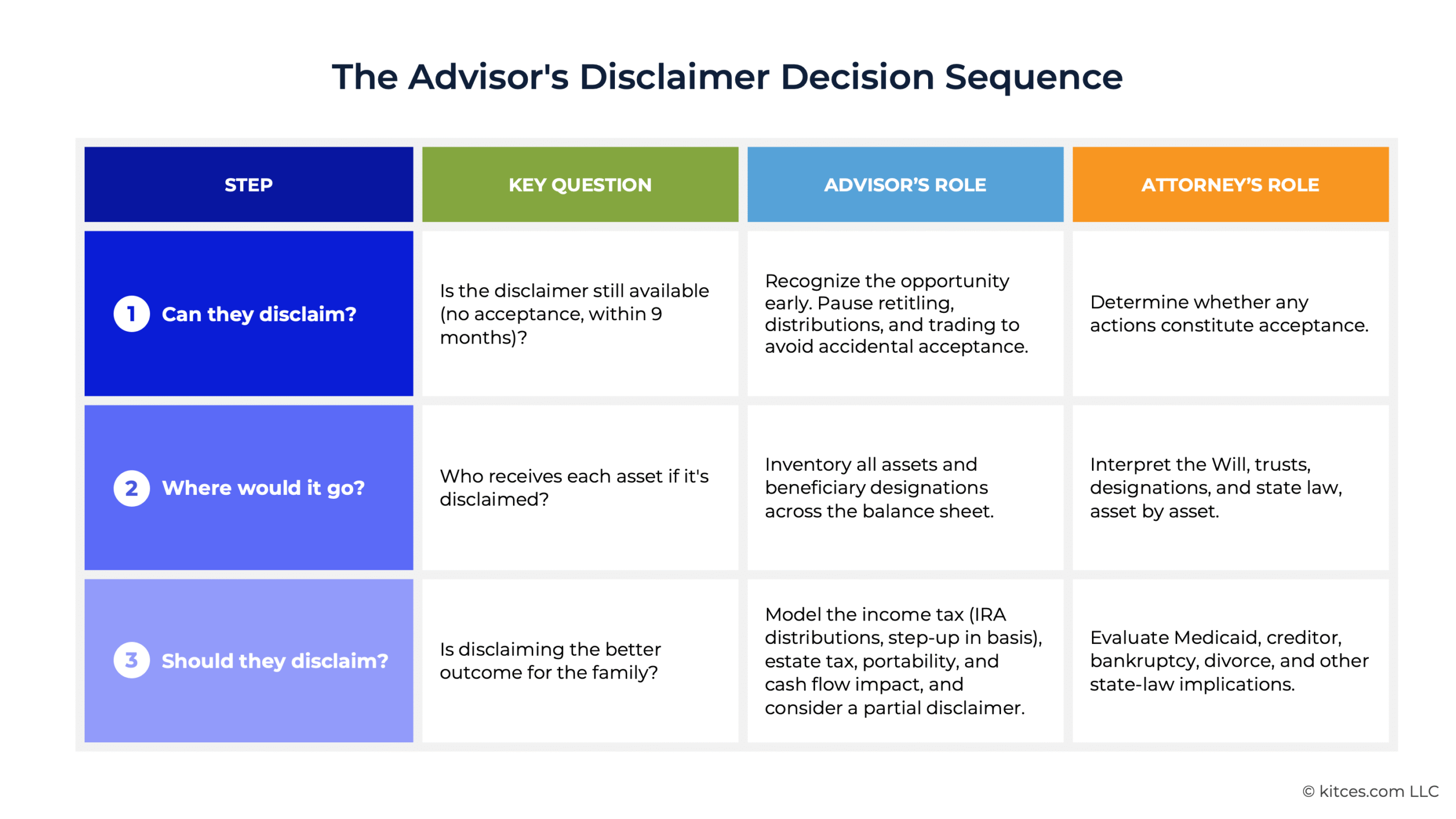
David: Yeah. I think the first thing is slow down. Understand they're in an emotional time period when there's a death, and you need to help them traverse that, but you can't go too quickly. And you need to make sure that the right sequencing event is happening. And the first question you can ask is, can they disclaim? So, is this a property that they have the ability to disclaim? Maybe they've already accepted it for whatever reason, and maybe the horse is out of the barn, and now you can kind of move forward because you know there's no opportunity to disclaim. But if you determine that they can disclaim it, now you want to move on to, okay, they can disclaim it, but where's it going to go if you disclaim it? If you determine that, "Oh, you know what? I would rather it stay in the family," or, "I would have gifted it to this person if it had come to me first," that might be the next step where you're saying, "All right, well, they can disclaim, but because of where it's going, they might not want to disclaim."
And then if you determine, "Yes, they can disclaim. It's going to go to the people that the disclaimant is comfortable with it going to", the next question is, should they disclaim? Because there can be a lot of questions as far as that is concerned, because when it comes to disclaimers, a lot of times, the tax conversation is, what dominates is, "I don't want it to pass through my estate." But it's not a magic wand, and the laws are not the same when it comes to the federal gift and estate tax transfer laws versus things like state creditor laws or Medicaid eligibility. And sometimes you can put your beneficiaries, or the disclaimant can put their beneficiaries, in a tough position.
For example, if there was a disclaimant who said, "I don't want to receive this because I'm going to be heading to the nursing home in a few months, and I would rather it not affect my eligibility", well, it may be the case, depending on state laws, that a disclaimed property is considered uncompensated transfer part of that five-year lookback period. So they're going to look at it just as if you had given a gift. And same thing when we're talking about bankruptcy or state creditor laws. They may look back and see it as a gift, even though, for federal estate tax purposes, they may say that it bypassed your estate. So a lot of different nuances to this, and that's why it's so important to have an attorney involved and to really look at it comprehensively and not just through only the tax mindset and also to think about all these other areas that it could affect.
Adam: Oh, interesting. Okay. So three steps there. First off, thinking about, can they disclaim? You said maybe they've already accepted it. The nine-month time limit has already passed. So if the advisor decides that, yes, it appears that they can disclaim it. Next question is, where would it go? Which, of course, as you mentioned before, the intended heir doesn't get a say in that, that it's going to be determined by the decedent's estate plan. And then, finally, the question is, should they disclaim? And again, as you mentioned, it's a variety of reasons and reasons not limited to the ultra-wealthy. So it's something that could come up with a variety of client situations.
Considering Disclaimers When Creating An Estate Plan [25:36]
Adam: Now, I was also going to ask, what's the role for an advisor working with a client who's preparing their estate plan in terms of thinking about, let's say, they have a client who's in their 80s or even 90s or something like that and thinking about where their assets are going, whether disclaimers might be an option for some of their heirs. How can advisors work with clients in that position to prepare for this conversation?
David: Yeah. I think the biggest place where I think disclaimers are thought of ahead of time is certainly in the spousal estate tax planning realm. Because right now, we're in a situation where the exemption did not sunset with the Tax Cuts and Jobs Act. So we're at a point where there's a $15 million per person exemption, and there is portability. And we're in a situation where a lot of people think that that means, "Well, I don't really need to do estate tax planning." Well, that's not necessarily the case because I think, as we all know, the laws are written in pencil, and we don't know what's going to happen with the estate tax in future years. There have been a lot of proposals for it to come tumbling down, depending on who's in power and how the makeup of Congress and the executive branches.
And so it's really important to understand that, even if you don't think that your client needs to have rigid estate tax planning, they still may want to have that ability to do it, to be able to disclaim, to make sure that assets are not passing through their estate if the estate laws change. And also, very importantly is if they're in a state that has a state estate tax... I'm in Massachusetts, the limit is much lower than the federal limit. It's only at $2 million per person, and it's not portable, meaning spouses cannot share the exemption. Disclaimers are hugely important, and they're very flexible. It means that when one spouse passes away, the surviving spouse has nine months to decide whether to do that estate tax planning, depending on how the laws are written and how the estate is composed at that time.
So I think that having a flexible plan, understanding that disclaimers exist and that you have a flexible way to potentially do planning, is an important thing to understand. And that's why it's so important that you understand that upfront and you don't blow it up by taking some kind of action right after death that you probably shouldn't have.
One Key Takeaway For Advisors [28:06]
Adam: And so, given we've covered a lot of ground today, thanks for all the wonderful explanations, what would be your one key takeaway for advisors when it comes to disclaimer conversations?
David: I think understanding the rules, and I think the sequencing that we just talked about, is if someone passes away and a client comes to you and says, "My parents just passed away, and these assets are going to come to me", or, "I'm a fiduciary", or, "My spouse has passed away", "My parents have passed away, what should I do?" I think the most important thing is you want to be helpful, you want to jump on that, you want to be as quick as possible to show value. But a lot of times, taking a beat, understanding that you should get the attorney involved to assess this, there are some planning opportunities that can be lost if you move too quickly. And so while good service means being on top of things, it also means being thoughtful about how you approach it.
And so, can they disclaim, where does it go, and then should they disclaim should always be the thought process that happens when there's a death, and we're looking at a situation where an inheritance is being passed on just so that you make sure that you're not going to forego a really important planning opportunity.
Adam: Terrific. Well, thanks so much again for joining us today here on the "Financial Advisor Technician" podcast, David.
David: Thanks so much. Great to be here.
Imagine a client whose father recently passed away. Their father left them $500,000, but they don’t really need the money. The client’s own financial plan is in good shape, but their two children are younger and could likely make better use of the inheritance.
So a pretty simple idea emerges. “What if I just disclaim the inheritance and let it go to my kids?”
Seems reasonable enough. The client doesn’t want the money, the kids certainly do, and disclaimers exist specifically to let someone refuse an inheritance. However, the process and rules for disclaiming an inheritance are not always as simple as it may seem.
What Is A (Qualified) Disclaimer?
At its most basic level, a disclaimer is simply a refusal to accept property, so that it may pass to someone else (often another member of the family) who might have a greater need. But there is a big estate and gift tax difference between saying “no thanks” and taking possession of the property first and then turning around and giving it away.
Example 1a: Suppose Frank leaves $500,000 to Dee. Dee accepts the inheritance and then decides she would rather have her siblings, Dennis and Charlie, receive the money. So she gives each of them $250,000. Dee has received the property and then made gifts of her own, directing the dollars to the recipients she wished had received the money.
In the above example, it’s important to recognize that because Dee did in fact receive the inheritance, her subsequent transfer to Dennis and Charlie was a gift of her own… and because it exceeds the annual gift tax exemption amount of $19,000 per person ($38,000 between the two of them), she will actually use a portion of her lifetime $15M gift tax exemption.
For clients who are not ultra-high-net-worth, this may not necessarily be problematic; if Dee still has more than $14.5M of gift and estate tax exemption remaining, that could still be more than enough to cover the bequest of her own future assets in the future.
However, the situation is different in the case of a pre-tax asset like an IRA.
Example 1b: Continuing the prior example, suppose instead that Frank’s bequest to Dee was a $500,000 IRA.
In fact, Dee will likely want or need to hold back a portion of the $500,000 to cover the Federal and potential state income taxes she’ll incur on the withdrawal, with only the remainder ultimately remaining to be gifted to Dennis and Charlie. Thus, her decision to liquidate and ‘re-gift’ the inheritance has especially adverse tax consequences in this scenario (even if manageable from a lifetime estate tax exemption perspective).
A qualified disclaimer is different works differently.
Section 2518 of the Internal Revenue Code provides that when a person makes a qualified disclaimer of an interest in property, the Federal estate, gift, and generation-skipping transfer tax rules generally apply as though the interest had never been transferred to the person making the disclaimer. In effect, rather than Dee receiving Frank’s $500,000 and then transferring it somewhere else, the disclaimed property is treated as passing without first being transferred to Dee, thus allowing her brothers to receive the asset directly, and to subsequently liquidate or withdraw it as though it’s their own asset (and thus at their own income tax rates).
Where Does Property Go After A Disclaimer?
While a qualified disclaimer allows a beneficiary can decline an inheritance, but they generally can’t direct where it goes next.
Section 2518 requires the disclaimed property to pass, without direction by the disclaimant, to the decedent’s spouse or to someone other than the disclaimant. In other words, a disclaimer isn’t generally a way for a beneficiary to unilaterally say, “I don’t want this, so give it to my kids instead.” The beneficiary can merely say, “I don’t want this.” From there, the governing documents, beneficiary designations, and applicable law determine what happens next.
Decline, Not Direct
The distinction that beneficiaries can decline, but not decline, where a disclaimed asset goes, can matter because the beneficiary’s desired outcome and the actual result of the disclaimer could theoretically end up being very different.
Example 2a: Suppose Drake is the primary beneficiary of his father’s $1 million IRA and his children, AJ and TreVeyon, are the contingent beneficiaries. If Drake makes a qualified disclaimer, the IRA may pass to AJ and TreVeyon, which produced the exact result Drake was hoping for.
But Drake didn’t make the decision to send the IRA to AJ and TreVeyon. The original beneficiary designation did!
Change the beneficiary designation recipients, and the same disclaimer could produce a completely different result.
Example 2b: Suppose Drake’s father instead named Drake and his brother Christian as the primary beneficiaries of his father’s $1 million IRA, on a per-capita basis (which means when there are two of them, it’s divided evenly between the two). Because the IRA is left per-capita, if Drake disclaims and the beneficiary treats the situation as though Drake wasn’t align… his brother Christian would then be the sole beneficiary on a per capital basis, which means Christian would receive 100% of the IRA (both his own share, and Drake’s), while Drake’s own children would be disinherited.<
[nerdnote] In situations where there is no contingent beneficiary named for an IRA in particular, often a contingent beneficiary does still exist by default: it’s named in the IRA custodian agreement, which typically stipulates a default beneficiary in the event that the decedent did not otherwise name one. Most commonly, the default beneficiary is simply the decedent’s estate (which in the case of an IRA can be especially unfavorable from a tax perspective), though in some situations it may default to naming a surviving spouse or other family members first. As a result, sometimes the next-in-line person when disclaiming an IRA will be whatever the IRA custodian agreement stipulates it will be (if the decedent had not already named one in their own beneficiary designation). And in the event that no beneficiary was named at all, the custodian agreement may guide who the primary beneficiary will be by default… and also, ironically, the contingent beneficiary if that custodian-named default primary beneficiary also wishes to disclaim! [/nerdnote]
Accordingly, before analyzing whether a beneficiary should disclaim an asset, the advisor (in concert with the client’s attorney) first needs to identify the dispositive path that already exists.
Different Assets May Go in Different Directions
An analysis of where disclaimed property will go isn’t necessarily performed once for a beneficiary’s entire inheritance. And this is where an advisor’s full view of the client’s balance sheet can be especially useful.
A beneficiary may simultaneously inherit an IRA, receive assets under a Last Will and Testament, become entitled to property under a trust, and as joint owner on a bank account. While the beneficiary may think of all of this collectively as “my inheritance,” each asset may pass under a different governing instrument and, therefore, by varying rules.
The IRA may be controlled by its beneficiary designation and plan or account terms/custodial agreement. A payable-on-death or transfer-on-death (POD or TOD) bank or investment account may have its own beneficiary designation (or may pass to a surviving spouse outright by rights of survivorship). Trust property will generally be governed by the trust instrument. Probate property will pass according to the Will and/or applicable state law.
As a result, disclaiming different assets may result in those assets flowing to different beneficiaries. Ironically, there can even be situations where disclaimed property actually finds its way back to the person who disclaimed it! The Regulations illustrate, for example, a beneficiary who disclaims property received under a Will but also has a right to receive some of that same property as an heir under state law. For a non-spouse beneficiary, additional interests from the estate may need to be disclaimed to prevent the property from returning to the disclaimant and jeopardizing qualified disclaimer treatment.
This is an important area for advisors because they often have visibility into the client’s assets and beneficiary designations that other professionals in the client’s orbit (i.e. attorney, CPA) may not have. The advisor doesn’t need to interpret the Will or determine the legal effect of a disclaimer, but the advisor can help identify which assets need to be examined and coordinate with the estate planning attorney to determine where each one would go and discuss the practical implications and whether it aligns with the client’s planning objectives.
So the practical question often isn’t, “Where does the inheritance go if the client disclaims?” It may be, “Where does each asset go?”
Special Considerations for Surviving Spouses
Surviving spouses have an important exception to the general rule. Section 2518 permits property a spouse disclaims to still pass indirectly to the decedent’s spouse subsequently to the disclaimer, by virtue of them retaining certain beneficial interests in the property even AFTER the disclaimer.
The Regulations illustrate this with a Will creating marital and nonmarital trusts for a surviving spouse. Property disclaimed from the marital trust passes to the nonmarital trust, where the spouse continues to receive income while she’s alive (with the remainder passing to other beneficiaries thereafter) The disclaimer can nevertheless satisfy the requirement that the property pass without direction by the spouse, even though she’s a participating beneficiary in the second trust that receives after she disclaims via the first.
For advisors, the important point isn’t to determine whether a particular trust provision satisfies Section 2518. That analysis belongs with the client’s estate planning attorney. The broader planning point is simply that there are many opportunities to shift where assets will go via a disclaimer… but it truly requires an asset-by-asset analysis to understand where each particular asset will go, based on the governing documents pertaining to that asset.

Nerd Note:
Joint bank and brokerage accounts can create some interesting disclaimer opportunities. When one joint owner contributed assets to an account and retained the unilateral ability to withdraw those contributions, the transfer of the survivor’s interest attributable to those contributions generally isn’t treated as occurring until the contributing owner dies. As a result, if one spouse funded 100% of a jointly titled brokerage account, the surviving spouse may potentially be able to disclaim more than 50% of the account, even though only 50% may be included in the deceased spouse’s estate under the spousal joint property rules!
Wanting To Disclaim Doesn’t Mean You Can
While making a disclaimer can be a powerful post-death planning tool, whether to shift assets for family financial needs, for income or estate tax purposes, or other reasons, a qualified disclaimer is still only valid if the requirements are actually satisfied.
Under IRC Section 2518, a qualified disclaimer generally must be an irrevocable and unqualified refusal to accept an interest in property that:
- Is made in writing;
- Is received by the appropriate person within the required time period, generally within 9 months after the transfer creating the interest;
- Is made before the disclaimant has accepted the interest or any of its benefits; and
- Results in the property passing without direction by the disclaimant to the decedent’s spouse or to someone other than the disclaimant.
For property transferred at death, the transfer creating the interest will generally occur on the date of the decedent’s death. Thus, when Frank dies and leaves property to Dee, Dee will generally have nine months from Frank’s death to complete a qualified disclaimer.
For most clients, this makes disclaimer planning seem straightforward: coordinate with the attorney settling the estate to determine based on the governing documents where the assets will flow if disclaimer (under #4 above), execute the qualified disclaimer in writing with the attorney’s support (satisfying requirement #1), and get it all done within nine months of the decedent’s date of death (to meet the timeline #2).
Nine months sounds like plenty of time. Except the nine-month deadline isn’t necessarily the only clock that is running.
How Advisors Can Unwittingly Ruin A Disclaimer With Proactive Service To Heirs
The nine-month rule can create a false sense of security. So, if Frank died last month, does the beneficiary have eight more months to decide whether to disclaim? Not necessarily.
The key distinction is requirement #3 to execute a qualified disclaimer: Section 2518 requires that the beneficiary not have accepted the property or any of its benefits before making the disclaimer. And the Treasury Regulations make clear that acceptance can be express or implied. An affirmative act consistent with ownership can constitute acceptance, including using the property, accepting income from it, or directing someone else to act with respect to it.
And that is where advisors can get tripped up. The beneficiary doesn’t need to wait nine months to lose the opportunity. Acceptance can immediately turn nine months into a far shorter time period.
Example 3a: Continuing the earlier example 2a, assume that Drake was the sole primary beneficiary of his father’s $1M brokerage account. In a burst of good service, the advisor who previously worked with Drake’s father promptly engages Drake as his new client, establishes and advisory agreement, opens a new account for Drake, and transfers the proceeds into Drake’s new managed account, all completed within 3 months of the death of Drake’s father.
If Drake now decides that he’d like to disclaim the assets to his children, AJ and TreVeyon… he can’t. Because by opening a new account and transferring the inheritance into it, Drake has accepted the inheritance, rendering his potential disclaimer invalid!
As Example 3 highlights, even advisors in the midst of proactive high-quality service can unwitting cause a disruption in the ability of (new) clients to execute a disclaimer. Which means it’s quite important to be cognizant of what may trigger disclaimer-invalidating “acceptance”.
And notably, the conditions that trigger acceptance may be broader than just outright receiving the assets. For instance, the Treasury Regulations give a specific example where a beneficiary inherits a farm and asks the executor to sell it and give him the proceeds. After the executor sells the farm, the beneficiary attempts to disclaim $50,000 of the proceeds. The disclaimer fails to qualify because asking the executor to sell the property was itself an act of acceptance. It didn’t matter that the executor wasn’t necessarily required to follow the beneficiary’s request. In that case. the beneficiary never had to receive the cash, deposit it, or spend a dollar. Telling the executor what to do with the inherited property was enough.
For advisors, that’s an important distinction. Acceptance isn’t necessarily limited to the obvious scenario where a client receives inherited cash, deposits it into a checking account, and spends it. The question can arise earlier, while the advisor and client are still ostensibly “deciding” what to do with the inheritance.
Example 3b: Continuing the preceding example with Drake, who inherited a brokerage account from his father. Even if the advisor doesn’t open a new account and transfer the funds to Drake, he takes directions from Drake as the beneficiary about what should be sold in the inherited account while they’re making the decision about whether to disclaim. Yet akin to the Treasury Regulations example, at the point that the advisor takes directions from Drake about how to manage the assets before a potential disclaimer, that itself can still constitute acceptance that disqualifies the disclaimer!
Whether a particular action constitutes acceptance is ultimately a legal question. But from the advisor’s perspective, the important point is that the disclaimer opportunity can potentially be affected while the family is still deciding what to do. And that proactive service from the advisor, to help manage the inherited assets or begin to distribute or retitle them, can directly negate the potential for a future disclaimer!
Which creates a somewhat counterintuitive planning point in that sometimes good service may mean recognizing when there is a reason not to move too quickly.
Nerd Note:
The 9-month clock works differently for beneficiaries under age 21. A beneficiary generally has until 9 months after turning 21 to make a qualified disclaimer, and actions taken by the beneficiary or a custodian before age 21 generally aren't treated as acceptance for this purpose.
Best Practices For Advisors To Support (And Avoid Accidentally Ruining) Disclaimer Planning
Because the proactive service of financial advisors to the heirs and beneficiaries of a deceased client can itself undermine disclaiming planning, advisors must be cautious sometimes not to be too proactive. At the same time, that doesn’t mean every action involving inherited property within the 9 months after death automatically constitute acceptance.
Supporting Heirs While Preserving The Option To Disclaim
Treasury Regulation 25.2518-2 illustrates distinctions between what does and does not trigger “acceptance” to end the disclaimer window. Merely taking delivery of title to property, without more, does not necessarily constitute acceptance. Nor is a beneficiary necessarily deemed to accept inherited residential property merely by continuing to live there when the beneficiary already owns another interest in the residence (e.g., a surviving spouse can continue to live in a jointly owned residence without disqualifying her ability to disclaim the portion that came from a deceased spouse).
Similarly, a beneficiary who is also serving as a fiduciary can take certain actions in that fiduciary capacity to preserve or maintain property without necessarily accepting the property in their individual capacity. For instance, Treasury Regulation 25.2518-2(d)(2) explicitly highlights that if a beneficiary is also acting in a fiduciary role (i.e. trustee, executor, etc.) and has a duty to preserve estate assets, fiduciary acts may not be determined to be acceptance by the beneficiary individually, because they were duty bound to act as a fiduciary of the estate property (as long as the fiduciary does not retain or exercise a discretionary power to allocate enjoyment of the property amongst the beneficiaries).
Nerd Note:
Taking a required minimum distribution doesn’t necessarily “blow” a disclaimer opportunity with an inherited IRA. In Rev. Rul. 2005-36, the IRS concluded that a beneficiary who took the decedent’s year-of-death required minimum distribution could still make a qualified disclaimer of all or part of the remaining IRA balance, assuming the other requirements were satisfied. The caveat is that the RMD amount already received, and certain income attributable to it, could not simply be swept into the disclaimer.
Similarly, the rules can also allow a beneficiary to accept a partial interest while still disclaiming another. For example, a trust beneficiary who accepted an income distribution and therefore could no longer disclaim the income interest, but who could still potentially make a qualified disclaimer of a separate principal/remainder interest.
The lesson for advisors isn’t that inherited property becomes untouchable for 9 months. It’s that 9 months is generally the deadline to complete the disclaimer, not 9 months to do whatever the beneficiary wants while keeping every option open.
Nerd Note:
The next beneficiary doesn’t necessarily get a “fresh” 9 month clock. If a beneficiary makes a qualified disclaimer and the property passes to someone else as a result, and that person also wants to disclaim to shift the assets further down the line of bequests, that next recipient generally must disclaim the previously disclaimed interest within 9 months of the original bequest date (not within 9 months of the first disclaimer). For example, if a beneficiary disclaims a specific bequest and the property falls to their child, the child’s 9-month deadline generally runs from the original owner’s death (not the first disclaimant).
And because advisors may be involved in dealing with beneficiary claims, communicating with custodians, about transactions, and helping clients decide what to do with inherited assets, they may be particularly well positioned to recognize when a potential disclaimer should be evaluated before the client begins exercising control over the property.
The advisor doesn’t need to determine whether a particular action legally constitutes acceptance. That’s a question to coordinate with the client’s estate planning attorney and/or other appropriate professionals. But the advisor can and should certainly recognize and raise the issue. Especially because acts of acceptance, including through the advisor helping to settle the estate or transition assets to heirs, can itself instantly curtail the 9-month window.
A client who says, “I don’t really need Dad’s money”, isn’t necessarily asking the advisor to solve a disclaimer problem on the spot. But it may be a reason to avoid immediately treating the inheritance as just another account to transfer, invest, or distribute.
Should the Beneficiary Disclaim?
Once the advisor and the client’s planning team determines that a beneficiary can still make a qualified disclaimer and understands where the property will go if they do, the analysis can finally turn to the question the beneficiary probably wanted answered in the first place: SHOULD they disclaim?
This is also where the financial advisor can play a particularly important role.
The attorney may determine whether the disclaimer satisfies Section 2518 and interpret the governing documents to determine where the property will pass. But the advisor may have the clearest picture of the beneficiary’s financial circumstances and can help model what receiving (or not receiving) the inheritance actually means for the client’s financial plan.
And one of the advantages of making this decision after death is that the client’s planning team isn’t trying to predict what the world will look like years from now. They know who died, the approximate size and composition of the estate, the tax and financial circumstances of the beneficiary (and contingency beneficiaries), and the tax laws actually in effect at the time.
The question is no longer what might happen. It’s what makes sense given what actually happened.
There are any number of reasons why a beneficiary might consider disclaiming inherited property.
Perhaps a surviving spouse already has substantial assets of their own and would prefer for property to pass to the next generation. Perhaps retaining additional property would increase the beneficiary’s own future estate tax exposure. Or perhaps the property will pass to a trust where it can still benefit a surviving spouse while potentially keeping the assets outside of the spouse’s taxable estate.
This can be particularly useful for a surviving spouse when the estate plan was intentionally designed with a “disclaimer trust”. This type of planning can allow the surviving spouse to decide after the first spouse’s death whether some portion of the inherited assets should instead pass to a trust that can still benefit the survivor (e.g., by providing income while the surviving spouse is alive), while potentially remaining outside of the survivor’s taxable estate (because the principal is not accessible to the surviving spouse, and instead will pass to the trust’s remainder beneficiaries).
That decision can now be made with information that simply did not exist when the documents were drafted – the actual size of the estate, the survivor’s own assets and spending needs, current Federal and state estate tax laws, and the assets involved.
However, the relevant considerations can also extend well beyond Federal estate tax.
For example, the advisor may need to consider state estate taxes, the liability risks associated with type of asset being inherited, its expected appreciation, the beneficiary’s own estate plan, and the financial circumstances of receiving the property.
Basis can matter too. Property acquired from a decedent generally receives a step-up in basis, often based on the asset’s value at death. But deciding which person should ultimately receive and own an appreciating asset can affect where future appreciation occurs and who ultimately bears the income tax consequences of a later sale. For example, if an elderly beneficiary disclaims an assets to a much younger beneficiary, the younger beneficiary would potentially miss out on a second step-up in basis on the asset upon the death of the originally intended beneficiary.
For a surviving spouse, portability may also be part of the analysis. An executor can elect to transfer a deceased spouse’s unused exclusion amount to the surviving spouse by timely filing Form 706 estate tax return, which can affect whether moving assets outside the surviving spouse’s estate through a disclaimer provides a meaningful estate tax benefit in the first place.
It’s also important to recognize that qualified disclaimers under Section 2518 doesn’t make the inheritance magically disappear for every other purpose.
A beneficiary’s refusal of an inheritance can potentially be analyzed differently for purposes of Medicaid eligibility, creditor rights, bankruptcy, divorce, or other state-law issues. And it is important to note that many of those rules depend heavily on state law and the beneficiary’s particular circumstances.
For advisors, this is an important distinction. A beneficiary may come to the advisor with what initially may sounds like a tax-planning question: “Can I disclaim this without it being a gift?”
The answer to that from a Federal transfer tax rule perspective may be yes. But if the beneficiary is receiving means-tested government benefits, has significant creditor issues, is contemplating bankruptcy or divorce, or has another legal issue where voluntarily refusing property could matter, the analysis needs to go deeper before making a decision.
The appropriate attorney may need to evaluate the disclaimer through those other legal lenses before the beneficiary acts.
Ultimately, the advisor can help compare all of the tax, economic, and other outcomes for a client weighing the disclaimer decision.
A Disclaimer Doesn’t Necessarily Mean All or Nothing
The word “disclaim” makes the decision sound pretty basis and drastic, as in “keep it or let it go”. But Section 2518 provides considerably more flexibility than that.
A beneficiary can potentially make a qualified disclaimer of an undivided portion of an interest. For example, the regulations provide that a beneficiary receiving shares of stock may accept some shares while making a qualified disclaimer of others, assuming the other requirements are satisfied.
That can create useful planning flexibility when the beneficiary doesn’t need to make an all-or-nothing decision.
Example 4: Suppose Frank leaves Dee 1,000 shares of stock in Wolf Cola. Dee determines that retaining all 1,000 shares would put more assets in her estate than she wants, but she also doesn’t want to give up the entire inheritance. Depending on the circumstances and applicable rules, the advisor and planning team may be able to consider whether Dee can retain SOME shares while disclaiming others.
For instance, by disclaiming 400 shares (that just received a step-up in basis) so her children can use the proceeds to buy their first home, but keeping the other 600 shares that the kids don’t need right now and by holding until death may receive a second step-up in basis at Dee’s death in the future.
Similarly, the regulations recognize that separately created interests in the same property can sometimes be treated separately for disclaimer purposes. A beneficiary may, for example, have an income interest and a separate remainder interest in property, potentially providing the ability to disclaim one without disclaiming the other.
There are important limits. A beneficiary generally can’t simply slice and dice an interest however they want and call the unwanted pieces a qualified disclaimer. Whether property or interests are sufficiently separate, severable, or constitute an undivided portion within the regulations can become a technical legal question. For instance, disclaiming 30% of an inherited house can be problematic. Though in general, common assets that advisors deal with – such as investment accounts, that hold stocks, bonds, mutual funds, and ETFs, with various shares or units – are fairly straightforward to partially disclaim (e.g., by disclaiming 30% of the shares).
For advisors, the takeaway is that the decision isn’t necessarily “keep everything or disclaim everything.” If the economics suggest that a partial disclaimer could produce a better result, that possibility can be raised with the estate planning attorney before assuming the beneficiary has only two choices.
The Advisor Doesn’t Need to Give Legal Advice to Assist with the Decision
None of this means financial advisors need to become legal disclaimer experts with the directive of interpreting all the nuances of Section 2518 and the decedent’s governing documents (e.g., Wills, trusts, etc.), determining whether an inheritor’s post actions constitute acceptance, or how state law treats disclaimers for creditor purposes.
In many cases, the advisor’s biggest contribution happens before anyone gets deep into the tax analysis. A client calls after a parent or spouse dies. The advisor sees that the client is about to inherit property they may not need. Instead of immediately helping the client take action to move the assets, the advisor recognizes that there may be a disclaimer opportunity worth preserving.
The advisor then helps identify the assets involved and coordinates with the client’s attorney to determine whether a qualified disclaimer is still available and where each asset would go.
That’s why asking the sequence of questions – can they disclaim? What does the property go after the disclaimer? Should they disclaim? (in that order) is critical to helping the client take the right path and not waste a lot of time in complex and costly analysis that may not ultimately matter. Getting to those questions early can be the difference between evaluating a useful post-death planning option and discovering that the option disappeared before anyone realized it was there.