
Executive Summary
A major focus in financial planning circles is the "Great Wealth Transfer" expected to unfold over the coming years, as members of the large Baby Boomer generation pass along their wealth to heirs. For financial advisors, this offers an opportunity to support existing clients through estate planning advice, but also creates a risk of losing continuity once clients' assets pass to the next generation – particularly when the advisor has no existing relationship with the heirs.
In this guest post, David Haughton, VP of Estate Planning at Carson Group, explains that although advisors may feel as though they already know a client's family well, that familiarity is often one-directional. From an heir's perspective, being thrust into the challenging situation of losing a loved one – and potentially being named executor or trustee – can make it difficult to build a personal relationship quickly and from scratch with an advisor. Nonetheless, there are several planning topics that naturally create opportunities for advisors to engage with the next generation, not only to build familiarity in advance of a future wealth transition, but also to add value for the existing client by helping heirs prepare for future roles and responsibilities.
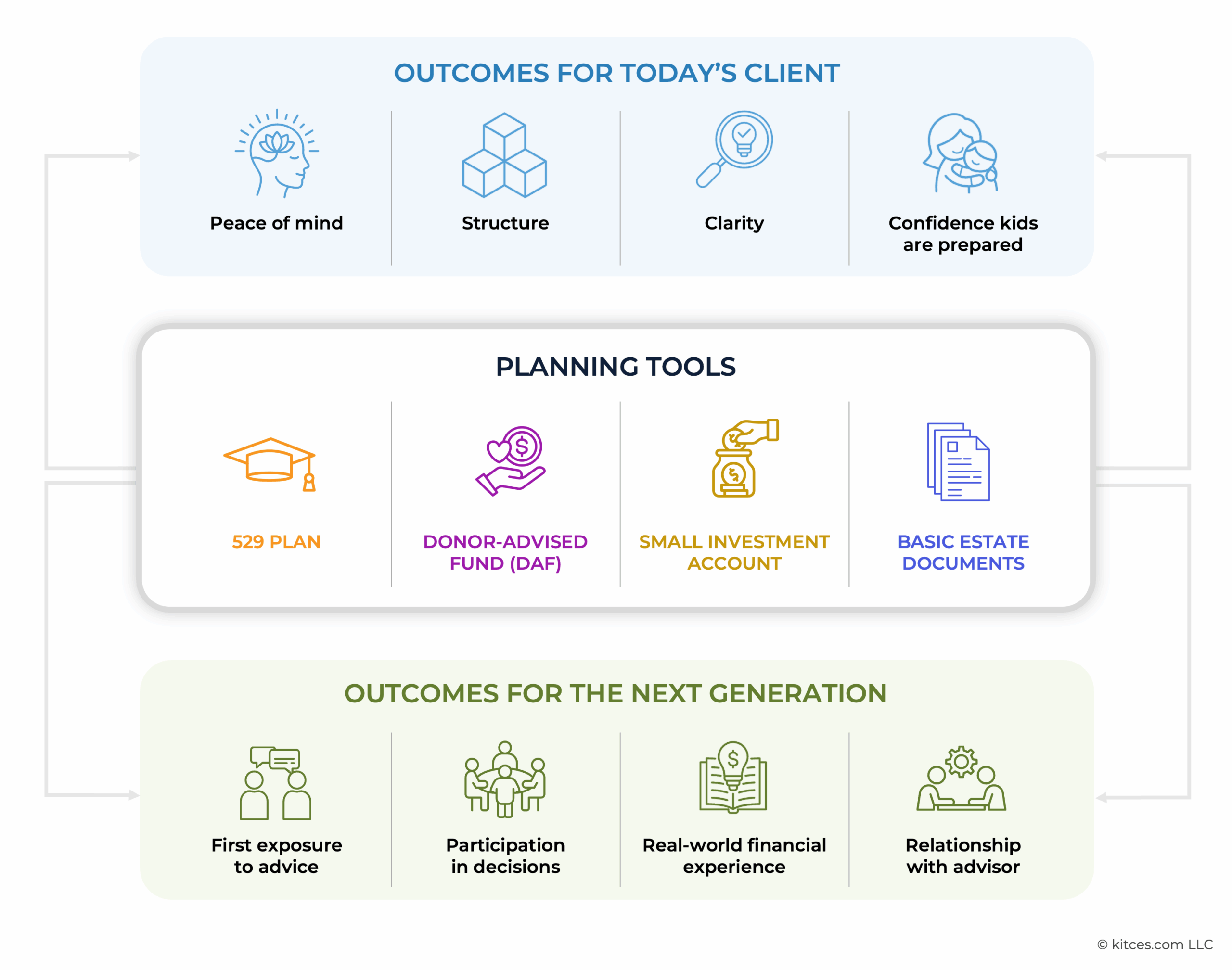
For instance, education planning can offer an early touchpoint, as an advisor might bring a 529 plan beneficiary into a conversation to discuss how the account may eventually be used and to show how financial planning translates into real-world outcomes. Charitable planning can also create a meaningful participation opportunity, such as when clients invite children into conversations about giving values and allow them to help direct a portion of charitable donations. Similarly, smaller investment accounts can give advisors a way to discuss concepts such as asset allocation, risk tolerance, and time horizon in a lower-stakes setting, while trust and estate planning conversations can help prepare future fiduciaries for responsibilities they may eventually need to take on.
As those early interactions accumulate, they can create a foundation for deeper family governance conversations. And because clients might feel hesitant about sharing detailed financial information or estate plan specifics, advisors can frame those meetings not as exercises in disclosure, but as opportunities to prepare heirs for future decision-making roles. Which can help clients articulate intentions that might otherwise go unspoken while also increasing their confidence that their plans will be understood and carried out as intended.
Ultimately, the key point is that while estate planning and inheritance conversations can be sensitive, many advisory relationships already contain natural entry points for involving the next generation in meaningful ways. And when those opportunities are used intentionally, they can improve family dialogue, help heirs feel more prepared for future responsibilities, and strengthen both the likelihood of continuity after a wealth transfer and the value of the planning itself for the current client!

Over the past decade, the financial planning industry has spent considerable time focusing on the "Great Wealth Transfer". Trillions of dollars are expected to move from older generations to their heirs in the coming years and decades. The drumbeat has been so constant that, for some advisors, it can start to feel like someone repeatedly insisting they have to watch a universally popular TV series – to the point that they avoid watching it almost out of principle. Because when a message becomes that ubiquitous, it can start to lose its urgency and feel more like a sales pitch than a genuine concern.
For advisors, however, this transition represents both a significant opportunity to serve existing clients in a meaningful way and a substantial risk of losing continuity once those assets pass to heirs. While much of the conversation has centered on how to retain assets as they move to heirs, the reality is that many advisors will still lose those relationships shortly after the transfer occurs, even when clients genuinely want their advisor to help their kids – especially at a stage when those children may not yet have the assets or the inclination to address basic planning needs themselves.
Why Advisors Often Fail To Build Relationships With The Next Generation
In many cases, the problem is not that heirs reject a long-standing advisory relationship, but that no meaningful relationship with them was ever established in the first place. Which makes it important to understand why that gap forms before the wealth transfer ever occurs.
Why Familiarity With The Family Does Not Always Mean A Relationship With Heirs
Often, when advisors fail to retain assets across generations, the cause is not poor performance, bad service, or inadequate planning. In many cases, the underlying plan is sound. The portfolios may be appropriate, the estate structure well designed, and the technical work done correctly. And yet, when the transition actually happens, the relationship does not continue. More often than not, the explanation is much simpler: the next generation never developed a meaningful relationship with the advisor in the first place.
This is not always obvious from the advisor's perspective. Over time, working closely with a client can create the sense that the advisor understands not just the individual, but the broader family dynamics as well. Advisors hear about children and grandchildren, follow major life events, and, in some cases, may even have limited social or passive professional interactions with them. But that familiarity is often one-directional. While the advisor may feel connected to the family, the next generation may only have a vague understanding of who the advisor is or what role they play.
In many cases, heirs have had little direct interaction with the advisor before inheriting assets. They may know that their parents worked with someone and may even have heard positive things about their parents' advisor, but they have not experienced the relationship themselves. They have not seen how advice is delivered, how decisions are made, or how the advisor fits into the broader financial picture.
Consider the common situation where an advisor has worked with a client for decades, helping manage a portfolio of assets the client built over time, while coordinating with attorneys to put an estate plan in place for the benefit of the children. When the client passes away, those children may inherit assets through a combination of beneficiary designations and trust interests. From the advisor's perspective, this may feel like the continuation and culmination of a long-standing relationship. But for the children, it is often just an introduction.
And that introduction may come at one of the worst possible moments in a person's life: after the death of a parent, during incapacity, or in the middle of estate or trust administration. Up to this point, the planning process often excluded them from meaningful participation. Estate planning conversations – where key decisions around structure, control, and responsibility are made – are typically limited to the client, the estate planning attorney, and (ideally) the advisor. The individuals who will ultimately be responsible for carrying out those plans are often not brought in until they need to act.
By then, those individuals may be stepping into roles such as trustee, executor, or agent under a power of attorney – with only a limited understanding of what those responsibilities entail – facing accounts that need to be retitled, distribution decisions and timing considerations to evaluate, and imminent administrative responsibilities to handle. These can be decisions that have real financial and tax consequences, and often need to be addressed quickly. Under those conditions, the advisor is not building a relationship with a long runway; they are being evaluated in real time.
Why Post-Transfer Retention Is So Difficult
This situation creates two related challenges that reinforce one another: the next generation may not feel fully prepared for the roles they are being asked to take on, and they may have little existing relationship with the advisor. A lack of preparedness can increase stress during an already difficult period, making heirs more likely to seek outside guidance. And without an existing relationship, the advisor may have a harder time providing guidance in a way that feels trusted and welcome.
Importantly, many heirs are already well into their professional lives and may already have existing relationships with other professionals, or may be influenced by peers, colleagues, or their own preferences around who should help manage their financial lives. Even when the current advisor is well qualified, the absence of a prior relationship makes continuity less likely. This is not a reflection of the quality of the advice, but of when the relationship began.
From a behavioral perspective, familiarity plays a significant role in how trust develops with a professional. Individuals are generally more comfortable continuing relationships that already exist, even if those relationships are relatively limited. By contrast, establishing a new relationship during a period of stress requires trust to develop quickly, which can be much more challenging. As a result, even small, early interactions with the next generation can have a big impact on whether a relationship continues after a wealth transfer.
It also helps explain why post-transfer retention strategies often struggle to produce consistent results. Outreach that begins only after assets have moved is trying to solve a problem that has already fully developed. By that point, the advisor is competing not only with other professionals, but with the natural tendency of heirs to rely on relationships that feel more familiar.
A more effective approach is to shift that engagement earlier and ensure there is already a relationship in place well before a wealth transfer takes place. Rather than waiting until wealth transfers occur, advisors can involve the next generation during the planning process itself – not as a separate marketing initiative, but as a natural extension of the work already being done. Because in practice, many of the most common planning strategies already create opportunities to involve heirs in meaningful ways: education funding conversations, charitable planning decisions, and trust design discussions all provide natural entry points.
Used more intentionally, those conversations can build both familiarity and understanding. This can help prepare future decision-makers for the roles they may eventually assume while also creating early points of connection between advisors and the next generation. Ultimately, engaging the next generation is not just about improving the likelihood of retaining assets after a transfer, but also supporting the planning itself for the client!
Planning Strategies That Naturally Create Opportunities For Next-Generation Engagement
If the issue is that advisors are often introduced too late, the natural next question is where earlier engagement is actually supposed to happen. In practice, this is where the idea can start to feel a little abstract. It's easy to say "build relationships earlier", but much harder to identify what that looks like in the day-to-day context of advisory work.
Fortunately, many – if not most – advisors do not need to create entirely new processes or service offerings to engage the next generation. The opportunity is likely already there, embedded in the typical planning strategies being implemented for the primary client. And importantly, these opportunities are not just about long-term relationship continuity with the next generation. In many cases, they create immediate value for the current client by addressing concerns they may already have about whether their children are prepared, engaged, or even aware of the planning that has been put in place.
Education Planning As An Early Touchpoint
529 plans are often among the earliest financial accounts established for a child or grandchild. For many years, they typically remain in the background. Contributions are made, an investment directive is selected, and the account grows tax-deferred – and potentially tax-free – with little involvement from, or even awareness on the part of, the beneficiary. But as college age approaches, the nature of the conversation changes. What was once a long-term savings vehicle becomes an account that is about to be used for the beneficiary's benefit. Questions around qualified expenses, distribution timing, and coordination with other resources become relevant in a very practical way.
This creates a natural entry point for next-generation engagement. Including the beneficiary in even a limited conversation does not require a major change in process, but it does create meaningful exposure. It gives them a chance to see how financial decisions are made, how the advisor communicates, and how the planning translates into real-world outcomes. The goal is not to educate them on the full mechanics of 529 plans or every related tax rule, but simply to make the advisor visible in a context that matters to them.
Charitable Planning As A Participation Opportunity
A similar dynamic appears in other areas of planning, often in ways that may be even more impactful. Charitable planning – particularly through donor-advised funds – tends to create one of the more natural opportunities for next-generation involvement. Unlike many financial decisions, charitable giving is not purely transactional. It is often tied to values, priorities, and personal experiences, which can make it easier to bring multiple generations into the conversation.
A client who has an established pattern of charitable giving may already be making annual decisions about which organizations to support. Involving children in that process – whether by asking for input, allocating a portion of charitable donations for them to direct, or simply walking through how those decisions are made – can create meaningful participation. At the same time, it introduces the advisor in a context that feels collaborative rather than transactional. Over time, those interactions can become recurring, and that consistency may matter more than any single conversation.
Trust Structures As Preparation For Responsibility
As heirs move toward adulthood, engagement often shifts from simple awareness to preparation for roles they may eventually need to take on. Estate plans – and trusts in particular – are often designed with goals such as efficient distribution, tax savings, asset protection, and control. But from a practical standpoint, they also assign important responsibilities.
Successor trustees, co-trustees, and agents under powers of attorney may eventually be expected to step into roles that involve discretion, close oversight, and, ideally, coordination with the advisor. Yet those individuals are rarely involved in the conversations where those expectations are established and context is provided up front. Introducing those future fiduciaries to the structure of the plan during the client's lifetime can materially change that dynamic. It does not necessarily need to involve a deep technical review, but it should provide clarity around what the role entails, how decisions are expected to be made, what standards apply, and how the advisor supports the process.
Concepts like discretionary distribution standards, fiduciary duty, or even the distinction between income and principal may seem straightforward to the professionals drafting the plan, but they can be far less intuitive to the person responsible for implementing the plan. Providing that context in advance makes it more likely those issues will be understood before they arise, rather than encountered for the first time under the intense pressure of a major life event such as death or incapacity.
Smaller Accounts As A Tool For Education
Smaller investment accounts established for children – relative to the client's overall net worth – can provide a practical training ground for heirs to better understand the planning and investment process. If a client has a vehicle for annual gifts or for gradually transferring assets, it can serve a much broader purpose than simply moving wealth. For many individuals, the first meaningful interaction with financial decision-making occurs when they are responsible for an account of their own.
Even if the value of the account is relatively modest, the decisions are real. Asset allocation, risk tolerance, and time horizon are no longer abstract concepts; they are tied to actual outcomes. That creates a natural reason for interaction with the next generation. Rather than waiting until a larger pool of inherited assets is involved, these accounts allow the advisor to engage earlier in a lower-stakes environment. Questions can be asked, decisions can be discussed, and familiarity can develop over time.
More broadly, engaging with the next generation is best understood as a progression rather than a single moment. There is rarely a single 'right' moment for introductions. Instead, engagement tends to unfold over time. It may start with simple exposure through an education planning conversation, evolve into participation through smaller financial decisions, and eventually lead to preparation for larger financial responsibilities. Not every client will want the same path for next-generation engagement, or even the same level of disclosure around financial details. But viewing engagement as a progression makes it easier to identify where to begin and better reflects how relationships actually develop.
Turning Planning Conversations Into Relationship-Building Opportunities
Advisors may recognize that involving the next generation earlier is beneficial, but still hesitate because they are unsure how to introduce the conversation, how much to share, or how the client will respond.
In practice, the difference between an idea and execution often comes down to how these interactions are framed and structured. When next-generation engagement is treated as a one-time event, it can start to feel forced. When it is introduced gradually and methodically tied to the planning process itself, it can tend to feel more natural.
Using Planning Milestones As A Starting Point
One of the more effective ways to begin engaging the next generation is by anchoring their involvement to moments that already exist within the planning relationship. Education funding decisions, charitable planning conversations, and discussions around future fiduciary roles all provide natural entry points. These are situations where the next generation is directly affected or will eventually have some level of responsibility, which makes their inclusion easier to justify.
Importantly, these early touchpoints can be quite simple. A short conversation about how a 529 plan works and how it may eventually be used, or a brief introduction to how charitable decisions are made, is often enough to create initial familiarity.
For example, an advisor might meet with a client's high-school-aged child who has just started a summer job. Rather than positioning it as a formal planning meeting, the conversation can be framed around something immediate and relevant, like what the student expects to earn, why their first paycheck is smaller than expected because of taxes and withholdings, and what that means for how much they will actually be able to take home and spend.
From there, the discussion can naturally extend into how to think about spending versus saving, setting aside a portion for near-term goals (like a car or college expenses), and introducing simple habits like using a separate savings account. The concepts may be simple, but the impact is not. The student leaves with a clearer understanding of their own money for the first time, and the advisor becomes associated with practical, approachable guidance at a formative moment.
Over time, these smaller touchpoints can accumulate into something more meaningful. The goal at this stage is not to fully educate or transition responsibility, but simply to make the advisor visible in a context that feels relevant.
Structuring Family Governance Conversations
Once those interactions are built and become more frequent, the opportunity shifts from simple exposure to more substantive interactions. This is where family governance planning conversations become particularly valuable, but also where many advisors are less certain about how to proceed.
In many cases, the most important part of these meetings happens before the meeting itself. Advisors often need to work with the client to clarify what they are comfortable sharing, what the objective of the discussion is, and how the conversation should be framed. This upfront alignment can significantly reduce hesitation and help position the meeting as a controlled and intentional discussion rather than an open-ended disclosure.
These family conversations aren't necessarily about reviewing account balances or walking through the financial or estate plan. Instead, they're about explaining how the plan is structured and how decisions are expected to be made. Estate plans often reflect broader intentions of how wealth should be stewarded, how discretion should be exercised, and what priorities should guide decision-making. But those intentions are not always communicated clearly to the individuals who will eventually be responsible for carrying them out.
Creating space for that discussion often starts with the advisor working with the client to define the scope of the conversation. This is often where hesitation shows up. Clients may be concerned about sharing too much information, creating unnecessary complexity, or introducing topics they are not fully ready to discuss.
Framing The Conversation As Preparation, Not Disclosure
Full transparency is not necessarily the goal if the client is uncomfortable, but it is important to frame the objective clearly. The purpose of the conversation is not disclosure, but preparation. A meeting that includes the next generation can focus primarily on roles, responsibilities, and future decision-making without requiring detailed financial information. For example, an advisor might facilitate a discussion around what it means to act as a trustee, how discretionary distributions are typically evaluated, or how different components of the estate plan interact. These are concepts that provide substantial clarity without requiring disclosure of specific asset values.
From a practical standpoint, structuring the meeting in advance can also help reduce friction. Setting expectations around what will be covered – and what will not – can give clients more control over the process. In many cases, it is helpful to position the initial meeting as a high-level, primarily educational conversation, with the understanding that additional detail can be introduced later if appropriate.
Advisors may also need to prepare the client for how the conversation will feel. For some families, this may be the first time these topics are discussed at any level of detail. Acknowledging that from the start, and emphasizing that the goal is simply to provide context rather than press for decisions, can help lower the barrier to getting started.
From such a meeting, heirs gain a clearer understanding of what may be expected of them, and advisors gain the opportunity to interact in a setting that is not driven by urgency. Over time, those interactions can serve as a foundation for both preparedness and relationship continuity.
What may start as a somewhat uncomfortable idea – bringing children into a planning discussion – often results in a clearer sense of alignment across the family. Clients are able to articulate intentions that might otherwise have gone unspoken, and in many cases gain confidence that their planning will actually be understood rather than simply implemented. Helping the client move from uncertainty to clarity can be one of the more meaningful outcomes of the planning process.
Extending The Relationship Beyond The Parents' Plan
A relationship that exists only in the context of the parent's plan can be difficult to sustain if it does not translate to the heir's own situation. This means the advisor should remain available as a resource during key transition points in the heir's life. Situations like starting a career, evaluating workplace retirement plan options and contribution decisions, making insurance choices, or purchasing a first home are all moments when guidance can be valuable and the time commitment relatively modest.
These interactions do not need to evolve into a full advisory relationship immediately, but they do give the advisor an opportunity to demonstrate how they think and how they add value. This is especially important because many younger individuals are used to managing their financial lives through tools that emphasize clarity, accessibility, and immediacy. Convenience is not viewed as an added benefit; it is the baseline expectation. When planning feels difficult to engage with, it tends to be deferred. When it feels understandable and relevant, however, engagement is more likely to happen earlier and more consistently. Engaging the next generation, then, is not just about introducing them to the existence of a plan, but about making the planning process itself easier to understand and interact with over time.
Over time, that relevance becomes increasingly important. When the next generation begins to take on greater financial responsibility and accumulates assets of their own – or inherits them – they are more likely to continue working with an advisor who has already been part of their decision-making process.
Creating Immediate Stickiness With The Current Client
While much of next-generation engagement is framed as a long-term retention strategy, some of the most practical opportunities create immediate value for the current client.
As children reach the age of majority, many have little to no planning in place. Basic documents such as powers of attorney, healthcare directives, and even simple coordination around financial accounts are often missing, not because they are complicated, but because they are easy to overlook. For most families, it simply does not feel urgent until something happens.
This creates a very natural role for the advisor. Helping coordinate or facilitate these foundational planning steps – whether by working with an estate planning attorney, explaining what documents are needed, sharing digital tools that can help create them, or simply prompting the conversation – addresses a gap that many clients are already concerned about but have not yet acted on.

Nerd Note:
At the age of majority (18 in most states), parents generally lose the legal authority to access financial accounts, communicate with institutions, or make healthcare decisions on behalf of their child without proper authorization. This includes restrictions under laws like the Health Insurance Portability and Accountability Act (HIPAA), which can limit access to medical information absent specific authorization.
This creates a somewhat counterintuitive dynamic because many 'new' adults are still dependents for tax purposes, remain on their parents' health insurance, and may rely on them for day-to-day expenses. Yet legally, the parents may have little to no ability to act on their behalf without foundational planning documents in place.
Clients gain the practical reassurance that their children have at least a basic level of protection and structure in place, that they can step in to help if needed, and that the family won't be completely unprepared in the event of an emergency. Importantly, these steps have been handled proactively rather than reactively.
From a relationship standpoint, this creates a different kind of 'stickiness'. The value is not tied to investment performance or long-term strategy for the client alone, but to a more abstract family-related concern that may be what's keeping them up at night. In many cases, this is one of the few planning recommendations that produces a tangible sense of relief almost as soon as it is implemented.
The benefit to this approach is that the next-generation relationship is secondary, but still present. The advisor becomes associated with helping the family navigate a transition from dependence to independence in a way that feels practical and thoughtful. And while that may not immediately translate into a formal relationship with the next generation, it does establish familiarity at a point where it is both relevant and appreciated. In that way, foundational planning for young adults supports long-term continuity while also reinforcing the value of the advisory relationship in the present.
Ultimately, the key point is that engaging the next generation is rarely about creating an entirely new service model, but about recognizing the opportunities already embedded in the planning work advisors are doing every day. Whether through education planning, charitable conversations, trust structures, or practical support during key life transitions, small moments of involvement can build familiarity, preparedness, and trust over time. And when those interactions are approached intentionally, they can strengthen both the likelihood of continuity after a wealth transfer and the value of the planning itself for the current client!





Leave a Reply