Executive Summary
While financial advisors often have discretionary control over a client's entire investment portfolio, sometimes new clients enter an advisory relationship with large, 'legacy' positions that they do not want (or are not able) to liquidate. For instance, the client might own a significant number of shares in a closely held business, hold a large position in company stock subject to a lock-up period, or have inherited shares of stock from a loved one that hold emotional value. While an advisor might be tempted to view such positions as peripheral (particularly if the firm isn't charging a fee on those assets), they can be subject to regulatory and civil litigation risks if the firm doesn't have a clear process for advising on (or around) them – including thorough documentation and consistent disclosure of recommended actions to clients.
In this guest post, Rich Chen, the founder of Brightstar Law Group, discusses how RIAs' fiduciary obligations apply to legacy positions, common scenarios (and traps) when dealing with them, billing considerations for firms, and best practices for advisors in managing legacy assets.
Under the Investment Advisers Act of 1940, investment advisers, whether or not they are registered with the SEC, owe clients a Federally-defined fiduciary duty comprised of two distinct obligations: a duty of care and a duty of loyalty. Notably, both duties apply to legacy assets; while the scope of an advisor's fiduciary obligations may be shaped by agreement between the client and advisor, the duty cannot be waived completely.
There are several 'traps' advisors can fall into when managing legacy assets, from assuming that limited trading authority means limited responsibility (when it does not), over-reliance on verbal understandings that are never documented (and that a client might remember differently years later), inconsistency across documents (e.g., an advisory agreement saying one thing and billing statements implying another), and arrangements that were reasonable when established but have become increasingly problematic as a client's circumstances have changed. Presenting alternatives (to continuing to own the legacy position) to the client – and documenting this communication – is the advisor's best defense against regulatory examination and civil litigation.
Billing on legacy assets presents another challenge, as regulators will want to ensure that the advisor's fees are reasonable given the level of service they're providing. Firms have multiple options for handling billing around legacy investments, including excluding legacy assets from billing entirely, continuing to bill on those assets while documenting client-imposed restrictions, and adopting alternative fee structures (e.g., charging a flat planning fee plus an asset-based fee on managed assets) designed to better align compensation with services rendered. Importantly, there is no one 'right' approach; a firm might choose a particular approach based on its own service model and the unique circumstances of its clients.
Amidst this backdrop, several best practices emerge for working with client assets to prevent misunderstandings and mitigate the risk of civil litigation and/or regulatory actions, including documenting client restrictions, clearly defining the advisor's role, evaluating the asset's impact on the overall portfolio, reassessing legacy asset arrangements periodically, ensuring billing practices remain appropriate, and preparing for examination scrutiny in advance. In sum, the most effective firms recognize that legacy assets require more process than advisor-managed assets, not less, because the advisor's limited authority makes documentation and communication all the more important.
Ultimately, the key point is that because there is no universal rule concerning handling legacy investment positions, firms can best serve their clients' interests (and protect themselves) by building a repeatable, consistent framework to deploy when working with a client with such a position!
 |
And if you want to go deeper on this topic, hear directly from the author on the Financial Advisor Technician podcast. |

Listen To The Financial Advisor Technician Podcast On This Topic




Episode Shownotes And Transcript
Click to expand transcript and show notes↓↓
Shownotes:
Episode Transcript:
Adam: Hello and welcome back to the Financial Advisor Technician podcast, I'm your host Adam Van Deusen.
On today's episode we're going to discuss concentrated investment positions, which clients might have because they are made up of shares of stock of the company they work for, because they inherited a large position in a single stock, or for other reasons. While concentrated positions present a challenge from a portfolio management perspective (given that they can make up a substantial portion of a client's overall portfolio), working with clients who have these positions (and particularly those who want to hold on to them) can also raise compliance issues, as the way they are managed (and billed on) can sometimes be different than how the rest of the client's portfolio is treated.
To help us dig deeper into this topic, I'm joined today by Rich Chen, the founder of Brightstar Law Group, to discuss the fiduciary challenge of working with clients who have concentrated positions, potential pitfalls that could get advisors into hot water with the SEC or even lead to a lawsuit, options for charging fees on concentrated positions, and best practices for advisors to support these clients compliantly.
Welcome, Rich, and thanks for joining us on the "Financial Advisor Technician" podcast.
Rich: Thank you so much for having me, Adam. I'm excited to be here.
The Fiduciary Challenge Of Working With Clients Who Have Concentrated Positions [1:33]
Adam: So to start, perhaps you could provide a quick rundown of why clients who hold legacy or concentrated positions can present challenges for an advisor from a fiduciary perspective and what the consequences of that might be.
Rich: Yeah. So a lot of clients, whether they come in with employer stock positions or large concentrated inherited positions, things like that, they don't want the advisor to really touch those positions for a variety of reasons, sentimental or tax reasons. And it can be challenging for an advisor to figure out how to work with those restrictions, at the same time, doing their job. Oftentimes what happens is that the advisors may say, "Well, okay, if the client doesn't want me to touch it, then I won't." But at the end of the day, the client may have different expectations about whether or not the advisor is going to actually give any recommendations or things like that.
And so when advisors have a disconnect with clients in terms of what the expectations are with respect to what to do with those investments, that can create a problem, because if advisors aren't doing very much, they subject themselves to possible lawsuit or an SEC action saying that, basically, they didn't satisfy their fiduciary duty to the client to act in their best interest.
Adam: Yeah, that's a great point, because I think, when a lot of advisors or a lot of folks maybe think about concentrated positions right now, it's a very hot topic. We've been in an extended bull market period. So a lot of people either have very large positions, or maybe they're getting inherited positions, or they work for a company that has a large, concentrated position. A lot of the talk is about, "Hey, what are we going to do from a tax perspective or an investment diversification perspective?" But I think the key point here is what you're saying is that there's also potentially a fiduciary risk if the advisor and the client aren't on the same page here. So perhaps you could walk us through maybe a scenario where an advisor could sort of find themselves in trouble when working with a client with a concentrated position.
Rich: Yeah. So definitely, there are situations where, let's say, a client has employer stock. And basically the client says, "Well, I don't want you to touch this because I have a low cost basis, and also, there are certain restrictions on what I can do." And an advisor may say, "Well, okay, that's fine." But sort of billing on those amounts and not really doing anything without sort of telling the client whether they're going to take that into consideration in terms of how they're going to provide overall financial planning and investment management can prove problematic, especially when there's billing. So an advisor may not necessarily agree with such a heavy concentration, but it's important for them to actually communicate that to the client as well and to let them know, "Well, okay, this is not ideal, and maybe we should try to sort of pare this position down over time," or, "Here's alternatives on how we could hedge your position," because not doing so risks the possibility that that stock may go down over time.
And that's something, like you mentioned, we haven't really faced lately with an extended bull run, but definitely, these suits happen when these positions do go down. And God forbid, we have a downdraft that will make these positions much more exposed to that likelihood. And if an advisor doesn't clearly communicate what it's going to do and sort of say, "Well, I think this is something that we want to ideally pare down over time or sort of think about alternatives for hedging," that can be a problem.
Adam: Yeah. So it seems like a big issue here is sort of expectations, whether it's, you mentioned, fees before, and we're going to come back to the fee question, but also about what services are being offered. Because again, the client might think that, "Well, even though this position isn't being sold, the advisor is still dealing with it," whereas the advisor may or may not be on the same page. So that's a really good example.
Rich: One of the things actually is...the interesting thing about employer stock is that sometimes if the advisor is not careful about when those restrictions come, when they're lifted, and the advisor is not sort of paying attention to that, and the client wants to sell or there's a stock auction exercise or something along that line, that can also create missed expectations where the client's like, "Well, okay, that should have been sort of looked at by the advisor as well."
What The SEC Has To Say About Fiduciary Obligations And Concentrated Positions [5:59]
Adam: Oh, interesting. So perhaps taking a step back, what does the SEC [Securities and Exchange Commission] actually say about an advisor's fiduciary obligations when it comes to this topic?
Rich: Yeah. So SEC-registered firms owe two primary fiduciary duties. First is the duty of care, which is the one that most people think of when they think of fiduciary duty, which is basically to act in managing the assets in the best interest of the client. And that holds true not only on an initial basis, but an ongoing basis if that's, in fact, what the advisor is doing. It's not just a one-time piece of advice. There is the expectation that there is ongoing sort of supervision or management of the position, and that, of course, can be sort of negotiated between the advisor and client, but it has to be made clear. The second duty is the duty of loyalty, which is the duty to provide all material facts relevant to the advice or services and understanding sort of what the advisor will do and what they're being paid for and disclosing or managing any appropriate conflicts of interest.
So both of these tie into sort of how these legacy positions are handled because not only sort of does the advisor have to communicate what's going to be done, but it also has to actually act in accordance with what's laid out in terms of the disclosure to the client.
Adam: Interesting. And so an advisor might have their next SEC examination come up. So this is a question that they might be facing. It says, "Hey, this client has a $5 million concentrated position. What are you doing about it?" So I'm assuming, from an advisor's perspective, the best practice here is going to sort of have the documentation there to show how they're handling it and that the client agreed to it. So I guess, what goes into high-quality documentation to both satisfy an SEC examiner and, perhaps, in case of a lawsuit?
Rich: Yeah. So basically, the SEC, when they look at whether or not an advisor is satisfying fiduciary duty of care, they'll often look to a client profile as a sort of starting point, right, to basically determine what the client communicated about its risk tolerance, investment objectives, and any guidelines or restrictions, which is where sort of the legacy concentrated position can be sort of documented as being something that the client wanted something in terms of restrictions on how that is handled. So that's oftentimes the first point of comparing what the advisor is actually doing against what the client has communicated as their objectives and risk tolerance and any sort of guidelines or restrictions. If there are any concerns with respect to such a heavy concentration, it is important for advisors to communicate that to the client because the client may not necessarily understand it. And even if it's said verbally, people do tend to forget. And if it's not documented from the SEC standpoint and from a legal standpoint in general, if the client sues, there's no record that the advisor cautioned the client about having a concentrated position or what they could do in order to sort of manage that risk.
Adam: Yeah, it's a tricky question because from the advisor's perspective, they might say, "Oh, well, I'd prefer if we could diversify out of this position." But of course, the clients often have several potentially valid reasons. As you mentioned before, some might be actually restricted from selling it, in the case of maybe employer stock. But you might have sentimental shares of a certain stock that have been in the family for decades and decades, and they don't want to. So there's definitely valid reasons for it. But it sounds like the key point here is coming to a clarity of understanding and writing down exactly what was discussed, why the client wants to take this position, and then how the advisor is going to incorporate it in their financial planning process.
Rich: Yes, that's exactly right. All of those things need to be clearly communicated. And I think it's particularly important for advisors just to make sure that they're communicating that clearly to the client.
Options For Advisors When Charging Fees On Concentrated Positions [10:08]
Adam: Great. So something you mentioned before was the issue of billing, and I can imagine this is particularly thorny. So let's say you're an advisor out there. You charge on an assets-under-management basis. There's a big difference in what you're going to charge if you're charging on the client's, let's say, $2 million investment portfolio or also including their $10 million concentrated position in employer stock. A really big difference there. But of course, the issue is that if the advisor is going to be taking that large, concentrated position into account when it comes to financial planning, whether it's tax planning, retirement projections, things like that, there is something to be said about being compensated for that work. Perhaps you could break it down in terms of the different options advisors might have for handling billing in such a situation.
Rich: Yeah. So as you mentioned, it is entirely valid for advisors to charge on overall position, and they can do different things and still be compensated overall. I think, however, if you are, in fact, charging on an ongoing basis, oftentimes there's a question of, "Well, are you really providing the services that warrant the fee that you're getting?" So the first position that some folks do is they'll simply exclude the concentrated position basically and, in that vein, relieve themselves of some responsibility, at least with respect to that specific position, and basically say, "Well, okay, we're just not going to charge on that" and basically wash our hands of anything that happens with respect to that individual stock. That being said, they still have the overall obligation, let's say, with that sort of $2 million sort of liquid piece to make sure, if it's possible, to actually sort of satisfy the risk tolerance and liquidity needs of the client and do that as well.
Some folks, oftentimes, it's a significant loss of revenue if you're not able to bill on those assets. So some advisors will basically say, "Well, okay, we're charging on the entire portfolio," and we'll note that the client has said don't touch the investment. And we will still provide overall sort of management of the entire portfolio and basically document the fact that the client has said don't touch that investment. And that being said, though, you still have to show that there was work done overall with respect to, one, making sure that the client's risk tolerance and liquidity profile and objectives are taken care of with respect to the overall portfolio. But also, it sort of begs the question of, "Well, okay, is there more that you need to do at least to caution the client about that position and sort of what the alternatives are?" especially if the fee is being taken on an ongoing basis.
And then the third option is a hybrid, which is basically, "Okay, we will do a limited sort of review of the concentrated position, and we'll just basically charge perhaps a reduced fee with respect to that position or maybe a flat fee or some other position that is sort of in line with sort of what the responsibility will be, not necessarily managing it, but, say, monitoring it and making sure that there's nothing that comes up that sort of raises an issue that we need to alert the client to." And so those are the three most common ways that billing happens when considering those types of positions.
Adam: Yeah. Okay, so running those down. So the first option is saying, "Okay, I'm just not going to bill on the concentrated position." Now, the downside to the advisor, of course, is there could be a very significant base of assets and so not necessarily getting a fee for that. But I think it sounded like what you were saying, though, is even if you don't charge on those assets, it's not necessarily a situation where you can just not even worry about those or not incorporate them into the plan. Because I'm assuming that for any retirement planning or tax planning, those are still going to sort of be a consideration. So even if you're not charging, it's not sort of a "put it to the side." Is that correct?
Rich: No, that's absolutely correct. Because if you cannot sort of reconcile the fact that the objectives are inconsistent with what the client wants in terms of liquidity, if they won't have, let's say, enough liquidity for their needs, you have to take into consideration what to do with that $2 million liquid piece and make sure that even if you're not charging on the larger piece, that you're taking that into consideration. And frankly, if you're not able to satisfy the objectives and liquidity needs of the client with that in mind, there's even a question as to whether or not you can continue to serve the client because not being able to satisfy their needs creates a fiduciary problem for the advisor.
Adam: Okay, yeah. And I think that's a good point. In some of these situations, especially if it's a prospect who's coming to the advisor, and it's something that's very different than who they commonly serve or their skills, declining the opportunity is potentially a consideration here, I would think.
Rich: Sure, it definitely is. If you're not able to do that in light of the restrictions they place, you definitely have to consider whether or not you can take that engagement on because that will definitely be something that's questioned sort of down the road, whether it's by a regulator or a lawyer.
Adam: Yeah. Okay. So then the second option you mentioned was actually charging on these assets. So I'd imagine an advisor might think, well, they could charge on their normal asset-based schedule, though, I guess, perhaps, some clients might balk at that, especially the very large concentrated position. In your experience, have you seen advisors use perhaps a reduced fee so their other assets are charged at maybe 1%, and they charge on the concentrated position at 0.5 or 0.25 or whatever it is? Is that a possibility?
Rich: I think, actually, that makes the most sense in many cases, because if you're not really able to fully sort of manage those investments, that is the easiest way to sort of say, "Well, okay, we're taking a lower sort of responsibility with respect to those positions, and so we're going to charge a lower fee." That being said, it really comes down to sort of the fact that these arrangements can be negotiated. But generally, what the SEC...without actually sort of digging into these negotiations, they do expect that if you're charging more, there is the expectation that there are more services that are sort of provided overall. So it's definitely a factor, and the reduced fee can sort of lighten some of the responsibility and sort of differentiate between the full management and just something like monitoring of the position to make sure there's nothing really sort of bad that needs to be alerted to the client.
Adam: Okay, great. And then, as you said, I think the third option is perhaps we're taking some sort of hybrid approach here, maybe a flat planning fee, plus AUM maybe on that, the liquid investments there. So a way to recognize the work the advisor is putting in, incorporating the concentrated position into the portfolio without tying sort of an asset-based fee to it.
Rich: Yeah. And oftentimes that will be done, let's say, as an initial assessment. If there's sort of evaluation, say, when they're coming in, you can sort of charge a flat fee and say, "Okay, this is our assessment. These are your options to deal with it." But we don't necessarily do this on an ongoing basis I guess, theoretically, they could charge a flat fee on an ongoing basis as well, and that may deal with some of the conflict issues related to valuation. Because sometimes these positions may be hard to value, and they create conflicts in terms of, sort of, especially if the advisor is being paid on sort of asset-based...using asset-based fees.
Adam: Now, I guess, from the SEC's perspective, are they sort of agnostic in terms of, I guess, they're not prescriptive on what fee model you have to choose when dealing with a concentrated position? I would sense that, it sounds like, their bigger concern is, is the advisor providing a sufficient level of service reflected by whatever fee they're charging? Is that sort of the way for advisors listening to think about this?
Rich: I think it's fair, although I will say that, generally speaking, the SEC tries not to sort of get too involved in terms of how much an advisor is charging, but something where they look at something comparative. If the same fee is being charged, but sort of lesser services are provided, maybe that creates an issue as to, well, does that really make sense from a fiduciary standpoint? But honestly, we generally don't see too much involvement when the SEC is assessing, well, whether or not there's an excessive fee or there's not enough services provided. But definitely, from a comparison standpoint, if they see that, I could definitely see that being an issue.
Adam: Interesting. And for our listeners out there, if you want to dig deeper into these topics, Rich has a terrific article that's up on the Nerd's Eye View blog today that gives a lot of different scenarios into concentrated positions. It gets at this billing question. So if you want to dig deeper, definitely check out the article. And you can get to that at kitces.com/FAT9. And we'll put a link to that in the episode description as well.
Advisor Best Practices When Dealing With Concentrated Positions [19:17]
Adam: Well, terrific, Rich. So we've covered a lot of ground so far today. So we understand some of the types of scenarios where we might encounter concentrated or legacy positions, talked a little bit about the SEC's thoughts, some of the billing practices. So, in terms of practical terms for advisors, maybe we could talk about some best practices for advisors. If we have a listener out there who says, "Okay, I want to make sure I'm crossing my T's and dotting my I's when it comes to this," to start off, what's a top best practice for advisors?
Rich: So my top practice is make sure to take it seriously, because these positions, despite the fact that we've had a bull run, can create real legal and regulatory risk, right? So it's important to make sure that there's proper documentation. And that is found in the advisor's Form ADV, but particularly in the advisory agreement. So if there's going to be a reduced level of services provided for those services, make that absolutely clear, what is going to be done and what isn't going to be done. And then, on the client profiles, important to note if the client said, "Don't sell this stock," make sure that that is absolutely clear that these are restrictions that the client has imposed. And then, also, sort of documentation on the lines of if you disagree and say, "Well, okay, we think, ideally, this is a position that we would pare down over time," that that's communicated to the client and ideally have the client sign off on, basically, sort of caution about what the advisor has recommended in spite of the fact that the client wants to continue to maintain that position.
So those are some of the core things that I would think about doing that will really cover an advisor from a duty of loyalty perspective. If the advisor does take on responsibility with respect to sort of looking after those investments, it's important to make sure to sort of understand those investments and sort of make sure that if you're identifying that there's something that needs to be notified to the client as to a problem, because circumstances do change, that the client is notified, right, that they know that, "Hey, maybe I should rethink my position about having such a heavy concentration here," or alternatives in terms of how to hedge that position. I think that's very, very helpful to have as well. And then, on the sort of annual meeting with the client, revisit the situation and say, "Hey, do you continue to think this way about this position, or has anything changed where we should think about whether or not we can start to sort of diversify away from this position and create a portfolio that gives you sort of more liquidity and perhaps more diversification as well?"
Adam: Okay, interesting. Yeah. So the documentation piece seems like a big one here. Now, it sounds like you're talking about both initially up front, the client agreement, as you mentioned, but is this also something you're sort of recording in the CRM on a regular basis? Any other places where advisors might think of putting this down in writing?
Rich: Yeah, I think definitely CRM. Meeting minutes, when you have your annual meeting with clients, make sure that this sort of position is not glossed over. It's important to make sure that it's addressed, particularly the hard, larger concentration in the portfolio it represents. So that's definitely something that's helpful, and the CRM notes are definitely helpful as well.
Adam: Yeah. And then the other thing I'm hearing from you is sort of this constant reassessment from the advisor's perspective of, I think you've mentioned, over time, maybe the client's job position has changed, or their other portfolio has changed, maybe a lockup period ended. There's going to be potential opportunities to address it. So this is not a set-it-and-forget-it kind of issue. So thinking about that sort of on an annual basis, does that seem appropriate to you?
Rich: That seems fair. I think when you have a position that is subject to sort of release from a lockup or outside of a blackout period, if the advisor has taken on the responsibility of sort of looking at those things or not specifically say that we won't do that, it will be important to do it sort of even more frequently, just to make sure they don't miss a window to sell. Because if the client said, "Well, okay, I know it's restricted now, but if there's an opportunity, let me know, and I could sell it." And if the advisor doesn't say, "Hey, we're not going to do that," that can create some real challenges.
Adam: Interesting. And then, I guess, advisors are maybe thinking about their next examination coming up. If they're going to prepare for potential questions from an examiner, what are the kind of questions they might want to be prepared to answer when it comes to if they have clients in this scenario?
Rich: Well, I think, definitely, several things come to mind. First, have you been able to manage the portfolio, given the restrictions that you have in place from the client? Do you understand, and can you convey what you're actually doing for the client? And is that consistent with what you've outlined in an advisory agreement with the client? And thinking about billing, right? If you're billing on those assets and it doesn't sort of indicate, "Well, okay, there's limitations on what you're doing," are you in fact, giving it sort of the full attention that it deserves? So basically, they're trying to understand, does what you're doing actually match what you've told the client you're going to do?
One Key Takeaway For Advisors [25:09]
Adam: Okay. I think that's really helpful. So, as we come to the end of our time today, what is the one key insight you'd like our listeners to take away from our discussion?
Rich: Take these positions very seriously, because they can be a source of regulatory sanctions. But I think, given where we are in the market cycle and the fact that we haven't had a significant drawdown in a while, there is real legal liability risk here if these positions go down. And fortunately, we haven't seen that. So I think there can understandably be some level of complacency. And I think it's important for advisors to take it seriously. And if need be, go back to sort of how you've been dealing with existing clients to make sure it's clear to them what you're doing and what you're not. And if not, then to actually go back and sort of repaper it to level-set expectations to make sure everyone's on the same page. I often tell people, what oftentimes gets people in trouble legally is mismatched expectations, right? And it's easy to miss that if there's not enough attention paid to it.
Adam: Great. Well, thank you so much for joining us today on the "Financial Advisor Technician" podcast, Rich.
Rich: Thank you so much for having me, Adam. It's been a pleasure.
Advisors' Fiduciary Obligations Towards Clients' Legacy Assets
Financial advisors face a challenge whenever a client arrives with a portfolio that includes significant assets they have no intention of liquidating. The positions may carry embedded capital gains accumulated over decades, represent a family business, or consist of restricted securities that cannot be sold or that the client prefers not to sell for sentimental or other reasons. But the client wants comprehensive wealth management, and the advisor wants the relationship, so the parties strike an arrangement: the advisor takes on the engagement, agrees to leave certain assets untouched, and begins charging fees on the relationship as a whole.
Many firms treat these 'legacy' investments as peripheral, viewing them as assets the advisor is not buying, selling, or exercising discretion over, and therefore not central to the advisor's fiduciary obligations. However, that assumption can prove costly when an RIA fails to clearly define its responsibilities with respect to such assets, both when it comes to dealing with regulators and unhappy clients.
When a legacy position declines sharply in value, clients and their estates frequently look for someone to hold responsible. If an advisor doesn't explicitly define the boundaries of their role, document the client's decision to retain the asset, or present alternative strategies in writing, they can find themselves as defendants in a regulatory or litigation proceeding, facing claims that range from breach of fiduciary duty and negligent investment advice to fraudulent omission and breach of contract. The regulatory and civil litigation risks are distinct but closely related, and both demand the same underlying remedy: process, documentation, and consistent disclosure. To that end, this article examines: (1) why an advisor's federal fiduciary duties of care and loyalty apply to legacy assets and cannot be waived, even where the client restricts the advisor's authority; (2) the common scenarios and recurring traps that arise across concentrated stock, inherited positions, restricted securities, private business interests, and annuities; (3) the three principal approaches RIAs use to bill on legacy assets, and how to align disclosures and compensation with the services actually provided; and (4) the best practices and documentation safeguards advisors should adopt to withstand regulatory examination and civil litigation.
Advisors' Duties Of Care And Loyalty
Fiduciary Obligations Cannot Be Waived
Under the Investment Advisers Act of 1940, investment advisers, whether or not registered with the SEC, owe clients a Federally-defined fiduciary duty comprised of two distinct obligations: a duty of care and a duty of loyalty. The Commission's 2019 Interpretation Regarding Standard of Conduct for Investment Advisors (Release No. IA-5248) describes the obligation to act in the client's best interest as an overarching principle that encompasses both duties. An investment advisor must at all times serve the best interest of its client and not subordinate its client's interest to its own. Both duties apply directly to legacy assets.
One threshold point from the Commission Interpretation deserves emphasis before turning to each duty. The fiduciary duty follows the contours of the relationship between the advisor and its client, and though the advisor and client may shape that relationship by agreement, the federal fiduciary duty itself may not be waived. As this relates to managing legacy client assets, the scope of an adviser's fiduciary obligations may be shaped by agreement, but the obligations themselves persist.
The Duty Of Care
The duty of care includes three components recognized in the Commission Interpretation:
- First is the duty to provide advice that is in the best interest of the client based on a reasonable understanding of the client's objectives. This generally requires a reasonable inquiry into the client's investment profile, encompassing the client's financial situation, level of financial sophistication, investment experience, and financial goals, and an obligation to update that profile as circumstances change. An adviser must have a reasonable belief that the advice it provides is suitable and in the best interest of the client, evaluated in the context of the portfolio the advisor manages and the client's overall objectives.
- Second is the duty to seek best execution of client transactions where the advisor has responsibility for selecting broker-dealers to execute trades.
- Third is the duty to provide advice and monitoring over the course of the relationship at a frequency that is in the best interest of the client, taking into account the scope of the agreed relationship. Where the advisor has an ongoing relationship and receives a periodic asset-based fee, the duty to provide advice and monitoring is relatively extensive. In practical terms for legacy assets, an advisor who constructs a portfolio strategy for the managed portion of a client's portfolio without accounting for a major concentrated legacy position may be failing the duty of care, not because the advisor bears independent responsibility for the legacy position itself, but because advice on managed assets cannot be suitable or in the client's best interest without reference to the client's overall investment profile and objectives.
The Duty Of Loyalty
The duty of loyalty requires an adviser not to subordinate its clients' interests to its own; the investment adviser cannot place its own interests ahead of the interests of its client. To meet this duty, an adviser must make full and fair disclosure to its clients of all material facts relating to the advisory relationship. Material facts include more than just conflicts of interest; they encompass the capacity in which the firm is acting and any circumstances relevant to the advisory relationship. With respect to conflicts specifically, the Commission Interpretation requires the advisor to eliminate or at least expose through full and fair disclosure all conflicts of interest that might incline an advisor, consciously or unconsciously, to render advice that is not disinterested, such that a client can provide informed consent to the conflict. Disclosure that an adviser "may" have a conflict, without more, is not adequate when the conflict actually exists. For disclosure to be full and fair, it must be sufficiently specific that the client can understand the material fact or conflict and make an informed decision whether to provide consent. The duty applies whenever compensation may be influenced by the presence of client assets, regardless of whether those assets are actively traded.
Implications For Legacy Assets
These obligations have concrete implications for legacy assets. An advisor who agrees not to touch a concentrated stock position representing seventy percent of a client's net worth must still consider the consequences of that concentration when advising on the remainder of the portfolio. This is not because the legacy asset itself falls within the advisor's management authority, but because that concentration is part of the client's investment profile and financial situation, and advice on the managed assets cannot be suitable or in the client's best interest without accounting for it. The advisor may need to increase liquidity reserves, reduce risk elsewhere, adjust spending assumptions, evaluate hedging alternatives, or discuss charitable planning strategies, each driven by a position the advisor cannot touch. This principle follows from the Commission Interpretation itself rather than from any single enforcement action: Fiduciary obligations are not defined by what an advisor trades, but by what the advisor undertook to do for the client. A client-imposed restriction limits what can be implemented and shapes the scope of the relationship; it does not eliminate the fiduciary obligation to evaluate how the asset affects the advice being given on the managed portfolio, nor does it waive the advisor's federal fiduciary duty.
In practical terms, an advisor demonstrates what they "undertook to do" through the record they create, not through the label in the advisory agreement alone. The most durable evidence is a consistent, contemporaneous trail: an engagement scope that expressly identifies the legacy asset and how it will be treated, financial plans and investment policy statements that reference the position and its effect on the managed portfolio, meeting notes recording that concentration risk and alternatives were discussed, and billing records that align with that stated role. Where those elements agree with one another, they establish the boundaries of the engagement far more persuasively than any single disclosure, and they allow the advisor to show precisely what they did and did not agree to do.
Common Scenarios (And Traps) Involving Legacy Investments
Assumptions Can Create Advisor Liability
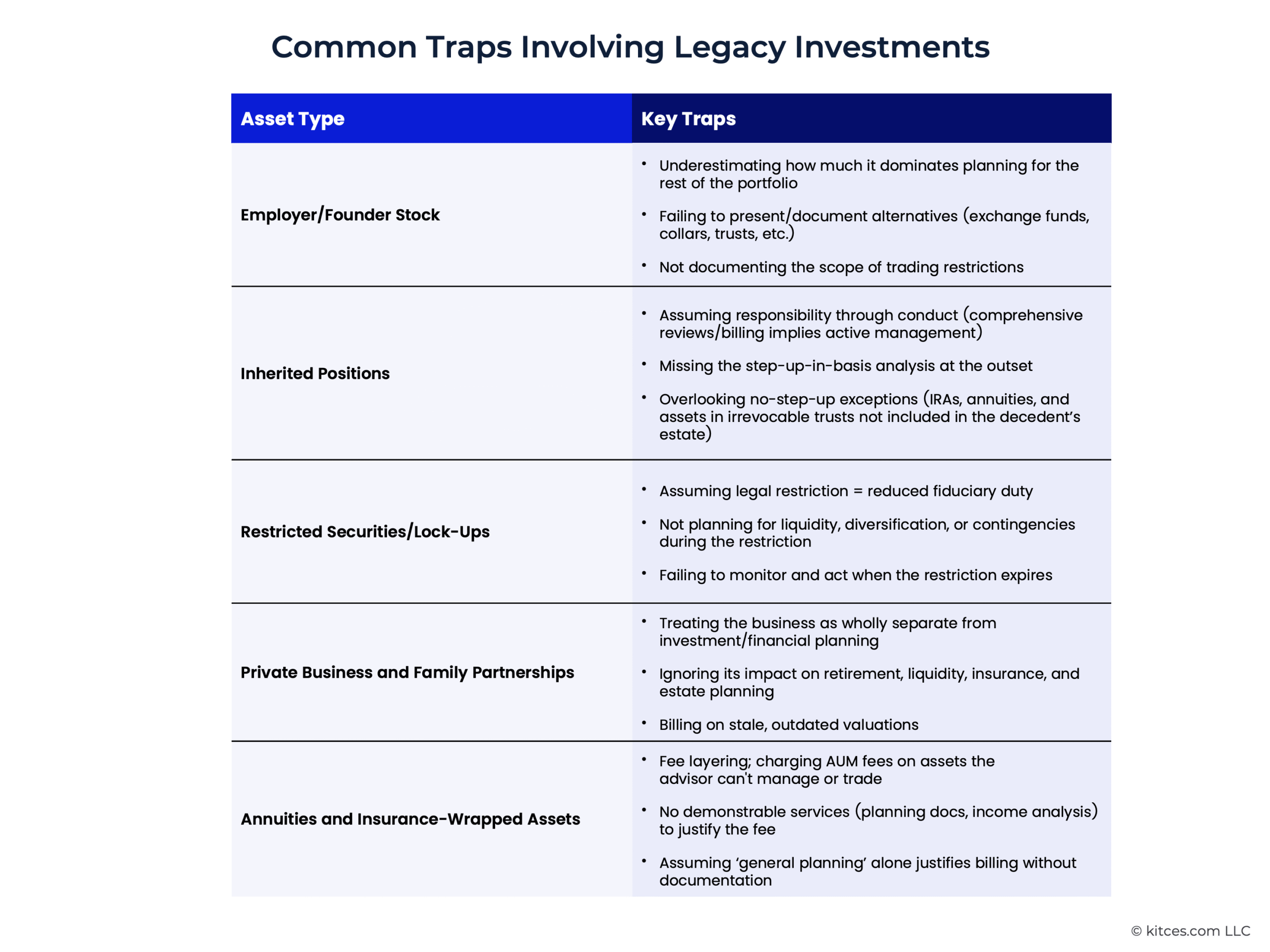
Concentrated stock positions are perhaps the most typical form of legacy investment, particularly among corporate executives and founders. Advisors also regularly encounter private equity investments, hedge fund interests, annuities, restricted securities, employer retirement plans, real estate holdings, family business interests, mineral rights, and other assets that clients either cannot or will not liquidate. The common thread is that the advisor's ability to control the asset is limited while its importance to the client's financial picture remains substantial.
There are several 'traps' that advisors fall into when managing legacy assets on behalf of their clients, and these traps recur across many types of assets. One is the assumption that limited trading authority means limited responsibility, when in fact it does not. Another is over-reliance on verbal understandings that are never documented and that the client may not remember the same way five years later. A third is inconsistency across documents, where the advisory agreement says one thing, the billing statements imply another, and the review materials describe something else entirely. Advisors also fail to revisit arrangements that were reasonable when established but have become increasingly problematic as the client's circumstances, the market, and the law have evolved. The most consequential failure, though, is the failure to present alternatives, not because the advisor believed the client would accept them, but because raising them, documenting them, and recording the client's decision is the single most powerful protection available against both regulatory examination and civil litigation.
A few of these traps warrant elaboration. The "limited responsibility" fallacy refers to the mistaken belief that because the advisor cannot trade an asset, the advisor need not analyze it, monitor it, or account for it when advising on the rest of the portfolio; in reality, the duty of care attaches to the advice given on the managed assets, which cannot be suitable without reference to the legacy position. The verbal understandings that most often go awry are precisely the ones that matter later: that the client, not the advisor, directed the position be retained; that the advisor recommended diversification and the client declined; that the client understood the concentration risk; or that a particular asset was expressly excluded from active management. Five years on, a client facing a large loss may sincerely remember these conversations differently, or not at all. Failure to present alternatives is the most consequential trap because it is the one most likely to convert a market loss into advisor liability: when a concentrated position declines, the central question in any examination or arbitration is whether the client was given, and knowingly declined, reasonable options to manage the risk. An advisor who raised, documented, and recorded the client's rejection of alternatives has a defensible engagement; an advisor who never raised them is left arguing about undocumented conversations against a sympathetic, aggrieved client.
Employer Or Founder Stock
Often a client holds a large position in the stock of a current or former employer, or in a company the client founded. The position may be worth as much as or more than the client's remaining liquid investment portfolio. The client may be unable to freely sell the position until the conditions of SEC Rule 144 are satisfied – including the applicable holding period and, for affiliates, volume limitations, manner-of-sale requirements, and current public information – or the position may be constrained by blackout periods or lock-up agreements. Or even if they are able to sell, they may be unwilling to do so due to emotional attachment, a belief in the company's prospects, a reluctance to realize a significant capital gain, or concerns about optics.
The potential traps here are numerous. First, advisors frequently underestimate how much the concentrated position dominates the financial planning analysis. An advisor managing a $2 million diversified portfolio alongside a $10 million block of single-stock exposure cannot construct a suitable strategy for the liquid assets without centering much of the analysis on the concentration risk. Cash reserves, fixed income allocation, insurance coverage, estate planning, and spending rates all turn on the existence of a position the advisor may have no authority to touch. An advisor who constructs the portion of the portfolio that they manage as if the concentrated position did not exist, or as if it were simply one line item among many, may be providing advice that is neither suitable nor in the client's best interest.
Second, advisors often fail to present or document the full range of strategies available for managing concentration risk short of outright sale. Although selling the position and paying tax on any capital gains can be one option for diversifying a concentrated position (assuming it can be sold), other options like exchange funds, tax-aware long/short strategies, prepaid variable forwards, protective put strategies, collars, charitable remainder trusts, and staged gifting programs may all be relevant depending on the client's tax situation, liquidity needs, and estate planning goals. An advisor who knows these tools exist but never raises them, documents nothing, and simply accepts the client's general preference to retain the position may have difficulty demonstrating that they have fulfilled their fiduciary duty of care with regards to their recommendation (or lack thereof) if the stock later declines in value.
Third, when the stock is subject to trading restrictions, the scope of those restrictions should be documented. An advisor who later faces a claim that diversification should have been implemented sooner needs to be able to demonstrate precisely why it could not have been.
Inherited Positions
In one common scenario, a client inherits a portfolio, often from a parent or spouse, containing positions accumulated over decades. The assets may include a mix of low-basis individual stocks, long-held mutual funds, bonds, and occasionally illiquid interests in private companies or family partnerships. Provided the portfolio was owned outright by the decedent, the client receives a step-up in basis upon inheritance – but even though the tax consequences of liquidating the portfolio may consequently be minimal, the emotional and family significance of the inherited positions may cause strong resistance to liquidation.
The central trap in inherited position cases is that when an advisor provides comprehensive wealth management advice to a beneficiary, sends periodic account reviews covering all assets (both managed and non-managed), and bills on that entire portfolio value, they may, over time, create the reasonable impression that all positions are under active management and oversight – regardless of whether the advisory agreement says that some assets are under the advisor's discretionary management and others are not. Courts and arbitrators evaluating a subsequent claim will look at the totality of the advisor's conduct, not merely the contract language. An advisor who consistently sent reports showing "Portfolio Overview: $4.2 million" encompassing inherited positions alongside managed assets will face difficulty arguing those inherited positions were entirely outside the engagement.
A related trap is the failure to conduct a step-up analysis at the outset of the relationship. When a client inherits a portfolio, the tax basis of most inherited capital assets resets to fair market value at the date of death (though income-in-respect-of-a-decedent assets, such as inherited IRAs, qualified retirement plans, and the deferred gain inside non-qualified annuities, are notable exceptions that receive no step-up). An advisor who fails to identify this, and thereby fails to flag that the tax impact of liquidation may be substantially reduced for inherited assets, may be providing materially incomplete advice at the most important planning juncture in the relationship. Although the custodian typically handles the actual mechanics of stepping up the asset, it is often incumbent on the advisor to facilitate that process by ensuring that a death certificate is provided and that the custodian's systems are updated to reflect the step-up in a timely manner.
It is also often the case that a client inherits a highly appreciated portfolio or concentrated stock position within a trust established for their benefit, in which case no step-up in basis occurs. The client may view the trust as part of the household assets that are available (to a greater or lesser degree, depending on trust terms) to fund their lifestyle – and thus the legacy position is often a component of the assets that the advisor may be considered to 'manage' on the client's behalf (if they report on, bill on, and provide financial planning and analysis based on the trust assets alongside those assets the advisor actually manages for the client).
Restricted Securities And Lock-Up Agreements
Clients who participate in private placements, receive pre-IPO equity, or are subject to post-merger lock-up agreements frequently hold positions they are legally prohibited from selling, at least for a period of time. The advisor's authority is not merely limited by client preference; it is constrained by securities law or contract.
The traps in this scenario are subtler than in others. Because the restriction is legal rather than elective, advisors sometimes reason that fiduciary responsibility is reduced: if the position cannot be sold, there is nothing to advise about. That reasoning is incorrect. The advisor must still evaluate how the illiquid, restricted position affects the liquidity profile of the overall portfolio, what contingency planning is appropriate if the restriction lifts and the position can be sold, what diversification strategies may be available during the restriction period, and what happens to the client's financial plan if the underlying issuer declines in value before the restriction expires.
A further trap is the failure to monitor the expiration of the restriction. Lock-up periods end and Rule 144 holding periods are satisfied, and when that happens a window opens during which diversification becomes possible. An advisor who was not tracking the restriction period may miss the opportunity to present options to the client at the appropriate time – or to execute upon an already-agreed-to plan. That failure can itself become the basis of a negligence or breach of fiduciary duty claim if the position subsequently declines.
Private Business Interests And Family Partnerships
Many affluent clients hold significant wealth in operating businesses, family limited partnerships, or closely held entities that are entirely illiquid. The advisor often has no meaningful role in the management or valuation of the underlying business, yet that interest may represent a substantial proportion of the client's net worth.
The principal trap is the false separation between investment management and financial planning. An advisor managing a $3 million investment portfolio for a client whose family business is worth $15 million cannot separate the advice being given on the investment portfolio from the planning implications of the business. Retirement readiness, liquidity planning, insurance needs, estate planning, charitable strategies, and key-person risk are all shaped by the dominant business interest. An advisor who treats the business as wholly outside the engagement, never asking about its current valuation, never discussing succession planning implications, and never revisiting its impact on the portfolio allocation, is building a managed portfolio on an incomplete picture of the client's financial situation.
A related trap involves valuations. Private business interests are rarely valued contemporaneously. An advisor billing on a stated value that has not been updated in several years may be charging fees on a stale number. That fact, combined with the absence of ongoing services related to the business, can draw both examiner scrutiny and civil claims challenging the reasonableness of the fee.
While billing on a private operating business owned by the client is relatively uncommon, those who do it usually do so only when a reasonably current valuation is available, such as a recent third-party appraisal, a 409A valuation, a financing round, or K-1 and financial-statement data. When no reliable current valuation exists, the better practice is to exclude the interest from AUM billing and charge for the related work through a separate fixed or planning fee, rather than billing on a stale figure that cannot be substantiated.
Annuities And Insurance-Wrapped Assets
Advisors frequently encounter clients who hold variable or fixed annuities, often purchased through a prior advisory relationship, that carry substantial surrender charges, tax-deferred accumulations, and/or guaranteed income riders that make liquidation economically irrational. The client is effectively locked in, and the advisor often has no authority over the annuity contract to change the impact that liquidation would have.
The trap unique to annuity cases involves the advisory fee layering problem. If an advisor charges an asset-based fee on the value of an annuity that they do not and cannot manage, a reasonable question arises: what services are the advisor providing to justify that fee? The annuity is managed by the insurance carrier, the advisor cannot reallocate the annuity's subaccounts without appropriate securities trading authority over the contract, and the client cannot surrender the contract without triggering penalties. If the advisor's rationale for charging fees based on the annuity value is that they take the annuity into consideration when providing financial planning and advice, that consideration needs to be demonstrable through evidence such as planning documents, meeting notes, income analysis, and integration of the annuity's income projections into the client's retirement plan. An advisor who bills on the annuity but cannot produce evidence of ongoing services related to it is particularly vulnerable to both regulatory examination and civil claims.
Billing Practices And Alignment Between Disclosures And Real-World Oversight
Whether advisors should charge fees on legacy assets they do not actively manage is among the most frequently debated questions in this area. There is no universal 'right' answer. The appropriate approach depends on the services being provided, the disclosures made to clients, and the expectations established between the parties, but billing practices can significantly influence how regulators assess fiduciary conduct.
When an advisor charges fees on a legacy asset, regulators may reasonably ask what services justify those fees. Examiners may reasonably question whether fee disclosures are accurate and whether the fees charged are reasonable in light of the extent to which planning services are being provided on an ongoing basis. The SEC's concern is not whether the advisor technically possessed trading authority, but whether the advisor's disclosures, compensation, and actual practices align.
An advisor may lack authority to trade an asset yet provide substantial advice concerning its impact on the client's financial objectives. Conversely, an advisor may include an asset in a managed account while providing very little meaningful oversight. The fiduciary analysis depends less on labels and more on substance.
Client expectations compound the challenge. Most clients do not distinguish between assets that are actively managed and assets that are merely monitored. If a concentrated position later experiences a dramatic decline, clients may question whether the advisor gave them adequate warning or discussed reasonable alternatives. These disputes typically arise years after the original decision was made, once memories have faded – and so documentation of the advisor's actions becomes critical to any regulatory or arbitration proceeding.
Three Approaches To Handling Billing On Legacy Client Assets
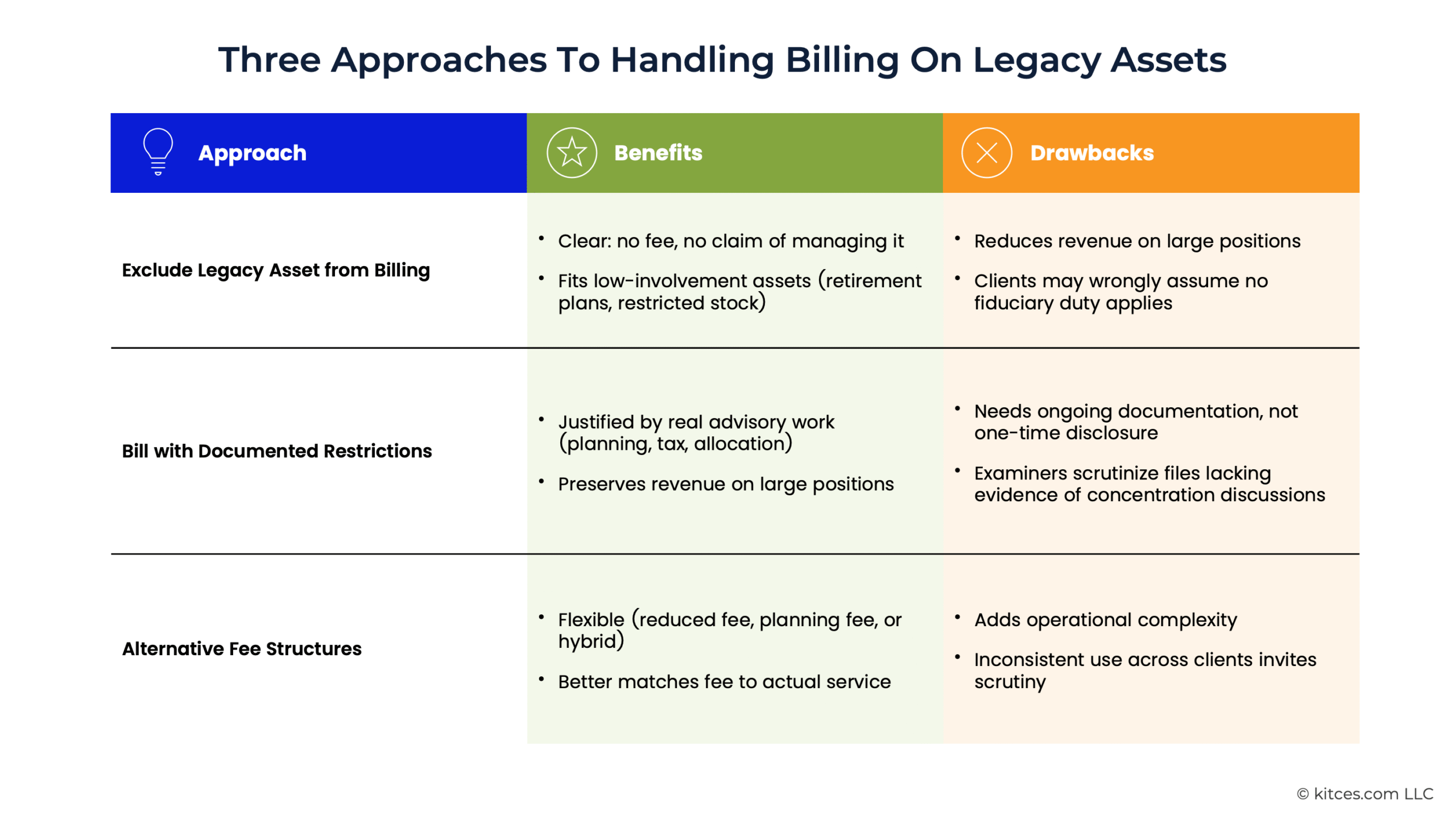
RIA firms have developed three primary models for billing on legacy client assets:
- Excluding legacy assets from billing entirely;
- Continuing to bill on those assets while documenting client-imposed restrictions; and
- Adopting alternative fee structures designed to better align compensation with services rendered.
Each carries advantages and disadvantages, and the SEC has not established a universal framework dictating how legacy assets must be treated. The analysis generally turns on whether the advisor's disclosures are accurate, whether compensation is fair relative to services provided, and whether the advisor continues acting in the client's best interest.
Approach One: Excluding The Legacy Asset From Billing
The simplest option is exclusion: identifying the restricted or legacy asset, removing it from the advisory fee calculation, and declining to charge an asset-based fee on that portion of the client's holdings. The advisor may still discuss the asset during review meetings and incorporate it into financial planning, but it falls outside the billing base.
The primary benefit is clarity. If the advisor is not charging a fee on the asset, it is easier to defend the proposition that the advisor is not being compensated for ongoing management. This approach is particularly common where the advisor has limited involvement with the asset: employer retirement plans that cannot be directly managed, private investments over which the advisor exercises no oversight, restricted securities, or concentrated stock positions that are rarely discussed. Many compliance professionals favor it because the billing arrangement aligns cleanly with the advisor's limited role.
The most obvious drawback is economic. Large legacy positions often represent a substantial percentage of client wealth, and excluding them can significantly reduce revenue. There is also a subtler risk: clients may incorrectly assume the advisor bears no fiduciary responsibility regarding the excluded asset. Consider a client holding $5 million of concentrated technology stock alongside $2 million of diversified investments. Even if the stock is excluded from billing, the advisor cannot construct an appropriate strategy for the remaining assets without accounting for the concentration risk it creates. The appropriate asset allocation, fixed-income weighting, and liquidity positioning for those two million dollars depend largely on the existence of the $5 million dollar position. Exclusion may reduce certain billing concerns, but it does not eliminate fiduciary considerations.
Approach Two: Continuing To Bill With Documented Client-Imposed Restrictions
An increasingly common approach involves continuing to bill on the legacy asset while documenting clearly that the client, not the advisor. Under this model, the advisor recognizes that the asset remains central to the client's overall financial picture and that ongoing advisory services justify inclusion in the fee base.
Consider a client who owns $8 million of founder stock alongside $2 million of diversified investments. Every recommendation the advisor makes regarding the remaining portfolio, whether asset allocation, spending rates, liquidity planning, tax management, charitable gifting, or estate planning, is shaped by the concentrated position. Many advisors in that situation believe they are providing substantial value related to the asset even though they are not actively trading it.
The key to this model is documentation, and the distinction between a defensible arrangement and a problematic one often comes down to process. The advisor should document that the client chose to retain the position, that the risks of concentration were explained, and that the advisor's authority was restricted at the client's direction. Those discussions should occur repeatedly over time rather than as a single initial disclosure. An SEC examiner reviewing a file in which the advisor bills on a large concentrated position but cannot produce evidence of ongoing discussions, concentration analysis, or diversification alternatives presented to the client may reasonably question what services justified the fee.
Best practice for implementation under this model has several concrete elements. The advisory agreement should describe the legacy asset, note that it is retained at the client's direction, and explain the basis for including it in the fee. The client's decision to retain the position, and the advisor's recommendation and any alternatives presented, should be memorialized in an investment policy statement or client profile at the outset. The advisor should then create a recurring, dated record, at least annually, showing the concentration or risk analysis performed, the alternatives revisited, and the client's continued instruction. Finally, the fee actually charged should be periodically tested against the services being delivered, so that the file affirmatively demonstrates what the client is paying for.
Approach Three: Alternative Fee Structures
A third approach bridges the gap between exclusion and full inclusion through customized arrangements. Some advisors apply a reduced asset-based fee to legacy positions to reflect limited management responsibilities (while still accounting for the reality that the advisor must incorporate the asset into their analysis and planning discussions). Others transition from asset-based fees to planning fees, charging a fixed amount that reflects ongoing financial planning, risk management, tax coordination, and wealth management services related to the position. Hybrid arrangements are also common: a traditional AUM fee on actively managed assets combined with a separate fixed planning fee that accounts for work performed regarding restricted positions.
These structures can provide flexibility and may reduce the appearance that an advisor is charging full management fees on assets receiving limited attention. They also create operational challenges. Billing practices must remain consistent across clients, disclosures must remain accurate, and client agreements must clearly explain how fees are calculated. Inconsistency in applying customized arrangements can draw examiner scrutiny even when individual arrangements are reasonable.
Selecting The Right Approach
The ultimate issue is rarely the billing methodology itself. Regulators generally focus on a broader question: does the advisor's compensation accurately reflect the services being provided? A firm cannot solve a disclosure problem by changing terminology, nor can it eliminate fiduciary concerns simply by excluding an asset from billing if it continues providing advice that is materially influenced by that asset.
Different clients may also warrant different approaches. A concentrated stock position representing twenty percent of a client's net worth presents different considerations than a private business representing eighty percent of a client's wealth. A restricted asset receiving extensive ongoing planning attention may justify different treatment than an asset that is rarely discussed. Flexibility is appropriate so long as the rationale is documented and consistently applied across the firm.
The most effective firms develop a deliberate framework for evaluating billing, defining responsibilities, documenting restrictions, and periodically reassessing whether each arrangement remains appropriate. When regulators review legacy asset arrangements, they typically focus less on the precise billing methodology and more on whether the advisor can articulate a coherent rationale supporting its approach. A thoughtful, documented process is far more valuable than any one particular billing answer.
Best Practices For Managing Legacy Client Assets
The critical question for most RIAs is not whether legacy assets create fiduciary obligations (which they plainly do), or which billing approach is technically permissible (since they all are, so long as they are documented and applied consistently). The real question is how to build a compliance framework capable of demonstrating, years later, that the advisor acted thoughtfully, transparently, and consistently. Regulatory problems often arise not because a particular billing approach was inherently improper, but because the advisor failed to implement adequate procedures supporting it: documentation is incomplete, client expectations are unclear, restrictions are poorly described, and periodic reviews never occur. The most effective firms recognize that legacy assets require more process, not less, because the advisor's limited authority makes documentation and communication all the more important.
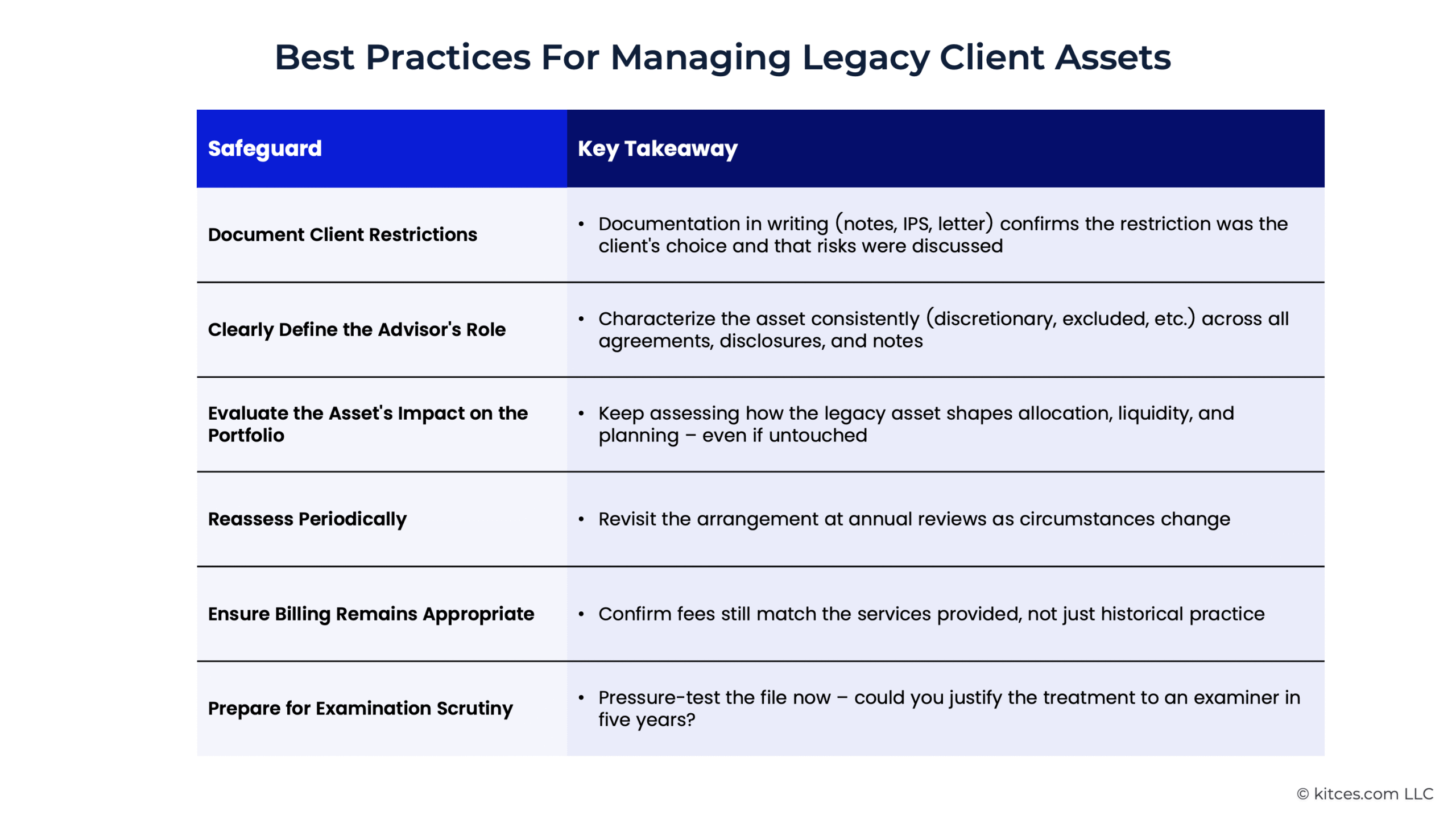
Safeguard One: Document Client Restrictions
Many legacy asset arrangements begin with a client decision: a refusal to diversify a concentrated position, an insistence on retaining a family business interest, a choice to hold an annuity despite the advisor's recommendation, or the existence of a private investment that cannot be liquidated. Advisors should avoid relying solely on verbal discussions. Instead, the client's decision to retain the asset, the advisor's recommendation, and the risks discussed should be documented in writing.
It need not be complicated; meeting notes, an investment policy statement, a client letter, or another contemporaneous record often suffices. What matters is that the advisor can demonstrate the issue was discussed and the client made an informed decision.
The practical stakes are significant. An executive holds a concentrated stock position representing sixty percent of household net worth. The advisor recommends diversification, and the client refuses. Five years later, the stock declines sharply. Contemporaneous documentation showing that alternatives were presented and declined can be dispositive, marking the difference between a defensible engagement and serious regulatory or litigation exposure.
Client restrictions do not eliminate fiduciary obligations. An instruction not to sell a concentrated position shapes the scope of the advisor's authority, but it does not waive the federal fiduciary duty or eliminate the obligation to evaluate and discuss the risks that position creates for the advice being given on the managed portfolio. The challenge is finding – and documenting – the proper balance between respecting client autonomy and fulfilling fiduciary responsibilities.
Documentation need not always be client-facing to be effective. Contemporaneous internal records, meeting notes, CRM entries, or AI-generated meeting summaries retained in the firm's system can carry significant evidentiary weight, particularly when created in the ordinary course of business and dated close to the discussion. That said, client-facing documentation is stronger where the point is that the client made an informed decision: a countersigned investment policy statement, a client letter, or an email confirming the client's instruction is harder to dispute later than an internal note alone. The most defensible files typically pair the two, using internal notes to capture ongoing analysis and at least one client-acknowledged record to confirm the key decision to retain the asset over the advisor's recommendation.
Safeguard Two: Clearly Define The Advisor's Role
Many regulatory concerns stem from ambiguity. The client believes the advisor is monitoring an asset, the advisor believes it falls outside the engagement, and neither party documented the arrangement at the outset.
Advisors can avoid this ambiguity by clearly identifying whether a legacy asset is discretionary, nondiscretionary, restricted, excluded from management, included in planning, or subject to some other treatment, and by ensuring that that characterization appears consistently across the advisory agreement, Form ADV disclosures, investment policy statements, financial plans, review meeting notes, and billing practices. An advisor who describes a legacy asset as excluded from management in the advisory agreement while repeatedly describing comprehensive oversight of all client assets in their performance review materials is creating precisely the kind of inconsistency that draws examiner scrutiny. Consistency is not optional; it is the foundation of a defensible position.
Safeguard Three: Evaluate The Asset's Impact On The Overall Portfolio
Legacy positions with a material real-world impact on a client's financial situation must be factored into the client's financial plan. A concentrated stock position affects diversification analysis, an illiquid private investment affects liquidity planning, a family business affects retirement readiness, and a large annuity affects income projections and tax planning. Even when advisors do not actively manage a legacy asset, they should continue evaluating how it affects broader financial objectives, and documenting that evaluation. Consider a client whose net worth consists primarily of company stock accumulated over decades. The advisor is prohibited from selling it, yet must still decide how aggressively or conservatively to invest the remainder of the portfolio. Increased fixed-income exposure, larger cash reserves, or alternative diversification strategies may all be warranted specifically because of the concentration risk that stock creates. That analysis remains valuable and necessary even though the concentrated position itself is untouched. It need not be repeated in full at every client interaction; at a minimum it should be documented at each review meeting with an investment or financial-planning focus, and refreshed whenever the position or the client's circumstances change materially.
Safeguard Four: Reassess Periodically
Many legacy asset arrangements begin for valid reasons and are never revisited. Clients retire, tax laws evolve, liquidity needs emerge, businesses are sold, and family situations change. The rationale supporting a restriction may look very different after five or ten years.
The strongest compliance programs revisit legacy asset arrangements at each annual review. The advisor can reassess whether the restriction continues serving the client's objectives, discuss changes in financial circumstances, evaluate alternative strategies, and confirm whether existing documentation remains accurate. Periodic reassessment also demonstrates that the advisor continues exercising professional judgment rather than simply inheriting historical decisions without analysis, a distinction that matters in both examinations and arbitration proceedings.
Safeguard Five: Ensure Billing Practices Remain Appropriate
Billing arrangements can drift over time. Suppose an advisor originally billed on a concentrated stock position because the advisor regularly analyzed diversification strategies, charitable gifting alternatives, and tax-management techniques related to the asset. Over time, those discussions diminish, and the advisor eventually provides little ongoing advice regarding the position. At that point, the firm should evaluate whether its fee arrangement continues reflecting the services actually being provided. The objective is not to reach a particular answer, but to ensure compensation remains aligned with the advisor's actual role, and that evaluation is best conducted proactively during annual reviews rather than in response to an examiner's inquiry.
Safeguard Six: Prepare For Examination Scrutiny In Advance
A useful internal exercise is to imagine an SEC examiner reviewing a client file five years from now. Could the advisor explain why the asset was treated the way it was? Could the advisor identify the client's restrictions, demonstrate that risks were discussed, and explain why the billing arrangement remained appropriate? If the answers are uncertain, additional documentation is warranted now. This perspective helps firms identify weaknesses before regulators do.
The SEC has consistently focused on disclosure, fairness, consistency, and fiduciary conduct rather than mandating a specific treatment for every legacy asset situation. There is no universal rule. Firms that search for one will be disappointed, while firms that build a repeatable framework will be prepared.
That framework should identify legacy assets, define the advisor's role, document client restrictions, evaluate portfolio impact, periodically reassess each arrangement, and ensure compensation remains aligned with services provided. When implemented consistently, it transforms legacy assets from isolated compliance concerns into another component of a disciplined fiduciary process.
Regulators rarely focus on whether a legacy asset was included or excluded from billing, or whether a concentrated position was sold or retained. They focus on whether the advisor clearly disclosed its role, acted consistently with that role, charged fees that were fair relative to services provided, and continued acting in the client's best interest. Those principles should serve as the foundation of every legacy asset compliance program.