Executive Summary
While working as a financial advisor can be attractive based on the ability to make a positive difference in clients’ lives, at the end of the day it is a business and the source of a firm owner’s livelihood. Amidst this backdrop, it’s important for firm owners to pay close attention to their profitability, as it not only helps determine their current-year income but also can serve as a buffer against adverse events (such as a major market downturn, a client lawsuit, or a regulatory action) that could massively disrupt the business.
In this guest post, Matthew Jarvis and Micah Shilanski, who now coach advisors through The Perfect RIA platform based on practices they successfully implemented in their own firms, discuss how advisors can measure their true profitability, create a client-by-client revenue report, and determine when it’s time to ‘graduate’ clients who are no longer a good fit (as well as how to approach this difficult conversation).
To calculate their profitability, a firm owner can start by determining their "True Gross", or the total amount of money paid by clients, which includes not only financial planning fees, but also investment fees, platform fees, fund expenses, etc. (to get a picture of the total amount a client is willing to pay for the stack of services the advisor offers). Next, the advisor can calculate their "True Net", which is all of the money that flows through to the advisor’s tax return from their practice (which could be some combination of wages, profits, owner’s distributions, guaranteed payments, etc). Finally, the owner can determine their profitability by dividing their True Net by their True Gross, aiming for at least 30% profitability – with 50% being ideal.
With a profitability figure in hand, firm owners can next use a "Red/Yellow/Green report" to sort their client base by revenue and identify clients who aren’t meeting the firm’s revenue-per-client targets. This exercise involves listing all client households, all revenues collected for each household over the last 12 months, and the assets managed by the firm. After determining the (ideal and realistic) per-client revenue target that they would like to reach, the advisor can then better identify those whose revenues already meet the desired target ("green" clients), those who fall between the ideal client revenue figure and one-half of this amount ("yellow" clients), and those whose revenues fall below one-half of the ideal amount.
"Green" clients are ideal and will be good candidates to remain with the firm going forward. "Yellow" clients can be given an ‘upgrade or graduate’ discussion, where they are given the opportunity to pay a fee that better reflects the value the advisor provides – or to find an advisor better suited to their needs. "Red" clients, with few exceptions (e.g., keeping 5 of these clients for every 100 in the firm’s client base), get put on the ‘graduation’ list, with the advisor offering a specific and authentic rationale for no longer being able to serve them and providing a way for them to find an advisory home that better fits their situation.
Ultimately, the key point is that while it can be tempting for firm owners to assume that they have healthy profitability (particularly when market performance is strong and buoys fees), it’s a valuable practice to take stock of the firm’s true profitability – to ensure sufficient cushion to protect against future contingencies, and to identify ways to increase profit margins into the future.
Authors:


Profitability As A Client Service Commitment
Suppose you were objectively the best financial advisor in the world, that delivered more value to clients than anyone else. But because of too many discounts to your fee schedule, you went bankrupt in the next bear market. Who, then, would take care of your clients?
As Advicers, we have a deep commitment to Delivering Massive Value to clients, but part of that commitment requires running a sustainable business that can continue serving clients in all market cycles. Many advisors have dual goals of providing genuine value to their clients and making a healthy living. In our experience, these need not be mutually exclusive goals – every firm can improve its profitability while simultaneously enhancing client service. The win-win result is a more efficient advisor (who also now has more time for non-work pursuits), with a more satisfied client base.
Having run our own seven-figure practices at 50%+ margins for many years that Deliver Massive Value to clients through quarterly value adds, semi-annual surge meetings and constant work in the five key areas of financial planning – and having coached hundreds of advisors to do the same – we know it can be done. In this article, we will walk through how to actually measure profitability (including "True Gross" and "True Net"), how to run a Red/Yellow/Green profitability report on a client-by-client basis, and actionable steps you can take to improve your profitability across your entire client base… so your best clients and/or your family aren’t subsidizing those who aren’t profitable by any measurement.
When we host financial advisor masterminds, the first step is an exercise we call ‘Financial Undressing’, and it’s as uncomfortable as it sounds. On a giant sticky note for all to see, advisors write down their AUM, True Gross, True Net, total Households, team size, and what they THINK is their fee schedule.

With this information, we can quickly assess the health of your practice, aiming for a profitability goal of at least 30%, and ideally, 50% of revenue that gets to owners by some means or another (whether via profits, owner’s salary, or some combination thereof). While 30% to 50% might seem like a high bar, especially when compared to industry survey data, practices below that range could struggle during bear markets – though some exceptions apply to firms with organic growth north of 20% annually who are aggressively reinvesting in the business by increasing staff.
Before we jump into why 30% profitability is the target, with 50%+ being the ideal, let’s make sure we are on the same page in calculating profitability, including what our friend and fellow rockstar financial advisor Chuck Failla likes to call "True Gross".
Calculating True Gross
True Gross is the total amount of money paid by clients. This includes all financial planning fees, investment fees, platform fees, fund expenses, etc. This is NOT the number reported by your Broker/Dealer or Mega-RIA, or even the number reported by the custodian, and it's certainly not the number in your P&L.
For example, let's say you are an advisor charging a 100 bps (1%) AUM fee, the TAMP/funds you are using charge 50 bps, and there is a 2 bps platform fee. This brings the total cost paid by the client to 152 bps. To keep the math easy, let’s say you have $100M of AUM and you are actually charging your fee on all of those assets (though in reality, this isn’t the case for most advisors). Regardless of what you see reported anywhere else, your True Gross is $1,520,000.
Yes, we know that your P&L won’t show $1,520,000, nor would you give this number to the IRS, but for the sake of measuring the profitability of your practice, consider that your True Gross. The biggest objection we hear at this point is that any fee other than the advisor’s fee is being paid by the client to someone else, and is therefore not part of the Advisor’s True Gross. From a tax and accounting perspective, this is correct. However, from a practice health perspective, the client in this example is willing to pay 152 bps for the stack of services you recommended. The fact that you’ve decided to outsource some of those services does not change how much the client is paying.
This True Gross approach is important as too often advisors will claim to be operating at a 90%+ profit margin, not because they are wildly efficient, but because they’ve moved key expenses off their balance sheets. A common example of this is platforms (e.g., B/Ds or RIAs) claiming a 98% payout, but only after some tortured math on what counts as revenue. Using our example above where the advisor’s P&L shows $1M but the client is paying $1.5M, the advisor essentially has $500k of expenses they are not seeing. Upon closer examination, the advisor may decide those services are worth $500k, or they may realize that the same or similar services could be had for just $150k.
Calculating True Net
The next step is to calculate your True Net, which is all of the money that shows up on your tax return from your practice. Depending on your business structure (LLC vs S-Corp), this will be some combination of wages, profits, owner’s distributions, guaranteed payments, K-1, etc. However it’s structured, if you can’t show it to us on your tax return, it doesn’t count. The only exception we allow is your pre-tax retirement plan contributions (e.g., 401(k), Defined Benefit, etc.), since those accrue for your benefit.
Yes, we know you have all sorts of ‘add-backs’ and that, thanks to the Augusta Rule, your home office deduction, and the car you claim is ‘business use only’, you’ve managed to bring down your tax bill – but none of that counts for your True Net. Why? Because the goal with this simplified approach is to make practices more comparable to each other for purposes of learning from fellow advisors in masterminds, and also to minimize opportunities for ‘creative’ objections to the exercise we’re going to do. To sum up:
- True Gross – ALL fees paid by clients
- True Net – ONLY the income showing up on your tax return
Continuing with our example above, if the advisor had a True Gross of $1,520,000 and their tax return showed $300k of taxable income (with the only add-back being their personal pre-tax retirement contributions), this gives us a True Profit Margin of 20% ($300k True Net/$1.52M True Gross).
Keep in mind that when this advisor walked into the room, he thought his Gross was $1M with a Net of $300k, and he was at the industry-accepted ‘healthy’ profit margin of 30%, only to realize that his expenses were some $520,000 more than he knew – giving him a True Profit Margin of just 20%.

Nerd Note:
Astute readers will notice that "True Net" is calculated using both owner-advisor salary and firm profit in the numerator of the calculation of profit margins. This differs from the traditional way in which Net Profit is calculated (which only includes owner-profits in the numerator, not owner-salary). However, the reality is that advisors pay themselves a wide range of salaries that may or may not reflect true market rates – in some cases, internal salaries for owner-advisors are set to equalize certain partner dynamics (e.g., one partner gets paid more or less to adjust for the other’s differing ownership percentage), or are deliberately adjusted for tax purposes (e.g., pushing salary below the Social Security wage base for an S corporation owner in order to reduce FICA taxes). Looking at total dollars received, regardless of whether it is from owner salary or owner profits, is known as "Earnings Before Owner Compensation" (EBOC), and makes it easier to evaluate and compare profitability of firms (without the confound of how owners happen to split their income between profits and salary). Hence the "True Net" nomenclature here, which is effectively measured based on EBOC, to differentiate the metric from traditional ‘Net’ (which would typically be calculated after owners paid themselves a market-rate salary).
Why 50% EBOC Profitability Is The Gold Standard
Now that we agree on how to actually calculate profitability, we can look at three reasons why 30% profitability from EBOC (Earnings Before Owner Compensation, or total income the owner is earning from all sources, regardless of how they pay it out to themselves) is the lower threshold an advisor should aspire to – with 50% being ideal, despite what you may have read in industry surveys or heard from experts.
This Is An Incredibly High-Risk Profession
While the Kitces Financial Advisor Success Podcast is full of success stories (hence the name), what you rarely hear are stories of advisors who have been sued, fined, censured, suspended or even jailed – due to both honest and dishonest mistakes. We work in a highly regulated industry and live in a litigious society, so it is worth taking preventative measures to ensure that your practice is well-insulated from these risks. Building a substantial profitability cushion is part of prudent risk management. For example, we personally know advisors who were sued for doing a Roth Conversion that the client agreed to in writing. Advisors who were suspended from the industry after following the written advice from one regulatory body, only to have another body claim the opposite. Advisors who were suspended for trying to fix a mistake. Advisors whose team mishandled a rollover by putting it into the wrong account, and, for the grand prize: advisors who went to jail for paperwork errors. And while it is easy to tell yourself that you would never make such mistakes, or that these advisors were crooks, go talk to a few yourself and you’ll realize how high-risk a profession we are working in.
Bear Markets Do Happen
Many advisors today do not recall – or were not yet practicing – during the Bear Markets (and subsequent prolonged market recovery periods) of 1973–1974 and 2008–2009. Having not ‘lived through it’ as an advisor, they may therefore discount the risk of having client fees cut in half. When (not if) we have the next 50% drawdown and your fees decline by 35% (assuming an aggregate allocation of 70/30 across your client base), taking your industry standard 30% profit margin to a loss, how will you pay your bills? This isn’t a hypothetical question, but one that you literally need to pencil out. Even if your typical client is more conservative (e.g., a 50/50 portfolio), and bonds rally in response to a market decline, fees in a bear market can still be cut 20%+. When clients need you the most, but you can’t pay your mortgage because your profit margins are so thin they no longer support your personal living expenses, what happens?
While Difficult, Running A 50% EBOC Margin Is Absolutely Possible
Marketing legend Alex Hormozi reminds us that the natural state of a business is to lose money, and that the only way to maintain profitability is to ruthlessly cut costs. The same is true for advisory firms, again with a caveat for firms with organic client growth above 20% who are hiring to staff up for anticipated continuing growth. It is realistic to run a white-glove service at 30%–50% EBOC margins, something we’ve each done ourselves for more than a decade. Does this require carefully designed and monitored processes? Yep. Does it require fee minimums? Yep (more on this below). Is it easy? Nope, otherwise the industry surveys/experts would agree that 30% is the minimum, not the ideal. Does running a higher profit margin make you a better advisor? We certainly think so! How? Because discount advisors running low margins can’t afford to invest in their professional development, staffing, technology, etc. This might seem counterintuitive, as all these things pull down your profitability, but the low-margin advisor is suffering not because of their investment in these domains, but rather due to a lack of discipline in charging fees and controlling expenses.
While actions like managing expenses and raising fees are essential tools in moving towards improved margins, here we will focus on identifying – and letting go of – the clients who are not profitable by any measurement, and whose fees are ultimately being subsidized by your best clients. Once we have more clearly assessed revenue by client, we can begin to take action according to some ‘best practice’ rules, while limiting our exceptions to the 5 per 100 rule.
Red/Yellow/Green Profitability Report
To begin addressing firm profitability, we start with a client profitability assessment, which we call your Red/Yellow/Green report. This may seem like a simple process, but having used it in our own practices and with hundreds of other advisors, we know that each step is critically important and must be done exactly as outlined to achieve maximum results.
Using this spreadsheet template, the exercise begins by gathering a list of all client households. And by ‘all’, we mean every household that has any kind of an account with your name listed as advisor. So, not just your ‘A’ clients, or just the clients paying you a fee, but every single client. For multi-generation clients, we recommend that each household be evaluated individually.
While some industry experts will tell you to segment your clients by the fee they pay and/or the services you provide, this is almost universally a bad idea. Remember that every client (and their beneficiaries), no matter how little they pay you, can be the complaint/lawsuit that ends your career if you do not exercise an appropriate duty of care towards them; starting with "…But they were a C-client!" won’t hold up in court in a lawsuit, nor with a regulator – nor should it hold up in your own conscience. Do your best work for clients, or ‘graduate’ them to work with someone who is willing to give them their best work.
Once we have a column of all households, the next column lists all revenue sources collected for the last 12 months. This includes AUM fees, commissions, planning fees, etc. While ideally this would be True-Gross numbers, for ease of calculation, you can use the number that shows up in your billing files. No guessing. No rounding. Only exact numbers.
The final column is all the client assets held/managed by your firm. This includes any cash accounts, funds within annuities or 529 plans, or anything else that appears on their statements.
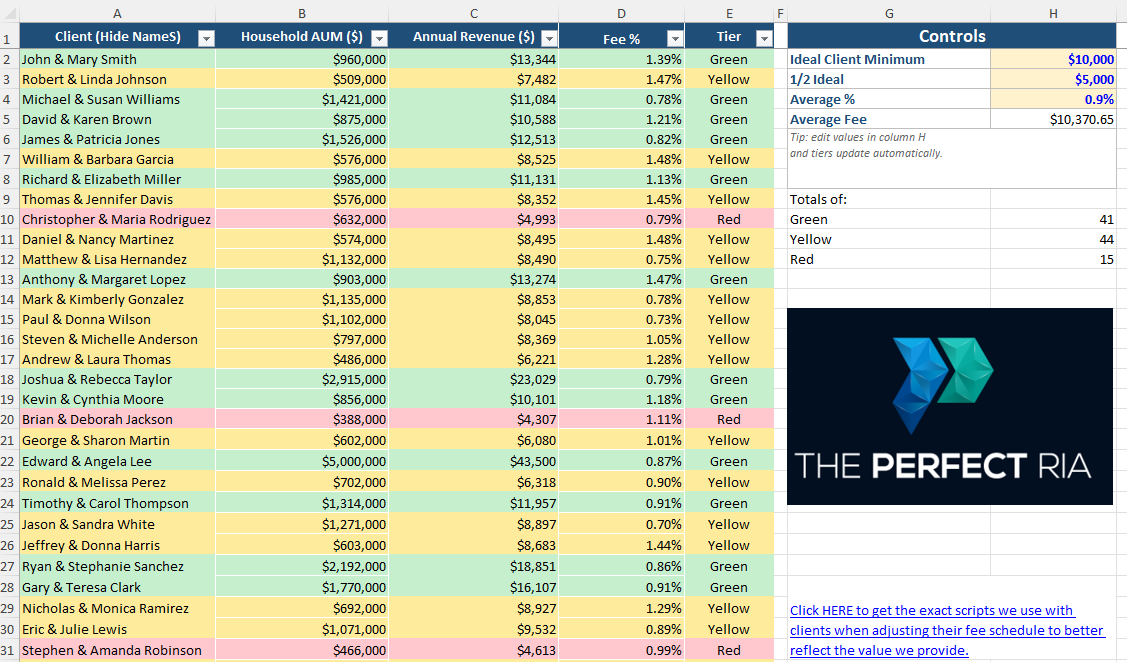
Click to download the Client Profitability RYG Report sample.
Populating these three columns may take you (or better yet, your team) a couple of hours, but it’s an exercise that we recommend doing annually. With this data, you can now sort by revenue, smallest to largest – and you should hide the name column while doing so. These exercises will not work if you leave the names visible because your excuse-making machine will keep you from making business decisions based on your feelings about individual clients and their circumstances. Seriously. Hide the names, or it won’t work.
With the names hidden, we now apply conditional formatting based on the next business milestone you are trying to achieve. Not your fantasy practice, but your realistic next level – typically no more than double your current revenue.
Continuing with the example above, let’s say the advisors' ideal and realistic next level is $1.5M gross/$750k net, with 200 clients. This would give us an average per-client gross revenue target of $7,500 ($1.5M/200 households). In our spreadsheet, any clients with an average revenue of $7,500 or more would be marked Green.
The next segment is everyone from your ideal average revenue ($7,500) down to one-half of your ideal revenue ($3,750), who will be marked Yellow.
The final segment is any client below one-half of your ideal fee (<$3,750), and will be marked Red.
 Green clients are your ideal clients. Keep "Delivering Massive Value" in the form of quarterly Value-Adds, semi-annual Surge Meetings, quarterly personalized newsletters, and appropriate encouragement for referrals and testimonials.
Yellow clients are given the ‘upgrade or graduate’ discussion, where they are given the opportunity to pay a fee that better reflects the value you provide (aka your new minimum), or to find an advisor better suited to their needs. Having this discussion in a way that is a win-win (and with the highest probability of success) requires careful planning and is beyond the scope of this article, but our podcast (The Perfect RIA, now a Kitces Top Podcast) has dozens of scripting examples.
Red clients, with very few exceptions, are your ‘graduation’ list. These are clients for whom receiving your level of services and paying accordingly simply doesn’t make sense. Think of it like taking a world-class oncology surgeon and asking her to do sports physicals instead.
Of course, graduating clients is the single hardest thing to do in an established practice, far more difficult than raising fees. And if you are like every other advisor we’ve coached, your headtrash is screaming some version of:
"These clients don’t take much work and they were my first clients and I’m not so greedy as to raise their fee and nobody can do as good a job as me and if I graduate them all of my other clients will fire me and my family will leave me and by the end of the day I’ll be holding a sign that says ‘will financial plan for food’".
Sound familiar?
But here’s the reality: by doing what you think is a favor, you are doing everyone a disservice. These Red clients are taking time away from your Green clients, which is another way of saying that your Green clients are unknowingly subsidizing your Red clients. Alternatively, they are taking time, uncompensated, away from your personal life. In other words, you are skipping a workout, or an evening with your family, to do minimum-wage (or sub-minimum-wage) work. And while you may tell yourself ‘these clients don’t take much of my time’, it’s more likely the case that this is either not true OR it’s only true because you are neglecting your duties for this client.
The final piece of headtrash we hear is "I’ll graduate these Red clients when…[some arbitrary goal or point in time]", but this is like saying you’ll give up potato chips and start doing ab work after you get a six-pack. Until you graduate these clients, you won’t have the mental or time capacity to run an effective prospect process or to truly deliver massive value to clients. And while your results may vary, having done this hundreds of times, every advisor we’ve taken through this process ends up delivering more value and having healthier profit margins than at any other time in their career.
Why This Is A Graduation And Not A Firing
Words matter. They matter with clients, with your team, and within your own mind. Just like you didn’t get ‘fired’ from college when you reach the age and stage that it’s no longer appropriate to remain a student there, when a client no longer meets your "3-Ps" (Personable, Productive, and Profitable), it’s time for them to work with someone else.
The 3-Ps are something that every advisor needs to define, both for themselves and for their clients. In our practices, we define the 3-Ps as follows:
Personable
When this person is on my schedule, I get excited. The opposite would be seeing their name on my calendar and cringing. The same applies to my team. If I don’t like the person, or at least respect them, I can’t work with them.
Productive
I have to be able to deliver massive value to their unique situation. This could be retirement income or tax planning, or risk management, but ultimately, the value I provide has to be worth some multiple of the fee I charge. In other words, if I can’t deliver value, I can’t collect a fee.
Profitable
In our practices, depending on the advisor assigned to the client, this ranges from $10,000 to $20,000 in annual revenue, with a two-year grace period to get to that level.
While your definitions of the 3-Ps will certainly be different from ours, every advisor needs a version of this. For more details on the 3-Ps, including how we explain them to clients, this episode of The Perfect RIA can be a helpful resource.
So, how exactly do you graduate a client? It's simple, but not easy.
Inspired by Nick Murray (one of the most influential advisors of all time), the discussion sounds something like:
"As my practice continues to grow, I find myself with more clients than I can effectively serve. Unfortunately, this means I need to hand off some of my clients to other equally skilled advisors, and while it breaks my heart, I’ve decided that you will be better served working with someone else. I know this is hard to hear, and as cliché as it sounds, this is about me trying to do my best work and has nothing to do with you. As a gesture of good faith, my team will do whatever we can to make this transition as smooth as possible, and we will be refunding our last quarter’s fees so we can part ways as friends."
Depending on the client and your situation, this may include a direct introduction to another advisor in your organization, or a recommendation for another advisor in your community, or simply providing a link to LetsMakeAPlan.org.
The more specific and authentic your rationale, the better received it will be by the client. For example: "as my kids get older and I need to spend more time with them…" or "with all of the burdens of the new compliance regulation…" or even "I find myself burning out…" will all help this land better.
While we have in the past (per Nick Murray’s recommendation) done this via email/letter, it’s far too easy for tone to be misunderstood, or for it to escalate into a potential complaint. As such, we recommend you do it in person. Run the meeting like any other, focus on Delivering Massive Value, and then wrap up with the script above.
Will it be easy? Nope. Will the client likely be upset? Yep. Is it possible they will get angry and/or cry? We’ve had both. Will having this uncomfortable three-minute conversation allow this client to find a better-suited advisor while also freeing up your time and energy to better serve the clients who are paying you full price? Absolutely.
For a more detailed discussion on HENRY’s, next generation wealth and other clients who might someday be ideal (but don’t meet your criteria right now), check out this classic Kitces article.
What Will It Take To Actually Make This Happen
Give yourself 5 exceptions per 100 households. Continuing with our example of the advisor with 200 households, he is allowed 10 exceptions. This can be for a family member, an OG client, a client that you feel morally obligated to help, or anyone else you feel you can’t graduate. But limit yourself to 5 per 100, and write your list by hand so that when you are tempted to grant another exception, someone else has to come off your list. Any Red client not on your list should be graduated.
For some advisors, simply bringing awareness to wrong-fit clients is motivation enough to take action. For others, their headtrash (i.e., doubts and insecurities) paralyzes them into inaction. For the latter group, we use a tactic called "Extreme Accountability" – a strategy in which advisors commit to completing an undesirable act in the event that they don’t follow through on their stated intention. The goal is to make the real pain of not doing something worse than the imagined pain of doing it. So, in this case, it would look something like this:
By [DATE (typically six months out)], I will graduate any client whose fees are less than one half of my ideal client minimum, aka [AMOUNT].
I am doing this because these ‘C’ clients deserve to be someone’s ‘A’ client, because I need back the time to spend with my other clients, and I can only work with people who need and are willing to pay for my best work.
After [DATE], for every Red client that still has me as their advisor (beyond the 5 per 100), I will donate (ideal client fee – so in our example, $7,500) to my least favorite political candidate, along with a note thanking them for their service to our country and a request for a bumper sticker that I will proudly display on my car.
The ‘tell’ that you’ve set this up correctly is that the advisor looks like they are going to throw up at even the idea of the consequence. Of course, this is a non-binding agreement, and nothing is stopping you from welching. But in our experience, this exercise has been transformative for advisors who want to make this change but need some extra motivation to do so.
Time To Take Action
At the end of the day, it’s not what you know that makes you a great advisor, it’s what you do. For example, you can have memorized every article in the Kitces.com library, but until you share your knowledge with clients, and in a way that gets them to take action, it doesn’t make a difference in the world. The same is true with running a sustainable (aka profitable) practice. You can know it’s important, but until you calculate your true gross/net, achieve your targeted profitability (we recommend 50%), upgrade or graduate wrong-fit clients, and are laser-focused on only doing your best work for the exact right clients, you will be selling yourself and your clients short on what’s truly possible. It won’t be easy (otherwise you would have already done it) – but it will be worth it.
Whatever your take on Extreme Accountability, or True Gross/Net, or having a 50% profit margin, the key is to take action. Calculate your True Gross and True Net. Establish your EBOC margin, and run the Red/Yellow/Green report on your clients. It will take time, and it won’t be fun, but if done correctly, it will transform your practice by allowing you to Deliver Massive Value to the clients who need and value your services, with a profit margin that reflects the risks and opportunities of our industry.
Happy Planning!
Resources: Basic Red/Yellow/Green spreadsheet and Advanced Client Profitability spreadsheet courtesy of Lacey Shrum of Smart KX