
Executive Summary
Heavy turnover leaves advisory firms in a vicious cycle of allocating resources to recruit and onboard new advisors, only to lose them before they generate enough value for the firm to recover its investment. And given that McKinsey projects a shortage of more than 100,000 financial advisors over the next decade, it's never been more important for advisory firms to succeed at attracting and retaining talent.
While attracting new talent and managing turnover are often thought of separately, the two are closely related because not all cohorts of potential new advisors targeted by advisory firms have identical turnover rates. In fact, our Kitces Research data shows new college graduates – a cohort traditionally targeted in recruiting efforts – have far higher turnover rates than those transitioning into financial planning later in their careers. This is for several reasons, including that career changers bring with them both soft skills (e.g., meeting deadlines and managing multiple projects) and transferable professional skills (e.g., analytical experience and managing client relationships) that can help them be – and feel – more effective on the job. These experiences, along with the professional networks developed through prior roles that can serve as an initial source of business, can also better position career changers to grow faster and generate revenue and income more quickly than new advisors fresh out of college.
The end result is an "upfront-cost" versus "attrition-cost" trade-off between career changers and new graduates: Career changers require greater investment to recruit (because they can enter financial planning from virtually any other industry and at any age, making them much more widely dispersed and difficult to target in a scalable way) and are also more expensive to employ, earning 20%–40% higher salaries in their first five years in the profession than new graduates. What firms get from these investments in career changers, though, is 2–5X lower turnover rates compared with new graduates. Which means firms looking to minimize advisor turnover should strongly consider whether the benefits of hiring career changers who are more likely to stick around are worth the higher costs of recruiting and employing them compared with traditional cohorts like new graduates.
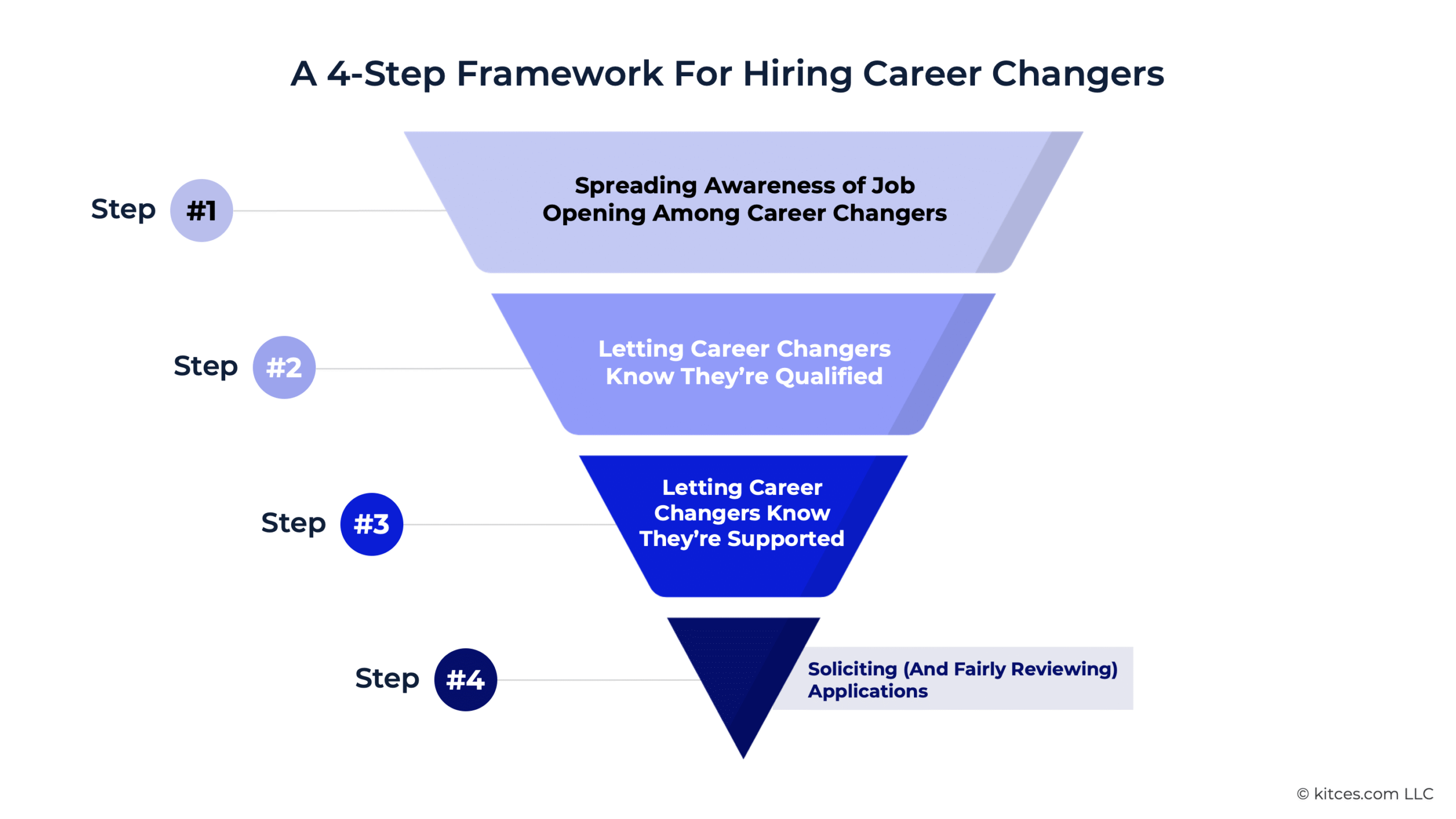
Drawing on a conversation with Hannah Moore, CFP®, founder of Guiding Wealth and Amplified Planning, as well as a research report from Amplified Planning on new entrants into financial services, we created a four-step framework for firms interested in hiring career changers. The first step contains tips for the top-of-funnel task of spreading awareness of job openings among career changers, including focusing on industry programs that have historically attracted large numbers of career changers (such as The Externship and FPA Residency), as well as non-industry-specific job boards. The second and third steps include middle-of-funnel recommendations aimed at letting career changers know they're qualified and will be supported, so that those who see the posting will be more likely to apply. This matters because many career changers hesitate to apply for financial planning industry jobs because, first, they worry employers will not value their professional experiences; and second, because they seek assurances that they'll be supported during the jump to a new industry, which can often involve a significant short-term reduction in income. The fourth and final step involves the bottom-of-funnel task of ensuring that those who do apply are fairly considered. This means ensuring that otherwise qualified candidates are not screened out by AI-based application filters (simply because they lack industry tenure or a degree in finance), and avoiding making common assumptions about career-changer candidates.
Ultimately, the key point is that the framework laid out in this article can be a helpful tool for firms to gain advisors who bring diverse experiences, transferable skills, and a greater likelihood of long-term success – making them valuable assets both to their firms and the profession as a whole!
Authors:


Challenges From The Industry Talent Shortage
Even a cursory review of industry media reveals countless articles discussing the advisor talent shortage. Consistent with research from other organizations, Kitces Research finds that the average age of financial advisors is now over 50. Among advisors who are baby boomers or older, 41% indicate that they're "likely" or "extremely likely" to leave the industry within the next five years. At the same time, the recruitment of new advisors has failed to keep pace with growing demand for financial advice. The result is that McKinsey projects a shortage of more than 100,000 financial advisors over the next decade, even after accounting for the role of technological advances (including growing advisor adoption of AI-powered tools) that make individual advisors more efficient. (Indeed, as we've written about separately, adoption of efficiency-enhancing technology presently corresponds with little in the way of efficiency gains at all.)
With the demand from clients needing advice outstripping the supply of advisors available to serve them, advisory firms face steep competition for talented advisors. Which leads to an increasing challenge in not only recruiting new advisors to join a firm, but also in retaining those advisors for more than a handful of years. Heavy turnover in an advisory firm leaves it in a constant cycle of spending resources to recruit and onboard new advisors, and then losing them before they generate enough value for the firm to recoup its investment. By most measures, the industry is clearly struggling in this regard. Indeed, Cerulli finds that 71% of new advisors drop out of the industry within 5 years of joining! While this stratospheric figure is driven by the large number of wirehouse advisors (where high turnover is an intentional feature of the business model), even among our data which is primarily focused on small-to-mid-sized independent RIA firms, a still-concerning 10% of new advisors are likely to leave the industry during these first five years.
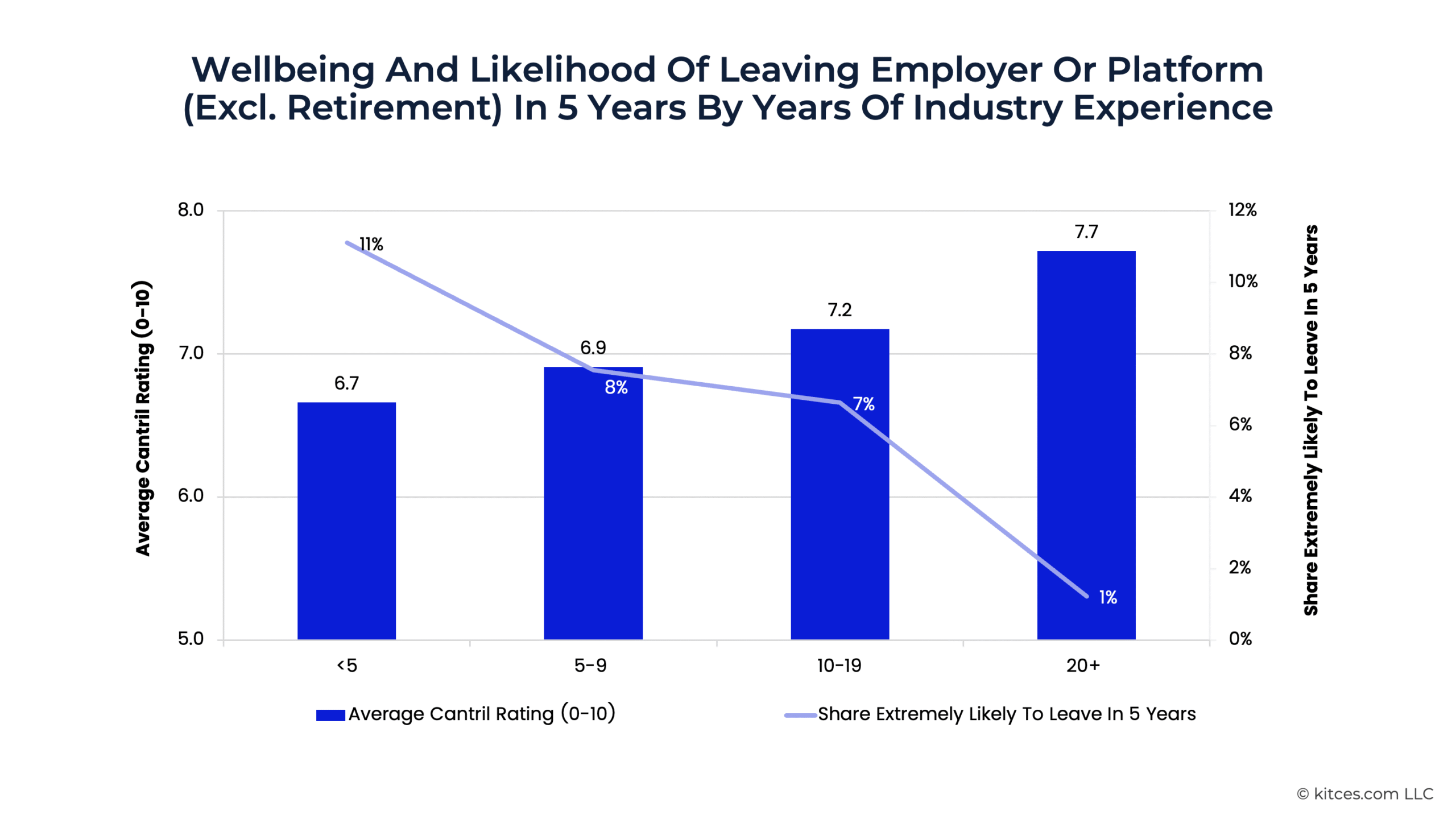
Data from the most recent Kitces Research on Advisor Wellbeing has demonstrated a strong link between an advisor's wellbeing and their likelihood of leaving their employer. As one might expect, advisors reporting lower levels of wellbeing (as measured by the "Cantril Ladder" system where survey takers rate their wellbeing on a 0–10 scale) tend to be substantially more likely to leave their current employer or platform than those with higher wellbeing. And of particular note to firms hiring newer advisors, those with the least experience in the industry tend to report the lowest levels of wellbeing, and thus the highest propensity for turnover: As the graphic below shows, average Cantril ratings start at 6.7 for advisors with fewer than 5 years of industry experience, and increase to 7.7 for those with 20 or more – while expected five-year turnover rates decline from 11% to 1% over that same period.
Managing Turnover By Hiring Career Changers
The Kitces Research data on the relationship between wellbeing and turnover suggests that a key component of an advisory firm's strategy for solving the turnover problem among newer advisors can be to focus on raising the wellbeing of their newly hired advisors. And one way to do that is to focus on a cohort of potential advisor recruits who have a propensity for higher-than-average wellbeing: Career changers.
Historically, larger advisory firms have focused much of their recruiting on recent college graduates rather than career changers, i.e., professionals seeking to transition into financial planning from other industries. There are several entirely rational reasons for this approach.
First, compared to career changers, college students and recent graduates are easier and less costly to identify because firms can target specific channels such as university job boards, career fairs, and academic programs. Career changers can enter the financial planning profession from virtually any other industry and at any age, making them much more widely dispersed and difficult to target in a scalable way.
Second, students earning undergraduate degrees in finance or related disciplines are more likely to actively seek out a career as a financial advisor, whereas individuals already working in other industries may not even be aware that a career in financial advice is a viable option unless the opportunity is presented to them.
Third, while financial advisors generally earn strong incomes over the course of their careers (the median advisor in many of our studies takes home approximately $220,000 per year, inclusive of any owner profits), compensation in early-career roles is often relatively modest. New advisors may initially work under compensation arrangements such as a salary draw against future revenue, and even those building their own books of business often generate little revenue initially simply because they have few clients. For instance, the typical advisor with their own startup-stage practice takes home just $40,000 per year, while the typical early career Associate Advisor supporting another Senior Advisor's client base generally takes home $73,750. While this earnings range may be reasonable for recent graduates, career changers (particularly those with existing financial obligations like a mortgage or child care costs) may be less willing to accept what could often be a meaningful reduction in income while establishing themselves in the profession.
Greater Wellbeing Among Career Changers Leads To Lower Turnover
But although the focus tends to be on new graduates for entry-level advisory firm roles, the data from Kitces Research on Wellbeing shows that new graduates actually report markedly lower levels of wellbeing during their early years in the profession than advisors entering from other industries. This can be seen when comparing advisor wellbeing among those entering the financial advice profession at the start of their careers (i.e., those entering before age 25), versus those who do so during the middle of their careers (between age 25 and 39) or later in life (age 40+).
As the figure below shows, among advisors with fewer than five years of industry experience (i.e., the time period when they would likely occupy an entry-level role at an advisory firm), those entering the profession at the start of their careers report not only the lowest average Cantril Ladder ratings (5.8) of any cohort shown in the figure, but also one of the lowest wellbeing scores observed across nearly all cohorts in our 86-page Advisor Wellbeing research report. That is to say, new college graduates are among the single most unhappy groups of advisors that exist. By contrast, mid-career changers report meaningfully higher wellbeing (6.3) during their first five years in the industry, while late-career changers report higher levels still (7.3).
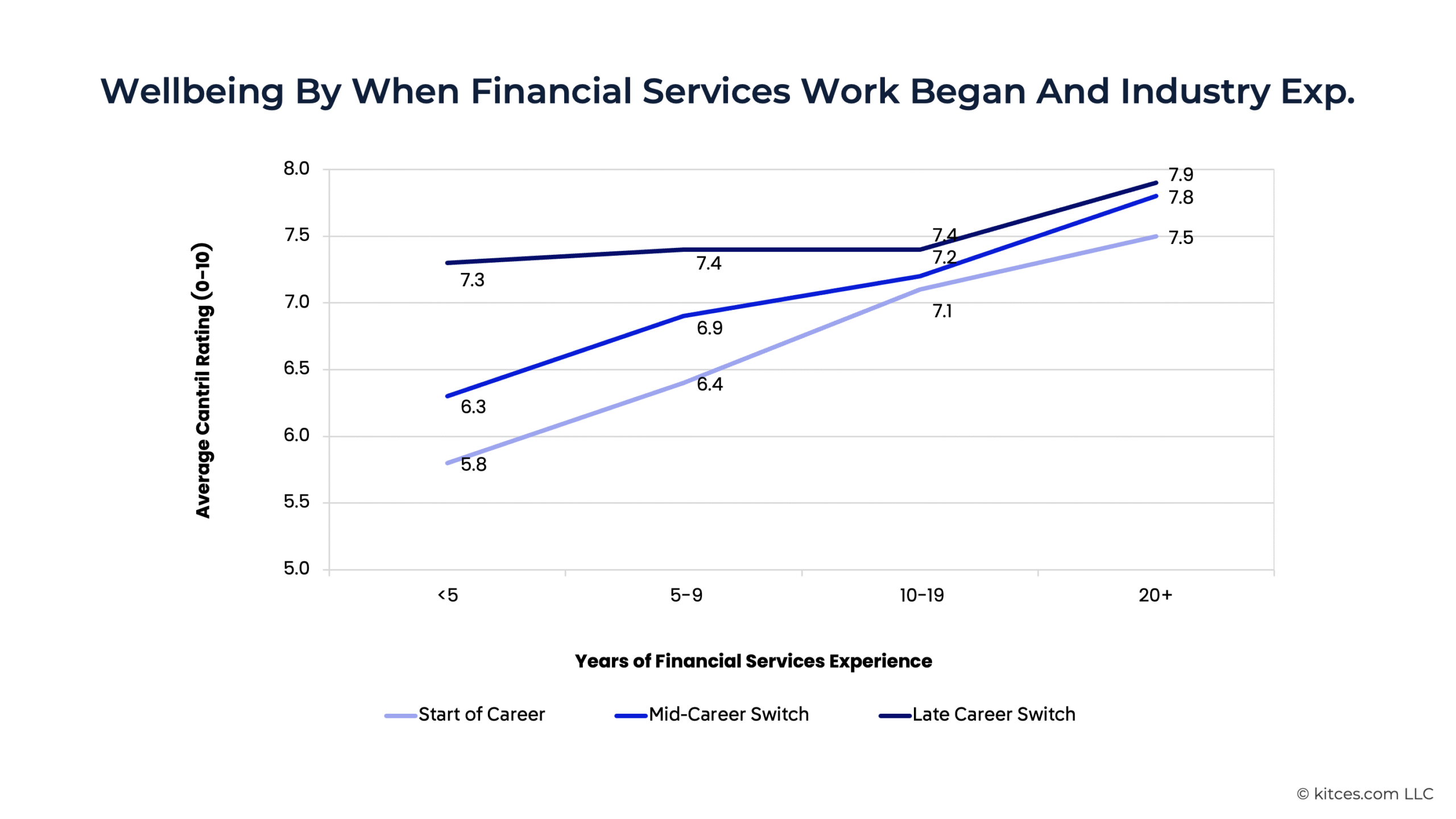
The sheer magnitude of these differences is striking. Advisors who enter the profession shortly after college do not reach the level of wellbeing reported by late-career changers in their first five years until they have accumulated a total of 20 years of industry experience! And even then, part of this convergence is attributable not to improvements in wellbeing but simply to survivorship bias, as many of the least-happy individuals entering directly from college will leave the profession before reaching those later career stages. And while the wellbeing gap between those entering at the start of their careers and career changers narrows over time – both because of this survivorship effect but also because advisors naturally become more confident and effective as they gain experience – it never fully disappears after 20+ years in the industry (though the small disparity beyond the 20-year mark may simply be due to the fact that career changers tend to be older and age generally corresponds with higher wellbeing).
Ultimately, these persistently lower levels of advisory wellbeing prove costly for firms in light of the aforementioned relationship between advisor wellbeing and turnover, as shown in the figure below. Among all advisors with fewer than five years of industry experience (who generally have lower levels of wellbeing than more experienced advisors), 20% of those who entered the financial services industry right out of college are at high risk of turnover. By contrast, this figure falls to 7% for advisors who transitioned into the profession in the middle of their careers after working in another industry, and declines further still to just 4% for those making a later-career transition.
In other words, because of the relationship between advisor wellbeing and turnover, advisors entering financial services later in life exhibit a whopping 2–5X lower turnover rate than those joining directly from college!
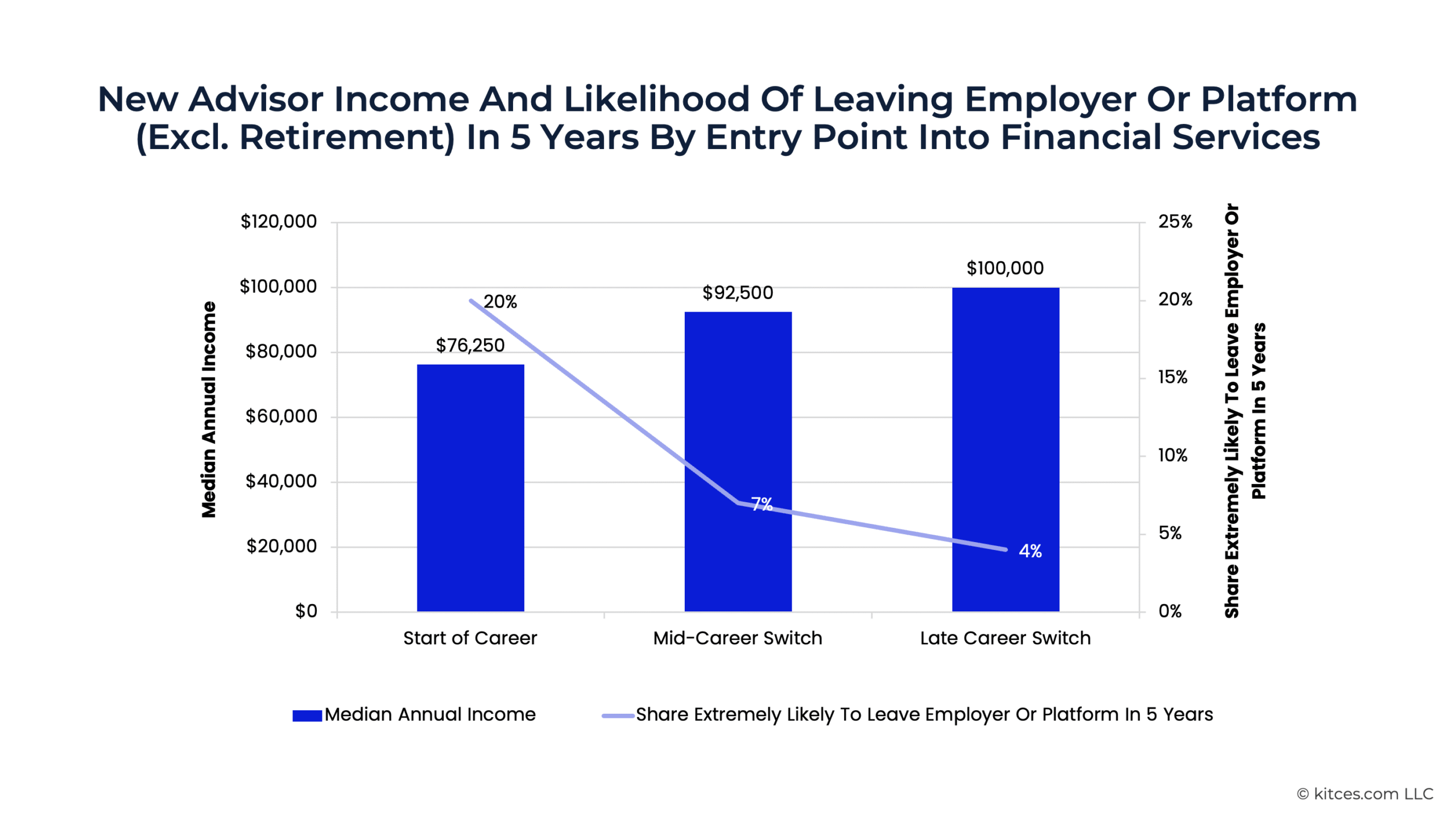
The catch, though, shown in the same figure, is that career changers are more expensive, costing 20-40% more than new hires entering right out of college. The typical new advisor joining right out of college takes home $76,250 in annual income, compared to $92,500 for mid-career changers and $100,000 for late-career changers. This is for the straightforward reason that they have more professional experience which enables them to earn more – a fact that we'll expand upon shortly.
The "Upfront-Cost" Vs "Attrition-Cost" Recruiting Trade-off
Taken together, this discussion leaves us with what we call the Upfront-Cost versus Attrition-Cost Recruiting Trade-off. Career changers require greater investment to recruit (because they are harder to identify and target) and to employ (because they often command higher compensation than new graduates). However, they are also considerably more likely to remain with the firm once they enter the profession. New graduates, by contrast, are generally less costly to identify and hire, but frequently require substantial organizational energy and resources given their higher turnover rates.
These costs can be compounded further when departing advisors take clients – and the associated revenue – with them, even when non-compete or non-solicitation agreements are in place. In fact, this phenomenon of "clients following their advisors" has intensified in recent decades as the industry has evolved from a transaction-based model centered on product sales to a relationship-based fiduciary model built around ongoing advice. As a result, many clients find it easier and more appealing to complete a new advisory agreement, risk-tolerance questionnaire, and ACAT transfer forms to follow a trusted advisor to a new firm than to build a relationship and trust from scratch with a replacement advisor at their previous one.
All of this is to say that while the "upfront cost" of hiring career changers may feel particularly acute to firms during the recruiting process, the "attrition cost" of hiring new graduates – while often less visible – is substantial as well.
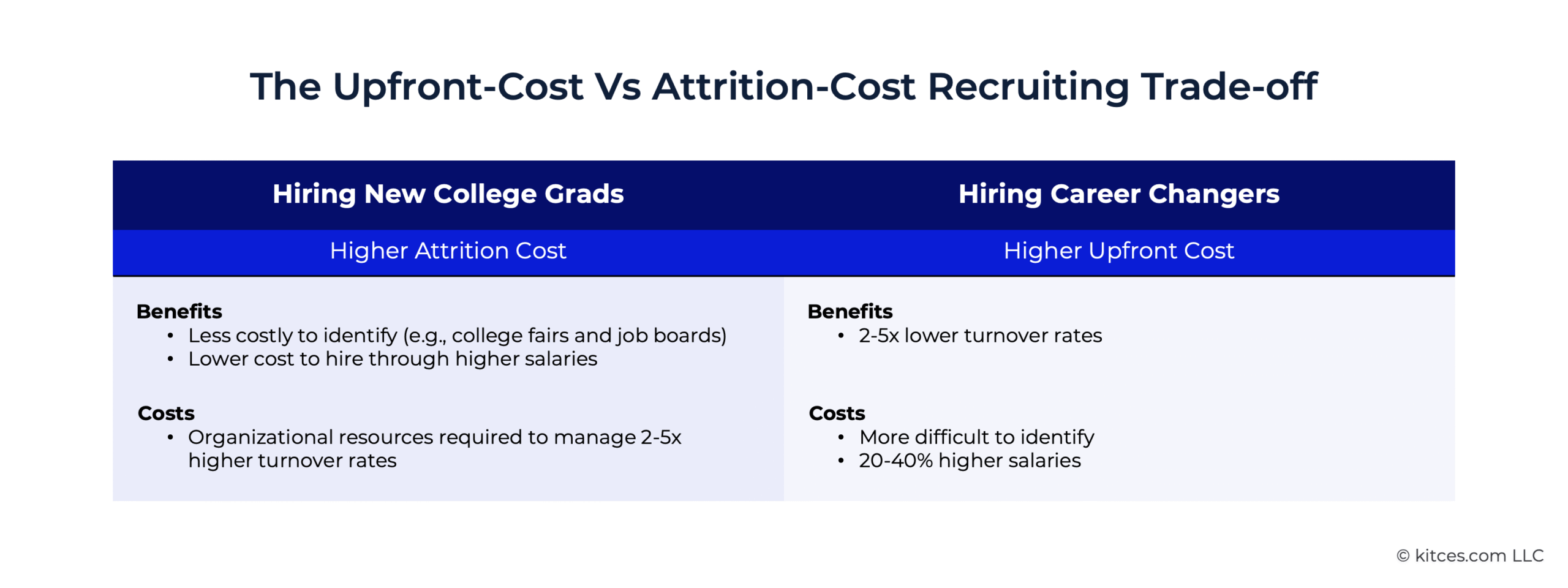
In the end, whether advisory firms should target college graduates or career transitioners depends on whether a firm has sufficient cash flow to invest in recruiting more experienced (and expensive) professionals from other industries. Firms with limited resources may instead prioritize the lower upfront cost of hiring new graduates, accepting the operational strain of higher turnover as part of their model.
Why Career Changers Have Lower Turnover Rates
Three important reasons why career changers have lower turnover rates than new college grads as a result of their experience in other industries are:
- They feel (and are) more effective at their job by having developed:
- Professional soft skills useful for any workplace; and
- Specialized skills (e.g., interacting with clients, analytical knowledge) transferable to advisor roles.
- This experience allows them to have higher starting incomes and (for those building their own client base) grow them faster.
- They are more likely to have found the "right" profession for them through trial and error.
Transferable Soft And Specialized Skills
The first reason why their previous experience in other industries contributes to career changers having lower turnover rates is their development of professional soft skills. Someone beginning a financial services career immediately after college is not only learning the difference between ordinary and qualified dividends or the compliance requirements associated with client records; they are also developing foundational workplace skills often acquired in early-career roles, such as meeting deadlines while simultaneously juggling multiple tasks, being accountable for outcomes, and navigating professional hierarchies. By contrast, individuals entering financial services later in their careers are more likely to have developed these soft skills elsewhere, making them feel (and be) more effective at work.
Beyond these broad workplace competencies, career changers may also bring more specialized experience that translates directly into advisory roles. For example, Kitces.com Financial Planning Nerd Adam Van Deusen, CFP® (a career changer himself), has written about how individuals with strong analytical backgrounds may be particularly well suited for behind-the-scenes work developing financial plans and recommendations. Similarly, those with extensive customer-facing experience may perform well in a client-facing advisor role (whether serving an existing client base as a Service Advisor or building one's own client base as a Senior Advisor). And the subset of this group with business development or sales experience may be especially well positioned to succeed in Senior Advisor roles responsible for building their own book of business. In other words, career changers' past roles may have more overlap in specialized skills relevant to being a client-facing or supporting advisor than many firm owners might initially suspect, better positioning them for success compared to new grads with an undergraduate degree in finance.
Commanding Higher Incomes
Because of this relevant prior experience, advisors with fewer than five years of industry experience who entered the profession as career changers are 29% more likely to strongly agree that they feel effective at their jobs than those who entered directly from college, which as shown earlier, corresponds with far lower turnover rates.
And notably, the benefits of career changers' past professional experience extend well beyond simply making them more effective at managing workloads or interacting with clients. Indeed, as noted earlier, the result of this prior experience is that as new advisors, career changers earn 20%–40% more in income as a result. This in turn drives higher wellbeing, evidenced by our Kitces Research data on Advisor Wellbeing, which finds that advisor wellbeing steadily rises with income up to approximately $500,000 per year, after which point the relationship plateaus.
There are several reasons that career changers tend to command higher income. First, career changers can leverage their prior professional experience into better compensation packages when negotiating for a new position. Second, for those building their own books of business, career changers often bring with them professional networks developed through prior roles that can serve as an initial source of clients. And further, those early clients are often more established in their own careers than the peer network of new grads, allowing career-changing advisors to gain traction more quickly.
Evidence of this latter point can be seen in our Kitces Research data. Compared to advisors who enter financial services directly after college, career changers tend to serve more affluent clients during their first five years in the industry. On average, their clients have higher household incomes ($200,000–$250,000 versus $150,000), greater investable assets ($1 million–$1.25 million versus $500,000), and higher net worths ($1.75 million–$2 million versus $1 million).
Career changers starting their own practice may also enjoy greater financial stability during the industry's notoriously low-income early years. Our data indicate that career changers are 20% more likely to have a domestic partner than those entering directly from college, meaning their households are more likely to have a second income earner capable of helping absorb the financial strain associated with launching an advisory career.
More Likely To Be In The 'Right' Profession For Them
Finally, career changers' stronger wellbeing appears partly attributable to a greater likelihood of feeling that they have found the 'right' profession. A common experience among recent graduates is discovering that the career they expected to enjoy is less fulfilling than anticipated, leading them to explore alternative career paths. Career changers, by definition, have already had an opportunity to test at least one other profession and develop a clearer understanding of the types of work they find satisfying. As a result, their decision to enter financial services is often informed by greater professional self-awareness. In this respect, many career changers appear to experience something akin to a "zeal of the converted" – a heightened sense of purpose and enthusiasm resulting from (finally) landing in a vocation one feels passionate about. Consistent with this idea, among new advisors, career changers are 7% more likely than those entering directly from college to strongly agree that their life has purpose and 22% more likely to strongly agree that what they do is valuable and worthwhile.
In sum, compared to recent graduates, career changers enter the profession with more relevant skills and greater confidence that the financial services industry is a good long-term fit for them. They also earn more once they've entered the field. The result is that career changers experience substantially higher wellbeing during their early years in the profession, making them less likely to leave their firms – and potentially even the industry altogether.
The fact that career changers are better positioned for success is also noteworthy in light of the biases firms may have against hiring them in the first place, such as a suspicion that, if they were great employees, they would already be thriving in their existing industries, or that new graduates might be more 'teachable' while hiring a career changer could require 'teaching an old dog new tricks.'
Ultimately, the key point is that firms looking to minimize advisor turnover should strongly consider whether the benefits of hiring career changers more likely to stick around are worth the higher cost of hiring and employing them over traditional cohorts like new graduates.
A Four-Step Guide To Hiring Career Changers
Based on the Upfront-Cost Vs Attrition-Cost Recruiting Trade-off, many advisory firms may want to prioritize hiring career changers (who are more expensive but have lower turnover rates) over new college graduates (who are less expensive to identify and hire but more likely to carry hidden costs to the firm later via higher turnover rates). But as noted earlier, part of the challenge of hiring career changers is that it's harder to target them like one might a soon-to-be/recent grad at a college fair or job board. Which means many firms may want to identify career changers but struggle to hire them in practice.
To provide guidance to advisory firms looking to hire more career changers, we first spoke with Hannah Moore, CFP®, the owner and Principal Financial Planner of Guiding Wealth, an advisory firm based in Richardson, TX. Moore also founded Amplified Planning – a monthly educational resource for current and aspiring financial planners and CFP students – which runs The Externship, an eight-week virtual program that is consistently comprised of about 40% career changers.
In addition, we reviewed Amplified Planning's report on new entrants to financial services, produced in collaboration with Schwab Advisor Services. Drawing on survey data from more than 1,800 participants in The Externship in 2025, the report provides an in-depth look at the factors that attract career changers to the profession, as well as the barriers they commonly encounter. Readers interested in a more comprehensive overview of these findings can access the full report, which is available free of charge on the Amplified Planning website.

Nerd Note:
While Hannah Moore reviewed a draft of this article to help ensure that her comments and research were represented accurately, the authors retained full editorial control over its content. Any errors or omissions are solely the responsibility of the authors.
For our purposes, we focus on four key conclusions from Moore and the Amplified Planning report and organize them into a four-step framework that maps to different stages of the recruiting funnel. These stages range from increasing awareness of job opportunities among potentially qualified candidates (top of the funnel), to making roles more appealing to career changers and encouraging them to apply (middle of the funnel), and ensuring that application reviewers give career changers fair consideration (bottom of the funnel).
This four-step funnel framework is illustrated below.
Step #1: Spreading Awareness Of Job Opening Among Career Changers
At the highest level of the recruiting funnel, the first challenge advisory firms face is simply getting their job postings in front of nontraditional candidates in the first place. Unlike traditional candidates or college students – who can be reached through industry job boards such as the FPA Job Board, NAPFA Career Corner, CFP Board Career Center, and Simply Paraplanner, or through university career centers, campus recruiting programs, and job fairs specifically designed for early-career individuals – career changers are a more diffuse population that can be inherently difficult to identify and reach.
For this reason, then, advisory firms have far more control over increasing the likelihood that career changers who do see their job postings apply than they do over increasing the total visibility of the posting in the first place. Still, firms are not powerless when it comes to increasing the visibility of their opportunities among this group.
In The Amplified Planning Building the Future of Advice report, Hannah Moore discusses the importance of recruiting outside the traditional financial planning ecosystem. This means looking beyond industry-specific job boards – which are often heavily frequented by individuals already familiar with the profession – and expanding recruiting efforts into channels more likely to reach professionals in other fields.
When it comes to online job boards, in a Kitces.com article, Daniel Yerger notes that posting positions on broader employment platforms such as LinkedIn, Indeed, Glassdoor, and Handshake often attracts meaningfully more applicants from nontraditional backgrounds than industry job boards. An important caveat, though, is that while casting a wider net makes firms more likely to identify qualified career changers, they are also more likely to catch a large number of unqualified applicants too. Therefore, the suggestion of posting on general job boards may only be suitable for larger firms with the recruiting infrastructure to sift through a larger number of applications.
Beyond online job postings, in the report Moore highlights the value of engaging with local career fairs, workforce development organizations, and professional career centers – resources that individuals considering a career change frequently turn to when exploring new opportunities. Firms can also benefit from targeting industries that have historically produced large numbers of successful career changers. According to the report, the most common prior professions among career changer Externs were Education (10.2%), Healthcare (8.5%), Technology/Software (6.8%), and Engineering (5.1%). Moore notes that these backgrounds often provide directly transferable skills. For instance, professionals coming from education and healthcare frequently possess strong communication and empathy skills that translate well to client-facing roles, while those from technology and engineering backgrounds may bring analytical and problem-solving capabilities that align naturally with planning-focused positions.
Finally, beyond utilizing broader job boards and targeting locations where career changers are likely to seek guidance, Moore notes that firms can recruit through training and career-transition programs such as The Externship and FPA Residency – which as discussed earlier, tend to attract disproportionately large numbers of career changers and therefore offer firms a concentrated source of candidates already exploring financial planning as a second career. Unlike posting on general job boards, targeting locations like these can be suitable for both large firms as well as smaller firms that don't have the capacity to sift through large numbers of applications.
In sum, while identifying and attracting professionals from other industries is inherently more challenging than recruiting recent college graduates, advisory firms nonetheless have several strategies at their disposal to increase the visibility of their opportunities among less traditional candidates interested in becoming advisors.
Step #2: Letting Career Changers Know They're Qualified
While advisory firms have fewer levers at their disposal at the top of the recruiting funnel to increase awareness of their job postings among career changers, they have far more actionable opportunities in the middle and bottom of the funnel to persuade career changers who view those postings to apply—and to seriously consider the applications of those who do.
At the most basic level, this means making it clear to career changers that they are qualified to apply in the first place.
The report notes that doing so intentionally is particularly important given the common frustration among career changers that employers discount prior experience simply because it was acquired outside of traditional industry pathways. As a result, many career changers enter the job search process already expecting that employers will not value their backgrounds. Job postings that focus heavily on industry-specific credentials or experience can inadvertently reinforce this perception, discouraging otherwise qualified candidates from applying.
One way to do this is by avoiding arbitrary requirements, such as having a degree in financial planning or a specified number of years in a financial services role. Instead, in her commentary included in the report, Moore suggests focusing on transferable skills required to fulfill advisor responsibilities rather than focusing narrowly on the specific advisor responsibilities themselves. Accordingly, firms should emphasize skills such as client-facing experience, analytical problem-solving, coaching individuals through difficult situations, teaching and education, project management, and other competencies that readily transfer into advisory roles. This slightly broader framing will ensure applications are appealing to those with both traditional and nontraditional backgrounds. In addition, some firms may even benefit from including a brief statement explicitly encouraging candidates from non-industry backgrounds to apply, helping prevent otherwise qualified career changers from self-selecting out of the process because they assume they do not meet the requirements.
Step #3: Letting Career Changers Know They're Supported
While conveying to career changers that they are qualified for an advisor role is a prerequisite to getting them to apply, it is by no means sufficient. After all, job applicants generally do not apply to positions merely because they are qualified for them. In the case of career changers, many are already clear-eyed that entering financial planning will involve a steep learning curve and, at least initially, a reduction in compensation. Nonetheless, what makes them more likely to apply is the belief that they will be supported through that transition.
Most fundamentally, this support begins with training. The financial advice profession has long been notorious for providing relatively little formal training during advisors' early years. While this may be less problematic for those entering directly from college (who often have little basis for comparison), career changers frequently contrast the industry's training practices with more robust practices of their prior professions. This can be especially frustrating given that career changers, by definition, are entering a new field and often feel a particularly strong need for structured development and support.
Indeed, in our conversation, Moore characterized it this way:
"Many [career changers] have reached success in their prior career and they understand what it takes to move up. And then they get [industry] jobs and then ask, 'Where's the training? I know how important training is, because I've seen it in my past careers. Where is it?' And they feel very unsupported when they may have seen more support in prior careers."
While extensive guidance on structuring effective training programs can be found in the Amplified Planning report, the key point here is simply that firms can make themselves substantially more attractive to career changers by clearly emphasizing the training, mentorship, and support they will receive during their transition into the profession.
Beyond initial training, career changers also want confidence that they will be supported throughout their longer-term professional journey through a clear and well-defined career path. This is particularly important given that many career changers make significant financial sacrifices to enter the profession and therefore seek reassurance that – contingent on achieving a certain level of performance—those sacrifices will ultimately be rewarded. As one participant quoted in the report explained:
"Being a career changer [is] a very hard pivot and [you have] to work your way back up… [You need a] roadmap [that is] super clear to get back to where you were financially."
Our Kitces Research data suggests that this desire for clarity is so strong that simply seeing another advisor successfully advance within a firm can function as a roadmap of what success might look like (though, of course, this is no substitute for having a clearly articulated career track of one's own).
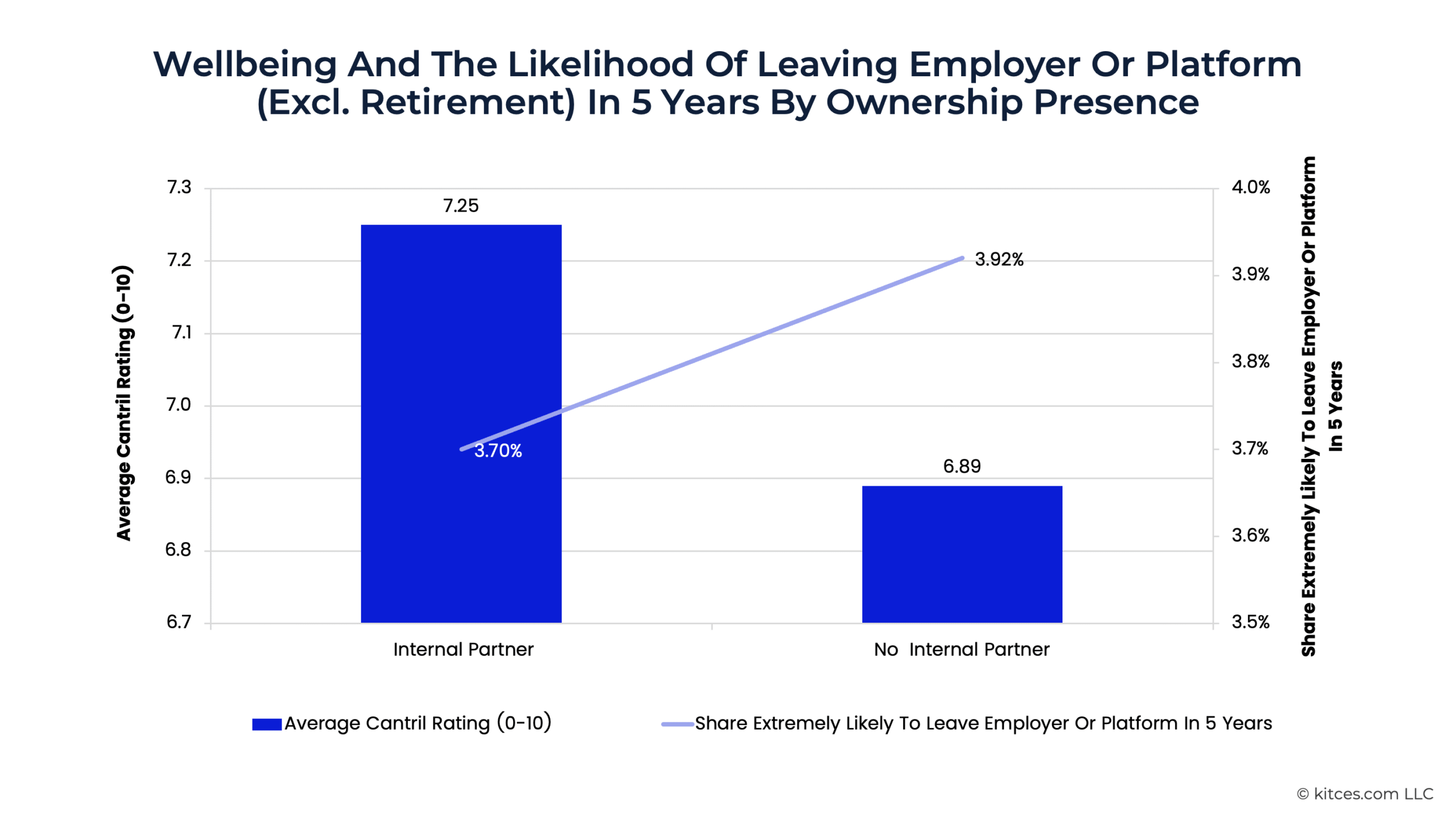
The figure below examines wellbeing and expected turnover risk among employee Senior Advisor career changers based on whether they have observed a demonstrated path to partnership – that is, whether another non-founding advisor at the firm successfully worked their way into ownership. Advisors who have witnessed such a path report higher wellbeing and lower expected five-year turnover rates than those who have not. While the differences are not enormous, the implication is clear: if merely observing another advisor's advancement produces measurable benefits, the effects of receiving a clearly defined growth path personally may be even greater.
Finally, the report makes clear that career changers place tremendous value on firm culture. When asked what factors are most important when evaluating advisory firms, 73% selected firm culture—the most commonly selected response.
In our conversation, the findings emphasized that culture matters "tremendously" for career changers because, having already had a career, they are not simply looking for "any job." Instead, they are making a highly deliberate decision about where to spend the next phase of their professional lives. Beyond having higher standards generally, many are taking substantial risks by leaving stable careers and incomes behind, making them especially concerned about joining firms that will treat them well and provide a supportive environment.
 One challenge for advisory firms in acting on this observation is the fact that so much of culture is experienced rather than described. Culture emerges through daily interactions, communication patterns, and – as Moore put it, "the way firms treat their people." However, firms are not powerless when it comes to conveying their culture in their job posting. According to the book "How To Be A Great Boss", firms' "core values" drive culture because they are the "soul of the organization." Conveying these core values on a job posting, then, can serve as a window into the firm's soul.
When looking at the relationship between firm culture, advisor wellbeing, and turnover in our Kitces Research data, our findings strongly support Moore's observations regarding the role these factors play in career changers' success.
The figure below compares three outcomes among career changers new to the profession based on whether or not they work at a mission-driven firm (defined as a firm whose mission and values are central to day-to-day operations): (1) wellbeing, (2) the share strongly agreeing with the statement "I can be myself at work," and (3) expected five-year turnover rates.
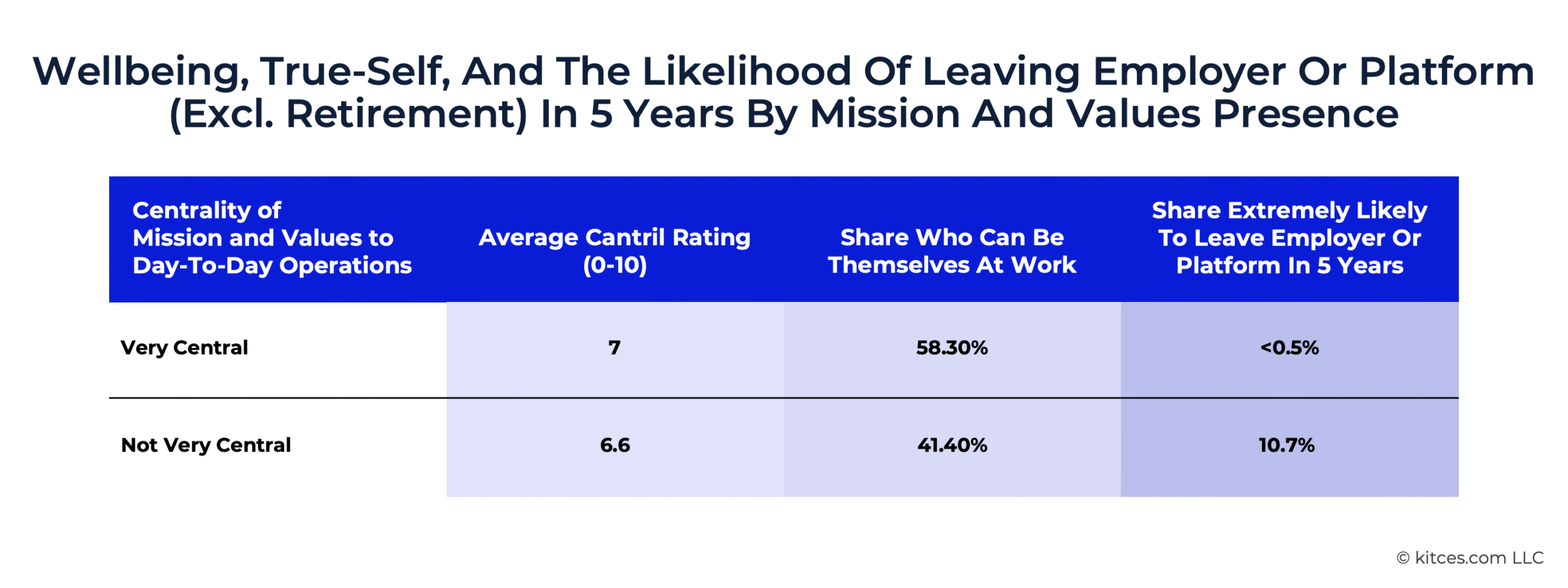
Overall, career changers at mission-driven firms report higher wellbeing, are 17% more likely to strongly agree that they can be themselves at work, and exhibit expected turnover rates that are 6% lower than their counterparts at non-mission-driven firms. In other words, it is not merely that career changers say they value firm culture – we can observe that they are happier and less likely to leave when working in environments that provide it. As a result, mission-driven firms stand to benefit by clearly and authentically communicating their mission and values throughout the recruiting process, including within their job postings.
Step #4: Soliciting (And Fairly Reviewing) Applications
After getting your job posting in front of career changers and communicating both why they are qualified for the role and how they will be supported in succeeding, all that remains is actually reviewing the applications. This somewhat obvious point nonetheless bears consideration in an era when automated résumé-screening tools and AI-based filters have become increasingly common. In her commentary in the Amplified Planning report, Moore notes that these tools can unintentionally screen out strong candidates with valuable transferable skills simply because they lack industry tenure or a degree in finance. Her recommendation, therefore, is to establish review processes that place greater emphasis on transferable skills and relevant experience rather than relying too heavily on traditional industry credentials, helping ensure that strong candidates are not overlooked. (Though it's worth noting that this added review time may be more difficult for smaller firms without dedicated hiring and HR staff.)
Where all firms regardless of size can excel is, when reviewing applications, not to assume that you know what is best for the applicant. One example Moore highlights is dismissing candidates because they appear overqualified or because you assume they would be unwilling to accept the compensation typically associated with an early-career advisor role. In reality, many career changers are fully aware of—and willing to accept—these tradeoffs in exchange for entering a profession they find more meaningful or fulfilling. The key takeaway, Moore notes, is to "avoid assumptions" and evaluate applicants on the merits of their qualifications and experiences rather than on judgments about whether they are making the right career decision.
Given the growing advisor talent shortage, it is more important than ever for advisory firms to be intentional about both recruiting new advisors and retaining the advisors they already have. Hiring career changers – whose prior professional experience often leaves them better positioned for success during their early years in the profession – offers firms an opportunity to tap into a talent pool that remains underutilized by much of the industry and has historically seen relatively low turnover rates. While career changers can take longer to locate and, in some cases, cost more to hire than candidates from traditional pathways, research from Amplified Planning and Kitces Research suggests that firms can meaningfully improve their ability to attract these individuals. In doing so, they gain advisors who bring diverse experiences, transferable skills, and a greater likelihood of long-term success—making them valuable assets to both their firms and the profession as a whole!
 About Kitces Research
The Wellbeing Study is one of our four original research studies – on advisor wellbeing, advisor technology, advisor productivity, and firm marketing – conducted by Kitces Research and shared with Kitces readers on a rotating schedule every two years. You can access the latest Kitces Research study on Advisor Wellbeing here.





Leave a Reply