Executive Summary
When hiring, financial planning firms will naturally seek to find the best possible candidate for the specific position. However, such individuals don’t necessarily appear on their own; rather, firms have to craft a job posting that attracts a qualified pool of candidates from which to choose (while also considering the time cost to the firm of assessing those who apply).
In this guest post, Daniel Yerger, founder and owner of the RIA MY Wealth Planners, outlines the strategy behind crafting a job description when his firm needed to hire two entry-level positions in relatively short order, and the tradeoffs involved in where to advertise the position.
To start, the concept of “signaling theory” suggests that employers will attract better candidates when their signals are clear in terms of expectations and rewards, and candidates with stronger qualifications will apply for roles in which they believe they are more likely to obtain adequate compensation in alignment with their qualifications.
With this in mind, an effective job posting can start with a basic description of the role and its responsibilities, followed immediately by compensation information (including a salary range as well as benefits offered). At this point, any qualified candidate for whom the compensation would be reasonable is likely to proceed, and any candidates not qualified or otherwise who feel their skill level is above the offer at hand will move on. Next, the description can describe common tasks for the job (to give candidates an idea of what their day-to-day work would be like in this position) as well as a list of minimum and preferred qualifications (with the former being a shorter list to avoid discouraging potential candidates who might only apply if they meet every one listed).
The job posting can then include a description of the hiring process to give candidates an idea of both what they can expect in terms of submission requirements (e.g., resume and cover letter) and the number of interviews, as well as when to expect to hear back from the firm (whether they’re selected to move on to the next round of the process or not) as well as the start date for the position. To help clients through this process, firms can also include a paragraph describing its target focus, the size of its client base, and any unique characteristics, as well as a list of resources where candidates can learn more about the company.
With the job posting created, firms can then consider where to advertise it to reach a desired pool of candidates. Notably, this decision involves tradeoffs; for example, while including the posting on larger platforms (e.g., LinkedIn or Indeed) can attract a broader (and more diverse) pool of candidates than on industry-specific job boards (e.g., the FPA Job Board or the CFP Board Career Center), doing so could require filtering through more submissions (though firms can reduce the number of superfluous candidates by having them apply on the firm’s website instead of directly on the site where the job posting is listed).
Ultimately, the key point is that given the high stakes involved in advisory firm hiring (particularly when it comes to the time and dollar costs of employee turnover), taking the time to craft and advertise a job posting that appeals to prospective candidates with the interest and qualifications to excel in the position is likely to be a worthwhile investment!

Imagine this: it’s September 29th, 2025. You’re flying home after an exciting time at the XYPN Live Conference in Austin, Texas. You’ve spent the past few days in community with some of the best and the brightest in the financial planning profession, and the future is bright. You’re returning home to a practice with just over a million in recurring revenue, serving 197 households with the support of two associate planners who are within a year of completing their CFP certification, and you just hired a top-notch office manager for administrative support a few weeks ago. To say your heart is full is an understatement.
The next day, you sit down with your team to discuss your takeaways from the conference and some action items for potential implementation. At the conclusion of the meeting, one of your associate planners asks if you have a few minutes afterward. They just returned from their own travels, having just spent the better part of the month of September on leave for a camping trip with their best friend, another outing with their partner, and a few weeks overseas on a European vacation. You’re excited to hear about all of that, but instead, they tell you they’ll be leaving in two weeks for another firm up the road. Surprising and disappointing to say the least!
To compound that challenge, the day after the first associate planner’s last day with the firm, your second associate planner delivers more bad news: next June, they’ll be moving across the country to be closer to their long-distance romantic partner. You’re happy for them, but this leaves you with quite the conundrum! Two weeks ago, you were on the precipice of a practice with the bandwidth to serve 300 clients. In nine months, you’re going to be drowning. You’re going to have to hire, and not just anyone, but the best and brightest you can find, and as soon as possible.
How Signaling Theory Applies In Hiring
The majority of financial planning firms are not widely known. While large institutions such as Vanguard, Fidelity, and Charles Schwab enjoy substantial market exposure and brand reputation, many solo and small financial planning practices are relatively anonymous in the landscape for financial planning careers. Thus, rather than being able to rely upon a well-established brand for career paths and recruitment, most small practices are going to make their first and only impression upon their job candidates with the job posting itself.
The primary mechanism for attracting candidates is best viewed through the lens of signaling theory. Proposed by Michael Spence in 1973 in The Quarterly Journal of Economics, signaling theory posits several observable behaviors in both job posting and job seeking:
- Employers will advertise roles with certain qualification requirements, such as degrees and credentials, based on their observation of the quality and output of employees with or without those qualifications.
- Applicants will obtain relevant signals, such as a degree or credentials that stand out as indicators that they will likely produce a greater marginal product if hired for a role.
- An equilibrium is struck where employers will offer higher wages and compensation in the presence of productive employee signals, and employees will accept better offers as a function of the reward for their relevant qualification signals.
To put that in plain English? Employers will attract better candidates when their signals are clear in terms of expectations and rewards, and candidates with stronger qualifications will apply for roles in which they believe they are more likely to obtain adequate compensation in alignment with their qualifications.
This means that employers that use specific keywords in their job postings – including in the title, the role and responsibility descriptions, the compensation details, and the qualifications – can clearly indicate to candidates that they are suitable for the role and that the role will meet their expectations. Clear signals for hiring someone in a paraplanning or associate planner role can include terms like "CFP professional", "candidate for CFP certification", "Series 65 licensed", and so on. Other signals can be related to compensation or cultural alignment, such as describing the compensation as “salaried” with a clear wage range, or indicating the firm is fee-based vs. fee-only, or that the firm has a clear mission alignment with a particular niche clientele, sociopolitical demographic, or ideal client profile.
In turn, candidates for roles in the financial planning field can indicate through their resume and cover letter their qualifications for the roles they’re applying to by highlighting their educational accomplishments, experience with relevant tools, and their focus on a career path aligning with the needs and mission of the firm. Examples of the aforementioned can include a degree in personal financial planning, completion of the Amplified Planning externship, or completion of CFP certification coursework; experience with eMoney, RightCapital, Holistiplan, or other common planning tools; and a description of how the firm’s role supporting a particular clientele holds personal significance, how the firm’s remote work might create necessary flexibility due to a spouse with regular relocation as part of their work, or why a part time or full time role are ideal given their work-life balance needs.
The Job Seeker Is The Hero Of The Story
The cardinal mistake many firms make when posting a job opportunity is centering the firm itself within the job posting. While it can be tempting to try to convey how excellent the firm and the opportunity are, the firm itself is likely a background consideration in why a candidate would apply to a yet-unknown growing practice. Job postings should instead focus on providing candidates with signals to recognize that it is the type of opportunity they are seeking, that they are strong candidates for, and that will reward them adequately if they are offered and accept the position. Wording can be incredibly important when going broad-based. For example, posting a position for a “Financial Planning Analyst” attracted enormous interest from quantitative finance, business analysts, and financial planning and analysis (FP&A) accountants, whereas posting a position for “Wealth Planning Analyst” resulted in a lower volume of candidates but also a much higher ratio of CFP candidates and personal financial planning-educated candidates.
Below is an example of a strong job posting for an in-person financial planning role.
[Editor's Note: The job posting's original formatting has been preserved for purposes of the example.]
Wealth Planning Analyst Job Description
Summary
[Firm Name] is hiring a Wealth Planning Analyst. This is an entry-level in-person position in the financial services industry in [City, State], with a start date on [date].
A Wealth Planning Analyst is a financial planner in training, primarily supporting the firm’s financial planners in financial plan development and client service tasks. This includes client document review, financial plan data entry, scenario modeling, and investment account administrative tasks. Wealth Planning Analysts will attend meetings with financial planners to take notes and engage in follow-up tasks such as updating client relationship management software and providing recap emails to clients. The position is expected to staff hours from 8:30 am through 5:00 pm, Monday through Friday, with moderate work volume. A candidate for this position is intended to be promoted to a Series 65 securities licensed associate financial planner after one year,* and is expected to complete their CFP® Certification** within the first few years of employment.
Compensation
- Salary: $58,010.10 - $64,079.23 based on relevant experience**
- *Associate financial planner pay range $78,008.40–$86,169.80.
- **Candidates with the CFP® Certification or comparable alternative receive a 20% premium enhancement to their base salary, above the stated range.
- After 90 Days:
- Quarterly Gainshare Bonus Eligibility based on company profitability
- 401(k) with a 6% Match immediately vested
- Health Insurance (ACA Gold-Tier Plan) 100% paid by Employer, with the option to add family members at Employee’s cost
- Health Savings Account (HSA) and Flex Spending Accounts (FSA)
- Vision & Dental insurance paid by Employer, with the option to add family members at Employee’s cost
- Life, Long-Term, and Short-Term Disability Insurance paid by Employer
- 21–26 Holidays per year (25 Scheduled in 2026)
- Unlimited PTO Policy
- Paid Medical, Jury, Military Service, and Bereavement Leave
- Continuing Education Budget for specified courses and certifications
- After One Year: 6 Months Paid Paternity & Maternity Leave
- Paid Sabbatical every 5th Employment Anniversary
- Partnership opportunities after 10 years
- Additional Information:
- Link to Video About Working at [Firm] (Sample Video)
- Link to Employee Benefits Guide for [Firm]
Common Tasks
- Supports senior team members by creating financial plans and preparing materials needed for client meetings and follow-ups
- Attends client meetings and takes extensive notes [Reference AI notetaker]
- Maintains information in the [CRM System]
- Sets up and retrieves reports in the portfolio management systems [List of relevant systems]
- Assists in generating performance and other reports using [List of relevant systems]
- Processes move money requests at a licensed planner’s direction
- Fills out necessary forms for opening or maintaining accounts at a licensed planner’s direction
- Performs ad hoc tasks in support of firm operations
Minimum Qualifications
- Bachelor’s Degree OR 1 Year in Position of Equivalent Experience
- Pending graduates for the [upcoming semester] are welcome to apply
- Speak, read, and write English
- Able to lift and carry up to 15 lbs
Preferred Qualifications
- Upbeat and personable
- Graduate of an accounting, finance, or personal financial planning program
- Prior completion of CFP® Certification courses via certificate or degree program
- Proficient with [Microsoft/Apple] and [Core Productivity Suite], including:
- [Word/Docs/Pages]
- [Excel/Sheets/Numbers]
- [Outlook/Gmail/Apple Mail]
- Experience with [firm-specific tools such as CRM, custodial platform, and financial planning software]
- Interest or background in financial services as a career path
Hiring Process
As this position is on our lead planner and partner career track, we are extremely thorough in our selection of candidates. Each step after the first should be considered as if moving forward. We will never ghost a candidate and will always provide positive confirmation that you are moving forward or have been declined at a certain stage. Below are the steps of the hiring process:
- Submit your application between [Dates, typically a 2–3 week range]. Note:
- Applications should include a resume and cover letter in .pdf format; no other formats are acceptable. Resumes and cover letters should not exceed one page each, for a total of two pages. Those who thoroughly read this job posting should include the phrase [AI-Proofing Term, such as “old-fashioned” or “Rocky Mountains”] in their cover letter.
- We often receive several hundred applications for positions at the firm, and if overwhelmed by interest, we may close the application window early and with limited notice on the job postings. Thus, applying with a sense of urgency is important.
- We will notify applicants not invited to move forward within a few days of applying; we believe in open and clear communication with all applicants to the firm.
- If selected as a candidate of interest, you will be asked to submit a video no longer than 5 minutes, introducing yourself. Your introduction video should be a link to the video, not sent as a file, and include:
- One minute on your background and yourself.
- Why you want to work in-person at [firm], specifically.
- Your understanding of our business model.
- An explanation on a financial planning topic, to be described with the invitation to submit a video.
- Your understanding of our business model.
- An explanation on a financial planning topic, to be described with the invitation to submit a video.
- If selected to interview, interview by [date] with the [firm name] team. If local, in person. For those applying from greater than 100 miles away, a Zoom interview will be permitted, but a final candidate will be invited to meet in person before being given a final offer letter. Transportation and accommodations will be paid for in such a case.
- Final selection of a candidate for the position will be made no later than [date]. All candidates not selected will also be notified by this date, though candidates who are not a fit may be notified earlier.
- Tentative offer made, and background check performed.
- Offer made and accepted no later than [date].
- Start Date: [date].
About [Firm Name]
[One paragraph, describing the firm’s target focus, size of client base, and any unique characteristics.]
See [previous content about] our hiring process:
[A list of resources, whether these be blog posts, podcasts, videos, or other places you’ve shared insightful information about the company, its culture, and how it onboards and develops new talent.]
Download this job description as a template here.
Why This Job Description Structure Works For Advisory Firms
The post is designed to provide the two most salient signals immediately: “Am I qualified, and if I am, would I be compensated adequately for the role?” The posting begins with a basic description of the role and its responsibilities, then is immediately followed by compensation information. Any qualified candidate for whom the compensation would be reasonable is likely to proceed, and any candidates not qualified or otherwise who feel their skill level is above the offer at hand will move on. For those interested, they’re then invited to learn more about the role through the list of common tasks, then about the specific qualifications for the role.
Notably, qualifications are broken up into a very low set of minimum requirements and a set of preferred requirements. Studies over the years have shown that different demographics can respond to job requirements in different ways. For example, women frequently will not apply for a role unless they believe they can satisfy 90% or more of the requirements of the position, whereas men will often apply for a role even if they are grossly underqualified. In other cases, applicants from lower socio-economic backgrounds can find it necessary to condense their job search to opportunities with clearly stated compensation to reduce their cost of search due to more limited resources; this can be more clearly emphasized in the wealth gaps between different racial groups, which often (but not always) can reflect the issues seen in such socioeconomic disparities.
Additionally, individuals from lower-income socioeconomic backgrounds or who are currently limited in resources may skip over jobs in which they cannot immediately assess the compensation for the role because they cannot afford to waste time applying for a job only to find out that the pay and benefits will be inadequate. In summation, being transparent about the job’s requirements and compensation up front helps signal to a larger variety of candidates whether they could be a good fit for the role and whether the role will suit their needs.
For these two associate advisor roles, the pay ranges shown were competitive salary scales in 2025 and early 2026 for an entry-level planner-track position requiring no experience. Pricing salary and base compensation for financial planners can vary wildly between firms that emphasize stability and professional development or a sales-oriented variable compensation approach. This job posting is focused on attracting candidates to the former and is likely to alienate incentive-driven candidates seeking roles with a greater focus on business development.
The subsequent increase with the promotion to associate financial planner dovetails with the advancement to a licensed role, which carries more direct client responsibility and the potential of engaging in business development activities. The additive 20% premium placed on holding the CFP certification is intended to reflect more appropriate compensation for those candidates who have the strong value signal of holding the CFP marks.
The pay scales themselves were developed based upon available industry benchmarking studies, namely Schwab RIA Compensation Benchmarking, CFP Board’s CFP Professional Compensation Calculator, Bureau of Labor Statistics, Investments News Advisor Benchmarking Study, and Kitces Research on “How Financial Planners Actually Do Financial Planning”. Altogether, this represented a slightly above-market base compensation level for hiring a planner in a medium-to-high cost-of-living region in Boulder County, Colorado. Those hiring in major metropolitan areas or in regions with higher or lower costs of living may want to adjust the salary scale up or down accordingly. Keep in mind that both Federal labor law and some states have minimum salary requirements to post a position as salaried rather than hourly, so firms should consult the relevant labor statutes in their state before posting a salary range.
Assuming that a candidate has then identified that they are qualified and that the compensation is adequate to their needs, the next section of information lays out every step of the application process, including anticipated timelines for each stage and what will be required at each stage. Notably, it also includes some specific directions that can be used to help identify candidates who might otherwise ‘apply in bulk’ to opportunities rather than thoroughly assessing the detailed information in the job posting, thus helping eliminate candidates with less than ideal attention to detail from the talent pipeline.
Finally, the job posting wraps up with a small blurb about the firm, enough to give the candidate some notional idea of where they’re applying to before they do more research, and finally, helpful resources for helping candidates better prepare for the opportunity. All of this presents the candidate with resources to better stand out, not just in terms of their quality of application or interview, but also to demonstrate that they can thoroughly perform due diligence and prepare accordingly, which are key skills for financial planners.
Posting An Advisory Firm Position: Casting A Wide Net Or Keeping It Focused
With a stellar job description in hand, the next and natural question that arises is where to share the opportunity (and how visible to make the job posting). There can be pros and cons to whether to share a job posting on a variety of wide-funnel recruiting platforms versus a narrow niche-based platform. For example, firms are likely to see a few dozen applicants if they limit their job posting to platforms such as the FPA Job Board, NAPFA Career Corner, CFP Board Career Center, and Simply Paraplanner; but the positive of that limited recruitment pool is that they will likely have a much higher average quality of candidate, because only those individuals seeking opportunities specifically in financial planning will be looking for jobs there.
In turn, if advisory firms want to open up the opportunity to less traditional candidates or to otherwise attract a more diverse pool of talent, they may want to look at posting to platforms such as LinkedIn, Indeed, Glassdoor, and Handshake.
This will dramatically increase the volume of applications received, which can create a greater challenge with filtering applicants down to a few select candidates, but otherwise may put the firm in a position to identify unique or differentiated candidates with less common backgrounds or experience in alternative industries, which can bring unique and valuable perspectives and skillsets into the firm.
One key element that can help cut down on superfluous or ‘high volume applicants’ is to only accept applications off-platform; that is to say, ask applicants to go to the firm’s website where the job posting is listed, and they can submit a resume, cover letter, and any additional supporting documentation. This will dramatically reduce the number of ‘spam’ applications received, as many job posting platforms will let applicants apply with as little as a single click to submit their platform-specific profile or auto-submit their resume. While there can be good candidates who are applying in such a manner, aim to focus on applicants who can demonstrate that they have thoroughly reviewed the opportunity and can follow the basic instructions given.
The Hiring Results Of These Job Posting Strategies
With our job description in hand, it was now time to hire – since we had to hire two roles, we did two rounds of hiring within three months of each other, using the exact job template posted above, with one cohort recruited from the broad base of platforms suggested above, and the other limited only to profession-specific platforms.
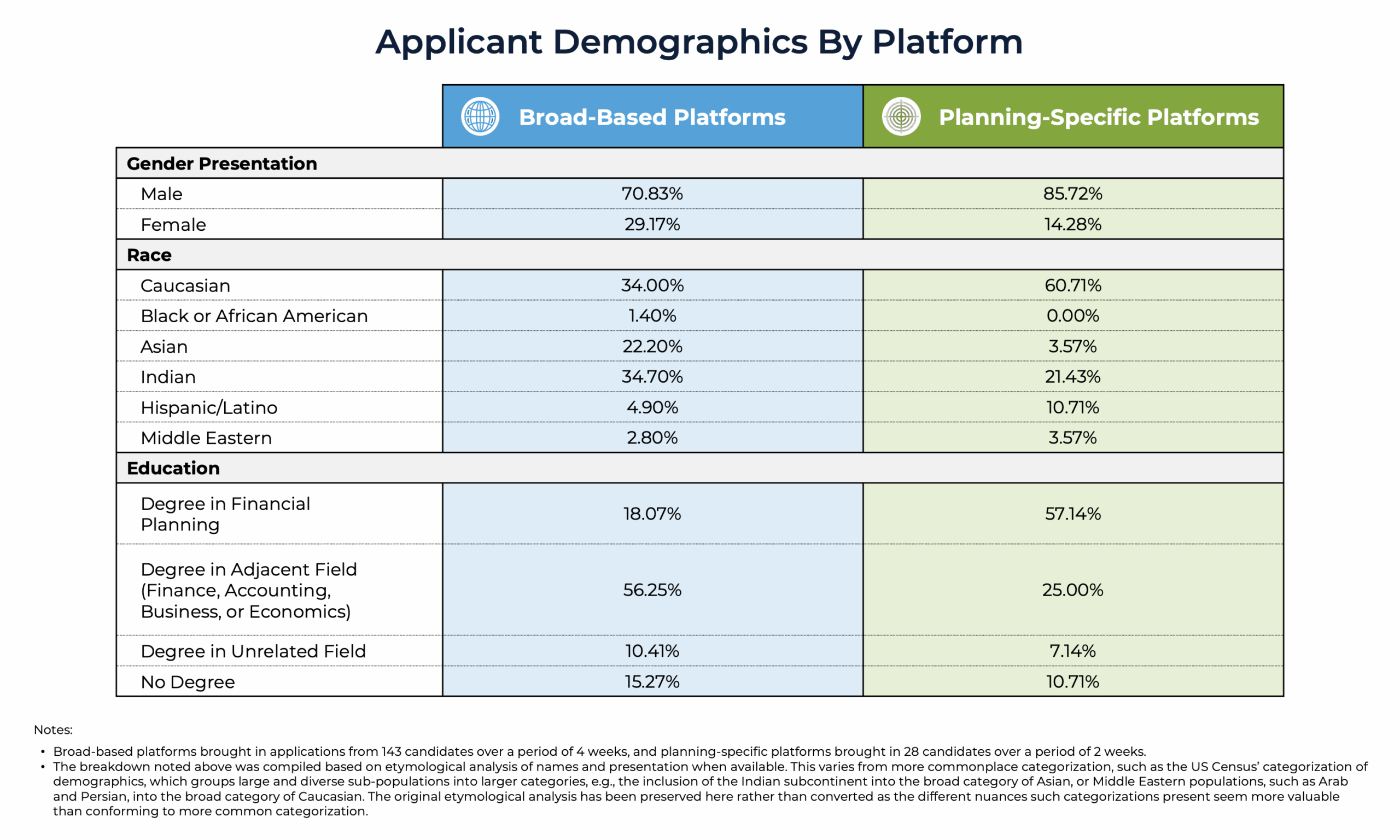
As shown above, there was a substantially greater volume of interest and more diverse interest generated by posts on the broad-based platforms. While the education of those on the planning-specific platforms was substantially more skewed toward financial planning, there was not a materially significant difference in the number of generally qualified candidates with respect to education or experience in personal finance or related fields. It is also notable that the planning-specific platforms were less diverse in terms of both gender and race, so if equitable hiring practices are important to the advisory firm, it may be important to expand the availability of their job postings beyond the profession-specific platforms like the CFP Board career site.
In turn, firms that are limited in time or resources to vet and evaluate a larger pool of applicants may benefit from the planning-specific platforms' higher sample density of those with financial planning-specific education and experience. This reduces the burden of filtering through multiple layers of candidates or the necessity of a strict scoring rubric when evaluating resumes and then moving on to later stages of the hiring process.
Ultimately, the process detailed above attracted two strong entry-level financial planning analysts. One analyst had no industry experience but had graduated with their bachelor’s degree in a rigorous academic field with an adjacent and relevant relationship to financial planning, and demonstrated other strong work ethic and competencies such as purchasing a home for their parents at the age of 19; and another new hire with almost a year of experience in a mature fee-only RIA planning to sit their CFP exam during the next test cycle while holding a bachelors in financial planning.
At the end of the day, clarity and specificity are the keys to a successful hiring process. The more that advisory firms signal exactly who they are looking for and what candidates can expect, the more likely they are to find applicants who are great fits – not only for the job, but for the firm culture as well. That, in turn, can make the hiring process faster while also increasing the odds of long-term team retention!