Executive Summary
Over the course of a long relationship with their advisor, a client's circumstances can change in many ways, from a growing family, to changing jobs, to ultimately retiring. While each of these transitions can create planning issues to be addressed, an advisor's ability to continue working with the client typically remains unchanged. However, a different type of client transition – relocating abroad – can be particularly challenging for advisors, not only in the technical planning questions such a move raises, but, more fundamentally, how (and whether) the advisory relationship may continue.
In this guest post, Ashley Murphy, co-founder and executive director of the Global Financial Planning Institute (GFPI) and the founder and principal of Arete Wealth Strategists Australia, discusses how a client's international move can affect everything about the advisory relationship, including the regulatory landscape that an advisor is subject to (even if nothing else has changed), as well as custodial options and capabilities.
To start, when a U.S.-based client moves abroad, the U.S. regulatory framework doesn't go away; rather, the new country's rules and regulations are added on as another layer of scrutiny. While different locales have their own regulations concerning when an advisor is "doing business" in the country, it's important for advisors to recognize that advising a client living there could be viewed as engaging in that country even if they don't have a physical presence there, potentially generating licensing and/or registration requirements.
Another key consideration when assessing whether continuing to serve the client is possible is how the client will be treated by the advisor's custodian, as some custodians have country- and account-specific restrictions that might not make it possible for a client to keep their current accounts with the custodian after moving abroad. Also, the advisor can examine their E&O policy to determine whether the client's new jurisdiction is covered at all and, if so, what the policy protects against.
Notably, the impact of a client's move abroad can differ based on the duration and permanence of the change. For instance, a client relocating for work for two years before returning to the United States might need relatively limited adjustments, while those who are moving permanently in retirement present greater complications. With this in mind, understanding the nature of a client's relocation plans (well in advance of the actual move) can help an advisor understand how the scope of the engagement might change if they continue working with the client.
Ultimately, the key point is that while an advisor's first instinct upon hearing that a client is moving abroad might be to dig into the technical planning details (e.g., tax laws and currency exchange issues) that such a move can create, a more important question to consider is whether they can continue serving the client in the first place. Which means that understanding the client's relocation plans and the unique issues that the new country may present (perhaps assisted by a professional network of local experts) can help the advisor decide whether they want to continue the relationship and, if so, determine what actions they need to take to do so effectively (and compliantly).
 |
And if you want to go deeper on this topic, hear directly from the author on the Financial Advisor Technician podcast. |

Listen To The Financial Advisor Technician Podcast On This Topic




Episode Shownotes And Transcript
Click to expand transcript and show notes↓↓
Title: Key Factors To Consider When A Client Plans To Move Abroad
Shownotes:
- Ashley Murphy: LinkedIn
- Areté Wealth Strategists
- Global Financial Planning Institute
- Baker McKenzie Global Financial Services Regulatory Guide
- International & Cross-Border Planning Knowledge Circle
- AICPA & CIMA
- The CIGA Network
Full Transcript:
Adam: Hello, and welcome back to the "Financial Advisor Technician" podcast. I'm your host, Adam Van Deusen. On today's episode, we're going to discuss the challenges that advisors face when a client tells them that they are moving abroad. Because while an advisor's first instinct upon hearing this news might be to consider the financial planning implications of such a move, my guest today suggests that a better first step is to consider whether the advisor should continue serving the client in the first place. Because while there are plenty of planning considerations involved when moving abroad, particularly when it's a long-term or even permanent move, an advisor could face unexpected regulatory scrutiny from the government of their client's new home, challenges managing the client's accounts through their current custodian, and potential issues with their errors and omissions insurance coverage.
So to help us dig deeper into this topic, I'm joined today by Ashley Murphy, the co-founder and executive director of the Global Financial Planning Institute and the founder and principal of Arete Wealth Strategists Australia, to discuss key questions advisors can ask when a client tells them that they plan to move abroad, how advisors might reconsider whether the scope of engagement with the client will change as a result of the move, and resources advisors might consider tapping into to help them determine whether and how to continue working with the client. So welcome, Ashley, to the "Financial Advisor Technician" podcast.
Ashley: It's a pleasure to join you here, Adam. Thank you so much.
The Importance Of Considering The Scope Of The Relationship When A Client Is Moving Abroad [1:35]
Adam: Terrific. So to start, perhaps you could begin by explaining broadly why you think it's more important for advisors to, first, consider whether to continue the client relationship before they get into the weeds in terms of how they would like to serve them after a move abroad.
Ashley: Yeah, absolutely. So that's the thing is I've often thought that the largest competitor, if you will, of any RIA that's focusing on cross-border clients is actually every other undifferentiated advisor. And that's because, inevitably, in even a medium-sized firm, there will be some cross-border clients that come along. And there's a tremendous amount to understand when it comes to working with these cross-border clients, including, well, firstly, will your custodian be happy to work with someone if they have a foreign address? What do you need to know about the tax situation in this foreign country? Will your E&O coverage work in the foreign country? There's just a laundry list of considerations that go into it in properly providing that advice and also doing so in a manner that's prudent for the risk exposure of the advisor based in the U.S.
Adam: Yeah. So you raised a lot of different issues that we'll definitely dig into today. And so I think one issue that's probably of note to understand upfront when you hear about this from a client is to understand, how long are they going to be abroad. Because I'd imagine there's sort of a different reaction or considerations if maybe it's a defined one-year move for their employer and they know they're going to come back to the U.S. for something that is more indefinite. Maybe they're going to be gone for five years or perhaps even retiring permanently abroad. How do those two different sort of sides of the coin play into this discussion?
Ashley: It's an excellent point. And we tend to think of client moves as falling into one of three timeframes. And that is there's either the temporary or working holiday timeframe. There's the what we call domicile uncertain, meaning they don't know where they're going to be. Just like I felt when I moved to the U.S. in 2005, I didn't really have any return plans at that point in time. It was only later, in meeting my wife, that the decision was made for me. And I ended up staying in the U.S. for 20 years in total. The third category is the permanent movers. Those are the people that have gotten excellent jobs. They've retired and moved abroad, but it's very clear that they're not coming back.
And the needs of the clients differ depending on those timeframes. I don't think it makes a ton of sense to really rock the boat and do much different for someone who's only coming for a short period of time. I think their financial center of gravity tends to remain in their host country. And we're talking about the U.S. here.
The U.S. has other significant advantages. It used to be that Morningstar ran a biennial series of reports called the Global Fund Investor Experience study, and they pointed to the fact that the U.S. is the number one environment, number one country for investing across four different dimensions that they tracked in that study. So the U.S. has got many advantages on that front. So keeping the clients' investments U.S. compliant is a different challenge, but keeping them in the U.S. is likely what's going to make most sense for a short-term mover.
For someone who's domicile uncertain, the advantages that I just outlined that Morningstar identified in their report, they're still going to be there, of course. But now we need to begin to think about the longer term for that client. And I think the order of the day is flexibility for the medium-term clients. And then the long-term clients, how do we really help them out in the most tax-efficient and compliant manner in the long term?
Foreign Regulatory Considerations When Working With A Client Living In Another Country [5:26]
Adam: Thanks for that rundown. And you mentioned compliance there at the end. Of course, advisors are used to dealing with their state regulator or the SEC here in the U.S. But a client moving abroad, as I understand, can create regulatory and compliance requirements perhaps in that country where the client is moving to, even if the advisor doesn't have a physical presence in that country. So I don't know if you could give sort of a rundown of some of the guidelines for different countries or maybe perhaps some examples that could shine a light on what might be an unexpected regulatory burden for an advisor.
Ashley: Yeah. So I focus specifically on Australians in America and Americans in Australia, and I can talk most confidently about that particular bilateral combination. But certainly, through the Global Financial Planning Institute, we've got experience in other country combinations as well. But to your broader point, Adam, absolutely. If you start providing advice to someone in a foreign country, it's not just the U.S. compliance situation you need to be mindful of. You could very easily be taking actions that put you in the crosshairs of a foreign regulator.
In my case, working with Australians, it was actually a remarkable story where here I am as an Australian citizen, an Australian financial advisor, but working with foreign assets, working with U.S. dollar assets. You would start to wonder, well, whose regulatory authority am I subject to? And it turns out it was both. So it was both ASIC, which is the Australian regulator, and the SEC. Of course, it was no mystery that I would remain SEC-regulated, but this was the situation, and I should say more broadly for other countries as well. Their securities laws are typically not written with this kind of situation in mind. They're typically written from a point of view where they're concerned with protecting the interests of domestic residents.
And so, if one is becoming an advisor to an individual who will become a domestic resident of a foreign country, then it's quite likely that that individual will become subject to the regulatory requirements of that foreign country. And so, in my own case, that's meant having to affiliate with an Australian financial services license holder and be subject to regulatory matters here, which, believe me, if you compared Australia and the U.S., Australia would be ten times worse in terms of the amount of compliance time required, where people measure it not in hours per month or year but in hours per week to remain compliant.
Adam: Yeah, that's interesting. And I guess from an advisor's perspective, if I'm not a cross-border specialist, again, maybe it's a one-off client who's moving abroad. So let's say I'm an advisor. My client says, "Hey, I have a two-year job opportunity in Australia. Let's say I'm moving there." Can an advisor be subject to that regulatory burden just from a single client? Is there some de minimis…I guess it's going to depend on the country, but is that a consideration as well?
Ashley: It is a consideration. But honestly, the next point I have to make kind of goes against the general message, and that is, if you just had a single client, I would wonder how you would land on their radar in the first place. If it was just a one-off exception, I have not heard of examples where someone is audited and fined for providing unregulated advice to that one American client that moved to Australia. I haven't heard of that. If it was a broader part of your business, though, different story.
I think working with a cross-border client, taking the one-off kind of client, is a little bit like being very interested in a unique private investment that catches your attention. So you come across something that you think is fantastic. It's going to work really well for a number of your clients, and it's going to be great. But then, when you begin to realize the tail of compliance work and due diligence, and will your custodian handle it, and will your E&O policy deal with it, that's when, I think, the more experienced practitioners begin to narrow their scope, and they'd say, "You know what, it's really just not worth it."
And those liability exposures are similar with working with a cross-border client, but it's worse in a manner, too. And that is we lead with, in teaching advisors through the GFP Institute, first, do no harm. And there are, in fact, some areas where if you don't know what you're doing, you truly could expose your client to significant fines and penalties. And so to simply be aware of the basics that would not expose your client to harm does require an investment in education just to be aware of what those bear traps are in the first place.
Potential Tax Traps When A Client Lives Abroad [10:34]
Adam: Oh, interesting. I guess, aside from the potential regulatory traps, what are some of those things that could harm the client in terms of taxes? Are we thinking about taxes, currency, that kind of thing?
Ashley: Currency, less so. Taxes, certainly. The one that most people have probably heard of is to do with PFICs, passive foreign investment companies. That's more to do with an American tax resident defined as either someone satisfying the green card test or the substantial presence test, owning a foreign managed investment. And there's finer details on what that means exactly, but that means an ETF, a managed fund of any kind, or any kind of, well, simply managed investment. So that would typically be beyond the purview of the American advisor. They're obviously not going to be motivated to recommend non-U.S. dollar funds, but if the client's holding those funds or you've recommended that they go buy the local Vanguard or whatever equivalent of a fund, you may unknowingly be causing them great financial harm.
Continuing to be compliant on the U.S. side, if someone moves abroad, they absolutely still need to continue filing their U.S. taxes. Even if there's no tax due, it is assessable, and there's a whole system of foreign tax credits and so forth that figure out what obligation may or may not exist. The European Union actually has a similar system to the PFIC system that the Americans have, and so you need to be mindful of whatever investment the client's holding on the U.S. side is not going to cause them harm or fines or penalties on the European side.
Another one, I'll round it out here. I'd say much more commonly, perhaps even verging on universally for clients of financial advisors, would be retirement accounts and how we help our clients save for retirement and do so in a manner that is not detrimental in one way or another to their overall financial position. How might that happen? That sounds pretty dramatic, what I just said, detrimental to their financial position. And the thing there is that the tax advantages offered to save into a retirement account for a foreign resident are often not there. So, for instance, the Americans in Australia, as I am, I'm an American citizen from birth, along with the hundreds of thousands of other American citizens here, are uniquely disadvantaged in how we may save into the Australian retirement system.
And I would hazard a guess that there's similar issues with foreign retirement systems also, where your retirement contributions are not tax-deductible. It's part of taxable income. The amounts that grow in the foreign retirement plan are not tax-deferred. And the amounts that are distributed, it gets even better, Adam, it's taxable income. And so that's really difficult if you have a client that's been away for a while or a permanent mover who's got years and years and years of foreign retirement contributions, to say it's only by being a U.S. citizen because, and I should have mentioned this earlier, the U.S. is somewhat unique globally, with the exception of Eritrea, in being a country that practices what's called citizenship-based taxation. It's not residency-based.
If you're a U.S. citizen and you move to Antarctica or Zimbabwe or anywhere in between, you're always a U.S. tax resident. And so that's one of the things that comes up in providing good cross-border advice to U.S. citizens is, how do we save efficiently and compliantly, and what are your options for the long term? And it may even involve possibly relinquishing U.S. citizenship given the complexities that arise over the long term.
When Custodians Won’t Serve Clients In Certain Countries [14:40]
Adam: Very interesting. Okay. So, so far, we have sort of the regulatory considerations, whether you're going to be on the radar of the local regulator and what some of the requirements for that might be. Of course, then being careful of understanding some of the pitfalls that you mentioned, particularly when it comes to taxation. Now, one other one that you've mentioned a couple of times is working with custodians. So I am an advisor. I custody with Schwab or Fidelity or another custodian here in the U.S. But from what you say, if the client moves abroad, that the custodian might not actually serve those accounts anymore. Could you talk about that process?
Ashley: Yeah, that's absolutely correct. It's one of the real problems in doing this cross-border work that we do, that global financial planners do, is it's not well known. It's perhaps becoming easier in the age of AI, but we just had Charles Schwab on to do a monthly webinar with the GFP Institute two months ago. And I asked them if they would make public the list of countries that they actually support, and they declined to do so. Even though they were happy to share it in the webinar, they wouldn't make that public.
So the broader point there is, across the major custodians of Schwab, Fidelity, Altruist, Pershing, and perhaps Interactive Brokers and StoneX, to throw in some other ones, it's really a hodgepodge of countries that are supported. And as best as I understand it, it's a function of whether there is sufficient business volume in any given country for a custodian to justify the investment of remaining compliant in that country. I don't think that it's a function necessarily of the securities laws of that country. I think it's just an individual business decision. And so we see, for instance, Schwab are happy to have clients in Australia. Fidelity are not. I don't know why that is other than what I just mentioned.
So if you were a generalist advisor and you had a client moving to XYZ country, that's going to be really difficult. Just purely from the point of the advisor, let alone the compliance and all the other things I've mentioned thus far, you would need to determine, can you, in fact, continue serving that client if they change their address, if they do update it to that foreign address? And sometimes the answer is no. We're dealing with the matter right now. We have a very, very limited number of private investments that we make available. And part of our due diligence upfront, Adam, before we even sign our first client with it, is we ask, what would it look like if someone moved abroad? And it took weeks and weeks for this provider to get back with an answer. And they said, "Oh," and they kind of ummed and ahhed, but eventually said it's okay.
And now we're dealing with that for the first time. It's been a couple of years since we had a client that signed up, and they've moved abroad. And it's funny that the client sent an email reminder last week. They said, "Hey, you're still sending mail to our old address." And I looked back at the email chain, and we've actually asked this investment provider a couple of times over the course of months what the proper answer is, and they're not replying. And so it makes me think they just don't want to answer this question. They just don't want to actually properly deal with it, and I presume, because the solution would likely mean not actually working with that client anymore.
Optimal Timing For Discussions Of Moving Abroad [18:15]
Adam: Oh, that's very interesting. And I think a lot of the points that you've made so far really speak to, I guess, the benefits that could come from having advance notice on some of this. So I'd imagine the clients who you're talking to in their 50s, and they talked about how they've always dreamed to retire in a certain country, it seems like a lot of advanced prep work that could be done to think about the feasibility of it. Now, the other client who says they have a job opportunity, they're going to leave, they have to leave in three months, there might be a little less turnaround time. But I'd imagine the longer the gap as possible, that would be beneficial in terms of exploring the custodial relationships, the regulatory environment.
Ashley: Yeah. We tend to think of the timeline for moving abroad as being ideally a minimum of three years. And so we get prospects that sometimes ask the question just as candidly. They'd say, "What is the ideal time for us to commence engaging?" And maybe you could accuse me of having a self-serving answer, but I say that the returns to planning are exponential, and the more time you give, the better off you'll be. I think that's especially the case with moving abroad because there's so much pre-work that goes into that. There's knowing if, here's one small example, there's a possibility of getting a step-up in basis on one's U.S. retirement account if a non-U.S. person was moving back to Australia, for instance. Well, that only works if you're in the country for the next six weeks after you quit with that employer, until that separation of service notice goes through, and you can actually roll that IRA over.
I've had people that have engaged at the last minute, and they've already booked their tickets. They say, "Sorry, we can't do that. We're moving into a new apartment on this date," or whatever. And I'd say, "You know what, that's going to cost you hundreds of thousands of dollars in extra tax because you didn't engage with us earlier on that point." Another example would be with the setup of the portfolio, having the appropriate funds in the appropriate currency to deal with upcoming bills, for instance, property purchases, as one example. I could probably do an entire hour presentation on that question, Adam, to do with things you might be aware of preceding your move. But I think it starts at 3 months, 12 months, 6 months out, and then, when you get to the countdown of less than 30 days, that's when there's a different list of things to get done at that point in time.
And then, conversely, once you move, there's a mirror opposite of timeframes. There's things that need to be done immediately, like getting your bank accounts in or getting your risk management program together. And then, on the opposite end, there's things like updating…some might disagree with me. They might say it's a more immediate concern. But getting your estate plan together. Is it something you need to do the minute you get off the plane? Just before you get your eSIM loaded on your phone, get your estate plan updated? Probably not. I'd say, with all of the moving parts and pieces, someone's probably got a little longer to get that figured out. But yeah, that's my answer. There's three years on the front end and then probably one to two years post-move to get things figured out.
Why An E&O Policy Might Not Provide Coverage For Lawsuits Filed In Another Country [21:37]
Adam: Very good. And then one other issue, which you've mentioned a couple of times, is on the E&O insurance. Are there limits on a lot of coverages in terms of clients moving to other countries? How does that work?
Ashley: It's a really good question. I think there's two elements to it. And that is someone, in theory, could bring suit wherever you are. And if you're like me, if you're living overseas, and there are a number of advisors that have such cross-border practices, focusing on Americans but are based primarily in Europe is where you see this, and even more so primarily in the UK. So there's the risk of being sued in-country, which would mean you need appropriate E&O in this country, or according to our client services agreements, the governing jurisdiction is back in Minnesota for me. So I've got U.S. E&O as well. But yeah, I think you need to be mindful of the gaps. I've inquired with my E&O insurer. They will only respond to...my U.S. E&O insurer will only respond to claims that are brought in the U.S. And fair enough, I get that.
So having the coverage on both sides is important. But then again, to determine whether that's relevant for you or not is going to be a function of really reading the article that we're talking about here today and understanding whether you would have those foreign compliance considerations arise in the first place. Because if you don't, then you don't need to worry a great deal about the foreign E&O situation, because it wouldn't be relevant. So it just depends on your situation.
Adam: Yes. And Ashley mentioned an article that he's written with a co-author that's appearing on the Nerd's Eye View blog. If you'd like to check that article out, it includes wonderful graphics and checklists and much more detailed information on handling this situation. You can go to kitces.com/FAT17 to check that article out.
Resources For Advisors When A Client Plans To Move Abroad [23:37]
Adam: Okay. So I think, at this point, Ashley, we probably have advisors with a lot going through their head, a lot of these potential concerns and considerations when a client moves abroad. Okay. Let's say that the client tells them this. They're thinking about planning, deciding how to potentially adjust the scope of the relationship. What are some resources that advisors could tap into to help them learn about whether it's this specific country or just sort of thinking about these issues in general?
Ashley: I get asked that quite frequently. I think the blessing of AI is that it's gotten a lot easier to do this. But as a saved article in my Financial Times subscription, one of the things of AI advice in the financial realm is that it's full of hallucinations and can provide some inaccurate answers. So, to support what AI research you may be doing, I would encourage you to check out the Global Financial Planning Institute, for one, given that that's the only program where there actually is an educational course offered for folks that want to learn more about this. There are other organizations out there. There's another one called CIGA. Let me see. AICPA has some resources focused on international and cross-border tax topics. The FPA has a knowledge circle, International and Cross-Border Knowledge Circle. Those are the only specific financial advisor-focused membership organizations that I'm aware of.
And then, when you get into country-specific research, there's a great resource actually that I could recommend from the compliance point of view. The best we found is one from Baker McKenzie, the accounting firm. So they've got a global resource on financial compliance. So I think using that in conjunction with some very skilled AI research could probably get some answers for what your compliance situation looks like. But yeah, that's what I have to say there.
Adam: Great. And we'll be sure to put links in the show notes to the various resources that Ashley had mentioned.
One Key Takeaway For Advisors [25:45]
Adam: So, Ashley, we've covered a lot of ground today. Considering that, what would be your one key takeaway for our advisor listeners when they encounter a situation of a client letting them know that they're moving abroad?
Ashley: I think that the answer I have to this question is more of an answer that one would expect to hear on the "Financial Advisor Success" podcast rather than the technical podcast, and that is, I think, you need to go back to figuring out who your ideal client is. Is it retirees generally? And if it is, is it going to include retirees that move abroad? Because that is going to have a lot of research and potentially risk involved if you've got clients that are moving to a number of countries. I would say, if they're moving to a particular country, that gets a lot easier. You can focus on the issues to do with that specific country. But otherwise, I'd say know your ideal client because there's a long tail of what you don't know could end up hurting you.
Adam: Very good. So thank you so much for joining us today on the "Financial Advisor Technician" podcast, Ashley.
Ashley: It's a pleasure, Adam. Thank you so much.
When Clients Outgrow The Circumstances An Advisor Can Competently Serve
Many financial advisors build a foundation through the CFP process and Standards of Conduct (i.e., their "four E's" of Education, Examination, Experience, Ethics) and then develop deeper expertise around the clients they actually serve. One advisor builds a practice around business owners, another around retirees, another around HENRYs. Over time, each develops the technical knowledge, systems, and professional network to serve that client type well.
But clients don't always stay within the circumstances an advisor became competent to serve them in. A client sells a business, receives an inheritance, divorces — or relocates abroad.
An international move is one of the more disruptive versions of this, because it's usually a one-off. Most advisors whose book of clients are otherwise 100% U.S.-based will encounter it rarely enough that they have no institutional memory to draw on: a client's spouse gets transferred to Singapore, or a longtime client decides to retire in Portugal, and the advisor is suddenly working from scratch to get up to speed on how their financial planning recommendations will work (or not) in a new country.
While an advisor's initial instinct may be to start researching – the tax treaty, what happens to distributions from the client's (pre-tax-in-the-U.S.) IRA, whether the 529 can still be funded – the threshold question is not how to advise a relocating client. It's whether the advisor and firm can lawfully and operationally continue advising them at all.
A U.S. registration to be a registered investment adviser or a registered representative of a broker-dealer is not a global license. The moment a client establishes residence abroad, a second regulator — one that has never heard of the Advisers Act or the CFP Board — may acquire a claim over the relationship and the laws and regulations that apply to it. At the same time, the U.S. custodian that holds the assets may apply its own (alas, often undisclosed) country-by-country policy that can freeze contributions or close the account outright (depending on the custodian's own comfort working within the laws and regulations, and complying with various anti-money-laundering and similar rules that may apply). And ultimately, if there's a problem, the firm's E&O policy may not respond to a claim filed outside the United States.
None of this requires an advisor to become an expert in a foreign country's securities laws. It requires issue-spotting and working with compliance and legal professionals, so that one is better equipped to recognize the shape of the problems that tend to surface, and open the door to do further research or make changes to the relationship if and as necessary.
A Client's International Move Can Change The Regulatory Landscape (Even If Nothing Else About The Relationship Changes)
Oftentimes, the relocating client is focused on the many matters they need to get in order prior to their international move: new residence, new bank account, an up-to-date passport. From a financial perspective, they may believe little has changed, particularly if they intend to retain their existing brokerage or retirement accounts and advisor (e.g., the client is thinking "same accounts, same advisor, no changes planned").
From the advisor's and regulator's perspective, however, the client's new address can be a material new fact that must be taken into account in determining whether the advisor is even legally permitted – by U.S. laws, and the laws of the other country – to continue working with the client.
The U.S. Framework Doesn't Go Away; The New Country's Is Added
A client's move abroad doesn't take the relationship outside U.S. securities regulation. Registration status, Form ADV disclosure, books and records, custody obligations, and fiduciary duty all travel with the client. However, once a client goes abroad, a second, co-existing regulatory layer is added on top. Just as advisors can be "dually-registered" between a broker-dealer and an RIA, so too may an advisor face a situation of needing to be dually-registered between the SEC in the U.S., and a foreign country's own securities regulator.
Say a longtime client is moving from New York to France and, in addition to wanting her U.S. portfolio managed, asks for ongoing financial planning advice on a new €1.5 million account she's opening locally. In addition to being regulated as a business based in the U.S., and needing to be clear about the capacity in which the client will be served (e.g., am I acting as a registered rep here, or as an IAR; will it be a brokerage or an advisory relationship?), now that the client is abroad, the question also arises whether the advisor has any authority under French law to provide financial planning or investment advice at all.
What Does The New Country Consider "Doing Business", And What Counts As "Investment Advice"?
A common assumption is that foreign regulation only becomes a concern if the advisor physically travels abroad or otherwise establishes an office location in that country. That's not the test most jurisdictions actually use. A U.S. advisor sitting in New York, emailing recommendations and running a quarterly Zoom review with a client now living in London, may be conducting a regulated activity "in the U.K." even though the U.S.-based advisor never leaves their home country.
The relevant question is where the jurisdiction considers the activity to be occurring — a function of the client's location, the method of communication, whether the advisor solicited the relationship, and whether the advice is "presented as suitable" for that specific person. That likely requires securities or compliance counsel specialized in that country.
Because every country defines this differently, a few concrete examples are worth having in mind — not because any one of them generalizes to the others, but because together they show the range of what "regulated advice" can mean:
- United Kingdom. Article 53 of the FSMA 2000 Regulated Activities Order refers to "advising a person" on the merits of buying, selling, holding, or exchanging a particular investment. The Financial Conduct Authority (FCA, or the U.K.'s equivalent of the SEC) has issued guidance that defines advice as a "personal recommendation", and explicitly includes a recommendation to hold, meaning telling a client to sit tight can itself be regulated advice. There's an overseas-persons exclusion, but it only applies to a "legitimate approach" — one the client initiated, or one that didn't breach the U.K.'s financial promotion restrictions. Whether that exclusion is available often turns on facts a U.S. advisor never thought to document, because the client was in Ohio when the relationship began.
- European Union. MiFID II defines investment advice as a personal recommendation on transactions in financial instruments, and ESMA's (European Securities and Markets Authority) guidance makes clear the recommendation doesn't need to be an explicit "buy" or "sell"; an annual review email suggesting a legacy position should be trimmed can qualify, which implicates many advisors who continue an advice relationship when their client moves abroad to a European Union country. Advisors often try to avoid this by reaching for a "reverse solicitation" exception (MiFID II Article 42, which exempts advice a client sought out on their own initiative), but ESMA has specifically warned about firms trying to manufacture client-initiative through boilerplate language in their advisory agreements. And implementation varies sharply by member state; Germany's BaFin, for instance, takes the position that a firm is providing services "in Germany" if it repeatedly and commercially targets German residents, regardless of where the firm itself sits, triggering a license requirement under the German Banking Act.
- Under FinSA (the country's "Financial Services Act", akin to the Investment Advisers Act in the U.S.), client-facing advisers of foreign financial services providers generally must be entered on a Swiss register before serving Swiss-resident clients (with only narrow exceptions for certain institutional investor and professional investor types, as distinct from the typical clientele of a U.S. advisor whose retail client retires to Geneva). And notably, this can create an individual registration obligation for the advisor, not just the firm, even where the firm is fully supervised in the U.S.
- The international adviser exemption in NI 31-103 §8.26 looks generous until you read the conditions: the client must be a "permitted client," which for an individual generally means financial assets exceeding $5 million net of liabilities; the adviser can't derive more than 10% of consolidated revenue from Canadian portfolio management; and the client must be notified the adviser isn't Canadian-registered. A $1.5 million client moving to Toronto simply doesn't qualify for the exemption, so in most "normal" cases, the U.S. advisor will have to become registered as an advisor in Canada, too.
- Carrying on a financial services business "in Australia" requires an Australian Financial Services Licence (AFSL), and the test isn't physical presence — it's whether the advisor engages in conduct "intended to induce" people in Australia to use the service. ASIC (the Australian Securities and Investments Commission) repealed its broad foreign-provider relief in 2020 and now grants relief only individually, and only for wholesale clients. A retail client is again the one case where relief is hardest to find, so the client who moves to Sydney puts their U.S. advisor in the same Australian boat as the other advisor whose client moved to Geneva and triggers Swiss registration.
Two patterns are worth carrying forward from this list, because they recur across almost every jurisdiction. First, "we're just holding the existing portfolio, not making new recommendations" is rarely a safe harbor, since most regimes treat a recommendation to hold the same way they treat a recommendation to buy or sell. Second, where relief exists to allow the U.S. advisor to not have to register in the foreign jurisdiction, it's almost always conditioned on client sophistication: Canada's permitted clients, Australia's wholesale clients, Switzerland's professional clients. The ordinary retail client (i.e., the most common relocation case an advisor will actually see) is precisely the client for whom relief tends to be unavailable.
This isn't theoretical, even if the enforcement record runs mostly in one direction so far. The SEC has repeatedly shown it will reach a relationship based on the client's location, regardless of where the firm sits. For example, it charged Leumi Private Bank under Advisers Act §203(a) for advising U.S.-resident clients from abroad without registering, and brought a similar action years earlier against a Portuguese commercial bank that marketed securities and investment advice to U.S. residents (many of them Portuguese immigrants) without SEC registration. Both cases involved a foreign firm advising U.S.-based clients without U.S. registration — the mirror image of the scenario this article is about, but built on the identical legal theory: the client's location, not the firm's, can be what triggers the registration requirement. A U.S. advisor serving a client who has relocated abroad is exposed to the same logic in reverse, just applied by a foreign regulator instead of the SEC. Publicly reported cases of a foreign regulator sanctioning a U.S.-based advisor specifically for this fact pattern are hard to find, but that's likely primarily a reflection of how rarely a single relocated client draws regulatory attention (i.e., the fact that foreign regulators haven't always caught one-off scenarios doesn't negate the legal and compliance obligations, or the consequences for the advisor unfortunate enough to be caught).
Will Your Custodian Even Let The (Foreign) Relationship Continue?
Even where a licensing path clearly exists, the engagement can fail on the ability to execute within the advisor's available platforms, most commonly because the custodial or brokerage platform is not willing to service foreign clients (or clients that move to a particular foreign jurisdiction). It's rarely disclosed proactively with a list of "countries that are or are not accepted", so it's worth calling the custodian before assuming anything about whether continuity of service will continue for a client who moves abroad.
Fidelity's published FAQ for investors living outside the U.S. is a useful template for the kinds of questions to ask any custodian. Fidelity states that it does not open new accounts for non-U.S. residents, does not provide discretionary management to non-U.S. residents, limits representative conversations for such clients to "ministerial or administrative matters" (no discussion of asset allocation or portfolio composition), prohibits new 529 or HSA accounts and further contributions to existing ones, and — since 2014 — has prohibited new mutual fund purchases, though existing positions aren't force-liquidated. In some countries, clients are limited to selling and withdrawing; elsewhere the restrictions are lighter but may still mean losing access to margin or options.
Other custodians have gone further. Schwab notified U.S. citizens living in several countries, including New Zealand, South Africa, and South Korea, that their accounts would be frozen to liquidation-only, with a deadline to close them; for an IRA, an involuntary closure is a taxable distribution unless it's rolled over within 60 days. Wells Fargo stopped opening new brokerage accounts for non-U.S. residents in 2021. T. Rowe Price and others have restricted purchases of U.S.-domiciled mutual funds by Americans living overseas — including inside advisor-managed accounts and IRAs.
Why such restrictions? It's not meant to be hostility toward expatriates or advisors trying to serve intentional clientele. Instead, the reasons are largely legal, most commonly because the destination country prohibits selling unregistered foreign funds to its own residents (and the custodian doesn't want to or can't be responsible for registering investments traded on its platform as foreign securities, and doesn't want to be responsible for tracking which particular investments are or are not), or because anti-money laundering regulations place sometimes-onerous additional compliance tracking requirements on the financial institution (for which some decide it's easier to just not serve foreign clients in those countries, rather than take on the costs of the compliance burdens).
Nonetheless, the point remains the same: not all custodians will continue to serve clients that move to other countries, different custodians may handle different countries differently (depending on their own internal capabilities for cross-border compliance), and the countries that custodians are willing to work with can and do change over time.
In some cases, the U.S.-based advisor may prefer to use a financial institution in the foreign country where the client has relocated, and fortunately the SEC custody rule does contemplate a foreign qualified custodian as an alternative to domestic custodians. However, moving an account doesn't solve the underlying cross-border licensing question for the advisor, or confirm the firm's ability to supervise assets held abroad. This is why the custodian call belongs near the start of the process, not after weeks of tax-treaty research into an account that's about to be restricted to liquidation-only anyway.
In the situation where the custodian will not support the client in their new country of residence, the ethical response is not to leave an outdated U.S. address on file, tempting though that may be in practice. Instead, the advisor should confirm the restriction directly with the custodian and determine whether another custodian can lawfully service the client in that jurisdiction. Interactive Brokers may be one possibility given its broad international footprint, but eligibility still depends on the client's country, account type, and the advisor's relationship with the platform — not simply the custodian's willingness to open an account. If no workable custodial solution exists, the advisor might restructure the relationship as advice-only or provide an orderly referral or termination; however, "advice-only" is not a regulatory escape hatch, since advising a resident of another country may itself trigger local registration or licensing requirements. As previously mentioned, this is precisely the type of fact-specific question that should be discussed with the firm's compliance counsel and, where appropriate, posed to a cross-border professional community such as the Global Financial Planning Institute or the Financial Planning Association's Cross-Border Knowledge Circle. Finally, advisors should distinguish mutual funds from ETFs: U.S. custodians commonly prohibit clients with foreign addresses from making new mutual-fund purchases, whereas purchases of U.S.-listed ETFs are generally more feasible but are not universally permitted. This is particularly the case in jurisdictions with their own retail-product rules (e.g. Europe), but note that foreign-domiciled ETFs can create punitive PFIC reporting and tax consequences for U.S. taxpayers.
The First Question Isn't "How Do I Advise This Client?" – It's "Should I Continue Advising This Client?"
Once it's clear the regulatory landscape may have shifted, the next step isn't to start learning the client's new country's tax code. It's to figure out whether the existing engagement still makes sense as designed, given the rules and regulations of the foreign country (if the advisor must be licensed/registered there) and/or whether it's worth altering the engagement to more easily comply with another country's securities laws.
Has The Scope Of The Engagement Changed?
Suppose an advisor has managed a client's U.S. brokerage account and IRA for ten years. The client moves to France. At first: "Nothing changes — just keep managing my U.S. portfolio." That's relatively contained. Then, a few months later: "My French employer offers a pension. Should I contribute, or increase my 401(k)? What are the U.S. and France tax implications?" Then: "Should I open a French investment account?" Then: "Should I buy a French mutual fund?" Then: "How should I think about my estate now that I live here?"
The engagement has changed, even though nothing was ever formally renegotiated. The advisor may still be entirely competent to manage the U.S. portfolio, and may even be comfortable providing some level of ongoing financial planning advice; however, the client's financial advice needs have simply moved into foreign-country-specific territory the advisor is not equipped for.
This isn't unique to international moves — a retirement-focused advisor doesn't become a business valuation expert because a client sells a company — but a relocation tends to generate this kind of scope creep gradually, one reasonable-sounding question at a time. Which at the least can raise questions about whether the advisor is still competent in all the domains of financial planning advice as it pertains to that cross-border client; at worst, a shifting scope of advice engagement could alter or expand licensing and registration requirements in the foreign jurisdiction.
Addressing A Competency Gap
Once an advisor has identified a competency gap, the next step is not necessarily to terminate the relationship. CFP Board's standards contemplate several alternatives: develop the necessary competence, engage another competent professional, expressly limit the scope of the engagement, or refer or transition the client to someone better equipped to serve them.
A useful starting point is to identify the client's anticipated long-term financial ‘center of gravity', i.e., where do they expect to remain domiciled, spend their money, own their home, pay tax, and ultimately retire? For a client making a permanent move to a politically and financially stable country, it will often make sense — subject to tax, legal, and investment constraints — for the majority of their investable assets and primary planning relationship eventually to be situated there, given that one of the central risks for clients retiring with assets denominated in a foreign currency is foreign exchange volatility.
Domicile, however, is a guide rather than a bright-line rule. A client may expect to live permanently in Country X while retaining most of their assets, business interests, or family connections in the United States. In that situation, the best answer may be a coordinated arrangement in which a local advisor handles the client's day-to-day planning in Country X and the U.S. advisor remains responsible for the U.S. components — or vice versa, depending on which jurisdiction dominates the client's financial life. The practical challenge is that many countries do not have the same depth of independent, comprehensive financial-planning professionals found in the United States; in some markets, "advisors" are primarily representatives of banks, insurers, or product providers. That scarcity does not expand the U.S. advisor's competence, but it does make careful due diligence and a professional network – such as the Global Financial Planning Institute – particularly important when identifying an appropriate local collaborator. When no suitable collaborator can be found, the advisor should document which matters remain within scope, which are excluded, and where the client needs local legal, tax, or investment advice. The adviser-client relationship can be shaped by its agreed scope, but the underlying fiduciary duty cannot simply be waived.
Duration And Permanence Change The Analysis More Than The Country Does
Two clients can both have ‘moved abroad' and present completely different planning problems. A couple relocating for a two-year assignment, expecting to return to the U.S. with their employment, retirement savings, and long-term residence still centered stateside, may need relatively limited adjustments: tax residency questions, account restrictions, currency conversion for day-to-day spending. Yet a couple moving for the medium term (at least three years or longer), such as those who may be planning to retire abroad, buy property, and eventually draw retirement income in euros, has handed the advisor a fundamentally different assignment: currency exposure, foreign pension coordination, Social Security's role relative to a foreign system, housing strategy, and income tax and estate planning across two jurisdictions.
One question that advisors can ask themselves is, "If I removed the foreign residence from this fact pattern entirely, would my advice change?" If not, the international element is probably contained. If yes — because the client can't contribute to the same accounts, expects income in two currencies, is buying a €900,000 house, or is investing in a friend's local business — each "yes" marks a specific competency gap.
The Client's Account Types And Investable Universe Can Change Out From Under Them
The products and accounts that were straightforward in the U.S. don't necessarily travel well. While the general concept of buying individual securities (e.g., stocks and bonds) or pooled investment vehicles (e.g., mutual funds, ETFs, and unit trusts) is mirrored in most countries with developed financial systems, each country still has its own regulations about how its securities are structured, what can and cannot be owned domestically or abroad (recognizing that for a client living in another country, their U.S. investment account's holdings are now ‘foreign' securities in the eyes of their new-home country!), and what various countries recognize or limit for income tax purposes.
Mutual Funds
New purchases are frequently blocked by both custodial policy and the destination country's own fund-registration rules and, in some countries, by local fund-distribution and retail-disclosure rules. A model portfolio built around U.S.-registered mutual funds may therefore need suitable ETF alternatives identified before the move rather than after the client's access has been restricted. ETFs are not automatically permitted simply because they trade on an exchange: in the EEA, for example, an ETF offered to retail investors generally requires a compliant Key Information Document, while a UCITS ETF marketed across member states is subject to regulatory notification and investor-information requirements. The U.K. similarly restricts the retail promotion of overseas collective investment schemes unless the fund is authorized, recognized, or an exemption applies. Advisors should also distinguish regulatory availability from tax treatment. For example, HMRC's reporting-fund list identifies offshore funds that have obtained a particular U.K. tax status; it is not a list of funds approved for marketing or necessarily suitable for a particular client.
Local Funds And PFICs
The client's obvious local substitute is often the worst option available. A client who says "everyone here just invests in this fund at the local bank" has likely been offered a UCITS fund. Known as an "Undertaking for Collective Investment in Transferable Securities", they are the functional equivalent of a mutual fund in the European Union, and a perfectly ordinary product locally… but a Passive Foreign Investment Company (PFIC) for U.S. tax purposes. PFIC taxation is punitive, and each one requires its own Form 8621. The advisor doesn't need to know the fund; they need to recognize the issues with investing in this kind of structure and alert their client to the tax and reporting burdens this would introduce.
529s And HSAs
These can be closed to new contributions purely by custodial policy, independent of anything the destination country's tax law says. More generally, these are very U.S.-specific account types, that often aren't recognized by foreign jurisdictions (that at best may treat them as a ‘normal' investment account, and at worst may not recognize the holdings because they don't conform to that jurisdiction's definition of securities investments).
Retirement Accounts
Pre-tax retirement accounts are pre-tax in the U.S.; whether their treatment is favorable in other countries depends on whether and what the tax treaty states between the U.S. and that country. Treaty treatment is genuinely jurisdiction-specific, not a matter of general principle. The U.K. HMRC's own guidance provides that a distribution from an IRA in the U.S. to a U.K. resident is treated as exempt to the same extent it would be exempt in the U.S., under Article 17(1)(b) of the U.S.–U.K. treaty — albeit a reading with no direct analogue in many other U.S. treaties. The same Roth conversion that's efficient for a client retiring to London may be value-destroying for a client retiring somewhere else entirely, and there's no shortcut that substitutes for checking the specific tax treaty.
Formal Expatriation of U.S. Citizenship
If the move eventually progresses to renouncing citizenship or ending long-term residency, IRC §877A's mark-to-market exit tax applies to a "covered expatriate" — triggered by net worth of $2 million or more, average annual net income tax above an inflation-adjusted threshold (around $211,000 for 2026), or simply failing to certify five years of tax compliance on Form 8854. If the client indicates that eventual expatriation is a possibility, the advisor may want to flag these thresholds early on so the client can plan accordingly.
In addition to the account types above, it's also the case that some account registration titles don't travel well, either. For instance, one should not automatically assume that a Revocable Trust will be treated by a foreign country as a disregarded entity for income tax purposes just because it has grantor trust status here in the States (to say nothing of the local heirship laws that could complicate a client's U.S. estate plan).
None of this requires the advisor to become a cross-border tax specialist. It requires recognizing that the client continuing to hold "the same funds" held within "the same account" doesn't mean the same thing once the client's residence changes, and that further due diligence is often needed.
A Five-Question Framework For Conversations With Compliance
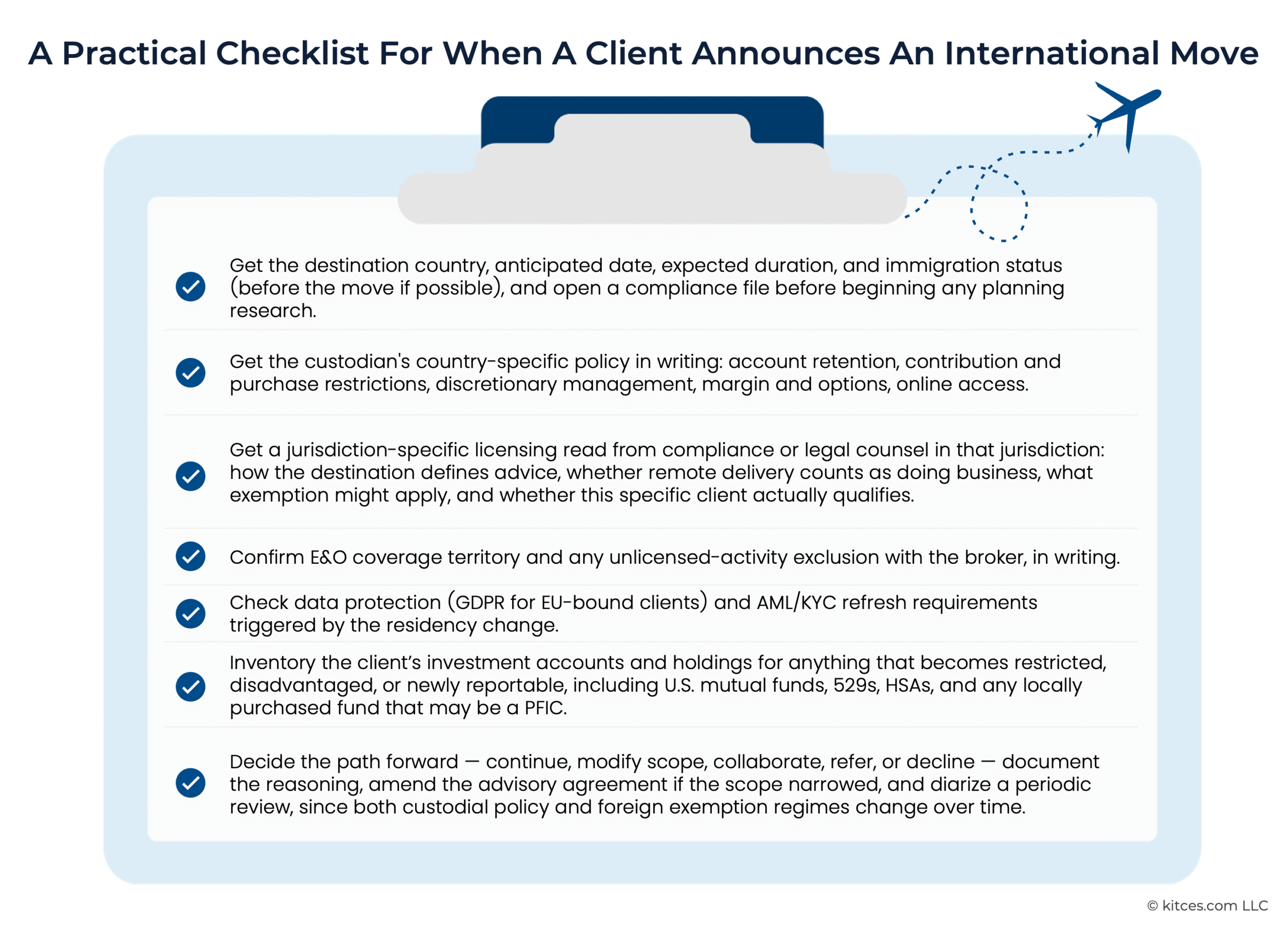
Rather than treating the relocation as an automatic termination or an automatic "nothing changes," use it as the trigger for a structured internal review, ideally opened as a compliance file before any investment, tax, or other planning research begins.
What Has Actually Changed?
New country of residence and expected tax residency, permanence of the move, immigration status, whether the client is asking for new kinds of advice, and — just as important — what hasn't changed, since exemptions like the U.K.'s overseas-persons exclusion or MiFID's reverse-solicitation rule can turn on how the relationship originally began.
Who Now Has A Claim To Regulate This Relationship?
What does the destination country consider investment advice, does remote presentation/delivery count as doing business there, is there an exemption and does this specific client actually qualify for it (not just "clients like this in general"), and does the U.S. side of the analysis — registration, ADV disclosure, custody, marketing rule — remain fully in force in parallel?
What Can The Firm's Operational Infrastructure Actually Support?
Get the custodian's country-specific policy in writing before assuming anything: account retention, purchase and contribution restrictions, discretionary authority, margin and options access. Layer in data protection (GDPR Article 3(2) reaches any EU-resident data subject regardless of citizenship, and can require a written EU representative under Article 27), AML/KYC refresh triggered by the address change, and whether advisor travel to the client's new country is anticipated and tracked, since physical presence and pattern of contact are exactly what several jurisdictions use to assess "doing business."
What Does The E&O Policy Actually Cover?
Covered below — this is best answered before the relocation, not after a claim.
What's The Appropriate Path Forward?
Continue as-is; continue with a modified, documented scope (for example, discretionary management of the existing U.S. accounts only, with local tax and estate questions referred out); collaborate with local professionals under a defined division of responsibility; refer the client to a cross-border specialist; or decline to continue. Whatever the answer, the decision and its rationale belong in the client file and, where the scope has narrowed, in an amended advisory agreement.
Don't Forget The E&O Policy
An advisor might reasonably assume that carrying professional liability insurance means the firm is protected if a relocated client later brings a claim. That assumption is often broader than the policy actually is.
Is The Jurisdiction Covered?
Many advisor E&O policies define coverage by where suit is brought, not where the advice was delivered. One representative policy covers claims "which take place anywhere in the world, provided that the claim is made and suit is brought against the Insured in the United States of America, its territories or possessions and the District of Columbia, Puerto Rico or Canada." Read literally, advice given to a client in Madrid is covered — but only if that client sues in a U.S. court. A claim filed in a Spanish court (because the client moved to Spain and that's now their home jurisdiction, and where they retain ‘local' counsel to sue) may fall outside the policy's territory entirely.
Does The Policy Exclude Unauthorized Activity?
Carriers commonly exclude claims arising from services that required a license the advisor didn't hold in the relevant jurisdiction — which means the same fact pattern that creates foreign regulatory exposure (the requirement to register or get a license in the foreign country) can simultaneously void the insurance that was supposed to cover it if the advisor fails to register or license themselves.
What Does The Policy Actually Protect Against?
E&O responds to negligence claims about professional services. It does not indemnify the firm against regulatory action for operating without a required local license. Advisors should ask their E&O insurance broker directly, in writing, about territorial exclusions, jurisdictional exclusions, unlicensed-practice exclusions, and whether the specific services now being requested fall within the policy's definition of professional services. "We have E&O" and "we are compliant" are two different questions, and only one of them can be solved by buying a policy.
The Bigger Lesson: Competency Includes Knowing When The Engagement Has Changed
Specialization is a strength: it's how advisors get efficient at serving the clients they know well. But specialization also creates a responsibility to notice when a specific client has moved outside the circumstances the advisor built that expertise around. An international relocation is one of the clearest versions of that.
The advisor's job isn't to become an expert in the client's new country, but rather to recognize that a relocation may touch licensing, registration, solicitation rules, account eligibility, product availability, tax treatment, retirement and estate planning, insurance, custodial policy, and the advisor's own competency — and to seek resources to support each aspect of the engagement. Among others, this could include working alongside a cross-border tax attorney, engaging local counsel to address licensing questions, and exploring whether the client's account can stay open at the existing custodian.
It is incumbent on the advisor to respond to the client's relocation deliberately rather than by default. That might mean continuing exactly as before, or narrowing the scope of the engagement, partnering with a local professional, or referring the client out entirely.
Which is why the first question after a client's international move should never be "how do I advise this client?" It should be: "Should I continue advising this client — and what would I need to confirm to do that competently and compliantly?"
Further Learning
Advisors who want a structured foundation in this area — rather than researching each relocation from scratch — can look at the Global Financial Planning Institute's Essentials Course. The curriculum covers cross-border fact-finding, U.S. and international tax considerations, foreign exchange, licensing and regulatory frameworks, Social Security coordination, multi-jurisdictional portfolios, cross-border retirement accounts, PFICs, and estate planning issues that arise when clients live and invest across borders.
Cross-border financial services rules are highly fact- and jurisdiction-specific. The country examples in this article illustrate the kinds of issues an advisor should identify and investigate — they are not legal, tax, or regulatory advice for any particular client or jurisdiction. Advisors should consult their firm's compliance function and, where appropriate, qualified legal and tax professionals before providing cross-border services.