Executive Summary
Although many advisors looking to sell their practices are ready to retire and cash in on the enterprise value they've spent their careers building, an increasing number of advisors are selling and staying, choosing to sell either because they believe they can grow faster by joining a larger firm with more capabilities or services, or simply because they want to offload many of the operational or compliance headaches that have taken up so much of their time when operating on their own. And in some cases, the seller is simply so upbeat on the potential of the buyer's continued growth that even though they plan to exit themselves, they want to roll over a portion of their equity into an acquirer for a period of years to have the potential for a second liquidity event (the proverbial "second bite at the apple"), ideally at the acquirer's higher valuation multiple. Taking equity can also be beneficial for advisors looking to defer a portion of the capital gains taxes associated with the sale of their practice (until the acquirer ultimately exits). Yet the reality is that trading an advisor's own equity for potentially illiquid and opaque equity in the acquirer's business presents a unique set of challenges that advisors must carefully weigh, as they can have significant economic consequences for the seller if not everything works out exactly as projected upfront.
In this guest post, Rich Chen, founder of Brightstar Law Group, explores how advisor sellers receiving equity in the acquirer's firm has become increasingly common, often 25%–40% of the seller's exit valuation and sometimes as much as 75%, and what advisors should watch out for to ensure they are getting "fair value" and the bundle of rights they are expecting for the cash they're giving up!
The rising popularity of taking equity in an acquirer's business appears to be driven in large part by the rapid growth of serial acquirers, aggregators, and other industry "roll-up" models, whose growth rates are often far in excess of what the advisor themselves could otherwise invest in. In other words, why sell the firm and reinvest the proceeds into a balanced portfolio of publicly traded securities that might grow at 8% in the long run, when the advisor can roll equity into an acquirer that will also grow with the market (as its AUM fees grow with rising client portfolios) and its organic and subsequent acquisition growth… potentially driving 15%–25%+ growth returns. In what is admittedly a "risky" small business, but one that the advisor-as-seller who ran their own business for decades may be quite comfortable with. Many buyers, in turn, want advisors (especially those who will continue with the firm post-closing) to take equity in the buyer's firm as part of the acquisition, because doing so preserves cash and provides more leverage to fund future acquisitions, while also aligning the interests of the selling advisor with the buyer.
The caveat is that while buyers may scrutinize a seller's firm to determine a value, sellers are often much more limited in assessing the buyer's business to understand whether the shares they're receiving are appropriately valued. Firms often use their own internal valuation formulas, that may truly represent a fair market value, or simply a multiple that the firm hopes to achieve in the future, with the risk borne by the seller if that growth, margin improvement, or other goals don't materialize. Sellers can at least partially protect themselves by asking for more disclosures about the buyer's valuation methodology, and a representation of the buyer's most recent external valuation or comparables (and then monitor financials ongoing by requesting information rights), but the seller's ability to negotiate is often still limited. And even a robust valuation can be undermined by dilution from subsequent acquisitions, management grants, or new capital raises between closing and exit.
In addition, it's important to recognize that not all equity received is necessarily even saleable. In some cases, equity received from the acquirer while the seller remains working at the buyer's firm will still have vesting contingencies (that might not be earned, and the buyer might even still have the right to terminate the advisor and end their vesting period). Even if vested, the shares are typically not liquid, not simply because it's hard to find a buyer for a small minority stake, but also due to the fact that operating agreements often have outright restrictions on transfers, and/or include repurchase rights that themselves might not be the most favorable terms for the seller to be compelled to sell back. And private equity sponsors and other preferred investors often sit ahead of the seller's equity class in a distribution waterfall, so the proceeds ultimately available to the seller's shares may be materially less than the headline ownership percentage implies.
Ultimately, the key point is to understand that taking equity in an acquirer's firm entails a whole separate level of risks and opportunities, beyond 'just' the effort of selling the advisory firm itself for a desirable valuation and with appealing payment terms. And while some provisions may be negotiated (if only by adjusting the valuation the seller receives for the buyer's equity shares), often complex businesses with a wide shareholder base cannot change terms for any one incoming partner… which means sellers must be especially proactive in due diligence to protect themselves and be clear about whether the acquirer's equity is really a good opportunity.

How Should Equity Received In An M&A Transaction Be Evaluated As A Component Of The Purchase Price?
While the traditional remuneration for selling an advisory firm (or any business) is receiving cash proceeds (upfront or over time), a growing portion of most RIA M&A transactions involves the buyer offering to the seller equity in the acquiring entity as part of the total package.
These equity components are almost always presented favorably, with compelling language about participation in future value creation, tax deferral benefits in getting an in-kind exchange/reorganization transaction that is only taxed when the acquiring firm's shares are ultimately sold, and the opportunity to benefit from the acquiring platform's growth trajectory (organically or with other acquisition deals it may pursue after the current seller's).
The pitch is not fabricated. For sellers who join the right platform at the right time, equity has produced returns that materially exceeded what an all-cash deal would have delivered.
The prevalence and scale of equity as a component of total proceeds has grown considerably in recent years. Transactions in which the acquirer's equity represents 25% to 40% of the total purchase price are now routine. In more aggressive structures, particularly those involving private equity-backed consolidators or high-growth platforms seeking to preserve cash for additional acquisitions, the equity component of the purchase price can constitute up to 75% of the total purchase price.
A seller who accepts such a structure is, in economic substance, making a leveraged bet on the buyer's future platform value, while simultaneously accepting the illiquidity, valuation opacity, and dilution risks that private equity ownership entails. Which means while the growth opportunity may be appealing, understanding those risks in detail is not optional.
Simply put, equity received in a private acquiring entity is categorically different from cash, and the gap between the two is wider than most sellers appreciate when they first evaluate an offer. Cash is certain. Equity is not. Cash is liquid. Equity in a private company is not, except on the buyer's timeline and on the buyer's terms. The value of equity in a private company is whatever the buyer says it is, subject to whatever limited challenge rights the seller has negotiated, not what a market price would independently establish.
Understanding these differences in detail before accepting an equity component as part of a purchase price is one of the most important analytical disciplines an RIA seller can apply.
The Benefits Of Advisors Receiving Equity In The Acquirer's Firm
Receiving equity in the acquiring entity is not inherently disadvantageous, and for the right seller in the right transaction, it can be a meaningful value-creation tool.
On the tax side, accepting equity as a component of the purchase price and rolling the seller's equity into the buyer's equity may allow a seller to defer paying taxes on a significant component of the purchase price until that acquiring firm's equity is eventually sold. In a transaction where a seller would otherwise face a substantial capital gains liability at closing, deferring that event by several years can have significant present-value benefits and preserve capital to continue growing that would otherwise be paid in taxes to the government.
Mechanically, an equity rollover works by having the seller contribute a portion of the equity (or assets) of their firm to the acquirer's holding entity in exchange for equity interests in that entity, rather than receiving cash for that portion of the purchase price. When structured properly, typically as a contribution to a partnership or LLC taxed as a partnership under IRC Section 721, or as a tax-deferred reorganization or exchange, the rolled-over portion is not treated as a sale for tax purposes at closing. Instead, the seller takes a carryover basis in the new equity, and the taxable gain on that portion is deferred until the acquirer's equity is itself sold in a future liquidity event.
The practical benefit is twofold: the seller keeps more capital working on a pre-tax basis (rather than surrendering the tax that would be due on the rolled amount at closing, which depending on deal structure, entity type, and the seller's state of residence can run roughly 20–30% for the portion taxed as long-term capital gain), and that larger, untaxed base is what compounds inside the acquirer's platform between closing and exit.
Two important caveats apply, however. First, deferral reaches only the rolled equity itself; the cash and any employment-based retention or earnout consideration are generally taxable at closing, so a partial rollover defers only a portion of the overall gain, not all of it. Second, the deferral is not automatic and depends on careful structuring. Section 721 nonrecognition can be lost where the receiving entity is treated as an "investment company," and the "disguised sale" rules can recharacterize a contribution paired with cash as a taxable sale. And the available path differs depending on the buyer's form: a contribution to a partnership or LLC taxed as a partnership can qualify under Section 721, but where the acquirer is a corporation, a lone seller contributing to an existing entity generally cannot obtain Section 351 nonrecognition on their own, and tax-free treatment then turns on qualifying as a reorganization. Sellers should confirm the intended treatment with tax counsel rather than assume it.
Beyond tax deferral, equity participation gives the seller a continued economic interest in the combined business, converting a single-firm, owner-operated asset into a stake in a larger, more diversified, and more professionally managed enterprise.
In fact, the growth case for taking equity benefits from several distinct drivers that can compound on top of one another. First is organic growth: a larger platform typically has the marketing, service, and investment infrastructure to grow AUM and revenue faster than a standalone advisor could on their own. Second is inorganic growth: an acquirer executing a disciplined roll-up strategy can add revenue and earnings with every subsequent acquisition, and the seller's equity can participate in that expanding base. Third is margin expansion: as the platform scales, fixed costs are spread across a larger revenue base, so EBITDA can grow faster than revenue, improving profitability per dollar of AUM.
Layered on top of these operational drivers is the potential for multiple expansion. The market has, at least thus far, consistently assigned a valuation premium to larger, faster-growing, more institutionalized firms, so a book of business that might trade at a single-digit or low-double-digit multiple of EBITDA as a standalone practice can be revalued at the acquirer's higher platform multiple simply by virtue of being part of the larger enterprise.
When organic growth, acquisition-driven growth, margin expansion, and multiple expansion combine, the equity a seller receives today can appreciate at a rate that a diversified portfolio of after-tax cash proceeds would struggle to match, producing the "second bite at the apple" at the acquirer's eventual liquidity event. For a seller who believes in the buyer's growth trajectory and management team, this combination of tax-deferred compounding and platform-level value creation is the core reason to accept equity in lieu of cash at closing.
Example 1. Zachary has decided to sell his $180M AUM advisory firm, in a "sell-and-stay" transaction where he will work for the next five years before ultimately retiring for good. The acquirer has valued his firm at $4M, of which Zachary will receive $2M in cash at closing, $400k in a one-year retention payment with a 97% revenue retention requirement, and $1.6M in equity of the acquirer.
The acquiring firm, coming off a fresh round of private equity capital, aims to do serial acquisitions over the next five years itself (of which Zachary's firm is just one of the first), in the hopes that the business can 3X to 5X over that time period.
Zachary reinvests his after-tax proceeds (about $1.5M after state and Federal capital gains taxes) into a diversified portfolio, adding $300k more of after-tax cash after the first year (when the retention payment is earned, minus what is paid to Uncle Sam). In the subsequent years, market returns are favorable, and Zachary's portfolio grows to nearly $3M by the end of the fifth year.
However, the upside of the market also helps to carry forward the growth of the acquiring firm, which is successful in rolling up dozens of advisory firms, coupled with reasonable organic growth, and the benefit of market returns for the acquirer's AUM; as a result, the firm does in fact achieve 4.2X growth in its enterprise value over its five-year growth cycle (a compound annual growth rate of 33%), which even after some dilution (from other sellers that also received partial equity rollovers) grows Zachary's shares from $1.6M to $5.8M.
The end result is that when the acquirer is ultimately recapitalized, Zachary's shares are worth $5.8M, or nearly double what his cash proceeds were able to grow to over 5 years. Even on an after-tax basis, Zachary nets well over $4M of cash, surpassing what his reinvested after-tax proceeds grew to, and in fact exceeding the entire purchase price to begin with, as his "second bite at the apple" proves even more valuable than the first original transaction!
The critical discipline, however, is ensuring that the apparent benefits are not offset by valuation opacity, illiquidity, or dilution, each of which is described in more detail below.
The Risks Of Taking Buyer Equity
The risks that come with accepting buyer equity fall into four broad categories, each addressed in turn below: first, the subjectivity of how the buyer's equity is valued at closing; second, the vesting requirements that condition the seller's receipt of the equity on meeting time-based or performance milestones; third, the share-class subordination that determines where the seller's equity ranks in the distribution waterfall and can reduce what the seller actually receives; and fourth, the transfer, repurchase, and dilution restrictions that limit if and when the seller can convert the equity to cash.
The Valuation Of Buyer's Equity Is Subjective
One of the most important considerations a seller should evaluate when receiving the equity of the buyer in a transaction is how much the acquirer's equity is really worth. Unfortunately, this can be quite subjective, given that most buyers are private companies without a public market for their securities to facilitate price discovery.
Typically, a buyer tells a seller that the buyer's equity is worth a specified amount, and the seller is presented with a number that carries the same nominal authority as a cash offer. It appears as a line item in the purchase price summary, it is added to the other consideration components to produce a total headline figure, and it is treated throughout the negotiation as if it were equivalent in certainty and value to cash.
However, equity in a private company is worth whatever the parties agree it is worth. Yet in an RIA acquisition, "what the parties agree it is worth" typically means what the buyer says it is worth, based on a valuation methodology that the seller has limited ability to independently verify or challenge.
Example 2a. Lawrence is considering the sale of his advisory firm to an aggregator, XYZ Financial, that is offering to buy his firm for 11X his adjusted EBITDA of $700,000, which would amount to a $7.7M purchase price. The deal terms are tilted heavily towards taking equity in the acquiring firm, such that only $2.31M (or 30%) would be paid in cash, and the other $5.39M (the remaining 70%) paid in the acquirer's equity.
The acquirer states that they believe a reasonable valuation for their firm, given its growth rate and size premium, would be 16X their internal calculation of EBITDA, resulting in a $1.57B enterprise value for their $40B AUM platform.
With a share price of $11.26 according to XYZ Financial's latest internal valuation (and approximately 139,254,000 outstanding shares in total, assuming for simplicity that the platform carries no net debt, so that equity value equals enterprise value), Lawrence's deal would convey $5,390,000 / 11.26 = 478,686 shares of the company, or about 0.34% of total share ownership.
When Lawrence questions how the firm arrived at 16X EBITDA, and how its EBITDA is calculated, the firm simply explains that this is the standard valuation formula they use for all of XYZ Financial's equity transactions.
The mechanics of equity valuation in RIA deals vary, but the power imbalance is consistent and the implications are significant. If the buyer's equity is valued at an inflated multiple relative to where the platform would actually trade in an arm's length secondary transaction, the seller may be receiving less value than the headline suggests, effectively getting fewer shares in the transaction as a result of the inflated price used in the calculation.
In turn, this means if the platform subsequently underperforms, the equity may be worth considerably less at the eventual liquidity event than anticipated – or in the extreme, can even be worth less than it was valued at closing.
Example 2b. Two years later, the aggregator firm XYZ Financial that acquired Lawrence's practice has grown another 20%, and is ultimately sold, allowing Lawrence to cash out his shares. However, the buyer makes several notable adjustments to XYZ's valuation, materially altering its value.
First and foremost, it turns out that when XYZ calculated its valuation as a multiple of EBITDA, it was using a "normalized" EBITDA of 35%, even though the firm was then running 28% margins. The assumption was that as the firm grew, there would be significant cost savings and economies of scale, once it worked through its "one-time" merger integration costs.
In practice, though, it turned out this was a bit too optimistic, as XYZ had to reinvest into staff infrastructure to accommodate its greater size and complexity, and while margins did improve, they rose "only" to 31%. Which meant that XYZ's actual EBITDA on $48B of AUM and $336M of revenue was not the $117.6M they projected, it was only $104M, immediately haircutting their multiple-of-EBITDA valuation by more than 10%.
In addition, because of the integration challenges that XYZ faced in the final years, they were not able to complete as many acquisitions, and their growth rate had slowed to only 20% across the final two years (impaired in part by a slight market decline in the final year as well). Given the slower growth momentum, the acquirer declared that it would only pay 14X adjusted EBITDA, and not the 16X that XYZ had valued itself at internally, resulting in another 12% haircut to the valuation.
The end result was that even though XYZ had grown by 20% in its final two years, the valuation adjustments resulted in an enterprise value of only $1.46B, and dropping the share price from the $11.26/share when Lawrence received the shares, to only $10.47 at the time of exit.
Which means that when the deal finally closed, Lawrence's 478,686 shares were only worth $5.01M, less than the $5.39M pegged two years prior, as it turned out XYZ was not able to achieve the EBITDA and valuation multiple assumptions built into their valuation at the time.
As a result, sellers should treat the valuation of buyer equity with a healthy amount of caution when deciding whether to convert a portion of their purchase price into equity of the buyer.
Navigating Vesting Requirements And Share Class Differences
The stated value of equity may also be further reduced by vesting schedules. Equity granted at closing does not necessarily vest immediately just because the deal has closed and the seller's equity was exchanged. Rather, it may still vest only after certain time periods or performance milestones have been achieved.
Sellers should treat unvested equity as categorically different from vested equity, and apply a meaningful discount to any unvested component in their net present value analysis to determine whether they are getting their desired level of proceeds from the sale (and/or in comparing the terms of one prospective buyer with unvested-equity with another that does not include such limitations).
Equity May Be Subordinated In The Buyer's Capital Stack
Beyond vesting, the equity class received by selling advisors in some private RIA platforms is not the most senior class in the acquiring entity's capital structure. Preferred equity holders (typically the private equity sponsors or institutional investors who provided growth capital) sit ahead of the seller's equity class in the distribution waterfall applicable to any future liquidity event.
In reviewed transactions, these preferred interests often carry a stated preferred return, accruing annually on a compounding basis, with the full accumulated preferred return required to be satisfied before any residual proceeds flowed to the class held by the seller.
If the platform's eventual exit valuation falls short of projections, or if the compounding preferred return has grown substantially over a multi-year holding period, the proceeds available to the seller's equity class may be materially lower than the nominal value implied by their ownership percentage at closing.
Example 2c. Continuing the earlier example with Lawrence's exchange of equity into XYZ Financial, it turns out that XYZ fueled its last round of growth with a sizable $210M round of capital two years ago from DEF Private Equity, which had a 12% cumulative preferred return that was compounding as a hurdle rate that the firm must exceed as a priority return of capital, and a Payment-In-Kind (PIK) provision that required XYZ to pay any cumulative return shortfall in equity shares if not already paid out as dividends.
At the time of the PE investment from DEF, the firm had $32B of AUM, at an average billing rate of 0.7% (for $224M of revenue), and a 30% profit margin (for $67M of EBITDA), on which XYZ had been willing to pay a 16X EBITDA multiple in part because of the protections of its cumulative preferred return (putting the enterprise value at $67M EBITDA x 16X multiple = $1.075B). This gave DEF a $210M capital / ($210M capital + $1.075B valuation) = 16.34% stake in the firm.
The original DEF investment happened two years prior to Lawrence's deal, and XYZ ultimately sold two years later. This meant DEF's cumulative return requirement over four years with compounding was 57.3%, requiring the firm to receive the first $330M of proceeds from the sale.
Since XYZ ultimately exited for $1.46B (after the adjustment for EBITDA by the new acquirer, and the reduced valuation multiple), the DEF stake of 16.34% was only worth $238M, far short of its $330M preferred. As a result, DEF received additional shares to true itself up to its $330M threshold, and the remaining investors (including Lawrence) saw their valuation reduced from $1.46B − $238M = $1.22B, to only $1.46B − $330M = $1.13B.
As a result of DEF's preferred return threshold on its higher tier of capital, Lawrence's stake was further reduced to $1.13B (actual valuation) / $1.22B (valuation before PIK) = 92.5% x $5.01M (Lawrence's original valuation) = $4.64M in value.
Sellers should model the equity to be received against the full distribution waterfall, at a range of plausible exit valuations, before accepting any equity component as part of their purchase price.
The Impact Of Transfer And Other Liquidity Restrictions On Acquirer's Equity
Even where equity is fairly valued at closing, and even where the seller has sufficient information to form a reasonable view of that value, the path from receiving equity interests to converting them into cash is longer, more uncertain, and more subject to buyer control than most sellers anticipate.
It operates across several distinct mechanisms: transfer restrictions that limit liquidity until an exit event occurs; dilution provisions that reduce the seller's ownership percentage between closing and that exit event; unilateral repurchase rights that allow the buyer to recapture the seller's equity at a buyer-determined price; forfeiture provisions triggered by employment termination or restrictive covenant breach; senior equity preferences that reduce the proceeds available to the seller's equity class at exit; and the near-universal absence of meaningful governance rights for the equity class sellers receive. Each of these mechanisms operates independently, but in combination they can transform equity that appears fixed and valuable at signing into a contingent, illiquid, and structurally subordinated interest that can deliver materially less than the headline implied.
It is important to recognize that transfer restrictions in RIA equity deals are the norm, not the exception. Because the equity issued to sellers is most often in the form of limited liability company membership interests or limited partnership interests (though some platforms, particularly those on an IPO track, issue private corporate stock instead), the seller typically receives interests in a private entity with no public market, no registered securities, and no mechanism for independent monetization.
Which means that the seller's equity really is illiquid until the buyer decides to create liquidity, through a sale, a recapitalization, or a public offering. And by restrictions in the operating agreement, the seller typically has no unilateral right to sell their interests, tender them to the market, or otherwise convert them to cash on any predictable timeline even if they wanted to find their own buyer earlier. Sellers who need liquidity - to fund retirement, pay estate obligations, rebalance their personal portfolio, or simply reduce concentration risk will find that the equity component of their purchase price is effectively frozen until the buyer acts.
Second, the dilution risk compounds this concern. From the date of closing forward, the buyer will continue to acquire additional RIA firms, bringing in new sellers who also often receive equity as part of their purchase price, too. The buyer will also often grant equity to management team members, key employees, and perhaps new financial sponsors who provide additional growth capital. Each of these issuances increases the total outstanding equity of the entity, and reduces the seller's ownership percentage, potentially significantly. The seller's equity interest may represent 2% of the platform at closing and 0.8% five years later, as the platform has grown to include dozens of additional acquisitions.
That doesn't have to be bad; whether the dilution outcome is economically advantageous for the seller depends on whether the platform's aggregate value has grown faster than the dilution. But that is a question that depends entirely on the quality of the buyer's execution and allocation decisions over the intervening years.
Third, a category of provisions that is almost universally present in private company governing documents, and almost universally unread by sellers before signing, gives the buyer the contractual right to repurchase the seller's equity interest at a board-determined price (which is not an independent market process and may use a buyer-friendly – i.e., low-valuation approach), and triggered by conditions the buyer controls (which can be wide-ranging, including termination of employment for any reason, breach of post-closing restrictive covenants, involuntary transfers such as bankruptcy or divorce, and in some structures voluntary retirement).
Even where the repurchase price is not discounted, the repurchase agreement dictates the buyer's preferred timeline and terms, which often means paying out sale proceeds over a lengthy period of time, thus requiring the seller to carry all of the credit risk, time-value discount, and subordination risk that deferred payments entail (i.e., akin to the structural risks in the context of earnouts and retention payments as well).
Although these terms are often very hard to negotiate - they typically sit within the buyer's operating agreement or partnership agreement, which is unlikely to be modified for any single seller being acquired - they are not entirely immovable, depending on the circumstances.
Sellers Can Protect Themselves When Evaluating And Receiving Equity
Taken together, the combination of valuation opacity, transfer and repurchase restrictions, share-class subordination, and dilution can transform equity that appears fixed and valuable at signing into a contingent, illiquid, and structurally subordinated interest. The section that follows sets out the specific protections a seller can realistically pursue to mitigate each of these risks - including the anti-dilution and pre-emptive rights that are worth negotiating for (even though buyers typically resist broad versions on the grounds that they create friction for future acquisitions).
The starting point is that sellers who accept equity as a component of the purchase price should not treat it as a settled line item on the purchase price summary, but as a distinct, illiquid, private-company investment that warrants its own diligence and its own negotiated protections. Because the buyer's operating or partnership agreement is unlikely to be rewritten for any single seller, the most effective time to secure these protections is at the Letter Of Intent (LOI) stage, before structural terms harden in the definitive purchase agreement. The protections below track the risks described above - valuation opacity, vesting and forfeiture, share-class subordination, transfer restrictions, and dilution - and are organized accordingly.
At the same time, sellers should enter these negotiations with realistic expectations, because securing equity protections is usually an uphill battle. Nearly every protection described below runs directly against the buyer's core interests, namely preserving flexibility to raise capital, complete serial acquisitions, and control the timing and terms of any liquidity event, and buyers, whose transaction counsel drafts the governing documents, routinely resist them. The realistic objective is rarely to rewrite the buyer's capital structure; it is to obtain meaningful disclosure, a handful of targeted contractual protections, and enough information to price the equity accurately, and, where the buyer will not move on terms, to insist on a larger cash component or a discount to the equity's stated value to compensate for the risks the seller is being asked to retain.
Valuation Protections
To guard against accepting equity at a value that later has to be written down - whether from a lower multiple or a reduced revenue or EBITDA base - sellers should seek:
-
- A disclosed and documented valuation methodology, including the multiple applied to the buyer's own earnings, and the specific assumptions underlying the buyer's projected growth (for the seller to scrutinize further);
- Summary historical financial information for the buyer's recent fiscal periods sufficient to test the valuation, most importantly a schedule showing how the buyer's "adjusted" or "normalized" EBITDA is calculated from actual results, including the specific add-backs and one-time or "non-recurring" adjustments and any difference between current and projected margins (recall that in the example above, XYZ valued itself on a "normalized" 35% margin it was not in fact then earning); a seller with sufficient leverage may also request audited or reviewed statements, but at a minimum should expect enough detail to understand the earnings base on which the multiple is applied;
- A representation about the buyer's most recent third-party valuation or comparable transaction data, if available (to clarify if the buyer is trading equity to sellers at a materially different valuation than the firm itself, or known similar firms, have recently transacted at); and
- Ongoing information rights that entitle the seller to periodic (at least annual, and preferably quarterly) financial reporting on the combined entity, including updated AUM, revenue, EBITDA, and capitalization data, sufficient to monitor the underlying value of their stake (so that at least if the valuation is not playing out as anticipated, it will not be a sudden surprise when the eventual liquidity event occurs).
Vesting/Forfeiture And Capital-Stack/Waterfall Protections
Where any portion of the equity is unvested and potentially subject to forfeiture, sellers should negotiate a defined and reasonable vesting schedule; acceleration of vesting on death, disability, a change of control of the buyer, or termination without cause; and narrow forfeiture triggers, so that equity already earned cannot be clawed back except for clearly defined cause.
Unvested equity should be discounted in the seller's net-present-value analysis and, wherever possible, converted to vested equity or offset with additional cash at closing.
At the same time, even vested equity is of limited value if it sits too far behind other investors in the capital stack (and their potential preferred-equity interests). Accordingly, sellers should obtain and review the full capitalization table and the distribution waterfall, and model their expected proceeds across a range of plausible exit valuations after giving effect to any senior preferred returns, liquidation preferences, and PIK (Payment-In-Kind) accruals.
Where the seller's equity share class (e.g., common) sits behind a compounding return of preferred shareholders, the seller should press for disclosure of the current preferred balance and its accrual rate, and consider negotiating for the same (or a pari passu) class of equity that the buyer's sponsors hold, or at least a cap on the preferred capital that can be layered in ahead of the seller's class. Sellers should also seek at least basic governance or consent rights over actions that would disproportionately harm their equity class.
Transfer And Liquidity Protections
Because an acquirer's equity is illiquid until the buyer themselves creates a liquidity event, sellers should try to negotiate tag-along rights (so they can participate proportionally if the buyer or its sponsors sell), and appropriate protection against drag-along provisions that could force a sale on unfavorable terms. Where repurchase rights exist (allowing the buyer to compel the seller to redeem their shares back to the firm), sellers should try to push for a fair, independently determined repurchase price (rather than a board-determined or discounted price), and for prompt payment rather than a multi-year, unsecured payout that shifts credit, time-value, and subordination risk onto the seller.
Another point of negotiation worth potentially pressing for are structural backstops that create at least some path to liquidity, or at least some protection against being singled out for worse terms. These include a put or redemption right that allows the seller to require the buyer to repurchase the equity at fair value after a defined holding period (e.g., after seven years) or upon retirement, death, or disability; a most-favored-nation provision entitling the seller to the benefit of any more favorable equity terms (on valuation, vesting, transfer, or waterfall priority) granted to other similarly situated selling advisors that may come to the table in the future; and, where the buyer insists that its valuation is sound, a valuation true-up or purchase-price adjustment that issues the seller additional equity (or cash) if the buyer's equity is later shown to have been valued above the valuation actually set in a subsequent financing or third-party valuation. Buyers frequently resist each of these, precisely because they shift risk back toward the buyer, which is why the seller's fallback, if these are refused, should be to reprice the deal through more cash at closing or a discount applied to the equity's stated value.
Given that many serial acquirers ultimately need to raise additional capital to support their ongoing purchases, a final path for sellers to explore is to seek pre-emptive or anti-dilution rights in future issuances (allowing them to contribute additional dollars to reinvest when the company raises capital, thereby maintaining their current ownership percentage). While buyers often resist broad versions of these rights because they create friction for serial acquisitions, even a narrower version – for example, one applying only to non-acquisition capital raises — offers meaningful protection.
Without these protections, equity is not a transparent component of the purchase price. Rather, it is a contingent promise whose value the seller cannot verify, and whose realization depends entirely on the buyer's future decisions and how accurately the buyer can project how markets will value their enterprise in the (unknown) future.
Conclusion
Merging an advisory firm into a larger acquirer can be an appealing way to get support in growing to the next level, especially when the larger firm has already "solved" the challenges that the seller is currently facing. At the least, this unlocks the potential for greater growth and improved work-life balance for the seller, and at the best, a combination of multiple selling advisors who are all unlocking growth potential means the whole of the acquirer's equity may become more valuable than just the sum of its parts. Especially when the industry continues to assign a valuation premium for larger firms.
Yet the reality remains that an advisory firm is an illiquid investment, which entails real risk to own. For many financial advisors, who have owned their own company for years, the idea of holding advisory firm stock may not seem so risky or concerning, as it's what they've already done for a long time. But someone else's advisory firm equity is not necessarily the same as your own; even though we're all "in the same business", advisory firms do not necessarily run and operate in exactly the same manner, and not all owners make the same business decisions about profits versus reinvestment and when to sell versus not.
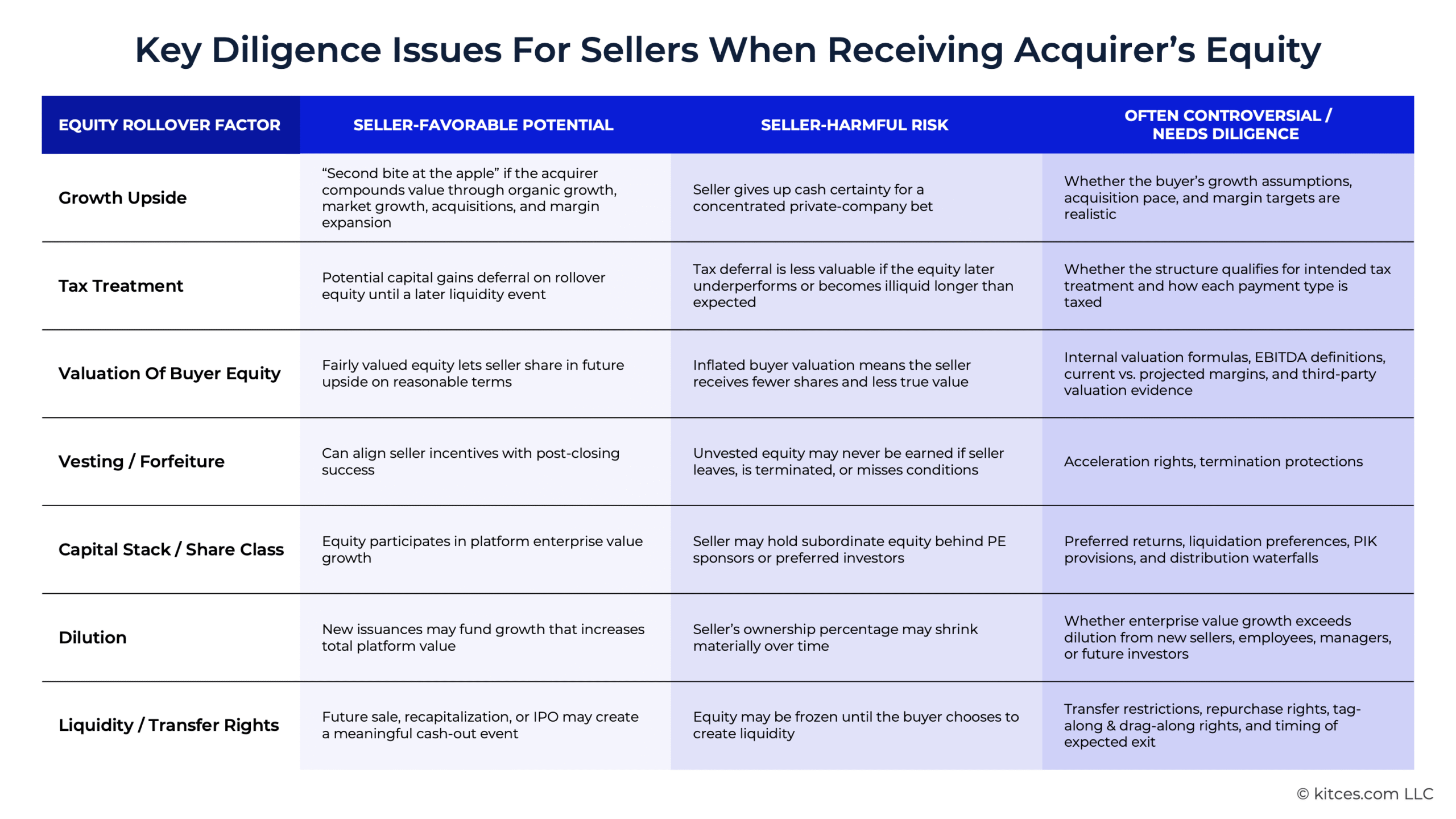
Which means it's important to treat the buyer's equity to be received in an acquisition as a separate asset class, requiring separate diligence. Obtain and read the LLC operating agreement. Understand the valuation methodology. Analyze the capitalization table and the potential dilution from both existing and future issuances. Negotiate for information rights, tag-along rights, and the most robust anti-dilution protections the buyer will accept. Do not allow the equity component to be presented as a given number without independently verifying the assumptions that produce that number.
Recognize as well that the buyer's transaction counsel has drafted these agreements to be buyer-favorable, and that many of the most consequential provisions (e.g., the revenue definition, the client consent adjustment mechanics, the earnout formula, and the equity governance documents) will not be the subject of extensive negotiation unless the seller raises them specifically. Sellers who do not have experienced M&A counsel reviewing these provisions at the Letter Of Intent (LOI) stage, before they have accepted structural terms that are very difficult to change in the purchase agreement, are consistently disadvantaged. Which risks putting the seller into an "equity consideration trap", where valuation opacity, transfer restrictions, and dilution can collectively make equity worth less, later, and in a smaller amount than the headline presentation implied.
Nonetheless, the environment for M&A of advisory firms remains incredibly healthy, in part because investors know and recognize that there is significant money to be made in acquirers building lasting advisor enterprises at scale. Which creates a compelling wealth-building opportunity to go along for that ride… but advisors need to remain eyes-wide-open about the risks that entails, especially when private equity investors negotiated preferred shares for themselves that pay out first, so incoming advisors must be confident that there will be enough left afterwards for themselves to benefit, too.