
Executive Summary
As human beings, most of us have a hard time letting go, especially in cases where we have held something for a long time and formed a personal attachment to it. From the treasured (blue) coffee mug, to the t-shirt we got at that concert, to the higher-stakes situations like the family home we've lived in for years, or the company stock we've built up over decades that made it possible to retire. The good news is that our human tendency to create attachment enables us to invest into ourselves and our community. The bad news is that it can create a resistance to change. Such an unwillingness to sell is especially problematic in situations like real estate or concentrated stock positions, which create real financial planning hazards that advisors must help their clients navigate.
In this guest post, Dr. Meghaan Lurtz, a leading expert on the psychology of financial planning and Professor of Practice at Kansas State University, explores the research behind this phenomenon (known formally as the "endowment effect"), how it typically manifests in financial planning situations with clients, and more importantly what financial advisors can actually do to help their clients get more comfortable with selling an asset that needs to be sold.
The endowment effect is complicated, though, because it's actually driven by three different mechanisms, any one of which (or sometimes a combination thereof) may be at play in any particular situation. In some cases, it's driven by loss aversion – the recognition that the pain of loss is twice as impactful as the joy of a comparable gain, which causes us to ask a lot more when selling something than we would ever pay to buy it. In other cases, our own identity gets tangled up into the situation… such as the concentrated stock position that was accumulated through years of employment, making it more difficult to sell since we feel that we earned it through the fruits of our labor and our success as a career professional. And sometimes, it's simply a result of different anchor points between buyers and sellers: when we're asked to let go we often think of the highest price it could be worth (e.g., what the most expensive property on the street ever sold for), while the buyer looks at how inexpensively it might be obtained (e.g., what the least expensive property in the area went for).
Being aware of when these dynamics are at play is important, because the emotionally driven phenomenon is not responsive to logic as a cure. Which means it's not enough to simply know that the endowment effect is at play, and it's especially unhelpful to communicate it that way to clients, as suggesting that their unwillingness to sell is ‘a result of their biases' is more likely to elicit defensiveness than a concession that they need to take action.
So what does work? Psychology research on the endowment effect suggests several paths. One approach is to have clients envision what their future life might look like, after a sale has already occurred, to help them get comfortable with being on the other side of the sale. Another option is to encourage them to capture a memento – from the doorknocker or a key piece of art from the family home they're selling, to perhaps a framed stock certificate of that company stock they held so long (and are now getting ready to liquidate) – to diminish the pain of the loss by having something to keep. Other tactics include working alongside with the client to re-anchor to a realistic price in the current environment (e.g., "Let's look together… at what comps are selling for" or "…at what price it's trading today"), trying to help the client get familiar with who will be on the receiving end of the sale (e.g., get to know the family that's looking to buy and move into your family home), or simply asking, "What do you think you'll lose if you let this go – not financially, but emotionally?" so the client can surface and start thinking through their own worries.
Ultimately, the key point is to recognize that an unwillingness to sell something we've had a long time and/or formed an attachment to is normal, is human, and is not simply a matter of showing enough logic to ‘prove the point' that it's a good financial planning decision to sell (even if that really is the case). Instead, because the reality is that the endowment effect is first and foremost an emotionally driven phenomenon, helping clients unearth that emotion, name it, and do their own work to begin working through it is the better way to help them begin to let go and engage in the sale of the asset.
 |
And if you want to go deeper on this topic, hear directly from the author on the Financial Advisor Technician podcast . |

Listen To The Financial Advisor Technician Podcast On This Topic




Episode Shownotes And Transcript
Most financial advisors have run into some version of these conversations. A client's family home is listed for sale, at a price well above what comparable properties on the same street have sold for, yet even when months pass without an offer, the client won't come down on the price. A client holds a concentrated position in their former employer's stock that hasn't been rebalanced in a decade, and every attempt to discuss diversification stalls. A recently widowed client refuses to touch a single position in their portfolio – even the ones that could be sold without any material tax impact – despite the reality that reallocating would clearly better serve their goals.
The advisor brings data. They show the real estate comparables, model the concentration risk, walk through the tax-aware reallocation. And still, the client can't let go.
It's tempting to treat this as a knowledge problem – as though the client simply hasn't gotten the right illustration or projection yet, that will finally help them to see the problem and take action. But the advisor in these moments doesn't have a logic problem. They have a behavioral one.
What they are bumping up against is known as the endowment effect: the well-documented tendency for people to value something more highly, simply because they already own it.
And, yet, no client in the history of financial planning has ever repriced their home or decided to sell the stock they didn't want to sell, just because someone told them they were experiencing a cognitive bias that was causing them to irrationally keep holding onto it. Said another way, being aware of this bias, and maybe even telling clients that their thinking is biased, is not enough to change behavior.
The good news is that the endowment effect is one of the most studied phenomena in behavioral economics, and the research offers far more than a label. It points to why clients become so attached to what they own – and, more usefully, to specific, research-backed ways advisors can work with that attachment rather than arguing against it.
Because the feelings driving the endowment effect – love for a place, pride in work, grief for a person – are real and legitimate. Treating them as "errors of logic" to be corrected instead just reliably backfires. Meeting clients where the feelings live, thankfully, does not.
What Is The Endowment Effect, And Why Does It Keep Showing Up In Your Client Meetings?
At its core, the endowment effect describes a simple but stubborn gap: people demand significantly more to give up something they own than they would otherwise pay to acquire it in the first place. Economists describe this as the gap between willingness to accept (what someone would need to be paid to part with a thing) and willingness to pay (what they would spend to acquire that same thing if they didn't already own it). And as researchers Morewedge and Giblin have shown, that gap is almost always larger – sometimes dramatically larger – than rational pricing would predict.
The landmark demonstration came from Daniel Kahneman, Jack Knetsch, and Richard Thaler, in a series of experiments now familiar to anyone who has studied behavioral economics. Researchers gave half of a group of students coffee mugs and let them hold and use the mugs briefly. Then they invited the owners to sell to the students who hadn't received one. The mugs were available in the campus store at a known, fixed price – a fact both groups understood. Yet sellers consistently demanded roughly twice what buyers were willing to pay. Nothing had changed about the mug, but clearly something had changed about the seller's relationship to it.
Where Advisors See Endowment Effects The Most
The endowment effect is not a quirk confined to sleep-deprived undergraduates and their coffee mugs. It surfaces, predictably, in three contexts that financial advisors encounter again and again:
- Real estate. Clients price a family home well above market comparables and resist coming down even when the listing stalls for months. The venetian blinds they ordered after hours of shopping in that store, the marble counters they added custom, the years of memories as the children grew up – none of that shows up in the comps of other homes being sold, but all of it shows up in the asking price of the client who's selling.
- Concentrated stock positions. Like the home that grew full of memories, the stock that the client once "wisely" bought (at least with the benefit of hindsight!) that grew and grew becomes endowed with the magic of their wealth-building prowess, and especially difficult to part with. This is especially true of shares earned through employment, where the stock is entangled with professional identity and years of effort. The client didn't just acquire the position; they earned it.
- Inherited portfolios. A stock that's held because it was inherited isn't just a stock anymore; the position carries the emotional weight of a deceased spouse or parent. In those cases, reallocation can feel less like a financial decision, and more like a betrayal of the gifts or memories of the deceased.
Like the coffee mugs, the end result is the same… clients might not be willing to purchase the real estate, or the portfolio positions, at these prices, yet they're thoroughly unwilling to sell for anything less. Because it's no longer about the price of what the advisor recommends should be sold, it's about the client's relationship to it.
Why Telling Clients About The Bias Doesn't Work
A common advisor instinct, when the pattern becomes obvious, is to want to name it: "This is just the endowment effect." Or perhaps, more empathically, "Hey, I know this is hard. Our minds are built to think our own stuff is more valuable than it really is…"
Yet, "naming it" almost never helps. Being told that a cognitive bias is steering a decision rarely makes anyone think more clearly; more often, it just makes the person saying it sound dismissive at best, or condescending at worst, which can trigger the client to feel defensive and dig in their heels further. No client has ever heard "that's just your bias talking" and immediately repriced their home to sell faster for less.
The reason is that the feelings underneath the attachment are not errors. They are love for a place, pride in hard-won work, and grief for a person who is gone. Treating those feelings as something to be corrected creates resistance, because the client experiences it – accurately – as having their humanity argued against.
The more productive move is to acknowledge the weight of what's being asked and then work with the feeling. To do that well, though, it helps to understand that the endowment effect isn't a single thing at all.
The Endowment Effect Is Not One Thing: Three Mechanisms, Three Different Interventions
For decades, behavioral economists and psychologists have debated why ownership inflates value – and the debate itself is revealing, because there turns out to be more than one right answer. As subsequent research over the years has revealed, the endowment effect has at least three distinct drivers, and each one calls for a different advisory response.
An advisor who can identify which mechanism is operating can choose the right tool, rather than applying a generic approach and hoping it lands.
Loss Aversion: The Transaction Feels Like A Goodbye
The classic explanation of the endowment effect comes from the foundational 1979 work of Kahneman and Tversky on prospect theory: losses tend to feel roughly twice as painful as equivalent gains feel good. Finding $20 on the sidewalk is a pleasant surprise; losing a $20 bill that was supposed to be in your pocket can send you tearing through the laundry. The dollar amount is identical, but the loss looms larger.
Applied to the endowment effect, loss aversion suggests that when a client contemplates selling something they own, the brain frames the transaction as a loss (of the object they're losing) rather than a gain (of the money they'll receive in return). The client isn't gaining the sale proceeds; they are losing the house, the memories, and everything the asset represents. The cash simply doesn't register with the same emotional weight as the thing being surrendered, because the joy of any gain is outweighed by the greater pain of the loss.
This mechanism is especially active during home sales or the sale of other sentimental assets – and it also helps explain why clients chronically underweight opportunity cost. The money left on the table by a home that sits unsold for six months, the returns forgone by an unrebalanced position, the next chapter that never starts – those costs are invisible, while the imagined loss of selling feels vivid and real. Loss aversion wins almost every time.
Ownership Identity: The Asset Is Entangled With The Self
Loss aversion explains a great deal, but it doesn't explain everything. Carey Morewedge and colleagues ran a clever variation of the mug experiment in 2009, designed to separate ownership from loss – and found that the endowment effect can appear independent of loss aversion entirely.
In their study, buyers who already owned an identical mug at home were willing to pay just as much for a new one, at a price that was still higher than at the university bookshop. That shouldn't happen if the effect is only about avoiding loss; these were buyers, not sellers, and nothing was being taken from them; they were getting ANOTHER mug at a higher price. The researchers surmised that simply already knowing, what it felt like to own the thing (the coffee mug at home) – that feeling changed how they valued it (the additional coffee mug would also be so nice and warm to hold and keep the coffee just right).
For advisors, this mechanism is the key to one of the most stubborn cases of the endowment effect: company stock. The inflated value doesn't come only from fear of losing the position. It comes from the positive experience of ownership itself, and from the way the asset has become a symbol of years of investing prowess, or in the case of earned stock from employment, of work and professional identity. Selling it can feel, in some hard-to-articulate way, like diminishing what the client did to earn it.
The same logic explains why the endowment effect can apply to objects of almost no monetary value – the conference pen, the chocolate bar that sat on a desk, the cup that holds your coffee just right – any ordinary thing that makes the quick journey from random object to mine.
Reference Price Anchoring: Buyer And Seller Are Using Different Benchmarks
A third mechanism, proposed by Weaver and Frederick, is more cognitive than emotional. In this view, the endowment effect can arise simply because buyers and sellers anchor to different reference points.
For instance, sellers look to the top of the market – the comparable property that sold for top dollar after a bidding war. Whereas buyers look to the bottom – the three nearby homes that need a little work and are listed for far less. Neither party is being irrational within their own frame; they just have completely different starting lines, but it nonetheless creates a significant gap in pricing expectations between the buyer and seller.
This version of the endowment effect is less about attachment, and more about information asymmetry. And it has a direct practical implication: when a client is anchored high on price, the most effective intervention may not be addressing the emotional attachment at all, but rather explicitly establishing a shared reference point from which both parties can reason.
The Answer Is Usually "Yes, And…"
In practice, these mechanisms rarely operate in isolation. The client clinging to company stock granted over a decade of work may be experiencing identity entanglement, layered on top of loss aversion. The client sitting on a childhood home full of furniture they don't really want but memories they do is likely deep in loss aversion – selling the house is a goodbye, not a transaction. And the client insisting their thoroughly average house is worth $300,000 more than comparable homes on the same street? That may be anchoring and reference price, with a light dusting of ownership identity on top.
Often it doesn't matter precisely which mechanism dominates. What matters is that the overvaluation is happening, and that the client may need help finding a new frame for thinking about it.
Still, knowing the three drivers – grief/loss, identity/ownership, anchoring/asymmetry – gives the advisor a better sense of which conversation to have. That is where the research becomes genuinely useful in advisor meetings.
Five Research-Backed Tools Advisors Can Use In Practice
The goal of each of the following tools is not to override the client's emotion or to win an argument against it. It is to create just enough space between the feeling and the decision for a more grounded choice to emerge. Each maps to specific research, and each can be deployed in an ordinary client conversation.
Tool 1: The Future-Self Question (And The "New Money" Test)
For attachment driven primarily by loss aversion, future-self framing is remarkably effective – precisely because it doesn't fight the feeling. Instead of arguing that the client should let go, it invites them to imagine a future in which they already have, and to notice how that future feels.
The framing sounds something like this:
"Imagine it's three years from now. The house sold, and you're settled somewhere new that you love – a good neighborhood, friends who've become real friends, family over for Sunday dinners. Life is full. And one day you find out the old house just came back on the market. Would you buy it back?"
Most clients, sitting with that question, say no. And that moment of recognition creates a crack in the attachment, without the advisor having to argue against anything. Crucially, this is not a "see, I told you so" moment – it doesn't prove the client is being irrational right now. It simply lets them experience letting go in a safe, hypothetical space, and it gently separates the life they love from the asset they're afraid to lose. Love and memories are portable; the house, it turns out, is not where they actually live.
For positions with lower emotional weight – most investment portfolios and some company stock – the closely related "new money" test works well:
"If you didn't already own this, would you buy it today, at today's price, with the proceeds from selling it?"
If the answer is no, that discrepancy is worth exploring together. Again, these are not 'I told you so' moments, but instead opportunities for connection and understanding—within the advisor-client relationship, but also within the client themselves. Again, in real estate situations or stock/portfolio decisions, clients are not actually thinking, "This is just my emotion talking and I need to be more rational." They are in some ways rationalizing through their emotions, and advisors are there to bear witness to that process. A client, saying out loud, "Yea, you know...I wouldn't buy it again" or "I wouldn't re-buy the house." They are coming to terms with their loss, grief, and identity in real time and navigating the resulting behavior change – to sell. This is tough stuff. It can't be rushed. It can be slow and emotional. Advisors might want to move quickly because they may be, rightly, concerned with opportunity costs. And yet, for the health of the advisor-client relationship (we don't want to be seen as pushy or cold) and the client's own mental health (they are the ones that ultimately have to live with their decision and regret is never fun), it really matters that they have time to process these emotions so they can ultimately approach selling with greater ease. While this is something only they can do, it often helps to have an empathetic, curious financial advisor there to ask the questions that thoughtfully bring about insight.
Why future questions matter: Both questions shift the client's focus away from the history of how they came to own the asset, and toward what the asset can do for them from here. The history of how someone acquired something is not, by itself, a reason to keep owning it. The future value might be. Reframing the decision around what comes next sidesteps the loss frame that makes selling feel like surrender.
Advisor tip: Resist the urge to point out that the client just revealed an inconsistency. The power of the question is in the client's own realization, not in the advisor's interpretation of it. Sit in the silence after they answer "no," and let them talk through their answer a bit, or advisors can ask, "What does saying 'no' mean to you? Or to this decision?" It is a more powerful experience for the client to come to their conclusion than to have logic or numbers forced upon them.
Tool 2: Give The Memory A New Home With A Memento
Researchers Chu and Shu found that providing sellers with a small memento of an item they were parting with – a photograph, or a small piece of a larger whole – significantly reduced both their reluctance to sell, and the price premium they demanded.
The insight is intuitive, but not broadly used in financial planning: clients often can't release the thing because the thing holds the memory. So, give the memory somewhere else to live.
In practice, this might mean suggesting the client commission a painting of the family home, keep one meaningful piece from a larger art collection, or assemble a dedicated photo book as part of the transition. Another idea is to get and then frame a physical stock certificate of the company stock they held successfully for so long.
The point is to honor the significance without erasing it – to move the memory from a heavy, illiquid, expensive vessel into a lighter one, and in doing so make the asset itself easier to release.
Why it matters: This tool addresses ownership-identity and grief-driven attachment directly, where logic and market data are least effective. It separates the memory from the asset without dismissing either, which is exactly what a framing like, "It's just a house" fails to do.
Advisor tip: Frame the keepsake as part of a deliberate ritual rather than a consolation prize. Language matters here: "Let's make sure the memory has a home before the house changes hands" lands very differently than, "You can always take a picture." Bring ideas like this to the table when you see clients struggling to commit or feeling ambivalent: "I have had clients take the doorknocker from the front door or another keepsake, and it has been a really meaningful experience. Is there something like that for you, in your home?"
Tool 3: Get Curious About What The Client Is Actually Protecting
Sometimes the most useful intervention is the simplest question: "What do you think you'll lose if you let this go – not financially, but emotionally?"
The answer surfaces the real driver. Sometimes it's a legitimate grief that deserves to be honored. Sometimes it's a fear that has never been examined. And sometimes the client discovers that what they're protecting isn't the asset at all, but their identity as the kind of person who owns it.
None of those answers is wrong, and all of them are more workable than "I just can't sell it." Clients can't move on from what they can't name, and as an advisor it's tough to bring empathy to what we haven't yet understood.
Why it matters: This tool is diagnostic as much as therapeutic. It tells the advisor which of the three mechanisms is in play – grief points toward loss aversion, "who I am" points toward identity, "it's worth more than they're offering" points toward anchoring – which in turn tells the advisor which of the other tools to reach for next.
Advisor tip: Ask the question, then stop talking. The instinct to fill the silence with reassurance or a planning point will short-circuit exactly the reflection you're trying to create. The client's pause is the work happening. If you are really nervous about the pause, set it up with a preface. Advisors can say, "I see how hard this is, and I want to acknowledge it. So I am going to ask, "What do you think you'll lose if you let this go – not financially, but emotionally?" I recognize that is a big question. I am going to give you the time and space to respond." Now the silence isn't weird; it is kind, patient, and respectful.
Tool 4: Anchor To The Market, Together
When reference-price anchoring is the driver, the most effective move is to do the work to figure out what the 'comparables' or reasonable price point should be, with the client – not to argue them down, but to establish a shared factual baseline from which both parties can reason. Look at what comparable assets have actually sold for; not what they were listed for, and not the optimistic ceiling of the range, but the realistic middle. Highlight what the stock is trading at today, not what its 52-week or all-time high might have been, or how low it once fell.
Research on the willingness-to-accept / willingness-to-pay gap suggests it shrinks meaningfully when buyer and seller share a reference price. Market data, presented this way, isn't intended to tell the client their asset isn't valuable, but rather to establish a shared language for both sides – and shared language is how deals get done.
Why it matters: Anchoring is the one mechanism that is genuinely more cognitive than emotional, which means it responds to information in a way the other two do not. But for that to occur, the information has to be co-created, not delivered. A client who helps assemble the comps owns the conclusion; a client who is handed the comps defends against them.
Advisor tip: Position yourself beside the client, not across from them – literally and figuratively. "Let's look at what's actually selling" invites collaboration; "Here's what the data says your stock is worth" invites a fight. The first establishes a shared starting line; the second moves the client's anchor further away. Pulling up the stock chart to say, "Let's see what it's actually trading at now" creates similar opportunities to re-anchor away from what the price once was (at its highs months or years ago).
Tool 5: The Empathy Pivot
Finally, one of the newer findings in the recent literature: Dyke and colleagues found that when sellers knew something personal about their buyer – a name, a story, a reason – the endowment effect substantially weakened, and in some cases reversed. When the person on the other side of the transaction became real, sellers lowered their prices and both parties became more generous.
Advisors can put this to work, particularly in real estate. Encouraging (or helping a client read) a buyer's personal letter, or simply humanizing the transaction, can loosen the grip. If a client learns that the couple buying their home is expecting their first child or racing to get into the school district before fall, it doesn't change the market value of the house – but it can change how the transaction feels. Letting go starts to feel less like losing something and more like allowing the thing to serve someone else.
It can also work, with a slight twist, in concentrated stock positions. In these scenarios, the advisor is not going to know the buyer. Yet, they will know or could know about the beneficiary of the proceeds: seed the donor-advised fund, pay for their granddaughter's first year of college, invest in a new kitchen for Sunday dinners with family. The call to humanity, to story, and to connection is extremely powerful.
Why it matters: The endowment effect doesn't always dissolve through logic, but it often softens when kindness and humanity enter the transaction. The empathy pivot works on all three mechanisms at once, because it reframes the entire act of selling from a loss to a gift.
Advisor tip: This doesn't require a dramatic backstory. In real estate transactions or rare art transactions, even small amounts of personalization – a name, a reason, a single detail about the person on the other side – can be enough to shift how the client experiences the sale. In concentrated stock scenarios, it is about who the proceeds help or support and the new story of identity and connection being written.
Helping Clients To Sell: Creating Space
The endowment effect is one of those biases that, once an advisor learns to see it, becomes visible everywhere – in the stalled listing, the unrebalanced portfolio, the inherited position no one will touch. And it is entirely human. More than that, it is rooted in things that are not remotely bad: the love of our things, the weight of our memories, and the deep desire to feel that our work, our time, and our choices have meant something. 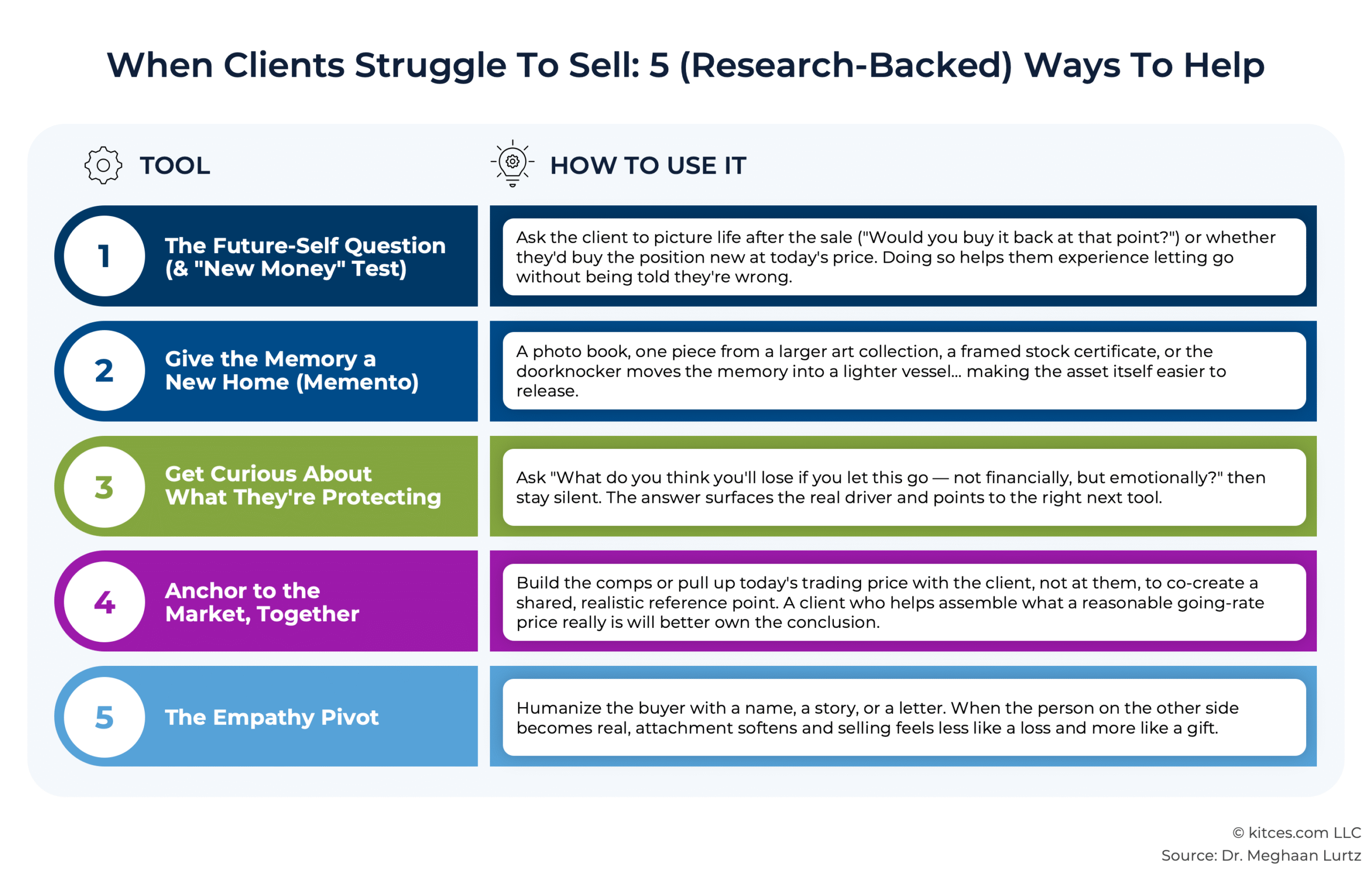 The goal, when working with a client struggling with the endowment effect, is never to strip all of that away. Instead, the goal is simply to create a little space between the feeling and the decision – enough space to ask whether what the client is protecting is really what they think they're protecting, and whether the price they're asking reflects the world as it is, or the world as it lives in memory.
That space is not created by better data or sharper arguments. It is created by better questions – questions that meet clients where the feeling lives, honor the attachment, and then, gently, make room for what comes next.





Leave a Reply