Executive Summary
Financial advisors who pursue the CFP certification mid-career often face a daunting logistical reality: how to complete a rigorous curriculum while working full-time, managing family responsibilities, and maintaining some semblance of personal balance. The CFP certification process itself requires candidates to satisfy four components: experience, education, ethics, and examination. Each component requires rigor and dedication, from the multi-year experience requirement to the intensive exam to the education requirement. The CFP education component consists of five core subject areas – Fundamentals and Insurance, Investment Planning, Income Tax Planning, Retirement Planning, and Estate Planning – culminating in a capstone project that requires synthesizing technical knowledge into a comprehensive financial plan.
In this article, Senior Financial Planning Nerd Sydney Squires details her journey to complete the education requirements for CFP certification in just one year. While every individual's journey through the education requirements is different, this can serve as a reference point for those beginning their education journey. While the sheer amount of material to be learned can feel intimidating, with structure, intentional study habits, and the right support systems, it is possible to complete the required coursework in an accelerated timeframe while still working full-time.
On average, completing the coursework in under a year may require nearly two hours of study per day, often concentrated on weekends. Beyond the raw time commitment, the deeper challenge lies in mastering breadth over specialization. The curriculum is intentionally generalist, requiring competency in areas where a candidate may have little prior exposure. This structure forces candidates to confront weaknesses they might otherwise avoid, from math to memorization. Topics such as retirement plans and trusts become more manageable when reframed at a systems level – through flowcharts and big-picture conceptual mapping – rather than approached as isolated exercises.
Success, then, is less about raw intelligence and more about adaptive learning strategies. For example, actively focusing on difficult concepts early, revisiting recorded lectures, comparing alternative instructor explanations, and creating personalized flashcards (rather than passively consuming pre-made materials) all strengthen retention. Even small tactical adjustments, such as using mnemonic devices for rote memorization or leveraging highlighting tools to avoid misreading exam questions, can materially improve outcomes.
More than anything else, the rigor of CFP education unfolds alongside real life. Professional and family obligations, relocations, travel, and unexpected personal events do not pause for coursework. Clear communication with family about time demands, conscious decisions about which personal activities to maintain, and the willingness to accept support become critical. Perhaps most impactful is the power of community – whether through coworkers, online networks, or cohort-based study groups – to get support, troubleshoot difficult concepts, and sustain momentum.
Ultimately, completing the CFP education requirement in under a year while working full-time is less about speed and more about intentionality. It requires structured scheduling, honest self-assessment, disciplined study habits, and a growth mindset that embraces "not yet" as a temporary state rather than a fixed limitation. For advisors and career changers alike, the process is demanding – but it also reinforces the very competencies that define effective planners: analytical rigor, adaptability, communication, and perseverance. In that sense, the journey through CFP education is not merely a credentialing exercise, but a formative experience that strengthens both technical capability and professional resilience… ultimately enabling advisors to better serve clients with confidence and depth!

In January 2025, I began my CFP certification education journey through Dalton Education. This was a year-long journey that culminated in passing my capstone on December 15, 2025 – fulfilling the entire CFP certification education requirement in one year. I completed this education while working full-time, rather than through an undergraduate or graduate program.
2025 was an exhausting, challenging, surprising year – and completing my CFP Education came with a lot of lessons learned. While there are many components to obtaining the CFP certification, this article will primarily focus on the journey to fulfill the education requirement in one year, with two areas of emphasis. First, I'll share the data of what this actually looked like, from time-tracking to the courses. Second, I want to provide the frameworks – tactical and emotional – that helped me get through a demanding process, and will hopefully help other candidates as well. My ultimate goal is to provide aspiring CFP certificants with both a roadmap and tactile resources.
With that in mind, let's get started!
The CFP Certification Process
I first committed to getting my CFP certification in the summer of 2024, as a part of my transition from a team management role to a team contributor role. I had joined the Nerd's Eye View as a manager – in fact, when interviewing for the role, I verified that I wouldn't need to know anything about finance, and that I wouldn't be required to get the CFP certification, which seemed like a lot of work.
Turns out that it is a lot of work. In order to obtain the CFP certification, a candidate must clear a four-step process:
- Experience: Accumulate the professional experience related to the CFP certification. This is typically either a 4,000-hour Apprenticeship (working directly in financial planning under the direct supervision of a CFP professional) or the 6,000-hour Standard Pathway (which can involve work in education supporting financial planners) related to the financial planning process.
- Education: Complete the required coursework and holding a bachelor's degree.
- Ethics: Adhere to high ethical and professional standards, pass a background check, and always act as a fiduciary.
- Exam: Pass the exam, which is 170 questions over 6 hours, covering all of the domains of CFP Education.

Nerd Note:
The CFP Experience standard is changing, beginning in Q1 2027. Candidates pursuing the Standard pathway will be required to "demonstrate experience addressing at least three steps of the financial planning process", according to the CFP Board.
Why Get A CFP Certification?
Like any long-term commitment, my reasons for pursuing the certification are multifaceted. In part, I was surprised at the intellectual home that I found within financial planning among the processes, problem-solving, and juxtaposition between 'spreadsheets' and real life. My background is primarily in publishing, and I realized that even if I wanted to continue in the writing and editing space, it would be ideal to have some credentials to support my expertise. And I discovered that I liked this "financial planning" thing, and that getting my CFP certification would open the door to a potential career path as a financial advisor. (And, hey, I've heard that the profession needs more young financial advisors!) Beyond that, I've also come to appreciate the way that financial decisions can truly mold the options that people have throughout their lives – and I wanted to not only have the expertise to help myself, but also my family, other advisors, and the general population.
In many ways, I'm extremely fortunate that my primary exposure to the financial planning community has been through the lens of "financial advicer", which provides an appealing clarity and purpose to financial planning as a whole!
This put me in an interesting corner as a career pivoter (more than an outright career changer). In many ways, this was exactly what I wanted: I deliberately didn't pursue post-graduate education after completing my undergraduate degree in English because I wanted to work for a few years before pursuing my path. In other ways, this presented different opportunities and challenges in that I wasn't going to be a full-time student: I was going to be balancing the education (and exam prep!) while also working.
Nerd Note:
Kitces Research on What Actually Makes A Difference In Advisor Well-being notes that career changers tend to be much happier in their advisory firm roles than those who started off their careers in financial planning services. Many in my Dalton education cohort are career changers seeking to meet their experience requirement, and this coursework demands immense dedication and effort. When hiring, don't rule out career changers!
The CFP Certification Experience requirement is typically a larger hurdle for aspiring advisors, who must have two years of hands-on experience or three years of 'related' experience. I was thankfully able to qualify thanks to my work at Kitces.com, which involves creating and curating educational content for financial advisors. This meant that 'all' I had to do was complete the education (and pass the exam, but that felt impossibly distant and daunting at the time).
The Logistics Of CFP Certification Education
When I selected my CFP education provider, I was searching for three primary traits: fast, remote, and synchronous. I wanted the accountability of a schedule and deadlines, (correctly) anticipating that I wouldn't be motivated to keep to the study schedule otherwise. Still… it was one thing to decide I wanted to quickly obtain my CFP Education. It was another to do it in real time.
I ultimately opted for Dalton Education as my CFP certification education provider. Its timing and structure worked with what I wanted, and I also heard their education offered unique depth and breadth. This was appealing to me, as I'd been surrounded by financial planning content and strategies for years… but not quite immersed enough to provide in-depth familiarity.
Regardless of the provider selected, the education component comprises five sections: Fundamentals and Insurance, Income Tax Planning, Retirement Planning, Investment Planning, and Estate Planning. Dalton Education had a rotation of instructors, with a specialist teaching each class – for example, my income tax planning course instructor worked as a tax planner.
The CFP certification education is largely generalist – rather than emphasizing specialization within any one area, it focuses on breadth of knowledge. In some ways, this is advantageous; in others, it means a lot of material is covered. In my opinion, the easiest classes were income tax planning, fundamentals, and estate planning. Insurance, investments, and retirement planning were all much more difficult for me. But from my anecdotal conversations with classmates, this varied widely depending on their backgrounds. For example, the Nerd's Eye View publishes extensively on tax planning, so I have absorbed a lot over the last few years.
What Do You Actually Learn In CFP Certification Education?
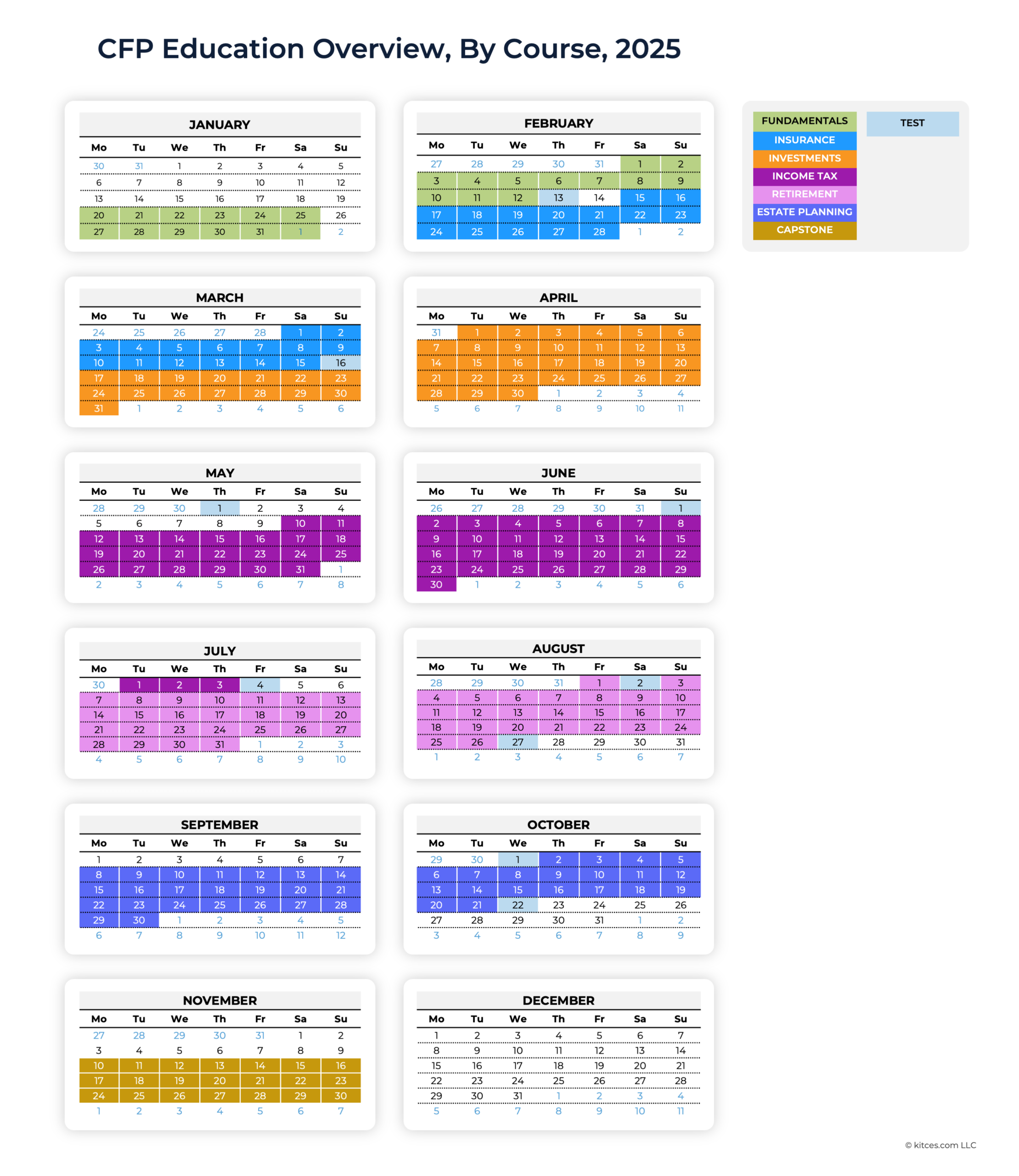
While I don't need to belabor what was covered in each class, the sections are so broad that I do want to briefly summarize what was covered in each course. I am also including the dates I started studying for each class through the date I took the final, which I feel is a more realistic representation of the time spent than 'just' the class dates.
Fundamentals (1/20–2/13) focuses largely on education planning, basic economics, and ethics. This course jumps immediately into time-value-of-money calculations, which, after a few hours of practice problems, proved less challenging than I'd anticipated. What I found most challenging in this course was the gift and income tax planning.
Note: Fundamentals had only one exam, since the Dalton Education program combines Fundamentals and Insurance into a single class.
Insurance Planning (2/15–3/16) focused on insurance vehicles, insurance needs analysis, and disability income insurance. This was a challenging course for me, in part due to lack of familiarity with some of the content… and in part because I was still developing a study strategy. With that said, I still do not enjoy calculating the Medicaid cost of a stay in a long-term care facility.
Note: Insurance had only one exam, for the same reason Fundamentals had only one.
Investment Planning (3/17-5/1) focused on the types of investment risk, bonds, and portfolio development. This was a tough class for me, as I struggled with the math and formulas. I'll cover that more later, but what I'll say for now is: this video by Advise Wise, which explains the formula sheet, helped immensely.
Income Tax Planning (5/10 – 7/4) ranged from tax law to business taxation. I enjoyed this class much more than I thought I would (and after the confidence test of investment planning, income tax was a much-needed breath of fresh air). I struggled more with business entity taxation, but the individual tax planning components made a lot of sense to me!
Retirement and Employee Benefit Planning (7/7 – 8/27) covered retirement needs analysis, retirement plan rules, and social security and Medicare planning. This felt like the course with the most raw material to learn, so I was grateful it came later in my education!
Note: Retirement Planning was scheduled to begin in mid-July, but I started early because I had a trip scheduled for the first week of the course. Thankfully, this worked out since I just had to watch the first two classes in advance, but I was grateful that I did that.
Estate Planning (9/8–10/22) discussed property titling, estate liquidity, and planning for special circumstances. Estate planning was less difficult than I anticipated, and I particularly enjoyed delving into the family dynamics that can reshape estate planning needs.
When I write it out this way, the education seems quick. In reality, with the schedule I chose with Dalton, classes would run on Tuesdays and Thursdays, from 7:00–9:30 PM ET. Each section ran from 6–8 weeks, on average (more on that later), with a midterm and a final. On midterms and finals, I had to obtain at least a 70% passing grade, and candidates are permitted two attempts per exam. In practice, this meant that I took a midterm every 23 days that I was actively in class – for a midterm approximately every 3 weeks – all while working full-time!
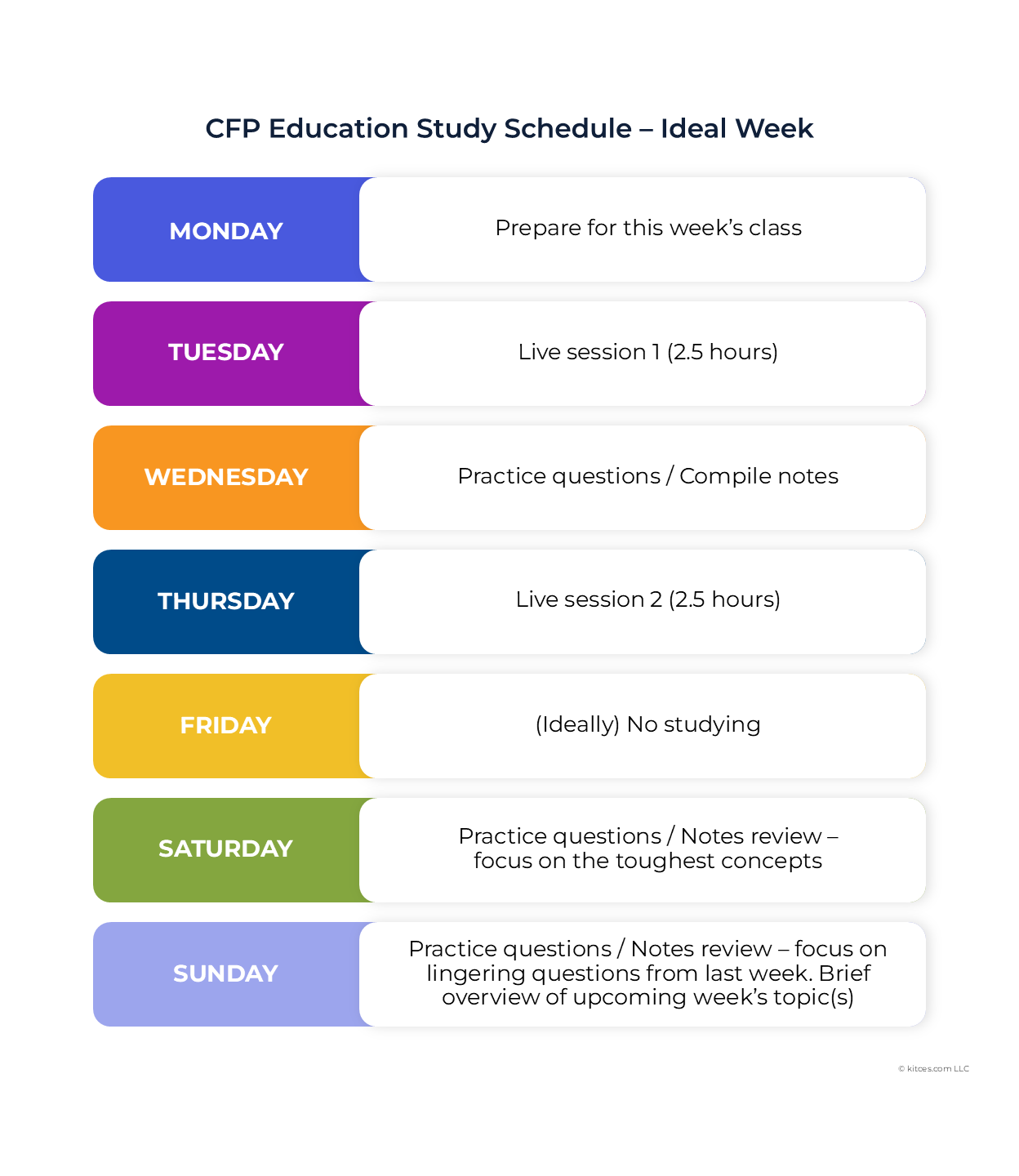
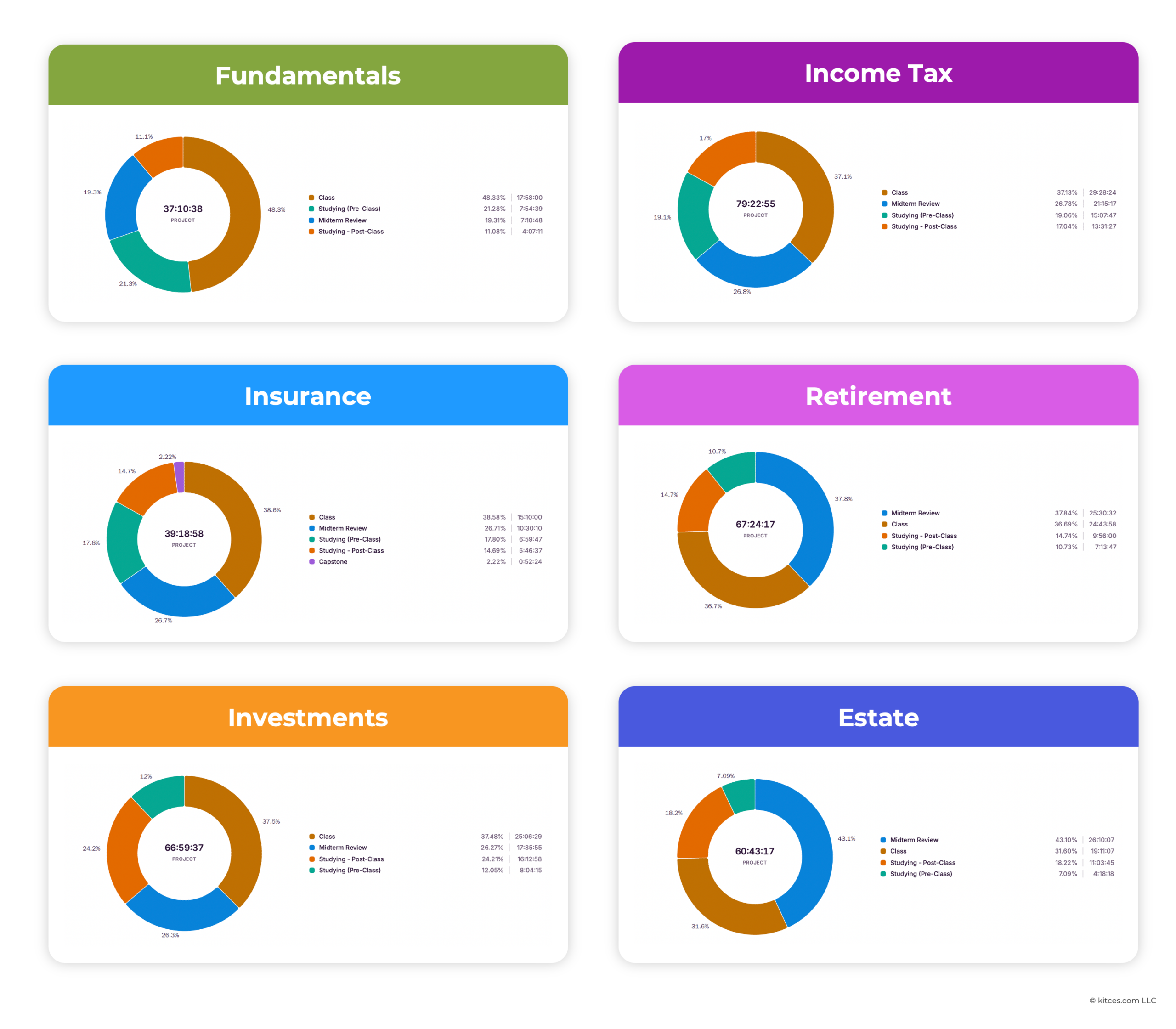
All told, I averaged 1.77 hours of studying a day, including time off and breaks. This studying was also 'lumpy' – I usually didn't study on Fridays, but I put in extra time on weekends.
With class on Tuesdays and Thursdays, during a 'standard' week, my schedule settled into something like the following:
Completing The Capstone
After completing my coursework on October 22nd, I intended to jump directly into my capstone, then take a break until I started exam preparation in mid-to-late December. As I finished up my estate planning course, my paternal grandparents passed away within a quick succession of each other. I don't want to deeply discuss all of the personal consequences of that here, but I do want to note that it delayed my capstone work while I flew home to pay my respects… and, honestly, while I mourned. I ended up beginning the bulk of my capstone on November 10th, roughly two weeks later than I originally planned.
The capstone assignment is relatively simple: prepare a financial plan based on a case study. Unlike the coursework, where each question had a clear right or wrong answer, the capstone was less about creating a 'right' answer and more about crafting a plan aligned with the client's needs.
My particular case study involved a young family trying to save for retirement while also funding the education of their children. The case study deliberately didn't provide all the information, so I had to annotate it with my own assumptions to fill in the gaps. (For example, my particular case study mentioned that grandparents could help with some of the education planning, but it was unclear how much funding the grandparents could provide!)
My task was three-fold: first, I had to extract analytical information from the textbook and put it into planning software, which was provided to me by Dalton. Then I needed to modify the data, run the analyses, and format them in a PowerPoint deck. Finally, I recorded myself presenting the case study to the clients. Many of the slides that I was required to create were not used in the presentation, but rather were included as a 'postscript' of sorts for my reviewers.
This took me about 20 hours in total, and I submitted my capstone on Sunday, November 30. Honestly, I think I could have done this faster had I tackled the capstone in a few longer sessions – this capstone was challenging to pick up for a brief period of time, since it took me a while to remember what I was doing each time. What I found most helpful was to download a copy of the rubric and to highlight each section that I had completed as I moved forward. This provided both helpful context when I returned to work on the capstone and clarity amongst all of the financial information I'd been presented with.
Tactical Changes I Made Over Time
One of the most challenging components of CFP education (other than the pace) was that I couldn't avoid topics or concepts that I was bad at. With only a few weeks between each exam, I had to find a way to quickly internalize those concepts, no matter how challenging I found them! At first, this was extremely taxing. Honestly, I think that the insurance course was so difficult for me, not because of the concepts themselves… but because I was still learning how I learned.
Here are a few of the changes I made over the course of my CFP certification education:
First and foremost, I slowly adapted a growth mindset. Prior to my studies and coursework, I've largely emphasized and enlarged my strengths. In the course of my education, I also had to confront my weaknesses… and work through them. I found that the word "yet" was powerful: reminding myself that I wasn't great at math yet, or that I didn't understand a concept yet, was key to maintaining the motivation to keep trying and eventually master different concepts.
Second, when I initially began my classes, I focused immensely on preparing for class: I read all of the recommended material and worked through the questions in advance. As time went on, I shifted most of my focus to studying after class. I would review the video and written lectures that Dalton provided before class so that everything would be familiar, and then rely on class to give me context. I still read the majority of my textbooks, but I usually saved those for last due to the sheer amount of information in them; it was helpful to get clarity on the topics that I struggled to understand, but I also knew what to skim (or at least, not worry about internalizing).
An example of this can be seen below: the green bars represent my class prep time, and the orange bars represent my time spent studying after class. Look at how that green bar shrinks over time!
Third, I began to focus more relentlessly on difficult concepts sooner (as the advice goes, don't focus just on areas that make you feel good!) in each section. I developed a better sense for when something was internalized and which concepts would be troublesome. For more difficult topics, I utilized class recordings, often revisiting confusing sections multiple times. I also leveraged the class archives. If I was really stumped on something, I sometimes found it helpful to watch someone else explain the same concept, so I searched the archives for a different instructor's class recording. This was often really helpful!
Fourth, I would iterate as quickly as possible to find out how I learned, and I would leverage those resources as much as possible. I really struggle to learn through video and audio, but I enjoy reading, writing out examples myself, and creating reference graphics.
For simpler concepts that required rote memorization, I also found mnemonic devices incredibly helpful. Don't underestimate a 'simple' memory trick. For example, "HO-4 = RENT" because "rent" has four letters; "HO-6 = CONDOS" because "condos" has six letters. It's not clever, but you know what? It earned me a couple of extra points on those exams!
Flashcards could be helpful, but only if I created them. I attempted to use provided flashcards, or to even use AI to create studying guides, but they just didn't help information stick. The mental effort of creating the flashcards and formatting them to fit my questions was extremely helpful. I know many people like paper flashcards, but I used Quizlet to study. I liked the portability of the flashcards – I often used Quizlet while brushing my teeth or cooking dinner.
Honestly, one of the biggest mistakes I made was trying to learn the larger, more complex topics as if they were simple concepts that required rote memorization. Instead of focusing on the tiny mechanics of different retirement plans that small businesses can adopt, I should have focused on the larger picture. Any time that I took a step back and created flowcharts of processes and problems, things began to click, and I could suddenly visualize how things worked together. For example, I realized that many of the trust-related questions were 'just' a vocabulary test: "irrevocable" meant the same thing for every trust. If I was stuck on an overall section, odds were that I hadn't taken enough steps back to understand the larger mechanics at play.
Fifth, I'd focus on good test-taking skills and minimizing the number of questions missed. At the surface, this sounds fairly obvious and feels like being asked, "Have you ever tried getting questions right?" But with that being said – Dalton and other education providers offer highlighting tools. I wanted to never miss a question because of a misreading – e.g., if I got a "Select which strategy does not apply" question, I'd highlight it and use scratch paper to mark out my thinking and reasoning. The more 'easy' questions that I got right, the more room for error there is on challenging questions!
If Math Is A Weakness
Before I started my CFP education coursework, I was concerned about the math involved, which has never been a strong suit of mine. People reassured me that there wasn't very much math involved. In my opinion, this is untrue, especially because if math is a weakness, you inevitably end up spending more time doing math in order to learn it. Every single formula or math problem felt immensely confusing: I'd look at the inputs, I'd review the outputs, and I struggled to put together the logical steps between how to put formulas together.
Here is what I did: I did a lot of math problems. And I labeled exactly what each number meant on every step. If I got the problem wrong, I'd redo it and relabel everything as I went, so I'd have a reference point for my next problem. If a video explanation was provided, I'd watch it and triple-check that I'd labeled everything correctly.
Additionally, rather than focusing on the numbers that had to be plugged into a formula, I tried to focus on the big picture 'story' being told.
This was incredibly tedious and often discouraging, but it did start to click eventually.
Not everyone will struggle with math, but the real trick of the CFP certification education coursework is that weaknesses aren't avoidable. All of the content will still be tested. So be prepared to spend some serious time focusing on and troubleshooting weaknesses… whatever those may be!
Managing Personal Components Amidst The Professional Challenges
Overall, I look over my CFP certification education with few regrets. Many people complete their CFP certification education faster than I did, but I think this was as quickly as I could have managed it. With that said, if I were starting my CFP certification education all over again, this is what I would do differently:
First, I would ensure that I had a more serious discussion about my coursework and the CFP certification at large with my family members. I had a surface-level conversation with my husband about the coursework and the length of the program, but I honestly should have sat down with him and explained what the estimated hours were per week and what, if anything, we needed to change. (He was extremely supportive and flexible – I think I didn't anticipate how much work it would be!)
During 'standard' class weeks, day-to-day responsibilities could run as normal. I am not a morning person, so I typically studied after making dinner, taking over our kitchen table with my exam books, laptop, flashcards, and scratch paper. During midterm weeks, I definitely needed more support with personal responsibilities.
In the same vein, I ended up making several trips across the country to support my family, which I hadn't anticipated at the start of my CFP certification. For example, during my insurance coursework, I flew home to support a family member who'd had surgery. The first time I flew home, it was a little challenging. When I fly home, I typically make it a point to support my family as much as possible, but this time I simply had fewer hours for them due to my obligations to work and studying. Ultimately, I'm glad that I flew out to lend support as best as I could – and I think it was helpful for my family to see me studying and putting in the effort!
Second, I would get very clear about which parts of my life would continue as usual… and which would be put on hold. For example, we moved to a new city about two months before I began my education. As one might imagine, I tried my best to get established in this new city… but I've also spent a lot of time and energy at home, studying. As the year went on, I was able to balance this a little better, but that was just a real dynamic I had to manage.
At the same time, I'm grateful that I didn't give up everything. I had to be more selective about which components of life I dedicated my energy toward, but I still spent time hiking, gardening, and playing tennis – all of which did immense good in keeping me sane during the pressure of courses!
Rely On Your Community
More than any other technique I used… the thing that I am most grateful for during my CFP certification education journey is the outpouring of support along the way. I am not only grateful for the LinkedIn community that has rallied around me over the last year, but also my coworkers, who fielded a lot of questions as I tried to master this content. (I work with very smart people.) I was also pleasantly surprised and encouraged by how people showed up in my personal life, especially as the months went on and I was still studying, which led to a lot of "So… what is this CFP thing?" conversations with people in my life.
But the best thing that I did was start a GroupMe chat with my cohort. There are 30 of us in the chat, making us a small-but-mighty cohort, but it was incredibly helpful to have people with me in real time. We spent time commiserating on classwork, sharing tips and tricks on different topics, and – my favorite – people would share questions that they missed in the chat, asking for help, and people would attempt to answer the question. It was a great resource, and it was wonderful to work alongside people. In a fully remote environment, this made all the difference.
If you are taking a live course, I can't recommend setting up a group chat highly enough. To spread awareness of the chat, all I did was share the link to join the group for the first few classes. If you are taking the coursework asynchronously, the CFP Board Candidate Forum, local FPA Groups, or FPA NextGen can also be powerful tools for working through questions, commiserating, and ultimately supporting each other.
If you are just beginning your CFP education journey, please feel free to reach out to me with any questions. Stay calm, set aside the time to work, and study hard, and I am confident that you can power through this education.