
Executive Summary
When a client asks their advisor to place an investment trade or execute another planning action, it typically comes as a result of a consultation with the advisor (and often reflects the advisor's recommended course of action). However, sometimes a client might request that the advisor take an action the advisor believes isn't in the client's best interests (e.g., moving their entire portfolio to cash amidst a market downturn). Which can create a delicate situation, not only with regard to the client's financial wellbeing and compliance issues, but also for the future of the advisor-client relationship.
The Securities and Exchange Commission's (SEC's) 2019 interpretation of the standard of conduct for investment advisers under the Advisers Act highlights that investment advisers and clients have a principal-agent relationship, under which an agent (in this case the advisor) has a duty to follow the lawful instructions of the principal (here, their client). Similarly, CFP Board's definition of a fiduciary, a CFP professional has a duty to follow instructions (along with a duties of care and loyalty), which includes complying with all reasonable and lawful directions of their client.
Amidst this backdrop, an advisor considering a client request that they believe isn't in the client's best interest is required to follow through on it as long as they determine that the client is able to make decisions for themselves (e.g., isn't showing signs of mental incapacity) and the request is lawful (e.g., they have the authority to make trades on the account in question).
That said, advisors can still first offer their recommendation, based on their professional judgment, that the client not follow through with their request, and perhaps pause before making a rash and impactful decision (fulfilling the advisor's duty of care), as well as confirm that the client is making a direct request and isn't merely expressing frustration (which could avoid a costly misunderstanding). Also, documenting the conversation and the final decision made can create a record describing both the client's request and the advisor's response to help mitigate against misunderstandings down the line (and could include an "Against Advisor's Advice" letter signed by the client acknowledging they directed their advisor to implement an action that the advisor did not recommend or outright recommended against).
While stopping at this point would fulfill the advisor's duty to follow the client's instructions, this scenario also raises the question of whether the advisor wants to continue their relationship with the client. For instance, a client instruction to move their entire portfolio to cash could call for a reassessment of the client's risk tolerance and investment policy statement. Going a step further, an advisor who fields regular trading requests from clients (against the advisor's advice) might prefer to change the scope of their engagement with the client to be planning only. And if an advisor feels their relationship with their client has become particularly misaligned, they might choose to terminate the engagement altogether.
Ultimately, the key point is that a situation where a client makes a request against their advisor's recommendation presents two questions: whether the advisor must comply with the instruction and whether the advisor wants to continue the relationship under its current terms. By separating these questions, advisors can make decisions regarding the request in line with relevant compliance requirements and whether the relationship with the client is likely to be productive going forward.
 |
And if you want to go deeper on this topic, hear directly from the author on the Financial Advisor Technician podcast. |

Listen To The Financial Advisor Technician Podcast On This Topic




Episode Shownotes And Transcript
Click to expand transcript and show notes↓↓
Shownotes:
- Shelitha Smodic: LinkedIn | Website
- The 3 Tiers Of Documents That Advisory Firms Retain To Stay Compliant (And Better Serve Their Clients)
Episode Transcript:
Adam: Hello, and welcome back to the "Financial Advisor Technician" podcast. I'm your host, Adam Van Deusen. On today's episode, we're going to discuss a challenging scenario for advisors, how to respond when a client requests an investment trade or other action that goes against the advisor's recommendation. For example, during a major market downturn, a client might call in a panic and ask the advisor to shift their entire portfolio to cash, despite the advisor's recommendation to stay the course. Because while investment advisors and CFP professionals have a duty to follow clients' instructions, this situation raises a variety of questions for the advisor, from how they might mitigate the fallout from a potential complaint from the client in the future if they regret the action that they took, to whether they want to continue working with the client at all.
To help us dig deeper into this topic, I'm joined today by Shelitha Smodic, the CE Nerd writer here at Kitces.com, to discuss the compliance requirements that can inform how advisors act in this type of situation, a process for navigating the client's requests in the short run, and how advisors can make decisions about how to handle the client relationship going forward. So welcome, Shelitha, and thanks for joining us here on the "Financial Advisor Technician" podcast.
Shelitha: Thank you for having me, Adam. I'm excited to talk about this with you today.
The Duty To Follow Client Instructions [1:33]
Adam: So, to start, perhaps you could discuss the compliance requirements advisors have when dealing with a client request that goes against their recommendations.
Shelitha: Sure. So it all very much depends on what type of designations that you have, of course, as far as what the exact requirements are. But we do know, for lots of governing bodies, there tends to be overlapping ethical principles that apply here. So when you're looking at something like the CFP Board's code of ethics and standards of conduct, there, the way that they describe or define a fiduciary duty, it explicitly includes three different things. That's going to be the duty of care, the duty of loyalty, and the duty to follow client instructions. And so it is right there that basically a CFP professional must comply with all objectives, policies, restrictions, and other terms of engagement of all reasonable and lawful directions of the client. We'll get back to those terms in just a second here. So it's very explicitly stated.
What's interesting when we look for some of our IAR professionals or those that are subject to the standards or ethical principles under the Advisers Act, when you look there, it's a little more buried, which I think is fascinating. When you look at their definitions of fiduciary standard, you'll see things that often very directly talk about the duties of care and the duties of loyalty. So you can see some of the overlap there. But when you dig into further interpretation of the standards of conduct for investment advisers, one of the things that they note there is that a client and advisor also share a principal-and-agent relationship. And that's the kind of language that you typically would just breeze on by. Okay, well, whatever. I saw that in there. What do those words really mean?
But it's really important here because it tells us a lot about what the expectation is regarding this duty to follow instructions. So because of their relationship that they highlight that our advisor-client relationships are similar to, it tells us that, again, an agent for a principal, so the advisor as an agent, a principal as the client, is required to follow the lawful instructions of the principal. So right there, again, it's almost very similar language, being a little nerdy and digging down into what the law actually says and what the SEC interpretations of it are. But it's also right there, which I think is kind of interesting.
Adam: Thanks for that rundown. Now, you did mention a couple of caveats in there. So one was lawful. So, what's an example that an advisor might face where they might actually have a question of whether it actually is sort of a lawful request?
Shelitha: Sure. That's a great question. So some of the ones that I think you would be more often to see or maybe would come up more in practice, and it may not even be a situation where someone is intentionally trying to do something nefarious, right? It could be a situation where, let's say, one spouse suggests that you make a specific trade in another spouse's account, but they don't actually have any authority to actually dictate that. Or they say, "Oh, I just want to draw this from my wife's account." Okay. Are they actually allowed to withdraw money from someone else's account? Are they allowed to make that distribution? Just because they're married doesn't necessarily give them that authority. So that might be something that seems like okay from the top perspective, but on the other hand, if you do that and then you find out that the spouse did not want that to happen, well, then you've made a distribution that shouldn't have been made.
Other examples will be things like intentionally committing tax fraud or something like that. That, again, if they told you, "Hey, we're going to take this action, but we already know that it's not really legal or we're using it for nefarious purposes," then an advisor is completely allowed to say, "Oh, no, I'm not going to do that. I'm not allowed to do that," or, "You know what, let me check and see what our company policies are." Because sometimes it might just be, "Oh, we just need to talk to your spouse," or something like that. But you would just either check in with your compliance or legal departments just to see what needs to happen. Sometimes it's just a review to just understand what the authorities are on the accounts. Or if it's something that you suspect is more on the truly, "This is likely an illegal action," then you can just truly tell the client, "Oh, I'm not allowed to do that," or, "This isn't something that we can do for you."
Adam: Interesting. And then the other aspect I think you mentioned was the client's capacity to make the request. Now, going back to our example of the market's down, the client is flustered. Is that the kind of consideration we're talking about, or is it more sort of a mental capacity in terms of diminished cognitive capacity that we're talking about here?
Shelitha: This is such a great question because I very much love the language here. Because they say the CFP Board uses the term reasonable to talk about this issue. And I think it's interesting because I think it's very easy in a situation where you have a client. We'll use our example of the market being down. And we go, "Oh, they want to pull everything out of the market and go to cash," or, "They want to pull everything out of the market and take this action with it and buy one giant house or something, even though they can't afford to pay for it," or something like that. And so I think it may be a moment where, as an advisor, you think, "Oh, that is very unreasonable."
Well, this is not the type of reasonableness that we're talking about. So it's less of a professional judgment of their instructions, and it's more about their ability to reason. So it's not as if, "Oh, they've made an unreasonable request, and I'm allowed to ignore it as far as I'm a professional, and I have judged their instructions as not a good choice." And it's more about, "Do they have the capacity to be able to make that choice?" So that can refer to mental capacity, something like that. But also, is there an expectation that there is maybe undue influence that may be happening?
You can find these types of instances in things like elder care abuse or elder abuse, those types of things, where if there is an expectation of, "Oh, they're making an unusual request, but it seems like it's coming from this other source, and it's really unusual behavior," then that's an instance where you can try to let the client know or highlight to the client, "Hey, you know what, let's think about this. Let's take a pause." Or if they have trusted contacts that you have that you might want to reach out to them, kind of explain what you're allowed to explain about the situation based on what was previously documented in their file to try to get some clarity on what's happening with the client before you move forward with specific actions.
Steps Advisors Can Take When A Client Wants To Take Action Against Their Advice [8:19]
Adam: Okay. So that's a really great background, thanks for that, in terms of the advisor's responsibility here. So let's put that into practice. So let's say I'm the client. The market's gone down 20% over the last month or so. I'm on the verge of retirement. I'm just seeing my retirement falling apart in front of my eyes. So it's 3:00 in the afternoon. I give you a call, Shelitha, as my advisor, and I say, "You know, Shelitha, I want to sell out all of my equities and go to cash." So you being in the advisor's position there, what's sort of a first step you might take in this scenario?
Shelitha: So always the first step here is not to go, "Oh, you're wrong. This is a terrible choice." You need to listen to the client and try to understand, "Okay, what is actually underlying this? Are you worried about what it would mean from a financial planning perspective? Is it just, 'Wow, the market is just really scary?'" I can acknowledge that. It's very scary when things go down. I wouldn't like to see that in my portfolio. So acknowledging that and seeing if you can educate the client, understand first where the client is coming from, what is causing their kind of gut reaction. But then, also, at that point, trying to educate them once you kind of hear what the real concern is about what action you think might be more appropriate.
You can tell them, "Oh, okay." If they decide, "Oh, I really just want to sell out. The market is worrying. I think it's not a good idea to stay in." You can talk to them about things like past performance or things like that of where you see them with market downturns, about the benefits of staying invested, and generally provide alternatives that might address their initial fears. So that is always an option. And it's important that we do this. So even if a client is suggesting that you are doing something that you don't agree with or that you don't find necessarily prudent, and it is a lawful and reasonable request, then we still have the duty of care, which is to use our skill and prudence and our professional judgment to try to educate the client on both what potential better alternatives may be, but also what the consequences are of that, that they're very, very aware before we take that action.
So that's how we help to maintain both our duty to follow the client instructions, but also to meet our fiduciary duty to have the duty of care to the client as well. We still don't get to kind of ignore that duty of care, even if we're following client instructions.
Adam: I was going to say the client at that point might be seeing the red numbers coming up on the ticker that their portfolio balance is going down, but they might not be considering, for example, the tax impacts of selling out and if they have a large taxable account or similar in that way.
Shelitha: That's exactly right.
Adam: Yeah. One other aspect of this I was going to ask about too is, is an element of this determining exactly what the client is asking for? Because I could see a big difference between the client who calls in and says, "I want to sell out," but really their motivation is they want assurance, they want the backing, the explanation from their advisor, versus a client who's giving a very direct request that they do want to sell out, and that's their direct instruction. So I would imagine that getting clarity on that point over the course of the conversation is a key element to this as well.
Shelitha: Absolutely. Because the last thing you want to do...let's continue with our example. Let's say that this person has embedded gains. They want to sell out, and it's dropped in, but on the other hand, it's going to have a big tax impact. Okay. So when you're thinking about that, and they initially just say it, you just immediately went and executed it, but you didn't take time to understand, "Oh, is he just afraid in the moment? Is it more, 'I'm brainstorming this, I'm phrasing it as a direction, but really I'm just trying to get your opinion on this action?'"
Sometimes, if you take that quick action, the client might go, "Oh, no, I didn't mean for you to actually execute this. I just wanted to talk about it." That's the worst-case scenario, right? Because then you've done something that you and the client both know are disadvantageous to the client, and really what they were looking for is brainstorming. They're kind of stating a preference. They're looking for feedback. They're looking for guidance. And they weren't actually providing a direct instruction.
The other thing I will say about getting that clarity, which truly is so vital, Adam, is that if they're saying, "Okay, I want to sell out of all of it," it's like, "Okay, is it truly all? Is it some portion? Do they have multiple accounts? Is it the equities in every single account? Is it just the one account?" So you want to be sure before you take an action, and this is what so much of planning anyway is, but you want to make sure that you know exactly what it is that they're wanting, even if it's a change in investment policy. Okay. Let's say we're going to move to cash, how long do we want to keep it in cash? Is this a permanent change of direction, or is it just for X amount of time?
So you want to have all of that clarity before something is executed. And this can really help to, A, ensure the client is very well informed of, again, the impacts and what exactly you're going to do, but it can also prevent the worst-case scenario where something is implemented, and then the client comes back and says, "That's not what I wanted." In this situation, documentation, which I'm a huge fan of, huge fan of documentation and all things, but documentation really helps us here too. Because having those conversations, AI note takers can really help us a lot to be able to document exactly what the advisor told the client and also have a record that goes to both clients explaining exactly what was said in the conversation can be very helpful, but also ensuring that even if the AI note taker wasn't used or there wasn't documentation of the conversation, that notes were specifically put in writing that clients...even you may decide to have a client actually sign off, noting exactly what you're going to do and what the requested action is and that it is against the advisor's recommendation, against their advice, and have them sign it, are all documentations that could be helpful that kind of gives you two benefits.
One, you're getting very good clarity, both the advisor and the client, on what exactly is going to happen and what the impacts are. And two, you have this documentation from the time period that says that, "We're going forward with this because it was a directed action, not because it was recommended. And you agreed to this as the client, and I have your signature here." And that could be very helpful if, in the future, there is a change of heart by the client or they later regret those actions once they see what the impacts are in the future.
Adam: Yeah. A lot of advisors, of course, have experienced, sometimes you have a downturn, and then it rebounds quickly, or the market eventually rebounds, sometimes very fast. So you could imagine someone selling out at the bottom, as it were. Then, a few months later, the market's up 20%, and they're ready to look at their statement and are surprised when they've been sitting in cash at that time and could be upset at the advisor for it. So your point on documentation is well taken.
And I should note as well, Shelitha has written a terrific article on the topic that we're talking about today for the Nerd's Eye View blog. If you'd like to check that out, you can go to kitces.com/FAT8, F-A-T, the number 8, to check that article out in terms of handling situations such as this that we're talking about. But we'll also include in the show notes a link to an article, a separate article that Shelitha has written on documentation. If you want to dig deeper into the types of documentation that can be valuable, the processes to create at your firm, I would highly encourage you to check that article out. So we'll be sure to put a link to that in the show notes.
So we're at the point now. So we've taken some time to try to fulfill the duty of care, explain to the client. Maybe they have decided to walk back from it, take a pause, perhaps, maybe at least wait until the next day to make the decision, if not longer. We've documented it. If the client does decide to act against the advisor's advice, perhaps having an explicit letter that's signed by the client acknowledging it. Otherwise, perhaps documenting it in a CRM or notes so that not only is there a written record in case of a potential client complaint, but also a record for the firm. So let's say the advisor is out and a different advisor is seeing the client for one reason or another. They can go in and see the record of why that decision was made. So I think your point on documentation is really well taken there.
Options For Advisors To Handle The Client Relationship Going Forward [16:49]
Adam: So, for some advisors, they might see this as the end of the road, right? So we've handled the situation. It's been resolved one way or another. It's been documented. But you make a really great point in the article that we've linked to in that this is not really the final question for the advisor. There's really a separate question here. It's not just a matter of, do you execute the request for the client? It's, what do you want this client relationship to look like going forward? So maybe this is the first time a client has come to you with such a request, but maybe it's not the first time. So, Shelitha, from your perspective, how do you think of this question, and what are some options advisors might have in terms of handling this client relationship differently into the future?
Shelitha: Sure. I sort of like to explain this kind of decision in a more like matrix or decision tree type of style when you think about it. And I do agree that, most of the time, as advisors, myself included, it's like, "Okay, well, this is not fun, but okay, the client's decided to move forward with this. I have it documented. We've executed the action. And okay, that's kind of that." However, it really can be more complex than that. Of course, again, if it's an unlawful action, then we know exactly we won't be complying, and you can decide if we're continuing with the relationship from there. But I think that decision of, "Okay, where do we, and we as the advisor and the client, then go from here?"
If it's a situation where, "Okay, it's a market downturn, and this is the first time that we've had a situation like this," then maybe that is truly the end of it. You comply with the action because that's what's required of us, and we document it. Okay, great. We're done. But in other scenarios, it's a situation where, "Okay, this becomes something that happens quite often." Every time that there's a market correction, then we get these potential panicked emails, and we're making all of these disadvantageous trades. Maybe you have a stack now of, against the advisor's advice, letters and notices on the file. At that point, it might be time to really revisit the relationship and try to understand if it actually is a good fit for you or the client.
Potentially, if something like that is happening and the client is quite often kind of making requests that go against the advisor's advice, maybe there is a general lack of trust there that needs to be addressed. It also might be, if you have discretion on the account, you tend to be managing the account, but then the client is actually directing several, several, several, several trades. Then maybe having discretion to trade on the account is not the correct relationship to actually have in place. So you might actually want to consider altering the relationship, or if what the client is really wanting to have happen doesn't fit your service model, then it might be a situation where you want to resign from that relationship.
Adam: Very interesting. And so it really does sound like there's sort of a spectrum of options for the advisor here. So I would guess, on one end, and this could be sort of good practice in any case here, is you talk to a client, especially a new client, maybe you give them a client risk tolerance questionnaire, you have other processes for that. But as they say, it's the market downturn itself that really could reveal how they feel about risk. And so a first incident that comes up with it could be a good opportunity, as you said, to check out the investment policy statement. Does that still make sense? Do we need to adjust, going forward, their asset allocation to something with a different risk profile? This would seem like the scenario where you still feel very comfortable working with the client, but maybe there are sort of adjustments around the edges that could support the relationship and perhaps more accurately reflect how they feel about their risk profile.
Shelitha: Right. And I think that's kind of the interesting thing, because a lot of times, when you have a situation where a client is doing something, it can be such a painful scenario, right? Because none of us, as advisors, for the most part, want to do anything that would hurt our clients, right? We get to know these people on intimate aspects of their financial life. You don't want to see them make a decision that's going to hurt them potentially long term, of course not. So it can be really challenging as a situation. So to go through that process, kind of, most often, you tend to leave it feeling a little bit icky, right, even if you have done everything that you can do and done the correct thing from a fiduciary standpoint.
But the kind of silver lining to it is that even when something like that happens, it doesn't mean that the relationship has soured or that there's nothing that could be beneficial from a growth perspective there. Because of what you said, it gives you a chance to really delve in, to talk, to learn more about the client, for the client to learn more about you and potentially also gain more trust in you as someone that they can come and talk to when they are having these kind of worried feelings or to bounce ideas off of. So there is a scenario here where it actually strengthens the relationship, which is something I think is kind of counterintuitive when you think about a situation like this.
Adam: Yeah. I think that's a really good note here. So, okay. So we have that at one level. So then perhaps a middle level here is, well, the relationship as a whole, which, of course, goes beyond portfolio management, tax planning, retirement planning that you're doing. Maybe other portions of the relationship appear to continue to be productive, but it's sort of this one element that's a sticking point where it doesn't seem to be working. So I think you gave the example of someone who doesn't just make one request to trade out. Now they're calling you once a week, "This asset's up. I want to buy. This asset's down. I want to sell," as it is. So, is there an option for an advisor here to sort of adjust the planning agreement to perhaps refocus on a certain set of areas and perhaps remove other areas, as long as that still fits within the advisor’s service model?
Shelitha: Yes. And you already hit on one point of this. So it's two pieces. One, it's what's going to fit with the advisor service model, right? So one piece is, "Okay, is what the client requesting, is that a typical way that you engage with your clients, or is it something that, okay, we're doing this, and it's kind of okay as a one-off, but if this continues to be a request, it really doesn't fit with the way that we serve our clients?" And the other thing is...so that's one thing. There, you might decide to go back to the client and say, "This isn't really how we operate. You might be more comfortable being able to direct your own trades as a DIY investor or something like that." And it might just be more appropriate for them.
At that point, you're saving them a fee. But then on top of that, you're also limiting the risk of maybe not getting the exact timing that the client wanted when they're trying to have you do specific trades at specific times and things like that. But it doesn't mean you have to completely exit the client relationship as a whole. Maybe you still do planning together, but then you kind of separate the planning from their investment management. That might be a scenario. Or you move from a discretionary authority on the account to non-discretionary, where you're getting trade approvals beforehand.
So these are things that you can consider changing. And again, as you are in situations like this, you kind of are monitoring their patterns of behavior to notice that there are those places where it's just not a good fit, where the model or the engagement, it's not a good fit for the advisor and the client.
Adam: And then I'd imagine sort of the far end of the spectrum is the idea where the advisor just does not feel comfortable continuing the client relationship. The areas of disagreement or the requests are coming to kind of a place the advisor might feel that they're putting themselves up for a potential client complaint or even worse. So, at that point, it would seem like a viable option to request to terminate the client relationship and perhaps help them find alternative source of advice that might better fit their needs.
Shelitha: Yes. And I think you came up with an example, and I know I talk about this in the article, but an example where there's a client who's doing the whole "I'm calling you every week and telling you what to buy and what to sell." That, on its face, can be an inconvenient thing, but I think, also, on top of that, it can be very risky. Because depending on...by the time the client called and the market is at this point, he wants you to buy at that price, and then you're going to actually go execute that trade, you can get completely different pricing, depending on what the market has done.
Well, if the client is going to be bothered by that lag in time, well, that could be risky from the perspective of, "This could lead to client complaints." Because it could be the client is saying, "Oh, well, it just wasn't executed quickly enough," or, "It wasn't done based on my instruction," or things like that. And so if a firm is not willing to take those kinds of risk or set up to be responsive at that level, then again, there are plenty of reasons why resigning and trying to help or assist with the transition of the client out of the firm or to another advisor would be an appropriate action to also just mitigate risk.
And that risk goes beyond investments. There's investment risk, yes. But also, if the client is trying to do something that is an impermissible transaction or something like that, well, then also, that's a time where you would not want to take that risk with your firm if you have a client that is knowingly and persistently asking for something that's unlawful. So that becomes, I think, probably the clearest examples of, "Yes, it's time to exit or resign." But I think some of the other examples where it's just a trade risk or there's risk of trade errors or there's risk of future client complaints, where it could be maybe where it's like, "Well, it's not the best, but it's okay. It's okay until it's not." And so what I would suggest for advisors is to evaluate and kind of keep track of what that looks like so that it's not a situation where it was kind of a problematic behavior, problematic pattern of behavior, but then it wasn't an issue until it was an issue. And now you're having to contend with a client complaint or a lawsuit or something like that.
One Key Takeaway For Advisors [27:19]
Adam: Very interesting. Well, thank you so much for this wonderful discussion, Shelitha. And given that we've covered a lot of ground today, what would be sort of the one key takeaway you'd like advisors to get from this conversation?
Shelitha: I think the main takeaway is to really make sure that when you're going through this that we don't just follow the instructions blindly. So even if you're required to comply with a client's request, we don't lose our duty of care. So we can still be caring and use our skill and prudence and professional judgment to support our clients, even in scenarios where they're moving forward with something that is not an action that we would advise on. And so, even if it doesn't feel great necessarily, you still have a real opportunity to still support the client in those times and provide a lot of value and also to potentially strengthen your relationship through that process.
Adam: Great. I think that's a terrific way to end things. So thank you so much for joining us today on the "Financial Advisor Technician" podcast, Shelitha.
Shelitha: Thank you, Adam.
Picture this: it's March 2020, and your client's investment portfolio is down nearly 20% (falling with markets that have plummeted 34% in just five weeks). Your client, John, is planning to retire in a few months and is now extremely worried. You have had several conversations with John to ease his concerns and explain why you think it's best to hold steady with your current investment strategy. Despite this, John remains adamant that he wants you to liquidate all of his current investment holdings and keep the portfolio in cash. As a financial advisor, how do you proceed when John gives you directions to take actions that contradict your own advice recommendations?
Working with clients and helping them to maintain steadfastness with their investment strategy is one of the many ways financial advisors can add immense value, as staying invested during periods of uncertainty can help drive long-term investment returns by ensuring clients participate in the market's best-performing days. However, ultimately, even if a financial advisor is given discretion to manage a client's accounts, advisors are not the final authority for whether they follow client instructions. For fiduciaries, the line is clear: financial advisors have the duty to follow client instructions.
A typical reflex for advisors when addressing these conflicts – where clients give directions for the advisor to act against their own advice – is to comply and document, so at least there's a record to point to if the client returns later asking questions about why the action was taken. This is a valid method of addressing the situation, but defaulting to this reflex may flatten an advisor's response into a single choice, rather than two distinct questions.
A useful way to think through situations such as this is to separate how an advisor may respond into two separate questions:
- Must the advisor comply with the instruction?
- Does the advisor want to continue the relationship under its current terms?
Treating these as distinct decisions creates room for a more thoughtful response than simply complying with the request and documenting the advisor's disagreement. It also places client communication at the center of the process, where advisors can clarify instructions, educate the client, explore alternatives, and decide whether the engagement still works for both parties.
But the starting point is to understand the legal and ethical obligations that financial advisors face as professionals when navigating such client situations.
The Duty To Follow Instructions Under CFP And SEC Guidance
The CFP Board's definition of a fiduciary explicitly includes the duty to follow instructions as one of the three fiduciary duties, alongside the duties of care and loyalty. Under the CFP Board's Code of Ethics and Standards of Conduct, a CFP professional must act as a fiduciary whenever providing financial advice to a client. The expectation under that standard is that, to satisfy the fiduciary duty, the CFP professional would satisfy all three components of that duty.
In the CFP Board Standards of Conduct, the following guidance is provided in Section A.1:
- The duty of loyalty requires that CFP professionals place the client's interests above their own and those of their firm, to avoid, disclose, or properly manage conflicts, and to act without regard to the interests of anyone other than the client.
- The duty of care requires that CFP professionals "act with the care, skill, prudence, and diligence that a prudent professional would exercise in the light of the client's goals, risk tolerance, objectives, and personal financial circumstances."
- "A CFP professional must comply with all objectives, policies, restrictions, and other terms of the Engagement and all reasonable and lawful directions of the Client."

The SEC's 2019 interpretation of the standard of conduct for investment advisers under the Advisers Act similarly explains that investment advisers are explicitly held to the fiduciary duties of care and loyalty. This guidance also highlighted that advisors and clients have a principal-agent relationship, and that classification subjects advisers to the broader common law of agency that imposes a duty for agents to follow the lawful instructions of the principal. As a result, investment advisers have a similar three-prong obligation as CFP professionals. A common non-financial example of this relationship is with real estate. A homeowner may hire a real estate agent to sell their home. The agent could recommend a listing price and respond to offers, but if the homeowner lawfully directs the agent to reject an offer, the agent could not accept the offer the homeowner wants to decline because the agent believes, in their professional judgment, that it is the best offer the homeowner will receive.
Of course, the challenge is that these three distinct definitions of the duties that comprise the fiduciary duty can create tension when these duties seem to conflict with one another. In the CFP Board ethical case study, "Applying the Fiduciary Duty to Client Instructions that Conflict with the Duty of Care," a client expresses interest in ESG funds, but the advisor believes the available ESG options across the two asset classes are not the best investment options. The CFP Board explains that the advisor should review the conclusion with the client, explain why the funds would not ordinarily be recommended, and ask whether the client wants to consider non-ESG alternatives. If the client then gives an explicit direction to only use ESG funds, the advisor must follow the client's instructions and exercise care in selecting the best remaining options still available that align with the client's stated objectives.
This example provides useful guidance on how the duty of care and the duty to follow instructions can work together in practice when an advisor believes a client is requesting imprudent action and still wants to navigate their ethical obligations appropriately. In this example, the client's instructions change the set of alternatives an advisor is allowed to consider. However, an advisor can still use their professional judgment within the restricted set of choices that remain given the client's instructions. Here, the duty of care is not eliminated by an advisor's duty to follow the client's instructions. The advisor must still competently analyze the remaining options available, explain the potential consequences to the client, and prudently implement the client's directions.
The CFP Board's example is consistent with SEC guidance, where similarly, the terms of the client-adviser relationship means that the client, as the principal, engages an advisor as an agent to perform functions on the client's behalf. When considering the client-advisor relationship through this lens, the specific obligations that an advisor has depend on what function they have agreed to fulfill on behalf of the client, for which the investment advisory agreement is typically the contract that governs. Accordingly, when the document specifies the services the advisor has agreed to provide and the authority the client has delegated to the advisor, and the client grants an advisor discretion to trade in the client's portfolio without prior approval but the client still retains the right to change their investment objectives or revoke that authority, the advisor acts as the client's agent and must remain within the authority granted by the agreement and continue to follow the client's instructions.
Let's return to the example of John wanting to liquidate his investment assets and maintain an all-cash allocation in his investment portfolio. Under the CFP Board's Standards of Conduct, it is an advisor's responsibility to provide competent advice about the implications of John's decision to move all of his money into a cash position. There is no current reason to believe the client is unable to make decisions for himself, and his request is lawful, so once the client understands the consequences of his request, the advisor would be obligated to follow the client's instructions. Thus, the advisor has ethically fulfilled their duty of care without transforming their professional judgment into ownership of the final decision, which belongs solely to the client.
When A Client's Instructions Conflict With An Advisor's Professional Judgment
John's request to move his portfolio into an all-cash position is a commonplace example of a client's instructions conflicting with an advisor's professional judgment. A prudent advisor is not only listening to their client's desires but also weighing the benefits and risks of changing the client's investment strategy. An advisor may speak to a client multiple times during market downturns, and the client may say they want to move their portfolio into an all-cash position, using phrases like "Maybe we should go to cash" or "I am thinking we should sell my stocks before they plummet further", but do these conversations constitute a direct instruction from the client? Not necessarily.
Imagine the scenario below.
John is in a meeting with his advisor and mentions that he is stressed about the market downturn and that he thinks they should move into a cash position. His advisor explains that he does not think this is a good idea, as it would lock in his losses and then he may miss out on a future market recovery. John replies that he still thinks moving to cash is a good idea.
In this scenario, the advisor is responsible for confirming what the client actually wants before treating their fear or brainstorming as a direct instruction. Before placing the trades, the advisor should clarify the action the client wants them to take, ensure they have fully explained their reasoning for disagreeing, and educate the client on the potential consequences. These actions help the advisor to satisfy their fiduciary duty of care.
For John, a thorough explanation of the impact of his instructions may include:
- The effect of selling at current prices;
- The risk that the markets recover while John remains in cash;
- The return John's financial plan requires to meet his goals;
- How a long-term cash allocation affects the probability of his portfolio supporting him throughout his retirement;
- The portion of the portfolio that John expects to spend in the near term;
- The tax consequences, transaction costs, or other implementation effects of liquidation;
- Alternatives that may address John's underlying concerns, such as raising a smaller cash reserve, reducing portfolio risk, delaying retirement, changing spending, or liquidating the portfolio over time.
From a compliance perspective, it is also prudent for the advisor to clarify the client's requests in detail, including the specific assets and accounts on which the client wants to implement this strategy, the desired timing, and whether these instructions represent a temporary or permanent change in the client's investment objectives. Documentation is crucial to demonstrate that an advisor has fulfilled their fiduciary duty, provide useful information to other staff members, and to serve as contemporaneous documentation of the conversations the advisor had with the client. This can also protect the advisor's firm from future client complaints, legal action, or requests for restitution if the client regrets their choice despite the advisor's warnings, or claims they did not actually instruct the advisor to sell their positions and the advisor has committed a trade error.
Notably, thoroughly educating the client and confirming the client's instructions may extend the time between the client's initial request and the ultimate execution of those instructions. However, repeatedly delaying the execution of a client's request in the hope that they will change their mind would violate the duty to follow instructions, as it would replace the client's direction with the advisor's preferred action. Advisors still have an obligation to fulfill their duty of care in a timely manner so as not to undermine the client's direct instructions.
In addition to ensuring that a client is actually providing an instruction, the advisor must determine if the request is reasonable and lawful. An advisor should not carry out instructions that would violate a law, court order, or regulatory requirements. Additionally, an advisor should be cautious to ensure the client actually has the authority to direct actions on the account.
John's advisor has confirmed that John would, in fact, like to move to an all-cash position in his accounts until further notice, and has detailed when the trades will be executed. John then explains that these changes should also apply to his wife and adult son's accounts with the firm. John is the most engaged member of this family's relationship with the firm, but the advisor has not spoken with John's family members about these changes.
In this case, an advisor should not execute those directed actions until confirming who has trading authority over the account. Even if an advisor typically speaks with one family member most frequently, that family member may not have the authority to direct such actions in another person's account, even if the relationship is considered one family.
It's important to recognize that while some advisors might consider it "unreasonable" to sell investments in the midst of a bear market, when assessing the reasonableness of a client's request from a legal perspective, imprudence alone does not necessarily mean the client is making an unreasonable request that an advisor is not required to execute. An advisor should not turn a difference of opinion with a client into unsupported proof of the client's incapacity to make decisions for themselves. However, an advisor may have reasonable grounds for concern when an instruction accompanies uncharacteristic client behavior, such as:
- Repeatedly forgetting prior conversations
- Providing conflicting instructions
- Struggling with previously familiar concepts
- Relying unexpectedly on a new person
- Requesting transactions that depart significantly from previously stated goals
The significance of these behaviors is that they are indicators that the client may be experiencing cognitive decline or otherwise not be operating in full and normal capacity to make decisions on their own behalf. Importantly, advisors are not expected to diagnose cognitive decline, but they can document the specific behaviors they observe and escalate concerns through the firm's established procedures.
The CFP Board provides a case study outlining recommended actions when an advisor suspects a client is experiencing a lack of capacity or undue influence. In this case study, an advisor suspects their client is experiencing memory lapses and has made an unusual request to change their beneficiary designations to include a person who is relatively new to their lives. In the suggested best response to this scenario, the CFP Board reiterates the need to educate the client about the impacts and risks of changing their beneficiary designation. Additionally, it is suggested that advisors check their firm's policies on such matters and, when previously authorized by the client, reach out to a Trusted Contact, though suspected incapacity alone does not authorize the contact to make decisions about the client's account. Depending on the specific circumstance, applicable state law and firm procedures may also require additional action, including reporting suspected exploitation or temporarily delaying a transaction while the concern is investigated.
Separating The Decision To Comply From The Decision To Continue With The Client Relationship
When advisors consider the necessity of following reasonable and lawful client instructions they disagree with, the decision often collapses into complying and documenting their interactions with the client, which has been widely discussed so far in this article. This option is always available to an advisor and represents an appropriate way an advisor may address this client situation. However, these situations may also raise a secondary question for the advisor: can the advisor continue to serve this client competently and effectively under the current engagement? When an advisor faces a client request they disagree with, the considerations primarily concern fiduciary duty, legal standards, and regulatory or contractual compliance. This secondary question is often a more nuanced exploration of whether the client and their needs are an appropriate fit for the advisor's practice and the future risk that the current engagement with the client may pose.
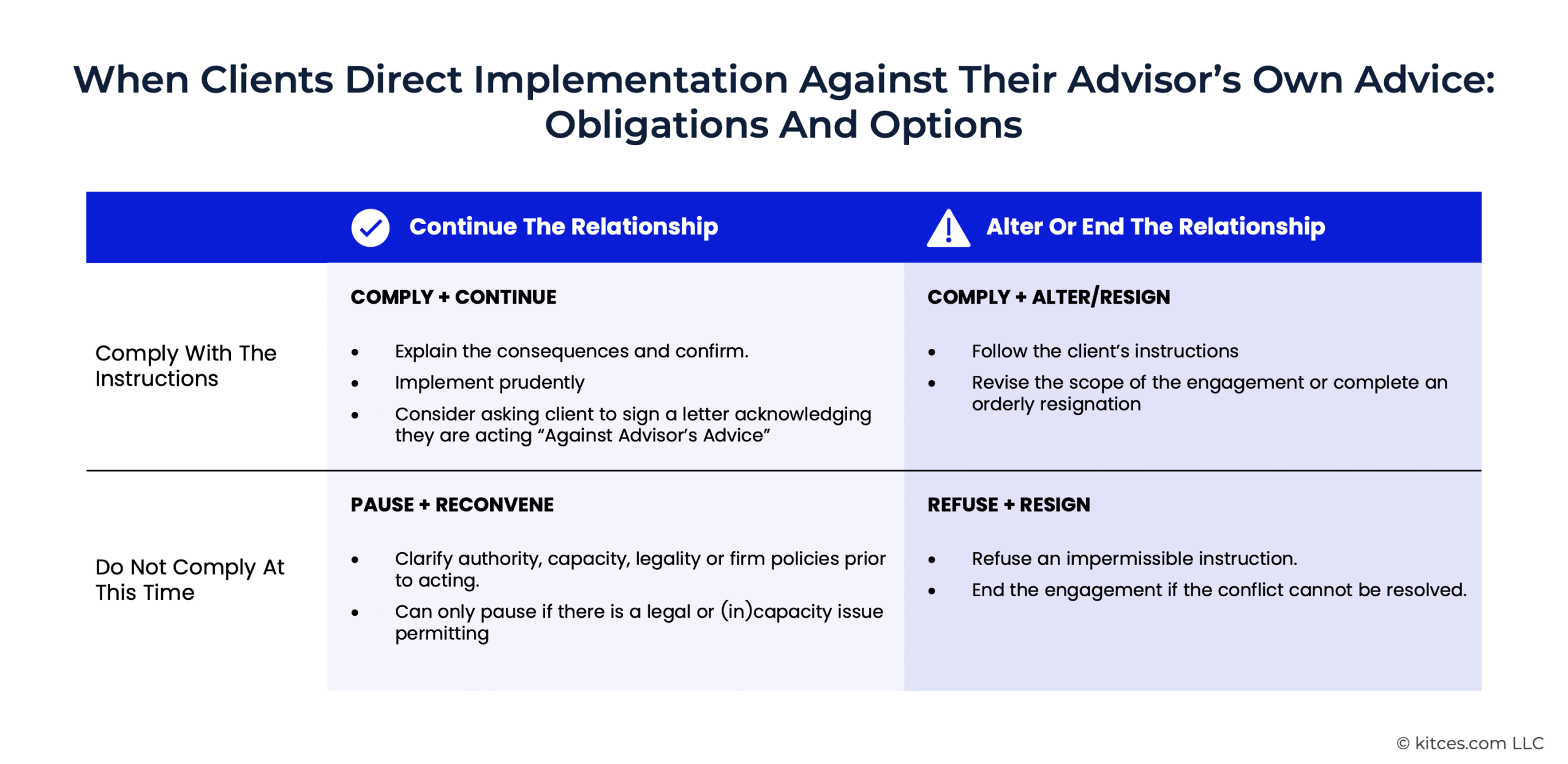
Thinking about how best to navigate the duty to follow instructions when an advisor disagrees with the direction provided by the client as two distinct questions on a spectrum, an advisor may be able to identify a wider and more nuanced approach to addressing concerns about the client's decisions, while also addressing concerns about the client relationship with the advisor and firm.
Option 1: Comply And Continue The Relationship
The option to comply with a client's instructions and continue the relationship as currently defined is appropriate when the client's instructions are clear, reasonable, and lawful, and aligned with the advisor's firm's policy. Despite the disagreement, the advisor also feels that the relationship remains workable, even if they and the client happen not to agree on the path forward in this particular instance.
In John's example, the advisor may recommend against liquidating his account, explain the consequences, explore alternatives, and yet still receive John's clear confirmation that he would like to move forward with a liquidation to cash. His advisor executes the instruction and documents his various interactions with the client on this matter. Afterward, the advisor and John might utilize this situation as a springboard to revisit their investment policy statement, John's stated risk tolerance, and how his other financial goals, such as his retirement date, might be impacted.
The experience may reveal more about John's personality and actual risk tolerance, perhaps highlighting that his risk tolerance is lower than he thought or that the advisor understood from his completed risk tolerance questionnaire. In a scenario such as this, the advisor's compliance with the duties to follow instructions and care is intact within the constraints provided by the client. Additionally, the advisor's diligence and conversations with the client may actually strengthen the relationship.
Unfortunately, a strengthened relationship with a client is not always the outcome after complying with a client's instructions against their advisor's advice. If the client later regrets their decision, they may file a regulatory complaint or take legal action against the advisor to seek compensation. This scenario is exemplified in the case of Maksumova v. Edelman Financial Engines, LLC, where a client is suing Edelman for allegedly failing to question or stop the liquidation of her retirement account for what turned out to be a crypto scam, even though the financial planner maintains that they did warn her and she chose to proceed anyway. In this scenario, contemporaneous documentation could significantly benefit the advisor in defending their actions throughout this client engagement. However, the risk of being sued and the resulting legal fees remain.
As an additional layer of protection against this risk, advisors may consider having the client sign a letter that directly states that the client is choosing to take a specific action against the advisor's advice, and details the action the advisor has alternatively recommended. Additionally, the letter could state that the client fully accepts and acknowledges the consequences of the action they are directing their advisor to take. If an advisor chooses this option, they should have their compliance and legal teams review the letter and their planned approach before seeking the client's signature. An advisor may also explain that if the client does not agree to sign the document, the advisor would have to resign from the relationship. Including this step in the process, while serving as a layer of protection for the advisor and their firm, also provides the client with one last chance to reconsider and fully think through the severity of the decision.
Option 2: Comply, Then Alter Or Resign From The Relationship
Contemporaneous documentation and signed against-advisor's-advice letters help address advisor liability if a client later regrets their instructions, but do not address whether the relationship itself is still functional. Even when an advisor is required to follow a reasonable and lawful client instruction, they may also decide that the relationship is no longer sustainable.
Suppose John directs the advisor to fully liquidate his portfolio to cash. The advisor confirms the instruction after explaining the consequences, and the trades are permitted under the advisory agreement and firm policy. The advisor complies and initially continues the relationship. However, over time, John increasingly directs the advisor to buy and sell specific securities based on short-term market movements. He also becomes agitated when the trades are not executed at the exact prices he expected. Although the advisory agreement grants the advisor discretion to trade in John's accounts, John's repeated directions have effectively transformed the relationship into one where he expects to control individual trading decisions and does not want to fully allow the advisor to actually manage the portfolio with discretion.
The advisor may therefore conclude that their relationship is no longer operating according to the scope of the initial agreement or the firm's investment management model. Complying with John's initial lawful instruction does not require the advisor to continue indefinitely in a relationship in which the client's expectations are fundamentally incompatible with the services the firm agreed to provide. The advisor can discuss the expectation mismatch with John and determine whether the engagement should be revised to reflect a non-discretionary arrangement if the firm offers that service, or whether it would be more appropriate for the advisor to resign from the relationship.
In this example, we can see that an initial conflict with a client does not necessarily mean the relationship itself requires alteration or termination. However, a client's pattern of behavior or repeated disagreements over instructions that an advisor is obligated to follow may be a sign of an overall incompatibility with the client or a misalignment between the client's needs and a firm's service offering.
If a client relationship is deemed to require alteration, the advisor could limit the scope of the engagement rather than fully terminate it. For example, an advisor might cease discretionary investment management while continuing to keep the client under a planning-only engagement. Assuming the client and advisor decide to move forward with altering the engagement, these changes should be clearly communicated and documented, including new signatures on an updated advisory agreement detailing the services the advisor will provide (and no longer provide) alongside the client's responsibilities, the effective date, and whether or how fees will change.
Option 3: Pause Before Complying And Reconvene After Clarification
Pausing before complying with a client instruction can provide an advisor with sufficient time to ensure that the client is actually providing a direct instruction that they expect the advisor to follow. It also provides the advisor with time to determine whether they can actually execute what the client is requesting, especially if it is not a clear or common request. A pause in these situations can mean asking the client to agree to a short window, from a few minutes within the same conversation ("Let's take a moment to refill our drinks and clear our minds and then come back to this decision."), to a few days in less time-sensitive situations ("Mr/Mrs Client, would you be comfortable to take a day or two to sleep on this before making a final choice about which action to take?"), to think about the decision before the advisor proceeds.
Slowing the process down can have many benefits for both the client and the advisor, though importantly the purpose of slowing things down should not be to simply circumvent the client's direction. Pausing can give the advisor time to spend with the client, both listening to their underlying concerns and educating them about other considerations they may not be considering. It can also give the advisor time to present potential alternatives that could help the client reach their underlying goals through a different action than what the client initially seemed to be requesting.
Pausing and taking some time before complying can ultimately ensure that an advisor has sufficient time to fulfill their duty of care by using their skill and due diligence before taking an action that may be irrevocable for the client or have far-reaching consequences. The advisor can ensure they are not acting on a client instruction without understanding what caused the client's distress. However, an advisor should be transparent about receiving the client's request and the next steps they would like to take before executing.
John's advisor receives a voicemail from him saying, "I'm really worried that my brokerage account is down by 20% today, and I want you to pull me out of this position before I lose everything." The advisor promptly returns John's call and asks him to share more about his concerns. The advisor listens to John's explanation and then provides feedback on how he thinks they should proceed. The advisor explains to John that he doesn't want to take any premature actions that could lead to tax consequences or affect John's retirement or other financial goals without fully understanding the implications of liquidating a large portion of his portfolio.
John agrees to wait until the advisor can do a little more research before making a determination on whether he will move forward with requesting that the account be liquidated.
When a client makes a statement that could be interpreted as either a direct instruction or simply an expression of emotional distress, it would be imprudent of an advisor to guess at the client's intent and immediately execute a transaction. Instead, the advisor should promptly contact the client to clarify, then proceed to address the client's concern, whether that be through simply having a conversation, agreeing to evaluate the consequences of a client's request or potential alternatives, or providing the client with an idea of the timing by which an advisor would be able to execute a client's request.
Option 4: Refuse To Comply And Resign From The Relationship
If an advisor determines that a client has requested an unreasonable or unlawful action, complying with and documenting the client's direction is not a permissible or appropriate manner of addressing the request. In these circumstances, the advisor should pause the transaction, preserve relevant information, and then escalate the matter either to their firm's leadership or legal counsel, depending on the specific nature of the situation with the client.
A simple misunderstanding where a client may not realize that their request is against firm policy, or even something that is unwittingly unlawful may occur (e.g., asking an advisor to report an IRA contribution as made before the contribution deadline, when it was not), and not be a sign that the relationship requires termination. However, resignation from the client relationship may be appropriate when a client insists that the advisor participate in unlawful conduct, repeatedly requests actions the firm cannot perform, refuses to provide information necessary for an advisor to act competently, or creates a fundamental breakdown in the overall client engagement.
In these cases, the reason for refusing a client instruction should be communicated to the client, to the extent the advisor is allowed to do so, as this could serve as an educational opportunity for the client and close the loop on why the advisor is not complying with a client's request.
When considering whether a client's actions warranted the consideration of resignation, an advisor may ask themselves the following questions:
- Is this a one-time decision during an extraordinary event or a pattern of behavior?
- Does the client understand the advice provided and think differently, or does the client repeatedly misunderstand the service being provided?
- Can the advisor continue to provide competent advice within the client's restrictions?
- Does a client's desired strategy fall outside of the firm's expertise, platform, or investment philosophy?
- Has trust deteriorated to the point the client no longer provides complete information, or the advisor can no longer communicate objectively?
- Would a narrower engagement be a better fit for the client and their needs?
- Do the client's instructions pose exceptional risk to the firm?
- Is the impulse to terminate based on genuine service limitations, or the advisor's discomfort with a client exercising their autonomy?
When a relationship between an advisor and client is no longer functioning, communication becomes even more important. An advisor should review the advisory agreement, firm procedures, custodial requirements, and applicable law before limiting or terminating services. Material scope changes should be accompanied by a full and fair disclosure and informed consent, typically in the form of a new advisory agreement with the new scope of services (and associated fees). The CFP Board standards likewise require a CFP professional to describe requested professional services that the professional will not provide (especially when there is a change in scope), and its financial planning practice standards recognize the need to limit the scope to terminate the engagement and the circumstances in which the advisor cannot obtain the information needed to fulfill the engagement. If an advisor decides to terminate or resign from a client relationship, the process should avoid unnecessarily harming the client during the transition.
Ultimately, the duty to follow client instructions is not an exception to acting in the client's best interests. Advisors serve clients not only by producing technically sound recommendations, but also by helping clients understand their options and exercise agency over their own financial lives. When a conflict arises, separating the obligation to comply from the decision to continue the relationship gives advisors a clearer path to navigating their ethical obligations: educate without coercing, follow valid instructions without abandoning professional judgment, and alter or end relationships carefully when the engagement can no longer be served well.





Leave a Reply