Executive Summary
When an advisor first starts out, staying on top of proactive client contact is relatively easy. But as the firm grows and takes on more clients and complexity, it inevitably hits a tipping point where client needs outstrip advisor capacity – whether that shows up as a client who has quietly 'slipped through the cracks,' a client questioning the value they receive for their fee, or an advisor who suddenly realizes just how much time it takes to prepare for a single meeting. Which raises the deceptively strategic question of how an advisory firm can maintain quality and value for clients while still running efficiently as it scales.
In this guest post, Mike Lecours explores how advisors have adapted a concept long used by client-facing businesses outside of financial planning – the Customer Journey Map – into what's become known within the profession as a Client Service Calendar (CSC): a proactive, often client-facing, outline of the touchpoints that a client can expect to experience with their advisor over the course of a year. Notably, the 2024 Kitces Research on Advisor Productivity found that CSC adoption climbs as a firm's service offering broadens, with the plurality of advisors who use one settling on just four touchpoints annually – suggesting that a CSC doesn't need to be elaborate to be effective.
The more important insight, though, is that not every CSC is solving for the same problem. Advisors whose first attempt at a CSC fails often do so because they never clarified which of two distinct goals they were actually building towards: an Efficiency-focused CSC, designed to streamline the advisor's workload by consolidating outreach into fewer, more systematized touchpoints (e.g., one generic email to all clients rather than a wave of individualized ones), or a Value-enhancement CSC, better suited to firms with capacity to spare, aimed at deepening the client relationship by pulling the advisor's 'behind the scenes' work – such as an investment committee meeting or an annual RMD review – out of the shadows and in front of the client. Building the ‘wrong type' of CSC that doesn't align with the firm's actual pain point is why many CSCs end up falling into disuse within a year.
Ultimately, the key point is that a Client Service Calendar isn't a one-size-fits-all solution, but rather a framework that can be pointed at whichever constraint is actually binding for the firm: capacity or perceived value. Once an advisor is clear about which problem they're solving for, a CSC can either free up real bandwidth for a firm that's outgrown its own service model, or turn previously invisible work into the very client experience that reinforces why the advisor was worth hiring in the first place!

The Tipping Point That Leads To The Need For More Structure
When an advisor first starts out, it's often relatively easy to be proactive in contacting clients and engaging in ongoing client service work. But as an advisory firm grows and adds more clients and complexity, it inevitably hits a tipping point where client needs outstrip advisor capacity. It is at that point that many advisors start to consider whether they should apply more structure to their business.
There are many inflection points that may prompt such reflection. Perhaps the advisor realizes that they haven't talked to a client in a long time, and that the client has ‘slipped between the cracks'. Or maybe a client is questioning whether they receive enough value for the fees they pay, or the advisor has realized how much time it takes to prepare for a meeting. No matter the reason, the point is the advisor recognizes that the status quo is untenable and a change is necessary.
There are many potential solutions to these capacity constraints. An advisor could hire an assistant to help with the administrative and operations tasks like completing paperwork, or another advisor to help service clients directly. Or, the solution could involve the use of technology to automate a process currently done manually (such as implementing workflows within CRM, or using Calendly to help with scheduling meetings).
Adding staff and technology can only take the advisory firm so far in dealing with the growing complexity of the business before one is faced with the larger strategic question: "As we grow, how do we balance firm efficiency with providing quality and value to the client?"
If the advisor built a successful business by providing high-touch service (like quarterly meetings with clients), it's challenging to transition towards a more efficient service model without sacrificing the quality of advice provided.
Structuring An Advisory Business Around A Customer Journey Map By Creating A Client Service Calendar
This dilemma of balancing efficiency with value is not unique to financial advisors, but rather is an issue that many businesses – from restaurants to manufacturing – are forced to confront. "Setting the Table" by Danny Meyer and "Brick by Brick," by David Robertson, are two examples of how Shake Shack and Lego have successfully navigated these challenges, respectively. While many business leaders find it useful to sketch out a prospective customer's full life cycle of engagement with their brand (i.e. using Kelsey Miller's Customer Journey Map), advisors have developed their own version of a Customer Journey Map, called a Client Service Calendar (‘CSC'). The purpose is the same despite the different names: proactively and consciously define how advisors will engage with their clients and to ensure that value is delivered on an ongoing basis.
A CSC becomes a useful framework to help advisors give structure to their growing business. For advisors worried that a client will slip through the cracks, the CSC can provide a plan to reach out to all clients proactively, ensuring a unified experience among a growing client base (and potentially among multiple advisors). For advisors that are fielding calls from clients questioning the value they receive, a CSC becomes a resource to demonstrate to clients all that is being done on their behalf (including work that happens ‘behind the scenes'). By intentionally designing the client experience, the advisor can incorporate aspects that reinforce a successful advisor/client relationship.
Originally proposed by Angie Herbers and outlined in ThinkAdvisor's 2014 blog post "Client Calendars Show Clients How Much You Do for Them", a client service calendar highlights the touchpoints that a client should expect to experience throughout a year of working with their advisor. Unlike a Customer Journey Map, which is designed to be an internal document to help visualize the client experience, a Client Service Calendar is predominantly client-facing. Michael Kitces provided the following example in the 2015 blog post, "Crafting An Annual Client Service Calendar To Illustrate A Financial Planner's Value To Prospective Clients."
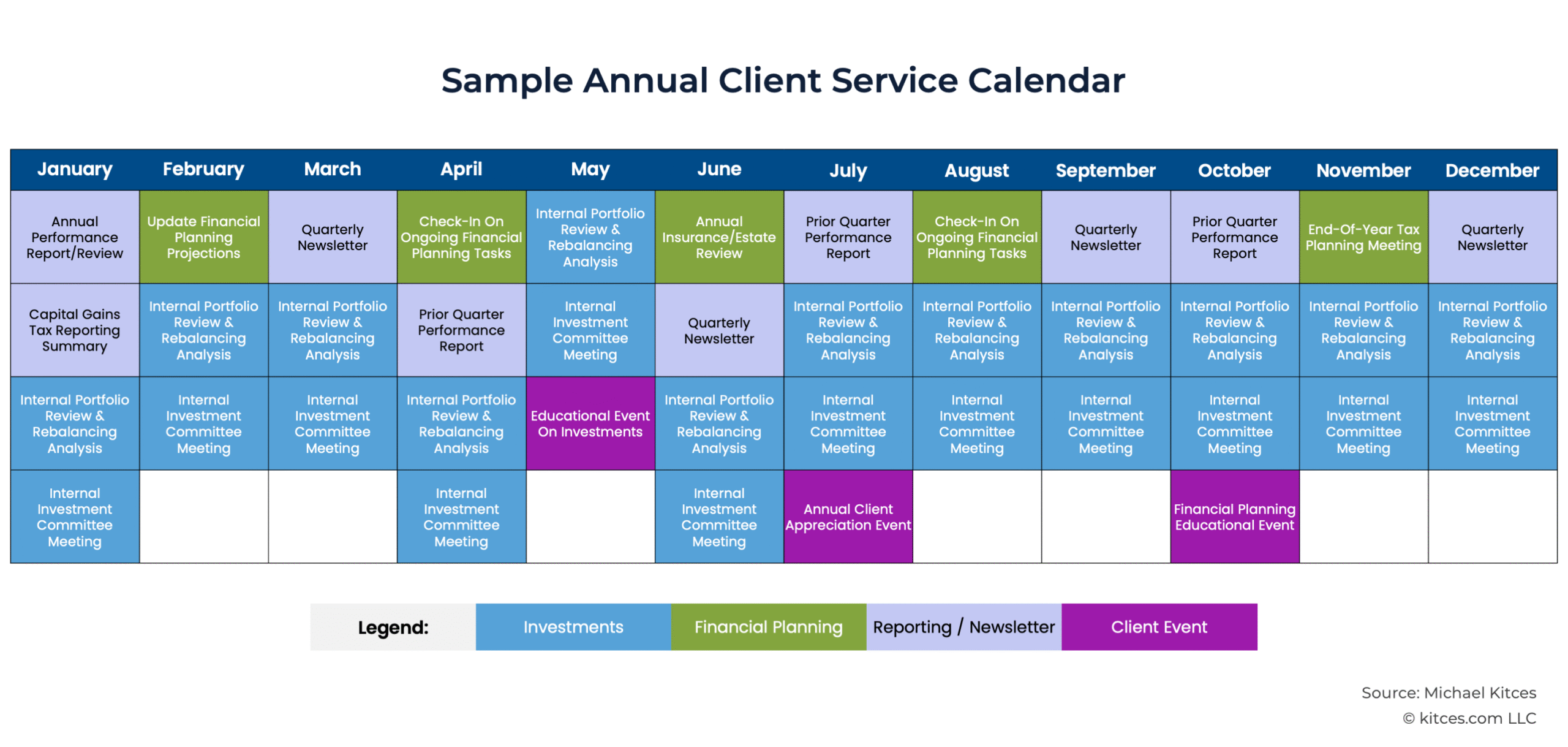
In this Client Service Calendar, there are several different touchpoints. Some are personalized deliverables sent to a client individually (like a performance report in January); other deliverables are sent to many clients at once (like a market newsletter or an educational event hosted by the firm). Still others are part of the firm's internal meetings and processes (e.g., investment committee meetings and rebalancing reviews) that can otherwise become "shadow work" that clients might not see or realize are occurring on their behalf. This is all in addition to an ongoing cadence of actual financial planning meetings that clients see and experience firsthand.
This client-facing service calendar accomplishes two goals:
- It helps set and manage client (or prospect) expectations regarding what it will be like to work with the advisor, in a way that is actually visual and even tactile (to the extent that the advisor prints the Client Service Calendar and brings it with them to a meeting with a client or prospect).
- The firm is prompted to build processes and systems to support the execution of the touchpoints outlined within the calendar, now that the advisor can visualize – and plan for – the fact that certain months will be busier than others (thereby avoiding what might otherwise stretch capacity and lead to a drop in quality).
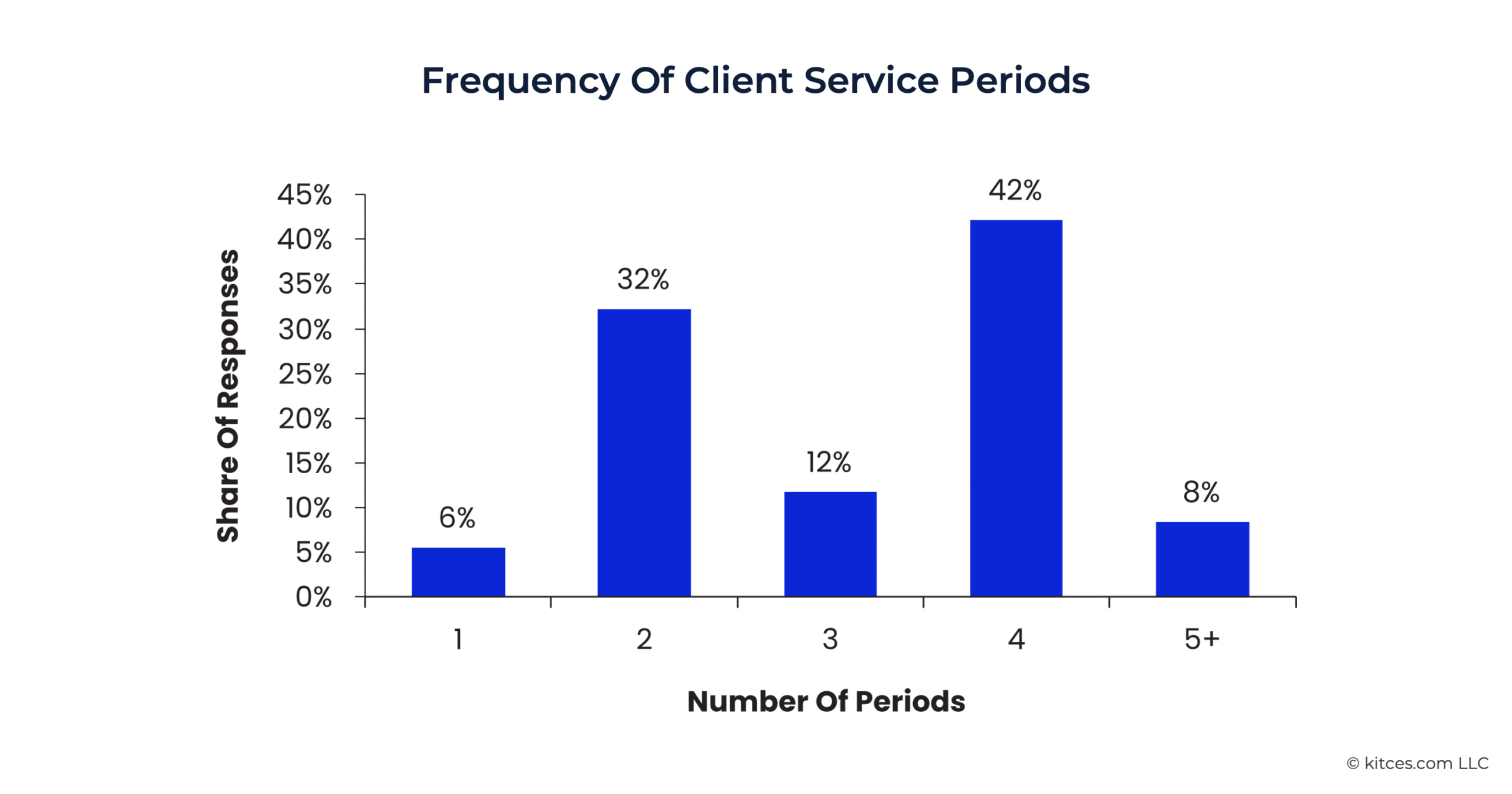
Some client service calendars are much simpler, and include as few as four touchpoints (and in fact, Kitces Research on Advisor Productivity has separately found that the plurality of advisors who offer Client Service Calendars use four service periods per year). In this video, I highlight an advisor whose CSC included the following four outgoing email communications:
- 1st Quarter: One email sent to all clients highlighting that the first quarter was a tax planning quarter and inviting the clients to schedule a meeting if they had a tax-related question or issue.
- 2nd Quarter: In this quarter, the advisor emailed clients saying that he was focused on cash flow and investments and encouraged them to reach out if either of those topics were on their minds.
- 3rd Quarter: In alternating years, the advisor would contact clients asking if they wanted to talk about insurance or estate planning, respectively.
- 4th Quarter: The advisor would let clients know that he was focused on end-of-year topics and asked them to reach out if they needed to discuss anything time-sensitive.
At first glance, it seems like this advisor is talking to his clients on a quarterly basis, but in reality he speaks with his clients only once or twice per year. When he does so, he stays in a tax or insurance mindset for all of the client meetings occurring in that quarter, rather than jumping around throughout the day to try and address a bunch of unrelated planning issues (as he did before implementing a CSC). The CSC also encourages clients to naturally group conversations by topic as the advisor proactively reaches out. Yet the rotating structure of the CSC helps to nudge the client into thinking about their financial situation from different angles throughout the year so the full gamut of financial planning topics are still covered.
Naturally, clients are not precluded from contacting this advisor with questions that come outside of the quarterly touchpoints. Clients may still end up with insurance-related questions in a quarter typically reserved for tax planning. And life events, like retirement or the birth of a child, will result in discussions on a variety of planning topics.
Morningstar's 2024 research on the relationship between client satisfaction and meeting cadence affirms the benefits of adopting a regular meeting schedule. Their survey found that clients preferred high-quality interaction over a large quantity of interactions, and goes as far as suggesting that a CSC could help to guide high-quality client engagement.
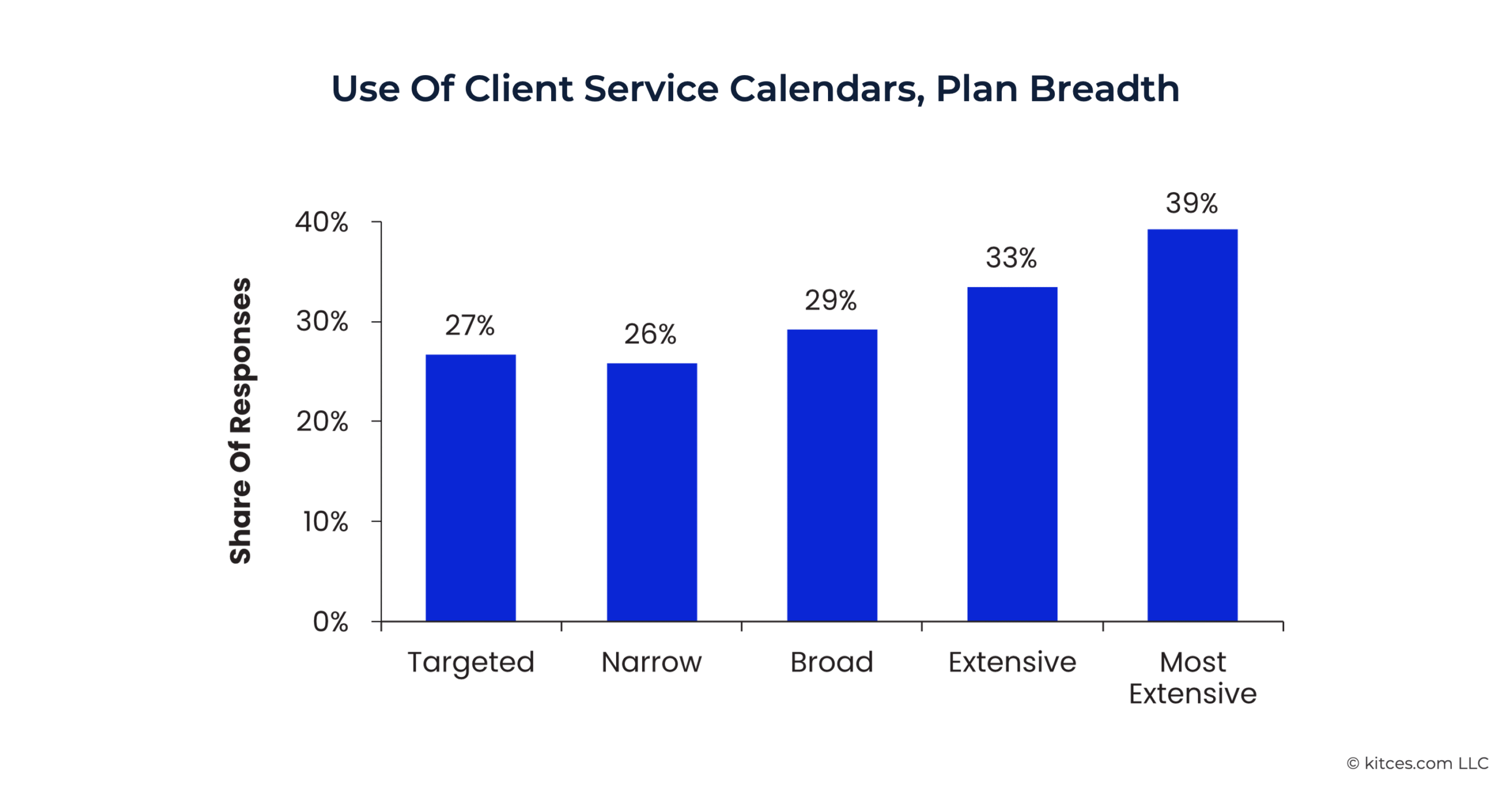
The 2024 Kitces Research on Advisor Productivity found that Client Service Calendars gain popularity as the breadth of a firm's service offering increases. For example, advisors with a targeted or narrow offering, such as a focus on just investments, reported having a Service Calendar 26%–27% of the time. As the service offering broadens and advisors are more likely to also offer components such as tax and estate planning, CSC adoption grows.
Among advisors using a CSC, there is a clear trend towards either two or four touchpoints, as demonstrated in the chart below:
Avoiding Common Pitfalls: Implementing Effective Efficiency-Focused And Value-Enhancement Client Service Calendars
In my own experience as an advisor, and in talking with other advisors, the journey to a great CSC usually starts with a lot of trial and error. Despite appearing simple to execute, many Client Service Calendars fail at first – for reasons ranging from "too many touchpoints", to "too hard to execute", to "not enough initial interest from clients". Meg Barlet's blog post "Abandoning Surge Meetings To Better Meet Client Needs And Promote Advisor Well-Being" describes her experience implementing and refining a CSC that captures these themes very well:
"Our attempt – and persistent failure – to actually deliver that amount of analysis throughout the year was overwhelming and depressing. Why didn't it work? A couple of reasons: it felt disconnected from the individual client's needs and therefore wasn't particularly motivating, and those projects require big chunks of time that we couldn't easily fit it into our already busy calendars."
I have found that too often, advisors rush to create a CSC without fully considering its true objective. Time and time again, I hear from advisors about how their first CSC failed and what they did to get it to work for them and their clients. Through these conversations, I've found advisors are looking for a CSC to help with one of two objectives: a CSC to help create efficiencies within the firm, or a CSC to enhance the value provided by the firm to the clients.
Two Kinds Of Client Service Calendars
Broadly speaking, Efficiency-focused CSCs should seek to streamline the business and create efficiencies, while Value-enhancement CSCs should demonstrate the advisor's value and improve client experience.
Instead, what often ends up happening is that an advisory firm has an efficiency problem – but builds a CSC focused on delivering more value to clients. The advisor runs into problems, then, because they haven't fully considered the time commitment necessary to execute each of the touchpoints, nor what activities they can now stop doing once the CSC is being executed. For example, if the advisor is sending out more deliverable reports in bulk to all clients as part of a CSC, perhaps they can reduce the frequency of other proactive touchpoints in some other area.
Efficiency-Focused Client Service Calendars
An advisor who has built up a successful practice by offering personalized and unique services (such as customized investments and reporting, and a variety of client meeting cadences) often becomes a victim of their own success. They have grown to a point where they lack the capacity to engage in proactive client outreach (except for their top clients), and frequently drop the ball on following up on tasks. Because there are so many clients with disparate needs, the advisor can find no routine and instead is in a constant state of putting out fires.
An Efficiency-focused CSC could help this advisor in the following ways:
- The team can prepare for one planning topic across many clients;
- Advisors can reuse talking points, emails, checklists, and meeting prompts;
- Client communication becomes more consistent; and
- The firm can create a repeatable service model without making the experience feel generic.
Below are the recommended steps that an advisor can use to implement such a calendar.
Determine How Much Capacity Is Currently Available.
It's imperative to have a handle on how much capacity the advisory team has available to work on a Client Service Calendar. Understanding the natural cycle of the business is important too; for example, March and April can be busy months for a firm dealing with tax-related matters. This capacity assessment can serve two purposes:
- Thoughtful timing of touchpoints: The firm can make a conscious effort not to provide a touchpoint at peak times so the advisory team can stay focused on the existing workload.
- Inspire a creative touchpoint: Perhaps a new touchpoint could be introduced that would alleviate pressure elsewhere, such as proactively sending out an email alerting clients to key dates for when 1099s will be mailed out (which should reduce client inquiries about these forms).
Review And Estimate The Time Needed To Create And Execute Each Touchpoint
This is where most advisors struggle, because they don't accurately assess the time needed to execute a touchpoint. Perhaps the team has sufficient capacity to send out a personalized tax report once per year. Or maybe that's too much – and instead they can only send out a general email to clients outlining that taxes will be a quarterly focus (at least until they build a better and more efficient process to produce the personalized tax report at scale). Actually doing the math regarding what each touchpoint would require from the team becomes an eye-opening exercise. While it may take "just" a few minutes to prepare a deliverable report, review it for accuracy, and send it to the client, that time multiplied across all clients and by the number of touchpoints each year can really add up. In this case, if we assume 15 minutes per report, 100 clients, and two touchpoints annually, that would represent 50 hours per year of work.
Include A Call To Action
Imagine a touchpoint consisting of a generic email with a personalized tax report attached that is unique to each client. How does the body of the email end – what is the advisor asking the client to do next? If the email ends by saying "Please schedule a time to discuss this report", the value the advisor is trying to provide would show up in the meeting and the report is merely a supplement. Although the report may trigger a valuable client conversation, doing so would take more advisor time (not less), so the touchpoint does not create efficiency in this case.
Instead, within an Efficiency-focused CSC, the email could end with "Click here to read the report" or "After reviewing the report, reach out if you have questions" because the report can stand alone (the deliverable is the value – rather than a subsequent meeting) and does not require more time from the advisor.
Manage Initial Expectations And Iterate On Future Touchpoints
After implementing a CSC, advisors will naturally note opportunities to improve their processes as well as the client experience. Maybe some touchpoints require more time than expected, or there is some way to automate a workflow that wasn't clear in the beginning. There is a natural concern that touchpoints delivered to clients en masse will lead to a rush of client meeting requests. It's a fair concern that many advisors express when launching a CSC for the first time.
Through conversations with advisors who have already implemented a CSC, however, that fear quickly dissipates. In fact, to the extent that a new CSC is not announced, it may take a few touchpoints before most clients even realize that an advisor has started doing it; advisors are just as likely to report that they felt their clients didn't initially appreciate the touchpoint and didn't place any value on it. This should be expected, but over time, appreciation will build as the client sees touchpoints consistently executed (even if just once or twice per year).
The important point to remember is that it will likely take several touchpoints before clients catch on to the new approach. Marketing and communication professionals sometimes refer to the "rule of seven", meaning that a customer (or client in this case) may need to encounter a message (CSC touchpoint) seven times before they take action.
Create One Client Service Calendar And Stick To It.
The repeatability of a CSC is key to its success. It can be tempting to create new touchpoints, but that defeats the purpose in this case – as doing so eliminates the efficiency that the CSC seeks to create. Give clients time to adjust and become familiar with the new touchpoints.
Value-Enhancement Client Service Calendars
Imagine the same scenario above (where an advisor's practice has outgrown their capacity), but instead of creating a client service calendar to solve the problem, the advisor hires another advisor to support them. Together they largely address the big issues related to gaps in service – there are no more fires to put out! But they soon realize that they have additional capacity now that there are two advisors, so they look to a Client Service Calendar to help structure improvements to the client experience – with an ultimate goal of driving more referrals.
They could create the same client service calendar mentioned above, but focus the touchpoints on bolstering the value provided to clients. In this case, it would help in the following ways:
- Allow for more proactivity in planning discussions;
- Narrow the focus of meetings to better address client concerns;
- Better differentiate from competitors; and
- Educate clients about what happens between review meetings (bringing ‘shadow work' into the light).
Below are some ideas that the advisor can use to implement such a calendar.
Client Education/Organization
At the start of this article, a four-touchpoint service calendar was described that highlighted what the advisor would be focused on for that quarter. It was a simple, generic email that was sent to all clients at once that stated what the advisor would be looking at in that quarter.
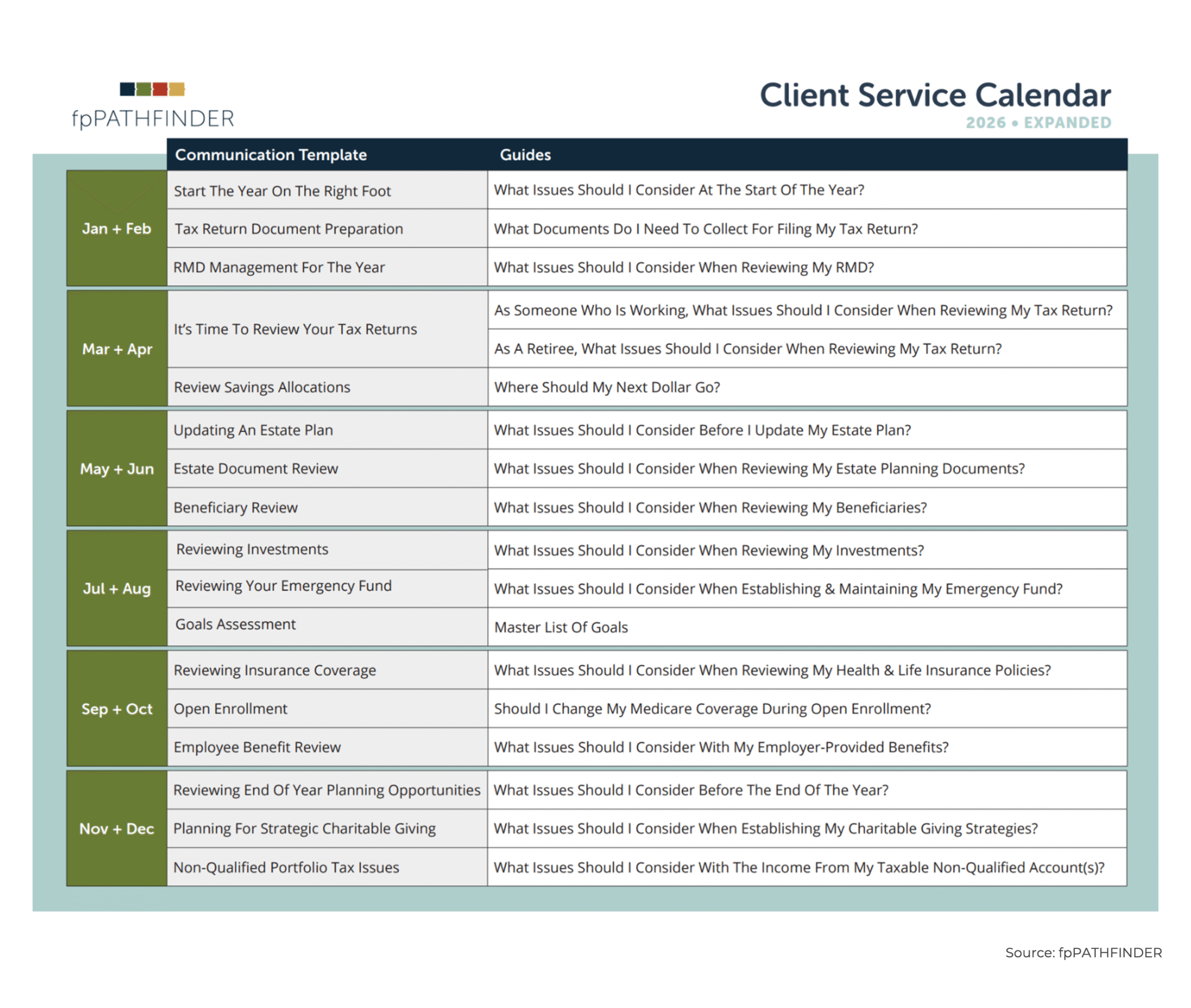
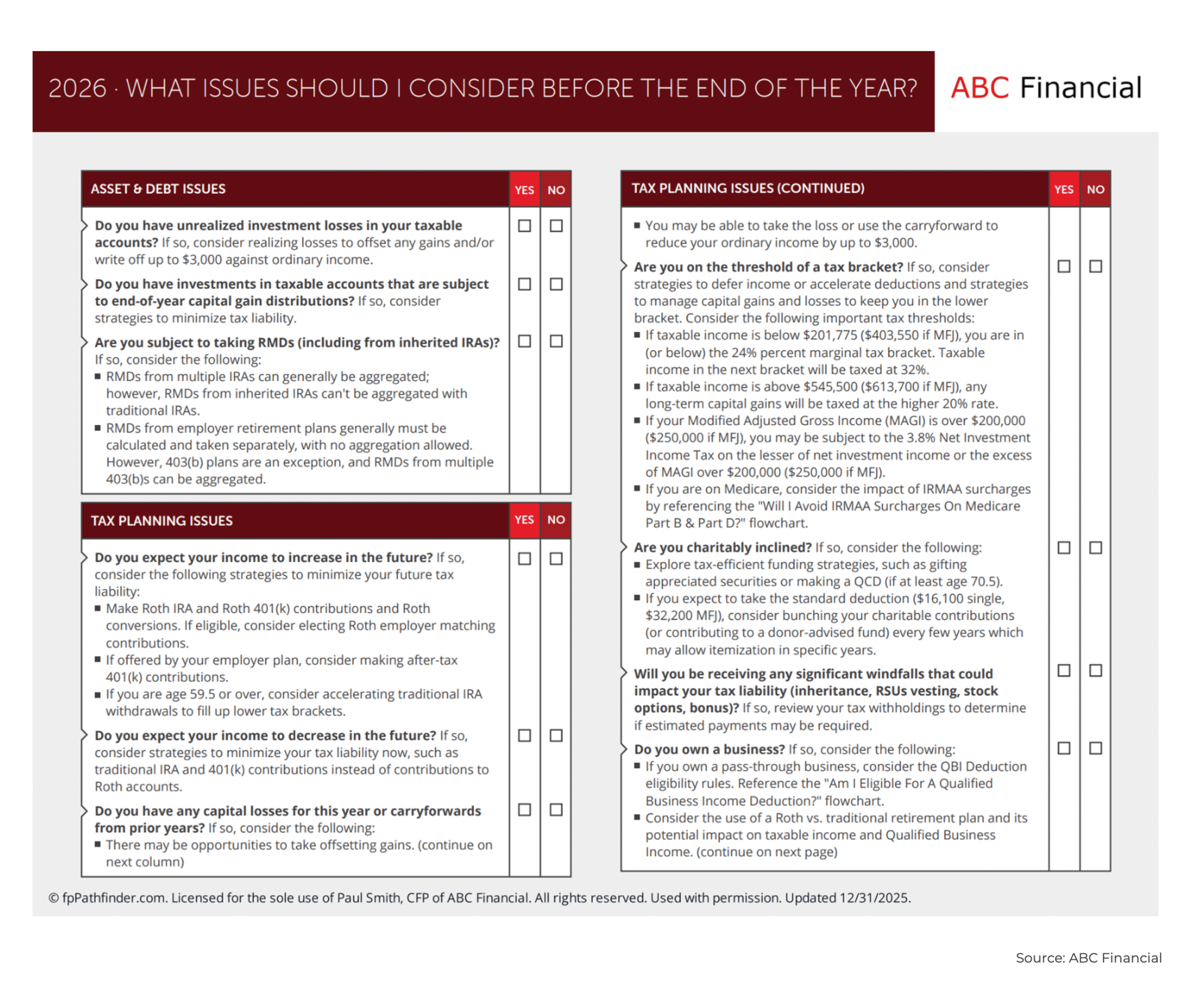
To add some value to the touchpoint, many advisors include a relevant piece of educational content, checklist, or similar easy-to-produce deliverable. For example, an advisor could reference a tax-related checklist (like the white-labeled one shown below from fpPathfinder) as an attachment to the email. In this case, the advisor is providing some probing questions to get the client to think about tax-related matters in preparation for filing their tax return.
Taking Shadow Work Out Of The Shadows
Financial advisors do a lot of work for their clients – only some of which is clearly visible to the client. With a bit of effort, advisors can bring this ‘behind the scenes' work to the client's attention.
For example, in Michael Kitces' CSC example shown earlier, there was a reference to an investment committee meeting – traditionally shadow work since the client does not know that it takes place or the impact it has on their portfolio. Instead of just holding the meeting, the advisor could email clients, saying something to the effect of:
"We just held our investment review meeting, and we have largely decided to maintain our current positions. In a few select cases, we will be doing a minor rebalance because cash levels are higher than we'd like to see. In the coming days, you may see a few trade confirms coming through."
All of a sudden, this shadow work turns into a wonderful touchpoint for a client and can mitigate clients reaching out to ask questions about why they received a trade confirmation or asking for the advisor's thoughts on their accounts. And even if there is nothing on the client's mind when they receive this email, it may just give them more confidence that they are being taken care of!
Other examples could include emails to groups of clients highlighting any unique findings from the advisor's annual RMD analysis. Some clients could receive an email saying something to the effect of "We conducted an RMD analysis on your accounts to make sure that it will be met by the end of the year and reviewed the withholding amounts. Everything looks good on our end, but reach out if you have any questions," while others might receive an email alerting the client to a possible issue as well as recommended steps to address it. Both clients come away with greater peace of mind that their accounts have been attended to.
There is a lot of low-hanging fruit for advisors to use when creating their own CSC, because the shadow work is already being done. The key step is to send a generic email announcing what is being done for everyone and that the advisor will be reaching out specifically to the impacted clients when action is required.
Personalized Client Deliverables
Advisors with capacity looking to demonstrate more value could also lean on their existing tech stack to create and send out reports personalized to the client. Building on the examples above, an advisor could provide an RMD report (like the one below, which comes from fpPathfinder) to each client at the start of the year, in addition to a timeline regarding when they will be reviewing RMDs.
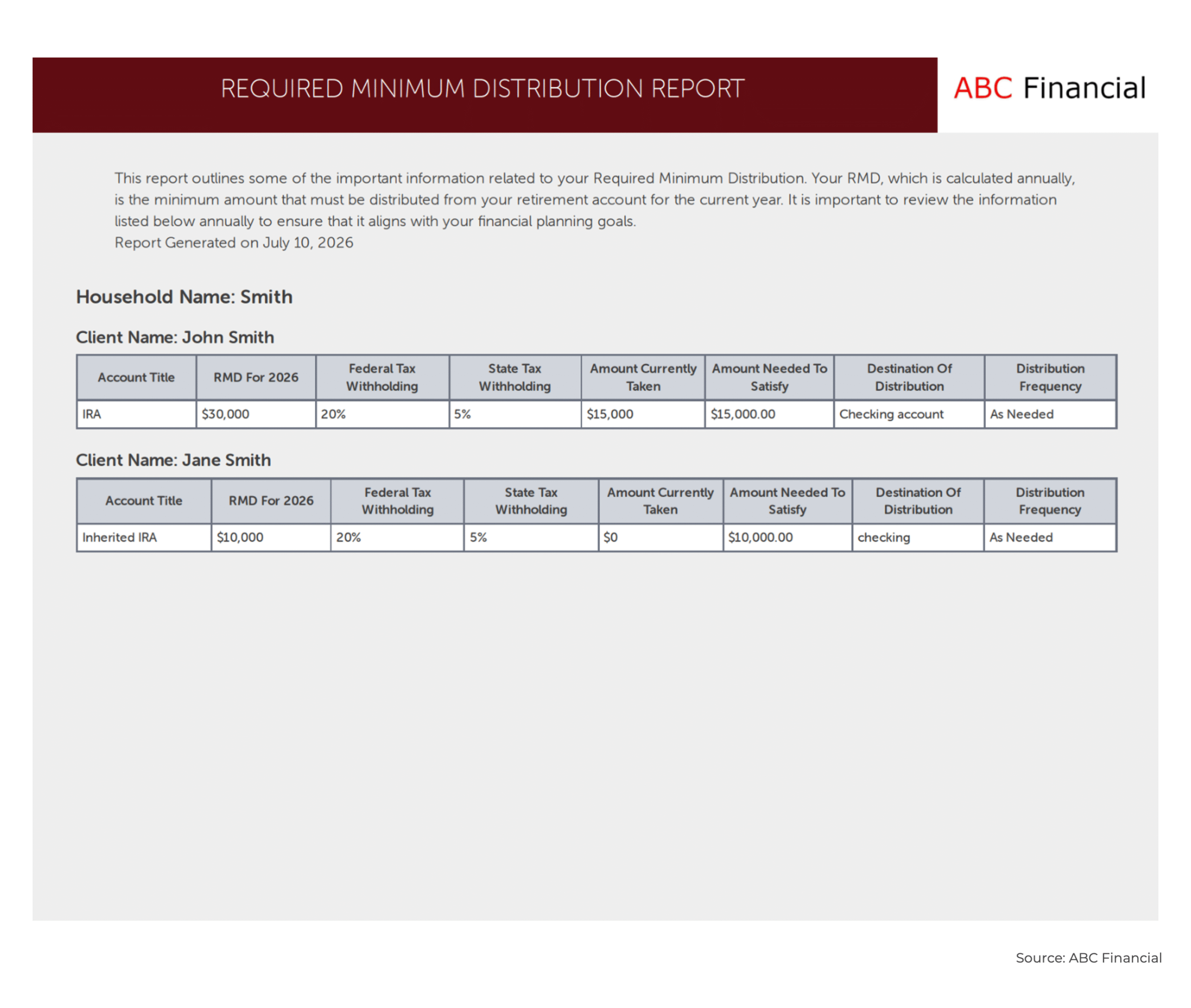
Now the client has received something of value: a report that shows the amount of the RMD, as well as confirmation regarding tax withholding and the destination of the distribution. The report itself answers most of the questions that clients have about RMDs.
Advisors could also send out deliverable reports generated by their various financial planning tools, such as Holistiplan's tax report shown below:
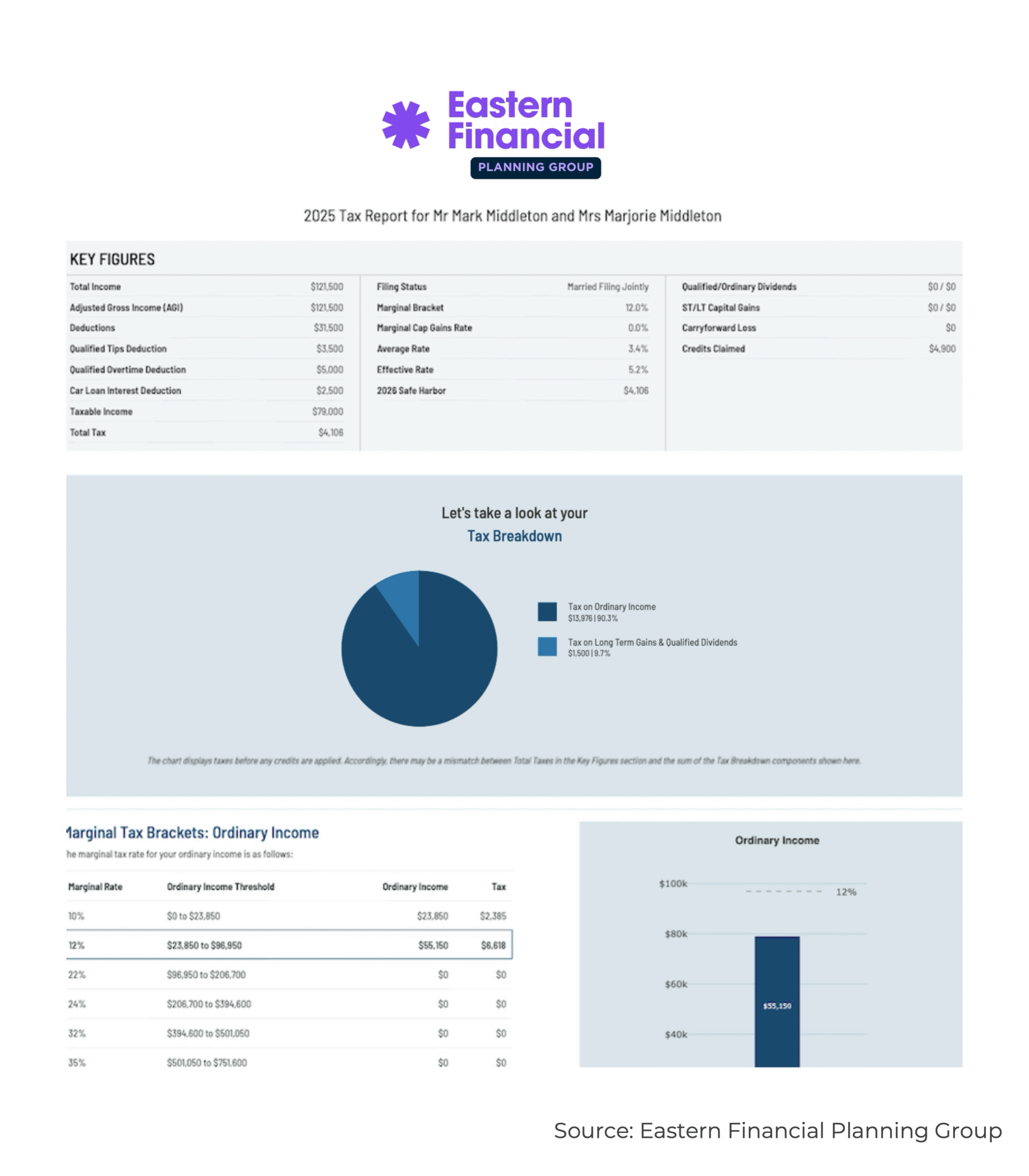
The example advisor mentioned above who is focused on tax planning in Q1 could send a ‘generic' email directing the client to their portal to access a personalized tax report from Holistiplan. The touchpoint, then, not only highlights what the advisor is focused on that quarter, it also provides something of value to the client that ties to the quarterly focus. Perhaps the message to clients would read:
"In this first quarter of this year, I will be focused on tax planning. If you have submitted a tax return to us, a report has been generated and reviewed by us that is located in your client portal. If you have a question related taxes or the report, please reach out to discuss."
Name It And Package It
With the touchpoints identified, the next step is to package the Client Service Calendar to help clients and prospects to easily visualize the financial planning. As a first step, an advisor could use the chart below to combine a few different terms to come up with a unique and compelling name:
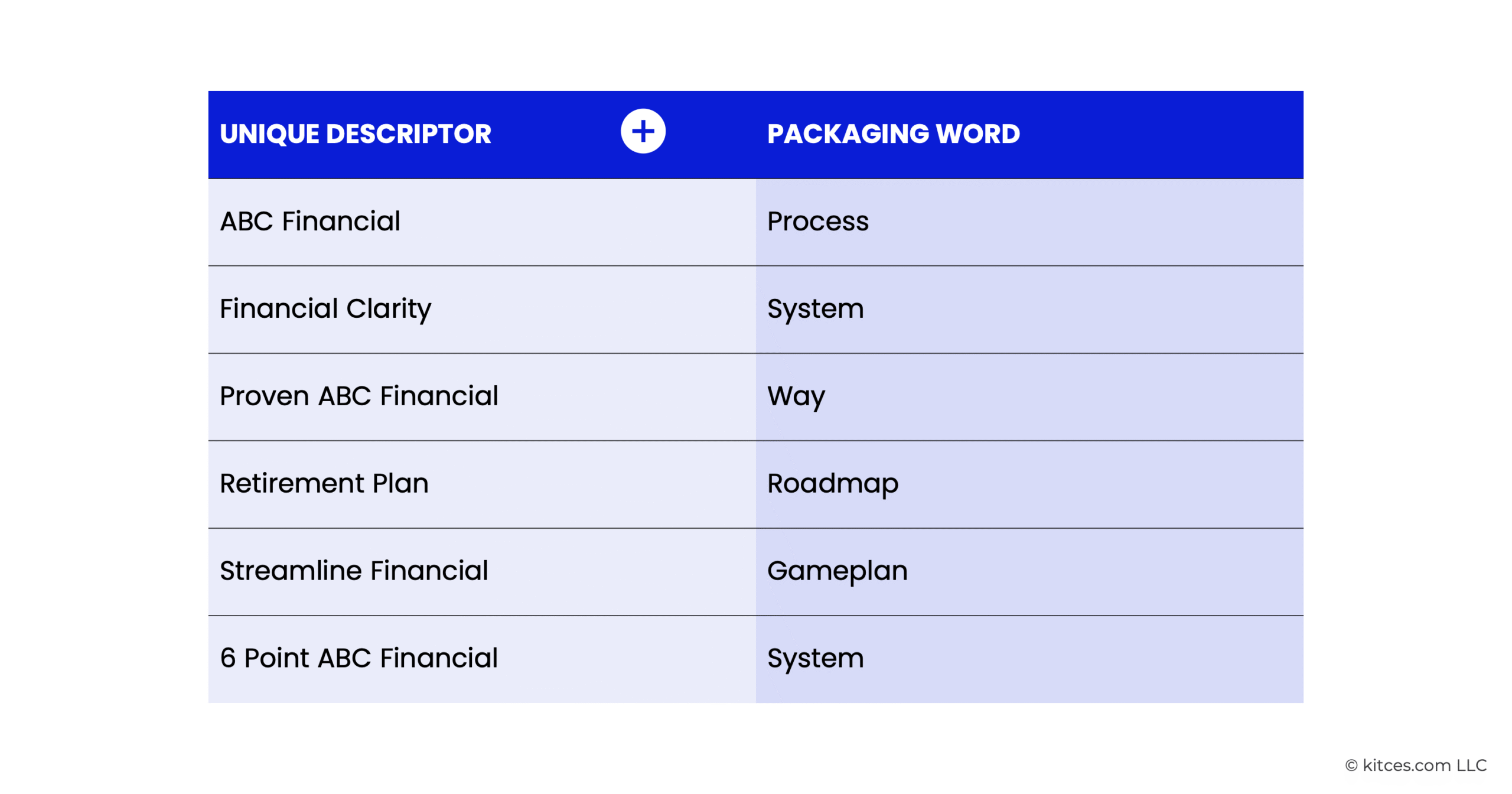
The second step would be creating some kind of marketing collateral that describes the touchpoints in a client-friendly way (see this blog post by Kitces Nerd Adam Van Deusen for examples).
Introduce New Touchpoints In Subsequent Years
Unlike an Efficiency-focused CSC where the touchpoints should be reused each year, the purpose of a Value-enhancement CSC is to demonstrate more value to the client. To that end, and assuming that there is sufficient capacity, an advisor could introduce different touchpoints each year. For example, Strategic Coach (a coaching service for entrepreneurs that attracts advisor founders) creates an entirely new touchpoint every quarter for their clients. It takes a large team to ideate, create, test, and print each touchpoint every quarter, but it works for them.
Be Mindful Of The Time Needed To Execute Upon The Client Service Calendar.
Even excess advisory capacity can quickly be absorbed. Consider the example earlier about a touchpoint that takes 25 hours to complete. Now, imagine that instead of it happening twice a year (a total of 50 hours), there are six touchpoints that require 150 hours each year. At the same time, this is still barely 10% of a full-time staff member's capacity, and if a proactive service calendar delivered to 100 top clients helps ensure their retention, it may be a very strong ROI for the firm to invest into team support to implement such a value-oriented CSC!
Putting It All Together
Client Service Calendars create a structured approach to helping clients and establishing the baseline for a process for the firm to follow. Depending on the needs of the firm, a CSC can help create efficiencies in the firm to free up bandwidth and ensure a unified client experience, or it can enhance the value provided by the firm to clients. If advisors and their firms lack capacity, then any CSC they create should focus on the former – while an advisory firm with excess capacity that is desirous of a better client experience should consider a CSC built around value enhancement. Advisors should begin by assessing their greatest need in order to adopt a CSC approach that is best suited for their situation. Then, they can create touchpoints that are easy to implement (such as by sending generic emails highlighting an action that the advisory firm is already doing on the client's behalf) or require more time and thought but ultimately add value for the client (such as providing a personalized report).
Whatever problem you're ‘solving for' with a CSC, make sure that you both systematize it internally and communicate it appropriately externally. When executed well, CSCs can unlock advisor capacity and result in an improved client experience!
For additional resources, fpPathfinder maintains a list of timely guides and email templates to provide inspiration for advisor touchpoints (example below).