
Executive Summary
While a financial advisor might prefer to manage all of a client's investible assets, when clients participate in a workplace retirement plan such as a 401(k), the assets in the plan typically can't be moved to a new managed account while the client remains employed there. A key moment for an advisor, then, occurs when a client separates from service by retiring or leaving their former employer and becomes eligible to roll their workplace retirement plan into an IRA.
While there are many potential reasons to roll over the plan assets, there may also be good reasons to keep assets within the employer plan, which suggests that clients could benefit from a personalized analysis when deciding whether or not to roll over their employer plan assets. And while a financial advisor is well-positioned to perform such an analysis, the ability to generate additional fees if the client decides to roll over the assets into an advisor-managed IRA creates a significant conflict of interest.
Amidst a fractured landscape of fiduciary requirements when it comes to rollover planning (e.g., different standards for RIAs and broker-dealers), the CFP Board has released a guide to applying its fiduciary duty to rollovers. While the CFP Board's fiduciary standard applies to CFP professionals, it offers a step-by-step framework that could allow all advisors to demonstrate the value of their advice and build greater trust with their clients in the process.
Given the many potential conflicts of interest that could go unmentioned and unaddressed by those without a fiduciary duty towards their clients, CFP Board requires a Duty of Loyalty of its certificants. In the case of rollover recommendations, this means identifying and disclosing conflicts fully, obtaining informed client consent, and managing conflicts with the client's best interest.
CFP Board also offers a seven-step process for applying its Duty of Care, which allows an advisor to take a methodical approach to analyzing a client's unique situation and developing recommendations accordingly. For instance, an advisor will want to understand the full range of options available to a client separating from their employer, as well as the tradeoffs involved in different alternatives (which go beyond costs and fees to include investment options, tax planning opportunities, and other factors). Also, documenting in writing the advisor's recommendations (along with supporting reasoning) as well as the client's ultimate decision can help avoid misunderstandings and provide institutional memory for the firm.
Notably, this analysis can be useful for both a client whose first instinct might have been to roll their workplace retirement plan assets to an IRA managed by their advisor (as they might not be aware of the potential benefits of keeping assets in an employer plan), as well as those who might be skeptical of rolling additional assets into an account managed and billed on by their advisor (as they might not have considered the benefits of unified asset allocation and coordinated tax planning opportunities).
Ultimately, the key point is that while rollover conversations are common among financial advisors and their clients, the decision isn't necessarily simple. From a fiduciary perspective, it merits both a thorough analysis of the available options and their tradeoffs, and the identification and disclosure of conflicts of interest that might be present. By doing so, an advisor can foster a more trusting relationship with their client that will hopefully last well beyond the time of the rollover recommendation!
 |
And if you want to go deeper on this topic, hear directly from the author on the Financial Advisor Technician podcast. |

Listen To The Financial Advisor Technician Podcast On This Topic




Episode Shownotes And Transcript
Click to expand transcript and show notes↓↓
Shownotes:
- Leo Rydzewski: LinkedIn
- CFP Board
- Guide to Applying the Fiduciary Duty to Rollovers
- CFP Board Compliance Resources
Adam: Hello, and welcome back to the "Financial Advisor Technician" podcast. I'm your host, Adam Van Deusen. On today's episode, we're going to discuss rollovers of employer-based retirement plans and the issues that they can present to financial advisors in fulfilling fiduciary responsibilities they have to their clients. For example, when a client tells their advisor that they're separating from their employer and wants to know what to do with their 401(k), an advisor's first instinct might be to recommend a rollover to an IRA that they manage. Nevertheless, while this might be the best option for the client, such a recommendation can come with conflicts of interest and is only one of several potential courses of action, whether it's leaving the assets in the employer plan, rolling the assets over to a new employer's plan, or taking a withdrawal, which suggests that a methodical approach to this conversation can both ensure that advisors are fulfilling their fiduciary responsibilities and ultimately lead to greater trust with their clients.
To help us dig deeper into this topic, I'm joined today by Leo Rydzewski, the general counsel and managing director of professional ethics at the CFP Board, to discuss the fiduciary considerations surrounding the rollover conversation, how CFP professionals can ensure they're fulfilling their duty of care and duty of loyalty to their clients, and to learn more about a guide to rollovers that CFP Board recently published to help advisors fulfill these responsibilities. So welcome, Leo, and thanks for joining us here on the "Financial Advisor Technician" podcast.
Leo: Thank you, Adam. Nice talking to you, and I appreciate you showcasing our new guide to applying the fiduciary duty to rollovers.
CFP Board’s Fiduciary Standard And Its New Rollover Guide [2:20]
Adam: Well, great. So to start, perhaps you could begin by giving our listeners a high-level overview of CFP Board's fiduciary standard and the new rollover guide and its development.
Leo: The CFP Board first adopted a fiduciary standard in 2008, and at that time, the requirement applied when providing financial planning services. The CFP Board expanded the scope of the fiduciary duty in 2018, and as of effective June 2020, the fiduciary standard applies at all times when providing financial advice to a client. CFP Board's fiduciary duty includes a duty of loyalty, a duty of care, and a duty to follow client instructions. The duty of loyalty requires a CFP professional to place the interests of the client above the interests of the professional and their firm, and they have a choice, either avoid conflicts of interest, on the one hand, or fully disclose the conflicts to the client, obtain the client's informed consent, and properly manage the conflict. The CFP professional also has a duty of care. That means acting with the care, skill, prudence, and diligence that a prudent professional would exercise in light of what's happened in the client's life, their goals, risk tolerances, objectives, and circumstances. And then, of course, ultimately, it's a client who gets to decide, so there is a duty to follow client instructions, complying with all objectives, policies, restrictions, and other terms of engagement, and in the client's reasonable and lawful directions.
The guide that we've talked about, this guide to applying the fiduciary duty to rollovers, is a guide that CFP Board issued on August 19, 2026, and it's designed to help CFP professionals provide financial advice on whether to roll over assets from an employer plan while fulfilling their fiduciary obligations and adhering to CFP Board's code of ethics and standards of conduct. Again, it covers all three aspects of the fiduciary duty that is mentioned: loyalty, care, and following client instructions. CFP Board worked with its Standards Resource Commission to develop the guide. Current members of the commission include Tom Anderson, Pam Banks, Chris Cannon, Jeff Daniher, Pat Daxon, Catheryne Diprete, Scott Eichhorn, Barry Flagg, Melissa Kemp, David Lau, Carolyn McClanahan, Fred Reish, Ron Rhodes, Kevin Ruth, and Dick Weber. And we have an assistant general counsel, Brian Wong, who supports the commission, and many other colleagues at CFP Board who are helpful in getting this finalized and published.
And this guide on rollovers is really part of an ongoing series of resources we have to help CFP professionals with their practice. At the end of last year, we published the divorce guide, "Navigating Divorce and Other Conflicts with Married Clients." We have a generative AI ethics guide, a guide to provide financial advice concerning cryptocurrency-related assets, a technology guide that includes highly detailed checklists with more than 200 sample questions to use when evaluating technology vendors, a guide to satisfying the duty of care, a guide that applies to seven-step financial planning process, a lot of FAQs, and then approximately 40 case studies that apply the ethical standards to specific factual situations. All of this material is available on cfp.net. And be on the lookout, we have a guide coming up relatively soon on planning for and managing diminished financial capacity in clients.
But Adam, we're here today to talk about the rollover guide. Our new CEO, Dane Snowden, said this when we published the guide a few weeks ago. "For many Americans, a rollover involves life savings they have worked decades to build, and the consequences can last a lifetime. With that much at stake, people deserve competent ethical advice that puts their interests first. This new guide gives CFP professionals practical direction for helping clients protect what they've earned." And indeed, the stakes are high. Millions of 401(k) rollovers occur every year, resulting in the transfer of hundreds of billions of dollars of assets moving to IRAs or new employer-sponsored plans. So the quality and integrity of rollover advice has never been more consequential. Rolling over a 401(k) to an IRA is a significant financial decision that can offer broader investment choices and make it easier to administer and keep track of assets. But bad or conflicted advice can expose the client to unnecessary costs or significant task penalties.
And so the guide addresses a number of things that we're going to go through today, but also two important myths that can lead clients and even advisors astray. One of those myths is that I have to rollover, but a rollover may not be required. The current course of action, which is remaining in the employer plan, is always one of the options to be considered. A CFP professional should never assume that a rollover is the default or the only path forward. In other words, sometimes the best move is no move at all. Another myth, I can undo this later. Rollover decisions may be irreversible. Once assets leave a plan, it may not be possible to reverse the transaction. That underscores the importance of a thorough analysis before executing any rollover. In other words, a rollover isn't a do over. Some decisions are irreversible.
So the guide points out that the financial advice to rollover assets creates several material conflicts of interest that a professional must disclose or manage. And it applies to a rollover recommendation, the seven-step process for complying with the duty of care when providing financial advice. And a professional can follow that process to act in the best interest of the client when providing financial advice about a rollover. So what the guide does at the highest of levels, it provides examples of the qualitative and quantitative information about the client's personal and financial circumstances that a CFP professional should gather. It also clarifies that financial advice about a rollover consists of several related but distinct recommendations. It identifies four potential alternative courses of action and ten features of the client's current employer plan, and each alternative that a CFP professional could, and should if they apply, consider, and describes eight characteristics of each alternative course of action that a CFP professional might assess in developing a recommendation.
Adam: Well, terrific. Thank you so much for that introduction. And I would note for our listeners, as Leo mentioned, there are several really great checklists and details in the guide that really make it worth reading. And if you'd like to check out the guide directly, we'll put a link to that in the show notes. So if you go to kitces.com/FAT10, you can check that out there. Something else I would note too is that I know a lot of our listeners out there are CFP professionals themselves, but for those of you who aren't, it is worth recognizing and I know this is actually discussed in the guide as well, is that there can be additional requirements when it comes to handling the rollover conversation. So for example, investment advisers under the Investment Advisers Act have a fiduciary duty to their clients. And so that's worth considering as well. And for broker-dealers out there subject to regulation best interest. Firms might have firm-specific policies too. So what we'll be discussing today is specific to the CFP Board's fiduciary requirements, but I think advisors across the spectrum definitely have a lot to benefit from, I think, some of the concepts, processes, and frameworks discussed in the guide the CFP Board's put together.
Applying The Duty Of Loyalty To The Rollover Conversation [10:10]
Adam: So with that in mind, why don't we jump in to some of these details? You mentioned in your comments sort of applying the duty of loyalty to the rollover conversation. And perhaps we could start out here with conflicts of interest that are going to arise because I think for many advisors, if they're charging, for example, on an assets under management basis, that's sort of a big potential conflict here that if they're currently not managing the client's assets in the workplace plan, but would be managing and charging on those assets if they are rolled over to an IRA advised on by the advisor and their firm, that's a potential conflict of interest compared to some of the other courses of action, whether it's leaving the assets in the plan, for example. So perhaps, Leo, you could talk about how advisors might identify this conflict, address it, disclose it to the client, and some of the requirements that they face in this scenario.
Leo: So financial advice about whether to roll over retirement plan assets, it presents several categories of conflicts of interest. And that's because it involves several decisions, whether to sell plan assets, whether to roll them out, what accounts to roll into, and how to invest. And the guide goes through the three primary type of conflicts. Let me address those here. So first is this rollover-driven compensation, financial advice about whether to roll over the assets or keep them in an employer plan presents a conflict if rolling over the assets would result in compensation that a CFP professional or their firm otherwise would not receive. That conflict exists regardless of whether the compensation model, we're talking about both commission payments and assets under management fees, they both create financial incentives to recommend a rollover.
The second type of conflict are those arising from the choice of account type or compensation model. A CFP professional is both a registered rep of a broker-dealer and an investment adviser representative or who otherwise offers multiple alternative compensation models has a conflict of interest related to the choice of account or compensation model used. So there is an incentive to recommend the type of account or compensation model that will result in the most revenue for the professional or the firm, even if a different account type or compensation model will be in the client's best interests. So for example, there is an incentive to recommend an advisory account paying a percentage of AUM, even if a brokerage account would be better for that client. Conversely, there is an incentive to recommend a brokerage account paying commissions, even if an advisory account would be better.
There are also investment-level compensation conflicts. If the client does roll over assets, the CFP professional might have a conflict of interest concerning the investment recommendations within the account. The professional might earn more sales-related compensation from recommending certain investments that pay the firm a higher commission. Also, some firms offer proprietary products or have revenue sharing arrangements with mutual fund companies where the firm gets a fee or other benefit when a client purchased those investments. Remember though that conflicts exist across all business models. Some conflicts are inherent to the model and how a CFP professional is compensated. It's not the fact that you have the conflicts themselves, it's how you disclose them and then how you also manage them.
Adam: That's a good point. It's not as though having the conflict makes it impossible for the advisor to address a client's question or this scenario. It becomes then, as you mentioned, sort of a matter of disclosing the conflict, obtaining the client's consent and then managing it. I was going to ask if you might be able to talk about some best practices in terms of the best way to disclose these conflicts to the client so that they sort of understand the scenario.
Leo: Well, so on the disclosure side, what really ties to this, you have to provide sufficiently specific facts so that a reasonable client would be able to understand the conflicts and the business practices that give rise to the conflicts so that they're able to give informed consent to the conflicts or even reject them if they don't agree to one. So you have to provide the information that enables a client receiving the disclosure to understand the conflict and how it might affect the financial advice. So here what you do is you disclose the incentive to recommend a rollover.
The types of specific disclosure could include the following. Explain the other options. So explain the other options that are available, such as keeping assets where they are or rolling into another plan and talk about those compensation incentives that emerge from the account type, whether it's commission-based, AUM-based, flat fee. Merely disclosing the type of compensation is not sufficient. The professional must explain the incentive that the compensation structure creates and how it could affect the advice.
And then, of course, I mentioned that there's three main types of conflicts. So you also need to explain the incentives relating to the investment selection. So if there's incentives for proprietary products or revenue sharing arrangements, that also must be shared with the client. And also, this comes up always, full disclosure doesn't mean long disclosure. You don't have to infer consent if the length of disclosure is so long nobody can understand it. And saying that a conflict may exist isn't sufficient if the conflict actually does. You have to disclose that that conflict does exist.
Adam: Is the best practice here to have this in writing? Is it merely required that it's a verbal explanation or perhaps a combination of the two?
Leo: So we strongly recommend written disclosure but it's not required under CFP Board's code and standards. Evidence of oral disclosure will be given such weight as CFP Board in its judgment deems appropriate. So it's highly, highly valuable to provide the conflict information in writing. Some people consider it just essential fiduciary hygiene to do that.
Adam: Yeah, I would imagine. And both good for the firm as well in terms of having institutional knowledge in case the client moves to a different advisor or, of course, a few years down the line, the client, if it's just discussed, doesn't remember having that conversation, having that written documentation sort of memorializes it for the advisor, the client, and the firm.
Leo: Yeah, Adam, you make a good point. You know, CFP Board's code and standards does say that a CFP professional needs to follow the firm's policies and procedures that obviously otherwise comply with the law. So to the extent that the firm requires that documentation, then the professional's required to undertake that documentation. And if the professional is subject to a law rule regulation that requires it, then that also would apply.
A 7-Step Process For Applying An Advisor’s Duty Of Care [17:45]
Adam: Great. Well, I think this is a really good segue point, because now we're at the point where the advisor has disclosed the conflicts of interest. So the question now becomes how might we manage this conflict of interest? So sort of transitioning over to the duty of care side, now we're thinking about how can we create sort of a structured process to ensure that the advisor is analyzing the full breadth of the client's situation, the options available, and just coming up with a recommendation. So you know, perhaps you could give...you had mentioned earlier that there's sort of a seven-step process described in the guide. Perhaps you could give sort of a brief rundown of each of those steps, and then maybe we can dig into specific areas that might be of interest.
Leo: Adam, happy to walk through all the rundown of the seven steps. So let's put it in context here. Probably the most important language in the CFP Board's code and standards beyond the statement that a CFP professional is making a commitment tacked as a fiduciary. And it's the idea that you need to manage conflicts of interest, because as we noted earlier, most professionals have conflicts. They're earning compensation. The fact that you're earning money, it presents a conflict because that will dictate what the client is paying and their incentives that are tied to compensation. And so managing the conflict is really super, super important for the professional to do so that if you have a conflict, that doesn't mean you can then act on the conflict and act in the client's … worst interest. You have to manage a conflict and act in their best interest.
And so under our code and standards at CFP Board, we say that the professional must adopt and follow business practices reasonably designed to prevent those conflicts from compromising the professional's ability to act in the client's best interests. Many firms have very strong conflict management processes and following those processes can be very, very valuable. But if the professional knows or should know that the firm's measures aren't sufficient, then the professional must implement additional conflict management practices. And this can include, and you were alluding to this, Adam, managing the conflict through a process that's consistent with the duty of care that's designed to result in financial advice that's in the client's best interest despite those conflicts.
This duty of care process, this seven-step process, many CFP professionals know this from the seven-step financial planning process. Really the only difference here, if you're providing financial planning or advice that doesn't require financial planning, is the scope of information that the professional must obtain and analyze and the depth of that analysis. Remember though, even when you don't control the compensation structures or the firm arrangements, many times it's outside of the individual CFP professional's control, the professional can still properly manage those conflicts through a process that generally includes gathering information to understand the client's circumstances, both their personal and financial circumstances, analyzing the current course of action. Remember, here we're talking about money that's in the qualified plan. And then what are the alternative courses of action, analyzing those as well, and then developing the financial advice recommendation.
So it's this duty of care process, analyzing the alternatives before making a recommendation. It's not just good practice, again, as I mentioned with other concepts before, it's essential fiduciary hygiene. And again, the whole managing conflicts point is another way of saying that disclosure enough is not sufficient. Disclosing the conflicts doesn't eliminate the other elements of the fiduciary duty. It doesn't authorize the professional to place their interests above the clients.
So here are the seven steps. Let's go through them. Applied to rollovers, here's what they are. Step one, understanding the client's personal and financial circumstances. So you're gathering both qualitative information, things like health, time horizon, goals, risk tolerance, desire to consolidate, need for creditor protection, there's others, as well as quantitative information. This is like their age, assets, liabilities, income, tax situation, capacity for risk. And then after you've understood their circumstances, you have to think about what financial advice is required to fulfill the scope of an engagement and understand that our role of a recommendation, as we talked about earlier, is several different but related recommendations. Whether to sell existing plan assets, whether to rollover, what account type and services to use, and how to invest those assets.
So when you get to the third step, you're into the analysis step. You're analyzing the current and potential courses of action. Evaluate the current plan versus the alternatives. Thinking about an IRA, a new employer plan, the previous employer plan, or withdrawal. And then understand and analyze features of each option, including the investment menu, the Roth account and conversion availability, cost, services, distribution rules, creditor protection, and more. And this idea of cost often comes up. So here, don't just compare apples to apples, compare expense ratios to expense ratios. A CFP professional must evaluate the costs of each alternative, but cost alone is not determinative. A higher cost option may be justified.
So after you've gone through that analysis, the next step is to develop your recommendations. Conduct that comparative analysis of the advantages and disadvantages of each alternative, taking into consideration the client's individual needs and circumstances. And then consider, how does each alternative facilitate the delivery of services the client needs? Depending upon the client's time horizon, these are taking loans or early withdrawals or distributions, costs, the benefits of consolidating accounts, the account types and fee arrangements that are available if the client rolls over, protection from creditors, and client preferences.
So as you've gone through and developed a recommendation, that's the time to talk to the client and present your recommendation to the client. And then if your scope of engagement includes implementation, then implement the rollover correctly. Follow the applicable rules and avoid inadvertent tax consequences and select investments in the client's best interests. And then the seventh step is monitoring and updating the financial advice, if that's within the scope of the engagement. You're going to look at appropriate intervals, whether a change in circumstances warrants updating your recommendations.
Adam: Yeah, thank you for that rundown. And you made a lot of really interesting points in there. I think the cost one is an interesting angle here because in years or decades past a lot of 401(k) plans were sort of not competitive in this realm, that the administrative fees to keep money in the plan or the expense ratios on the investment options in the plan might have been so prohibitively high that rolling it over to an account managed by an advisor would make sense on the surface. So nowadays with a lot of the workplace plans having more competitive fees, perhaps that's not quite as much of a consideration, or I should say not necessarily that way, but is a little more competitive with what an advisor can offer.
So I think your point was well taken that it's not just about comparing costs, because as a lot of advisors will know, having an account managed by the advisor offers a lot of different planning opportunities, whether it's a unified asset allocation across their full asset base, being able to implement certain planning strategies, whether it's Roth conversions or otherwise. So I think having this sort of structured process, and again, I would really refer folks to the checklist that you can find in the guide, as it can really give you as an advisor a more thorough rundown of how to analyze the client's situation and then present your recommendation to the client, whether it is to do a rollover or otherwise.
Leo: You know, Adam, on that point, everybody should realize that information about the plan in a new employer plan, you should be able to get that information through Department of Labor regulations. And if the plan information is not reasonably available, you're trying to make that type of comparative analysis, you can make reasonable assumptions based upon credible, publicly available information like Form 5500, reliable benchmarks, third-party commercial services, and explain those estimates to the client. So the information is out there that a CFP professional can use to conduct this evaluation.
Adam: Yeah, and something else I think that you mentioned at the end in terms of the final step of monitoring and updating the financial advice is a real key one here too because the advice could change over time. I would imagine the client, for example, changes employers once again, and the circumstances of their current plan or one in the future might have changed to make the recommendation different. Or similarly, if the client decides to retire, that could be a change as well. So this isn't just a one-time decision, but an ongoing conversation and an ongoing part of the process of having a long-term client relationship.
One Key Takeaway For Advisors [27:15]
Adam: So thank you so much for that rundown, Leo, of both the guide and some of the details within it. So we've covered a lot of ground today. So with that in mind, what would be your one key takeaway for our advisor listeners on handling rollover conversations with clients?
Leo: So a CFP professional can manage conflicts of interest arising in rollover recommendations by employing a duty of care process that's reasonably designed to result in financial advice that's in the client's best interest. That process provides a structured, disciplined framework, understanding the client's circumstances, discerning the advice required, analyzing current and alternative courses of action, developing recommendations based on the comparative analysis, presenting and implementing those recommendations, and monitoring and updating over time. That process-driven approach means that when even where conflicts exist, as they do in all business models, a CFP professional can still fulfill the fiduciary duty by following a rigorous client-centered process that is reasonably designed to produce advice in the client's best interest.
And as you pointed out, Adam, the guide that we put together goes through each of those seven steps, provides checklists, talks about what the professional could be and should be considering and evaluating as part of delivering that important financial advice recommendation that exists with respect to what could be the client's most important and valuable assets, the money that they have in their 401(k) plan.
Adam: All right, well, thank you so much, Leo. I think that's a great place to end. So thank you so much for joining us here on the "Financial Advisor Technician" podcast.
Leo: Thank you, Adam. I appreciate you having me.
The "Roll-Over-Or-Stay-Put" Decision For Client 401(k) Plan Assets
Portfolio management is a core element of many financial advisory firms' value propositions, even those that cover a range of planning topics for their clients. Typically, firms will have new clients open accounts such as Individual Retirement Accounts (IRAs) and taxable brokerage accounts at the custodian(s) with which they work (e.g., Charles Schwab, Fidelity, or Altruist) and transfer in the assets from the equivalent accounts they hold at other institutions. However, when clients participate in a workplace retirement plan such as a 401(k) at their current employer, the assets in the plan typically can't be moved to a new managed account. And though some advisors use held-away asset management technology tools to facilitate management of these assets, pushback from state securities regulators and 401(k) plan recordkeepers like Fidelity has made it difficult to provide management of held-away assets across an entire client base.
A key moment for an advisor, then, occurs when a client separates from service by retiring or leaving their former employer and becomes eligible to roll their workplace retirement plan into an IRA managed by the advisor. This creates an opportunity for the advisor to assume discretionary trading authority over the assets once they're rolled (and, for advisors charging on an assets under management basis, begin billing on them as well). While there are many potential reasons to roll over the plan assets (e.g., more efficient management and/or better investment options within an advisor-managed IRA), there may also be reasons to keep assets within the employer plan (e.g., to keep basis within a traditional IRA isolated from any pre-tax dollars, lessening the tax impact of any subsequent Roth conversions). Clients could therefore benefit from a personalized analysis when making the decision of whether or not to roll over their employer plan assets. And while a financial advisor is certainly well-positioned to undertake such an analysis, the ability to generate additional fees if the client decides to roll over the assets into an advisor-managed IRA creates a significant conflict of interest.
Which Advisors Have A Fiduciary Duty For Rollover Advice?
RIAs are subject to a fiduciary duty under the Investment Advisers Act when making rollover recommendations, and therefore must consider how to manage this conflict of interest when considering a rollover recommendation. Broker-dealers have specific obligations for making recommendations (including rollover advice) under the SEC's Regulation Best Interest ("Reg BI") rule, though it falls short of a full fiduciary standard as applies to RIAs. And although the Department of Labor (DoL)'s Retirement Security Rule (a.k.a. "Fiduciary Rule 2.0") would have expanded the fiduciary standard to cover broker-dealers as well as other financial professionals like insurance agents and bank employees and imposed specific disclosure and conduct rules on advisors recommending rollovers, the rule was struck down by courts and ultimately rolled back by the Trump-era DoL.
With an inconsistent regulatory landscape and little concrete guidance on how advisors must approach rollover decisions to meet their regulatory obligations it's helpful to have a framework for considering when it's in the client's best interests to roll over their employer retirement plan assets. Additionally, an established process for making the rollover decision can help advisors demonstrate the value of their advice for prospective clients deciding whether or not to hire the advisor to help them manage their assets going forward.
Financial advisors who are CFP professionals are bound by the CFP Board's Fiduciary-At-All-Times standard, which includes a duty of loyalty, duty of care, and a duty to follow instructions from their clients when providing financial advice. Notably, all three of these duties are highly relevant when considering a rollover, particularly amidst the tradeoffs and conflicts of interest inherent in such a decision. Amidst this backdrop, CFP Board has recently released a Guide To Applying The Fiduciary Duty To Rollovers, which provides guidance to CFP professionals on how to apply CFP Board's fiduciary standard to rollover conversations.
Available Rollover Options For Retirement Savers (And Their Advisors)
While rollover conversations often happen at the start of new client relationships (particularly if the client has recently retired, plans to do so soon, or has held-over plan assets from one or more former employer), they also can occur whenever a client changes jobs – making rollovers a frequent (and potentially high-impact) activity for advisors.
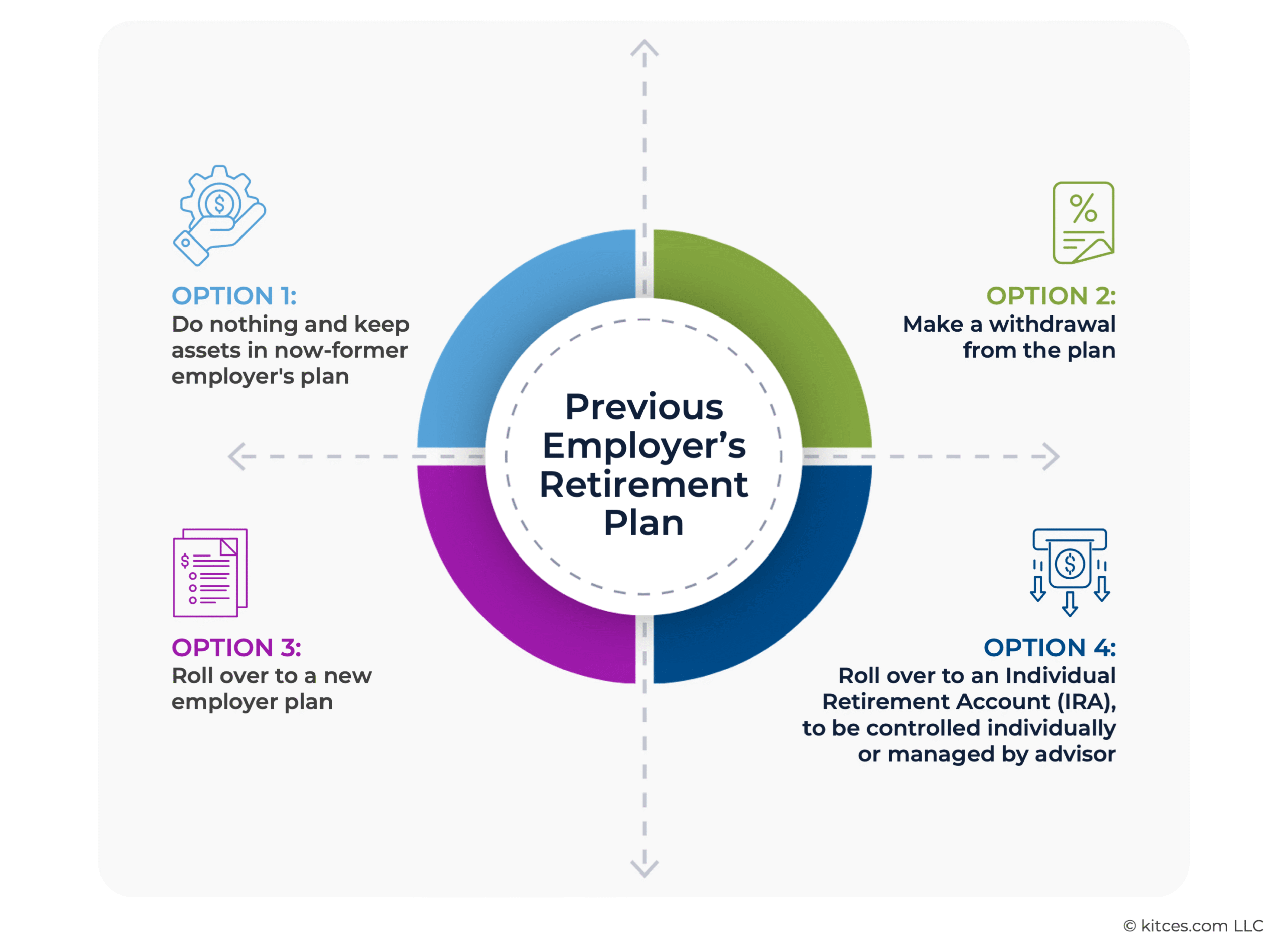
In broad terms, individuals have four options for the assets in their workplace retirement plan when departing from a job. First, they can elect to 'do nothing', and keep the assets in the now-former employer's plan, which is the 'default' choice for many individuals. While this option requires the least amount of work, it sometimes results in workers ending up with assets in several 401(k) or similar plans over the course of a multi-employer career (creating a potential opportunity for advisors to add value for their clients by helping them identify any 'orphaned' accounts from previous employers!).
If the individual is moving to a new job that also offers a 401(k) or other qualified plan, they can elect to roll over the assets from their previous employer's plan into the new one. This has the advantage of consolidating all workplace retirement plan assets in one place, though the investment options and related fees in the new employer's plan might not be as attractive as those in the individual's current plan.
A third option is to make a partial or full withdrawal from the plan, without re-depositing those assets elsewhere in another qualified plan. Doing so can be inefficient from both an investment perspective (i.e., reducing the assets available to compound until needed in retirement) and with regard to taxes (as individuals making a withdrawal before reaching age 55 under the "separation from service" exception could be subject to a 10% penalty, in addition to any income taxes owed), though for individuals with limited other savings these assets may be a financial lifeline that helps bridge gaps in cash flow (e.g., during a period between jobs).
Finally, an individual can elect to roll over the assets from an employer retirement plan into an IRA, whether one they control individually or one managed by a financial advisor. IRAs can prove more flexible than workplace retirement plans in terms of investment options (and allow the individual to avoid any fees required for maintaining assets in the workplace plan), but certain individuals might want to keep assets in the workplace plan rather than roll them over.

Nerd Note:
A potential consideration when deciding how to handle a workplace retirement account from a previous employer is the creditor protections available with different options. In general, assets held in qualified retirement plans that are subject to the Employee Retirement Income Security Act (ERISA) are shielded from creditors, even if an individual declares bankruptcy (though they do not have this same protection in the case of divorce or IRS actions). This protection also extends to qualified plan assets that are rolled into a rollover IRA; however, contributory IRAs do not have the same level of protection (with the Federal government offering an exemption of approximately $1.7 million in the case of bankruptcy and state laws offering varying levels of protection for non-bankruptcy scenarios), which means that individuals (and their advisors) will want to ensure assets rolled over from a qualified retirement plan remain in a rollover IRA and are not commingled with contributory IRA assets.
Applying CFP Board Fiduciary Principles To The Rollover Conversation
Applying The Duty Of Loyalty Amidst Potential Conflicts Of Interest
Given the many potential conflicts of interest that could go unmentioned and unaddressed by those without a fiduciary duty towards their clients, CFP Board requires a Duty of Loyalty of its certificants. In the case of rollover recommendations, this means identifying and disclosing conflicts fully, obtaining informed client consent, and managing conflicts in the client's best interest.
First, an advisor can identify the conflicts of interest that apply to their particular practice. As previously discussed, the most prominent conflict for many advisors will be their ability to charge fees on assets rolled over into an IRA that they manage and their potential inability to do so if the client keeps the assets in a 401(k) or similar held-away workplace plan. For certain advisors, this includes the ability to earn revenue from commissions on the sale of products within a rollover IRA, or incentives that they or their firm receive for having clients purchase certain investments. On the other hand, advisors who charge on a fee-for-service basis (e.g., on a subscription, hourly, or project basis) might not share a similar conflict of interest based on fees, as their compensation wouldn't necessarily be affected by an asset rollover into a managed account (or not).
Nerd Note:
The availability of held-away asset management technology means that some advisors might already be charging fees on client assets held in 401(k)s. Which means that the decision of whether to roll over these assets after leaving an employer might come with reduced compensation-related conflicts (particularly if the fee charged on these assets will remain identical after being rolled into an IRA). Nevertheless, an advisor in this situation can support their clients by conducting an analysis of the benefits and drawbacks of different courses of action for the client even if there would be no change in fees.
Of course, rolling assets into an IRA could still be a prudent recommendation even if conflicts of interest exist. An important step, then, is to fully disclose any conflicts of interest to the client and obtain informed consent (which not only fulfills the advisor's fiduciary responsibilities, but also can build client trust by giving them greater confidence in the advisor's transparency when it comes to how they are compensated). Such disclosure could include explaining the available options (thoroughly and completely) to a client who is leaving their employer, as well as explaining the compensation incentives that come from different account types and investment selections.
According to CFP Board guidelines on conflicts of interest, while CFP professionals are required to disclose material conflicts of interest, these do not necessarily need to be made in writing (i.e., they can be made verbally) – though, as will be discussed in more depth later on, written disclosures can offer advantages to both the advisor (e.g., by creating a permanent record of the disclosure in the case of a future client complaint) and their client (who can ensure they fully understand the full extent of any conflicts of interest).
A 7-Step Process For Fulfilling The Duty Of Care
Given the presence of conflicts of interest during the rollover conversation, prospective or current clients might reasonably have a certain level of skepticism about the advice being given (particularly if the advisor's recommendation is to roll over assets into a fee-generating IRA!). That said, by undertaking a process of evaluating a client's unique situation, analyzing available options, and presenting a recommendation alongside alternatives, an advisor can demonstrate that they have thoroughly assessed key factors and have provided the client with the information needed to make a decision about what to do with their workplace retirement plan. With this in mind, the CFP Board lays out a seven-step process that can allow an advisor to fulfill its Duty of Care requirement when considering a rollover.
The first step in this process is to understand the client's personal and financial circumstances, as these could play a material role in the rollover decision. This information could include both qualitative factors (e.g., the client's desire for simplicity in their accounts or their level of satisfaction with customer service provided by their current plan) and quantitative data (e.g., their income and tax situation and the amount and type of assets held in non-retirement and other retirement accounts).
A second step is to determine the financial advice required to fulfill the scope of engagement with the client. For example, a rollover decision in reality involves multiple choices, including whether to sell assets in the client's existing employer plan in order to move the assets to a different account (as 401(k) plans typically don't allow for in-kind rollovers) which could at least temporarily affect a client's asset allocation, whether to roll over assets into a new account (and if so, into which account type to roll them into, such as a new employer's 401(k) plan or an IRA), and how to invest the assets in the new account. The client engagement might cover any or all of these steps, and potentially ongoing advice and/or portfolio management following the rollover, but the advisor will need to be clear about which steps they're responsible for (and which will be handled by the client or a third party, e.g., a tax professional to analyze the tax considerations of different courses of action).
In the third step, the advisor can analyze the client's current course of action (by default, leaving the assets in the employer plan, unless they have a small balance and are forced out of the plan) and compare it to various alternatives (e.g., rolling funds into a new employer's plan, rolling into an IRA, or making a distribution). This can include conducting research into the features of the current retirement plan and comparing them to a new employer's plan (if available) and an IRA (along with considering whether a distribution might be appropriate – for example if a Net Unrealized Appreciation strategy is available). Because plan options can vary widely in terms of fees, the quality of investment options available, and the availability of other planning features (such as designated Roth accounts and in-plan conversions), the benefits and drawbacks of staying the course in the client's current plan will be different from one plan to the next.
Nerd Note:
In years past, the costs involved in leaving assets in a previous employer's 401(k) might have been a powerful argument in their own right for rolling over assets into an IRA (that wouldn't carry the same administrative fees). However, recent years have seen compression in 401(k) plan fees (and a greater diversity of lower-fee investment options) amidst greater competition and trustee litigation, perhaps making this element not as determinative as it once might have been (when weighed amongst other factors guiding the rollover conversation for a particular client). However, researching fees can still be valuable, particularly if a client worked at a smaller company (whose plans tend to have higher fees); according to 2025 data from Morningstar, small companies had average plan expenses of 0.43% compared to only 0.07% for the largest companies
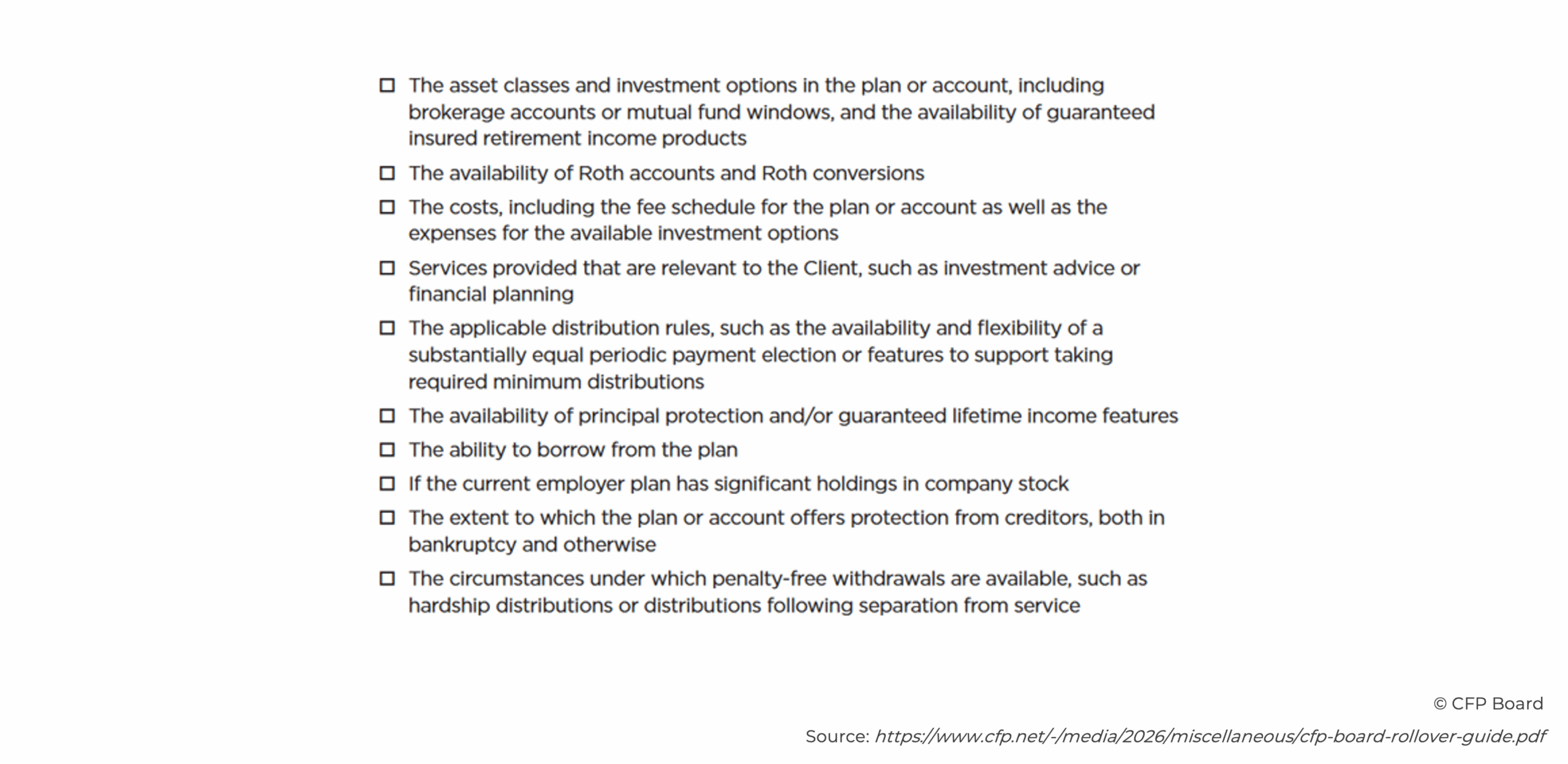
The fourth step for a CFP professional to fulfill the duty of care is to develop recommendations that are in the best interest of the client by conducting a comparative analysis of the advantages and disadvantages of available courses of action. Notably, while costs might be an important factor to consider (e.g., comparing administrative and fund costs within a 401(k) to advisory and fund costs for managed accounts), it's possible that an advisor might recommend an option with higher costs if it is determined to better fit a client's stated goals.
Example 1: Ashley is planning to retire soon and has asked her financial advisor, Felicia, for advice on what to do with her 401(k) assets when she leaves her employer. Ashley currently has a 401(k) at her current employer as well as two 401(k)s from previous employers. Each of the 401(k)s has an administrative fee of 0.25% and average fund fees of 0.50% (for a combined fee of 0.75%). If she rolls over the assets into an IRA managed by Felicia and her firm, Ashley will pay a combined 1.15% in advisory and fund fees. However, because Felicia has stated that she puts a high priority on simplicity in her accounts and is not interested in continuing to manage the investments within her 401(k)s (and has no other extenuating circumstances that might make leaving the assets in the plans preferable), Felicia can recommend that Ashley roll the assets into an IRA that she will manage while fulfilling her duty of care to Ashley.
This stage can also provide an opportunity for an advisor to demonstrate their expertise by considering planning strategies that might be appropriate for a given client. For instance, a client who is still working and would benefit from making 'backdoor' Roth IRA contributions (because their income puts them over the limit to make regular direct Roth IRA contributions) might not want to roll over an entire 401(k) into an IRA if some of the assets were made on a traditional/pre-tax basis, as having pre-tax assets in an IRA can complicate the backdoor strategy by mixing pre-tax and nondeductible contributions (even if they are held in separate IRAs) and subjecting any Roth conversions to the pro-rata rule.
In the fifth step, the advisor can demonstrate transparency and engender trust and goodwill from the client by presenting their ultimate recommendation (and corresponding reasoning) alongside all available alternatives. And once the client has chosen a course of action, the sixth step involves the advisor and/or client implementing the chosen strategy (e.g., taking steps needed to initiate a rollover efficiently and investing the rolled-over assets in a timely manner).
Finally, in the seventh step, advisors can then further support their clients by monitoring the situation for any rollover-related changes that might be beneficial to the client.
Example 2: After leaving his previous employer five years ago, Darren, in consultation with his financial advisor Ben, decided to roll the assets from his previous 401(k) to the 401(k) at his new employer, which has low fees and a sufficient investment selection for his needs. Darren is now planning to retire, though, and Kelly identifies that he would face additional costs for leaving the assets in the 401(k). After going through the steps in the duty of care process once again, Darren decides that he will roll his 401(k) assets into an IRA managed by Kelly after he retires.
Another such example for a client who continues to work could be later rolling funds out of a managed IRA and back into a subsequent employer's plan down the road, in order to preserve the client's ability to make backdoor Roth contributions.
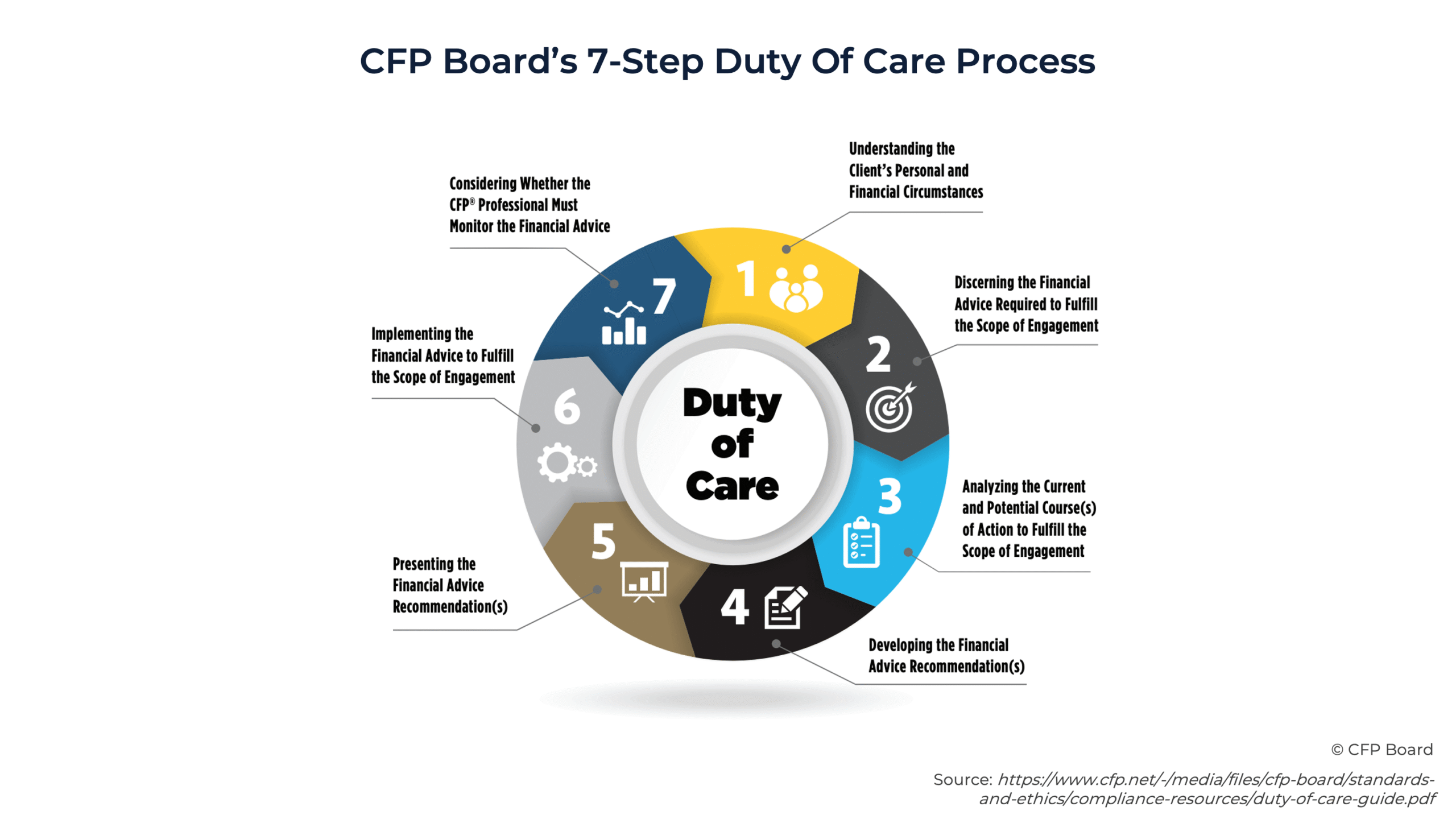
In sum, while many factors might lead an advisor to recommend that a client roll over their workplace retirement plan assets into an IRA managed by the advisor, completing the steps outlined in the duty of care process can give CFP professionals greater confidence that they haven't missed a step or consideration when analyzing a potential rollover. The CFP Board has provided a checklist of potential items to consider during this process in the appendix of its rollover guide, with the aim of helping advisors make better-informed recommendations while also fulfilling their fiduciary responsibilities under CFP Board's standards.
Engaging In And Documenting The Rollover Conversation
Sometimes, a client who has left or is planning to leave their employer will have their mind made up in terms of wanting to conduct a rollover (e.g., if the fees are high and customer service has been poor in their current 401(k)). On the other hand, a new or prospective client might be circumspect about their advisor's intentions about recommending a rollover if it would mean that they would pay higher fees. In either case, though, engaging in the steps outlined in CFP Board's Duty of Loyalty and Duty of Care can provide the factual and analytical backing to make and communicate an appropriate recommendation.
Engaging A Client Who Is Eager To Roll Over Their Assets
Some prospects or clients might be fed up with the 401(k) plan available at their current provider and assume that the best course of action is to roll it over into an IRA managed by the advisor when they are eligible to do so (other clients might be under the possibly mistaken assumption that they must roll over their 401(k) upon leaving their employer, though employers typically are only permitted to 'force out' separated employees who have a retirement plan balance up to $7,000). Here, the advisor has the opportunity to both educate the client (e.g., to fully explain the options available to them for the workplace retirement plan) as well as analyze whether a rollover is an appropriate recommendation given the client's circumstances. Under the Duty of Loyalty, a CFP professional must still identify and disclose any conflicts of interest they have with regard to the potential rollover.
Example 3: During her annual meeting, Jordan, age 56, lets her advisor Craig know that she is about to leave her job and plans to take three months off before searching for a new position. She tells Craig that she's interested in rolling over her 401(k) to an IRA that he would manage. Upon hearing this, Craig explains his conflict of interest verbally (while also providing a document outlining it) since he would then charge on the rolled-over assets. After considering Jordan's situation, Craig also highlights that Jordan might want to maintain access to a 401(k), at least for now, because she won't know whether her new employer will offer one and she might want to preserve access to some benefits available in 401(k)s but not IRAs, such as the ability to withdraw funds penalty-free under the 'Rule of 55', which could be helpful in her case because she has limited other assets that could be accessed penalty-free. Provided with this information, Jordan decides to leave her 401(k) as-is until she finds a new job, at which point she and Craig agree to revisit the rollover conversation. Jordan is grateful that Craig incorporated cash flow and tax planning considerations into the rollover conversation.
Working With A Skeptical Client
While some prospects or clients might be eager to roll over their 401(k) assets into an IRA managed by their advisor, other clients might be more hesitant. For instance, a client who has the option to remain in a 401(k) that has very low administrative expenses and fund fees might be hesitant to pay what would be higher combined fees to have their advisor manage these assets (particularly as they already get the benefits of the advisor's non-portfolio management services, which they pay for via AUM fees on their other assets that the advisor does currently manage).
If the advisor follows through with the seven-step duty of care process and determines that a rollover to an IRA would be the most prudent decision for the client, they can then make that recommendation to the client with more confidence.
Example 4: Jerome, age 71, is about to retire. He has never worked with a financial advisor before and approaches Stephanie about starting an advisory relationship. Jerome has $500,000 in taxable assets and $500,000 in pretax 401(k) assets. Because his taxable assets alone are enough to meet Stephanie's asset minimum, he asks her why he might want to roll the 401(k) assets into an account that she would manage as well. Stephanie acknowledges the conflict of interest that is present regarding her fees, then notes that her recommendation is based on her ability to provide unified asset allocation and management at an all-in fee that is close to that of his 401(k). Stephanie also notes that having assets in the IRA would allow the charitably-minded Jerome to make Qualified Charitable Distributions, which aren't permitted from 401(k)s but would count towards future Required Minimum Distribution obligations. Jerome hadn't previously considered these factors and decides to work with Stephanie and roll his 401(k) assets to an IRA under her management.
The Importance Of Documentation
Whether a client is immediately onboard with a rollover recommendation or is more circumspect, properly documenting the conversation (as well as the research and analysis that went into it) can benefit the client, the advisor, and their firm.
As previously discussed, while CFP Board doesn't require that disclosures of conflicts of interest be made in writing, doing so could allow the client to clearly consider and understand what these conflicts entail and how the advisor plans to manage them – which are points that the client might forget if they occur in the middle of a longer meeting. For the advisor, written client acknowledgement of the conflicts and of the advisor's analysis that went into the recommendation could forestall a client complaint down the line that they didn't realize the full implications of rolling over their 401(k) plan to their advisor. And for a firm, establishing a process in which advisors document their thinking behind rollover recommendations (as well as any written notes pertaining to the actual rollover conversation itself) can provide institutional memory if the client eventually needs to be served by a different advisor.
Example 5: Jasmine has worked with her advisor Marcos for 10 years. Earlier on in the relationship, Jasmine switched employers but, after consulting with Marcos, decided to leave the assets in the 401(k) plan at her previous employer because it had a solid selection of investments and low fees and she didn't mind handling transactions in the account on her own. Recently, Marcos retired and Jasmine began working with a different advisor at the firm, Estelle. Thanks to Marcos' contemporaneous notes in the firm's CRM, Estelle knows that Jasmine has multiple 401(k)s and avoids the potential pitfall that the plan at the previous employer becomes 'orphaned'.
Ultimately, the key point is that while rollover conversations are common among financial advisors and their clients, the decision isn't necessarily simple. It merits – from a fiduciary perspective – both a thorough analysis of the available options and their tradeoffs for the client, and the identification and disclosure of conflicts of interest that might be present. By doing so, an advisor can foster a more trusting relationship with their client that will hopefully last well beyond the time of the rollover recommendation!





Leave a Reply