
Executive Summary
Business owners have long been a popular target clientele for financial advisors; successful firms with strong profitability created an advisor opportunity to help business owners diversify their wealth (into the advisor’s managed accounts), to propose tax shelters (to offset business income), and to secure the value of the business with life insurance (to fund buy-sell agreements or estate liquidity). However, while the reality is that these have been lucrative ways for financial advisors to engage with business owners, it understates the full breadth of the unique financial advice needs of many business owners. After all, successful businesses are often the largest asset by far on the business owner’s balance sheet, which means advice to help them better grow and manage the business as an asset, can far exceed the economic impact of any of the advisor’s ‘traditional’ offerings. With the caveat that means advisors may need to develop new advice skills and new domains of advice expertise to serve the full breadth of business owners most effectively!
In this ‘hybrid’ video-based article, Michael Kitces and John Bowen, CEO and founder of CEG Worldwide and CEG Insights (formerly Spectrem Group), map out the four stages that entrepreneurs pass through as they grow and scale their business – and the new kinds of knowledge expertise that advisors need to develop to best help their business owner clients overcome obstacles along the way.
The first stage (Foundation for Freedom), centers on moving from scarcity to structure. At this point, owners are building stability, generating income, and coordinating basic financial infrastructure. This is where most traditional advisory services fit comfortably, including investment management, retirement plans, tax coordination, and basic succession discussions.
The second stage (Energy for Expansion), begins when entrepreneurs start converting their expertise into scalable intellectual property. Instead of relying entirely on personal effort, they begin building systems, processes, training, and thought leadership that can grow independently of the founder’s direct involvement. However, many businesses become trapped by "founder dependency," where the owner remains indispensable to operations and growth, which creates both valuation limitations and operational bottlenecks. In these stages, advisors are largely focused on collaborative and coordinating services – such as ensuring CPAs, attorneys, and other specialist all work together to help the business owner achieve their goals, connecting the business owner to IP attorneys to understand how to turn their experiential knowledge into valuable intellectual property, and perhaps even some coaching nudges to the business owner themselves about how to evolve the business to be less dependent on them as a path to expanding enterprise value.
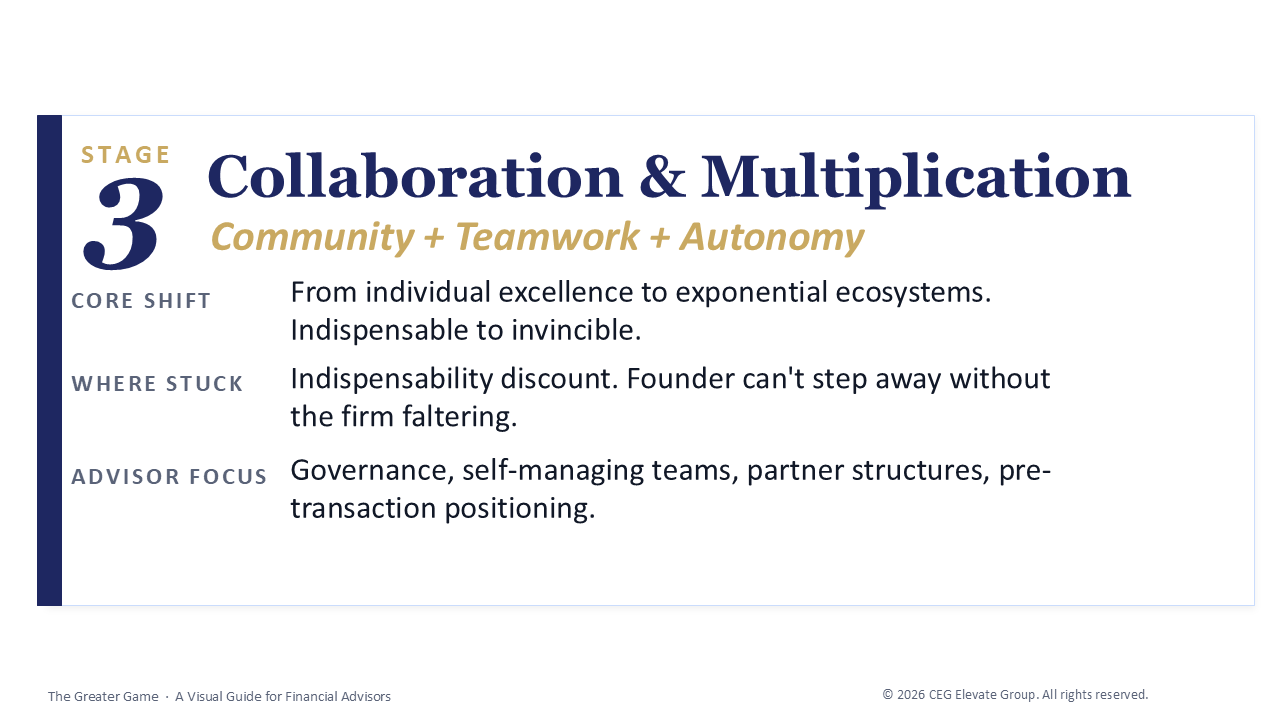
If entrepreneurs can mold a business to run independently of themselves, then they enter the scaling-focused stages. The third stage (Collaboration and Multiplication), is where business evolve into self-managing teams that can make complex decisions independent of the owner. From the advisor perspective, expertise needs shift significantly at this stage, as the business owner focuses more on how to ensure good governance of a business they may be less involved with day-to-day, the implications of sharing equity across key leaders in the business (as it dilutes the business owner’s own stake), and beginning to position the business for an eventual exit and liquidity event.
Finally, at the most mature fourth stage (Exponential Impact), entrepreneurs move beyond wealth accumulation toward significance and long-term influence. With their financial security firmly established and financial goals broadly achieved, the focus shifts toward family governance, strategic philanthropy, next-generation development, and perhaps how to create meaningful impact during their lifetime (rather than simply leaving a legacy after death). Many ultra-high-net-worth entrepreneurs are less concerned with maximizing investment returns (growth for what purpose at that point?) and more focused on defining purpose, stewarding family relationships, and aligning capital with personal values. This is where advisors increasingly function as strategic coordinators and personal CFOs, helping clients integrate financial, family, business, and philanthropic decisions into a coherent vision for the future.
The broader implication for advisors is that serving affluent entrepreneurs effectively requires a shift away from traditional expertise of investments, insurance, and retirement planning, into a more integrated advisory role that delves into valuable "non-traditional" advice domains from how to really boost enterprise value, to governance of their wealth and managing their equity cap table, and ultimately how to better align their wealth with their values and legacy (when all their other goals have been satisfied), while increasingly serving as orchestrators of expertise amongst increasingly specialized legal and tax experts.
Ultimately, there is a wealth of opportunities for advisors who work with business owners, particularly those who can emphasize their role as a thought partner, coach, and coordinator, by developing the unique expertise capabilities that successful entrepreneurs need. Especially for financial advisors who want to work with business owners of larger enterprises, where "traditional" financial planning expertise becomes less relevant, and the truly unique planning needs of business owners arise!

Show Notes
 "The Greater Game: A Diagnostic for Business-Owner Clients Across Four Stages" Slides – Download (PPT)
- Take Assessment: "The Greater Game" Dashboard
- "The Greater Game" with Dan Sullivan of Strategic Coach World
- CEG Elevate Group
- #FA Success Ep 333: Scaling A Small-Business-Owner Boutique To A $31M Retainer-Based Valuation, With Jim Dew
Full Transcript
Michael: Welcome, John Bowen, to join us again on "Nerd's Eye View".
John: Hi, Michael. I always love hanging out with you.
Michael: Well, I'm excited to have you join us today and to get to dig in, I think, just a little further into serving business owners, right? So many of us advisors serve business owners. As many know, I started out in the life insurance world. We were very focused on business owners. Now, frankly, back then, that was because we wanted to sell you the buy-sell life insurance policy because that was the life insurance deal, but it was always, like, find a business owner that might have an opportunity.
But I mean, I know the reality of having lived this myself. There are lots of different types of business owners, right? Just literally saying, business owner is a bit of a painful generalization. Like, firms are at different sizes, different dynamics of founders.
And so, at least from my experience, I've always tended to these, think of these stages as being very size-based. Like, tell me how many team members are in your organization, and I can start to visualize the kinds of problems you are probably facing as a business owner because of the organizational complexity of your team count. But John, I know you have recently written a book now delving into this called "The Greater Game" with Dan Sullivan of Strategic Coach World about this, I guess, business owner entrepreneurial journey, and the fact that there really are some quite predictable stages and evolutions, maybe not size related, but that do flow in a sequence. So, I just I'm excited to dive in and talk about, what does that journey really look like? And right from our end as advisors, like, how do we show, like, what expertise and advice do I need to be bringing depending on where my clients are as business owners?
How The Founder Role Shifts As The Business Grows [01:50]
John: Yeah. Yeah, Michael, as you know, I coach, you know, top financial advisors, and the largest concentration of wealth is with business owners. And you described, they're all over the place. And a couple of years ago, Dan and I, Sullivan and I did a 25-year agreement to do an annual survey of entrepreneurs where we actually have now changed, we're doing it monthly. But the idea was, is to really answer the question that you have. Because being in business, there's the mom-and-pop coffee shop, and then there's Starbucks, they're both served coffee. They're very different.
Michael: Yes. But, like, Howard Schultz's challenges running Starbucks are a little bit different than, like, my mom-and-pop coffee shop off the store. They both run a business and have challenges, but they're different.
John: Yeah. And the coffee, my guess is they're pretty good at both. And what we came up with, and this is something that we really wanted to look at is, you know, business owners are monolithic, as you talked about. And there's really four stages that we saw. The first one was kind of a foundation. This is just getting started. You know, they've got the ambition. You know, they may or may not have cash confidence, but they're making progress. And then, you know, the stage two is expansion where they're starting to get the energy and they have motivation now. They're usually have created some substantial IP at this point.
And then stage three is multiplication. And this is where they learn to really work collaboratively. Not, you know, we always think the team first, but it's actually creating the community or be part of someone else's community. And then stage four, the impact. This is all about, you know, really, what are those businesses that blow by $100 million of revenue, let's say. That they're doing and creating that agency... kind of the, you know, going to the blue ocean, they create their own market.
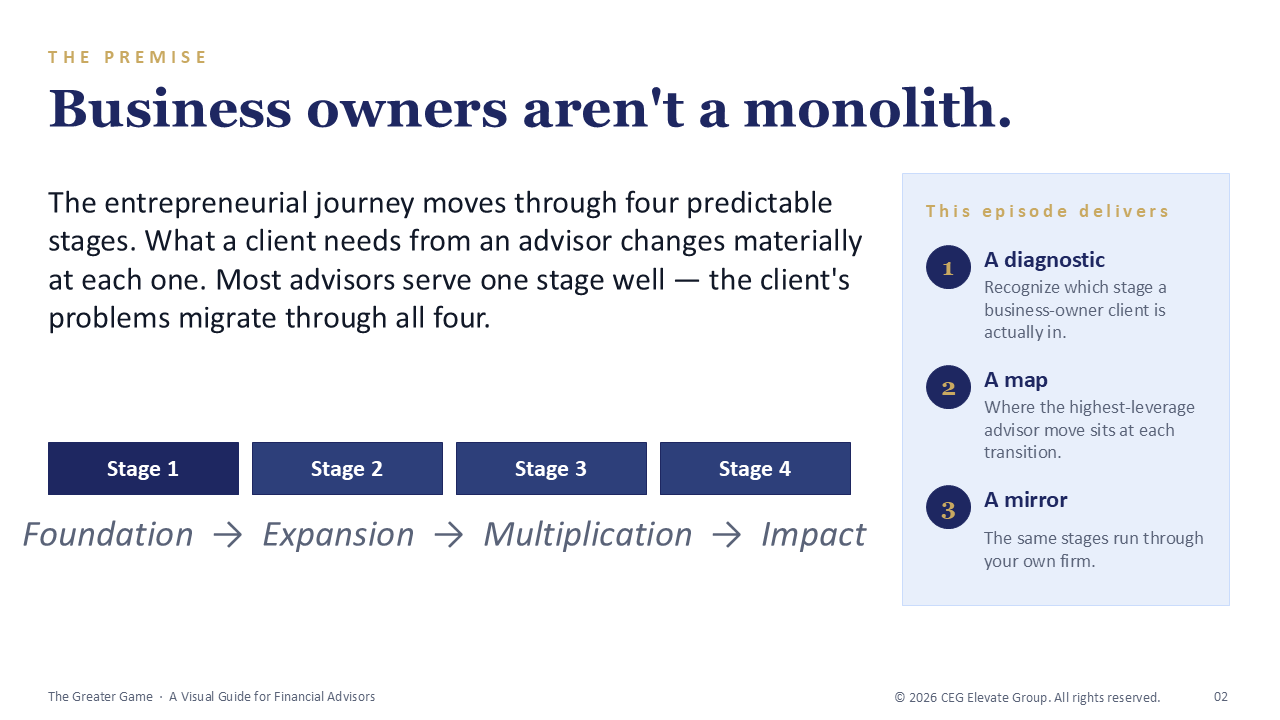
And what I'd like everybody to think, as you and I were talking about, we're going to talk about entrepreneurs, business owners, but everybody listening here as a financial advisor or watching the video, you are a business owner or entrepreneurs.
Michael: We do a version of this, too, if you're a firm owner. Yep.
John: Yeah. Or if you have an equity piece, you want to be able to hold a mirror to yourself and start thinking, where are you in this process? And what can you learn from some of the most successful entrepreneurs? We really focused on, Dan and I identified 5.4% of the advisors we surveyed in this study for, what were the things that were driving their success that they were doing? There were ten multipliers that they were just killing it. And in the book we have 26 stories of, you know, great entrepreneurs and a little bit of the backstory. It's so colorful. But boy, you know, one of the things that we all want is a framework. So, as an advisor, that I can better serve the entrepreneurs I work with and differentiate myself and help them along this pathway. And then I also liked that it helps me an awful lot as well.
Michael: So, now, help us understand, I guess, like, can you drill further into what's going on in these stages? Because, I guess, I also want to be mindful, stages here, like, these are not stages of the business. These are stages of the business owner. Like, this is what I'm doing with and in and around my business.
John: So, you know, I'm putting up, if you're listening to this, you can go, and Michael's team will make available a deck that you can download to have all these slides.
But I just want to put up, you know, the very first one is, you know, four stages is a glance.
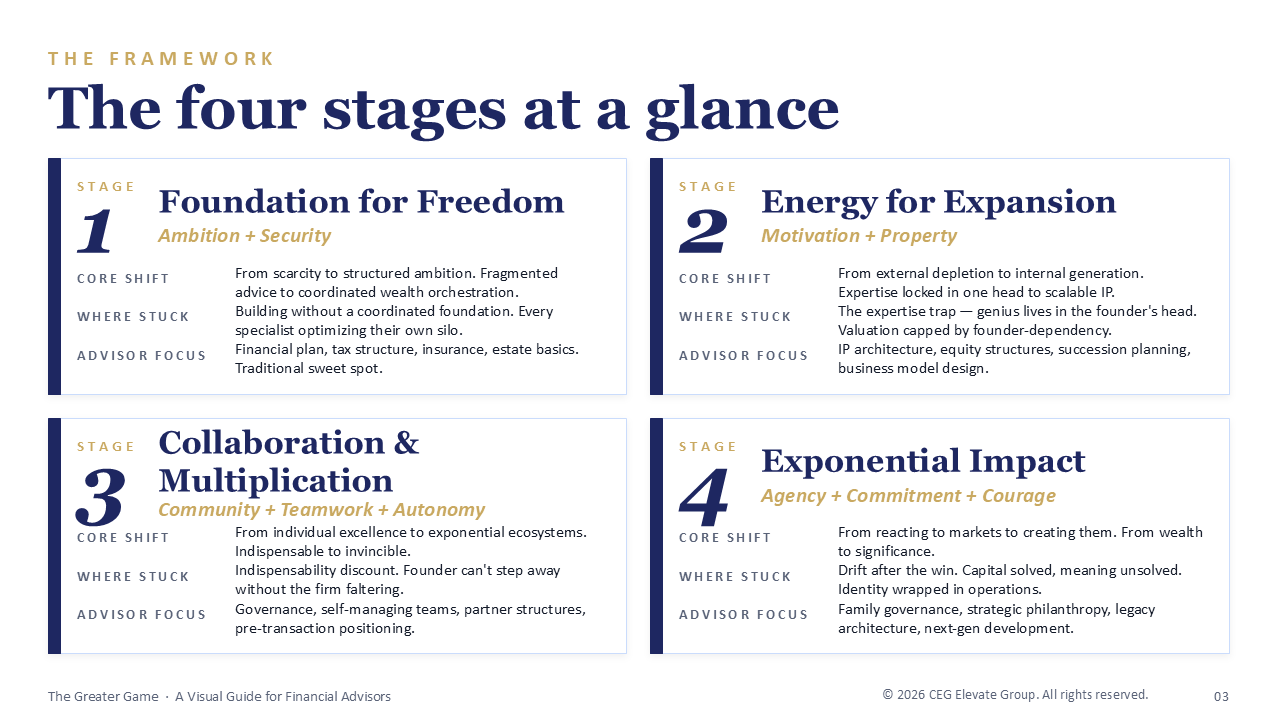
I mean, this is that foundation for freedom. Number one, it's really the core shift. Is where business owners are moving from scarcity to kind of a structured ambition. They're starting to get their wealth together. And this is where the opportunity for financial advisors start. Where they get stuck is it's usually not coordinated, any of the wealth management. And, you know, they're getting people to help them, but they're siloed.
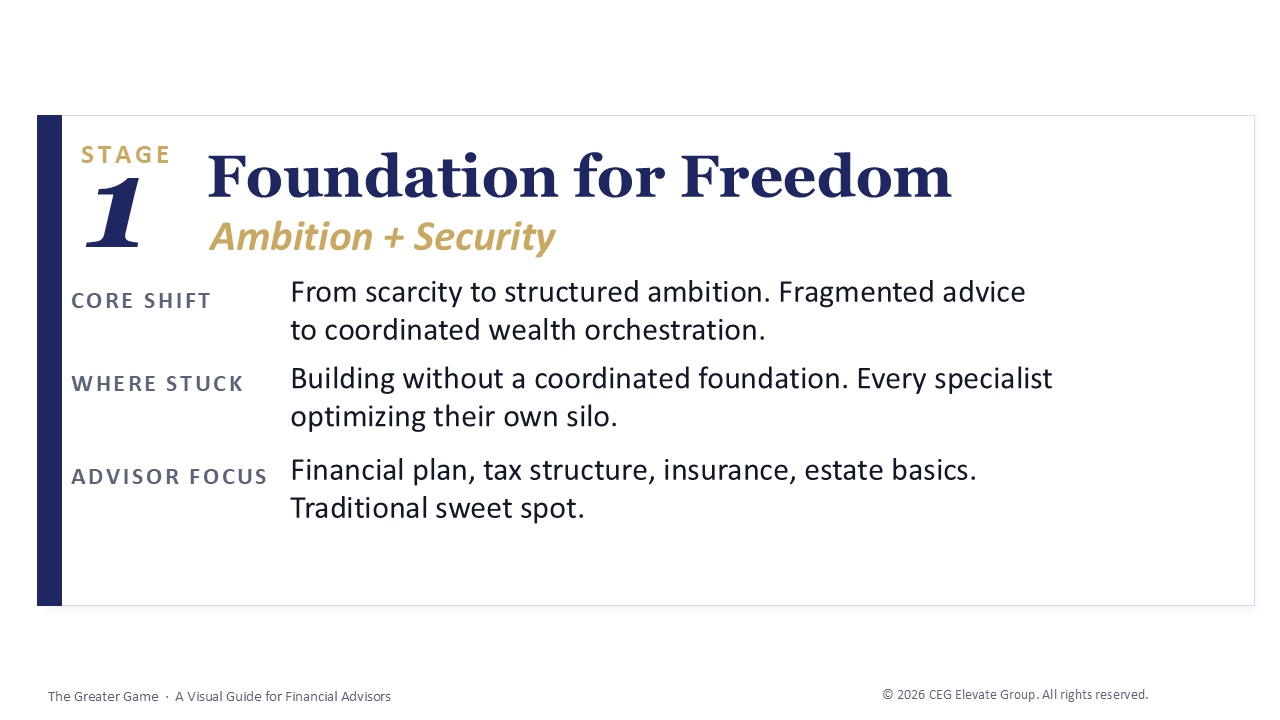
Michael: I feel like this is my traditional advisory, right? Like, "I've got my clients. It's the mom and pop coffee shop," or it's the doctor that owns the medical practice. The business is getting going. They're making some money. They've got a CPA doing one set of things and a practice manager doing something else. And then they're figuring out their own money stuff on the side.
John: And they never talk to each other.
Michael: Nothing talks to the other.
John: Yeah, this is a traditional sweet spot for our industry. And Michael, I'm a little older than you, if you don't know that. And the training you got, and it sounds like the training I got in the industry is really for this level of business owner entrepreneur. And that's where, you know, really what we're talking about today, is understanding the level. And they need different services from advisors. And if you want to play at the higher level and, you know, if we look at all the households in the U.S. and you're focused on $25 million and above of financial assets, you want to work there, that's 90% are business owners. Well, 5% percent or $5M of investable assets to $25M, it's 3 out of 4 are business owners, so this is the greatest way of wealth. But you've got to understand the levels here.
Michael: So, then take me to stage two now. So, what's going on? What's changing?
John: This is where it gets really interesting, because now, they're getting energy for expansion. So, you know, they were already ambitious. You know, they've got some security so they're able to make some business decisions. They're building wealth. They're very motivated. They get off the couch. You know, ambition here, think of it as more vision. Motivation is actually taking action. But the big thing here is they start getting the insights out of their head. Michael, you create an awful lot of IP, intellectual property. I do, too. Okay, if it's in our heads, the value is only so much that you can trade hours for. But by putting it in a form of whether it's thought leadership, training, coaching, business processes, and so on, that becomes big.
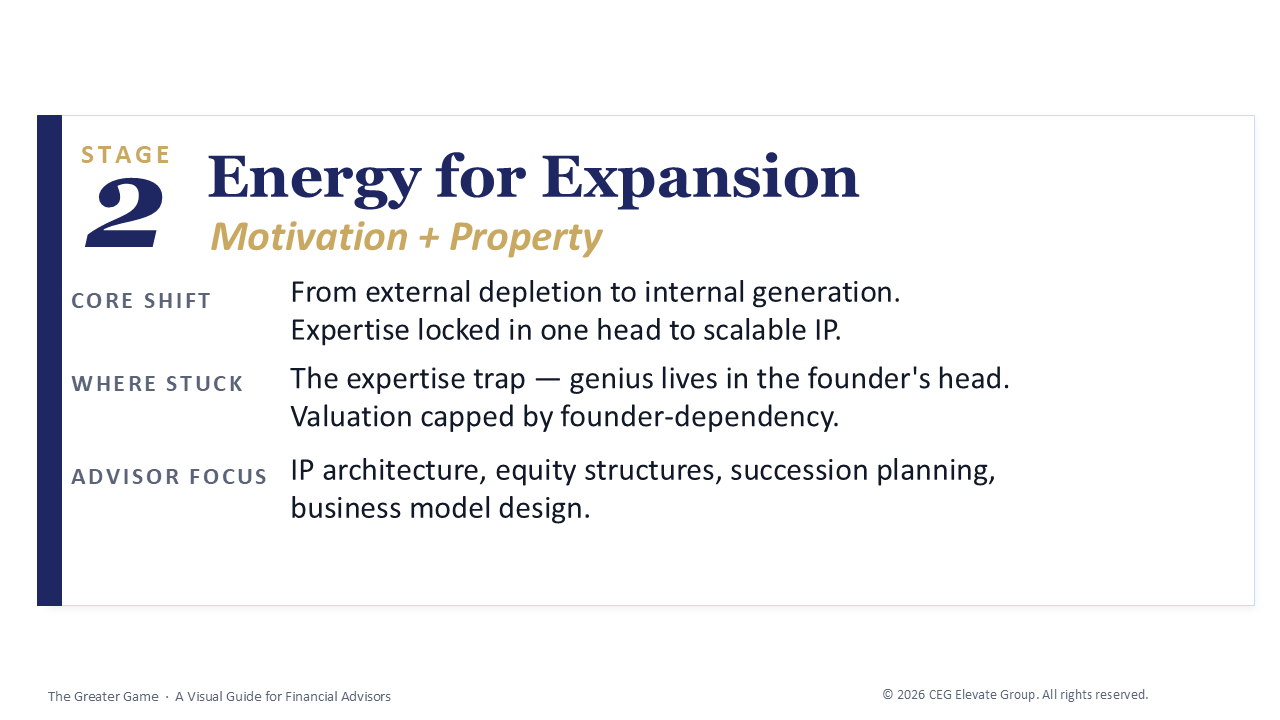
John: So, the core shift here is instead of really depleting ourselves from energy, we have an internal generation. And instead of locking one head, it's scalable. Where they get stuck is they really have a hard time moving this out and they get caught in a founder dependency. So, what that means is that one person is critical to the business. And that's usually where they keep them at level two from an advisor focus. Now, you don't have to be the expert on this, but what starts coming in here is understanding IP, equity structures, succession planning and business model design. And I'll share a little later some of the statistics. But boy, they're looking for, can you help them get through this level?
Michael: Well, I mean, this now reminds me, I guess, you know, come from an advisor and professional services world, like, this feels very professional services to me in particular. I'm just visiting the three or four person law practice because it's one dude or dudette at the top who has this amazing expertise and build a practice and added a couple of lawyers or accountants or folks around them to kind of take some of their clients and leverage them a little bit. But if that person at the top went away, like, the clients aren't coming anymore. Like, they come for the person at the top. I feel like a lot of us advisors probably have this as well as a certain practice size where there are several of us as advisors, but let's be honest, I'm not sure the firm's really going to keep growing if that person at the top ever went away, which means...
John: Not only are they not going to do the growing, if the primary, the dependency founder is getting all this, then, you know, the team isn't ever going to learn how to do it.
Michael: And so, it strikes me now when you just get down to, what do we do as advisors. Where did I historically show up for a stage two firm? "Oh, you're trying to figure out how to eventually hand off your firm to, like, successors, the other two lawyers or doctors in your firm. Do you have a buy-sell agreement? Because I'd be happy to help you fund that."
John: That's the one thing.
Michael: We show up at the succession part. We show up maybe at the entity structuring, not because we're giving legal advice on entity, but because we might be helping clients think through like, well, who takes over? Who buys it out? How do you eventually get your dollars out of this business? If it's going to be hard to mine dollars out, let's create a new retirement plan structure where we'll help you mine more dollars out of the business. Like, just feel like that's where we tend to show up as advisors as we interface into this.
John: Well, and I would say that would be the better advisor on stage two. We totally ignore the IP, and we really ignore the multiplier effect on EBITDA as well. And those are big ones that we can easily address. Again, remember, what they're not asking, you know, Michael, you to be an expert at everything or me or any advisor. They want you to curate that expertise so that it's coordinated. It's not in a silo. And that's where the value comes in tremendously.
Michael: So, then what happens as I go to stage three?
John: This is where it really starts taking off. And we call it the collaboration multiplication. There's a community. And the way in this, you know, each of these gold here are the ten multipliers we call the greater community. And notice it's before teamwork. One of the things is you're building businesses. If you can identify the community that you can be part of, you can work with competitors and the whole thing. And really the noise, particularly in today's marketplace, without being in a community, it's very hard to be successful. Then your team. And then one of the big multipliers is making autonomy, giving yourself autonomy so that you have the ability to step away. That's where the multiplication really goes up, because, you know, otherwise, if you need to be there, somebody is buying an expensive job, where when you have autonomy, you can step away for 90 days.
Michael: This feels like the old Dan Sullivan, like, this is when you get to the so-called self-managing teams, like, what happens when that business gets to the point that you can go disappear for a few weeks or a month at a time, like, "Oh, everything just kept running and did its thing. It didn't matter that I wasn't there."
John: Well, and this is where Dan wrote the book with me. We're co-authors of this. And we've spent a lot of time on this framework.
And, you know, when we look at it, kind of the shifts that are going on, as you are moving from individual excellence to exponential ecosystems, we're moving from being indispensable to invincible because of the team that we have, you know, the indispensable discount. If you are the guy or the girl, the dude or dudette, you are going to get a discount. But if you can step away, there is a multiplier. The adviser focus here is what they're looking for. They want to help on governance, self-managed, partnership structures, pre-transaction positioning here. This is really big and very seldom how they get here.
The Value Of The Financial Advisor As Coordinator [13:49]
Michael: You just, like, exited stage left from what most of us do and are trained in as advisors. I'm like, I don't get trained in, what you say, governance and pre-transaction positioning. Like, that's not my expertise skill set. So, is this a separation where advisors can't help anymore? Or is this like a retraining, like, we need to learn, old dogs need to learn new tricks?
John: I think it's a little of both, Michael. We don't need to be experts, but we have to know enough so that we can pick partners that we're going to work with that can bring that expertise to our clients who need that. And that's where... Nobody... Again, I mean, you know, Michael, you're in the center of an awful lot of IP. I own a research company. I got all kinds of IP. I will train 10,000 advisors this year, a 1,000 in coaching programs. And I got to tell you, I get exposed to an awful lot. I don't know everything. You know, nobody knows everything.
Michael: Yeah, we're all learning.
John: I actually learned very quickly how little I know one time there. But this is where getting the learning, so I jokingly call it ‘superficial knowledge’, but enough so that we can go ahead and have the experts working with us. And that's what clients really appreciate, is that coordination... you know, curation for us, coordination so that they're tied together.
Michael: It just strikes me that I think about... I mean, I guess, like, I'm maybe over-projecting my own history with clients like this in in the past and what I feel like I see from our industry. Like, I mean, I don't know what size is. I'm presuming just team-wise, if I'm getting to the point that the business is self-managing and I'm thinking about governance things and partner structures. I mean, "I'm a 30-, 40-, 50-plus person organization. I might have $5, $10 million-plus of revenue and up to multiples of that." I just feel like, I mean, our traditional advisory review is something to the effect of, "Wow, it's amazing. This is a client who might save $0.5 million, a million dollars a year into my portfolio. And I'd be so happy to help you grow those assets, attend those assets, and do all the things that we do." And the things you're actually talking about of what drives outcomes for them has, like, basically nothing to do with that. That's the part left over after you...
John: That's table stakes. That's nice to have. But the value creation isn't that. And it's not that that's not important, but that's table stakes, where the more you can bring out and help them... And let's go one more level, Michael, because I think this is where it comes together and people can really see the value creation. Because, you know, what we find, if you make it to stage four, this is exponential growth. I mean, you're really making an impact. And from here, you know, they're no longer reacting, they're creating markets. And this is where they're going to blue oceans, creating. That's really what agency is. And from wealth to significance, is what they're looking...
Michael: This is like my serial entrepreneur who, like, had this big liquidity event and says like, "Well, now I'm going to do the big impact thing. I'm making three more businesses."
John: Well, yeah. I mean, I started three businesses on my 70th birthday. I started a private foundation, you know, all that stuff. I would be your stage four if you're an advisor, you know, I would be a great client for you. And, you know, if we look at the multipliers that are going on, it's agency, you're creating markets commitment. You know, they are looking to make a major impact in that marketplace. And they have the courage to do that. Now, a big part of it is they actually have great... I have a lot more courage now that I have a great security from the asset base and so on.
But there's been an explosion of wealth really since 2008 or March 2009. And so, what they're looking for help, you know, they get stuck is that they drift after the win. You know, your best clients are already wealthy without you, okay? They've won. But okay, they've solved capital. They're struggling more with meaning and identity. And what they want from their advisors, you know, they've got families. How are they going to do family governance? They want strategically to be able to make charitable gifts.
What Owners Of Mature Businesses Are Seeking (That Advisors Miss) [18:34]
The big thing that people get caught up to advisors, Michael, is legacy. Okay, I'm 70, but I don't want an enduring legacy. I want an active legacy, my wife and I. I want to make a difference while I'm living. Next generation development. This is a really big thing for me. And so, you know, when you start talking with...and I have the privilege of working with an awful lot of successful entrepreneurs, this is what they want. But we want to keep on telling them how to make just a little bit more money on the investment side. They want you to see the big picture and help curate that, their success with them.
Michael: Well, and it strikes me when the domain you're talking about in stage 4 there, like, family governance, strategic philanthropy, what's my legacy, and four? Is this for businesses of that size? I feel like that's where a lot of my friends that work with, dare I say, like, traditional, ultra-high net worth multifamily office environments, like, yes, that's a lot of their conversation. There's so much dollars that, you know, a portion is going to go to Uncle Sam or a charity because them's the estate laws. So, we have to open up philanthropy-giving doors. Family governance is real because there's enough money. We can mess up some kids if we're not careful.
I guess what strikes me, like, just hearing this, I guess, to me, I feel like we have a bigger gap in maybe stage three, sort of two and three. Like, I know what I do with my stage ones, right? We're trying to help you survive, make a little money, get some money out of the business, just, like, get your framework in place, get the experts talking to each other. I know what comes at the end. There's a lot of money. Let's be good stewards of it. And all the pieces that go with it. And the middle stages that just feel very, build the business because the biggest lever is making the business bigger. And that, to me, just that feels like a gap for where we tend to be as advisors because we tend to focus on the dollars coming out of the business, not actually like, "What can I do to impact the enterprise value of your business even though that's the biggest asset on your balance sheet?
John: Well, and this is where, you know, we're so used to assets under management, I think, Michael. I don't know your exact thoughts on this, so it'd be great for you to express it. But what we're seeing, you know, when a survey of a little over 3,000 entrepreneurs we just did it, you know, the lowest thing they were concerned was with fees. It was 2.5% when we get to concerns. You know, they only become concerned when the absence of value. Your ability to do retainers and all that business with this audience is huge. You know, the assets are the table stakes. They're going to give those to you if you can deliver the value.
I call it the four bridges. And this is, you know, how can an advisor at each of these stages help them move from one to two?
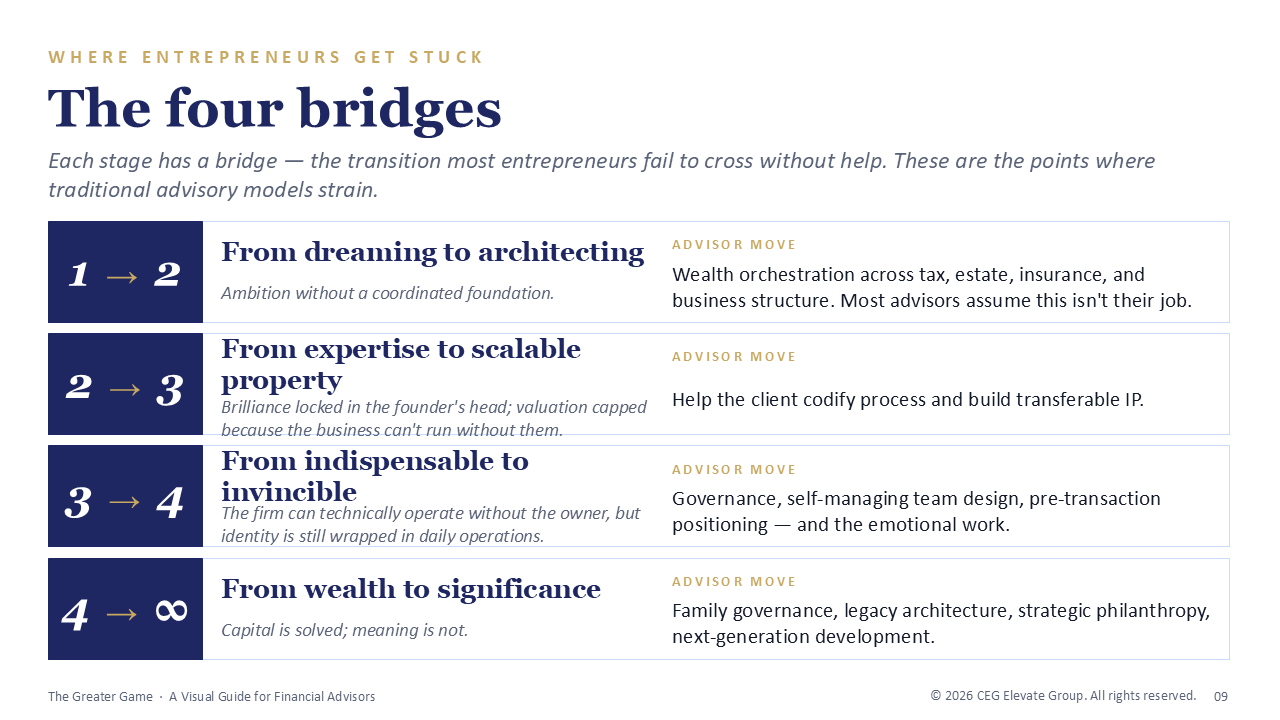
Well, you know, the beginning guys, you know, small business, they're dreaming to architecting. And this is where, I got to say, most advisors working with business owners, I want to believe, are doing this well. I can tell you, unfortunately, in our research, only 6% are delivering it from the entrepreneurs’ belief [perspective] at this level.
Michael: When you ask the client business owners, is your advisor actually helping to orchestrate all your things? 6% of them are saying yes.
John: Yes. And that's where...
Michael: Okay. That's a little pain point.
John: And it's taking care of the investment side, not surprising. That's fairly high, but it's only 70% mitigating taxes, taking care of the areas, protecting the assets, and the charitable planning. And then succession planning would be the six. And we will ask on that, and 6% are doing it across the board, or perceived they're doing. When we ask the advisors, it's in the 80% are delivering. So, somebody is not telling the truth. But the question is, if the client doesn't perceive you're doing it, then, you know, doesn't matter if you perceive you're doing it.
So, one of the things I just want to encourage everybody to do is, and these slides will be available, you know, but you got to do the orchestration. They want the coordination. They want the curation. And what we do is, at best, we're referring that out. There has to be working together. So, there's a coordination on this. And unfortunately, most advisors assume if they mention some things in it, that counts. That's not enough, Michael. And that's a baseline. When we go from level two to three, where we're moving from expertise to now becoming scalable, this is where if you can learn a little bit about IP. And you can get a relationship with an IP attorney, I got to tell you, they're going to love you.
John: When we start moving from three to four, Michael, is one of the things... You know, you're the guy in your organization. I have been the guy. I'm now moving as quickly as possible away from that. And what makes it, the business move from indispensable to invincible is that. Well, these are the adviser things. You know, can you help on governance? Okay, probably you're not the expert in that. Bring somebody in. Self-managed team design. Okay, this is Dan Sullivan's group. Big part of it. Pre-transaction, you know. If you don't have a CEPA (Certified Exit Planning Advisor), you may want to get some experts from that. And then the emotional work on the identity...
Michael: The CEPA, the CEPA designation.
John: Yeah, the Certified Exit Planning Association [Advisor] type thing. But, you know, get a little training, and then decide what level of expertise you want to be. But, you know, the opportunities there are huge. And then lastly, I mean, this is where it really starts coming together, when we start going from four to infinite, from wealth to significance, capital doesn't... I mean, my wife and I, no matter what we do, will never spend the capital that we have. Okay, we just can't, okay? That's a lot of your ultra-high net worth clients have that.
So, now, it's like the meaning. You know, we're in our 70s, our meaning, what is it? Well, family governance, legacy. What are we doing? You know, strategic philanthropy. Next generation. This becomes really... This is a much bigger issue. And it's not just leaving money to kids, like, in Jeannie. In my case, we don't have kids. So, I've had plenty of young people offer to be adopted. But, you know, we have some charitable interests. And we said, "You know what? We should start practicing now." We started a foundation, funded it well, and we're going to continue to fund it every year.
And the idea here is, "Okay, what do we want to do in an enduring legacy?" Why we're living. Obviously, you know, most people want to have the... Excuse me, active legacy. Most of us advisors are always talking the enduring legacy once they're gone. There's plenty of people who don't care once they're gone. Others do. So, you want to address their concerns. But these are really the four bridges that you can do to work in this market. And, you know, all of them, hopefully, Michael, they heard that they could partner with other people to be able to do this.
Shifting The Advisory Service Model To Better Serve Business Owners [26:30]
Michael: So, now, if I'm... I mean, it strikes me we do have, I guess, some gaps advisors, right? My traditional training covers me well for stage one. I maybe need to learn a little bit more about intellectual property law. And number two, I don't even know, are there good resources for us advisors? Like, how do I get tuned up on IP-ing my business?
John: Well, I told them we're coming out with a whole series to do VFO, virtual family office training, where we're in pilot now delivering it this month in our internal clients. But, you know, there is going to be training. And the reason... You like statistics, I like, statistics. I mean, you know, when we look, this is what entrepreneurs are telling us today type thing. 84.6% percent want succession. 21% say they're getting it from their advisor. 79.2% want nonliquid. Big part of the nonliquid, they're businesses, they want help with that. 70% say they're getting some help.
What they're citing as the biggest driver, whether they're working with somebody, is the quality of the advice across those. 53.9%. I mentioned earlier the 59.2% of entrepreneurs are likely to switch or add an advisor in 24 months. 94.6% said there is a coordination gap between the professionals they work with today. This is where the openings are just like, okay, this is the most wealthy segment. The wealth is exploding because of what's going on in today's economy of the most successful. The most asset-based people are doing extremely well. They want to move to qualified advisors. You got to put up your hand and actually be in a position to deliver the experience.
Michael: This reminds me, we had an advisor on our "Advisor Success" podcast a little ways ago named Jim Dew. So, at kitces.com/333 for the episode. It was episode 333.
John: Jim's a good friend and was long-term coaching client.
Michael: So, you know Jim? Yeah. So, Jim's model, like, it's all business owners, I guess, by your framing here are probably, like, a lot of stage two and stage three folks that have a million plus dollars of...
John: Well, and some stage fours too. Because I do know Jim well.
Michael: And it is to your point, I mean, it was fascinating when he came on even a few years ago. I don't know if the bus business models evolved further. He was running retainer model for business owners that was $10,000 financial planning fees per month just to do, like, this level of hands-on work and activity, because there's a lot there to do. But he's got planning fees higher than most firms ever get AUM fees, like, just doing this and going really deep with it.
John: Yeah. No, I mean, you know, Jim was one of our clients. I think he would give us credit for giving him the framing in the beginning. He's taken and run... I don't want to take anything away from him. He's a very talented guy.
Michael: Yeah, he's been amazing.
John: And what he's done is also one of the big multipliers. He's been involved in a community of masterminds, and that's where almost all his clients come from. And this is where, you know, we as advisors, we can decide what level we want to play at. And if this is important, then, you know, we want to serve business owners, well then, you know, really come armed to provide them the service. They're willing to pay. They're happy to pay for this service. But you've got to be able to deliver the right experience.
Michael: What strikes me just relative to the conversation, though is, you know, just, I don't know, how not fitting our traditional advisor services are for a lot of the stages. I feel, again, like our traditional stuff does a lot of stage one. There's some ultra-high net worth family office types that do a lot of stage four. And we don't necessarily have traditional tools in our toolbox for stages two and three. It's we've got some learning to do to be effective there.
John: Well, one of the reasons why, I'm going to go to... This is our website for our holding company, CEG Elevate Group, and I'm going to just pull up. I thought this was so meaningful. And this is one of the reasons why we need to really think about it. I took 2013 through 2025, and this is our research. And we do study in all areas because of our corporate clients. The mass affluent is growing just a tiny bit, 19% during that period. Millionaires grew 79%. Ultra-high net worth $5–$25 million net. And that and this is not investable. This is not counting personal residence, but it's net worth less personal residence. Ultra-high net worth 145%.
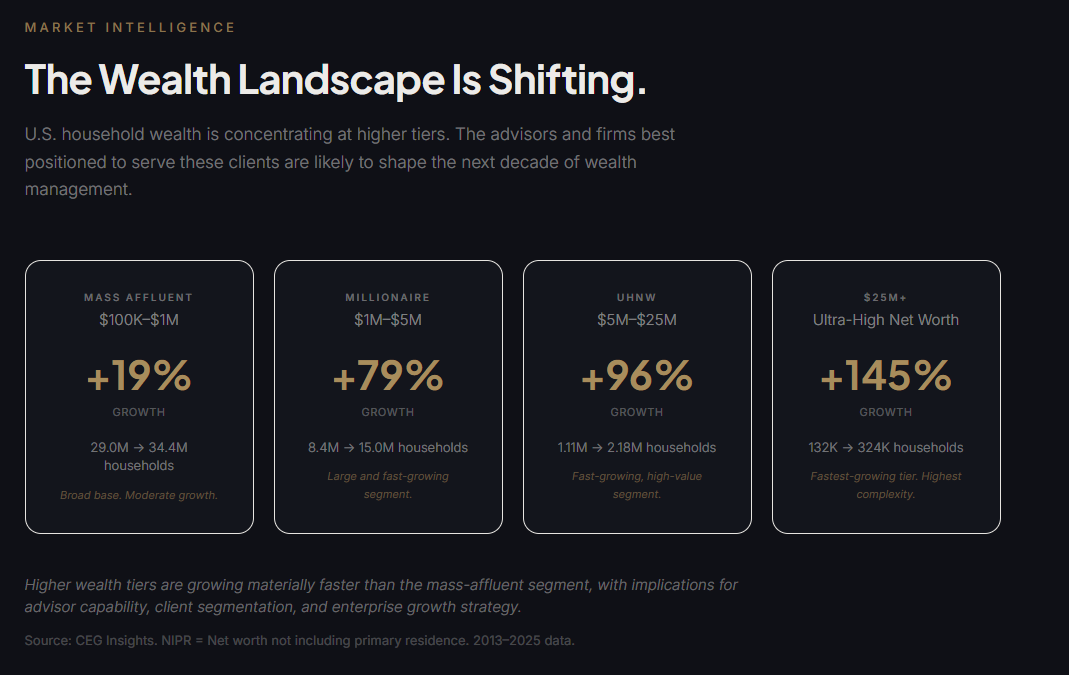
This is where the world's changing. There's been an explosion. Everybody's heard of the K-shaped economy. One of our studies on the high-net-worth, ultra-high net worth, they want to work with an adviser that can use these tools, that can bring these experts together, but they want somebody to act as a personal CFO type.
Using CEG Insights Dashboard To Compare Business Owner Stages And Data [32:12]
Michael: So, as we come towards our end here, if I’m trying to figure out, how do I figure out where my clients are or, I guess, even where I am, if I'm an adviser business owner that's maybe figuring out where I line up on this?
John: Well, one of the things that's so great is the ability to build out diagnostic tools with, you know, the different tools that we have access today. And we built a dashboard, Dan and I and our teams, that I will make sure you get the address on how to get to it. And this is, you come in. You're already successful. You take an assessment. I would encourage everybody to do it as an adviser first. What it comes up with is going to share the vision that came out, the profile it's going to ask you to do. It's going to give you a relative index, you know, how you're doing on the ten multipliers. But it's going to show in detail each of the levels where you are.
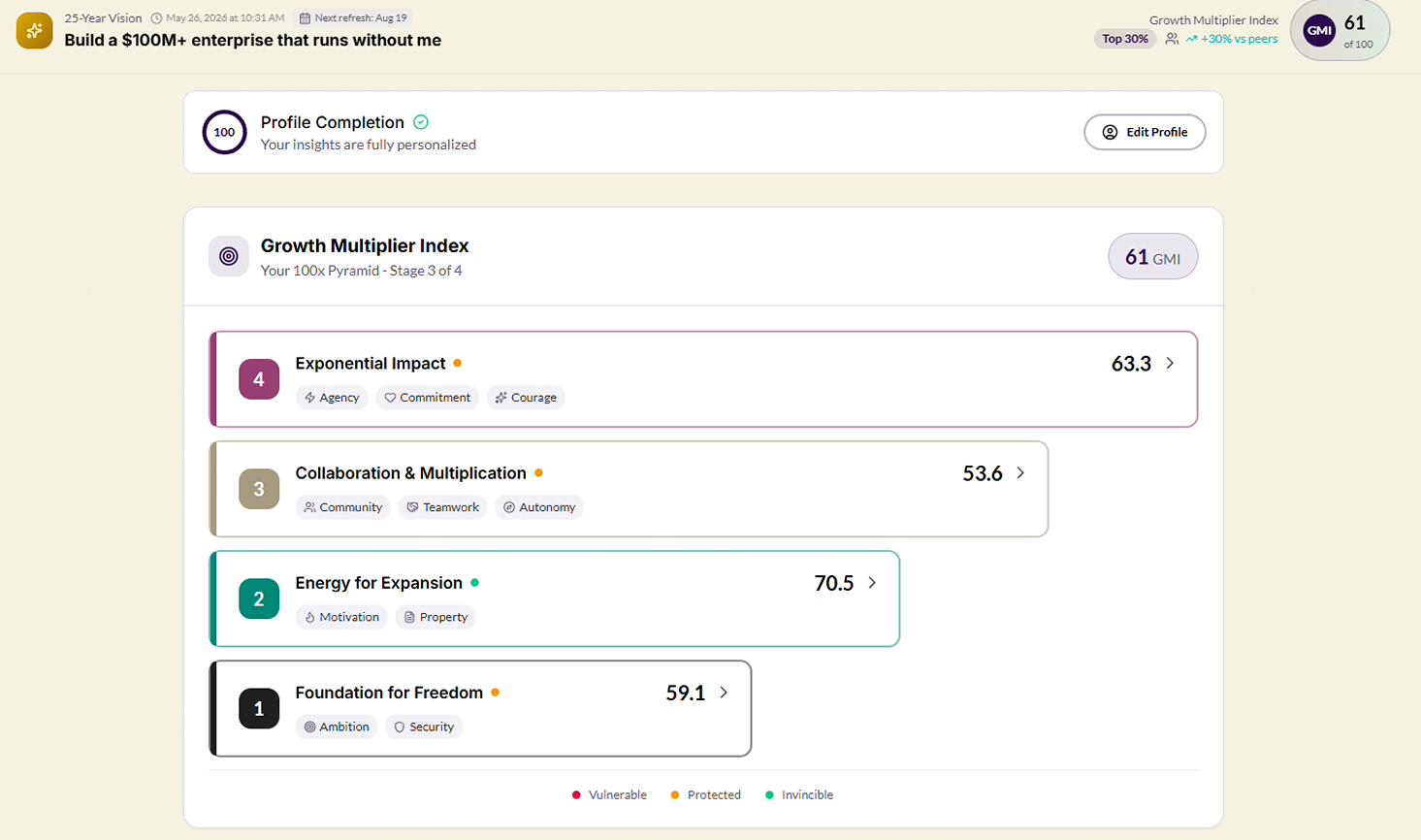
Also, if you want to dive in, where do you compare to your peers at whatever revenue level you had? Where do you compare it to the top in the book? And then we're updating this constantly. Where do you compare with the other entrepreneurs that are in the database?
As advisers, you know, if you have an equity interest in the business, you own the firm, you know, you started, you're a builder. But you're just trying to make it go. That's like the foundation. And the grower, you start getting something that works and you're going to continue to do that. That's the expansion. The operator, the business is really running well. You're just leading the charge. And the architect is when you're really creating where there's no dependency, you're able to get exponential growth, you know, usually building by the billions on this and getting the impact as well.
Michael: So, I guess, for folks who are listening and want to go deeper down the proverbial rabbit hole. So, again, I know, John, you're putting out a new book, I guess, is about to come out when recording this, has just come out as of when this goes live called "The Greater Game" with you and Dan Sullivan. So, I appreciate it. It's like we'll have a link out in the show notes, thegreatergamedashboard.com/kitces.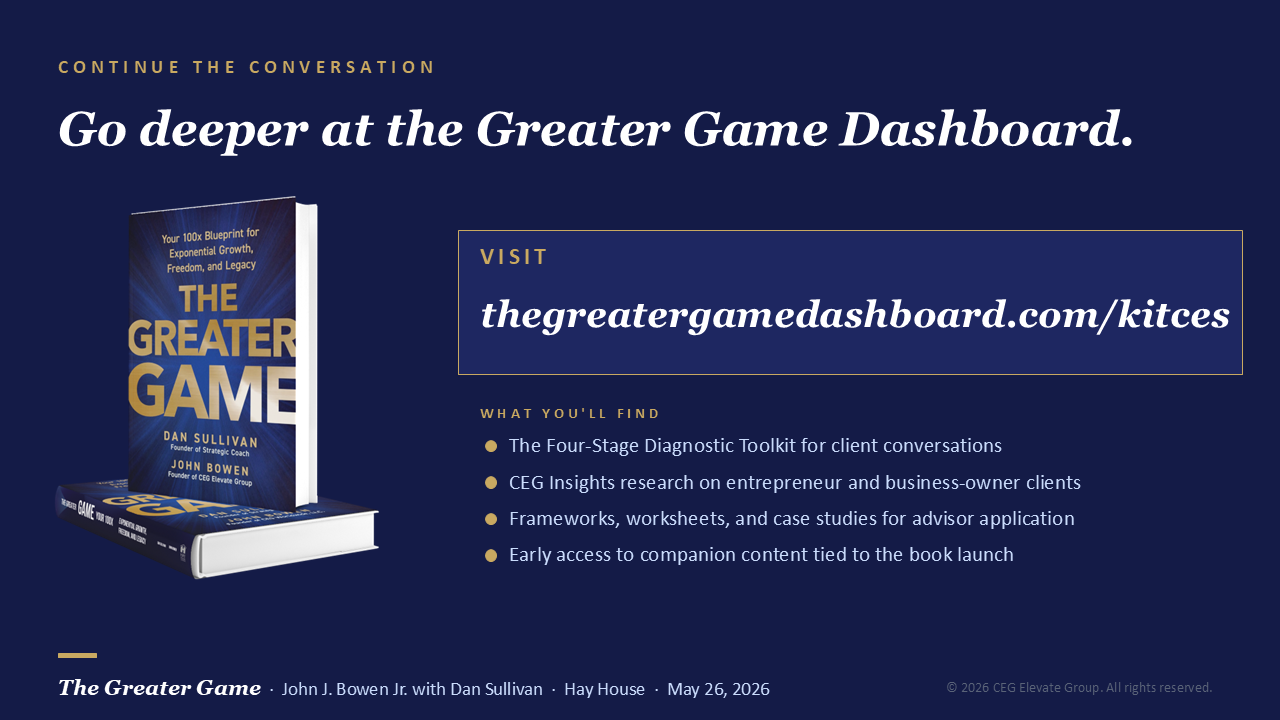
Michael: And again, this strikes me, it's more different than I think a lot of advisors realize of what these clients are really looking for to really wrap their whole financial picture together beyond the assets that get invested from the income that happens to kick off from the business. Just not really the center of their lives.
John: It really is.
Michael: Very cool. Very cool. Thank you again, John, for joining us and spending the time.





Leave a Reply