Executive Summary
Managing risks in the face of uncertainty has long been a staple of financial planning. From helping clients evaluate the risk/return potential of various investment opportunities, to recommending insurance coverage against the risks too big to handle, to making decisions about how much to spend today versus saving for the (uncertain) future, the whole framework of the financial planning process is a means to evaluate the trade-offs. Yet with the recent rise of AI, the uncertainty seems to have reached whole new proportions – where the trade-off isn't just the potential for significant growth or a market pullback, but according to some the potential for a post-scarcity utopia, or an artificial-general-intelligence destruction of humanity. Which raises the practical but remarkably difficult question: how should we counsel clients through such potential extreme outcomes?
In this guest post, Zach Bennedsen, CFP, a Product Manager for Advisor360°, explores how advisors can think through the incredible breadth of upside and downside scenarios for AI, and the ways to have practical conversations with clients about how they can plan for and within an era of such uncertainty.
The starting point is simply to recognize how diverse the views are about AI. Proponents of the technology sometimes forget the fact that 75% of Americans are concerned that AI will reduce the number of available jobs (with the risk of wage depression or outright mass unemployment). While those who are bearish on potential AI outcomes forget that prior transformative technologies ultimately created far more jobs than they eliminated (with 60 percent of jobs in the U.S. representing types of work that didn't even exist before 1940!).
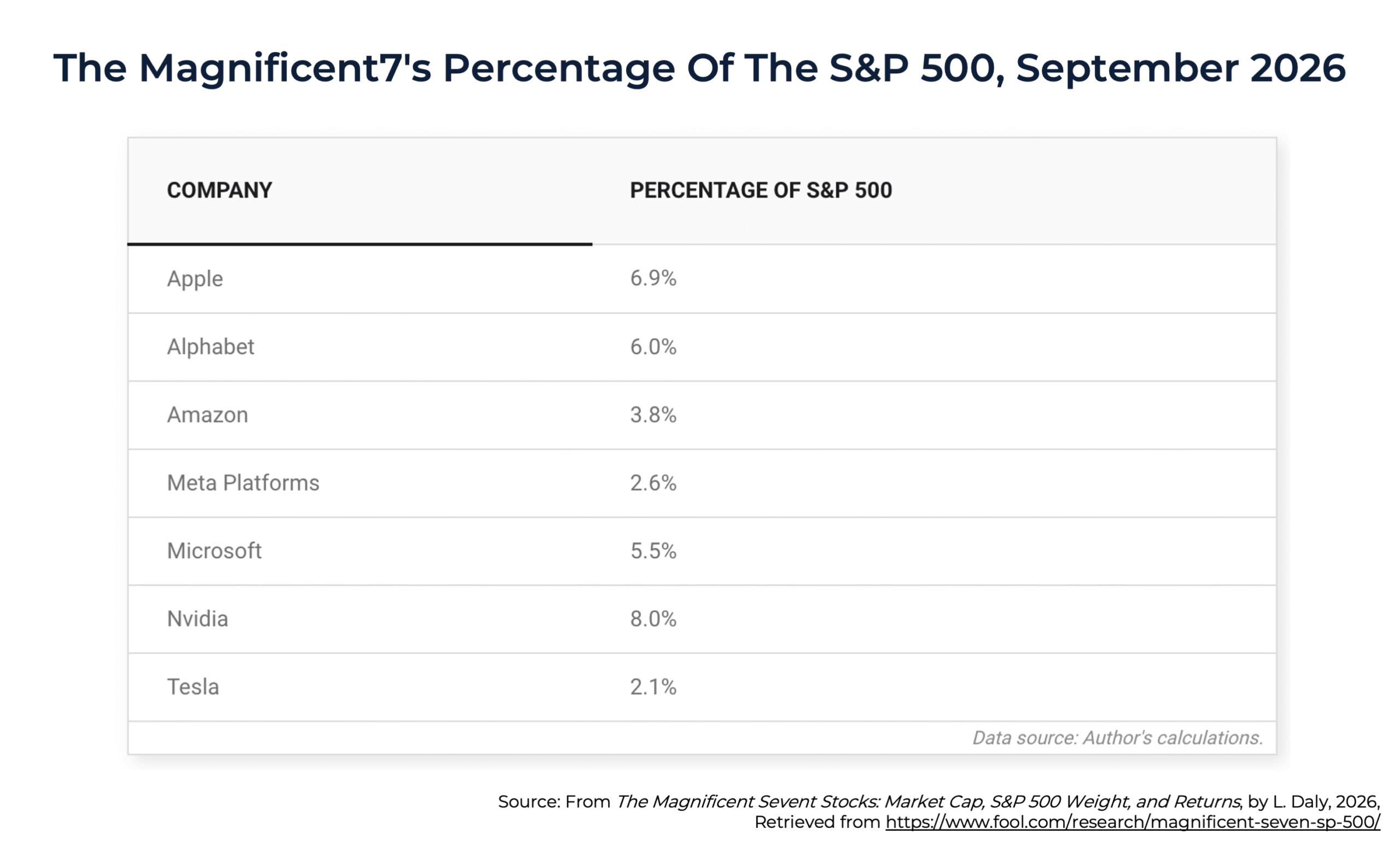
For many advisors, the first stage of advice will still be the client's portfolio itself. For clients who want exposure to the opportunities of AI, it's important to recognize that a broad-based diversified portfolio already actually has substantial AI exposure (as the AI-heavy Mag7 stocks already comprise 33% of the S&P 500 as of September 2026!). And that, at least until there are more IPOs, many of the leading AI businesses remain privately held and simply aren't investable. On the other hand, for clients who are fearful of or want to avoid AI, the broad exposure in market indices that supports AI enthusiasts makes it difficult for pessimists to avoid. Still, some paths are available, from leveraging direct indexing or new ETFs specifically built for non-AI exposure… or even donating AI-driven gains into non-AI charitable support.
For clients still in their working years, though, arguably the bigger impact is not the risk of AI impacting their financial portfolio, but their human capital in the form of their job and future earnings potential. Which may mean actively discussing larger – potentially much larger – emergency savings to help navigate a career or industry change should it become necessary. Though for some who expect AI to augment more than automate, the greatest career opportunity for many clients may simply be to continue delving deeper to become an expert in their current field, and leverage AI to accelerate their career further.
Still, with such extreme utopia-or-extinction level forecasts, some clients may simply be paralyzed by the sheer level of uncertainty. For which at least one approach is to not make predictions of how it will turn out, but at least take actions to try to protect against whichever scenarios will produce the most regret. For instance, the client who doesn't want to bother saving anymore – in the expectation that AI will soon automate away most work and make money meaningless – might reflect that if AI really does make money meaningless they will still have many years of happiness anyway, but if they're wrong they may severely regret not having continued to save.
Ultimately, though, the key point is that supporting clients through conversations about uncertainty is not new; what's changed, perhaps, is that at least the current forecasts about the potential of AI have amplified the potential outcomes (to the upside, and the downside). Still, though, that doesn't change the value of having financial planning conversations, planning through What-If Scenarios, and engaging in principles of building reserves and diversification… in fact, it arguably just makes financial planning more valuable than ever!
 |
And if you want to go deeper on this topic, hear directly from the author on the Financial Advisor Technician podcast. |

Listen To The Financial Advisor Technician Podcast On This Topic




Episode Shownotes And Transcript
Click to expand transcript and show notes↓↓
Title: Scripts For Addressing Clients' AI Uncertainty
Shownotes:
- Zach Bennedsen: LinkedIn | Advisor360
Full Transcript:
Adam: Hello, and welcome back to the "Financial Advisor Technician" podcast. I'm your host, Adam Van Deusen. On today's episode, we're going to discuss artificial intelligence and the various risks associated with it. While much discussion of AI in financial advisor circles has centered on its potential impact on the advisory business, clients are also seeing regular headlines about AI and how it might affect their careers and their portfolios. Which could lead many to ask their advisor about how AI risk might impact their financial lives, while those who hold strong opinions about where AI is headed might come to the table with their own ideas for how to adjust their portfolio in response.
So, to help us dig deeper into this topic, I'm joined today by Zach Bennedsen, a product manager focused on financial planning at Advisor360, to discuss the different types of AI risk, how advisors can engage with clients constructively around AI uncertainty, and a framework that can help shape these conversations no matter what a client's perspective is. So, welcome, Zach, to the "Financial Advisor Technician" podcast.
Zach: Thank you, Adam. Very happy to be here.
What "AI Uncertainty" Looks Like In The Financial Advisory Context [1:20]
Adam: So, to start, perhaps you could begin by defining what you might call AI uncertainty in the financial advisory context.
Zach: Absolutely. So, anytime a new technology comes along, and artificial intelligence is certainly a big one, there's going to be uncertainty in how certain parts of that fabric will play out. In AI, what I'm specifically looking at right now in the context of financial planning is how AI progress might affect a client's portfolio, their human capital, or their career, and job prospects, as well as a framework for how they might think about basically minimizing regrets as they make decisions around what they personally think might happen with AI. That one we'll get into a little bit later, I believe, because it's a little bit more nuanced. But basically, AI is what is called a general-purpose technology. You might see that parallel in ChatGPT. And so, big changes coming across the bay, with a lot of different takes, I would say, a lot of different perspectives on this. And so, anytime something's that sensitive and that uncertain, there are going to be conversations that an advisor can help their clients navigate that uncertainty.
Adam: Yeah. I think you mentioned this, but like the political realm, clients are going to probably come from all over the spectrum in this way. I can imagine some clients being very bullish on the technology, its prospects. But even for clients like that, you can be bullish on the technology, but that could be bearish for their careers, perhaps, if they think it really is going to be transformative, whether their specific career or business otherwise, whereas you might have many more skeptical clients who think, whether it's in terms of the ability of the technology to do certain things or what it's going to mean for the financial market. So, I think this is a really nice topic because advisors will need to be prepared for all these different potential conversations that could arise.
How AI Developments Could Affect Portfolio Management Conversations [3:16]
Adam: So, I guess let's jump in then and talk about how we can talk to clients constructively in different scenarios. So, you mentioned one area in portfolio construction. Maybe you can just lay the groundwork in general of what are the factors concerning AI that are going to be driving portfolio-related conversations?
Zach: So, as you mentioned, Adam, there's a couple of axes that someone might view AI risk along, their career, but also their portfolio construction. So, anytime there's a new technology, a new level of uncertainty, people will take different sides of that position. So, you'll have some clients that are very bullish about the prospect of AI companies and want to include that exposure in their portfolio. Other clients are going to be very bearish, be afraid that this will all end in a bubble and come crashing down, and will want to remove that exposure from their portfolio. Still others will want to keep it out of their portfolio for potentially ethical or moral reasons around things like energy consumption or, frankly, its effect on human creativity.
So, again, people can come from all different places with how they might approach AI vis-a-vis their portfolio. It's important to remember that the main AI companies, the frontier labs especially, are all privately held as of the recording of this podcast. That will change soon with Anthropic recently announcing their S-1. But right now, those main AI companies that people think about when you talk about AI are privately held, so those aren't even accessible really for clients to be invested in. However, the "Magnificent Seven", as they've been called lately, comprise 33% of the S&P 500 as of this fall. And all of those companies, so that's Alphabet, Meta, Microsoft, Netflix, they all have significant AI components of their own products. So, people already have this AI exposure in their portfolio whether they want to or not.
Now, that can make conversations around AI and portfolio construction difficult. It can potentially mean that for a client who wants more exposure, you can point them to the exposure they already have in their diversified portfolio. But for those who want to remove it, there are fewer options right now. There are a couple of ETFs that have come out, which are mentioned in the article itself, that have taken the contrary position to eliminate AI exposure from the portfolio. But due to the diffused nature of AI's effect on the marketplace at large, it's pretty difficult to pinpoint removing those. So, we've talked in the past about things like ESG investing, where you might build your own funds. But it's pretty difficult to see in behind the curtain to see which companies are using AI and which aren't to run those screens themselves.
So, this is an evolving space right now, but I think the important piece is for clients who want the exposure, it's really already there. And for those who are looking to remove it, you can always point to the values of diversification to state that while your portfolio may have exposure to this, you are not necessarily overloaded based on the rest of your exposure.
Adam: Great. And Zach noted there that he's written an excellent article on this topic for our Nerd's Eye View blog. So, if you're interested in checking that out, you can go to kitces.com/FAT18 to read that article, which has a lot more detail on the different types of AI risk, a lot of great example conversations advisors could use as a reference. So, please check that out.
How Advisors Can Respond To Different Client Perspectives On AI [6:50]
Adam: All right. Well, Zach, thank you for doing that rundown on portfolio considerations. So, why don't we jump in, maybe doing some sample role-plays here. I'll be the client, and perhaps you could give an example of how an advisor could consider responding in such a situation. So, let's say I'm Client A. I'm coming in. I'm just really nervous about AI. I've been reading all these headlines, Zach. I just think every stock that I have in my portfolio, in my index fund, from Alphabet to Meta, is just all in on AI. I was an investor during the dot-com crash, and I saw what happened then. Now that I'm closer to retirement, I'm really worried about losing 20%, 30%, 40%, 50% of my portfolio again. Zach, my advisor, what should we do about this?
Zach: Absolutely, Adam. And so, we're pinpointing AI exposure in this specific case, as you mentioned, having lived through the dot-com crash, maybe the '07, '08 market crash. There's always something, whether it's AI or some other level of uncertainty. Uncertainty is risk, and risk is the reason that we have return in our portfolios. Without that risk, there'd be no return, and we'd all be sitting in cash, which is really the only certain way that you won't be able to meet your goals. So, we know that some level of risk is going to be necessary. It's just a matter of how much exposure to it you have and how we can smooth that risk out through diversification. So, yes, you have exposure to companies involved in AI, and yes, there is always the risk that portfolios can have a downturn.
At the same time, in this hypothetical, let's say I have a globally diversified portfolio where you have investments outside of the U.S., you have investments into more traditional industries that aren't directly affected by the ebbs and flows of the technology marketplace, and again, hypothetically here, let's say that you also have a 30% allocation to bonds, which can bridge you through five to six years of a downturn where you could tap into the bond portion of your portfolio versus the equity portion if there were a downturn. Now, of course, if you wanted to make changes to minimize exposure to the technology sector, we can always have that conversation. Again, at the end of the day, advisors are beholden to the investors' opinions in that regard.
But from the advisor perspective, stepping slightly outside of my role-play here, we'll notice that the tools aren't new. It's the same conversation. It's just a different subject. Advisors have the tools available already to be able to hold conversations about portfolio uncertainty with their clients.
Adam: Yeah. And I think that's a really good point. I know a lot of advisors out there are looking to create the diversified portfolio. So, recognizing that that forgotten bond allocation that maybe they were concerned about a couple of years ago, worried about having too much in bonds when stocks were flying pretty high, is now perhaps serving as the ballast that could provide some support in case of a downturn associated with AI.
Zach: Absolutely. As you mentioned, it's been a run-up for a long time now. And so this is perhaps an opportunity for advisors to again signal value through the fact that they have been looking ahead. We don't know what the uncertainty will come from. If we did, it wouldn't be uncertainty. But this is why portfolios are built in a certain way. This is why financial planners build robust plans that can be steady in the face of uncertainty.
Adam: All right. Very good. All right. So now Client Adam has had a total change of heart, or he's a totally different person, let's say, coming to you and is now saying, "I've been reading so much about AI, and I'm convinced this is the technology of the future. These AI companies, I've just seen the growth rates. They're just going to shoot through the roof. I think I need more exposure to this because I need to get the high returns that can come with it, and I don't want to be left behind. So, what could we do, or should I supercharge my portfolio with AI-related stocks?"
Zach: Yeah. Absolutely. And so, this conversation in some ways is easier. I think, again, pointing out the fact that your U.S. large-cap exposure, which I would hazard a guess that almost every client of an advisor has some level of exposure there, already has a significant weighting towards technology and artificial intelligence. So, you have these exposures right now. And as the AI marketplace wins, your portfolio will also win. Now, if you want additional exposure, where we sit right now, unfortunately, some of the main companies that might be on your mind, whether that's an OpenAI, an Anthropic, are not available for investment to you or really to anybody outside of the company. And so, that's a little bit off the table for us right now.
Now, whether it's AI, whether it's cryptocurrency, whether it's a client's pet investment that they are interested in, it's not an uncommon framework for advisors to help clients set up a fun money fund. And so, in this hypothetical, Adam, if you were super bullish, super gung ho about AI and wanted to identify some companies that you wanted to take a bet on, again, with the understanding that these are not the core funds that will help fund your future, but rather something to make an informed bet on, again, it's the client's money at the end of the day. Advisors can always help clients right-size that portfolio such that if they pick winners, great. If it doesn't happen to work out in their favor, they haven't unnecessarily handicapped their portfolio's ability to fund their future.
Adam: Yeah, again, just like we saw on the concerned person at the front, during hot times when there's either hot stocks or industries, the advisor's probably heard this conversation before, "Should I be more exposed to it?" So, while AI developments have been newer lately, it's very similar to what we've seen before.
So, now let's see. You mentioned this one a little bit before, but let's say I'm coming to you as the client, and I'm saying, "Hey, it's not that I'm skeptical of AI, I just don't like it. There's a data center going up in my city. I don't like it. I just don't like where it's heading, what it means for writing and humanity and things like that. So, I would actually like to avoid having AI-related stocks in my portfolio." So, if a client comes to you with that, how might an advisor respond?
Zach: Absolutely. That one is the most challenging at the moment because of that diffused nature that I mentioned, where the technology really has crossed across many different industries here. However, there are a few specific ETFs... one we mentioned in the article is a heavy assets ETF that removes a lot of the technology pieces from a portfolio. There's also a new SPXXAI, so S&P 500 ex-AI index. It's not available for investment right now, but it is an index that is being tracked. So, strategies advisors could take with clients who are very against having this exposure in their portfolio would be more akin to how advisors handle other ethical or moral considerations in the portfolio context.
So, the lens of ESG, or environmental, social, and governance, investing tied with direct indexing, where individual funds are used to comprise an index to give clients similar exposure to something like an ETF or a mutual fund, can be utilized here. So, for example, looking at that S&P ex-AI fund, an advisor who had a client very interested in removing these pieces from their portfolio could use a direct indexing strategy to remove those. Another perhaps more elegant strategy, or at least an easier one to implement, is, just like in cases with ethical and moral considerations, to invest in the market at large and create some policies to take what you could call, "the ill-gotten gains" from AI exposure and use them to fund causes that are important to that client, perhaps in ways that would lead to things like energy conservation or the preservation of arts or other pieces, outside of the economy, but of our society that might be susceptible to AI disruption.
Adam: Yeah, that's a good point. So, again, there are parallels here to things that advisors have seen before, ESG investing, things like that. Though, as you noted, I think a key point here is it could be a little bit trickier, whereas maybe there's someone out there who really wants to avoid oil companies, for example. So, the main oil companies are pretty specific, are easy to identify, and not invest in, let's say, through a direct indexing strategy. But in this case, as you said, AI goes across a lot of companies in different ways. You have, as you mentioned, the OpenAI, etc., who are not yet, at least, available to invest in, but the major other tech companies, Google, Amazon, Meta, are exposed to it down the line. So, it could be trickier.
So, as you mentioned, this could be a case where it says, "Hey, we'll keep our diversified set of investments, but would you be interested in...we can talk about your charitable giving program and how we might use potential gains from that for there." So, I think that's a really interesting application.
Adam: All right. One more here. Let's say someone is totally bearish on AI and says, "Hey, I'm not just concerned that we could see a downturn. I am certain this bubble is about to pop, and I want to bet against AI." How might an advisor approach that type of client?
Zach: I think this is similar to conversations that advisors have with clients, again, about any other subject they might be bearish about. There will always be clients at any time in an advisor's book who are screaming to run for the hills, and this time will be no different. So, I think the same tools that advisors have used to keep their clients from fleeing to cash or making bets that have a one-sided exposure are the same tools that they will be able to put into place here. So, in the case of AI, again, there are not necessarily funds available right now to take a contrary bet to a high degree. But there are ways to tilt a portfolio towards more traditional industries, less exposed pieces of the marketplace. But it is, again, the same tools to keep a client invested, to keep them on track, and not make decisions that will hinder their future.
Addressing Potential Client Career Disruption From AI [17:19]
Adam: All right. Now let's shift gears a little bit. So far, we've been largely talking about the portfolio impact of AI. But one of the main topics of conversation around AI uncertainty and AI risk has been around careers and what AI might mean for the job market of the future. So, if I'm an advisor and I have some clients who are still in their working years, I imagine I might get a question that says, "Hey, what is the risk of my financial plan to a career disruption?" Perhaps in the past you've modeled what would happen if you had six months or a year of unemployment, but if we're looking at something that could be even more impactful for that, how might an advisor approach that conversation, and what sort of planning levers are available to help reassure clients?
Zach: Absolutely. I think the main lever available, or the main tact in this place, is to hold conversations with the client to help them understand what their AI risk or exposure might be. One of the metrics that I found useful in this regard is to help clients think about automation versus augmentation of their job.
And so, if we use historical examples, a canonical example that comes up often when we talk about technology disruption of the job market is the power loom and its effect on hand weavers. Now, that was a job that absolutely was automated away by the advent of new technology.
However, other jobs, such as skilled carpenters or, right now, potentially software engineers, are experiencing what I would call augmentation, not automation, of their roles, where the technology is actually helping to increase the value of their labor. A skilled carpenter who has access to better tooling can perform jobs quicker and potentially with more accuracy than with hand tools. A software engineer with access to the latest version of Claude Code can potentially be a 10X or 100X effective engineer versus themselves coding "by hand."
So, I think that's an important framework to help clients think through where they can take advantage of the technology to stay on top of their career path versus where they might have exposure such that their job might be disrupted in a deeper manner. At the same time, this again ties into other parts of things like the emergency fund, other risk management tools that clients have always had built into their financial plan. So, in this case, it really is the idea of staying aware of how AI has affected anyone's individual career and thinking of ways to help them navigate that uncertainty through that new lens.
Adam: Yeah. And within the article that Zach's written, he has a really interesting graphic in there that shows various careers and where they stand on these axes. So, that could be a helpful starting point for some clients, although I'd imagine many who have been in their careers for a while have probably started to recognize where they might be and where AI could be fitting in. But I like that idea here of expanding the conversation out just beyond the portfolio because that might be where a client goes first.
Especially for someone who might have years or decades left in their career, that human capital is one of their more valuable assets. So, being aware of that risk and help clients plan for different contingencies seems like a really great way for advisors to offer value there.
Using A "Regret Minimization Framework" For Making Decisions Around AI [20:39]
Adam: So, I guess now stepping back and the bigger picture, in your article you introduce the idea of having a regret minimization framework for handling various AI issues, no matter what question the client comes to you with. So, could you explain that framework, and then maybe we can jump into a couple of potential applications?
Zach: Absolutely. And so, I think the important thing to preface this part of the conversation with is that informed, intelligent individuals have very disparate, divergent viewpoints on where artificial intelligence might take our future. For instance, there are some people out there who, as Adam alluded to, think this is going to lead to a huge bubble, going to lead to a widespread economic downturn, or perhaps even scenarios where the computers take all of our jobs and there is no job marketplace anymore. Other people think that the computers will take all of our jobs again, but it will lead to somewhat of a post-scarcity, post-money utopia where the AI is performing the jobs that provide economic value. Everyone else can then focus on their own creative pursuits.
We don't need to get into, I think, anyone's personal takes on this, but can still understand that clients are going to come from multiple different viewpoints here. And so, advisors should be ready to speak to multiple different viewpoints and to hold space for those conversations. Now, in the case of the regret minimization framework, what I'm thinking about here is a client who does walk in and is thinking that AI is going to usher in an era of post-money utopia, and therefore they don't need to save for their future anymore. The kind of levers that were available before, the mechanism of saving for retirement and then spending down after retirement, is no longer valid, and therefore they can just spend their money now and wait for the AI to usher in the post-money economy.
In the regret minimization framework, what's important to remember is if they are right about that bet, great. They spend some extra money in the meantime while they waited for that kind of utopian future. But if they're wrong about the bet, that's when things go awry. The other case, if they believe that post-money utopia is coming, but they still save diligently just in case, they have provided themselves with an escape valve, so to speak, if the future doesn't turn out the way it does, or rather in the way that they were hoping. But if it does turn out that way, yes, they turn down some additional consumption in the interim. But hey, if we make it to a post-money utopia and we can all focus on our creative pursuits for the end of days, I think everyone's still going to be pretty happy even if they save a little extra along the way.
Adam: Yeah. And imagine it works the other way too, the person who's concerned or bearish about AI, which is that, hey, if you're putting all your chips against AI, you might have some regrets if it doesn't turn out that way, whether in the form of missed appreciation on your assets, things like that. And of course, in that scenario, just like getting out of the market in general, you have to be right twice in terms of getting out and coming back in and perhaps doing a buying high and selling low type scenario. So, I'd imagine that's probably a good conversation for a variety of perspectives coming in from the client side.
Zach: Absolutely. I would say the framework, while I'm applying it to artificial intelligence uncertainty here, is helpful across the board for advisors to help a client just run through the thought experiment of "All right, if I made this decision and my hypothesis is true, what happens? If it's false, what happens?" And then taking the converse of that. I find that a very helpful framework to help advisors and clients just navigate uncertainty through whatever lens is relevant at the time.
One Key Takeaway For Advisors [24:33]
Adam: Yeah, great point. So, Zach, given that we've covered a lot of ground today, what would be your one key takeaway for advisors when thinking about working with clients amidst uncertainty around AI?
Zach: Absolutely. I think we've weaved it into this conversation already to a large degree, but it really is that advisors already have the tools available to them to help clients navigate uncertainty. Uncertainty and risk are nothing new for advisors, and frankly, those conversations are some of the most valuable that you can be having with your clients. And so, while the lens now is AI uncertainty and some of the details might be new, the general playbooks available, the general philosophies that advisors have brought to help their clients navigate uncertainty have not changed. So, again, there's always something new, but in a lot of ways it is same as it ever was, even in the face of potentially transformative technology.
Adam: Well, that is a great place to end. So, thank you so much for joining us today here on the "Financial Advisor Technician" podcast, Zach.
Zach: Thank you for having me, Adam. I appreciate it.
"Risk" may well be one of financial advisors' favorite words (along with the phrase "it depends"). Market risk, idiosyncratic risk, risk-adjusted return… the modifiers are extensive, and all represent opportunities for us as advisors to help our clients navigate. In the past few years, a new prefix has joined the list: "AI-Risk".
Risk is, at its core, uncertainty. And the uncertainty introduced by artificial intelligence's rapid spread through the fabric of the economy – and society – introduces a unique type of risk. AI is rapidly transforming many facets of daily life in ways both mundane and profound. The question becomes – are advisors prepared to help their clients navigate this new form of uncertainty?
AI Uncertainty For All (It's Not Unique To Financial Planners)
As a community, financial advisors have become acutely aware of the risks (and opportunities!) of the uncertain AI future, and are actively exploring how these technologies will affect their business.
Some corners of the industry insist on the impending death of the financial advisor as a profession (perhaps swallowed whole by ChatGPT's personal finance chatbot), while others see the ability to super-charge their productivity (through the use of Anthropic's Claude plugin for wealth management, or myriad other AI-powered AdvisorTech tools). Still others see a chance to differentiate from AI-created ‘advice-slop' through their humanness. If one thing is consistent, it is that each advisor has their own nuanced opinion on how AI will affect the future of the profession.
As in this space, so too in others – it's fair to assume these AI conversations are not unique to financial advisors. AI usage has permeated across society at blazing speeds, spurring innovation (and controversy) in fields from education to farming to – indeed – financial advice. Over 50% of U.S. adults are using AI chatbots in some capacity, with many facing company mandates to utilize the technology in the workplace.
Yet while usage is high, over a third of consumers are more concerned than excited about AI's impact on the future. In a July 2026 poll, 75% of respondents expect AI to reduce the total number of jobs in the economy. Knowledge workers – historically a core demographic of financial advisors – are perhaps most at risk of transformational role change or job loss due to AI progress. Which at best means those clients have to navigate a higher level of uncertainty about their future careers, and at worst may face a severe financial disruption to their livelihood and ability to save for their long-term financial goals.
On the flipside, certain technical roles have experienced exponential efficiency gains, and thus provide exponentially more financial value in an AI-driven future. Perhaps the key factor of AI uncertainty is the bi-directionality of the risk – things could go unfathomably well, or unfathomably poorly.
The question is, what tools – both functional and psychological – can advisors employ to help clients understand, adjust to, and try to plan for this uncertainty?
Before reviewing potential strategies and conversational frameworks to help address client concerns around AI uncertainty, it would be helpful to define more specifically what we mean by "AI uncertainty".
Defining AI Uncertainty
Transformative AI Risk
The term artificial intelligence, or AI, has been part of our lexicon since the 1950s. However, beginning with the launch of ChatGPT by OpenAI in 2022, the term has been on everyone's tongues seemingly nonstop. From conversations with a helpful chatbot to a flood of artificially generated text and images, we bump into the effects of AI on a daily basis.
Researchers have highlighted that AI is a "transformative technology", or one that can fundamentally change industries, economies, or human behavior. But AI is not the first transformative, or "general purpose" technology in our history; previous examples include steam power and the airplane.
Some of the changes caused by AI are mundane, such as the ability to generate a LinkedIn post off of a one-sentence prompt. Others are profound, like breakthroughs on decades-old mathematical problems previously thought to be unsolvable. Still others are uncanny, like the ability to generate (almost) life-like images of events that never happened, or the forming of romantic relationships with an entirely artificial being.
While it is an overstatement to say that AI has changed the lives of everyone on earth – and there are certainly many who resist AI's ingression into their lives at all – it is fair to say the technology has transformed, even in small ways, the lives of many. And while one can make a personal choice to avoid the usage of AI in their lives, anyone who wishes to participate in the modern economy is not offered such choice.
Many careers, particularly those traditionally considered ‘knowledge work' have been disrupted by advances in AI's capability. This is particularly true in technical fields such as computer science. Functions that historically needed a team of experts at the wheel can now be accomplished by AI, or by a single expert prompting that AI. This has led some to question the future of careers that have, to date, been considered safe bets for those seeking positive economic outcomes for themselves. As AI improves, the uncertainty about which careers will prove valuable evolves.
However, this uncertainty does not imply only negative outcomes are possible. Some claim that entire industries will be rendered obsolete, while others believe that new technologies will create a small upper crust of 10X (or 1,000X) workers, each utilizing a small army of AI agents to leverage their productivity. In this latter scenario, some look towards a post-scarcity utopia while others see the traditional mechanisms of personal wealth creation destroyed, leaving all but a select few without a way to fund their future (while those that land in the ‘upper crust' may achieve disproportionately favorable financial outcomes).
Existential AI Risk
Transformative AI risk pertains to uncertainty as it relates to how AI may change their daily lives. On a more philosophical level, an entire new field of study has spun up around the idea of Existential AI risk, or "X-risk". While the ideas put forth by this field are myriad, the core concern is that, as AI continues to develop towards super-human intelligence (often called AGI, or Artificial General Intelligence), it may acquire goals that are at odds with those of its creators (or humanity at large).
The key concept is "alignment", or whether or not an AI's goals agree with its creator's. At its worst, misalignment manifests in thought experiments such as the paperclip maximizer problem, where a rogue (unaligned) AI's goal to maximize the number of paperclips on earth without constraint leads it to unwittingly use all resources to achieve this goal… at the expense of undermining the entire world's economy.
While these examples might sound a little too close to Arthur C. Clarke's HAL 9000 (or suggest protections akin to Asimov's three laws of robotics to avoid the ‘unconstrained' outcomes), the study of AI X-risk has attracted intellectual elites from fields far and wide who believe this is the most important problem facing society today. Those partaking in the AI-futurism conversation assign a probability of doom or "p(doom)" to establish what they personally think are the chances that AI development leads to the end of humanity as we know it.
Axiomatically, this probability is risk, and risk is the stuff of markets. This leads us closer to home for the financial advisor, where research papers have reviewed how AI X-risk may already be priced into (and help explain the recent rise in) long-term interest rates.
While X-risk is the most dramatic version of the AI uncertainty conversation, it is one that could well come up from clients. And even for clients who are not considering AI uncertainty through an existential lens, it's likely they have some sort of opinion on the technology!
Disparate Opinions, Divergent Outcomes
Financial advisors may be tempted to scoff at the notion of AI X-risk or some of the further-flung ideas about how society may be organized in a post-AGI world. Yet it's important to recognize that a divergence of views suggests that it is on the minds of many. It seems there are equal numbers of smart people shouting from the rooftops about impending doom as there are who are minimizing AI's potential effects on society and the economy.
It's important to recognize that AI isn't the only topic on which reasonable people can disagree. Politics, morality, family values, charitable intentions…advisors are well-versed in wading into sticky, potentially emotionally charged, subjects with their clients. Intelligent individuals have wide-ranging opinions regarding AI's potential impact on the future.
Advisors can expect their client base to hold a similarly wide range of opinions.
One of the things that makes the AI conversation so challenging, and the range of opinions so wide, is that the uncertainty presented by AI development is not simply upside risk or downside risk. It's both, at the same time, with incredibly long tails in either direction. AI could usher in an era of post-scarcity, or it could lead to the destruction of all jobs. It could lead to dramatic advances in healthcare and drug discovery, and it could make it easier for hackers to steal sensitive information through increasingly convincing deepfakes.
It's exactly the two-sided nature of this uncertainty that leads to interesting planning opportunities – and conversations. Some clients will be focused on protecting themselves from the potential downsides of AI. Others will be all-in on the upside. Perhaps AI will simply make us all a little more efficient and a little busier, as we otherwise go on about our days.
But for clients concerned about one or the other extreme, advisors will be charged with creating strategies, and cultivating client sentiment, that consider both downside protection and upside exposure.
Engaging With Clients Constructively About AI Uncertainty
While questions about AI uncertainty may tempt philosophical discussion, we can reorient towards more tangible courses of action. AI risk is not the first, nor the only, macro-scale uncertainty that affects a financial plan. To ground ourselves from the hypothetical towards the actionable, let's review key components of a financial plan and explore how AI uncertainty may affect a financial plan.
Portfolio Construction
First, let's address AI risk through the lens of portfolio construction. How can advisors have grounded discussions with their clients about the effect of AI on their investments? Perhaps a client insists on betting on AI with their portfolio – how might an advisor respond?
To start, AI-specific companies, particularly the frontier labs, have typically been privately held – for example, Open AI was valued at $1.25 trillion in its latest private funding round. Clients may experience a fear of missing out – or FOMO – due to the fact they couldn't own a slice of these purported rocketships. Further, these companies have been extremely guarded about secondary market sales of company stock, going so far as to block former employees from participating in secondary sales. While the investing opportunity is set to change with Anthropic's IPO and rumors that Open AI may follow, the concern also arises that the bulk of the gains may have already gone to private shareholders (and that buying into the IPOs may have significant downside risk even if AI adoption continues to grow).
However, other companies making heavy investments into their AI offerings (e.g., Alphabet, Meta, Microsoft) are public, and are likely already owned in a client's portfolio. The Mag7 stocks, all of which are at least partially AI companies, comprise 33% of the S&P 500 as of September 2026, meaning virtually all client portfolios already have significant exposure to (and may already be benefitting from) AI upside. And with Anthropic's introduction to the NASDAQ, many clients may receive investment exposure to a frontier lab by virtue of index investing.
For those clients who are very bullish on AI, however, diffuse exposure may not seem like enough. These clients may wish to take bets on individual companies who they foresee as outsize winners.
An advisor (and their client) would do well to look at historical industry-wide bull markets and remember that, even when an entire industry wins, it's difficult to correctly choose the specific companies that survive, let alone win. The dot-com era saw the rise of a now dominant technology: the internet. While it's undeniable that ‘the internet' established itself into the fabric of society after this period, only 48% of web startups survived during the dot-com boom, regardless of funding or size. A win for a general technology does not guarantee a win for a specific company, which is part of the long-standing case for taking on diversified exposure even and perhaps especially to new types of market opportunities.
Factoring client exuberance about a particular industry, technology, or stock into a financial plan is nothing new for advisors. But what about clients who are bearish, or ethically opposed, to AI exposure?
There's a growing anti-AI sentiment in the public discourse, often centered around environmental concerns due to data center energy demands. If a client wants to limit AI exposure from their portfolio, is that even possible? Now, that same diffuse exposure to AI in a typical diversified portfolio is a problem rather than a boon.
Traditionally, if a client wanted to exclude a certain industry, stock, or geographical region from their portfolio on moral grounds, they could look to ESG investing options. However, to date, there are no out-of-the-box funds that exclude AI exposure.
An advisor could use a custom direct indexing strategy to exclude certain stock or ETF tickers, but we run into two issues: (1) the diffuse nature of AI exposure and (2) the fact that the AI companies with the biggest mindshare (and controversy) are still private companies, and thus are excluded from the typical client's (publicly-traded) portfolio by default already!
So, for a client who wishes to stay away from AI for ethical reasons, the better solution may be to work with them to target non-profit organizations that help advance causes they care about, and donating a portion of any ‘ill-gotten' gains the advisor may calculate can be traced to AI exposure. And, for those who are bearish on AI and want a counter-exposure, funds are beginning to pop up (such as Roundhill's Heavy Assets and Low Obsolescence ETF, ticker: LOHA, or Goldman's S&P 500 Ex-AI Index, ticker: SPXXAI, currently only available to Goldman customers) that could help a client take an anti-AI bet with their investments.
Lastly, for clients who are worried about massive valuations of AI companies and a potential AI bubble, advisors can further emphasize the benefits of diversification, along with traditional risk management techniques like holding greater bond allocations, and other traditional portfolio strategies they may employ to help clients stay the course through downturns.
To bring these concepts to life, let's review the case of Minnie and Max, a couple with different opinions on AI's effect on their investments. Their advisor, Bala, helps to bridge the gap.
Client Conversation 1
(Advisor): Max, before this meeting, you had sent over some more companies you'd like to invest in, mentioning how bullish you are on AI progress right now. Before we make any changes to your portfolio, I do want to point out that you already have significant exposure to some of the biggest names in the AI space right now, through your U.S. large-cap funds.
Max (Client): Sure sure, but I think these companies are going to dwarf returns from the rest of the market, so it seems like a wasted opportunity to not get more exposure.
Minnie (Client): Hold on, I totally disagree! Like Bala's chart says, our U.S. stocks are already a third invested in tech! These companies have grown so fast…how do we know this isn't another dot-com boom and bust cycle?
Bala: That's a fair point Minnie. While it's always easy to say "this time it's different", it is helpful to look at other historical runs like this. We can't say "we're in a bubble" for certain, or even if or when it would pop if we are. But, there's a reason we've agreed to a diversified portfolio with exposure to multiple industries and regions. It's also why we have an allocation to fixed income – we can never predict when things will flip from bull to bear, but we'll be ready to bridge a downturn when it comes. For Max – I understand the desire to load up on the ‘winners' here. We've already established a "fun money" account for you to pick companies you're excited about. Would that be the best place to increase this exposure? That way, if they really are huge winners, you still get to participate in the return. And if things don't go as anticipated, the core portfolio is still on track.
Max: Fine…I may want to add a bit to the fun money account for these bets, but I'll talk it over with Minnie first.
Client Careers And Human Capital
Constructing a portfolio to incorporate a particular hypothesis regarding AI is one thing, but how might one incorporate their thoughts about AI into their career?
It may be tempting to look at the pace of technological change and predict the collapse of certain career paths, and there is certainly no lack of Cassandras doing exactly that. However, it's important to remember that AI is not the first transformative technology to disrupt our economy, and we can look to historical examples to see how things have played out before. Historically, technological changes lead to acute shocks to specific industries coupled with overall economic gains, and in fact to more jobs in the market at large.
Of course, this was no solace for the Luddites when the power loom took away their livelihood as weavers.
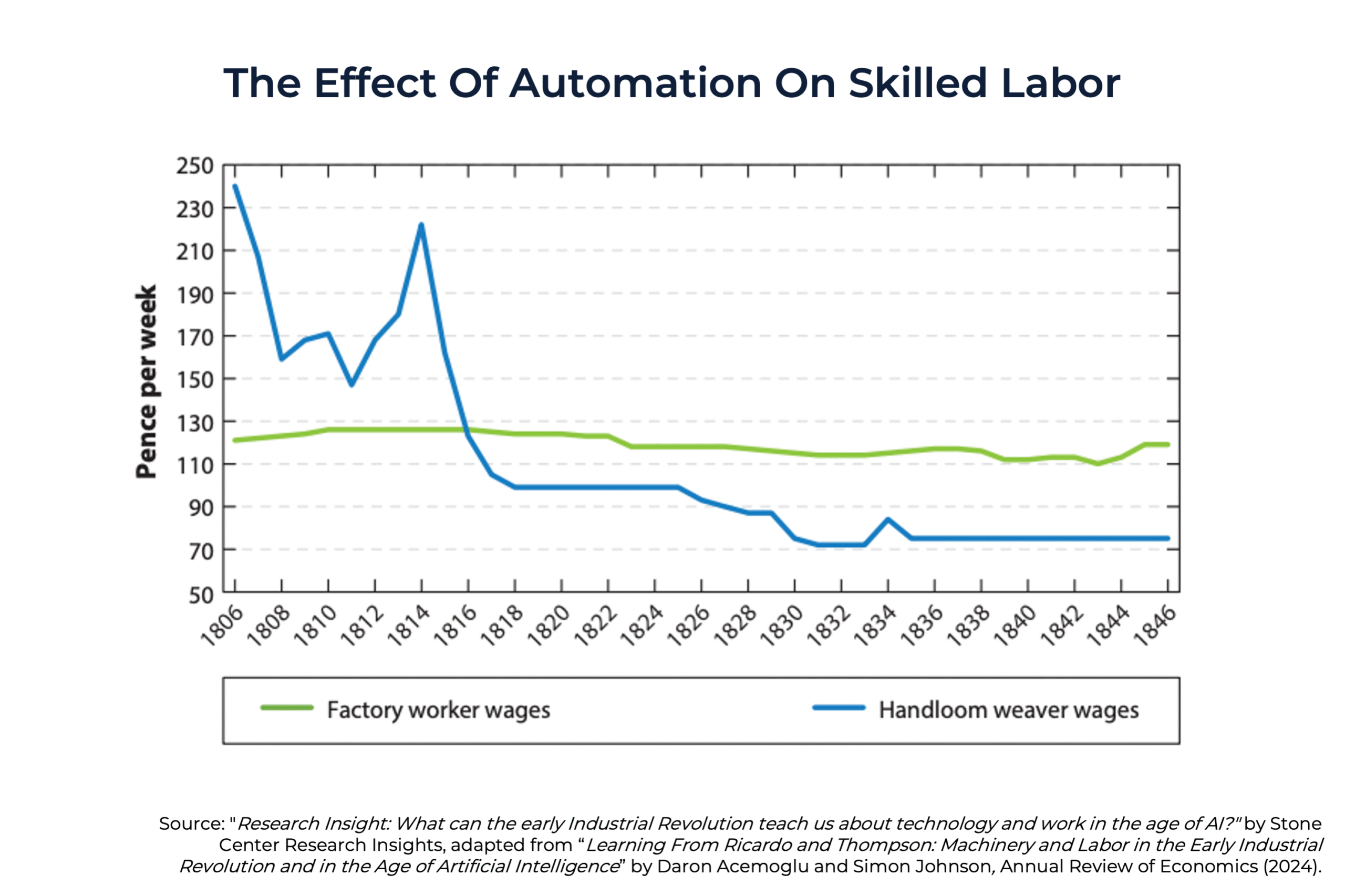
With new technology it can be difficult to accurately predict which specific job functions will be displaced. Will software engineers be the AI generation's weavers, with their jobs automated away entirely? Or will they be our new AI-augmented economic elites, turning out immense volumes of code that create incredible one-person businesses? Will manufacturing jobs become completely obsolete? Or will there be a shift towards hands-on work that computers can't do?
The question of automation vs. augmentation comes up whenever a new technology disrupts a field. In some cases, like that of the aforementioned power loom, a previously skilled job is automated away, decreasing the value of that particular labor. In others, such as the advent of power tools allowing a skilled carpenter to become much more efficient, technology increased the value of labor. It's still unclear which jobs may be automated, and which augmented, by AI, and projections vary widely on how particular roles will fare.
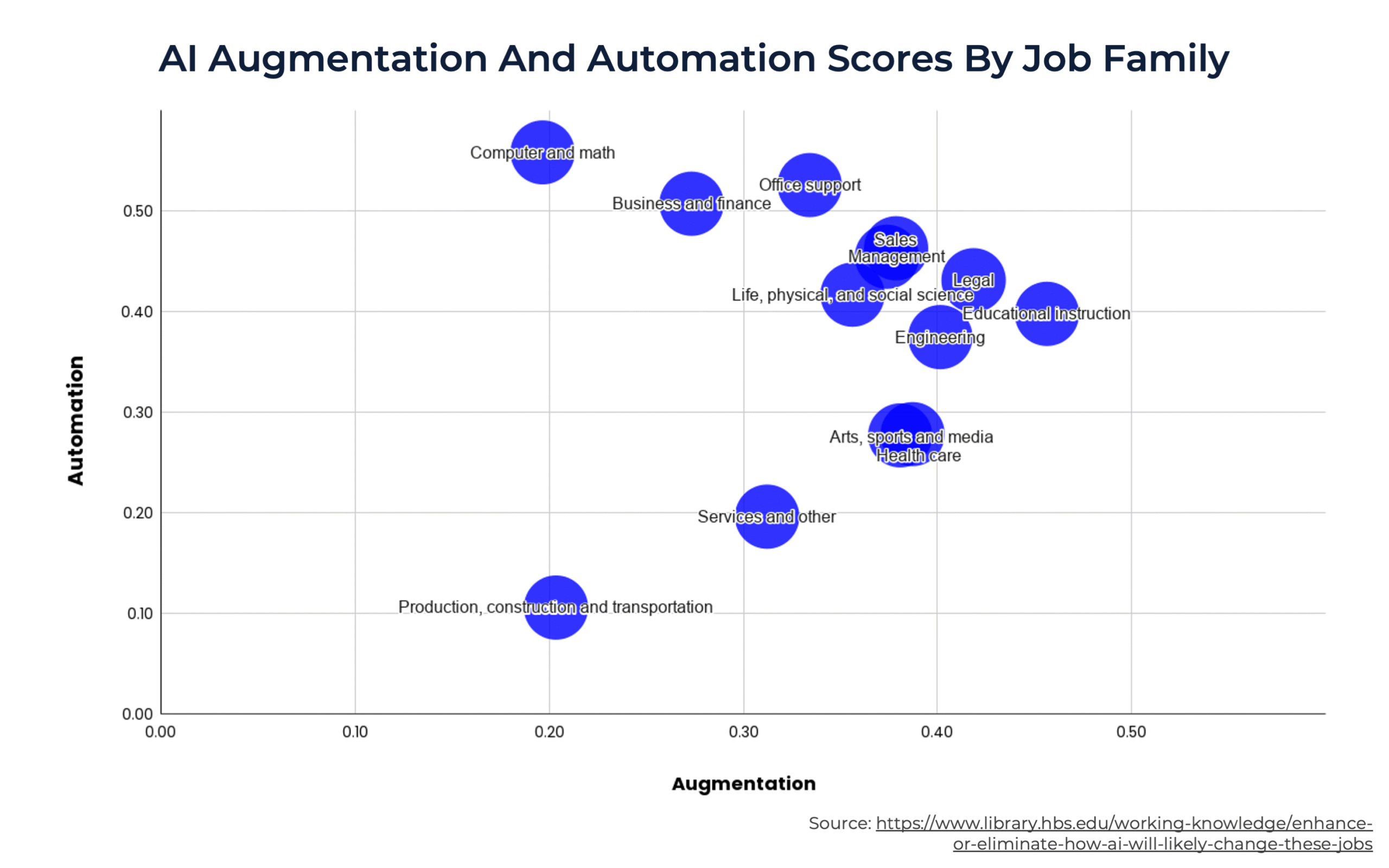
Another important concept is that new technology doesn't simply destroy (or change) existing jobs, it creates entirely new ones, oftentimes ones that weren't imaginable before the technology existed. 60% of jobs in the U.S. represent types of work that didn't exist before 1940. As technology changes, so do potential career paths.
The lens of human capital planning proves useful to help clients who are feeling anxious about AI uncertainty with regard to their career. Human capital is the economic value of an individual's skills and experience. Just like financial capital, human capital compounds over time, and comprises the knowledge and network that one cultivates over time.
Financial advisors already have a role to play in helping clients navigate career decisions, from evaluating job offers to negotiating equity compensation packages. After all, for those with many working years ahead, increasing income, rather than reducing spending, is often the most effective way to lift long-term financial success.
To that end, in an era of AI uncertainty, advisors may be expected to become more actively involved in strategic career planning with their clients. Just as an advisor helps identify the risk of a concentrated investment, or the lack of an estate plan, helping clients evaluate how their careers may be affected by AI could become more common.
In some ways, this is no different than evaluating other macro-risks. Hard times can hit the entire job market at once, so most advisors are already discussing emergency fund and cash buffer strategies with clients. For clients who are more concerned about potential AI disruption to their career, advisors may consider bolstering their typical cash buffer recommendations to account for increased uncertainty.
In good news, some of the careers that may be most at-risk for AI disruption in the long-term are ones that have done very well, financially speaking, in the recent past. Clients in the technology sector, especially those with equity compensation, may wish to set aside some of their gains from their company stock growth in recent years for a specifically earmarked AI-uncertainty fund to protect their future years.
It also appears that, to date, job-specific unemployment rates are not particularly affected by exposure to AI in the workplace. More concerning is the technology's effect on early-career employment levels. With AI already being capable of performing many entry-level job tasks, certain fields have seen steep declines in early-career employment rates coinciding with the rise of workplace AI, even as mid-career growth has continued unabated:
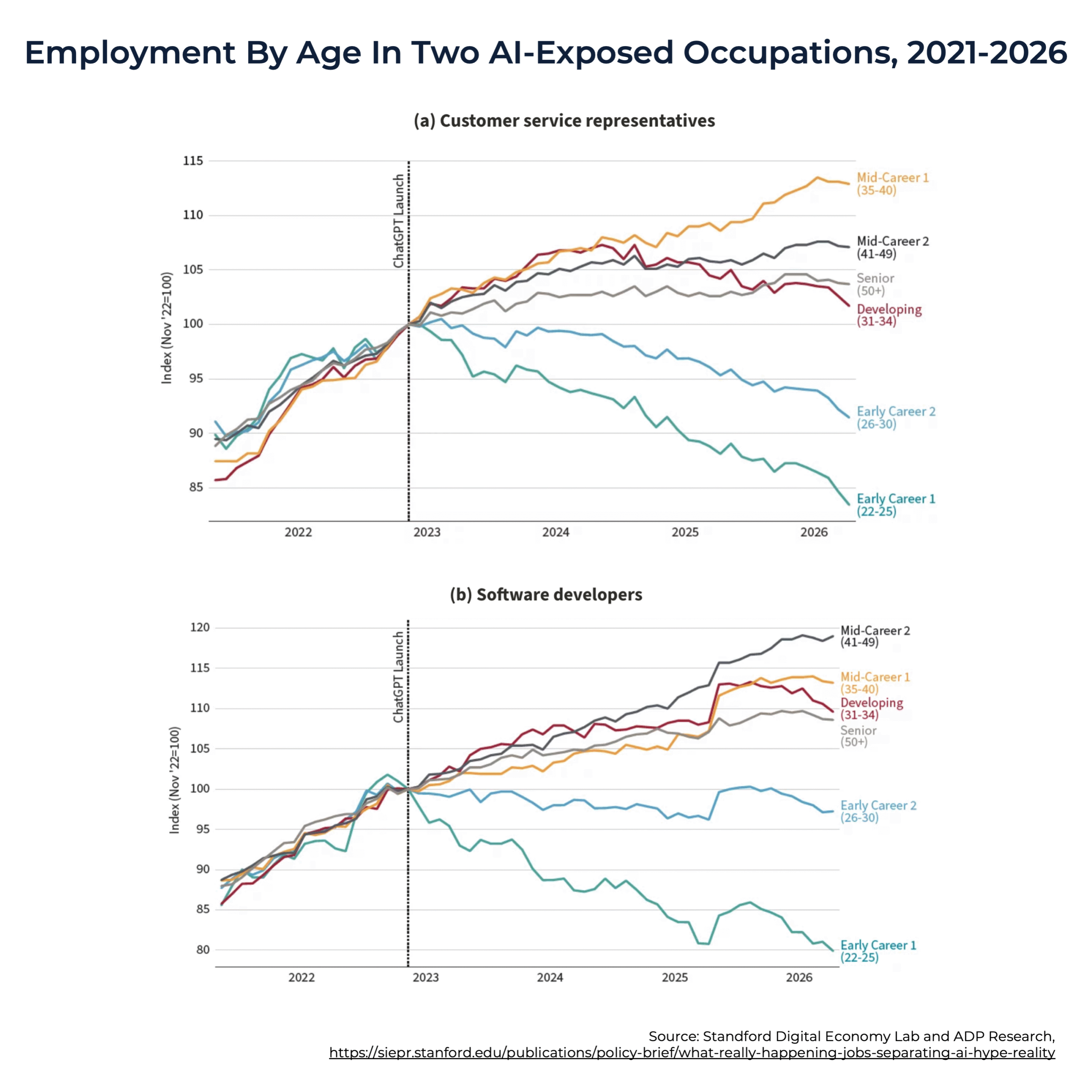
Advisors may expect, therefore, to hear concerns not just about the careers of their clients, but also about their clients' adult children.
To review how this augmentation vs. automation concept can apply to client conversations, let's review the case of Clara, PhD, a 42-year-old genetic researcher with concerns about AI's potential negative effects on her career.
Florence, her advisor, holds space for a conversation.
Client Conversation 2
Florence (Advisor): Your recent email mentioned concerns about your job security in the next few years. Now that we're able to talk this through directly, can you share more about what's on your mind?
Clara (Client): It's just…every month it seems like another part of my field's research is eaten up by AI. It seems like every breakthrough right now mentions the AI model that solved the problem, before it talks about the scientists involved. I'm worried that, at this rate, the models will just take over entirely, and I'll have sacrificed all this time to earn my PhD, only to see my field crumble before I can really make a mark on the field…or on my savings!
Florence: Those are really valid concerns, and I imagine it's scary to feel like your career is being disrupted by new technology. I'd love to explore that a little more with you, if that's ok? You mentioned that AI models are becoming more prominent in your field of research, but that, at least so far, there are still researchers involved in the studies, yes?
Clara: That's right…so far, I don't know anyone who has lost their job at my level. We've hired fewer people right out of their PhD programs, but I've made it past those roles already. But, things could change, and it could be my level that gets shrunk next!
Florence: Maybe. AI is certainly having big effects on a lot of industries, but it's important to remember that this isn't the first time a technology has shifted the ground under the economy! Historically, we've seen new technologies either automate away a job, or augment the person doing the job, ultimately making them more effective and valuable. Does it feel more like your role is something that can be automated away, or something that new technology could augment to make you more effective?
Clara: Well, there have certainly been some researchers who have published more than ever lately with the help of AI models to crunch datasets faster. So, it might be that there are fewer roles, but the ones that remain are supercharged?
Florence: That's possible! And while we'll plan for you to be part of the supercharged group, we don't have a crystal ball. And that's why, whether it's AI or something else, we've already set up a 12-month emergency fund for you. If that feels a little light due to your concerns, we can always talk about raising your cash targets to help weather a bigger storm.
Clara: Thanks, this gives me a lot to think about. Let's keep this as an item to revisit as I learn more about what's going on at the lab.
Regret Minimization In The Face Of AI Uncertainty
"If AI is leading us to a post-work utopia, I don't need to save anymore," one client says (perhaps influenced by the online musings of a certain controversial tech baron). Meanwhile, another thinks "Before AI eliminates my career (or the AI bubble pops), I need to have as much cash saved up as possible". Which client is right?
Well, if we knew the answer, there wouldn't be uncertainty, or risk! Clients will enter the AI uncertainty conversation with potentially very different priors, so let's use a thought experiment to guide us through how we may address the concerns of each.
When charged with a decision in the face of uncertainty, it is common to feel paralyzed. A helpful tool to inform the next best step can be a ‘regret minimization framework'. In this exercise, one asks themselves, "Of the choices available to me, which would I regret the most if it turned out poorly?"
While focusing exclusively on negative outcomes isn't a recipe for a healthy financial planning relationship, it can help steer clients towards more prudent courses of action. Let's review a specific example.
Olly Optimist is gung-ho on AI's capabilities, and thinks we're only a few years away from the machines being able to run our entire economy, allowing humans to focus on leisure and artistic pursuits. With abundance just around the corner, he's loath to save too much money in the short run, as the savings won't do him any good in a post-money utopia. Jon, his advisor, helps walk him through the decision framework here.
Client Conversation 3
Olly (Client): I'm telling you, AI is going to make jobs as we know them obsolete! Once we reach AGI, there's going to be so much value created that we can all focus on creativity while AI runs the economy. Why would I bother saving if that's the case? I can spend more now while the money means something, and then still enjoy the fruits of the future!
Jon (Advisor): Let's unpack the options here. Your hypothesis is that technological progress will advance society to a point where personal savings are no longer necessary. If you stop saving, and you're right, you can spend more money while waiting for utopia, and then enjoy utopia along with everyone else. BUT – if you stop saving and you're wrong about the future… well, now we have a problem. You may have enjoyed spending more money in the short term, but if your hypothesis is wrong, you'd need to play a lot of catch up! And, as we've talked about before, the time value of money means that savings today are worth a lot more than savings in the future.
Olly: Right…
Jon: On the other hand, if you keep saving in the meantime, and society reaches post-scarcity eventually, you might regret having penny-pinched along the way (Olly: "exactly!"), but at least you can still enjoy utopia when it comes! And, if you keep saving and AI doesn't shepherd in a Star Trek economy, you'll be happy you stayed the course?
Olly: I guess so…I'm pretty convinced on where we're headed, but you make a good point. If I keep saving and we get to utopia, it'll still go pretty well for me in the long run! The scenario I'd regret the most is if I stop saving and things don't turn out as planned. Even if that's a small chance, you're right that I need to prepare for it.
When faced with the regret minimization framework, it's clear to Olly that he's still better off saving for retirement, as the outcome he'd most regret is the one where he didn't save and then his bet on post-scarcity didn't pay off (or didn't on the timeline he needed!).
Same As It Ever Was
Advisors will notice that, while AI uncertainty may be new, the concepts and strategies discussed to address it are not. Advisors and their clients have always built plans designed to withstand the winds of change, and it's always been true that we can't know for certain where those winds will come from. Diversification, cash buffers, talking clients off the ledge – the playbook has not changed for advisors leading their clients through uncertain times. In the words of David Byrne, in many ways it truly is the "same as it ever was".
Ultimately, advisors are certain to face client questions and concerns about how AI will affect their financial plans. By staying current on the AI conversation, applying time-tested strategies, and acknowledging that smart individuals often have disparate opinions on emerging technologies, they can be prepared to meet their clients where they are, leading them to better financial and emotional outcomes!