Executive Summary
Welcome to the September 2026 issue of the Latest News in Financial #AdvisorTech – where we look at the big news, announcements, and underlying trends and developments that are emerging in the world of technology solutions for financial advisors!
This month's edition kicks off with the news that Altruist has been acquired by Vanguard, representing a major shift for an RIA custodian that had previously been untethered to a retail financial institution – but the bigger industry implication is that by owning its own custodian, Vanguard can undercut and effectively push back on the insistence of other custodians to charge revenue sharing payments on ETF assets, which could have a profound impact on those custodians' revenue models and potentially trigger another round of consolidation in the custody business.
From there, the latest highlights also feature a number of other interesting advisor technology announcements, including:
- The AI prospecting solution FINNY has revamped its pricing model, switching from a flat-fee annual subscription to primarily a 20bps revenue share for new client revenue brought in through the platform – which shows how FINNY sees itself as more of an automated business development 'employee' than a SaaS platform, but the question remains how much of the prospect sourcing and cultivation process FINNY can truly automate (since advisors have proven willing to pay a revenue-share percentage to people or platforms that can reliably get prospects on their calendar, but may not be willing to do so if they're still responsible for doing most of the work of sourcing and developing those prospects)?
- Startup CRM providers Slant and FinTurk both launched new forms-related tools – Slant's for building forms, and FinTurk's for filling forms out – that eliminate the need for their users to buy standalone tools for those purposes, and reaffirm how CRMs can still be useful in the era of AI by building new functions that help advisors better leverage the data they have
- Pontera, the platform aiming to enable advisors to directly manage their clients' assets within 401(k) plans, has announced a new non-discretionary 401(k) advice tool for advisors who can't or prefer not to manage their clients' 401(k) assets directly (perhaps as a response to state regulators and 401(k) recordkeepers like Fidelity cracking down on Pontera's original technology)
Read the analysis about these announcements in this month's column, and a discussion of more trends in advisor technology, including:
- Wavvest, which built an 'all-in-one' AI technology solution for financial advisors, has also launched an in-house RIA based on that technology, which in light of the growth and funding success of 'digitally native' RIAs like Savvy and Farther (which are built on their own proprietary technology platforms) suggests that the economics of running an RIA might be better than those of selling all-in-one technology to RIAs
- Even as surging AdvisorTech categories like AI notetakers have raised hundreds of millions in investment capital over the last two years, platforms related to alternative investment distribution and support for RIAs have raised over $2 billion – showing that even though advisors may only allocate a small amount of clients' portfolios to alternatives, the revenue opportunity of participating in asset distribution still far outpaces that of selling SaaS solutions
And be certain to read to the end, where we have provided an update to our popular "Financial AdvisorTech Solutions Map" (and also added the changes to our AdvisorTech Directory) as well!
*To submit a request for inclusion or updates on the Financial Advisor FinTech Solutions Map and AdvisorTech Directory, please share information on the solution at the AdvisorTech Map submission form.
Authors:


Altruist Is Acquired By Vanguard To Vertically Integrate Asset Management And Custody (And Strike A Blow In The Battle Over ETF Revenue Sharing)
Historically, the economics of RIA custody rested on three main pillars: Ticket charges on trades, various revenue sharing payments from mutual fund companies (from sub-TA fees to data sharing agreements), and net interest income on cash (i.e., the difference between the amount of interest the custodian pays on cash in a client's account and the amount that they receive from lending those dollars out in margin loans), all of which generated revenue for the custodian and allowed them to provide their services and technology to RIAs for 'free' without an explicit platform fee.
Over time, though, the economic math began to shift as the preferences of advisors and their clients evolved. Brokerage and custodial platforms began to roll out lineups of 'No Transaction Fee' (NTF) mutual funds and later ETFs, where funds could be listed and bought free of ticket charges – except in order to still make money on the arrangement, the custodians charged ongoing revenue sharing (for mutual funds) and shelf-space (for ETF) fees, effectively shifting the revenue from the front end (ticket charges at purchase) to the back end of the transaction (revenue-sharing directly from the asset manager to the platform), which the fund companies then passed along to investors in the form of higher expense ratios (to cover what had shifted from a one-time to an ongoing recurring payment). Most fund companies went along with this shift, with the notable exceptions of Vanguard and Dimensional Fund Advisors (DFA), which resisted back-end revenue payments in order to keep ongoing expense ratio costs lower (with the consequences that they continued to have higher ticket charges for transactions than other mutual funds and ETFs on most platforms). From the custodial perspective this worked fine, because they were still able to earn money either on the front end or the back end of the transaction, but clients (and often advisors) often found the bifurcated arrangement confusing and annoying, and often didn't realize that the lack of an upfront commission was usually more than offset by a (less transparently) higher expense ratio.
In 2019, however, in response to platforms like Robinhood offering zero-commission trading on most equities and ETFs (and Vanguard eliminating ETF transaction fees on its own brokerage platform, including from non-Vanguard ETF providers), Schwab and what became a wave of other custodians responded by cutting most of their ticket charges for purchase or sale transactions on those assets – which almost overnight removed what had been a major pillar of their business model. And that came at a time when the growth of ETF assets was starting to outpace that of mutual funds, which further eroded the mutual fund revenue sharing that custodians had relied on as well. Custodians found ways to make up for at least some of that revenue – most notably payment-for-order flow and securities lending programs – but as the financials of publicly traded custodians like Schwab have shown, their revenue streams from RIAs have steadily declined even as assets have increased, leaving them searching for new ways to make up the lost income.
The strategy that several large custodians have used to boost their flagging revenue has been to push for more revenue sharing on ETFs. Fidelity has been charging ETF sponsors a revenue share of around 15% total fund revenue since 2024 (and hitting funds that don't make the payments with a $100 'service fee' on transactions). Schwab announced in April that it was in negotiation with 400+ asset managers to impose revenue sharing on ETFs on their platform. And Merrill Lynch recently announced its own 10bps revenue sharing charge on active ETFs starting in 2027. But Vanguard, which has long resisted participating in revenue sharing in the name of keeping its expenses low, seems unlikely to go along with the new push for ETF revenue sharing, which on account of the sheer amount of assets managed by Vanguard could impose a heavy 'tax' on Vanguard and, ultimately, its investors: As a napkin-math estimate, with an estimated $4.524 trillion of assets in Vanguard’s ETFs, with an average 0.08% expense ratio, a 15% revenue share would amount to a $4,524 × 0.08% × 15% = $543 million per year paid out to broker-dealers and custodial platforms. Although the actual amount that would be less since Vanguard wouldn’t pay revenue sharing for ETFs sold though its own brokerage platform, the annual cost could still easily be on the order of hundreds of millions of dollars per year, adding up to billions over the long run.
All of which is important context for understanding the blockbuster announcement this month that Vanguard is acquiring the RIA custodian Altruist for a reported $4.6 billion.
At first glance, the transaction is surprising. Even though Vanguard was one of its earliest outside investors, Altruist made its initial mark as being exclusively an RIA custodian with no retail brokerage or asset manager affiliation, and therefore no incentive to compete with the RIAs on its own platform. Selling to Vanguard is a blow to what had been a pillar of Altruist's 'focused solely on advisors' brand, and some RIAs who moved to Altruist on the account of that may be upset to now have Vanguard and its retail brokerage behemoth (and thousands of CFP advisors through its Personal Advisor and Wealth Management arms) looming over their shoulders. And for its part, despite being around for over 50 years, Vanguard has long resisted getting into the custodial game (other than a brief attempt in the late 1990s and early 2000s that was eventually shut down and sold to TD Waterhouse). So why would Vanguard choose to get into the RIA custodial business now – and why would they acquire a custodian that has made its independence a core part of its value proposition?
For Vanguard's part, the long-term answer appears to lie in the battle over ETF revenue sharing, and more broadly on the way other brokerage and RIA custodial platforms are trying to generate revenue as intermediaries in the asset manager distribution ecosystem. When Vanguard eliminated all ETF trading fees on its brokerage platform back in 2018, it set the stage for other platforms to do the same by undercutting the fees that most of the other retail broker-dealers imposed. Acquiring an RIA custodian allows Vanguard to do the same thing for back-end revenue sharing payments: If other brokerage platforms or RIA custodians are going to require ETFs to pay 15% of their revenue back to the platform, Vanguard can undercut those arrangements by offering (both Vanguard and non-Vanguard) ETFs without such pay-for-play requirements via Altruist. Which in turn gives it more leverage to resist revenue sharing on other broker-dealer platforms… while incidentally also giving other asset managers more leverage as well, since they can always nudge advisors towards the Altruist platform as a lower-cost way to access their own asset management offerings. In other words, by paying $4B for Altruist today, Vanguard can potentially avoid a $100M+ annual revenue sharing ‘tax’ to other custodians – while almost as a side effect creating a new platform ecosystem that may keep costs lower for the entire asset management industry.
And so one of the big questions from here is how Vanguard's acquisition of Altruist impacts the custodian landscape as a whole. The move towards zero-commission trading led to a round of consolidation in the industry, most notably Schwab's acquisition of TD Ameritrade. If this acquisition undermines the possibility of ETF revenue sharing as a major source of income for custodians like Schwab and Fidelity, will more consolidation follow as custodians find themselves even more squeezed on revenue? Or will custodians be compelled to finally seriously consider charging an explicit custody fee to advisors to make up the lost revenue, rather than seeking ever more (less transparent) ways to generate revenue off of RIAs' clients?
There are other questions as well that will need to be answered as the acquisition unfolds. What will become of Hazel – the AI notetaker that Altruist bought and then turned into a full-fledged AI tax planning tool that momentarily shook the custodial market – if Vanguard decides it doesn't want to be in the business of selling SaaS technology (or will Altruist maintain it as a way to attract more advisors to Altruist's custodial platform as part of its technology value proposition)? How will Vanguard manage the conflicts between its own advice business – which Vanguard CEO Salim Ramji has vowed to expand in order to "democratize" advice – and the independent RIAs on Altruist's platform that don't want to compete with (or risk being undercut by) Altruist's new parent company for clients? And although Vanguard has stated its intention to keep Altruist as a separate operating business, will it eventually fold Altruist into the Vanguard brand as something like 'Vanguard Advisor Services', and/or redirect its software engineers away from 'just' building for advisors on Altruist and towards Vanguard's own recognized-to-be-outdated technology platform (effectively shifting the Altruist roadmap from Altruist advisors to Vanguard retail)? Time will tell… but for the time being, the Altruist acquisition is simply one more example of Vanguard's willingness to use its enormous size and scale to influence the costs and distribution economics of the financial industry as a whole.
FINNY Pivots To A "Pay-As-You-Grow" Revenue-Share Model In Hopes That Advisors Will See It As A True Business Development 'Hire'
New business and revenue generation is one of the primary challenges of financial advisors. And because the lifetime value to the advisor of an ongoing advisory client is so high (e.g., if the advisor manages $1M for the client at a 1% fee, then over a 20-year relationship the client will pay the advisor 20 × (1% × $1M) = $200,000, which at a 30% average profit margin is $60,000 of lifetime profits from a single client relationship over two decades of service), advisors are often willing to pay a significant chunk of that revenue to someone who can bring new business to them.
Historically, this often meant paying a percentage of new business revenue to the person responsible for bringing it in – or as it played out under the old "finder, binder, grinder, minder" model, essentially splitting new client revenue four ways between the person who sourced and brought in the prospect, the one who closed the sale and "bound" the prospect as a client, the one who did the analysis and implementation paperwork, and the one who tended to the ongoing relationship. Which led to what has become an industry standard of paying around 25% of revenue for a business developer who can reliably find prospects and get them onto the calendar (or simply as a case-split for whoever brought a particular client in).
In modern times, while some advisory firms have in-house business development staff who handle the lead generation and prospecting role themselves, more often lead advisors themselves source their own business (and have revenue-based compensation as a heavy component of their compensation to reward their finder efforts), or the firm outsources at least part of the job to a third party – some to lead generation platforms like Zoe Financial, and others to custodial referral programs like Schwab Advisor Network. Throughout the various combinations that have evolved over the years, though, the revenue-sharing model has persisted, and still hovers around the 25% rate that goes back to the old finder/binder/grinder/minder system.
In the context of external providers, the revenue-share model has become especially appealing for advisory firms that are jaded about marketing promoters that overpromise and underdeliver, because the advisory firm only pays for actual new revenue. Which means the person or platform generating the leads takes on the risk that if they're not able to reliably source new business for the advisor, they'll get paid only a minimal amount or nothing at all. But the economic upside for the platform is still substantial if they can deliver new business, since they'll earn a percentage of revenue that each client found through the platform pays the advisor for as long as they remain a client, allowing the successful prospect-sourcing solution to participate in the incredible lifetime-client-value economics of the typical advisory firm.
In this context, it's notable that FINNY, the AI-powered prospecting and marketing automation platform, has announced a new "Pay-As-You-Grow" pricing model that is effectively a 20bps revenue share for new clients sourced through the platform, plus a $50/month flat subscription fee for access to the platform.
The new pricing model is a significant overhaul for FINNY, which previously charged a flat fee from $6k to $12k per year for an advisory firm to use its software. Under the old model, firms were asked to pay a high initial cost (since the entire year's fee was paid upfront) with no guarantee they would recoup that cost from new client growth. Even though ultimately it would take only one to two new clients for most firms to cover that expense, this still made FINNY a difficult sell for advisors, who tend to have high skepticism of marketing solutions with upfront costs but no actual requirement to deliver results – and especially so because FINNY's main function has been facilitating cold outreach (i.e., the software targets prospects and provides automated outreach materials), which at best is still a time-intensive effort to follow up on leads with a high volume of rejection (that advisors would pay for the privilege of pursuing).
FINNY in turn sought to reduce this friction with the launch of "Hunter", their anthropomorphized AI engine to automate as much of the cold outreach process as they could on the advisor's behalf. Still, relatively few advisors actually use cold outreach as a primary marketing technique – only around 7%, according to data from the upcoming Kitces Research Study on Advisor Marketing – and so even if FINNY made it easier to find and reach out to new prospects, the demonstrated market for cold outreach was not large, and the high upfront fee made it hard to convince advisors who were new at outbound prospecting (or spend years growing their practices to the point they didn't have to cold call anymore) to try it out.
The new model, then, creates a much lower barrier for those "come and try it out" advisors, since it only involves at most 1/10th of the flat fee that FINNY charged under the old model. Which results in potentially more users paying a smaller flat fee – but if even a modest number of those firms are successful at generating new business, then the economics will work out favorably for FINNY. For example, if an RIA gains a new client paying $10k/year, then the firm will pay $500 (the flat fee) + $10k × 0.2 (the revenue share) = $2.5k. If they gain three new clients, they'll pay $6.5k – more than FINNY's minimum flat fee under the old model, and even if the advisor leaves after a year, FINNY's revenue-share could continue for a decade or two thereafter. And if the advisor instead remains, and gains three more new clients the following year, they'll pay $6k (the ongoing revenue share from the three clients gained in the first year) + $6k (the revenue share from the three new clients in the second year) + $500 (the flat fee) = $12.5k – and that amount will keep increasing the more new clients they gain, as long as they continue to retain the old clients. All of which adds up for substantially more potential revenue growth for FINNY over the long term, because even though they slashed their flat fee by 90%, the economics of a lifetime revenue share are so good that they could still come out well ahead compared to their old SaaS fee. In fact, overall the revenue-sharing model allows FINNY to drive significantly more revenue overall from a much smaller number of successful firms (who really get clients and pay revenue-shares) than it would have had to under its prior pure SaaS model.
The caveat, however, is unlike the lead generation and custodial referral platforms to whom advisors traditionally have been willing to pay a revenue share (since they do the work of delivering leads willing to meet with the advisor, effectively serving as an outsourced lead generation service), outbound prospecting still takes work on the advisor's behalf, and tends to have a very low conversion rate. And FINNY is still ultimately an outbound prospecting platform, albeit one that revolves around its "Hunter" AI agent to automate an increasing share of the process of researching, reaching out to, and following up with cold-outreach prospects to make them, hopefully, at least a little bit warmer.
So the big question is whether FINNY's AI software can effectively do the work of a lead generation platform or business development employee – i.e., to take substantively all of the work of identifying and reaching out to prospects and only delivering them into the advisor's hands (or onto the advisor's calendar) once they're ready to book an initial meeting – in which case it's possible to see advisors willing to pay a revenue share for FINNY as they are for other platforms that do the same thing (put actual prospect meetings onto the calendar). But if the advisor is still expected to take on a non-trivial (or outright majority) share of the work of sourcing leads through FINNY, they may not be willing to pay a percentage of revenue when they're still the ones doing the work (or conversely, they may simply not be willing to do the work needed to get new clients through the platform, which then results in no new revenue to share in the first place). And on the flip side, advisors who have already successfully been using FINNY under its flat fee model are likely to be upset because now instead of being capped on the amount that they spend for the platform with a fixed SaaS fee (and keeping 100% of any revenue they generate above that), their costs for using FINNY will grow along with the clients they get from it – perhaps causing some to jump over to alternative AI prospecting platforms like Wealthfeed or Finterest or AIdentified that still charge a traditional flat SaaS fee.
The key point is that although advisors are willing to pay a percentage of revenue for people or platforms who will deliver new business – and FINNY's new structure is very aligned to the psychology of advisors who have been burned by failed marketing and growth techniques, for whom there's appeal in only paying for what is successful – it's still an open question as to how much of that process can truly be outsourced to technology, how much of it will still ultimately rest on the advisor, and what advisors will pay for AI agents if they still have to do much of the actual 'Finder' work themselves. If FINNY can position – and sell – their Hunter agent as the equivalent of a business development hire that only happens to be AI, then advisors might be willing to cut FINNY into the portion of the new client revenue split that would have traditionally gone to such a hire. But if FINNY 'just' makes it easier to do outbound prospecting – but still requires the advisor to do the work of getting the prospects in the door – then it might be harder to convince advisors to pay revenue-share fees for a SaaS solution.
Slant And FinTurk Debut New Forms Tools To Bolster CRM's Case As The "Data Hub" In The AI Era
An advisory firm's client onboarding and financial planning process is only as efficient as the data-gathering tools that it uses. As soon as a prospect becomes a client, the advisor needs to start collecting data on the client's household and financial situation, as well as getting paperwork out to the advisor's custodian for opening new accounts and transferring funds. The faster the advisor and client can get through this process, the faster the advisor can start doing the things like financial planning and portfolio management that they do to create value and earn their revenue.
There have been several different versions of this data gathering process over the years as RIAs' technology infrastructure has evolved. Version 1.0 of the process usually looked something like a paper checklist and questionnaire, mailed to the client or handed to them at their first meeting, which they would work through and mail or bring back to the advisor – with a timespan that would typically be measured in weeks – and once everything arrived the advisory team would subsequently need to go through it by hand, check for completeness, and transcribe the client's information into whatever computer systems the advisor used.
Version 2.0 moved at least part of the data gathering process online, and typically involved static forms and/or fillable PDFs, along with document portals such as in eMoney for clients to upload documents. This eliminated some of the speed and reliability issues of snail-mailing or hand-delivering paper documents, and thus could reduce the data gathering timeline from weeks to a few days. But once the client information arrived in the advisor's document portal, it was much the same as if it had come in a big envelope full of documents: they would need to look through all the files and questionnaires one by one, check to make sure that everything was there that needed to be, and manually key information like account values and Social Security numbers into their software tools. Meanwhile, much of that information would need to get re-transcribed into the account paperwork needed to open and fund the client's custodial accounts, with typos or missing information often leading to NIGOs that prolonged the process even further.
Many firms have now reached Version 3.0 of client data gathering, which is about ensuring that the data that's provided by the client can move automatically into where it needs to go, whether that's the advisors' CRM or financial planning software or the custodian's account opening forms. It's also about validating the data to make sure that the client provided everything they were asked for and eliminate the back-and-forth needed to fill in the gaps. All of which requires both a dynamic form that can recognize the data that the client has entered, as well as reliable connections to the other software that the advisor uses – most importantly their CRM (since that's where most client data tends to live), but also their financial planning software, portfolio management software, digital account opening, and any other tools that the advisor uses for onboarding.
This Version 3.0 of data gathering has been possible in some form for years now, either through standalone tools like PreciseFP (in which advisors can build the data-gathering forms they need and connect to their other software tools, many of which PreciseFP integrates with via API), or by building static forms using tools like Google Forms or JotForm and building automations via Zapier. However, it's seemed odd that advisors have been forced to either rely on a standalone data gathering tool (which, with PreciseFP costing $89/month, is almost if not more than the same price as the CRM software itself) or to patch together non-integrated form builders via Zapier. Given how much of the data gathered via forms goes on to live in other places like the CRM, it would stand to reason that the data gathering process itself should also live in the CRM.
Which is why it's notable that this month, two of the recent generation of 'AI-native' CRMs, Slant and FinTurk, both announced new tools to assist advisors with data gathering and client account opening, both of which leverage the CRM's function as a data hub to eliminate the need for third-party tools built on top of that data.
Slant's new forms tool allows advisors to build customized forms for emailing to the client – from standard client intake questionnaires to risk tolerance assessments to annual review preparation to invitations to client events – with the client's responses automatically flowing into Slant's CRM. The forms can also trigger automations or tasks when submitted. Meanwhile, FinTurk's new FormFiller tool handles forms from the other direction, taking information that's already in the CRM and using it to automatically populate forms like account applications, rollover requests, and SLOAs to send on to the custodian. These new tools reduce the need for users to buy a separate form-building tool like PreciseFP or a form-filling tool like Laser App.
What's also notable from an advisor perspective is that while both Slant and FinTurk position themselves as AI-native CRMs, these new tools only rely on a minimal amount of AI to function – e.g., Slant's forms can be edited via typing requests in a chat interface, though it could have just as easily left out AI altogether and used a traditional drag-and-drop interface; while FinTurk's FormFiller uses AI to map data fields on a form to the corresponding CRM data, which allows it to support a wider range of different forms, but it could have also opted to map each field manually and support a smaller number of forms. In other words, while AI might enhance both functions, it wasn't strictly necessary for either – instead, this is more of a case of the new, startup CRMs taking the initiative to recognize functions that their users want (and were annoyed with needing to pay for in a standalone solution) and turning them into built-in features.
Which is in keeping with the broader overall story in CRM, which has historically had relatively low advisor satisfaction scores in our Kitces Research on Advisor Technology relative to its nearly-universal adoption. There were signs that the category was poised for some amount of disruption from new entrants that could better meet advisors' needs in areas like workflow automation and better leveraging the client information they have on hand, and the emergence of new providers like Slant and FinTurk – which are rolling out new features that not only differentiate them from competing CRMs, but also eliminate the need to buy other standalone tools like PreciseFP – may be the start of a bigger shift in the CRM category.
And in the bigger picture, these new features from Slant and FinTurk show how the age of AI doesn't necessarily lessen the importance of CRM. Indeed, if CRMs can continue to build tools – with or without AI – that leverage the data that they already hold (and the integrations with other software that they build) to either eliminate manual processes or reduce the need to buy standalone software, they can assume an even bigger role in the middle of the advisor tech stack by helping advisors make better use of the client data on their hands. All that was needed were providers to come along that understood what advisors really wanted out of their CRM in the first place.
Pontera Announces Non-Discretionary 401(K) Management Tool For Advisors Who Can't (Or Don't Want To) Manage Them Directly
Most financial advisors bill on an AUM basis, which works well when their clients have assets for them to manage (and bill on), but runs into problems when the client either doesn't have the assets to meet the advisor's minimum, or when the client's assets aren't available for the advisor to manage. Of which one of the more common scenarios is when a large proportion of the client's net worth is inside of a 401(k) plan – because although a client who has retired or left their job may be able to roll the account over into an IRA which can be subsequently managed by the advisor, if they are still working and contributing to the plan the assets are for the most part 'locked up' in the plan where the advisor can't manage or bill them directly.
And so advisors historically only worked with clients with 401(k) assets when the client had other investable assets that the advisor could bill on, in which case the cost of advising on the 401(k) plan was effectively bundled into the fee the client paid on their other assets. To the extent that the advisor actually 'managed' the 401(k) plan assets, it was typically either by having the client log into their 401(k) account during a meeting and walking them through the process of rebalancing, or else by actually obtaining the client's login information and doing the rebalancing themselves (which came along with a host of compliance and custody issues related to holding client credentials).
In 2018, however, Pontera launched with the aim of bridging the gap between advisors and their clients' 401(k) plans by allowing the advisor to directly trade in the client's 401(k) plan (without holding the client's login credentials, since the client logged in and gave the advisor permission to trade in their accounts on their own side of Pontera's portal). Although some advisors viewed this as a mere convenience – since trading in the clients' accounts directly saved some of the hassle of relying on the client to implement the advisor's recommended trades themselves – Pontera positioned it as a growth platform whereby advisors could start to count their clients' 401(k) plans among the assets that the advisor managed and billed on. And Pontera priced the offering as such, charging advisors a 30bps fee on the assets they managed through the platform with the clear expectation that advisors would charge their clients at least that much (if perhaps not their full ~1% management fee).
The formula appeared to work for Pontera, which had good growth momentum over its first five years. Starting in 2023, however, a series of state regulators issued notices to advisors scrutinizing the use of Pontera amid concerns that sharing login credentials was a violation of clients' user agreements with their 401(k) providers (and that advisors' use of the platform effectively abetted that violation), which began to give some advisors pause about whether they'd be able to continue using the tool (although confusingly, other state regulators issued their own contradictory guidance that explicitly allowed the use of Pontera to manage client assets, making the ability to use Pontera contingent on the state or states where the advisor did business). But the real blow came in the fall of 2024, when Fidelity – by far the largest 401(k) provider – started to block credential sharing systems including Pontera, effectively locking advisors out from their clients' accounts. At which point Pontera could do little more than issue strongly-worded letters asking Fidelity to reconsider, and advisors were left to question whether it was really workable to use Pontera for managing clients' 401(k) assets when a sizeable portion of those would be off-limits due to being held at Fidelity.
Which makes it interesting to see that this month Pontera announced a new "non-discretionary" 401(k) advice tool for financial advisors, which allows advisors to view and make recommendations for clients' 401(k) plan assets but leaves the implementation – i.e., the actual trading and rebalancing actions – up to the client.
The tool itself appears to be focused around streamlining the workflows associated with giving advice on 401(k) assets. It has tools for advisors to review clients' current assets and available investment options, communicate rebalancing recommendations, give guidance on the actual steps the clients can take to implement the recommendations, and send follow-up reminders and monitor the plan for future review. Which at its core makes Pontera's non-discretionary platform sound little different from many of the other account aggregation tools in advisors' portfolio management and financial planning software, with some extra features geared specifically towards 401(k) plan implementation.
But it's hard not to view Pontera's new features in the context of the struggles they've had over the past several years, first with state regulatory issues and then with Fidelity's crackdown, at maintaining the growth of its flagship discretionary 401(k) management tool. After years of fighting to make their case that managing clients' 401(k) accounts was in alignment with advisors' fiduciary duties (since after all, it was an improvement over the advisors holding their clients' credentials themselves), it could be that Pontera has resigned itself to the idea that it's unlikely to break through with resistant state regulators or the likes of Fidelity, and that a more traditional data-sharing arrangement (where the advisor can see what's in the client's account but not actually take any action within it) was the only hope of salvaging some of the value of its relationships with advisors who can no longer (or who no longer wish to) manage client 401(k) assets directly.
To that end, it will be interesting to note how Pontera positions and prices its new non-discretionary feature. While theoretically it only differs from the original Pontera tool in its inability to implement client trades after analyzing and recommending them, it may be hard to argue to advisors that it represents the same revenue growth opportunity that the original Pontera once promised now that it's clear that not all states or recordkeepers will allow its use. Meaning that advisors could likely be unwilling to pay in the neighborhood of the ~30bps that Pontera charges for its original product, and may not be willing to pay a bps fee at all for a product that doesn't seem as likely to directly grow their revenue.
Wavvest Launches In-House RIA As AI-Native Operating Systems Seek To Monetize As Platforms Instead Of SaaS
The economics of owning an RIA are vastly different from those of selling software. Software companies generally sell subscriptions at flat-fee rates rarely exceeding a few hundred dollars a month, and generally need multiple staff members for engineering, support, and sales, whereas an advisory firm can be run by a single advisor (with or without in-house support) and charge $10,000+ per client per year. And so while a SaaS company might need to sell hundreds of subscriptions to even get to a sustainable level of revenue, an advisory firm can be very comfortably profitable with just 50 clients.
These advisory firm economics, and the hope that they can be even more profitable with better technology for efficiencies, are what have caused venture capital firms to pour money into RIAs like Savvy, Farther, and Compound. Although built and heavily marketed around their own proprietary technology platforms, these firms at their core are run like any other RIA in growth mode, spending much of their startup capital not just on technology but on bonuses and other incentives to recruit financial advisors to bring in their existing books of business. Which on the one hand calls into question some of the multiples at which these VC firms are investing into the RIAs, which are higher even than what PE firms are paying to acquire more traditional advisory firms. But on the other hand, firms like Savvy are likely able to raise far more as a "digitally native" RIA built on a proprietary tech platform than they would if they were just selling the tech platform itself – because while better technology might allow an RIA to expand its margins through more efficiency (although 30 years of RIA benchmarking studies have failed to show any evidence of overall higher profitability for RIAs despite all the technological advances in that time), the real driver of profitability for advisory firms is the ability to provide expert advice and serve clients well, and charge accordingly high fees for that advice and service. Or viewed from another perspective, there's a lot more room to profit by participating in the typically-30% profit margins on 100% of an advisor's revenue, than to scale a technology-only solution competing for just 5% of the advisor's revenue typically spent on technology in the first place (and have to drive all the technology firm's profits from that small slice).
At the same time, though, we've recently seen the emergence of a number of new technology companies positioning themselves as all-in-one (increasingly "AI-native") "operating systems" for advisory firms, like Nevis, Wavvest, and StratiFi. Yet despite those platforms' promises to help advisors eliminate the inefficiencies created by the gaps between separate pieces of standalone software, the all-in-one concept has not really taken off among advisors, if only because switching would mean having to transfer client data and workflows from multiple different pieces of software all at once (and at some point, the switching costs are higher than the efficiency savings could ever be on the other side, anyway). And so it might be tempting for some of those all-in-one-operating-system software providers, who look at the growth and fundraising success of RIA platforms built around proprietary technology, to consider launching their own RIAs around the all-in-one technology that they've already built – in other words, effectively becoming the proprietary technology at the center of a new RIA (and capturing the resulting RIA economics) rather than continuing to be software companies (pursuing SaaS economics).
In this context, it's notable that Wavvest, one of the AI-native "operating systems" that have cropped up for advisors in the last few years, has announced the launch of its own in-house RIA, which it will run while continuing to sell its software on a standalone basis (alongside a more TAMP-like solution that also includes back-office support and tax filing).
The announcement comes at a point where it's become apparent that, even though it's easier than ever to build an all-in-one software solution (since AI makes it easier to pull together data from multiple components into a single interface), it's still stubbornly difficult to sell all-in-one solutions. Every advisor has their own processes, service models, client planning needs, and other individual nuances that make it really hard to build a software tool that does everything well for everyone who uses it. That combined with the difficulty of transitioning from one software to another means that if a firm likes the software that they use for one function, even if it's just a standalone tool, they're likely to stick with it unless they're really sure that another solution will do it better (and even then, they're wary not to have to deal with too many software changes at once).
But while it's difficult to build effective all-in-one software to sell to other firms, RIAs clearly see plenty of reasons to want to build software specific to their own firms that help their advisors do better work. Mega-RIAs like Mercer and Mariner have invested millions into overhauling their in-house technology, and the growth of firms like Farther and Savvy show that they're winning recruiting business at least in part on how they've differentiated through their proprietary technology platforms. As all-in-one software struggles to gain much adoption on its own, there's every reason to look at advisory firm economics and want to bolt an RIA onto the software you've already built.
The caveat, though, is that a big part of what has allowed firms like Farther and Savvy to grow is their ability to write checks to advisors to join their platform. In other words, it isn't an 'if you build it, they will come' situation: In addition to their technology, a firm like Wavvest will also need to pour resources into recruiting advisors from other platforms, offering various combinations of recruiting bonuses or better payouts than they can find elsewhere to compete in the crowded advisor recruiting marketplace.
Either way, in the long run, whether or not that approach proves successful will (like Farther and Savvy) depend on how much more efficient their technology will actually make their advisors: The more they pay upfront to recruit or increase their payouts to attract advisors to their platform, the more productivity they'll need to get out of those advisors just to remain comparably profitable to other firms, and yet there's no evidence yet that a slick proprietary operating system actually leads to higher productivity (or just allows advisors to take more time off, increasing their happiness but not their tech-enabled RIA platform's profitability). In fact, according to the most recent Kitces Research on Productivity, investing into supporting staff – not technology – to offload cumbersome administrative work is what's really correlated with greater productivity.
So it's an open question at this point as to whether RIA platforms built around proprietary technology – whether they started with the technology and then added an RIA like Wavvest, or whether they built the technology to go with the RIA, like Farther and Savvy – will see any material benefit from having their own in-house tech platform. But in the end, what's clear is that the opportunity of participating in RIA economics with bespoke technology is better – at least in the eyes of a growing number of tech providers and RIAs, and the VC and PE firms that invest into them – than selling subscriptions to all-in-one software to firms that don't necessarily want to go (or deal with the hassles of transitioning) to an all-in on one piece of technology.
Funding For Alternative Investment Distribution Continues To Swamp SaaS Solutions
Alternative investments have gotten a lot of attention for their growth in recent years, yet they still remain a relatively small part of the overall investment landscape. For example, there is around $20 trillion invested in alternative assets like private equity and debt, hedge funds, and real estate, but that's a relative drop in the bucket compared to the estimated $318 trillion in combined global public equity and fixed income outstanding. Which roughly aligns to the estimated 3% average allocation to alternative investments by RIAs. Although many alternatives managers and platforms have pushed for higher adoption, various factors – from higher fees and complexity to liquidity concerns to the difficulty of due diligence on many disparate alternatives managers – have made advisors wary of allocating a substantial amount of their clients' assets to alternatives, such that when they do include alternatives they don't tend to exceed 10%–15% of the client's portfolio.
But even though the average advisor doesn't allocate a large amount to alternatives, those numbers add up when applied to the entire RIA landscape. With RIAs managing around $13.8 trillion of assets for individual investors, an average 3% allocation still equates to around $414 billion allocated to alternative investments. And assuming those investments charge around 2% per year in fees, that equates to around an $8 billion annual revenue opportunity for alternative investment managers solely from RIAs and their clients.
And because alternatives are so operationally distinct from traditional investments, they have a whole ecosystem of technology and services to make them possible for advisory firms to implement. They don't have public data listed on sites like Morningstar, so there are providers like Canoe, Alkymi, and Altidar to do research and due diligence. They don't trade on traditional broker-dealer platforms, so alternatives marketplaces like CAIS and iCapital connect advisors and their clients with alternative investment options. They don't feed into standard reporting software, so tools like Arch exist to pull in the data to feed into other tools. And the opportunity associated with all of these tools tracks along with the alternatives market as a whole.
Which is why we've recently seen a number of strikingly large investments into alternatives-related platforms over recent months. In July, the alternatives marketplace CAIS raised $170 million in Series D funding at a $2 billion valuation, the data and reporting provider Arch raised $52 million in Series B funding, and the alternatives data and research provider Canoe was acquired by Bloomberg for what was reportedly close to $1 billion. All of which came just about one year after iCapital's own whopping $820 million capital raise. In other words, at least $2 billion of investment dollars have flowed into the alternatives space in the last year alone – not into the alternative funds themselves, but just the platforms that help to distribute and support them.
What's striking about these numbers beyond their sheer size is how vast they are compared to the investments flowing into other advisor technology. For example, in the AI notetaker space, which has been one of the hottest categories in the advisor technology space, Jump has raised $104.6 million since the start of 2025, while Zocks has raised an additional $58.8 million, and Nevis has raised $35M. In other words, since the start of 2025, the most sought-after category in advisor technology attracted just under $200 million of investment – which was no more than 10% of the amount that went into alternative investment technology over that same time.
The difference between those relative investment levels speaks to the fundamental difference between revenue models that are based on flat fees versus those that come from basis points. On the advisory firm side, there's a reason why the vast majority of advisory firms continue to bill based on AUM even as they base their value proposition more on planning and advice than on asset management: Basis points tend to be far more lucrative, as shown by Kitces Research on Advisor Productivity showing that AUM advisors charge 2X–3X the annual fees of flat-fee advisors. In the world of vendors serving advisors, the divide is clear from who buys booths at industry conventions: When it costs $10k or more for a booth, a technology company selling $75/month SaaS subscriptions will need to sell 12 new licenses to make up for the cost on an annual basis. Whereas if an asset manager or SMA provider charging 50bps can make up their cost if they can get a single advisor to allocate $2 million of client money to them. Hence the exhibit halls of advisory conventions tend to be dominated by asset managers and other companies that can charge via basis points.
And so venture capital investors likewise see a vast difference between the opportunities for an alternatives platform charging basis points and SaaS companies charging flat subscription fees. If a software company were to somehow sell a $100/month license to 100% of the estimated 300,000 financial advisors in the U.S., that would 'only' equate to $360 million in annual revenue – which is only 4.5% of the $8+ billion flowing from alternative investments. Hence, even though advisors might only allocate around 3% of client assets to alternatives, compared to 40%+ of advisors using meeting notetakers according to 2025 Kitces Research on Advisor Technology, with the adoption rate having surely increased since then – alternatives-related technology receives around 10X the investment of even the hottest SaaS category.
Which is ultimately just a reminder that when it comes to where dollars flow in the financial industry at large, there's the dollars that participate in asset management and/or distribution, and then there's everything else. Which is why even though new technology might get a lot of attention and high adoption growth, the investment dollars available for those providers are swamped by those that go into asset distribution.
In the meantime, we've rolled out a beta version of our new AdvisorTech Directory, along with making updates to the latest version of our Financial AdvisorTech Solutions Map (produced in collaboration with Craig Iskowitz of Ezra Group)!
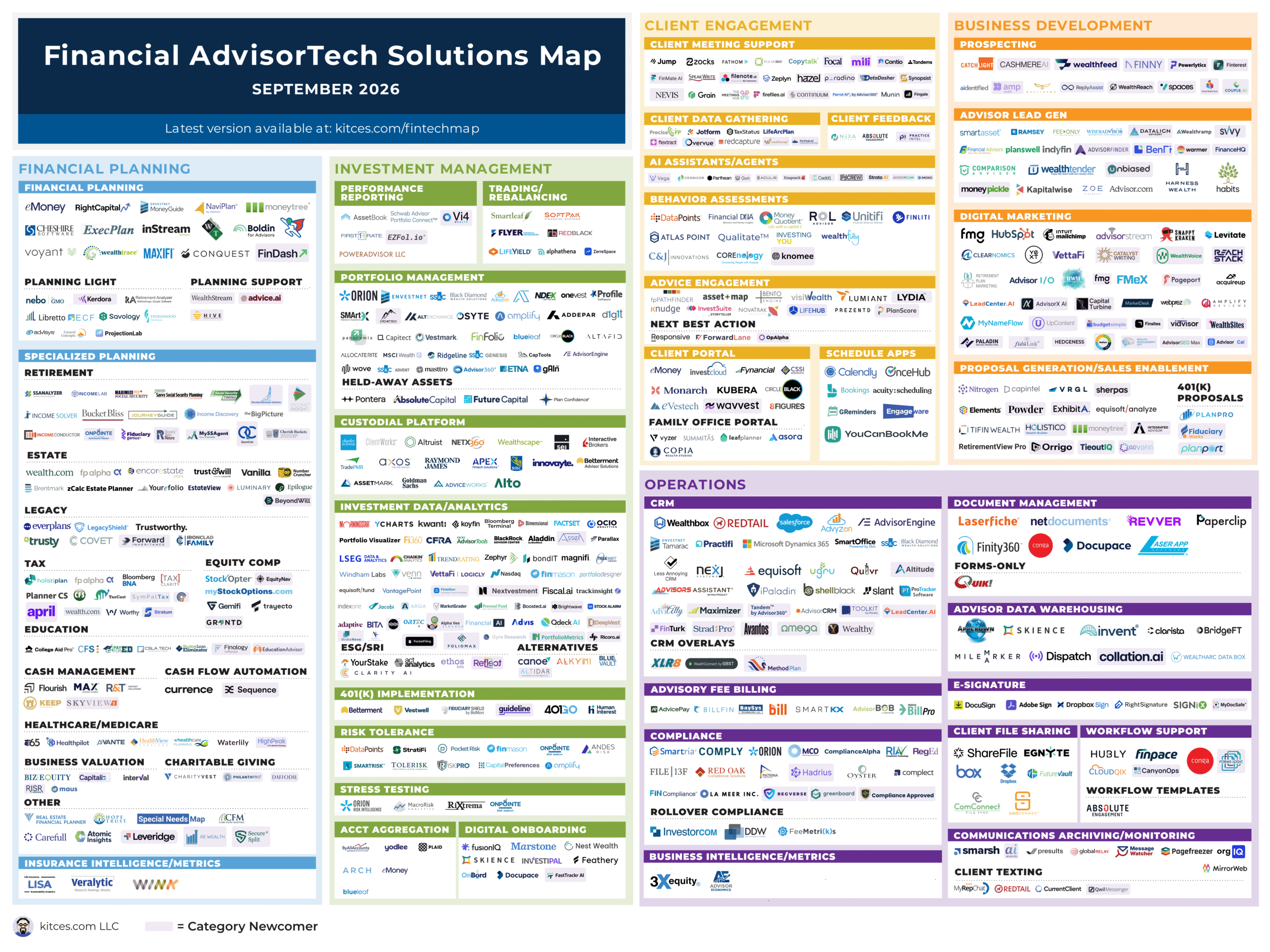
So what do you think? Will Vanguard's acquisition of Altruist trigger further disruption in the RIA custody business? Will FINNY's AI agent be good enough at bringing in new business (without the advisor's involvement) to earn a 20% revenue share? Is it worth it to use Pontera for advising on 401(k) assets if you can't manage them directly? Let us know your thoughts by sharing in the comments below!