Executive Summary
For many advisory firm owners, deciding how much time to take away from work is largely a personal choice shaped by client needs, business demands, and personal priorities. But once a firm hires employees with their own need to step away from time to time, Paid Time Off (PTO) becomes much more than an individual preference: it evolves into a key part of firm culture, team wellbeing, operational resilience, and talent retention. As our own Kitces Research on Advisory Wellbeing consistently shows, autonomy over time and work-life balance are among the strongest drivers of professional satisfaction, even for highly compensated advisors. Because while compensation matters, there is a point where additional income delivers diminishing returns relative to the ability to enjoy more flexibility and personal time. On the other hand, firms that fail to create sustainable workloads and meaningful opportunities for rest may ultimately face lower morale, reduced productivity, and higher turnover costs than firms that proactively support employee time away from work. And so a well-designed PTO policy is ultimately an investment in employee wellbeing, productivity, and long-term sustainability.
The starting point of an effective PTO policy is a consistent structure. Advisory firms generally structure PTO using one of three approaches: separate leave, single-bank, or unlimited PTO. Traditional separate leave systems divide vacation and sick days into distinct categories (e.g., 15 vacation days and 5 sick days). Single-bank PTO combines all paid leave into one flexible bucket, allowing employees to allocate time according to their own needs. By contrast, unlimited PTO policies put no putative restrictions on the amount of time off available for any purpose – which while theoretically offering maximum flexibility for employees and reducing the administrative burden of tracking PTO accrual, often ends up resulting in employees taking less time off than under traditional plans due to the social stigma of taking the 'most' time off. To that end, although every system has its administrative benefits and burdens, the success of a firm's PTO policy depends less on the number of nominal days off it offers and more on whether employees can realistically use them without damaging their own career growth or creating more operational strain for themselves or their teammates.
Small advisory firms often struggle most with this challenge because employees typically wear multiple hats, and there may be little redundancy across roles. Research shows that advisors in very small teams frequently report greater difficulty taking time off than solo advisors or members of larger firms because there are too few people available to provide meaningful coverage. Which suggests that effectively implementing a PTO policy requires firms to build operational redundancy through cross-training, clear documentation of responsibilities, and managing each team member's workload to accommodate for the possibility of backing up other employees' work. Teams may also need to clarify which operational tasks must continue during absences (e.g., trading and rebalancing and handling client questions and requests) and ensure that more than one person understands each essential workflow to ensure that the firm can stay running smoothly during any team member's time off. All of which can help make sure that employees feel comfortable using the PTO they have available (and actually being fully 'off' from work while on PTO) without worrying about falling behind or burdening coworkers with extra work.
To enact this in real time, firms may choose to put together a piecemeal cross-training plan, training employees on different processes on a weekly or monthly cadence to ensure everyone remains up-to-date on the work they might be expected to cover. From there, every period of PTO becomes an opportunity to ensure that everyone fully understands each other's work – and as the team iterates and builds confidence in covering each others' roles, taking time off can become easier and easier over time. And for certain tasks requiring more specialization, advisory firms may also consider bringing in fractional help to ensure they can genuinely disconnect.
Ultimately, firms that encourage employees to take meaningful breaks, establish realistic workload expectations, and invest in cross-training and redundancy are better positioned to maintain both employee wellbeing and a consistent quality of client service. And importantly, firm owners must model these behaviors themselves. Advisors who encourage employees to take time off while never disconnecting themselves may unintentionally signal that true rest is incompatible with professional success. But when advisory firms thoughtfully design PTO systems that balance flexibility, accountability, and operational resilience – for both leaders and employees – they create healthier teams, stronger firm cultures, and ultimately more sustainable businesses that better serve both employees and clients alike!

There's an abundance of focus within industry research on how advisory teams spend their working hours to maximize their productivity and satisfaction. But as important as it is to get the most from the team's time spent in the office, the reality is that time out of the office can also play an essential role in both of these outcomes.
For financial advisors who own and manage their own practice, there is a host of factors in deciding when and how much time to take off from work but ultimately those advisor/owners are in control of the decision and can take off as much time as they want to and can reasonably manage. But when an advisory firm starts hiring employees, it becomes essential to set a firmwide Paid Time Off (PTO) policy, both to set clear guidelines around how much time (and for what reason) employees can take off from work and to plan for how to cover the day-to-day functions of the firm will be covered when employees do take time off to keep the firm running smoothly with less than 100% of its staff on duty.
In general, PTO is inclusive of sick leave, traditional (i.e., vacation) time off, and company-wide holidays. There's no Federally-mandated amount of PTO that businesses must offer their employees; to the extent that there are laws and regulations for businesses regarding time off, they're set by the states in which those businesses operate. Some labor union contracts may also specify a certain amount of time off. But in most cases, PTO is offered by businesses voluntarily as a benefit, both for the happiness and wellbeing of their employees as well as for providing an advantage in attracting and retaining talent. Which means that in general, it's up to businesses as to whether or not they want to offer PTO, and if so, how they want to structure their plan to provide the most benefit to employees (while also not being so generous with time off that the firm's staff are constantly spread thin and company goals aren't being met from the sheer amount of time that employees are out of the office).
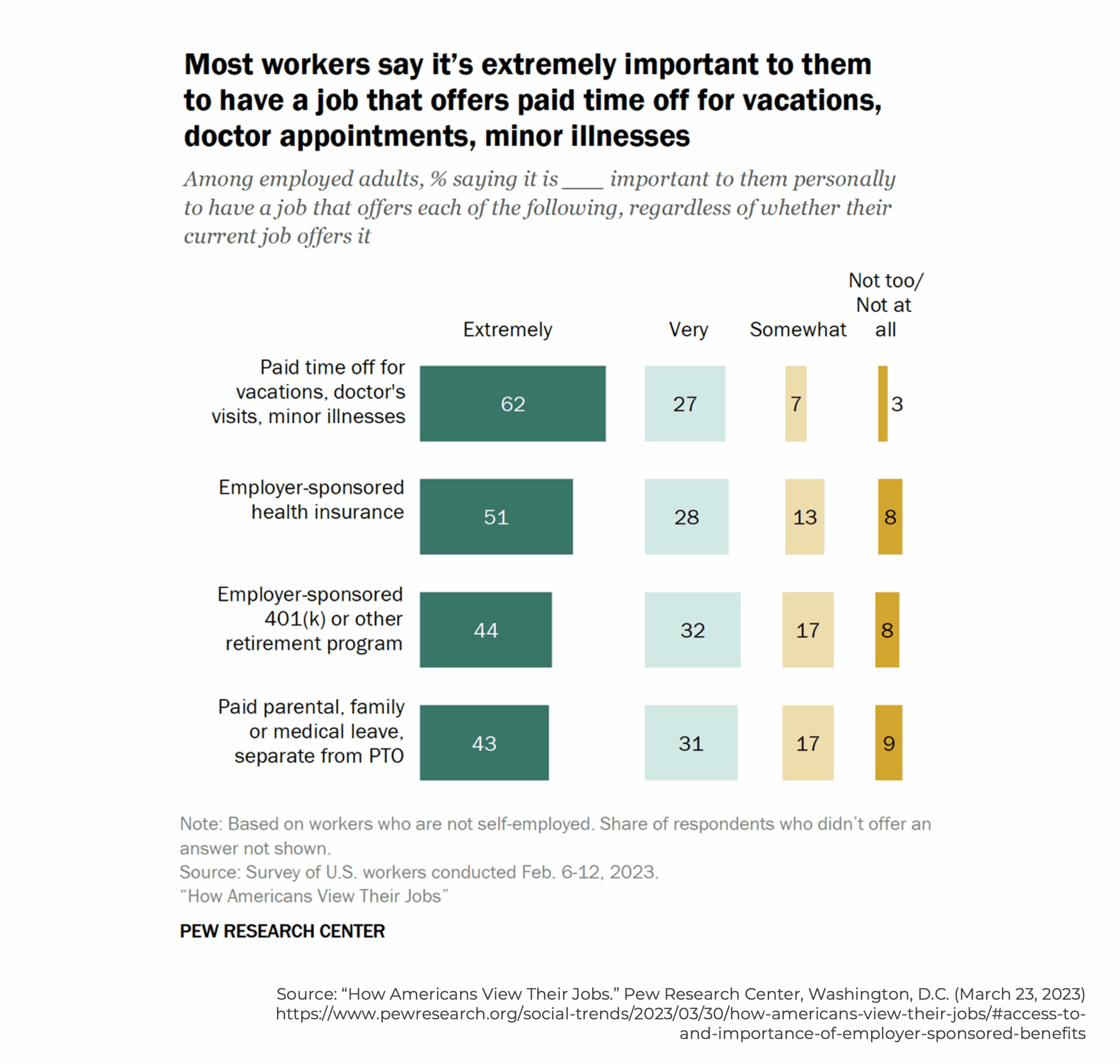
A PTO policy can be structured in a variety of ways (more on that later!), which means that it requires putting some thought into designing a policy that works for the firm and its employees - but it's worth the effort given how important employees view time off being as part of their overall compensation package. 2023 data from Pew Research Center, summarized below, suggests that employees across all industries value PTO as a benefit even over health insurance or 401(k) matches, with 89% of employees reporting that paid time off is "extremely" or "very" important versus 79% for health insurance, 76% for 401(k) plans, and 74% for paid parental, family, or medical leave. (Although notably, if employees are asked to choose 'just one' benefit, most of them choose health insurance, suggesting that employees most likely view health insurance as a necessity rather than as a 'fringe' benefit like PTO or a 401(k) plan.)
Why Offering PTO Benefits Advisory Firms
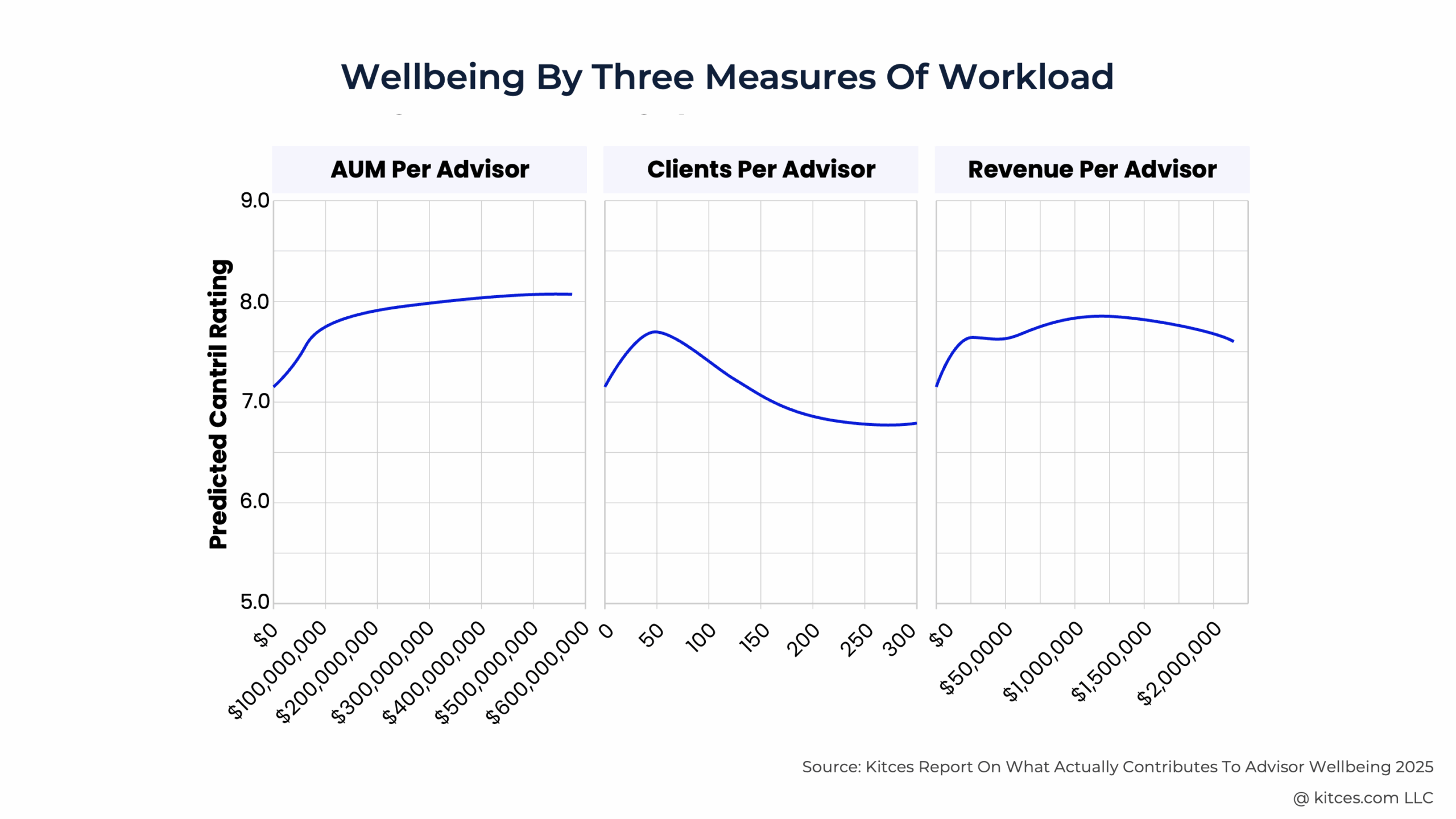
When it comes to work satisfaction, Kitces Research on What Actually Contributes To Advisor Wellbeing found that many of the factors most correlated with high satisfaction involved autonomy over one's time – both in day-to-day flexibility over their time, and having big-picture work/life balance. As the study notes, "Wellbeing rises sharply with revenue per advisor up to around $250,000 – an amount that typically allows advisors to earn an economically viable income after expenses". But regardless of the measure used – AUM, clients, or revenue per advisor – there is nearly always a 'breaking point' where team members experience diminishing returns for these increases.
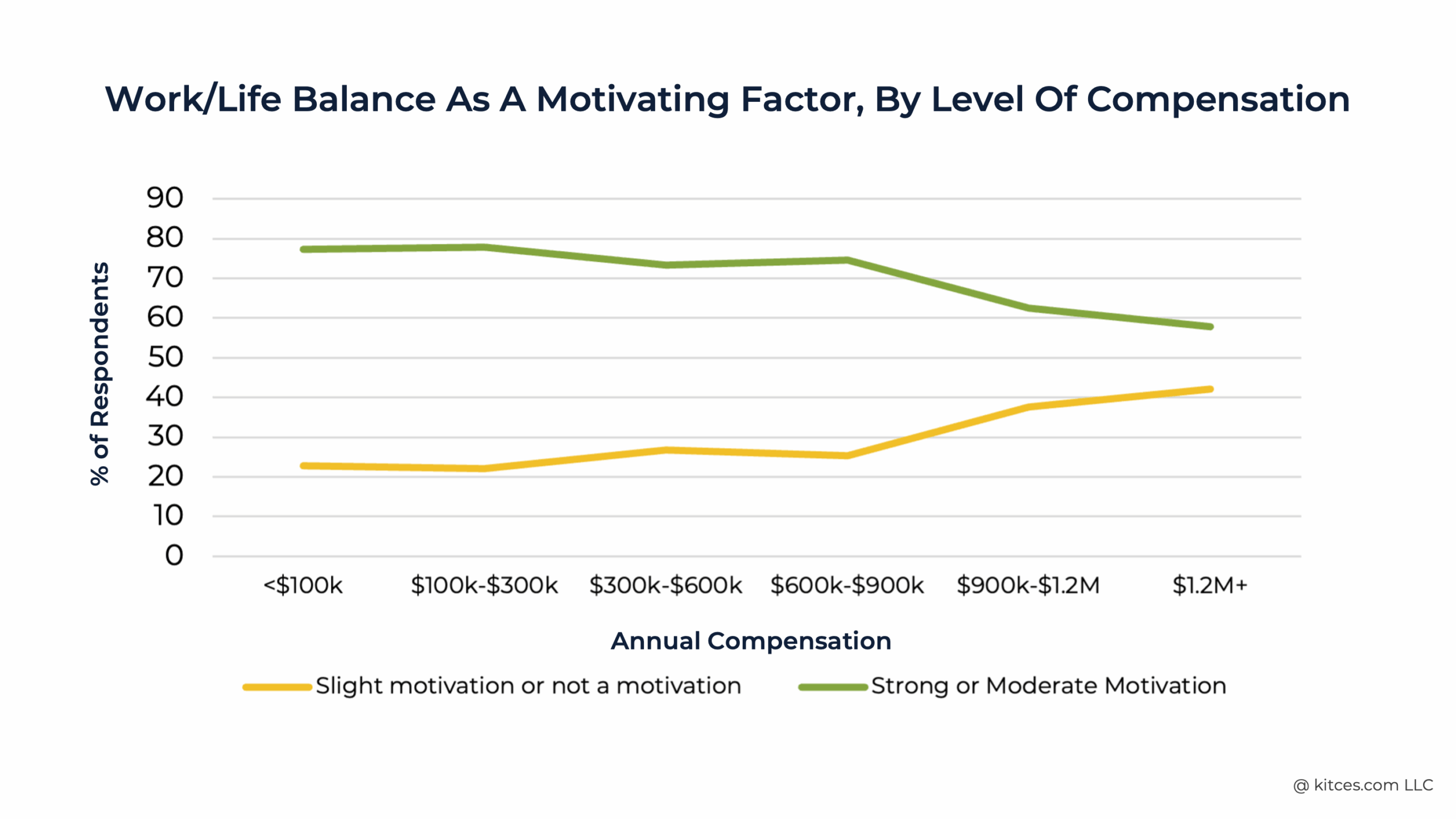
To put it in perspective, 75% of advisors reported that work/life balance was a "strong or moderate" motivating factor to their work and role – a number which only begins to notably decline for advisors making over $900K annually. But even the majority (57.9%) of advisors making over $1.2M value their work-life balance. Everyone wants some level of balance, which can include flexibilitiy, time off, and other markers of autonomy over one's time.
All of that is to say, even if the compensation of a role is great, it won't necessarily yield commensurately high productivity for the firm if the role doesn't also offer some amount of flexibility and time off. Because as many advisory firm leaders can attest to, it's often possible to be more productive when taking regular and deliberate breaks than it is to simply grind through with no rest. And at minimum, it will likely be less expensive to give an employee regular time off than it will be to replace and train a new hire if the original employee leaves for another job that offers better work/life balance!
Like other benefits and areas of compensation, determining a time off policy is often about two things at once: first, given that resources are limited, a firm's compensation and benefits signal the firm's priorities and culture for present and prospective team members. As such, the compensation and benefits must be structured in a way that attracts the 'right' team members that are cohesive with the firm culture. Second, firms also want to present time off in a way that is competitive with other firms, in order to retain and attract employees. This is especially true as advisors become more experienced. Experienced advisors frequently command high salaries, but when it's not feasible to simply 'out-pay' other advisory firms from a monetary standpoint, other benefits like PTO can make up a significant amount of that gap (and even cause a candidate to choose a slightly-lower-paying role that will give them a better work/life balance).
PTO Policy Options And Trade-Offs For Advisory Firms
Financial advisory roles are rarely physically demanding, but they are emotionally and mentally taxing – and just as how the body requires rest, so does the mind. And people need time off for a variety of reasons, from illness to children's school closures to family and pet issues to just needing time to rest. A PTO policy has to accommodate both the planned time off that helps employees rest and reset, and the "random" time off that crops up whenever life happens. Put another way, for most financial planning firms, it's not a question of 'whether' to have a paid time off policy: it's what to offer.
How Much PTO Do Financial Advisors Get Each Year?
According to the CFP Board's 2025 Compensation Study, the median advisor receives 20 days of PTO every year. Some firms subdivide this time into vacation and sick leave days, receiving a median of approximately 15 and 5 days for each respective allocation. Additionally, advisors receive a median of 10 paid holidays (e.g., Federal holidays), adding up to a total of around 30 days off per year.
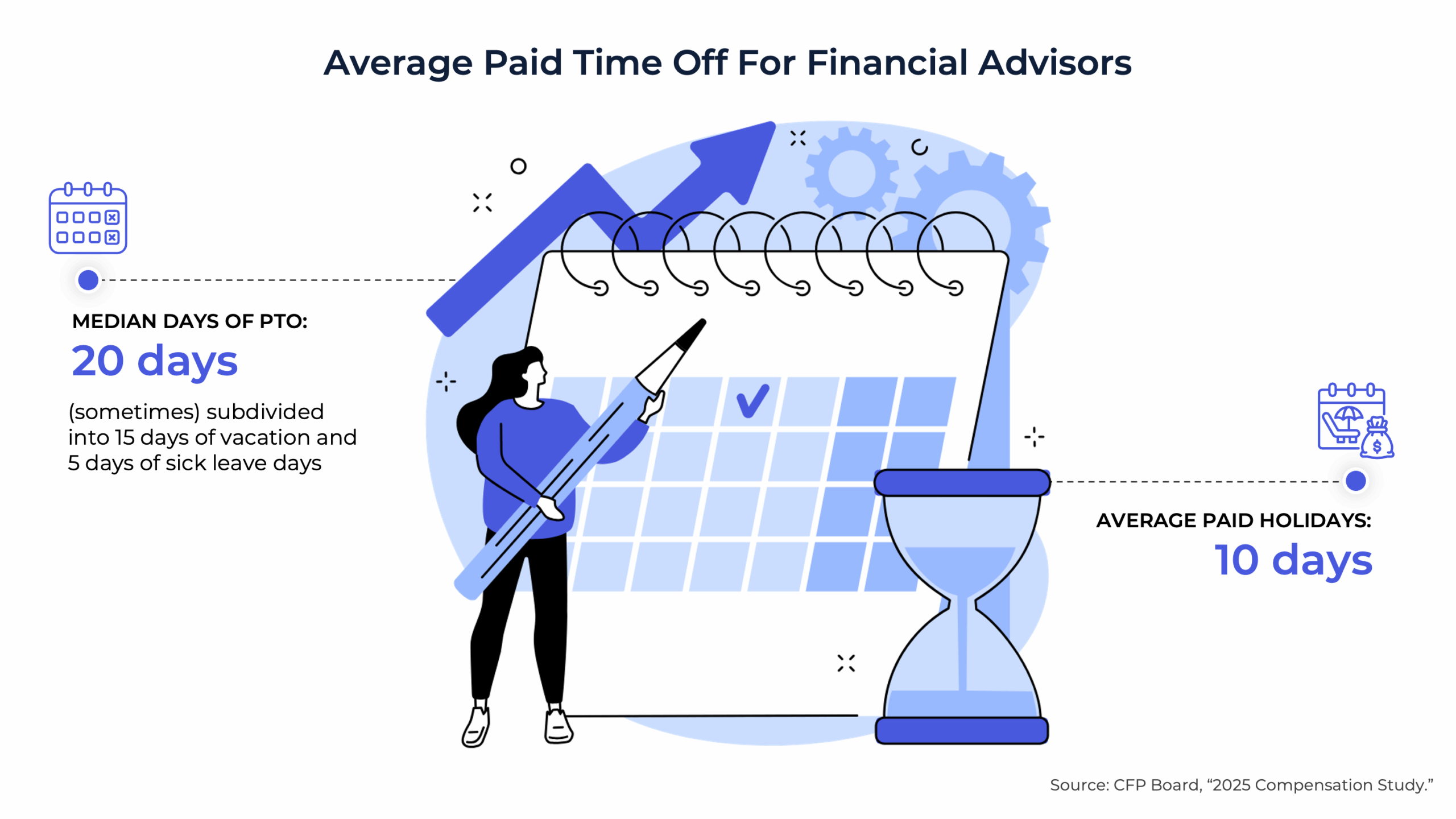
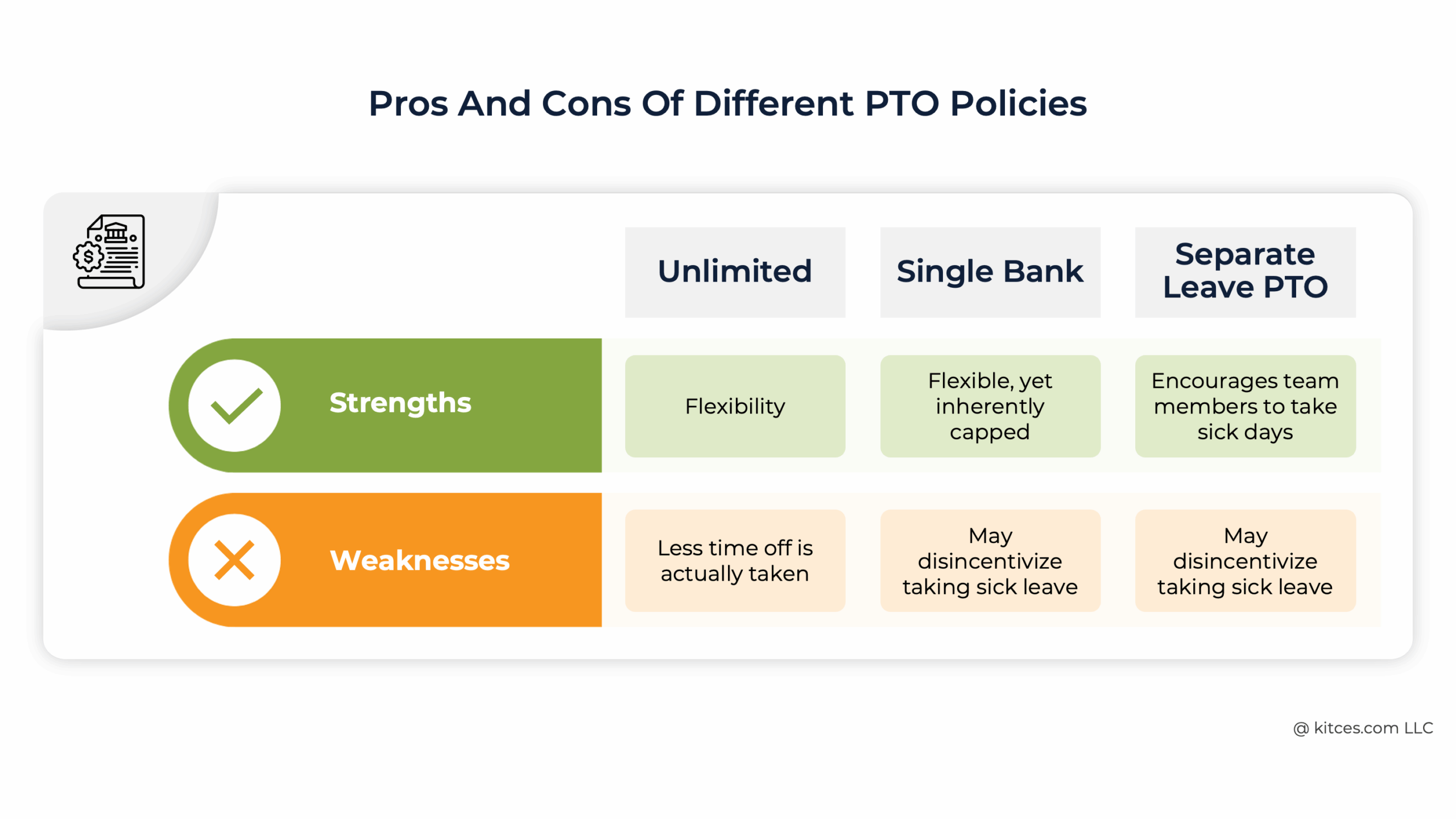
As the above data show, while the total number of days off per advisor remains relatively consistent, the way that firms structure those days varies. Advisory firms generally structure their PTO policies in one of three ways: separate leave, "single-bank", and unlimited PTO – and each comes with its own strengths and tradeoffs.
Separate Leave PTO
The most traditional form of PTO policy is one where vacation and sick leave are treated as two separate categories of time off. As the above data from CFP Board's Compensation Study show, the median advisory firm using this structure offers 15 days (i.e., three weeks) of vacation time, and an additional 5 days (one week) of sick time.
The benefit to this structure is that by clearly differentiating sick time from other forms of leave (most of which are drawn from the bank of vacation time), employees know exactly how much time will be available to them for each. Which then encourages team members to actually use their sick leave when they need it; otherwise, without a separate bank of sick time which will be lost if it isn't used by the end of the year, there's an incentive to 'work through it' so as not to use a day that's already been earmarked for a family trip or school holiday. (As an added benefit, this system provides additional information to management about PTO is being used, which can be informative.)
The con of separate leave is that health isn't very predictable; some employees may need more sick days than others and some may have varying needs for sick days from one year to the next. Employees who tend to use greater – or fewer – sick days than the PTO policy provides for can feel frustrated at having their buckets 'decided' for them. A team member having a very healthy year may rue not using the additional days to travel or visit family; a team member with an unexpectedly unhealthy year who has to withdraw from their 'vacation' budget may feel that sting on a deeper level. (And a firm with a use-it-or-lose-it sick day policy might see a not-so-coincidental spike in employee sick days taken near the end of the year right before the allocation resets, which can cause staffing challenges particularly in advisory firms that often have a flurry of year-end planning tasks to complete.)
Single-Bank PTO
In this version of PTO, rather than differentiating between sick days and vacation days, an employee has a single combined 'bucket' of time off every year for both sick leave and vacation. This leave is typically earned on an accrual basis, usually per pay period (e.g., 20 days of PTO would accrue at a rate of 1.5 days per pay period). As the CFP Board Compensation Study data show, the median advisory firm employee receives 20 combined PTO days per year, which is the same median total number of PTO days offered under separate leave plans (which averaged 15 days of vacation and 5 days of sick time for a total of 20 days) – so while the combined number of days off might not vary much between a single-bank and a separate leave plan, the employee has the flexibility to allocate as many (or as few) days to sick time as they want under the single-bank plan.
This flexibility is the main advantage of a single-bank PTO plan, since employees can set their allocations for sick and other leave based on their own expectations rather than a single company-wide standard. From an administrative standpoint, single-bank plans are often simpler to manage, with only one time bucket per employee to account for that accumulates and decumulates at a set rate, making it easy to calculate how much time off an employee is 'owed'. Employers may also allow employees to carry over a certain number of hours from one year to the next, alleviating the tendency for employees to take extra days off near the end of the year before those days are lost.
The primary drawback of the single-bank policy, though, is that employees are primarily responsible for accurately budgeting their time use – namely, taking their paid time off and saving space for unexpected sick days. Some employees may underestimate how much time is needed, creating potential situations where someone is negative in their accrued time; others may overestimate and 'hoard' their time off out of concern for prolonged period of absence.
For employers, any accrual-based PTO can create some cash risks. As with separate leave PTO, if an employee with single-bank PTO has accumulated 20 days of time off when they depart, the company owes them payment for that time – which can create a cashflow risk if a team member cannot (or does not) consistently take the time off that they are allotted.
Unlimited PTO
In more recent years, an increasing number of firms have done away with PTO caps entirely and moved to an 'unlimited' PTO policy. This has particularly picked up amid the post-pandemic shift to remote work, where it's harder to keep track of when employees are officially "in" or "out" of the virtual "office" – making it more practical to simply get rid of any tracking and allow employees to take as many (or few) days off as they want so long that their work gets done. According to 2024 data from Mercer's annual Absence and Disability study, the proportion of companies offering unlimited leave to at least some employees jumped from 20% in 2021 to 32% in 2024.
For several years, unlimited PTO seemed to be the gold standard for time-off policies (at least in the primarily white-collar jobs with the staffing flexibility to accommodate them) – after all, who doesn't want to take 'as much time' as needed, whenever it suits them?
The main advantage of unlimited PTO is this promise of flexibility. In addition to freeing employees from the need to continuously track and manage their PTO budget, unlimited PTO also minimizes nitpicking over things like half days for dentist and doctor's appointments or ensuring that two hours to pick up a sick child from school get made up at some other point during the week. And there are also logistical benefits from an employer perspective: for example, unlimited PTO means there are no PTO days to accrue and account for, and therefore no requirement to 'pay out' PTO when an employee exits. It also saves some time and mental overhead in setting up a policy, as there's no need to discuss different levels of sick versus vacation days, or whether to offer different levels of PTO to different employees (e.g., giving employees of a certain level of rank or experience an additional week each year).
Yet in reality, as the use of unlimited PTO has ramped up over the last decade, its downsides have also begun to emerge more clearly. Most strikingly, research has consistently found that employees with unlimited PTO often end up taking less time off than those with capped PTO policies. With no clear guidelines on how may days are 'acceptable' to take off, employees must look to their managers or each other for cues, and will often tend to err on the low end (because few employees likely want to be known for taking the most days off among their teammates) – which in turn drags down PTO usage at the company level. And because none of those 'missing' PTO days accrue to employees' balances or are paid out when the employee leaves, they result in a net loss to the employee. Employers who offer unlimited PTO, then, must often take active steps to encourage their employees to take time off – some employers now even mandate a specific minimum number of days employees must take off, or Minimum Time Off (MTO), with no corresponding upper limit on PTO days.
At an administrative level, unlimited PTO may also not be as simple as it seems. While there's no need to track employee leave requests from an accrual accounting perspective, employers do need to know when employees plan to take time off to ensure there's adequate coverage for day-to-day company functions, which requires a system of requesting and approving time off even under an unlimited PTO policy. Employers also may need to know which employees are taking enough (or any!) time off to ensure that they get the resk they need to do their job well. And even under unlimited PTO plans, employers may need to set guidelines around acceptable PTO usage, such as setting limits for consecutive days off (e.g., could a team member take off two consecutive weeks? Six? Twelve?) – in other words, to set consistent expectations for all employees, so team members don't have to rely on (often inconsistent) social cues to know what they really can or can't do under an obstensibly 'unlimited' PTO policy.

Nerd Note:
As noted above, there is no Federal law mandating paid time off of any sort; any laws around PTO accrual and usage are, by and large, set by states. At a basic level, the main legal distinctions between states are (1) whether any PTO (or 'just' sick leave) is required, (2) if the firm is required to 'pay out' unused accrued PTO when a team member leaves, and (3) if a firm is required to set a 'use-it-or-lose-it' policy (in which a team member is required to have no more than a set number of hours by year's end – and if they haven't used that time, then their time will be reduced to that maximum). If a firm uses an outsourced HR provider it should be able to provide guidance on which rules apply, but otherwise firm owners will need to verify the ins and outs of the firm's state regulations before enacting a policy!
Implementing An Effective PTO Policy
The Challenge Of Designing A PTO Policy That Works For Everyone
It's one thing to pick an overall PTO structure, but it's another thing to implement it in a way that works for everyone involved – the firm's employees, their managers (which may just be the firm owner in a small advisory firm), and the firm itself. Which might be more challenging than it may seem – after all, when the advisory firm starts out, it's often just one advisor/owner wearing all the different 'hats' in the firm, meaning that when they take any time off, none of those various roles are being performed. When the firm grows to add more team members, it should at least in theory be easier for any one person to take time off, right?
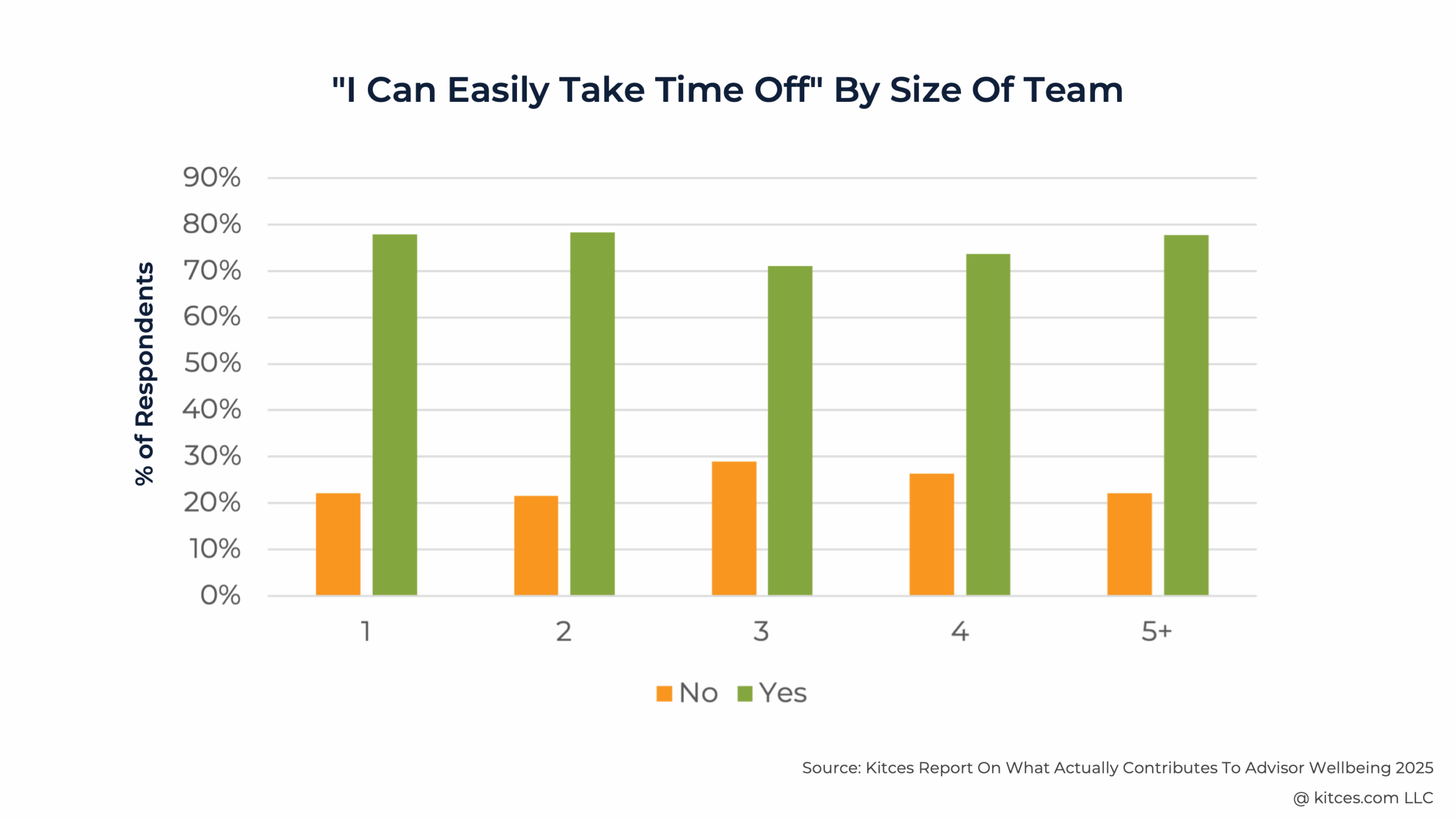
Kitces Research on Advisor Wellbeing suggests this is not the case – while approximately 78% of solo firm owners report that they can take time off of work without stress, this number decreases as an advisory firm hire and grow into three and four-person teams (approximately 71% and 74%) for those teams, respectively), which then recovers once the firm grows to 5 or more members.
This is often an extension of larger teams allowing for more redundancy – there may be multiple advisors, client service associates (CSAs), managers, and so on to cover various advisory firm roles in any teammate's absence. There might also be full-time HR personnel to manage PTO policies from the top down, e.g., setting formalized backup responsibilities for essential day-to-day functions and monitoring PTO use at an individual team level.
At smaller firms, however, there's not only less redundancy in team members allowing one to step in for another when they're on PTO, but it's also more likely that each employee will have multiple job duties themselves – in other words, when each team member wears 4–5 different hats as a part of their full-time role, it's that much harder for another team member (who also has multiple roles to fill) to cover in their absence. Compounding this is that advisory firms are in the client service business, and clients can have life events happen at any time. A call from a client (or multiple clients) who had a new job opportunity come along, or had a relative pass away, or are worried about market volatility, and want to set up a meeting can put additional strain on a team that's already stretched thin.
Which is why it's not just about setting a number of PTO days available or assigning backup duties for when team members take time off. It's also about making sure that PTO actually gets used. Because if employees feel that they're already stretched beyond their capacity without taking PTO, then they'll feel like taking those days off will stress them out even more.
Returning to the Pew Research cited earlier, more than 40% of employees don't use all of their PTO – and 49% of respondants said "they'd worry about falling behind at work if they took more time off". Additionally, "43% of workers who don't take all their time off say they'd feel badly about their co-workers taking on additional work". Additionally, even when many employees do take the time to go out of office, they aren't really gone – it's common to "discretely" check into work channels, email, and so on to ensure that everything is operating smoothly without them (as suggested by previous Kitces Research on Wellbeing showing that significantly less than half of advisors find it possible to fully disconnect from work while on vacation!).
Key Metrics For Understanding Whether A PTO Policy Is Working
Unlimited, single-bank, or separate leave PTO can each be effective in their own way – or susceptible to considerable setbacks. While no system is perfect, many of the drawbacks can be mitigated by good policy and company culture. For example, a firm with unlimited PTO may consider implementing a 'required minimum': either a set number of minimum days in a row (or per year) that a team member must take. Or they may, conversely, set a policy about the maximum number of days in a row.
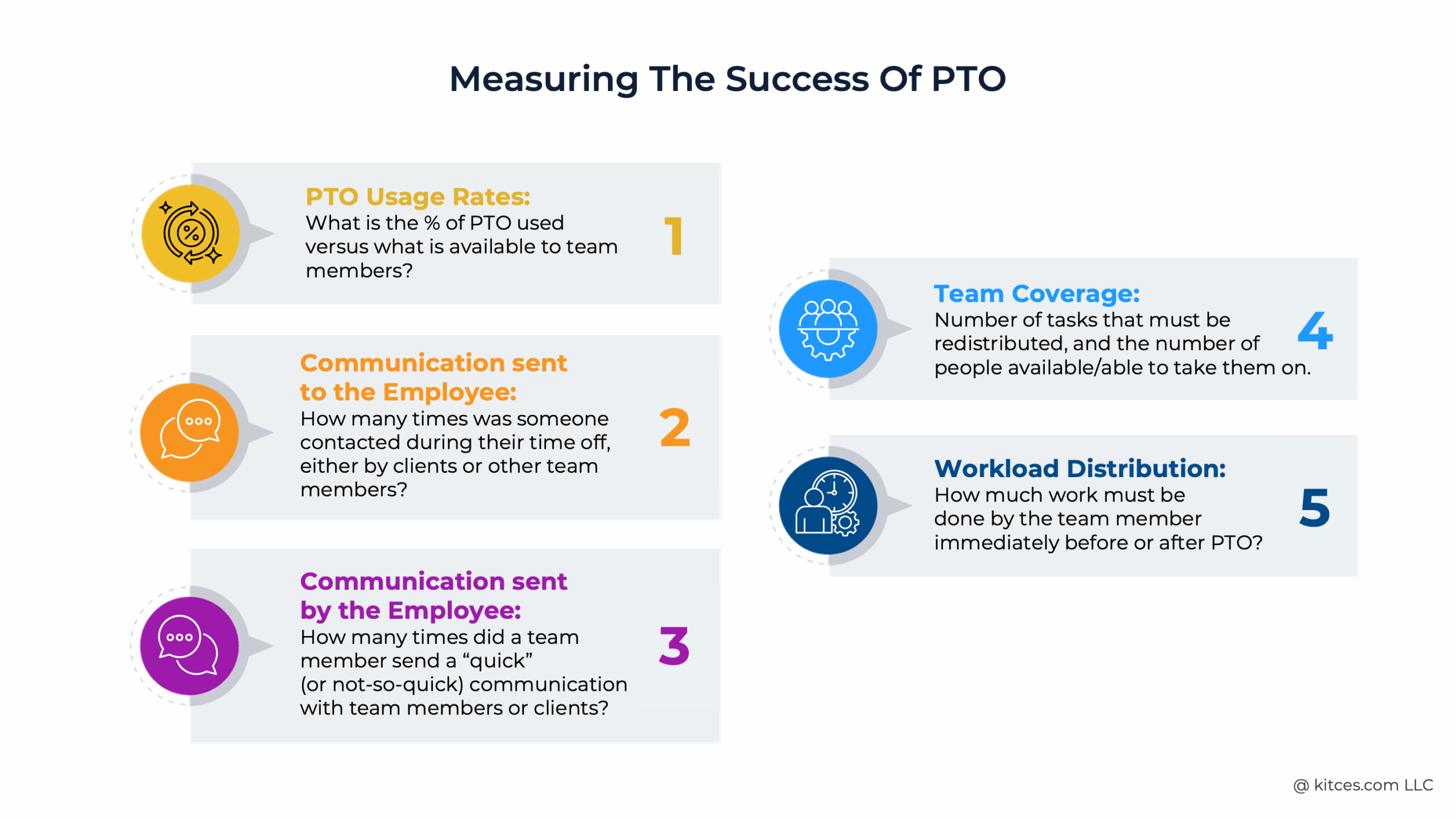
The success of any PTO policy can be measured in a few ways to gauge whether it's working well for employees, or conversely whether it's susceptible to setbacks that may hinder team members' ability to actually take time off. These key metrics can include:
- PTO Usage Rates: What is the % of PTO used versus what is available to team members?
- Communication sent to the Employee: How many times was someone contacted during their time off, either by clients or other team members?
- Communication sent by the Employee: How many times did a team member send a "quick" (or not-so-quick) communication with team members or clients?
- Team Coverage: Number of tasks that must be redistributed, and the number of people available/able to take them on.
- Workload Distribution: How much work must be done by the team member immediately before or after PTO?
All of these elements have some level of nuance – for example, a team member might prefer to be contacted in the case of an emergency, but who defines an "emergency"? Put another way, any PTO policy is only helpful to the extent that it helps team members disconnect and return rejuvenated without either disrupting the firm's operations or putting undue strain on the remaining team members. So, how can firms create a culture of PTO that is effective to all parties?
For small firms, it can be helpful to map out team member responsibilities, which can be as simple as a written list of individual job duties. From there, get specific, narrowing in which tasks must be done while a team member is out of office. Differentiate between what needs to be covered on a daily or weekly basis, and what can reasonably wait until that person's return. Any task which is crucial, but that only one team member knows how to do, requires training at least one other team member on – because while it may be possible to plan those crucial tasks around the absences of the person responsible for doing them, illness and emergencies still occur that could cause disruption. A good measuring stick is the "stomach flu test": if someone was unexpectedly and wholly absent for a week, what would happen? Could team members easily figure out what work needed to be done? Which tasks could the rest of the team easily do, and where are the training gaps? What tasks could generally wait?
In order to ensure that the work can actually be covered, ideally a good PTO policy is at least "two-deep" (i.e., there are two potential backups in addition to the primary person responsible) on as many types of work as possible. This increases the number of options for team coverage and reduce the additional strain put on any one team member while someone is out of office. Ideally, the end result will be a grid of essential job responsibilities showing the primary person accountable for each, plus whoever will provide backup coverage. Below is an example of what this can look like across a three-person team.
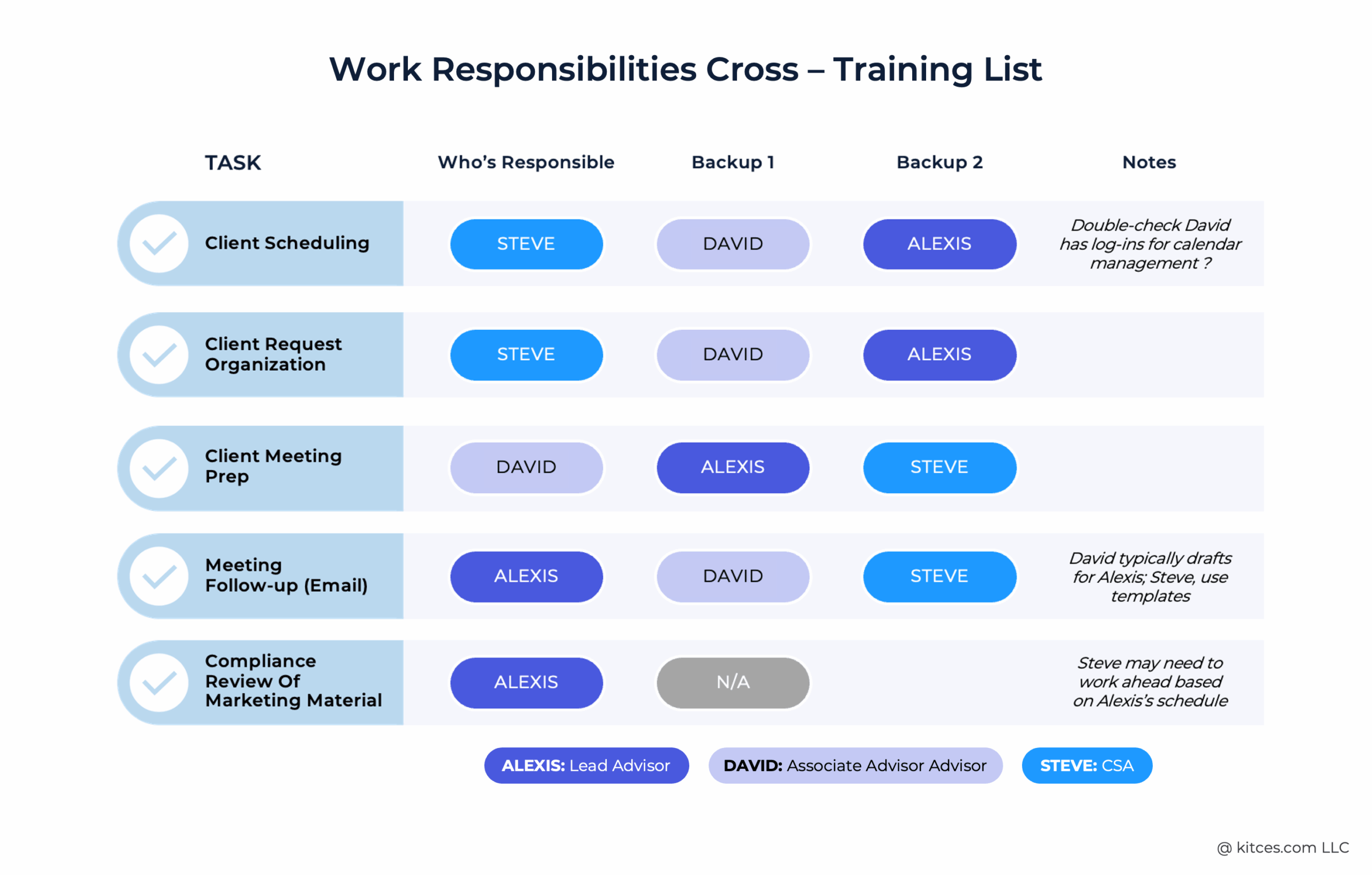
At this point, advisory firm leaders can begin to clarify their PTO expectations based on the amount of backup available for each task. For example, if a firm only has one backup available for most tasks, they may not be able to approve PTO for more than one employee at a time, which may require a fair amount of advance notice and transparent communication for common vacation times (e.g., spring break and the holiday season at the end of the year).
Which introduces another aspect of a good PTO planning: ensuring that other team members have enough capacity to cover for each other. If the team's capacity is already strained, then any absence can prove challenging. This can manifest in an individual team member putting in a disproportionate number of hours before or after their PTO, and/or in their teammates' capacity being overwhelmed as they attempt to cover while managing their own work. Put one way, if a team's staffing plan is not robust enough to allow for everyone to take time off, then a team is understaffed, because one way or another, the team is not getting adequate rest. To that point, advisory firms may consider using fractional staff, especially for prolonged periods of absence, to ensure that the remaining team is not completely overwhelmed.
For a small team with no backups, creating this sort of redundancy doesn't happen overnight – it may take continual conversations and planning in order to ensure that everyone feels empowered to genuinely "check out". An advisory firm may want to set weekly or monthly goals to create their cross-training documentation (which, as a starting point, may be as simple as a screen recording while the task is being done). And any prolonged time out of office can present a good opportunity to revisit what is documented and anticipated.
When initially cross-training, aiming for the 80% rule is often ideal – what will help the team member cover 80% of client requests or processes? Once the team member is confidently cross-trained in the vast majority of cases, the advisory team can consider if and when it is worth ensuring someone is trained up to cover that 'last' 20% - or what they would do in those extenuating circumstances.
As the advisory team progresses in their cross-training, planned time out of office then becomes good "practice" for unplanned time out of office. Unexpected circumstances will inevitably come up on occasion… and when they do, it can be helpful to debrief on the gaps that manifested in cross-training and planning. For a small team, it may be a work in progress, but it can yield great things in the long run!
Other Considerations For Creating A Good PTO Policy
In some ways, a sustainable PTO policy for small teams is similar to household budgeting – while getting the fixed expenses are important, anticipating the 'unexpected' expenses is often the key to managing cashflow. With PTO policies, ensuring people can take planned extended time off is important – and it's also important to consider and adapt for the more common 'unexpected' circumstances. The more of these pieces that can be considered and planned for in advance, the easier it is for these teams to adapt.
Other questions that are worth considering when crafting a policy:
- How far in advance must a team member alert their manager that they will be out of office (for non-emergencies)?
- How and when will clients be informed if their advisor (or other client-facing team members) go out of office?
- Are team members allowed to take PTO during their onboarding period?
- Are there any "blackout periods" during the year where PTO should be avoided as much as possible (e.g., "surge season" for firms on a surge meeting schedule)?
- Are there any basic exceptions to PTO requirements that should be considered?
- If a bucket/accumulation system is used, can team members go 'negative' (i.e., use more PTO than they have accrued, with the assumption that they'll accrue enough afterwards to make up the difference before the end of the year)?
- (And what happens if a team member departs with a negative PTO balance?)
- Which team members would need to coordinate their PTO with each other to avoid gaps in essential functions?
- Which team absences do clients need to know about? How far in advance do they need to be told?
- What is the minimum amount of PTO that team members are expected to take during the year? What is the maximum number of days that team members can take without needing a higher level of discussion?
- What is the policy for flex time out of office (i.e., smaller chunks of time away, such as for a doctor appointment or school event, usually with the expectation that the time will be made up elsewhere)?
- How will emergencies, such as natural disasters, familial emergencies, or bereavement, be handled? (This should align with what's in the firm's BCP [Business Continuity Plan].)
These considerations don't necessarily all need to be formally written out, especially for smaller firms – but it is helpful to have some high-level ideas about these types of absences and consistent standards to follow from one employee to the next. When possible, advisors and managers may want to err on the side of generosity, with some basic written guardrails to clarify the firm's expectations. When exceptions and edge cases do emerge (as they always do), leaders don't have to capture every one in the moment it occurs, but it can be helpful to gradually update the written policy to include these instances – both for team visibility and for the firm's own protection. (And it may be helpful to dillneate between these policies based on roles, as required. For example, financial planners and CSAs may have opportunities for flexibility at different times.)
Nerd Note:
While parental and other types of caretaking leave are topics deserving of their own article, requiring an employee to use up all of their sick leave/paid time off as a part of their parental leave is often deeply impractical. Whether a child has just been born, adopted, or integrated into the family for other reasons, illness and other setbacks are still likely to happen. Leaving a new parent or caretaker with no time off left for the rest of the year doesn't set anyone up for success – or long-term retention.
Finally, from a firm culture prespective it is especially important for managers and leadership to follow the policies they set for the whole firm – which starts with truly taking time off themselves. Leaders set the tone for the entire firm, communicating what the expectation is for the firm not just by their written policies but by their own actions. A firm owner who stresses their expectation for team members to take time out of office, but who never takes time off themselves, creates an implicit expectation that high performance and time off do not go hand in hand. Taking time off as a leader can be daunting – but it's also important. Often, having the leader not immediately around to answer questions is key to building team confidence and helping them problem-solve!
Improving Work-Life Balance Beyond PTO
As a final note, don't discount other elements of flexibility and autonomy that can help employees improve their work-live balance without being full-fledged PTO. This can look like anything from hybrid work schedules to blocking time for client-facing and internal meetings with team members (allowing for more uninterrupted stretches of 'deep work' time during the remainder of the week) to increasing the number of firmwide holidays (giving team members more time off without needing to cross-coordinate on backup duties since it's understood that nobody is working that day). Any of these elements can help advisory teams better manage their stress and workload, without adding more PTO that the firm must coordinate in order to keep itself running.
Ultimately, the key point is that while PTO policies can look any number of ways, it is important to structure the policy and support systems in such a way that it ensures that team members can genuinely take time out of office. With patience and iteration, leaders can build a policy which their entire team can use – including themselves – allowing for true rest and relaxation in order to be more successful the long-term!