Executive Summary
When advisors work with couples, the goal is to make both parties feel seen and heard. Yet while many advisors aim to include both clients, this is often easier said than done. One client may be very engaged in the financial planning relationship, and the other may be less enthused by the prospect of meeting with an advisor. While not all clients need to be equally interested in the financial planning engagement, potential issues can compound over time to the point where only one partner is present in the financial planning relationship, and the other is absent – or they attend meetings but give no input.
Conceiving of this client as the "disengaged spouse" may be doing a disservice to the client. After all, several elements may be at play, including role specialization (where one partner handles the majority of financial decisions, while the other focuses elsewhere) as well as a difference in communication styles. In their 2018 Journal of Financial Planning article, "Planning for Conflict in Client Relationships," authors Sarah Asbedos and Emily Purdon presented a framework of conflict styles within couples, asserting that all individuals had some combination of high/low accommodation and high/low assertiveness. A client who has a high assertiveness/low accommodation style, for example, may be less willing to compromise – whereas a client with the opposite traits may be too willing to compromise, rather than speak their mind. These elements can make it more difficult for both partners to be heard and understood when the couple is in a meeting together.
As such, it may be more helpful to label these dynamics as a sort of "misengagement" between the client couple – gaps in a couple's priorities and communication styles that can make understanding what motivates both people challenging. An advisor who can quickly identify and adapt to these differences in early meetings stands a higher chance of keeping both parties engaged.
What each couple needs will vary. For example, if one partner is more assertive, but not very cooperative, they may be prone to quickly sharing their judgement – and the advisor may need to use reflection language to 'neutralize' some of their assertiveness. On the other hand, if one partner is less assertive, they may need to be invited to share their thoughts first – or may benefit from opportunities to share their thoughts outside of the immediate pressure of a meeting.
Ultimately, the key point is that client "disengagement" is a multi-faceted issue, and advisors can use a variety of tools to increase their odds of connecting with both partners. While some clients may willingly step back and opt to let their partners steer the relationship, the advisor can still encourage their presence within goal-setting or other decision-making meetings that may feel less 'technical' in nature. If advisors can thread the needle between providing options without being overbearing, they may be able to iterate with the client couple to find a rhythm inside (and outside of) meetings that works for everyone!
 |
And if you want to go deeper on this topic, hear directly from the author on the Financial Advisor Technician podcast . |

Listen To The Financial Advisor Technician Podcast On This Topic




Episode Shownotes And Transcript
Click to expand transcript and show notes↓↓
Shownotes:
- Sydney Squires: LinkedIn
- DiSC®
- Fix, Fine, Flourish: A Framework To Take Clients From (Just) "Fine" Stagnancy To Being Engaged Again
Full Transcript:
Adam: Hello, and welcome back to the "Financial Advisor Technician" podcast. I'm your host, Adam Van Deusen. On today's episode, we're going to discuss a common issue for financial advisors working with client couples, which is what happens when each member of the couple isn't exactly on the same wavelength when it comes to engagement or communication with the advisor or with each other. For instance, one member might be the so-called family financial officer, while the other is deferential when it comes to making financial decisions. Or perhaps one member of the couple speaks openly during meetings with the advisor, while the other is more quiet. While it's rare for client couples to be equally engaged and share similar communication styles, when a couple is particularly misengaged, it can be challenging for both the advisor, who might wonder whether they are truly serving the needs of both partners, and the clients themselves, as one partner's goals or interests might dominate, perhaps creating strain in the relationship.
To help us dig deeper into this topic, I'm joined today by Sydney Squires, a senior financial planning nerd here at Kitces.com, to discuss a framework advisors can use to identify different types of client-couple decision-making styles, the consequences of different types of mismatched engagement styles, and concrete tactics advisors can use to ensure that everyone is heard. Welcome, Sydney, and thanks for joining us on the "Financial Advisor Technician" podcast.
Sydney: Hi, Adam. I'm super excited to be here.
Identifying "Misengaged Couples" [1:49]
Adam: Great. Well, so to start, perhaps you could begin by talking about exactly what you mean when you use the term misengaged couple, and what it means in the financial advisory context.
Sydney: Yeah. So I'll start with a term that I think people are going to be most familiar with, which is the disengaged client. So, often when you're serving a client-couple, there's, so to speak, often the person who's really the driver, probably the person who contacted the financial advisor. And then there's a person who is kind of less into the financial planning process, whether they just kind of show up and they're out of it, whether they don't show up at all, whether they don't participate. And I think that's a framework that many advisors see.
I do think that that's important. That's something that we'll discuss more in this, but I think that what might be a more productive framework that doesn't necessarily put the whole onus on the part of the couple that's less into finances is to kind of broaden this scale of engagement. Because really, if both members of the couple were kind of not into finances, right, or financial planning, the advisor could adapt their style pretty easily to match both of them. Likewise, if both members of the couple were super into all the financial details and financial planning, then the advisor could adapt to both of them. So this is kind of what I've started calling misengagement and misengaged couples, which is that the couple is operating on a different wavelength, and they're struggling to work cooperatively together. And I think there are other examples of this…from one member of the couple is, for example, overassertive in a meeting. I would argue that couples fighting in a meeting is a symptom of this misengagement. Where it's just kind of they're not operating in the same style, and that kind of poses a challenge to the financial advisor because you're kind of trying to operate on two frameworks at the same time to speak to both clients, which is just very challenging to run a meeting that engages both people well that way.
Adam: Yeah, and so it sounds like, I think, the key point here is that there's just different styles of misengagement. Perhaps one of them, again, as you said, is sort of the disengagement. One member of the client is always the one who's speaking more in meetings. Maybe the other partner just doesn't even show up to the meetings. That can happen sometimes. But even when both clients are in the meeting, they might be on different wavelengths in terms of how much they're engaging on the financial situation, in terms of their priorities, I would imagine as well. One client is very concerned about cash flow issues, while maybe one is concerned about retirement planning issues. So it sounds like the key here is that there's different ways to be misengaged. As we'll get into, as an advisor, it could be quite valuable not only to diagnose these, but also sort of find ways to bring each of those partners together.
Sydney: Yeah, and I think the big thing with it is it's no one's at fault when it comes to misengagement. It's actually just, I think, in many ways, a symptom of how many couples operate over time. Because modern life demands so many different skills, I think it's very normal for couples to end up with some areas of specialty. One example is, in my own household, I'm much more of a financial specialist. And if you asked me one question about our cars, I would have literally no information to say. And I don't think that's a bad thing. It's just that I personally don't have time to care about both the finances and the cars, and vice versa for my husband. And so it's not a bad thing, but when you multiply that by five years, 10 years, 15 years and all of that, you end up with one member of the client couple who's very concerned with and has mastery of a certain skill set and another member of the couple who is at this point kind of used to taking, if not the back seat, then at least the passenger seat and just letting the other member of the couple drive a little bit.
A Framework To Identify The Different Types Of Misengaged Couples [6:05]
Adam: Yeah. And so I think that's actually a really great segue because we really like to get nerdy here at Kitces and on the "Financial Advisor Technician" podcast. So I understand that we could talk, perhaps, about a framework that you discuss in an article that you've written on this topic to sort of help advisors identify the different types of client relationships that they might encounter when they're dealing with a misengaged couple.
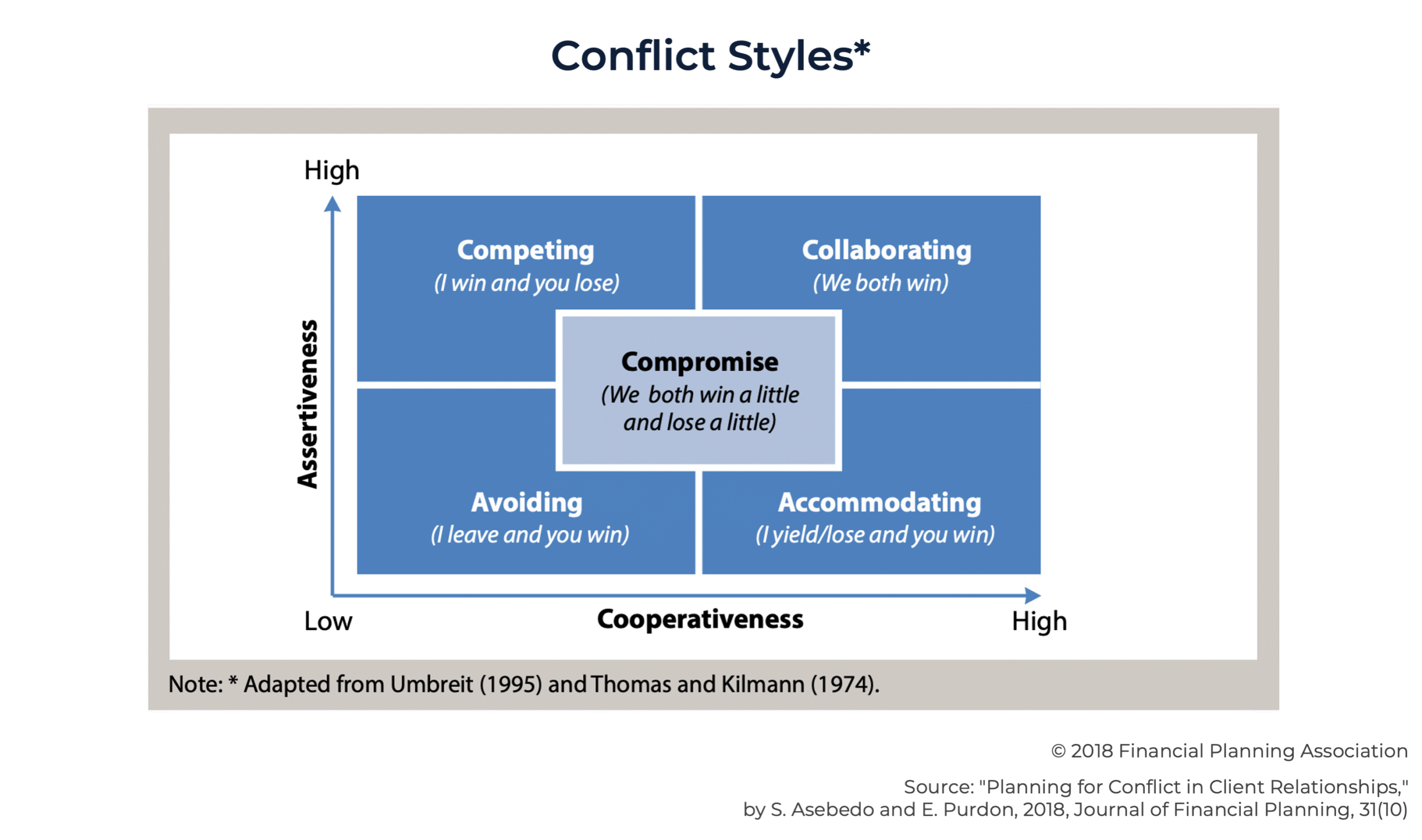
Sydney: Yeah. Within the financial planning meeting itself, I think that there's kind of a framework that can help it feel a little more practical than all the different areas of role specialization and all of that. And this was written about by Sarah Asebedo and Emily Purdon, and they kind of adapted this from prior research. Basically, imagine a kind of two-way spectrum of assertiveness and cooperativeness, and basically low to high on each of those.
So, for example, if someone is low cooperativeness and low assertiveness in the meeting, that's called avoidance within this framework. So that's someone in the couple is absent, whether in practice or in actuality, right? Just like, I'm not in the meeting, or I'm in the meeting, but I'm super checked out. If someone is low cooperativeness, so they're not necessarily wanting to work together with the other person in the couple, but is very competitive, that basically means, "Hey, whatever my partner says in the meeting, I don't know if I'm really going to be agreeing. I don't really want them to get any ground," right? And so you almost approach the meetings like it's a competition a bit, and you end up in this framework of, "I win, and you lose," or at least in a winners and losers framework.
On the other side of the spectrum is what I'll call the high cooperativeness side, so you're willing to work with your spouse. But if you're very cooperative and not very assertive, that's called accommodation. And it's pretty much just, "I'm going to yield on all of these different points and I will just kind of let my partner drive, let my partner win," even, right? It may be something is not worth the fight. It may be that I don't feel like I know enough about something. And so I'm just going to accommodate like, "Whatever you guys say is fine. That sounds good with me."
And then, kind of the high assertiveness and high cooperativeness is collaboration. Basically, you end up where both of us win and all that. And then kind of in the middle of it all is compromise, which I think is a more realistic corner that stuff ends in, where most people are giving up a little bit. There's a little bit of just scarcity, and that there's a fixed amount of resources. So it's unrealistic. We can do everything that's important to all of us all the time. And so, kind of areas of collaboration and compromise are ideally where you want a couple to settle in. But again, in this assertiveness to cooperativeness scale, you kind of need both parties to show up in a high assertiveness, high cooperativeness area of things.
If one couple shows up and they're completely avoidant, or one couple shows up and they're being very competitive in a meeting, the other spouse might be trying to be that blend of assertive and cooperative, and they may be trying to find a compromise. But it's really hard if the other person in the couple is not necessarily in that same headspace.
Adam: Thanks for running down each of those. So sort of just to summarize, we're looking at the two axes here. So we have assertiveness, cooperativeness. So perhaps in an ideal world, as you mentioned, it's a compromise where both sides are willing to yield or perhaps collaborating where both sides or both partners are extremely engaged, but are really willing to work with each other. When we're talking about misengaged couples, so it sounds like we're working in the other three boxes. So competing where both people are assertive in the meeting, and they're not particularly cooperating with each other, avoiding where one partner is just totally absent and the other person is totally deciding, and then accommodating where one partner is actively sort of deferential to the other partner, is willing to sort of cede the decision making. And as you said, there's potential problem areas in each of these in terms of both partners being able to explain and reach their financial goals here.
The Consequences Of Client "Misengagement" For Advisors And Their Clients [10:33]
Adam: So Sydney, I think we're in a good place right here. So now we sort of understand what it means by misengaged couple. We have some of the sort of archetypes of what different types of misengaged couples look like. But for advisors out there, what are some of the consequences of couples who are misengaged, both perhaps for the couples themselves, but also for the advisor in their business?
Sydney: Yeah. In the very short term, I think it's kind of unpleasant, and I think that's worth just kind of addressing on its face. I think most advisors in an ideal world, you really want to feel like you're the person who can help both parts of the couple feel heard. You want to really help them get engaged and get excited, especially if it's a corner of their lives they haven't felt excited about in the past. And so, if you are managing a whole meeting and you're trying to get one member of this partnership to speak more or speak less and all of that, that's a different area of meeting management. And that can sometimes feel very frustrating.
But separate from the short-term stuff, I think that there are kind of two corners of these long-term consequences that advisors are concerned about. I think that the first is just I really like the Dick Wagner quote of, "Money skills are life skills." And just that I think advisors are aware that in the long term, if the part of the couple who's been like the family financial officer, right, the person driving all these financial situations, if they are either incapacitated for the short or long term, if they pass away first, then the other member of the couple that's declared themselves to not be the financial person can kind of end up in a really tough spot really quickly. And hopefully, the advisor can guide them through that, but that learning curve is a lot easier if it's happened over five years in the financial planning relationship and not when everything's kind of in a state of emergency.
And then the other outcome of that is that I think a lot of advisors worry a little bit about client couple retention, either in the short term, where that member of the couple is like, "You know what, I'm actually not feeling heard." But also in the event that one client passes away, that the widowed person may then be trying to move on to someone else, ironically, right when they might need the advisor the most. So there's that short-term end of it's unpleasant in the short term, but then also this pattern kind of perpetuates...it can lead to dysfunction or, again, just the relationship ending in the long term.
Adam: Yeah. And I think one key point here, though, is that sometimes with a misengaged couple, let's take the example of one of the partners is very engaged with the advisor and the other one isn't, sort of an easier path perhaps is to engage with that more active person. They're responding to the emails, they're coming to the client meetings. It might be simpler than doing sort of this active outreach to the other partner who's maybe less communicative in the meetings. But as you're saying, there are consequences to that, whether it is, as you said, in the near term, you're not necessarily being aware of the goals of both partners in the couple. One might not really be so approving or engaged with the advisor themselves, which could have consequences, as you said, for the long run. Let's say the one partner passes away or is incapacitated, as you said, they might not know exactly what's in their financial plan, and they might go looking for a different advisor if they felt like the advisor that they had been working with hadn't been actively reaching out to them. So it sounds like what you're saying is that it's important for the advisors to sort of be proactive in this realm.
Sydney: Yeah. There's a lot for just...if you're goal setting, then often making really big financial decisions and half of the couple, for all sorts of different reasons, may not feel heard. That has really long consequences, both for the couple and also for the advisor. But yeah, it's a tough dynamic to manage when you're trying to get someone to speak up in a corner of their relationship where they've been very used to being in that avoidance, accommodation corner of things. And yeah, just have a lot of empathy for the advisor who is balancing these dynamics. It's certainly not easy.
How Advisors Can Support Misengaged Couples [15:19]
Adam: So we've discussed sort of the issue with misengaged couples, helping to identify the different types of them and why it can be valuable for advisors to address this issue. Let's move on to potential tactics to help address this issue. So I would imagine with a misengaged couple, early identification and perhaps finding ways to address the issue very early on in the advisor-client relationship would be helpful. What's something that an advisor could do early on, whether it's identify or help bring in both partners into the conversation?
Sydney: Yeah. The very easiest thing is to try, in every way, just start with setting that as the expectation. I think many clients, whether this is the first financial advisor they've ever worked with or they've worked with a financial advisor in the past, when it's a new relationship, the client is trying to figure out what the advisor expects of them and vice versa. And so whether it's when meetings are first scheduled, putting something explicitly of like, "Hey, if you're married or in a committed relationship, we really want to have both parties there."
And I think doing a little bit of... I'll say, I think that for the four areas of misengagement, it can be very helpful to send things like meeting agendas in advance. If you're working with someone who's kind of on that lower assertive end and lower cooperative ends of things, that's where that member of the couple would probably really benefit by having a written agenda of here's exactly what we're going to talk over, particularly if the financial advisor does much more on the behavioral finance side. In some ways, that can be a nice way to affirm, "Yeah, we're going to talk through the finance stuff," right? "We're going to talk through a lot of this. And also, I just really want to hear about your goals." A lot of clients may not have realized that that's a dynamic that even can happen in a financial planning meeting. And so there's a point to which it's like, if you're talking about more things than just the hard numbers and you're trying to give a big picture of the goals, letting the clients know up front might actually help make the couple, as a whole, more interested and can also help dial down people's expectations if someone is wanting to come and only discuss the hard numbers or if someone is only coming just to make their partner happy or something. So that can be a good way to kind of thread that line.
The other thing is, if the advisor has the capacity for it up front, I personally am always a proponent of doing personality assessments. I think that where personality assessments can be very helpful is just to capture patterns. People are always more complex than any full assessment can show, but it can be a helpful really big-picture thing of how people like to show up. In particular, when it comes to how people tend to show up within meetings, relationships, and stuff, I personally really like the DISC profile, which kind of shows things from, literally, dominance is one of them to cooperativeness. And it will kind of rate people to have either really high or extremely low areas of that. So if you send clients that in advance as a part of the onboarding process, you can kind of see, "Oh, client A is very high in dominance, and client B is really low in dominance." And it can be really helpful just to know that going into a meeting that you will probably have to work a little more proactively with client B to get them to kind of speak up while also kind of doing a little bit of management of client A. And again, this is all pre-meeting stuff that can actually help the meeting itself go a lot more smoothly.
Adam: Yeah, that's a really good point. I was going to say, so it sounds like the first item is sort of for the advisors, literally, setting the agenda, letting the clients know what's going to be discussed. And again, perhaps giving both clients an idea of what to expect. So if someone, for example, doesn't enjoy speaking extemporaneously quite as much, maybe they can gather their thoughts in advance and perhaps be more engaged during the meeting.
And then the second item, it sounds like what you said was sort of digging in, whether it's using a formal personality assessment or otherwise, to better get to know each of the clients. And I'm assuming in this case that each member of the couple is taking this assessment separately. So perhaps it's teaching them something about themselves, but as the advisor, really letting you know how each of the members of the couple are coming to the table sort of separately. Is that right?
Sydney: Yes. Be sure to test both of them separately because of that dynamic. If you send one DISC profile assessment or even one risk tolerance assessment to the client couple, honestly, the odds that the couple sits down and takes it together is, A, pretty unlikely, right, within a family financial officer and partner dynamic. But also, B, getting the aggregate average of how both clients tend to show up is not always the most helpful thing. Looping back to the DISC profile example, if one member of the client couple is very, very assertive and the other is very not assertive, and they're trying to answer in the middle ground, and you end up with just a moderate dominance score, then that's actually not informative to how either client is going to show up in the meeting. So just anything that can be done, when possible, to capture that data separately is very helpful. And I think that the scale of that and the spot where advisors will need to be discerning is just being mindful, particularly for the less engaged spouse or the spouse who isn't traditionally as into finance, that really the number of things you can ask them to do, especially in the early relationship is going to be pretty limited. So try to keep it to one or two specific things that you are really asking them for, and be really specific about the why and why it matters. So do what you can to capture good data, but just be very mindful of the pacing at which you send it so that you're not affirming to the spouse that wasn't that into finance that this is still going to be a lot of work, so to speak.
Adam: Right, right. And client onboarding, always a lot of paperwork, a lot of homework that advisors are asking. So this could be very useful, but as you mentioned, maybe one more thing that's on the list to do. So preparation seems to be a big part of this. But let's say that we're now in the meeting with clients, whether it's a newer client or perhaps an established client. I'm sure a lot of advisors out there listening right now can think of some of the clients that they have where this sort of misengaged status might apply. So what are some tactics that advisors can use during the meeting itself to sort of address the misengaged client issue?
Sydney: Yeah. Just for established clients, Dr. Meghaan Lurtz has this really excellent article about reengagement meetings about kind of either things have changed, or stuff's been going around for a while where she basically talks through holding a new engagement meeting. And so for established clients and for new clients, I think that there's always a power in explicitly setting the stage and just asking good questions to help everyone just put expectations out into the open and to even just explicitly call out dynamics. And I think that when advisors can do that with both some level of sensitivity as well as, honestly, a little bit of humor can go a really long way. If the advisor calls out, what would a really successful financial advising meeting look like? And also, what would it look like if this thing were fun? And I think you can sort of be a little playful with it, calling out some areas of misengagement.
But I think that some things that can be very helpful is, if the advisor has capacity for it, getting some baseline of how would each member of the client couple really prefer to be contacted, communicated with, and all of that. If the advisor kind of has their set touch points or methods of communication, it may be helpful just to start with listing what their options are so that people know, but even just asking both members of the couple that. I think it's helpful to ask both members of the couple about their main goals and just what's important to them. And if the advisor can spot a dynamic where one couple is much more accommodating or much less assertive, it's usually helpful to start with that person. And if that person is kind of struggling to come up with things, that's where it may be helpful to just list a few examples. Just things that, again, help lower the stakes for them. I think on the other end, with the partner that's kind of more assertive and is more enthusiastic, that's where the advisor will want to use just some blend of really reflective language and really cooperation-focused language to just help resetting that person towards that main goal. One member of the couple may feel that the other is "spoiling the kids," right? And trying to reroute that towards, okay, what's actually the shared problem here? What's that deeper concern? And pulling that away from that partner, I think, can help ease things in the short term and can also help in the long term, kind of set an implicit expectation of, "Hey, don't triangulate me between you two," which can also be very helpful.
Adam: Yeah. And I think advisors would prefer to avoid that kind of awkward situation there. So, yeah, a lot of good things that you mentioned there. So it sounds like first off is setting the table and letting each of the partners explain how they prefer to communicate and what's the best way to get their goals across. So I can imagine one partner might prefer to send their questions in advance or be able to write it down in an email in advance, whereas the other partner might be willing to go off on a 20-minute monologue at the start of the meeting talking about their concerns. So using different types of modes of communication. And as you mentioned, letting the clients know what types of communication are available because they might assume that what's discussed at the meeting itself is the only place to discuss issues, whereas the advisor might be open to receiving it via email or other fora. That's great.
The other key point I think I got from you there is a lot of the focus here sometimes could be on trying to get perhaps a lesser engaged partner to be more engaged. So we've talked a lot about the questions and the tactics to do that. But as you mentioned, there's also an element here for the more engaged partner or a more assertive partner in the sense that if they are the one who's speaking for almost the entire meeting, they could really drown out the other partner, and perhaps, unintentionally, they might not realize that they're doing it. But if that happens, it might leave very little room for the other partner to get a word in, their goals explained, or any questions or concerns addressed. So you mentioned, I think, which is a great tactic, which is the first thing to do from the advisor's end is speaking to, perhaps if they've identified them, the lesser engaged partner, letting them get sort of the first word in to make sure that they can explain or discuss the issues that they want to before perhaps the more assertive partner does more in the conversation. So I think those are really, really great questions, great tactics for advisors to consider.
One Key Takeaway For Advisors [27:32]
Adam: So as we come to the end of our time today, we've covered a lot of ground, but we always like to leave our listeners as the final question with one key takeaway that you think they should get from this conversation. So from your end, Sydney, what would that be for our listeners?
Sydney: I think that the really big takeaway is thinking about this engagement dynamic as a spectrum, just because that then enables the advisor to not just be thinking about the less engaged client, but then also the more engaged and more assertive member of the couple. And I think that when the advisor can ideally start with the explicit idea that both people are heard, but then genuinely use communication tactics in the meeting as well as outside of it to really back that up, then they can help the couple understand, maybe for the first time in a very long relationship, how to show up cooperatively in a financial discussion and the way that both of their dreams and long term ambitions and goals can actually play out in this financial planning relationship. I think there's a degree to which clients might not know what is possible because they may have had prior experience with financial advisors, this may be their first time, this is probably a decades-old relationship. And so I think that advisors who can, particularly early in the financial planning relationship, just set a really good groundwork for their expectations just may be surprised at how those dynamics can change in the long term.
Adam: Yeah, I think that's a really great way to wrap up. So well, thank you so much again for joining us today on the "Financial Advisor Technician" podcast, Sydney.
Sydney: Thank you, Adam.
Advisors working with couples often work diligently to ensure that they get input from both partners as a part of their financial planning process. While couples often aim to be aligned, they will also naturally have some divergent thoughts and priorities, which may at times play out in real time in front of the advisor. Still, even if there is occasional disagreement, having both partners present helps the advisor ensure that planning and investment conversations reflect the (sometimes conflicting) wishes of both partners.
Yet many advisors may see a different problem: one half of the couple may be enthusiastically involved, and the other less so. At best, they may be passively present in the meeting, and at worst, they may be absent entirely. This scenario is commonly referred to as the 'disengaged' or 'disinterested' spouse, and it poses a dilemma for advisors trying to determine how much to pressure (if at all) a client to bring their 'less engaged' spouse to the meeting. If they push for the absent party to attend, will that strengthen or weaken the current planning relationship?
Why Couples Differ In Engagement And Communication
Differences in engagement can come from a few places – typically, it's a combination of role specialization, and differences in communication styles. In regard to the former, every couple works with some degree of scarcity when it comes to time, money, and emotional energy. As such, it is natural that over time many couples have adapted some level of role specialization, where each individual 'specializes' in different areas of household/life responsibilities. Each partner's domain comes with its own mental load and demands, so how this work gets allocated is often a result of many factors, ranging from aptitude to time availability to socialized perceptions of who 'ought' to handle various responsibilities. For example, one person may be primarily responsible for childcare, and another may coordinate meals on a day-to-day basis. All of this to say, when an advisor first meets with a client couple, they are often dealing with dynamics that have developed in a multi-dimensional way over years, if not decades.
According to a 2024 study by Northwestern Mutual, the average age that a person first seeks financial advice is 38 (and similarly, a Wealthtender survey found 37 to be the average age). Additionally, by virtue of how many advisors charge fees (e.g., AUM or a similarly-priced fee-only structure), oftentimes clients have already achieved a high degree of economic success by the time they initiate a financial planning engagement. As such, clients may come in with some already deeply-entrenched rules or philosophies about money – including the role that each spouse plays in handling or managing it – which they may believe have contributed to their relative success. The advisor is entering a complex, often long-standing relationship dynamic as a third-party. Much as the client comes to the advisor with a lifetime's accumulation of savings, so too are they coming in with a lifetime's accumulation of financial and communication habits.
One spouse – referred to in some corners of financial planning as the "Family Financial Officer" – may have directed investment decisions up to this point, filed household taxes, and so on. Meanwhile, the other partner (who is still naturally affected by financial outcomes, and perhaps even handles day-to-day cash flow but may not have the same balance sheet 'specialty' and may be less invested in the meetings) is often overlooked. Of course, the dynamics of the FFO and their partner will greatly vary based on the couple; there are as many ways to divide financial responsibilities as there are responsibilities in general. But for the financial advisor, this often manifests as one person in the couple who primarily handles the advisor/client relationship – for example, by initiating and maintaining communication with the advisor – while the other party remains 'disengaged'. These engagements tend to look something like this:
Barbara onboards a new client couple, Billy and Valencia. Billy is an optometrist and the primary breadwinner, but Valencia has been the driving force behind starting the engagement – she was the one who contacted Barbara, answered the emails, and arranged the meetings. She is the one who has driven most of their retirement and savings strategy to date, whereas Billy tends to focus his energy on maximizing his income and other areas of household management. While Billy has an interest in ensuring he can retire and talking through some travel in the first few years, he seems disinterested-at-best in discussing most of the details of how to get there.
When Billy attends meetings, he rarely asks questions. Over time, Barbara and Valencia increasingly communicate exclusively, and Billy rarely attends meetings, if at all. Barbara feels as though she has no real client relationship with Billy – she is left hoping that Valencia and Billy have really talked through "our goals", as Valencia describes in their meetings.
The term "disengaged spouse" is often used as a shorthand to describe this spouse who appears disinterested in the financial planning process, and while this may be a neutral or well-intentioned description of the dynamic, it can do a disservice to this person (since the label itself implies that this spouse is a 'problem'). Rather, what manifests as "disengagement" may genuinely be differing values/interests within the couple… or it may be a misalignment in communication styles that changes how each client 'shows up' in a call.
How Differences In Communication Style Affect How Couples Manage Conflict
While some aspects of the couple's engagement in financial planning may come down to role specialization, an equally potent force is each person's unique communication style, which can create different types of conflict (and withdrawal) during a financial planning meeting, as Sarah Asbedos and Emily Purdon outlined in their 2018 article for the Journal of Financial Planning. Adopting research from Umbreit (1995) and Thomas and Kilmann (1974), Asbedos and Purdon characterized peoples' conflict response styles as falling along two spectrums: high/low assertiveness, and high/low cooperativeness.
In real life, this can look something like the following within a client couple, Billy and Valencia:
- Example 1: Avoiding (low assertiveness / low cooperativeness): Billy never attends meetings, or when he does, is more or less silent the entire time.
- Example 2: Accommodation (low assertiveness / high cooperativeness): Valencia drives all of the communication, and Billy simply 'goes with the flow', agreeing with everything Valencia says.
- Example 3: Competing (high assertiveness / low cooperativeness): Valencia and Billy argue in every single engagement meeting, sometimes forcing the advisor to 'referee' or 'pick sides'.
- Example 4: Collaboration (high assertiveness / high cooperativeness): Valencia and Billy both want more or less the same thing.
- Example 5: Compromise (moderate assertiveness / moderate cooperativeness): Valencia and Billy have different perspectives but eventually reach an agreement and find a middle ground.
While mismatching communication styles isn't necessarily anyone's 'fault', it can be challenging for advisors to navigate these dynamics. For example, during a goal-setting meeting, a spouse with a Competitive communication style may be more willing to share their goals (and may therefore take up more of the call), while the less assertive, Accommodating partner may be more willing to take the back seat. Given that a client's 'true' goals may go deeper than what is 'just' stated aloud or visible from the outside, understanding more about what actually drives clients often requires a lot of follow-up questions. So if one client has opted out of those conversations, or is taking a backseat, then it can be difficult to ensure that the entire couple is represented in those shared dreams – or to catch any possible areas of tension within the couple. This, in turn, can create a self-fulfilling cycle where only one partner feels heard, so only one partner bothers to truly engage, so only one partner feels heard… and so on.
In the longer term, if one part of the couple is Avoidant or Accommodating (and doesn't occupy a financially-oriented role in the household), then advisors may be concerned that this partner is at risk of struggling in the event they are ever thrust into that role involuntarily. (To paraphrase the influential writer and financial planner Dick Wagner, money skills are a 21st century survival skill.) It's not that advisors expect clients to be as fluent in technical financial planning as they are – they hired a financial advisor for a reason. But if a client has declared themselves to not be 'a finance person', disengaging before the advisor can demonstrate that not all financial discussions have to be painful or onerous, this can have painful consequences if the more financially-oriented spouse becomes incapacitated or passes away first, leaving the less engaged partner to navigate household finances at a most inopportune moment. And if the more engaged spouse does become debilitated or worse, then the advisor may also be worried about retaining the widowed client in the long term. After all, if they have not built an ongoing relationship with both clients, then the advisor may struggle to work with the surviving spouse during such an emotional, vulnerable period.
While some of the nuances of each couple's communication dynamics will unfold over time, the advisor that can quickly understand the gist of this couple's style(s) can increase their chances of setting up the advisor/client relationship for long-term success.
Managing Client Couple Dynamics To Ensure Everyone Is Heard
For advisors, the early stages of the client relationship are the easiest time to set expectations around client couple engagement, with a goal of indicating to the 'disinterested' partner that this engagement will be relevant to them.
For example, if the advisor wants to meet with both partners within the couple, include that language on the website and in early scheduling emails. Something as simple as this can suffice:
If you are married or in a similarly committed relationship, our expectation is to include both partners at the onset, especially in our goal-setting meetings. Please ensure both partners are present if possible, this conversation will expand beyond the financial details – we want to hear about what motivates both of you!
Another bonus of language like this is that it allows the advisor to reiterate that this firm goes deeper than investment advice and that the financial planning provided will be relationship-oriented.
Additionally, in the early aspects of the financial planning relationship, it can be helpful for the advisor to gauge each partner's communication preferences. Much as how it can be helpful to survey both members of the couple about their risk tolerance separately, some type of communication preference or personality assessment intake form (such as the DiSC Profile)– provided that it is not overly burdensome – can be helpful for the advisor to get an early snapshot of the dynamics at play. For example, if one client appears to favor direct, to-the-point communication, they may have a more "Dominant" personality (as defined by DiSC Profile), and the advisor may be able to tailor communications accordingly.
Advisors can also observe how clients relate to each other – e.g., one person regularly drives the conversation, while the other agrees in order to help move things along, even if they haven't really shared their thoughts or offered much nuance. Advisors may want to watch for signs that one partner is less engaged on household finances consistently, such as being surprised at certain account balances or showing unease when asked to make a decision. This can signal to the advisor that they need to slow down and ensure that both clients understand their role and value in driving planning decisions.
Questions To Create A More Balanced Meeting (And Engage the Less Assertive / Less Cooperative Partner)
Regardless of the couple's dynamics, it is often helpful to begin with the end in mind – either by revisiting the pre-meeting exchange to clarify the clients' goals and affirm that they still want to discuss that problem, or, especially for prospective clients, asking questions like "Why now?" to quickly establish the core issue.
Advisors can then further probe:
- I'm so excited you both are here, and I really want to ensure both of you are heard when it comes to envisioning the future. What is most important to both of you to hear in these meetings?
- What would each of you describe as your main goal in hiring a financial planner?
How would you both prefer to be contacted? How often? (Given that not every client knows what to expect from an advisor relationship, the advisor may want to provide examples where needed. For example, if the advisor has set touchpoints or types of communication, it may be helpful to list these as an example, or limit communication offerings to just that.)
- Help me understand what makes you tick.
- What is most important to you about this next phase of life?
- What would a really successful – or even fun! – meeting look like?
These questions may feel inane to the partner who cares more about finances, but they are especially important for less assertive / less cooperative partners – in short, partners who are more likely to be Avoidant.
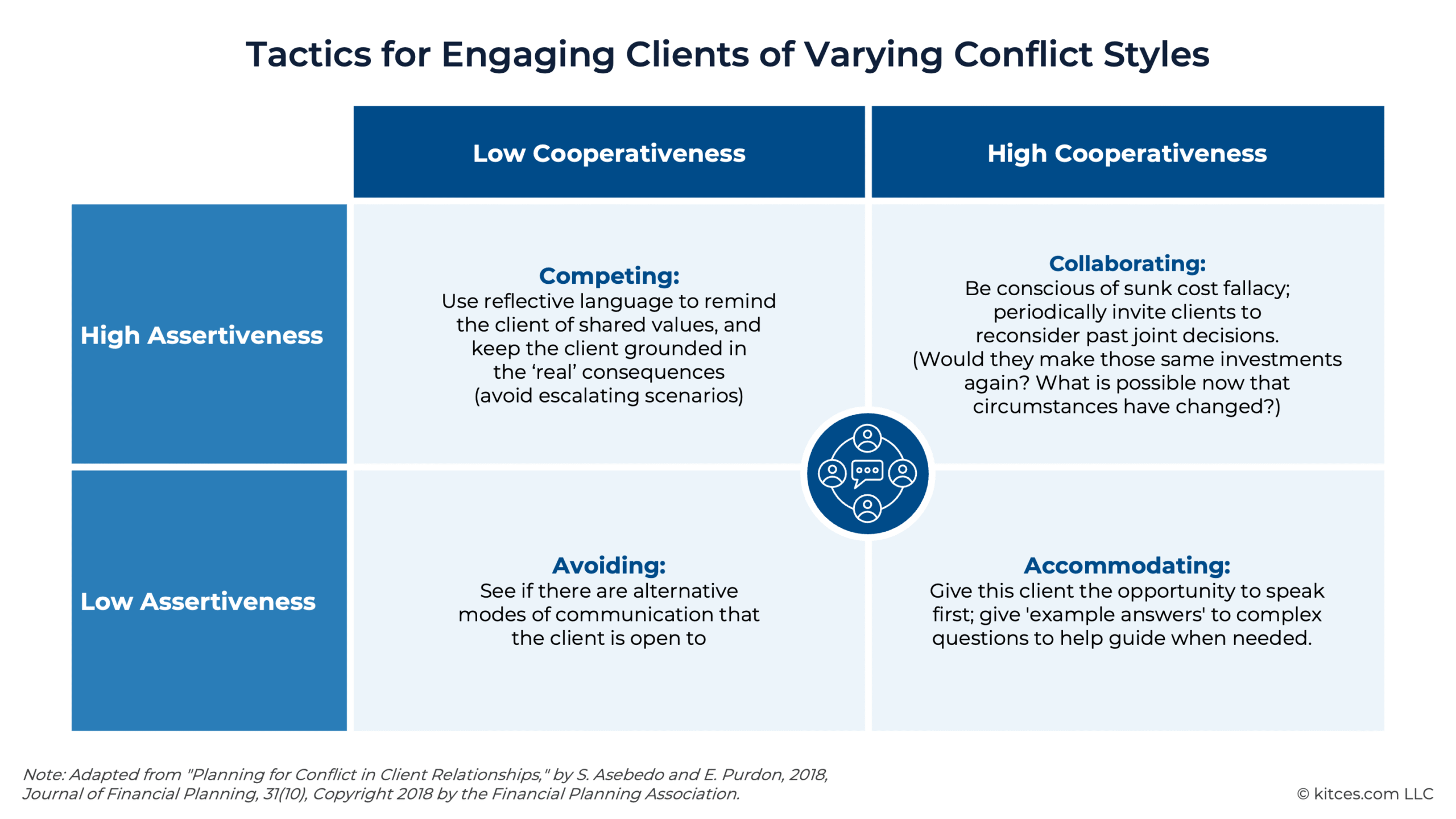
Advisors may consider inviting Avoidant clients to 'just be part of' the meeting – for example, "We'll spend the first 30 minutes talking about how your first year of retirement has gone and what you'd like to change next year, and then we'll move into more of the nuts and bolts. I'd love to have you there for the whole meeting, but it's especially important to have you in the first 30 minutes if you have time in your schedule." If the client is resistant to even that, then the advisor could see if they are open to more off-book conversations – such as a phone call or by emailing a few high-level thoughts. Clients who are very avoidant may not develop an interest in engaging, but the advisor may still be able to provide them with a few tools and options to gain a greater understanding of the household's positioning.
Tactics To Engage The Less Assertive (And More Cooperative) Partner
Given that finances and financial decisions can reinforce existing 'specializations' and make it easy for couples to continue doing what they're doing (including not engaging in financial matters), advisors may want to hold a goal-setting meeting in a neutral setting that feels less 'financial'. Meeting at a casual restaurant or coffee shop could be a way to help the discussion feel more 'conversational'. (This may not allow advisors to record the meeting or do much analysis 'on the go' – but it can be a good way to build rapport before jumping into 'business', depending on the type of clientele they serve).
With that said, changing the meeting space isn't always practical. In conversation, it can be helpful to acknowledge (even somewhat humorously) that finances aren't entertaining for everyone. Advisors can also give the less assertive party time to gather their thoughts, such as emailing the questions or general talking points in clear language in advance. This also means that when engaging in goal-setting, the advisor can generally give the less financially-oriented spouse an opportunity to speak before their financial partner. (Of course, some people may also talk less in initial meetings due to social discomfort or shyness, so keep an eye on the client's body language when deciding how much to 'push'.)
If the less assertive partner is also less engaged on household finances, the advisor may also want to anticipate and proactively answer some questions that the less-engaged spouse is likely to have but could be reluctant to ask, such as the consequences of a tax planning strategy or why a portfolio is constructed a certain way. Even if someone is open about knowing less than the others in the room, it can still be unpleasant to have to ask in front of experts, so modeling this can help to both educate the client and to lower the stakes around what is an 'acceptable' question to ask. Furthermore, if one partner has a higher degree of financial knowledge and the advisor ends up in a more technical conversation with that spouse, it can be helpful to add a few summary sentences in plainer language at the end of the conversation that are directed to "no one in particular".
Tactics For More Assertive (And Less Cooperative) Partners
If, on the other hand, one partner consistently dominates the conversation, it can be helpful for the advisor to ask probing questions that help establish norms and set expectations, so that the advisor and clients can co-create a strong relationship with both spouses.
Clients that are less cooperative and more assertive may be more likely to point blame about spending or saving issues. When that happens, Asbedos and Purdon remind advisors to use reflective listening. For example, one partner may complain about the other spending too much to "spoil the kids", which can raise issues related to legacy planning, budgeting, etc. – but the advisor can use reflective language (e.g., "You sound worried about your children's independence") to help neutralize the discussion and seek some common ground. From there, the advisor can ask follow-up questions that force the client to become more specific – for example, if they're worried about "spoiling the kids", advisors can start with something as simple as "What does that look like?" and ask for further details. Faced with enough questions about what the client (or their family) might do if their fear came to pass, the client is pulled from abstract concerns into concrete consequences, and eventually may talk through a solution or acknowledge that the dire straits they imagine are less likely than they originally perceived.
Tactics For More Assertive And More Cooperative Partners
It is worth noting that even if couples have a variety of role specializations and communication styles, many couples would say they are at least trying to be Collaborative and Compromising. For advisors, the challenge becomes to balance how quickly a couple moves through conflict towards resolution. Ironically, if both partners are happy to Compromise, advisors may want to invite them to hang out in the brainstorming space for longer to ensure that everyone has fully voiced their respective points of view – including when something isn't working for them (especially if something previously agreed to in the past isn't working now).
If the advisor observes tension around past decisions, they may want to take steps to address the sunk cost fallacy at work. For example, if a couple purchased a vacation home a few years ago but seem to now be squabbing about whether and how to fund ongoing maintenance of the property, it may be worth asking if they would purchase the home all over again today. In short, for Collaborative partners, asking questions about what's possible now that circumstances have changed is key to ensuring that the couple is continually iterating towards more fulfilling spending.
Ultimately, the key point is that what often manifests as 'disengagement' can reflect areas of specialization… or a misalignment in communication styles! And while some people may be more involved in parts of the planning process than others, what really matters is to ensure that both parties are fully present for conversations that drive the advisor's recommendations – since, after all, the advisor has a fiduciary duty to both clients. As such, it may be helpful to continually remind both parties of the end goal: to build a productive working relationship that everyone can fully enjoy and be seen in. With some persistence, the advisor can provide resources to establish smoother communication in the long-term – and make sure that everyone is heard in the way they tend to 'show up'!