Executive Summary
 Welcome everyone! Welcome to the 485th episode of the Financial Advisor Success Podcast!
My guest on today's podcast is Michael Kay. Michael is a retired financial advisor and a current life coach and author who helps high-performing individuals successfully make the transition to retirement.
What's unique about Michael, though, is how he has developed questions and exercises that financial advisors can use to help clients (and themselves) make the transition to retirement.
In this episode, we talk in-depth about how while Michael identified plenty of activities that would fill his time in retirement he found he didn’t give himself enough time to process the transition from leading a financial firm to taking on other pursuits, how Michael considers the retirement transition to be a "grieving process" requiring thoughtful consideration given that many successful professionals have a multi-decade relationship with their job (which can become part of their identity), and how Michael found that acknowledging that his previous professional success was "enough" helped him gain the closure to move on to the next phase of his life.
We also talk about how Michael finds that advisors can support clients by having them think through how they will fill up their entire weeks in retirement (going beyond just a few hobbies), along with contingency plans if health or other issues prevent them from pursuing their initial plans, how Michael suggests that clients think back to their first day at work to remember what that major transition felt like (including the nerves they might have had at the time), and why Michael finds it important for those nearing retirement to consider how their social structures will change along with the transition (as they will no longer have the experience of seeing coworkers on a day-to-day basis).
And be certain to listen to the end, where Michael shares how the ability to say "no" more often than he did during his working years has led to greater satisfaction in retirement, how Michael’s work building and participating in an online community has brought him meaning during his retirement journey, and how Michael has found success in retirement in part by recognizing that his new avocations are still making a difference in the world (even if it’s a different type of impact than he had during his working years).
So, whether you’re interested in learning about the challenges of retiring after a successful career as a financial advisor, exercises advisors can use to help clients make the transition to retirement, or the keys to creating a meaningful retirement experience, then we hope you enjoy this episode of the Financial Advisor Success podcast, with Michael Kay.

Podcast Player:




Resources Featured In This Episode:
Full Transcript:
Michael Kitces: Welcome, Michael Kay, to the "Financial Advisor Success" Podcast.
Michael Kay: I am thrilled to be here, Michael. This is wonderful to get to sit and chat with you.
Michael Kitces: I'm really looking forward to the conversation today and get to delve into what, to me, just are the really unique dynamics when someone leaves a job, leaves their firm, leaves work, and retires, and how much your perspective changes once you are on the other side. It's striking to me in the work that we do as advisors working with a lot of clients who are retired. I found most of us as advisors tend actually to make practices with people like themselves. If I am a former engineer, I tend to get a lot of engineer-type clients. If I am a 30-something navigating the challenges of family and young children and starting a business and work-life challenges, I end up forming a niche with millennials who are going through those same circumstances themselves. If I am a 50-something advisor, I tend to work with a lot of 50-something pre-retirees and help them transition to retirement. The one place that does't work is when your clients are retirees, which is a lot of us in the industry.
If we're working as financial advisors and still working as financial advisors, we cannot help them with the retirement transition from experience. We can learn about it, we can get experience working with multiple clients that have gone through the retirement transition, we can get specialized designations and other knowledge, and get, I think, pretty darn good at it. But to me, there's always this risk or wonder or question of, "What else we do not realize about the transition of retirement because none of us who advise clients on this have ever been through it?" And so, that is why I'm excited to have this conversation with you, Michael, because you spent 30 years an advisor, and one very focused on life planning and a lot of these issues, and have now retired and done the transition yourself, and are now speaking to us from the other side, but the living other side, just the retirement other side, about what it's really like on the other side.
I'm excited to learn about what we don't realize as still-working advisors about helping our clients in the transition of retirement when we haven't actually done the transition ourselves.
Michael Kay: First of all, I'm glad you clarified that we were talking about the other side of retirement...
Michael Kitces: Of retirement. Our podcast mics aren't that good.
Michael Kay: Right. And not the other side of the other side. After spending decades working with clients and asking those big questions, "What does life look like?" And, "What are you looking forward to?" And, "How will you spend your time? What do you value?" and all those big questions, I think the number one thing that I realized, and honestly, I thought I was super prepared for the transition, and I think for the most part, or at least to some extent I was, what I didn't recognize or realize is that understanding of having to redefine yourself, "I'm a financial advisor, I'm a CFP, I'm a business owner, I'm whatever." When that goes away, there's, "Who am I? Who am I when I'm no longer my job?" If I can share a quick story.
Michael Kitces: Please.
Michael Kay: I had a client who had to retire by contract with his partners. He's an oral surgeon. We worked for years. Financially, he was fine. And we spent years talking about the things that he loved. He loved to fish, and he loved to spend time with his grandchildren, and he loved to go to the gym, and he loved to travel, and all these other things. The retirement date hit, and six months later he was back in the office. I said to him, "How's it going?" He looked at me kind of sheepishly. He actually didn't look at me, he was studying the table. He said, "Things are good." He goes, "I went back to work." He says, "I'm filling in for surgeons who were sick or on vacation." I was floored. I said, "Well..."
Michael Kitces: "We worked so hard on this financial plan so you wouldn't have to do that."
Michael Kay: Yeah. We never talked about the possibility, or you never talked about the possibility of working. There's nothing wrong with working, but we never talked about it. He said, "After a few months, I realized I've been a doctor all my life. I don't want to be a mister." There was just this dead silence. What I actually told him was that, after the silence met its end, I said, "I've been a mister all my life, it's not that bad." But this, for him, was the no‑fly zone. He just couldn't conceive of life where he wasn't a doctor. And I've seen that time and time again with attorneys who hate to retire. They don't want to retire because of the idea of not being who they are. I recently, on a trip, ran into a 93‑year‑old criminal defense lawyer who, only reason he retired was because of COVID and he couldn't go to court.
But the idea is, on the other side...and I'll share my story, if you want to do that right now.
Michael Kitces: Sure. Sure.
Michael’s Transition From Advisory Firm Owner To Retirement [08:41]
Michael Kay: I had spent a long time thinking about the things that I value, the things I wanted to do. I got certified as a life coach. I took two different courses, all this after I transitioned the firm to my younger partner, Jeremy Levin. I had full confidence that he could handle it. He's way smarter than I, totally equipped for the job. So, I had total confidence that the firm would continue, that he would do great, that clients were being properly taken care of. I had all these things that I was excited about, including returning to... I was a classically trained trumpet player growing up, and I put the horn in the case and didn't touch it for 50 years. And one of the things I did in my transition was go back and start playing again. But that's another story.
Anyway, I had all these things that I was looking forward to. And about five months or so in, I just went into a very dark hole, and I didn't understand why. I'm blessed with grandchildren. One of my two children lives locally. I'm healthy. My wife is healthy. All the things that anyone could ask for. I did a lot of thinking about it, and I wrote about it in my blog for the Chapter X community. I basically opened up a vein and bled all over the page of how I was feeling. What came out was the fact that I had never grieved the loss of the thing I had created. I had never spent the time to really come to terms with it, not that I missed it.
Michael Kitces: "The thing" being the firm, the business.
Michael Kay: Yeah, the concept that I created, the systems, the people, the clients. It wasn't that I missed the work. When I made the decision, part of my decision was that I felt like I had accomplished everything that I could possibly accomplish in my role. I didn't feel like there was anything new for me in this field. It wasn't that I missed, "Oh, I wish I was in a client meeting, I wish I was preparing financial documents and doing financial plans." But I just hadn't grieved. I hadn't said, "Wow, I need to really put this in a place."
And I got an amazing amount of support from people in the Chapter X community and from my wife. I had done a lot of soul‑searching. I finally understood what it was. The realization that came to me is that, you can prepare, I had done a lot of preparation. I had lists of things, I had concepts, and I had things I was involved with. I was doing volunteer work, things that I created, because, in my mind, if it wasn't joyful, I'm not doing it. That's my boundary. And so, all the things I was doing were things I was joyful about, but I had never gone through that step.
The realization came to me that until you walk on the hot coals, you can't know what it feels like. Until you sit in the crucible of change and feel the heat of becoming something else, or someone else, or becoming that next iteration of who you are or who you're meant to be, it's really hard to talk about it. It's really hard to talk about it from the standpoint of planner to client or from client to planner.
Michael Kitces: So, take me back a moment, just tell us more about the advisory firm that you had built as you got to the end point of retiring and transitioning it to Jeremy. Can you paint a picture of what the advisory business itself looked like?
Michael Kay: Sure. So, I had created what was originally called Financial Focus, which we changed to Financial Life Focus. We were an RIA firm that was actually transitioning away from AUM to a retainer model for all clients. And we were working with Buckingham, and we had an advisor in Boston and New York.
Michael Kitces: So, how many clients was it? What was AUM or revenue? How big was the team? What was the contours of the business itself?
Michael Kay: In terms of the team, we had, I think, five or six advisors, three support people. We had, probably in assets, I am going to say...
Michael Kitces: Approximately. No one is going to pull your ADV from five years ago.
Michael Kay: I am going to say somewhere in the $500 million range.
Dedicating Time To The "Grieving Process" That Can Come With Retirement [14:12]
Michael Kitces: Okay. So, now you said part of the challenge here was this grieving process. Help us understand a little bit more, what were you grieving? You are grieving the loss of the job, the loss of the identity, literally, the loss of the firm? You made this firm, this was your additional child on top of the rest of your children.
Michael Kay: Yeah. I think it was more the loss of the child, but it wasn't that I wanted it, like, "I wish I was sitting in my chair in the office. I wish I was on the phone with clients or sitting across the table from them." It really wasn't that because I felt confident that they were being well served. It was interesting because I started working when I was 12 years old and I never stopped. It was just a continuous from that point on forward until 68 years old where I was just continually working and I was like, "Okay, this part of my life is over. Should there have been some closure or something that felt like something?" And not that I am saying I wish they did a going away party, it was COVID and everything else, but it was...
Michael Kitces: Bad timing.
Michael Kay: Yeah, it was really bad timing. But it is not that I was looking for that attention, it was just, in my own mind, it was that realization that this continuum that started when I was 12 is now over. And it wasn't overt. It wasn't like, "Gee, this part of my life is over." It was just this feeling of sadness, this feeling of, I will use the word despair because that's as close to reality as it was. It was a depression. And I really had to think about it and I really had to understand, "What is different? What's missing? What am I feeling?" So, I really had to spend a lot of time in reviewing and thinking and talking to people, including a therapist, about what I was experiencing. And it dawned on me. I was like, "I turned the page." It was like coming to the end of a chapter and then you turn the page and you are on the next chapter. There was no pause. There was no space. And I think if I could go back and redo it, I would look for that space to, rather than throw myself into with both hands and both feet and a nose and two ears, and a mouth, and throw myself into this next chapter, is to think about, "How do I respectfully and lovingly put this to rest?"
Michael Kitces: So, can you share more there? What do you mean by, "I wish there had been space"?
Michael Kay: So, when someone dies, there is that period of mourning, there is that period of reflection, there is that period of looking back, there is that period of acknowledgment. And I look at the loss, and I shouldn't say loss of the firm, the transition from work to this part of my life, as a death, a death of a part of my life that was intrinsic to who I was from the time I was 12 years old. The idea of purpose, the idea of, you've got to go out there and make money, you've got to go out there and support your family, you've got to make sure everything is taken care of. What's next? What's next? What's next? What's next? And I didn't acknowledge it, I just said, "What's next? What's next? What's next?"
Michael Kitces: Because you're a good planner, so you had gotten really clear about what's next. I think you said earlier you had the plans, you knew what you were retiring to, you got certified as the coach, you broke out the trumpet, you had your list of only joyful things. It strikes me, you were quite clear about what you wanted a joyous, happy retirement to look like.
Michael Kay: Absolutely. Absolutely. But I guess a part of, for lack of a better word, my soul, had a different idea. There was a lack of alignment. My brain said, "Here are all the things that you find interesting. Here are things that you find joyful. Here are things that get you out of bed in the morning, and a continuation of helping people through that transition, writing, doing a podcast, doing coaching, whatever, all those things, learning." So, all the things that lit up my intellectual side and my heart, being able to play music again from a different standpoint, from the standpoint of it being fun rather than it being this driving need to be the best. I didn't take the time and space to say, "Huh, how does this change affect you emotionally? How does it affect how you see yourself or how you have lived the last 56 years of that driving, striving, eager builder?"
I didn't give myself that space, that permission to just be. You know how in a client conversation, when you ask a really good question, and the client doesn't know what to say, or they are formulating their thoughts and there is this space, and you just have to let that space breathe until the client finds their voice. To me, it's the same thing.
Michael Kitces: So I guess can you translate that to me, what was the, I was going to say the action step or ironically, maybe the not action step, if the point is space. What was the thing or step or part of the process that you would redesign differently if you could go back? What did you need to do to make the space?
Michael Kay: Yeah. I think what I would have needed to do was to do nothing, was to be more contemplative, was to be more self-aware of, what is the meaning of this transition? Not the meaning of, "Okay, you're no longer getting your paycheck. You're no longer running the firm, but what does it mean on a deeper level?" To your idea of whether it's your identity, whether it's, you've been running this race since I was 12, what does it mean? What might I need to support this from an internal level that there is more than just our thoughts. We are built with a brain to think through problems but we don't necessarily give enough attention to the fact that there's that emotional part of us that is going to come back and potentially bite us. It's the idea of someone who swallows down all their anxiety and eventually, it becomes an ulcer. This was the ulcer that I swallowed, that I didn't acknowledge.
It's the willingness to be vulnerable to whatever is underneath the surface. And I think the only way you access that, or one of the ways to access that is through therapy, through contemplation and meditation and self-awareness to think about, "What does this mean to me?" We live in this distraction factory. It's like, "What do I need to do to just really sit with this." Me being the founder of a firm doesn't mean anything anymore. The race I've been running is over. How does that feel?
Michael Kitces: So, does this become a literal pause, if you're retiring from your firm and you know all the things you are retiring to, don't start your retiring to things until three months after you retire so that you can force yourself to create some space to assimilate to process this change you have created or inflicted upon yourself?
Michael Kay: I'd say there's a meeting in the middle. I think instead of saying, "Well, I am going to pause for three months," because you don't know, you might get the work done in 30 days, in 60 days.
Michael Kitces: I'm a slow student, but that's great, it should serve you.
Michael Kay: It could be six months, whatever. It's going to take as long as it takes. So, to me, it would be, "All right, you need to maybe give yourself an hour a day to just be with your thoughts." To start, what are the questions? First, let's think about what those questions are that I want to ask myself or that I want answers to.
Michael Kitces: How would you formulate those? Or what were the questions for you?
Michael Kay: How do I feel about coming to the end of "the race"? How do I feel about it? What bothers me about it? What's impacting my thinking? We have to ask ourselves these questions, "Just because I have done this way for the last 50 years, do I still need that? Is it still useful for me now? What habits, what beliefs, what feelings that I have had do I no longer need?" For me, I grew up in a family where my father grew up in the depression and he was the consummate workaholic. And I watched him... He was a school teacher, he was a professional musician, and he did all the carpentry and the painting and the plumbing and the electrical. You name it, he did it around the house. And if he would ever catch me sitting on the couch, he was like, "Hey, get off the couch. There's things to do." Which in his parlance meant, "Go get a broom and a dustpan and clean up the mess I made down in the basement," or whatever. And I think I took on a lot of his go, go, go, go, go, go, go, go, go, and not sitting, to this day. To this day, if I am sitting on the couch reading, I'm like, "Should I be sitting here reading or"...
Michael Kitces: There's a mess somewhere to be cleaned by me.
Michael Kay: Right. A dustpan in the ....
Michael Kitces: Hallway
Michael Kay: Exactly. It's like, "I've got to update the checkbook, I have got to..." And I'm like, "Dad, shut the hell up. Yes, I can sit here and enjoy this book, and whatever is waiting for me will still be there." So, you have to talk to yourself, not in a crazy way, not so that other people hear you talking to yourself, but asking that question, "Where is this coming from? Where is this message or this belief or this behavior coming from that is causing me to feel a certain way?"
Michael Kitces: It strikes me, your framing of, "What beliefs, what feelings, what habits do I no longer need?" I guess, as you framed it in the story with your father and now the friction when you are sitting on the couch, that habits part to me really sticks out. It really is linked: it's habits, it's placed, its feelings. For so many of us that live various versions of work hard, provide, "hustle culture" is the label for it now, but for a lot of us, I feel like, particularly in financial advisor world, business owner world, it's really hard to sit still at pretty much any point of anything. If you're sitting still, you're wasting an opportunity that you could be doing something with this time. Those kinds of scripts crop up all over the place. Very easy for you then to visualize, yeah, that is probably not going to be a very terribly pleasant or useful habit and belief when you are retired, and you literally don't need to do anything. "But do I?" "But I don't." "Yeah, but do I?"
Michael Kay: Right. It's that push-pull until you recognize where it is coming from so that you can make a change. If you were to ask me... I'm going to ask myself the question that you would ask me and tell me if I get it right or wrong. If I could look back and say,"What's the one thing that I can see as a clear difference between myself in my role as advisor, as business owner, to now?" It's two words. It is "yes" and "no". As an advisor and a business owner, I said, "Yes". Client needs something? "Yes." I would say yes to try and make everyone around me as happy and as satisfied as possible, to meet and beat their expectations. Now, I can say, "No".
Michael Kitces: Except, can you, Michael?
Michael Kay: I can. I'll give you an example. So, as I told you, going back to doing music and taking lessons again, I started playing with an adult big band, which I am having a ball with. I was asked to play with a community band. And I went to two rehearsals, and I hated every minute of it. I didn't like the people, I didn't like the music. I said, "No. I tried it. This is not for me. Thanks very much. Here is your folder. Bye-bye." Because I created for myself the boundary of joy. If it's not joyful, I am not doing it. Hard stop. As an advisor, I would never think of that. "Oh, you need this tomorrow, I don't care if I have to work all night. I'll get it to you tomorrow."
Michael Kitces: At least to me, I think of that as a form of filters. I don't know, maybe that's just how my brain works. I've always looked at this like never-ending flow of decisions and choices that we face about, what are we going to do in our businesses for the people that we serve, in our lives as we get to to various family and work and life and other trade-offs, that you have these series of filters that helps you figure out what to say yes, what to say no to. Sometimes they're subconscious, sometimes we express them more overtly. "I don't want to do that if it doesn't allow me to have more time with my family. I'm not going to say yes to the client unless they generate $X dollars of revenue because I need to make the math work for my business."
We may create these filters over time. And, at least from that lens, what strikes me in what you're saying here is, we accumulate this series of filters, this group of decision frameworks that we use to navigate our lives and what we're going to say yes and no to, and we've often held on to them because they're serving us in our lives. They're helping us get to our goals, our desired outcomes, they're leading to things that on average feel more good than not good, so we continue to do them. And then a whole bunch of them just break when you get to retirement, and that's just not the decision framework anymore. That's not the filter anymore.
Michael Kay: No. No. So, you get to create on a very different landscape what it is that is important to you. And you have to know why it's important to you. And so much of the work that I did as a planner in terms of talking to people about what they value…if you don't value it, you're not going to do it. If you don't value your kids' education, you're not going to accumulate funds to send them to college. So, the whole idea in retirement is to start with those values. And also, the recognition that this transition is just the next one in line from a hugely long line of transitions that we've gone through in our lives.
Michael Kitces: But I feel like, from what you said earlier, there is something distinct or different or bigger and more substantive at least about this transition because it triggers more of a grieving process and it needs more space. Is that fair?
Michael Kay: It is fair. It is different, but the recognition that we've been through transitions before is a baseline understanding to go in with. It's like, "Okay, I haven't done this one before," but every other transition you've gone through, you hadn't done before either. The question is, when you get to this one, you have to be open and willing enough to explore what it really means to you and whether it's creating these feelings of fear, of remorse, of panic, of anger. I've talked to so many men who are angry and they sit around talking about their war stories of their career. And I'm like, "Wow, that's kind of sad." They've got nothing to talk about for now, or for what they're doing, or for what they're looking forward to. But it's very big if all you have is your past to lean into and talk about.
Key Questions To Ask To Help Clients Prepare For The Shift To Retirement [36:17]
Michael Kitces: So, now let me shift a little bit from... There's two versions of this. We are practicing advisors who have the great privilege to live long enough and save well enough that eventually we get to retire, this too shall come for us someday. Slightly more proximally, we've got all these retired clients or retiring clients where this may be happening in practice, in real time. Not necessarily in our office depending on how much clients bring it back in, but is happening with the clients that we're supporting and going through retirement transitions. So, how do I prepare clients for this? How does this inform what I do with the clients that I serve if I'm working with retirees and people transitioning into retirement?
Michael Kay: Yeah. I think we need to ask big questions and provide space. And I also think that we need to provide a cautionary tale that you might lay out all the ideas and all the thoughts and all the ideas of what life looks like, but be prepared that until you're walking on the hot coals, you're not going to know how it's going to feel and you need to be mindful of that. How many advisors have listened to clients, especially men, when asked about what retirement looks like and they, "Oh, I'm going to play golf."
Michael Kitces: Yep. Heard that one many times.
Michael Kay: Right. And you look at them like...you try not to laugh and you try not to shake your head and go, "Oh my God." They haven't begun to touch the reality of what that actually means. It's a great default to say, "Oh yeah, I'm going to play golf…seven days a week, 365?" What are you going to do when it rains?
Michael Kitces: Yeah, that's where I would usually take that conversation. Not to be negative, belittling, but like, "Cool, but how much golf? Every week? Awesome. Every day of the week? No, no, every Friday." I'm like, "Cool. What are you going to do with the other six days of the week for the next 30 years?"
Michael Kay: Yeah. And the follow-up question is... I remember my wife and I were on a trip and we met this couple, and he was newly retired and he was talking about how he's been looking forward to playing golf. And we just started talking, and I just said, "Well, what happens if your hip goes out, or your knee, whatever?" And he looked at me like the deer in the headlights, like, "Oh my God, I never thought about that." Well, what's your plan B? What's your plan C? Do you have enough in your life that you're interested in that's meaningful? We have to have meaning in our life. And it's so important to think about, "What gives me meaning?" And we need to help our clients understand that meaning and purpose doesn't mean solving world hunger or curing cancer, that meaning and purpose is personal to who you are and what you care about. Maybe it's taking your grandkid to school, or being a mentor for someone, or learning a language, or whatever it is. The spectrum is open.
We haven't talked about it, but in the creation of my book is this whole idea of helping people kind of go through this process of trying to find it for yourself. Trying to find your feet when you make this transition. It's very personal. There's no cookie cutter. The advisor needs to ask those questions, and not only ask those questions, but also set out the ground like, whatever it is that you explore is not a lifelong sentence. If you want to paint, you do not have to be Picasso or Rembrandt. You can smear up a canvas and as long as you're having fun with it, that's all good. If you want to learn how to play a clarinet and it's squeaky and whatever, but you're having fun with it, you don't have to be Benny Goodman. You're not going to be Benny, who cares? Have fun. For me, in my story, as I said, I was a classically trained trumpet player who was trained by one of the trumpet players from the New York Philharmonic who literally brought me to tears every week that I was not good enough, not good enough, not good enough. When I put the horn in the case, never to open it again. Fifty years later, I had a conversation with a world-renowned drummer and music educator who said, he knew my story, he goes, "Can't you just have fun with it?" I looked at him like, "Huh?"
Michael Kitces: You're allowed to do that?
Michael Kay: Like, "What? It never occurred to me." Now on my music stand, I have a smiley face, I have another sticker that says, "Have fun." Not to beat myself up if I blow a note or it sounds terrible or whatever, have fun. These are the things that I think advisors need to remind clients that it's an exploration. Just like when we were kids, you go out into the woods and you're turning over rocks and stumps and you're seeing toads and salamanders and whatever, and it's all an exploration. Can you find the joy in that?
Michael Kitces: I'm trying to figure out, what else can I ask clients to try to open up this thread? I hear you on the conversation of having the conversation of, "What are you going to be doing in retirement? What does that look like? No, no, what does that really look like aside from, I know you want to play golf, but you're not really going to do it 24/7." And I've long experienced this with clients over the years as well. There are clients who are retiring to something and there are clients who are retiring from something. And the to's are pretty consistently more happier than the froms, I find.
Michael Kay: For sure.
Michael Kitces: But as you shared for your journey, you had what sounded like a pretty above-average level of clarity about what you were retiring to and what that was going to look like. You got certified as a coach, you pulled the trumpet back out, you had your, "if it's not joyful, I'm not doing it" filter. I feel like you had a pretty good amount of clarity and then it didn't go well and the depression hit.
Michael Kay: Mm-hmm.
Michael Kitces: So, what else? What other questions can we be asking, conversations can we be having with clients to try to help and prepare them for this?
Michael Kay: Yeah. I think some of the questions is going back to values. To give them the, "prepare the earth". Scrape up the surface and say, what are the things you really care about? And might that be fertile ground for you to investigate, what are the things that are associative to those values? What types of things? If you value learning, what are some of the things that you might explore to feed that? And just ask those questions and say, "Maybe make a list, make a journal of things that are associative to the things you care most about." And if you say, "Oh, I care about my family." Well, what does that mean? What are the activities where you can take that care of family and turn that into an action? What's joyful for you? What are the things that you have no interest in? And what is your attitude towards exploration? How do you feel about trying something? And then if you don't like it, do you feel you have to continue doing it because you started? Show up on time, do what you say you're going to do, and finish what you start."
I'm all about showing up on time. I'm all about doing what you say you're going to do. But the "finish what you start", if it's something that's not joyful, goes right in the trash. The acknowledgment that when you leave your job, that the people who you've spent so much time with are not coming with you. What are some of the ways that you are going to build a social network that's satisfying? And for men, that's hard. We stink at it, by and large. Unless we are very intentional and we understand this is life or death, because the statistics are clear. Men suffer from depression and the suicide rates are through the roof for retired men. And a lot of that is attributable to the loss of social structure. So, what are you going to do? Be aware of that. Here's the statistic. Here is the data. What are you going to do about it? So, as you are approaching your retirement, what can you build for yourself? What structure can you build that will support this? And the importance of this...
Michael Kitces: What kind of structures do I build? What are my feasible paths here?
Michael Kay: Yeah. It's like, okay, who are your friends? Who do you hang out with? What kind of things can you do with other maybe similarly aged men who are in the same boat, who are desperately looking for social connection? I reconnected with a guy who I hadn't seen since sixth or seventh grade. And for whatever reason, his name popped in my head and I looked him up on LinkedIn and we reconnected. And we were very good friends in elementary school. He was actually the first guest on my podcast. And we've been in touch, we see each other. He lives in Westchester County, and he and his wife come down, we get together every now and then. Who are the people that are additive to your life? And who are the people that suck the life out of you? I've also had that situation where people who were negative aspects of my life that I've cut out of my life, like, "This is not good."
Michael Kitces: Which I guess gets back to your earlier theme and comment, I guess my paraphrasing, you're a lot more comfortable with "no" now.
Michael Kay: Yeah.
Michael Kitces: Like, "I'm not enjoying my time with that person, so I'm just not going to hang out with them anymore. I joined a thing and I really don't enjoy it, so I'm not going to finish what I started. I'm going to say I don't enjoy it and stop." That's okay.
Michael Kay: Yeah. If it doesn't meet the criteria. And I am a firm believer, and that's why I put it in the title of the book, is the idea of joy. If you can't find joy in what you're doing, if it's not joyful, why are you doing it? If you're a slave to the idea of, "I should do this and I should do that," you are going down a destructive path.
Michael Kitces: So, again, I'm still struck, you seemed to do a lot of this pre-work, and the challenges were still there, and the moments of despair and depression kicked in. So, is there a takeaway there, you can only ever do so much pre-work for this? There's a level of this that no one can do until they've actually made the retirement transition and just have to deal with it in the space when they get there?
Michael Kay: I think that's true. I think maybe we can do maybe 90% of the work. No, we can do 75% of the work. But until we're sitting with it and sitting in it, it's really hard to understand how it impacts our sense of identity, our sense of self, our sense of where we are in the world. We knew who we were in the world the day before we retired. But we don't know, it's destabilizing. We talk destabilizing, think back to the first day that you went to work in your professional career, however you started, I think you were also a CPA, right? Your background?
Michael Kitces: No, I came through the planning side. I got my tax degree later, but I dodged the audit part. I'm pretty happy about that.
Michael Kay: I love the audit. But if you think about the first day that you walked into the office of wherever you were working, talk about destabilizing. You didn't know anyone, you didn't know anything. I can bring back that day to such clarity. And I think almost everyone can do that. But think about how destabilizing you were. I remember I had to be in the office at 9 a.m., the CPA firm that hired me out of college. I think I was up at 5 a.m. I was showered and dressed by 5:20. And I remember sitting there trying to carefully drink a cup of coffee and not spill it on my white shirt.
Michael Kitces: I remember a very similar experience.
Michael Kay: I'm sitting in the parking lot at 7:30 because the office was 15 minutes away. It's watching people walking in the building wondering if I'll be working with that person. I can remember it. But think of how destabilizing that was. And this was in the beginning of our professional careers. It's like the trick with the tablecloth where you pull and everything is still on the table. This is the day after you retire. It's gone. It can be really destabilizing. And because we live in a distraction factory and we can distract ourselves to the nth degree, we're not really giving ourselves permission to think about where this hurts or where we're really feeling it, or what this really means.
So, with all the preparation and with all the... And I think the preparation is super important. It is so vitally important that we start thinking about our values, that we start thinking about transitions, that we start thinking about these. But at the end of the day, we have to walk the hot coals. And we have to be aware of, we don't know how we're going to feel. And it's our feelings at the end of the day that's going to decide how we come out of that crucible, how we come off of that. Do we come off with burned feet or with calluses? How do we come out of it? Do we come out of it whole? What might I need? Am I working with a therapist? Do I have people that I trust to talk to about this? Can I be vulnerable enough? Because after all, we're men. We're not vulnerable. We're strong. We're the Marlboro Man. We're strong, silent type. We don't hurt. We don't cry. We don't have pain.
We need to understand that our bodies will tell us the truth eventually. So, unless you want it to come back and smack you in the back of the head when you're not looking, you need to be aware that you're going to have this experience to one degree or another.
Michael Kitces: And you framed that particularly in terms of men. Do you think there are unique aspects of this for how men experience versus women?
Michael Kay: Generally speaking, and I'll put generally speaking in bold, underline, quotes. Men and women, I think by and large, generally speaking, are different this way. For example, I think women are so much better, by and large, generally speaking, at transitions, at socialization, at being more in touch with their emotions over these things and being able to share.
Michael Kitces: Whereas we don't like transitions, are terrible at making social networks, are not known for being in touch with our feelings or sharing well. Seems fair. And by and large, generally speaking, seems fair.
Michael Kay: Yeah. Yeah. Bold, underline, put in quotations. We're just not, because we haven't been trained to. We are trained to be masters of the universe, crawl over whoever you need to, get to the top, be the best. And that's not to say that women don't have challenges of their own, because they do, absolutely. But the socialization aspect, the ability to share, absolutely, by and large, generally speaking. And those are huge advantages in these transitions.
Having Clients Reflect On Their Values And Previous Career Transitions [55:51]
Michael Kitces: So, what else do I need to do or advise or guide clients in the transition, in the moment? I guess I'm starting to think, how do I help my clients with this if they're in the not-so-emotionally aware and introspective part of the range?
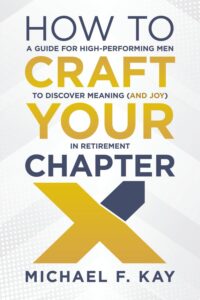
Michael Kay: Well, you could give them a copy of my book, "How to Craft Your Chapter X". You could do that. You could also ask them to talk about some of their transitions and how they dealt with it. Ask them to recount those. Ask them to talk about their values. Ask them to talk about their successes. Ask them to talk about, what have they learned from their failures? I think where the learning is. I think also telling people that it tends to be, you land squarely in the discomfort zone.You are going to be uncomfortable because it is new. And the day before you retire, you are squarely in your comfort zone. You have reached the finest point of your focus and everything else as you're moving towards retirement. So, this is the time to just say...
You're going to be uncomfortable. But you've been uncomfortable before. How did you deal with it? How did you deal with failure? How did you deal with big changes? Someone who's lost a job, they've dealt with big changes, or divorce, or death, or these other things that happen in life. They've dealt with these things. It needs to be recalled. It needs to be reminded that we've been through the meat grinder of life and now we have an opportunity to take what we've learned and what we've experienced. And not only do we have the opportunity to live a joyful life and a meaningful life, but also an opportunity to give back, to be more generative and give back in ways that they might not have thought about. How do you take your wisdom, your experience, and help someone else?
Michael Kitces: You mentioned there your own book on this, I guess as a guide for the folks who are struggling with the transition. So, just can you give us a little bit more context on the book itself? What have you done in this space?
Michael Kay: Yeah. I actually did not want to write this book. I've written two books before, but this book kept nudging at me and nudging at me and nudging at me. And I felt especially after the experience that I had and then the experience of, I've had, I don't know, 200 podcasts that I've done so far, and all the writing and the coaching and the discussions that I've had, I said, "I think this needs to be told." So, I created this book, "How to Craft Your Chapter X: A Guide for High-Performing Men to Discover Meaning and Joy in Retirement". And what I tried to do was take them through a series of exercises and acknowledgments of the tools that they have, understanding their core values, and how to use the tools that they have to help them build the next chapter of their life in a way that is meaningful and joyful for them.
We have to continually remind ourselves that straight line to success doesn't happen. Or if it happens...we become successful because we've worked hard, we've failed, we've tried, we've innovated, we've learned, we've sat and listened to the gurus and the experts, and we've taken things away from their experiences, and we've applied it to our own thinking and our own imagination and our own creativity. And that's how we've built our firms, that's how we've built our lives on being this sponge of knowledge and experience. The guests that you've brought on and the topics that you talk about all fit in beautifully with...this whole idea is, this is how we learn. Well, the same things apply to how we live our next chapter or what I call Chapter X. Is, how do we define, how do we solve for this X? How do we figure out all these things that we need to do now that we might not have done, that we didn't have the opportunity or the need to do before?
For example, I had several experts write chapters in the book. One who is a gerontologist, one who is a therapist, one who is an exercise specialist. And I had someone else who is a therapist and social worker who deals with women and couples, to also add to the book, to talk about some of these things that we need to be aware of. We never thought of, we need to be fit, but what's different about fitness in this stage of life than it was when we were in our 30s? What do we have to be mindful of? This is one of those points in the discussion where everyone closes their ears, earmuffs, and go, "Blah, blah, blah, blah, blah." We're all going to freaking die, we don't know when. But how do we make whatever time we have left after our work career, how do we make it meaningful? How do we have it mean something? Are we defined by our career as human beings?
I have a very dear friend of mine who is an attorney. He's a little older than I, and he still works like a first-year associate. And I think his tombstone's going to say, "He was a great attorney." But we're more than our jobs. We were something else before our jobs, our careers, our titles. Who are we after?
Michael Kitces: So, for folks who are listening, curious to check out the book, we'll have a link in the show notes. So, this is episode 485. So if you go to kitces.com/485 and scroll down a tiny bit to the show notes section, we'll have a link out to the book.
Exercises To Help Clients Consider Their Retirement Transition [1:02:47]
Michael Kitces: Michael, are there other exercises in the book that would be helpful for us to understand or reflect on in the conversation here?
Michael Kay: Yeah, there are a bunch of different exercises. I think there's 13 different worksheets in the book. They're throughout the book and then I have them in the back in the appendix. I ask questions like, "Who are you and what do you really want out of retirement? Who were you on the day before you retired? Who are you on the day after? What do you want out of your next chapter?" Some of these types of questions, visualization questions. I pose a couple of the Kinder questions about, "What did you miss? If you have that one day to live, what did I miss? Who did I not get to be?" I want people to really think about those really deeper questions that go beyond the striving, go beyond the caretaking of clients and raising of families. I want them to understand also that they have all the tools. What are some of the things that we have that we build in our lifetime of problem solving and learning and creativity, flexibility, resilience, things like that.
The Benefits Of Being Able To Say "No" More Often In Retirement [1:04:13]
Michael Kitces: So, now bring us up to speed. I think you said ultimately you sold the firm and did the transition about five years ago. So, what are you doing now? What is the world of Michael Kay at this point?
Michael Kay: I still write my blog pieces. I do the weekly podcast for "Chapter X." I hold a monthly Zoom meeting for anyone who wants to come on from guys all over the country, and we sit and talk about real stuff, which deep and vulnerable and well-connected. I am blessed with three granddaughters ranging from age of nine down to four, two of which are local, and we spend a lot of time with them and helping out where we can. And it's joyful. Music is important. I make sure that I have social engagements with other guys at least once or twice a week. I exercise five, six times a week in various ways. And my hope and wish is that as a result of doing this book, that I'll find groups that might want to hear or workshops that might want to be taken through some of these things to help those people, to speak to groups.
I'm always exploring. I love languages. I'm in the middle of deciding whether I want to go back to learn Spanish or learn German for no apparent reason, but because I love languages. And we do a little bit of traveling. And my wife and I will be married, it'll be 49 years this summer. She's still putting up with me, which is pretty amazing. So, that's life. And as I said, it's joyful. You deal with whatever you have to deal with. I'm having a little procedure to remove some basal cell on my nose next week. And it's like, " Okay. Well, I never didn't see this coming, but it's here, so let's deal with it." And it's going to interrupt my exercise routine, which is making me crazy, but it's like, " Okay, but you got to deal with it." So, you deal with what you have to deal with. That's the resilience muscle and the flexibility. And those are the tools I have.
Michael Kitces: So, what surprised you the most about building this post-retirement life after advisory firm?
Michael Kay: What surprised me? Writing the book surprised me because I never intended to do that. I actually wanted to write fiction, and I actually had a short story published in a publication last year. And I never really expected how good it felt to say no to anything that is not joyful or to separate from people who suck the life out of you. I didn't realize. That was a surprise. But that's my determination, and as uncomfortable as it felt, once you experience it, you go, "Oh yeah." You know what it's like to fire a bad client, how good that feels, but how weird it feels when you do it the first time?
Michael Kitces: Yeah. Terrifying and horrifying in the moment, and then any bad separation, all of about 20 minutes later, it's like, "I feel a lot better now."
Michael Kay: My life is wonderful.
Michael Kitces: It just feels like weight has literally come off my shoulders.
Michael Kay: Exactly. And that is the feeling. That is exactly the feeling. I had a client that I took on. I didn't want to take on the client, but it was an attorney who had referred the guy to me, and he was like, " I really want you to take care of him." And I'm like, "I really don't want to take care of this guy." And the guy was asking me to do things that I wouldn't do, but the attorney was, blah, blah, blah, blah, blah. And finally, after two months, I fired the guy. And I was like, "I don't care about the attorney. This guy made my life miserable." So, being able to do that in retirement, okay. When I handed the folder in to the conductor of that band, I was like, " Here you go. Sorry, this is not for me." I felt great. I felt weird doing it because saying no or not finishing what I start is completely opposite of my personality, but the more you do it, the better you get at it.
Michael Kitces: It strikes me there's the somewhat now famous happiness curve that I think originated from Gallup research, where they've got a standard question about happiness they use, I think, globally now, happiness and well-being. And they've asked people of all countries, all cultures, all ages, and they get this curve where you're relatively happy in your younger years. It goes down through a lot of your adult years, it troughs in your mid to late 40s, and then it starts to come up again. And it just keeps going up. Fifty-somethings, on average, are happier than 40s, 60s are happier than 50s, 70s are happier than 60s, 80s are happier than 70s, 90s are happier than 80s.
And for anyone who's had family and/or clients that have gone through later years, there's some really hard stuff that's coming at you in your 80s and 90s. And the research question arose, why are they still showing up happier than anyone else? And one of the major factors they found was basically a version of this, that there's a point in our years we're like, "That just doesn't make me happy, so I'm not going to do it anymore." And it turns out when you start saying no to those things, your happiness really starts to pick up.
Michael Kay: It really does.
Michael Kitces: It is an amazing thing.
Michael Kay: It really is amazing.
Michael Kitces: You technically don't have to wait until you're retired for the record.
Michael Kay: Right. But we're so aimed at, we want to make everyone happy. We want everyone to say good things about us. We want to enhance our reputation by being I-can-do-it person. And maybe it's a really good lesson to learn earlier of to say, "This just makes me miserable. This just doesn't fit." I think we need to have those reality checks of... The belief system of by saying yes, who are we serving? Is this a false idea that by saying yes, we are actually enhancing our reputation, or is this just a belief? So, we have to take those beliefs and re-examine them.
The Low Point On Michael’s Retirement Journey [1:11:27]
Michael Kitces: So, tell us a little bit more about where the low point came and when or how it ultimately troughed and turned around for you.
Michael Kay: I think the low point came, it was probably about five months in. And it stayed around for probably, I'm going to say somewhere between six and eight weeks until I was able to turn it around, because I needed the time to really recognize what it really was. It was like opening the door to the monster in the closet. And it's like, you know there's a monster in there, and I'm not even going to look at the door. So, you have to get to the point where you can look at the door and then fling it open to see that you are the monster. There's just a mirror. So, it took around that amount of time to recognize and to understand. And a lot of it, as I said, helped by sharing it. I wrote about it, I shared it. I was completely...
I talked about being depressed. I felt despondent. I felt lost. And being able to share it, which in itself gave other people permission to be willing to share where they were and what they were feeling. And that was big when I got emails from people sharing their experience.
Michael Kitces: And so, I guess just tell us more what changed or shifted that then things were better?
Michael Kay: It was the recognition of what it was that was driving me to this feeling. For lack of a better expression, I didn't sit shiva for my own demise of my life as a "productive" person in career. I hadn't mourned it. I hadn't put it to rest. And once I understood what it was, I was able to do that. I was able to look back and say, hard-fought victories. I looked at the people that I helped. I looked at the colleagues that I loved and worked with. I looked at the positives, and I said, "I think I've done my share. I think I've done enough. I've done all I could have done. I have no regrets." And I needed that. I needed to acknowledge what I did, what I built, what I handed off. I needed to acknowledge that it was, in fact, a death, and that I was no longer those things.
And I needed to appreciate the fact that I could look back at my careers as both a CPA and financial services, financial planner, and firm founder and say, "You're always there to do good. You cared about people. You were always honest. You worked to your highest ability to bring the best of yourself. And that has to be enough." And that really was healing.
Michael Kitces: And so, in that context, the death, the grieving transition, from what I'm understanding, it was less literally the loss of the firm. It was the loss of your connection to the firm. It was like the intertwinement of the firm and the business and your identity because you are a financial advisor and CPA, you are a professional services provider. It was the loss of that?
Michael Kay: Yeah. I think it was the loss of this continuum that started when I started working towards success. And I had to redefine, what is success now? How do I measure? You can measure success in dollars, but when you're retired, you're not measuring success in dollars. You're measuring success in other ways. So, it is, what's the exchange rate between your work life and your post-work life, to be able to measure, am I bringing the best of myself in retirement? Am I making a difference? Every week, I visit this elderly guy who's got macular degeneration, and he's now in assisted living and I write out his bills, and I sit and I talk with him, and we spend an hour or two each week. And when I see these people in these assisted living and they're in various stages of decline, I'm like, "Does this matter that I'm doing this?"
And so, there's two things that are going on, there's, I'm helping someone? That's important to me. But I'm also seeing people who seemingly have very little purpose in living. And it's that kick in the butt that says, "Do you know your purpose? Are you living to your purpose? Are you living to your values?" And they're great reminders of, if you're hanging out with all healthy and amazing people, it's lovely. But when you start seeing the dark underside of what could be ahead, again, you kiss reality somewhere near the mouth. It could be you, if you're unlucky or if you're not taking care of yourself. So, how do you think about these things in terms of whatever runway we have left?
Michael’s Advice For His Pre-Retirement Self And For Advisors On The Edge Of Retirement [1:17:44]
Michael Kitces: So, what else do you know now you wish you could go back and tell you five years ago making the transition to retirement with the wisdom of five more years of experience?
Michael Kay: Be gentle with yourself. Instead of kicking it into fifth gear from day one, do a better assessment of who you are, where you are, what you're thinking, what are you feeling? Forget about what you're thinking, what are you feeling? What does this big shift mean to you? What does it really mean to you? It doesn't mean that you don't have to be at the office at 8:00. It means something else. It means other things. It doesn't mean that you don't have the responsibility of making sure your firm has been paid or that new clients are coming in, it's, "How is my day? Have I done something meaningful today? Have I done something in alignment today? Do I give myself permission to sit and read that book, or to take a walk, or to notice things that I haven't noticed before because I was too busy? And have I just had time to just be with my thoughts?"
And that's something that when you're in that mode of go, go, go, go, go, go, go, and especially when you have children and you're taking them to their sporting things and their other things and their other commitments and life and social and career and go, go, go, go, go, go, where do we take time to just sit and think? And how important that is.
Michael Kitces: So, what advice would you give experienced advisors who are maybe staring down preparation for their own retirement?
Michael Kay: A couple of years ago, while I was still in the transition and I needed some CPE credits, and I went to a local meeting, and there were these guys who were...they had to have been in their late 80s, and they just sat in the back of the room to get their credits. And you could tell, completely disengaged from what was going on in the room. And I was like, "I'm so glad that that will not be me." It's just hanging on because I can't think of anything else to do. So, I would tell advisors, think about who you can become. Who do you need to become? What is there left to do as a human that's not as a financial advisor, but as you after your work is done? And how can you create it in all the shades and tones and colors that represent joy for you? What are the things that mean something to you? And how can you live it?
And again, it's having those really deep moments of contemplation and of thought and of asking yourself those questions. What am I missing? What are my beliefs? What could I be doing differently? What do I need to be doing differently? What does the next chapter look like? What do I want it to look like? What are the things that might be in the road? If you have parents, they might tend towards dementia or Alzheimer's, is that my future? What do I need to do? Or I have arthritis. What do I need to do? I need to look forward, and I need to create for myself the best life I can possibly make with whatever limitations exist.
Michael Kitces: Any other advice or tips you would give us to help our clients with these transitions? You lived this as a practitioner for many decades as well. There's certain contours about how these conversations flow when I'm in an advisor-client relationship. So, what can I do, wearing my advisor hat, helping my clients with these transitions?
Michael Kay: This is one of those things where if all of your conversations with your client is centered around dollars, there needs to be a transition that expands that conversation to other things, to life, and how those dollars attach to values, and how those values attach to who they are as human beings. And being able to have conversations with clients that are really deep and rich and asking those questions. And they might not share it with you. They might not share their deepest secret with you, but you can ask the questions and say, "Maybe here are some things to ponder, to think about as you move forward." Ask the questions. If you get a response, great. If they're resistant, then it's just like, "Maybe take these home and pull them out every now and then and just start thinking about them. And if you want to talk about it, I'd love to talk about it with you. I'd love to listen to your thoughts on it."
Asking those questions that give them space and confidence that you're not sitting in judgment. Giving them the space and the confidence that you are along for the ride with them, that you're not judging their responses, you're not weighing them, you're just there. And allowing them that freedom to share what they will, and then ask them another question. Those big, beautiful questions that are there to stimulate their thinking and their minds and their hearts. Because, you know what, we can look at numbers, we can say, "Hey, you've got enough resources to last three lifetimes, but what's going to make your life amazing? What's going to make your life wonderful? What's meaningful for you? How do you take these resources? What do you want these resources to do?" And ask them to talk about those things, "Would you share some of your thoughts with me? I'd be really interested."
Michael Kitces: So, where do I go to learn to get more comfortable with these conversations if this is not my natural space already?
Michael Kay: I guess you could tune into Meghaan Lurtz's Substack and some of her work because I think she really has that so wonderfully aligned in terms of what she puts out in the world. More listening, more questions that are aimed at just opening people's hearts and opening their thoughts, so that there can be a melding. But they need to feel safe. So, providing that safe space. And that's what, as a financial life planner, was so important to just provide that fertile ground for conversation. And know that you're there with them, you are in community with them as they walk and as they talk. And being aware of your body language, being aware of the words you use, and being able to allow their expansiveness or giving them permission to just not talk if they're not ready and they're not willing. And I think those are some of the things. It's a mindset more than anything, is, "I am here for you. Yes, we've taken care of your financial life, but there's the other part of that word. There's financial, and there's life, and I'm really interested. Would you share?" And people, if they feel safe, will share. And that's also to me, there's no better way of building a strong relationship with a client than to help them feel heard.
What Success Means To Michael [1:26:33]
Michael Kitces: So, as we come to the end here, this is a podcast about success, and one of the things I've always observed is just that the word success means different things to different people, as you highlighted earlier. It can get redefined for us as we go through different stages, different seasons of life. And so, you built and sold a successful advisory business. You've transitioned to this new phase. Can you share with us a little bit more about how you define success for yourself at this point?
Michael Kay: Well, I had a client who, on her first visit to me, came in with a walker. She was a retired pediatrician, and her name was Suzanne. And I said, "Suzanne, how are you?" And she moved both her elbows out to the side, and she said, "Michael, every day I wake up, and I go like this." She moves her elbows out to the side. She said, "If I don't feel wood, it's a good day." And the idea of like, what are our blessings? What is our gauge for what success is, or for what happiness, or what joy is? Is it tethered to something that we value? I adore my grandchildren. I adore my children, my grandchildren are amazing. And any time I get to spend with them, to me, I could not be happier. When I have the opportunity to learn something or to sit with someone and listen to them and hear what they're experiencing, that's success. I just feel blessed and lucky that I'm here, I'm healthy, I have a wonderful family, and that I feel like right now, the things that I'm doing all bring me joy. And I also feel grateful that I know that if it stops bringing me joy, I'm going to stop doing it, and I'm going to look for something else that brings me joy. So, I couldn't be more successful in that light.
Michael Kitces: I love it. I love it. Thank you so much, Michael, for joining us on the "Financial Advisor Success" Podcast.
Michael Kay: It has been my joy.
Michael Kitces: Thank you.
Michael Kay: Thank you.