

Executive Summary
Great firms need great clients. But to find the right clients, they first need to be able to consistently find viable prospects – which means marketing. Modern-day marketing has nearly endless options – podcasts, webinars, social media, SEO – and firms can attempt nearly all of these tactics to see what sticks. However, the result is often a fragmented plan that attempts to appease everyone, lacks strategic alignment, and is quickly abandoned when early results disappoint. Over time, firms conclude that marketing itself doesn't work, when in fact the failure lies in how marketing decisions are made.
In this article, Kristen Luke, founder of Kaleido Creative Studio, discusses how firms can establish a marketing committee to develop an annual marketing strategy that resonates with its long-term strategy while balancing the firm's constraints of budget and time – ensuring that the firm gets the highest return for its investments.
Marketing decisions can be evaluated through six key filters: client journey stage, implementation capacity, time horizon, quality versus quantity, team preferences, and budget. This framework is designed to align marketing efforts with the advisor team's personalities, who they serve, and what outcomes they're trying to achieve. By defining upfront what the firm will – and won't – do over the next year, leadership can avoid second-guessing or being distracted by new ideas midyear!
From there, a marketing plan can be mapped to the different stages of the prospecting journey: Awareness, Consideration, and Decision. A balanced plan typically emphasizes Awareness to generate new interest, Consideration strategies to nurture prospects, and Decision-stage tactics to help close business. Next, the firm can assess implementation logistics – whether activities are scalable, delegable, or advisor-driven – and determine the appropriate mix based on available time and resources. Among the components to consider are the desired balance between short- and long-term impact, as well as quality (e.g., deep relationship-building) versus quantity (broader reach with more lead filtering). And perhaps most crucially, the team's strengths and interests must align with the selected marketing activities. After all, if marketing strategies align with the team's inclinations and strengths, it is much easier to sustain them in the long term!
Once all these components have been written out, the marketing planning process becomes one of subtraction rather than addition – eliminating entire categories or specific tactics that don't align with the firm's audience, culture, goals, or constraints. Starting with a comprehensive marketing matrix, firms can cross out what doesn't fit and gradually highlight what does, eventually narrowing the list down to a realistic, well-aligned set of activities. Strategic decisions can then be documented in a one-page summary outlining the firm's target audience, marketing goals, and selected tactics, providing a clear reference point throughout the year.
Ultimately, a well-crafted annual marketing strategy serves as a powerful filter, helping firms say yes to the right opportunities and no to distractions. It simplifies planning, improves execution, and creates confidence that marketing is being done with purpose, not guesswork. By shifting from a reactive to an intentional approach, firms can build marketing programs that are not only more effective but also more sustainable – leading to better business development outcomes and a stronger alignment between marketing efforts and firm goals!

Creating an annual marketing strategy can often feel like throwing spaghetti at the wall and seeing what sticks. For many advisory firms, marketing planning feels more like a guessing game than a strategic endeavor. It often looks something like this: the firm starts their 'annual marketing planning' by brainstorming ideas with the team and comes up with a list that includes things like podcasts, social media, webinars, or some new tech solution. Why those ideas? Probably because they're what the firm has heard of at the last conference or read about in a recent article. Maybe it's something another advisor swears is working for them. Or it's simply what the firm thinks they should be doing (ahem, social media).
At larger firms with a dozen or more advisors, each one likely brings their own set of marketing ideas they picked up from the industry. The combined list of potential marketing ideas can quickly become overwhelming and untenable.
The outcome of such an overwhelming list is predictable. What often happens is that the marketing lead tries to appease everyone by doing a little bit of everything. Or they lead by consensus, where everyone votes, and the firm ends up with the most popular (not the most effective) ideas. Either way, the firm winds up with a collection of disconnected tactics that may or may not actually attract new clients.
And because there's little confidence in the process used to make these decisions, the moment a marketing activity seems like it's not working, it gets dropped – usually before it's had a real chance to gain traction. This cycle repeats every few months, with new ideas and the same disappointing lack of outcomes. Nothing sticks long enough to generate real results.
After multiple cycles of this same process, marketing can start to feel expensive and pointless, leading many firms to conclude that marketing itself doesn't work. But the real issue isn't whether a particular idea is a winner or a loser. The problem is that when marketing ideas are chosen in a vacuum, without a clear understanding of how they work together or what they're trying to achieve, they're unlikely to work at all.
However, there is another way: a strategic selection process.
Rethinking How To Choose Marketing Activities
Many firms approach marketing planning as a creative brainstorming session; collecting ideas, debating what sounds interesting, and selecting a few to try. But that is where the problem lies.
Marketing planning is not a creative brainstorming exercise. It is a strategic decision-making process.
Too often, ideas are generated out of thin air and are rarely filtered through a defined set of decision factors. Without a clear structure for evaluating ideas, the shiny objects prevail over the truly effective strategies
So, if annual marketing planning isn't a brainstorming exercise, but rather a strategic process, how can a firm better structure its marketing strategy?
Building An Annual Marketing Strategy With Intention, Not Ideas
Creating an intentional strategy begins with an annual planning meeting with a select group of employees, where ideas are evaluated against established decision-making criteria. The activities selected in this session set the parameters for what the firm is willing to do over the next year. This session does not produce a detailed roadmap for every little thing the firm will do. For example, it won't tell an advisor to speak at the Chamber of Commerce on March 3rd. But it will state that arranging speaking engagements aimed at the firm's ideal client is a strategy worth pursuing.
By creating a guiding strategy at the beginning of the year that outlines which activities the firm is (and is not) willing to take on, it's possible to evaluate new opportunities that arise throughout the year intentionally. If a team member proposes a new idea in June, leadership can refer to the marketing strategy and say, "Yes, we can explore that", or "No, that's not in the plan for this year". They won't have to second-guess themselves, because they already took the time to make thoughtful decisions at the start of the year.
So, how does a firm create a strategy detailing the activities it will and won't do for the year? By discussing the following factors:
- Client Journey Stage: Are we balancing our activities across the stages a prospective client experiences before hiring us?
- Implementation Factors: Are we using the right mix of scalable, delegable, and advisor-driven activities?
- Time Frame: Should we focus on short-term wins, invest in long-term, compounding results, or a mix of both?
- Quality Versus Quantity: Are we more effective with high-quality, lower-volume efforts or higher-volume ones that require more screening of and selling to prospective clients?
- Marketing Preferences: Are we focusing our team (internal or external) on what they do well and enjoy doing?
- Budget: Is our level of investment realistic, and how should it be distributed?
Together, these discussion points lead to a meaningful conversation about the firm's marketing strategy and help to create the right mix of marketing activities.
Let's take a closer look at each one.
Client Journey Stage
The first thing to consider is whether the firm is effectively reaching prospects at all stages of their buying journey. Every marketing activity is designed to connect with someone at a specific point in their path toward hiring a financial advisor. The stages are typically defined as Awareness, Consideration, and Decision. When selecting marketing activities, it's prudent to cover each of these stages.
Awareness
People at this stage don't know the firm yet. Perhaps they don't yet realize they have a financial problem. The goal is to build visibility and help them recognize the problems that the firm solves.
Examples: SEO, podcasts, PR, Instagram Reels
Consideration
At this stage, prospects know they need help and are looking at their options. That could mean comparing financial advisors, exploring alternatives like online tools, or doing it themselves. Marketing at this stage educates the prospect and demonstrates how the firm differs from competitors or alternatives.
Examples: Webinars, blogs, newsletters
Decision
Prospects at this stage are ready to hire an advisor. They're just trying to decide who they trust and want to work with. Marketing at this stage helps them build confidence and guides them to take that final step.
Examples: Google reviews, case studies, personal outreach
Most marketing plans contain a healthy mix across all three stages. Typically, a firm can devote more activity toward Awareness to bring in new leads, less toward Consideration to nurture the people already in its orbit, and the least toward Decision to help move people from interest to action.
Implementation Factors
The next thing to discuss is implementation. Every marketing activity requires a different level of effort and ownership. It's important that leadership is honest about the team's capabilities and available resources. Evaluating how scalable, delegable, or advisor-driven each activity is helps the firm choose the ones that actually fit its capacity.
Scalable Activities
These reach more prospects without requiring the advisor to spend more time as the firm grows. Once set up, they continue working with minimal ongoing effort.
Examples: SEO, advisor directories, paid search
Delegable Activities
These can be managed by support staff or outsourced partners once the right systems are in place.
Examples: Newsletters, social media management, client events
Advisor-Driven Activities
These require advisor participation. They often have the greatest impact, but don't scale as easily.
Examples: Speaking engagements, networking, client or COI referrals
Each type has its place depending on how much time, money, and capacity the firm chooses to devote to marketing. The key is choosing a mix the team can commit to and sustain once started.
Time Frame
The next consideration is time frame. Does the firm need a short-term strategy to fill excess capacity with new clients quickly? Or is it nearing capacity and focused on building long-term benefits that compound over time? Or does the firm want to balance short-term results with long-term impact? Both short-term and long-term strategies play an important role, so most plans incorporate a mix of both.
Short-Term Activities
These generate leads or visibility quickly but require ongoing effort to sustain. Once the effort or money is cut off, the benefits come to a quick stop.
Examples: Workshops, paid search ads
Long-Term Activities
These build trust and credibility that grow over time. They take longer to show results, but require less maintenance once established, and can produce results year after year.
Examples: Content marketing, SEO, community involvement
It's easy for a firm's marketing strategy to lean too far in one direction, either by chasing quick wins or spending too much time on activities that won't produce results for years. If a solo advisor is just getting started or needs to source leads quickly, leaning into short-term activities with just a few long-term ones can be the best way forward. If a firm is already at capacity, it may choose to shift its focus to long-term growth. Short- and long-term activities don't need to be split evenly. They simply need to align with the firm's goals, resources, and timeline.
Quality Versus Quantity
The next factor for the firm to consider is whether it wants to focus on quality, quantity, or a mix of both. Marketing exists on a spectrum from high-quality, low-volume activities to high-volume, low-quality ones.
High-Quality / Low-Volume
These are personalized, high-touch efforts that build deep relationships but rely heavily on advisor time or referrals. I find most relationship-oriented firms pursue this route.
Examples: client events, personal introductions, speaking engagements.
High-Volume / Lower-Quality
These are broad-reaching tactics that are scalable and efficient, but they bring in a wider mix of both qualified and unqualified leads, requiring more screening and follow-up. These are usually appropriate for firms with strong sales processes or for tactics that don't require much ongoing effort.
Examples: digital ads, paid lead listings, SEO.
High-quality efforts often drive stronger conversions but can limit growth due to capacity constraints. High-volume efforts scale easily but require more time spent on filtering and follow-up.
Marketing Preferences
The next factor to consider is the team's marketing preferences. Even the best ideas fail if the team lacks the interest or skills to execute them consistently.
The most effective strategy aligns with what team members naturally enjoy and excel at, because those are the actions that actually get done.
Leadership can consider where a team's strengths lie and select marketing activities accordingly:
- Writing – Blogs, newsletters, educational articles
- Video – Educational videos, YouTube content, webinars
- Audio – Podcasts, interviews, guest appearances
- Presenting – Workshops, webinars, speaking engagements
- Graphics – Infographics, charts, carousels
- Relationship Building – Networking, client events, referrals
Activities that feel natural are sustainable over time. Firms would do well to avoid choosing activities that the team is only 'willing' to do. Instead, they can focus on what comes naturally and will actually get done. Rarely have I seen teams consistently maintain the things they think they 'should' be doing. There are plenty of marketing opportunities that align with a team's natural strengths – focusing on those specific activities will lead to both greater results and higher team satisfaction.
Budget
The next factor to consider is budget. Every marketing activity has a cost – either in terms of time or money – and there is often a trade-off between the two. A firm only has so much time and money to spend, and both need to be invested wisely.
In addition to considering how much money is available to spend on marketing, then allocating it across different activities, firms can consider the following:
Trading Time For Money
If a firm is not paying in dollars, it is paying in hours. When advisors spend their time creating content or posting on social media, the cost may seem inexpensive. But if we consider their wage per hour, we'll see the costs add up quickly when compared to other marketing activities that have an explicit dollar cost.
High-Leverage Investments
Some activities require very little time and effort, and just one new client can offset their entire annual expense. For instance, paid advisor directories or search ads require an upfront cost, but once set up, can deliver ongoing results with minimal effort.
Is The Firm Spending Enough To See Results?
It's important to be honest regarding whether an advisor is spending enough on a marketing activity to make it successful. For example, Google search ads can be effective. But if a San Francisco-based firm is only spending $300 a month, they are probably just throwing that money away, knowing that institutional-scale competition with national reach are consistently outbidding smaller firms. Or if an advisor only has $2,000 to spend on a public workshop, they probably don't have enough budget to drive leads through ads or direct mail to fill the room. If a firm is going to spend money on a marketing strategy, it needs to ensure it allocates enough dollars to give the tactic a real shot at working.
A marketing budget doesn't need to be huge, but it does need to be intentional. Spend where you can see real traction, and skip what you can't support effectively.
Using Strategy As A Filter
In the next section, I'll walk through how to create an annual marketing strategy using a simple, step-by-step process. The outcome will be a clear guide to define what a firm will and won't do this year. It doesn't dictate how or when to implement each activity. Instead, it provides a filter to evaluate new ideas and opportunities as they come up.
This filter acts as guardrails for the year – a tool to help sort through options, eliminate distractions, and stay focused on what actually matters.
How To Create A Marketing Strategy
With an understanding of the factors that should guide a firm's marketing strategy, it's time to put them into action.
The first step is to establish a marketing committee made up of the right individuals. In firms with more than five employees, it's important not to include everyone, as too many voices can make the process inefficient. An ideal committee typically consists of five to seven people, including:
- A primary decision-maker – usually the CEO or President who sets the vision and makes final decisions.
- The individual responsible for marketing execution – such as a marketing manager, coordinator, or an administrative team member if no dedicated marketing staff exists.
- Geographic advisor representation – one lead advisor from each office, or a regional manager in larger firms, to represent location-specific interests.
- A compliance representative – someone who can weigh in on what's permissible under regulatory guidelines.
- Advisors responsible for driving business – those who are tasked to bring in a significant portion of new clients through external business development efforts.
Keeping the group small and focused enables faster decision-making and a more productive planning process.
Once the committee is set, it's time to begin evaluating marketing options. To do that, the committee can use the Marketing Matrix, a tool that shows the full range of marketing options and how they map to the factors we've covered. It's meant to help view the big picture and start narrowing choices with intention. The chart is based on my 20 years of experience working with financial advisors, but the committee's own experience matters too. For example, I've seen local SEO deliver quick results for some firms, while others need more time to see traction. Using this downloadable Canva template (or by downloading a PDF copy), a firm can customize the chart based on its prior marketing experiences.
Once the chart is ready, print it out, gather the committee, and grab a Sharpie and a highlighter. This is where the strategy starts to take shape.
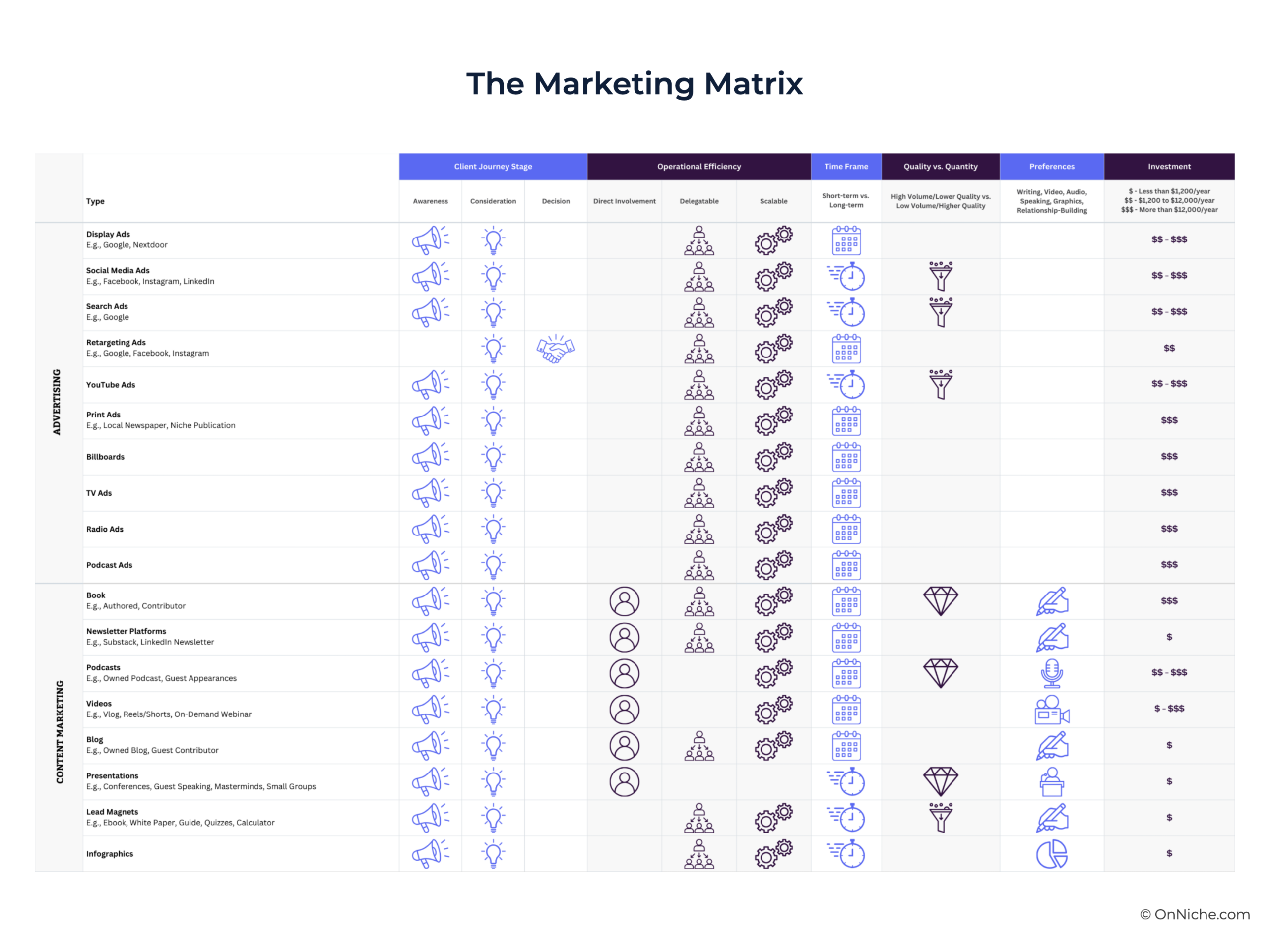
Abridged – Click for Downloadable Link
Understanding The Firm's Who And What
Who Are You Trying To Reach?
Before the marketing committee can start marking up the Marketing Matrix, they must begin with one simple question: Who are we trying to reach?
It sounds obvious, but most firms skip this step and jump straight into tactics. Without a clear audience in mind, the rest of the plan quickly falls apart.
Ideally, a firm's Who and What can be described in one sentence as one audience and one problem. For example:
- Tech professionals in their 30s and 40s earning over $300,000 and struggling to make decisions about their equity compensation.
- Pre-retirees within five years of retirement who need to shift from wealth accumulation to wealth distribution.
- Business owners with companies valued at $5 million or more who are selling their business and need the proceeds to fund their retirement.
If a firm serves multiple distinct audiences, it may repeat this process for each one. The marketing activities used for business owners selling a company will look very different from the ones for widows who recently lost a spouse. The narrower the focus and the fewer audiences served, the easier this process becomes.
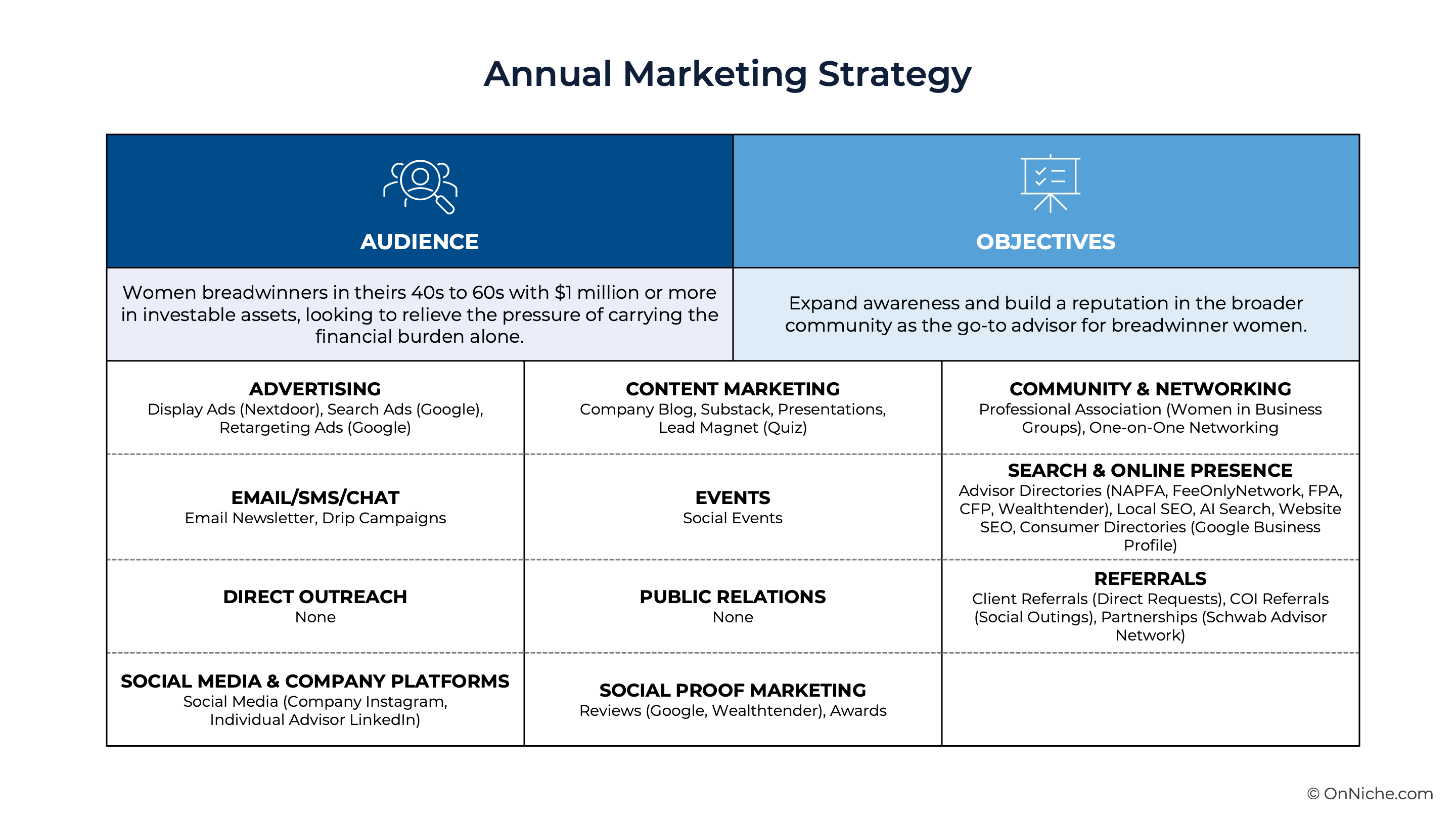
Example 1: Women breadwinners in their 40s to 60s with $1 million or more in investable assets, looking to relieve the pressure of carrying the financial burden alone.
What Outcome Are You Trying To Achieve?
The next question to ask before moving on to the Marketing Matrix is: What are we trying to achieve with marketing?
Again, it sounds obvious, but taking the time to answer this question will provide more clarity about what the firm actually wants its marketing to accomplish.
Let's say a planner asks the question and answers, "We've tapped out our clients' network for referrals, and we need to find other avenues". The insight is: it may be time to shift away from time-consuming and expensive referral activities (like client appreciation events) and expand into new activities that don't rely on existing clients.
That plan will look very different from one that states, "We have a huge number of biotech employers in town that we haven't tapped into". In that case, the insight is that marketing efforts need to be highly targeted to that specific niche.
Here are a few more examples of strong answers to the question, "What outcome are we trying to achieve?"
- Deepen relationships with the next generation
- Expand leads beyond client referrals
- Enter a new market or niche
- Focus on scalable efforts that don't rely on advisor time
- Increase AUM, clients, or revenue by a target date
- Convert hourly or project-based clients to AUM clients
Note that this list doesn't include goals like 'increase website leads'. That's because it's not an outcome, it's a tactic. A goal like 'increase website leads' focuses too narrowly on one activity. Instead, we can reframe it around the bigger picture, such as 'increase leads from sources outside of client referrals'. This shift keeps the firm open to exploring a full range of marketing activities that could actually move the needle.
Example 2: Expand awareness and build a reputation in the broader community as the go-to advisor for breadwinner women.
Insight: The firm needs to invest in marketing that engages its current client base for referrals while also expanding beyond it.
Evaluating The Options
With a clear idea of what the firm aims to achieve, it's time to move on to the fun part: identifying the marketing activities that will comprise its strategy.
Planners are typically not short of marketing ideas. Instead of starting with a blank page and adding to it, I find it's easier to start with a full page of options and begin by subtracting. Seeing all the possibilities at once makes it easier to eliminate what doesn't fit, leaving only the strongest remaining activities for thoughtful evaluation and discussion.
With a pre-vetted slate of potential strategies, the marketing committee can get started on the Marketing Matrix.
Cross Off What Doesn't Fit Your Firm
The first thing I like to do is eliminate entire categories of marketing ideas that clearly aren't a fit for the firm. That might be due to culture, compliance, business structure, budget, or simply personal preference (which is a valid reason to eliminate an idea!).
To make this easier, I like to group marketing activities into broad categories:
- Advertising – Traditional or online ads
- Content Marketing – Blogs, videos, podcasts, presentations
- Community & Networking – Professional groups, conferences, one-on-one meetings
- Email, SMS, or Chat – Newsletters, drip campaigns, automated messaging
- Events – Educational workshops, client socials, webinars
- Search & Online Presence – SEO, advisor directories, AI search
- Direct Outreach – Direct mail, cold calling
- Public Relations – Media mentions, guest articles, local stories
- Referrals – Clients, COIs, or centers of influence
- Social Media & Online Communities – LinkedIn, Reddit, Slack groups
- Social Proof – Testimonials, reviews, case studies
Viewing the list this way helps the firm quickly rule out large swaths of marketing ideas that just aren't aligned with its people, goals, or prospects. Here are a few examples:
- Culture: "Direct outreach just isn't who we are." → Eliminate Direct Outreach.
- Compliance: "Our state rules make testimonials impossible." → Eliminate Social Proof.
- Structure: "We're a fully remote team, and events don't make sense." → Eliminate Events.
- Preference: "No one here likes social media." → Eliminate Social Media & Community Platforms.
- Cost: "We don't have the budget to spend on ads." → Eliminate Advertising.
The firm should feel comfortable crossing out major categories that clearly aren't a fit. There will still be plenty of options to choose from later.
Example 3: The firm decides that culturally, direct outreach – like cold calling or Automated AI email campaigns – doesn't align with who they are. Because they're relationship-focused, not transaction-driven, they cross out everything in the Direct Outreach section of the Marketing Matrix.
Cross Off What Doesn't Fit Your Who And What
After eliminating what's not a fit for the firm itself, we can eliminate what's not a fit for the firm's ideal client and the firm's objectives. To home in further, the firm can evaluate each of these questions:
"Will this help us reach our audience?"
"Will this help us get closer to the outcome we're trying to achieve?"
If the answer is no, the firm can eliminate that option. If they're unsure, they can leave it unmarked for now. This step is primarily about eliminating the obvious 'nos', as there will be time to discuss all the 'maybes' later.
For example:
- If the goal is to engage children of clients, COI referrals or media stories probably won't move the needle – cross them out.
- If the firm's audience is tech professionals, TV and radio ads likely won't reach them effectively – cross them out.
This doesn't mean ignoring those activities completely if opportunities arise. If a journalist calls or a COI referral lands in the planner's inbox, great! However, it does mean the firm won't make an intentional effort or dedicate resources to those activities this year.
Example 4: The firm determines that its audience doesn't consume traditional TV or radio, so they cross those ad types off. Their ideal clients are busy managing careers, caring for their families, and handling financial responsibilities, and are unlikely to have time to attend a public workshop, so they eliminate that option as well.
Cross Off What You Can't Afford To Do
Next, the firm can view its list of potential marketing strategies through the lens of budget. Every marketing activity comes with a price tag, and there is only so much to spend. Start crossing out any activities that require more than you're realistically willing or able to invest. If the budget is tight, that might mean eliminating higher-cost channels, such as advertising or in-person events.
It's also important to commit enough dollars to an activity to give it a chance to succeed or otherwise choose to forgo the activity entirely. If a firm knows it can't allocate enough dollars to a tactic to make it effective (such as running Google Ads in a competitive market), it's better to cut it now than waste money hoping it works.
Example 5: The firm decides they don't want to spend money on billboards or print ads long enough for them to make a lasting impression on the community. They cross off those two activities from the list.
Evaluate What Remains
At this point, the firm has identified all the obvious 'nos' and is now ready to start identifying the potential "yeses" and "maybes".
Starting With Team Preferences
This step begins by identifying the firm's natural marketing strengths. These are the activities that individual team members enjoy and can sustain over time. In my experience, when marketing plays to a team's natural talents, it's more effective and more likely to stick.
Leadership can highlight the activities the team wants to do, not those they are merely willing to do. If a team member enjoys writing, the firm can highlight the activities that align with those strengths, such as a blog or newsletter platform. If they enjoy relationship-building, instead highlight activities like one-on-one networking. If there are activities the team absolutely doesn't want to do, the firm can eliminate them entirely.
Example 6: The committee identifies that the key team advisors likely to participate in marketing enjoy writing, speaking, and relationship-building. They highlight activities that align with those strengths, such as books, newsletter platforms, blogs, presentations, everything in the Community & Networking category, the entire referrals category, educational events, social events, and live webinars. They cross out videos and infographics, concluding that no one on the team has the skill set, time, or interest to pursue them. However, they add podcasts as a potential option. While audio wasn't called out as a core strength, podcasting blends relationship-building and presenting, making it worth discussing further.
Considering Implementation Factors
Next, the firm can look for activities that are scalable or easy to delegate. These are usually the simplest to implement and maintain over time. At this point, they can highlight any activities in these two categories that they are open to considering. This doesn't lock them into a plan. It just flags them as strong candidates worth considering.
Example 7: The committee decides that both online and offline ads are easy to delegate to an outside agency and scale efficiently, so they highlight those options. They also highlight everything in the Search & Online Presence category, noting that these channels are both scalable and easy to outsource. However, they cross off lead generation sites based on their own past experience. While these platforms can work well, the firm didn't have systems in place to follow up with leads quickly, something they recognize as essential for success in those channels. Finally, they highlight social media making note that any activity they do would need to be done by the marketing coordinator on behalf of the company, not the individual advisors.
Choosing Advisor-Driven Activities
Now look the activities that require the advisor's direct involvement. Knowing that the advisors' time is the most valuable marketing resource means the firm should be selective about how much of that time they will commit to marketing activities. As the firm goes down the list of activities requiring direct advisor involvement, it can ask each of the questions below.
- Which activities get the advisor(s) in front of high-quality clients that have a high likelihood of closing?
- Which activities get the advisor(s) in front of a large quantity of people at once?
- Which activities have a long-term impact that will pay dividends for years to come?
- Which activities produce short-term revenue?
At this point, the firm can highlight the activities that align with its previously agreed-upon quality vs. quantity and short-term vs. long-term objectives and cross off any that no longer fit – even if they were highlighted earlier.
Example 8: The committee agrees that if a financial advisor is involved in an activity, they need to be focused on the things that build relationships or reputation in the community. At this time, they do not identify any new activities to highlight, but will come back to this conversation when they pick the final activities.
Evaluating For Balance
Now that the list has been narrowed down, the firm can look at it through one final lens: balance.
The firm can start by reviewing all highlighted activities. Does the list cover all three stages of the client journey, with more at Awareness, fewer at Consideration, and the fewest at Decision? Does it have the right mix of short-term tactics that can create quick wins and long-term activities that build slowly but compound over time? These don't need to be split evenly; they just need to align with the firm's goals and timeline. Would too much of the budget be allocated to one area, reducing funding for others? Are we spreading ourselves too thin?
If there is an imbalance, it's time to revisit the activities that haven't yet been highlighted or crossed off. Highlight any that would strengthen the plan. But before doing so, the firm should make sure the activity is appropriate for its audience and the firm's desired outcomes. Be intentional. Eliminate anything that no longer makes sense.
Example 9: The committee reviews the list once more through the lens of balance. The first thing they notice is that they've highlighted too many different types of ads. Running all of them would spread their resources too thin, so they decide to exclude YouTube and podcast ads.
To strengthen the Decision stage of the funnel beyond just word-of-mouth, they highlight Google reviews. They also identify the need to capture contact information from website and social media visitors, so they highlight a lead magnet. To nurture those contacts through the Consideration stage, they also highlight an email newsletter and drip email campaigns.
Choosing What Makes The Cut
At this point, the list is nearly complete. Now it's time for the firm to decide what's actually going into its annual marketing strategy.
Go down the list and discuss each activity as a committee, using the following questions to guide the conversation:
- Is this a realistic activity for the year, considering the time, budget, and other planned priorities?
- Does this activity reflect the appropriate level of marketing maturity, or is it too advanced given current foundational efforts? (e.g., writing a book before consistently publishing blog content)
- Should this activity be narrowed to a more specific version that aligns with available resources and focus? (e.g., instead of all social media, commit to one or two channels)
- Are there activities the team is open to, including this year, even if specific ideas aren't yet defined? (e.g., speaking to local groups)
During this process, previously highlighted activities will be crossed out. Just make sure not to throw off the balance. The firm still wants a healthy mix across the client journey stages, short- and long-term activities, and levels of involvement.
Just because something doesn't make the cut this year doesn't mean it's off the table forever. The firm will revisit the strategy next year and can always bring those ideas back in as your capacity or priorities shift.
Once final decisions are made, the committee captures everything in a clear, one-page document. This should state the firm's target audience and primary marketing objective for the year, along with the selected activities. Some may be broad (e.g., 'presentations'), providing flexibility to take advantage of opportunities that arise throughout the year. Others may be more specific (e.g., 'social media – Instagram and LinkedIn only') to help prevent the team from getting distracted by shiny new ideas midyear.
Use the accompanying template to capture and organize the final strategy.
Applying The Firm's Marketing Strategy Throughout The Year
Now that the firm has established a focused marketing strategy, it doesn't mean everything must be executed at once. The strategy acts as a set of guardrails – a clear guide for what the firm is committed to this year, and what it has intentionally chosen to set aside. It's not a detailed calendar or an exhaustive task list. Rather, it's a decision-making filter that simplifies planning, reduces second-guessing, and keeps the team aligned throughout the year.
Each quarter, the marketing committee can refer to the documented strategy and build a tactical plan for the months ahead. This is where high-level decisions turn into specific actions – choosing which activities to prioritize, assigning responsibilities, setting timelines, and identifying any outside support needed.
The benefit of this approach is clarity. When new ideas or opportunities arise midyear (and they will), the team can quickly assess: Does this fit within our strategy? If yes, it may be worth adjusting plans. If not, it's easy to say, "not right now", with confidence.
With a defined strategy in place, quarterly implementation becomes more focused, and evaluating success becomes more meaningful. The hard thinking is already done; now it's just about execution!