Executive Summary
As a brand-new advisor, there are few clearer markers of success than landing new clients. Each new relationship signals growing skills and brings in additional revenue that can eventually support a healthy income and, for some, the hiring of support staff to take administrative responsibilities off the advisor's plate so they can focus on the work they love. Eventually, though, some advisors find that what once felt like a marker of success – gaining new clients – steadily becomes more draining than fulfilling. Their finite time and attention are increasingly diverted away from existing client relationships they're deeply invested in and toward an ever-larger pool of clients, along with the growing staff required to support them. The question, then, is not simply how many clients an advisor can serve, but how many they should serve to maximize their own wellbeing.
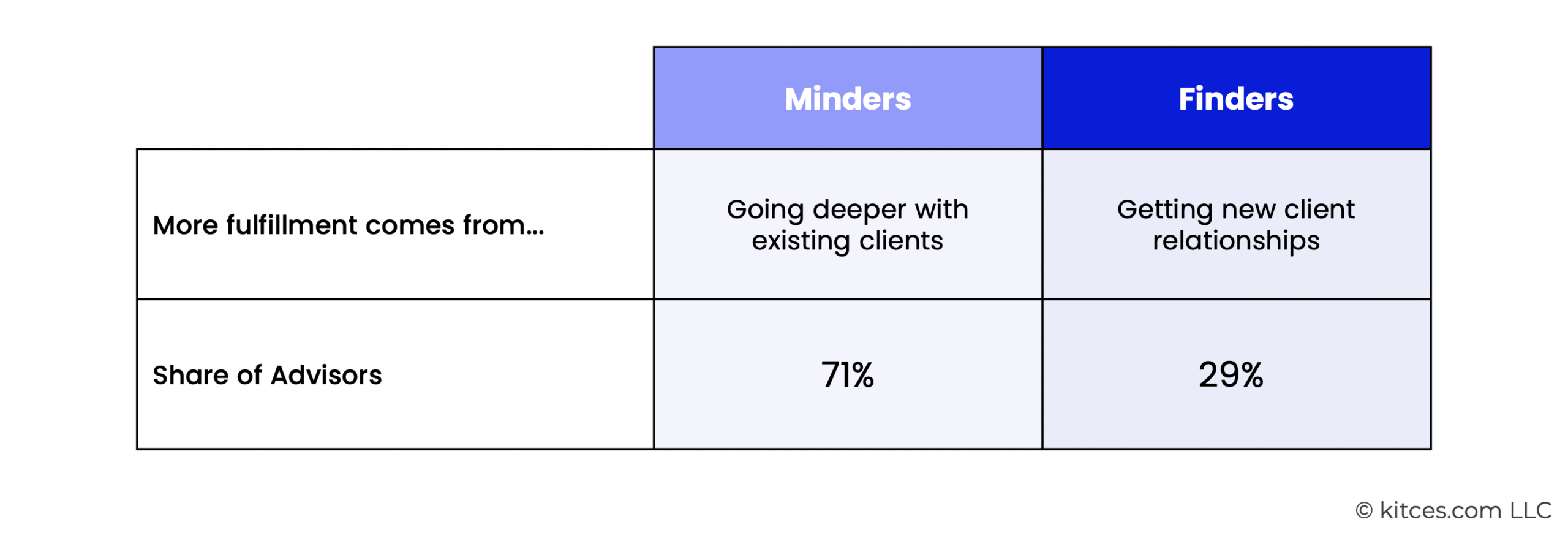
According to the latest Kitces Research on Advisor Wellbeing, the answer depends significantly on whether an advisor is a "minder", who prefers going deeper with existing clients, or a "finder", who enjoys developing new client relationships. Approximately 71% of advisors are minders, deriving greater satisfaction from financial planning, investment management, and meetings with existing clients, while the remaining 29% are finders who prefer marketing, prospect meetings, and growing their businesses. These preferences have important implications for the ideal number of clients: Minder wellbeing peaks at approximately 50–100 clients per advisor, then progressively declines as client counts increase. Finder wellbeing, by contrast, generally continues rising with client count, reaching its highest levels among advisors serving 200 or more clients.
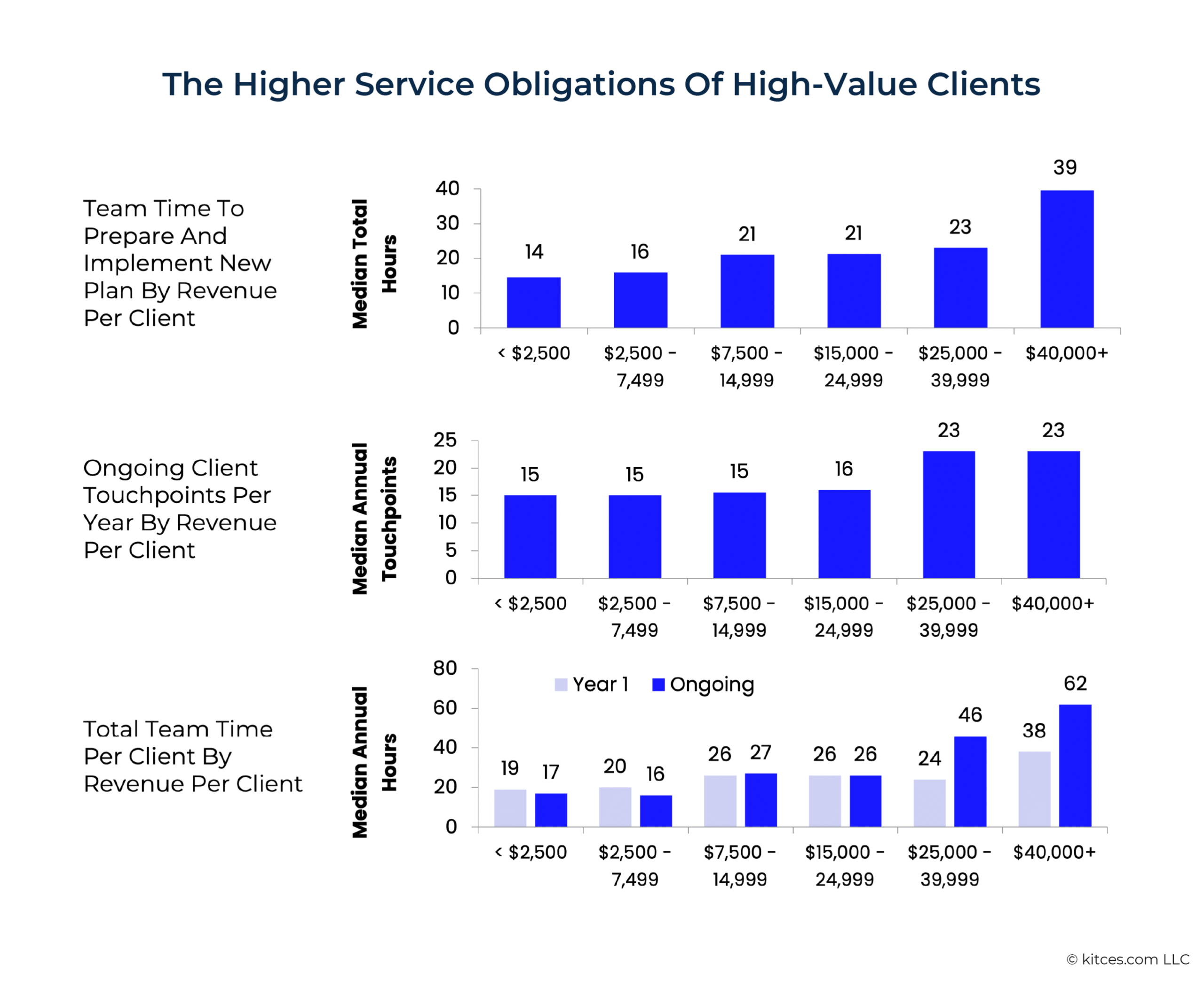
Beyond these preferences, the ideal number of clients depends on other factors like the complexity and affluence of the clients being served. More affluent clients typically require more extensive financial planning, with Kitces Research finding that ongoing annual service hours (collectively across all members of an advisory service team) increase from 17 for clients generating less than $2,500 in annual revenue to 62 for those generating $40,000 or more. Consequently, advisors serving higher-revenue clients tend to have smaller client bases, even as they generate substantially more revenue overall. For minders, serving affluent clients can be especially rewarding because it creates opportunities to engage in deeper, more complex planning work, though taking on too many such relationships can sharply reduce wellbeing. For finders, meanwhile, serving clients with less complex needs may actually be preferable, as the lighter servicing workload leaves more time for the business development activities they enjoy.
These differences suggest that minders and finders may benefit from fundamentally different growth strategies. For minders, one option is to stop actively pursuing growth once they've reached a satisfying client load, focusing instead on existing relationships while maintaining modest revenue growth through market appreciation and occasional referrals. Alternatively, minders who want to increase revenue can pursue an "averaging up" strategy, selectively adding higher-revenue clients while graduating less profitable relationships to other advisors. This allows them to increase revenue per client while potentially reducing their overall client count and spending more time on complex planning. Finders, by contrast, may be better suited to "sizing up" their practices by continually adding clients and expanding capacity through additional staff or operational efficiencies.
Ultimately, the key point is that continued growth in client count does not necessarily translate into greater advisor wellbeing, particularly once a practice has reached the capacity supported by its first one or two hires. While some advisors thrive on continually developing new relationships and expanding their businesses, others find greater satisfaction in serving a relatively stable group of clients more deeply. By recognizing whether they are primarily a minder or a finder, considering the complexity of the clients they serve, and choosing a growth strategy that aligns with their preferences, advisors can build practices that are not only financially successful but also personally fulfilling – allowing them to spend more time doing the work they enjoy most and, ultimately, better serve their clients!

The Expectation Of Continued Benefits From Continued Growth
As a brand-new advisor, there are few clearer markers of success than landing new clients. Each client coming on board is a testament to your growing ability to understand the concerns that led that person to seek out an advisor in the first place, offer solutions that address those concerns, and conduct yourself in a way that inspires someone to trust you with their life's savings. Each new client helps advisors grow from a startup to a profitable small business, perhaps eventually getting to a point where they can make their first support hire (usually a CSA, followed by an Associate Advisor). Thus the advisor's capacity expands, allowing them to delegate the administrative and servicing work that they least enjoy, and freeing up more time to meet with clients – often the very work they joined the profession to do (that also happens to be good for the business).
Because of the basic human inclination to assume that past trends will continue, many advisors naturally expect that as their client base grows, their wellbeing will continue to increase along with it. Eventually, though, some advisors find that what used to mark success – gaining new clients – steadily starts feeling more draining instead of fulfilling. Advisors may find their finite time and attention diverted away from the existing client relationships they're really invested in, instead distributed across an ever-larger pool of clients and service staff.
On the latter point, while at first expanding the team to include a CSA and possibly an Associate Advisor allows advisors to offload work they don't enjoy, if client count keeps rising and more advisor or support positions are needed, the advisor risks their time being increasingly eaten up by people-management responsibilities like running a hiring process, onboarding, training, delegation, engaging in growth discussions and performance reviews, and so on.
Over time, these responsibilities can steadily crowd out time for other work, including time spent on business development and growing the firm – ultimately making larger teams less productive in terms of the revenue they generate per advisor on the team (a process we've dubbed "The Management Tax"). In essence, the team that was originally built to offload work and better leverage the advisor can eventually grow to the point that it creates onerous management obligations of its own.
Beyond the financial considerations, though, for advisors that didn't enter the financial planning field with an entrepreneurial desire to grow a firm and manage people, client headcount can eventually impact how fulfilling these advisors find their work. More clients once meant more support to do more of the work they loved; now, it means spending more time on management responsibilities they didn't necessarily want, and less time on the client relationships they most valued.
Minders Vs Finders: Advisors' Preferences About Getting 'More' Clients Or 'Going Deeper' With Them
While many advisors love the entrepreneurial process of growing their firm, for others, growth (at least beyond a certain point) can come with the feeling of being pulled in too many directions – whether by a growing number of clients or by the staff required to serve them. As it turns out, advisors express diverging preferences about the kind of work they find most fulfilling. In our latest Kitces Research data on Advisor Wellbeing, we asked advisors to choose whether they prefer 'going deeper' with existing clients or going out to find new clients. (Of course, some advisors can and do enjoy both, but by forcing an expression of preference between them we sought to identify which represents the greater source of fulfillment.) About 70% of advisors – a clear majority – can be thought of as "minders" who prefer going deeper with existing clients, while 30% are "finders" who prefer developing new relationships to grow their business.
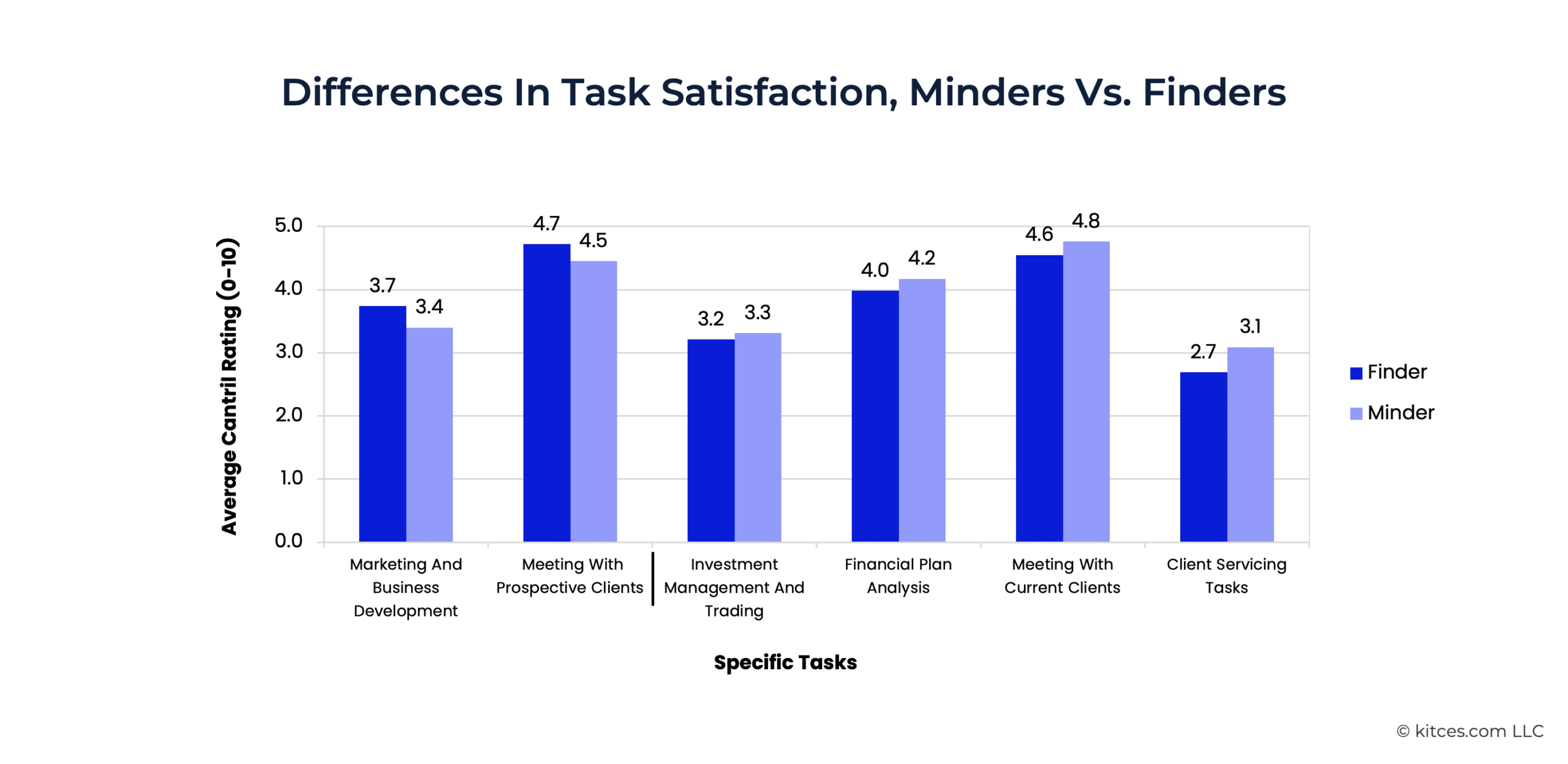
These differences in how minders and finders prefer to spend their time show up in the level of fulfillment they find in various business activities. The graphic below displays average satisfaction levels for each group on a scale ranging from 1 (very frustrating) to 5 (very satisfying). Finders find greater enjoyment than minders from working 'on' their business, such as by marketing for new clients and holding the resulting prospect meetings – with the latter being their single most highly-rated task. Minders, by contrast, find greater enjoyment than finders from working 'in' their business, such as by managing investments and conducting financial planning analyses for existing clients, as well as discussing that work with clients in meetings – with the latter being their single most highly-rated task. It's worth noting that the differences between these groups aren't necessarily substantial for any individual task; both tend to enjoy meetings (whether with prospective or existing clients) and are less enthusiastic about servicing tasks and spending time on investments. However, the consistency in the direction of these differences across tasks is notable: minders systematically derive relatively more enjoyment from activities that involve going 'deeper' with existing clients, while finders derive relatively more enjoyment from activities associated with finding new ones.
Ultimately, these differences between minders and finders also show up in the number of clients that maximizes advisors' wellbeing and, in turn, the strategies they should adopt to build their practices.

Nerd Note:
In this article and throughout Kitces Research, our metric of "number of clients" generally counts each client as a client household, unless an advisor truly serves individual members of the household separately (in which case they are counted separately). Clients include all unique ongoing and one-time relationships during calendar year 2025 and exclude pro bono and prospective clients.
The Ideal Number Of Clients For Minders And Finders
Most financial advisors are minders who derive the most enjoyment from going deeper with existing clients – which, given a finite number of hours in the day, runs directly up against the preference of finders to go out and acquire more of them. For this reason, then, the ideal number of clients for maximizing advisor wellbeing differs between these groups.
The graphic below displays levels of advisor wellbeing (measured via the Cantril Ladder, which asks respondents to rate their current wellbeing on a scale from 0 to 10) by the number of clients per advisor on advisors' service teams, both for our full sample of advisors and separately for minders and finders. For minders (and the overall sample, which consists primarily of them), wellbeing rises with client count up to a 'sweet spot' of 50–100 clients per advisor, after which it progressively falls as more clients are added.
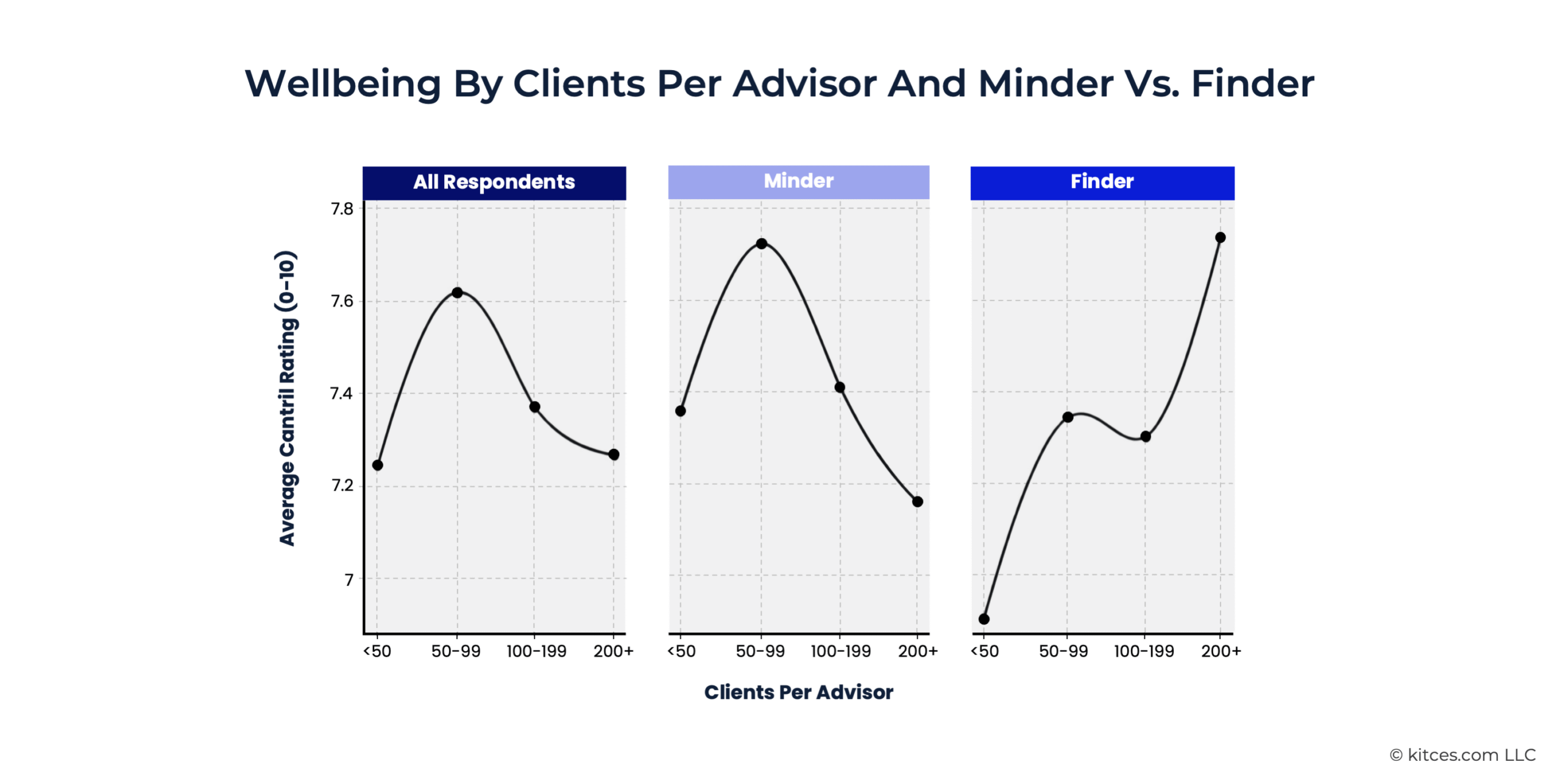
For finders, advisor wellbeing continues marching north as the number of clients they have increases.
Notably, both minders in their sweet spot (50–100 clients) and finders in theirs (200+ clients) report similar levels of wellbeing. This speaks to how there is no universal 'right' number of clients for maximizing wellbeing.
While both minders and finders can build fulfilling practices fine-tuned to their preferences about work, the wellbeing 'floor' is far lower for finders. The least happy cohort of any displayed in the graphic is finders with fewer than 50 clients – because they love getting new clients, but haven't gotten many yet!
So to start out, knowing whether you're a minder or a finder is a crucial factor in determining the ideal number of clients for maximizing personal wellbeing. However, the exact number of clients to target will ultimately vary from advisor to advisor based on a range of considerations, such as the level of planning complexity required (which itself is determined by the demographics of advisors' clientele and their target market), the extent of staff support (as even <50 fairly complex clients could be demanding without at least CSA support), and the level of operational efficiency (as this can reduce per-client work and increase the number of clients that can be supported at a given team size).
Giving an exhaustive account of every possible source of variation in the ideal number of clients is beyond the scope of this article. The key points are simply that, for the 70% of advisors who are 'minders', continued growth in client count generally stops corresponding with greater job satisfaction once they've filled out capacity with one or two support hires, and that (as discussed more below) minders and finders might benefit from pursuing different strategies for growth. However, one factor in particular is worth discussing at length as it relates to the ideal number of clients for each respective group: client affluence.
How Minder And Finder Wellbeing Differs By Client Affluence
The trend of minders preferring between 50–100 clients and finders preferring more varies somewhat with the affluence of a firm's clientele, for two related reasons. First, as client affluence increases, clients tend to have greater financial complexity – including intricate estate plans and multigenerational wealth-transfer strategies, tax optimization across diverse income streams, business succession planning, charitable giving structures, and concentrated stock positions – which requires much more advisor and staff time to address (and thus limits the number of clients a firm can serve with a given staff size). Second, more affluent clients have both the willingness and financial resources to pay higher fees for an advisor's help managing that financial complexity (and thus allow advisors to earn a comfortable income while serving fewer clients).
Regarding the first point, the graphic below shows several measures of total team workload by annual revenue per client, where the typical service team consists of 3 members, typically a Senior Advisor, Associate Advisor, and CSA. (While revenue is not a direct measure of affluence like income or net worth and is also shaped by factors like pricing models – e.g., advisors charging AUM fees generate higher revenue per client – broadly speaking, more affluent clients generate more annual revenue for advisors.) Comparing practices where the typical client generates <$2,500 annually (e.g., AUM fees on accounts below $250,000; short-term clients charged hourly or project-based fees) with those where the typical client generates $40,000+ (e.g., $5M+ AUM clients, accounting for discounted upper tiers of AUM fee schedules), total team hours required to prepare and implement a financial plan increase from 15 to 40, total hours spent during the first year of the relationship rise from 19 to 38, total hours during ongoing years rise from 17 to 62, and annual client touchpoints increase from 15 to 23. While the relationship between revenue per client and workload isn't perfectly linear (with relatively little difference between clients generating $7,500 and $25,000 annually, for instance), the key point is that client complexity – which generally increases with affluence – is an important factor in determining the 'right' number of clients for an advisor to serve.
Because of these growing service obligations, advisors and their staff don't have time to serve as many clients, which is why client counts decline as advisors move upmarket. As shown in the graphic below, client counts fall from 130 for advisors serving clients who generate less than $2,500 per year, to 40 for those serving clients who generate $40,000 or more!
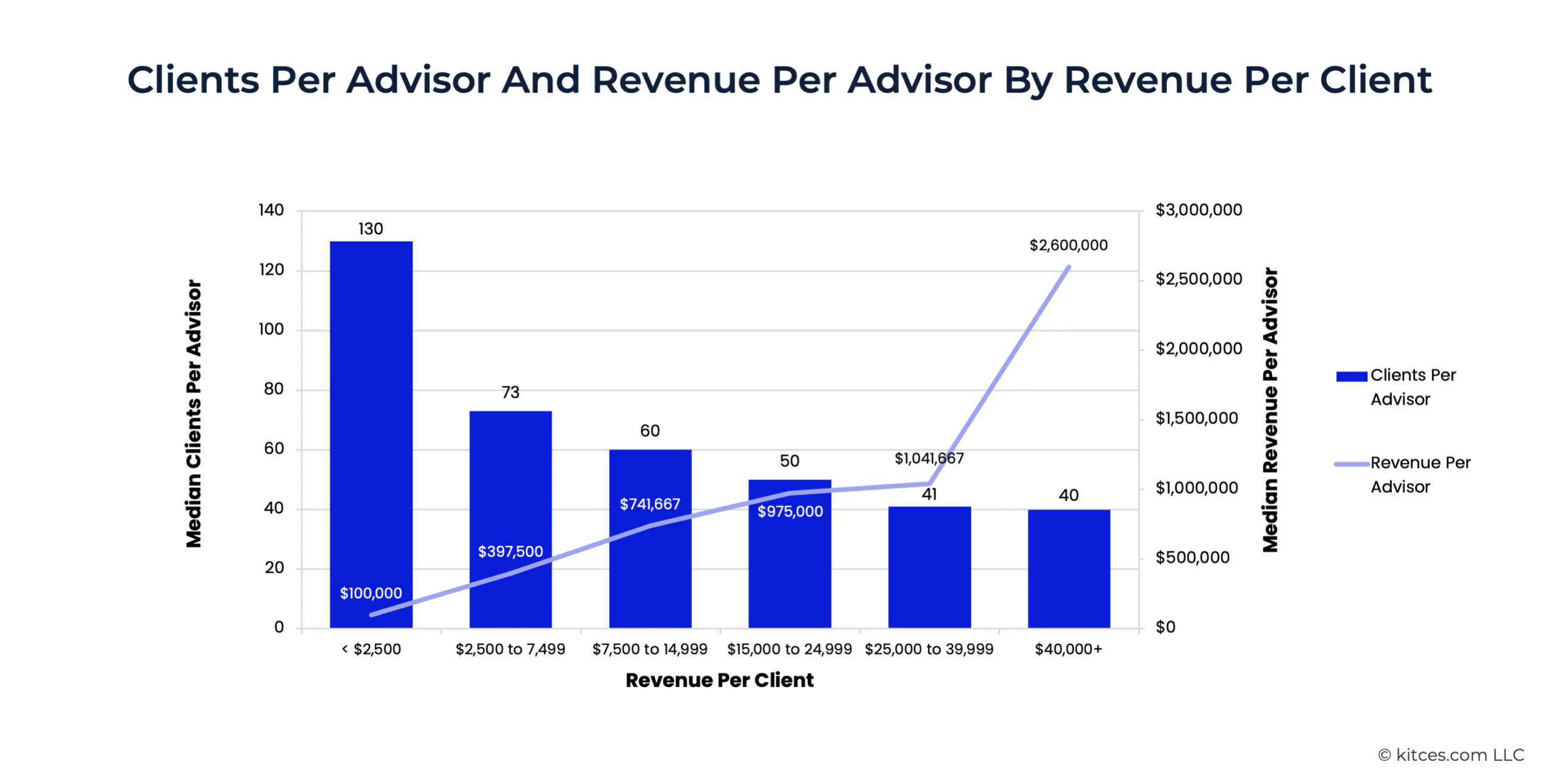
Even as client count goes down, though, the increased revenue per client corresponds with greater overall revenue, as shown in the secondary axis for the above figure, with annual revenue per advisor rising from $100,000 to $2,600,000.
This all comes together when looking at how the relationship between number of clients and advisor wellbeing (as measured again with the Cantril Ladder from 0 to 10) varies among minders and finders based on client affluence. The graphic below displays advisor wellbeing among the 'finder' and 'minder' groups segmented based on whether annual revenue per client falls above or below the overall sample median of just over $5,800.
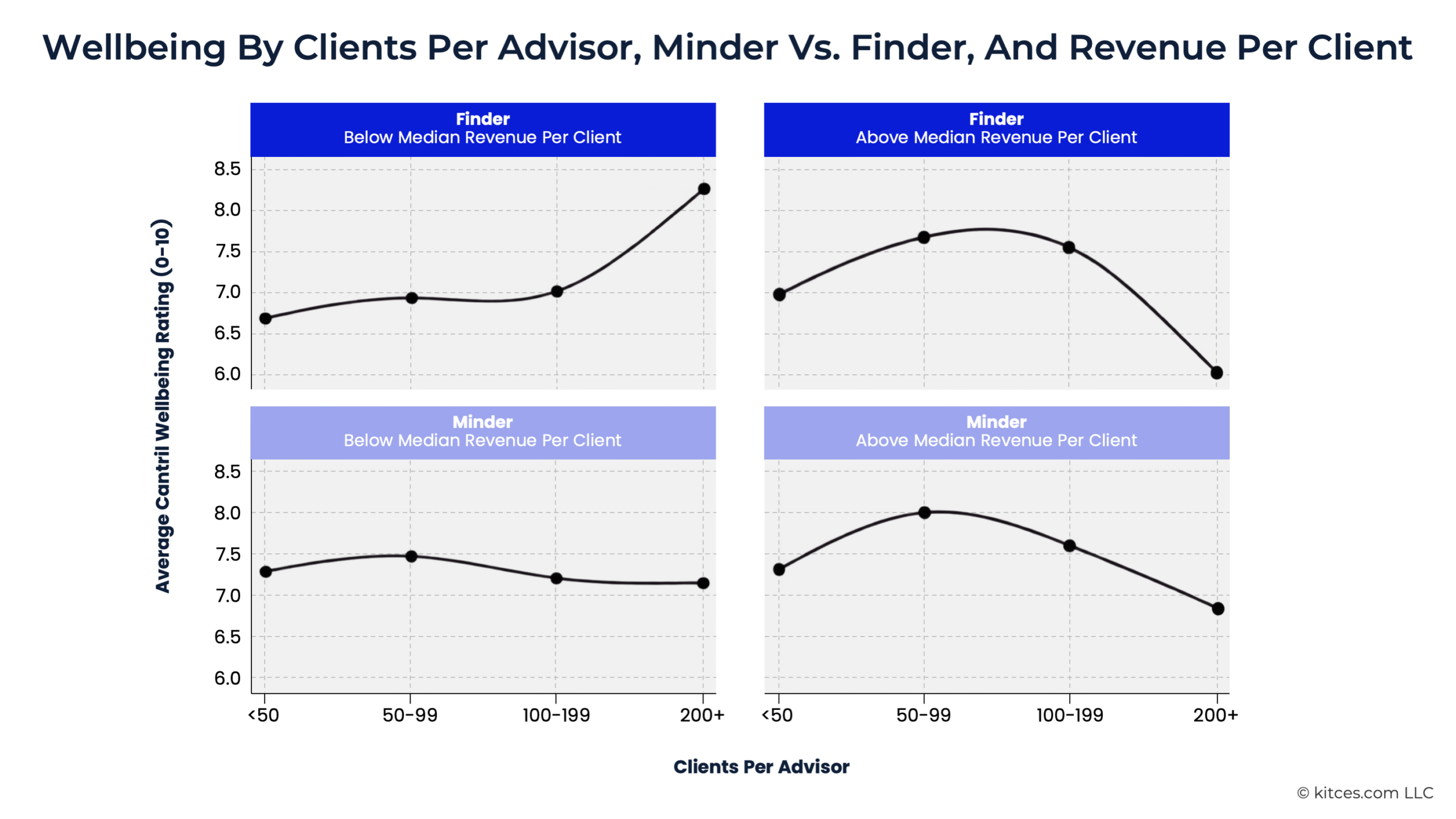
Among minders, while wellbeing peaks in the 50–100 client range for advisors both above and below our sample median for typical revenue per client, there is more variability at both the high and low ends among those serving more affluent (higher-revenue) clientele. That is to say, minders with revenue per client above $5,800 have higher wellbeing within the 50–100 client 'sweet spot' both because they're generating more revenue from those clients and because they enjoy going deeper with them by engaging in more complex planning work. However, as client count rises, wellbeing drops more sharply among this group because not only is their attention being diffused across a larger number of relationships (as with the lower-revenue-per-client group) which is less fulfilling for minders, but there is also more work involved in serving each relationship. For this group, the frustration may come either from wanting to dedicate more time to each client but being unable to do so, or from actually dedicating that time but finding that serving so many complex client relationships requires increasingly long hours, ultimately leading to burnout.
Among finders, the positive relationship between client count and wellbeing identified earlier only appears among those serving clients who typically generate less than $5,800, because the more clients these individual advisors serve, the less time they can dedicate to each one while still meeting their obligations to all their other clients. So when client affluence rises and clients have more complex planning needs that must be addressed, those needs can pull advisors away from working "on" the business and toward working "in" the business to an extent that hurts their wellbeing. But when revenue per client remains lower, there is less planning work required to serve existing clients, leaving advisors freer to pursue attracting new ones.
The broader takeaway is that while conventional industry wisdom often encourages advisors to move upmarket, charge higher fees, and deliver more comprehensive financial planning, serving more affluent clients with increasingly complex needs isn't necessarily better for advisor wellbeing. For minders, the challenge is recognizing when they've reached their capacity to serve clients at their desired level of depth, and either slowing growth or expanding their team to accommodate more clients without burning out. For finders, it may mean intentionally limiting the scope of their planning services – even if that means charging less per client – so they can continue dedicating more of their time to the business development activities they find most fulfilling.
Are You A Minder Or A Finder?
Given that minders and finders have sharp differences in the number of clients that maximizes their personal wellbeing, the first step to optimizing your client load is simply knowing whether you're a minder or a finder in the first place.
While most advisors will have a sense of whether they find more fulfillment in the entrepreneurial push to increase client headcount and grow the firm or in going deeper in their planning work with clients, the answer for others may not always be obvious. One tool that may help is to rate each of the following six business activities on a scale of 1 (very frustrating) to 5 (very satisfying).
- Marketing and business development (e.g., giving seminars, cold-calling or door-knocking, engaging in cold outreach campaigns, hosting client appreciation events, etc.)
- Meeting with prospective clients (e.g., discovery, data gathering, closing the 'sale')
- Investment management (e.g., conducting investment manager due diligence, portfolio rebalancing, communicating with clients about market developments)
- Financial planning analysis (e.g., constructing a long-term financial plan, implementing a tax-efficient retirement drawdown strategy, engaging in tax optimization)
- Meeting with current clients (e.g., client education, reviewing and communicating portfolio performance, fielding client questions in real time)
- Client servicing tasks (e.g., money movements and account re-positioning, liaising with custodians and third-party vendors on clients' behalf)
Then compare your results with those typical among minders and finders discussed earlier. If your highest marks are for activities related to marketing and meeting with the resulting prospects, you're likely to be a finder. If they are for the various service tasks for your existing clients and discussing their planning needs with them during client meetings, you're likely to be a minder.
Scaling Your Practice As A Minder Vs A Finder
Once advisors know whether they are a minder or finder and their corresponding ideal number of clients, they need to make decisions about if and how they will grow or scale their firm in service of that goal.
The question of 'if' they will seek to do this is particularly important for minders, many of whom are happy with their existing practice and clients and eager to give up business development responsibilities altogether. Out of our list of 13 business activities, minders rate marketing and business development near the bottom of the list, ahead of only the administrative and client servicing tasks typically delegated away at the first opportunity, as well as compliance.
Kitces research consistently identifies about 15% of advisory firms as "mature" practices that are no longer seeking further growth (though they may still accept the occasional referral). Rather than "mature" representing a euphemism for a stagnant or declining practice, these advisors appear quite satisfied with their current state: among the many cohorts of advisors examined in our research on advisor wellbeing, those at mature practices consistently rank among the happiest in personal wellbeing because they spend their time working 'in' the business they enjoy most. In other words, one possibility for minders happy with their current set of clients is simply to take their foot off the business development 'gas' and focus on servicing their existing book of clients, while still averaging modest revenue growth from market appreciation and by replacing occasional departing clients with inbound referrals.
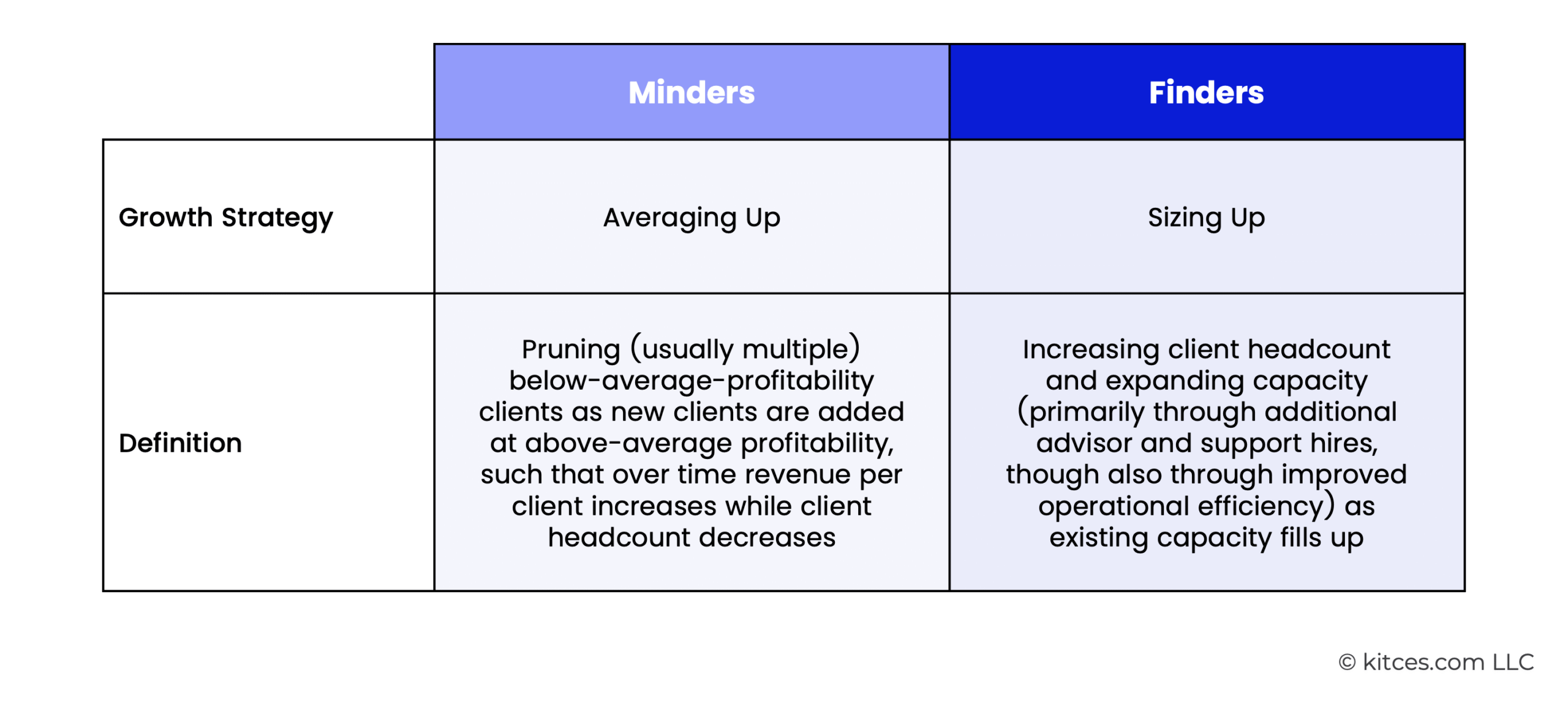
However, just because minders are less happy after surpassing 100 clients doesn't mean they can't work 'on' their business and actively try to grow revenue if they choose (or if their employers demand it). It simply means the strategy by which they do so need not be geared toward increasing client headcount. Specifically, minders may derive more enjoyment from 'averaging up' their practice, while finders pursue a more traditional path of 'sizing up' their practice.
Averaging up refers to taking on only new clients who rank above average in terms of profitability, while 'graduating' clients that do not meet that criteria (e.g., by referring them to other advisors) – such that ultimately advisors move upmarket at their existing level of capacity (rather than expanding it). The catch is that because more profitable clients tend to be more affluent and thus have greater financial complexity, requiring more work from advisors and their teams to address, averaging up often means that each new client taken on requires graduating multiple existing clients, such that client count steadily decreases as revenue per client increases (which is consistent with Kitces Research findings described earlier that higher per-client fees and planning workloads correspond with lower client headcounts). The benefit for minders in averaging up to a smaller number of clients with greater financial complexity (and correspondingly higher planning fees) is that it can satisfy their desire to go 'deeper' with their clients by addressing a wider range of more complex planning challenges. Doing so, however, can cut against the investment they may already have made into longstanding relationships they value and may not want to give up.
Sizing up, by contrast, refers to what most commonly comes to mind when thinking of growth: continuing to add new clients and revenue while expanding capacity as existing capacity fills up – which is primarily done by increasing advisor and support staff headcount, but can also be done by enhancing operational efficiency (e.g., by using a TAMP or improving their technology – though in practice we find little evidence that most advisors seeking to boost efficiency through leveraging technology are successful in these efforts).
For advisors who enjoy aspects of both finding and minding (or those whose employer constrains their ability to niche into primarily one or the other), there may still be ways to maximize wellbeing. For example, an advisor could partner with another advisor in the same practice whose skill set and interests 'lean' more heavily into one characterization than the other, with the goal of building a complementary relationship. Perhaps one advisor is primarily focused on sourcing new clients, while the other provides exemplary service that keeps existing clients happy. The key to this model is ensuring that compensation incentives for each advisor are aligned with their value proposition and role on the team.
As advisors grow from running a scrappy startup to a successful small business, adding new clients generally corresponds with their jobs becoming more personally and financially rewarding. Once advisors fill their existing capacity after their first 1–2 support hires, however, whether additional clients (and the staff required to support them) continue to result in a more fulfilling career depends on advisors' individual preferences for going 'deeper' with existing clients, versus going out and getting new ones – as well as other factors, such as their level of operational efficiency and the affluence of their clientele. At this crossroads, understanding how the 'ideal' number of clients varies based on advisors' unique professional circumstances and preferences – and by extension, whether they should seek to grow by 'averaging up', 'sizing up', or simply no longer actively grow at all – can help them build the practice they find most enjoyable… which, in turn, best positions them to serve their clients!
Of course, not all advisors have the freedom to choose whether or how they grow their practice. While independent firm owners may have considerable flexibility to pursue growth strategies aligned with their personal preferences, employee advisors may face growth expectations set by firm leadership, particularly at larger firms where continued growth is a central business objective. For these advisors, understanding whether they are more of a finder or minder may be less about choosing a growth strategy and more about recognizing whether their current role aligns with the work they find most fulfilling. And for those who find that their employer's expectations are fundamentally at odds with their preferences, it may be worth considering whether a different role, firm, or even a move to independence would offer a better fit.