
Executive Summary
Many financial advisors reach a critical juncture in their growth known as the "capacity crossroads," when personal bandwidth becomes strained by increasing client demands. At this stage, advisors often need to begin determining what to delegate – and to whom. Administrative responsibilities are often the first to go, as these tasks are often repetitive in nature and usually less fulfilling for advisors (according to Kitces research). However, advisors looking to delegate administrative work may find themselves overwhelmed by too many choices, a phenomenon known as overchoice, where an abundance of options leads to decision paralysis. What may start as a simple intention to "get help with some admin work" can quickly spiral into hours of research, comparison, and uncertainty about what type of support is truly needed.
Hiring a fractional admin assistant offers an elegant solution for advisors who need help but aren't ready – or willing – to commit to a full-time employee. Fractional professionals can fill half-time or even quarter-time roles, bridging the gap between solo practice and a fully staffed firm. These roles are especially useful when the workload doesn't yet justify a 40-hour position or when advisors are experimenting with the delegation process. In addition to flexibility, experienced fractional assistants often require less onboarding time and can bring immediate structure, systems, and operational insight.
In this article, Sydney Squires, Senior Financial Planning Nerd, discusses how to evaluate various administrative assistant options, make an informed hiring decision, and onboard the assistant as smoothly as possible. Because not all administrative assistants are created equal, and success often depends on defining the scope of the role clearly. Advisors need to consider whether they want a strategic partner – someone capable of process design, workflow refinement, and judgment-driven tasks like calendar coordination – or an assistant focused on routine checklist-style tasks. Both roles are valuable, but identifying the dominant need helps narrow the candidate pool. A time audit or even a quick calendar review can help advisors determine what's consuming their time, what's most draining, and what logically groups together into a defined role. From there, advisors can distinguish between must-haves and nice-to-haves, setting the foundation for either a job posting or a targeted search among third-party providers.
Evaluating candidates effectively – whether through job boards or outsourcing platforms – means focusing on alignment of experience, work style, and availability. Advisors should be clear about expected hours, responsibilities, and whether there's potential for the role to grow. Interviews can help uncover a candidates' software familiarity, ability to handle sensitive information, and communication preferences. Once hired, onboarding goes most smoothly when centered on clear expectations, feedback mechanisms, and regular check-ins. While repetitive tasks may be handed off within weeks, more nuanced responsibilities may require a longer ramp-up period.
Ultimately, hiring a fractional assistant isn't just about reducing workload – it's about building capacity with intention. Advisors who successfully define, delegate, and onboard administrative help not only create more time for client-facing work and business development, but also lay the groundwork for smoother, more scalable operations. Over time, these assistants can become trusted partners, offering fresh insights and helping improve firm systems in ways that benefit both the advisor and their clients. With a clear plan and the right fit, even a few hours a week of support can lead to meaningful improvements in advisor wellbeing, firm efficiency, and long-term sustainability!

In my brief foray into homeownership, my husband and I threw ourselves into reworking our condo to make it feel like it was truly ours. We discussed our vision, shared images, and finally settled on an overall idea. Then we went to our local hardware store to review the hundreds of paint samples available to us – and immediately got into one of our most intense arguments to date. The 'simple' clarity of our vision suddenly felt very complex when we were staring down hundreds of potential choices. Just knowing we wanted something cool and blue opened up a dozen more questions and opinions we didn't even realize we had, including a debate about whether this blue was 'too blue'.
The situation was further exacerbated when I realized how many other areas there were that I hadn't considered prior to our hardware store visit – we hadn't bought furniture for the room yet, and I struggled to visualize how everything would come together. This was, in short, not my strong suit, which made it even harder to appreciate all the subtle differences between our choices… all while figuring out what those differences were in the first place!

The phenomenon we experienced is called "overchoice", which is the psychological phenomenon that occurs when people are presented with too many choices, which, in turn, decreases their ability to make a confident decision.
Overchoice can show up in many corners of building a financial planning firm, but one area where advisors may encounter it most frequently is in deciding what to outsource and to whom. One of the perks – and disadvantages – of living in this technological era is that there's an expert, outsourcing solution, or technology tool for virtually everything. Even when an advisor starts with a general idea of what they'd like to outsource – like administrative work – it can open an enormous rabbit hole of research.
The natural next step when faced with several options is (usually) to dig deeper. Surely, diving into the specifics of what's available will simplify things… or not. Sometimes, diving into the rabbit hole just raises more questions, which only creates more overwhelm. In fact, it can create a kind of Dunning-Kruger effect: where finding the right outsourcing solution sounds simple enough, but when the details emerge, the process quickly becomes overwhelming – and disheartening.
Why Firms Hire Fractional Employees
Let's back up a bit from finding an outsourced solution and consider this question first: What gets an advisory firm to this point in the first place?
By the time a firm has grown enough to considering outsourcing, many advisors have reached what's often referred to as "the capacity crossroads" – the stage at which the firm has gained enough clients and revenue that the advisor's own capacity becomes strained, forcing them to decide whether to hire full-time help or stay solo.
Outsourcing can play an important role in navigating this crossroads. Bringing on a contractor can be a way to hire 'early' relative to the firm's growth, to prolong the transitional crossroads period, or simply to test what it's like to manage a person as a business owner. Fractional employees can be especially effective when advisors face having 'half a job' – where the work that needs to be delegated doesn't yet justify a 40-hour work week, but still needs to come off the advisor's plate to keep the firm growing.
Alternatively, some advisors may not want to grow their firm to the point of needing full-time employees – now or ever. Yet they may still prefer not to handle every function themselves, whether to reduce client load, free up time for business development, or simply improving their day-to-day satisfaction.
One final perk of outsourcing help is the typically shorter ramp-up period for fractional employees. Depending on cash flow, a firm may only be able to afford a less experienced full-time employee, especially after factoring in salary and benefits.
On the other hand, hiring a more experienced assistant for fewer hours can shorten both the interview process and onboarding timeline. Experienced fractional professionals rarely need to give notice to free up client capacity, and their expertise can also mean sharper efficiency and valuable insight into operational improvements or pitfalls to avoid.
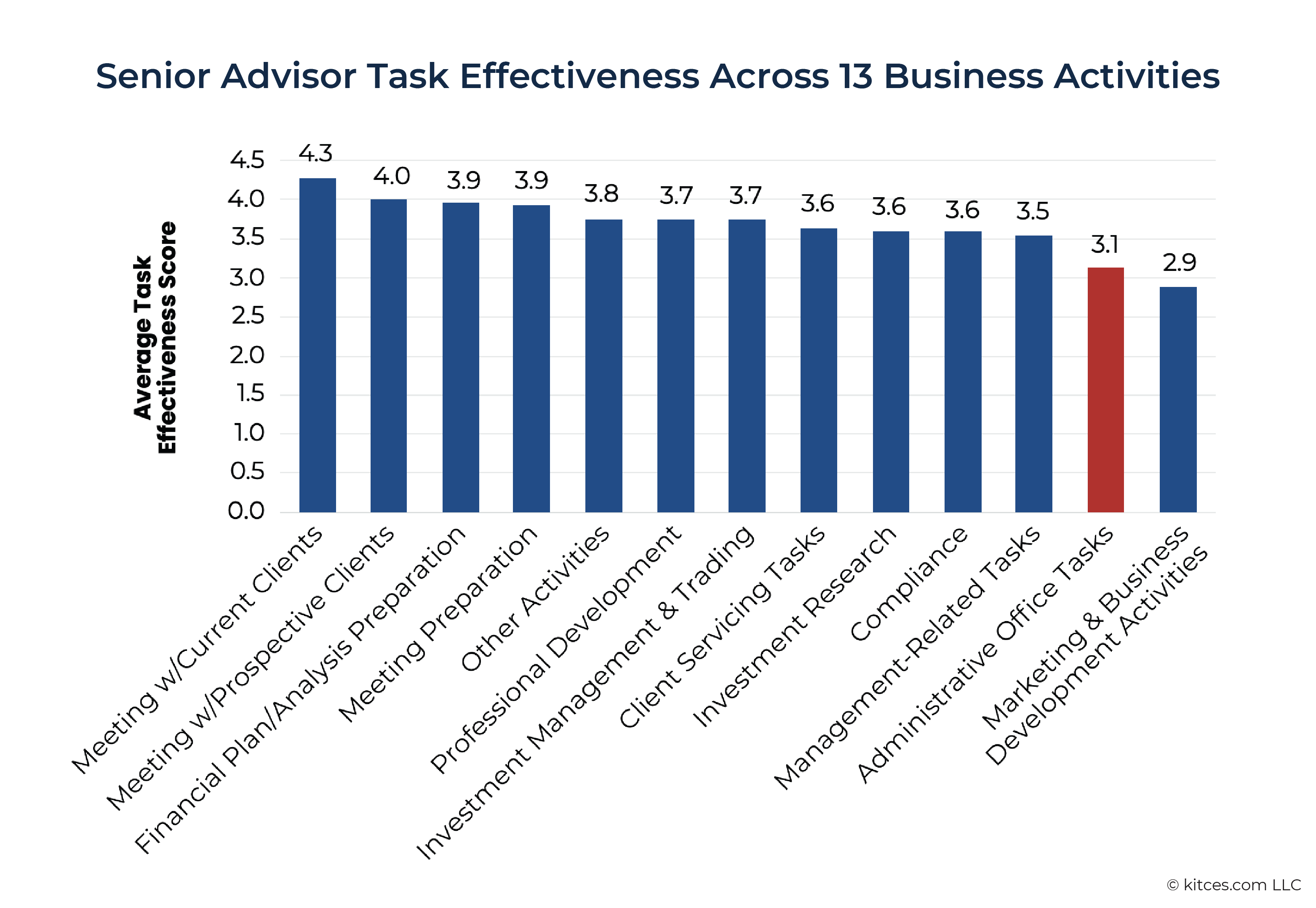
Kitces research on What Actually Contributes To Advisor Wellbeing demonstrates another element to consider: most advisors simply don't enjoy administrative work. When asked to rate their effectiveness across various tasks, administrative work ranked second lowest, at 3.1 out of 5. The only tasks that rated lower were marketing and business development activities (which scored 2.9).
Many parts of administrative work are important – they're foundational to keeping the business running. But just because they're important to the advisory firm doesn't mean they have to be done personally by the advisor. Returning to my house example above: while the homeowners may have been responsible for choosing the paint color paint and design vision, they certainly didn't have to be the ones to paint the walls (although they did; it took more time than they anticipated, and they regretted it… but that's another story).
In the long run, when weighing the cost of an advisor's time, it's not only less expensive to outsource administrative tasks, but can also free the advisor to focus on work that's more engaging and valuable to them.
Creating A More Refined Job Description For Administrative Assistants
As discussed earlier, one of the challenges in finding an administrative assistant is the sheer number of options. Highly trained generalist administrative and executive assistants can be found nearly everywhere, as can those with more specialized industry experience. Advisors can also consider whether they prefer to hire a firm – which may provide broader coverage and fewer 'closed' days – or an individual.
In general, the more experienced the individual and the more specialized their expertise, the higher their time will cost. And in financial planning, that premium can be worthwhile, given the profession's unique context and regulatory requirements, particularly around compliance.
However, determining which type of fractional administrative assistant to hire often comes down to more than just industry experience. To make the right choice, advisors need to shrink the field of eligible candidates by defining what they truly need.
One of the most important distinctions is whether the wants a thought partner who can engage in strategic work alongside them, or someone more focused on checklist-oriented work. Strategic partners tend to specialize in optimizing processes or supporting forwardl-looking decisions. Within a fractional administrative role, this often includes process documentation or workflow improvement, or managing nuanced, judgment-based tasks such as calendar coordination.
Checklist-oriented administrative work, by contrast, focuses on working through defined "to-do list" tasks efficiently and consistently with minimal discretion. Most roles aren't entirely one or the other, but identifying which side the role leans toward helps advisors find the right fit.
Determining What To Delegate
Given the wide variety of work that's done within a firm, it can be challenging to decide what to delegate. There are a few tasks that often get assigned to administrative assistants:
- Calendar management
- Email management
- Fielding incoming client calls and requests
- Selecting and sending client appreciation gifts
- Event registration and travel logistics
- Organizing and updating client files
- Sorting client inquiries and requests, including updating the CRM
- Documenting processes and procedures
- Inputting content into the firm's website or newsletter
- Scheduling social media or email campaigns
- Data entry
The easiest tasks to delegate are those that are high-frequency and repetitive – they can typically be explained once (or twice) before handoff. However, as the firm grows, it's important not to underestimate the value of a well-organized assistant who can create systems and structure. That kind of foundational organization can be key in creating an infrastructure that allows a client base to grow. And in the long term, this may even allow the advisor to prolong the time until they make their next hire, if they so choose!
Ideally, advisors can conduct a time audit to assess where their time is actually going each week. Barring time for that, reviewing one's calendar and checklist and writing out recurring tasks in a simple Word document can work just as well. The goal is to identify tasks that are either disruptive to the week or take up large blocks of time but still need to get done. Highlight the ones that are draining or overly laborious.
From there, it's helpful to apply two filters:
- What tasks organically fit together?
- Which are the most painful or energy-draining?
For example, if calendar management, email management, and reviewing prospect screening forms all drain time and energy, that grouping could define the scope of the assistant's role.
From there, the advisor can identify their "must-haves" – the non-negotiable tasks the assistant must be able to handle – and a few "nice-to-haves" that would be bonuses but aren't dealbreakers (especially if including them would increase the cost significantly).
With administrative assistants, there's a wide variety available and even limited support can make a meaningful difference. Hiring someone for just a few hours a week can still provide a valuable lift – and there's always someone who will appreciate and excel in those few hours of work!
Selecting A Fractional Admin Assistant
There are two main ways to find an administrative assistant: by posting a job listing or by researching providers directly through web (or AI) search. Creating a job listing will generally allow the advisor to specify the rate they are willing to pay and attract interested candidates who self-select into the opportunity. Searching the web, by contrast, often leads to more established assistants and service companies, which may appeal to those seeking a more 'white glove' experience – though typically at a higher cost.
Creating A Job Description
If the advisor chooses to post a job description on LinkedIn, Upwork, or Indeed, transparency is key. Include the core responsibilities, anticipated hours per week, and whether the role is anticipated to stay fractional or if it might grow into full-time work. Different candidates will be attracted to roles that have the possibility of becoming full-time (so only include it if reasonably confident that this may actually happen!).
Searching For And Evaluating Providers
For those opting to work with a third-party provider, several mainstream and specialized companies focus on administrative support for financial advisors, including those below and listed on the Advisor Services Map.
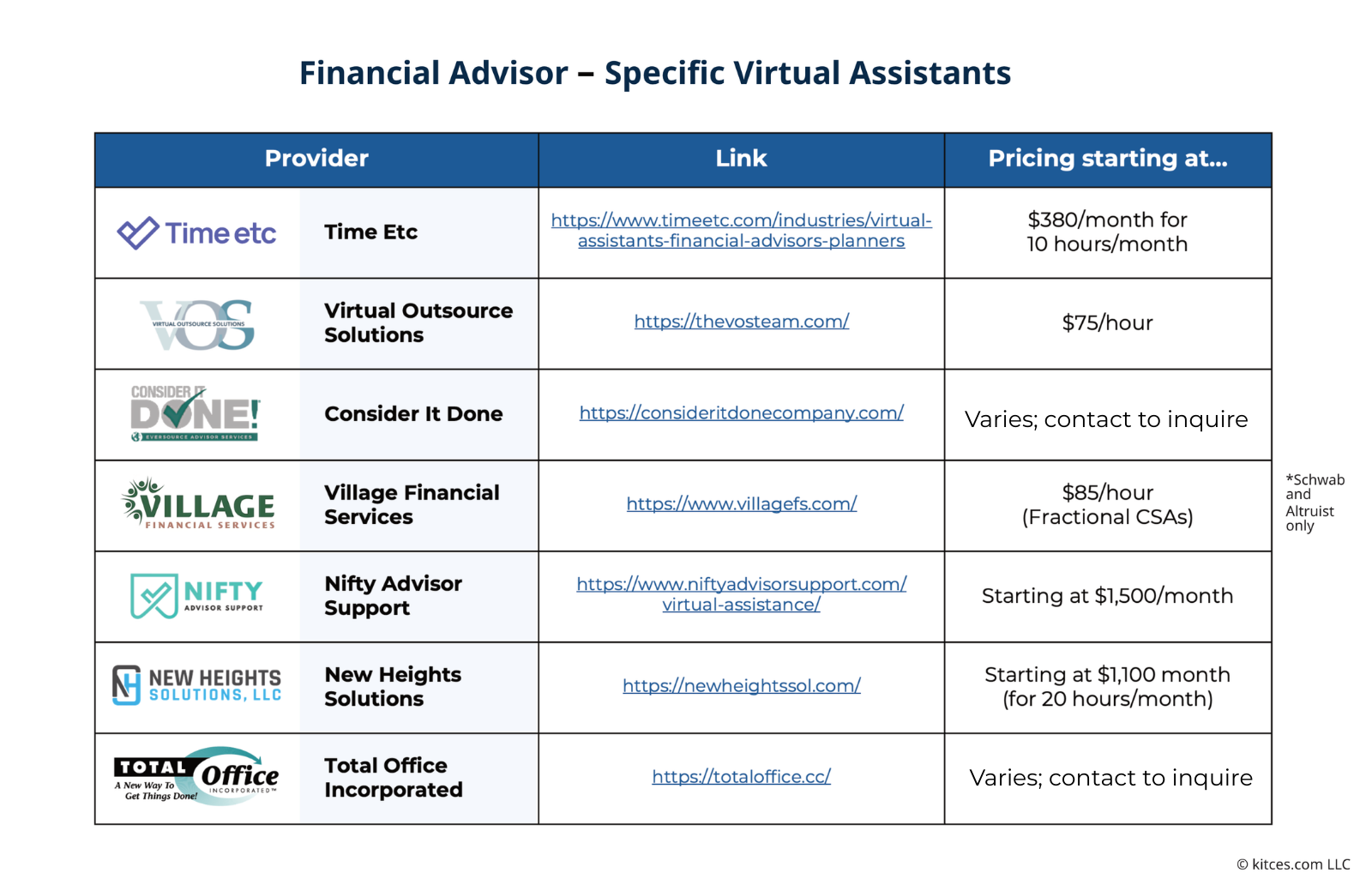
Because there are so many excellent providers in the space, tracking each provider's features against the firm's needs can make comparison much easier. A simple Excel sheet that can work well for this purpose, and can be set up with the following columns:
Columns 1–2: Company name and website.
Columns 3–5: Anticipated cost, billing rate, billing frequency.
Next Columns: Must-have and nice-to-haves features, individually listed.
Most company websites provide enough information to identify the services they actually provide. A quick "X" in the relevant columns is often sufficient, though brief comments can add useful context as well.
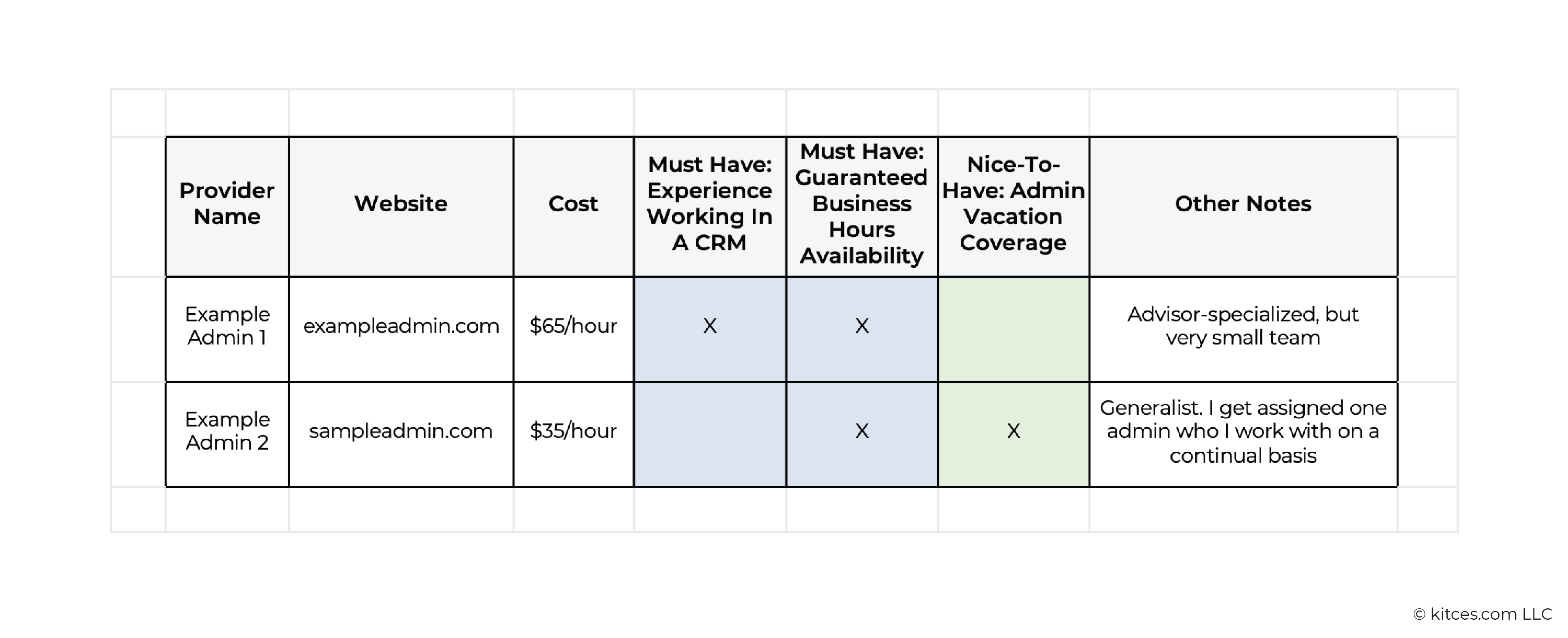
Doing this work can help to cut through marketing language on the website and quickly narrow the field down to a few viable finalists based on cost, fit, and service offerings. When in doubt, it may be worth following up with a provider to confirm specific features or clarify gray areas.
Screening Questions To Ask
Regardless of whether the advisor has decided to contact a provider themselves or create a job listing, having a phone interview with two or three providers can be helpful to get a better sense for what it would be like to work together. This doesn't have to be as strenuous as a full hiring process, but even a thirty-minute call can reveal plenty of information and help the advisor make a decision.
There are a few items that may be particularly helpful to discuss:
- Pricing and Billing. If the job was listed, start with affirming that they read the payment per hour and that the payment works for them.
- Work Experience. Assess the company size they tend to work and their industry background.
- If the person or provider specializes with advisors, this is a great time to investigate what software programs they are familiar with and what they've done within that software.
- If this is someone without prior experience with financial advisors, ask them about equivalent experience – have they had to teach themselves complex software before? Do they have experience working with clients or providing services? What is their experience working with small businesses?
- Availability and Hours. Review the anticipated workflow, scheduling expectations, and if there are certain business hours or busy periods when it's crucial for the assistant to be available. (Some fractional assistants may charge more to have 'guaranteed' hours, and some may require a guaranteed minimum number of hours a week.)
- Work Style and Collaboration. While this, to some degree, will vary based on the advisor's and administrative assistant's communication styles, discussing any specific work style needs and understanding preferences for collaborating with others is another area where it's important to find a fit.
Immediately after the interviews, it can be helpful to record not only the candidate's responses to the logistical questions, but also any impressions of the candidates' and firm's offerings. From there, advisors can narrow their choices down based on price, personality fit, and how well their experience maps onto the firm's needs – and ideally, send someone an offer quickly.
The Onboarding Process For An Administrative Assistant
As mentioned earlier, onboarding generally moves faster for a contractor than for a new employee. On their first day, it's helpful to give them a 'tour' of the software systems they'll use and clarify exactly what the advisor hopes they'll handle. Reviews of their work can often be done asynchronously, though the advisor may want to record themselves demonstrating trickier tasks for reference.
Within the first few weeks, aim to establish the following:
- Which tasks are most urgent for the administrative assistant to take on?
- How much can the assistant eventually handle independently, and what should be reviewed first? For example, the advisor may prefer that all external communication be queued in their inbox, or may allow some responses to go out without review.
- When the assistant gets blocked, what is the best way for them to contact the advisor?
- Which processes are flexible, and which must be done the same way every time?
- If calendar management is being delegated, this is an especially important area to clarify – particularly if the advisor is looking to reclaim time as the firm grows.
- How does the assistant prefer to receive feedback?
If the assistant is newer to the advisory space, it may be helpful to review compliance requirements at the firm, especially relative to client communication, privacy, and other firm procedures they'll regularly touch.
During the first weeks, keep short check-in calls on the calendar to discuss progress and answer any questions. The ideal frequency depends on the scope of work. For interpersonal high-touch work like calendar and email management, a biweekly standing meeting may be best. For less intensive work, a bimonthly or quarterly call may be enough (but reserving some time for regular touchpoints strengthens the relationship).
Short of complex work that takes longer to delegate, the advisor can expect their assistant to be operating confidently within repetitive tasks within four weeks. More nuanced tasks, such as calendar management or drafting up emails in the 'voice' of the firm, may take longer.
With contractors, clear is kind. Be quick to share what's working well and where there's room for improvement. For advisors new to delegating, it can be surprisingly difficult to articulate what's "good enough" beyond the instinctive "I'll know it when I see it" – but that's a difficult standard for contractors to meet.
If coming up with specific standards feels challenging, start by reviewing the previous week's work. Are there weekly schedules or emails that, in hindsight, didn't work well? Which ones felt particularly 'right', where things flowed well? Those examples can serve as a benchmark for discussion and ongoing feedback.
As the advisor and assistant work together, it's likely that tasks and procedures will continue to shift. Maybe a Monday morning check-in is less effective than Monday afternoon after the week's priorities are clearer). Maybe tasks anticipated to take five hours may only require three, which raises the question of delegating additional work, if any. Conversely, maybe a task that seemed simple might actually require more work and training than expected.
In short, while assistants may quickly gain confidence in routine tasks, it may take a few months for the advisor and assistant to refine systems and expectations fully – which is totally normal.
Monitoring For Ongoing Success
As the relationship progresses, it's important for the advisor to ensure that work is actually being delegated. Once the assistant has hit their stride with most of their recurring tasks – often around the four-month mark – schedule a check-in call to review how things are going.
Use that conversation to gauge how the assistant feels about their workload, if they need support in any additional areas, and if there are opportunities for further refinement. Ask whether they see inefficiencies in current processes or ways to improve client experience and automation. A fresh set of eyes can be a valuable asset, finding issues that might otherwise be overlooked by long-time team members and helping to improve systems for everyone.
Ultimately, the key point is that a fractional assistant can be a powerful way to delegate administrative work without taking on the cost and additional management that comes with a full-time employee. Getting clear on what can be delegated and beginning with a clear screening process can make a big difference in finding the right fit. And while the short-term benefit is immediate relief, the long-term payoff is even greater: the advisor gains a trusted partner who not only manages key tasks – but also finds opportunities to make the firm run more smoothly and sustainably!
Do you use a fractional admin assistant? Share your provider with us for consideration on our new Financial Advisor Services Map!