Executive Summary
One of the biggest challenges in scaling up an advisory firm beyond the founder is figuring out how to ensure that all the new and future team members of the firm will deliver advice consistent with the founder's approach. Historically, this has meant training advisors largely through osmosis; associate advisors were expected to be part of client meetings alongside the founder, to not just capture notes for CRM, compliance, and follow-up purposes, but to be present and absorb and learn by seeing and hearing (and eventually, supervised doing). Yet with the arrival of AI notetakers, many advisory firms have begun to question whether it's even a good use of time for team members to still be in client meetings when notetaking can occur automatically. While at the same time, the question arises: if team members aren't in client meetings, how else can they possibly learn the founder's approach and planning philosophy? (Unless they go separately to the founder with each and every planning question, which ironically can take even more of the founder's time!)
In this guest post, Jake Northrup, founder of Experience Your Wealth, shares how his 3-person advisory firm built their own custom AI assistant, not as a means to replace team members but a way to teach, train, and support their advisors and ensure advice is delivered more deeply and consistently to clients… while reducing how often the team comes to Jake as the founder for direct input.
Of course, the starting point for any AI-related initiative in an advisory firm – especially when it involves client-specific situations and therefore client data – is how to do so securely. Which Jake ultimately solved for by transitioning to a new CRM system (Slant) that has securely integrated Claude directly into its own client database. Additionally, with support from the firm's outsourced IT and Cybersecurity provider, CyberSecureRIA, Jake was able to set up a secure private cloud environment – dubbed "Rocky" – where the firm's IP can be uploaded and utilized safely (after trying a smaller-scope setup with a contractor on Upwork that failed!).
Once the client and firm data was secured in a safe environment, Jake shares how he utilized Claude to develop a "Standard Operating Procedure" (SOP) document that could be used to teach their AI-assistant Rocky how the firm handles any particular planning situation based on the AI-generated notes and transcripts of various internal firm and client meetings (already held safely in their Slant CRM or secure private server), along with other firm data.
Once trained, Rocky is now able to act like a thinking partner for the firm, allowing them to more consistently create the deep advice that Experience Your Wealth provides to its clients while reducing how often the team needs to come back to Jake for input. With the caveat that Rocky isn't expected to be (and isn't) perfect, and some issues will still need to be escalated for input from the founder. Which means that from the team perspective, the focus can shift from memorizing what the firm's standard approach is for certain client scenarios (since Rocky can quickly make those connections), to exercising judgment about when to trust Rocky's output, when to push back, and when to bring it to the founder for further (albeit still less frequent and time-saving) input.
An interesting side-effect of Jake's efforts is to find that 'just' consolidating the firm's information into their CRM system has been enough to apply Rocky as their own AI assistant "lens" through which client scenarios can be analyzed. In other words, it wasn't necessary for them to go through the complexity of creating their own "data warehouse" as some larger firms have done; instead, Jake's firm achieved their AI unlock by switching to a new CRM system (Slant) that was able to bring together all of their client relationship and meeting data (e.g., AI notes and transcripts) into one central CRM location.
Ultimately, the key point is that building an AI assistant tool, trained on your firm's individual data, is something that can be accomplished even in a solo advisor or small team environment, as long as some outside help is used for the initial technical setup. And doing so is arguably especially helpful for smaller/solo advisors, where training team members – who otherwise crave the founder's input and time – can create growth bottlenecks that an AI trained on the firm's planning approaches can help to solve. Which in the long run doesn't only help the firm to train and develop team faster, but also helps them more quickly go deeper with each client, supporting the firm's ability to continue to grow without needing to hire additional team as rapidly, thanks to the technology support!

I started using AI actively in early 2024. What I saw immediately was the power in pattern recognition, information retrieval, and the ability to take large amounts of unstructured material and make sense of it in seconds. I'd been trying for years to get the knowledge in my head out into something my team could actually use – workflows, how-to guides, training documents, SOPs, planning frameworks – and the result was always the same: messy, hard to maintain, and hard for the team to find what they needed when they needed it.
What I wanted was a ChatGPT specific to my firm, trained on how we think, compliant with our data security requirements, and available to my team as a thinking partner instead of a stranger summarizing the internet. It took me about 18 months and one failed build to actually get there. This article is the story of how I built that tool, named Rocky (shoutout Project Hail Mary!).
The Arc
In two prior Kitces articles covering years 1 to 3 and then years 3 to 5 of building Experience Your Wealth (EYW), I wrote about the structural side of building a firm – the team transitions, the niche tightening, the operational rebuilds, the growing pains of going from solo founder to multi-person firm. This is a different chapter; it's about infrastructure, not headcount.
As of this writing, EYW serves 78 clients with nearly $1 million of ongoing revenue and a three-person team. We're not trying to grow into a much bigger team – we're trying to build the firm into one that can do meaningfully more, better planning, deeper relationships, sharper judgment, and more thoughtful client work, without becoming a bigger team to do it. That's the thesis "Rocky" – our custom AI assistant for all EYW team members that helps us serve our financial planning clients – is built on: custom AI infrastructure as a way to scale a lean firm's capability without scaling its headcount.
Step 1: Why I Decided To Build Instead Of Buy
I'm not a technical founder, and I want to say that up front because I think it changes how to read everything that follows. I've adopted AI tools quickly, and I'd put myself above average on prompting, identifying use cases, and building AI into a workflow. But the underlying architecture – Azure tenants, vector databases, retrieval pipelines – is not my world, and it's not intended to be. If you're reading this thinking you could never build something like Rocky because you're not technical enough, I want you to know I had the same thought. I built it anyway, and here's how I got there.
It Started With Hiring, Not Planning
The first time I leaned on AI in any serious way at EYW was in early 2025, during a hiring process. I fed ChatGPT candidate transcripts, DISC assessments, case study responses, and our job description, and asked it to help me identify themes, mesh candidates against the role, and surface what I might be missing. It was excellent – not because it knew anything about financial planning hiring (it didn't), but because it was good at organizing the data I gave it. That was the first real lesson: AI is powerful when it's synthesizing data I provide, but it's unreliable when it's sourcing its own.
As a result, I deliberately didn't trust it with planning work yet. The sources felt too unknown, and when I ran anonymized planning scenarios through ChatGPT and Claude as tests, the outputs were inconsistent. Sometimes the technical answer was right, sometimes it wasn't. If a generic model couldn't reliably nail the 'science' of financial planning (it's remarkably terrible at identifying IRS contribution limits!), it certainly wasn't ready for the 'art.'
TaxBert Was The Proof Of Concept
The shift happened when our team started using TaxBert, an AI research assistant from TheTaxBook that's trained exclusively on TheTaxBook's content. We adopted an AI tool that was actually useful for tax research because the knowledge base was curated, controlled, and authoritative. I liked how TaxBert recognized when questions were outside of its scope, and how it curated answers – staying more factual versus hallucinating.
That experience led me to a reframe that ended up shaping everything that came next: the financial planning 'science' is widely shared, but the 'art' is uniquely ours. Tax research has a TaxBert because the underlying source material (IRS code, regulations, TheTaxBook itself) is public, established, and shared across the profession. The 'science' of financial planning is similar.
The 'art' of financial planning, on the other hand, is firm-specific. How we think about a client weighing whether to exercise ISOs in December versus January. How we frame the AMT spacing conversation. How we write a meeting recap so a client actually reads it. How we say "you have enough" without it sounding like we're telling them to stop dreaming. None of that lives in a public knowledge base - it lives in 7+ years of EYW-specific conversations, emails, planning approaches, and team training. No off-the-shelf tool was ever going to deliver that; the technology was good enough, but the data and voice wasn't ours.
My First Attempt To Build Rocky Failed
In mid-2025, I committed $7,500 to an Upwork developer to build a custom AI agent for EYW. I had a vision: a chatbot integrated into Microsoft Teams that could pull from both our internal documentation and our CRM (Wealthbox at the time), answer questions about firm policy and client history, and learn over time when it didn't know an answer. I had data to feed it, and I figured all I needed was someone who could code. It didn't work. Communication was poor. They didn't understand the financial advisory industry, which meant I was teaching them my world on my dime, slowly and badly. The timeline kept slipping. I eventually walked away with a partial refund and zero usable infrastructure.
The lesson wasn't "don't build." The lesson was that I'd underestimated who I needed to build it with.
Enter Jonathan
Jonathan is the founder of CyberSecureRIA – we've been working with his team for IT and cybersecurity for a few years and appreciated their focus on helping fee-only RIAs. Because client data and firm IP were involved in the Upwork build, Jonathan's team had a front-row seat to that failed engagement, in an oversight role. By the time I called the Upwork experiment, Jonathan already knew what I was trying to build, what wasn't working, and what compliance guardrails it needed. He understood my firm, he understood the industry-adjacent context, and he could translate between what I wanted Rocky to do and what the infrastructure needed to be.
We started over together, this time on LibreChat running on private Azure infrastructure that Jonathan's CyberSecureRIA team controlled and secured.
Most of the build-vs-buy debate in our industry misses the more important question. The question isn't whether to build, but who's going to build it with you. The infrastructure isn't the hard part – the translator between your firm's reality and the underlying technology is the hard part. If you don't have a Jonathan, someone who already understands your firm, your compliance environment, and your operational constraints, then buying off-the-shelf may be the right move. But if you do, or you're ready to really develop a relationship with a technical someone who does, the door to building something genuinely your own is wider open than you think.
Step 2: What Rocky Actually Is (And Isn't)
Rocky is a custom AI assistant, built on LibreChat and hosted on private Azure infrastructure that our IT partner controls. But what Rocky is, technically, is less interesting than what Rocky does – so let me start there.
Right now, Rocky and our CRM (Slant) are not yet directly integrated; that integration is in progress. The workflow today is manual but tight, and I want to describe it accurately because the manual version is actually instructive – it shows what the architecture is doing before automation hides it.
Here's what an Associate Financial Planner does when working through a financial planning question for an EYW client. They start in Slant by running a prompt in the CRM (using Slant's native AI functionality) against the specific data in the client's CRM record – meeting transcripts, planning notes, communication history, tax documents, the full client record – and then copy that full output and paste it into Rocky. From there, they ask Rocky to apply the EYW lens: our planning approach, our voice, our communication style, our preferred provisions, our nuanced positions on the topics we work on most. Rocky returns a draft answer that reflects how we would think about that client's specific situation. The Associate Financial Planner reviews the output, identifies anything that doesn't quite fit, and only if a judgment call is genuinely needed, escalates to me with a sharp, specific question – something like, "Here's what Rocky said. Here's why I think this client's situation might be different. What do you think?"
For example, let's say a client starts a new job, shares their open enrollment guide and asks our feedback for benefit elections. An associate would paste the open enrollment guide into Rocky and ask Rocky to summarize the key points. Rocky is trained on how we 'do' open enrollment – so it knows to look for things like health insurance plan comparisons, after-tax contributions in a 401(k), employer 401(k) match true-ups, disability, life insurance, etc. Our associate can then share context about the specific client that helps Rocky personalize recommendations (for example, if they have a strong preference against HSA plans), and Rocky can adjust recommendations accordingly.
After some back and forth prompting (because we never expect Rocky to be 'right' initially), our associate can then identify some recommendations for me to review (e.g., "let's choose this PPO health plan") and identify the areas that require more human judgment. For example, if the 401(k) plan permits after-tax contributions which would allow the client to make "Mega-Backdoor Roth Contributions" on top of their standard employee salary deferral, adding those contributions would significantly reduce the client's take-home pay, and we'd therefore need to update their cash flow in their financial plan accordingly. This is a good example of Rocky expediting our team's ability to maybe get 80% of the way to a full recommendation, while leaving the last (and usually most complex, client-specific, and often more valuable) 20% for human judgment.
Put more simply, Slant has the client history and context, Rocky has the EYW planning lens, the Associate Financial Planner holds the early judgment, and I – the lead planner – hold the final judgment.
The architecture I keep coming back to is that Slant is the subject, Rocky is the lens, and the team is the judgment. As our CRM, Slant knows the key information about each client – their history, their emotions around money, their equity comp situation, what we said in the last meeting, what their last email asked. Rocky knows how we think – our SOPs (Standard Operating Procedures), our planning frameworks, our client communication style, our preferred trust provisions, our approach to direct indexing thresholds, our stance on early ISO exercises. Slant and Rocky can hopefully get us to 80% on most planning questions, dramatically faster than we could before. But the team's job is to handle the genuinely hard 20%, and to know the difference.
Rocky is a thinking partner. He doesn't replace anyone on my team, and he is very explicitly not a replacement for advisor judgment. Every output Rocky produces gets human review before it ever reaches a client, because Rocky is only as good as what we've put into him – and we treat him accordingly.
What Actually Changed For Our Advisors With A Custom AI Assistant
The biggest shift, though, hasn't been speed (though the speed is real – eventually, I'd estimate Rocky will roughly cut turnaround time on client one-off planning questions in half, with more consistency on the answers themselves).
The deeper shift is what the team is being asked to do. Before Rocky, our team's job involved a lot of memory recall: what's our position on this, where did we land last time, how does Jake usually frame this conversation? Most planning questions had to either be remembered or escalated to me, and most got escalated. After Rocky, the recall layer largely goes away – the team can get to a draft answer in EYW's voice in a few minutes, because Rocky has memorized our approach.
The team's skill set shifts from, "Do you remember what we said?" to, "Is Rocky's answer right for this client, and if not, why?" That's a different cognitive job – harder, more judgment-driven, and more interesting. Using an AI tool like Rocky isn't de-skilling our team; he's upskilling them by removing the routine work and elevating the parts of the role that actually matter.
A few things worth being explicit about, though, because the AI conversation in our profession is full of conflated categories.
Rocky is not connected to the internet – he doesn't browse, he doesn't pull live data, and he doesn't search Google; he answers from the knowledge base we built (with our firm's data and frameworks, as explained further in the next section), and nothing else.
Rocky is not a generic AI search engine – ChatGPT and Claude can do things Rocky can't, like answer trivia or summarize a Wikipedia article, and that's not Rocky's job.
Rocky is not a chatbot bolted onto an existing tool – he's a purpose-built system, running on infrastructure we control and trained on data we own.
And finally, Rocky is not finished – the integration with Slant isn't live yet, the knowledge base is always being added to, and team adoption is still being built into our operating rhythm. We're early.
Step 3: How We Built The EYW Knowledge Base (To Teach Rocky)
This is the part of the build I expected to be the hardest, but it actually turned out to be the easiest. Rocky's knowledge base today is roughly 25+ structured documents, a mix of Word docs and a few PDFs from saved trainings, covering SOPs, communication guidelines, planning approach frameworks, client examples, team roles, and how-to guides for the planning topics we work on most. The total time to build the initial version of the knowledge base was only about 6 to 8 hours.
Not all of Rocky's knowledge base came from inside EYW. Some of the most valuable SOPs started with source materials from outside the firm, with EYW's specific approach layered on top.
The clearest example is our Financial Behavior Coaching SOP, which defines how we partner with our financial behavior specialist, Ashley Quamme of Beyond the Plan. Ashley provided four source documents: a service overview, a welcome letter, a "what to expect" guide, and a client self-assessment. None of it contained client data, so I could use the public version of Claude.
I uploaded the four documents and prompted Claude with what I was building - an SOP for how the EYW team identifies behavioral signals during meeting prep, refers clients to Ashley with the right language, and handles the most common forms of client resistance. I asked Claude to propose a Rocky-friendly structure and draft a first pass using Ashley's materials as the substantive backbone.
That draft got me about 70% of the way there. The remaining 30% was the part Rocky needed: the three-layer model defining what Rocky does versus what I do versus what Ashley does, the Rocky usage patterns showing exactly how the team prompts Rocky in specific scenarios, the escalation logic, and EYW's voice on framing principles.
The end result was a 20-page SOP that's been live in Rocky's knowledge base for several months, gets referenced by the team regularly, and that I'm sharing as a sample of what these documents look like in practice.
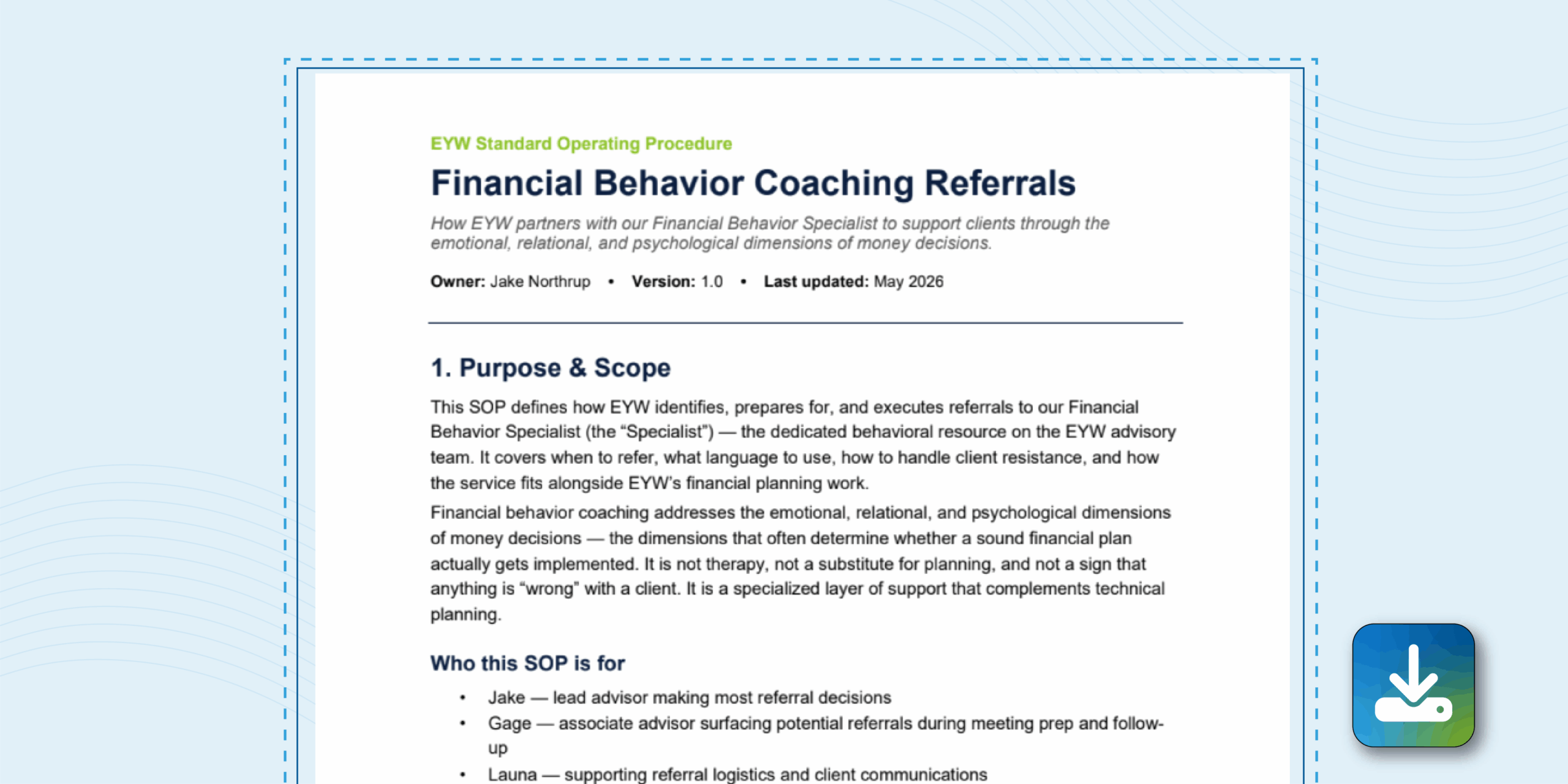
Click to download the EYW Financial Behavior Coaching Referrals SOP.
I Started Small And Tested Before I Scaled
The first thing I loaded into Rocky was a handful of basic documents: our EYW handbook, a few existing financial planning how-tos we'd already written down, and a batch of raw team training transcripts and client meeting transcripts.
I didn't try to build a full knowledge base out of the gate – I wanted to see if Rocky could do something useful with imperfect, lightly structured material before I committed real time to building polished SOPs. I uploaded a few of the non-client sensitive SOPs into Claude and had it draft some basic, intermediate and advanced testing questions that I could ask Rocky. For example, I first asked basic questions like "what's the company PTO policy" before moving to more advanced questions like "how do we determine life insurance needs analysis for a client". It turned out Rocky answered these very well, so I shifted the focus.
The Structured SOP Build
Once I knew Rocky was going to work, the next question was how to feed him better. I went back to Claude (the public version) and brainstormed: if I want Rocky to retrieve information well, what's the ideal structure of a written Standard Operating Procedure? (Because how better to ideate on the best uses of AI in our advisory firm, than to ask AI for its opinion!)
That conversation with Claude produced an SOP template – section headers Rocky could navigate, our planning approach written out explicitly, client situation examples included throughout, and our voice and philosophy embedded in the writing. Then I ran a test batch.
I picked five planning topics we work on a lot: what we do when a client leaves a job, how we approach IPO planning, our life insurance review process, and a couple of others. I built structured SOPs for each one using Slant's Claude integration, which lets me prompt Claude directly inside our CRM against 7+ years of EYW client emails, meeting notes, and planning conversations. I'd ask Claude to surface how we'd handled that situation in the past, refine the output across a few prompts, and shape it into an SOP using the output format that Claude had previously suggested would be best to train Rocky, that captured our voice, philosophy, and client examples.
Each SOP took 5 to 10 minutes to create, review, and adjust. I loaded those five into Rocky, tested it, and saw the quality improve significantly – which gave me the confidence to start building out the rest of the knowledge base.
What Surprised Me About The Slant Pull
Pulling 7+ years of client conversations through an AI showed me something I didn't expect: we had a more consistent planning approach than I would have predicted. The patterns were there, we just didn't have them documented right. Rocky's knowledge base, in that sense, is more of an organized excavation. The IP was already inside our firm, buried in old emails, transcripts, and meeting notes – we just hadn't been able to retrieve it.
If you've been operating for any meaningful length of time (and if you have an AI notetaker!), you almost certainly already have the raw material for a Rocky-equivalent. You just haven't pulled it out yet.
The Grain Transcripts: A Workaround Worth Describing
Not all of EYW's institutional knowledge lived in Slant. We also had 1+ year of internal team training transcripts captured in Grain (a separate AI notetaker that we use to capture our internal team meetings) – meetings where we'd worked through cases, debated planning approaches, and trained team members on how we think. It was very rich material, but because it wasn't tied to client meetings, it was not in our CRM.
I didn't want to paste those transcripts into the public version of Claude since they contained client information, and that's a hard line. Instead, I used the Claude integration inside Slant, which kept the work in our secured environment. I described what I was trying to do (turn these raw training transcripts into structured SOPs organized by topic), manually pasted the Grain transcripts in, and asked Claude to propose a structured list of SOPs we could derive from the raw data. From there, I refined, formatted, and added each one to Rocky's knowledge base.
The lesson generalizes: if you have rich firm knowledge sitting in messy, unstructured form (meeting recordings, training sessions, internal Slack threads), there's almost always a path to convert it into Rocky-ready material without compromising client data. You just have to be deliberate about where the AI work happens, and rely on vendors that have created secure environments where your private client data won't be shared beyond your internal AI walls.
What I Deliberately Left Out Of Rocky's Training
Just as important as what's in Rocky is what isn't. I made a deliberate choice to keep the knowledge base evergreen, which meant excluding things like company-specific facts ("Apple's 401(k) match is X"), client-specific facts ("this client has Y situation"), year-specific tax thresholds, contribution limits, or legislative details that change annually, and anything dependent on real-time data.
That information lives, and should live, in Slant. Rocky is the lens; Slant is the subject. The other reason for keeping things evergreen is maintainability – the reason most internal knowledge bases die is that they become obsolete faster than anyone can update them. By keeping Rocky's content principle-level and approach-level rather than fact-level, the knowledge base stays useful without requiring constant maintenance.
The Structure Of A Rocky Document
Concretely, here's what a typical Rocky SOP looks like:
- Header: what the document covers and when to use it.
- EYW's approach: our planning philosophy on this topic, written in our voice.
- Key considerations: the factors we weigh when working through this situation.
- Client examples: anonymized, illustrative scenarios showing how we've applied the approach in practice.
- Common pitfalls: what we've learned to watch for.
The headers matter because Rocky uses them to navigate the document during retrieval, so a well-structured SOP returns better answers than a wall of text. The client examples matter because they teach Rocky how the approach gets applied, not just what the approach is. And the voice matters because Rocky picks up the way we write from how the SOPs are written – so writing the SOP in our actual voice (rather than corporate-speak) is part of the work.
Again, though, we didn't actually have to write each of these in the first place. We leveraged all of our data through Slant's integration to Claude, and prompted Claude to create all these SOPs, using our historical meeting transcripts and other planning data that showed how we already handled them in the past. Which allowed Claude turn out existing data into these SOPs, and all we had to do was review each one to ensure it accurately reflected our approach and planning principles.
The Honest Takeaway
I assumed building Rocky's knowledge base would be the hardest part of this project, and it wasn't. The hardest part was the failed Upwork build, the architecture decisions, and the compliance setup – all of which Jonathan handled or guided (a great reminder that often it's easier to solve a complex problem by finding who can help than trying to figure out how to do it yourself!).
The knowledge base, the part that requires firm knowledge and judgment, and the part nobody else can do for you, turned out to be the most achievable, because it was driven by using AI to create an SOP template, and then using AI to populate each of the SOPs, by leveraging all of our existing client meeting data and other data already in Slant (and Grain). The six-to-eight-hour investment was the foundation that Rocky was built upon.
Step 4: What Rocky Does For The Team Today
Before I describe what Rocky does today, one quick note: we are pre-Rocky/Slant integration. Everything in this section reflects what Rocky enables right now, with Slant as a separate workflow that we manually bridge. The integrated version, coming in the next phase, will compress these workflows further – but the value is already real. Here's what Rocky is actually being used for, week to week.
The Three Primary Use Cases
The first use case is Rocky as the first place to go for firm and planning questions. Before Rocky, when a team member had a question – e.g., what's our approach to AMT spacing when staggering stock options exercises, what's our policy on rebalancing during a market drawdown, how do we handle the cash flow conversation with a client whose comp just doubled – the answer lived in one of three places: the EYW Playbook (slow to retrieve from the right section of our written training document), a previous meeting transcript (slower to search through numerous meetings across so many clients over the years), or my brain (fastest, but a bottleneck).
Now, Rocky is the first stop. The team can ask any firm or planning question and get an answer in our voice, pulling from our SOPs, frameworks, and 7+ years of how we've handled similar situations. It's a low-stakes, always-available thinking partner, and the "is this worth interrupting Jake for?" hesitation is mostly gone.
The second use case is drafting and auditing client communication, and this is where Rocky has changed our writing. The team can paste an existing email into Rocky and ask it to either draft an initial response based on a prompt, or audit an email already written for planning approach and firm voice. Think of it as Grammarly meets EYW's style guide. The result is faster outbound communication, more consistent voice across team members, and fewer rounds of internal review on emails that used to come back to me as founder for tone polish to train our team. Voice consistency at scale is one of the hardest problems for any firm trying to grow without losing what makes them themselves – and more than anything else, Rocky is a voice consistency engine.
The third use case is the one I underestimated: Rocky as an ad-hoc thinking partner during real planning work, pulling on firm resources to help us reason through a live client situation. Let me give you a real example.
One Workflow, Walked Through
A client received a new job offer at a Series A tech company with an equity-heavy package, and we were evaluating the comp, equity, and benefits. I started by pasting the full benefits package into Rocky and asking it to summarize, which was table stakes – Rocky did it in seconds. I then asked Rocky to help me think through what was negotiable: what questions should we be asking, what did the offer look like relative to firm-specific equity comp principles?
Rocky started wide. It pulled from Consider Your Options (Kaye Thomas's foundational equity comp book), webinars and resources from myStockOptions.com, and our own EYW equity comp SOPs – a blend of canonical industry knowledge and firm IP. The first pass was directionally useful but generic.
So I narrowed it. I told Rocky more about the company (funding stage, headcount, growth profile) and asked it to refine. Then I pasted in equity benchmarking data from Carta and asked it to identify what fair asks looked like given the company's stage and the client's role. Rocky came back with a tighter, more specific list of negotiation points tailored to the actual situation.
From there, I worked with the client on the asks, using Rocky's initial perspective to help fast-track my work. The client ultimately landed with a $20,000 higher base salary, 50,000 additional stock options, and the ability to early exercise options while QSBS-eligible – a combination that materially shifted both their cash flow and their long-term equity outcome.
Could I have done this without Rocky? Most likely. But not in the same time, and not with the same breadth of starting context. Rocky compressed what would have been a longer process of research and memory recall into a ~30-minute brainstorming session. The client got more thorough advice, faster, with no shortcut on quality.
What's Changed For The Team
I want to be honest here, because the easy version of this story is "Rocky made everyone faster and happier," and that's not quite right. The team has to take a few steps backward to take leaps forward.
When you suddenly hand a team this much information, this many resources, and this many capabilities at their fingertips, the initial response isn't seamless adoption – it's disorientation. There's a period of unlearning the old way of working (the memory-recall-driven version of the role) and re-learning what the role is now: less recall and more judgment, less escalation and more autonomy, less "what does Jake think" and more "what do I think, and is Rocky's answer right for this client." That's a meaningful skill shift, and it takes time. The team has to develop a new sense of when to trust Rocky, when to push back on Rocky, and when to bring something to me – and that instinct doesn't form in a week.
This is the honest version of the AI productivity story most firms aren't telling. The first 90 days of meaningful AI adoption inside a planning team look more like adjustment than acceleration; the acceleration comes after. We're still in the adjustment phase on some workflows and past it on others.
What I can already see is the trajectory: the team is becoming more self-reliant, less dependent on me as the founder for answers, and more tooled-up to do real planning work independently, escalating only when judgment is genuinely required. That trajectory is what Rocky is building toward – a more capable team next year, not just a faster team next week.
What's Changed For Me
Year-to-date, I'm spending about 28% of my time on CEO and creative work, marketing and business development, and prospects. In prior years, that number landed around 15%-20%. A 10-percentage-point shift in how a founder spends their time is significant.
But I want to be honest about what's actually driving it. That shift didn't happen because Rocky started saving me time. Most of it happened because of the broader rebuild of our team and operations over the past two years: better SOPs, a stronger team, sharper delegation, and more rigorous use of EOS. That work freed me up. And a meaningful chunk of the freed-up time has gone right back into building Rocky and migrating to Slant.
The honest reading of the YTD numbers is that the team improvements bought me time, and I used it to build the next layer of infrastructure. Rocky hasn't returned the time yet. The bet I'm making is that it will, and that the returns will compound.
There are already smaller wins. The team uses Rocky regularly for meeting prep, drafting client communications in our voice, and reasoning through planning questions they would have escalated to me a year ago. I use Rocky as a thinking partner during live planning work, the way I described earlier. These are real wins, but not yet the structural shift I expect Rocky to produce over the next year or two as the knowledge base deepens, the Slant integration goes live, and the team builds Rocky into their daily rhythm.
That's the actual ROI of building a tool like Rocky. Not the time saved on individual tasks, but the gradual reshaping of who does what inside the firm, and the founder time that gets freed up when the founder's knowledge, memory, and recall, stop being a bottleneck.
Step 5: Why Rocky Alone Isn't Enough – The Role Of Slant
Rocky knows how we think. What he doesn't know yet is the specifics of each client – their income, their spending, their cash flow, their equity grants, their estate plan, their last conversation, the home renovation that's stretching their savings rate, the fact that they want to be financially independent in their early 40s, the way they've evolved on risk tolerance over seven years of meetings. That's where Slant comes in as our CRM. Again, because these are separate systems with separate roles, it's not just a matter of building your own custom AI assistant for your firm; it's having the (right) CRM system to feed it the data Rocky needs to train and analyze.
Rocky Is The Lens. Slant Is The Subject (And Made It Possible).
If Rocky is the firm's voice, philosophy, and planning approach, then Slant is the entirety of the client. Slant holds the full CRM history (migrated over from Wealthbox when we transitioned earlier this year), every interaction, task, and note from the day a client signed on. It holds every meeting transcript since we started using an AI notetaker, migrated from Jump and now captured natively by Slant's built-in notetaker. And it holds the full financial planning record – income details, equity grants, estate plan parties, life insurance policies, tax-related events, ongoing planning topics – migrated over from MeisterTask, where we'd been forced to store this data because legacy advisor CRMs weren't built to hold it.
This is unique because, for most of the financial advisory industry's history, the CRM was just a system of record for key contact information – names, addresses, birthdays, last contact date. The actual substance of a client's financial life (their cash flow, their equity comp grants, their estate plan provisions, their tax projections) lived somewhere else: spreadsheets, project management tools, financial planning software, the advisor's head. That fragmentation is what made an integrated AI planning assistant impossible to build. Rocky could know our firm's voice, but there was no single place that held the full client picture for him to reference.
Slant has changed that for us. It's built from the ground up to hold the planning substance, not just the contact and relationship metadata. For the first time, the client's full financial life can sit in one place, with our firm's full voice and philosophy sitting alongside it in Rocky. That's what makes the integration finally possible.
In other words, while some larger advisor enterprises in the industry have been talking about building out their own data warehouses to manage all of their firm's data, we have found that it's sufficient to 'just' do this by housing all of our data within our CRM system. Once we found a CRM system that really could centralize all the data we wanted to bring together, and could make it available to/via Claude in a secure manner. (Which is what Slant does for us.)
What Integration Unlocks, Using A Story We've Already Told
Earlier in this article, I walked through how I used Rocky to help a client negotiate a job offer. Rocky helped me think through what was negotiable, what to ask for, what fair benchmarks looked like at the company's stage, and the client landed $20,000 in additional base, 50,000 more options, and an early exercise provision while QSBS-eligible.
What I didn't tell you is what Rocky couldn't do. Rocky didn't know the client's current income. He didn't know their spending, their savings rate, their cash reserves, the home renovation in progress, or the desire for early financial independence that was shaping every other financial decision they were making. He didn't know that they're more risk-tolerant on equity than the typical client at their income level, or that their last meeting had focused specifically on building tax flexibility before a possible exit event. I knew all of that – so I provided that context manually from a prompt within Slant.
Every time the team uses Rocky for a client question today, we are the bridge between Rocky's firm knowledge and Slant's client knowledge, by either adding more context about the client into the prompt we ask, or pushing an export of the client's data from Slant into Rocky one instance at a time. That bridge is manual, it's mental, and it's a real bottleneck on what Rocky can be. Once integrated, Rocky won't just know how we think about a job offer – he'll know how we'd think about this client's job offer, given their cash flow, their equity exposure, their goals, and their last seven years of planning conversations. That's the next step.
A Meaningful Caveat
Even with full integration, Slant doesn't replace human judgment. Slant has the full history of our discovery meetings, our ongoing values conversations, and our clients' evolving priorities – that data is there. But knowing what a client said in a meeting two years ago is not the same as knowing what they meant, or what's changed in their life since, or what subtle thing they're really telling us when they say "we're thinking about scaling back".
The Rocky/Slant integration will dramatically compress the path to first 80% of the client's planning context. It will surface the right facts, the right history, and the right firm-specific framing for any client situation, faster than any team could pull it together manually.
But the last 20% that actually moves a client's life forward – the judgment about what matters, the read on what's underneath what they're saying, the choice about what to push on and what to let breathe – is still ours. Still mine, the Associate Financial Planner's, and the client's, in conversation.
Once integrated with Slant, Rocky is going to make our firm faster, more consistent when we go deep, and more capable of doing real planning work at scale. It's not going to make us optional. The deeper the integration goes, the more clearly the irreplaceable part of advice work comes into focus – and that's the part we're building toward.
Step 6: What We've Learned, And What Comes Next
I'll close with the lesson I most want a reader to take away, and then a few honest reflections about where we are and where this is going.
The Lesson: Firm IP Is The Foundation
The AI is only as good as the knowledge base underneath it, and this is the part of the AI conversation I think most firms are getting backwards. The discourse focuses on the tools – which model, which platform, which AI notetaker, which integration – but the actual leverage is somewhere else.
The leverage is in your firm's IP: your planning approach, your voice, your client examples, your nuanced positions on the topics you work on every day, the thousands of small decisions, conversations, and frameworks that make your firm yours and not someone else's. If you want AI inside your firm guardrails (secure, compliant, on your own infrastructure), the AI itself is increasingly a commodity. The knowledge base isn't – the knowledge base is what you've built over years, and what nobody else can build for you.
Here's the accessible piece of good news: most firms already have more raw material about their financial planning views and frameworks, their approach and their voice, than they realize.
Almost every firm I talk to is using some version of an AI notetaker, and almost every firm has been quietly accumulating a structured archive of client conversations, planning discussions, and internal team meetings. That is the exact raw material a Rocky-equivalent needs to be built on top of. If you've been operating for any meaningful length of time and capturing meeting transcripts along the way, the foundation is already there – the IP is already yours. You just have to pull it out, structure it, and put it somewhere your AI can actually use it. That's not a six-month project; that's a weekend, if you've already done the underlying work of running a firm with a point of view.
What I Underestimated
The biggest thing I got wrong in building Rocky was underestimating how powerful this is going to be. I started this project thinking about reactive AI work – the team has a question and Rocky answers, the team has an email to write and Rocky helps, the team has a planning situation to think through and Rocky is a thinking partner. That's where most of our current Rocky use cases live, and it's already creating real leverage.
But reactive agentic work is the surface of what's possible. The deeper layer is proactive agentic work – AI that doesn't just respond to a query, but generates recommendations, surfaces opportunities, and prompts the team to act on things they hadn't yet thought to look at.
Imagine an agent that, every Monday morning, reviews each client's full Slant context, cross-references our firm's planning approach, and surfaces something like: "This client has a mortgage rate of 6.25%. The last time we explored this, rates were around 6%, but the break-even math on the closing costs didn't make sense. Now that rates are 5.75%, would you like me to draft an email for you to review to their mortgage broker asking for an updated refi analysis?"
That's the next phase, and we haven't built it yet. We've barely scratched the surface of what proactive agentic work inside a firm could be. I underestimated this part, but I'm catching up.
Where The Team Is
I've already talked in this article about the team's unlearn-and-relearn phase, so I won't dwell. The honest update is that we're still in it – the team is still learning when to trust Rocky, when to push back on Rocky, and when to escalate to me. That instinct is being built day by day.
We're earlier in this than the article might make it sound, and the leverage is real and growing, but it's compounding slowly, not arriving in a single moment.
What's Coming Next
The immediate next milestone is the Rocky/Slant integration. Once that's live, the team won't have to manually bridge between firm knowledge and client context for every question, and that alone will compress workflows that today still feel slow.
Beyond that, the direction is specialized agents – agents that own specific workflows like meeting prep, post-meeting follow-up, prospect research, and blog drafting. Each one would pull on Rocky's firm IP and Slant's client context, and each would be tuned to do one thing well.
Eventually, proactive agents that surface what the team should be paying attention to before anyone thinks to ask. We're maybe 20% of the way into what this is going to be.
A Closing Thought
If there's anything I'm certain about, it's that what we've built today is going to look different a year from now. The architecture will evolve, the models will change, the integrations we're building now will probably be replaced by better ones, and some of what I've written in this article will be out of date by the time you read it. That's the work, now.
The skill that will matter most for firm owners over the next decade isn't picking the right AI tool – it's the willingness to keep pivoting, adjusting, and staying open as the ground keeps moving. To build something, watch it become obsolete, and build the next version. To hold the firm's IP, voice, and judgment as the constants while everything around them changes.
The firms that do well in this next chapter will be the ones that stayed close enough to their clients, sharp enough about their own IP, and humble enough to keep moving. That's what Rocky has reinforced for me: the technology is a means, but the clarity about what only we can do, and the discipline to keep building toward it as the tools change underneath us, is what matters. I can't imagine going back. I also can't predict what comes next – and that's the part I'm most excited about.